complexity adaptive optical OFDM
systems for software-defined
transmission in elastic optical
networks
Ph.D. Thesis dissertation
By
Laia Nadal Reixats
Submitted to the Universitat Polit`ecnica de Catalunya (UPC)
in partial fulfillment of the requirements for the degree of
DOCTOR OF PHILOSOPHY
Barcelona, September 2014
Supervised by Dr. Michela Svaluto Moreolo
Tutor: Gabriel Junyent Giralt
Due to the increasing global IP traffic and the exponential growing demand for broad-band services, optical networks are experimenting significant changes. Advanced mod-ulation formats are being implemented at the Digital Signal Processing (DSP) level as key enablers for high data rate transmission. Whereas in the network layer, flexi Dense Wavelength-Division Multiplexing (DWDM) grids are being investigated in order to efficiently use the optical spectrum according to the traffic demand. Enabling these capabilities makes high data rate transmission more feasible. Hence, introducing flex-ibility in the system is one of the main goals of this thesis. Furthermore, minimizing the cost and enhancing the Spectral Efficiency (SE) of the system are two crucial issues to consider in the transceiver design.
This dissertation investigates the use of Optical Orthogonal Frequency Division Multiplexing (O-OFDM) based either on the Fast Fourier Transform (FFT) or the Fast Hartley Transform (FHT) and flexi-grid technology to allow high data rate transmission over the fiber. Different cost-effective solutions for Elastic Optical Networks (EON) are provided.
On the one hand, Direct Detection (DD) systems are investigated and proposed to cope with present and future traffic demand. After an introduction to the principles of OFDM and its application in optical systems, the main problems of such modulation is introduced. In particular, Peak-to-Average Power Ratio (PAPR) is presented as a limitation in OFDM systems, as well as clipping and quantization noise. Hence, PAPR reduction techniques are proposed to mitigate these impairments. Additionally, Low Complexity (LC) PAPR reduction techniques based on the FHT have also been presented with a simplified DSP.
On the other hand, loading schemes have also been introduced in the analyzed sys-tem to combat Chromatic Dispersion (CD) when transmitting over the optical link. Moreover, thanks to Bit Loading (BL) and Power Loading (PL), flexible and
the data rate to the current demand and the actual network conditions. Specifically, OFDM symbols are created by mapping the different subcarriers with different modula-tion formats according to the channel profile. Experimental validamodula-tion of the proposed flexible transceivers is also provided in this dissertation. The benefits of including loading capabilities in the design, such as enabling high data rate and software-defined transmission, are highlighted.
Degut al creixement del tr`afic IP i de la demanda de serveis de banda ampla, les xarxes `
optiques estan experimentant canvis significatius. Els formats avan¸cats de modulaci´o, implementats a nivell de processat del senyal digital, habiliten la transmissi´o a alta velocitat. Mentre que a la capa de xarxa, l’espectre `optic es dividit en ranures flexibles ocupant l’ample de banda necessari segons la demanda de tr`afic. La transmissi´o a alta velocitat ´es fa m´es tangible un cop habilitades totes aquestes funcionalitats. D’aquesta manera un dels principals objectius d’aquesta tesis es introduir flexibilitat al sistema. A dem´es, minimitzar el cost i maximitzar l’efici`encia espectral del sistema s´on tamb´e dos aspectes crucials a considerar en el disseny del transmissor i receptor.
Aquesta tesis investiga l’´us de la tecnologia Optical Orthogonal Frequency Division Multiplexing (OFDM) basada en la transformada de Fourier (FFT) i la de Hartley (FHT) per tal de dissenyar un sistema flexible i capa¸c de transmetre a alta velocitat a trav´es de la fibra `optica. Per tant, es proposen diferent solucions de baix cost v`alides per a utilitzar en xarxes `optiques el`astiques.
En primer lloc, s’investiguen i es proposen sistemes basats en detecci´o directa per tal de suportar la present i futura demanda. Despr´es d’una introducci´o dels principis d’ OFDM i la seva aplicaci´o als sistemes `optics, s’introdueixen alguns dels problemes d’aquesta modulaci´o. En particular, es presenten el Peak-to-Average Power Ratio (PAPR) i els sorolls de clipping i de quantizaci´o com a limitaci´o dels sistemes OFDM. S’analitzen t`ecniques de reducci´o de PAPR per tal de reduir l’impacte d’aquests im-pediments. Tamb´e es proposen t`ecniques de baixa complexitat per a reduir el PAPR basades en la FHT.
Finalment, s’utilitzen algoritmes d’assignaci´o de bits i de pot`encia, Bit Loading (BL) i Power Loading (PL), per tal de combatre la dispersi´o crom`atica quan es transmet pel canal `optic. Amb la implementaci´o dels algoritmes de BL i PL, es poden dissenyar transmissors i receptors flexibles adaptant la velocitat a la demanda del moment i a les
cada portadora amb un format de modulaci´o diferent segons el perfil del canal. El sistema ´es validat experimentalment mostrant les prestacions i els beneficis d’incloure flexibilitat per tal de facilitar la transmissi´o a alta velocitat i cobrir les necessitats de l’Internet del futur.
Debido al crecimiento del tr´afico IP y de la demanda de servicios de banda ancha, las redes ´opticas est´an experimentando cambios significativos. Los formatos avanzados de modulaci´on, implementados a nivel de procesado de la se˜nal digital, habilitan la transmisi´on a alta velocidad. Mientras que en la capa de red, el espectro ´optico se divide en ranuras flexibles ocupando el ancho de banda necesario seg´un la demanda de tr´afico. La transmisi´on a alta velocidad es m´as tangible una vez habilitadas todas estas funcionalidades. De este modo uno de los principales objetivos de esta tesis es introducir flexibilidad en el sistema. Adem´as, minimizar el coste y maximizar la eficiencia espectral del sistema son tambi´en dos aspectos cruciales a considerar en el dise˜no del transmisor y receptor.
Esta tesis investiga el uso de la tecnologia Optical Orthogonal Frequency Division Multiplexing (OFDM) basada en la transformada de Fourier (FFT) y en la de Hartley (FHT) con tal de dise˜nar un sistema flexible y capaz de transmitir a alta velocidad a trav´es de la fibra ´optica. Por lo tanto, se proponen distintas soluciones de bajo coste v´alidas para utilizar en redes ´opticas el´asticas.
En primer lugar, se investigan y se proponen sistemas basados en detecci´on directa con tal de soportar la presente y futura demanda. Despu´es de una introducci´on de los principios de OFDM y su aplicaci´on en los sistemas ´opticos, se introduce el principal problema de ´esta modulaci´on. En particular se presentan el Peak-to-Average Power Ratio (PAPR) y los ruidos de clipping y cuantizaci´on como limitaciones de los sistemas OFDM. Se analizan t´ecnicas de reducci´on de PAPR con tal de reducir el impacto de estos impedimentos. Tambi´en se proponen t´ecnicas de baja complejidad para reducir el PAPR basadas en la FHT.
Finalmente, se utilizan algoritmos de asignaci´on de bits y potencia, Bit Loading (BL) y Power Loading (PL), con tal de combatir la dispersi´on crom´atica cuando se transmite por el canal ´optico. Con la implementaci´on de los algoritmos de BL y PL, se
del momento y a las actuales condiciones de la red. En particular, los s´ımbolos OFDM se crean mapeando cada portadora con un formato de modulaci´on distinto seg´un el perfil del canal. El sistema se valida experimentalmente mostrando las prestaciones y los beneficios de incluir flexibilidad con tal de facilitar la transmisi´on a alta velocidad y cubrir las necesidades de Internet del futuro.
M’imagino 4 anys enrere i encara no em faig a la idea de que ja hagi arribat aquest dia. El dia en que estic escrivint els agra¨ıments de la tesis. Semblava tan lluny i ja est`a aqu´ı. El que hagi passat tot tan despresa nom´es ´es una mostra dels bons anys y les bones experi`encies que he viscut fins arribar a aquest punt. ´Es per aix`o que voldria agrair a totes les persones que han estat al meu costat i han fet possible aquesta tesis.
Primer de tot vull agrair al CTTC i a tot el personal del centre el seu suport i l’ajuda que m’han oferit durant aquests anys, fent la meva estada al centre m´es c`omoda i especial.
Voldria tamb´e agrair a la Michela Svaluto Moreolo, Gabriel Junyent i al Josep Maria F`abrega per ajudar-me en tot moment. I tamb´e a tots els companys del grup d’`optica el Ra¨ul Mu˜noz, Ricard Vilalta, Ricardo Mart´ınez, Ram´on Casellas, Arturo Mayoral i Fco. Javier V´ılchez.
Quiero agradecer en especial a mi directora de tesis, Michela Svaluto Moreolo, su apoyo y paciencia durante estos a˜nos, sin ella no hubiese podido realizar esta tesis. Pero sobre todo gracias por preocuparte siempre por m´ı.
Agrair tamb´e als meus companys i amics del despatx 109 per fer la meva estada al centre millor. Gr`acies a: Pol Blasco per organitzar festes al terrat, Angelos Antonopou-los for your patience, Giuseppe Cocco to join the coffee team, Alessandro Acampora for your histories, Moises Espinosa por escucharnos, Vahid Joroughi for your kindness, Musbah Shaat for your advices, Jaime Ferragut per ajudar-nos a entendre millor el BOE, Ana Mar´ıa Galindo per animar-nos sempre i a Laura Mart´ın, Maria Gregori i Jessica Moysen per la vostra amistat i bon humor.
V´azquez por tu ayuda; i gr`acies a Anica Bukva, Kyriaki Niotaki, I˜naki Estella, Lazar Berbakov, Tatjana Predojev, Biljana Bojovic, Onur Tan, Konstantinos Ntontin, An-drea Bartoli, Daniel Sacristan i Javier Arribas .
Me gustar´ıa agradecer tambi´en a Miguel ´Angel Lagunas por hacer posible trabajar en el CTTC. Tambi´en a Ana I. P´erez por haberme guiado al acabar la carrera.
Agradecer al Ministerio de Economia y Competitividad (MINECO), por haber fi-nanciado esta investigaci´on.
Schließlich, Ich m¨ochte mich bei Jansen Sander Lars, Michael Eiselt, Helmut Grieβer, Annika Dochman and J¨org-Peter Elbers f¨ur Ihre Hilfe wenn ich in ADVA optical net-working w¨are bedanken.
Moltes gr`acies tamb´e a la meva fam´ılia per haver-me ajudat sempre. Sobretot gr`acies al meu pare, Julio Nadal, que s´e que li hagu´es fet molta il.lusi´o compartir aquest moment amb jo. Gr`acies a la meva mare, Marina Reixats i a la meva tieta, Pilar Nadal pel seu suport incondicional. Gr`acies tamb´e a Quimeta Fontelles, Casimiro Reixats, Maria Gramunt, i Sandra Nonell per haver estat al meu costat. Gr`acies a Pepita Fierro i Gaspar Murg´o per haver-me ajudat tant. Molt´ıssimes gr`acies a Miquel Murg´o per estar sempre amb mi, per animar-me en els mals moments i per la teva paci`encia, gr`acies per tot.
Moltes gr`acies a Joana Maria Frontera, Lled´o Esquerra i Laura Alan´ıs. Tot i que estigueu tan lluny de Barcelona sempre us tinc molt aprop.
Agrair tamb´e als meus amics i amigues Elisabet Bosch, Anna Fum`as, Lourdes Mons´o, Ione Verdeny, Adriana Pedrico, B´arbara Garc´ıa, Anna P´erez, Maria Cirera, Albert Parra, Pau Guri, Cristina Garc´ıa, Daniel P´erez, Jana Verdeny, Rebeca Escales, Gemma Rib´o, Llum Rey, Cl`audia Subarroca, Montse G´andara, Vanesa Veras, Jordi Ubach, Oriol Ubach, Miquel Armengol, Jordi Fum`as, Toni Tom`as i Joan Torrecillas.
List of publications associated with this thesis, divided into journals, international and national conferences and master thesis in inverse chronological order.
Journals
(J1) L. Nadal, M. Svaluto Moreolo, J.M. F`abrega, A. Dochhan, H. Grießer, M. Eiselt, J.-Peter Elbers, ”DMT Modulation with Adaptive Loading for High Bit Rate Transmission Over Directly Detected Optical Channels”, Journal of Lightwave Technology, vol.PP, no.99, pp.1,1, August, 2014.
(J2) L. Nadal, M. Svaluto Moreolo, J.M. F`abrega and G. Junyent, ”Low Complexity PAPR Reduction Techniques for Clipping and Quantization Noise Mitigation in Direct-Detection O-OFDM Systems”, Optical Fiber Technology (OFT), Volume 20, Issue 3, Pages 208-216, June, 2014.
(J3) M. Svaluto Moreolo, J.M. F`abrega, F. V´ılchez, L. Nadal and G. Junyent, ”Ex-perimental Demonstration of a Cost-Effective Bit Rate Variable IM/DD Optical OFDM with Reduced Guard Band”, Optics Express, n.20, pp.159-164, October, 2012.
International conferences
(C1) M. Svaluto Moreolo, J.M. F`abrega,L. Nadal, F.J. V´ılchez, ”Optical transceiver technologies for inter-data center connectivity [Invited]”,in Proceedings of Inter-national Conference on Transparent Optical Networks (ICTON), 6-10 July, 2014, Graz (Austria).
bers, ”Discrete Multitone Transmission for Next Generation 400G Data Center Inter-Connections [Invited]”, OECC/ACOFT, 6-10 Juli, 2014, Melbourne, (Aus-tralia).
(C3) A. Dochhan, H. Grießer, L. Nadal, M. Eiselt, M. Svaluto Moreolo, J.-Peter Elbers, ”Discrete Multitone Transmission in the Presence of Optical Noise, Chro-matic Dispersion and Narrow-band Optical Filtering”,ITG Fachtagung Sprachkom-munikation, 24-26 September, 2014, Erlangen (Germany).
(C4) M. Svaluto Moreolo, J. M. F`abrega, L. Nadal, F. J. V´ılchez, V. L´opez, and J. P. Fern´andez-Palacios, ”Cost-Effective Data Plane Solutions Based on OFDM Technology for Flexi-Grid Metro Networks Using Sliceable Bandwidth Variable Transponders”,in Proceedings of Optical Network Design and Modeling (ONDM), 19-22 May, 2014, Stockholm (Sweden).
(C5) A. Dochhan,L. Nadal, H. Griesser, M. Eiselt, M. Svaluto Moreolo, and J.-Peter Elbers, ”Experimental Investigation of Discrete Multitone Transmission in the Presence of Optical Noise and Chromatic Dispersion”, in Proceedings of Optical Fiber Communication (OFC), 9-13 March, 2014, San Francisco, California (USA).
(C6) M. Svaluto Moreolo, J. M. F`abrega, Fco. J. V´ılchez, L. Nadal, V. L´opez and G. Junyent, ”Experimental Validation of an Elastic Low-Complex OFDM-Based BVT for Flexi-Grid Metro Networks”, in Proceedings of European Conference and Exhibition on Optical Communication (ECOC 2013), 22-26 September, 2013, London (United Kingdom).
(C7) L. Nadal, M. Svaluto Moreolo, J. M. F`abrega and G. Junyent, ”Adaptive Bit Loading in FHT-based OFDM Transponders for Flexi-Grid Optical Networks”,
in Proceedings of International Conference on Transparent Optical Networks (IC-TON 2013), 23-27 June, 2013, Cartagena (Spain).
(C8) M. Svaluto Moreolo, J. M. F`abrega, L. Nadal, F. Javier V´ılchez and G. Jun-yent, ”Bandwidth Variable Transponders Based on OFDM Technology for Elastic Optical Networks”, in Proceedings of International Conference on Transparent Optical Networks (ICTON 2013), 23-27 June, 2013, Cartagena (Spain).
(C9) J. M. F`abrega, M. Svaluto Moreolo, Fco. J. V´ılchez, andL. Nadal, ”Experimen-tal Characterization of a Burst-Enabled O-OFDM Transceiver”, in Proceedings of CLEO/Europe-IQEC, 12-16 May, 2013, Munich (Germany).
(C10) M. Svaluto Moreolo, J. M. F`abrega, Fco. J. V´ılchez, L. Nadaland G. Junyent, ”Experimental Demonstration of a Cost-Effective Bit Rate Variable Intensity Modulation and Direct Detection Optical OFDM with Reduced Guard Band”,
in Proceedings of 38th European Conference and Exhibition on Optical Commu-nication (ECOC 2012), 16-20 September, 2012, Amsterdam (The Netherlands).
(C11) L. Nadal, M. Svaluto Moreolo, J. M. F`abrega, G. Junyent, ”Clipping and Quan-tization Noise Mitigation in Intensity-Modulated Direct Detection O-OFDM Sys-tems based on the FHT”, in Proceedings of 14th International Conference on Transparent Optical Networks (ICTON 2012), 2-5 July, 2012, Coventry (UK).
(C12) M. Svaluto Moreolo, J. M. F`abrega, L. Nadal, G. Junyent, ”Software-Defined Optical OFDM Transmission Systems: Enabling Elasticity in the Data Plane”,
in Proceedings of 14th International Conference on Transparent Optical Networks (ICTON 2012), 2-5 July, 2012, Coventry (UK).
(C13) L. Nadal, M. Svaluto Moreolo, J. M. F`abrega, G. Junyent, ”Low Complexity Bit Rate Variable Transponders Based on Optical OFDM with PAPR Reduction Ca-pabilities”, in Proceedings of 17th European Conference on Network and Optical Communications (NOC 2012), 19-22 June, 2012, Vilanova i la Geltr´u,(Spain).
(C14) M. Svaluto Moreolo, J. M. F`abrega, L. Nadal, G. Junyent, ”FHT-Based Archi-tectures for Multicarrier Modulation in Direct Detection and Coherent Optical Systems”, in Proceedings of 13th International Conference on Transparent Opti-cal Networks (ICTON 2011), 26-30 June, 2011, Stockholm (Sweden).
(C15) L. Nadal, M. Svaluto Moreolo, J. M. F`abrega, G. Junyent, ”Comparison of Peak Power Reduction Techniques in Optical OFDM Systems Based on FFT and FHT”, in Proceedings of 13th International Conference on Transparent Optical Networks (ICTON 2011), 26-30 June, 2011, Stockholm (Sweden).
National conferences
(N1) L. Nadal, M. Svaluto Moreolo and G. Junyent, ”Elastic Transponders for Optical Direct Detection OFDM Systems based on the FHT”, in Proceedings of 3rd Forum on Ph.D. Research in Information and Communication Technologies, 15 October, 2012, Barcelona.
• L. Nadal, ”Performance Analysis of Optical OFDM Transmission Systems Us-ing PAPR Mitigation Techniques and Alternative Transforms”, Supervisor: M. Savaluto-Moreolo (CTTC), Advisor: Prof. G. Junyent (UPC), April, 2012.
1 Introduction 1
1.1 Motivation . . . 1
1.2 Thesis Overview . . . 4
2 Background and State of the Art 9 2.1 High Speed Transmission . . . 9
2.2 Elastic Optical Networks . . . 10
2.3 Orthogonal Frequency Division Multiplexing . . . 11
2.4 OFDM in Optical Communications . . . 14
2.4.1 Direct Detection . . . 16
2.4.2 Chromatic dispersion in SSMF . . . 22
2.4.3 Channel Estimation and Equalization . . . 22
2.4.4 Synchronization in OFDM systems . . . 24
3 PAPR, clipping and quantization noise mitigation 27 3.1 Introduction . . . 27
3.2 PAPR, clipping and quantization noise in FHT-based O-OFDM systems 29 3.3 Distortionless PAPR reduction techniques . . . 33
3.3.1 Selective mapping . . . 33
3.3.2 Interleaving . . . 34
3.3.3 Partial transmit sequence . . . 34
3.3.4 Precoding with the Hadamard transform . . . 35
3.4 Low complexity PAPR reduction techniques . . . 36
3.4.1 Low complexity selective mapping . . . 36
3.4.2 Low complexity partial transmit sequences . . . 37
3.4.3 Low complexity SLM with precoding . . . 38
3.6 Performance analysis . . . 41
3.6.1 Comparison using the FFT and the FHT . . . 43
3.6.2 Clipping noise analysis . . . 44
3.6.3 Quantization noise analysis . . . 46
3.6.4 PAPR reduction impact on the system performance . . . 47
3.7 Summary . . . 49
4 Design of adaptive FHT-based O-OFDM systems 51 4.1 Introduction . . . 51
4.2 BL in O-OFDM systems based on the FHT . . . 53
4.2.1 PAPR analysis . . . 55
4.2.2 Performance evaluation in AWGN . . . 56
4.3 Adaptive FHT-based O-OFDM transceivers: DSB transmission . . . . 61
4.3.1 Performance analysis using BL . . . 65
4.3.2 Performance analysis using optimized BL and PL algorithm . . 69
4.4 Summary . . . 72
5 Implementation of FHT-based O-OFDM systems 75 5.1 Introduction . . . 75
5.2 Bit rate variable O-OFDM system with reduced guard band . . . 76
5.2.1 Comparison using the FFT and the FHT . . . 77
5.2.2 Performance analysis . . . 79
5.2.3 System Optimization . . . 81
5.3 Elastic OFDM-based BVT . . . 82
5.3.1 Experimental assessment in the ADRENALINE testbed . . . 84
5.3.2 Proof of concept of a S-BVT . . . 86
5.4 Summary . . . 88
6 Design of adaptive FFT-based DMT systems 91 6.1 Introduction . . . 91
6.2 Adaptive DMT transceiver design . . . 93
6.3 Performance analysis . . . 96
6.4 Summary . . . 106
7 Implementation of FFT-based DMT systems 109 7.1 Introduction . . . 109
7.2 Experimental validation of the adaptive DMT transceiver . . . 110
7.3.1 Comparison of DSB and VSB filtering . . . 121 7.3.2 Adaptive DMT systems performance . . . 123 7.4 Summary . . . 126
8 Conclusions and future work 129
8.1 Conclusions . . . 129 8.2 Future work . . . 131
1.1 Global data center IP traffic growth. Source: Cisco Global Cloud Index:
Forecast and Methodology, 2012−2017. . . 2
2.1 Evolutionary flexi-grid MAN scenario with S-BVT at the BRASes. . . . 11
2.2 OFDM spectrum. . . 12
2.3 Time domain signal of one subcarrier for two OFDM frames using CP. 12 2.4 (a) 16QAM and (b) 16PSK constellations. . . 13
2.5 Block diagram of the OFDM transmitter based on the FFT. . . 14
2.6 Block diagram of the OFDM receiver based on the FFT. . . 14
2.7 Block diagram of a CO-OFDM system. . . 15
2.8 Block diagram of a IM/DD system using four different transmission ar-chitectures: (a) RF conversion, (b) DMT modulation, (c) FHT tranform and (d) Hilbert transform. . . 17
2.9 Block diagram of a IM/DD system. . . 18
2.10 Real-valued OFDM time domain signal. . . 19
2.11 Schematic of DMT modulation. . . 21
2.12 Timing metric before (a) and after (b) the average windowing. . . 25
3.1 Block diagram of a DD O-OFDM system based on the FHT. . . 30
3.2 CCDF of O-OFDM based on FHT (N = 256) for different values of oversampling factor. . . 31
3.3 PAPR as a function of the number of subcarriers in FHT-based O-OFDM system at a CCDF of 0.1%. . . 32
3.4 Block diagram of SLM PAPR reduction technique using U transform (FHT) blocks in order to create U different signal representations. . . . 33
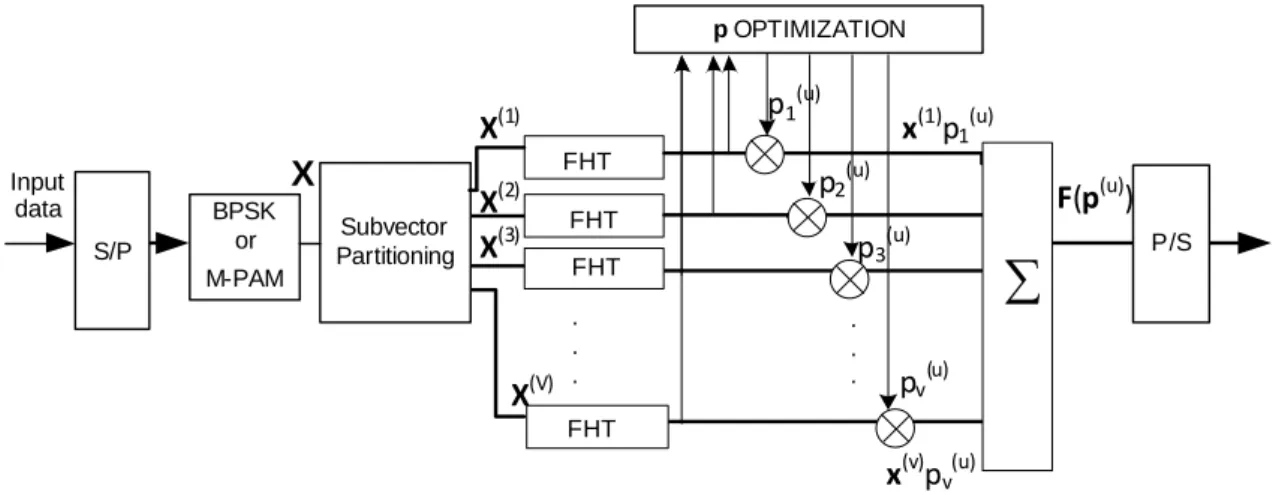
(FHT) blocks. . . 35 3.6 Block diagram of LC-SLM PAPR reduction technique applied to an
OFDM transmitter based on the FHT. . . 37 3.7 Block diagram of LC-PTS PAPR reduction technique applied to an
OFDM transmitter based on the FHT. . . 37 3.8 Block diagram of LC-SLM with the Hadamard transform precoding
ap-plied to an OFDM transmitter based on the FHT. . . 38 3.9 CCDF vs. P AP R0 for OFDM signals (for N = 256) with and without
standard and LC PAPR reduction techniques. . . 39 3.10 Sensitivity performance comparison of DD O-OFDM system based on
FFT and FHT. . . 43 3.11 Sensitivity performance of the FHT based O-OFDM system of Fig. 3.1
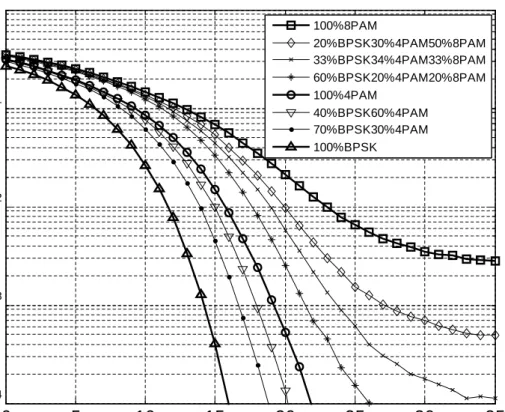
at a target BER of 10−3 for different k values using BPSK, 4PAM and 8PAM formats. . . 44 3.12 BER performance in B2B configuration at a constant receiver input
power of −17 dBm versus clipping level for 8PAM O-OFDM (N = 256) with and without LC PAPR reduction techniques. . . 45 3.13 Sensitivity performance of the FHT based O-OFDM system of Fig. 3.1
at a target BER of 10−3 for different ADC and DAC resolutions using 8PAM format and k= 3 . . . 46 3.14 BER performance at a constant receiver input power of−17 dBm versus
the number of bits of the DAC for 8PAM O-OFDM based on the FHT (N = 256) with and without LC PAPR reduction techniques. . . 47 3.15 BER performance versusk for different DAC resolutions with and
with-out LC-SLM. . . 48 3.16 Sensitivity performance at a target BER of 10−3 for 8PAM O-OFDM
system based on the FHT affected by clipping and quantization noise varying the clipping level and using 6 and 8 bit DAC resolutions. . . . 49
4.1 Example of adaptive DC biased O-OFDM system based on the FHT. . 54 4.2 OFDM transmitter using LC-SLM PAPR reduction technique with BL
and a single FHT block. . . 55 4.3 PAPR analysis of OFDM signals (N = 512) with and without the SLM
technique of Fig. 4.2. . . 56 4.4 BER performance of adaptive DC biased O-OFDM system based on the
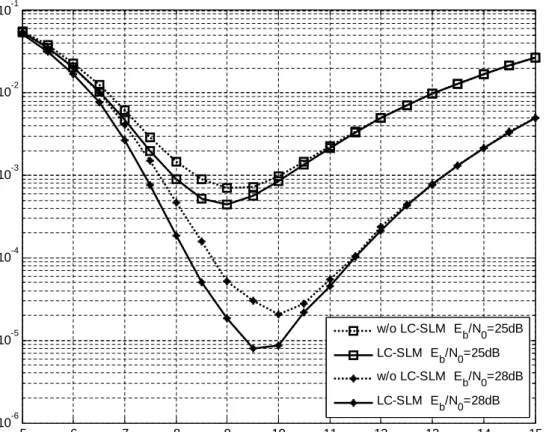
4.5 BER performance at two constant values ofEb/N0 versus bias for 8PAM (p3 = 100%) O-OFDM (N = 512) with and without LC-SLM technique. 59 4.6 BER performance of DC biased O-OFDM system for 8PAM (p3 = 100%)
and using 7 dB and 9 dB bias. . . 60 4.7 Block diagram of the adaptive transceiver based on the FHT. . . 61 4.8 BER performance versus receiver power for different laser linewidths and
guard band bandwidths. . . 63 4.9 Received B2B (a) and after 80 km of fiber (b) spectrum after
photode-tection of a signal of BS = 8 GHz and BG = 500 MHz with 4PAM.
. . . 64 4.10 Sensitivity performance at a BER 10−3 and after 80 km of fiber at the
varying of the OFDM signal bandwidth. In the inset of the figure, optimum modulation format and SE for a required gross bit rate. . . . 65 4.11 Receiver sensitivity to achieve a target BER of 10−3 versus fiber length
for BPSK, 4PAM and 8PAM format. . . 66 4.12 SNR per subcarrier of a signal of BS = 5.5 GHz after 120 km of SSMF. 67
4.13 Receiver sensitivity at a target BER of 10−3 for different links and BL schemes. . . 68 4.14 SNR estimation vs number of subcarriers for different electrical signal
bandwidths at −13 dBm receiver sensitivity after 80km of SSMF. . . . 70 4.15 Bit and power allocation vs number of subcarriers considering a Bs =
19 GHz at 27 Gb/s after 80 km of Standard Single Mode Fiber (SSMF). 71 4.16 Maximum Rg and corresponding SE vs different fiber link for different
signal bandwidths to ensure 10−3 BER. . . . . 71
5.1 Experimental set-up for optical OFDM systems using IM/DD and (a) FFT-based (b) FHT-based processing. . . 76 5.2 Sensitivity performance of the O-OFDM back-to-back system for FHT
and FFT processing at 5 Gb/s. . . 78 5.3 Sensitivity at 10−3 BER of the B2B system and after 25 km of SSMF,
varying bit rate and guard band. . . 79 5.4 BER versus received power at 5 Gb/s (B2B) and 8 Gb/s (B2B and after
25 km). . . 80 5.5 Received spectra after photodetection for B2B transmission at (a) 5
Gb/s (BG=BS = 5 GHz) and (b) 8 Gb/s (BG = 2 GHz, BS = 8 GHz). 80
5.6 BER versus received power at 9 Gb/s using the optimized bit rate vari-able transceiver. . . 81 5.7 BVT schematic and experimental set-up . . . 83
5.9 BVT performance at different optical paths . . . 85 5.10 S-BVT architecture . . . 86 5.11 Set-up for S-BVT proof of concept . . . 87
6.1 DMT system model. The DSP modules at the DMT transmitter/re-ceiver (Tx/Rx) are detailed. . . 93 6.2 BPSK and rectangular QAM constellations implemented at the
trans-mitter [1]. . . 95 6.3 (a) SNR estimation of an optical B2B channel and (b) BER (solid line)
and number of errors (dotted line) per subcarrier transmitting 8441920 bits at 100 Gb/s with 16 QAM (Uniform bit loading) in the B2B con-figuration. The estimation time is 89.75 s. . . 98 6.4 (a) SNR estimation after 50 km of SSMF fiber and (b) BER (solid
line) and number of errors (dotted line) per subcarrier transmitting 8441920 bits at 100 Gb/s with 16 QAM (Uniform bit loading) after 50 km of SSMF fiber. The estimation time is 466.21 s. . . 99 6.5 (a) Bit loading and (b) power loading using LCMA at 100 Gb/s in the
B2B case. . . 100 6.6 (a) Bit loading and (b) power loading using LCMA for 100 Gb/s after
50 km of SSMF. . . 101 6.7 BER performance comparison using LCMA and CCBMA algorithms vs
OSNR for various bit rates after 50 km of SSMF. . . 102 6.8 BER performance comparison using LCMA and uniform loading vs
OSNR for various bit rates after 50 km of SSMF. . . 103 6.9 Achievable data rate for a target BER of 10−3 using LCMA algorithm
and uniform loading for different fiber links. . . 104 6.10 BER performance using LCMA vs OSNR for 40 Gb/s, 50 Gb/s and
60 Gb/s after 80 km and 150 km of SSMF. . . 105
7.1 Experimental set-up. . . 110 7.2 Bit loading using LCMA for 56 Gb/s and the estimated SNR (inset) in
the B2B configuration. . . 111 7.3 Experimental and numerical BER curves for different data rates and
OSNR values in the B2B configuration. . . 112 7.4 Bit loading using LCMA for 56 Gb/s and the estimated SNR (inset)
after 50.5 km of SSMF. . . 113 7.5 Experimental and numerical BER curves for different data rates and
7.6 Bit loading using LCMA for 56 Gb/s and the estimated SNR (inset) after 82.1 km of SSMF. . . 114 7.7 Experimental and numerical BER curves for different data rates and
OSNR values after 82.1 km of SSMF. . . 114 7.8 Experimental setup. . . 116 7.9 BER vs. OSNR for 56 Gb/s in B2B configuration. . . 117 7.10 Required OSNR at 4·10−3 and 10−3 BER vs. transmission length. . . 118 7.11 Estimated SNR for B2B, 10.8 km and 80.5 km of SSMF using 100 GHz
filters. . . 119 7.12 BER vs. OSNR for different transmission lengths using 36 GHz filters. 119 7.13 Estimated SNR for B2B, 10.8 km and 80.5 km of SSMF using 36 GHz
filters. . . 120 7.14 BER at OSNR of 32 dB vs. center frequency offset using VSB filtering. 121 7.15 BER vs. OSNR after (left) 80.5 km of SSMF and (right) 101 km SSMF
for a 100 GHz symmetrically and asymmetrically filtered signal. . . 122 7.16 Estimated SNR for 0, 10 and 18 GHz of filter detuning and 80.5 km of
SSMF. . . 122 7.17 BER vs. OSNR after (left) 162.5 km of SSMF and (right) 202 km SSMF
for a 100 GHz DSB and VSB signal. . . 123 7.18 BER vs. OSNR for different data rates in a B2B configuration. . . 124 7.19 BER vs. OSNR for different data rates after 81.6 km of SSMF. . . 125 7.20 Required OSNR for 4·10−3 BER vs. transmission reach at 56 Gb/s. . . 125 7.21 Estimated SNR for various SSMF lengths and 100 GHz filters. . . 126
3.1 Comparison of PAPR reduction at 10−3 CCDF varying the number of FHT blocks at the transmitter for different distortionless techniques . . 40 3.2 PAPR techniques overview . . . 41 3.3 Achieved PAPR reduction at 10−5 CCDF varying the number of IFFT
blocks at the transmitter for different distortionless techniques in a Orthogonal Frequency Division Multiplexing (OFDM) system, reported in [2] . . . 41 3.4 System parameters . . . 42
4.1 System parameters . . . 54 4.2 System parameters . . . 61 4.3 Table of different BL schemes and corresponding achievable reach. Rg
has been approximated . . . 67
5.1 System parameters . . . 77 5.2 Optimized system parameters . . . 82 5.3 Optimized system parameters . . . 84
6.1 System parameters . . . 97 6.2 Achievable reach, required OSNR for 10−3 BER, maximum assigned
number of bits per symbol and effective signal bandwidth using LCMA at different gross data rates . . . 103 6.3 Achievable reach, fCD1 , required OSNR for 10−3 BER, signal bandwidth
and modulation format used to implement uniform loading at different gross data rates . . . 104
7.1 System parameters . . . 111
ACE Active Constellation Extension
ACO-OFDMAsymmetrically Clipped Optical-OFDM
ADC Analog-to-Digital Converter
ADRENALINEAll-optical Dynamic REliable Network hAndLINg
IP/Ethernet Gigabit traffic with QoS
AMO-OFDMAdaptively Modulated O-OFDM
APD Avalanche Photo-Detector
ASEAmplified Spontaneous Emission
ASICApplication Specific Integrated Circuits
AWG Arbitrary Waveform Generator
AWGN Additive White Gaussian Noise
BERBit Error Rate
BL Bit Loading
BPSK Binary Phase-Shift Keying
B2BBack-to-Back
BRASBroadband Remote Access Servers
BVTBandwidth Variable Transceiver
BVTx Bandwidth Variable Transmitter
BVRx Bandwidth Variable Receiver
CapEx Capital Expenditure
CCDF Complementary Cumulative Density Function
CCB Chow Cioffi Bingham
CCBMACCB Margin Adaptive
CCBRACCB Rate Adaptive
CD Chromatic Dispersion
CMLChirp Managed Lasers
CO-OFDMCoherent Optical OFDM
CP Cyclic Prefix
CSI Channel State Information
DAC Digital-to-Analog Converter
DFB Distributed FeedBack
DMLDirectly Modulated Laser
DMTDiscrete MultiTone
DSB Double-Side Band
DSP Digital Signal Processing
DWDM Dense Wavelength Division Multiplexing
EDFA Erbium Doped Fiber Amplifier
EON Elastic Optical Networks
EML Electro-absorption Modulated Laser
ENOBEffective Number Of Bits
FHT Fast Hartley Transform
FFT Fast Fourier Transform
FEC Forward Error Correction
FPGAField Programmable Gate Arrays
HD Hard Decision
HS Hermitian Symmetry
IFFT Inverse Fast Fourier Transform
ICIInterCarrier Interference
LCLow Complexity
LCMA Levin Campello Margin Adaptive
LCRALevin Campello Rate Adaptive
MA Margin Adaptive
MAN Metro Area Networks
MTUMulti-Tenant Unit
MZMMach-Zehnder modulator
MCMMultiCarrier Modulation
N-WDMNyquist WDM
NZDSF Non-Zero Dispersion-Shifted Fiber
OXCOptical Cross-Connect
OFDM Orthogonal Frequency Division Multiplexing
OLTOptical Line Terminal
O-OFDM Optical-OFDM
OpEx Operational Expenditures
OSCOptical Supervisory Channel
OSNR Optical Signal-to-Noise Ratio
PAPR Peak-to-Average Power Ratio
PL Power Loading
PONPassive Optical Network
PS Parallel to Serial
PSK Phase Shift Keying
PTS Partial Transmit Sequence
QAMQuadrature Amplitude Modulation
RA Rate Adaptive
RFRadio Frequency
ROADM Reconfigurable Add-Drop Multiplexer
S-BVTSliceable BVT
S-BVRx Sliceable BVRx
S-BVRx Sliceable BVRx
SDSoft Decision
SDOT Software-Defined Optical Transmission
SE Spectral Efficiency
SLM SeLective Mapping
SNR Signal-to-Noise Ratio
SSMF Standard Single Mode Fiber
TITone Injection
TIATransImpedance Amplifier
TL Tunable Laser
TR Tone Reservation
TS Training Symbols
VOAVariable Optical Attenuator
VSBVestigial-Side Band Transmission
WDM Wavelength Division Multiplexing
1
Introduction
”Technology has advanced more in the last thirty years than in the previous two thousand. The exponential increase in advancement will only
continue. Anthropological Commentary The opposite of a trivial truth is false; the opposite of a great truth is also true.”
Niels Bohr
1.1
Motivation
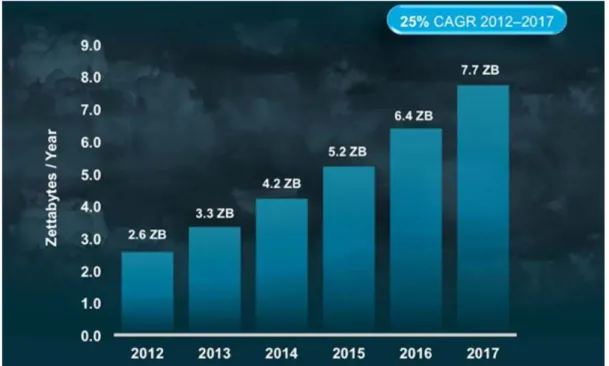
The ever increasing demand for communication services and the tremendous growth of global IP traffic are driving the development of novel, high-capacity Elastic Optical Networks (EON). In fact, according to [3] forecast, global IP traffic has increased more than fourfold in the past 5 years, and will increase threefold over the next 5 years. Additionally, data center and cloud IP traffic is increasing drastically every month and the new emerging applications and services such as cloud computing and high quality IP services (VoIP, IPTV, etc.) will also increase in the near future [4]. Specifically, annual global data center IP traffic will reach 7.7 zettabytes by the end of 2017, according to Cisco forecast [4] (see Fig. 1.1).
Dense Wavelength Division Multiplexing (DWDM) are currently being deployed to transport 100 Gb/s per channel using standard fixed-grid [5]. In the conventional fixed spectrum grid, the optical spectrum is divided into separate channels spaced by 50 or 100 GHz as specified by ITU-T standards [6]. DWDM infrastructure leads to an inefficient use of the available resources of the network when the transmitted traffic doesn’t occupy the whole allocated optical spectrum. Hence, in order to solve this mismatch of granularities between the client layer and the wavelength layer, DWDM normative has been updated to support finer frequency grids enabling flexible DWDM [6]. Specifically, in order to evolve to a more scalable and flexible grid to efficiently
Figure 1.1: Global data center IP traffic growth. Source: Cisco Global Cloud Index: Forecast and Methodology, 2012−2017.
allocate the optical bandwidth resources in EON, frequency slots of 12.5 and 6.25 GHz are defined (further reducing by a factor of 2 the minimum fixed channel spacing of 25 GHz) [7].
The need for high-speed data transmission and the evolution of optical systems towards elastic functionalities and variable bit rates from 10 Gb/s to 100 Gb/s and beyond arises new technical challenges. Single-carrier modulation formats require high symbol rates to enable 100 Gb/s transmission and beyond, that are not technologically feasible in the near future [8]. Hence, advanced modulation formats, such as Optical-OFDM (O-Optical-OFDM), and Nyquist WDM (N-WDM) between others are more suitable solutions to fully exploit flexibility at the data plane level in EON. By using multi-carrier modulation formats, high Spectral Efficiency (SE) and high data rate can be achieved while minimizing complexity, power consumption and transceiver cost [9, 10]. In particular, SE can be enhanced by using higher order modulation formats and polarization multiplexing at the expense of the receiver sensitivity and system complexity, respectively. Additionally, Bandwidth Variable Transceiver (BVT) can be designed to fully exploit the flexibility in the data plane level [11]. Flexibility can further be enhanced by slicing the single BVT into several ”virtual transceivers” known as Sliceable BVT (S-BVT) [11, 12].
On the one hand, N-WDM enables high SE by using a spectral pulse shaping filter at the transmitter side to allow a narrow subcarrier spacing within the Nyquist frequency limit. Thus, a dense allocation of N-WDM subcarriers is allowed creating a
superchannel. However, significant power penalties arise when the channel frequency spacing is equal to the symbol rate. As a result, Forward Error Correction (FEC) is required to enhance system performance, existing a trade-off between spectral efficiency and InterCarrier Interference (ICI). This transmission scheme becomes an interesting solution for long-haul and ultra long-haul applications.
Although the concept of Orthogonal Frequency Division Multiplexing (OFDM) was first introduced by Chang in 1966 [13], it was not until 1996 that Pan and Green ap-plied this concept to optical communications field [14]. OFDM achieves the same SE as N-WDM when a subcarrier number greater or equal to 64 is used [15]. Despite its late appearance in optics, O-OFDM is arising as one of the most promising technology for designing bit rate and BVT as key enablers for future EON due to its unique data rate/bandwidth scalability and superwavelength and also subwavelength granularity. Additionally, O-OFDM also enables Software-Defined Optical Transmission (SDOT), which allows dynamically adapting or reconfiguring the transmitter and receiver of an optical communication system [9]. SDOT is possible thanks to the advances in Digital Signal Processing (DSP) technology. Advanced multi-level and multi-dimensional mod-ulation formats are supported by OFDM technology providing higher data rate and SE [16]. Hence, OFDM becomes a promising technology to consider in the design of the BVT in EON.
However, high data rate transmission over Standard Single Mode Fiber (SSMF) is affected by fiber impairments such as Chromatic Dispersion (CD) and the band-width limitation of some electrical components, such as the Digital-to-Analog Con-verter (DAC) and the Analog-to-Digital ConCon-verter (ADC) [17]. Additionally, DAC and ADC present limited bit resolution which lead to quantization noise. The dy-namic range of the converters must be adjusted in order to accommodate the OFDM signal. A major drawback of OFDM systems is the high Peak-to-Average Power Ra-tio (PAPR) of the transmitted signals, which results in signal distorRa-tion. Specifically, high peaks occur when multiple OFDM subcarriers, that could interfere constructively, are superposed. Therefore, the DAC and the ADC must ensure a dynamic range up to the value of the PAPR. A possible way to adjust the dynamic range of the converters to a lower value is to clip the signal [18,19]. Clipping the signal results in clipping noise which also degrades the system performance. Due to all these impairments, hardware limitations and high implementation costs, OFDM technology can not be considered as a near-term solution for EON.
Depending on the application, different O-OFDM schemes can be used to allow high data rate transmission trading cost-effectiveness and performance. Specifically, ultimate performance can be achieved using coherent detection, where the system ro-bustness against CD is enhanced at the expense of increasing the system cost.
Alterna-arises as a potential cost-effective candidate to reduce the cost and complexity of the optical implementation [9, 20]. In a typical implementation, a single modulator and a single photodetector are needed in transmission and reception, respectively, as a real signal is transmitted. The signal processing at the OFDM transmitter/receiver is based on the Fast Fourier Transform (FFT). Nevertheless, the Fast Hartley Transform (FHT) is an alternative transform to the FFT that can also be used to implement the OFDM symbols, further simplifying the complexity of the system [21]. Different transmission architectures can be adopted to transmit real OFDM symbols. However, one of them, the Discrete MultiTone (DMT) attracted attention for the application in optical trans-mission systems since 2006 [22, 23]. Recently, DMT has been proposed as a low-cost approach for optical transmission of up to 100 Gb/s data using DD and 10G-class components [24]. CD resilience in DD can be enhanced by using optical filters in order to allow Single-Side Band (SSB) and Vestigial-Side Band Transmission (VSB) instead of Double-Side Band (DSB) transmission [25, 26].
In this thesis, cost-efficient adaptive O-OFDM solutions using DD are proposed in order to built novel elastic network architectures to meet the requirements of future EON. The goal is to limit the aforementioned system impairments and enhance the system performance using low complexity DSP in order to drive the use of OFDM tech-nology in EON. PAPR reduction techniques are analyzed to mitigate PAPR, clipping and quantization noise. On the other hand, SDOT and adaptive features are provided by implementing loading algorithms in the transponders. Moreover, Bit Loading (BL) and Power Loading (PL) schemes are also suitable to deal with CD impairment [27]. These solutions can be adopted in elastic Metro Area Networks (MAN) and data center inter-connections using flexible technology, as possible target applications. In particu-lar, FHT-based O-OFDM systems are investigated for MAN. Whereas, DMT systems are analyzed in order to allow elastic high data rate transmission over extended data center connections.
1.2
Thesis Overview
In this section, we present the topic of each chapter and outline the contributions that are included in the present dissertation.
In Chapter 2, the state of the art of the present work is introduced. At the beginning of the chapter, an overview of high speed transmission systems and EON is provided. Then, an introduction of OFDM technology and its application in optical systems is shown. A brief description of CD impairment when transmitting over SSMF
is also discussed. Finally, estimation, equalization and synchronization are explained as essential methods to successfully recover the transmitted data at the receiver side.
In Chapter 3, the PAPR is presented as one of the major problems of OFDM signals that should be mitigated. Additional drawbacks such as clipping noise and quantization noise are also investigated. Distortionless PAPR reduction techniques based on the FHT are proposed to mitigate all the analyzed impairments. Finally, a performance analysis is provided by means of numerical simulations.
The contributions related to this chapter are contained in the following publications:
• L. Nadal, M. Svaluto Moreolo, J.M. F`abrega and G. Junyent, ”Low Complexity PAPR Reduction Techniques for Clipping and Quantization Noise Mitigation in Direct-Detection O-OFDM Systems”, Optical Fiber Technology (OFT), Volume 20, Issue 3, Pages 208-216, June, 2014.
• L. Nadal, M. Svaluto Moreolo, J.M. F`abrega, G. Junyent, ”Clipping and Quanti-zation Noise Mitigation in Intensity-Modulated Direct Detection O-OFDM Sys-tems based on the FHT”, in Proceedings of 14th International Conference on Transparent Optical Networks (ICTON 2012), 2-5 July, 2012, Coventry (UK).
• L. Nadal, M. Svaluto Moreolo, J.M. F`abrega, G. Junyent, ”Comparison of Peak Power Reduction Techniques in Optical OFDM Systems Based on FFT and FHT”, in Proceedings of 13th International Conference on Transparent Optical Networks (ICTON 2011), 26-30 June, 2011, Stockholm (Sweden).
Chapter 4 deals with BL and PL solutions in O-OFDM systems based on the FHT. A first analysis is performed in Additive White Gaussian Noise (AWGN) channel. Then, DSB transmission is considered over SSMF in a MAN scenario. A first loading approach is proposed for the OFDM-based BVT followed by a further improved loading algorithm suitable to perform the bit and power allocation.
The following publications support the content of this chapter:
• L. Nadal, M. Svaluto Moreolo, J.M. F`abrega and G. Junyent, ”Adaptive Bit Loading in FHT-based OFDM Transponders for Flexi-Grid Optical Networks”,
in Proceedings of International Conference on Transparent Optical Networks (IC-TON 2013), 23-27 June, 2013, Cartagena (Spain).
Direct Detection OFDM Systems based on the FHT”, in Proceedings of 3rd Forum on Ph.D. Research in Information and Communication Technologies, 15 October, 2012, Barcelona.
• M. Svaluto Moreolo, J. M. F`abrega, L. Nadal, G. Junyent, ”Software-Defined Optical OFDM Transmission Systems: Enabling Elasticity in the Data Plane”,
in Proceedings of 14th International Conference on Transparent Optical Networks (ICTON 2012), 2-5 July, 2012, Coventry (UK).
• L. Nadal, M. Svaluto Moreolo, J.M. F`abrega, G. Junyent, ”Low Complexity Bit Rate Variable Transponders Based on Optical OFDM with PAPR Reduction Ca-pabilities”, in Proceedings of 17th European Conference on Network and Optical Communications (NOC 2012), 19-22 June, 2012, Vilanova i la Geltr´u,(Spain).
• M. Svaluto Moreolo, J. M. F`abrega,L. Nadal, G. Junyent, ”FHT-Based Archi-tectures for Multicarrier Modulation in Direct Detection and Coherent Optical Systems”, in Proceedings of 13th International Conference on Transparent Opti-cal Networks (ICTON 2011), 26-30 June, 2011, Stockholm (Sweden).
In Chapter 5, an experimental validation of the proposed elastic OFDM-based BVT is provided. Then, a system optimization is provided. Finally, the system performance is assessed for flexi-grid MAN. Moreover, a proof of concept of the BVT being a fundamental building block for future S-BVT is included.
The contributions of this chapter are contained in the following publications:
• M. Svaluto Moreolo, J.M. F`abrega,L. Nadal, F.J. V´ılchez, ”Optical transceiver technologies for inter-data center connectivity [Invited]”,in Proceedings of Inter-national Conference on Transparent Optical Networks (ICTON), 6-10 July, 2014, Graz (Austria).
• M. Svaluto Moreolo, J. M. F`abrega, L. Nadal, F. J. V´ılchez, V. L´opez, and J. P. Fern´andez-Palacios, ”Cost-Effective Data Plane Solutions Based on OFDM Technology for Flexi-Grid Metro Networks Using Sliceable Bandwidth Variable Transponders”,in Proceedings of Optical Network Design and Modeling (ONDM), 19-22 May, 2014, Stockholm (Sweden).
• J. F`abrega, M. Svaluto Moreolo, Fco. J. V´ılchez, and L. Nadal, ”Experimental Characterization of a Burst-Enabled O-OFDM Transceiver”, in Proceedings of CLEO/Europe-IQEC, 12-16 May, 2013, Munich (Germany).
• M. Svaluto Moreolo, J. M. F`abrega, Fco. J. V´ılchez, L. Nadal, V. L´opez and G. Junyent, ”Experimental Validation of an Elastic Low-Complex OFDM-Based BVT for Flexi-Grid Metro Networks”, in Proceedings of European Conference and Exhibition on Optical Communication (ECOC 2013), 22-26 September, 2013, London (United Kingdom).
• M. Svaluto Moreolo, J. M. F`abrega, L. Nadal, F. Javier V´ılchez and G. Jun-yent, ”Bandwidth Variable Transponders Based on OFDM Technology for Elastic Optical Networks”, in Proceedings of International Conference on Transparent Optical Networks (ICTON 2013), 23-27 June, 2013, Cartagena (Spain).
• M. Svaluto Moreolo, J. M. F`abrega, F. V´ılchez, L. Nadaland G. Junyent, ”Ex-perimental Demonstration of a Cost-Effective Bit Rate Variable IM/DD Optical OFDM with Reduced Guard Band”, accepted in Optics Express, n.20, pp.159-164, October 2012.
• M. Svaluto Moreolo, J. M. F`abrega, Fco. J. V´ılchez, L. Nadaland G. Junyent, ”Experimental Demonstration of a Cost-Effective Bit Rate Variable Intensity Modulation and Direct Detection Optical OFDM with Reduced Guard Band”,
in Proceedings of 38th European Conference and Exhibition on Optical Commu-nication (ECOC 2012), 16-20 September, 2012, Amsterdam (The Netherlands).
In Chapter 6, an adaptive cost-effective DMT transponder based on the FFT using DD is presented. The target scenario is data center inter-connections. A loading algorithm is implemented to overcome CD and enhance the system performance.
The content of this chapter is contained in the following publication:
• L. Nadal, M. Svaluto Moreolo, J.M. F`abrega, A. Dochhan, H. Grießer, M. Eiselt, J.-Peter Elbers, ”DMT Modulation with Adaptive Loading for High Bit Rate Transmission Over Directly Detected Optical Channels”, Journal of Lightwave Technology, vol.PP, no.99, pp.1,1, August, 2014.
In Chapter 7 the proposed DMT transponder is experimentally validated to enable high data rate transmission over extended data center links. As a second step, optical filtering is analyzed for fixed-grid and flexi-grid technologies.
J.-Peter Elbers, ”DMT Modulation with Adaptive Loading for High Bit Rate Transmission Over Directly Detected Optical Channels”, Journal of Lightwave Technology, vol.PP, no.99, pp.1,1, August, 2014.
• A. Dochhan, H. Grießer, L. Nadal, M. Eiselt, M. Svaluto Moreolo, J.-Peter Elbers, ”Discrete Multitone Transmission for Next Generation 400G Data Cen-ter InCen-ter-Connections [Invited]”, OECC/ACOFT, 6-10 Juli, 2014, Melbourne, (Australia).
• A. Dochhan, H. Grießer, L. Nadal, M. Eiselt, M. Svaluto Moreolo, J.-Peter Elbers, ”Discrete Multitone Transmission in the Presence of Optical Noise, Chro-matic Dispersion and Narrow-band Optical Filtering”,ITG Fachtagung Sprachkom-munikation, 24-26 September, 2014, Erlangen (Germany).
• A. Dochhan,L. Nadal, H. Griesser, M. Eiselt, M. Svaluto Moreolo, and J.-Peter Elbers, ”Experimental Investigation of Discrete Multitone Transmission in the Presence of Optical Noise and Chromatic Dispersion”, in Proceedings of Opti-cal Fiber Communication (OFC), 9-13 March, 2014, San Francisco, California, (USA).
Finally, in Chapter 8, the final conclusions of the current thesis and future work are discussed.
2
Background and State of the Art
”The science of today is the technology of tomorrow.”
Edward Teller
2.1
High Speed Transmission
Current optical networks must evolve in order to support high data rate transmission and increase the optical capacity to meet the needs of future demand. The electrical bandwidth bottleneck limitation and physical impairments become more severe at the increasing of the data rate. Hence, looking for solutions to support high data rate transmission at the data and control plane levels become a trending topic to enable next generation optical networks. Data rates beyond 100 Gb/s will be required to increase the optical channel capacity and support high rate client interfaces [11]. In fact, 100 Gb/s Ethernet (100 GbE) technology is already standardized by the IEEE and 400 GbE and 1 TbE solutions for Ethernet physical layer are under investiga-tion in order to support the future incoming demand [28]. The need of enhancing the spectral efficiency combined with the newly built data centers and the influence from providers make really difficult to predict the traffic current demand. Intra or short inter data center point-to-point fiber optics interfaces are defined as client optics. Ma-jor client optics applications can be general data center and metro inter data center connections which typically cover distances from 10 km up to 40 km of Standard Sin-gle Mode Fiber (SSMF) [29]. As a high number of links are required to interconnect all the data centers distributed over an area, simple and low-cost solutions has to be investigated. However, maintaining low cost and high spectral efficiency when high data rate signals are transmitted is certainly not an easy task. The network condi-tion and data rate should be adapted to the traffic demand by implementing flexible and adaptive networks equipped with flexible Bandwidth Variable Transceiver (BVT),
Wavelength Division Multiplexing (WDM) transmission is demonstrated using Discrete MultiTone (DMT) modulation, which is a special class of Orthogonal Frequency Divi-sion Multiplexing (OFDM) systems. Specifically, 100 Gb/s per wavelength data rate is achieved after 5 km of SSMF ensuring a target Bit Error Rate (BER) of 10−3, which can satisfy the short distance connection between data centers. Hence, OFDM also arises as a potential solution for high data rate transmission in short-links scenarios.
Additionally, equipment and device integration can be a future possible solution to reduce the system cost and physical component dimensions. Silicon photonics integra-tion and CMOS with photonics integraintegra-tion are promising technologies under investi-gation that achieve high power reduction and energy efficiency [33].
2.2
Elastic Optical Networks
EONs arise as a potential solution to deal with high data rates (beyond 100 Gb/s). However, upgrading the current network towards elastic functionalities usually implies additional efforts by the operators. In particular, the deployment of new telecommu-nications infrastructures and the increasing of the electrical power consumption causes high Capital Expenditure (CapEx) and Operational Expenditure (OpEx), respectively. Hence, the spectral and energy efficiency, the flexibility and the network equipment costs will be crucial parameters to take into account when designing the EON [34]. Highly efficient and adaptive management of the optical spectrum is achieved by using flexi-grid technology [6]. Specifically, fine channel spacings of 12.5 GHz and 6.25 GHz are considered, for the Dense Wavelength Division Multiplexing (DWDM) grid, to adaptively allocate variable-sized frequency slots to bandwidth-variable optical con-nections, according to the client data rate and the physical conditions of the path. Additionally, the use of advanced optical modulation schemes, such as OFDM, that efficiently use allocated spectrum slots, fully exploit the flexibility enabling Software-Defined Optical Transmission (SDOT) in EON. In fact, SDOT and flexi-grid are considered as technology enablers for high data rate transmission, as well as BVT and flexible spectrum Wavelength Selective Switches (WSS), which can multiplex and switch variable spectral bands. Hence, the flexibility and scalability of the network can be maximized and the cost and energy consumption minimized.
A possible use case of EON using Optical-OFDM (O-OFDM) technology can be Metro Area Networks (MAN), where all these elastic features can be adopted. In particular, MAN is the network segment between the access and the core network. Typically, metro architectures are composed of two main levels of aggregation. The first level of aggregation, called Multi-Tenant Unit (MTU), is in charge of collecting
traffic from the Optical Line Terminal (OLT). Whereas, the second level of aggregation is the access level, which aggregates the traffic from the MTU mainly through direct fiber connections.
Figure 2.1: Evolutionary flexi-grid MAN scenario with S-BVT at the BRASes.
Nowadays, the IP functionality, such as traffic classification, routing or authenti-cation, is implemented in the Broadband Remote Access Servers (BRAS), which are usually located at the second level of aggregation. Therefore, they are distributed in many sites along the regional area covered by the MAN, causing a high CapEx impact [11]. Lately, main network operators are expanding their photonic mesh to the regional networks, so BRASes could be co-located in fewer locations reducing investment. In fact, as cost effectiveness is an important requirement for the system design, it is de-sirable to adopt low complex data plane solutions to further minimize the network cost. Additionally, flexi-grid MAN can benefit from the use of BVT and Sliceable BVT (S-BVT) at the BRAS servers, enhancing system’s flexibility (see Fig. 2.1).
2.3
Orthogonal Frequency Division Multiplexing
OFDM is a special class of MultiCarrier Modulation (MCM) that consists of transmit-ting a signal over several lower-rate orthogonal subchannels [9, 35]. The spectrum of individual subcarriers, which has asin(x)/xform, can overlap due to its orthogonality. As it can be seen in Fig. 2.2, where the different subcarriers that form one OFDM symbol are depicted, each OFDM subcarrier has significant sidelobes over a frequency range which includes many other subcarriers. On the one hand, OFDM presents ro-bustness against channel dispersion and allows an easy phase and channel estimation in a time-varying environment. Thanks to the use of a Cyclic Prefix (CP), the channel dispersion-induced InterSymbol Interference (ISI) and InterCarrier Interference (ICI)
f1 ... fN
Figure 2.2: OFDM spectrum.
can be resolved [9,36]. The CP is a cyclic redundancy introduced in the OFDM symbol. The elements in the tail of the discrete OFDM signal vector are copied and pasted as a prefix (see Fig. 2.3).
On the other hand, OFDM has disadvantages, such as the high Peak-to-Average Power Ratio (PAPR) and sensitivity to frequency and phase noise [9]. The PAPR problem will be detailed and analyzed in chapter 3. Whereas frequency offset and phase noise appear due to the relatively long OFDM symbol length and they lead to ICI. Frequency estimation and compensation can be implemented at the receiver side to mitigate the frequency offset sensitivity. The phase noise sensitivity can be resolved by careful designing the Radio Frequency (RF) local oscillators.
Figure 2.3: Time domain signal of one subcarrier for two OFDM frames using CP.
In order to create the orthogonal subcarriers the Inverse Fast Fourier Transform (IFFT) and the Fast Fourier Transform (FFT) are used for the modulation and
de-modulation of the signal, respectively [37]. The IFFT can be defined as: ym = 1 √ N N−1 X n=0 Yn exp(2jπmn/N) m= 0,1, ..., N −1, (2.1)
where Yn indicates the symbol sequence, previously mapped with a M Quadrature
Amplitude Modulation (MQAM) or M Phase Shift Keying (MPSK) format, and N
represents the number of subcarriers. The symbols have different energy levels when
-2 -1.5 -1 -0.5 0 0.5 1 1.5 2 -2 -1 0 1 2 -4 -2 0 2 4 -4 -3 -2 -1 0 1 2 3 4 16-QAM 16-PSK (a) (b)
Figure 2.4: (a) 16QAM and (b) 16PSK constellations.
they are mapped into MQAM constellation. Whereas, with mPSK format, they are distributed in a circle of unitary energy [1]. UsingMQAM, for a large M, the symbols have more distance between each other and hence, the receiver can recover the signal with less errors. Nevertheless more power is needed to transmit them. For large-size constellations, MPSK format is not suitable, due to the reduced distance between symbols. The constellations of both modulation formats (for 16 symbols) are depicted in Fig. 2.4.
The block diagram of the transmitter is shown in Fig. 2.5 and it is composed by a Serial to Parallel (SP) converter, a mapper, a block to insert the Training Symbols (TS), an IFFT ofN points, a block to insert the CP and a Parallel to Serial (PS) converter. With the mapping, a certain number of bits is represented by each mapped symbol. The IFFT block generates an OFDM symbol with N orthogonal subcarriers. Finally the resulting signal is serialized, digital-to-analog converted with a Digital-to-Analog Converter (DAC) and sent through the channel.
I Q Serial to Pa ra llel FFT‐based OFDM transmitter Input data DA C DA C Re{ym} Yn ym Im{ym} Mapper N ‐ IFFT CP insertion Pa ra llel to Serial . . . . . . . . . . . . TS insertion . . .
Figure 2.5: Block diagram of the OFDM transmitter based on the FFT.
I Q ADC ADC Serial to Pa ra llel Output data Pa ra llel to Serial
FFT‐based OFDM receiver
CP re m o va l N ‐ FFT Equaliz at ion Demapper . . . . . . . . . . . . . . .
Figure 2.6: Block diagram of the OFDM receiver based on the FFT.
of the signal, the received data is analog-to-digital converted with an Analog-to-Digital Converter (ADC). The resulting digital signal is parallelized in order to remove the CP in the following step. Then, the FFT is implemented and equalization is performed. Finally, the resulting signal is demapped and serialized in order to recover the original bit stream.
2.4
OFDM in Optical Communications
One of the reasons why OFDM has been applied to optical communications is its capability to use high modulation formats to increase the spectral efficiency allowing
high signal-transmission capacities according to the future and growing demand [9,35]. However, the use of high order modulation formats presents lower Optical Signal-to-Noise Ratio (OSNR) tolerance resulting in a shorter distant reach. In order to overcome this limitation, reconfigurable transceivers can be implemented to adapt the system to the current traffic demand and network condition. In fact, O-OFDM has been proposed to cope with upgrades to the next transmission speed in highly reconfigurable networks. It is also a good option for optical long-haul communications specially because it can be designed to be extremely tolerant to Chromatic Dispersion (CD). Additionally, OFDM is a key enabler of future EON as it can be combined with Bit Loading (BL) and Power Loading (PL) [27]. Direct Detection (DD) and coherent detection are two possible optical implementations for receiving the OFDM signal through the optical channel. On the one hand, DD is a very attractive optical implementation due to its low cost and it is suitable for MAN. In such systems, the detection is performed using a single photodetector, as a real signal is transmitted. Additionally, the optical signal can be created with a single laser by directly or externally modulating the electrical signal at the transmitter. DD implementation is explained in more detail in section 2.4.1, as it is the solution adopted in this thesis. On the other hand, Coherent Optical OFDM (CO-OFDM) is an alternative optical implementation which was proposed to combat CD in long haul transmission [22]. It presents better performance than DD-based
Data I Q MZ M MZM MZ M MZM 90º
channel receiverOFDM Data + -+ -+ -+ -Local laser 90º Hybrid IQ optical modulator OFDM transmitter
Figure 2.7: Block diagram of a CO-OFDM system.
OFDM in terms of bandwidth efficiency, robustness against fiber dispersion and receiver sensitivity, but it requires higher complexity in the transceiver design than DD systems [9]. Hence, DD scheme result in a more cost-effective solution. According to [38], reduced power consumption can be achieved in either DD or coherent detection when moving towards photonic integration. However, CO-OFDM systems require additional optical components, whose optical performance is so much more demanding than in DD systems. Hence, photonic integration doesn’t reduce at all the economic gap between DD and coherent schemes, as the majority of the system’s cost is due to the optical components, according to [38]. A typical CO-OFDM block diagram is depicted in
signal are modulated by using an IQ optical modulator. Then the modulated signal is transmitted to the optical channel. In reception, one laser as local oscillator, a 90o hybrid and 4 balanced photodetectors are needed to recover the signal, 2 for the quadrature and 2 for the in-phase components of the received signal. Finally, both components are filtered and demodulated at the OFDM receiver.
2.4.1
Direct Detection
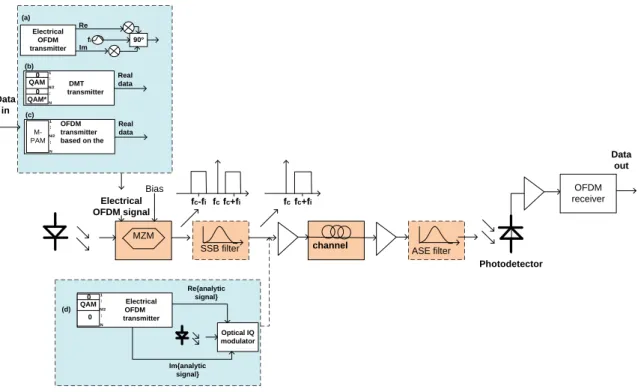
DD has been presented as a low cost and low complexity optical configuration, which becomes a suitable solution to meet the challenges of this thesis. DD can be used in a broader range of applications due to its transmitter and receiver simplicity. DD variants can be implemented depending on the scenario. On the receiver side, a simple photodetector, which can be either a PIN or an Avalanche Photo-Detector (APD), can be used to directly detect the signal. PIN has lower responsivity and cost than an APD. Despite that the common feature in all possible DD schemes is the use of direct detection at the receiver, alternatives to generate the optical signal exist. Regardless of the implemented transmission architecture, different modulators can be used to perform the electrical-to-optical conversion [39–43]. Specifically, Distributed FeedBack (DFB) laser, Directly Modulated Laser (DML) and Chirp Managed Lasers (CML) directly modulate the electrical signal into the optical domain. DMLs provide high output power and low threshold current [39]. However, it introduces high laser chirp limiting the transmission reach and the achievable bit rate. Alternatively, the electrical real OFDM signal can be externally modulated by using an Electro-absorption Modulated Laser (EML) or a Mach-Zehnder modulator (MZM). EML performance is limited to the fiber length. In contrast, MZM is a typically used external modulator as it presents negligible chirp [9]. Hence, MZM achieves better performance than DML at the expense of increased cost. The MZM creates a Double-Side Band (DSB) spectrum with respect to the optical carrier (fc), see Fig. 2.8. DSB transmission is very
susceptible to chromatic dispersion, however it is simple to implement. Alternatively, Single-Side Band (SSB) was proposed by Schmidt et al. in [25] for chromatic dispersion compensation in DD systems featured by long haul optical fiber links. SSB modulation ensures that the OFDM subcarriers are represented only once by the optical frequencies and avoid CD fading. Optical SSB-OFDM consists of suppressing one of the two OFDM sidebands presented by the real signal. For this purpose, optical filters or more complex schemes are required [25, 44, 45]. Furthermore, a guard band (BG) equal to
the bandwidth of the electrical OFDM signal (BS) must be considered, reducing the
MZM Bias
SSB filter channel ASE filter
Photodetector OFDM receiver fcfc+fi fc+fi fc fc-fi Data out Data in Electrical OFDM signal (a) (b) Electrical OFDM transmitter Re Im fi 90º DMT transmitter 0 QAM QAM* 0 Real data 1 N N/2 ... ... (d) Electrical OFDM transmitter 0 QAM 0 1 N N/2 ... .. . Optical IQ modulator Re{analytic signal} Im{analytic signal} (c) OFDM transmitter based on the FHT Real data 1 N N/2 ... ... M-PAM
Figure 2.8: Block diagram of a IM/DD system using four different transmission archi-tectures: (a) RF conversion, (b) DMT modulation, (c) FHT tranform and (d) Hilbert transform.
as a variant of SSB modulation. It uses an optical filter, which has not to be centered in the optical carrier [26]. Moreover, depending on the MZM bias point selection, linear field modulation or Intensity-Modulation (IM) can be provided. IM is achieved by biasing the MZM at the quadrature point. Additionally, IM can also be implemented using the aforementioned directly modulated lasers.
DD O-OFDM using IM: AC and DC-biased solutions
When IM is used, the system is less robust against dispersion impairments due to the nonlinear mapping between the OFDM baseband signal and the optical field. In IM systems, using direct laser modulation, the OFDM signal is represented by the optical intensity and not by the optical field. Thus, the transmitted signal must be unipolar. A positive signal can be obtained by applying Asymmetrically Clipped Optical-OFDM (ACO-OFDM) or adding a DC bias to the real OFDM signal generated by a DMT transmitter (DCO-OFDM).
ACO-OFDM ACO-OFDM consists of modulating only the odd subcarriers and set to zero the even ones. Then the signal can be clipped at zero level without any lost of information [46]. The odd frequencies have the property that:
bias IM Optical channel DD FFT-based OFDM Tx FFT-based OFDM Rx
Figure 2.9: Block diagram of a IM/DD system.
whereN is the number of subcarriers and Y is the input vector of the real-valued FFT block. Thus, the useful information in the odd frequencies is redundant and we can cut at zero level without any loss of performance. The clipping noise falls in the even subcarriers, that can be discarded at the receiver side. With this scheme the optical power is substantially reduced, but in contrast it only carries useful information on half of the available signal bandwidth.
DCO-OFDM DCO-OFDM consists of adding a bias (B) to the signal and then clipping it at zero level. The resulting signal from this asymmetrically clipping can be written as: ˆ ym = 0, ym+B ≤0 ym+B, ym+B >0 (2.3)
Alternatively, symmetrically clipping can also be applied. It consists of limiting the amplitude of the signal and then adding a bias equal to this maximum amplitude value in order to ensure a positive signal. The symmetrically clipped digital OFDM signal can be represented by:
ˆ ym = ym, |ym| ≤B B·sign(ym), |ym|> B (2.4)
where B is also the maximum allowed signal amplitude and it is k times the standard deviation of the signal. The clipping level (C) is defined in decibels as
C= 10·log10 B2 E[|ym|2] , (2.5)
where E[|ym|2] denotes the average signal power of the transmitted signal.
Symmet-rically clipping is also used to limit the high PAPR of O-OFDM signals. However, clipping the signal introduces a penalty due to the appearance of clipping noise that degrades the performance of the system. Usually, the value of the clipping level is 7 dB [47]. However, when high order modulation formats are used, 7 dB clipping level
is not enough to guarantee a BER lower than 10−3. Higher clipping level values can be applied to the signal for reducing the clipping noise at the expense of increasing the electrical power of the signal [21, 47]. Hence, there is a trade off between power efficiency and noise in the selection of the clipping level or bias.
5 10 15 20 25 30 -3 -2 -1 0 1 2 3 Time A m p lit u d e 5 10 15 20 25 30 -3 -2 -1 0 1 2 3 Time A m pl it ude 5 10 15 20 25 30 -3 -2 -1 0 1 2 3 Time A m pl it ude 5 10 15 20 25 30 -3 -2 -1 0 1 2 3 4 5 6 Time A m p lit u d e (a) (b) (c) (d)
Figure 2.10: Real-valued OFDM time domain signal (a) with only odd subcarriers mod-ulated and (b) clipped to zero level (ACO-OFDM); (c) with all subcarriers modmod-ulated and (d) clipped to zero level after adding a bias (DCO-OFDM).
ACO-OFDM and DCO-OFDM comparison Fig. 2.10(a) shows an OFDM frame with only the odd subcarriers modulated (ACO-OFDM). Therefore, as the signal has odd symmetry according to equation (2.2), we can clip the signal without loosing data, as it can be seen in Fig. 2.10(b). In Fig. 2.10(c) it is represented one OFDM frame with all the subcarriers modulated and Fig. 2.10(d) shows the signal clipped to the zero level after adding a bias of twice the standard deviation of the original signal (DCO-OFDM). DCO-OFDM allows transmitting more information than ACO-OFDM with the same bandwidth, implying higher spectral efficiency. However, clipping noise could degrade the transmission. ACO-OFDM can be easily used in adaptive systems using different