School of Engineering and Computer Science Adaptive Systems Research Group
Investigating human perceptions of trust and
social cues in robots for safe Human-Robot
Interaction in human-oriented environments
submitted to the University of Hertfordshire in partial
fulfilment of the requirements of the degree of
Doctor of Philosophy
Principal Supervisor
Prof. Kerstin DAUTENHAHN
PhD Student
Co-Supervisors Alessandra Rossi
Dr. Kheng Lee KOAY 15058449
Dr. Michael L. WALTERS
For the children who never tire of moon gazing upon the dock, by the light of the fireflies, till the angels are dispatched by Nana, to sprinkle sleepy dust in their eyelashes so long and fine
Were The World Mine - Tanner Cohen
I am a star ...
I am a star in the firmament
that observe the world, despises the world and consumed in its heat.
I am the sea by night in a storm
the sea shouting that accumulates new sins and to the ancient makes recompense. I am exiled from your world
of pride polite, by pride defrauded, I am the king without crown. I am the passion without words without stones of the hearth, without weapons in the war,
is my same force that make me sick.
Sono una stella del firmamento
che osserva il mondo, disprezza il mondo e si consuma del proprio ardore.
Sono il mare che di notte si infuria, il mare urlante che accumula nuovi peccati e agli antichi rende mercede.
Sono dal vostro mondo esiliato
di superbia educato, dalla superbia frodato, io sono il re senza corona.
Sono la passione senza parole
senza pietre nel focolare, senz’arma nella guerra,
è la mia stessa forza che mi ammala.
I would like to thank my supervisor Prof. Kerstin Dautenhahn for providing enthusiastic support and great advice. Since the beginning she has been a very inspirational model offering her guidance and experience for letting me grow as researcher.
I am also very grateful for the amazing and relentless support received by Dr. Kheng Lee Koay. He has been always ready to help, discuss and advice me regarding all the aspects of my research. He became a very good friend in which, I know, I can always count in ... but he will probably deny it.
I would also like to thank Dr. Mick Walters for his feedback and comments to the work presented in this thesis. He also has been very patience with me and my itaglish, as Kheng Lee likes to call it.
My supervisors taught me a lot, and this would not have been possible without them!
I am very grateful to Prof. Silvia Rossi. She has been my professor of Robotics during my MSc and supervisor for my MSc final project. Then, she became my mentor and, finally, friend. She always pushed to be the best of me, supporting me and providing constant advice. She guided me, and she is keeping guiding me through my journey in the research.
I am very grateful for the moral and technical support that I received by my friend Dr. Patrick Holthaus.
I would also like to thank Dr. Joe Saunders for his support and input at the beginning of this work.
I am also very grateful for being part of an amazing training project such as SECURE. The PIs, colleagues and learning opportunities opened for me a new world full of wonders.
I am very grateful to the staff of University of Hertfordshire for their support and help. In particular, I would like to thank Mariana Lilley for being such a lovely and supportive person. Thank you, Simon, Volker.
I would also like to thank my friends and colleague from the Adaptive Systems Research Group. They made me feel welcome and have always been supportive. They have been always ready to help me and discuss with me about research, interests. Thank you, Frank, Gabi, Luke, Ben, Marcus, Greg, Azeemsha, Udeshika, Karen, Bente. Thank you to Dag for patiently advising me on statistics.
A special thank goes to my friend and colleague Silvia Moros. She made my life happier by introducing me to the aerial circus. Hanging upside down became my happy place.
I would also particularly thank Dan Barry who has been a pain and an amazing friend since the moment I met him (but I am sure he would say the same). Thank you for always being there for me.
Thank you, Marcus, for introducing me to the RoboCup. It became constant part of my life. I would also like to thank my team Bold Hearts for believing in me as their team leader. I would also like to thank Prof. Daniel Polani for his trust and support he gave me since I joined the team.
I would also like to thank my friends for baring with me, my craziness and stress. I could not make it without you. Thank you, Janmarie, David, Natalie, Andrei, Agne, Samir, Pahn, Julie-anne. A special thank you to Maria.
A warm thank you to my family and friends. My cousins Manuela, Laura and Chiara always encouraged me to be strong, happy and smiling.
I think I should include my sweet dog, Yuri, that never gets mad at me and always unconditionally loves me.
I want to dedicate this thesis to the most important people of my life, my mom, my brother Roberto, my lovely nephew Christian, and my dad who is always watching me.
Abstract
As robots increasingly take part in daily living activities, humans will have to interact with them in domestic and other human-oriented environments. This thesis envisages a future where autonomous robots could be used as home companions to assist and collaborate with their human partners in unstructured environments without the support of any roboticist or expert. To realise such a vision, it is impor-tant to identify which factors (e.g. trust, participants’ personalities and background etc.) that influence people to accept robots’ as companions and trust the robots to look after their well-being. I am particularly interested in the possibility of robots using social behaviours and natural communications as a repair mechanism to positively influence humans’ sense of trust and companionship towards the robots. The main reason being that trust can change over time due to different factors (e.g. perceived erroneous robot behaviours). In this thesis, I provide guidelines for a robot to regain human trust by adopting certain human-like behaviours. I can expect that domestic robots will exhibit occasional mechanical, programming or functional errors, as occurs with any other electrical consumer devices. For example, these might include software errors, dropping objects due to gripper malfunctions, picking up the wrong object or showing faulty navigational skills due to unclear camera images or noisy laser scanner data respectively. It is therefore important for a domestic robot to have acceptable interactive behaviour when exhibiting and recovering from an error situation. In this context, several open questions need to be addressed regarding both individuals’ perceptions of the errors and robots, and the effects of these on people’s trust in robots.
As a first step, I investigated how the severity of the consequences and the timing of a robot’s different types of erroneous behaviours during an interaction may have different impact on users’ attitudes towards a domestic robot. I concluded that there is a correlation between the magnitude of an error performed by the robot and the corresponding loss of trust of the human in the robot. In particular, people’s trust was strongly affected by robot errors that had severe consequences.
This led us to investigate whether people’s awareness of robots’ functionalities may affect their trust in a robot. I found that people’s acceptance and trust in the robot may be affected by their knowledge of the robot’s capabilities and its limitations differently according the participants’ age and the robot’s embodiment.
In order to deploy robots in the wild, strategies for mitigating and re-gaining people’s trust in robots in case of errors needs to be implemented. In the following three studies, I assessed if a robot with awareness of human social conventions would increase people’s trust in the robot. My findings showed that people almost blindly trusted a social and a non-social robot in scenarios with non-severe error consequences. In contrast, people that interacted with a social robot did not trust its suggestions in a scenario with a higher risk outcome.
Finally, I investigated the effects of robots’ errors on people’s trust of a robot over time. The findings showed that participants’ judgement of a robot is formed during the first stage of their interaction. Therefore, people are more inclined to lose trust in a robot if it makes big errors at the beginning of the interaction.
The findings from the Human-Robot Interaction experiments presented in this thesis will contribute to an advanced understanding of the trust dynamics between humans and robots for a long-lasting and successful collaboration.
Contents
1 Introduction 1
1.1 Research Problem . . . 2
1.2 The Approach . . . 4
1.2.1 Extended research questions . . . 6
1.3 Contribution to Knowledge . . . 7
1.3.1 Publications. . . 8
1.4 Structure of the Thesis . . . 11
2 Background 15 2.1 Trust in Human-Human Interaction. . . 15
2.1.1 Definition of Trust . . . 16
2.1.2 Building Trust in Human-Human Interaction . . . 17
2.1.3 Trust Violation and Trust Recovery in Human-Human In-teraction. . . 17
2.2 Trust in Human-Robot Interaction . . . 18
2.2.1 Robot’s errors . . . 19
Research questions . . . 21
2.2.2 Individual’s differences . . . 22
Antecedents of Trust . . . 22
Human awareness in Human-Robot Interaction . . . 22
Research questions . . . 24
2.2.3 Social dynamics of human-robot interaction . . . 24
Research questions . . . 26
2.2.4 Trust in long-term human-robot interactions . . . 26
Research questions . . . 28
3 Experimental Design and Implementation 29 3.1 The Robots . . . 29
3.1.1 The virtual robot . . . 29
3.1.2 Pepper . . . 30
3.1.3 Care-O-bot 4 . . . 32
3.1.4 Kaspar . . . 33
3.1.5 Roomba . . . 34
3.2 The Experimental settings . . . 34
3.2.1 The virtual environment . . . 34
3.2.2 Primary and Secondary Schools . . . 35
3.2.3 Robot House . . . 35
3.2.4 Adaptive Systems Research Lab . . . 36
3.2.5 Video recordings . . . 37
3.3 The software . . . 38
3.3.1 The virtual robot and environment . . . 38
3.3.2 Pepper robot . . . 39
3.3.3 Kaspar robot . . . 40
3.3.4 Care-O-bot 4 robot . . . 41
3.3.5 Roomba robot . . . 41
4 Study 1: Human Perceptions of the Severity of Domestic Robot Errors 43 4.1 Method . . . 44
4.2 Procedure . . . 45
4.3 Participants . . . 47
4.4 Results. . . 47
4.5 Discussion and Conclusion . . . 50
5 Study 2: How the Timing and Magnitude of Robot Errors Influence Peoples’ Trust of Robots in an Emergency Scenario 51 5.1 Experimental Design . . . 54
5.2 Experimental Procedure. . . 55
5.3 System Design and Materials . . . 56
5.3.1 Operating System . . . 58
5.3.2 Motion picture generation . . . 58
The robot . . . 59
5.3.3 The database . . . 59
5.3.4 The interface . . . 60
5.4 Participants . . . 61
5.5 Results. . . 61
A. Rossi
5.6 Discussion and Conclusion . . . 68
6 Study 2.1: How Human Personality and Disposition Affect Peoples’ Trust of Robots 71 6.1 Effects of the participants’ personalities and dispositions of trust on HRI . . . 73
6.2 Trust in Jace . . . 74
6.3 Previous experiences with robots . . . 75
6.3.1 Effects of participants’ personalities . . . 76
6.3.2 Effects of participants’ disposition of trust . . . 77
6.4 Perception of the robot Jace. . . 77
6.4.1 Effects of participants’ personalities . . . 79
Questions Q1 and Q2: Companionship . . . 79
Questions Q4 - Q10: Perceived reliability and faith in the ability of the robot . . . 79
Questions Q11 - Q13: Perception of the robot’s role . . . 80
6.4.2 Effects of participants’ disposition of trust . . . 81
Questions Q1 and Q2: Companionship . . . 81
Questions Q4 - Q10: Perceived reliability and faith in the ability of the robot . . . 81
Questions Q11 - Q13: Perception of the robot’s role . . . 82
6.4.3 Perception of the interaction . . . 82
6.4.4 Effects of perception of severity of the scenarios . . . 83
6.5 Discussion and Conclusion . . . 84
7 Study 2.2: Evaluating the Effects of People’s Previous Experiences with Robots on Trust for a Safe HRI 85 7.1 Effects of Perception of robots . . . 86
7.1.1 Perception of a robot as companion . . . 88
7.1.2 Expectation of a robot’s capabilities . . . 88
7.1.3 Perception of a robot’s role . . . 88
7.2 Effects of Perception of Jace . . . 88
7.2.1 Questions Q1 and Q2: Companionship . . . 89
7.2.2 Questions Q4 - Q10: Perceived reliability and faith in the ability of the robot . . . 89
7.2.3 Questions Q11 - Q13: Perception of the robot’s role . . . 90
7.3 Trust in Jace . . . 90
8 Study 3: Effects of People’s Awareness of a Robot’s Capabilities on
their Trust in the Robot 93
8.1 Experimental Design of the two Studies . . . 95
8.2 Study at the secondary school with Pepper . . . 96
8.2.1 System Design and Materials. . . 97
8.2.2 Participants . . . 98
8.2.3 Results . . . 98
Questions Q3: Companionship . . . 98
Questions Q4-Q7: Trust in the robot . . . 99
Questions Q8-Q10: Programming Pepper . . . 103
8.2.4 Conclusion . . . 104
8.3 Study at the primary school with Kaspar . . . 105
8.3.1 System Design and Materials. . . 105
8.3.2 Participant . . . 106
8.3.3 Results . . . 106
Questions Q3: Companionship . . . 107
Questions Q4-Q7: Trust in the robot . . . 108
Questions Q8-Q10: Programming Kaspar . . . 110
8.3.4 Conclusion . . . 111
8.4 Comparing the two studies . . . 112
8.4.1 Questions Q3: Companionship . . . 112
8.4.2 Questions Q4-Q7: Trust in the robot . . . 113
8.4.3 Conclusion . . . 114
8.5 Discussion and Conclusion . . . 114
9 Study 4: Human Perceptions of the Social Cues Expressed by a Do-mestic Robot 117 9.1 Experimental Design . . . 119
9.1.1 Experimental Procedure . . . 120
9.1.2 Measures . . . 121
9.2 System Design and Materials . . . 122
9.2.1 Operating System . . . 122
9.2.2 The robot . . . 122
9.2.3 The Social Cues . . . 123
9.2.4 The video interaction . . . 124
9.2.5 The website . . . 125
9.3 Participants . . . 125
A. Rossi
9.4.1 Previous experience with robots . . . 125
9.4.2 Ratings the relevance of robot’s social cues . . . 126
9.4.3 Effects of Personality traits on participants’ perception of social cues . . . 128
9.4.4 Participants’ preferences of social cues . . . 129
9.5 Discussion and Conclusion . . . 129
10 Study 5: Effects of Robot Appearance on People’s Perceptions of Robots133 10.1 Experimental Design . . . 135
10.1.1 Procedure . . . 135
10.1.2 Evaluation . . . 135
10.2 System Design and Materials . . . 136
10.2.1 The robots . . . 136
10.2.2 The videos . . . 138
10.2.3 The website . . . 139
10.3 Participants . . . 140
10.4 Results. . . 140
10.4.1 Previous experience with robots . . . 140
10.4.2 Expectation towards robots . . . 141
10.4.3 Effects of robots’ appearance on perception on social cues 141 10.4.4 Perception of Pepper and Care-O-bot 4 . . . 144
10.5 Comparing Pepper and Care-O-bot 4 . . . 145
10.6 Discussion and Conclusion . . . 146
11 Study 6: How Social Robot Influence People’s Trust of Robots in Crit-ical Situations 149 11.1 Experimental Design . . . 151 11.1.1 Pre-Interaction . . . 153 11.1.2 Interaction . . . 153 11.1.3 Post-Interaction . . . 153 11.1.4 Post Study . . . 154
11.2 System Design and Materials . . . 154
11.2.1 Operating System. . . 154 11.2.2 The robot . . . 155 11.2.3 Robot’s behaviours . . . 155 11.2.4 The environment . . . 156 11.3 Participants . . . 157 11.4 Results. . . 157
11.4.1 Measuring trust in robots . . . 158
Participants’ trust in Task 1. . . 158
Participants’ trust in Task 2. . . 158
Participants’ trust in Task 3. . . 160
11.4.2 Participants’ personality traits and disposition of trust. . . 162
11.4.3 Participants’ perception of robots . . . 164
11.4.4 Participants’ perception of Pepper . . . 164
11.4.5 General comments . . . 165
11.5 Discussion and Conclusion . . . 166
12 Study 7: Evaluating people’s perceptions of trust in a robot in a re-peated interactions study 169 12.1 Experimental Design . . . 171
12.2 Experimental Procedure. . . 171
12.3 Evaluation . . . 173
12.4 System Design and Materials . . . 175
12.4.1 Operating System . . . 175 12.4.2 The robot . . . 176 12.4.3 The tasks . . . 176 12.4.4 The environment . . . 180 12.5 Participants . . . 181 12.6 Results. . . 182 12.6.1 Trust in Care-O-bot 4 . . . 182 Qualitative Analysis . . . 182 12.6.2 Antecedents of trust . . . 184
Previous experience with robots . . . 185
Personality traits and Disposition of trust . . . 185
Perceptions of robots . . . 186
12.6.3 NARS Analysis . . . 186
12.6.4 Post-experimental evaluation . . . 188
Perception of the interaction . . . 188
Perceptions of Care-O-bot 4 . . . 188
12.6.5 Errors evaluation . . . 189
12.7 Discussion and Conclusion . . . 191
13 Discussion & Conclusions 193 13.1 Summary of research . . . 194
A. Rossi
13.2.1 Final remarks on contribution to knowledge . . . 199
13.3 Limitations . . . 200
13.3.1 Population validity . . . 200
13.3.2 Age range . . . 200
13.3.3 Duration of the interactions . . . 201
13.3.4 Ethical and legal challenges . . . 201
13.3.5 Robot appearance. . . 201 13.3.6 Technological limitations. . . 202 13.3.7 Online investigations . . . 202 13.4 Future Works . . . 203 References 204 Appendix A Publications 231 Appendix B Study 1 235 B.1 Ethics Approval . . . 236 B.2 Questionnaire . . . 237 Appendix C Study 2 239 C.1 Ethics Approval . . . 240
C.2 Questionnaire Pre Experiment . . . 242
C.3 Questionnaire Post Experiment . . . 246
C.4 Example of Storyboard . . . 250
Appendix D Study 3 251 D.1 Ethics Approval . . . 252
D.2 Questionnaire Post Video Interaction . . . 254
D.3 Questionnaire Post Live Interaction . . . 259
D.4 Questionnaire Post Programming Interaction. . . 264
Appendix E Study 4 269 E.1 Ethics Approval . . . 270
E.2 Questionnaire Post Video . . . 272
E.3 Questionnaire Post Experiment . . . 274
Appendix F Study 5 279 F.1 Ethics Approval . . . 280
F.3 Questionnaire Post Video . . . 284
F.4 Questionnaire Post Experiment . . . 286
Appendix G Study 6 289
G.1 Ethics Approval . . . 290
G.2 Questionnaire Pre Experiment . . . 291
G.3 Questionnaire Post Experiment . . . 295
Appendix H Study 7 299
H.1 Ethics Approval . . . 300
H.2 Questionnaire Pre Experiment . . . 301
H.3 Questionnaire Post Experiment . . . 316
List of Figures
2.1 A human-robot failure taxonomy reproduced by Honig et al. (2018). 20
3.1 The virtual robot called Jace. . . 30
3.2 Pepper robot. . . 31
3.3 Care-O-bot 4 robot. . . 32
3.4 Kaspar robot. . . 33
3.5 Roomba robot, model 760. . . 34
3.6 Overview of the experimental area of the Robot House. . . 36
3.7 Overview of the experimental area of the Adaptive Systems Re-search Lab. . . 37
5.1 Experimental conditions presented to the participants. . . 54
5.2 The participant asks the robot to charge her phone. In the Figure a) the robot does the task correctly; in the figure b) the robot puts the phone in the toaster making a very dangerous error. In both figures, the robot believes that it had correctly performed the task and states this to the participant. . . 56
5.3 Emergency scenario presented to participants. Participants visu-alised both the Figures of the storyboard and the captions guiding them through the narrative. . . 57
5.4 Two examples of motion pictures created using a combination of 3D objects and images. . . 58
5.5 The robot Jace used for the interactions with the participants in the storyboard. . . 59
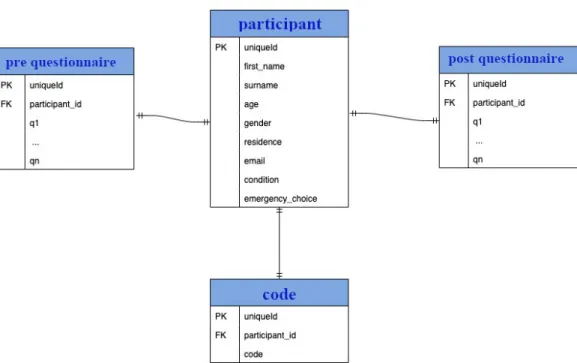
5.6 Entity Relationship Diagram for the database used to store partici-pants’ data while interacting with the storyboard. . . 60
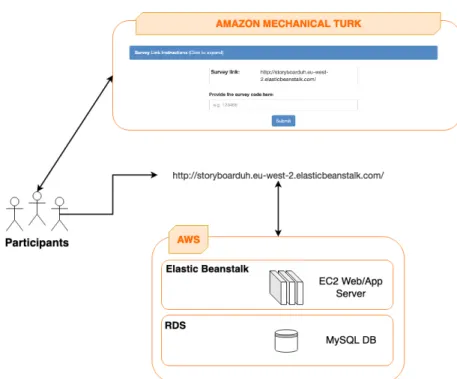
5.7 Overview of the interaction diagram. Participants access to the web application through Amazon Mechanical Turk. The storyboard is provided by setting up a web server and a database. . . 62
5.8 Responses of participants regarding the realism of scenarios and their interaction with the robot. . . 63
5.9 Responses of participants from different conditions to the Emer-gency Scenario. C1: 10 different tasks executed correctly; condi-tionC2: 10 different tasks with 3 severe errors at the beginning and at the end of the interaction; conditionC3: 10 different tasks with 3 severe errors at the beginning and 3 trivial errors at end of the interaction; conditionC4: 10 different tasks with 3 trivial errors at the beginning and 3 severe errors at the ends of the interaction; and condition C5: 10 different tasks with 3 trivial errors at the beginning and at the end of the interaction.. . . 64
5.10 The qualitative analysis of participants’ responses for the reasons why they did or did not trust the robot Jace. Categories are divided by differences in trusting response, positive and negative. . . 68
6.1 Multiple linear regression analysis to predict personalities charac-teristics of the participants based on their perception of the robot they interacted in the experimental conditions they were assigned to. Yellow dots represent tasks with robot’s trivial errors, red dots represent tasks with robot’s severe errors, and green dots represent tasks executed flawlessly by the robot. . . 80
8.1 Pupils are interacting with the robot during the second stage of the study. . . 97
8.2 Questions Q8-Q10: Programming Pepper. Participants used this scale for rating their experience with Pepper during the Robotics Week. . . 104
8.3 A child interacting with the humanoid robot Kaspar.. . . 106
8.4 Questions Q8-Q10: Programming Kaspar. Participants used this scale for rating their experience with Kaspar during the Robotics Week. . . 110
8.5 Comparison of participants’ perception of the robots (Pepper and Kaspar) as home companion after each interaction condition (video, live, programming). Results are categorised by their responses (no, maybe and yes) to have the robots as home companion. . . 112
A. Rossi
9.1 A shot of the interaction between the actor and Pepper. The actor is asking the robot to fetch him a pack of crisps. . . 124
9.2 Participants’ responses to the 8 different sets of social cues were ranked according to their mean perceptions of the robot’s socia-bility. In particular, a lower mean corresponds to a less sociable rating. . . 127
9.3 Correlations between participants’ personality traits and their rat-ings to robot’s social behaviours. . . 130
10.1 The robots Pepper and Care-O-bot 4 funnily arranged as in a conversation by the candidate in UH Robot House. This picture was not part of any study. . . 137
10.2 The robots Pepper (Figure 10.2a) and Care-O-bot 4 (Figure 10.2b) showing a happy expression. . . 139
11.1 Layout of the experiment environment: A participant is interacting with the robot, when a courier knocks at the door of the room they are in. The robot will ask the participant to open the door. After the courier explains his intrusion, the robot will invite the participant to give the package on the green couch to the courier. . . 157
11.2 Summary of the qualitative analysis of participants’ responses for the reasons why they did trust the robot Pepper. Categories are divided by differences in trusting responses, related by the robot, the task or the study. . . 160
11.3 Summary of the qualitative analysis of participants’ responses for the reasons why they did trust the robot Pepper. Categories are divided by differences in positive and negative trusting responses. 162
11.4 Participants’ scores by experimental condition related to: In Figure a) personality traits; in figure b) disposition of trust. . . 163
11.5 Participants’ perception of the robot according the scores of warmth, competence, and discomfort divided by experimental condition. . 165
12.1 Experimental conditions presented to the participants. . . 172
12.2 Examples of participants interacting with the robot during the "Watch a movie" and "Serve a drink" tasks. . . 178
12.3 Examples of the games and robot’s interactions with participants for the "Play a game" task. In Figure 12.3a, the game involved participant using the arrow keys to move a red cube to avoid he falling obstacles (green lines). In Figure 12.3b,the participant is standing in front of the robot playing the game. . . 179
12.4 Examples of the games and robot’s interactions with participants for the "Solve a puzzle" task. . . 180
12.5 Examples of the games and robot’s interactions with participants for the "Lego puzzle" task. . . 181
12.6 Robot House’s map of the experimental area. Participants had access to living room, kitchen and bathroom, while they did not go in the conservatory, the bedroom and the experimenter rooms. In Robot House, there are several robots (including the ones in the pictures). However, they were hidden to the participants in the bedroom during the study. . . 183
12.7 Summary of the qualitative analysis of participants’ responses for the reasons why they did or did not trust the robot Care-O-bot 4. Categories are divided by differences in trusting response, positive and negative. . . 185
List of Tables
1.1 Distributions of research questions across this thesis’ chapters. . . 11
4.1 Participants’ responses to the 20 different scenarios were ranked according to their mean perceptions of the magnitude of the errors. The ’Big Errors’ category groups all the errors rated with mean value greater than 4; the ’Small Errors’ category groups all the errors rated with mean values smaller than 4; the ’Medium Errors’ category groups all the other errors (i.e. those rated as 4). . . 48
5.1 The adjusted standardised residuals of the Crosstabulation between the choices made by the participants in the emergency scenario and the different conditions presented to the participants. . . 65
6.1 The Cross-tabulation between the participants’ disposition of trust and participants’ personality traits: agreeableness, conscientious-ness and emotional stability. . . 74
8.1 Paired samples t-test analysis comparing the means of participants’ responses at Question Q3 according the three different HRIs. For each pair of interactions it shows the t values, p-value correspond-ing to the given test statistic t, the upper and lower bounds of the confidence interval. . . 99
8.2 Paired samples t-test analysis comparing the means of participants’ responses for Question Q4 according to the three different activ-ities. For each pair of activities it shows the t values, p-value corresponding to the given test statistic t, the upper and lower bounds of the confidence interval. . . 100
8.3 Paired samples t-test analysis comparing the means of participants’ responses at Question Q5 according the three different activities. For each pair of interactions it shows the t values, p-value corre-sponding to the given test statistic t, the upper and lower bounds of the confidence interval. . . 101
8.4 Paired samples t-test analysis comparing the means of participants’ responses at Question Q6 for the three different activities. For each pair of activities it shows the t values, p-value corresponding to the given test statistic t, the upper and lower bounds of the confidence interval. . . 102
8.5 Paired samples t-test analysis comparing the means of participants’ responses at Question Q7 according the three different activities. For each pair of activities it shows the t values, p-value correspond-ing to the given test statistic t, the upper and lower bounds of the confidence interval. . . 102
8.6 Paired samples t-test analysis comparing the means of participants’ responses to Question Q3 according to the three different activity experiences. For each pair of activities it shows the t values, p-value corresponding to the given test statistic t, the upper and lower bounds of the confidence interval. . . 107
9.1 Results of ANOVA with single contrasts test with a pairwise com-parison of the participants’ ratings to the robot’s social level in the different videos. . . 128
9.2 Robot’s social behaviours preferred by the participants during ten different scenarios. . . 131
12.1 Negative Attitudes towards Robots Items with Subscales . . . 187
12.2 Participants’ ratings of big and small errors . . . 190
Chapter 1
Introduction
All the world is made of faith, and trust, and pixie dust.
J.M. Barrie, Peter Pan
Robots are beginning to take part in our lives in many different ways, and the in-creasing presence of humanoid and human-friendly robots in daily living activities requires the development of more natural Human-Robot Interaction (HRI). Indeed, autonomous robots are more and more used to assist older people (Monte-merlo et al.2002; Pollack2005; Wada et al.2002) or to interact with children with autism, or assist humans in daily living activities in household situations, such as answering questions, providing information of delivery news, turning on the light, as for support in a kitchen (Stiefelhagen et al.2004).
This prospect opened two main challenges for consideration: people will need to be able to accept the presence of the robot in their living space and they will also need to be able to trust that their robotic companion will look after their well-being without compromising their safety. Indeed, it is really important that humans trust their robot companion to not create a hazardous situation, such as start a fire when trying to make a cup of tea, or an unsafe situation, such as leaving the door open unattended or open the door to strangers - and potential thieves. Humans should be able to wake up in the middle of the night to get a cup of water from the kitchen without worrying about stumbling into the robot and get injured.
Nevertheless, trust is a very complex feeling even between humans, and it can be fostered and enhanced according different factors. In order to identify these factors and create mitigation in case of a lack of trust, this research has been carried out considering different assumptions.
Firstly, HRI researches established that trust has a key role for an effective collabo-ration between people and robots (Ross2008). Indeed, trust affects the humans perception of the usefulness of the information and capabilities provided by the robots (Cameron et al.2015). However, robots can have erroneous behaviours (mechanical, software or perceived), and they, consequently, can affect negatively people’s trust in them.
Secondly, people’s perception of a robot is affected by several factors, including individuals’ differences (or antecedents of trust). The antecedents of trust are characterised by people’s background, intelligence, personality traits, skills and aptitudes are recognised as the most relevant (Williamson2018).
Finally, a natural interaction with a robot permits a greater social acceptance by humans (Kerstin Dautenhahn 2007a; Kerstin Dautenhahn 2007b). Human interactions are based upon natural language (NL), gesture, pose and body language. Natural interaction and communication are complicated mechanisms, however humans easily learn and master the proper linguistic and social skills necessary. A robot should be able to learn and perform these humans modes in order both to provide physical, mental and social support to people, and to support and improve collaborative and cooperative teamwork.
Therefore, these assumptions are used in this thesis to:
• Investigate how people’s trust in a robot changes due to robot erroneous behaviours. In particular, considering that errors can have different conse-quences, and therefore, they might affect people’s trust in a robot in different ways;
• Identify which antecedents of trust affect people’s trust in robots. In partic-ular, I investigated whether people’s trust in a robot that sometimes makes errors is influenced differently according to the individuals’ differences; • Mitigate a loss of trust in a robot due to robot erroneous behaviours by
designing robot’s behaviours that are perceived as natural and social.
1.1
Research Problem
In the not too distant future, autonomous robots will take part in people’s daily living activities. We expect that robots will support humans in everyday tasks in healthcare facilities and hospitals, they will be companions in private homes, assist people in shopping malls, or deliver goods to customers. For example, a home
Chapter 1 A. Rossi
companion robot might provide affective and social aid for people’s with dementia (Liang et al.2017), autonomous robots can be good exercise partners for socially anxious individuals (Yamada et al.2019), they can also help cover wide areas to securely control the borders of a country (Alex et al.2017; Penghou et al.2019), or as shopping assistant in a galleria (Sidorov et al.2019).
These interactions are intended to be developed to function without the intervention of roboticists and expert supervisors. Specifically, they are going to take place in unstructured and unpredictable environments. Robots are machines and they might exhibit occasional mechanical or functional errors. For example, the robot may turn off during a delicate task because its battery was fully discharged without warning, or a robot might unlock the front door to strangers who may be potential thieves. It might not be able to detect an obstacle and tip over, or the arm of the robot might accidentally knock over a porcelain vale while executing a task. In such scenarios, several interaction dynamics can arise: people might lose trust and not rely anymore in their assistance (Steinfeld et al.2006; E. D. Visser et al.2006); they might lose interest in robots and toss them away (M. d. Graaf et al.2017); or they might overtrust their capabilities (Booth et al.2017; Robinette, W. Li, et al.
2016) with possible fatal consequences.
It is therefore important to design and develop a mechanism to mitigate people’s trust in a service robot, in particular in domestic environments. A positive balanced trust, indeed, is fundamental for building a high quality interaction (Atkinson et al.
2014). Therefore, companion robots should have acceptable interactive behaviours when exhibiting and recovering from an error situation.
Most researchers are currently focusing their attention on robot errors of similar nature, whereas each of the mentioned robot errors might be perceived differently according to the resultant consequences. In order to define these behaviours, it is firstly necessary to consider that errors can have different degrees of consequences, and people might judge them differently according their own perception. Factors that influence their perception may include the severity and duration between errors, i.e. the impact of isolated ’big errors’, or an accumulation of ’small errors’. For example, Muir and Moray (1996) argue that human perceptions of a machine are affected in a more severe and long-term way by an accumulation of ’small’ errors rather than one single ’big’ error. But what is perceived as a ’big error’ and what is a ’small error’? People have individual differences, including age, gender, cultural and social habits, which may impact their perceptions of what are considered big or small errors. In order to study the differences in terms of the impact of errors in a human-robot interaction, first I have to establish what people consider subjectively to be ’small’ or ’big’ errors exhibited by a companion robot.
People’s trust in a robot does not depend only on the robot’s performances, but also on their own individual differences. People can differ from each other for their previous experiences, background, age and gender, personalities and pre-dispositions (Williamson 2018). These characteristics often rule their attitude, their way of interacting with others, and their perception of a situation or others. Therefore, researchers expected that people’s interactions with robots also might be affected by their differences. They place emphasis on the impact of these on their trust in robots (Hancock et al.2011). However, it is likely that a person’s antecedents of trust will vary their perception of the different type of robot errors, and consequently a loss of trust might linger differently for different individuals. In order to foster long-lasting relationship between robots and users, it is important to identify which are the factors affecting people’s trust that can be used to create coping mechanisms for robots to mitigate and respond in case of lack of trust in robots. In this direction, socially-aware robots are perceived more positively by people (Kerstin Dautenhahn2007a), in particular, in social context and situations (Rios-Martinez et al.2015), such as home environments. Social robotics systems, therefore, should integrate people’s modes of communication. People communicate between each other using different modalities, including natural language, body gesture, and other form of communicative signals and behaviours linked to cultural and social expectations, preferences and sharing same mental models. Several researchers are trying to develop robots able to interact with social signals to foster trust in robots (Martelaro et al.2016; Alessandra Rossi, Garcia, Maya, et al.
2019; Sebo et al.2019). However, most of these efforts assumed flawless robots behaviours and positive individuals’ attitude towards the robots. Nevertheless, to effectively deploy robots that provide successful collaborative and cooperative teamwork, it is fundamental to consider that robots can be faulty, and consequently people’s predisposition towards them can vary overtime. Indeed, Rossi et al. (S. Rossi et al.2020) claimed the necessity of having a robot capable of self-adapting to satisfy people’s needs (i.e. personality, emotions, preferences, habits), and incorporating a reactive and predictive meta-cognition models to reason about the situational context (i.e. its own erroneous behaviours) and provide socially acceptable behaviours.
1.2
The Approach
In this thesis, I want to explore the factors that affect people’s trust in order to foster an effective and successful cooperation between humans and people in public and
Chapter 1 A. Rossi
private human-oriented environments. Our aim is to create guidelines that allow humans to trust robots that are able to look after their well-being by adopting human-like behaviours.
I want to identify the factors affecting people’s trust in robots, and create appro-priate metrics and mechanisms to develop socially acceptable companion robots. Indeed, the first aim of our research is to understand the effects of robot erroneous behaviours on people’s trust in them. I want to show that the type of an error and the timing in which it happens affect people’s trust in the robot differently. I want to test how people choose to trust a robot according the robot’s performances, the trade-off between risk of failure and possible outcome of a task, but also their pre-dispositions towards robots and other people. The goal is to provide mechanisms to mitigate robot’s errors on people’s loss of trust in order to foster solid long-lasting relationships between humans and robots.
Hence, my first studies aim to identify whether people perceive errors according their magnitude of consequences, and how these errors affect their trust in the robot. I firstly categorised 20 different robot errors according their severity of consequences (small, moderate and severe) using a questionnaire-based study. Then, I used these information to investigate people’s changes of trust in a robot that occasionally made small, big or a combination of both, errors during an interaction. I used an interactive storyboard to study people’s choices of trusting the robot, and understanding how they are affected by people’s age, gender, nationality, personalities traits, disposition of trust and previous experiences with other robots. These results drove me to continue to investigate the correlation between individ-uals’ differences and their trust in the robot. In this direction, further effort was invested in understanding how people’s awareness of robots’ potentialities and limitations affect their trust in robots. I collected the perception of trust of pupils of different groups of school age after gradually increasing their knowledge and awareness of the robot.
The findings of my studies showed me which are the factors affecting people’s trust in the robot. Lack of trust has big impact on the interactions between humans and robots, therefore, a robot should have mechanisms that allows it to recover it. I want to design robots that are able to mitigate a loss of trust, so I tested the effects of robot’s social behaviours on people’s trust. Firstly, I identified which are the social signals in literature that influence people’s perception of a robot as social entity. Then, I rated the social cues for higher impact on people’s perception of sociability in robots. In addition, I investigated the impact of robot appearances on people’s perception of robot sociability. The most relevant social signals that were unequivocally perceived by people regardless of robot’s appearances were
used to observe people’s trust in a robot in three tasks having different criticality of consequences.
Finally, I want to integrate my studies and observations to investigate whether humans’ trust of a robot changes over time if the initial conditions are not anymore the same, i.e. the robot has erroneous behaviours. The study served to investigate if people would trust a robot that broke their trust in a initial or later stage of the interaction.
In summary, the research conducted in this thesis has been carried out to investigate the following main research questions:
RQ-1 How do various types of robot errors affect human’s trust in a robot? RQ-2 Can people’s trust in a robot change diversely according their personal
differences?
RQ-3 Does a robot that expresses social conventions gain more people’s trust in it than a non-social robot?
RQ-4 Does people’s trust on a robot change over time if the initial conditions of trusting the robot change?
1.2.1
Extended research questions
As my research project evolved, the primary research questions were adapted and expanded to fully explore the aspects and implications generated from the literature review.
The resulting research questions will be addressed in this thesis: RQ-1.1 How do people classify errors?
RQ-1.2 Which kind of erroneous behaviours impact a human’s trust in a robot? RQ-1.3 Does the impact on trust change if the error happens at the beginning or
end of an interaction?
RQ-1.4 How does the combination of timing and frequency of trust have any significant impact on trust recovery process?
RQ-2.1 Do personalities and characteristics of humans affect their perception and trust of a robot?
Chapter 1 A. Rossi
RQ-2.2 Does previous experience with robots affect human perception and trust of a robot?
RQ-2.3 Can different levels of awareness of a robot’s potential affect human perception and trust of a robot?
RQ-3.1 Which are social cues people recognise?
RQ-3.2 Do different robot appearances affect people’s perception of a robot? RQ-3.3 Does a robot that expresses social conventions gain more of people’s
trust than those that do not express social conventions?
RQ-4 Does people’s trust on a robot change over time if the initial conditions (positive or negative) of trust in the robot changes?
1.3
Contribution to Knowledge
Investigating people’s trust in robots can be a challenging task, in particular when it comes to identify which are the factors that undermine it, i.e. robots errors. The research presented in this thesis introduces the novel concept that errors made by a robot may have different magnitude of consequences, and, therefore, they will affect differently people’s acceptance and trust in robots. The studies presented in Chapters4,5and6resulted in two conference papers (Alessandra Rossi, Kerstin Dautenhahn, Kheng Lee Koay, and Michael L. Walters2017a; Alessandra Rossi, Kerstin Dautenhahn, Kheng Lee Koay, and Michael L. Walters2017b) and a journal paper (Alessandra Rossi, Kerstin Dautenhahn, Kheng Lee Koay, and Michael L. Walters2018).
The study presented in Chapter5has been conducted with an immersive narrative approach through a crowdsourcing service. This approach allowed us to overcome the difficult challenges of investigating people’s trust in realistic life-threatening scenarios without endangering and distress participants. Another challenge when conducting this type of research is related to the difficulty of designing studies where people interact with a robot that is fully functional and versatile to execute realistic tasks. For example, a robot should be able to manipulate objects, navigate autonomously and being able of converse with users in noisy environments. To the best of my knowledge, such interactive storyboards have not been used in similar large scale studies to investigate HRI.
Another contribution to knowledge relevant for roboticist research community from this thesis is presented in Chapter12. A series of live HRIs have been conducted to investigate whether people’s trust in a robot changes overtime or it is irreversibly affected by a negative initial perception of the robot, i.e. due to robot errors. The findings from this study gave further insight on how trust human-robot relationships develop in HRI.
Further investigations to identify the antecedents of trust have been conducted in Chapter8 which were published in (A. Rossi et al. 2019; Alessandra Rossi, Holthaus, et al.2018a; Alessandra Rossi, Holthaus, et al.2018b).
This research also aimed to provide recovery mechanisms in trust violation situa-tions, many of the novel results resulting from the studies presented in Chapters
9, 10 and 11 have been accepted and presented in (Alessandra Rossi, Kerstin Dautenhahn, Kheng Lee Koay, and Michael L. Walters2020; Alessandra Rossi, Kerstin Dautenhahn, Kheng Lee Koay, Michael L. Walters, and Holthaus2020).
1.3.1
Publications
The research conducted during the project produced several journal manuscripts, conferences’ and workshops papers. I completed them, after the supervisors’ revision and approval, and I submitted for publication. I was supported by my supervisors through feedback and revision meetings during the design, development and evaluation of the studies presented in this thesis. Three published papers have been written in collaboration with other colleagues. I entirely structured and wrote most of the content of these papers. I also supervised and revised the contributions to the papers given by my colleagues.
The following papers are presented as part of this thesis in the relative coming Chapters:
2017 A. Rossi, K. Dautenhahn, K. L. Koay, M. L. Walters, How the Timing and Magnitude of Robot Errors Influence Peoples’ Trust of Robots in an Emergency Scenario. In: Kheddar A. et al. (eds) Social Robotics. ICSR 2017. Lecture Notes in Computer Science, vol 10652. Springer, Cham
2017 A. Rossi, K. Dautenhahn, K. L. Koay, M. L. Walters, Human Perceptions of the Severity of Domestic Robot Errors. In: Kheddar A. et al. (eds) Social Robotics. ICSR 2017. Lecture Notes in Computer Science, vol 10652. Springer, Cham
Chapter 1 A. Rossi
2017 A. Rossi, K. Dautenhahn, K. L. Koay and J. Saunders, Investigating hu-man perceptions of trust in robots for safe HRI in home environments, Human-Robot Interaction Pioneers Workshop in conjunction with the 2017 ACM/IEEE International Conference on Human-Robot Interaction, March, 2017.
2018 A. Rossi, K. Dautenhahn, K., Koay and M.L. Walters, The impact of peo-ples’ personal dispositions and personalities on their trust of robots in an emergency scenario. Paladyn, Journal of Behavioral Robotics, 9(1), pp. 137-154
2018 A. Rossi, K. Dautenhahn, K. L. Koay and M. L. Walters, Investigating human perception of trust and social cues in robots for safe HRI in home environments, International PhD Conference on Safe and Social Robotics (SSR-2018), Madrid, 29-30 September 2018
2018 A. Rossi, P. Holthaus, K. Dautenhahn, K. L. Koay, and M. L. Walters. Getting to know Pepper: Effects of people’s awareness of a robot’s capabilities on their trust in the robot. In Proceedings of the 6th International Conference on Human-Agent Interaction (HAI ’18). ACM, New York, NY, USA, 246-252 2018 A. Rossi, P. Holthaus, K. Dautenhahn, K.L. Koay and M.L. Walters,
Pro-gramming Pepper: What can you make a humanoid robot do?, 3rd Workshop on Behaviour Adaptation, Interaction and Learning for Assistive Robotics -IEEE-RO-MAN 2018, 27 - 31 of August 2018, Nanjing, China
2019 A. Rossi, K. Dautenhahn, K.L. Koay and M.L. Walters, Evaluating the effects of an autonomous robot’s social behaviours on people’s trust. IEEE International Conference on Robot & Human Interactive Communication (RO-MAN)
2019 A. Rossi, K. Dautenhahn, K.L. Koay and M.L. Walters, Investigating human perceptions of trust and social cues in robots for safe HRI, Personal robotics and secure human-robot collaboration Workshop, IEEE ICDL- EPIROB, Oslo, Norway
2019 A. Rossi, S. Moros, K. Dautenhahn, K.L. Koay and M.L. Walters, Getting to know Kaspar: Effects of people’s awareness of a robot’s capabilities on their trust in the robot. IEEE International Conference on Robot & Human Interactive Communication (RO-MAN), New Delhi, India
2020 A. Rossi, K. Dautenhahn, K.L. Koay and M.L. Walters, How Social Robots Influence People’s Trust in Critical Situations. IEEE International Confer-ence on Robot & Human Interactive Communication (RO-MAN), Naples, Italy
2020 A. Rossi, K. Dautenhahn, K.L. Koay, M.L. Walters and P. Holthaus, Evaluat-ing people’s perceptions of trust in a robot in a repeated interactions study. 12th International Conference on Social Robotics (ICSR 2020), Golden,
Colorado
During the project, I have been in two secondments: one research-oriented at SoftBank Robotics in Paris (France), and a training-oriented at Fraunhofer Institute for Manufacturing Engineering and Automation IPA in Stuttgart (Germany). The research carried in SoftBank Robotics brought the publication of the following paper that is not part of my thesis, but played an important role in the research carried out to further understanding the impact of social cues on people’s trust in robot:
2019 A. Rossi, F. Garcia, A. Cruz Maya, K. Dautenhahn, K. L. Koay, M. L. Walters and A. K. Pandey. Investigating the Effects of Social Interactive Behaviours of a Robot on People’s Trust During a Navigation Task. In: Althoefer K., Konstantinova J., Zhang K. (eds) Towards Autonomous Robotic Systems. TAROS 2019. Lecture Notes in Computer Science, vol 11649. Springer, Cham
I also collaborated with the University of Naples Federico II (Italy). The collab-oration brought a publication that is not part of this thesis, but it is based on the knowledge and experiences gained during the project:
2020 S. Rossi, A. Rossi and K. Dautenhahn. The Secret Life of Robots: Perspec-tives and Challenges for Robot’s Behaviours During Non-interactive Tasks. International Journal of Social Robotics. Springer Nature.
Another publication that is not part of this thesis, but based on the knowledge and experiences gained during this project, resulted from the fruitful collaboration with the University of Canterbury (New Zealand):
2020 M. Keijsers and A. Rossi. RoboCup 2050: from human fouls to robot bully-ism. Virtual RoboCup Humanoid Open Workshops (V-RoHOW) (accepted).
Chapter 1 A. Rossi
I also had other relevant collaborations that brought to publications in robotics applications in the Education field.
The results of Chapters 7, 8, 10 and 12 will be submitted to the International Journal of Social Robotics1, and 12th International Conference on Social Robotics (ICSR 2020)2.
1.4
Structure of the Thesis
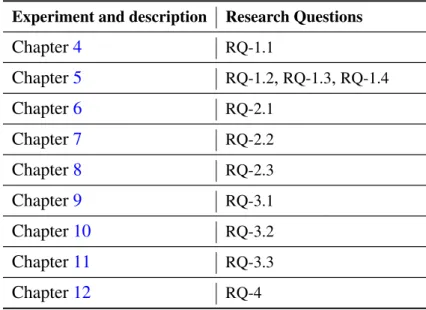
This thesis is organised to answer the research questions presented in Section1.2.1. The studies designed for each questions are presented in the Chapters4-12 as illustrated in Table1.1.
Table 1.1: Distributions of research questions across this thesis’ chapters.
Experiment and description Research Questions
Chapter4 RQ-1.1 Chapter5 RQ-1.2,RQ-1.3,RQ-1.4 Chapter6 RQ-2.1 Chapter7 RQ-2.2 Chapter8 RQ-2.3 Chapter9 RQ-3.1 Chapter10 RQ-3.2 Chapter11 RQ-3.3 Chapter12 RQ-4
Specifically, this thesis is organised as follows:
Chapter2 I give an overview of the current state-of-art of HRI, briefly analysing the human skills application in relation to robots and
1International Journal of Social Roboticshttps://www.springer.com/journal/12369 212th International Conference on Social Robotics (ICSR 2020)https://sites.psu.edu/ icsr2020/
introducing the develop of trust in human and human-robot interactions, with particular focus on the resulting issues and recovery mechanisms in trust violation situations.
Chapter3 In this Chapter, I provided an overview of the software and hardware used for the studies presented in this thesis, including also details of the experimental setups implemented.
Chapter4 This Chapter provides a pre-study to investigate people’s per-ception of severity of different scenarios during which a generic robot makes errors. In this study, participants were asked to rate a robot’s errors according the magnitude of their consequences. The results of this study was fundamental for the planning of the next one. The results of this study were presented at the conference Social Robotics (ICSR) (Alessandra Rossi, Kerstin Dautenhahn, Kheng Lee Koay, and Michael L. Walters2017b).
Chapter5 In this Chapter, I focused on investigating the impact of different magnitude and timing of a robot’s errors on people’s trust in the robot. In this study, participants were tested using a storyboard presenting five different experimental conditions in which the robot made combinations of errors with different magnitude. At the end of each interactions, I evaluated people’s choice of trust-ing or not the robot in an emergency scenario. The results of this study were presented at the conference Social Robotics (ICSR) (Alessandra Rossi, Kerstin Dautenhahn, Kheng Lee Koay, and Michael L. Walters2017a).
Chapter6 Continuing to analysing the participants’ responses collected in Chapter 5, I analyse the effects of participants personality traits and predisposition of trust on their choices of trusting the robot. The results of this study are published in Paladyn, Journal of Behavioral Robotics (Alessandra Rossi, Kerstin Dautenhahn, Kheng Lee Koay, and Michael L. Walters2018).
Chapter7 This Chapter presents more results of Chapter5. In particular, I analysed the effects of people’s previous experience with robots on their choices for trusting the robot.
Chapter 1 A. Rossi
Chapter8 In this Chapter, I focused on how people awareness of a robot’s real capabilities and limitations affected their trust in the robot. This study was conducted in two events as part of the UK Robotics Week in a local primary and a secondary school. The Chapter introduces the robots used in each school, the experi-mental conditions and interactions. Finally, I define three level of awareness, I also present the resulting pupils’ trust in the robots and a comparison between the groups age of the two schools. The results of this study were presented at the 6th International Con-ference on Human-Agent Interaction (HAI) (Alessandra Rossi, Holthaus, et al.2018a), IEEE International Conference on Robot and Human Interactive Communication (RO-MAN) (A. Rossi et al.2019; Alessandra Rossi, Holthaus, et al.2018b).
Chapter9 In this Chapter, I define which are the social cues and behaviours used in literature that increase the social perception of robots and, consequently, people’s acceptance of them.
Chapter10 In this Chapter, I focus on the impact of two robots’ appearances on people’s perception of robots’ social expressions.
Chapter11 Following Chapter9and10, in Study 6 I investigate the impact of social cues on humans’ trust in robots. The results of this study were presented at IEEE International Conference on Robot & Human Interactive Communication (RO-MAN) (Alessandra Rossi, Kerstin Dautenhahn, Kheng Lee Koay, and Michael L. Walters2020).
Chapter12 In this Chapter, I present my last study that focuses on the evo-lution of people’s trust in the robot overtime. The results of this study have been published in the 12th International Confer-ence on Social Robotics (ICSR 2020) (Alessandra Rossi, Kerstin Dautenhahn, Kheng Lee Koay, Michael L. Walters, and Holthaus
2020).
Chapter13 This Chapter summarises the results of my studies, the novel impact of this research on future robotics applications, outlining limitations of current research and future works.
AppendixA In this Appendix, I listed all publications produced during this project.
AppendixesBtoH For each study, I included ethical approvals and questionnaires used for the experiments.
Chapter 2
Background
The more I study, the more
insatiable do I feel my genius for it to be.
Ada Lovelace
In this Section, I give an overview of the current state-of-art of Human-Robot Interaction (HRI), briefly analysing the human social skills in relation to robots and introducing the development of trust in human-robot interactions. In particular, I will present issues related to robots violating human trust and the need of recovery mechanisms for robots to regain the trust of humans.
Reviewing the literature regarding acceptance and trust in HRI, it appears to be a number of open questions that need to be addressed in order to establish effective collaborations between humans and robots in real-world applications. In particular, I identified four principal open areas that should be investigated to create guidelines for the successful deployment of robots in the wild. These areas are focused on: 1) the robot’s abilities and limitations, 2) the individuals’ differences, 3) the dynamics of human-robot trust, and 4) the interaction between humans and robots overtime.
2.1
Trust in Human-Human Interaction
Trust is an interdisciplinary fundamental factor that plays a significant role in interpersonal and economic interactions. Therefore, several studies define the concept of trust in different fields, including in Human (HHI), in Human-Computer (HCI) and Human-Robot Interactions (HRI). Identifying the principal
points associated to the development and preservation of trust between people can guide roboticists to build trustful robots for successful HRI.
2.1.1
Definition of Trust
Simpson (2007; 2007) highlights four core principles that affect trust. First, individuals assess the degree of trust by observing a partner acting unselfishly and supporting the best interests of both the individuals and the relationship. Second, individuals may purposefully create situations to test their partner’s trust. Third, individuals with lower self-esteem may be less trustful of their partner. Finally, the level of trust in short-term or long-term relationships cannot be fully understood without considering the predisposition of trust of all the parties involved in the relationship.
Mayer et al. (2007;1995) established that trust is constructed from a perception of ability, benevolence and integrity.
Human’s trust is also affected by the perception of the risk of the interaction with other humans. The popular poker game is a concrete example to how risk-taking behaviours affect the credibility of a poker player, and thus it is important for all players to develop a good reputation during a game (Billings1995). Deutsch (1958) claims that risk-taking and trusting behaviour are different sides of the same coin, and that a person is willing to take a risk only if the odds of a possible positive outcome are greater than those for a potential loss. Golder and Donath (2004) claim that a good reputation is very important in enhancing trust both in short and long term relations.
Deutsch defines trust as "confidence that [one] will find what is desired [from another] rather than what is feared." (Deutsch1958, p. 148). Although multiple definitions exist, and several previous studies have adopted one of the first defi-nitions of trust (Deutsch1958), there is a convergent tendency (Yu et al. 2017) towards using the definition proposed by Lee (2004, p. 51) "Trust can be defined as the attitude that an agent will help achieve an individual’s goals in a situation characterized by uncertainty and vulnerability". This definition encapsulates the most important factors that can affect Human-Robot Trust: Human-related, Robot-related and Context-Robot-related. Specific human-Robot-related factors include demographics, personality traits, prior experiences, situations awareness, self-confidence, propen-sity of trust and attitude towards robots. Robot-related factors include robot’s reliability, transparency, legibility and predictability of robot’s behaviours, robot’s personality and anthropomorphism, autonomy and failures. Factors related to context comprehend communication modes and shared mental models between
Chapter 2 A. Rossi
people and robots, specific task typology and complexity, and the environment.
2.1.2
Building Trust in Human-Human Interaction
Humans rely on each other everyday for different things and trust plays a key role in this. For example, students may trust their mentors to provide them with reliable information, and travellers trust the pilot to take them to their destination safely. However, trust is a complex feeling (Kramer et al.2003) and it may also be influenced by different internal and external factors.
Internal factors can be based on cognitive and affective foundations (McAllister
1995) which are related to the expectation of reliability of other individual’s actions and behaviours, or to the development of an affection that supports the belief that the involved parts are invested in a common goal (Becker1996; Lewis et al.1985). Emotional foundations also exists because people believe their trusted partner has genuine care and concern for their well-being. Indeed, another aspect to consider in order to build people’s trust is knowing when to apologise. Brooks et al. (2014) demonstrated that, while an apology could be often seen as admission of blameworthiness by the culprit, but it also could be viewed as an expression of regret for an unpleasant event, even when the apologiser is not to be blamed for the situation (e.g. a superfluous apology because it is a rainy day). They demonstrated that superfluous apologies increased trust due to a perception of empathic concern towards the person. However, there can be different factors that can mitigate trust (e.g. insincere behaviour or characteristics of both the apologiser and recipient).
2.1.3
Trust Violation and Trust Recovery in Human-Human
Interaction
Despite people investing a substantial effort in building and nurturing trust in interpersonal relationships, trust can be broken. When there is a breach of trust, people may react very differently (Haselhuhn et al.2010; Schilke et al.2013; J. A. Simpson2007). Some people are quick to forgive while others believe that once the trust is broken, it can not be mended (Slovic 2000). Indeed, it is very hard to re-establish the trust lost between two parties after a breach as there are many different factors that affect the recovery of trust.
Haselhuhn et al. (2010) showed that people who believe in the moral that a character can change over time (called incremental beliefs) are more likely to trust again the person who broke their trust if they show regrets, promise to change and
apologise. While those who do not believe that moral character can change (called entity beliefs) are sceptical in trusting the other person again.
Apologies and offers of penance seem to mitigate the effects of a loss of trust (Bottom et al.2002; H. et al.2004; Schweitzer et al.2006). However, it is more difficult to establish how long a loss of trust will linger in the dynamics of human relationships. Trust of people is not only affected by the characteristics of the persons involved, but also by the type and length of the relationship they have. Moreover, "Will people be more likely to forgive a breach of trust in an earlier or later stage of an interpersonal relationship?" (Schilke et al.2013). Schilke et al. (2013) investigated how certain kind of relationships recover better and faster after a violation of trust and how the timing of the violation affects the recovery. They demonstrated that people in longer relationship re-establish the trust easier than that of a newer relationship. Therefore, it is expected that the trust recovery process will also be easier for people whom have established a longer relationship than those in a newer relationship.
2.2
Trust in Human-Robot Interaction
A task can be successfully accomplished as a team effort between people and robots only if people trust that the robots will protect them and the positive outcome of the task-goal will be achieved. In this situation, the level of trust people have for the robot is directly associated with their perception of the robot’s reliability (Ross
2008).
Hancock et al. (2011) identify 33 factors influencing trust in HRI, grouped within 3 categories and 6 sub-categories. The main categories are: Human-related, such as self-confidence, prior experience with robots and operator workload; Robot-related, such as proximity, robot’s embodiment, transparency, level of autonomy and failure rates; and Environmental, such as communication and team collaboration.
Trust affects people’s perception of the usefulness of the information and capabili-ties of a robot(Cameron et al.2015). The consistency and reliability of a robot’s behaviours can positively affect people’s trust, while erroneous behaviours can lead to a loss of trust. Indeed, the absence or a lower level of trust in a robot can lead a person to intervene or take over control of the task from the robot (Steinfeld et al.2006; E. D. Visser et al.2006). Trust is particularly important in unstructured situations characterised by uncertainty and risk, and in which the current literature gives mixed results. For example, while Garreau (2007) showed that trust can be easily built during a stressful situation. However, a military robot developed by
Chapter 2 A. Rossi
Ogreten et al. (2010) was never used in action because the soldiers never trusted the unexpected movements of the robot.
2.2.1
Robot’s errors
People’s perception of a robot’s reliability depends not only on the ability of a robot to complete a task, but also by its behaviours to reach a goal. Several studies (Honig et al.2018; Lemaignan et al.2015; Short et al.2010) showed that people might consider unexpected and incoherent behaviours, perceived failures, and actual failures as robot errors. Humans may perceive erroneous robot behaviours according to their expectations of a robot’s proper functions (Michael L. Walters et al.2011). For example, a robot that navigates too slowly might be considered having faulty behaviours. Honing et al. (2018) proposed a taxonomy for classifying possible types of robotic failures, also referred as faults (see Figure 2.1). They identified two principal categories of errors: technical failures and interaction failures. Technical failures are considered errors caused by hardware or software problems, which can depend on an erroneous design, communication or processing. In contrast, interaction errors are related to social norm violations, organisational and mental-models faults in the interaction with the environment and other agents, including people.
Bainbridge et al. (2011) found that participants were happy to follow a robot’s instructions to throw books in the trash if the robot was present in the room with them, but not when the robot was not physically in the same room.
Other studies (M. Desai et al. 2012; Munjal Desai et al.2013) showed that the order of presentation of the decreased reliability produces an evident drop in the trust in the robot which can be restored by continuing the interaction. They showed that warning the participants about a drop in the robot’s performance can mitigate the loss in trust.
Wang et al. (2015)’s studies showed that the frequency and significance of errors can impact humans’ trust in an imperfect on-line system. They showed that people are not willing to follow an imperfect robot if the outcomes are severe, and could lead to permanent consequences, e.g. death of the human.
Booth et al. (2017) investigated participants’ responses to a robot’s request to move in a secure-access student dormitory. They conducted the experiment with two conditions: 1) an anonymous robot and 2) a food delivery robot, where both asked to enter the building. They observed that participants were more likely to let the food delivery robot enter the building or in situations when they were in a group.
Figure 2.1: A human-robot failure taxonomy reproduced by Honig et al. (2018).
Robinette et al. (2015) investigated the effects of apologies, promises and addi-tional reasons given by a robot for its errors on participants’ trust in a simulated fire evacuation scenario conducted in a virtual environment. They showed that participants’ trust was repaired if the robot apologised and promised to not repeat the error soon after it made the error but not during the emergency.
Salem et al. (2015) studied human perception of trust in robots, and how willing they are to follow a robot showing faulty behaviours. They showed that no matter how erratic the behaviour of the robots, participants followed the instructions of the robots. Similarly, Robinette et al. (2016) used an emergency evacuation scenario, with artificial smoke and a smoke detector, in which a robot guided a person to an exit, in order to study how willing were humans to follow a robot that had previously exhibit erratic behaviour. Their results indicated that all the participants of the experiment followed the robot’s instruction. In both experiments participants trusted the robots for different reasons. For example, some of them believed it was all staged, others that they were supposed to follow it because they accepted to participate in the experiments.
Both Salem et al. (2015) and Robinette et al. (2016)’s works showed that some participants did believe that they were acting according to the experimenter deci-sions and that their lives where not in danger. Therefore, it is still not clear from