^
UNIVERSITY OF
SURREY
Faculty of Health & Medical Science
School of Health & Social Care
Reliability of peer assessed medicine management Objective
Structured Clinical Examination (OSCE) for pre-registration
nursing students: an explanatory sequential mixed methods
study
By
Allison Wiseman RGN, MSc, BSc (Hons), Dip Nursing
A thesis submitted for Doctorate in Clinical Practice
Faculty of Health & Medical Sciences
School of Health and Social care
University of Surrey
June 2014
© Allison Wiseman
P ro Q u e s t N u m be r: 27750497
All rights reserved
INFO RM ATION TO ALL USERS
The quality of this reproduction is dependent on the quality of the copy submitted.
in the unlikely event that the author did not send a complete manuscript and there are missing pages, these will be noted. Also, if material had to be removed,
a note will indicate the deletion.
uest
P roQ uest 27750497
Published by ProQuest LLC (2019). Copyright of the Dissertation is held by the Author.
Ail Rights Reserved.
This work is protected against unauthorized copying under Title 17, United States Code Microform Edition © ProQuest LLC.
ProQuest LLC
789 East Eisenhower Parkway P.O. Box 1346
statement of Originality
This thesis and the work to which it refers are the results of my own efforts. Any
ideas, data, images or texts resulting from the work of others (whether published or
unpublished) are fully identified as such within this works and attributed to the
originator in the references. This thesis has not been submitted in whole or part for
any other academic degree or professional qualification.
... date
Allison Wiseman
Abstract
Background: The Nursing and Midwifery Council stipulates that medicines
management is one of the five essential skills to be achieved prior to registration.
Nurse education programmes must use robust teaching and learning strategies to
meet this requirement. One strategy in current use is the Peer Assessed Medicines
management Objective Structured Clinical Examination [OSCE]; this approach as a
tool for learning and assessment has not been evaluated.
Aim: The aim of this study is to evaluate the reliability of peer assessed medicines
management objective structured clinical examinations (PAMMO), undertaken in the
simulated practice learning environment.
Methods: Explanatory sequential mixed methods study. Phase 1, sixty six third year
student nurses assessed the safety of peer students medicines management, via
video vignettes, using the PAMMO assessment tool. The efficacy of the PAMMO
assessment was evaluated using the Simulation Effectiveness Tool [SET]. Phase 2
twenty two students from phase one of the study participated in three focus groups
interviews. They discussed the basis for their judgements of safe MM practice, using
the PAMMO assessment tool.
Findings: Phase 1: The PAMMO tool demonstrated satisfactory levels of inter-rater
reliability. Criteria requiring subjective assessment judgements of communication and
caring and global judgements of safety [safe, unsafe, borderline] demonstrated the
lowest levels of inter-rater reliability. The PAMMO increased students learning,
confidence and satisfaction in medicines management. Phase 2: students judgements
of safe medicines management were based upon prescriptive and descriptive
judgement processes
Conclusions: PAMMO offer a reliable learning and assessment strategy for
medicines management. The PAMMO improved students’ self-rated medicines
management learning and confidence. Their assessments of safe MM used intuition,
reflection, peer, systems, research and experiential evidence aided judgement.
Acknowledgements
I should like to acknowledge and thank my supervisors Professor Helen Allan and
Professor Sara Faithfull for their encouragement and constructive feedback during the
final stages of writing this thesis. Furthermore I would like to thank my former
supervisors who have helped me achieve direction and focus in this study.
I would also like to thank my husband, who has patiently watched the dining room
being taken over as my study area and taken our son to many sporting activities, so
that I could study. Also included in my thanks is my very patient son who has guided
his mother through her word processing frustrations and kept her on track when she
had the potential for becoming distracted.
I would like to thank my friends who have continually encouraged my endeavours and
been part of my lived Doctoral experience.
Index
Section Topic Page
Number Statement of originality 2 Abstract 3 Acknowledgements 4 Index 6 1.0 Introduction 11 1.1 Background 13
1.11 Personal and professional drivers for study 13
1.12 Medicines management and student nurses 14
1.13 Assessment of medicines management safety 19
1.14 Medicines management safety 20
1.15 Simulation and learning 21
1.16 Clinical skills acquisition 22
1.161 Medicines management scenario development 26
1.17 Medicines management and student nurses 26
1.18 Objectivity and assessment of clinical skills 28
1.2 Chapter summary 30
2.0 Literature review 32
2.1 Identification of the problem 32
2.2 Aim of review 33
2.21 Literature review question 33
2.3 Literature review methods 34
2.31 Search strategy 34
2.32 Data collection strategy 36
2.4 Review findings 37
2.41 Methodological issues 38
2.5 Exploration of the themes 55
2.51 Medicines management 55
2.511 Integrating medicines management within the pre-registration healthcare curricula
55
2.512 Exposure to medicines management in the practice setting 60
2.513 Supervisory experiences of medicines management 60
2.514 Medicines management adherence 63
2.52 Objective Structured Clinical Examination [OSCE] as an assessment strategy
63
2.53 Assessment tool development 65
2.54 Reliability and validity of assessments 72
2.55 Peer assessment and OSCE 78
2.56 Learning and assessment experience 79
2.6 Discussion 81
2.61 Limitations and strengths of the of the literature review process 81
2.62 Implications of the review 84
2.621 Assessment tool development and design 88
2.622 Assessment method and authenticity of assessment 89
2.7 Chapter summary 93
3.0 Methodology and design 96
3.1 Statement of the problem 96
3.11 Research question 97
3.12 Aim and objectives of the study 97
3.2 Methodology 98
3.21 Philosophical stance 99
3.22 Choice of mixed methods approach 100
3.3 Research design 103
3.31 Sample and sampling method 107
3.311 Sample size and statistical power 107
3.32 Data collection tools and strategies 109
3.321 Peer assessed medicines management OSCE [PAMMO] tool development
109
3.322 Simulation Effectiveness Tool [SET] 110
3.323 Focus group interviews 111
3.4 Data analysis 113
3.41 Data analysis- quantitative 113
3.42 Data analysis- qualitative 115
3.5 Chapter summary 118
4.0 Ethics 119
4.1 Ethical approval 119
4.2 Ethical considerations 119
4.21 Use of video vignettes for data collection 120
4.22 Researcher participation and ethical issues 121
4.3 Chapter Summary 122
5.0 Results- Phase 1 PAMMO and SET 123
5.1 Phase 1 results- the PAMMO 123
5.11 Students demographic data 124
5.2 PAMMO results 125
5.21 Criteria 1- Communication 127
5.22 Criteria 2- preparation for medicines administration 131
5.23 Criteria 3- medicines calculations 134
5.24 Criteria 4- Dispensing the medication 136
5.25 Criteria 5- Drug knowledge 138
5.26 Criteria 6- Administration of medicine 140
5.27 Comparisons of pass/ refer scores between group A & B participants
143
5.28 Comparison of global scores across groups 143
5.3 Results of SET data 145
5.31 Results of SET question exploring the concept of Learning. 146 5.32 Results of SET questions exploring the concept of confidence 147 5.33 Results of SET questions exploring the concept of satisfaction 147
5.34 Reliability of SET data 148
5.341 Reliability of learning subset 149
5.342 Reliability of the confidence subset 150
5.343 Reliability of satisfaction subset 150
5.4 Chapter summary 150
6.0 Findings of the focus group interviews 152
6.1 Introduction 152 6.2 Charting and validating the results from the focus group
interviews
155
6.3 Presentation of the themes arising from the focus group interviews 156 6.31 Medicines management 157 6.311 Safety 157 6.312 Dignified care 162 6.32 Supervision 165
6.33 Peer learning and assessment 169
6.34 The OSCE process 175
6.4 Chapter summary 178
7.0 Discussion interpreting and explaining the results (phase 1) and findings (phase 2) of the study
183
7.1 Introduction 183
7.2 Peer Assessed Medicines Management OSCEs and social constructivism
188
7.3 Peer Assessed Medicines Management OSCEs and the cognitive continuum of decision and iudgement making
197
7.31 Intuition, judgement and decision making 198
7.32 Reflective judgement and decision making 202
7.33 Peer aided judgement and decision making 210
7.34 System aided judgement and decision making 210
7.35 Critical review of experiential and research evidence judgement and decision making
212
7.4 Chapter Summary 213
8.0 Conclusion 219
8.1 Introduction 220
8.2 Summary of the study 220
8.3 Summary of the findings 221
8.4 Strengths and limitations of the study 224
8.5 Implications for practice 228
8.51 Learning and assessment of medicines management in HEI 2228 8.52 Learning and assessment of medicines management in HO 231 8.53 Role of peer learning and assessment in enhancing the
medicines management skills of student nurses
234
8.54 Medicines management OSCEs in a simulated practice setting 237 8.55 Medicines management and making judgements of safe
medicines management practice
238
8.6 Summary of the recommendations for practice and research 241
8.7 The reflexive research journey 242
8.8 Chapter summary. 245
References 247
Bibliography 273
Appendices
1 Glossary of terms 277
2 Essential skills clusters for nursing (NMC, 2007) 279
3 Conceptual map of the integrated literature review process 291
4 Methodology of literature review 292
5 Critique tool (Caldwell et al., 2005) 317
6 Miller’s pyramid of skills acquisition (1990) 318
7 Revised cognitive Continuum of judgement and decision making (Standing, 2010)
319
8 Historical development of mixed methods research 320
g Peer assessed medication OSCE proforma [PAMMO} 321
10 Medicines prescription chart 323
11 Simulation Effectiveness Tool questionnaire [SET] 325
12 Copy of email permitting adaptation of the SET 327
13 Focus group interview plan 328
14 Framework approach to data analysis (Smith & Firth, 2011) 329 15 Visual model of the study’s sequential explanatory design
procedures (adapted from Ivankova, Creswell and Stick, 2006: 16)
330
16 Ethical approval 331
17 Poster advertising the study 332
18 Participants letter of invitation to participate in the study 333 19 Participant information sheet pre-registration student nurses 334
20 Consent form student nurses 337
21 Video 1: PAMMO assessment table comparing group a and group b pass/ refer scores
338
22 Video 1: PAMMO assessment table comparing group a and group b pass/ refer scores
339
23 Video 1: PAMMO assessment table comparing group a and group b pass/ refer scores
340 24 An example of the framework analysis undertaken with the
transcripts for the PAMMO study to identify the emergent themes focus group interview 3
341
25 Stages of reflective judgement 362
26 Research log 364
27 Overview and integration of knowledge research and practice 383
Figures
1 Map of the taught theoretical and practical aspects of medicines management teaching from an HEI’s perspective
12
2 A conceptual map of the factors affecting safe medicines management for student nurses
15
3 Integrated model for skills acquisition 25
4 Data bases searched 35
5 Inclusion criteria for the review 35
6 Key words used for the search 35
7 Further key words applied to the literature search 35
8 Result of the search strategy 36
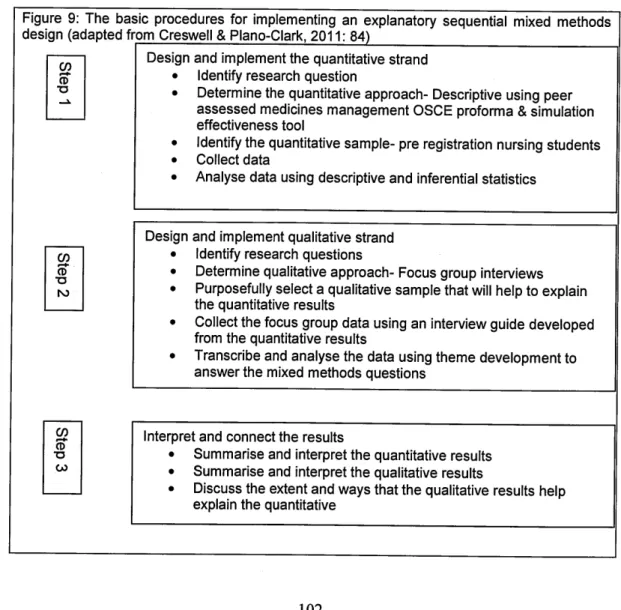
9 The basic procedures for implementing an explanatory design (adapted from Creswell & Plano-Clark, 2011: 84)
37
10 Research Design 102
11 Inclusion criteria for participants 106
12 Sample size calculations for Phase 1 of study 107
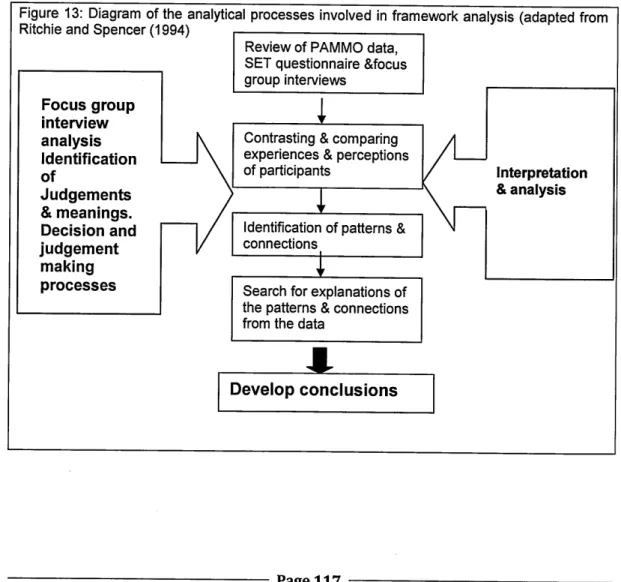
13 Diagram of the analytical processes involved in framework analysis (adapted from Ritchie & Spencer (1994
109
14 Video 1 comparison of group a and group b pass refer scores for PAMMO sub-criteria
117
15 Video 2 comparison of group a and group b pass refer scores for PAMMO sub-criteria
126
16 Video 3 comparison of group a and group b pass refer scores for PAMMO sub-criteria
126
17 Comparison of global scores by group for videos 145
18 Frequencies of responses to the SET questions 148
19 Coing matrix formed from initial data management of interviews 153 20 Seven categories arising from the focus group interviews 154
21 Final themes arising from the focus group interviews 156
22 Conceptual framework explaining how peeer students construct their judgements of peers safe medicines management practice
187
Tables
1 Methodologies of studies in the review 40
2 Synthesis and summary of the competency categories identified in the literature review
52
3 Demographics for participants- gender and years of experience in healthcare prior to nursing studies
124
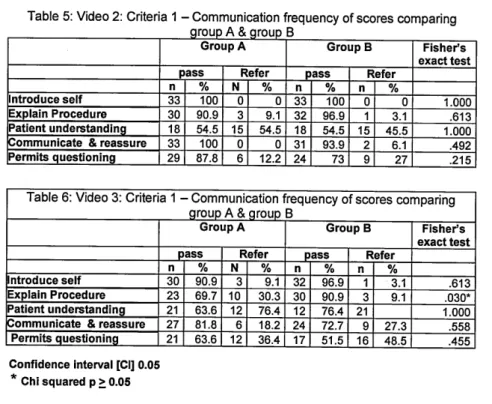
4 Video 1 : Criteria 1 - Communication frequency of scores comparing group A & group B
129 5 : Video 2: Criteria 1 - Communication frequency of scores
comparing group A & group B
130
6 Video 3: Criteria 1 - Communication frequency of scores comparing group A & group B
130
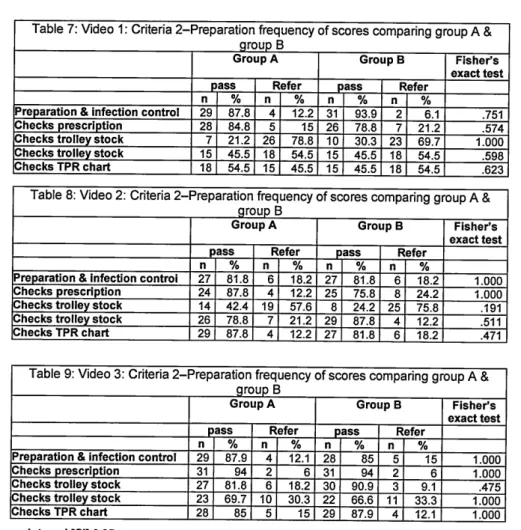
7 Video 1 : Criteria 2-Preparation frequency of scores comparing group A & group B
133
8 Video 2: Criteria 2-Preparation frequency of scores comparing group A & group B
133
9 Video 3: Criteria 2-Preparation frequency of scores comparing group A & group B
133
10 Video 1: Criteria 3 -Medication calculation frequency of scores comparing group A & group B
135
11 Video 2: Criteria 3 -Medication calculation frequency of scores comparing group A & group B
135
12 Video 3: Criteria 3 -Medication calculation frequency of scores comparing group A & group B
135
13 Video 1 : Criteria 4 -dispensing the medication frequency of scores comparing group A & group B
137
14 Video 2: Criteria 4 -dispensing the medication frequency of scores comparing group A & group B
138
15 : Video 3: Criteria 4 -dispensing the medication frequency of scores comparing group A & group B
138
16 Video 1 : Criteria 5 - Drug knowledge frequency of scores comparing group A & group B
139
17 Video 2: Criteria 5 - Drug knowledge frequency of scores comparing group A & group B
139
18 Video 3: Criteria 5 - Drug knowledge comparison of group A & group B scores
140
19 Video 1 : Criteria 6 -medicines administration frequency of scores comparing group A & group B
142
20 Video 2: Criteria 6 -medicines administration frequency of scores comparing group A & group B
142
21 Video 3: Criteria 6 -medicines administration frequency of scores comparing group A & group B
142
22 Video 1 :pass refer scores for PAMMO comparing group A & group B
143 23 Video 2:pass refer scores for PAMMO comparing group A &
group B
143
24 Video 3:pass refer scores for PAMMO comparing group A & group B
143
25 Video 1 global scores comparing group a & b 144
26 Video 2 global scores comparing group a & b 144
27 Video 3 global scores comparing group a & b 144
28 Frequency scores for the learning subset (N=66) 146
29 Confidence levels for all participants 147
30 Frequency scores for the confidence subset (N=66) 147
31 Frequency scores for the satisfaction subset (N=66) 148
32 Table for evaluation of internal consistency (adapted from George and Mallery, 2003)
148
33 Reliability of the SET 149
34 Recommendations for practice and research 241
Thesis part 2 394
1.0 Introduction
This study aims to evaluate the reliability of peer assessed medicines management
objective structured clinical examinations (PAMMO) for student nurses. Peer
assessment involves students assessing the work of other students, either formatively
or summatively for the purpose of learning and assessment (Orsmond, 2011) [see
appendix 1 for glossary of key terms]. As a consequence students’ evaluate their own
learning thereby enhancing their understanding of the objectives for their learning and
assessment activities (Orsmond, 2011). Peer assessment may therefore facilitate the
students’ ability to contextualise their learning and apply this learning to different
contexts, such as clinical practice and the simulated practice setting. Medicines
management [MM] is a skill that student nurses learn within the Higher Education
Institute and the clinical setting, however evidence suggests that student nurses and
registered nurses find learning medicines management problematic (Lim, Honey,
2006). This may impact upon how student nurses demonstrate the assessment and
decision making skills for safe medicines management.
The PAMMO evaluation will be conducted in the simulated practice learning
environment using video vignettes and will include exploring with the peer students
how their judgements of safe medicines management practice were made.
Safe MM by student nurses and qualified nurses in healthcare practice is mandatory
(Department of Health, [DH] 2000). Medicines management errors cost the United
Kingdom (UK) National Health Service (NHS) an estimated fifteen million pounds a
year in litigation (Patient Safety Committee, 2009). Additionally McBride-Henry and
Foureur, (2006) suggest they directly impact on patient morbidity and mortality. The
causes of medicines management errors vary with some errors arising from
deficiencies in the educational preparation of nurses for medicines management
(Courtenay, 1991; Bullock and Manias, 2002). Although education has a key role in
---developing care that is of a high quality and safe (Francis, 2013: Mansour, 2012;
Pearson, Steven, 2009) there remains a need for a curricula focussing on patient
safety (Mansour, 2012).
The education and training of student nurses is a partnership process between Higher
Education Institutes [HEI] and Healthcare Organisations [HO] (Primary Care,
Secondary Care, Independent and Voluntary Care Organisations). The students are
supported in their learning and assessed by qualified nurse mentors in practice.
Evidence suggests that every mentor may not be competent in medicines
management (Lim and Honey, 2006). Hence some mentors may ineffectively role
model the decision making processes required for safe medicines management [MM].
Effective teaching and assessment of student nurses in MM contributes to patient
safety (Manias and Bullock, 2002). MM learning experiences take place in a range of
environments including lecture theatres, classrooms, simulated and clinical practice.
Crucial to the efficacy of this learning is the integration of the theory of MM
(bioscience, pharmacology and law and ethics) with the practical skills MM (see figure
1 for a map of the theory teaching and the practical aspects of medicines
management from an HEI’s perspective).
Fiqurel: Map of the taught theory and practical skills of medicines m anagem ent teaching from an H E I’s perspective
Taught theoretical input
• Bioscience
• Law & ethics
• Policy and guidelines
• Pharmacokinetics &
pharmacodynamics
• Drug groups in health
& disease • Documentation • Numeracy Practical skills • Simulated clinical learning experiences • Simulated medicines administration • Learning in practice • Mentor support Page 12
This integration suggests that MM should be assimilated across curriculum and
supported by students’ consistent exposed to safe medicines management in their
practice learning with their mentors.
Integrating MM across the undergraduate pre-registration curriculum may address the
reasons for errors in MM involving student nurses, identified by Courtenay (1991),
Manias and Bullock (2002) and Evans (2009). Evans (2009) explains these may also
occur due to deficiencies in student nurses numeracy skills, supervisory support in
practice, lack of adherence to procedural guidelines and assessment strategies for
medicines management that do not reflect the realities of MM in clinical practice The
next section will identify the rationale for the choice of topic area and background
information. This will include clarifying key terminology, such as medication error and
error management.
1.1 Background to the study
1.11 Professional and personal drivers for the studv.
This topic has been chosen due to the recent increased emphasis placed upon safe
MM by the Nursing and Midwifery Council (2005) and the General Medical Council
[GMC] (2011). Both the NMC (2005) and GMC (2011) have highlighted their concerns
regarding the educational preparation of students for medicines management. These
concerns reflect work by the National Patient Safety Agency (2004) identifying how
making medicines management safer within the National Health Service [NHS] makes
patient care safer. Subsequent documents by the NPSA (2006; 2007) have advised
how the process of medicines management can be made safer by improving the
competence of the healthcare workforce in MM. Indeed the NMC (2010b) have
reviewed and revised the “essential skills clusters” for nurses clearly identifying
medicines management as one of the five essential skills for nurses to achieve for
registration [see appendix 2]. The skills clusters identify stages for the development of
student nurses MM skills for each of the three years of training and for registration.
Currently this author is a nurse educator in an HEI who teaches and assesses the
theory and practice of pharmacology, to pre-registration and post-registration nursing
students. This includes developing simulated learning and assessment activities to
advance students’ MM skills away from the patient’s bedside. This topic has also
been chosen due to this author’s previous experiences of MM as a senior nurse in
critical care and her current role as a staff nurse in a large medical assessment unit in
an NHS Foundation Trust. All of these roles require that this author is accountable for
supporting and assessing the development of student and registered nurses MM
skills.
Informal student feedback to this tutor following students MM learning and
assessment exercises indicate that students find learning pharmacology difficult and
want more time for MM within the curriculum. Sulosaari et a/.’s, (2010) literature
review exploring registered nurses perceptions of MM teaching and learning supports
these views. Sulosaari et al. (2010) identified that registered nurses’ negative
perceptions of MM curriculum delivery arose from deficiencies in the learning and
assessment of medicines management as pre-registrants. Consequently Sulosaari et
al. (2010) proposed that the integrated approach to MM learning and assessment,
briefly introduced in 1.0, may address these perceptions.
1.12 Medicines management and student nurses.
MM by student nurses must be performed under the direct supervision of registered
nurses and mentors (Nursing and Midwifery Council, [NMC] 2010a). Mentors are
healthcare professionals, who have been registered for one year or more, and been
selected by their employers to undertake mentor training. The mentor training
requires them to meet the standards for the supervision and assessment of student
——---nurses in practice set by the NMC (2010a). Mentors have joint accountability with
HEIs for making the decision that a nursing student has met the outcomes for
progression to the next stage in their training and if they are “sign off mentors”, for
registration (NMC, 2010a). Mentors need to be able to make effective judgments of
the knowledge, skills and professional attributes of student nurses in practice and this
includes safe MM.
Despite the NMC’s (2010) directive for the direct supervision of student nurses’
medicines management in practice, evidence suggests that students may
unknowingly participate in MM errors (Harding, Petrie, 2008; Wolf et al., 2006; Wright
2010). This evidence raises concerns about the supervisory processes student
nurses experience in practice and the training they receive in MM at the HEI (see
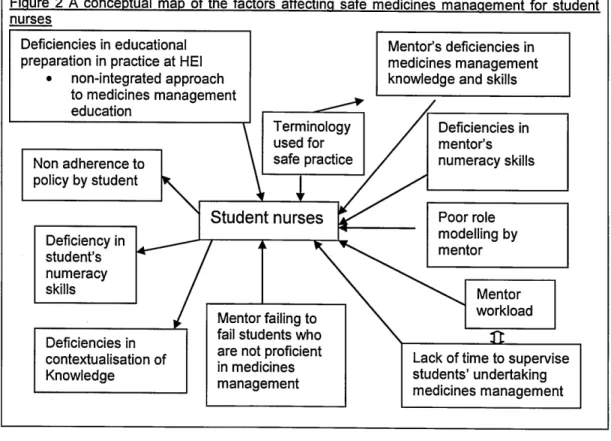
Figure 2).
Figure 2 A conceptual map of the factors affecting safe medicines m anagem ent for student nurses i I Mentor workload Student nurses Terminology used for safe practice Non adherence to policy by student Deficiency in student’s numeracy skills Poor role modelling by mentor Deficiencies in contextualisation of Knowledge Deficiencies in mentor’s numeracy skills
Lack of time to supervise students’ undertaking medicines m anagem ent Mentor’s deficiencies in medicines management knowledge and skills
Mentor failing to fail students who are not proficient in medicines management Deficiencies in educational
preparation in practice at HEI
• non-integrated approach
to medicines management education
The NMC (2010a) and other authors such as Myell et al. (2008) highlight the pivotal
role mentors have in developing students’ proficiencies in MM. Without valid and
reliable assessments of the student nurses MM practice patient safety may be
compromised.
Professional and Regulatory bodies concerns regarding the training and assessment
of pre-registrants in MM are not unique to nursing. Historically the NMC (2005) and
the General Medical Council (GMC, 2011) have expressed their concerns regarding
the MM skills of registrants (see 1.2). The NMC (2010b) have published “essential
skills clusters” for pre-registration nurse education to address these concerns, with
MM being one of the 5 essential skills for safe nursing practice (NMC, 2010b) [see
appendix 2]. The “essential skills clusters” identify achievement benchmarks for
student nurses MM throughout their training. One criticism of the skills clusters is the
broadness of these benchmark statements as they do not specify how assessments
of MM proficiency will be undertaken. Similarly the assessment tools to be used are
not clearly articulated. Consequently variations in the reliability and validity of the
assessment of student nurses MM may arise from variations in the assessment
processes and tools used between HEIs’ and HOs’. These national variations may
support the need for a single MM assessment tool and process to assure safe
practice.
The use of broad benchmark statements for the assessment of student nurses’ MM
skills and knowledge is not unique to the UK. Similar issues are also evident in
benchmark statements from international bodies, such as the International Council of
Nurses (ICN, 2002), the Clinical Excellence Commission [Australia] (2007) and the
World Health Organisation (WHO, 2004). It is clear that safe MM where risk is
reduced, effectively managed and assessed is a complex phenomenon. By failing to
provide robust, commonly agreed processes and tools for the assessment of student
—---nurses’ MM proficiency, professional bodies and nurse educators may be increasing
the potential for risk. It is imperative that the assessment processes and tools used
are clear and understood by mentors, students and nurse educators. This will aid the
justification of assessment decisions of proficiency and competency in medicines
management.
Competency in nursing is recognised by Axley (2008) to directly impact on safe
patient care. Whilst the NMC (2007) require that student nurses demonstrate
proficiency in the “essential skills” they also identify that student nurses demonstrate
competence for registration, as a nurse. The terms competency and proficiency are
commonly used within healthcare yet they are poorly defined (Cowan, Norman,
Coopamah, 2005; Epstein, Hundert, 2002). The perceptual confusion over the term
competence may have arisen from the different authors interpretations of the term
competence. Benner (1982) suggests competency is “the ability to perform a task with
desirable outcomes under varied circumstances in the real world” (p.304) whereas
Gonci, Hager & Oliver (1990) propose it is 'A combination of attributes enabling
performance of a range of professional tasks to the appropriate standards.'
(p.62).These differing views may suggest there is a duality in terminology based
within the behavioural construct (being able to perform the task) and the
psychological construct (cognitive, affective and psychomotor skills) of learning
(Cowan, Norman, Coopamah, 2005; Girot, 1993). Indeed competency is viewed by
both Benner (1984) and Dreyfuss (1986) as lower in the hierarchy of expertise than
proficiency which suggest that nurses may be competent but not proficient. This may
make the assessment of practice problematic for mentors. This dichotomy for the
assessment is illustrated in the NMC’s (2007; 2010b) interchangeable use off the
terms competency and proficiency where competency describes “the skills and ability
to practise safely and effectively without the need for supervision” (NMC, 2010b), yet
medicines management for student nurses must be performed under the direct
---supervision of a registered nurse (Dolan, 2003). This lack of clarity may make it
problematic for mentors to effectively judge students’ performance or the potential for
the student to perform MM safely.
The confusion over terminology also extends to the language used to describe errors
in practice. Terms such as error, failure, near miss, violation deviation and adverse
drug reaction are used interchangeably. This multifactor use of terms creates a
potential barrier to error recognition and reporting (Lisby et al., 2010). The variations
in terminology may also reflect the complexity of the interrelationships between
different definitions for adverse drug reactions [ADRsj. These are identified as: a.
ADRs not arising from errors; b. ADRs arising from errors; c. medication errors not
resulting in ADRs; d. medication errors not causing ADRs (Aronson, 2009).
Reclassifying them into: a. knowledge based; b. rule-based; c. action based; d.
memory based errors, may afford greater clarity for nurses including nursing students
(Ferner, Aronson, 2006).
To date, the practical assessment of MM competence has taken a behavioural
approach, which may reflect the behavioural construct discussed earlier when
exploring the term competency. This behavioural approach focuses on the
psychomotor skills of MM and adhering to the “five rights” (right patient, drug, time,
dose, route) of MM, not the knowledge base and decision making skills supporting
safe MM. As a consequence assessment by the mentor may be invalid and unreliable
as the knowledge, skills and attitudes required for safe MM may not be adequately
assessed. Potentially this may widen the perceived theory practice gap in MM
articulated by Lim, Honey (2006) and Watson et al. (2002) identifying that student
nurses are unable to integrate the theory and practice of MM.
An integrated approach to students’ MM learning and assessment is required. This
must encompass the knowledge, skills and attitudes required for safe MM, hence
---—---addressing the cognitive affective and psychomotor domains of MM learning and
assessment. An integrated approach to MM may enable students to make the
conceptual links between the knowledge of MM, such as pharmacology, policies and
standards; the skills of MM, such as the psychomotor skills and drug calculations and
the critical thinking and decision making required for safe practice (McMullan et al.,
2003; Sulosaari et al., 2011). Although McMullan et al. (2003) and Sulosaari et al.
(2011) suggest the potential that holistic and integrated learning and assessment of
MM has to enhancing the skills, knowledge and thereby safe practice of nurses there
is little evidence supporting it.
1.13 Assessment of medicines management safetv.
Improving MM safety through assessments of the competence and/ or proficiency of
healthcare staff remains challenging and raises questions such as, who assesses,
how often should assessments be undertaken, how valid and reliable are existing
assessment tools?
The NMC (2010b) are clear on who assesses, for example the qualified mentor (see
figure 2). The NMC (2010b) have also set assessment points for the numeracy skills
required for MM assessments in practice (see appendix 2). Good assessment
practice suggests one off assessments lack reliability, as skills performance may
deteriorate over time (Nicklin, Kenworthy, 2008). Mentors and nurse educators
should continuously assess student nurses performance in MM across the pre
registration programme using a range of strategies, such as direct observation,
questioning and reflection (NMC, 2010b). Accountability for the effective assessment
of student MM proficiency rests with mentors, nurse educators and the students
themselves (NMC, 2010b) Additionally this accountability should emphasise the skills
of assessment (self, peer, formative and summative) and feedback (Sulosaari et al.,
2010).
---—---1.14 Medicine management safety.
As discussed in 1.0 and 1.12 unsafe MM may arise from a variety of sources [see
figure 2]. As explored in the last section, responsibility for the educational preparation
of student nurses for MM rests with the HEI, HOs’ and the student. To demonstrate
safe MM student nurses need to be able to apply the knowledge skills and attitudes
for the delivery of safe MM at the point of care. The delivery of safe MM, at the point
of care, also requires students to effectively manage the organisational issues
influencing their learning and assessment in practice, without this student nurses may
participate in unsafe MM (Murphy 2012). This section of the thesis will develop the
discussion on the “drivers” for safe MM presented in 1.1 to facilitate deeper
understanding and insight into this complex topic and how it may affect student
nurses’ medicines management learning and assessment.
Section 1.1 identified that the number and costs of medicines management errors are
rising, however this may not be a true reflection of the status of MM errors, as many
remain unreported (Gregory, 2007; National Patient Safety Agency [NPSA], 2010).
The non-reporting of MM errors may arise from a number of sources including the
lack of professional accountability of the person committing the error. This lack of
accountability may arise from the individual’s perception of their role within the HO,
the MM knowledge and skills gap of the healthcare professional, organisational
factors and fear of the consequences of reporting errors (Hartnell et al., 2012; NPSA,
2004). Hartnell et al. (2012) proposed that making the existing systems for MM error
reporting and management easier to use and providing training and education for
healthcare professionals may improve MM error reporting. Arguably this training must
include student nurses, as students may be unable to demonstrate safe medicines
management if they cannot identify the potential for errors and manage them.
A further risk reduction strategy within HOs’ has been the introduction of MM
competency assessments for new and existing registered nurses to address poor MM
practice and deficiencies in numeracy skills (NMC, 2010; Wright, 2010). From the
NMC’s perspective (2010b) the standards for medicines management have been
reviewed in response to the “medicines management framework”, introduced in 2003
by the Secretary for Health and the NPSA (2004) “safety in doses - improving
medication safety”. Each of these documents provides broad benchmark statements
for medicines management to manage and reduce risk. However the benchmarks do
not specify how they are to be achieved and are, therefore, open to individual
interpretation by different HOs.
The NPSA (2010), in response to the Parliamentary Safety Health Committee (2009)
recommendations for new educational strategies to reduce risk, proposed the use of
simulation to train healthcare staff to manage, identify and effectively respond to
untoward incidents such as medication errors. Simulation can be undertaken in a safe
and supportive learning environment away from the patient care situation (Eppich et
al., 2011 ; Kneebone, 2005). The simulated practice setting permits the replication of
actual adverse patient incidents involving MM allowing staff to gain confidence and
competence medicines management error identification and management
(Kenaszchuk, 2011). Potentially simulated practice learning [SPL] may develop and
enhance the critical thinking, clinical decision making and clinical judgement skills of
student nurses (Dracup and Bryan-Brown, 2004; Dreifuerst, 2009; Raisbeck, 2012).
1.15 Simulation and learning
If the simulated practice setting is going to be used for MM learning and assessment it
must offer an authentic learning experience (Koper, 2005). Without this authenticity
students may not be able to make the conceptual links between the theoretical and
practical elements of their learning. Hence they may not be able to develop the
---knowledge and skills required for safe and competent practice (Benner, 1994; Koper,
2005; Kneebone et al., 2004).
The value of including simulation, in curriculum design within healthcare, for a
capable and competent workforce, is essential for the delivery of safe patient care
(Fraser, Greenhaigh, 2001). The NPSA (2010) recognises the contribution that
learning from adverse incidents, away from the patient interface makes to safe
practice. Simulated practice learning [SPL] engages learners in active learning,
thereby developing their psychomotor, cognitive and affective skills (McConville,
Lane, 2006). SPL embraces the scientific and interpretative stances of learning and
assessment using a holistic approach to the acquisition of clinical skills, such as MM,
based upon authentic learning and assessment experiences (Bradley, 2006; Dent,
2002). If educators do not provide simulated MM learning experiences that are holistic
and authentic, which guide students’ development of MM skills, Gaba’s (2004) view
of simulation as a technique not a technology may not be achievable.
1.7 Clinical skills acquisition.
The factors affecting students’ acquisition of clinical skills using SPL are well
documented (Maran, Glavin, 2003). Gaba’s (2004) work identifies that simulation is a
technique which requires an effective balance between the fidelity, or realism, of the
experience and the equipment to facilitate skills acquisition (Alinier et al., 2004). High
fidelity Human Patient Simulators (HPS) (patient mannequins which have chest wall
movement, eye opening, papillary reactions, palpable pulses and physiological
responses to interventions) are reported to help students’ contextualise their learning
experiences, due to the realism and fidelity they afford. Other options for the delivery
of SPL include simulated patients (actors), low fidelity (mannequins unable to
simulate all the features of the HPS), part task training (such as urinary
catheterisation trainers and demonstrations (Henneman et al., 2010). Regardless of
---the simulation medium used ---the must accept responsibility for ---their own learning, for
the learning experience to be successful (Schwirth, Van der VIeutin, 2003).
Skills acquisition can be understood as a complex matrix for skills development
(Lammers et al., 2008). It forms a continuum of development starting at replication
and potentially ending at unconscious action. However unconscious action may be
problematic and result in judgement errors arising from the emphasis placed upon the
speed of performance. Consequently deficient self-monitoring and self-regulation by
the practitioners may result in judgement errors (Adams, 1971; James, 1980; Reason,
1990). Safety may also be compromised due to the competing demands of patient
care and student supervision (see figure 2). Earlier the role of simulation in enhancing
the error recognition and management skills of healthcare staff was explored. Error
recognition and management require staff to self-monitor their practice as part of the
self-assessment process. Figure 1 mapped the taught elements of MM, student
nurses need to interpret and translate this knowledge and understanding to transfer it
to the world of clinical practice, in other words re-contextualise it (Evans et al., 2010).
The re-contextualisation of MM knowledge and skills is not solely requisite on the
student. Evans et al. (2010: 246) argue that re-contextualisation occurs in four
interrelated domains “content, pedagogical, workplace and learner”. Content and
pedagogical re-contextualisation refers to the curriculum design process and the
learning environment. However the curriculum design process and the learning
environment are intrinsically linked to learning in the workplace and the sense
learners make of their learning processes (Evans et al., 2010). Earlier in this chapter
(1.0) this author presented the evidence supporting the need for an integrated
approach to MM learning and assessment. Re-contextualisation of MM learning and
assessment needs student nurses to be able to socially construct, or make sense, of
the skills or behaviours associated with safe MM practice. Hence they need to be able
---to demonstrate and apply their learning within: a) the cognitive (law, ethics,
pharmacokinetics, pharmacodynamics, bioscience, numeracy skills and policies
guiding safe MM); b) the psychomotor domain (the skills of MM) c) the affective
domains of learning (the care and communication skills) for safe MM practice.
In addition central to the skills of MM is the conceptual understanding of the skill itself,
which must be developed in conjunction with the problem identification and solving
skills required for MM error recognition and management (Lim, Honey, 2006). The
simulated practice learning environment [SPLE], as identified in 1.13 and 1.14,
permits mistakes to be made and rectified away from the patient interface where
student nurses can apply their MM knowledge and understanding (Wooley, Jarvis,
2006).
An integrated model for skills acquisition (see figure 3), using MM scenarios across
and within the curriculum, developed with expert practitioners may address students
and registered nurses concerns about the current delivery of MM learning. MM
curricular should integrate learning and assessment strategies across and within the
student curriculum. Furthermore it should facilitate the development of the knowledge
skills and attitudes required for safe MM practice. These may include the problem
solving, reflection, critical thinking, decision and judgement making skills required by
the NMC (2010) for registration as a nurse. Such skills and knowledge may involve
the use of simulation, role modelling and experiential learning, incorporates the
affective psychomotor and cognitive domains of learning. This may enable students to
re-contextualise their medicines management learning and apply this across different
learning environments including the SPLE and clinical practice.
Figure 3 Integrated model for skills acquisition
L
E
A
R
N
I
N
G
RwHclency
Cognitive ^R^lection domain Critical Role thinking Modelling Communication skillsCues Facilitation Complexity
Scenario developm ent
Debriefing Scaffolding Objectives
X Judgement Decision making Problem solving Affective domain Experiential learning --- / Psychomotor domain Articulation Self confidence
X
A
S
S
E
S
S
M
E
N
TompetencY
Learning and assessment must not be viewed as separate educational processes;
they should be integrated throughout the educational program so that student nurses
perceive their MM learning and assessment as meaningful. This will enable students
to assimilate their MM learning and assessment at university to practice. They need to
reflect on and in their practice to develop their proficiency, self-confidence,
communication skills and articulation the rationale for their MM decisions; this may
decrease the perceived theory practice gap.
1.161 MM scenario development
MM scenario development for SPL requires evidence based objectives. These should
be developed in conjunction with experts from practice and students, to facilitate
understanding of how simulated learning, assessment and theoretical comprehension
link to the evidence base supporting the practice of MM (Zunzarren, Rodriguez-
Sedano, 2011). Simulated patient presentations of varying levels of complexity must
be developed to aid the contextualisation of real world practice (Gaba, 2004).
Students’ must critically reflect on their practice so that potential judgement errors can
be addressed away from the patient interface, without this they may not develop the
clinical decision making, problem solving, error recognition and management skills
required for registration as a nurse (NMC, 2010b). Assessments of safe practice must
include multi-method assessment strategies, such as Objective Structured Clinical
Examination [OSCE], to address the need for the effective assessment of student
nurses (Dent, 2002).
1.7 Medicines management assessment and student nurses.
The assessment strategies used by nurse educators and mentors to assess the
proficiency of student nurses have evoived in the last four decades (Cowan et al.,
2005). Accordingly mentors’ accountability for making valid and reliable judgements of
students’ proficiency in practice have been emphasised by the NMC (2008b).
The challenge for nurse educators and mentors is the objective assessment of
student nurses’ practice proficiency in a complex and rapidly changing healthcare
delivery system (Norman et al., 2007; Redfern et al., 2002). Assessing students’
practice proficiency is not only of international concern to nursing, but includes other
practice based disciplines, such as medicine, dentistry and teaching (Whiteford,
2007). Professionally mentors and assessors are responsible for gate keeping their
professions by assuring professionai bodies that students are proficient to enter the
:---professional register. Potential flaws in gate-keeping the :---professional register have
been highlighted from ongoing concerns about the veracity of mentors' assessments
of student practice, where mentors have failed to fail nursing student which may put
patient’s safety at risk (Duffy, 2003; Luhanga et al, 2008).
Failure to fail is complex and external factors to the mentor student relationship may
compound this. External factors such as the mechanisms and support available for
mentors may affect the mentors’ ability to make valid and reliable judgements of
students’ safe practice (Gainsbury, 2010). Although Hunt et al., (2011) identify there is
a mismatch between students’ theoretical [examinations and assignment] and
practice failure [inability to meet levels of proficiency for their stage of learning] they
do not identify how these variations relate to MM. This may support the notion that all
registrants may not be proficient at the point of registration. This is however difficult to
quantify, as the NMC (2011) do not clearly differentiate between new registrants and
existing registrants in their “annual fitness for practice reports”.
To address these concerns Objective Structured Ciinical Examinations [OSCEs]
conducted in the SPUE have gained prominence in nurse education, due to the
perception that they offer a more objective approach to assessing clinical practice
(Redfern, Norman, 2002). The OSCE may offer an assessment framework that
addresses the cognitive, affective and psychomotor domains of learning. Furthermore
the knowledge, attitudes and beliefs that underpin practice (critical thinking, problem
solving, team working and communication skills) may also be assessed (Girot, 1993;
DeFloor et al., 2006). Although this infers that OSCEs objectively assess students’
performance, critics suggest their reliability as an assessment method lacks true
objectivity due to the potential sources of error arising from differing learning
experiences and assessment procedures across organisations (Reznick et al., 1998;
Turner, Dankoski, 2008). Further evidence suggests their objectivity may be
---enhanced through the development of authentic assessment experiences, validated
assessment tools and robust assessment processes (Zunzarren, Rodriguez- Sedano,
2011). Further research is required to identify their best use for assessing essential
clinical skills. This must include the development of evidence based assessment
tools, incorporating both criterion and global ratings of performance, developed in
conjunction with healthcare practitioners (Val Waas etal., 2001).
1.18 Obiectivitv and the assessment of clinical skills.
Earlier in this thesis it was identified that assuring the objectivity of assessments of
clinical skills is potentially problematic, due to differences in procedural guidelines and
disciplinary competencies globally and nationally. An example of this can be seen in
guidance produced by the Nursing and Midwifery Council (2004; 2010b) and the
Health Care Professions Council (HCPC, 2007) which state the criteria for the
assessment of clinical skills, for progression and registration, but do not explicitly
state the assessment methods and procedures to be adopted. Potential variation in
assessment methods and procedures may generate variations in the capability of
practitioners at the point of registration across HEIs.
The current lack of a national assessment tool for MM, amongst other skills, raises
the question “How can the complex repertoire of skills required for safe and effective
health care practice be assessed and achieved, as a national standard?” Norman et
al., (2007) suggest that a “one size fits all approach” may not offer the required levels
of sensitivity needed for uni-disciplinary and interdisciplinary healthcare practice.
Although multi-method assessment strategies (examinations, assignments, portfolios,
practice assessments and OSCEs), based upon best practice assessment criteria,
may be more efficacious an integrated assessment tool may offer more objectivity
(Norman et al., 2007). Integrated assessments will facilitate the evaluation of
students’ scientific knowledge, psychomotor skills, attitudes, professional behaviour,
---—---problem solving and decision making skills, required for safe patient care, through
clinical encounters in clinical practice or the simulated practice learning environment
[SPLE] (Feeley et al., 2003). Subsequently higher levels of internal consistency may
be achieved, which may address criticisms of clinical skills assessments in clinical
practice and SPLE (McCallum, 2006).
Assessment skiils are required by student nurses in their practice role. Students find
assessment and the assessment process challenging and stressful, according to Burr
(2003), Midgely (2006) and Norman (2012). Effective briefing and debriefing before
and following assessment activities may help address these concerns (Norman, 2012;
Fanning, Gaba, 2007; Nicklin, Kenworthy, 2008).
Assessments of practice skills are termed as summative or formative and may involve
the mentor, nurse educator, self or peer assessment (Nicklin, Kenworthy, 2008).
Although self and peer assessment have the potential for bias, each type of
assessment has its place in supporting students’ learning (Orsmond, 2011).
Peer assessment is suggested to facilitate the development of higher leveis of
cognitive thinking, where students can internalise their own strengths and
weaknesses thereby becoming active independent adult learners (Van Zundert et al.,
2010). Consequently peer assessment maybe one of a range of assessment
strategies used to assess proficiency in clinical skills (Boulet, 2008; Epstein, Hundert,
2002).
has received increased prominence in the training and education of heaithcare
professionals, yet there is little evidence evaluating the value of MM assessment in
simulated practice [SP] or clinical practice to patient safety. The NPSA (2010) views
SPL as an effective learning strategy for error management and reduction. Research
---is needed to evaluate peer assessed OSCE’s as a strategy for developing and
assessing pre-registration nursing students’ MM skills. Additionally there is a need to
explore how students make judgements of safe MM practice and whether the
judgement processes of students and registered nurses are different. This may
facilitate nurse educators and HOs’ understanding of student nurses’ MM decision
making and reasoning and thereby aid curricuium development.
1.2 Chapter summary
Peer assessment of MM by student nurses in the simulated practice learning
environment [SPLE] appears to be chailenging for students and nurse educators and
requires further exploration. Despite strengthening of assessment strategies the
assessment of essential skills such as MM remains one of the most challenging tasks
in nurse education today.
OSCE’s are suggested to be one way of evaluating the ciinical proficiency of
students. They may influence the conceptualisation and evaluation of clinical
proficiency by student nurses’ and educators’ however they are resource intensive.
Mentors are responsible for the assessment of students’ safe MM practice, but they
have little opportunity to rehearse this skill in practice. Additionaily students need to
practice the skills of MM in a safe and supportive learning environment. Such safety
and support may not always be available in clinical practice, due to workload
pressures; the SPLE may provide a more effective learning environment.
The rehearsal of MM skills by student nurses, using peer assessed OSCEs in a
SPLE, may enhance students judgements of their own and their peers proficiency.
The use of peer assessment in higher education has increased in response to the
need for students to be active learners. Peer assessment may result in students
interacting with their peers and organising their own learning to encourage deeper
—---learning. Error making may then be viewed as an opportunity for reflection on practice
and learning, rather than perceived as failure. Students’ will therefore develop the
sustainable skills of judgement making and the assessment of self and others which
are requisite for registration.
Student nurses are expected to attain proficiency in MM yet the teaching and
assessment of MM is time consuming. Mentors have to balance the needs of students
against those of the patient, as they are accountable to both parties. The SPLE may
address concerns such as lack of exposure to MM for students in clinical practice. If
students’ MM is to be assessed in the SPLE, using OSCEs, an integrated
assessment approach is required. This requires valid and reliable assessment tools
and processes which are robustly evaluated to facilitate curriculum development and
quality assurance processes. Peer assessed OSCEs have the potential to support
practice learning and assessment of MM in developing students’ re-contextualisation
of MM to practice. Developing students’ judgement making, assessment and
feedback skiils may potentially reduce the theory practice gap.
The next section of this study wili present a literature review exploring and evaluating
the evidence base supporting medicines management assessment.
2.0 Literature review
2.1 Identification of the problem
The previous chapter identified that medicines management [MM] is an essential skill
for nursing practice. Professional and regulatory bodies, such as the NMC (2010),
GMC (2011) and Health Care Professionals Council [HCPC, 2010] require that
students are taught and assessed in MM to demonstrate their proficiency or
competency for registration. How the assessment of proficiency or competency is
achieved, in the practice learning environment (both simulated and real world), is
unclear.
OSCEs are used by healthcare educators to assess a range of students clinical skills
in the simulated practice learning environment [SPLE] and clinical practice. The
objective structured clinical examination (OSCE) was originally developed in 1975 by
Harden to avoid the many disadvantages of the traditional clinical examination and to
improve feedback between staff and students. The objectivity of the examination is
enhanced through the development of an evidence based marking strategy where
assessment criteria and processes are explicit. OSCEs are assessed formatively or
summatively by peers, educators, simulated patients or practitioners (Alsenany, AI
Saif, 2012). One advantage of OSCEs is that they can be set up to integrate theory
and practice in the form of small scenarios, simulations and cases. They can facilitate
students own learning and reflection in a learning environment away from direct
patient contact, which students perceive as safe (Roberts, Brown, 1990).
Although the reliability of OSCE’s, as an assessment strategy, has been evaluated for
a number of clinical skills, the reliability of medicines management [MM] OSCE’s has
not been formally tested. A challenge for the delivery of OSCEs as an assessment
strategy by nurse educators’ is their resource intensiveness (Walsh, Hill Bailey,
Koran, 2009; Wass, 2001). One solution for resourcing OSCEs may be peer
---assessment; however peer assessment of clinical skills must be robustly evaluated to
justify its reliability and validity (Turner, Dankoski, 2009). Peer assessed MM OSCEs
may afford a valid and reliable approach to student nurses’ assessment in a simulated
environment. Furthermore they may enable students to gain greater exposure to the
rehearsal of MM. This may help address continuing concerns regarding MM learning
and assessment for student nurses and the validity and reliability of mentors’
assessments of student nurses’ proficiency in practice (Duffy, 2004; Lim, Honey,
2006; Luhanga, Yonge, Myrick, 2006; Manias, Bullock, 2002).
2.2 Aim of the review
This review aims to critically evaluate the literature pertaining to the assessment of
student nurses’ proficiency in medicines management in a simulated practice setting
utilising OSCE’s.
To structure the review, the current evidence surrounding MM assessments in the
simulated and clinical practice setting wiii be explored. Firstly evaluating the literature
to facilitate deeper understanding of the factors influencing MM assessment decisions
and the assessment strategies used. Secondly this review evaluated the OSCE and
peer assessment literature to gain a deeper understanding of their use in assessing
clinical skills including MM. Thirdly the findings from these four viewpoints was
synthesised and the themes, gaps and inconsistencies in the evidence base identified
and summarised to justify the research approach, as presented in chapter 3.
2.21 Literature review questions
A series of questions were developed to focus the literature search as follows:
• How is the assessment of medicines management conducted in the clinical
and the simulated practice setting?
• What is the evidence base for peer assessed MM?
---• How do peers and qualified nurses make judgements of students’ proficiency,
in medicines management?
• Does the simulated practice learning environment provide an authentic
practice experience for the assessment of medicines management. •
2.3 Literature review methods
An integrated review method was used for this review, as it permitted the inclusion of
a wide range of research methodologies and perspectives (Whitmore, KnafI, 2005).
This enhanced the author’s understanding of the science and practice of MM
assessments through an objective and thorough analysis of the topic (Cooper, 1989;
Ganong, 1987; Whittemore, KnafI, 2005), in this case MM, OSCEs and peer
assessment. Whittemore and KnafI (2005) argue that an integrated literature review is
a creative process of analysis requiring the organisation of the current evidence base
to report the review as though it were primary research. This supports the idea that
the integrated review process mirrors that of the research process. Consequently the
subjects were- the research studies analysed, the methods- the literature reviewing
procedures, the data- elements of the included studies, the results and the
conclusions drawn by the researcher (Whittemore, Knafi, 2005) (see appendix 3 for a
conceptual map of the integrative review process).
2.31 Search strategy
The data collection process commenced with a search of the available electronic
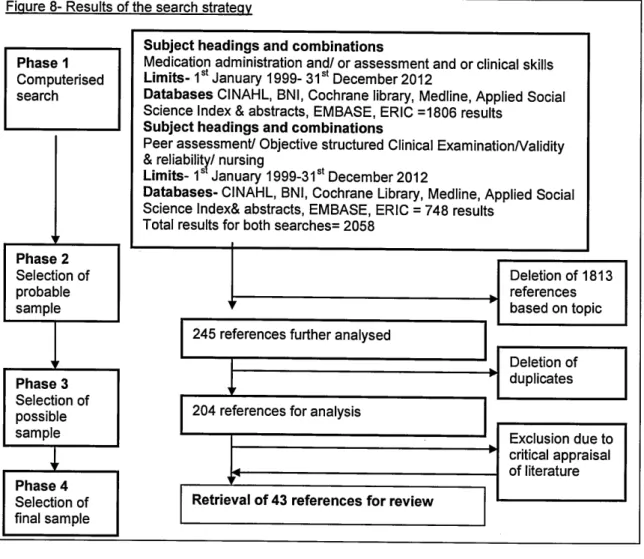
databases, as detailed in figure 4