READING STRATEGY INSTRUCTION IN GRADES 4 to 6:
TOWARDS A FRAMEWORK FOR IMPLEMENTATION
Nanda M Klapwijk
Dissertation presented for the degree of Doctor of Philosophy
at Stellenbosch University
Promot
e
r: Prof C van der Walt
Co-promot
e
r: Dr RR Nathanson
Declaration
By submitting this dissertation electronically, I declare that the entirety of the work contained therein is my own, original work, that I am the authorship owner thereof (unless to the extent explicitly otherwise stated) and that I have not previously in its entirety or in part submitted it for obtaining any qualification.
Signature: ……….. Date: ………
Copyright © 2011 Stellenbosch University All rights reserved
Abstract
This study focuses on the effect of a reading strategy instruction research intervention on teachers and learners in Grade 4 to 6 at a primary school in the Western Cape.
Literacy levels for South African Intermediate Phase learners remain at a disturbingly low level and Systemic Evaluation Assessments performed by the Department of Education show that reading, and more specifically reading comprehension, is a serious area of concern. A closer look at the Revised National Curriculum Statement and in-service as well as pre-service teacher training courses reveals that while teachers are trained to teach reading, very little, if any, focus is placed on training them how to teach comprehension. With a growing trend towards English as language of instruction for multilingual, non-English first language learners, the need to equip learners with ways of constructing meaning from texts becomes ever more crucial.
This study addresses the need for reading comprehension through the use of reading strategies – conscious tools that readers can be taught to improve their individual meaning-making efforts during the reading process. The study implements reading strategies through an intervention based on pre-selected reading strategies set within a structured teaching approach which aims to provide teachers (and learners) with adequate guidance and support for implementing reading strategies.
Through a case-study design this study utilises a mixed-method methodology for gathering both quantitative and qualitative data. The quantitative data serve to provide baseline data of selected reading-related abilities for learners before the start of the intervention, and to provide comparative data for specific measurements taken before and after the intervention. The qualitative data, gathered through classroom observations, unstructured interviews and obtaining samples of learners‘ work, provide rich, in-depth data about how teachers and, to a lesser extent, learners took on reading strategy instruction, and what factors influenced them in the process.
This study found that a multitude of factors affect the uptake of strategy instruction as part of everyday teaching practice, and, furthermore, that teachers and learners move through distinct phases in their uptake of reading strategy instruction.
While the study highlights a number of issues that are important to reading strategy instruction in Grades 4 to 6 in South Africa, a few of the more pertinent issues are the following: (1) teachers seem to need specific basic knowledge of language and texts for effective reading strategy instruction to take place (and very little, if any, research seems to address this issue), (2) the frequency of reading strategy instruction seems crucial to its success – the more often, the better, (3) engagement with teachers over a longer period is necessary for effective change in their instructional methods to take place, and (4) the gap between research and practice (that which is taught in classrooms) remains considerable.
The findings of this study, while specific to reading strategy instruction, contribute to the rapidly-growing body of knowledge on reading comprehension instruction, (particularly within a multilingual environment) and teacher development from the basis of research that is focused on changing teacher practice.
Opsomming
Hierdie studie fokus op die uitwerking van ‗n intervensie oor die onderrig van leesstrategieë op Graad 4 tot 6 onderwysers en leerders by ‘n Wes-Kaapse laerskool. Die geletterdheidsvlakke van Suid-Afrikaanse leerders in die Intermediêre Fase bly kommerwekkend laag, en Sistemiese Evalueringstoetse wat deur die Departement van Onderwys gedoen is, toon dat lees, en meer spesifiek leesbegrip, ‘n ernstige bron tot kommer is. Wanneer in meer detail gekyk word na die Hersiene Nasionale Kurrikulumverklaring, asook na die opleidingskursusse van diensdoenende onderwysers en onderwysstudente, blyk dit dat hoewel onderwysers geleer word hoe om lees te onderrig, daar min, indien enige, fokus geplaas word op die onderrig van leesbegrip. Met die toename in die gebruik van Engels as taal van onderrig vir meertalige, nie-Engelssprekende eerstetaal-leerders word dit al hoe meer belangrik dat leerders weet hoe om betekenis uit tekste te skep.
Hierdie studie maak gebruik van leesstrategieë om die behoefte aan leesbegrip aan te spreek – leesstrategieë is metodes wat leerders kan aanleer om bewustelik toe te pas om hul individuele pogings tot betekenisskepping te verbeter. Die studie implementeer leesstrategieë d.m.v. ‘n intervensie wat van voorafgeselekteerde leesstrategieë gebruik maak en waarvan die opleiding sodanig gestruktureer is dat onderwysers (en leerders) die gepaste leiding en ondersteuning gebied word vir die implementering van leesstrategieë.
Die studie gebruik ‘n gevallestudie-ontwerp tesame met ‘n ‚gemengde-metode‘ metodologie wat vir die insameling van beide kwantitatiewe en kwalitatiewe data voorsiening maak. Die kwantitatiewe data verskaf basisdata oor geselekteerde leesverwante vermoëns vir leerders voor die aanvang van die intervensie, en dien as vergelykbare data vir spesifieke metings voor en na die intervensie. Die kwalitatiewe data, wat ingesamel is deur klaskamerwaarnemings, ongestruktureerde onderhoude en voorbeelde van leerders se werk, verskaf ryk, diepgaande data oor hoe onderwysers en, tot ‘n mindere mate, leerders die onderrig van leesstrategieë aangeneem het, en watter faktore hulle in hierdie proses beïnvloed het.
Hierdie studie het bevind dat ‘n verskeidenheid faktore ‘n invloed het op die aanvaarding van strategie-onderrig as deel van alledaagse onderrigpraktyk, en veral dat onderwysers en leerders deur spesifieke fases beweeg in hul aanvaarding van leesstrategie-onderrig.
Hoewel die studie lig werp op verskeie belangrike kwessies vir die onderrig van leesstrategieë in Graad 4 tot 6 in Suid-Afrika, is ‘n paar van die meer pertinente kwessies die volgende: (1) dit blyk dat onderwysers spesifieke basiese kennis van taal en tekste nodig het vir effektiewe onderrig van leesstrategieë (en dat min, indien enige, navorsing skynbaar hierdie kwessie aanspreek), (2) die gereeldheid van leesstrategie-onderrig blyk kritiek tot die sukses daarvan te wees – hoe gereelder, hoe beter, (3) betrokkenheid by onderwysers oor ‗n langer tydperk is nodig om te verseker dat hulle hul onderrigpraktyk verander, en (4) die gaping tussen navorsing en realiteit (dit wat in klaskamers onderrig word) blyk steeds aansienlik te wees.
Hierdie studie se bevindinge, hoewel spesifiek gerig op die onderrig van leesstrategieë, dra by tot die snelgroeiende kennisveld oor die onderrig van leesbegrip (veral in ‘n meertalige omgewing) en die ontwikkeling van onderwysers vanuit die oogpunt van wat vereis word om onderrigpratkyk te verander.
Table of Contents
Acknowledgements/Bedankings ... i
List of Tables ... ii
List of Figures ... iii
Chapter 1 Positioning the Study ... 1
1.1 Introduction ... 1
1.2 Context of the study ... 2
1.3 Motivation for the study ... 5
1.4 Aim of the study ... 7
1.5 Research design ... 8
1.5.1 Data collection... 8
1.5.2 Data analysis ... 9
1.6 Conceptual framework – positioning the study ...10
1.7 Outline of chapters ...13
1.8 Definition of terms ...14
1.9 Definition of constructs and delimitation of the study ...15
1.9.1 Reading and literacy ...16
1.9.2 A definition of reading comprehension ...17
1.9.3 Teacher development and change ...18
Chapter 2 Theoretical Perspectives on Reading, Reading Comprehension and Reading Comprehension Instruction ... 19
2.1 Early perspectives on reading ...21
2.1.1 A scientific view of reading ...22
2.1.2 Toward a meaning-making view of reading ...24
2.1.2.1 Associationism ...26
2.1.2.2 Structuralism ...27
2.1.2.3 Unfoldment Theory ...29
2.2 A Behaviourist perspective: reading as decoding...30
2.2.1 Behaviourist perspective and reading instruction ...32
2.2.2 A return to meaning making in reading ...34
2.3 A Cognitive perspective: reading for meaning ...35
2.3.1 Information-processing models ...36
2.3.2 Schema Theory ...38
2.3.3 Metacognition ...40
2.3.4 Constructivism ...42
2.3.5 The Cognitive perspective and reading instruction ...42
2.4 A Social perspective: reading in social context ...45
2.4.1 The role of text and context ...46
2.4.2 The Social perspective and reading instruction ...47
2.5 An Early Literacy perspective: reading as literacy development ...50
2.5.1 Reading readiness vs. emerging into literacy ...52
2.5.2 A critical view of emergent literacy ...53
2.5.3 Early Literacy Development and reading instruction ...54
2.6 Reading in a second language ...56
2.7 Writing and comprehension ...59
Chapter 3 A View of Known Practice ... 64
3.1 Reading instruction in South Africa ...64
3.2 A theoretical perspective of the National Curriculum Statement ...66
3.3 A critical perspective on the RNCS ...69
3.5 Language of instruction and the development of literacy ...72
3.5.1 Multilingualism and the National Curriculum Statement ...74
3.5.2 Method of language instruction and the RNCS ...76
3.6 The place of reading comprehension instruction ...78
3.7 Reading strategies ...79
3.7.1 Skills vs. strategies ...81
3.7.2 Reading strategy instruction research ...82
3.7.3 Strategy instruction: what, when & how ...84
3.7.4 Reading strategy instruction and teachers ...86
3.7.4.1 Research on teacher development and change ...87
3.7.4.2 Teacher change in this study ...90
3.7.5 Selecting strategies for implementation ...91
3.7.6 Conclusion...93
Chapter 4 Research Design ... 94
4.1 Conceptual framework ...95
4.1.1 Research approach ...95
4.1.2 Research conditions ...97
4.1.3 Research questions ...98
4.2 Research paradigm & method ...99
4.2.1 Research paradigm...99 4.2.2 Research method ...101 4.3 Research participants ...103 4.3.1 School ...103 4.3.2 Teachers ...105 4.3.3 Learners ...105 4.4 Research intervention ...106 4.5 Research instruments...108 4.5.1 Quantitative instruments ...108
4.5.1.1 Burt Word Reading Test ...109
4.5.1.2 Cloze Test ...111
4.5.1.3 Reading strategy exploratory test ...113
4.5.1.4 Reading strategy-transfer test ...113
4.5.2 Qualitative instruments ...115
4.5.2.1 Classroom observations ...115
4.5.2.2 Unstructured interviews ...116
4.5.2.3 Learners‘ work ...116
4.6 Data analysis & interpretation ...116
4.6.1 Statistical analyses of quantitative data ...116
4.6.2 Effect size or statistical significance ...117
4.6.3 Analysing the qualitative data ...119
4.7 Ethical issues ...120
4.8 Conclusion...120
Chapter 5 Research Results: Quantitative Data ... 121
5.1 Analysis and interpretation of Phase 1 Quantitative Data ...122
5.1.1 Burt Word Reading Test results...123
5.1.2 Cloze Test results ...126
5.1.3 Relationship between reading age difference and comprehension ...126
5.2 Analysis and interpretation of Phase 3 Quantitative Data ...129
5.2.1 Analysis of Exploratory Test data ...130
5.2.2 Analysis of Strategy Transfer Test data ...132
5.2.3 Comment on Strategy Transfer Test measurements ...133
Chapter 6 Research Results: Qualitative Data ... 137
6.1.1 School attendance ...143
6.1.2 Language of Learning and Teaching (LoLT) ...144
6.1.3 Multilingual classes ...147
6.1.4 Administrative burden ...148
6.1.5 Class size ...150
6.1.6 Learner literacy levels ...151
6.1.7 Teacher expectations...153
6.1.8 Reading resources, reading culture and teaching of reading ...157
6.1.9 Teacher knowledge ...160
6.1.9.1 Text type and genre...163
6.1.9.2 Text structure ...164
6.1.9.3 Putting language concepts into context ...164
6.1.9.4 Text-level processing ...165
6.1.9.5 Existing research on knowledge specific to reading strategy instruction ...166
6.1.10 Concluding remarks ...167
6.2 How teachers took on strategy instruction ...167
6.2.1 Expectation Phase ...171
6.2.2 Implementation Phase 1 ...174
6.2.2.1 Uncertainty and lack of confidence ...175
6.2.2.2 Doing things ‗right‘ or ‗wrong‘ ...176
6.2.2.3 Controlling learners‘ responses ...178
6.2.2.4 Preparation and attempting too much too soon ...180
6.2.2.5 Teacher change in Implementation Phase 1 ...188
6.2.3 Implementation Phase 2 (Experimentation) ...191
6.2.3.1 Teacher knowledge and reading strategy instruction ...192
6.2.3.2 Teacher approach and acceptance of support ...198
6.2.3.3 Teacher change in Implementation Phase 2 ...207
6.2.4 Independence Phase ...210
6.2.5 ‗What‘ and ‗How‘ and Teacher Change ...215
6.3 Learners‘ uptake of strategy instruction ...217
6.3.1 Learners and reading strategies ...217
6.3.2 Purpose for reading and text type ...220
6.3.3 Activating Prior Knowledge ...220
6.3.4 Questioning ...223
6.3.5 Summarisation ...226
6.4 Conclusion...227
Chapter 7 Review and Conclusions: Towards Implementation ... 230
7.1 Introduction ...230
7.2 Addressing the research conditions ...231
7.3 Answering the research questions ...234
7.3.1 Factors that influenced teachers‘ reading strategy instruction ...235
7.3.2 Teachers‘ instructional practices: from expectation to independence? ...236
7.3.3 Required teacher knowledge: becoming familiar with RSI ...237
7.3.4 Factors that influenced learners‘ reading strategy instruction ...239
7.3.5 Measurable knowledge transfer ...240
7.4 Contribution of the study: Towards a Framework for Reading Strategy Instruction ...241
7.4.1 Creating a context for a proposed framework: the possibilities of teacher update and instructional change ...241
7.4.2 Proposing a reading strategy instruction framework ...243
7.4.3 To what extent is reading strategy instruction possible? ...246
7.5 Recommendations for implementation ...248
7.5.2 Identify ‗linguistic knowledge‘ required for reading strategy instruction ...250
7.5.3 Adaptation in teacher support to engender lasting change ...251
7.5.4 Research component in PRESET, INSET and professional development courses ...252
7.5.5 Strengthen multilingual teaching principles in teacher-training courses ...253
7.6 Limitations of the study ...254
7.7 Future prospects ...255
7.8 Final thoughts ...255
References ... 257
Addendum A – Teacher Checklist ... 286
Addendum B – Assessment Schedule ... 287
Addendum C – Burt Word Reading Test ... 289
Addendum D1 – Cloze Test for Grade 4 ... 291
Addendum D2 – Cloze Test for Grade 5 ... 292
Addendum D3 – Cloze Test for Grade 6 ... 293
Addendum E – WCED literacy results for research school... 294
Addendum F – Exploratory Test ... 296
Addendum G – Strategy Transfer Test ... 297
Addendum H – Samples of Learners’ Work ... 299
Addendum I – WCED Permission for Research ... 301
Addendum J – Stellenbosch University Ethical Clearance for Research .... 302
Addendum K – Informed Consent form for teachers ... 303
Addendum L – Informed Consent Form for learners ... 306
Addendum M – Real Age & Burt Age results (ANOVA) ... 309
Addendum N - Raw data - Real Age, Burt Age, Cloze scores ... 313
Addendum O – Comparison of ET and STT scores for Experimental Group 317 Addendum P – Original Afrikaans utterances ... 319
Addendum Q1 – Reading text 1 ... 321
Addendum Q2 – Reading text 2 ... 322
Addendum Q3 – Reading text 3 ... 323
Addendum R – Sample of observation notes ... 324
Acknowledgements/Bedankings
I would like to extend my thanks and appreciation to: Prof Christa van der Walt and Dr Rénee Nathanson for their professionalism and
integrity, guidance and feedback, kindness and unwavering support. Dit was ‗n plesier en ‗n voorreg om hierdie proses saam met julle deur te loop.
Prof Martin Kidd of the Centre for Statistical Consultation at Stellenbosch
University for his invaluable assistance with data analysis and interpretation.
My ma, wat my oorspronklik na Matriek in staat gestel het om hierdie reis te
begin en geleer het waar om my krag te vind, en my broers vir hulle lojaliteit en humor.
Annelie van Jaarsveldt en Anlen Boshoff vir datakontrole en teksversorging.
Nadine & Coenie Brand vir ‗n gerieflike blyplek op Stellenbosch.
The teachers and learners at the research school who for ethical reasons must
remain anonymous but without whom there would be no study. Dankie vir julle vriendelikheid, tyd en bereidwilligheid onder somtyds moeilike omstandighede. Alle voorspoed met die reuse taak wat julle daagliks verrig.
List of Tables
Table 1 Research-based strategies and strategies used in this research 91
Table 2 Reading phases and related reading strategies 93
Table 3 Grouping of learners and data-gathering participation 105
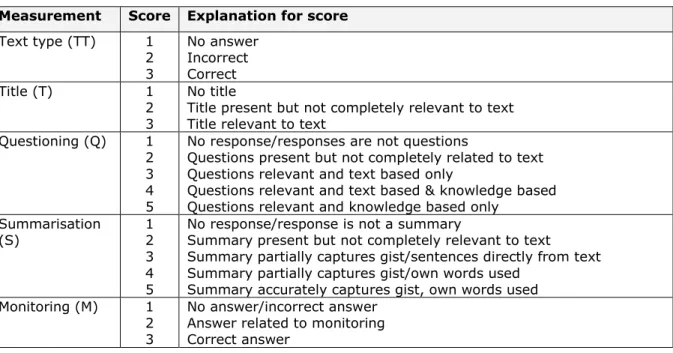
Table 4 Strategy Transfer Test scoring rubric 114
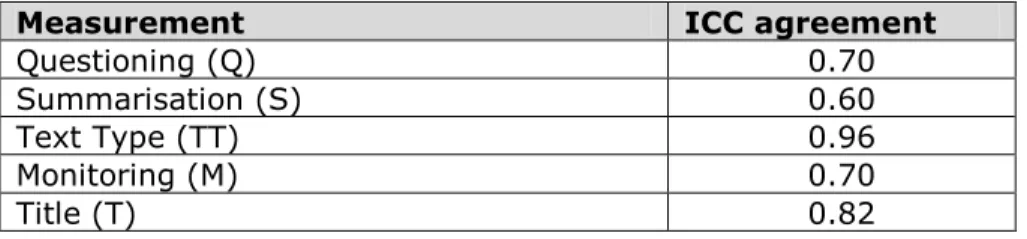
Table 5 Inter-rater reliability results for Strategy Transfer Test 115
Table 6 Calculation of reading age difference 123
Table 7 Mean age totals and mean reading age difference per group 124
Table 8 Average Cloze Test score 126
Table 9 Cloze Test score vs. reading age difference 127
Table 10 Effect size analysis of Exploratory Test measurements 131
Table 11 Effect size analysis of Strategy Transfer Test measurements 133
Table 12 Linguistic knowledge for strategies used in intervention 162
List of Figures
Figure 1 Conceptual Framework 12
Figure 2 Data-gathering sequence and integration 102
Figure 3 Analysis and interpretation of data 121
Figure 4 Mean Burt Age and mean Real Age for groups 124
Figure 5 Comparison of mean age groups 125
Figure 6 Scatterplot of mean reading age difference vs. Cloze scores 128
Figure 7 Interaction of What factors and How phases 140
Figure 8 Teachers‘ reading strategy instruction phases 170
Figure 9 Learners‘ reading strategy instruction phases 218
Figure 10 Context for reading strategy instruction framework 242
Chapter 1
Positioning the Study
“There is no reading without reading comprehension” Goodman & Goodman (2009:92)
1.1 Introduction
Reading is, without doubt, considered to be one of the most important linguistic skills that need to be developed in young children. All academic achievement ―depends to a lesser or greater extent on reading literacy‖ (Pretorius & Machet, 2004:45), or as stated in the South African Department of Education‘s National Reading Strategy, ―reading serves as a building block upon which all other learning takes place‖ (Department of Education, 2008:19). Parris, Gambrell and Schleicher (2008:10) argue that the ability to read is a fundamental necessity for ―full participation in one‘s society and economy‖. However, developing the ability to read successfully is not a simple process: ―reading, like thinking, is very complex‖ (Clay, 1991:320). Reading is about more than the ability to recognise letters and decode words. Reading is ultimately about constructing meaning from written text (Graves, Juel and Graves, 1998; Snow, 2002a; Williams, 2008). In other words, the aim of reading is to
comprehend what is being read. Reading comprehension requires the ―integration of meaning across words, sentences and passages‖ (Paris & Hamilton, 2009:40) and the ―simultaneous, flexible consideration … of multiple elements‖ (Cartwright, 2009:115). Dreyer and Nel (2003:349) consider the ability to read and understand texts as ―one of the most crucial skills that students … need to acquire‖ and describe reading comprehension as the ―essence of reading‖, whereas Leu et al. (2008:321) take an even stronger view in describing reading comprehension as ―central to success in the
21st century‖.
Goodman & Goodman (2009:92) are of the opinion that ―the study of reading is the study of reading comprehension‖. The focus of this study then, while related to the reading process in general, is aimed at the issue of reading comprehension, and more specifically, implementing the teaching of reading strategies with a view to improved reading comprehension in the current South African Intermediate Phase school curriculum.
1.2 Context of the study
Over the past few decades literacy and the consequences of being illiterate have become a concern worldwide. South Africa is often described as being in a ‗literacy crisis‘, and indeed, South African Grade 4 learners were placed last out of 40 countries in the Progress in International Reading Literacy Study (PIRLS) survey, which studies the reading achievement and reading behaviours and attitudes of fourth-grade students (Howie et al., 2007). The Western Cape Education Department‘s Literacy and Numeracy Strategy document refers to ―alarmingly poor literacy levels‖ (Department of Education, 2006:4). South African literacy statistics further reflect that some 29 percent of the population is illiterate (READ, 2010). This is a situation that must be remedied at primary school level in order to produce learners who can one day compete in the 21st century ‗knowledge economy‘ that demands ever higher levels of literacy. The question is: to what extent and how is literacy in general and reading in particular being addressed in South African schools? In terms of a focus on reading as part of literacy, the Department of Education launched their National Reading Strategy (NRS) in February 2008, partly in support of the United Nations Literacy Decade 2003-2013 and Literacy for All campaigns to increase literacy rates by 50% by the year 2015, but with the main goal of ―improv[ing] reading competence of learners‖ (Department of Education, 2008:5). South Africa‘s current school curriculum, originally introduced in 1997 under the name Curriculum 2005, places a high premium on literacy as a means to both personal development and the nation's economic prosperity. Curriculum 2005 was designed to ―rationalize and consolidate‖ nineteen different educational departments, each with their own curriculums and syllabi, ―into a single, core syllabus‖ (Department of Education, 2002:4). Curriculum 2005 was revised in 2000 and replaced with the Revised National Curriculum Statement (RNCS) in 2002. The revisions of the RNCS included streamlining and reducing the curriculum design, simplifying its language, aligning curriculum and assessment and strengthening its implementation by improved teacher orientation and training, support materials and provincial support (Department of Education, 2002:7).
However, despite the improvements intended by the RNCS - which also include a stronger focus on multilingualism and learners‘ right to be taught in their home language – it would seem that literacy objectives are not being met. The report of the
last Grade 6 Intermediate Phase Systemic Evaluation1 shows that 63% of learners scored at the ‗Not Achieved‘ level in the Language of Learning and Teaching (LoLT) tasks (Department of Education, 2005:78). In the Languages learning area, learners scored 51% for the Reading and Viewing learning outcome, and only 31% for the Thinking and Reasoning outcome. What was further noticeable in the Languages learning area scores is the fact that learners achieved an average of 49% in multiple choice questions, but only achieved an average of 31% for open-ended questions. This seems to indicate that where test questions do not allow some form of ‗deduction of meaning‘ (as is possible to a degree in multiple choice questions), learners lack sufficient understanding and struggle to formulate their own answers. As Langer et al. (1990:464) confirm, open-ended questions allow learners ―to better reveal what and how well they understand‖. When viewing learners‘ scores for content subjects the same trend appears in the Systemic Evaluation results: for Natural Science learners scored the lowest (35%) in Learning Outcome 1 (Scientific Investigations) which focuses on evaluating and communicating findings. The report describes this result as ―probably the result of difficulties experienced in communicating and grasping intended meanings‖ (Department of Education, 2005:93).
While the use of ‗intended meanings‘ in reference to making meaning from reading material (texts and tests) is debatable from a social learning point of view - the view taken by this study, and a view that the RNCS seems to aspire to (see 3.2) - the statement ―grasping intended meanings‖ does seem to indicate not only that the LoLT
may be an issue in learners‘ low Systemic Evaluation scores, but that comprehension
of information is an issue: in order to formulate an own response (as required in open-ended questions), a learner must not only be linguistically competent in a specific language, but also be able to understand (construct meaning from) a test/text. As Calfee (2009:xiii) states, ―the capacity to explain one‘s thinking is critically important in school tasks‖ and underlines the importance of the development of comprehension. Based on the Systemic Evaluation results, it is clear that constructing meaning from a text is a problem amongst South African (Grade 6) learners. Dixon & Peake (2008:74) point out that ―if we are failing to teach children to comprehend what they are reading … then critical [thinking] is unlikely to be part of the pedagogical practices of many teachers‖. The question is: how is the issue of
1The Intermediate Phase Systemic Evaluation is performed every three years. The most recent evaluation
reading comprehension addressed in the curriculum (if at all), and how is reading
comprehension taught in South African schools, if at all?
In South Africa the emphasis in teaching reading in general seems to be more on comprehension testing or what this study calls the ‗three-step process‘: handing out a text after announcing the topic, reading the text and asking learners to answer written or oral questions afterwards, and an overemphasis on phonics in early reading instruction. As Nathanson (2008:6) states, a clear need exists ―for research that investigates alternatives to the kinds of … literacy instruction currently provided in many South African schools‖.
During the past 20 to 30 years, research has shown that comprehension ―can be increased significantly when it is taught explicitly‖ (Paris & Hamilton, 2009:49). Pressley (2001) states that ―[t]he case is very strong that teaching … students to use a repertoire of comprehension strategies increases their comprehension of text‖. In essence, comprehension strategies are the things that skilled readers do to ensure
that they understand what they read. Research about comprehension strategy
instruction ranges from work as early as Durkin‘s classroom observations in 1978 to 1979 to the seminal study done on reciprocal teaching by Palincsar and Brown (1984)
to the work by Pressley throughout the 1980s and into the 21st century. Reading
strategy instruction has been an education focus in countries such as the United States, the United Kingdom, Australia and New Zealand for up to 30 years. Multiple studies have found the teaching of reading strategies effective, for example Palincsar and Brown (1984), Pressley and Harris (1990), Pressley (2001, 2005), Block and Duffy (2008) and Williams (2008) to name a few. As many as 45 individual reading strategies have been documented through research, although this number has more recently been reduced; Block and Duffy (2008:22) identify nine reading strategies that have been researched and validated as highly successful since 2000. These strategies include, amongst others: predicting (sizing up a text in advance), monitoring (checking comprehension during the reading process), fix-it strategies (stopping and re-reading when meaning is unclear), summarizing (finding main ideas) and inferring (connecting text to prior experience and knowledge).
Although terms such as ―skilled readers‖ and ―repertoire of strategies‖ could imply the use of a set of skills, it is important to point out that teaching reading strategies is not the same as teaching reading skills (Dole et al., 1991). In essence skills
the skills they learn to whatever they read. Basically, skills are applied the same way each time without conscious thought. Strategies, on the other hand, are applied consciously and adapted to a particular situation (Block & Duffy, 2008). For example, word recognition, an essential skill for reading success, is learned until it becomes automatic. By contrast, a strategy, such as predicting, is applied differently in each reading situation because each reader brings a different purpose and different prior knowledge to the situation. However, like skills, strategies must be taught directly and intensively with the ultimate goal that learners are able to use the trained strategies autonomously, skilfully and appropriately (Pressley & Harris, 1990). Strategy instruction should ideally occur across the school curriculum and across the school day, every day until learners use the strategies independently. To achieve this
strategy instruction will have to be included in reading (and all learning) instruction
for as long as it takes.
1.3 Motivation for the study
Despite research evidence of the value of reading strategies, two issues appear clear: (1) there seems to be ―very little, if any, explicit and continuous strategy instruction‖ (Pressley, 2001, 2005; Van Keer, 2004; Pressley and Harris, 1990) in classrooms, and (2) there seems to be a distinct lack of research into and professional development of teachers in terms of reading comprehension instruction – most development seems focussed on reading instruction (Sailors, 2008:653).
There seem to be three reasons for the ‗non-uptake‘: firstly a lack of proper teacher education (Sailors, 2008) and therefore a lack of knowledge about reading strategy instruction, secondly perceived time demands involved in preparing teaching material, and thirdly, teachers remaining unconvinced about the effect of strategy instruction on their learners‘ progress. Pressley and Beard El-Dinary (1997) state that teachers feel that comprehension-strategies instruction takes ―a great deal of classroom time‖ and that teachers require a ―great deal of support to understand and implement comprehension-strategies instruction‖. What remains evident is that without professional development teachers will have difficulty implementing comprehension instruction (Block & Duffy, 2008:23).
Generally it would seem that teachers may not have the skills needed for teaching comprehension. This raises questions about the development of teacher training courses in the area of literacy skills and in-service teacher training programmes,
which currently do not seem to focus specifically on issues of comprehension. Sailors (2008:653) states that ―teachers are taught basic skills of reading instruction and sent out to teach with the understanding that, in time, they will learn all that they need to know to support comprehension. This is simply not true.‖
Research does, however, indicate that teachers are encouraged to change and take on new methodologies and curricula if teacher development initiatives satisfy specific requirements, which include but are not limited to: showing clear and positive benefits to their learners, are meaningfully integrated into life at the school, are supported by the principal, provide teachers with hands-on active learning opportunities (as opposed to listening passively) and provide sufficient time for classroom implementation and adequate support (Huberman & Miles, 1984; Gersten et al., 1997; Pressley & Beard El-Dinary, 1997; Richardson et al., 1991; Richardson, 1998; Torff & Byrnes, 2011).
When one looks critically at the Revised National Curriculum Statement (RNCS) and
its requirements, specifically in the Languages learning area, there seems to be very little explicit focus on teaching reading comprehension. In fact, the word
‗comprehend‘ does not appear at all in the general RNCS document, nor in the RNCS
Languages or RNCS Teacher‟s Guide. The word ‗understand/ing‘ is used in all three the documents, but only in relation to ‗understanding and speaking a language‘ in general – no mention is made of the explicit teaching of comprehension or
understanding in terms of reading. The RNCS Teachers‟ Guide refers to the use of
reading strategies for learners to ―read flexibly and purposefully with confidence and enjoyment‖ (Department of Education, 2003:27) and goes on to list a few strategies, but no guidance is provided for how to go about implementing such strategies.
Similarly the RNCS for Home Language provides a detailed list of assessment
standards (which includes the mention of ‗reading and comprehension strategies‘) under the Reading & Viewing Outcome, but places what is in fact a description of comprehension strategies under the heading ‗reading and viewing‘ rather than ‗comprehending/understanding‘. The National Reading Strategy states that it intends to implement teacher development programmes in reading strategies (2008:15) and that the school principal‘s main responsibilities include ensuring that reading strategies are integrated in all school subjects (2008:16). However, no clear implementation in this regard seems to have been made to date, and like the RNCS, the NRS does not provide a clear distinction between comprehending and viewing and what ‗reading strategies‘ entail or how to go about implementing them.
While research findings in general seem to attribute modest but consistent comprehension gains to strategy instruction, Koda (2004:222) states that little information is available about which specific aspects of instruction are actually responsible for reported gains. Koda (2004:218) further points out that ―systematic connections between particular sets of strategies and reading effectiveness‖ have not yet emerged, nor does research properly explain the extent to which ―instructional benefits are affected by other variables‖, such as reader characteristics, text properties and task nature (Koda, 2004:221).
This study, therefore, aims to contribute to the body of research on comprehension instruction by investigating aspects of instruction that may affect reading strategy instruction, recommending specific strategies, supporting teachers in their efforts to implement reading comprehension strategies and laying the foundation for a reading strategy instruction framework in Grades 4 to 6.
1.4 Aim of the study
The overarching aim of this study was to investigate the following: How can reading strategy instruction be introduced and supported to encourage its application by teachers and learners? The following sub-questions were formulated to guide the study:
1. What influences teachers and learners in taking on reading strategy
instruction?
2. How do teachers take on reading strategy instruction?
2.1 How do teachers and their instructional practices change from the
start to the end of the research intervention, if at all?
2.2 How do teachers‘ instructional changes affect learners‘ awareness/uptake of
reading strategies?
3. To what extent is the transfer of reading strategy knowledge measurable?
In responding to the research questions the intention is to perform a critical review of existing literature about reading strategy instruction, and conduct a study that could contribute to the existing body of research on reading comprehension instruction.
1.5 Research design
Mouton and Marais (1990:169) state that the issues investigated in the social sciences tend to be so ―enmeshed‖ that a single approach simply cannot succeed ―in encompassing human beings in their full complexity‖. Qualitative research is usually regarded as a research orientation that enables reflection on the complexities of human interaction. However, qualitative research is often viewed as ―anecdotal‖ by policy makers and funders who prefer ―hard evidence‖ before agreeing to participation in a project (De Vos et al., 2005:358). At the same time, quantitative research cannot accurately and fully reflect or account for the human element in social science research. The research questions and aims of this study are a good example of this complexity – on the one hand the study aims to observe the ‗how‘ and ‗why‘ of reading strategy instruction to determine a framework for implementation in schools, but at the same time it aims to provide measurable evidence of knowledge transfer of a set of reading strategies; ‗hard evidence‘ that could conceivably act as visible encouragement for teachers to teach what is effectively an invisible skill. For this reason a mixed-method design was used, which incorporates the use of both qualitative and quantitative data-gathering methods. A mixed-method approach assumes that ―collecting diverse types of data best provides an understanding of the research problem‖ (Creswell, 2003:21).
1.5.1 Data collection
The collection of quantitative and qualitative data was done sequentially using a method that can best be described as a variation of what Creswell (2003:216) calls the Sequential Transformative Strategy (STS). In the STS there are two distinct collection phases, however, either method (quantitative or qualitative) may be used first and the results of the two phases are integrated during the interpretation phase. An important feature of the STS is that it is guided by a theoretical perspective, be it a conceptual framework, ideology or advocacy, which is deemed more important in guiding the study than the use of the methods alone. In this study, the critical analysis of existing literature led to a conceptual framework (see 1.6) that guided the data collection process and served as the motivation for change in reading strategy instruction.
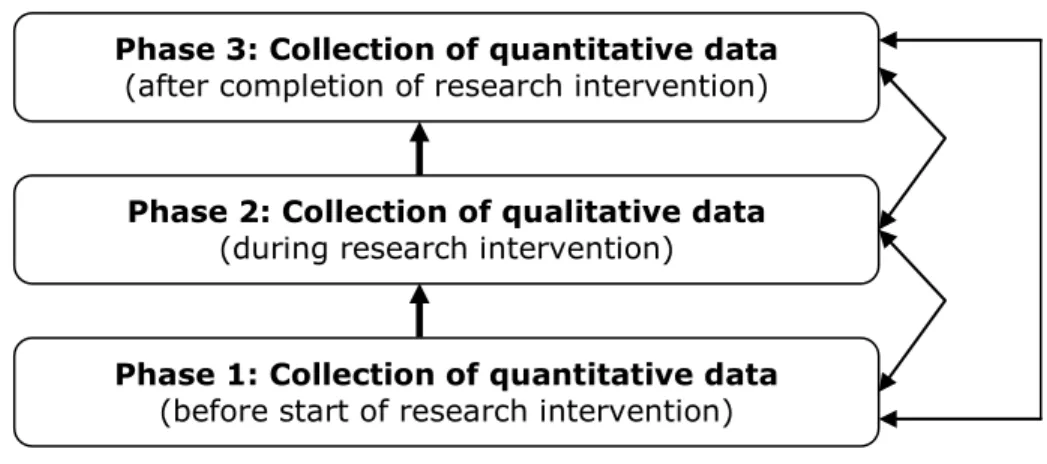
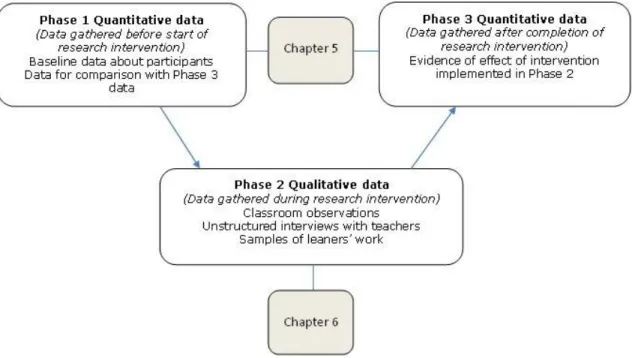
This study used three sequential data-collection phases: first quantitative data were collected, followed by a qualitative data-collection phase and finally a second
collection of quantitative data. The first quantitative data collection entailed two sets of information: (1) administering a word reading test and a Cloze test to all Grade 4 to 6 learners who participated in the study to obtain independent baseline data about
participants‘ reading age and reading comprehension ability before the start of the
intervention, and (2) obtaining measurement data from the experimental group (one Grade 5 class) before the start of the intervention for comparison before and after the research intervention. These quantitative data were collected before teachers implemented the research intervention (see 4.4) in their respective classes.
During the same period that the word reading test and Cloze tests were administered, teachers were given an information session about the research intervention. Once teachers were ready to implement the intervention the qualitative data were collected over a period of 15 weeks (two school terms) through classroom observations, unstructured interviews, discussions with teachers and obtaining samples of learners‘ work. During this ‗transformational‘ phase (in Creswell‘s terms) teachers were accompanied and supported if required and where needed.
The third data-collection phase was conducted at the end of the 15 weeks when a final set of quantitative data, in the form of a Strategy Transfer Test, was collected from both the experimental and control group.
1.5.2 Data analysis
Analysis of the Phase 1 quantitative data was done immediately after gathering the data. It must be emphasized that the sole purposes of this phase was to obtain baseline data about learners to frame the intervention, the results of which provide the bulk of the data. After assessing and scoring the word reading test and Cloze test, a Mixed Model Repeated Measures ANOVA test was performed on the data for comparing learners‘ measured reading age in their respective grade groups, and a Pearson correlation was used to determine the relationship between learners‘ measured reading age and measured comprehension ability.
Whereas the quantitative data collection had a fixed start and end point, the collection and analysis of qualitative data was far less absolute and, to an extent, formed a simultaneous process. My analysis of the qualitative data was guided by principles from existing research, and more specifically principles of qualitative data analysis espoused by Miles & Huberman (1984), Tesch (1990) and Boeije (2010), all
of whom propose what is effectively a three-step process in analysing data. I started the analysis of qualitative data by identifying topics that ―occur and reoccur‖ throughout the data (Tesch, 1990:90), or what Miles & Huberman (1984) call identifying ―categories‖. In doing this, I identified a range of topics, which although at that point were not listed in any particular order or divided into any particular theme or group, were finally clustered together into two main groups.
The analysis of the quantitative data gathered in the third and final phase of the study enabled the comparison of results between the experimental and control group, and a comparison within the experimental group to determine progress (if any) from the start to the end of the intervention.
1.6 Conceptual framework – positioning the study
A conceptual framework, according to Maxwell (2005:33), is primarily a ―conception or model of what is out there that you plan to study, and of what is going on with
these things and why — a tentative theory of the phenomena that you are
investigating‖. Punch (2009:83) describes a conceptual framework as a representation of the ―main concepts and variables and their presumed relationship with each other‖. In essence, a framework serves to justify and inform research by asking relevant research questions, selecting appropriate methods and identifying potential validity threats to conclusions. Maxwell (2005:35) states that a conceptual
framework assists the researcher in understanding what problems have been
encountered with existing research and theory, what contradictions the researcher has found in existing views, and how the study can make an original contribution to our understanding. He also warns that while the Literature Review is an integral part of developing a conceptual framework, researchers too often see the Literature Review merely as ―covering the field‖ or being a ―description‖ of existing research. Maxwell (2005:35) recommends that researchers treat existing literature not as an ―authority to be deferred to‖ but rather as a ―useful but fallible source of ideas‖ that can be used to frame issues in alternative ways.
This study will attempt to do just that: it wishes to propose a framework for reading strategy instruction not based purely on a theoretical (literature research) point of view, but also by taking existing practice into account, or at least acknowledging the constraints caused by the gap between research and practice. Clay (1991:16), for example, states that ―researchers rarely ask the questions which teachers want answered … and educators rarely work to implement the implications of particular
research findings‖. Clay further claims that researchers (theorists) are too ―general‖ in their documenting of advances in understanding, and that researchers and teachers alike would be served better if practice and theory were considered together in order to inform each other. In South Africa teachers feel overwhelmed by policy documents and professional development initiatives (see Chapter 6) which try to bring new insights from research into classrooms. In the face of large classes and demands for assessment and other administrative documentation from the Education Department, teachers often go into a type of survival mode where they stick to familiar practices, even when these practices do not show the required results. The gap between research and practice is, therefore, a real and abiding one in the South African context.
Since it seems research and practice do not often meet, taking a purely top-down approach (theory informing practice) in proposing a framework is not ideal; at the same time it would be equally impractical to base a proposed framework purely on current practice, because practice is typically fraught with ideological and social issues and must be informed by evidence-based theory and methods to remain current and sustainable. Therefore, this study will position itself in the gap between research and practice by taking into account both existing theory (research) and current reality (practice). The study will attempt to narrow the gap between research and practice in terms of reading comprehension instruction by proposing an instructional framework for teaching reading comprehension in a manner which is sustainable, accessible and measurable for all teachers.
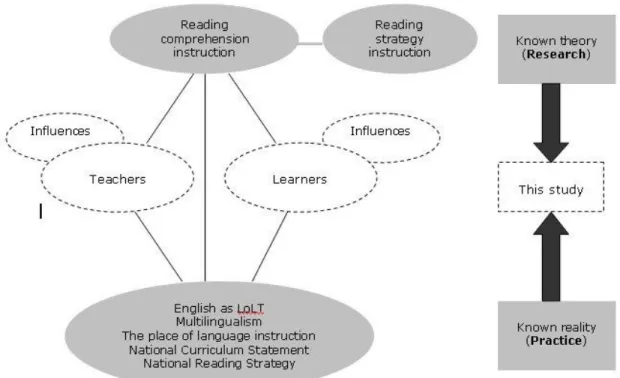
Figure 1: Conceptual framework
In Figure 1 the framework is represented by three ‗bands‘: at the top Known Theory/Research is represented by existing literature of reading comprehension and reading strategy instruction. At the bottom the Known Reality/Practice is represented by issues affecting education in South Africa, such as English as Language of Learning and Teaching (LoLT) in a country where English L1 speakers comprise less than 10% of the total population, multilingualism in education, the place of reading/language instruction, the (Revised) National Curriculum Statement and Department of Education literacy initiatives, such as the National Reading Strategy (2008). In the middle, represented by a dotted outline, this study has been positioned along with teachers and learners. Teachers and learners are positioned here because, in the tension between research and practice, they fulfil a dual role (albeit often involuntarily): while they are the first-line beneficiaries of research outputs in educational research, due to the influences of practice (LoLT, multilingualism, curriculum statements) they also almost solely determine whether research will be taken up and be sustained. Being situated in the middle means that the study is
informed by known theory (research) and influenced by known reality (practice) and therefore in a position to attempt to bridge the gap – at least in terms of reading comprehension instruction – between research and practice.
Van Keer & Verhaeghe (2005:544) make a call for research placed in the ‗gap‘ between research and practice when they state: ―Taking into account this marked gap between empirical research and instructional practice, a major issue of concern is the development and implementation of effective ways to prepare teachers to tune their teaching to recent research findings … therefore, researchers should accept the challenge to inquire into effective strategies for disseminating research-based practices, for questions remain concerning how to conceptualize teacher learning and, correspondingly, about how to construct professional development so as to foster meaningful change in educational practice.‖
1.7 Outline of chapters
The conceptual framework for this study places this research in the gap between research and practice with the aim of proposing a framework that can help narrow the gap. However, if the study is situated in the gap between research and practice,
it means that it is also influenced by research (known theory) and practice (known
reality/existing teaching practice). Since the objective of a literature review is to provide a critical overview of existing knowledge about the main issues related to the study topic, it seemed sensible to create two summaries for this study: an overview of known theory (research), and an overview of known practice (reality).
In order to provide a logical break between the issues of research and practice, the overviews will be divided into two different chapters. The first chapter, Chapter 2, will focus on research (known theory) and will include the following: an overview of different perspectives on reading and their effect on reading instruction and reading comprehension instruction and a short discussion of the link between writing and comprehension. The second chapter, Chapter 3, will focus on the current practice (known reality), and include the following: an overview of reading instruction in South Africa, an analysis of the Revised National Curriculum Statement (based on the perspectives described in the first chapter), and finally, a discussion of reading strategies and reading strategy instruction.
Chapter 4 describes how the research design was informed by the study‘s conceptual framework and the research approach and research aims which flowed from the framework. It further describes the study‘s research paradigm and methodology, and provides detail about the study‘s participants, intervention, instruments used for data gathering and how the gathered data were analysed and interpreted.
Chapters 5 and 6, the Results chapters, provide a detailed description of the results of the analyses and interpretation of the quantitative data (Chapter 5) and qualitative data (Chapter 6) respectively and also set the scene for proposing a framework for reading strategy instruction in accordance with the aim of the study. Chapter 7 concludes the study by drawing together the results of the previous chapters before proposing a framework for reading strategy instruction, and closes with recommendations for future practice and opportunities for future research.
1.8 Definition of terms
The following terms are used repeatedly in this study and, therefore, require some explanation and positioning. Although the following terms have clear definitions, their application is somewhat problematic in the multilingual South African school environment where all learners are considered to be at least bilingual, if not multilingual, and it is often difficult to determine outright what learners‘ first/strongest language is.
Home language (HL) – The RNCS distinguishes between three types of language instruction in South African schools: home language, first additional language and second additional language. For the purposes of this study ‗home language‘ will be seen as synonymous with First Language (L1), and be understood to be the language a learner feels most comfortable using and the language which is assumed to be learners‘ dominant language by the school. It also refers to the language most spoken at home by most members of a family. In bilingual or multilingual communities it is possible that more than one language could function as the home language. The insistence that parents indicate one language as a home language is evident of the monolingual bias that remains even in multilingual communities. While the use of ‗home language‘ in the RNCS as a type of instruction is intended to refer to instruction in learners‘ most spoken language (i.e. any one of the 11 official languages), it is somewhat ironic in the South African education scenario because the Language of Learning and Teaching (LoLT) invariably tends to be English or
Afrikaans; according to the 2001 Census2 (Statistics South Africa, 2005:32) Afrikaans
is the third most-spoken home language (13,3% of the population), while English is spoken at home by only 8,2% of the population.
2The next National Census is due in 2011
Second language (L2) – in a broad sense ‗second language‘ refers to any language learned after one has learnt one‘s first language (Richards & Schmidt, 2002). The second language is often a language that plays an important role in a specific country or region even though it may not be the first language of many of the people who use it. English is often a second language in countries where it fulfils important functions, such as the language of education and government, and where learning English is considered necessary to be successful in those contexts. South Africa is an example of a multilingual country where – contrary to what the Constitution and education policies state - English fulfils the main functions of government and education and is perceived to be the ‗language of success‘, often resulting in English as LoLT in non-English speaking communities. For the purposes of this study, ‗second language‘ will be deemed synonymous with First Additional Language as used in the RNCS because the term ‗second language‘ seems to be widespread in literature on language teaching.
English Home Language (EHL) instruction - refers to classes in South African schools where English is the LoLT and is assumed to be learners‘ home language or first language. Since parents usually indicate the language in which they prefer their children to receive instruction (a decision that can be influenced by various factors, such as political and social factors), EHL learners do not necessarily receive instruction in their home language. In this study EHL classes and learners are those where the LoLT (English) is assumed to be study participants‘ home language.
Language of Learning and Teaching (LoLT) – this refers to the primary language of instruction used in school classrooms. According to the RNCS the LoLT should ideally be the same as the Home Language for the first four years of schooling, whereafter it may change to a learner‘s second language.
1.9 Definition of constructs and delimitation of the study
While this study is primarily about teacher change in relation to reading strategy instruction and reading comprehension, the links between reading and literacy development and instructional change cannot be ignored. As will be seen in the chapters that follow, views on the development of the reading process have changed over time to include speaking and writing, much like literacy is generally seen to be a combination of reading and writing. The role of instruction in this process has also changed: from the perception of a person drilling learners through a set number of
skills (see 2.2.1) to a skilful mediator who scaffolds learners‘ engagement with text through the use of targeted strategies (see 3.7 and subsections).
1.9.1 Reading and literacy
In general, definitions of and opinions about literacy are multiple and varied; the term ‗literacy‘ tends to be a concept that is hard to define in isolation and is often
best defined and contained in conjunction with a type of literacy, such as academic
literacy, computer literacy or multiliteracy. Barton (2007:38), while describing ―a literacy‖ (in other words, any type of literacy) as ―a stable, coherent, identifiable configuration of practices‖, also warns that ―literacy is such a huge domain that it [still] lacks clear definition‖ (2007:40).
In this study the term ‗literacy‘ will be taken to mean the ability to read and write in a school context. It is, however, necessary to explain the broader context in which this study views literacy, especially because the study focuses on reading and reading comprehension in a multilingual environment; in view of the social and linguistic challenges inherent in such an environment it is necessary to ensure that the framework proposed at the end of this research incorporates a view of literacy which acknowledges these challenges.
The traditional view of literacy is defined in rather simple terms: the ability to read and sometimes write (Gee, 1996:39). The most common view of literacy emanates from educational settings where it is taught in a classroom (Barton, 2007:4), and definitions tend to resemble that of Ogbu (1990) who states that literacy is seen to be ―synonymous with academic performance‖ and ―the ability to read and write and compute in the form taught and expected in formal education‖. The traditional, autonomous view of literacy is that it is a universal trait independent of specific cultural contexts and ideologies. Gee (1996:39) describes the traditional view of literacy as a view in which, if readers know the language, they can decode writing and use requisite background ―facts‖ to construct the ―right‖ interpretation of a text in their heads which would be roughly the same for all competent readers.
The traditional view of literacy has, however, changed to include the ideological model (Street, 1984) which does not regard literacy as a universal, single trait but rather acknowledges it to be ―related to specific cultural contexts associated with relations of power and ideology‖ (Verhoeven & Durgunoglu, 1998:ix). According to
the ideological model, literacy is not regarded as ―something that is done just at school or work‖ (Barton, 2007:4) but is, instead, seen as a ―lifelong context-bound set of practices in which an individual‘s needs vary with time and place‖ (Street, 1993). Literacy is seen to be ―almost always fully integrated with … the very texture of wider practices that involve talk, interaction, values and beliefs‖ (Gee, 1996). Literacy is seen to be ―embedded in everyday life‖ (Barton, 2007:4) and as ―dependent on the social institutions in which it is embedded‖ (Street, 1984:8). The ideological model, therefore, acknowledges that no single literacy is ‗right‘ or ‗wrong‘, and that all types of literacy are socially constructed. This study supports the view that literacy is socially constructed and that the reading process comprises an interaction between reader, text and (socio-cultural) context.
1.9.2 A definition of reading comprehension
The reading process typically comprises the reader, the text and the activity (Snow,
2002a:11) which all occur within a specific context. Each of the elements brings
characteristics to the reading situation that can affect the reading process and
outcome. Views about the importance of the reader, text and context in the reading
process have, however, changed considerably over the past century. The development of these changes will be highlighted in the discussion of research into reading in Chapter 2. The view of the respective roles as accepted by this study is that the reader plays an active and critical part in constructing meaning and that the reader brings socio-cultural knowledge, skills and experience to the reading process which can lead to the construction of multiple meanings as opposed to a single, author-driven meaning (Cairney, 1990:15; Chapman, 2006:115). Smith (2004:152) goes as far as saying that it is ―impossible‖ to determine the number of alternative meanings there might be in a text because it ―depends on what an individual reader is looking for‖.
This study, which takes the view that literacy is socially constructed and that the reading process comprises an interaction between reader, text and (socio-cultural) context, views reading comprehension as resulting from ―an interaction among the reader, the strategies the reader employs, the material being read, and the context in which reading takes place‖ (Edwards & Turner, 2009:631). In the context of these beliefs, the study views the value of reading strategy instruction as teaching learners the ‗tools‘ with which they can ‗unlock‘ their own socio-cultural schemata.
1.9.3 Teacher development and change
The fact that this is an intervention to improve reading strategy instruction implies that attempts will be made to change teachers‘ professional practice, in line with the conceptual framework (1.6) that places the study between known reality and known practice. The study thus touches on aspects of teacher change and professional
development in relation to reading strategy instruction. It does not attempt to
provide a full justification and description of or model for teacher development and change.
This chapter has described the motivation, aims and research design for this study, and has positioned the study within a conceptual framework. Let us start the literature review process with a perspective-based discussion of existing literature on reading and reading comprehension.
Chapter 2
Theoretical Perspectives on Reading, Reading Comprehension
and Reading Comprehension Instruction
As the main topic of this research, it would be tempting to launch directly into a discussion of reading strategies and their value and application. However, as Smith (1971:1) states, ―[r]eading is a specialised and complex skill involving a number of more general skills that have to be understood in any serious analysis of the subject‖. In the same way, reading strategies did not develop in isolation and also cannot be applied in isolation. Therefore, it is necessary to take a step back and consider a short comment on the history of literature related to reading, reading instruction and reading comprehension to gain a better understanding of the human and educational factors involved in the reading process. This chapter, which essentially forms part 1 of the literature review, provides an overview of existing research (known theory) about reading and includes the following: a summary of different perspectives on reading and their effect on reading instruction and reading comprehension instruction, a summary of reading in a second language and finally, a short discussion of the link between writing and comprehension.
This chapter will show that often viewpoints and theories within each perspective overlap in their development and effect on educational practices, and that many ‗new‘ theories and models of reading that have emerged over the past few years are at best ‗revised‘ or ‗refined‘ versions of concepts that have long existed. To quote Venezky (1984:27): ―Reading research has not made a disciplined journey over the landscape of time‖. In fact, so many theories exist that it would be impossible to cover them all. Theories generally provide frameworks through which various research studies can be linked ―within and between fields of study‖, and further provide frameworks ―for teachers‘ practices and researchers‘ investigations‖ (Tracey & Morrow, 2006:7). While the modern field of literacy learning no longer seems to search for a single theory or model of reading that could explain all the components of reading (process, development, disability, instruction), it is important to understand past research and theories in order to gain an informed opinion of reading and research into reading today.
In compiling an overview of research into reading and reading comprehension it therefore seemed more realistic to look at any given selection of theories or any period of progress as part of a ‗perspective‘ on reading and reading comprehension, rather than looking at theories in isolation. Therefore, for the purposes of this study I will take a slightly different approach by not so much focusing on the time periods
and theories in isolation than on the perspectives (supported by selected theories)
that seem to have had a considerable influence on (1) reading instruction and views
of reading comprehension in general, and (2) more specifically on reading instruction in South Africa. It must also be pointed out that the selection of perspectives does not pretend to cover all theoretical and research issues that have been part of the history of educational psychology. Also, in terms of the influence on reading instruction in South Africa, the perspectives that are discussed will form both a historical and future view, because (as will become clear during the review) the perspectives under discussion cannot all be said to have taken effect in reading instruction in South Africa. Therefore, the ‗future view‘ of the perspectives under
discussion is aimed at perspectives that should conceivably be taken into account
when considering reading instruction in South Africa today, particularly in a multilingual and multicultural context.
In chapter 1 (see 1.9) the point was made that this study deals with the concept of reading strategy instruction, which implies that reading, comprehension and instruction are tightly interwoven in the teaching and learning process. For that reason I will discuss how the perspective on reading has shaped reading instruction at the conclusion of the discussion of each perspective.
There are a multitude of sources which attempt to summarise the theories of reading from their origins to the theories espoused today, for example Venezky (1984), Graves, Juel & Graves (1998), Turbill (2002) and Tracey & Morrow (2006). The history of reading research is described by Venezky (1984:3) as ―not [being] a single, continuous stream of human endeavour but at least four and perhaps as many as six independent threads, each with its own methods and each moving to the beat of a different drummer‖. Venezky (1984) identifies the four main threads of reading research as research on reading processes, research on reading instruction, research on the testing movement and finally the study of literacy. Other sources, such as Tracey & Morrow (2006) propose a more detailed division of reading theories and their time periods, such as Behaviourism (1900–1950s), Constructivism (1920– present), Theories of Literacy Development (1930–present), Social Learning (1960s–