Kertas Asli/Original Articles
Adaptation, Validation and Reliability Testing of Sensory Processing Measure Home
Form Malay version for Children with Autism
(Adaptasi, Kesahan dan Kebolehpercayaan Borang Sensory Processing Measure Home Form versi Bahasa Melayu untuk Digunakan terhadap Kanak-kanak dengan Autisme)
NOOR MUKMININ AHMAD, MASNE KADAR, CHAI SIAW CHUI, HANIF FARHAN MOHD RASDI, NOR AFIFI RAZAOB@RAZAB & DZALANI HARUN
ABSTRACT
Inappropriate responses towards sensory input received from the environment, also known as sensory processing difficulties (SPD) may affect daily living activities of the children with Autism Spectrum Disorder (ASD). Sensory Processing Measure Home Form (SPM Home Form) as a parent report measure for SPD is available in English and other foreign languages. To enhance the applicability and meaningfulness of SPM Home Form for the Malay speaking population, a study that focuses on translating, adapting, and validating the SPM Home Form into the Malay language was conducted. The development of the Malay version of the SPM Home Form (SPM-MV Home Form) involved three steps: 1) Item evaluation, 2) Forward and backward translation, and 3) Expert review and content validity. The process of translation and adaptation of the form was performed according to standard guidelines. No item was excluded from the original SPM Home Form as all the items were considered by the expert panel as appropriate and relevance to evaluate the activity and social participation among children in Malaysia. Content validity as measured by 10 experts in occupational therapy is high. The mean of sub-scales I-CVI is between 0.96 and 1.00. The total S-CVI of the form is 0.95 with sub-scales S-CVI range between 0.82 and 1.00. Cronbach’s alpha for internal consistency was reported at 0.80 and ICC for test-retest reliability ranged from 0.80 to 0.97. The SPM-MV Home Form has high potential to be used for assessing SPD among children ages 5-12 years in Malaysia.
Keywords: Autism spectrum disorder; sensory processing difficulties; occupational therapy assessment; sensory processing measure; validity and reliability
ABSTRAK
Respons yang tidak bertepatan dengan rangsangan sensori yang diterima dari persekitaran, atau dikenali sebagai sensory processing difficulties (SPD) mungkin menjejaskan aktiviti seharian dalam kalangan kanak-kanak dengan Autism Spectrum Disorder (ASD). Sensory Processing Measure Home Form (SPM Home Form) sebagai alat pengukuran berdasarkan laporan penjaga bagi pengesanan SPD hanya boleh didapati dalam Bahasa Inggeris dan beberapa bahasa lain. Bagi mengukuhkan keboleh gunaan dan manafaat borang SPM home Form ke atas populasi yang bertutur dalam Bahasa Melayu, satu kajian yang memfokuskan kepada penterjemahan, adaptasi, dan kesahan borang tersebut ke dalam Bahasa Melayu telah dijalankan. Pembangunan borang SPM Home Form versi Bahasa Melayu (SPM-MV Home Form) melibatkan tiga langkah: 1) Penilaian item, 2) Penterjemahan kehadapan dan penterjemahan semula, dan 3) Penilaian pakar dan kesahan kandungan. Proses penterjemahan dan adaptasi borang telah dijalankan berdasarkan panduan piawai. Tiada item yang digugurkan ketika proses penilaian oleh pakar penilai kerana kesemua item didapati sesuai dan berkaitan dengan aktiviti dan penglibatan sosial dalam kalangan kanak-kanak di Malaysia. Kesahan kandungan yang dijalankan oleh 10 orang pakar yang terdiri daripada terapis carakerja didapati tinggi. Purata sub-skala untuk I-CVI dilaporkan pada 0.96 dan 1.00. Jumlah keseluruhan skala S-CVI dilaporkan pada 0.95 dengan sub-skala S-CVI pada julat antara 0.82 dan 1.00. Kesahan dalaman cronbach’s alpha dilaporkan pada 0.80 dan kebolehpercayaan ulang uji ICC pada julat antara 0.80 hingga 0.97. SPM Home Form berpotensi tinggi adalah sesuai untuk digunakan untuk menilai SPD dalam kalangan kanak-kanak berusia antara 5-12 tahun di Malaysia.
Kata kunci: Autism spectrum disorder; sensory processing difficulties; penilaian terapi carakerja; sensory processing measure; kesahan dan kebolehpercayaan
Jurnal Sains Kesihatan Malaysia18 (1) 2020: 37 - 45
INTRODUCTION
Hyper- or hypo-reactivity to sensory input and unusual interest in sensory aspect from surrounding environment has been included as one of the diagnostic criteria of Autism Spectrum Disorder (ASD) in the latest edition of the Diagnostic and Statistical Manual of Mental Disorders, 5th
Edition (DSM-5) (American Psychiatric Association, APA
2013). Specifically, this includes unusual responses towards pain, sounds, and certain textures as well as excessive smelling and/or touching of objects. Extreme fascination that occurs may involve visual input such as towards certain lights or movement (APA 2013). Hyper- or hypo-reactivity to sensory input and unusual responses toward sensory input received from the environment, also known as sensory processing difficulties (SPD), may cause various problems in managing daily activities among children with
ASD (Jorquera-Cabrera et al. 2017; McAuliffe et al. 2019).
SPD may interrupt daily routine, social engagement, and learning process, and to a serious extent, causing injury to these children (Marco et al. 2011). The inclusion of unusual sensory responses in the diagnostic criteria of ASD invites attention from healthcare providers, particularly on how to identify SPD and on how best such problems can be managed.
Occupational therapists have been increasingly receiving referrals on children with ASD for assessment and intervention (Ashburner et al. 2014). The Clinical Practice Guideline on Management of Autism Spectrum Disorder in Children and Adolescents as published by the Ministry of Health, Malaysia has listed occupational therapy as one of the intervention that should be provided to that particular population, for it is rated as a Grade A recommendation, i.e., highly recommended based on good evidence available (Ministry of Health, Malaysia 2014). It is vital for occupational therapists to use precise assessment measures that can yield objective and meaningful findings for appropriate intervention planning and implementation (Ashburner et al. 2014). Particularly, the use of culturally-relevant measures is said to be of relevance in succeeding the process of clinical decision making (Hong et al. 2017). Identifying and managing SPD among children with ASD have constantly challenged occupational therapists working in various pediatric settings due to the difficulty in obtaining culturally-relevant assessment measures. Currently, most of the established assessment measures are developed in Western countries in their respective languages, mainly English, which may be suitable for use among individuals that adopt Western culture only (Hunt & Bhopal 2014; Mehraban et al. 2014). Sensory Processing Measure (SPM) (Parham & Ecker 2007a), one of the most widely used assessment measures
for identifying SPD (Pfeiffer et al. 2011; Jorquera-Cabrera et al. 2017) is developed in the United States in English. The SPM Home Form has been translated into other languages, such as Chinese with high psychometric properties (Lai et al. 2011).
THE SENSORY PROCESSING MEASURE Developed by occupational therapists, SPM in general is important in providing information for effective intervention planning for all healthcare professionals working with children with ASD. SPM is a parent report measure that covers larger aspect of behaviours and characteristics of sensory processing abilities, i.e., sensory processing issues, praxis (ability to plan, organise, and carry out a sequence of actions/movements), and social participation (Parham & Ecker 2007a; Parham et al. 2007b). It consists of 75 items which are divided into: (1) social participation; (2) vision; (3) hearing; (4) touch; (5) body awareness; (6) balance and motion; (7) planning and ideas; (8) total sensory systems; and along with five additional items on taste and smell processing. Each item is scored according to the frequency of behaviour occurrence on a 4-point Likert-type scale, i.e., Never, Occasionally, Frequently, and Always. It is designed to assess children ages 5-12 years and can be completed in about 15-20 minutes by parents or caregivers who are familiar with the child that is being assessed. Internal consistency of the SPM was reported to range from 0.77 to 0.95 with test-retest reliability ranges between 0.94 and 0.98 (Parham et al. 2007b).
Given its comprehensiveness, good psychometric properties (Jorquera-Cabrera et al. 2017), and ease of administration, translating the SPM Home Form into Malay and adapting it to be culturally-relevant for Malay speaking Malaysian population is urgently needed and rationally justified as the main aim of this current study.
METHODS AND MATERIALS
The SPM has three forms: (1) SPM Home Form; (2) SPM
Main Classroom Form; and (3) SPM School Environment Form. SPM Home Form in particular is important because it can be used with school-aged children or younger (preschool version) and can be rated by parents in various home settings (Parham & Ecker 2007a). To enhance the applicability and meaningfulness of SPM Home Form for the Malay speaking Malaysian population, the researchers had conducted a study that focuses on developing a culturally-suitable sensory processing assessment measure by translating, adapting, and validating the SPM Home Form into the Malay language. This translated and adapted
version is expected to be used among Malay speaking children with ASD ages 5-12 years in Malaysia.
The development of the Malay version of the SPM
Home Form involved three steps: (1) Item evaluation; (2) Forward and backward translation; and (3) Expert review, content validation, internal consistency and test-retest reliability testing. The entire process is simplified in Figure 1. The translation and adaptation process of the SPM Home Form was performed according to the guideline outlined by the World Health Organisation (WHO 2017) and recommendations made by other published articles related to measurement tool translation and cultural adaptation (Hunt & Bhopal 2014; Mehraban et al. 2014; Lai et al. 2014; Hamed et al. 2012).
FIGURE 1. The steps involved in the translation and adaptation process of the SPM-Home Form
STEP 1- ITEM EVALUATION
In this step, each item in the SPM Home Form was evaluated in terms of its appropriateness to the Malaysian culture, particularly on activities most commonly participated by children in Malaysia. A discussion among the expert panel was used to evaluate the items listed in the form. Served on the expert panel were four occupational therapists who have been practicing in various settings
including pediatrics for 10-20 years. Specifically, one expert holds a bachelor’s degree, one expert holds a master’s degree, and two experts have a doctoral qualification. Also included in the discussion was the decision of whether or not to maintain or adapt the items before the translation process. Notes about the discussion were taken via pen-paper method to ensure important issues and suggestion were recorded and was held in the meeting room.
STEP 2- FORWARD AND BACKWARD TRANSLATION
This step involved translating the original SPM Home Form from English into Malay by two translators independently from each other. One translator was an English language lecturer with six years of working experience, and another one was an occupational therapist with eight years of working experience. Both translators are Malay native speakers and proficient in English. Completed translations were compared and discussed among researchers and both translators. Inconsistency in the translation between both translators was discussed in order to reach consensus for selection of the most suitable wordings or expressions. Problematic items were reviewed and modified in the process of harmonisation to allow the production of only one Malay version of the SPM Home Form.
During the backward translation process, the harmonised Malay version was translated back to English independently by another two translators who were unfamiliar to the original SPM Home Form. One translator was an English language lecturer with almost 30 years of working experience, and another translator was an occupational therapist with eight years of working experience. Upon completion, both back translations were compared to the original SPM Home Form. A discussion was made between the researchers and translators on items that have been translated differently from the original form. Any differences in the meaning and intent between the backward translation and the original form were reviewed. Items in the harmonized forward translation that did not reflect the original intent of the English form were re-worded in Malay for production of the final forward Malay translation of the SPM Home Form.
STEP 3- EXPERT REVIEW, CONTENT VALIDATION, INTERNAL CONSISTENCY AND
TEST-RETEST RELIABILITY TESTING In this step, the appropriateness of final forward Malay translation of the SPM Home Form was evaluated by expert reviewers. A purposive sampling was adopted in order to select suitable experts according to the inclusion and
FIGURE 1.The steps involved in the translation and adaptation process of the SPM-Home Form
Step 3: Expert review and Content Validity Index (CVI)
The Malay version of SPM-Home Form was sent for
review by experts.
Step 2: Forward and backward translation
Forward translation from English to Malay was
performed by 2 translators independently
Review and harmonisation process
Backward translation from Malay back to English was
performed by 2 translators independently
Review and harmonisation process
Comparison was made with the original English
version
Necessary modifications were made to items in the
forward translation
Step 1: Items Evaluation
75 items were evaluated to assess its appropriateness for
exclusion criteria. Experts were selected among Malaysian occupational therapists, either a diploma or bachelor degree holders in occupational therapy, with at least 5 years working experience in pediatrics. Exclusion criteria were those who are unable to comprehend Malay language satisfactorily. A diploma holders in occupational therapy with more than 5 years working experience were considered as experts as they are directly involved with performing the assessment and intervention for pediatric cases. Considering the service nature in Malaysian context, these practitioners with diploma qualifications are considered competence in their field as they have fulfill and passed the 1000 hours of clinical placement and examination during their training.
A total of 10 experts were invited to review this translated form as such number is being considered as adequate in producing a strong CVI results (WHO 2017; Zamanzadeh et al. 2014). In order to facilitate the process, expert reviewers were given: (1) the original English SPM
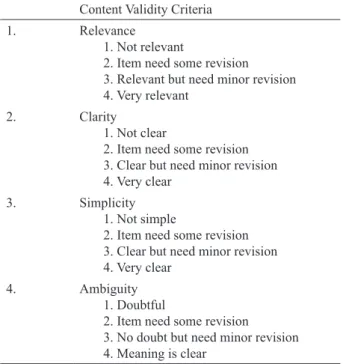
Home Form; (2) the final forward Malay translation of the SPM Home Form; and (3) a questionnaire that consists of four questions, i.e., relevance, clarity, simplicity, and ambiguity for each item listed in the translated form. The four questions in this questionnaire were selected and developed based on Polit and Beck’s (2006) and Zamanzadeh et al.’s (2014) suggestions and recommendations on content validation review. Example of the questions is shown in Table 1. The experts were asked to score the content validity for each translated item on a 4-point Likert-type scale, i.e., 1, 2, 3, and 4. To further improve the quality of the translation, experts were also encouraged to provide written feedback regarding the translated SPM Home Form. Content Validity Index (CVI)
was used to express the content validity. CVI for each item
(I-CVI) was calculated by dividing the total number of
experts who had rated the item with a score of 3 or 4 by the total number of experts participated in the study. Mean
I-CVI was calculated by dividing the total score of I-CVI
by the total number of items. CVI for the scale (S-CVI) was calculated by dividing the total number of experts who had rated the item with a score of 3 or 4 by the total number of items. An I-CVI and S-CVI of >0.80 is considered acceptable (good I-CVI ≥0.78 and S-CVI ≥0.90) (Polit & Beck 2006). The SPM Home Form Malay version was then tested on 30 children with ASD, with their parents as respondents.
A purposive sampling method was adopted by selecting children with ASD attending treatment or intervention in
private centers on the state of Kedah. Parents who have children with ASD were invited if their children aged
between 5 to 12 year-old, Malaysian citizen, and was formally diagnosed with ASD by medical practitioners.
Those with dual-diagnosis and with sensory issues of hearing and visual impairments were excluded.
TABLE 1 Criteria of measuring content validity for each item in the Malay translation of the SPM-Home Form
Internal consistency and test-retest reliability were performed. For test-retest reliability, reevaluation was done between seven to ten days after the first evaluation (Paiva et al 2014). Seven to ten days interval was considered suitable for the current study in order to prevent memory bias and obvious changes to the subjects. The Cronbach’s alpha was calculated to examine the internal consistency. According to Terwee et al. (2007), a good internal consistency value is between 0.70 – 0.95. For the test–retest reliability, it was estimated using the intraclass correlation coefficient (ICC) which considered suitable for such test (Weir 2005). An ICC value of poor < 0.5, moderate = 0.51 – 0.74, good = 0.75 – 0.90, and excellent > 0.90 were adopted as suggested by Portney & Watkins (2008).
Additionally, the limit of agreement (LOA) was measured based on four criteria consists of: (1) mean difference close to zero; (2) the closeness of variance to the mean differences; (3) the spread of scores towards the mean; and (4) the presence of outliers (Bland, 2000; Bland & Altman, 1986).
ETHICAL APPROVAL
Ethics approval to conduct this study was granted by the Medical Research and Innovation Secretariat, Universiti Kebangsaan Malaysia, and allocated a project number:
NN-2017-060. Permission to translate the SPM Home Form
into the Malay language was officially granted by the copyright holder-The Western Psychological Services.
Content Validity Criteria
1. Relevance
1. Not relevant
2. Item need some revision 3. Relevant but need minor revision 4. Very relevant
2. Clarity
1. Not clear
2. Item need some revision 3. Clear but need minor revision 4. Very clear
3. Simplicity
1. Not simple
2. Item need some revision 3. Clear but need minor revision 4. Very clear
4. Ambiguity
1. Doubtful
2. Item need some revision 3. No doubt but need minor revision 4. Meaning is clear
RESULTS
The adaptation, validation and reliability testing process has produced a Malay version of the SPM Home Form
(SPM-MV Home Form). During the item evaluation
process, no item was being excluded from the original SPM
Home Form as all the items were considered by the expert
panel as appropriate and relevance to the activity and social participation among Malay speaking children in Malaysia. During the forward and backward translation process, two examples given in items, i.e., #29 and #50 were identified as being problematic because certain examples used in the items, such as ‘party noisemakers’ and ‘walking heavily’ were unable to be translated literally into Malay.
Scale I-CVI
Item of the Sub-scale Relevance Clarity Simplicity Ambiguity Total S-CVI
Social Participation (10 items)
0.95 1-10 1.00 1.00 1.00 1.00 Mean I-CVI 1.00 1.00 1.00 1.00 S-CVI 1.00 1.00 1.00 1.00 Vision (11 items) 11-16 18-19,21 1.00 1.00 1.00 1.00 17,20 1.00 0.90 0.90 0.90 Mean I-CVI 1.00 0.98 0.98 0.98 S-CVI 1.00 0.82 0.82 0.82 Hearing (8 items) 23-28, 30 1.00 1.00 1.00 1.00 29 0.70 0.70 0.70 1.00 Mean I-CVI 0.96 0.96 0.96 1.00 S-CVI 0.88 0.88 0.88 1.00 Touch (10 items) 31-40 1.00 1.00 1.00 1.00 Mean I-CVI 1.00 1.00 1.00 1.00 S-CVI 1.00 1.00 1.00 1.00
Taste and Smell (5 items)
41-45 1.00 1.00 1.00 1.00
Mean I-CVI 1.00 1.00 1.00 1.00
S-CVI 1.00 1.00 1.00 1.00
Body Awareness (11 items)
46-49, 51-56 1.00 1.00 1.00 1.00
50 1.00 0.70 0.70 0.70
Mean I-CVI 1.00 0.97 0.97 0.97
S-CVI 1.00 0.91 0.91 0.91
Balance and Motion (11 items)
56-57, 59-66 1.00 1.00 1.00 1.00
58 1.00 0.70 0.70 0.70
Mean I-CVI 1.00 0.97 0.97 0.97
S-CVI 1.00 0.91 0.91 0.91
Planning and Ideas (9 items)
67, 69-75 1.00 1.00 1.00 1.00
68 1.00 1.00 0.80 0.80
Mean I-CVI 1.00 1.00 0.98 0.98
S-CVI 1.00 1.00 0.89 0.89
*I-CVI=item content validity index, **S-CVI/UA=scale content validity index/universal agreement
After an extensive discussion, the researchers and translators agreed to exclude an example of ‘party noisemakers’ in #29 under hearing subdomain from the item. The decision of exclusion came after ascertainment that there are still sufficient examples retained to reflect the actual meaning and intent of the translated item. For ‘walking heavily’ in #50 under body awareness subdomain, the researchers and translators had reached a consensus to use ‘stomping while walking’ as an alternative expression, for it can be more accurately translated into Malay and of the fact that it shares similar meaning with the original example. The SPM-MV Home Form was completed in the exact same format as the original version, as required by the copyright-holder.
TABLE 3. Demographic information of parents of children with ASD
The required number of 10 experts were successfully recruited. The experts, aged ranging from 29 to 37 years old, were occupational therapists who have extensive practice experience of between 5 and 15 years. Two of the experts qualified with a Diploma in Occupational Therapy, seven experts with a Bachelor’s Degree, and one expert with a Master’s Degree. The CVI, specifically, the I-CVI
and S-CVI of the SPM-MV Home Form is high respectively.
The mean of sub-scales I-CVI was between 0.96 and 1.00 (Table 2). The total S-CVI of the form was 0.95 with sub-scales S-CVI ranged between 0.82 and 1.00.
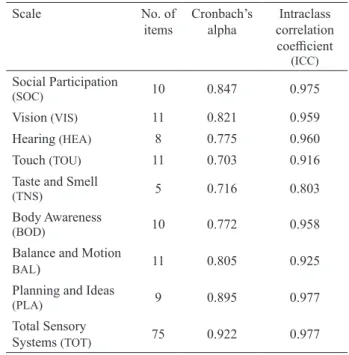
Tested using parents of 30 children with ASD (Table 3), the SPM-MV Home Form was noted to have good internal consistency with 4 out of 8 Home scales showed Cronbach’s alpha of 0.80 or greater. There was no item that scored less than 0.70 in the SPM-MV Home Form, with items score ranged from 0.70 to 1.00. The test–retest reliability of the SPM-MV Home Form was good to excellent with ICC of the form ranged from 0.80 to 0.97 (Table 4). The overall mean of differences of SPM-MV
Home Form has closeness of variance to mean difference and the spread of scores towards the mean without any clear patterns of distribution (Figure 2).
TABLE 4. Result on Internal consistency and test–retest
intraclass correlation coefficient of the SPM-MV (n=30)
Scale No. of
items Cronbach’s alpha correlation Intraclass coefficient (ICC) Social Participation (SOC) 10 0.847 0.975 Vision (VIS) 11 0.821 0.959 Hearing (HEA) 8 0.775 0.960 Touch (TOU) 11 0.703 0.916
Taste and Smell
(TNS) 5 0.716 0.803
Body Awareness
(BOD) 10 0.772 0.958
Balance and Motion
BAL) 11 0.805 0.925
Planning and Ideas
(PLA) 9 0.895 0.977 Total Sensory Systems (TOT) 75 0.922 0.977 Variables N % Gender Male 8 26.7 Female 22 73.3 Age 30 – 39 29 96.7 40 – 49 1 3.3 Ethnicity Malay 22 73.3 Chinese 6 20.0 Indian 2 6.7
Highest academic qualification
High school 2 6.7 Diploma 10 53.3 Bachelor degree 16 33.3 Master/PhD 2 6.7 Occupation Employed 30 100.0 Not employed Marital status Married 30 100.0 Monthly income RM1000-5000 17 56.7 >RM5000 13 43.3 Health issues Yes 11 36.7 No 19 63.3
FIGURE 2 Bland and Altman Plot presenting the test-retest
results from the SPM-MV Home Form
DISCUSSION
Planning and implementing appropriate interventions according to the needs of individual client is important in occupational therapy practice (Jorquera-Cabrera et al. 2017; Pfeiffer et al. 2011, McAuliffe et al. 2019). This can partly be achieved by performing accurate assessments to help outlining needs for further interventions (Ashburner et al. 2014; Jorquera-Cabrera 2017). Managing children with limited ability to express themselves is challenging. Not having valid and culturally-suitable assessment measures for these children in Malaysia is even more challenging. One study in Malaysia shows difference nature of languages on grammar, syntax, cultural applicability and idiomatic expression challenges the translation process (Ee et al. 2015); therefore, translation according to the meaning instead of direct translation of component words is the best to achieve equivalent meaning. Given this understanding, this current study had translated and adapted the SPM Home Form from English into Malay and thereafter, had validated the form on its suitability for Malay speaking Malaysian population. Specifically, the content validity obtained through both I-CVI and S-CVI as well as the internal consistency and test-retest reliability shows that the translated form is valid, reliable and culturally-relevant to be used with the Malay speaking Malaysian population, especially for parents with children ages 5-12 years in order for them to accurately evaluate their children sensory processing ability. Although faced with the difficulty in translating certain terms into Malay language such as ‘walking heavily’, through discussion the term ‘stomping while walking’ was considered as equivalent and was finally adopted. With this agreement, translation for the form into Malay was finally completed as the intended purpose of this translation process was
aimed at achieving the most relevant meaning and intent of the English terms and translating them into the conceptually equivalent Malay language accordingly.
The thorough development of this translation version based on the standard guidelines provided by WHO on tools/instruments translation process may give additional value to occupational therapy and other healthcare professions in terms of facilitating better assessment process and communication with parents in the management of children with ASD. Thorough understanding of parents regarding each assessed item is crucial in the process of getting accurate responses suitable with their context and cultural situations (Hunt & Bhopal 2004).
However, being the proxy-administered assessment measure, it is crucial to ensure accurate information regarding the children with ASD being assessed can be obtained from their parents. Proxy-rated was found to be less sensitive to capture meaningful outcome compared to self-rated (Galloway & Newman 2017); however this is not possible for SPM as obtaining information from children with ASD can be difficult. In the other hand, outcome from proxy-rated by family members were found to be slightly different when compared with professional-rated (Garcia et al. 2002); where the occupational therapists have knowledge and expertise to detect any changes or issues compared to lay-persons. Therefore, occupational therapists in charge must take necessary measures in order to ensure the assessment is scored by parents with satisfactory knowledge and understanding about their children with ASD. However, the use of proxy-rating on evaluating sensory challenges among children with ASD is currently the best practice and should be encouraged. Therefore, occupational therapists in charge must take necessary measures in order to ensure the assessment is scored by parents with satisfactory knowledge and understanding about their children with ASD.
This study is strong in terms of its comprehensiveness in performing item evaluation, translation, validation, and reliability testing. The expert review process was performed in a thorough manner. Developed according to standard
WHO guidelines,this SPM-MV Home Form is of adequate quality by including experienced occupational therapists as expert panels and reviewers as well as language experts as translators. Compared to the original version of SPM -Home Form with reported internal consistency of each item ranged between .78 to .92 and the test–retest reliability of the form ranged .94 to .98 (Parham et al. 2007), the
SPM-MV Home Form can be considered as satisfactorily
valid and reliable. Meanwhile, the nearly similar cultural comparison that can be done with SPM-MV Malay version is to the Chinese translated version (SPM-HKC) translated by Lai et al (2011). The SPM-HKC version has an internal consistency for each item reported to range from .67 to
.86, and the test-retest reliability was reported at .70 to .95 (Lai et al 2011).
CONCLUSION
This preliminary study reveals that the translated SPM-MV
Home Form has a high content validity and reliability in which it is valid, reliable, and suitable to be used with Malay speaking Malaysian population. The SPM-MV Home Form is found suitable to be administered by Malay speaking Malaysian parents with children with ASD to assist occupational therapists and other healthcare practitioners in evaluating and planning for intervention for children with ASD ages 5-12 year-old. It is believed that by having this translated and culturally-adapted Malay version, occupational therapy services for children with
ASD and their family in Malaysia can be greatly enhanced and also to ensure appropriate services are received by the children with ASD and their family.
STUDY LIMITATION AND FUTURE
RECOMMENDATION
One of the limitation in this preliminary study was that it is based on 30 respondents to establish its internal consistency and test-retest reliability due to time constrains and difficulty in getting the participants. This is owing to parents constrains in finding times to fill in the assessment form. It is highly recommended for future study to include much larger sample size of children with ASD in order to gain more conclusive results. It is also suggested for the therapists to be able to sit together with the parents in order to answer any questions or give clarification needed by parents.
REFERENCES
American Psychiatric Association (APA). 2013. Diagnostic and Statistical Manual of Mental Disorders (5th Eds.).
Arlington, VA: American Psychiatric Association. Ashburner, J., Rodger, S., Ziviani, J. & Jones, J. 2014.
Occupational therapy services for people with autism spectrum disorders: Current state of play, use of evidence and future learning priorities. Australian Occupational Therapy Journal, 61(2): 110-120. https://doi.org/10.1111/1440-1630.12083.
Bland, J. M. & Altman, D. G. 1986. Statistical methods for assessing agreement between two methods of clinical measurement. Lancet 327(8476): 307-310. Bland, J. M. 2015. An Introduction to Medical Statistics
(4th Eds.). Oxford: New York, Oxford University
Press.
Ee, S. I., Loh, S. Y., Chinna, K. & Marret, M. J. 2015. Cross-cultural adaptation and psychometric properties of the Malay version of the Short Sensory Profile. Physical & Occupational Therapy in Pediatrics 36(2): 117-130. https://doi.org/10.3109/0 1942638.2015.1040574.
Galloway, H. & Newman, E. 2017. Is there a difference between child self-ratings and parent proxy-ratings of the quality of life of children with a diagnosis of attention-deficit hyperactivity disorder (ADHD)? A systematic review of the literature. Attention Deficit and Hyperactivity Disorders 9(1): 11-29. https://doi. org/10.1007/s12402-016-0210-9.
Garcia, R., Joseph, T., Turk, J. & Basu, R. 2002. A comparison of parent and therapist ratings of outcome in a child mental health clinic. Child and Adolescent Mental Health 7(4): 168-172. https://doi. org/10.1111/1475-3588.00030.
Hamed, R., Abu Tariah, H., Jarrar, M. & Holm, M.B. 2012. Development of the Arabic version of the Performance Assessment of Self-Care Skills. Jordan Medical Journal 46(3): 221-228.
Hong, I., Lim, Y., Han, H., Hay, C. C. & Woo, H. S. 2017. Application of the Korean version of the Modified Barthel Index: Development of a keyform for use in clinical practice. Hong Kong Journal of Occupational Therapy 29: 39-46. https://doi. org/10.1016/j.hkjot.2017.06.001.
Hunt, S. M. & Bhopal, R. 2004. Self-report in clinical and epidemiological studies with non-English speakers: The challenge of language and culture. Journal of Epidemiology and Community Health 58(7): 618-622. https://doi.org/10.1136/jech.2003.010074. Jorquera-Cabrera, S., Romero-Ayuso, D.,
Rodriguez-Gil, G. & Triviño-Juárez, J-M. 2017. Assessment of sensory processing charactersitics in children between 3 and 11 years old: A systematic review.
Frontiers in Pediatrics 5(57): 1-18. https://doi. org/10.3389/fped.2017.00057.
Lai, C. Y., Chung, J. C., Chan, C. C. & Li-Tsang, C. W. 2011. Sensory processing measure-HK Chinese version: Psychometric properties and pattern of response across environments. Research in Developmental Disabilities 32(6): 2636-43. https:// doi.org/10.1016/j.ridd.2011.06.010.
Marco, E. J., Hinkley, L. B. N., Hill, S. S. & Nagarajan, S.S. 2011. Sensory processing in autism: A review of neurophysiologic findings. Pediatric Research 69(5): 48R-54R. https://doi.org/10.1203/ PDR.0b013e3182130c54.
McAuliffe, T., Thomas, Y., Vaz, S., Falkmer, T. & Cordier, R. 2019. The experiences of mothers of children with autism spectrum disorder: Managing family routines and mothers’ health and wellbeing.
Australian Occupational Therapy Journal 66: 68-76. https://doi.org/10.1111/1440-1630.12524.
Mehraban, A. S., Soltanmohamadi, Y., Akbarfahimi, M. & Taghizadeh, G. 2014. Validity and reliability of the Persian version of Lawton Instrumental Activities of Daily Living Scale in patients with dementia. Medical Journal of the Islamic Republic of Iran 28(25): 1-8. Ministry of Health, Malaysia. 2014. Clinical Practice
Guideline: Management of Autism Spectrum Disorder in Children and Adolescents. Malaysian Health Technology Assessment Section (MaHTAS).
Medical Development Division, Malaysia.
Paiva, C. E., Barroso, E. M., Carneseca, E. C., Pádua Souza, C., Santos, F. P., López, R. V. M. & Paiva, S. B. R. 2014. A critical analysis of test-retest reliability in instrument validation studies of cancer patients under palliative care: a systematic review. BMC
Medical Research Methodology 14(8).
Parham, L. D. & Ecker, C. 2007a. Sensory Processing Measure (SPM) Home Form. Los Angeles: Western Psychological Services.
Parham, L. D., Ecker, C., Miller-Kuhananeck, H., Henry, D.A. & Glennon, T. 2007b. Sensory Processing Measure (Manual). Torrance, CA: Western Psychological Services.
Pfeiffer, B. A., Koenig, K., Kinnealey, M., Sheppard, M. & Henderson, L. 2011. Effectiveness of sensory integration interventions in children with autism spectrum disorders: A pilot study. American Journal of Occupational Therapy 65(1): 76-85. https://doi. org/10.5014/ajot.2011.09205.
Polit, D. F. & Beck, C.T. 2006. The content validity index: Are you sure you know what’s being reported? Critique and recommendations. Research in Nursing & Health 29(5): 489–497. https://doi.org/10.1002/ nur.20147.
Portney, L. G. & Watkins, M.P. 2008. Foundations of Clinical Research: Applications to Practice
(3rd Eds.). Prentice Hall. Terwee, C. B., Bot, S.
D., de Boer, M. R., van der Windt, D. A., Knol, D. L., Dekker, J., Bouter, L. M., de Vet, H. C. 2007. Quality criteria were proposed for measurement properties of health status questionnaires. Journal of Clinical Epidemiology 60(1): 34-42.
Weir, J. P. 2005. Quantifying test-retest reliability using the intraclass correlation coefficient and the SEM.
Journal of Strength and Conditioning Research
19(1): 231-240.
World Health Organization (WHO). 2017. Process of Translation and Adaptation of Instruments. [cited June 2017]. Available from www.who.int/substance_ abuse/research_tools/translation/en/.
Zamanzadeh, V., Rassouli, M., Abbaszadeh, A., Majd, H. A., Nikanfar, A., & Ghahramanian, A. 2014. Details of content validity and objectifying it in instrument development. Nursing Practice Today 1(3): 163-171.
Noor Mukminin Ahmad Hospital Jitra, Kedah Ministry of Health Malaysia
Masne Kadar Chai Siaw Chui
Hanif Farhan Mohd Rasdi Nor Afifi Razaob@Razab Dzalani Harun
Occupational Therapy Programme Center for Rehabilitatin & Special Needs Faculty of Health Sciences (FSK)
*Corresponding author’s email address: masne_kadar@ ukm.edu.my