The use of case-based learning in the development of student
teachers’ levels of moral reasoning
Abstract
The important role of the teacher in developing morally sensitive individuals is widely acknowledged. This paper examines the integration of context specific moral development interventions within a 4-year undergraduate teacher education programme in Ireland. The intervention strategy employed a case-based pedagogical approach (Shulman 1992) where participants (n=123) explored and discussed classroom scenarios to prepare them for a 6-week school-based placement. Using the Defining Issues Test (DIT), results indicate statistically significant increases in levels of moral reasoning post intervention, suggesting that the use of a layered case-based pedagogical strategy provides students with alternative perspectives on their classroom practices and challenges their lay theories.
Keywords: Pre-service teacher education; moral reasoning, case-based learning; ethical practice
Introduction
The importance of education in developing morally sensitive individuals who use principled moral reasoning when facing dilemmas has been widely acknowledged (Pascarella and Terenzini 1991; Rest, Narvaez, Bebeau and Thoma 1999). The recent global economic crisis has brought this issue to the fore. The prevailing discourse now centres on a claim that, compared to previous generations, levels of moral thinking is a cause for concern. Reasons given for this apparent change range from declining religious worship in western societies, the increasing reach and influence of global media, and changes to societal and family structures where individualism has replaced the cooperative ethos of previous generations. Evidence of these changes, it is argued, is reflected in reductions in levels of volunteerism and civic engagement, a lack of engagement in democratic processes and an emphasis on the human as opposed to social capital driven by a commercial and economic ideology (Putman 2000; OECD 2001) .
While traditionally a strongly Catholic country with a state education system1 predominantly controlled by the Catholic Church (Lee 1989; Kane 1996), Ireland has also witnessed declining levels of religious worship and similar changes to societal and family structures. Concerns regarding the increasing rise of individualism and a decline in moral values have often dominated public debate. These issues are compounded by recent scandals, which have emerged in the last decade, relating to child sexual abuse cases brought against the clergy and Church run institutions. This has resulted in the diminution of the Catholic Church’s influence on people’s beliefs and values and subsequent religious teachings which up to now provided the primary vehicle for moral education within the state education system (Fuller 1990; 2002).
1State education in Ireland encompasses both primary (4-12 years of age) and
Within the emerging vacuum questions are now being asked about the role and provision of moral education within the state education system. Solutions are increasingly focusing on the role of all teachers as moral educators. The Teaching Council of Ireland (the professional accreditation body for all primary and post-primary teachers) for example, identifies the moral role of the teacher as a key role of all professionally recognised teachers in the state (Teaching Council of Ireland 2006).
Societal expectations of teachers in this regard are quite high. Parents, for example, entrust their children to teachers and feel safe in the expectation that they behave ethically, transmit values, and serve as moral role models for their students (Sirotnik 1990). However, the limited international comparative research available indicates that student teachers score significantly lower in levels of moral reasoning than students from other disciplines (McNeel 1994; Lampe 1994; Cummings et al. 2001). Similarly, empirical evidence within the Irish context suggests pre-service teachers compare negatively with their international counterparts in terms of levels of moral reasoning ability (Gleeson 1992; Author et al. 2009; Author et al. forthcoming). This evidence would suggest that teacher education programmes should prioritise the moral role of the teacher.
This paper examines the integration of context specific moral development interventions within a 4-year undergraduate teacher education programme in the Republic of Ireland (RoI). The intervetion strategy employed a case-based pedagogical appoach (Shulman 1992) where participants, n=123 explored and discussed classroom scenarios to prepare them for a 6-week school-based placement. Using the Defining Issues Test (DIT), a psychometric measurement of moral reasoning, the participants were pre and post-tested in order to examine the impact of this intervention strategy.
Cognitive Moral Reasoning
Moral reasoning is one of the components necessary for moral behaviour, according to Rest’s four component model (1983), however level of moral reasoning alone is an insufficient predictor of behaviour in specific situations (Thoma 1994; Bebeau 2002). The four psychological components that form the foundation of Rest’s model for moral action are: a) moral sensitivity; b) moral reasoning; c) moral motivation and d) moral character (Rest 1983). Cognitive developmental psychologists believe that before an individual reaches a decision about how and whether to behave ethically in a specific situation, ethical or moral reasoning takes place. The psychology of moral reasoning aims to understand how people think about moral dilemmas and the processes they use in approaching them. It is concerned with the state of mind of the decision maker, how he or she defines the moral dilemma being faced and the concepts of fairness that the decision maker applies to the decision (Kohlberg 1973; Rest 1979). The processes used by individuals to reason morally, alter over time and there is empirical evidence to support the contention that moral reasoning ability develops sequentially (Kohlberg 1973; Rest 1979). Kohlberg’s (1958) stage theory provides the framework for cognitive theory development in moral reasoning. Kohlberg (1958) proposed three levels through which moral reasoning develops Preconventional, Conventional, and Postconventional. Each level contained two stages, where the primary concern is with the principle of justice. Kohlberg considered interview data as central to the process
of identifying moral structures. Rest proposed an alternative to the Kohlberg system that focused on the development ‘of a methodology that conformed to a cognitive developmental model but minimized the practical and empirical concerns associated with Kohlberg's system’ (Thoma 2002, 227) and developed a new measure using short issue statements called the Defining Issues Test (DIT). Instead of scoring verbal interview responses to hypothetical moral dilemmas, the DIT presents the subject with an instrument containing 12 short issue statements around each of six hypothetical dilemmas. The subject is asked to rank and rate each issue statement in terms of its importance. Due to its paper and pencil format and associated scoring process this is recognised today as a user-friendly method of measuring Kohlberg’s Stages.
Factor analysis of a mega-sample of over 44,000 subjects (Rest et al. 1997) indicated that DIT items cluster around three general moral schemas: the Personal Interest Schema (derived from Kohlberg’s Stages 2 and 3); the Maintaining Norms Schema (derived from Kohlberg’s Stage 4); and the Post-Conventional Schema (derived from Kohlberg’s Stages 5 and 6). While these schemas have a close relation to Kohlberg’s stages, there are also differences. As with Kohlberg’s theory, the schema scores purport to measure developmental adequacy and in particular, how people conceptualise the organisation of cooperation in society. The main focus of the Personal Interest Schema is on direct advantage to the individual. Stage 2 considerations focus on the direct advantages to the individual and the fairness of simple exchanges of favour for favour. Stage 3 considerations focus on the good and evil intentions of the parties involved, on the person’s concern for maintaining friendships and good relationships, and maintaining approval. From a cognitive development perspective both the Maintaining Norms and Post Conventional Schema is more advanced in attaining a socio-centric perspective than the egocentric perspective of the Personal Interest Schema. Maintaining Norms represents the proportion of items selected that appeal to stage 4 e.g., focusing on maintaining the legal system, maintaining existing roles and formal organisational structures. Those who fit the Post-Conventional Schema arrive at moral decisions on the basis of shared ideals that are fully reciprocal and open to scrutiny (Rest et al., 1999a; Rest et al., 1999b). Such individuals begin to question and suggest changes to the status quo, for moral reasons (Narvaez and Bock 2002). As development of moral reasoning continues, the Postconventional Schema is activated.
The Defining Issues Test
Participants taking the DIT are presented with five ethical dilemmas stated in third-person form. The dilemmas are presented as narratives describing the circumstances of the third party who is faced with making a decision on how to act in the scenario. After reviewing the dilemmas, participants choose what the protagonist should do in the circumstances from three options offered: ‘take the action’, ‘do not take the action’, or ‘cannot decide’. They are then asked to rate the importance of 12 considerations relating to the particular dilemma, indicating how important each is (in their opinion) in making the decision described in the scenario, using a five-level scale (great importance, much importance, some, little or no importance). The 12 statements were constructed by Rest to include considerations that would be prevalent at particular stages of moral judgement development in each situation. Once the 12 items have been rated, the participant is asked to select the four items that he/she considers to be of most importance to the decision and to rank these in order of
importance. In scoring the DIT, weighted points are allocated to the considerations chosen as the four most important in each scenario. The points corresponding to the highest modes of moral reasoning (stages five and six) are used to construct a single measure known as the ‘P’ score (standing for ‘principled moral thinking’) for each participant (Rest 1994). As the Rest model is developmental and sequential, a higher P score implies a lower percentage of reasoning at lower levels. P Score is the weighted average of the ranked Stage 5 and 6 items selected across five stories. P Score ranges between 0 and 95 and is interpreted as the percentage of reasoning that is at the post-conventional level and thus the degree to which the participant values post-conventional, or principled, considerations (Rest et al., 1999a). Test-retest correlations and internal reliabilities of the DIT average in the .80s (Rest, 1994). Based on thousands of studies carried out internationally, Bebeau and Thoma (2003) report that high school students generally average P scores in the 20s, college students in the 40s, graduate students in the 50s and moral philosophers in the 60s.
While researchers have typically reported moral reasoning scores in terms of P score, more sensitive developmental change can now be reported in terms of schema score indices (Bebeau and Thoma 2003) to the extent that an individual has developed them. The N2 index captures an individual’s response pattern and as a result offers a better estimate of his/her location on the developmental continuum (Thoma 2002; Bebeau and Thoma 2003). This new index is basically a modified P score that is adjusted by the degree to which an individual discriminates clearly between lower and higher stages (Rest and Narvaez 1998; Rest et al. 1999; Bebeau and Thoma 2003). Higher N2 scores reflect an individual’s increased capacity for reasoning about moral issues based on a system of fairness that serves the public good; lower N2 scores tend to reflect reasoning about moral issues from a self-serving understanding of fairness. The DIT moral dilemmas and issue statements activate moral schemas to the extent that an individual has developed them.
The moral role of the teacher
Teachers have tremendous influence on the moral reasoning development of children (Chang 1994) so much so that Goodlad et al. (1990) describe teaching as a moral enterprise. Teachers therefore should be able to make sound moral judgements and look beyond their own personal interests to the broader moral dimension that presents itself in their classrooms. Teachers who reason at the postconventional or principled levels of moral reasoning are more likely than those who reason at lower levels to have a heightened sense of their moral responsibility as well as the moral dimension of teaching (Chang 1994; Cummings et al. 2001; Cummings et al. 2010).
From the early 20th century, the moral and ethical aspects of teaching have been emphasised (Goodlad et al. 1990). It is increasingly becoming recognised that teaching involves more than the mere transmission of knowledge. Teaching is now viewed as a multi-dimensional role, where the teacher has a number of important functions. The need for teachers to become more than mere subject experts is being recognised with Sugrue et al. (2001, 6) outlining the increasing demand on schools to become ‘caring and nurturing institutions rather than focusing exclusively on academic attainment’. Teachers are no longer simply required to ensure that students
achieve academically, they must also aid and encourage them to become caring, mature adults who develop into caring and active citizens;
It is an activity in which the teacher is sharing in a moral enterprise, namely, the initiation of (usually) young people into a worthwhile way of seeing the world, of experiencing it, of relating to others in a more human and understanding way’ (Pring 2001, 106).
Being essentially a moral enterprise in which adults ask and require children to change in directions, confronts a teacher with potentially unsettling questions: by what authority do I push for changes in the lives of these children? At what costs to their freedom and autonomy? Where does my responsibility for these young lives begin and end? How should I deal with true moral dilemmas in which it is simply not possible to realise two goods or avoid two evils? How much pain and discomfort am I willing to endure on behalf of my students? How are my own character flaws affecting the lives of others? (Goodlad et al. 1990, 264). Thoughtful reflection on and responses to these questions requires teachers to make sound moral judgements which may involve ‘defining what the moral issues are, how conflicts among parties can be settled, and the rationales for deciding on a course of action’ (Rest et al. 1997, 5). Cummings et al. (2007) echo previous research when they suggest that teachers who reason at post-conventional or principled levels of moral reasoning are more likely to motivate students’ learning and social development than teachers who reason at lower levels of moral reasoning. According to Beyer (2001), the teacher’s ability to consider the moral dimensions of teaching is essential for working in schools that operate within a culturally diverse society. Cochran-Smith argues that the most important goals of teaching and teacher education are ‘social responsibility, social change, and
social justice’ (1999, 116). Furthermore, it is suggested that the tools needed to teach
social responsibility and social change must be embedded in pre-service teacher education (Cochran-Smith 1999, 138). Many prior studies examining the moral reasoning of teacher education students have found that they function at the conventional level of moral reasoning (Chang 1994; Lampe 1994; McNeel 1994; Cummings et al. 2001, 2007).
Much of the concern that has been expressed by researchers who have used teacher education students as their subjects has been whether teachers display levels of moral reasoning higher than that of their students? (Tan-Wiliam 1978; Holt et al. 1980; Wilkins 1980; Yeazell and Johnson 1988; Chang 1994; McNeel 1994; Lampe 1994). This raises doubts about the ability of this group to understand and teach ethical principles and their ability to facilitate the development of their own students’ moral reasoning. Also questions arise concerning their ability to make decisions in their daily classrooms regarding moral situations such as fairness and discipline (Yeazell and Johnson 1988). Teacher education students should be exposed to course content that is thought provoking and challenges thinking. Otherwise, once they become teachers, they will have a repertoire of teaching methods but may not have conceptual understanding about how and with whom to implement these methods. Consequently, they risk becoming technicians instead of morally engaged people who think critically about and reflect upon their ethical and moral responsibilities to their students (Cummings et al. 2007). A number of the researchers (Yeazell and Johnson 1988; Lampe 1994; Rest et al. 1999) argue that factors inherent in the pre-service teacher education curriculum accounts for lower levels of moral reasoning in teacher
education students for example, a focus on technical knowledge, little promotion of moral reasoning and ethics in the classroom or discussion of moral dilemmas.
Some Irish Context
The importance of ethics in teaching cannot be overstated. The influence of schools and teachers in the modelling of values has increased (Lumpkin 2008) as other vehicles such as church and community decrease (Fuller 2002). The enormous influence of the main Christian Churches on Irish post-primary provision lead to a conservative environment, where Church and moral teaching were inextricably linked and the Churches provided clear and unquestionable answers to all moral problems (Lynch 1989). Within this context moral education was, and continues to be, transmitted as a subset of Religious Education to students of all denominations. Participation in this subject is optional. Gleeson (1996) suggests that the conservative legacy of the Irish Catholic Church’s domination of education supplants a school culture that is slow to support change. Gleeson also suggests that in Ireland, education for democracy is rarely debated. This results in a school culture that is the antithesis of empowerment and critical questioning of power relations in society (Lynch and Lodge 2002) and does not encourage young people to become active in the democratic processes. The OECD (1991) highlighted the authoritarian nature of the teacher student relationship in Irish post-primary schools. This was further corroborated by Lynch and Lodge (1999) when they highlighted the lack of autonomy afforded to post-primary students in Ireland as well as the prominence of competitive individualism. The relational context within which Irish pupils are socialised in post-primary schools is profoundly hierarchical. Pupils have little control over either what they do in school, when they do it or how they do it (Lynch 1989, 98). For example, student democracy has only recently found its way into Irish post-primary education with the mandatory inclusion of Student Councils, which provide opportunities to participate in decision-making processes. Lynch (1989) reports that Irish students are rarely consulted regarding allocation to class groups or streams, neither do pupils have autonomy in determining school policies that may affect their learning and finally little evidence was reported that pupils exercised any choice in their mode of dress. The prevalence of a consensualist society resonating a belief that society are represented as an undifferentiated whole militates against autonomous thinking and development of moral reasoning.
It can no longer be assumed that Irish children come to school with values, attitudes and morals “taught or caught” in the home or the church. Therefore, the moral role and significance of today’s teacher is more pronounced than it has been for a long time (Hargreaves and Fullan 1998).
Empirical Data from two Irish Studies
To illustrate the critical need for the inclusion of explicit context specific moral reasoning interventions within the initial teacher education curriculum, evidence from two recent research projects in Ireland is now presented. The first focuses on student teachers. Apart from being of interest as a cohort in themselves, student teachers will eventually be responsible for educating future generations. The second study examines a longitudinal study of students at an Irish university. Rest’s five-story DIT was used to examine moral reasoning in 120 first year teacher education students (Author et al. 2013). The mean P score was 29.03. This compares
poorly with the average scores reported by Rest (1986a, iii) on the basis of the norms complied by the Centre for the Study of Ethical Development (CSED) in Alabama. According to the CSED norms, the scores from the study are most comparable with those of average senior high students and are well below the level of adults in general and college students in particular. Given the paucity of Irish based research on students’ levels of moral reasoning, a longitudinal study of the levels of moral reasoning was conducted in a convenience sample of university students in an Irish university (n=252). Students tested represented six colleges within the university; Education; Business; Humanities; Engineering; Science and Informatics & Electronics. Results indicated that students made impressive gains in levels of moral reasoning over the four years, consistent with the positive effects of higher and continued education on the development of moral reasoning in other systems. Some of the other main findings that emerged include: students’ levels of moral reasoning are considerably lower than their international counterparts; pre-service teacher education students scored higher than students from a number of other academic disciplines and compared favourably with student teachers in other jurisdictions (see Author et al. 2009; Author et al. forthcoming).
Methodology Intervention Studies
Research suggests that explicitly including moral content in the curriculum fosters growth of moral reasoning (D’Arcy-Garvey 1988; Mayhew and King 2008). Intervention studies using the DIT have been used with a number of different participants ranging from adolescents to adults. Rest et al. (1999) describe intervention studies as follows:
Intervention studies are like longitudinal studies in testing and retesting the same subjects … Intervention studies are usually shorter in duration than longitudinal studies… intervention studies also have more control over what experiences the subjects have between testings (p. 74).
Schlaefli, Rest and Thoma (1985) conducted a meta-analysis of 55 intervention studies using the DIT. The majority of the interventions used peer discussion of controversial moral dilemmas used to challenge thinking, re-examine personal assumptions, listen to the views of others, argue in a logical manner and respond rationally to counter arguments. Rest and Narvaez (1994) described a number of intervention studies with various academic disciplines. All experimental groups as described by Rest and Narvaez (1994) displayed significantly high DIT (P) score gains than the control or comparison groups. The most successful programmes included: taught self-reflection; stimulated growth in cognitive processes – role taking and empathy; the integrated instruction of moral and ethical issues and finally logical and philosophical concepts which are critical to the development of moral reasoning ability were taught directly to the students followed by discussion of individual cases of moral problem solving. Other intervention programmes used different approaches, including, self-reflection and reflection about the self in relation to others in order to increase empathy; instruction in general theories of moral development including Kohlberg’s six stage theory and discussions of moral and ethical issues within the content of the course being studied. Key findings reported from a meta-analysis study indicate that use of interventions involving both discussion of dilemmas and
presentation of theoretical models of moral development – produced moderate effect sizes and also an intervention that lasted anywhere from 3-12 weeks was ideal (Rest et al. 1999).
Case-based Approach
According to Shulman (1992) case-based learning provides situations for teachers to analyse situations and make judgements in “the messy world of practice” (p. xiv). A key feature of this approach is the theoretical alignment of the case with the core concepts and learning outcomes of the programme. Constructed in this manner, the experience can encourage reflective practice though the application of theoretical concepts to real-life events.
The case-based experience used in this study provided students with typical classroom scenarios that they were likely to encounter during their placement. The approach used could be described as a ‘layered’ case where additional perspectives or lenses are provided to the original case (Shulman 1992). All students in the experimental group were provided with a description of a typical classroom incident they would be likely to encounter on their placement. For example, in the case provided all students were initially given a vignette of a teacher struggling to manage a group of disruptive students in her class. Following this, working in smaller teams each group was then provided with additional information on the case. The additional information provided to each group differed in focus and linked to different theoretical concepts and associated readings. For example one group were provided with information on the socioeconomic background of the students within the vignette and provided with additional information on the effects of social class on educational achievement. Another group were provided with additional information on the teacher and her background and given additional information on the effects of teacher expectations on students’ performance in schools. In all a total of five different perspectives were provided. This gave the students different lenses through which the original case could be viewed. As a result, each group constructed a different interpretation of the classroom event, often influenced by their understanding and interpretation of the additional information provided. Having examined the case from their particular perspective, the various groups were then exposed, through a class discussion, to other groups’ perspectives on the same case. This approach was used to challenge thinking, re-examine personal assumptions, argue in a logical manner and respond rationally to counter arguments. At the end, students completed a reflective overview of their experience and analysed how they planned to apply their learning from this intervention to their future pedagogic strategies during their 6-week school-based placement.
One of the main aims of this strategy was to prevent the students from simplifying the origins of the problem and subsequently, the teacher’s response to it. Rather than providing the students with ‘solutions’ to the classroom management problems that they typically encounter, which many in the past have sought, the aim of this experience was to provide the students with alternative perspectives on these events.
The purpose of the present study was to test an educational intervention designed to advance moral reasoning scores of undergraduate student teachers. The research
employed a pre-test – post-test quasi-experimental design. A quasi-experimental design indicates that the experimental and control groups have not been equated by randomisation, that is both groups are ‘non-equivalent’ (Cohen et al. 2011, 316). However, in order to strengthen the equivalence both the control and experimental groups were selected from the same population, in this case student teachers from the same institution.
Research Participants
Intervention participants in this study were second-year undergraduate students on a four-year concurrent teacher education degree programme specialising in the teaching of Technology, Science, Physical Education and Languages. The case-based learning experiences formed part of a preparatory module on classroom practice and planning for learning provided in advance of the students’ first teaching placement (6 weeks in duration). In this module content is selected which builds on the areas of communication, identity and learning theory which enable the student to plan and teach more effectively; create effective opportunities for pupil learning to take place and also to deal with the many challenges of classroom life. The selection of content delivered prepares the student for teaching in a classroom as well as preparing the student to plan and effectively facilitate student learning by examining planning, classroom management and different pedagogical strategies that can be employed to maximise pupil learning. The module also introduces key concepts including; the role of assessment in learning, issues dealing with mixed abilities in the classroom and other important topics such as the use of ICT, education for sustainable development (ESD) and the professional responsibilities of teachers in Irish post-primary schools.
The DIT was administered electronically to the experimental or intervention cohort of 123 student teachers at the beginning and end of their Preparatory Module and again after their teaching practice placement (some 20 weeks apart in total). Participants were volunteers and were not given additional compensation such as extra credit, additional points, or being excused from taking examinations. All research procedures were approved by the university’s institutional review board for the protection of human subjects. Males represented 58% of the cohort (n=71) with 42% of the cohort being female (n=52). 51% of the cohort were enrolled on Technology programmes, a further 26% enrolled in Science programmes, 19% in Physical Education and 4% in Languages.
Given the research evidence supporting the educational value of case-based learning, it was considered unethical not to expose students currently enrolled on the initial teacher education programme to the case-based approach. Therefore control participants in this study were second year undergraduate student teachers enrolled some four years earlier, on the same programme. These participants were similar in age, academic ability and socio-economic background as the experimental group. As the programme content and structure had not changed in the intervening period – they in essence, had completed the same programme of study. These participants were also specialising in the teaching of Technology, Science, Physical Education and
Languages (n=102). The DIT was administered electronically to the control group of 102 student teachers at the beginning of their Preparatory Module and again after their teaching practice placement (some 20 weeks apart in total). Students in the control group were exposed to similar course content, that is, control participants completed the same module as experiment participants without the inclusion of the case-based experience. Whilst, control group participants were exposed to similar content as experiment participants, content was delivered using traditional lecture format and the opportunity to interrogate alternative interpretations of classroom events and practice was not afforded. Males represented 68% of the control group (n=68) with 32% of the control group being female (n=33). 48% of the cohort were enrolled on Technology programmes, with a further 16% enrolled in Science programmes, and 32% in Physical Education. At the time of testing a BA in Language was not offered at the research university site.
Completed DIT answer sheets were sent to the Centre for the Study of Ethical Development at the University of Alabama for optical scanning. As soon as all forms are scanned, the data is then entered into a scoring programme. A paper copy of the results as well as a diskette containing both raw and processed data is returned to the researcher. Developmental Indices, including (P) score and N2 score are returned as well as numerous other developmental and experimental indices. Separate analyses of variance were run on each of the respondent variables using P score and the N2 score as the dependent variables. This makes the data comparable with other research, which has been conducted using the Defining Issues Test.
Results
All of the analyses outlined in this paper have been done using SPSS. P score standing for Principled Score, is regarded as the most consistent index for the DIT and as a direct indicator of the development of moral reasoning from adolescence to adulthood (Thoma 2002). P score, is the weighted average across the five stories of the ranked Stage 5 and 6 items. The N2 score, developed during the late 1990s, represents a modified version of the P score adjusted by the degree to which an individual respondent discriminates clearly between lower and higher staged DIT items (Rest and Narvaez 1998; Rest et al. 1999; Bebeau and Thoma 2003).
Levels of Moral Reasoning as indicated by P Score and N2 Score Students’ P Scores
Results indicate that P score mean values for the control and experimental groups varied from the onset (mean pre-intervention P score for experimental group = 28.69 (n=123), mean pre-intervention P score for control group = 25.37 (n=102)). Following the intervention, mean P scores increased at an equal rate for both groups. The mean P score post-intervention for the experiment group = 34.35 (n=123), demonstrating a mean increase of 5.66 points, from pre to post, a growth rate of 17%. Post intervention the mean P score for those students in the control group = 31.56 (n=102) demonstrating a mean increase of 6.19 points, from pre to post, a growth rate of 19% (see Table 1). An independent t-test was used to examine the statistical relationship between mean P score values for both the control and experiment groups. Using the Levene test (which is a guide as to aid selecting whether equal variances has been assumed or not, Cohen et al., 2011), the t-test indicates that equal variances are assumed. Looking at the (2-tailed) significance between both groups, significant
P score differences emerge pre-intervention (p<0.05) however, this trend does not emerge post-intervention. .
[Insert Table 1 here]
Paired sample t-tests compare means where the groups are correlated, for example repeated measures (Robson 2000). They are used to compare P and N2 score means pre and post intervention for both control and experiment groups. Paired sample t-tests reveal statistically significant differences between mean P scores pre and post intervention for both control (p<0.001) and experiment participants (p<0.02). Values or effect sizes provide an objective measure of the importance of an effect, or quantifying the difference between two groups (Cohen et al., 2011). There are several different calculations of effect size, for the purposes of this paper the authors employed Cohen’s d (see Cohen et al., 2011, p. 617). Cohen’s d for the experimental group P score was 0.4 compared with 0.46 for the control group indicating a modest effect size.
Students’ N2 scores
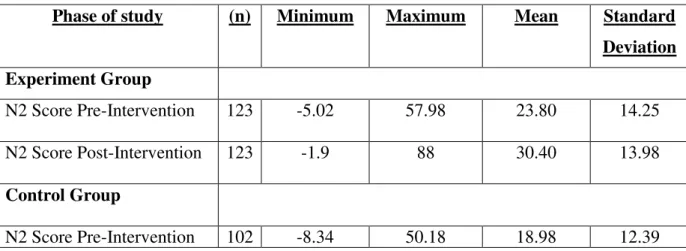
Once again, results indicate that mean N2 score values for the control and experiment group varied from the onset (mean pre-intervention N2 score for experiment group = 23.8 (n=123), mean pre-intervention N2 score for control group = 18.98 (n=102)). Following the intervention, mean N2 scores increased for the experiment group whilst mean N2 scores remained static for the control group. The mean N2 score post-intervention for the experiment group = 30.40 demonstrating a mean increase of 6.6 points, from pre to post, a growth rate of almost 22%. Post intervention the mean N2 score for those students in the control group = 18.98 (n=102) demonstrating a 0% growth rate (see Table 2 below). An independent t-test was used to examine the statistical relationship between mean N2 score values for both the control and experiment groups. The Levene test indicates that equal variances are assumed. Looking at the (2-tailed) significance between both groups, N2 score means display statistically significant differences pre-intervention (p<0.01) and post-intervention (p<0.000). Paired sample t-tests reveal statistically significant differences between
mean N2 scores pre and post intervention for experiment participants (p<0.002). Cohen’s d for the experimental group for N2 score was 0.46, indicating a modest effect size, compared with 0 for the control group.
[Insert Table 2 here] Levels of Moral Reasoning and Gender
Experiment Group: Results indicate that females out perform males both pre
and post intervention. Pre-intervention, females report a mean P score of 33.46 as compared to 26.47 for males. Again this trend emerges post intervention where females display a mean of 39.87 as compared to 30.59. Using independent sample t-tests, P score means were statistically significantly different for males and females both pre (p<0.007, equal variances are assumed) and post test (p<0.01, equal variances are assumed). A similar trend emerges for N2 score both pre and post intervention (p<0.01, equal variances are assumed).
Control Group: Results indicate that females significantly out perform males post intervention, with mean P score values of 29.29 as compared to 36.65 (p<0.05). This trend does not emerge with N2 score means.
Levels of Moral Reasoning and Programme of Study
Experiment Group: Students enrolled in the Physical Sciences programme
display the highest mean P score pre-intervention at 36.4 followed by students enrolled in Biological Science, 34.04. Students enrolled in Materials and Engineering Technology and Materials and Architectural Technology display the lowest pre-intervention mean P scores respectively (23.25 and 26.24). Largely this trend remains post-intervention with students from the Physical Sciences displaying the highest mean P score averages, of 41 whilst students enrolled in Materials and Architectural Technology display the lowest mean 29.56. An ANOVA can be used when looking at distributions of data within and between groups (Cohen et al. 2011). Results indicate that P score means are significantly different from each other depending on programme of study pre-intervention – this trend does not hold post-intervention. Similar results are evident for N2 scores.
Control Group: Similar to the experiment group students enrolled in Science
programmes display the highest P score values both pre and post. Using ANOVA results indicate that P score and N2 score means are not statistically different from each other depending on programme of study pre-intervention or post-intervention. Discussion and Conclusions
The case-based approach has appeared to have had a positive effect on increasing levels of moral reasoning. Both P and N2 scores increased following the intervention and while the mean P score increases observed are not statistically significant, the N2 scores are. Statistically significant differences were noted with N2 score means for the experiment group compared with the control group. Results indicate statistically significant increases in mean P scores post intervention for both the experiment and control group. Females consistently outperform males significantly throughout the process. It is also worth noting that despite demographic similarities between the control and experiment groups (e.g., age, academic ability, socio-economic background) P score means of the experimental group are significantly higher at the onset of the study.
The positive effects of higher and continued education on the development of moral reasoning have been well documented (Rest 1986; Pascarella and Terenzini 1991; Rest and Narvaez 1994; Cartwright and Good 1998). Rest contends that moral reasoning increases with age and education (see, for example, Rest et al. 1999). Bebeau and Thoma (2003) report that the level of formal education accounts for 30% to 50% of the variance in DIT scores. The general trend that emerges from the DIT literature is that DIT P scores tend to increase while an individual is in a formal education setting and then reach a plateau as the individual exits formal education (Rest et al. 1999, 73). It would seem that the college experience in particular seems to foster moral development. Rest et al. (1999, 73) suggest that college seems to ‘prod students to re-examine their thoughts about the moral basis of society and to value post-conventional reasoning more and more’. Rest (1986) contended that moral reasoning might be enhanced through certain forms of instruction. It is also important to reiterate that whilst moral reasoning alone is an insufficient predictor of moral
action, it is however one of the components necessary in order for moral action to occur.
Previous research indicates that a variety of education interventions have been successful in raising levels of moral reasoning (see Schlaefli, Rest and Thoma 1985; Rest and Narvaez 1994; Rest et al. 1999). There are a number of reasons for the apparent success of the intervention strategy in raising the levels of moral reasoning amongst the group of students. It could be argued that the 6-week placement within a school setting, where the student teachers are placed within a position of responsibility, charged with the pastoral care of the students and confronted with challenging behaviour has resulted in the changes observed in DIT scores. However the research data do not strongly support this thesis since significant differences in N2 score means were recorded post intervention between the control and experimental groups. Therefore, simply placing students within such challenging settings does not necessarily result in the development of moral reasoning ability. If this was the case student teachers should compare favourably with peers from other disciplines since their education involves a considerable school-based experience. Indeed, it could be argued that such environments, may in fact, strengthen existing prejudices. This can happen when student teachers revert to lay theories and unchallenged assumptions when confronted with challenging scenarios (Brookfield 1995; Sugure 2001).
It is the contention of the authors that the higher levels of moral reasoning observed in the experimental group is a result of exposure to the layered case-based learning activities. Through the use of these cases students develop a heightened awareness of the complexity of classroom life and are equipped with the ability to apply a variety of perspectives to a single event. Among these perspectives include an awareness of the student perspective, a deeper understanding of adolescent development; an understanding of the socio-economic context, an understanding of the influence of teachers’ beliefs and attitudes and the influence of school culture. Deconstructing such incidents in a non-emotive manner avoids the typical stereotyping that often takes place when incidents such as these emerge during the students’ practice. It prevents the students from drawing on the dominant discourses of student behaviour that can often depersonalise incidents and create an ‘us versus them’ response which may be at the heart of the changes to levels of moral reasoning observed in this study. Providing alternative explanations for classroom life and the complexities of classroom dynamics also moves student teachers beyond a reliance on the ‘tricks of the trade’ since case-based analysis highlights the multiple processes at play that cannot be ‘trumped’ by a single action.
Implications for teacher education
This study raises important implications for teacher education. Firstly, the case-based learning in this study can provide more authentic preparation for school-based placements. A significant challenge in all teacher education programmes is the ability to bridge the theory/practice divide and in particular to provide concrete examples for students of how their understanding of theoretical perspectives can influence and benefit their professional practice. As this study has highlighted, providing students with authentic layered case-based learning of this nature not only has significant impact on student teachers’ levels of moral reasoning but it also highlights the complexity of teaching and learning and prevents classroom scenarios
and teaching practices being presented in a sterile homogenous form. The multiple interpretations drawn from the cases and the many different solutions proposed by students is an important shift from a culture of ‘the right answer’ syndrome.
Secondly, this approach appears to help to deconstruct student teachers’ existing beliefs and attitudes by challenging the prevailing discourse on student behaviour. Conceptions of teaching are formed, enacted and maintained through several discursive resources that construct the student-teacher relationship, define the parameters of the profession and dictate the teacher’s response to critical incidents. The cases presented to the student teachers question the traditional assumptions that underpin this prevailing discourse by providing a deeper insight into events. The layered case studies used in the students’ preparation for their school-based placement provides them with a number of lenses to critically examine their practice from alternative perspectives. The presentation of these alternative perspectives prevents them from reverting to the discursive resources used to frame classroom life and indeed may challenge their interpretation of teaching and learning that has been formed by their 15-year apprenticeship of observation (Lortie 1975; Zeichner and Liston 1996).
A third implication for teacher education arising from this study is to recognise the broader role of the teacher and how such pedagogical strategies can assist in this process. The Codes of Professional Conduct published in 2006 by the Teaching Council of Ireland identify key responsibilities which are central for the practice of teaching including some core values of the teaching profession such as the holistic development of the child and social justice equality and inclusion.
Teachers are committed to a holistic vision of education which includes the aesthetic … creative, moral, social, political, spiritual, physical and healthy development of their students ... Teachers in their professional role show commitment to democracy, social justice, equality and inclusion … support students in thinking critically about significant social issues, in valuing and accommodating diversity and in responding appropriately. (Teaching Council 2006, 11)
If teachers are to adopt these values they must recognise the importance of promoting holistic development of students, promotion of justice and equality with their students. It has to be noted that facilitation of higher levels of moral reasoning can only be achieved when the individual engages with someone functioning at a higher level (Duska and Whelan 1975).
In conclusion the findings of this study highlight the need for a scaffolded approach to students’ understanding of classroom practice and one which carefully avoids students’ reliance on lay theories of teaching and learning. Within this context it is essential that the professional learning gained in school placements aligns with the values and theoretical perspectives espoused during their on-campus experiences. This is particularly important for undergraduate student teachers who often revert to traditional beliefs and values when confronted with challenging experiences whilst on placement.
It is noted that control participants in this study were second year undergraduate student teachers enrolled some four years earlier, on the same initial teacher education programme. This may be deemed a limitation of the study, however as outlined earlier programme content and structure had not changed in the intervening period; the authors in good conscious could not expose only certain students to the case-based approach and both control and experiment groups were similar in terms of age; gender; and academic discipline(s).
While the increase in levels of moral reasoning observed in this study does not necessarily infer changes to the student teachers’ decision making in the classroom in response to challenging environments – it must be seen within the context of an overall positive trajectory (see Rest’s 1983, four-component model). Future research should examine possible relationships between these increases in levels of moral reasoning and the discursive resources used by student teachers’ in describing and explaining challenging classroom environments which they have personally experienced. It is unlikely that the higher levels of moral reasoning displayed in the post-test results would not influence their interpretation of classroom events.
Table 1: Mean P Score Pre and Post Intervention
Phase of study (n) Minimum Maximum Mean Standard
Deviation Experiment Group P Score Pre-Intervention 123 0.00 60.00 28.69 13.60 P Score Post-Intervention 123 6.00 88.00 34.35 16.41 Control Group P Score Pre-Intervention 102 2.00 52.00 25.37 11.15 P Score Post-Intervention 102 2.00 68.00 31.56 15.43
Table 2: Mean N2 Score Pre and Post Intervention
Phase of study (n) Minimum Maximum Mean Standard
Deviation Experiment Group N2 Score Pre-Intervention 123 -5.02 57.98 23.80 14.25 N2 Score Post-Intervention 123 -1.9 88 30.40 13.98 Control Group N2 Score Pre-Intervention 102 -8.34 50.18 18.98 12.39
N2 Score Post-Intervention 102 -8.34 50.18 18.98 12.39
References
Author et al.2009. [Details removed for peer review]. Author et al. 2013 [Details removed for peer review].
Author et al. (forthcoming). [Details removed for peer review].
Bebeau, M. 2002. The Defining Issues Test and the Four Component Model:
contributions to professional education. Journal of Moral Education 31, no. 3: 271-295.
Bebeau, M., Thoma, S.J. 2003. Draft Guide for DIT-2, Version 3.0. Minneapolis: Centre for the Study of Ethical Development, University of Minnesota., USA. Beyer. L.E. 2001. The Value of Critical Perspectives in Teacher Education, Journal of
Teacher Education, Vol. 52, (2), 151-163.
Brookfield, S. D. 1995. Becoming a critically reflective teacher. San Francisco: Jossey-Bass.
Cartwright, C., Good, J. 1998. Development of Moral Judgement Amoung
Undergraduate University Students. College Student Journal 32, no. 2: 270-276.
Chang, Fon-Yean. 1994. School Teachers’ Moral Reasoning. In Moral development
in the professions: Psychology and applied ethics, ed. J.R. Rest, and D.
Narvaez, 71-83. Hillsdale, NJ: Lawrence Erlbaum Associates.
Cochran-Smith, M. 1999. Learning to Teach for Social Justice. In The education of teachers: Ninety-eighth yearbook of the National Society for the Study of
Education, ed. G. Griffin, 114-144. Chicago: University of Chicago Press.
Cohen, L., Manion, L. and K. Morrison. 2011. Research Methods in Education, Seventh Edition, London: Routledge/Falmer, Taylor & Francis Group. Cummings, R., L . Dyas, Maddux, C.D. and A. Kochman. 2001. Principled moral
reasoning and behaviour of preservice teacher education students. American
Education Research Journal 38, no. 1: 143-158.
Cummings, R., Harlow, S. and C.D.Maddux. 2007. Moral reasoning of in-service and pre-service teachers: a review of the research. Journal of Moral Education 36, no. 1: 67-78.
Cummings, R., Maddux, C.D,. Richmond, A., and A. Cladianos. 2010. Teachers
College Record Volume 112 Number 3, 2010, p. 621-644
D’Arcy-Garvey, A. 1988. An Application of Kohlberg’s Theory of Moral
Development in an Irish Third-Level College, unpublished PhD Thesis.
Duska, R, Whelan M. 1975. Moral Development. A Guide to Piaget and Kohlberg. New York: Paulist Press.
Fuller, L. 1990. An Ideological Critique of the Irish Post-Primary School Curriculum unpublished M..Ed thesis, Maynooth University.
Fuller, L. 2002. Irish Catholicism since 1950: the Undoing of a Culture, Dublin: Gill and Macmillan.
Gleeson, J. 1992. Longitudinal study of the levels of moral reasoning of student
teachers in an Irish College of Education, unpublished report, Thomand
College of Education, Limerick, Ireland.
Gleeson, J. 1996. Senior Cycle Curriculum Policy in Hogan, P., (Ed.) Issues in
Education, Vol. 1, Dublin: ASTI, 57-67.
Goodlad, J. I., Soder, R., and K.A. Sirotnik. 1990. The moral dimensions of teaching, San Francisco, CA: Jossey-Bass.
Hargreaves, A., Fullan, M. 1998. What's Worth Fighting for in Education. Buckingham: Open University Press.
Holt, L., Kauchak, D., and K. Person. 1980. Moral Development, Educational Attitudes and Self-Concept in Beginning Teacher Education Students,
Educational Research Quarterly 5, no.3: 50-56.
Kane, E. 1996. The Power of paradigms: social science and intellectual contributions to public discourse in Ireland, in O Dowd, L., (Editor) On Intellectuals and
Intellectual Life in Ireland, Dublin: RIAC.
Kohlberg, L. 1958. The development of modes of moral thinking and choice in the
years 10 to 16. University of Chicago: unpublished doctoral dissertation cited
in L. Kohlberg, 1984, The Psychology of Moral Development. Essays on
Moral Development, Vol. 2. San Francisco: Harper & Row.
Kohlberg, L. 1973. Collected Papers on Moral Development and Moral Education. Cambridge, Mass.: Laboratory of Human Development, Harvard University. Lampe, J. 1994. Teacher Education Students’ Moral Development and Ethical
Reasoning Process. International Journal of Educology 8, 1-25.
Lee, J.J. 1989. Ireland 1912-1985: Politics and Society, Cambridge: University Press. Lortie, D. C. 1975. Schoolteacher: A sociological study. Chicago: University of
Chicago Press.
Lumpkin, A. (2008). Teachers as Role Models Teaching Character and Moral Virtues.
Journal of Physical Education, Recreation and Dance, 79, (2), 45-49.Lynch,
K. 1989. The Hidden Curriculum, London: The Falmer Press.
Lynch, K., Lodge, A. 1999. Essays on School in Lynch, K., Equality in Education, Dublin: Gill & Macmillan Ltd.
Lynch, K., Lodge, A. 2002. Equality and Power in Schools: Redistribution,
Recognition and Representation, London: Routledge/ Falmer.
Mayhew, M., King, P. 2008. How Curricular Content and Pedagogical Strategies Affect Moral Reasoning Development in College Students. Journal of Moral
Education 37, no.1: 17-40
McNeel, S.P. 1994. University Teaching and Student Moral Development. In Moral
Development in the Professions: Psychology and Applied Ethics, ed. J. Rest
Narvaez, D., & Bock, T. (2002). Moral Schemas and Tacit Judgement or How the Defining Issues Test is supported by Cognitive Science, Journal of Moral
Education, Vol. 31, (3), 297-314.
OECD, Organisation for Economic Co-operation and Development. 1991. Reviews of
National Policies for Education: Ireland, Paris.
Pascarella, E.T., Terenzini, P.T. 1991. How College Affects Students. San Francisco: Jossey-Bass.
Pring, R. 2001. Education as a Moral Practice. Journal of Moral Education 30, no.2: 101-112.
Putnam, R.D. 2000. Bowling Alone: The Collapse and Revival of American
Community, New York: Simon & Schuster.
Rest, J. 1979. Development in Judging Moral Issues. Minneapolis: University of Minnesota Press.
Rest, J. 1983. Morality. In Manual of Child Psychology, Vol. 3: Cognitive
Development, ed. J. Flavell and E. Markman, 556-629. New York: John
Wiley and Sons.
Rest, J. 1986. Moral Development. Advances in Research and Theory. New York: Praeger Publishers.
Rest, J. 1986a. DIT: Manual for the Defining Issues Test. Minneapolis: University of Minnesota Centre for the Study of Ethical Development.
Rest, J. 1994. Background: Theory and Research. In Moral Development in the
Professions, ed. J. Rest and D. Narvaez, 1-26. Hillsdale, New Jersey:
Lawrence Erlbaum Associates, Inc.
Rest, J., and Narvaez, D. (Eds) 1994. Moral Development in the Professions:
Psychology and Applied Ethics. Hillsdale, New Jersey: Lawrence Erlbaum
Associates.
Rest, J., Narvaez, D. 1998. Supplement to Guide for DIT-1. Minneapolis: Center for the Study of Ethical Development, University of Minnesota.
Rest, J., Thoma, S., and L. Edwards. 1997. Designing and Validating a Measure of Moral Judgement: Stage Preference and Stage Consistency Approaches,
Journal of Educational Psychology, Vol. 89, (1), 5-28.
Rest, J., D. Narvaez, Bebeau, M. and S.J.Thoma. 1999. Postconventional Moral
Thinking: A Neo-Kohlbergian Approach. Mahwah, NJ: Lawrence Erlbaum
Associates.
Robson, C. 2000. Real World Research, Oxford: Blackwell.
Schlaefli, A., Rest, J.R. and S.J.Thoma. 1985. Does Moral Education Improve Moral Judgement? A Meta-Analysis of Intervention Studies Using the Defining Issues Test. Review of Educational Research 55, no. 3: 319-352.
Shulman, J. 1992. Case methods in teacher education. New York: Teachers College Press.
Sirotnik, K.A. 1990. Society, schooling, teaching, and preparing to teach, in Goodlad, J.I., Soder, R., and K.A. Sirotnik. (Eds.), The Moral Dimensions of Teaching, San Francisco: Jossey-Bass, 296-327.
Sugrue, C., Devine, D., Morgan, M., and D. Raferty. 2001. Policy and Practice of professional development for primary and post-primary teachers in Ireland. Dublin: Stationary Office.
Tan-Wiliam, C. 1978. A look at the moral reasoning of prospective Canadian teachers, Psychological Reports 43, 172-174.
Teaching Council. 2006. Codes of Professional Conduct for Teachers, Maynooth: The Teaching Council, Ireland.
Thoma, S. J. 1994. Trends and Issues in Moral Judgement Research using the Defining Issues Test, Moral Education Forum 19, no. 1: 1-7.
Thoma, S.J. 2002. An Overview of the Minnesota Approach to Research in Moral Development, Journal of Moral Education 31, no. 3: 225-245.
Wilkins, R.A. 1980. If Moral Reasoning of Teachers if Deficient, What Hope for Pupils? Phi Delta Kappan 61, no.8: 548-549.
Yeazell, M.I., Johnson, S.F. 1988. Levels of Moral Judgement of Faculty and
Students in a Teacher Education Programme: A Micro Study of an Institution,
Teacher Education Quarterly 15, no.1: 61-70.
Zeichner, K.M. Liston, D.P. 1996. Teachers' Practical Theories. In Reflective Teaching and the Social Conditions of Schooling: A Series for Prospective
and Practicing Teachers, ed. D.P. Liston & K.M. Zeichner, 23-33. New
Jersey: Lawrence Erlbaum Associates, Inc.