PhD-FSTC-2017-03
The Faculty of Sciences, Technology and Communication
DISSERTATION
Defense held on 17/01/2017 in Luxembourg to obtain the degree of
DOCTEUR DE L’UNIVERSIT´
E DU LUXEMBOURG
EN INFORMATIQUE
byAfonso DELERUE ARRIAGA
Born on 7 March 1984 in Angra do Hero´ısmo, PortugalPrivate Functional Encryption –
Hiding What Cannot Be Learned Through
Function Evaluation
Dissertation defense committee
Dr. Peter Y.A. Ryan, dissertation supervisorProfessor, Universit´e du Luxembourg
Dr. Qiang Tang
Research Associate, Universit´e du Luxembourg
Dr. Jean-S´ebastien Coron, chairman
A-Professor, Universit´e du Luxembourg
Dr. Michel Abdalla
Professor, ´Ecole Normale Sup´erieure (Paris, France)
Abstract
Functional encryption (FE) is a generalization of many commonly employed crypto-graphic primitives, such as keyword search encryption (KS), identity-based encryption (IBE), inner-product encryption (IPE) and attribute-based encryption (ABE). In an FE scheme, the holder of a master secret key can issue tokens associated with functions of its choice. Possessing a token for f allows one to recover f(m), given an encryption of m. As it is important that ciphertexts preserve data privacy, in various scenarios it is also important that tokens do not expose their associated function. A notable example being the usage of FE to search over encrypted data without revealing the search query. Function privacy is an emerging new notion that aims to address this problem. The difficulty of formalizing it lies in the verification functionality, as the holder of a token for function f may encrypt arbitrary messages using the public key, and obtain a large number of evaluations of f.
Prior privacy models in the literature were fine-tuned for specific functionalities, did not model correlations between ciphertexts and decryption tokens, or fell under strong uninstantiability results. Our first contribution is a new indistinguishability-based privacy notion that overcomes these limitations and is flexible enough to capture all previously proposed indistinguishability-based definitions as particular cases.
The second contribution of this thesis is five constructions of private functional encryp-tion supporting different classes of funcencryp-tions and meeting varying degrees of security: (1) a white-box construction of an Anonymous IBE scheme based on composite-order groups, shown to be secure in the absence of correlated messages; (2) a simple and functionality-agnostic black-box construction from obfuscation, also shown to be secure in the absence of correlated messages; (3) a more evolved and still functionality-agnostic construction that achieves a form of function privacy that tolerates limited correlations between
mes-sages and functions; (4) a KS scheme achieving privacy in the presence of correlated messages beyond all previously proposed indistinguishability-based security definitions; (5) a KS construction that achieves our strongest notion of privacy (but relies on a more expressive form of obfuscation than the previous construction).
The standard approach in FE is to model complex functions as circuits, which yields inefficient evaluations over large inputs. As our third contribution, we propose a new primitive that we call “updatable functional encryption” (UFE), where instead of cir-cuits we deal with RAM programs, which are closer to how programs are expressed in von Neumann architecture. We impose strict efficiency constrains and we envision tokens that are capable of updating the ciphertext, over which other tokens can be subsequently executed. We define a security notion for our primitive and propose a candidate construc-tion from obfuscaconstruc-tion, which serves as a starting point towards the realizaconstruc-tion of other schemes and contributes to the study on how to compute RAM programs over public-key encrypted data.
Acknowledgements
I would like to express gratitude to my supervisor, Prof. Peter Y. A. Ryan, for his kindness and advice throughout the course of my Ph.D, and to my co-supervisor, Dr. Qiang Tang, for his continuous support and for suggesting me the topic of this thesis, at a time when the term “function privacy” had not been coined yet. To you both, a warm thank you for allowing me to join APSIA group and making this thesis possible. To my fellow colleagues from APSIA, thank you for your friendship and for the many fun moments we had in the last four years.
My first steps into cryptography and research were guided by Prof. Manuel Barbosa and Dr. Pooya Farshim, during my Master’s degree, and I had the great pleasure to keep working with them since. I could not thank you both enough for all you have taught me, for the enthusiastic discussions we had, and for the time and effort you dedicated to our research projects. I will always feel indebted to you.
I would also like to express my appreciation to Prof. Michel Abdalla for accepting being a member of my dissertation committee. His insightful comments were greatly valued.
Finally, I must acknowledge that my Ph.D was supported by Luxembourg National Research Fund (FNR), under AFR Grant No. 5107187, and in multiple occasions by the Doctoral School of Computer Science & Computer Engineering of the University of Luxembourg as well.
To my loving and supportive girlfriend, Joana de Castro Ribeiro, and to my always-encouraging parents, Alice Delerue and Carlos Arriaga.
Contents
1 Introduction 1
1.1 Related work . . . 3
1.2 Our contributions . . . 5
2 Preliminaries, Notation and Standard Definitions 11 2.1 Notation . . . 11
2.2 Bilinear groups and complexity assumptions . . . 12
2.2.1 Bilinear groups of prime order . . . 12
2.2.2 Bilinear groups of composite order . . . 13
2.3 Cryptographic primitives . . . 14
2.3.1 Pseudorandom permutations . . . 15
2.3.2 Public-key encryption . . . 16
2.3.3 Functional encryption . . . 17
2.3.3.1 Anonymous identity-based encryption . . . 19
2.3.3.2 Keyword search encryption . . . 20
2.3.3.3 Inner-product encryption . . . 20
2.3.4 NIZK proof systems . . . 21
2.3.5 Collision-resistant hash functions . . . 23
2.3.6 Puncturable pseudorandom functions . . . 23
3 Unpredictable Samplers 25 3.1 Definitions . . . 25
3.2 Taxonomy of samplers . . . 28
4 Obfuscators 31 4.1 Indistinguishability obfuscation . . . 32
4.2 Composable VGB obfuscation . . . 33
4.3 Distributional indistinguishability obfuscation . . . 34
4.3.1 Canetti’s point obfuscator . . . 37
4.3.2 An hyperplane membership obfuscator . . . 38
4.4 Instantiations and obfuscation-based attacks . . . 41
5 Function Privacy: A Unified Approach 42 5.1 The case of keyword search. . . 44
5.2 On revealing images . . . 45
5.3 Relations among notions . . . 46
6 Function Private Constructions 48 6.1 Two white-box constructions of AIBE schemes . . . 48
6.1.1 A simplified Boyen-Waters AIBE scheme in the RO model . . . . 49
6.1.2 An extended version over composite-order groups . . . 57
6.2 The obfuscate-extract (OX) transform . . . 61
6.3 The trojan-obfuscate-extract (TOX) transform . . . 64
6.4 The disjunctively-obfuscate-extract (DOX) transform . . . 69
6.5 The verifiably-obfuscate-encrypt-extract (VOEX) transform . . . 75
7 Updatable Functional Encryption 80 7.1 RAM programs . . . 81
7.2 Definitions . . . 83
7.3 Candidate construction . . . 86
8 Conclusion and Open Problems 93
Bibliography 95
List of Figures
2.1 Games defining DBDH and DLIN computational assumptions. . . 13
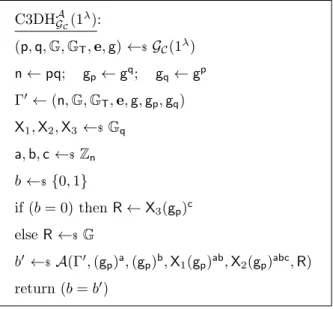
2.2 Game defining C3DH computational assumption. . . 14
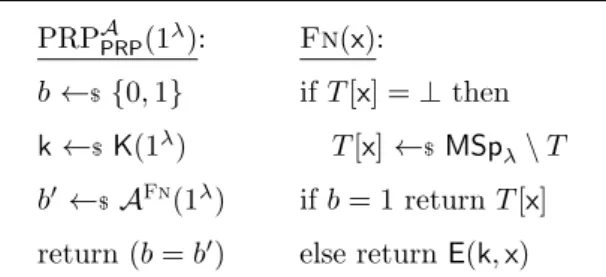
2.3 Game defining the security of a pseudorandom permutation PRP. . . 15
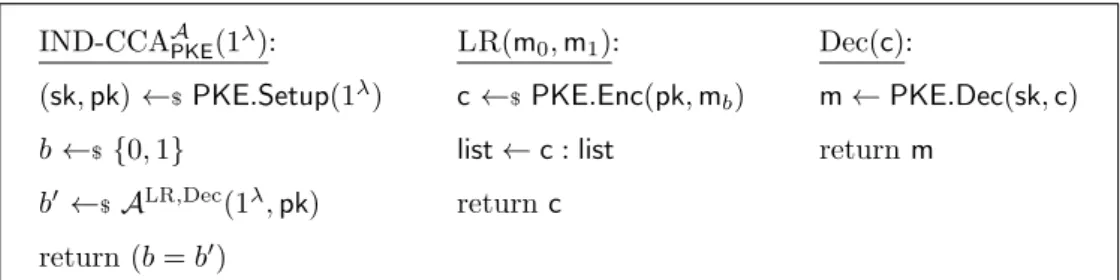
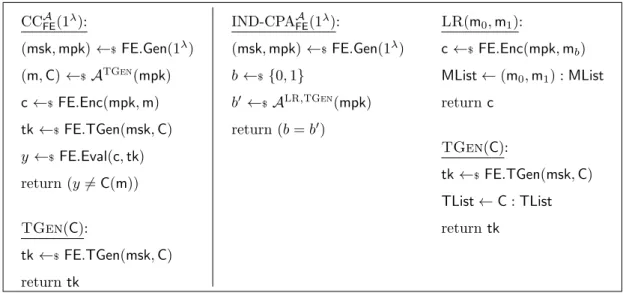
2.4 Game defining IND-CCA security of a public-key encryption scheme PKE. 16 2.5 Games defining the computational correctness and IND-CPA security of a functional encryption scheme FE. . . 18
2.6 Games defining the completeness and soundness properties of a non-interactive zero-knowledge proof system NIZK. . . 22
2.7 Games defining the knowledge property of a non-interactive zero-knowledge proof system NIZK. . . 22
2.8 Game defining collision-resistance of a hash function family H. . . 23
2.9 Game defining the pseudorandomness at punctured points property of a puncturable pseudorandom functionPPRF. . . 24
3.1 Games defining multi-instance and single-instance unpredictability of a samplerS. . . 27
4.1 Game defining iO security of an obfuscator Obf. . . 33
4.2 Games defining the CVGB security of an obfuscator Obf. . . 33
4.3 Games defining the DI and OW security of an obfuscatorObf. . . 34
4.4 Game defining single-instance unpredictability of a hyperplane member-ship samplerS. . . 39
4.5 Game defining a DDH-style computational assumption. . . 40
5.2 Relations among security notions for private functional encryption. . . . 46
6.1 AIBE1, a simplified version of Boyen-Waters AIBE scheme. . . 50
6.2 DBDH adversary B1, as part of proof of Theorem 2. . . 52
6.3 DLIN adversary B2, as part of proof of Theorem 2. . . 53
6.4 DLIN adversary B1, as part of proof of Theorem 3. . . 56
6.5 AIBE2, an extended version of AIBE scheme AIBE1, over composite-order groups. . . 57
6.6 Game defining CDDH computational assumption. . . 58
6.7 CDDH adversary Bi, as part of proof of Theorem 4. . . 61
7.1 Execution process of a programP on a RAM machine with memory D. . 83
7.2 Selective security of an updatable functional encryption scheme UFE. . . 85
7.3 Specification of circuit bδ, as part of our updatable functional encryption scheme. . . 89
A.1 DI adversary (S4,B4), as part of proof of Theorem 8. . . 109
A.2 IND-CPA adversary B5, as part of proof of Theorem 8. . . 111
A.3 DI adversary (S6,B6) and predictor Q, as part of proof of Theorem 8. . . 113
A.4 Sequence of games in proof of Theorem 8 (part 1 of 2). . . 114
Chapter 1
Introduction
As cloud services become increasingly popular, security concerns arise from exposing the user’s data to third-party service providers. Encryption can be used to protect the user’s data, but traditional public-key encryption is intrinsically designed to provide all-or-nothing security guarantees, meaning that either one possesses the decryption key and can decrypt the entire plaintext or nothing can be learned about the plaintext (besides, perhaps, its length). In this sense, usability is sacrificed if the owner of the data is unable to specify a decryption policy or delegate search operations to the storage service provider.
Over time, several cryptographic primitives emerged, with different use-case scenarios in mind, where one can learn a function of the plaintext. The first of such primitives was identity-based encryption (IBE), proposed by Shamir [Sha84] in 1984, but instantiations only appeared later in 2001 with the seminal papers of Boneh and Franklin [BF01] and Cocks [Coc01]. In an IBE scheme, an authority holding the master secret key can extract decryption keys associated with identities, which are bit-strings that uniquely identify an entity or a person, such as a passport number or an e-mail address. A ciphertext encrypted under the master public-key and (let’s say) Alice’s identity (e.g. “[email protected]”) can only be decrypted with Alice’s decryption key, which only the holder of the master secret key can issue.
Other primitives provide search delegation functionalities. The simplest of wich is public-key encryption with keyword search (KS), introduced in [BDOP04]. It allows
primitive can bring great benefits to users (and consequently to service providers wishing to increase their customer base as well) is that of any email system. Suppose user Alice stores her emails in the servers of some email service provider, so that she can access them from either her laptop or her smartphone. Alice does not trust the service provider or fears that government agencies may require the service provider to hand over all her data. Using standard public key encryption, any user with Alice’s public key can send her encrypted emails that only she can decrypt. For Alice to find a particular email later on, the sender could also attach to the email somesearchable ciphertexts, produced from a KS scheme, with keywords that Alice might use when searching for this email. These ciphertexts are searchable upon delegation, meaning that only Alice can authorize the email service provider to search on her behalf by issuing a token that encodes Alice’s search criteria (e.g. ciphertexts that encrypt the keyword “project RAPID20130115”), generated from her own secret key. The service provider searches through all Alice’s emails for those containing searchable ciphertexts that match the issued token, and returns to her only those with a positive match.
For more expressive search queries, the works of Boneh and Waters [BW07] and Katz, Sahai and Waters [KSW13] show how to compute conjunctive queries (P1∧...∧Pl),
disjunctive queries (P1∨...∨Pl), subset queries (x∈S) and range queries (x∈[a, b]) from
inner-product encryption (IPE) [AAB+15], where evaluating a token for vector a on a ciphertext that encrypts vectorbgives 1 if and only ifha,bi= 0. Some variants of IPE are defined such that the evaluation returns a payload messagem[KSW13,LOS+10,AFV11], or the actual result of computing the inner productha,bi[ABDP15,ABDP16]. The most recent developments IPE give rise to efficient schemes from standard assumptions.
More generally, the concept of functional encryption (FE) was independently formal-ized by Boneh, Sahai and Waters [BSW11] and O’Neil [O’N10]. In an FE scheme, the holder of the master secret key can issue tokens associated with functions of its choice. Possessing a token for function f allows one to recover f(m), given an encryption of m. Informally, security dictates that only f(m) is revealed about m and nothing else. One can easily see that IBE, KS and IPE fall in as particular cases of functional encryption with restricted functionality support. The most common approach is to model functions as circuits, and in an important fundamental result, Garg et al. [GGH+13] put forth
the first construction of an FE scheme supporting all polynomial-size circuits based on indistinguishability obfuscation (iO) for circuits, which is now known as a central hub for the realization of many cryptographic primitives [SW14].
Standard notions of security for functional encryption [BSW11, O’N10] do not cover important use cases where, not only encrypted data, but also the functions associated with decryption tokens contain sensitive information. They guarantee that nothing about the plaintexts beyond query results are revealed to the server. However, they do not guarantee that the performed query, which may also contain sensitive information, remains hidden, which is of particular relevance in the context of searchable encryption. Function privacy
is an emerging new notion that aims to address this problem. The difficulty of formalizing it lies in the evaluation functionality of FE, as the holder of a token for f may encrypt arbitrary messages using the public key, and obtain a large number of evaluations of f via the decryption algorithm. This means that function privacy can only be achieved as long as the token holder is unable to learn f through such an attack. How to define function privacy and how construct FE schemes that offer such security guarantees are the main questions addressed in this thesis.
1.1
Related work
The formal study of function privacy begins in the work of Boneh, Raghunathan and Segev [BRS13a], where the authors focused on identity-based encryption (IBE) and pre-sented the first constructions offering various degrees of privacy. From the onset, it became clear that formalizing such a notion is challenging, even for simple functionalities such as IBE, as a large number of evaluation can always be computed for each token via the decryption algorithm. Boneh et al. therefore considered privacy for identities with high min-entropy. In general, however, the previous observation implies that function privacy can only be achieved as long as the token holder is unable to learn the function associated with the token through function evaluation, immediately suggesting a strong connection between private functional encryption and obfuscation.
Boneh, Raghunathan and Segev [BRS13a, BRS13b] give indistinguishability-based definitions of function privacy for IBE and subspace membership (a generalization of
inner-product encryption). Roughly speaking, the IBE model imposes that whenever the token queries of the adversary have high min-entropy (or form a block source), decryption tokens will be indistinguishable from those corresponding to identities sampled from the uniform distribution. For subspace membership, the definition requires the random variables associated with vector components to be a block source.
Tokens for high-entropy identities, however, rarely exist in isolation and are often available in conjunction with ciphertexts encrypted for the very same identities. To ad-dress this requirement, the same authors [BRS13a] proposed an enhanced model for IBE in which the adversary also gets access to ciphertexts encrypted for identities associated with the challenge tokens. We show this model to be infeasible under the formalism of Boneh et al., as correlations with encrypted identities can lead to distinguishing at-tacks, e.g. via repetition patterns. (We will discuss this later in the thesis.) Although the model can be salvaged by further restricting the class of admissible distributions, it becomes primitive-specific and formulating a definition for other functionalities is not obvious (and indeed a similar extension was not formalized for subspace membership
in [BRS13b]). Additionally, this model also falls short of capturing arbitrary
correla-tions between encrypted messages and tokens, as it does not allow an adversary to see ciphertexts for identities which, although correlated with those extracted in the challenge tokens, do not match any of them.
Recently, Agrawal et al. [AAB+15] put forth a model for functional encryption that
aims to address this problem with a very general UC-style definition (called “wishful se-curity”). The core of the definition is an ideal security notion for functional encryption, which makes it explicit that both data privacy and function privacy should be simulta-neously enforced. However, not only is this general simulation-based definition difficult to work with, but also aiming for it would amount to constructing virtual black-box ob-fuscation, for which strong impossibility results are known [BGI+01,GK05]. Indeed, the
1.2
Our contributions
The above discussion highlights the need for a general and convenient definition of pri-vacy that incorporates arbitrary correlations between decryption tokens and encrypted messages, and yet can be shown to be feasible without relying on idealized models of computation. The first contribution of our work is an indistinguishability-based defi-nition that precisely models arbitrary correlations for general circuits. Our defidefi-nition builds on a framework forunpredictable samplers and unifies within a single definition all previous indistinguishability-based notions.
The second contribution of this thesis is five constructions of private functional en-cryption schemes supporting different classes of functions and meeting varying degrees of security: (1) a white-box construction of an Anonymous IBE scheme based on composite-order groups, shown to be secure in the absence of correlated messages; (2) a simple and functionality-agnostic black-box construction from obfuscation, also shown to be secure in the absence of correlated messages; (3) a more evolved and still functionality-agnostic construction that achieves a form of function privacy that tolerates limited correlations between messages and functions; (4) a KS scheme achieving privacy in the presence of correlated messages beyond all previously proposed indistinguishability-based security definitions; (5) a KS construction that achieves our strongest notion of privacy (but relies on a more expressive form of obfuscation than the previous construction). We also develop an obfuscator for hyperplane membership that, when plugged into the third construction above gives rise to a private inner-product encryption scheme, answering a question left open by Boneh, Raghunathan and Segev [BRS13b] on how to define and realizeenhanced
security (i.e., privacy in the presence of correlated messages) for schemes supporting this functionality.
The standard approach in FE is to model complex functions as circuits, which yields inefficient evaluations over large inputs. As our third contribution, we propose a new primitive that we call “updatable functional encryption” (UFE), where instead of cir-cuits we deal with RAM programs, which are closer to how programs are expressed in von Neumann architecture. We impose strict efficiency constrains and we envision tokens that are capable of updating the ciphertext, over which other tokens can be subsequently
executed. We define a security notion for our primitive and propose a candidate construc-tion from obfuscaconstruc-tion, which serves as a starting point towards the realizaconstruc-tion of other schemes and contributes to the study on how to compute RAM programs over public-key encrypted data.
The unpredictability framework. At the core of our definitional work lies a
pre-cise definition characterizing which distributions over circuits and what correlated side information can be tolerated by a private FE scheme. We build on ideas from obfusca-tion [BST14, BC14, BBC+14], functional encryption [BSW11, O’N10] and prior work in
function privacy [BRS13a, BRS13b, ATR14, AAB+15] to define a game-based notion of
unpredictability for general functions. Our definition allows asampler S to output a pair of circuit vectors (C0,C1) and a pair of message vectors (m0,m1) with arbitrary
correla-tions between them, along with some side information z. Unpredictability then imposes that no predictor P interacting with oracles computing evaluations on these circuits and messages can find a pointxsuch thatC0(x)6=C1(x). (We do not impose
indistinguisha-bility, which is stronger, results in a smaller class of unpredictable samplers, and hence leads to weaker security.) The predictorP sees z and the outputs of the sampled circuits on the sampled messages. It can run in bounded or unbounded time, but it can only make polynomially many oracle queries to obtain additional information about the sam-pled circuits and messages. To avoid attacks that arise in the presence of computationally unpredictable auxiliary information [BM14,BST16] we adoptunbounded prediction later in the security analysis of our private functional encryption schemes.
This formalism fixes the unpredictability notion throughout the thesis. We can then capture specific types of samplers by imposing extra structural requirements on them. For instance, we may require the sampler to output a bounded number of circuits and mes-sages, or include specific data in the auxiliary information, or not include any auxiliary information at all. Imposing that the sampler outputs single-circuit vectors, no messages, and includes the circuits as auxiliary information leads to the notion of differing-inputs obfuscation [ABG+13, BST14]. Further imposing that the sampler also includes in the
auxiliary information its random coins or allowing the predictor to run in unbounded time leads to public-coin differing-inputs obfuscation [IPS15] and indistinguishability obfusca-tion [GR14, BM14, GGH+13], respectively. A sampler outputting circuits and messages
comes to hand to model the privacy for functional encryption. We emphasize that our definition intentionally does not require the messages to be unpredictable. Further dis-cussion on this choice can be found in Chapter 3.
ThePRIV model. Building on unpredictability, we put forth a new
indistinguishability-based notion of function privacy. Our notion, which we call PRIV, bears close resemblance to the standard IND-CPA model for functional encryption: it comes with a left-or-right
LR oracle, a token-extraction TGen oracle and the goal of the adversary is to guess
a bit. The power of the model lies in that we endow LR with the ability to generate
arbitrary messages and circuits via an unpredictable sampler. Trivial attacks are excluded by the joint action of unpredictability and the usual FE legitimacy condition, imposing equality of images on left and right. The enhanced model of Boneh, Raghunathan and Segev [BRS13a] falls in as a special case where the sampler is structurally restricted to be a block source. But our definition goes well beyond this and considers arbitrary and possibly low-entropy correlations. Furthermore, since unpredictability isnot imposed on messages, PRIV implies IND-CPA security, and consequently it also guarantees anonymity for primitives such as IBE and ABE [BSW11]. Correlated circuits may be “low entropy” as long as they are identical on left and right, and since previous definitions adopted a real-or-random definition, they had to exclude this possibility. By giving the sampler the option to omit, manipulate and repeat the messages, our security notion implies previous indistinguishability-based notions in the literature, including those in [BRS13a, BRS13b,
ATR14, AAB+15].
The implications of our new definition become clearer when we focus on (public-key encryption with) keyword search (KS) [BDOP04]. Consider a scenario where a client searches for a keyword but obtains no matching ciphertexts. The client then slightly modifies the keyword and requests a new search, now resulting in one or more successful matches. In this setting, the server sees ciphertexts encrypting unknown keywords that are closely related to keywords which the server holds tokens for. Our model ensures that if searched keywords are unpredictable from the perspective of the server, this uncertainty is preserved by the KS scheme after the searches are carried out. This does not imply that the server will be unable to distinguish a sequence of successful queries over thesame
keywords (this is impossible to achieve [ATR14]). However, when keyword searches donot
match any of the correlated ciphertexts, then search patterns are guaranteed to remain hidden, even in the presence of low-entropy correlated encrypted keywords. We note that this captures a strong notion of unlinkability and untraceability betweenunmatched queries.
Constructions. We start by looking at Boyen and Waters [BW06] anonymous
identity-based encryption scheme in the hope of showing that it already achieves some form of function privacy, as the decryption keys are randomized. Towards this end, we first present a simplified version of the original scheme and show that, in the random oracle model, not only IND-CPA security is still guaranteed, we are also able to lift the selective-id constraint in the proof. Next, we show that the scheme is PRIV secure up to two decryption keys, in the absence of correlated messages. In fact, we also show that if the sampler outputs vectors with just three identities, there is a trivial attack. To improve security, we extend the scheme to groups of composite order and show that the extended version is secure for an unbounded number of keys.
Taking a more general approach, we then formalize the intuition that obfuscating cir-cuits before extraction should provide some level of privacy in FE. Using unpredictable samplers, we first generalize distributionally-indistinguishable (DI) obfuscators [BC14] from point functions to general circuits. Our obfuscate-then-extractOXtransform shows that PRIV security in the absence of correlated messages can be achieved using DI obfus-cators. In the reverse direction, we also established that some weak form of DI obfusca-tion (for samplers outputting single-circuit vectors) is also necessary. We also show that
composable VGB obfuscation implies full-fledged DI obfuscation. So, emerging positive results on composable VGB obfuscation [BCKP14, BC14] already lead to PRIV-secure functional encryption schemes (supporting the same class of circuits as the obfuscator) in the absence of correlated messages.
To move beyond the above token-only model, we need to “decouple” the correlations between encrypted messages and challenge circuits so we can take advantage of FE secu-rity (that protects ciphertexts) and obfuscation (that protects the circuits) in a cumulative way. Building on ideas from [ABSV15] and [BCKP14] we identify a class of concentrated
tech-nique to boost selective security to adaptive security in FE—to achieve function privacy. This construction improves on the security guarantees of OX considerably, but comes with the caveat that a mild restriction on second-stage token queries must be imposed: they must reveal (via circuit outputs) no more information about encrypted correlated messages than those revealed by first-stage queries. We give non-trivial examples of con-centrated samplers and derive constructions for classes of circuits that encompass, among other functionalities, IBE, KS andinner-product encryption. By giving a construction of a DI obfuscator for hyperplane membership, we resolve a question left open by Boneh, Raghunathan and Segev [BRS13b] on the extension and realization of enhanced security
for inner-product encryption.
Our forth construction is specific to point functions, and besides being simpler and more efficient, can tolerate arbitrary correlations between challenge keywords and en-crypted messages. Put differently this construction removes the concentration restriction on samplers. For this construction we require a functional encryption scheme that sup-ports the OR composition of two DI-secure point obfuscations. The composable VGB
point obfuscator of Bitansky and Canetti [BC14] implies that the required DI point obfus-cator exists. Furthermore, we also rely on a standard functional encryption scheme that supports the evaluations of four group operations in a DDH group (corresponding to the disjunction of two point function obfuscations), which is a relatively modest computation. We are, however, unable to lift the mild second-stage restriction.
Our last construction lifts the second-stage restriction at the cost of relying on more expressive forms of obfuscators. The novelty in this construction resides in the observation that, in order to offer the keyword search functionality, it suffices to encrypt information that enables equality checks between words and messages to be carried out. In our fourth construction we encode a message m as an obfuscation of the point function C[m]. Con-cretely, we obfuscate words before extraction and messages before encryption. Equality with w can be checked using a circuit D[w] that on input an obfuscated point function
Obf(C[m]) returns Obf(C[m])(w). We emphasize that D[w] is not a point function. We also need to ensure that an attacker cannot exploit the D[w] circuits by, say, encrypting obfuscations of malicious circuits of its choice. We do this using NIZK proofs to ensure the outputs of the point obfuscator areverifiable: one can publicly verify that an obfuscation
indeed corresponds to some point function. To summarize, our construction relies on a DI obfuscator supporting point functions C[m](w) := (m =w) and circuitsD[w](C) :=C(w) and a general-purpose FE. The circuits C[m] and D[w] were used negatively by Barak et al. [BGI+01] to launch generic attacks against VBB. Here, the restrictions imposed on
legitimate PRIV samplers ensure that these attacks cannot be carried out in our setting, and obfuscators supporting them can be used positively to build private FE schemes.
Chapter 2
Preliminaries, Notation and
Standard Definitions
2.1
Notation
We denote the security parameter by λ ∈ N and assume it is implicitly given to all algorithms in unary representation 1λ. We denote the set of all bit strings of length ` by
{0,1}` and the length of a string x by |x|. The bit complement of a string x is denoted
byx. We use the symbolε to denote the empty string. A vector of stringsxis written in boldface, andx[i] denotes its ith entry. The number of entries ofxis denoted by|x|. For a finite set X, we denote its cardinality by |X| and the action of sampling a uniformly random element x from X by x ←$ X. For a random variable X we denote its support
by [X]. For a circuit C we denote its size by |C|. We call a real-valued function µ(λ) negligible if µ(λ) ∈ O(λ−ω(1)) and denote the set of all negligible functions by
Negl.
Throughput this thesis,⊥ denotes a special failure symbol outside the spaces underlying a cryptographic primitive. We adopt the code-based game-playing framework [BR06]. As usual “ppt” stands for probabilistic polynomial time.
Circuit families. Let MSp := {MSpλ}λ∈N and OSp := {OSpλ}λ∈N be two families of finite sets parametrized by a security parameter λ ∈ N. A circuit family CSp :=
{CSpλ}λ∈N is a sequence of circuit sets indexed by the security parameter. We assume that for all λ ∈ N, all circuits in CSpλ share a common input domain MSpλ and output
space OSpλ. We also assume that membership in sets can be efficiently decided. For a vector of circuits C= [C1, . . . ,Cn] and a vector of messagesm= [m1, . . . ,mm] we define C(m) to be an n×m matrix whose ijth entry is Ci(mj). When OSpλ = {0,1} for all
values of λ we call the circuit family Boolean.
Trees. We associate a tree T with the set of its nodes {nodei,j}. Each node is indexed
by a pair of non-negative integers representing the position (level and branch) of the node on the tree. The root of the tree is indexed by (0,0), its children have indices (1,0), (1,1), etc. A binary tree is perfectly balanced if every leaf is at the same level.
2.2
Bilinear groups and complexity assumptions
We first review the basic properties of prime-order bilinear groups and the computa-tional assumptions Decision Bilinear Diffie-Hellman (DBDH) [BF01] and Decision Lin-ear (DLIN) [BBS04]. We then review the properties of composite-order bilinear groups and theComposite 3-party Diffie-Hellman(C3DH) assumption made in [BW07]. Looking ahead, these properties are relevant for our white-box construction of a function-private AIBE scheme, described in Section 6.1.
2.2.1
Bilinear groups of prime order
A prime-order bilinear group generator is an algorithm GP that takes as input a security parameter 1λ and outputs a description Γ = (p,
G,GT,e,g) where:
• G and GT are groups of orderp with efficiently-computable group laws, where p is
a λ-bit prime.
• g is a generator of G.
• eis an efficiently-computable bilinear pairinge:GxG→GT, i.e. a map satisfying
the following properties:
– Bilinearity: ∀a,b∈Zp,e(ga,gb) = e(g,g)ab; – Non-degeneracy: e(g,g)6= 1.
Definition 1. We say the DBDH assumption holds for group generator GP if for every ppt adversary A we have that
AdvdbdhG P,A(λ) := 2·Pr[DBDH A GP(1 λ)] −1∈Negl,
where game DBDH is described in Figure 2.1 on the left.
Definition 2. We say the DLIN assumption holds for group generator GP if for every ppt adversary A we have that
AdvdlinGP,A(λ) := 2·Pr[DLINAGP(1λ)]−1∈Negl,
where game DLIN is described in Figure 2.1 on the right.
DBDHAGP(1 λ): Γ ←$GP(1λ) (p,G,GT,e,g)←Γ z1,z2,z3←$ Zp b ←${0,1} if (b= 0) then Z←e(g,g)z1z2z3 else Z←$GT b0 ←$A(Γ,gz1,gz2,gz3,Z) return (b=b0) DLINAGP(1 λ): Γ←$GP(1λ) (p,G,GT,e,g)←Γ z1,z2,z3,z4←$ Zp b←${0,1} if (b= 0) thenZ←gz3+z4 elseZ←$GT b0 ←$ A(Γ,gz1,gz2,gz1z3,gz2z4,Z) return (b=b0)
Figure 2.1: Games defining DBDH and DLIN computational assumptions.
2.2.2
Bilinear groups of composite order
A composite-order bilinear group generator is an algorithm GC that takes as input a security parameter 1λ and outputs a description Γ = (p,q,
G,GT,e,g) where:
• Gand GT are groups of ordern=pq, where pand qare independent λ-bit primes,
with efficiently computable group laws.
• g is a generator of G.
• eis an efficiently-computable bilinear pairinge:GxG→GT, i.e. a map satisfying
– Bilinearity: ∀a,b∈Zn,e(ga,gb) = e(g,g)ab; – Non-degeneracy: e(g,g)6= 1.
Subgroups Gp⊂G and Gq ⊂G of orderp and order q can be generated respectively by
gp=gq and gq=gp. We recall some important properties regarding these groups:
• G=Gp xGq
• e(gp,gq) =e(gq,gp) =e(g,g)n= 1
• e(gp,(gp)a·(gq)b) = e(gp,(gp)a)·e(gp,(gq)b) = e(gp,gp)a
Definition 3. We say the C3DH assumption holds for group generator GC if for every ppt adversary A we have that
Advc3dhGC,A(λ) := 2·Pr[C3DHAGC(1λ)]−1∈Negl,
where game C3DH is described in Figure 2.2.
C3DHAGC(1 λ): (p,q,G,GT,e,g)←$GC(1λ) n←pq; gp←gq; gq←gp Γ0←(n, G,GT,e,g,gp,gq) X1,X2,X3 ←$Gq a,b,c←$ Zn b ←${0,1} if (b= 0) then R←X3(gp)c else R←$ G b0 ←$A(Γ0,(gp)a,(gp)b,X1(gp)ab,X2(gp)abc,R) return (b=b0)
Figure 2.2: Game defining C3DH computational assumption.
2.3
Cryptographic primitives
We now review standard definitions of several cryptographic primitives, namely pseu-dorandom permutations, public-key encryption, functional encryption (and its
particu-lar forms anonymous identity-based encryption, keyword search encryption and inner-product encryption), non-interactive zero-knowledge proof systems, collision-resistant hash functions and puncturable pseudorandom functions. The definitions of functional encryption will serve as a starting point towards the security modelling of what we call pri-vate functional encryption. The remaining cryptographic primitives will serve as building blocks in our constructions.
2.3.1
Pseudorandom permutations
LetKSp:={KSpλ}λ∈NandMSp:={MSpλ}λ∈Nbe two families of finite sets parametrized by a security parameter λ ∈ N. A pseudorandom permutation (PRP) family PRP := (K,E,D) is a triple of ppt algorithms as follows. (1) K on input the security parameter outputs a uniform element in KSpλ; (2) E is deterministic and on input a key k∈ KSpλ
and a point x ∈ MSpλ outputs a point in MSpλ; (3) D is deterministic and on input a k ∈ KSpλ and a point x ∈ MSpλ outputs a point in MSpλ. The PRP family PRP is correct if for all λ ∈ N, all k ∈ KSpλ and all x ∈ MSpλ we have that D(k,E(k,x)) = x. A pseudorandom permutation PRP := (K,E,D) is called PRP secure if for every ppt adversary A we have that
AdvprpPRP,A(λ) := 2·PrPRPAPRP(1λ)−1∈Negl
where game PRPAPRP(1λ) is defined in Figure2.3. For our purposes, we rely on the
non-strong security notion where inverse queries are not allowed. Furthermore, we do not necessarily require the inverse map Dto be efficiently computable.
PRPAPRP(1λ): b←${0,1} k←$K(1λ) b0 ←$ AFn(1λ) return (b=b0) Fn(x): ifT[x] =⊥then T[x]←$ MSpλ\T ifb= 1 returnT[x] else returnE(k,x)
2.3.2
Public-key encryption
A public-key encryption scheme PKE := (PKE.Setup,PKE.Enc,PKE.Dec) with message space MSp:={MSpλ}λ∈N and randomness space RSp :={RSpλ}λ∈N is specified by three ppt algorithms as follows. (1) PKE.Setup(1λ) is the probabilistic key-generation algo-rithm, taking as input the security parameter and returning a secret key sk and a public keypk. (2)PKE.Enc(pk,m;r) is the probabilistic encryption algorithm. On input a public key pk, a message m ∈MSpλ and possibly some random coins r ∈ RSpλ, this algorithm outputs a ciphertext c. (3)PKE.Dec(sk,c) is the deterministic decryption algorithm. On input of a secret key sk and a ciphertext c, this algorithm outputs a messagem ∈MSpλ
or failure symbol ⊥.
Correctness. The correctness of a public-key encryption scheme requires that for any
λ ∈ N, any (sk,pk) ∈ [PKE.Setup(1λ)], any m ∈ MSpλ and any random coins r ∈ RSpλ, we have thatPKE.Dec(sk,PKE.Enc(pk,m;r)) =m.
Security. We recall the standard security notions of indistinguishability under chosen
ciphertext attacks(IND-CCA) and its weaker variant known as indistinguishability under chosen plaintext attacks (IND-CPA). We say that a public-key encryption scheme PKE
is IND-CCA secure if for every legitimateppt adversary A
AdvindPKE,-ccaA(λ) := 2·Pr[IND-CCAAPKE(1λ)]−1,
where game IND-CCAAPKE described in Figure 2.4, in which the adversary has access to a left-or-right challenge oracle (LR) and a decryption oracle (Dec). We say that A
is legitimate if: (1) |m0| = |m1| whenever the left-or-right oracle is queried; and (2)
the adversary does not call the decryption oracle with c ∈ list. We obtain the weaker IND-CPA notion if the adversary is not allowed to place any decryption query.
IND-CCAAPKE(1λ): (sk,pk)←$ PKE.Setup(1λ) b←$ {0,1} b0 ←$ALR,Dec(1λ,pk) return (b=b0) LR(m0,m1): c←$PKE.Enc(pk,mb) list←c:list returnc Dec(c): m←PKE.Dec(sk,c) returnm
2.3.3
Functional encryption
Syntax. A functional encryption scheme FE associated with a circuit family CSp is
specified by four ppt algorithms as follows. (1) FE.Gen(1λ) is the setup algorithm and
on input a security parameter 1λ it outputs a master secret key msk and a master public key mpk; (2) FE.TGen(msk,C) is the token-generation algorithm and on input a master secret keymskand a circuitC∈CSpλ outputs a tokentkforC; (3)FE.Enc(mpk,m) is the encryption algorithm and on input a master public key mpk and a message m ∈ MSpλ
outputs a ciphertext c; (4) FE.Eval(c,tk) is the deterministic evaluation (or decryption) algorithm and on input a ciphertext cand a tokentkoutputs a valuey∈OSpλ or failure symbol ⊥.
We adopt a computational notion of correctness for FE schemes and require that no ppt adversary is able to produce a message m and a circuitC that violates the standard correctness property of the FE scheme (that is,FE.Eval(FE.Enc(mpk,m),FE.TGen(msk,C))
6
=C(m)), even with the help of an (unrestricted) token-generation oracle. We also adopt the standard notion of IND-CPA security [BSW11, O’N10] where an adversary with ac-cess to a token-generation oracle cannot distinguish encryptions of messagesm0,m1 under
the standard restriction that it cannot obtain a decryption token for a circuitC for which
C(m0)6=C(m1).
Correctness. We will adopt a game-based definition of computational correctness for
FE schemes which has been widely adopted in the literature [ABC+08,Gol04] and suffices for the overwhelming majority of use cases. Roughly speaking, this property requires that no efficient adversary is able to come up with a message and a circuit which violates the correctness property of the FE scheme, even with the help of an (unrestricted) token-generation oracle. Formally, we say that scheme FE is computationally correct if for all ppt adversaries A
AdvccFE,A(λ) := Pr
CCAFE(1λ)∈Negl ,
where game CCAFE(1λ) is shown in Figure2.5 on the left. Perfect correctness corresponds to the setting where the above advantage is required to be zero.
for any legitimate ppt adversary A
Advind-cpaFE,A (λ) := 2·PrIND-CPAFEA (1λ)−1∈Negl ,
where game IND-CPAAFE(1λ) is defined in Figure2.5 on the right. We sayA is legitimate
if for all messages pairs queried to the left-or-right oracle, i.e., for all (m0,m1) ∈ MList,
and all extracted circuits C∈TListwe have that C(m0) =C(m1).
CCAFE(1 λ): (msk,mpk)←$FE.Gen(1λ) (m,C)←$ ATGen(mpk) c←$ FE.Enc(mpk,m) tk←$ FE.TGen(msk,C) y←$ FE.Eval(c,tk) return (y6=C(m)) TGen(C): tk←$ FE.TGen(msk,C) returntk IND-CPAAFE(1 λ): (msk,mpk)←$ FE.Gen(1λ) b ←${0,1} b0 ← $ALR,TGen(mpk) return (b=b0) LR(m0,m1): c←$ FE.Enc(mpk,mb) MList←(m0,m1) :MList returnc TGen(C): tk←$ FE.TGen(msk,C) TList←C:TList returntk
Figure 2.5: Games defining the computational correctness and IND-CPA security of a functional encryption scheme FE.
The IND-CPA notion self-composes in the sense that security against adversaries that place one LRquery is equivalent to the setting where an arbitrary number of queries is
allowed. It is also well known that IND-CPA security is weaker than generalizations of semantic security for functional encryption [BSW11, O’N10, BF13], and strong im-possibility results for the latter have been established [BSW11, GVW12, AGVW13]. On the other hand, IND-CPA-secure FE schemes for all polynomial-size circuit families have been recently constructed [GVW12, GGH+13, GKP+13]. Other recent feasibility results have been established in weaker forms of the IND-CPA model such as the selec-tive model [GVW12, GGH+13, GKP+13] where the adversary commits to its challenge messages at the onset; or the weak model for Boolean circuits, where the adversary is restricted to extract tokens that evaluate to 0 on the challenge messages [GVW15].
2.3.3.1 Anonymous identity-based encryption
Identity-based encryption (IBE) was first proposed by Shamir [Sha84], but instantia-tions only appeared later with the seminal papers of Boneh and Franklin [BF01] and Cocks [Coc01]. In an IBE scheme, an authority holding the master secret key can extract decryption keys associated with identities, such as passport numbers or an e-mail ad-dresses. A ciphertext encrypted under the master public-key and some identity can only be decrypted with a decryption key for that identity, which only the authority holding the master secret key can issue. Here, we describe the syntax, correctness and security of
anonymous identity-based encryption schemes (AIBE). Briefly, anonymity requires that the ciphertext also hides the identity for which it is intended.
Syntax. An anonymous identity based encryption scheme AIBE is a functional
encryp-tion scheme for a circuit family CSpλ :={C[id?] : id? ∈IdSpλ}, over identity space IdSpλ
and message space MSpλ, such that each circuitC is defined as:
C[id?](id,m) := m if (id=id?); ⊥ otherwise.
For simplicity,C iscanonically represented by the identityid? with which it is associated. We write the algorithms of an AIBE scheme as follows. (1) AIBE.Setup(1λ) is the setup
algorithm and on input a security parameter 1λ it outputs a master secret key msk and
a master public key mpk; (2) AIBE.Enc(mpk,id,m) is the encryption algorithm and on input a master public key mpk, an identity id ∈ IdSpλ and a message m ∈ MSpλ, it outputs a ciphertext c; (3) AIBE.KeyGen(msk,id) is the key-generation algorithm and on input a master secret key msk and an identity id ∈ IdSpλ it outputs a decryption key
skid; (4) finally, AIBE.Dec(skid,c) is the decryption algorithm that on input a secret key
skid and a ciphertext c, it either outputs a message m ∈ MSpλ or a failure symbol ⊥.
The correctness and IND-CPA security of AIBE are defined identically to that of FE schemes supporting the circuit class described above. Note that this results in semantic security and anonymity in the traditional sense applied to identity-based encryption, i.e. ciphertexts conceal both the message and the identity of the recipient.
2.3.3.2 Keyword search encryption
Set circuits. In this work we are interested in Boolean circuits that assume the value
1 on only a polynomially large subset of their domains. We call these set circuits. We define the canonical representation of a set circuitC with its corresponding set S as the circuit C[S] that has the setS explicitly hardwired in it:
C[S](m) := 1 if m∈S; 0 otherwise.
Formally, a family of Boolean circuits CSp is a set circuit family if there is a polynomial
poly such that for all λ ∈ N and all C ∈ CSpλ we have that |S(C)| ≤ poly(λ) where S(C) := {m ∈ MSpλ : C(m) = 1}. Point circuits/functions correspond to the case where poly(λ) = 1. We use C[m] to denote the point circuit that on input m returns 1 and 0 otherwise. Throughout the thesis, we assume that non-obfuscated set circuits are canonically represented.
Syntax. A public-key encryption with keyword search scheme (or simply a keyword
search scheme) KS is a functional encryption scheme for a point circuit family over the message space: CSpλ := {C[m] : m ∈ MSpλ}. We often identify circuit C[m] with its messagem, but in order to distinguish circuits from messages we use the termkeywordto refer to the former. We write the algorithms associated to a KS scheme as KS.Gen(1λ),
KS.Enc(pk,m),KS.TGen(sk,w) andKS.Test(c,tk), where the latter outputs either 0 or 1. The computational correctness of a KS scheme is defined identically to that of an FE scheme. We say the scheme has no false negatives if correctness advantage is negligible and, wheneverAoutputs (w,C[w]), it is 0. IND-CPA security is also defined identically to FE schemes for point function families. Note that weak and standard IND-CPA notions are equivalent for KS schemes.
2.3.3.3 Inner-product encryption
Syntax. Let CSp := {CSpdp} be a set circuit family of hyperplane membership testing
functions that is defined for each value of the security parameterλ such thatp is aλ-bit prime and d is a positive integer. Every circuit C∈CSpdp is canonically represented by a
vector~a ∈ Zd
p (i.e. ~a is a vector of d elements from Zp) and returns 1 if and only if the
input vector~x∈Zd
p is orthogonal to~a. More precisely,
C[~a](~x) := 1 if h~x, ~ai= 0; 0 otherwise.
An inner-product encryption scheme IPE is a functional encryption scheme for a hy-perplane membership testing circuit family CSpλ := {C[~a] : ~a ∈ Zdp}. The correctness and IND-CPA security of inner-product encryption are defined identically to that of FE schemes supporting the circuit classCSp as defined above.
2.3.4
NIZK proof systems
Syntax. A non-interactive zero-knowledge proof system for an NP language L with
an efficiently computable binary relation R consists of three ppt algorithms as follows. (1)NIZK.Setup(1λ) is the setup algorithm and on input a security parameter 1λ it outputs
a common reference string crs; (2) NIZK.Prove(crs,x, ω) is the proving algorithm and on input a common reference string crs, a statementx and a witness ω it outputs a proofπ or a failure symbol⊥; (3)NIZK.Verify(crs,x, π) is the verification algorithm and on input a common reference stringcrs, a statementxand a proofπ it outputs eithertrue orfalse.
Perfect completeness. Completeness imposes that an honest prover can always
convince an honest verifier that a statement belongs toL, provided that it holds a witness testifying to this fact. We say a NIZK proof is perfectly complete if for every (possibly unbounded) adversary A
AdvcompleteNIZK,A (λ) := Pr
CompleteANIZK(1λ)
= 0 ,
where game CompleteANIZK(1λ) is shown in Figure 2.6 on the left.
Statistical soundness. Soundness imposes that a malicious prover cannot convince
an honest verifier of a false statement. We say a NIZK proof isperfectly soundif for every (possibly unbounded) adversaryA we have that
where game SoundANIZK(1λ) is shown in Figure 2.6 on the right. If the above advantage is
0, we say the NIZK proof system isperfectly sound.
Computational zero knowledge. The zero-knowledge property guarantees that
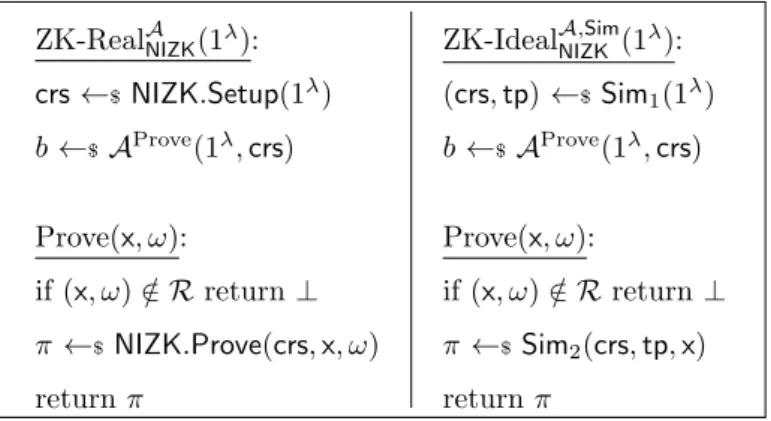
proofs do not leak information about the witnesses that originated them. Technically, this is formalized by requiring the existence of a ppt simulator Sim= (Sim1,Sim2) where
Sim1 takes the security parameter 1λ as input and outputs a simulated common reference
string crstogether with a trapdoor tp, and Sim2 takes the trapdoor as input tp together
with a statement x ∈ L for which it must forge a proof π. We say a proof system is
computationally zero knowledge if, for every ppt adversary A, there exists a simulator
Sim such that
AdvzkNIZK,A,Sim(λ) := Pr ZK-RealANIZK(1λ)− h
ZK-IdealANIZK,Sim(1λ)
i
∈Negl ,
where games ZK-RealANIZK(1λ) and ZK-IdealA,Sim
NIZK (1λ) are shown in Figure 2.7.
CompleteANIZK(1λ):
crs←$ NIZK.Setup(1λ)
(x, ω)←$A(1λ,crs)
if (x, ω)∈ R/ return 0
π←$NIZK.Prove(crs,x, ω)
return¬(NIZK.Verify(crs,x, π))
SoundANIZK(1λ):
crs←$ NIZK.Setup(1λ)
(x, π)←$ A(1λ,crs)
return (x∈ L ∧/
NIZK.Verify(crs,x, π))
Figure 2.6: Games defining the completeness and soundness properties of a non-interactive zero-knowledge proof systemNIZK.
ZK-RealANIZK(1λ): crs ←$NIZK.Setup(1λ) b ←$AProve(1λ,crs) Prove(x, ω): if (x, ω)∈ R/ return⊥ π←$ NIZK.Prove(crs,x, ω) returnπ
ZK-IdealANIZK,Sim(1λ):
(crs,tp)←$ Sim1(1λ) b←$AProve(1λ,crs) Prove(x, ω): if (x, ω)∈ R/ return⊥ π←$Sim2(crs,tp,x) returnπ
Figure 2.7: Games defining the knowledge property of a non-interactive zero-knowledge proof system NIZK.
2.3.5
Collision-resistant hash functions
A hash function family H := {Hλ}λ∈N is a set parametrized by a security parameter λ ∈ N, where each Hλ is a collection of functions mapping {0,1}m to {0,1}n such that
m > n. The hash function family H is said to be collision-resistant if no ppt adversary
A can find a pair of colliding inputs, with noticeable probability, given a function picked uniformly fromHλ. More precisely, we require that
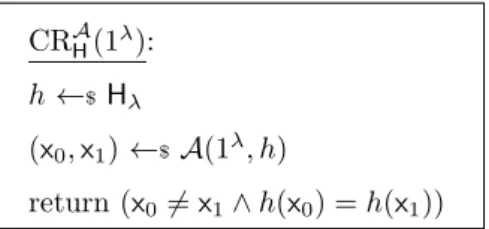
AdvcrH,A(λ) := Pr[CRAH(1λ)]∈Negl, where game CRAH(1λ) is defined in Figure 2.8.
CRAH(1λ):
h←$Hλ
(x0,x1)←$A(1λ, h)
return (x06=x1∧h(x0) =h(x1))
Figure 2.8: Game defining collision-resistance of a hash function family H.
2.3.6
Puncturable pseudorandom functions
We define a puncturable pseudorandom function family PPRF:= (PPRF.Gen,PPRF.Eval,
PPRF.Punc) as the following triple of ppt algorithms. (1)PPRF.Genon input the security parameter 1λ outputs a uniform element inKSpλ; (2) PPRF.Eval is deterministic and on input a key k ∈ KSpλ and a point x ∈ Xλ outputs a point y ∈ Yλ; (3) PPRF.Punc is
probabilistic and on input ak∈KSpλ and a polynomial-size set of points S⊆Xλ outputs
a punctured key kS. As per [SW14], we require the PPRF to satisfy the following two
properties:
Functionality preservation under puncturing : It holds that for every λ ∈ N,
every polynomial-size set S⊆Xλ and everyx∈Xλ\S,
Pr PPRF.Eval(k,x) = PPRF.Eval(kS,x) k←$ PPRF.Gen(1λ) kS ←$ PPRF.Punc(k,S) = 1.
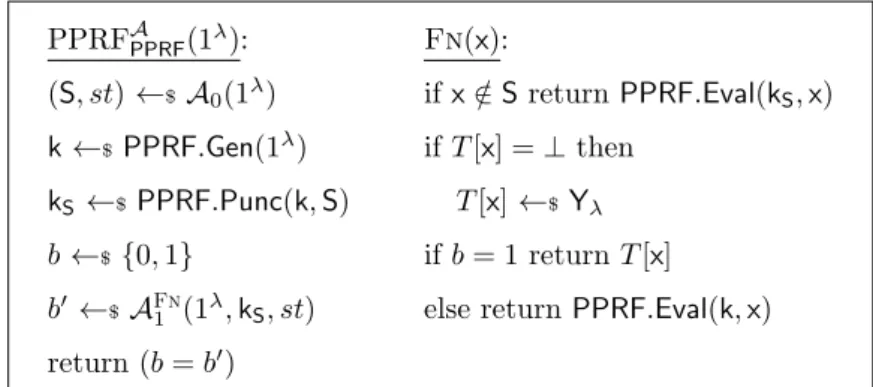
Pseudorandomness at punctured points : For every ppt adversary A,
where game PPRFAPPRF(1λ) is defined in Figure 2.9. PPRFAPPRF(1λ): (S, st)←$A0(1λ) k←$PPRF.Gen(1λ) kS ←$PPRF.Punc(k,S) b←${0,1} b0 ←$ AFn1 (1λ,kS, st) return (b=b0) Fn(x): ifx∈/ SreturnPPRF.Eval(kS,x) ifT[x] =⊥then T[x]←$ Yλ ifb= 1 returnT[x]
else returnPPRF.Eval(k,x)
Figure 2.9: Game defining the pseudorandomness at punctured points property of a puncturable pseudorandom functionPPRF.
Chapter 3
Unpredictable Samplers
The results described in this section have been published in [ABF16].
The privacy notions that we will be developing in the coming sections rely on multistage adversaries that must adhere to certain high-entropy requirements on the sampled cir-cuits. Rather than speaking about specific distributions for specific circuit classes, we introduce a uniform treatment for any circuit class via an unpredictability game. Our framework allows one to introduce restricted classes of samplers by imposing structural restrictions on their internal operation without changes to the reference unpredictability game. Our framework extends that of Bellare, Stepanov and Tessaro [BST14] for obfus-cators and also models the challenge-generation phase in private functional encryption in prior works [BRS13a, BRS13b, ATR14, AAB+15].
3.1
Definitions
Syntax. A sampler for a circuit familyCSpis an algorithmS that on input the security
parameter 1λ and possibly some state information st outputs a pair of vectors of CSp λ
circuits (C0,C1) of equal dimension, a pair of vectors of MSpλ messages (m0,m1) of
equal dimension, and some auxiliary information z. We require the components of the two circuit (resp., message) vectors to be encoded as bit strings of equal length. Input st may encode information about the environment where the sampler is run (e.g., the
public parameters of a higher-level protocol) and z models side information available on the sampled circuits or messages.
In the security games we will be considering later on, the goal of adversary will be to distinguish which of two circuit distributions produced by an unpredictable sampler was used to form some cryptographic data (e.g., an obfuscated circuit or an FE token). Our unpredictability definition formalizes the intuition that by examining the input/output behavior of the sampled circuits on messages of choice, the evaluation of legitimate cir-cuits of choice on sampled messages, and the evaluation of sampled circir-cuits on sampled messages, a point leading to differing outputs on some pair of sampled circuits cannot be found. Drawing a parallel to the functional encryption setting, once decryption tokens or encrypted messages become available, the tokens can be used by a legitimate adversary to compute the circuits underneath on arbitrary values, including some special messages that are possibly correlated with the circuits.
Unpredictability. A legitimate sampler S is statistically (multi-instance)
unpre-dictable if for any unbounded legitimate predictor P that places polynomially many queries
Adv(m)predS,P (λ) := Pr(m)PredPS(1λ)
∈Negl ,
where games mPredPS(1λ) and PredPS(1λ) are shown in Figure 3.1. Sampler S is called legitimate ifC0(m00) =C1(m01) for all queries made to theSporacle in game mPred
P S(1λ), or simply required thatC0(m0) =C1(m1) in game Pred
P
S(1λ). Predictor P is legitimate if C(m0) = C(m1) for all queries made to the Func oracle (in both multi-instance and
single-instance games).1
The mPred game is multi-instance and the predictor can place polynomially many queries toSamand setstarbitrarily. The latter essentially ensures thatS generates fresh
entropy on any inputst. We emphasize that the winning condition demands component-wise inequality of circuit outputs. In particular the predictor isnot considered successful if it outputs a message which leads to different outputs across different Sam queries or
within the same Sam query but on different circuit indices. 1Wedo not impose thatC
0(m) =C1(m) within theFuncoracle as this is exactly the event thatP is
aiming to invoke to win the game. The restriction we do impose allows for a sampler to be unpredictable while possibility outputting low-entropy messages that might even differ on left and right.
mPredPS(1λ): (i,m)←$ PSam,Func,Sp(1λ) (C0,C1,m0,m1)←list[i] return (C0(m)6=C1(m)) Sam(st): (C0,C1,m0,m1, z)←$S(st) list←list: (C0,C1,m0,m1) returnz Func(i,m,C): (C0,C1,m0,m1)←list[i] return (C0(m),C(m0)) Sp(i, j): (C0,C1,m0,m1)←list[i] (C00,C01,m00,m01)←list[j] returnC0(m00) PredPS(1λ): (st, st0)←$P1(1λ) (C0,C1,m0,m1, z)←$S(st) m←$ P2Func(1λ,C0(m0), z, st0) return (C0(m)6=C1(m)) Func(m,C): return (C0(m),C(m0))
Figure 3.1: Games defining multi-instance and single-instance unpredictability of a sam-pler S.
A number of technical choices have been made in devising these definitions. By the legitimacy of the sampler C0(m0) = C1(m1) and hence only one of these values
is provided to the predictor. Furthermore, since the goal of the predictor is to find a differing input, modifying the experiment so that Func returns C1(m) (or both values)
would result in an equivalent definition. Our definition intentionally does not consider unpredictability of messages. Instead, one could ask the predictor to output either a message that results in differing evaluations on challenge circuits or a circuit that evaluates differently on challenge messages. This would, however, lead to an excessively restrictive unpredictability notion and excludes many circuit samplers of practical relevance.
Composition. A standard guessing argument shows that any stateless sampler (one
that keeps no internal state and uses independent random coins on each invocation, but might still receive st explicitly passed as input) is multi-instance unpredictable (where
P can place q queries to Sam) if and only if it is single-instance unpredictable (where
P can only place a single Sam query). The reduction in one direction is trivial. In the
other direction we guess the indexi∗ that the multi-instance predictorP will output and simulate Sam queries 1, . . . ,(i∗−1) and (i∗ + 1), . . . , q by running the sampler S in the
reduction—this is where we need the stateless property—and answer the i∗th one using the Samoracle in the single-instance game. Queries toFunc with indexi∗ are answered
analogously using the single-instance counterpart whereas those with index different from i∗ will use the explicit knowledge of the circuits and messages generated by the reduction.
Queries Sp with index (i, j) are answered as follows. If both i and j are different from i∗, use the explicit knowledge of circuits and messages. If i = i∗ but j 6= i∗, use the explicit knowledge of the messages and the single-instance Func oracle on i∗. If i 6= i∗ butj =i∗, use the knowledge of the circuit and single-instanceFunc. For (i∗, i∗) queries,
use theSporacle in the single-instance game. Note that the legitimacy of the constructed single-instance predictor follows from the legitimacy of the multi-instance predictor and
the sampler.
Proposition 1 (Unpredictability composition). A stateless sampler is multi-instance unpredictable (Figure 3.1 on the left) if and only if it is single-instance unpredictable (Figure 3.1 on the right).
The samplers that we study in this work are stateless and therefore we use the def-inition in Figure 3.1 on the right for simplicity. Nevertheless, our framework can be used to analyze stateful samplers as well. We leave the study of such samplers as an important (and practically relevant) direction for future work. In the following section, we define a number of special classes of samplers by imposing structural restrictions on their internal operation. This serves to illustrate how various samplers that previously appeared in the literature can be modeled within our framework. In particular, defini-tions of high-entropy and block source samplers for keywords [BRS13a], block sources for inner products [BRS13b], and circuit sampler distributions used in various obfuscation definitions can be seen as particular cases within this framework.
3.2
Taxonomy of samplers
We define a number of special classes of samplers by imposing structural restrictions on their internal operation.
Stateless. The sampler does not keep any internal state and uses independent set of coins on each invocation. All samplers will be stateless in this work unless stated otherwise.
(t, s)-bounded. For polynomials t and s, with overwhelming probability |C0|=|C1| ≤
Circuits-only. The sampler outputs no messages with overwhelming probability, i.e. it is (·,0)-bounded.
One-sided. C0 =C1 andm0 =m1 with overwhelming probability. In this case we will
simply write (C,m, z) ←$ S(1λ, st) for the sampling operation. Note that every
one-sided sampler is trivially unpredictable.
Input-independent. For any 1λ and st, S(1λ, st) = S(1λ, ε) with overwhelming
proba-bility.
Aux-free. With overwhelming probability z =ε.
Simple. If the sampler is both aux-free and input-independent.
Random-aux. For a polynomialpolyand a ppt algorithmS0 the sampler takes the form
S(1λ, st) : z ←
$ {0,1}poly(λ);
(C0,C1,m0,m1)←$ S0(1λ, z, st);
return (C0,C1,m0,m1, z) .
Differing-inputs. With overwhelming probability z contains the sampler’s output cir-cuits (C0,C1). Note that statistical unpredictability would imply that the sampled
circuits are functionally equivalent, whereas computational unpredictability would lead to a notion of differing-inputs samplers used to formulate differing-inputs ob-fuscation [ABG+13, BST14].
Block-source. A t-block-source is a random variableX = (X1, . . . , Xt) where for every
j ∈ [t] and x1, . . . , xj−1 it holds that Xj|X1=x1,...,Xj−1=xj−1 has high min-entropy.
There is therefore sufficient decorrelation between different components in such a distribution. We can model block sources in our framework by restricting attention to ppt samplers that take the form
S(1λ, st) : (C0,C1) ←$ S0(1λ, st);
j ←$ [t];
return ((C0[j],C1[j]),(C0[1..(j−1)],C1[1..(j−1)]))
whereS0 is a (t,0)-bounded sampler. The rationale here is that any indistinguisha-bility-based security definition that imposes an adversary to output two block
sources, and later on distinguish some computation performed on the sampled val-ues, e.g. [BRS13a], would remain the same if a sampler such as the one above was used instead (note that in this case, the adversary can only have an advan-tage when outputting distributions that component-wise differ with non-negligible probability).
Functionally-differing. S is a (t,·)-bounded sampler and, with overwhelming proba-bility over its random coins, ∀j ∈[t], ∃x s.t. C0[j](x)6=C1[j](x).
Chapter 4
Obfuscators
The results described in this section have been published in [ABF16].
An obfuscator is an efficient compiler that takes as input a circuit description and out-puts the description of another circuit with the same functionality that is of similar size, but yet is unintelligible. In recent years, program obfuscation as found tremendous applications in cryptography, ranging from functional encryption [GGH+13] to deniable
encryption [SW14] to multi-party computation [GGHR14]. Several of the constructions we propose later in this thesis rely on obfuscation, so we take the time go over def-initions and revisit concrete obfuscators for the classes of functions comprising point functions and hyperplane membership testing functions. We generalize distributionally-indistinguishable (DI) obfuscators [BC14] from point functions to general circuits, show that DI is a weakening of composable virtual grey-box (CVGB) [BC14, BCKP14], and construct a DI obfuscator for hyperplane membership testing functions.
Syntax. An obfuscator for a circuit family CSp is a uniform ppt algorithmObf that on
input the security parameter 1λ and the description of a circuit C ∈ CSp
λ outputs the
description of another circuit C. We require any obfuscator to satisfy the following two requirements.
Functionality preservation : For any λ ∈ N, any C ∈ CSpλ and any m ∈ MSpλ,
with overwhelming probability over the choice of C ←$ Obf(1λ,C) we have that C(m) =C(m).