June, 2009
The Methods for the Synthesis of
Studies without Control Groups
The Methods for the Synthesis of
Studies without Control Groups
Prepared for the National Collaborating Centre for Methods and Tools by
Donna Fitzpatrick-Lewis • Donna Ciliska • Helen Thomas
June, 2009
National Collaborating Centre for Methods and Tools (NCCMT)
School of Nursing, McMaster University
Suite 302, 1685 Main Street West
Hamilton, Ontario L8S 1G5
Telephone: (905) 525-9140, ext. 20455
Fax: (905 529-4184
Funded by the Public Health Agency of Canada
Affiliated with McMaster University
Production of this paper has been made possible through a financial contribution from the Public Health Agency of Canada. The views expressed herein do not necessarily represent the views of the Public Health Agency of Canada.
How to cite this resource:
Fitzpatrick-Lewis, D., Ciliska, D., & Thomas, H. (2009). The Methods for the Synthesis of Studies without Control Groups. Hamilton, ON: National Collaborating Centre for Methods and Tools. [http://
Contents
Key Recommendations:. . . 6 Summary . . . 7 Introduction. . . 10 Methods. . . 10 Relevance . . . 11 Data Synthesis . . . 11 Findings . . . 12Critical Appraisal Tools . . . 12
Systematic Reviews . . . 17
Methods for Synthesizing Quantitative Studies without Control Groups . . . 23
Combining Qualitative and Quantitative Studies . . . 26
Studies Comparing Results Using Differing Methods . . . 27
Discussion . . . 29
Recommendations . . . 30
Tables summarizing results of relevant papers . . . 32
Key Recommendations:
1. Incorporate studies without control groups into systematic reviews, especially when
there are no other studies to consider. Studies without control groups can also
pro-vide information on long-term effectiveness, rare events and adverse effects. 2. Do not generalize the direction of differences in outcome between randomized and
non-controlled studies. While effect sizes are more often smaller in randomized controlled trials (RCTs), some show the reverse or the same results across study
designs.
3. Use Whittemore and Knafl’s (2005) approach to include results of non-randomized trials. Whittemore and Knafl provide a five-step integrative review method that incorporates problem identification, literature search, data evaluation, data analysis
and presentation of data.
4. Recommendations for methods of systematic review including studies without con -trol groups:
a) Use a critical appraisal tool that has been tested for internal consistency, test-retest and inter-rater reliability, and at least face and criterion validity
(Downs & Black, 1998; Slim, Nini, Forestier et al., 2003; Steuten, Vrijhoef, van-Merode et al., 2004; Thomas, Ciliska, Dobbins et al., 2004a; Zaza, Wright-De Aguero, Briss et al., 2000).
b) Do not meta-analyse results from observational studies. 5. Suggestions to authors of primary studies:
a) Ensure a strong and transparent study design in all non-randomized trials. b) Confirm that the research question determines the study design.
c) Incorporate detailed information about the study; lack of information means that readers cannot determine what has or has not been done in the study
design.
d) Ensure consistency in terminology and descriptions across non-random
-ized studies to facilitate comparisons. 6. Implications for further research:
a) Conduct reliability and validity testing of any critical appraisal tools.
b) Conduct further studies to assess the different results obtained by random
-ized versus non-random-ized trials.
7. Including data from non-randomized trials is challenging; however, several benefits
can be achieved:
a) A wider body of literature can be included in search strategies (Thomas, Harden, Oakley et al., 2004).
b) The scope of the questions that can be answered may be broadened. c) This research can shed light on why, how and for whom interventions or
Summary
There is currently no standardized model for synthesizing results of studies that do not have control groups. The purpose of this paper is to examine synthesis methods, critical appraisal tools and studies that deal with appraising and synthesizing quantitative studies without
control groups. RCTs are achievable in clinical settings, but public health interventions can
rarely replicate the controlled environment of the clinic. Researchers, policy-makers and practice decision-makers often must rely on other types of study designs for their source of
evidence. This paper will outline precautions to be aware of when including non-controlled
studies as evidence, and recommends effective tools to use to analyse the results from
these types of studies. Methods
With the assistance of a librarian, five electronic databases were searched using keywords.
In addition, reference lists of all relevant articles and grey literature were searched.
An article met the relevance criteria if:
it was a primary study comparing results of the same intervention using randomized •
controlled trials (RCTs) versus designs without control groups;
it was a synthesis of methods used to review studies without control groups; •
at least one of these designs was included: one group cohort (before/after or just •
after), cross-sectional, interrupted time series or mixed methods; it was published between 1995 and November 2007.
•
A paper was excluded if:
the focus was RCT, clinical controlled trials or quasi-randomized studies; •
the focus was a cohort analytic study (before/after on two or more groups); •
the study was qualitative only; •
it was published before 1995.
•
Thirty-six papers passed the relevance test and full data extraction was completed on those papers. Many of the included studies were observational studies. It is important to note that while there are many definitions of observational studies, only those without control groups
were included in this paper. Findings
Fourteen articles provided critical appraisal tools that could assist in judging the method
-ological rigour of primary studies. Primary studies for a systematic review should include a quality assessment of the studies. A critical appraisal tool is essential when sifting through evidence in primary studies without control groups. These tools can provide information about the strengths and weaknesses of information. Critical appraisal tools assist the reader in assessing the methodological quality, managing confounders, determining potential bi
assessing RCTs are not applicable. Many of the tools have not been tested for validity and
reliability; this testing might be a sensible next step.
Eleven systematic reviews incorporated primary studies without control groups, or examined critical appraisal tools for quality assessment of studies without control groups. The reviews that examined the feasibility of combining the results of RCTs and non-RCTs suggest that well-designed studies can produce similar results, regardless of the study type. Many of these reviews suggest that poor execution of the primary study design result in lower quality scoring, rather than the study design itself. They cited under-reporting of methodology, poor management of confounders and/or lack of consistent analytical terminology as problematic when trying to compare data between studies.
Six papers examined various methods of synthesizing and integrating quantitative data from studies without control groups. The authors agreed that there is benefit to incorporating evi
-dence from diverse study designs, but quality assessment is paramount for providing trust
-worthy evidence. Primary studies that are clear about potential bias and probable impact on effect can be usefully incorporated into systematic reviews.
Three articles described methods of synthesizing data from both qualitative and quantita
-tive studies. Incorporating qualita-tive and quantita-tive data in one report can help build an understanding of the success or failure of interventions. Assessing the quality of studies without control groups can be problematic, especially if quality is assessed with traditional criteria used in systematic reviews or meta-analyses. Results of quality assessment were not used as exclusion criteria, but could be incorporated in the discussion of findings. Group
-ing find-ings accord-ing to a thematic and aggregate method was offered as an appropriate and alternative approach to meta-analysis. Researchers could also incorporate some of the processes used in systematic reviews, such as having two people review and perform
data extraction. Most of these authors suggested a narrative approach for presenting results
when meta-analysis was not appropriate.
Two papers compared the results of different methodologies applied to the same interven -tion. Those articles pointed out that it is useful to consider different designs in reviews. Not
only may they be the best available information, but they also can be more able to answer questions related to long-term effectiveness, adverse events and rare events. The strengths of including different designs in reviews outweigh the limitations.
Recommendations
1. Incorporate studies without control groups into systematic reviews, especially when
there are no other studies to consider. Studies without control groups can also
pro-vide information on long-term effectiveness, rare events and adverse effects. 2. Do not generalize the direction of differences in outcome between randomized and
non-controlled studies. While effect sizes are more often smaller in randomized controlled trials (RCTs), some show the reverse or the same results across study
designs.
3. Use Whittemore and Knafl’s (2005) approach to include results of non-randomized trials. Whittemore and Knafl provide a five-step integrative review method that
incorporates problem identification, literature search, data evaluation, data analysis
and presentation of data.
4. Recommendations for methods of systematic review including studies without con -trol groups:
a) Use a critical appraisal tool that has been tested for internal consistency, test-retest and inter-rater reliability, and at least face and criterion validity
(Downs & Black, 1998; Slim, Nini, Forestier et al., 2003; Steuten, Vrijhoef, van-Merode et al., 2004; Thomas, Ciliska, Dobbins et al., 2004a; Zaza, Wright-De Aguero, Briss et al., 2000).
b) Do not meta-analyse results from observational studies. 5. Suggestions to authors of primary studies:
a) Ensure a strong and transparent study design in all non-randomized trials. b) Confirm that the research question determines the study design.
c) Incorporate detailed information about the study; lack of information means that readers cannot determine what has or has not been done in the study
design.
d) Ensure consistency in terminology and descriptions across non-random
-ized studies to facilitate comparisons. 6. Implications for further research:
a) Conduct reliability and validity testing of any critical appraisal tools.
b) Conduct further studies to assess the different results obtained by random
-ized versus non-random-ized trials.
7. Including data from non-randomized trials is challenging; however, several benefits
can be achieved:
a) A wider body of literature can be included in search strategies (Thomas, Harden, Oakley et al., 2004).
b) The scope of the questions that can be answered may be broadened. c) This research can shed light on why, how and for whom interventions or
Introduction
The overriding goal of public health policy and practice is to protect people’s health. To achieve this goal, public health professionals consider evidence when making decisions. Historically, scientists have preferred the randomized controlled trial (RCT) study design to provide the least biased results when analysing the effectiveness of interventions. An RCT may provide rigorous study results for effectiveness questions; however, it might not be the best study design for other types of research questions (DiCenso, Prevost, Benefield et al., 2004). In public health and health promotion, it may be difficult to use randomized trials for a particular question; does that mean we should ignore evidence from other methods? Some researchers believe that only RCTs have the scientific rigour to produce valuable evidence.
In clinical settings, RCTs are achievable. But public health interventions can rarely replicate
the controlled environment of the clinic. These interventions are often community-based and recruitment can be challenging, creating a selection bias. As a result, maintaining pure control groups without cross-contamination may be impossible or impractical. Public health researchers must often rely on other types of study designs, often classified as lower on the “hierarchy of evidence” (Ogilvie, Egan, Hamilton et al., 2005). However, observational stud
-ies, for example, can provide valuable information for public health decision-making. Qualita
-tive information can supplement statistical data by helping us understand the ‘who, why and how’ of intervention success or failure. There is a whole body of literature about the methods for synthesizing qualitative studies (meta-synthesis), but these methods are beyond the
scope of this paper.
Due to the greater potential for bias in observational studies, they are often excluded from systematic reviews of treatments. However, they offer several advantages to RCTs, includ
-ing: being less costly; allowing for larger sample sizes; and providing more long-term out
-come measurements (Benson & Hartz, 2000). As well, observational studies may provide the “best available evidence” in certain situations (Ogilvie et al., 2005).
There is currently no standardized model for synthesizing the results of studies that do not have control groups. The purpose of this paper is to examine synthesis methods, criti
-cal appraisal tools and studies that deal with appraising and synthesizing the results from quantitative studies that lack control groups. This paper will also outline some precautions to take when using non-controlled studies as evidence, and will make recommendations for
processes and tools.
Methods
The methods used to collect the literature for this paper included:
a comprehensive literature search of published literature from January 1995 to •
October 2007;
review and retrieval of references from relevant articles; •
a search and retrieval of potentially relevant grey literature.
•
review, systematic review, literature review, meta-analysis, not random and not randomized clinical trials. These key word searches were conducted in a several databases: PsycINFO, OVID MEDLINE, EMBASE, CINAHL and Scholars Portal. The initial search located 9324
potentially relevant articles. Titles and abstracts were read independently by two reviewers who passed on 182 articles for full relevance testing.
Relevance
An article was included for full relevance testing if:
it was a primary study comparing results of the same intervention using randomized •
trials versus designs without control groups;
it was a synthesis of methods used to review studies without control groups; •
at least one of these designs was included: one group cohort (before/after or just •
after), cross-sectional, interrupted time series or mixed methods; it was published between 1995 and November 2007.
•
A paper was excluded if:
the focus was RCT, clinical controlled trials or quasi-randomized studies; •
the focus was a cohort analytic study (before/after on two or more groups); •
the study was qualitative only; •
it was published before 1995.
•
Thirty-six papers passed the relevance test, and researchers completed full data extrac
-tion on those papers. Many of the final papers were observa-tional studies. There are many definitions for observational studies; for this paper, only observational studies with no control
groups were considered relevant.
Data Synthesis
Researchers synthesized 36 papers in a narrative format by topic:
critical appraisal tools
•
systematic reviews •
methods for synthesizing quantitative studies without control groups •
combined qualitative and quantitative studies •
comparing results using differing methods •
Some papers could have been included in more than one section; however, we placed the papers in the groups that appeared most suitable.
The paper provides a narrative synopsis of the relevant papers. The results are also detailed
Findings
Critical Appraisal Tools
A total of 14 papers described critical appraisal tools.
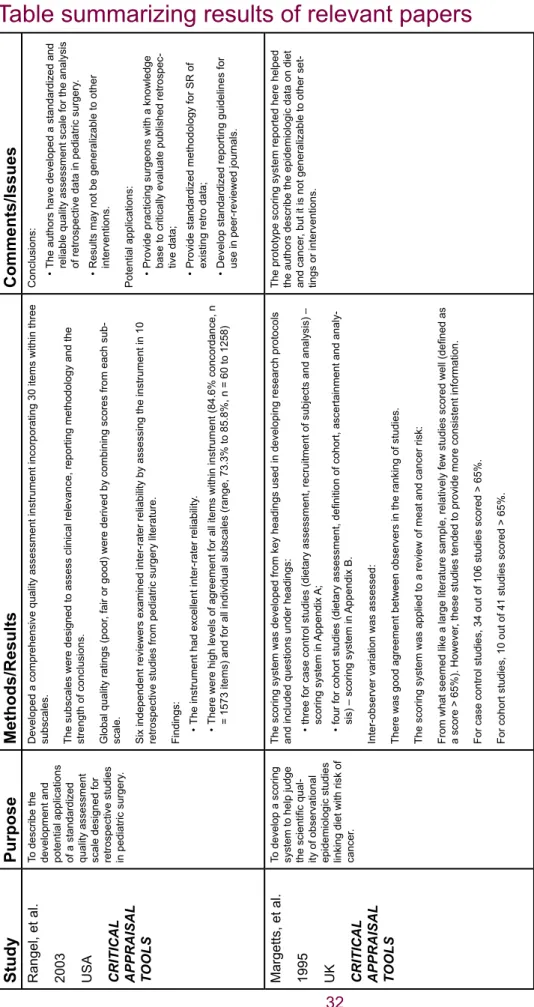
Rangel, Kelsey, Colby et al., (2003) addressed the lack of a standardized measurement tool to determine the quality of observational studies. They developed a quality assessment in
-strument for non-randomized studies that incorporated 30 items within three subscales. The subscales assessed clinical relevance, reporting methodology and the strength of conclu
-sions. Global ratings were determined by combining each subscale, and the studies were thereby rated as ‘good,’ ‘fair’ or ‘poor.’ They achieved high inter-rater reliability with levels of agreement reaching 84.6% concordance of results (n = 1573 items). For all individual subscales, there was range of 73.3% to 85.8% (n = 60 to 1258). The potential applications
for this tool include:
facilitating the development of standardized methodology for conducting systematic •
reviews of retrospective data;
helping to develop a strategy for meta-analysis of non-randomized trials; •
developing standardized reporting guidelines for use in peer-reviewed journals. •
Margetts et al. (1995) developed a scoring system to judge the scientific quality of obser
-vational epidemiological studies linking diet with the risk of cancer. Case-control and cohort studies were reviewed separately because some of the reliability markers applied to only one of these study types. Case-control studies were rated on three broad areas: quality of dietary assessment; recruitment of subject; and the analysis of results. Cohort studies were scored on four areas: dietary assessment, definition of cohort, ascertainment of disease
cases and analysis of results. Inter-rater reliability was assessed and resulted in a high level
of agreement between reviewers, with the cohort reviewers attaining a slightly higher level of agreement. This prototype scoring system helped the authors to describe the epidemiologi
-cal data on diet and cancer; however it may not be generalizable to other topics.
Downs and Black (1998) developed and tested a checklist to assess randomized and non-randomized studies. They used epidemiological principles, reviews of study designs and existing checklists to develop their checklist, consisting of 26 items distributed between five
subscales: reporting • external validity • bias • confounding • power •
The maximum score was 31. Twenty-three of the questions could be asked of any study of any health care intervention. The other three questions were topic sensitive and were cus
-ple size required for clinical and statistical significance (p<0.05). The quality index had high
internal consistency, good test-retest and inter-rater reliability and good face and criterion
validity. It performed as well as other established checklists on randomized trials, and there was little difference between its performance with non-randomized and randomized studies. To address the lack of validated instruments to measure quality of observational or non-ran
-domized trials, Slim et al. (2003) tested a methodological index for non-ran-domized studies (MINORS). This tool includes 12 items (the first eight items were designed specifically for non-comparison trials):
a clearly stated aim •
inclusion of consecutive patients
•
prospective collection of data
•
endpoints appropriate to the aim of the study •
unbiased assessment of the study endpoints •
a follow-up period appropriate to the aim of the study •
loss to follow-up less than 5% •
prospective calculation of the study size
•
an adequate control group •
contemporary groups •
baseline equivalence of groups •
adequate statistical analysis •
This tool had good reliability, internal consistency and validity.
Zaza et al. (2000) developed a format to classify and provide descriptive components of public health inventions and assess the quality of the study’s execution. The authors ac
-knowledged that all study designs have issues particular to their specific design, therefore the quality questions were developed to reflect those specific issues. For example, the authors suggested that while blinding is an important component to consider for randomized trials, it is not appropriate to assess validity in a time series design. Zaza et al. provided cat
-egories of questions to assess potential threats to the validity of results in primary studies,
including:
description of the invention
•
sampling •
reliability and validity of outcome measurements •
the appropriateness of the statistical analysis
•
the interpretation of results
•
One aim of their approach was to design a tool that was flexible enough to be useful in the assessment of divergent study designs and interventions. The standardized abstraction form and procedure improved the validity and reliability of the Guide to Community Prevention Services: Systematic Reviews and Evidence-Based Recommendations.
Greer et al. (2000) presented and discussed a system of grading evidence that was devel
-oped by the Institute for Clinical Systems Improvement (ICSI). This approach was devel-oped in response to feedback indicating that an existing system was not working. Its goal is to as
-sist busy practitioners who need to judge the quality of evidence. After reviewing many other grading systems, the ICSI working group agreed that it was important to separate the evalu
-ation of the individual research reports from the assessment of the totality of the evidence supporting the conclusion. The subsequent worksheet for grading evidence—the primary tool—included a statement of conclusion, a summary of the research reports that support or dispute the conclusion, assignment of classes and quality markers to the research reports and assignment of a grade to the conclusion. Primary reports of new data collection were assigned a letter grade of A to D, depending on the type of study: randomized controlled trial; cohort study; non-randomized trial with concurrent or historic controls; case-control study; study of sensitivity and specificity of a diagnostic test; population-based descriptive study; cross-sectional study; case series; or case report. The report also included a five-point quality system to rate both positive and negative study design attributes, with ratings of plus, negative or neutral. The questions included:
a priori inclusion/exclusion criteria
•
bias
•
statistical or clinically significant results •
generalizability of results to other populations
•
clearly outlined study design
•
This system has been applied to more than 40 ICSI guidelines and technology assessment reports. The authors reported that the system appears to be successful in reducing the complexity of other grading systems, while yielding defendable classification of conclusions
based on the strength of the underlying evidence.
Steuten et al. (2004) critiqued the tools used to assess the methodological quality of the Health Technology Assessment (HTA) of disease management. The authors developed an inventory of problems that arise when assessing HTA studies, including: study design (RCT vs. observational); criteria for selection and restriction of patients; baseline and outcome measures; blinding of patients and providers; the description of complex, multifaceted inter -ventions; and avoidance of co-interventions. They developed, proposed and validated a new
instrument for assessing the methodological quality of HTA for disease management that includes four components:
study population • description of intervention • measurement of outcomes •
data analysis/presentation of data
•
The instrument includes 15 items that cover internal validity, external validity and statistical considerations. This instrument is reliable in terms of hierarchical ranking, test-retest reliabil
-ity and inter-rater reliabil-ity when applied to HTAs of disease management.
that evidence of harm is as important as evidence of effect. However, standard systematic reviews focusing on effectiveness and randomized trials may not be an efficient model for evaluating harm. Literature related to harm is found in unpublished trials, observational stud
-ies and grey literature. Applying existing quality checklists to this data set was problematic and did not readily capture the types of information pertinent to harmful effects. McIntosh et al. adapted published checklists to reflect information about harmful effects found in obser
-vational cohort studies. This new checklist also incorporated items such as how and when events were reported, and whether the time at which they occurred during the study was recorded. However, the greatest barrier to applying any checklist was the lack of method
-ological detail provided by the primary study authors. The researchers also included narra
-tive outcome reports. Chou and Helfand (2005) examined case reports and observational studies of harmful effects of treatment. They too found quality assessment difficult, as instru
-ments for assessing these types of studies were rare or inconsistent. Developmental rigour, scope, and the number and type of items used were all contentious issues. They pilot-tested a quality assessment tool for RCTs, clinical control trials (CCTs) and cohort studies for an uncontrolled surgical series that reported complications from carotid endarterectomy. This eight-point tool provided a ranking of ‘good,’ ‘fair’ or ‘poor.’ The tool was tested on studies for
one intervention. The authors cautioned researchers to avoid inappropriate pooling of
statis-tical results from observational studies, given the potential for bias due to inadequate control
of confounders and selection bias.
The GRADE Working Group (Atkins, Briss, Eccles et al., 2005) reported on the development and pilot testing of the GRADE approach to assessing evidence and recommendations. Twelve evidence profiles were independently graded by 17 judges who all had experience using other approaches to assessing evidence and recommendations. Each evidence profile was based on information available in a systematic review and included two tables, one for quality assessment and one for the summary of the findings. The quality assessment process was designed so that each outcome was evaluated separately. The outcome table displayed the number of studies that had reported that outcome, the study design (RCTs or observational) and the quality of the studies. Assessment of the quality of outcome revealed that factors other than study design, quality, consistency and directness affected the review
-er’s judgment about quality. These other factors included: sparse data, strong associations,
publication bias, dose response and situations where all plausible confounders strengthened
rather than weakened confidence in the direction of effect. The judges were asked about the
ease of understanding and the sensibility of the approach; they generally agreed that the
GRADE approach was clear, understandable and sensible.
Khan et al. (2001) provided information on what needs to be included in any quality assess
-ment checklist. In effectiveness trials, RCTs should be considered first when they are avail
-able and well-designed. In the absence of good RCTs, well-designed quasi-experimental and observational studies should be considered. Khan et al. provided several questions to consider when assessing the quality of observational studies. They cautioned that although conclusions can be drawn from these studies, it may be unclear whether the groups within studies are comparable. The authors suggested that results need to be reported with cau
-tion, and often with recommendations for further research.
allowed for the methodological rating of studies that were not randomized control trials, for inclusion in a systematic review. This method was specifically developed for quality assess
-ment of public health research. Quality assess-ment components included:
selection bias • study design • confounders • blinding •
data collection methods •
withdrawals or dropouts
•
Studies rated with this system achieved a ‘strong,’ ‘moderate’ or ‘weak’ methodological rat
-ing. The instrument had good inter-rater and test-retest reliability. It also had proven content and criterion validity, randomized control trials and clinical control trials were rated as strong and non-RCTs such as cohorts and observational studies were rated as moderate. However, non-randomized studies could achieve an overall study rating of ‘moderate’ if the other com
-ponents of the study were strong. Data is extracted from studies and reported in a narrative format. Meta-analysis was rarely done as it was found that public health study populations
and interventions are often too heterogeneous for this type of analysis. Data extraction
al-lowed for reporting statistically significant (or lack of) effects from each study, and the re
-searchers commented on the clinical meaningfulness of any statistically significant effect. Ramsay et al. (2003) reviewed the quality of Interrupted Time Series (ITS) using studies included in two systematic reviews. They developed a quality assessment tool that incorpo -rated the following criteria:
the intervention occurred independently of other changes over time; •
the intervention was unlikely to affect data collection;
•
the outcome was assessed blindly or measured objectively; •
the outcome was reliable or measured objectively; •
the composition of the data set at each time point covered at least 80% of all par
-•
ticipants in the study;
the shape of the intervention effect was pre-specified; •
the rationale for the number and spacing of data points was described; •
the study was analysed appropriately using time series techniques. •
They found that 37 of the 58 studies were not analysed appropriately, and that 33 of those
should be re-analysed. Poor study designs, insufficient power and inappropriate analysis of ITS studies resulted in misleading conclusions being presented in the published literature. The authors recommend that all data from ITS studies be re-analysed before inclusion in reviews. Conn and Rantz (2003) explored ways in which researchers can manage quality when considering primary studies within a meta-analysis. While there are more than 100 scales available to measure the quality of these studies, they vary in size, composition, complexity and extent of development. Establishing the validity of the scales is complicated and chal -lenging. Scales are not reliable and accurate for all areas of science, and application of the
scales can be problematic and inconsistent. Conn and Rantz outlined three methods that could potentially manage quality:
setting a quality threshold •
weighting by quality scoring •
considering quality as an empirical question •
However, as a stand-alone method, each has limitations. For instance, setting a quality threshold may result in the exclusion of less rigorous research—data that may contain im
-portant information. Weighting by study quality can be limited by the scaling tools used and some potentially inherent problems such as inter-rater reliability. Finally, considering quality as an empirical question may lead to overall measures masking interesting effects of indi
-vidual components of quality on effect-size estimates. To accommodate for these limitations, researchers may need to combine strategies to include studies that are rated as method
-ologically weak but still contain important information.
Section Summary
Reviewing literature to be included in a systematic review should include a quality assess
-ment. A critical appraisal tool is essential when sifting through evidence in primary studies without control groups. These tools can provide information regarding the strengths and weaknesses of information. Critical appraisal tools assist the reader in assessing the evi
-dence provided based on methodological quality, management of confounders, potential biases and data analysis. These tools are particularly helpful where systems of assessment
used for RCTs are not applicable. Many of the tools presented here have not been tested for validity and reliability. This is a reasonable next step.
Systematic Reviews
Eleven systematic reviews considered the question of synthesizing data from studies without
control groups.
Linde, Scholz, Melchart and Willich (2002) examined whether systematic reviews should include both randomized and non-randomized studies. The researchers examined the data on the use of acupuncture for chronic headaches to explore the following questions:
1. Do randomized and non-randomized studies of acupuncture for chronic headaches differ in regard to patients, interventions, design-independent quality aspects and response rates?
2. Do non-randomized studies provide relevant additional information (results of long-term outcomes, prognostic factors, adverse effects or complications and response rates in representative and well-defined groups of patients)?
3. If response rates in randomized and non-randomized patients differ, what are the possible explanations?
Fifty-nine studies met the inclusion criteria, of which 24 were randomized trials and 35 were non-randomized trials (five non-randomized control trials, 10 prospective uncontrolled stud
-ies, 10 case series and 10 cross-sectional surveys). A total of 535 patients received acu
-puncture treatment in the 24 RCTs, compared with 2695 in the 35 non-randomized studies. On average, randomized trials had smaller sample sizes, met more quality criteria and had lower response rates to treatment (0.59; 0.40–0.69) vs. (0.78; 0.72–0.83). Regardless of randomization status, studies meeting more quality criteria had lower response to treatment rates. Follow-up time was not significantly greater in the non-randomized studies. In the case of acupuncture for chronic headaches, non-randomized studies confirmed the findings in a previous study (Greenhalgh, Robert, Macfarlane et al., 2005) that the treatment was likely to be effective. However, non-randomized studies provided little additional relevant in
-formation on long-term effects, prognostic factors or adverse effects. In general, the authors concluded that non-randomized studies of good quality yielded results similar to RCTs. This suggests that their inclusion in systematic reviews, while increasing the workload for authors of these reviews, may provide a useful extension for generalizability.
MacLehose et al. (2000) investigated the association between methodological quality and estimates of effectiveness by comparing RCTs and quasi-experimental and observational (QEO) studies. The authors employed two strategies when reviewing the literature:
1. comparing RCT and QEO study estimates of effectiveness of any intervention, where both estimates were reported in one paper;
2. comparing the RCT and QEO estimates of effectiveness for specified interventions, where the estimates were reported in different papers.
For strategy 1, the authors identified 14 papers containing 38 comparisons, of which 13 were classified as high quality and 25 were classified as low. Quality assessment criteria
included:
study estimates derived from the same population; •
blinding of outcome assessors; •
the extent to which the QEO study estimate took possible confounding into ac
-•
count.
The findings indicated that the discrepancies between RCT and QEO study estimates of effect size and outcome frequency for intervention and control groups were smaller for high-quality than for low-high-quality comparisons. In addition, there was no tendency for QEO study estimates of effect size to be more extreme for high-quality comparisons than low-quality RCTs. For strategy 2, the specific interventions included mammography screening to re
-duce breast cancer mortality and folic acid supplements to re-duce neutral tube defects. The authors identified 34 papers, of which 12 papers were RCTs, 11 were non-randomized trials or cohort studies and nine were matched or unmatched case-control studies. These studies
were assessed based on
the quality of the reporting; •
the generalizability of the results;
•
the extent to which estimates of effectiveness may have been subject to bias or •
confounding.
lower quality scores than case-control studies. Meta-regression of study attributes against relative risk estimates showed no association between effect size and study quality. Esti
-mates for RCTs and cohort studies were not significantly different; however, case-control studies gave significantly different estimates in the mammography studies (greater benefit) and the folic acid studies (less benefit).
Britton et al. (1998) explored issues related to the process of randomization that may af
-fect the validity of conclusions drawn from the results of RCTs and non-randomized studies (including studies without control groups). The authors asked four research questions to examine the issues of randomization and validity:
1. Do non-randomized studies differ systemically from RCTs in terms of treatment ef
-fect?
2. Are there systematic differences between the included and excluded individuals, and do these influence the measured treatment effect?
3. To what extent is it possible to adjust for baseline differences between study groups?
4. How important is patient preference in terms of outcomes?
Their study included 18 papers that directly compared the results from RCTs and non-ran
-domized studies. The results found no consistent reporting of larger or smaller estimates of treatment effect based on study design. The authors also reported that the intervention type did not seem to be influential; however, they cautioned that more study is needed to vali
-date that inference. In RCTs, blanket exclusions were common, and the number of included eligible subjects ranged from 1% to 100%. Large clinical databases containing detailed information of patient severity and prognosis were used instead of RCTs. Where the da
-tabase subjects were selected according to the same inclusion criteria as RCTs, the treat
-ment effects of the two designs were similar. Docu-mentation of the characteristics of eligible individuals who did not participate in the trials was poorly recorded in most RCTs. Treatment effect measures in RCTs may be exaggerated due to the larger participation of university and teaching centres as compared to non-randomized studies. In non-randomized stud
-ies, adjustment for differences often changed the treatment effect size, but not significantly; more importantly, the direction of the change was consistent. Only four papers addressed the role of patient preference on results. In those papers, preference accounted for some of
the observed differences between study designs. Britton et al. concluded:
a well-designed non-randomized study is preferable to a small, poorly designed •
and exclusive RCT;
RCTs should include a wide range of practice settings;
•
study populations should be representative of all patients receiving the intervention;
•
exclusions for administrative convenience should be rejected; •
differences should be minimized by ensuring that subjects in both kinds of study •
are comparable.
Lemmer, Grellier and Stevens (1999) modified the Cochrane Collaboration Protocol for Sys
-tematic Reviews for a report that explored the evidence for decision-making and health visits (home health care provision) in Britain. Health visiting and decision-making are influenced
by factors such as social and environmental forces, which tend not to be captured in the evidence emerging from randomized control trials. The adapted Cochrane Protocol omitted sections that were felt to be inappropriate for non-RCT research papers. The methodologi
-cal rigour and relevance of each article was determined with a numeri-cal score ranging from 8 (maximum) to 1 (minimum). The authors did not provide the variables used to measure methodological rigour. Two members of the research team reviewed each article, and week
-ly consensus meetings were held to reach agreement on scoring differences. The scores were intended to provide a rapid overview of the methodology and relevance of each article; however, the final aggregate score provided no indication of the allocation of marks. Review
-ers commented on the appropriateness and significance of each article, but these comments were not part of the scoring. The authors found that the scoring system was a useful way to guide discussion at the consensus meetings. Scoring was impacted by the reviewers’ inter
-pretation of qualitative methodologies and relevance of articles. They also suggested that this more open approach allowed articles that contained important information or sections to be reviewed in spite of low scores. Some papers contained very brief methods sections, which made the scoring difficult and resulted in low scores.
Acknowledging that synthesizing diverse data in reviews is a challenge, Goldsmith, Bank
-head and Austoker (2007) developed a new review method. They implemented it on a re
-view of evidence to inform guidelines for the content of patient information related to cervical screening. They followed standard procedures for conducting a systematic review, including:
a priori study design
•
comprehensive literature search •
two people independently reviewing titles and abstracts
•
quality assessment •
data extraction
•
The researchers used checklists to perform quality assessment on both quantitative and qualitative studies. Established checklists were used for quantitative studies (Critical Ap
-praisals Skills Program (CASP), Scottish Intercollegiate Guidelines Network (SIGN), New Zealand Guidelines Group (NZGG) and UK Government Chief Social Researcher’s Office (UKGCSRO)) (CASP, 2005; Khan et al., 2001; Lethaby, Wells, & Furness, 2001; Spencer, Ritchie, & Lewis, 2004) . The researchers developed a checklist for the qualitative studies that included purpose, population, response rate, outcome definition and assessment. All checklists included a comments section. The methodological quality of studies was rated as ++ (all or most criteria were fulfilled), + (some criteria were fulfilled) or – (few or no criteria were fulfilled). The quality appraisal provided insight into the strengths and weaknesses of each study. However, methodological flaws did not result in studies being excluded. Quality scores were incorporated in the data synthesis phase of the review. Goldsmith et al. (2005) incorporated the synthesis guidelines set out in the GRADING system (Atkins et al., 2005) discussed in the Critical Appraisal Tools section of this paper.
DeWalt et al. (2004) conducted a systematic review of studies that measured literacy plus one or more health outcomes. The eligible study designs were observational: prospective
and retrospective cohort studies, case-control studies and cross-sectional studies. Their
a comprehensive literature search of several electronic databases; •
well-defined research questions; •
inclusion/exclusion criteria;
•
two authors reviewing full articles
•
quality assessment and reporting of findings. •
The researchers adapted the quality assessment tool from West et al. (2002). Each study
was rated according to: study population
•
comparability of subjects •
validity and reliability of the literacy measure •
maintenance of comparable groups •
outcome measure •
statistical analysis
•
controlling for confounding
•
Based on these criterions, the studies received a ‘good,’ ‘fair’ or ‘poor’ rating. This tool has not been validated. Although the review authors were able to provide a statistical analysis of the literacy and health outcomes, they cautioned that the primary study data posed many challenges due to the various reading measures used and cut points for analysis. As well, lack of adequate statistical measures, inadequate controlling for confounders and lack of adjustment for multiple comparisons made comparisons between studies difficult.
Thomson et al. (2006) examined data reporting on socioeconomic determinants of health in the UK to determine if governmental investment in the area had improved health. The data from 10 evaluations were synthesised using systematic review methods, including:
a search strategy
•
a priori inclusion/exclusion criteria
•
two people independently reviewing articles
•
data extraction
•
data synthesis
•
Eight of the impact evaluations used case studies where data were gathered from a few sites to represent the national program. Methodological issues with the evaluation reports in
-cluded poor evaluation methods and data sources and low sample sizes. The authors used a narrative synthesis to report findings. They reported that this approach was a new way to build evidence with the message tailored to impact the development of health public policy. The synthesis was challenged by the methodological shortcomings of the included studies. Two studies (Stein, Dalziel, Garside et al., 2005; Dalziel, Round, Stein et al., 2005) exam
-ined the quality of evidence of effectiveness used in health technology assessments (HTA). Case series, commonly used in HTAs, constitute a weak form of evidence in the hierarchy of evidence. In ideal situations, case series data would not be used in systematic reviews; however, there are times when they might be the only available evidence. Finding no simi
-lar studies in their literature search, Stein et al. examined a sample of systematic reviews
of case series that explored the association between the characteristics of case series
and outcome. They did not compare case series results with RCT results. In their analysis, they found little evidence of association between methodological features, sample size or prospective approach and outcome. They provided a narrative report of their findings, and included a table of individual outcomes of the analysed variables. They cautioned that all the interventions studied were surgical, which might limit the generalizability of their find
-ings. In a second study, Dalziel et al. compared results from RCTs and case series studies in surgical interventions. They examined reports that included data from both RCTs and case series. They compared these studies using the intervention arm of the RCTs as a comparator: meta-analysis of RCT was compared with weighted robust regressions using the intervention as the confounding factor and estimating the coefficient size. Their analysis revealed that the RCTs showed no outcome difference between treatment types, while the case series showed an increase in mortality of 1–2% between treatments. Limitations of this
review include:
analysis was constrained by methodological flaws in the case series studies, such •
as poor reporting of data;
use of specific surgical interventions may limit the generalizability of findings; •
findings were based on a small number of studies. •
In a report that examined evidence for, and methods of, evaluating non-randomized trials, Deeks et al. (2003) identified 194 tools used to assess the quality of these trials. Sixty tools covered at least five of six pre-specified domains for internal validity and were classified as ‘top tools.’ Fourteen tools were ranked as ‘best tools,’ covering three of four core items of particular importance for non-randomized studies (allocation, comparable groups, prognostic factors identified and use of case-mix adjustment). The authors identified six of 14 tools as being suitable for use in systematic reviews. The strength of those tools was the phrasing of items that channelled the reviewer’s responses in a systematic way to ensure the assess
-ments were as objective as possible.
Katrak et al. (2004) produced a systematic review of 121 published critical assessment tools from 108 papers located by searching electronic databases and the Internet. Most of the tools (87%) were specific to research design, with many (45%) of those developed for ex
-perimental studies (RCTs and CCTs). Of a total of 16 generic critical appraisal tools, six were developed for experimental and observational studies. Eleven tools were found to be useful for any qualitative and quantitative research design. The authors extracted 74 items from 19 critical appraisal tools for observational studies. These items focused on:
data analyses
•
consideration of confounders
•
sample size or power calculation •
whether appropriate statistical analysis was undertaken
•
They extracted 36 items from the seven critical appraisal tools for qualitative studies. Most of the items focused on assessing external validity, methods of data analyses and justifica
blinding, intervention or bias. The generic tools, reportedly usable for either experimental or observational studies, contained items that focused on sampling selection and data analy
-ses, such as appropriateness of statistical analyses and sample size and power calculation.
This review found no gold standard appraisal tool for any type of study. Section Summary
These systematic reviews successfully incorporated primary studies with data that did not have control groups, or they examined studies with critical appraisal tools for the quality assessment of studies without control groups. The reviews that examined the feasibility of combining the results of RCTs and non-RCTs suggest that well-designed studies can pro
-duce similar results, regardless of the study type. Many of these reviews suggest that poor execution of the primary study design, rather than the study design itself, result in lower quality scoring. They site under-reporting of methodology, poor management of confounders and/or lack of consistent analytical terminology as problematic when trying to compare data
between studies.
Methods for Synthesizing Quantitative Studies without Control Groups
This section includes five papers that described methods for synthesizing quantitative stud -ies without control groups.
In a 2005 paper, Greenhalgh et al. described their process of meta-narrative review, devel
-oped as a methodology for the synthesis of evidence across disciplines. They used a six-step process that included planning, searching for literature, mapping, doing an appraisal, synthesizing and making recommendations. According to the authors, their approach of producing “storied” accounts of the key research traditions moved complex literature out of confusion and into “sensemaking.” Five key principles underpinned this meta-narrative technique: pragmatism • pluralism • historicity • contestation • peer review •
This approach may be helpful in situations where the scope of the research is broad and the literature diverse, and where researchers have approached a common problem using differ -ent study designs.
Whittemore and Knafl (2005) highlighted the integrative review method as a good option for integrating evidence from studies that emerge from diverse methodologies. The authors outlined strategies to enhance the rigour of integrative reviews. They proposed five steps to help ensure the methodological rigour of this type of review:
1. Problem identification: Ensures the research question is clearly defined. 2. Literature search: Incorporates a comprehensive search strategy.
3. Data evaluation: Becomes somewhat complex due to the methodologically diverse primary studies included in the review. Evaluating quality cannot follow the stan
-dard systematic review process, but may need to focus on examples of authentic
-ity, methodological qual-ity, informational value and representativeness of available primary studies.
4. Data analysis: Includes data reduction, display, comparison and conclusions. Data reduction is achieved through an overall classification system in which primary
studies are divided into subgroups that provide a logical order for analysis. This
subgroup classification can be based on types of evidence, chronology, setting, sample characteristics or by a predetermined conceptual classification. The next step in the data reduction process is to code and extract data into a manageable framework. Data display involves converting the extracted data by specific vari
-ables and subgroups. These displays include matrices, graphs and charts that allow for comparison across studies. Data comparison identifies patterns, themes and relationships between and amongst the variables. The final stage in data analy -sis is drawing conclusions.
5. Presentation: Includes the reporting of findings in an integrative review that can be in the form of tables or diagrams, and should include implications for practice,
policy and research.
Norris and Atkins (2005) examined 49 reviews released during a five-year period by the Evidence-based Practice Centers that included evidence from studies using designs other than RCTs. Those designs included cohort studies and time series, before-after case series studies and cross-sectional studies. The authors suggested that one benefit to incorporating
cohort studies and case series studies in reviews is that these types of designs are better
able to capture long-term outcomes than are RCTs. They observed that while most of the 49 reviews incorporated non-randomized studies, the evidence tended to be from the RCTs. Assessing the quality of non-randomized trials was a challenge. Of the 49 reviews, 25% did not assess quality, 16% used published checklists or scoring systems, 10% adapted pub
-lished scoring instruments and 49% used checklists that had been developed by the review -ers. Few of the tools had been tested for validity. To ensure adherence to principles of best
evidence and to reduce bias, Norris and Atkins suggested that reviews begin with a detailed protocol which would then be strictly followed from review inception to completion. As well, the search strategy may need to be more fluid and repeated to compensate for the lack of sensitive and specific search strategies used for RCTs. The authors made the following recommendations:
1. Reviewers should assess the availability of RCTs addressing their review question before determining final inclusion criteria.
2. When considering the inclusion of non-randomized trials, reviewers need to consid
-er potential biases and wheth-er those biases can be minimized in well-conducted non-randomized trials.
3. The review process must be transparent so that reasons for inclusion and exclusion
of study designs are explicit.
5. Reviewers should be aware of the impact of their inclusion criteria on the findings, and include a discussion of the potential impacts of bias on their conclusions. 6. Methodological quality of the included studies needs to be part of the discussion
and conclusions, regardless of study design.
Jackson and Waters (2005) looked specifically at the challenges faced in writing systematic reviews for the public health sector. Some of the inherent difficulties included multi-compo
-nent interventions, multiple outcomes measured, diverse populations and mixed study de -signs. They agreed with others who say that in public health, the intervention and the popu-lation need to dictate the study design, not vice versa. The researchers acknowledged the
controversy around the appropriateness of the systematic review process for public health intervention studies. They also offered suggestions for improving the process as a means of moderating that criticism. Searching for literature is complex and time consuming. Therefore, it is essential to allow sufficient time for an adequate search, as well as to search multiple electronic databases and sources of grey literature. Quality assessment of all included ar
-ticles is necessary, and they recommended using the tool developed by the Effective Public Health Practice Project, Hamilton, Ontario (Thomas et al., 2004a) “Quality Assessment Tool for Quantitative Studies.” This strong instrument (Deeks et al., 2003) can be used on RCTs, quasi-experimental and uncontrolled studies. Attention to theoretical frameworks in both primary studies and systematic reviews can help explain the differences that occur between the planning and the outcomes of the interventions. Measuring the integrity of inventions can help determine if an intervention was ineffective because of poor planning, or because the delivery of the intervention was incomplete. Due to the diverse populations receiving public
health interventions, researchers should expect heterogeneity. Researchers and reviewers
will not find all these components readily incorporated in all primary studies, but aware
-ness of these components may help to strengthen systematic reviews emerging from public
health intervention research.
Atkins and DiGuiseppi’s 1998 paper examined research needs about preventative health services use. Evidence from RCTs was not always available in the area of health promotion and preventative health. The researchers cited the known problems associated with obser -vational studies as reason for caution; however, they acknowledged that these studies can add to the body of knowledge. The strengths of observational studies include:
establishing linkages in the causal pathway;
•
building understanding of the natural history of disease;
•
identifying risk factors;
•
measuring compliance with and adverse effects of treatments; •
determining accuracy of diagnostic tests; •
assessing efficacy of interventions. •
Risk of bias can be modified with representative, population-based samples and careful con -sideration of potential confounders. Researchers also need to recognise that observational
studies tend to exaggerate beneficial effects of treatment. The authors recommend including a large number of well-designed studies with consistent and preferably large effects when using observational studies to build treatment recommendations.
Section Summary
Synthesizing and integrating quantitative data from studies without control groups is chal
-lenging. These six papers reported on various methods to incorporate such data in a useful format. The authors agreed that there is benefit to incorporating evidence from diverse study designs, but quality assessment is paramount for providing trustworthy evidence. Primary studies that clearly identify potential biases and probable impacts on effect can be usefully incorporated into systematic reviews.
Combining Qualitative and Quantitative Studies
This section examines three articles that describe methods for synthesizing data from both qualitative and quantitative studies.
Determining the quality of non-experimental studies is challenging and controversial; how
-ever, these types of studies often contain important information for public health. Assessing quality using standard tools is not particularly helpful because few of these studies would score in the high or moderate category. Harden et al. (2004) used a standard approach for methodological quality assessment in systematic reviews on 35 primary non-intervention studies. Only four met all seven criteria used to assess quality. They developed a data extraction tool to help deconstruct each study (both quantitative and qualitative). From this, they reconstructed the results and presented them in structured summaries and evidence ta -bles. The synthesis process was non-linear and involved two reviewers going back and forth between the papers, the data extraction and the evidence tables. Pooling results, as done
in meta-analysis, was not appropriate. Instead, these researchers used aggregate methods according to identified themes to synthesize findings. To answer the main research question, the reviewers integrated the findings from the non-intervention studies with 36 intervention studies, comparing the results to identify similarities and differences (Oliver et al., 2005).
Using these two types of results allowed for greater breadth of perspectives and deeper
understanding of public health issues from the point of view of the people who receive the
targeted interventions.
Meta-reviews, as described by Wong and Raabe (1996), incorporate both qualitative and quantitative data. The authors suggested using a meta-review to address some of the limi
-tations associated with traditional qualitative reviews, such as subjectivity in article selec
-tion and weights assigned to individual studies, and lack of quantitative analysis. This was achieved by including the meta-analysis of quantitative data within a narrative review. The first factor for determining whether a study should be included is the study design; studies with different designs should not be grouped together for meta-analysis. Meta-analysis can increase statistical power, but it cannot compensate for other study design methodological issues. There are some basics steps in conducting a meta-review:
1. Define the research question.
2. Conduct a comprehensive literature review.
3. Create a priori inclusion criteria.
5. Conduct a quantitative meta-analysis.
6. Integrate a traditional qualitative review with quantitative meta-analysis. 7. Apply criteria for causation in interpretation.
The authors suggest that incorporating a meta-analysis with a traditional narrative review can reduce subjectivity.
A 2007 paper by Sandelowski, Barroso, & Voils, discussed the need for health disciplines to include both qualitative and quantitative research findings in reviews, especially in light of the growth of mixed methods research design. The authors examined 42 reports, including jour -nal articles, unpublished dissertations/theses and technical reports. To differentiate their
ap-proach from a standard systematic review, no report was excluded based on methodological quality. To synthesize their findings, they developed a qualitative meta-synthesis model that grouped primary research findings in topical and thematic units. The meta-summary included the extracting, grouping and formatting of findings, as well as the calculating of frequency and effect sizes for the quantitative data. This approach can be used to synthesize mixed meth
-ods surveys in which the data collection and analysis procedures are similar.
Section Summary
Incorporating qualitative and quantitative data in one report can be helpful for building an understanding of the success or failure of interventions. However, assessing the quality of studies without control groups can be problematic, especially if quality is assessed with traditional methods used in systematic reviews or meta-analysis. Results of quality assess
-ment were not used as exclusion criteria, but were instead incorporated in the discussion of findings. Grouping findings according to a thematic and aggregate method is an appropri
-ate alternative approach to meta-analysis. Researchers could incorpor-ate some systematic review processes, such as having two people review and perform data extraction, but most authors suggest using a narrative approach for presenting results when meta-analysis is not
appropriate.
Studies Comparing Results Using Differing Methods
The search included two studies that examined issues that arise when comparing results of randomized and non-randomized studies of the same intervention.
Jefferson and Demicheli (1999) assessed the capability of different research designs for testing four aspects of vaccine performance (immunogenicity, duration of immunity con
-ferred, incidence and seriousness of side effects, and number of infections prevented by vaccination). Their findings indicated that in vaccinology, experimental and non-experimental study designs are frequently complementary. However, in some situations, vaccine quality could only be measured with one type of study. For instance, an RCT is the preferred study design to measure side effects. Non-experimental designs are appropriately applied when:
an experiment is impossible, unnecessary or inappropriate; •
the individual efficacy is to be measured in terms of infrequent adverse events; •
when interventions prevent rare events or the population effectiveness of an
vention to be measured in the long term.
Using interview data collected from 17 authors or users of Health Technology Assessments (HTA), Rotstein and Laupacis (2004) shed light on the differences between HTAs and sys
-tematic reviews. These differences include:
1. Methodological standards—HTAs may include literature of poor methodological quality if a topic is important to decision-makers.
2. Replication of previous studies—systematic reviews do not need to be repeated if previous studies were of high-quality or when there is no new high-quality evi
-dence; in HTAs there is often a need to repeat studies to defend the report’s con -clusions.
3. Choice of topics—topics are more policy-oriented with HTAs, while systematic re
-views tend to be driven by effectiveness questions.
4. Inclusion of content experts (in systematic reviews) and policy-makers (in HTAs) as
authors.
5. Inclusion of economic evaluations—in HTAs. 6. Making policy recommendations—in HTAs.
7. Dissemination of report—more often actively done for HTAs.
HTAs are not specifically designed for evaluating scientific evidence, while systematic re
-views are designed for this purpose. Yet the impartial nature of scientific investigation would help strengthen the policy decisions emerging from HTA evidence. Different levels of evi
-dence (below RCTs in the hierarchy) are more acceptable in HTAs.
Section Summary
These two comparisons of results from different designs about the same intervention point out that it is useful to consider different designs in reviews, not only because they may be the best available information, but also because they can more likely answer questions re
-lated to long-term effectiveness, adverse events and rare events. The strengths of including other designs outweigh the limitations.
Discussion
The main research focus for this paper was the methods of including results from non-randomized trials, as well as the quality and synthesis of that data. This is an important research question because in many areas of health and public health, evidence from ran
-domized control trials is not available. Historically, evidence emerging from non-ran-domized trials has been criticized as unreliable due to a greater potential of bias. It is commonly
understood that there is a greater tendency for selection, allocation or attrition bias in
non-randomized trials. Readers of data from non-non-randomized trials need to be aware that these biases may exist, and researchers should account for these potential biases in their studies. Some suggestions emerging from the studies examined in this paper include:
There is a need for a strong and transparent study design in all non-randomized •
trials.
The research question should determine the study design. •
Study authors need to incorporate detailed information about the study; lack of •
information means that readers cannot determine what has or has not been done in
the study design.
There is a need for consistency in terminology and descriptions across non-ran
-•
domized studies to facilitate comparisons.
There are several methodological approaches for including data from non-randomized stud
-ies. We found the work of Whittemore and Knafl (2005) to be most systematic. Whittemore and Knafl provide a five-step integrative review method that incorporates problem identifica -tion, literature search, data evalua-tion, data analysis and presentation of data.
Many researchers use various assessment tools to determine the quality of the included studies. Norris and Atkins (2005) provide a comprehensive list of recommendations for assessing study quality that emerged from the 49 reviews they examined. These recom
-mendations were outlined earlier in this paper. Other authors used existing checklists or scoring instruments, such as MINORS or GRADING. Some adapted tools to conform to the study designs found in the primary studies, while others developed new tools that reflected the information to be extracted from included studies. Many of these tools have not been tested for validity or reliability. We recommend that further research be done to determine the validity and reliability of these quality assessment tools for non-randomized trials. Where possible, reviewers should use tools that have been tested and determined to be valid and reliable for non-randomized trials, such as the Quality Assessment Instrument for Primary Studies developed by the Effective Public Health Practice Project, Hamilton, Ontario. Including data from non-randomized trials is challenging; however, several benefits can be achieved from its inclusion. Drawing from non-randomized studies means that researchers can add a wider body of literature in their search strategies (Thomas et al., 2004). Incorpo
-rating these studies may broaden the scope of the questions that can be answered. This research can shed light on why, how and for whom interventions or programs succeed or fail (Oliver et al., 2005).