Education Dissertations and Projects School of Education
2017
A Comparative Study of Two Graduation
Pathways: Traditional vs. STEM at a Southeastern
High School
Chemisi Asha Kogo-Masila
Follow this and additional works at:https://digitalcommons.gardner-webb.edu/education_etd
Part of theCurriculum and Instruction Commons,Science and Mathematics Education Commons, and theSecondary Education Commons
This Dissertation is brought to you for free and open access by the School of Education at Digital Commons @ Gardner-Webb University. It has been accepted for inclusion in Education Dissertations and Projects by an authorized administrator of Digital Commons @ Gardner-Webb University. For more information, please seeCopyright and Publishing Info.
Recommended Citation
Kogo-Masila, Chemisi Asha, "A Comparative Study of Two Graduation Pathways: Traditional vs. STEM at a Southeastern High School" (2017).Education Dissertations and Projects. 250.
By
Chemisi Asha Kogo-Masila
A Dissertation Submitted to the
Gardner-Webb University School of Education in Partial Fulfillment of the Requirements
for the Degree of Doctor of Education
Gardner-Webb University 2017
ii
This dissertation was submitted by Chemisi Asha Kogo-Masila under the direction of the persons listed below. It was submitted to the Gardner-Webb University School of Education and approved in partial fulfillment of the requirements for the degree of Doctor of Education at Gardner-Webb University.
__________________________________ ________________________ Mary Beth Roth, Ed.D. Date
Committee Chair
_________________________________ ________________________ Kelly Clark, Ed.D. Date
Committee Member
_________________________________ ________________________ Sylvia Barbee-Walker, Ed.D. Date
Committee Member
_________________________________ ________________________
Jeffrey Rogers, Ph.D. Date
Dean of the Gayle Bolt Price School of Graduate Studies
iii
Dedication
This work is dedicated to two great and dear people who are no longer with us. Cindy, you will always be in our hearts and will never be forgotten. Mwalimu Chemisi, my Aunt, mentor, whom I miss dearly, your inspiration, encouragement, and support drove me to be who I am today.
iv
Acknowledgements
I would like to thank my dissertation advisor Dr. Mary Beth Roth, my dissertation committee members Dr. Kelly Clark and Dr. Sylvia Barbee-Walker for the continued support, encouragement, and patience. I truly appreciate your dedication and willingness to guide me through the entire process. To administrators, school staff, and teachers who supported my effort, it shows your true dedication to education.
To my husband Masila Mutua, thank you for the sacrifice and encouragement, for always being exceptionally supportive and believing in me. I would not have done it without you. My beautiful girls Tatyana and Teilah Masila, thank you for putting up with me and supporting me. To my parents, thank you for stressing the importance of
education and for the support and encouragement. Last, but not least, to my brothers, sisters, relatives, and friends who were always supportive and encouraging, thank you all for believing in me!
v
Abstract
A Comparative Study of Two Graduation Pathways: Traditional vs. STEM at a Southeastern High School. Kogo-Masila, Chemisi Asha, 2017: Dissertation, Gardner-Webb University, Comparative/Graduation Pathways/Traditional/STEM/Standardized Tests/Student Achievement
This mixed-methods study approach investigated the impact of standardized tests on student achievement from the STEM program and the traditional program in a suburban high school. Qualitative data were collected from interviews, focus groups, and
questionnaires to get perceptual data from teachers. Quantitative data were collected from different demographic information and the standardized tests American College Testing (ACT) and end-of-course examination (EOC). An independent sample t test, the Chi-Square Test of Independence and Pearson R Correlation of association test were used to analyze the data collected. Documents with the graduation rates for the participants were reviewed, and both programs had a 100% graduation rate. The results of the survey were presented in tables and figures and then interpreted using the results of the statistical tests.
Results from this study showed there was no statistically significant difference in the mean average for ACT, Biology, Math I and English II scores. This led to the conclusion that there were no statistically significant differences in the achievement and graduation rate of students who were in STEM and traditional programs. The results for ACT, Biology, and Math 1 favored the STEM students; while the results for English II favored the traditional students. The qualitative data from teachers who were surveyed and those who participated in the focus groups and individual teacher interviews showed there was an association in student achievement based on the professional development activities in which the STEM teachers participated. Also, the participating teachers had a positive perception regarding the overall impact of the STEM program. The study showed the rigorous and challenging STEM curriculum increased motivation, engagement, achievement, and self-efficacy among the STEM students. Staff development and in-service training for the STEM teachers led to teacher self-efficacy and equipped them with the ability to instruct and facilitate instructions in STEM classrooms effectively.
vi
Table of Contents
Page
Chapter 1: Introduction ...1
Background of the Problem ...2
Statement of the Problem ...2
Theoretical Framework ...4
Research Questions ...5
Research Purpose ...6
Definitions of Terms ...6
Delimitations and Limitations of the Study ...9
Significance of the Study ...9
Summary ...10
Chapter 2: Literature Review ...11
Introduction ...11
History of STEM Education ...12
Policies and Publications Influencing STEM Program ...14
Occupational Careers Related to STEM Program ...17
Strategies for STEM Program ...18
Defining STEM Program ...20
Definition of Traditional Program ...23
Progress towards STEM Goals: Research Influencing High School STEM Programs ...25
High Schools ...28
Middle School ...30
Elementary Schools ...31
Theoretical Framework ...32
Implications of Bruner’s (1966) Theory and Barrows’s (1986) Theory on Education ...35
Summary ...36
Chapter 3: Research Design and Methodology ...38
Introduction ...38
Purpose of the Study ...38
Research Questions ...39
Null Hypothesis ...39
Research Methods ...40
Study Design Framework ...41
Participant and Site Selection ...42
Description of the Site ...42
STEM Program Students ...43
Traditional Program Students ...44
STEM and Non-STEM Teachers ...46
Role of the Researcher ...48
Data Sources and Collection ...49
Quantitative Phase ...49
Standardized Test Scores ...50
Qualitative Phase ...50
Interviews and Focus Groups...51
Document Analysis ...52
vii
Validity and Reliability ...55
Triangulation Method ...57
Member Checking ...58
Reactivity ...59
Methodology Limitations...59
Compliance with Ethical Guidelines ...60
Summary ...60
Chapter 4: Results ...62
Introduction ...62
Data Analysis Strategy ...63
Quantitative Data Finding ...64
Research Question 1 ...66 Chi-Square ...69 Research Question 2 ...69 Document Review ...70 Research Question 3 ...70 Pearson R Correlation ...71 Survey ...72 Professional Development ...74
Teaching Resources and Strategies ...74
Qualitative Data Findings ...76
Teacher Focus Groups ...76
Teacher Interviews ...77
Coding ...77
School Culture ...79
Goal of Implementing STEM Program...82
Teaching Strategies ...83 Teacher Training ...85 Summary ...86 Chapter 5: Discussion ...87 Introduction ...87 Overview ...87 Interpretation of Findings ...88
Level of Student Engagement ...93
Professional Development ...95
Teaching Resources and Strategies ...96
School Culture ...99
Conclusions ...100
Limitations and Delimitations ...103
Implications for Practice ...103
Recommendations for Further Study ...105
Summary ...106
References ...108
Appendices A PISA Scores for Selected Education Systems ...122
B High School ACT College Readiness ...124
viii
D Teacher Perception Survey ...128
E Focus Group Prompts ...131 F Individual Interview Prompts ...133
G Request for Permission Letter ...135
H Permission granted letter ...137
I Consent Form ...139
J Teacher Perception Survey Responses ...141 K NC Report Card 2015/2016 ...152
L 2015/16 NC Public Schools Graduation Report ...154
M STEM Pathway ...156
Tables 1 Research on STEM Education Programs ...27
2 Teacher Profiles – STEM Teachers ...47
3 Teacher Profiles – STEM and Traditional Courses ...47
4 Profile of Teachers ...48
5 Data Analysis Overview ...53
6 Profile of Subjects ...65
7 Descriptive Statistics ...66
8 Assumption of Homogeneity of Variance for the Scores ...67
9 Group Differences for the Scores ...68
10 Statistical Significance for the Scores...68
11 Gender and Program Type ...69
12 Symmetric Measures ...69
13 Level of Student Engagement Responses ...71
14 Pearson R Correlation between Teacher Perception and Student Achievement ...72
15 Teacher Responses by Course ...73
16 Professional Development Responses ...74
17 Teaching Resources and Strategies Responses ...75
18 Emergent Themes, Code word, and Frequencies ...79
Figures 1 Projected Percentage Increases in STEM Jobs ...18
2 Traditional and Balanced School Calendar...25
3 Study Design Framework ...41
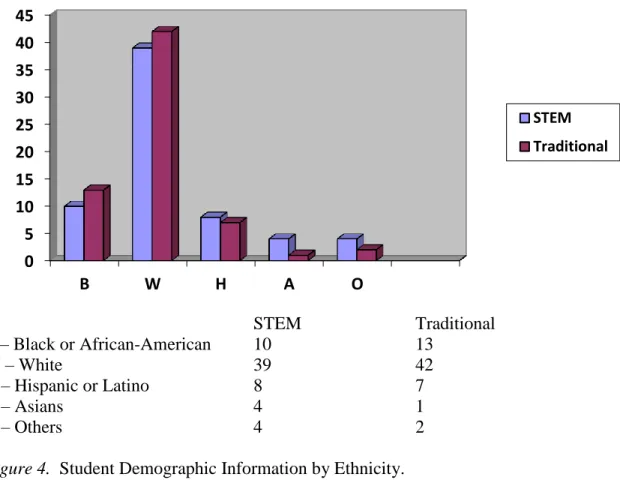
4 Student Demographic Information by Ethnicity ...45
5 Student Demographic Information by Gender ...46
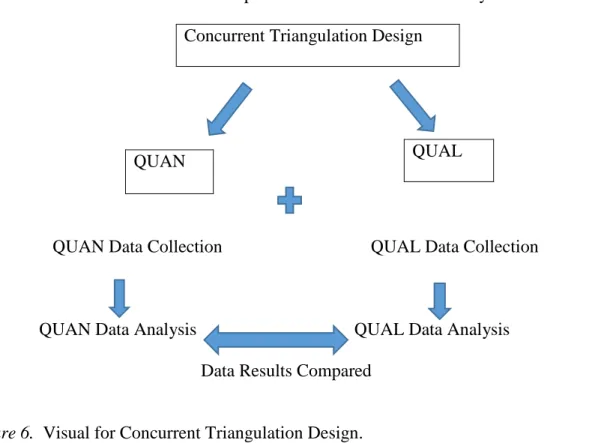
6 Visual for Concurrent Triangulation Design ...58
Chapter 1: Introduction
The term “STEM education” has been referred to by the Congressional Research Service (2012) as teaching and learning in the fields of science, technology, engineering, and mathematics (STEM). Federal policymakers have shown an increased interest in STEM education which has seen more than 200 bills containing the term “science education” introduced between 100th and 110th Congresses which took place between 1987-2009. Despite this interest, concerns remain with the ranking of U.S. students on international assessments. The National Center for Education Statistics (NCES, 2012) showed the 2012 Program for International Student Assessment (PISA) results which ranked American students 23 of 65 countries in the world in science assessment and 35th in the world in math assessment (Appendix A). In the today’s global economy,
knowledge in STEM fields has become a crucial issue in the creation of many
occupations (National Research Council [NRC], 2011). The U.S. falls short in preparing students for the different occupations requiring STEM knowledge. In response to this, the National Resource Council (2011) report points the importance of developing new strategies to increase the number of students in STEM education, especially students from historically underrepresented populations.
In the U.S. Senate Report (2011), four key recommendations were presented: (a) increase achievement of the U.S. K-12 education system in science and mathematics to a leading position by global standards; (b) sustain and strengthen the long-term
commitment to basic research; (c) encourage more U.S. citizens to pursue careers in mathematics, science, and engineering; and (d) rebuild the competitive ecosystem. Of these recommendations, education in the STEM discipline has received the most attention. The U.S. Senate Report (2011) concluded the primary driver of the future
economy and creation of jobs in the 21st century would be innovation largely derived from advances in science and engineering.
Background of the Problem
The National Academies of Science, Engineering, and Medicine (2015) outlined three goals for K-12 STEM education in the U.S.: (a) expand the number of students who pursue advanced degrees and careers in STEM fields; (b) increase the participation of women and minorities in STEM fields; and (c) increase STEM literacy for all students including those who do not pursue STEM disciplines. The last goal is similar to one of the three goals for K-12 education outlined in the Report of the Academic
Competitiveness Council (U.S. Department of Education, 2007), which stated to prepare all students with STEM skills required to succeed in the global world.
There has been an increase of STEM programs in high schools across the U.S. STEM programs integrate the four disciplines into a cohesive program based on real-world application. Despite being a leader in the past, data from the U.S. Department of Education (2010) indicated only 16% of high school students are interested in a STEM career. Twenty-eight percent of high school first-year students have an interest in a STEM-related field, and 57% of these students lose interest by the time they graduate from high school. Several STEM programs have been designed by different school districts to meet the goals of K-12 STEM education in the U.S. (U.S. Department of Education, 2014).
Statement of the Problem
The decline in the ranking of U.S. education to 36 of 65 countries on PISA has stimulated interest in creating and implementing STEM programs across the country. The report from STEMconnector and My College Options (2013) indicated that many
high school students lose interest in STEM. American College Testing (ACT) research also suggests that student interest in these fields is on the decline (Appendix B). Over the past 10 years, the percentage of ACT-tested students who said they were interested in majoring in STEM fields dropped steadily from 7.6% to 4.9%. This is contrary to the fact that job opportunities in the STEM fields are expected to increase significantly in the coming years. Despite this, teen interest in STEM fields is also declining. The Junior Achievement USA and ING (2013) survey where 1,025 teens were asked about their career plans showed a decrease of 15% from the 2012 survey when 61% of the students considered STEM as their top choice.
Federal funding for STEM education has increased to almost $3 billion. School systems continue to introduce and implement STEM programs, yet little is known about the relationship of the program to student achievement in standardized tests to justify the increased funding. There is a lack of research documenting STEM school programs, teacher training, student achievement, and graduation rates from high school. The problem is compounded by the lack of instruments of demonstrated validity and reliability to measure important outcomes of STEM education (National Science Foundation [NSF], 2011).
To address the current status of STEM programs in the U.S., several STEM high schools have been created and are currently operating all over the U.S. (NRC, 2011). This is a step forward to address the issue, despite there being little research available to document the effectiveness of the program using standardized tests to determine the level of student achievement (NRC, 2011). This creates a need to gather information from a current STEM program in a suburban high school with both the traditional program and the STEM program and compare how the two groups perform using standardized tests as
indicators. The findings of this study will help school districts considering the
development and implementation of STEM programs in evaluating effective strategies that make the program successful.
Information that will be helpful to educational leaders in starting new STEM programs includes population served, criteria used to select the students, staff
development that the STEM teachers undergo that are not available to the traditional program teachers, performance on achievement tests, and teaching methods used. Education leaders planning to begin a STEM program will benefit from the research based on the outcome using the standardized tests as indicators. This study will provide school leaders with the relevant information to open more STEM schools, justify the allocation of resources to STEM programs, and determine if the program will be beneficial to the entire school population and not only those who meet the selection criteria to join the STEM program.
Theoretical Framework
The study was influenced by two theories: Bruner’s (1966) Discovery Learning Theory and American physician and medical educator Barrows’s (1986) Problem-Based Learning (PBL). Bruner, an American psychologist and a cognitive learning theorist, promoted an example of cognitivism referred to as Discovery Learning. The
constructivist view is that the learner creates understanding through personal experience and interaction with external stimuli (Bruner, 1966). Bruner’s (1966) theory focuses on the belief that active engagement by students including experiments, exploration, and knowing the world around them leads to knowledge development. This, in turn, leads to motivation and creativity in developing problem-solving skills.
inquiry and constructivist learning. It can be considered a constructivist approach to instruction, emphasizing collaborative and self-directed learning (Schmidt & Moust, 2000). The use of PBL has been motivated by recognition of the failures of traditional instruction and the emergence of a deeper understanding of how people learn (Caswell, 2015). As a strategy, PBL attempts to get students to apply knowledge to new situations by developing critical thinking and creative skills, improving problem-solving skills, increasing motivation, and helping students learn how to transfer knowledge to new situations.
The effects of the STEM PBL approach are varied and include positive attitude towards learning, team communication, collaborative behavior, increased student interest, self-confidence, and self-efficacy (Baran & Maskan, 2010; Dominguez & Jaime, 2010). The approach used in STEM education encourages students to be motivated, creative, and develop problem-solving skills. The constructivist theory will influence the teaching methods used in STEM programs.
Research Questions
The study was guided by the following questions.
1. To what extent is there a statistically significant difference in the achievement of students who are in the STEM program as opposed to students in the traditional program?
2. To what extent is there a statistically significant difference in the graduation rate of students who completed the STEM program as opposed to students in the traditional program?
3. To what extent is there an association between the professional development activities of STEM faculty and student achievement?
4. What perception do teachers have regarding the overall impact of the STEM program?
Research Purpose
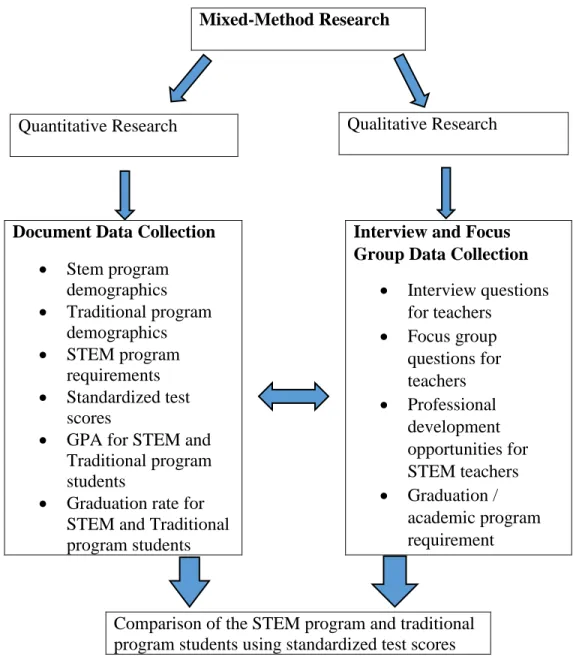
The goal of this mixed-methods research was to gain an in-depth understanding of the impact of the0 STEM program on student achievement. The end-of-course (EOC) state assessment and standardized test ACT were used as the academic achievement indicators. The information was used to determine the graduation rate of the STEM students and the traditional students. Mixed-methods research uses both qualitative and quantitative research. Mertens (2010) mentioned that mixed-method research is of
particular value in education-related research. Creswell (2014) noted that mixed-methods research can balance biases found in other research methods and allow for triangulation of data providing a solid foundation to research.
The study used concurrent mixed methods where the quantitative and qualitative data were collected roughly at the same time. The data were then merged to provide a comprehensive analysis of the research problem (Creswell, 2014). “Concurrent mixed method data collection strategies have been employed to validate one form of data with the other kind, to transform the data for comparison, or to address different types of questions” (Creswell & Plano Clark, 2007, p. 118). To be able to gain perspective on how the STEM and the traditional programs perform on standardized tests as well as to understand how teacher training, instructional strategies, and professional development offered to teachers affect student achievement, it was important to utilize a mixed-method approach.
Definition of Terms
science, technology, engineering, and mathematics. It is an interdisciplinary approach to learning where rigorous academic concepts are coupled with real-world lessons. Students apply science, technology, engineering, and mathematics in contexts that make
connections to real life situations enabling the development of STEM literacy and with it the ability to compete in the new economy (Tsupros, Kohler, & Hallinen, 2009).
Magnet schools. Public schools that exist outside of zoned school boundaries offering specialized curriculum focus not available elsewhere in the school district. They are designed to attract a more diverse student body from throughout a school district with similar educational interests and provide a unique set of learning opportunities. Magnet schools have a focused theme and aligned curricula in STEM, Fine and Performing Arts, International Baccalaureate, International Studies, and World Language immersion and non-immersion. Most magnet schools have specific academic entrance requirements; others use a random computer-based lottery system for admission (U.S. Department of Education, 2004).
Traditional schools. Schools that are maintained at public expense for the education of the children in a district. The schools are funded and controlled by three levels of government: the U.S. Department of Education on the federal level, state level departments of education, and the school district at the local level (Tourkin et al., 2010).
Curriculum. A term used to refer to the lessons and academic content taught in a school or a particular course or program. It is the knowledge and skills students are expected to learn, which include the learning standards the students are expected to learn. “It is the totality of learning experiences provided to students so that they can attain general skills and knowledge at a variety of learning sites” (Marsh & Willis, 2006, p. 11).
content a student learns in a determined amount of time. Each grade level has learning goals that educators are required to teach. Student achievement will increase when the quality instruction is used to teach instructional standards (Marzano, Pickering, &
Pollock, 2001).
Assessment. Refers to the different methods or tools educators use to evaluate, measure, and document the academic readiness, learning progress, and skill acquisition or education needs of students as a result of their educational experiences. It is a critical tool of differentiated instruction that helps to identify the most effective strategies and activities that will encourage student learning (Ontario, Ministry of Education, 2010).
Graduation rate. The percentage of students who have completed high school within 4 years of their entry into ninth grade as measured by annual cohort. High schools and school districts are held accountable for their graduation rate for the purpose of determining Adequate Yearly Progress (AYP) by the state and federal government (NCES, 2016).
PBL. An instructional method of hands-on active learning centered on the investigation of real world problems. Learning is driven by challenging, open-ended questions with no right answers where students work as self-directed, active investigators and problem solvers in small collaborative groups (Boud & Feletti, 1997).
Professional development. A broad range of specialized training, formal education, or advanced professional learning intended to help administrators, teachers, and other educators improve their professional knowledge, competence, skill, and effectiveness (Jasper, 2006).
Student engagement. Refers to the degree of attention, curiosity, interest, optimism, and passion demonstrated by students when they are learning or being taught,
which extends to the level of motivation they have to learn and progress in their education (Willms, 2003).
School culture. Refers to the beliefs, perceptions, relationships, attitudes, and written and unwritten rules that shape and influence every aspect of how a school functions. Culture encompasses traditions and ceremonies schools hold to build community and reinforce their values(Peterson & Deal, 2009).
Self-efficacy. People beliefs about their capabilities to perform tasks and
influence outcomes of events that affect their lives. Self-efficacy beliefs determine how people feel, think, motivate themselves, and behave (Bandura, 1997).
Delimitation and Limitation of the Study
The delimitation for this study is the fact that the study was conducted in one high school in North Carolina. Due to the nonprobability nature of sampling, external validity was limited to study participants. The first limitation of the study is the size of the population. Internal validity was affected as random assignment was not conducted with students in the STEM program due to there only being approximately 100 students per grade level. The second limitation is the number of years since the program was established. Using data 4 years old when the first STEM group was in ninth grade presented a limitation in generalizing in the current use.
Significance of the Study
The study will be valuable by providing school systems, administrators, teachers, and other stakeholders in the community an insight into the STEM program comparative data on student achievement on EOC assessments and ACT for students in the STEM program versus students in the traditional program. An analysis of data gathered from documents, surveys, and interviews with teachers and students provided information
necessary in expanding STEM programs in high schools. Results from the study may provide support and documentation to continue funding and to expand STEM programs.
Summary
A STEM program in a suburban high school offers the program to students who meet the eligibility requirements. The school continues to offer a tradition high school program to the rest of the students. A mixed-method approach was used to gather different data using documents, surveys, and interviews with teachers. The purpose of the study was to determine how effective the STEM program was compared to the traditional program. The standardized tests, EOC and ACT, were used as achievement indicators. The results of this study will be relevant to key stakeholders by providing an insight of the STEM programs in high schools and providing support and documentation for the purpose of funding and expansion of the program.
Chapter 2 presents a review of literature starting with the history of the STEM program in the U.S. and the different policies and publications that have influenced the program. To better understand the differences between the STEM and traditional programs, a detailed definition of the programs is done. Also, the literature review contains a summary of documented research on the STEM program by other researchers and their impact on academic achievement. This will highlight the progress that has been made toward achieving the goals of the STEM program in the U.S.
Chapter 2: Literature Review Introduction
Wagner (2012) stated that the country’s economic problems are based in its education system. The nature of education today is that it is ubiquitous, constantly changing, and growing exponentially. America’s last competitive advantage is its ability to innovate. Wagner (2010) defined the skills needed for Americans to stay competitive in an increasingly globalized workforce as “the set of core competencies that every student must master before the end of high school” (p. 14). The seven core competencies are (a) critical thinking and problem solving; (b) collaboration and leadership; (c) agility and adaptability; (d) initiative and entrepreneurialism; (e) effective oral and written communication; (f) accessing and analyzing information–information is constantly changing and growing; and (g) curiosity and imagination–innovation and creativity.
The changing nature of education requires students to be proficient in transferring knowledge and skills, and problem solving is a critical skill for students to learn to adapt to a changing world that supports the seven sets of core competencies. Problem solving is one of the instructional strategies employed in teaching the STEM program.
According to Mayer and Wittrock (2006), problem solving is “cognitive processing directed at achieving a goal when no solution method is obvious to the problem solver” (p. 287). Based on the definition, problem solving consists of four parts: (a) problem solving is cognitive; (b) problem solving is a process; (c) problem solving is directed; and (d) problem solving is personal, that is problem solving depends on the knowledge and skill of the problem solver.
Literature identifying teacher training in STEM education, skills that students need to succeed in STEM education, and careers related to STEM education and
STEM-focused schools are abundant. The effectiveness of the STEM program using assessment indicators like EOC state exams and the ACT in high schools is lacking. The purpose of this review was to provide a background for this research by contextualizing the literature on the effectiveness of the STEM program using standardized assessments as indicators. To adequately examine the research, it is important to give attention to the history of STEM education. Providing a brief overview of the history of STEM education provides a contextual understanding of the need for more research on STEM teaching and high school achievement.
History of STEM Education
The history of STEM in the U.S. dates back to the mid-1990s over the heated controversy known as “The Mathematics Wars” (Schoenfeld, 2004). The teaching of mathematics was in the center of the controversy traced back to the reform stimulated by the National Council of Teachers of Mathematics’ Curriculum and Evaluation Standards for School Mathematics. The traditionalists feared the reform-oriented, “standard based” curricula were superficial and undermined classical mathematical values. On the other hand, the reformers claimed that such curricula reflected a deeper, richer view of mathematics than the traditional curricula (Schoenfeld, 2004). This led to the idea of integrating content in a problem-centered environment with a variety of sources, some as far back as the 1920s. John Dewey viewed the role of a teacher as a facilitator using inquiry method, problem solving, and integrated curriculum. His concept of
instrumentalism in education on “learning by doing” explained that people learn best through experience and advocated for inquiry-based education. His emphasis was that active curriculum should be integrated rather than divided into subject-matter segments (Brewer, 2007).
It is important to understand that curriculum integration is an idea that has a strong historical background. Disciplines were created in an attempt to organize the world around them; sometimes this was motivated by political means (Beane, 1991). It was not until the USSR launched Sputnik, the first space satellite in 1957, that the efforts
of the early advocates of PBL received attention. This was viewed as a major humiliation to Americans which prompted attention to the low quality of mathematics and science instruction in the US. This led to Congress passing the 1958 National Defense Education Act to increase the number of science and math majors (Klein, 2003b).
Recently, attention to the K-12 curriculum and instruction regarding the quality of mathematics and science has led to several publications. Before It’s Too Late (U.S.
Department of Education, 2000) was written by the National Commission on
Mathematics and Science with the message that America’s students must improve their performance in mathematics and science to succeed in today’s world. The U.S.
Department of Education (2007) also aimed to improve America’s competitiveness in STEM education by laying the groundwork for sustained collaboration among STEM education program and federal agencies.
Several other bills have been passed to ensure the U.S. maintains a global leadership position in science, technology, and innovation. They include America Competes Act (Civic Impulse, 2015) and American Recovery and Reinvestment Act of 2009 which includes $2.5 billion in funding for NSF and STEM education program; STEM Education for the Global Economy Act of 2015; and Klobuchar and Hoeven’s (2015) STEM legislation among others. All these bills were passed to ensure that the U.S. stays competitive in the 21st century economy by adequately preparing students for future jobs. This is by increasing quality STEM education which is an important
component in the education of American students (Klobuchar & Hoeven, 2015).
Policies and Publications Influencing STEM
States and federal initiatives and funding play a significant role essential to quality education for all American children. The section highlights different government policies and reports that have influenced public education in the U.S. A Nation at Risk
(1983) cited a decline of the educational system in America with high school student performance in the U.S. and other countries as an indicator. The report identified specific problem areas and offered multiple recommendations to increase high school graduation requirements, one of which was to increase the number of years for mathematics and science to 3 years. The report also highlighted the shortage of qualified mathematics and science teachers.
In September 2000, the report titled Before It’s Too Late was released by the
National Commission of Mathematics and Science (U.S. Department of Education, 2000). In the report, it was noted that for the U.S. to stay competitive in the global economy, America’s students must improve their performance in mathematics and science. Goals for improvement were stated as follows: (a) improve the quality of
mathematics and science teaching in Grades K-12; (b) increase the number and quality of mathematics and science teachers; and (c) improve working conditions for teachers to make the profession more attractive for mathematics and science teachers.
The federal legislation act that effectively scaled up the federal role in holding schools accountable for student outcomes was the No Child Left Behind ACT of 2001 (U.S. Department of Education, 2003). The act required states to develop assessments in basic skills to be given to all students if those states are to receive federal funding for schools. The bill sought to advance American competitiveness and close the
achievement gap between poor and minority students and their more advantaged peers. Four pillars were emphasized within the bill by NCLB (U.S. Department of Education, 2003):
1. States to ensure that disadvantaged students achieve academic proficiency. 2. Allow school district flexibility in how they use federal education funds to
improve student achievement.
3. Emphasize educational programs and practices that have been proven effective through scientific research.
4. Increase choices available to the parents of students attending Title I schools. This legislature does not specifically target STEM education but has had a significant impact on U.S. education.
The National Governors Association (NGA, 2007) released a final report depicting the role of governors in establishing best practices in education. Three core strategies were identified: improving STEM education, aligning state K-12 STEM
standards with state economies, and encouraging regional economic growth. Obstacles to these core strategies related to STEM were identified as
1. Many high school graduates are not prepared for postsecondary education. 2. Lack of alignment between K-12 postsecondary skills and expectations. 3. Shortage of STEM teaching workforce due to attrition, migration, and
retirement.
A workforce of problem solvers, innovators, and inventors is essential to drive innovative capacity in a state. A key to developing these skills is by strengthening STEM
competencies in K-12 grades in school (NGA, 2007).
built on the main areas of progress in education made in recent years. The act saw the end of NCLB by restoring to states the responsibility for determining how to use federally required tests for accountability. The law is divided into eight different titles, each aimed at strengthening and supporting the educational systems of state and Local Education Agencies (LEAs). The titles of the law are:
1. Title I – Improving basic programs operated by state and LEAs
2. Title II – Preparing, training, and recruiting high-quality teachers and other school leaders
3. Title III – Language instruction for English learners and immigrant students 4. Title IV – 21st century schools
5. Title V – State innovation and local flexibility
6. Title VI – Indian, Native Hawaiian, and Alaska Native Education 7. Title VII – Impact aid
8. Title VII – General provisions
In addition to the titles, the law has provisions, some of which are a continuation of the NCLB requirements. An example is to continue with the NCLB requirement that states have in place for academic content and achievement standards. The only difference from NCLB is that the standards must be the same for all students.
The STEM Education Act of 2015 is an amendment of the NSF Act of 2002. The Act of 2002 limited the award of NSF Master Teaching Fellowship to mathematics and science teachers with a master’s degree and not bachelor’s degree. The new law allows the award to bachelor’s degrees. The STEM Education Act of 2015 requires NSF to continue to award competitive merit-reviewed grants to support (a) expanding research and training opportunities for math and science teachers through NSF, (b) boosting
research that advances the field of informal STEM education, and (c) incorporating computer science into the definition of STEM education. The bill was supported by the STEM Education Coalition (2015), stating, “The STEM Act is a good starting point to ensure that federal education and workforce programs are aligned with the needs of today’s students and our future economy” (para. 1).
The reports and the laws described above were designed to bring attention to the need for improving education in the U.S. Suggestions made have led to the
implementation of new programs with the STEM program being one of them (President’s Council of Advisors on Science and Technology [PCAST], 2009).
Occupational Careers Related to STEM Program
Different publications and reports have highlighted the importance of STEM education. One report is by Connections Learning which emphasized that STEM
education will be beneficial to students due to the STEM fields expanding more quickly. By 2018, 1 in 20 global jobs will be STEM related which is an estimated 2.8 million jobs. STEM-related skills are not just a source of jobs but are a source of employment that pay very well (Figure 1). A report from Georgetown University Center on Education and workforce found that 65% of those with bachelor’s degrees in STEM fields earn more than those with master’s degrees in non-STEM occupations. The number of jobs available in any nation fuels its economy. According to the U.S. Labor Department, STEM careers are among the nation’s fastest growing fields with the 10 fastest growing occupations from 2008-2018 being STEM occupations (Science Pioneers, 2010).
Figure 1. Projected Percentage Increase in STEM Jobs. Source: U.S. Department of Education (2010).
Careers related to STEM are very diverse, and the top 10 STEM jobs are Computer Systems Analyst, Software Developer, Web Developer, Accountant,
Biomedical Engineer, IT Manager, Financial Advisor, and Information Security Analyst (U.S. News & World Report, 2016). STEM occupations are projected to grow faster than the average for all the professions. Over the past 10 years, growth in STEM jobs was three times as fast as growth in non-STEM jobs (U.S. Department of Commerce,
Economics, and Statistics Administration, 2011). In 2010, there were 7.6 million STEM jobs, representing one in 18 workers. STEM occupations were projected to grow by 17% from 2008 to 2018, compared to 9.8% growth for non-STEM occupations. When it comes to earning, workers in STEM occupations earn 26% more compared to their counterparts in other jobs and experience less joblessness (Appendix C).
Strategies for STEM Programs
approaches, PBL, and making connections to the real world. In the classroom,
constructivism is implemented through hands-on activities that motivate students to make observations, ask questions, and at the end develop their ideas. The teacher facilitates instruction by guiding the learning process. Learning is also contextual and only takes place when the learner connects ideas or facts to a larger picture. The PBL is grounded in the constructivist theory that research has proved advances learning (Torp & Sage, 2002). STEM PBL is an interdisciplinary teaching and learning approach that involves hands-on activities, collaboration, team communication, knowledge construction, and formative assessment as the primary components for PBL (Barron et al., 1998). This is in higher level cognitive tasks such as scientific processes and mathematic problem solving. The opportunity to communicate and collaborate with peers and teachers stimulates students to construct their knowledge and make use of formative feedback which is important in STEM PBL classes (Capraro & Yetkiner, 2008).
Projects for STEM PBL are composed of several problems where students apply prior knowledge learned before or at present to find strategies to solve new challenges (Goldman & Petrosino, 1999). Also, the hands-on activities, communication, and collaboration with peers help students develop positive attitudes (Blumenfeld, Fishman, Krajcik, Marx, & Soloway, 2001). Multiple research-based approaches to STEM
education include Design-Based Science (Fortus, Krajcib, Dershimerb, Max, & Mamlok Naamand, 2005); Math Out of the Box (Diaz & King, 2007); Learning by Design
(Kolodner et al., 2003); and Integrated Mathematics, Science, and Technology (Satchwell & Loepp, 2002) among others. All of these approaches incorporate a process of inquiry-based activities with five steps: reflection, research, discovery, application, and
Defining STEM Program
NSF came up with the word STEM as an acronym for science, technology, engineering, and mathematics. Bybee (2010) defined STEM education as an integrative approach to curriculum and instruction. The STEM program aims to change the
traditional teacher-centered classroom by having a curriculum that is driven by problem solving, discovery, and exploratory learning and involves active engagement by students. The four disciplines that make up STEM have been taught independently from each other in the past. Science, technology, engineering, and mathematics play an important part in the teaching of the program. The technology component provides the creative and
innovative ways to solve problems and application of what has been learned in the STEM program.
The STEM program is fully integrated at an elementary level compared to the higher levels with the students being taught with a single teacher for the most part of the day. At the elementary level, STEM education focuses on the introductory level
providing students with awareness about STEM fields and occupations. The level also provides standard-based learning aimed at connecting all four STEM subjects. The course becomes more rigorous and challenging at the middle school level with the exploration of the different STEM careers. The high school level focuses on the
application of the subject in a challenging and rigorous way. At this level, pathways and occupations are made available to the students; and preparation for postsecondary
education and employment is emphasized at this level.
Several organizations are in the forefront for advocating for policies to improve STEM education at all levels. The STEM Education Coalition is an example of the central mission to inform federal and state policymakers on the vital role that STEM
education plays in U.S. competitiveness and future economic prosperity. In the coalition, the annual report of 2014, the “Core Policy Principles” that the coalition embodies and seeks to implement are outlined: (a) STEM education must be a national priority; (b) economic prosperity is linked with student success in the STEM fields; (c) the capacity and diversity of the STEM workforce need to be expanded in the U.S.; (d) all
policymakers need to be informed of policy issues related to STEM education; and (e) policies to promote STEM education should be bipartisan and evidence based.
The STEM program teaches independent innovation that allows students to explore different subjects in depth and to utilize the skills learned to help them become competitive globally.
In the 21st century, Scientific and Technological innovations have become increasingly important as we face the benefits and challenges of both globalization and a knowledge-based economy. To succeed in the new
information-based and highly technological society, students need to develop their capabilities in STEM to levels much beyond what was considered acceptable in the past. (NSF, 2007, p. 2)
As the U.S. strives to keep up with the increased need of STEM students and pushing toward holding a competitive edge in a rapidly changing workforce, it is important to keep up with the demand for STEM output. This can be done by ensuring that American students have a solid foundation in the STEM disciplines through a well-rounded curriculum and teachers who are experts in STEM education. Graduates who have studied calculus, engineering, physics, chemistry, biology, and other STEM subjects can be trained to teach STEM classes. Professional development sessions and instruction strategies on how to teach STEM courses are offered to the graduates while on the job.
Professional development offered to STEM teachers on implementing STEM PBL is successful in increasing teacher self-efficacy and improvement of classroom practices (Hmelo-Silver, 2004; Shin et al., 2010). Completion of the professional development enables teachers to use more standards-based teaching practices and informal assessments than they did prior (Zhang, Lundeberg, & Eberhardt, 2011). In addition to the
pedagogical content knowledge, 2-year-long activities positively impacted the teaching knowledge of teachers who attended (Garet et al., 2011).
Several professional development resources that can be utilized in the classroom are available to them free of charge. The STEM Education Resource Center provides nearly 4,000 STEM resources for prekindergarten-12. The trainings offered are designed to be used by the teachers at their own time and are self-paced modules that can be utilized by STEM teachers in middle and high schools. National Aeronautics and Space Administration (NASA) is also in the forefront with providing professional development to STEM teachers. NASAePDN, an Electronic Professional Development Network, offers free online professional development to K-12 teachers. The areas focused on include robotics, statistics, project-based inquiry learning, and technology integration (National Education Association, 2015).
The National Academies of Science, Engineering, and Medicine (2015) outlined three goals for K-12 STEM education in the U.S.: (a) increase the number of students who ultimately pursue advanced degrees and careers in STEM fields. It is important to raise the participation of Blacks, Hispanics, and low-income students in the STEM fields to meet this goal; (b) broaden the participation of women and minorities in these areas. This is crucial to the U.S. economy as the current demand for STEM workers is greater than the supply of applicants who have trained in STEM careers; and (c) increase STEM
literacy for all students including those who do not pursue STEM disciplines. NRC (2011) defined STEM literacy as knowledge and understanding of scientific and mathematical concepts and processes required for personal decision making.
Definition of Traditional Schools
Traditional schools also are known as public schools that receive government funding as their primary support and provide free public elementary or secondary schooling operated by an LEA (Tourkin et al., 2010). Students are matched by age and possibly by ability level with direct instruction, lecture, listening, and observation being the primary methods of teaching. The focus of the school is on basic education practices with the expectation of mastery in the core subjects and increases in test scores, grades, and graduation rates (Coalition of Education, 2016). Traditional schools are required to admit all students who live in the assigned neighborhood school. The advantages of traditional schools include the use of state-approved standards in all curricular areas; a diverse population which encourages tolerance among students; and social interactions through clubs, sports, prom, homecoming, and pep rallies (Coalition of Education, 2016).
The funding of the traditional schools is through the state and federal government which makes support services like counseling, special education, and speech therapy available for students who qualify. The schools are regulated and monitored by the state which makes sure that teachers are properly trained to teach with most holding a
bachelor’s degree or higher in addition to being state certified (NCES, 2015). High-quality resources like updated textbooks and technology and elective courses like art, music studies, carpentry, and masonry among others are made available for students. Due to these resources, traditional schools do better in reading and math compared to charter and private schools (NCES, 2015).
Traditional schools operate using the traditional calendar and the year-round or balanced calendar. The traditional school calendar has students in session for 180 days with small breaks during the year and a long summer vacation. The traditional school calendar was developed for two primary reasons: agrarian needs to free students to work in farms and lack of air conditioning (Morison, 2002). Today, the vast population has become urbanized; but still, the educational system has continued to be based on the traditional calendar (Cooper, Valentine, Charlton, & Melson, 2003). Students in the traditional school calendar experience some learning loss during the summer vacation. There was an increased loss of skills among the students and a larger learning gap among students from different socioeconomic backgrounds (Cooper et al., 2003).
According to National Association for Year-Round Education (NAYRE, 2010), the year-round calendar affords students the ability to continue their education
uninterrupted and address key learning areas. Year-round schools operate with more breaks which are shorter, unlike the schools that use the traditional school calendar. The year-round calendars provide accelerated programs and advanced classes which studies have shown to be beneficial to high-achieving students (Coalition of Education, 2016).
Figure 2. Traditional and Balanced School Calendar. Source: NAYRE (2010).
Progress toward STEM Goals:Research Influencing High School STEM Programs
The U.S. Department of Education and NSF have continuously supported the development of new approaches to STEM education. NSF has continually been looking to fund projects that will provide a national perspective on programs that support
advances in fundamental research on STEM learning and education (NSF, 2015). The projects should involve efforts in developing foundational knowledge in STEM learning and learning contexts from K-16, learning in STEM learning environments, STEM professional workforce development, and research on broadening participation in STEM education (NSF, 2015). Results from the different research will be made available to the public and could impact how STEM programs are designed, the teaching of STEM courses, and preparation of STEM professionals.
A report published by the Harvard Business School highlighted the importance of improving prekindergarten-12 education by committing to an innovative approach
(Grossman & Lombard, 2015). The approach is known as “collective impact” and addresses weaknesses in the U.S. education. The ability of the U.S. to prepare students for college or career will determine its competitiveness in a global economy. This can only be achieved by improving the U.S. public education system (Grossman & Lombard, 2015). The National Math and Science Initiative and the STEM Education Coalition advocate for STEM education to ensure U.S. viability in the world economy. For the U.S. to regain its competitiveness, the importance of STEM education must be emphasized.
The following section of the literature review contains a summary of documented research on STEM programs and their impact on academic achievement. Table 1 is an overview of the studies that were conducted and the results found by the researchers. A description of the different studies follows the table.
Table 1
Research on STEM Education Programs
Participants Topic Design Results
Middle school Impact of a STEM Program Ex-post facto Positively impacted
students On Academic Achievement casual-comparative academic
Of Eighth Grade Students. research. achievement. Elementary Effect of STEM education on Quantitative STEM education has students Mathematics achievement of nonexperimental the potential to 4th grade minority students. descriptive improve Comparative study. achievement on standardized assessment. High school Impact of STEM PBL teacher Mixed-method case Low performing students and Professional development on study. students showed teachers Student mathematics in high statistically schools. significantly higher growth rates. Attendance in PBL significantly correlated with the quality of the in- class PBL implementation. STEM PBL instruction positively influenced Hispanic students’ achievement in mathematics. Elementary Investigating the effects of Mixed-method quasi- Increased student integrating Science and experimental study. learning and interest and Engineering content in Science.
and pedagogy in an elementary school.
High school The influences of mathematics Longitudinal study Mathematics identity Students self-efficacy, identity, interest was the strongest and parental involvement on predictor of STEM STEM achievement in achievement for Algebra for female high female high school school students. regardless of race.
High Schools
The Federal Science, Technology, Engineering, and Mathematics (STEM) Education 5-Year Strategic Plan: A Report from the Committee on STEM Education (National Science and Technological Council, 2013) outlined five priority STEM education investment areas. The areas are to improve STEM instruction, increase and sustain youth and public engagement in STEM before completing high school, better serve groups historically underrepresented in STEM fields, and design graduate education for tomorrow’s STEM workforce (National Science and Technological
Council, 2013). NSF funded several research projects to identify best practices in STEM education in all types of schools. The results indicated that for effective K-12 STEM instruction to become the norm, schools and districts must be transformed.
Howard (2015) investigated the motivational factors and parental involvement associated with female high school student STEM achievement in algebra. This study was influenced by National Assessment of Education Progress (NAEP, 2011) on the achievement gap in the educational setting. Achievement gaps can occur when one group of students outperforms another group and the difference in average scores for each group is statistically significant (NAEP, 2011). Researchers provided information on differences in achievement revealing several unmet goals in minority students and
confirming the persistent existence of a gap in achievement (NAEP, 2011). Longitudinal data from national, regional, and institutional databases were analyzed to identify the gender gap in STEM education. Multiple contributing factors related to academic preparation of females were studied by researchers (Ethington & Wolfe, 1988). The obstacles related to academic achievement include perceptions of a lower self-assessment of capabilities for females compared to their male counterparts (Betz & Hackett, 1983;
Brainard & Carlin 1998; Correll, 2001; Feather, 1988; Hyde, Fennema, & Lamon, 1990; Sax, 1994); societal stereotypes (Entwisle, Alexander, & Olson, 1994); and a lack of female role models in STEM as well as family and peer influences (Ost, 2010).
Han (2013) analyzed the impact of professional development on teacher understanding and implementation of STEM PBL. The participants were teachers in three high schools who attended professional development and were required to
implement STEM PBL once every 6 weeks for 3 years. Three articles were utilized for this study. The first report employed a mixed-method case study to explore the relation between the quality of teachers in class STEM PBL implementations. Many studies have indicated that professional developments implementing STEM PBL have shown an increase in teacher self-efficacy and improvement of classroom practices (Hmelo-Silver, 2004; Shin et al., 2010). Teachers who attended and completed the professional
development reported an increased ability to use more standard-based teaching practices, informal assessment, technological instruments, and communication than they did before attending the professional development. The quantitative findings indicated the
attendance in the professional development activities was significantly correlated with the quality of the in-class PBL implementation in 2010. In addition, qualitative results showed that the teachers viewed STEM PBL pedagogy as a way to promote student interest in mathematics.
The second article investigated the effect of STEM PBL on Hispanic and at-risk students’ mathematics achievements. The participants were students from STEM PBL high schools and non-STEM PBL schools in the same region. In STEM PBL schools, students can communicate and collaborate with peers and teachers in small groups while exploring a project (Chen, Lam & Chan, 2008). STEM PBL engages students in solving
problems within a project either individually or in a group. They explore strategies and apply content knowledge to real-world problems (Barron et al., 1998). Latent growth modeling was used to analyze the repeated measures across years. The results indicated STEM PBL instruction positively influenced Hispanic student achievement in
mathematics but not at-risk students.
The last study investigated whether participating in STEM PBL activities
influenced students with varied performance levels and to what extent student individual factors influenced their mathematics achievement. The participants were high school students from three different high schools. The effects of STEM PBL have been reported with several studies supporting the positive impact on student content knowledge (Barron et al., 1998; Boaler, 1997; Liu & Hsiao, 2002). The application of hands-on activities and field-based contexts of STEM PBL were the primary factors that resulted in positive effects on student content knowledge (Kaldi, Filippatou, & Govaris, 2011). The findings of the study showed statistically significantly higher growth rates on mathematics than middle- and high-performing students over a period of 3 years.
Middle Schools
Olivarez (2012) investigated the impact of the STEM program on academic achievement. The participants were eighth graders; 73 were students in a STEM academic program, while 103 were students in a non-STEM academic program. The conclusion was that participation in a STEM academic program where teachers use PBL, collaborative learning, and hands-on strategies positively impacted eighth-grade student academic achievement in mathematics, science, and reading. The study was conducted in an area predominantly populated by Hispanics. The disparity between the academic achievement of Hispanic and non-Hispanic White students has been documented. This
was linked to a significant percentage of Hispanic parents not completing high school or pursuing further education. Other factors included lack of parental involvement, low parental expectations, and lack of motivation on the student’s part. Hispanic students who graduate from high school are less qualified to be admitted to a 4-year college compared to their White counterparts. They also have low test scores across subjects and are less likely to take advanced coursework (Reigle-Crumb & Callahan, 2009).
Elementary Schools
Barth (2013) conducted a study on the effects of science-engineering integration on student learning, student attitudes, and student interest in science in elementary
school. Integration of curriculum is being researched at multiple levels within education. Literature in educational research contains some examples of STEM integration within K-12 education, but more studies within elementary levels are needed (Cantrell, Pekcan, & Itani, 2006). Several arguments have been made in support of including curriculum integration within K-12. One argument is that curriculum integration is practical as it follows patterns of how disciplines are integrated outside of an educational setting. Mason (1996) viewed integrated curriculum to prepare students for the world in which they live. Hurd (1991) added that the disciplines of science and technology are currently merging into an integrated system making integrating the discipline in schools vital in preparing students for the future. This research suggests that educators who use the pedagogy of integration may be able to meet the needs and help students achieve greater levels of learning (Cunningham, Lachapelle, & Hertel, 2012).
McClain (2015) conducted a study to determine if there was a significant
difference between the academic achievement of underrepresented minority students who were exposed to STEM education and minority students who were not exposed to STEM
education. The information for the study was from a criterion-referenced competency test where comparison of scores of students with STEM education and non-STEM
education was done. The study revealed mixed results of the relationship between STEM and non-STEM education student test scores. This means that STEM education has the potential to improve student achievement on standardized assessments. Performance within education is varied across race/ethnicity and gender. NCES explored the achievement gaps between students from the different subgroups using NAEP to shed light on the patterns and identify factors that might underlie such differences. Black and Hispanic students have shown a gain in the percentage of students scoring at or above proficient between 2009 and 2013. The gains have done little to narrow the achievement gap between them and their White counterparts.
Theoretical Framework
Bruner’s (1966) discovery learning theory. Bruner (1966) was one of the founders of constructivist theory, and the discovery learning theory was influenced by Piaget’s ideas about cognitive development in children. The theoretical framework, according to Bruner (1966), is based on the theme that the learners construct new
concepts based on existing knowledge. Constructivism is a broad conceptual framework with several perspectives; Bruner’s (1966) theory being one of them. Bruner’s (1966) theory emphasizes the importance of categorization in learning. The key concept in learning is interpreting information and experiences by similarities and differences (Bruner, 1961). Bruner’s (1961) early works dating back to the 1940s focused on the impact of needs, motivation, and expectation and the influence on perception which are referred to as mental sets.
categorization and introduced the view that children are active problem solvers capable of exploring the surroundings around them. Bruner’s (1966) theory early work led to the emergence of four key themes:
1. The role of structure in learning and the need to be made central in teaching. 2. A spiral curriculum where ideas are revisited and build upon to the level of
understanding and mastery.
3. Intuitive and analytical thinking should be encouraged and rewarded. 4. The motivation for learning where interest in the subject matter is built and
becomes a stimulus for learning.
Bruner’s (1966) theory was then influenced by Vygotsky’s and turned away from the intrapersonal focus for learning to a social and political view of learning. Bruner (1966) placed more emphasis on the social influences on development and identified three stages of cognitive representation which are integrated. Bruner (1963) believed that learning occurs through three stages and should begin with direct manipulation of objects; then the learner should be encouraged to construct visual representation; and finally, the learner understands the symbols associated with what they represent (McLeod, 2008). The three stages are as follows:
Enactive stage 0-1 year (action-based). This is the first stage which involves encoding and storage of information. Knowledge is represented through actions and involves manipulation of objects.
Iconic stage 1-7 years (image-based). In this stage, learningis achieved through using models and pictures. Learning involves representation of external objects usually in the form of a mental image or icon.
capacity to think in abstract terms. Information is stored in the form of code or a symbol such as a language.
Discovery learning implies a learner constructs knowledge as opposed to being told what to do. The role of the teacher should be a facilitator who develops lessons but does not organize them for the learner (Bruner, 1961). Types of discovery learning used in schools are experiments, exploration, web quests, simulation-based learning, inquiry-based learning, and PBL. The educational goals of discovery learning include a deep understanding, developing meta-cognitive skills, and encouraging a high level of student engagement (Saab, van Joolingen, & van Hout-Wolters, 2005). Similar constructivist learning theories were developed by John Dewey and Lev Vygotsky; both suggested that discovery learning encourages students to become active participants in the learning process (Saab et al., 2005).
Discovery learning has three main characteristics: exploration and problem solving, student-centered activities, and scaffolding new information into students’ existing knowledge (Bicknell-Holmes & Hoffman, 2000). This is different from the traditional learning models with five notable differences. Castronova (2002) identified five characteristics of discovery learning which differentiate it from the traditional models.
1. Learning is active with hands-on and problem-solving activities instead of knowledge transfer.
2. Discovery learning emphasizes the process instead of the end product. 3. Lessons learned from failure encourage mastery and application.
4. Feedback, collaboration, and discussion are an essential part of the learning process.
5. Discovery learning promotes individual interests through the satisfaction of human curiosity.
The discovery learning model has advantages, such as it encourages motivation, active involvement, and creativity; can be adjusted to the learner’s pace; promotes autonomy and independence; and ensures higher levels of retention (Bruner, 1961).
Barrows’s (1986) PBL theory. The origin of PBL can be traced back to the progressive movement. PBL shares Dewey’s belief that teachers should teach by
appealing to student natural instincts to investigate and create (Barrows, 1986). Barrows (1986), a physician and medical educator, developed methods of instructing physicians to build capabilities for reflection outside of school. This led to Barrows’s (1986) first educational objective for PBL which stated, “the medical students we educate must acquire basic science knowledge that is better retained, retrieved, and later used in the clinical context” (p. 5).
PBL is identified as a constructivist learning environment with the instructional principles described in a constructivist framework (Savery & Duffy, 1995). The instructional principles are based on the assumption that learners are constructors of knowledge gained. The learning environment should be developed to encourage active participation of learners. Schmidt (1983) summarized PBL in three essential principles: activation of prior learning using stated problem, students recall what has been learned better in the context in which the knowledge will be used, and learning enhances subsequent retrieval.
Implications of Bruner’s (1966) Theory and Barrows’s (1986) Theory on Education
Bruner (1971) felt the goal of education should be intellectual development and not rote memorization of facts. Bruner (1973) felt the purpose of education is not to