An
automatic
clustering
algorithm
inspired
by
membrane
computing
Hong
Peng
a, Jun
Wang
b, Peng
Shi
c,
Agustín
Riscos-Núñez
d,
Mario
J.
Pérez-Jiménez
daSchoolofComputerandSoftwareEngineering,XihuaUniversity,Chengdu610039,China bSchoolofElectricalandInformationEngineering,XihuaUniversity,Chengdu610039,China cSchoolofElectricalandElectronicEngineering,UniversityofAdelaide,Adelaide5005,Australia
dResearchGroupofNaturalComputing,DepartmentofComputerScienceandArtificialIntelligence,UniversityofSeville,Sevilla41012,Spain
Keywords:
Membranecomputing
Membranesystems
Tissue-likemembranesystems AutomaticclusteringMembrane clusteringalgorithm
a b s t r a c t
Membrane computing is a class of distributed parallel computing models. Inspired from the structure and in-herent mechanism of membrane computing, a membrane clustering algorithm is proposed to deal with auto-matic clustering problem, in which a tissue-like membrane system with fully connected structure is designed as its computing framework. Moreover, based on its special structure and inherent mechanism, an improved velocity-position model is developed as evolution rules. Under the control of evolution-communication mechanism, the tissue-like membrane system cannot only find the most appropriate number of clusters but else determine a good clustering partitioning for a data set. Six benchmark data sets are used to evaluate the proposed membrane clustering algorithm. Experiment results show that the proposed algorithm is superior or competitive to three state-and-the-art automatic clustering algorithms recently reported in the literature.
1. Introduction
Dataclusteringasoneofthemostusefuldataminingtechniques hasbeenwidelyusedinmanyfields,suchaspatternrecognition, im-ageprocessing,webminingandbiology[7,10,22,38].Clusteringwill accomplishsuch ataskthatfindsout thenaturalpartition froma datasetsuchthatdatapointsbelongingtothesameclassareas sim-ilartoeachotheraspossiblewhereasdatapointsfromtwodifferent classessharethemaximumdifference[13].Partionalclusteringisa classofthemostimportantclusteringmethods,whichattemptsto directlydecomposethedatasetintoseveraldisjointedclusters ac-cordingtosomecriteria[44].Thecriteriacommonlyadoptedin clus-teringisminimizing somemeasureofdissimilarityinthesamples withineachclusterandmaximizingthedisimilarityofdifferent clus-ters.K-meansisawidelyusedpartitionalclusteringalgorithm[16]. However,k-meanshasthefollowingdisadvantages:(1)itissensitive totheinitialclustercentersandeasytogetstuckatthelocaloptimal solutions;(2)ittakeslargetimecosttofindtheglobaloptimal solu-tionwhenthenumberofdatapointsislarge;(3)itrequiresapriori specificationofthenumberofclusters.
Inrecentyears,anumberofglobaloptimizationmethodshave beenintroduced toovercome the disadvantagesofk-means, such as genetic algorithms (GA), simulated annealing (SA), ant colony
optimization (ACO), particle swarm optimization (PSO) and differen-tial evolution (DE) algorithm. The global search ability of the GA was first developed to find the optimal cluster centers for a data set[21]. The GA-based methods use two different coding schemes to express the clustering solutions: (i) using the chromosome directly to encode the cluster number that each data point belongs to[20]; (ii) using the chromosome to describe the cluster centers[2]. First scheme can suffer from huge searching space and high computing cost when the number of data points is very large. Thus, second scheme is commonly adopted by most of GA-based methods[3,19]. Although many GAs have shown good performance for finding the promising regions of the search space, most of them often have two drawbacks: premature convergence and lack of good local search ability. Thus, in order to overcome the problems above, other global searching techniques have been successively developed for data clustering problem. A PSO-based clustering method has been proposed in[17], where the PSO is used to find the optimal cluster centers. In[39], ACO has been introduced to process data clustering problem. Moreover, ACO and SA has been combined to solve clustering problem in [25], and a hybrid evolutionary algorithm based on PSO and ACO to find the optimal cluster centers has been also presented in[24]. In addition, a hybrid clustering method, which combines GA and EM (expectation maximization) to automatically determine the optimal cluster centers has been proposed in[23].
The clustering methods described above use the different global searching techniques to find the optimal cluster centers for a data set to be clustered. However, these clustering methods have a limit in practical application: the number of clusters needs to be
determined a priori. In fact, it is difficult to specify the number of clus-ters in advance for most application. Thus, it becomes a challenge in such a situation in order to determine an appropriate number of clus-ters and provide a good partitioning for a data set automatically, that is, automatic clustering problem. In recent years, GA, PSO and DE have been used to deal with the automatic clustering problem. A cluster-ing method that uses the GA to automatically evolve the clusters has been presented in[1]. This method uses a variable-length chromo-some to express both the cluster centers and the number of clusters, and then achieves automatic clustering by evolving the two parts at the same time. In[27], a PSO-based automatic clustering method has been reported, which first uses the PSO to find the optimal number of clusters and then determines the corresponding cluster centers by using k-means algorithm. In addition, a variable-length GA to solve automatic fuzzy clustering problem has been developed in[37], while an automatic clustering algorithm based on an improved differential evolution has been presented in[6].
Membrane computing, as a class of distributed parallel computing models, is inspired from the structure and functioning of living cells as well as the cooperation of cells in tissues, organs and populations of cells[35,36]. The models are commonly called membrane systems or P systems. Over the past years, a variety of variants of membrane systems have been proposed[12,15,32–34,40,42,43], including mem-brane algorithms of solving the global optimization problems. In re-cent years, membrane algorithms have attracted much attention on applications of membrane computing[26]. The research results on a lot of global optimization problems have shown that compared to the existing evolutionary algorithms, membrane algorithms offer a more competitive method due to three advantages: better convergence, stronger robustness and better balance between exploration and ex-ploitation[14,29–31,45]. Based on the above consideration, this paper proposes an automatic clustering algorithm that uses a tissue-like membrane system with fully connected structure to determine the most appropriate number of clusters and find a good partition for a data set to be clustered. Moreover, a modification of velocity-position model is developed according to its special structure and evolution-communication mechanism, which can accelerate the object evolu-tion and enhance the diversity of objects in the system.
The rest of this paper is organized as follows.Section 2states the problem to be solved and then presents a brief of introduction of tissue-like membrane systems. The proposed membrane cluster-ing algorithm is described in detail inSection 3. Experimental results and analysis are provided inSection 4. Finally,Section 5draws the conclusions.
2. Preliminaries
2.1. Data clustering problem
Data clustering in aD-dimensional Euclidean space is such a pro-cess, which partitions a data set consisted ofndata points intoK groups (clusters) according to some similarity measure. It is well-known that minimizing some similarity measure to find the natural partitioning on a non-uniform data set is a NP-hard problem essen-tially[11,22,24].
Assume thatX=
{
X1,X2, . . . ,Xn}
is a data set ofnunlabeled datapoints, whereXi=
(
xi1,xi2, . . . ,xiD)
is itsith data point. For the datasetX, a partitional clustering algorithm tries to find a partitioning,
{
C1,C2, . . . ,CK}
,such that the similarity of the data points in the samecluster is maximum and data points from different clusters differ as far as possible.
K-means algorithm is a widely used clustering technique, which attempts to find the optimal cluster centers for determining a good partitioning of a data set. In order to determine the optimal clus-ter cenclus-ters, therefore, a data clusclus-tering problem can be viewed as an optimization (minimization) problem. The objective function used in
k-means is the following total mean square error:
Jm
(
C1,C2, . . . ,CK)
= K i=1 Xj∈Ci||
Xj−zi||
2 (1)where z1,z2, . . . ,zK are the cluster centers of the partitioning,
C1,C2, . . . ,CK,respectively. Note that in k-means each cluster center
is the average of samples in the corresponding cluster. However, in most evolutionary clustering algorithms and the proposed algorithm, the cluster center is a representative point of the corresponding clus-ter and it is often different from the average of samples. Moreover, the cluster centers, as the solutions of an optimization problem, are determined by the evolutionary clustering algorithms.
In recent years several clustering validity indexes have been pro-posed to evaluate the goodness of partitioning obtained by a cluster-ing algorithm, such asDIindex[9],DBindex[8],PBMindex[28]and CSmeasure[4]. The existing works have shown thatJmindex can well
capture only hyperspherical shaped clusters. However, data sets may have different shapes, spatial separations, densities and sizes. Com-pared with other clustering validity indexes, advantage ofCS mea-sure lies in the effectiveness of dealing with the clusters with differ-ent densities and sizes[4,5,7]. TheCSmeasure is defined as follows:
CS
(
K)
= K i=1 1 Ni Xl∈CimaxX j∈Ci||
Xl−Xj|| K i=1 min 1≤j≤K,j=i||
mi−mj|| (2)wheremidenotes average (vector) of samples inith cluster and is
calculated as follows: mi= 1 Ni Xj∈Ci Xj (3)
Generally, the lowerCSmeasure under the constrain thatCS>0 means that the obtained partition is better, namely, the considered clustering algorithm gains a good clustering performance, and vice versa.
2.2. Tissue-like membrane systems
Tissue-like membrane systems are a kind of variants of membrane systems, which are inspired from the behavior of multiple single-membrane cells evolved in a common environment. A tissue-like membrane system can be logically viewed as a net, in which each cell is regarded as a processor that deals with the objects and communi-cates them between the cells along the channels assigned in advance. The object processing is completed by evolution rules while object communication is achieved by communication rules. We briefly re-view the definition and inherent mechanism of tissue-like membrane systems. More detailed descriptions of tissue-like membrane systems can be found in[12,35].
A tissue-like membrane system of degreeqis a construct
=
(
O,w1, . . . ,wq,R1, . . . ,Rq,R,i0)
(4)where
(1) Ois a finite non-empty alphabet (of objects);
(2) wi(1≤i≤q) is finite set of strings overO, which represents
multiset of objects initially present in celli; (3) Ri(1≤i≤q) is finite set of evolution rules in celli;
(4) Ris finite set of communication rules of the form (i,u/v,j), which represents communication rule between celliand cellj, i=j,i,j=1,2, . . . ,q,u,v∈O∗;
Fig. 1. The designed tissue-like membrane system.
A tissue-like membrane system consists ofqcells and each cell is surrounded by a cell membrane, while the region outside theqcells is called the environment. Usually, each cell contains a number of ob-jects.w1,w1, . . . ,wqdescribe multisets of objects of theqcells,
re-spectively.
In a tissue-like membrane system, there are usually two types of rules: evolution rule and communication rule. Evolution rule is of the formu→v, which means that objectuwill be evolved to objectv. The communication rule between celliand celljis of the form (i,u/v, j). The application of this rule means that the objects represented by uandvare interchanged between the two cells. Specially, the com-munication rule between celliand the environment is described by the rule (i,u/
λ
, 0), which indicates that objectuwill transported into the environment.As usual in the framework of membrane computing, every cell as a computing unit works in a maximally parallel way (a universal clock is considered here). A computation in a tissue-like membrane system is a sequence of computing steps which start with theqcells contain-ing the initial multisets of objectsw1, . . . ,wqand where, in each step,
one or more rules are applied to the current multisets of objects. A computation is successful if and only if it halts. When it halts, it pro-duces a final result in output region.
3. Membrane clustering algorithm for automatic clustering problem
3.1. A tissue-like membrane system designed
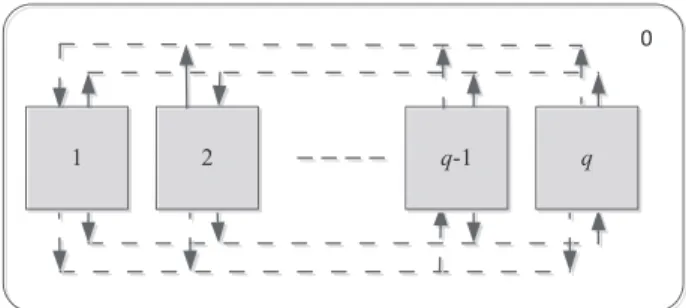
The proposed membrane clustering algorithm is an automatic clustering algorithm inspired by inherent mechanism of membrane systems, whose key component is a tissue-like membrane system with fully connected structure, shown inFig. 1. The tissue-like mem-brane system consists ofqcells that are surrounded byq elemen-tary membranes respectively. Each cell will use the evolution rules to evolve its objects. The dotted lines with direction describe the com-munication channels between the cells, which are used to achieve the exchange and sharing of objects. The communication of objects are achieved by communication rules. The communication mechanism of objects can realize the co-evolution of objects between theqcells and accelerate the convergence to the global optimum. Assume that the environment (labeled by 0) is the output region of the system. 3.1.1. Objects
The role of the tissue-like membrane system in the proposed membrane clustering algorithm is to determine the most appropriate number of clusters and search for the corresponding optimal clus-ter cenclus-ters for a data set. Therefore, each object in cells is used to describe a feasible solution of automatic clustering problem. A max-imum number of clusters is assigned a priori, denoted asKmax. Thus,
the number of clusters of the found good partitioning should be be-tween 2 andKmax.
Assume that the data set X to be clustered has at most Kmax
clusters,C1,C2, . . . ,CKmax,and the corresponding cluster centers are
Fig. 2. The example of object representation.
z1,z2, . . . ,zKmax,respectively. Each cluster center is aD-dimensional vector,zi=
{
zi1, . . . ,ziD}
,i=1,2, . . . ,Kmax. Thus, each object in thesystem is designed as a (Kmax+Kmax×D)-dimensional vector:
Z=
(τ
1, . . . ,τ
Kmax,z11, . . . ,z1D, . . . ,zKmax1, . . . ,zKmaxD)
(5) The first Kmax components,τ
1,τ
2, . . . ,τ
Kmax, are real numbers in [0, 1], where componentτ
iindicates whether theith cluster is active,namely, it will participate in classification or not. The remaining parts correspond toKmaxcluster centers respectively, wherezi1,zi2, . . . ,ziD
are theDcomponents ofith cluster.
Theith clusterCiof an objectZis called active cluster if and only if
τ
i≥0.5. However, ifτ
i<0.5 the cluster is inactive. An activeclus-ter means that it will participate in partitioning data points, oth-erwise it does not participate in data classification. Therefore, the
τ
i(
i=1,2, . . . ,Kmax)
,as some control variables, maintain theselec-tion of active clusters.
Fig. 2shows an example of object representation. Let the maxi-mum number of clusters,Kmax, be 5, namely, at most five clusters are
assigned a prior, and they are denoted byC1,C2,C3,C4,C5, respec-tively. The centers of the five clusters are (3.2, 8.6), (5.9, 1.3), (0.6, 8.3), (4.4, 7.1) and (2.5, 7.5), respectively. The first five components of the object, (0.6, 0.2, 0.7, 0.9, 0.4), are control variables that indi-cate whether the corresponding clusters are active. According to the definition of active clusters,C1,C3,C4are three active clusters. This means that actual clusters expressed by the object are the three clus-ters, thus the corresponding cluster cenclus-ters, (3.2, 8.6), (0.6, 8.3) and (4.4, 7.1), will participate in data classification. However,C2andC5are inactive, so they will be ignored when partitioning data points.
As usual in membrane systems, each cell contains one or more ob-jects and these obob-jects will be evolved by its evolution rules. For sim-ply, assume that theqcells have the same number of objects, denoted bym. During the calculation, the best object found in whole system so far is always stored in the environment, which is called global best object, denoted byZbest.
Initially, the system will generateminitial objects for each cell. When producing an initial object, Kmax real numbers in [0,1] and
(Kmax×D) random real numbers that satisfy the ranges of the
cor-responding component values of samples in data set are generated repeatedly. During object evolution, the system needs to evaluate its each object. TheCSmeasure descried above is used to evaluate the objects or as the fitness values of objects. Generally, the lower theCS measure, the better the object, otherwise, it is worse.
3.1.2. A modification to velocity-position model
The tissue-like membrane system uses evolution rules to evolve the objects in cells. In this work, the velocity-position model in PSO [18]is introduced as the evolution rules of cells. However, a modifica-tion of velocity-posimodifica-tion model is developed based on the used brane structure and inherent mechanism of the tissue-like mem-brane system. The modification is inspired from such an intuition: each cell has two best objects from different sources, first is the best object found by it so far (called local best object, denoted byZlbest),
and another is the best object communicated from otherq−1 cells (called external best object, which is selected randomly from the q−1 communicated best objects, denoted byZebest). The two best
objects in cells. The benefit of the consideration is enhancing the di-versity of objects in the system and the global exploration ability of the designed tissue-like membrane system.
Assuming thatZiisith object in a cell, the modification of velocity-position model can be described as follows:
Vi=wZi+c1r1
(
Pi−Zi)
+c2r2(
Zlbest−Zi)
+c3r3(
Zebest−Zi)
Zi=Zi+Vi
(6) wherePiis the best position of objectZifound so far,wis inertia
weight,c1,c2,c3are learning factors, andr1,r2,r3are three random real numbers in [0,1]. In the implementation, we use the following decreasing strategy of inertia weight:
w=wmax−
(
wmax−wmin)
t/tmax (7)wherewmaxandwminare maximum value and minimum value of
in-ertia weight respectively, andtmaxis maximum computing step
num-ber (or maximum iteration numnum-ber). 3.1.3. Communication rules
The tissue-like membrane system uses inherent communication mechanism to achieve the exchange and sharing of objects between different cells. The communication mechanism is provided by com-munication rules. In the tissue-like membrane system, two kinds of communication rules are adopted:
(I)
(
i,Z1Z2· · ·Zr/Z1Z1Z2· · ·Zr,j)
,wherei=j,i.j=1,2, . . . ,q.Application of the rule means thatrobjectsZ1Z2Zrin celli
will be communicated into cellj, and at the same timerobjects Z1Z2· · ·Zrin celljwill be communicated into celli.
(II) (i,Zlbest/
λ
, 0),i=1,2, . . . ,q.Here,Zlbest is local best object of celliin current computing
step and
λ
is an empty object. Application of the rule means that objectZlbestin celliwill be communicated into theenvi-ronment.
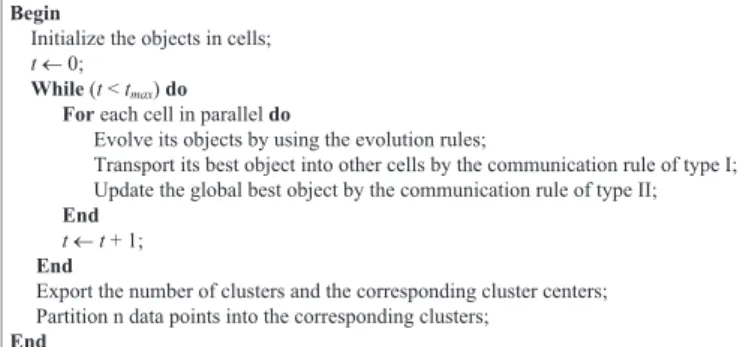
Theqcells in the tissue-like membrane system apply first com-munication rule (I) to establish the comcom-munication relationship of objects between them (see the dotted lines inFig. 1). Each cell trans-ports its best object into otherq−1 cells by using first communi-cation rule, thus, each cell will receiveq−1 best objects from other cells. The receivedq−1 best objects constitute a subset of external best objects in the cell, which will participate in object evolution in next computing step. At the same time, each cell communicates its best object into the environment by using second communication rule (II) and updates the global best objectZgbest.
3.1.4. Halting and output
The designed tissue-like membrane system adopts a simple halt-ing condition, namely, maximum computhalt-ing step number. The tissue-like membrane system will continue to execute until the halting con-dition is reached, thus, the system halts. When the system halts, the global best object stored in the environment is regarded as final com-puting result, namely, the determined number of clusters and the cor-responding cluster centers.
3.2. Automatic membrane clustering algorithm
The role of the tissue-like membrane system in the developed automatic membrane clustering algorithm is determining the most appropriate number of clusters and find the corresponding optimal cluster centers for a data set. For a data set ofndata points,X, the maximum number of clusters,Kmax, is assigned by a prior. Each
ob-ject in the tissue-like membrane system represents a vector associ-ated with a group of feasible clusters, including the control variables of active clusters and the corresponding cluster centers.
Begin
Initialize the objects in cells;
t 0;
While(t<tmax)do
Foreach cell in paralleldo
Evolve its objects by using the evolution rules;
Transport its best object into other cells by the communication rule of type I; Update the global best object by the communication rule of type II;
End t t+ 1;
End
Export the number of clusters and the corresponding cluster centers; Partition n data points into the corresponding clusters;
End
Fig. 3.Pseudo code of the proposed membrane clustering algorithm.
The membrane clustering algorithm first generates m initial objects for each cell, and then executes the tissue-like membrane system. As usual, all cells in the tissue-like membrane system as computing units run in parallel. Each cell uses the improved velocity-position rule to evolve its objects, and then transports its best object into other cells and updates the global best objectZgbest.
The evolution-communication procedure is repeated constantly until the halting condition is reached. At this time, the global best object Zgbest is found most appropriate number of clusters,K, as well as
the corresponding optimal cluster centers. Finally, the membrane clustering algorithm achieves data clustering by partitioningndata points intoKclusters according to the obtained optimal cluster cen-ters. The proposed membrane clustering algorithm is summarized inFig. 3. In the following, we briery discuss its time and storage complexities. The proposed algorithm consists of three main steps: initialization, object evolution-communication and output. From Fig. 3, it can be observed that initialization step contains double loop (qandmtimes, respectively), so its time complexity isO(qm). For object evolution-communication step, there are triple loop (q,m, and tmaxtimes, respectively), therefore, its time complexity isO(qmtmax).
For output step, its time complexity isO(nKmax). Therefore, the time
complexity of the proposed algorithm isO
(
qmtmax+nKmax)
. Duringthe computation, the used membrane system needs to store qm objects (it hasqcells and each cell has mobjects), so the storage complexity of the proposed algorithm isO(qm).
4. Experimental results and analysis
In order to evaluate the performance of the proposed membrane clustering algorithm, six benchmark data sets from[41]are used in experiments, includingIris,Newthyroid,Vowel,Glass,Wineand Can-cer. The six data sets are briefly described as follows:
(1) Iris. The data set consists of 150 points distributed over three clusters (setosa,versicolorandvirginica). Each data has four fea-tures:sepal length,sepal width,petal lengthandpetal width. (2) Newthyroid. The data set has 215 points along with five
fea-tures, which are distributed over three clusters:euthyroidism, hypothyroidismandhyperthyroidism.
(3) Vowel. The data set has 871 points along with five features and is divided into six clusters.
(4) Glass. The data set has 214 points and is divided into six clusters. Each data point has nine features:rrefractive index, sodium,magnesium,aluminum,silicon,potassium,calcium, bar-iumandiron.
(5) Wine. The data set has 178 points along with 13 features. It is divided into three clusters.
(6) Cancer. The data set consists of 683 points and each pattern has nine features. There are two categories in the data:malignant andbenign.
Table 1
The numbers of clusters estimated by several clustering algorithms.
Data sets Actual
number
Membrane systems
ACDE GCUK DCPSO
Iris 3 3.26 3.28 2.33 2.21 ±0.028 ±0.039 ±0.098 ±0.045 Newthyroid 3 3.15 3.22 2.74 3.31 ±0.015 ±0.036 ±0.086 ±0.038 Vowel 6 6.25 5.68 5.03 7.18 ±0.022 ±0.065 ±0.023 ±0.035 Glass 6 6.03 6.08 5.89 5.81 ±0.009 ±0.074 ±0.018 ±0.019 Wine 3 3.12 3.31 2.74 3.47 ±0.014 ±0.042 ±0.025 ±0.029 Cancer 2 2.02 2.05 2.12 2.31 ±0.010 ±0.064 ±0.011 ±0.027
In experiments, the proposed membrane clustering algorithm is compared with three recently developed automatic clustering algo-rithms, which areGCUK[1],ACDE[5]andDCPSO[27]algorithms. In order to evaluate the objects in cells or chromosomes in population, CSmeasure is used as fitness function in these clustering algorithms. The input parameters of tissue-like membrane system in the pro-posed membrane clustering algorithm are as follows: the number of cellsq=4,the number of objects in each cellm=50,and max-imum computing step numbertmax=300. In the improved
velocity-position model, input parameters arewmax=0.9, wmin=0.2 and
c1=c2=c3=1.0. In experiments,ACDE,GCUKandDCPSOuse the parameters given in original literature. In the implementation of ACDE, we use the population sizeNP=200,CRmax=1.8,CRmin=0.5
and iteration numbertmax=300. ForGCUK, we set the population size NP=200,crossover probabilitypc=0.8,mutation probabilitypm=
0.001 and iteration numbertmax=300. The parameters ofDCPSOare as follows: the population sizeNP=200,C1=C2=1.494,Pini=0.75
and iteration numbertmax=300. In addition, assumeKmax=10 in the
clustering algorithms above.
In order to check the clustering qualities of the clustering algo-rithms, we use F-measure of the whole partitioning and at the same time examine the optimal numbers of clusters determined by the clustering algorithms. Letmijbe the number of points that belong to
both clusteriand clusterj;miis the total number of points in cluster
i. The F-measure of clusteriwith respect to classjis defined by:
F
(
i,j)
=(
2×precision(
i,j)
×recall(
i,j))
(
precision(
i,j)
+recall(
i,j))
(8)whereprecision
(
i,j)
=pi j=mi j/miexpresses the precision of clusteriwith respect to classj, andrecall
(
i,j)
=mi j/mjdenotes the recall ofclusteriwith respect to classj. Thus, the overall F-measure of the whole partitioning is calculated by:
F= j
mj
m maxi F
(
i,j)
(9)For the F-measure, the optimum score is 1; higher scores are consid-ered better than lower scores.
Since the proposed membrane clustering algorithm,ACDE,GCUK and DCPSO contain some random/stochastic factors, the optimal numbers of clusters determined by them as well as the obtained F-measures of the corresponding clustering partitioning on different runs may be different. Therefore, the clustering algorithms are inde-pendently executed 50 times on each data set (with different initial objects or initial population), and then calculate the mean values and standard deviations of the obtained optimal numbers of clusters and F-measures respectively.
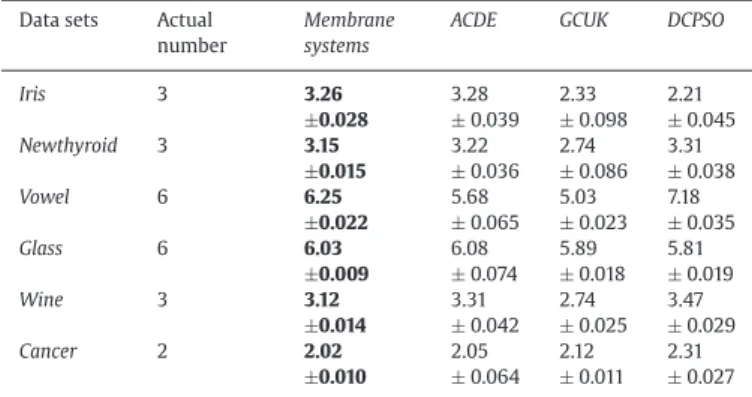
Table 1provides the comparison results of the optimal numbers of clusters estimated by the clustering algorithms. Each data set has an actual number of clusters, whileTable 1gives the mean values and
Table 2
The F-measures calculated by several clustering algorithms.
Data sets Membrane systems ACDE GCUK DCPSO
Iris 0.826 0.821 0.695 0.728 ±0.009 ±0.022 ±0.032 ±0.043 Newthyroid 0.842 0.835 0.762 0.785 ±0.011 ±0.023 ±0.033 ±0.039 Vowel 0.882 0.874 0.826 0.829 ±0.008 ±0.025 ±0.036 ±0.044 Glass 0.492 0.485 0.429 0.433 ±0.012 ±0.024 ±0.031 ±0.038 Wine 0.683 0.685 0.523 0.547 ±0.013 ±0.022 ±0.030 ±0.042 Cancer 0.967 0.963 0.826 0.854 ±0.009 ±0.021 ±0.033 ±0.040
standard deviations of the numbers of clusters estimated by the clus-tering algorithms the 50 times on each data set. It can be seen from Table 1that mean values of the proposed membrane clustering algo-rithm (membrane systems) andACDEalgorithm are the most close to the actual number of clusters in each data set. For example, forIris, the mean values of the number of clusters estimated by the proposed membrane clustering algorithm andACDEare 3.26 and 3.28, however, that ofGCUKandDCPSOare 2.33 and 2.21 respectively. Note that the actual number of clusters forIrisis 3, so this illustrates the ability of the membrane clustering algorithm for estimating the number of clusters outperforms other three clustering algorithms. The results onGlassshow that the average number of clusters for the proposed membrane clustering algorithm is 6.03 while the average numbers of clusters forACDE,GCUKandDCPSOare 6.08, 5.89 and 5.81 respec-tively. TheGlassactually has six clusters, so the comparison results indicate that the membrane clustering algorithm is the best of all the clustering algorithms for the prediction ability. At the same time it is clear seen that standard deviations of the numbers of clusters ob-tained by the proposed membrane clustering algorithm is lower than that of other three clustering algorithms, so the membrane clustering algorithm is robust.
The F-measure is used to evaluate the goodness of clustering partitioning generated by a clustering algorithm. Usually, higher F-measure means that the clustering algorithm has a better clus-tering performance, otherwise, it has a worse performance.Table 2 shows the comparison results of F-measures obtained by all cluster-ing algorithms on the six benchmark data sets. It can be observed fromTable 2that for all data sets, the mean values of F-measures produced by the proposed membrane clustering algorithm andACDE are higher than that ofGCUKandDCPSO. This illustrates that the pro-posed membrane clustering algorithm andACDEcan find the better clustering partitioning. Moreover, in addition toWine, the cluster-ing performances of the proposed membrane clustercluster-ing algorithm on other five data sets are better than that ofACDE.Table 2clear shows that the proposed membrane clustering algorithm achieves the lowest standard deviation on all data sets. Therefore, compared with other three algorithms, the proposed membrane clustering al-gorithm has a stronger robustness.
In experiments, when a clustering algorithm is executed a time on a data set, we compute its classification error according to the obtained partitioning and actual partitioning. Then, we further com-pute the average classification errors and standard deviations of the 50 runs on each data set for the clustering algorithms, respectively. Table 3reports comparison results of classification errors produced by the clustering algorithms on six benchmark data sets. The results clear show that compared with other three clustering algorithms, the proposed membrane clustering algorithm has lower average classi-fication error and standard deviation. Therefore, the experimental results further demonstrate the effectiveness of the proposed mem-brane clustering algorithm in solving automatic clustering problem.
Table 3
The classification errors of several clustering algorithms.
Data sets Membrane systems ACDE GCUK DCPSO
Iris 2.44 2.56 5.37 4.92 ±0.01 ±0.01 ±0.03 ±0.03 Newthyroid 12.26 12.33 25.47 22.75 ±1.18 ±1.27 ±1.46 ±1.51 Vowel 38.51 40.24 112.15 102.61 ±1.01 ±1.02 ±1.16 ±1.12 Glass 94.65 98.85 102.39 107.19 ±0.21 ±0.25 ±0.14 ±0.89 Wine 37.46 41.12 107.72 102.32 ±0.07 ±0.08 ±1.28 ±1.25 Cancer 23.92 25.18 30.42 29.21 ±0.26 ±0.35 ±1.82 ±1.39 Table 4
Comparison of average computing time (second) over 50 runs.
Data sets Membrane systems ACDE GCUK DCPSO
Iris 11.38 11.87 12.62 12.45 Newthyroid 12.19 12.35 12.93 12.65 Vowel 15.58 15.81 16.38 16.19 Glass 12.57 12.85 13.42 13.15 Wine 13.18 13.36 13.97 13.62 Cancer 16.47 16.62 17.38 17.04
The computing time refers to the spending time of an algorithm when it converges to its best objective function value during its a run.Table 4provides the comparison results of the four algorithms in terms of computing time (second). It can be seen fromTable 4 that the proposed membrane clustering algorithm has the smallest average computing time in the four algorithms. Note that the four algorithms have the same computational load because they contain 200 objects (individuals or particles). The comparison results illus-trate that the proposed membrane clustering algorithm has the rela-tively faster convergence.
The experimental results above demonstrate that the proposed membrane clustering algorithm can find the optimal number of clus-ters and provide a good clustering partitioning for a data set. We fur-ther notice thatIris,NewthyroidandVowelhave the lower dimensions (4-, 5- and 5-dimensions respectively) while dimensions of Glass, WineandCancerare higher (9-, 13- and 9-dimensions respectively). It can be seen from the experimental results above that the proposed membrane clustering algorithm not only has a good clustering perfor-mance on the low dimensional data sets but also achieves the better clustering effects on the higher dimensional data sets. This observa-tion demonstrates that the proposed membrane clustering algorithm has the better scalability.
5. Conclusions
This paper introduces the inherent mechanism of tissue-like membrane systems to solve automatic clustering problem and pro-poses an automatic clustering algorithm, called membrane cluster-ing algorithm. A tissue-like membrane system with fully connected structure is designed, and a modification of velocity-position model is developed as evolution rules based on its communication mecha-nism. The tissue-like membrane system can automatically determine the most appropriate number of clusters as well as the correspond-ing optimal clustercorrespond-ing partitioncorrespond-ing for a data set. In order to establish the availability and effectiveness of the proposed membrane cluster-ing algorithm in solvcluster-ing automatic clustercluster-ing problem, it is compared with three recently developed automatic clustering algorithms on six benchmark data sets. The comparison includes three aspects: the es-timated number of clusters, F-measure and classification error. The comparison results indicate that the proposed membrane clustering
algorithm can effectively determine the most appropriate number of clusters and provide a good clustering partitioning and it is robust. At the same time, the proposed membrane clustering algorithm not only has a good clustering performance on the low dimensional data sets but also achieves the better clustering effects on the higher di-mensional data sets.
Acknowledgments
This work was partially supported by theNational Natural Sci-ence Foundation of China (Grant nos. 61170030 and 61472328), and Research Fund of Sichuan Science and Technology Project (No. 2015HH0057), China.
References
[1] S. Bandyopadhyay, U. Maulik, Genetic clustering for automatic evolution of clus-ters and application to image classification, Pattern Recogn. 35(6) (2002) 1197– 1208.
[2] S. Bandyopdhyay, S. Saha, Gaps: a clustering method using a new point symmetry-based distance measure, Pattern Recogn. 40 (2007) 3430–3451. [3] D. Chang, X. Zhang, C. Zheng, A genetic algorithm with gene rearrangment for
k-means clustering, Pattern Recogn. 42 (2009) 1210–1222.
[4] C. Chou, M. Su, E. Lai, A new cluster validity measure and its application to image compression, Pattern Anal. Appl. 7(2) (2004) 205–220.
[5] S. Das, A. Abraham, A. Konar, Automatic clustering using an improved different evolution algorithm, IEEE Trans. Systems, Man Cybern., Part A 38(1) (2008) 218– 237.
[6] S. Das, A. Konar, Automatic image pixel clustering with an improved different evolution, Appl. Soft Comput. 9 (2009) 226–236.
[7] S. Das, S. Sil, Kernel-induced fuzzy clustering of image pixels with an improved different evolution algorithm, Inf. Sci. 180 (2010) 1237–1256.
[8] D. Davies, D. Bouldin, A cluster separation measure, IEEE Trans. Pattern Anal. Mach. Intell. 1(2) (1979) 224–227.
[9] J. Dunn, Well separated clusters and optimal fuzzy partitions, J. Cybern. 4 (1974) 95–104.
[10]B. Everitt, S. Landau, M. Leese, Cluster Analysis, Arnold, London, 2001. [11]E. Falkenauer, Genetic Algorithms and Grouping Problms, Wiley, New York, 1998. [12] R. Freund, G. Pˇaun, M. Pérez-Jiménez, Tissue-like p systems with channel-states,
Theor. Comput. Sci. 330(1) (2005) 101–116.
[13]J. Hartigan, Clustering Algorithm, Wiley, New York, 1975.
[14]L. Huang, I. Suh, A. Abraham, Dynamic mul-objective optimization based on membrane computing for control of time-varying unstable plants, Inf. Sci. 181(11) (2011) 2370–2391.
[15]M. Ionescu, G. Pˇaun, T. Yokomori, Spiking neural p systems, Fundam. Inf. 71(2–3) (2006) 279–308.
[16]A. Jain, Data clustering: 50 years beyond k-means, Pattern Recogn. Lett. 31 (2010) 651–666.
[17]Y. Kao, E. Zahara, I. Kao, A hybridized approach to data clustering, Expert Syst. Appl. 34(3) (2008) 1754–1762.
[18]J. Kennedy, R. Eberhart, Particle swarm optimization, in: Proceedings of the IEEE International Conference on Neural Network, 1999, pp. 1942–1948.Piscataway, NJ [19]M. Laszlo, S. Mukherjee, A genetic algorithm that exchanges neighboring centers
for k-means clustering, Pattern Recognit. Lett. 28 (2007) 2359–2366.
[20]U. Maulik, S. Bandyopadhyay, Genetic algorithm based clustering technique, Pat-tern Recognit. 33 (2000) 1455–1465.
[21]C. Murthy, N. Chowdhury, In search of optimal clusters using genetic algorithms, Pattern Recognit. Lett. 17 (1996) 825–832.
[22]M. Naldi, R. Campello, E. Hruschka, A. Carvalho, Efficiency of evolutionary k-means, Appl. Soft Comput. 11 (2011) 1938–1952.
[23]C. Nguyen, K. Cios, Gakrem: a novel hybrid clustering algorithm, Inf. Sci. 78 (2008) 4205–4227.
[24]T. Niknam, B. Amiri, An efficient hybrid approach based on pso, aco and k-means for cluster analysis, Appl. Soft Comput. 10 (2010) 183–197.
[25]T. Niknam, J. Olamaie, B. Amiri, A hybrid evolutionary algorithm based on aco and sa for cluster analysis, J. Appl. Sci. 8(15) (2008) 2695–2702.
[26]T. Nishida, An approximate algorithm for np-complete optimization problems ex-poiting p systems, in: Proceedings of the Workshop on Uncertainty in Membrane Computing. Palma de Mallorca, 2004, pp. 185–192.
[27]M. Omran, A. Salman, A. Engelbrecht, Dynamic clustering using particle swarm optimization with application in unsupervised image classification, Pattern Anal. Appl. 8(4) (2006) 332–344.
[28]M. Pakhira, S. Bandyopadhyay, U. Maulik, Validity index for crisp and fuzzy clus-ters, Pattern Recognit. Lett. 37(3) (2004) 487–501.
[29]H. Peng, J. Wang, M. Pérez-Jiménez, Optimal multi-level thresholding with mem-brane computing, Digit. Signal Process. 37 (2015a) 53–64.
[30]H. Peng, J. Wang, M. Pérez-Jiménez, A. Riscos-Núñez, The framework of p systems applied to solve optimal watermarking problem, Signal Process. 101 (2014) 256– 265.
[31] H. Peng, J. Wang, M. Pérez-Jiménez, A. Riscos-Núñez, An unsupervised learning algorithm for membrane computing, Inf. Sci. 304 (2015b) 80–91.
[32]H. Peng, J. Wang, M. Pérez-Jiménez, P. Shi, A novel image thresholding method based on membrane computing and fuzzy entropy, J. Intell. Fuzzy Syst. 24(2) (2013) 229–237.
[33]H. Peng, J. Wang, M. Pérez-Jiménez, H. Wang, J. Shao, T. Wang, Fuzzy reasoning spiking neural p system for fault diagnosis, Inf. Sci. 235 (2013) 106–116. [34]G. Pˇaun, M. Pérez-Jiménez, Membrane computing: brief introduction, recent
re-sults and applications, BioSystems 85 (2006) 11–22.
[35]G. Pˇaun, G. Rozenberg, A. Salomaa, The Oxford Handbook of Membrane Comput-ing, Oxford University Press, New York, 2010.
[36]G. Pˇaun, Computing with membranes, J. Comput. Syst. Sci. 61(1) (2000) 108–143. [37]S. Saha, S. andyopadhyay, A new point symmetry based fuzzy genetic clustering
technique for automatic evolution of clusters, Inf. Sci. 179 (2009) 3230–3246. [38]S. Saha, S. Bandyopadhyay, A symmetry based multiobjective clustering
tech-nique for automatic evolution of clusters, Pattern Recognit. 43 (2010) 738–751. [39]P. Shelokar, V. Jayaraman, B. Kulkarni, An ant colony approach for clustering, Anal.
Chim. Acta 509(2) (2004) 187–195.
[41] UCI, Uci datasets [online]. URL:http://www.ics.uci.edu/∼mlearn/MLRepository. html.
[42]J. Wang, P. Shi, H. Peng, M. Pérez-Jiménez, T. Wang, Weighted fuzzy spiking neural p systems, IEEE Trans. Fuzzy Syst. 21(2) (2013) 209–220.
[43]J. Wang, L. Zhou, H. Peng, G. Zhang, An extended spiking neural p system for fuzzy knowledge representation, Int. J. Innov. Comput. 7(7A) (2011) 3709–3724. [44]R. Xu, D. Wunsch, Survey of clustering algorithm, IEEE Trans. Neural Netw. 16(3)
(2005) 645–678.
[45]G. Zhang, J. Cheng, M. Gheorghe, Q. Meng, A hybrid approach based on different evolution and tissue membrane systems for solving constrained manufacturing parameter optimization problems, Appl. Soft Comput. 13(3) (2013) 1528–1542.