Full Terms & Conditions of access and use can be found at
https://www.tandfonline.com/action/journalInformation?journalCode=tcfm20
Engineering Applications of Computational Fluid
Mechanics
ISSN: 1994-2060 (Print) 1997-003X (Online) Journal homepage: https://www.tandfonline.com/loi/tcfm20
Implementation of evolutionary computing
models for reference evapotranspiration
modeling: short review, assessment and possible
future research directions
Wang Jing, Zaher Mundher Yaseen, Shamsuddin Shahid, Mandeep Kaur
Saggi, Hai Tao, Ozgur Kisi, Sinan Q. Salih, Nadhir Al-Ansari & Kwok-Wing
Chau
To cite this article: Wang Jing, Zaher Mundher Yaseen, Shamsuddin Shahid, Mandeep Kaur Saggi, Hai Tao, Ozgur Kisi, Sinan Q. Salih, Nadhir Al-Ansari & Kwok-Wing Chau (2019) Implementation of evolutionary computing models for reference evapotranspiration modeling: short review, assessment and possible future research directions, Engineering Applications of Computational Fluid Mechanics, 13:1, 811-823, DOI: 10.1080/19942060.2019.1645045 To link to this article: https://doi.org/10.1080/19942060.2019.1645045
© 2019 The Author(s). Published by Informa UK Limited, trading as Taylor & Francis Group
Published online: 08 Aug 2019.
Submit your article to this journal Article views: 336
ENGINEERING APPLICATIONS OF COMPUTATIONAL FLUID MECHANICS 2019, VOL. 13, NO. 1, 811–823
https://doi.org/10.1080/19942060.2019.1645045
Implementation of evolutionary computing models for reference
evapotranspiration modeling: short review, assessment and possible future
research directions
Wang Jinga,b, Zaher Mundher Yaseen c, Shamsuddin Shahid d, Mandeep Kaur Saggie, Hai Taoa, Ozgur Kisif, Sinan Q. Salihg, Nadhir Al-Ansarihand Kwok-Wing Chaui
aDepartment of Computer Science, Baoji University of Arts and Sciences, Shaanxi, People’s Republic of China;bFaculty of Computer Systems &
Software Engineering, University Malaysia Pahang, Pahang, Malaysia;cSustainable Developments in Civil Engineering Research Group, Faculty of Civil Engineering, Ton Duc Thang University, Ho Chi Minh City, Vietnam;dSchool of Civil Engineering, Faculty of Engineering, Universiti
Teknologi Malaysia (UTM), Johor Bahru, Malaysia;eDepartment of Computer Science, Thapar Institute of Engineering and Technology, Patiala,
India;fFaculty of Natural Sciences and Engineering, Ilia State University, Tbilisi, Georgia;gInstitute of Research and Development, Duy Tan
University, Da Nang 550000, Vietnam;hCivil, Environmental and Natural Resources Engineering, Lulea University of Technology, Lulea, Sweden;
iDepartment of Civil and Environmental Engineering, Hong Kong Polytechnic University, Hong Kong, People’s Republic of China
ABSTRACT
Evapotranspiration is one of the most important components of the hydrological cycle as it accounts for more than two-thirds of the global precipitation losses. Indeed, the accurate prediction of reference evapotranspiration (ETo) is highly significant for many watershed activities, including
agri-culture, water management, crop production and several other applications. Therefore, reliable estimation of ETois a major concern in hydrology. ETocan be estimated using different approaches,
including field measurement, empirical formulation and mathematical equations. Most recently, advanced machine learning models have been developed for the estimation of ETo. Among several
machine learning models, evolutionary computing (EC) has demonstrated a remarkable progression in the modeling of ETo. The current research is devoted to providing a new milestone in the
imple-mentation of the EC algorithm for the modeling of ETo. A comprehensive review is conducted to
recognize the feasibility of EC models and their potential in simulating EToin a wide range of
envi-ronments. Evaluation and assessment of the models are also presented based on the review. Finally, several possible future research directions are proposed for the investigations of ETousing EC.
ARTICLE HISTORY Received 12 May 2019 Accepted 14 July 2019 KEYWORDS evapotranspiration prediction; state of the art; evolutionary computing models; input variability; future research directions
1. Introduction
Proper monitoring of climate requires comprehensive information about land surface fluxes, particularly the latent and sensible components (Courault, Seguin, & Olioso,2005). This information is also important for the evaluation of the parameterization schemes in the climate and weather models used for the flux exchange prediction between the surface and the lower atmosphere (Allen, Burt, Solomon, Clemmens, & O’Halloran,2005; Fisher et al.,2009). In agriculture, it is required for irrigation scheduling and other applications (Farg, Arafat, Abd El-Wahed, & El-Gindy,2012). It is a major component of the hydrological cycle and, therefore, it has significant implications on water requirements and water resource management (Figure 1). Therefore, it is necessary that water managers and irrigation engineers are provided with an accurate and robust tool for estimating surface
CONTACT Zaher Mundher Yaseen [email protected]
fluxes, and especially evapotranspiration (Pereira, Green, & Villa Nova,2006).
The reference evapotranspiration (ETo) can be deter-mined either directly through experiments or indirectly through mathematical models. Practically, the major classical methods for ETomeasurement are only obtain-able at the field scale (Bowen ratio, eddy correlation system, soil water balance) (Tao, Diop, et al.,2018). How-ever, certain limitations restrict the application of these methods in flux prediction, especially when applied to large spatial scales (Kumar, Jat, & Shankar,2012). Besides, the field methods are expensive, time consuming and difficult. ETois also difficult to measure mathematically because it depends on the interaction of several climatic factors, including temperature, wind speed, humidity and radiation (Tao, Diop, et al.,2018). Hence, evapotranspira-tion is featured by a nonlinear and complex phenomenon
© 2019 The Author(s). Published by Informa UK Limited, trading as Taylor & Francis Group
This is an Open Access article distributed under the terms of the Creative Commons Attribution License (http://creativecommons.org/licenses/by/4.0/), which permits unrestricted use, distribution, and reproduction in any medium, provided the original work is properly cited.
812 W. JING ET AL.
Figure 1.Schematic diagram of hydrological cycle showing the importance of evapotranspiration (ET).
and its determination is based on the availability of sev-eral climatic parameters and their mutual interactions with each other.
Experts have developed several EToestimation meth-ods over the years; however, the selection of a suit-able method depends mainly on the availability of the measured climatic factors. The generalized Pen-man–Monteith (PM) method is the most adopted method for the estimation of ETo in agricultural and environmental research, as it tallies well with field observations (Penman,1948). The PM model has been acknowledged as the standard ETo estimation method despite the fact that its application requires the availabil-ity of a significant amount of climatic data, which may not be available in certain locations, such as in the developing countries. Such cases demand the deployment of alter-native methods with less dependence on many weather inputs. The artificial intelligence (AI) methods can model highly nonlinear phenomena with a limited amount of data (Meng et al.,2019). Therefore, the application of AI methods has grown rapidly in recent years for the devel-opment of alternative methods of ETo estimation from limited weather inputs.
2. State of the art: evolutionary computing (EC) models for ETosimulation
The evolution of computer technology has increased the applicability of AI in different scientific fields (Bagh-ban, Jalali, Shafiee, Ahmadi, & Chau,2019; Chau,2017; Chuntian & Chau, 2002; Haie, Pereira, Machado, & Shahidian,2019; Wu & Chau,2011). AI is a connection of
several processors, distributed in parallel and composed of simple processing units with the natural capability to store experimental information and produce it whenever needed (Danandeh Mehr et al.,2018; Yaseen, Sulaiman, Deo, & Chau,2019). Since AI models require few inputs and can map input–output relationships without having prior knowledge of the physical processes involved, they are considered as effective tools for nonlinear process modeling. Consequently, several alternative intelligent computational models for the estimation of ETo have been developed over the last few decades (Chen, Chen, & Chen,2018; Kumar, Raghuwanshi, & Singh,2011; Sun et al.,2019).
EC approaches, such as gene expression programming (GEP) and genetic programming (GP), are one of several types of AI model which have been considered appro-priate for the modeling of ETo (Danandeh Mehr et al., 2018). These models were originally developed by Koza (1992), when the concept of GP was first introduced. They were conceptually developed based on the genetic algorithm (GA), an algorithm used for the implemen-tation of symbolic regression when trying to establish a mathematical function that fits a data set (Maulik & Bandyopadhyay,2000; Najafzadeh & Kargar,2019). Sev-eral attempts have been made regarding the feasibility of using EC to solve problems such as circuit design, multi-agent strategies and time-series prediction (Dineva et al.,
2019; Mirjalili, Mirjalili, Saremi, & Mirjalili,2020). Simi-larly, several researchers have examined the applicability of EC to solve hydrological, climatological, environmen-tal and ecological problems over the past two decades (Yaseen, El-shafie, Jaafar, Afan, & Sayl,2015).
ENGINEERING APPLICATIONS OF COMPUTATIONAL FLUID MECHANICS 813
Within the scope of modeling the EToprocess, a num-ber of studies have been conducted using EC for differ-ent climatological scenarios. To investigate the effect of different climatic and topographic conditions (Parasur-aman, Elshorbagy, & Carey, 2007), ETo was estimated using GP from ground temperature, wind speed, eddy-covariance-measured latent heat as a function of net radi-ation, relative humidity and air temperature. Based on the predictability comparison with the classical artificial neural network (ANN) and PM empirical formulation, it was found to be a potential model (Parasuraman et al.,
2007).
Guven, Aytek, Yuce, and Aksoy (2008) investigated the effect of ETo using the daily atmospheric variables collected from the California Irrigation Management Information System (CIMIS) database for Davis, Hast-ing, Suisun, Dixon and Oakville stations. The authors validated the performance of the GA model against sev-eral empirical models such as the Food and Agriculture Organization of the United Nations Penman–Monteith (FAO56-PM), the PM, the Jensen–Haise, the Harg-reaves–Samani (HS) equation, the Jones–Ritchie, the Turc method and solar radiation-based models. It was found that the GA model performed better than the con-sidered empirical models, with relatively low error and high correlation metrics.
Kim and Kim (2008) proposed three type of GA model based on the generalized regression neural net-works model (GRNNM) namely, COMBINE-GRNNM-GA, EXTREME-GRNNM-GA and Average-GRNNM-GA, for the estimation of pan evaporation and alfalfa reference evapotranspiration (ETref) for the period 1985–1992 at 14 meteorological stations located in the Republic of Korea. Based on statistical results, they found COMBINE-GRNNM-GA to be the best performing of these models. Kisi and Guven (2010) investigated the accuracy of linear genetic programming (LGP) with GEP for modeling ETo at three stations, and indicated the superior performance of LGP over GEP.
El-Baroudy, Elshorbagy, Carey, Giustolisi, and Savic (2010) reported two case studies of the South West Sand Storage and the South Bison Hill, Mildred Lake mine, Canada, for the estimation of ETo using three intelli-gent models, namely evolutionary polynomial regression (EPR), ANN and GEP. The authors found better per-formance of the EPR model over the other models in estimation of ETo.
Izadifar and Elshorbagy (2010) estimated ETo using a physical model, i.e. HYDRUS-1D, at Alberta, Canada, and compared its performance with different AI (ANN and GP) and statistical models. The results indicated that the multiple regression and GP models performed better than the ANN model in estimating ETo.
Kisi (2010) used GA for the calibration of the fuzzy membership function for the modeling of daily ETo at three stations located in central California, USA, for the period 1998–2007. They employed the fuzzy-genetic (FG) model to estimate the ETo obtained using the FAO56-PM method and compared its performance with the Penman, Hargreaves, Ritchie, Turc and ANN meth-ods. It was observed that the FG model, which uses only two parameters, performed better in estimating ETo compared to other empirical models.
Shiri et al. (2012) applied the GEP model to determine the magnitude of ETo in the Basque Country (north-ern Spain). The models were developed using weather parameters, namely relative humidity, solar radiation, air temperature and wind speed. The capability of the GEP model was validated against the other AI and empirical models. Overall, the results showed that the GEP model achieved better accuracy than the Priestley–Taylor (PT), HS and adaptive neuro-fuzzy inference system (ANFIS) models.
The generalizability of the GEP model was scrutinized by Traore and Guven (2012) for modeling the ETo in Sahelian country, Burkina Faso. They reported that the incorporation of several weather variables provided the best accuracy using the GEP model. Jean et al. (2012) proved that the combination of GEP and FAO56-PM models can better estimate evaporation and seepage for Datong Basin. In another major study, Eslamian, Gohari, Zareian, and Firoozfar (2012) developed hybrid ANN and GA (ANN-GA) and ANN models for the estimation of ETo. They found that the ANN-GA could calculate the ETomore accurately than the other models.
Shiri et al. (2013) investigated the performance of GEP and ANFIS models for ETo estimation at five stations in Iran. The authors found that the GEP model outper-formed the empirical formulations (e.g. HS, Makkink and Turc) and ANFIS model.
The GEP model was developed for the estimation of ETo over West Africa (Traore & Guven, 2013). The authors reported a high performance of the algebraic for-mulation obtained using GEP for ETosimulation over the Sub-Saharan African regions.
A comparative analysis using several intelligent mod-els, namely ANN, ANFIS, support vector machine (SVM) and GEP to estimate the ETowas investigated by Shiri, Nazemi, et al. (2014). In addition, the capacity of the established AI models was validated against sev-eral empirical formulations, namely PT, HS, Turc and Makkink. The results showed the superiority of the GEP model over the other AI and empirical methodologies.
Shiri, Sadraddini, et al. (2014) applied GEP to estimate ETowith different combinations of meteorological vari-ables as input attributes to construct a predictive model.
814 W. JING ET AL.
The study reported an excellent performance of GEP using all available meteorological variables.
The performance of ANN, an integrative ANFIS with subtractive clustering and grid partition, and GEP mod-els was inspected to simulate the long-term monthly ETo at 50 stations in Iran (Kisi, Sanikhani, Zounemat-Kermani, & Niazi,2015). The authors reported the fea-sibility of the GEP model over the other developed AI models. They also reported a remarkably consistent pre-dictability in ETosimulation using GEP.
Martí, González-Altozano, López-Urrea, Mancha, and Shiri (2015) conducted a study to compare the perfor-mance of GEP in estimation of ETowith lysimeter data at two locations in Spain: Las Tiesas (Albacete) and La Orden (Badajoz). The study reported that the best results in the estimation of ETowere obtained using GEP.
The performance of the PM model with four soft computing approaches, namely SVM–firefly algorithm (SVM-FFA), ANN, SVM-wavelet and GP, in the esti-mation of ETo in Serbia was assessed by Gocić et al. (2015). They reported that SVM-wavelet and SVM-FFA performed better than GP and ANN.
Yassin, Alazba, and Mattar (2016b) developed math-ematical equations using GEP for the estimation of ETo from meteorological data at 13 stations in the Kingdom of Saudi Arabia, and reported accurate estimation of ETo using the GEP model. However, they found a slightly better performance using ANN compared to GEP.
Alazba, Yassin, and Mattar (2016) developed ETo models for eight combinations of inputs using GEP for 19 meteorological stations located in a hyper-arid region. The performance of the GEP model was compared with the PM model, and better formation of the GEP model with eight input variables was found.
Yassin et al. (2016b) investigated the performance of GEP and ANN in modeling daily ETref at 19 meteoro-logical stations in Saudi Arabia for the period 1980–2010. The results showed that the ANN performed better than the GEP in estimating ETref.
Kumar, Adamowski, Suresh, and Ozga-zielinski (2016) investigated the performance of extreme learning machine (ELM), ANN, GP and SVM in estimating daily ETo in North Bihar, India, for the period 2001–2005. They reported that the ELM model performed better than the other machine learning and soft computing approaches.
Karimi, Kisi, and Kim (2017) developed heuristic models combining SVM and GEP for the estimation of EToin the Republic of Korea. The result showed that the GEP model outperformed the SVM model in the local and cross-station scenarios.
Kiafar et al. (2017) derived equations for the esti-mation of ETo at two meteorological stations located
in a hyper-arid region of Iran and at two stations in a humid region of Spain. The authors compared the per-formance of GEP with three empirical models to calcu-late ETo, namely the mass transfer, temperature-based and radiation-based models. They reported better per-formance of the GEP model with four inputs compared to the empirical models.
Mehdizadeh, Behmanesh, and Khalili (2017) investi-gated the performance of SVM [Poly and radial basis function (RBF)], GEP, multivariate adaptive regression spline (MARS) and the empirical models to determine the EToat 44 meteorological stations in Iran. The study reported that the MARS and SVM-RBF models per-formed better than the SVM-Poly and GEP models.
The daily scale of EToat Gaoyou station in China was predicted using the GEP algorithm (Traore, Luo, & Fipps,
2017). The study suggested that the GEP model can be used for estimation of ETo and also it can be employed as a tool for short-term irrigation scheduling for decision making.
Different empirical and semi-empirical approaches namely, Kimberly–Penman, temperature-based and radiation-based models, were applied along with GEP by Shiri (2017) for the estimation of daily EToat five mete-orological stations in Iran. The author divided the data set into three segments for model calibration, testing and validation. The comparison of the results showed that the temperature-based empirical model developed using GEP was the most accurate in estimating ETo.
The random forest model (RFM) and general-ized regression neural network (GRNN) models were employed by Feng, Cui, Gong, Zhang, and Zhao (2017) to estimate the ETofor the period 2009–2014 at two stations in China. The results revealed that the temperature-based RFM and GRNN models could be applied successfully for daily EToestimation. However, the RFM could perform slightly better than the GRNN in estimating ETo.
The performance of AI-based models such as ANN and GEP and ancillary/external approaches were inves-tigated by Landeras et al. (2018) for the estimation of ETo at four stations in Ghana. They used 7 years’ data (2006–2009) for the training and 4 years’ data (2009–2012) for the testing of the models. The study reported that the GEP and ancillary model could be applied for better estimation of EToin West Africa.
Mattar and Alazba (2018) examined the performance of the GEP model with eight input combinations for the simulation of monthly EToat 27 meteorological stations in Egypt using the CLIMWAT meteorological data. The authors found that the air temperature, wind speed and relative humidity are required for accurate modeling of ETo. The results also indicated that multiple linear regres-sion (MLR) and GEP with mean humidity and wind
ENGINEERING APPLICATIONS OF COMPUTATIONAL FLUID MECHANICS 815
speed at 2 m height as inputs provide the best estimation of ETo.
Mattar (2018) implemented eight combinations of GEP models to calculate the EToat 32 stations in Egypt using the CLIMWAT data. The comparison of the per-formance of GEP model with other empirical models showed that the GEP model provides promising out-comes in the modeling of ETo.
Mehdizadeh (2018) performed extensive research using MARS and GEP to determine the daily EToat six stations in Iran, namely Isfahan and Shiraz (arid), Urmia and Tabriz (semi-arid) and Yazd and Zahedan (hyper-arid), for the period 2000–2014. They used daily meteo-rological data and their lags for the modeling of ETo, and concluded that MARS–autoregressive conditional het-eroscedasticity (MARS-ARCH) and GEP-ARCH showed superior results compared to the standalone MARS and GEP models.
The potential of the GEP model for the estimation of ETowas analyzed by Jovic, Nedeljkovic, Golubovic, and Kostic (2018). The models were built based on diverse meteorological variables including minimum and maxi-mum temperature, vapor pressure, wind speed, sunshine hours and relative humidity. The authors evidenced the improved capability of the EC model through the incor-poration of more climatic information.
Mohammad, Pour, Piri, and Kisi (2018) investigated the performance of three data-driven models, SVM, ANFIS and GEP, to estimate the ETo. They used five dif-ferent combinations of input for the simulation of ETofor the period 1970–2010 in south-eastern Iran. The results showed that the SVM model had superior performance with the input combination of average air temperature, relative humidity, wind speed and sunshine hours.
Six AI models, namely multilayer perceptron, GRNN, radial basis neural network (RBNN), ANFIS with grid partition (ANFIS-GP), ANFIS with subtractive clus-tering (ANFIS-SC) and GEP, were investigated by Sanikhani, Kisi, Maroufpoor, and Yaseen (2019) for the determination of ETo at two meteorological stations located in the Mediterranean region, at Antalya and Isparta in Turkey. The prediction results revealed that the best performance belonged to the GRNN and GEP mod-els at Antalya station, and ANFIS-SC and RBNN modmod-els at Isparta station.
Daily ETowas calculated using PM-FAO56, radiation-based, mass transfer-based and temperature-based mod-els at five stations in Iran (Shiri,2019). The performance of the empirical models was validated against the pre-dominant EC model (i.e. GEP). The author reported the better performance of the mass transfer-based model and relatively lower performance of GEP, temperature-based and radiation-based models.
Shiri (2019) presented the results of ETo models at five stations in Iran. The author calculated the daily ETowith FAO56-PM and compared the results with the temperature-, radiation- and mass transfer-based ETo equations and GEP-derived models. Overall, the results indicated that the temperature-based and the radiation-based empirical and GEP models could not provide satis-factory results to simulate ETo, while the models derived from mass transfer equations could provide more accu-rate results.
Shiri, Marti, Karimi, and Landeras (2019) introduced a new approach for the estimation of ETo by splitting the data set and incorporating external ancillary inputs. They applied GEP with the temperature-based HS model and the radiation-based PT model for the estimation of ETo from the local meteorological inputs. Comparison of the performance accuracy of the models revealed that the GEP-based model produced the most accurate results among all the applied approaches.
The present review also investigated the success-ful application of evolutionary algorithms in other fields. For instance, Danandeh Mehr, Kahya, and Ozger (2014) introduced a new explicit gene-wavelet model for drought forecasting, Mehr (2018) developed a new hybrid GA combined with GEP for stream flow forecast-ing in intermittent streams, and other studies investigated the capability of GP in advances in rainfall runoff mod-eling (e.g. Jayawardena, Muttil, & Lee, 2006; Nourani, Komasi, & Alami,2013).
3. Survey evaluation and assessment
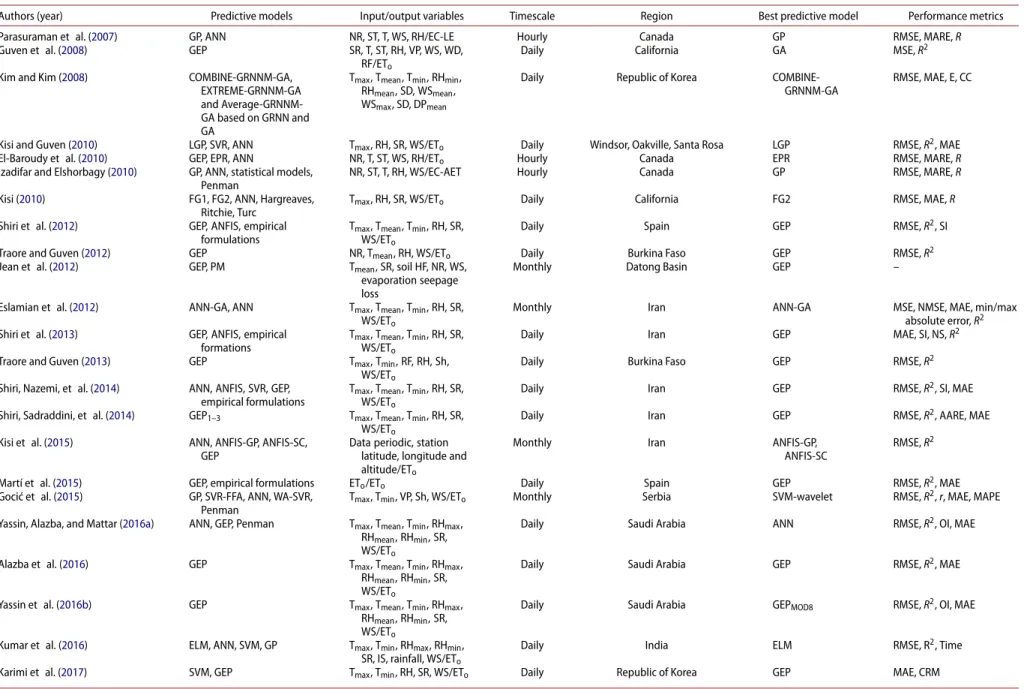
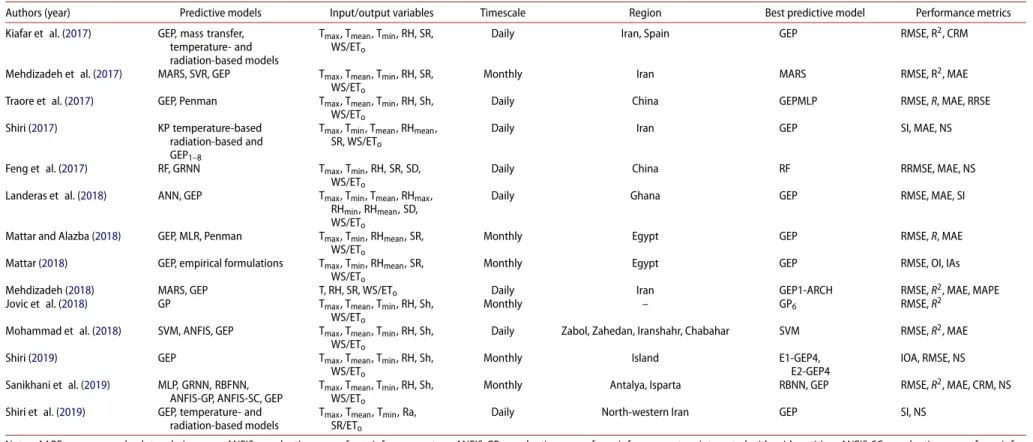
The summary of the research which implemented the EC models for the estimation of ETo over the period 2007–2018 is reported in Table1. It was observed that a large number of studies has been conducted on the implementation of GP and GEP models for estimation of ETo. The main reason for preferring evolutionary models in estimating ETo their capability to provide explicit formulation and ease of application. The formu-lation provided by GEP can be simply used in practical applications.
Most studies have demonstrated a limitation in the predictability of EC models using fewer meteorological variables as input. This was observed more prominently in the regions characterized by arid and semi-arid cli-mates. This can best be explained by the ETo processes being influenced by multiple climate variables and thus varying from one case to another. Hence, it can be con-cluded, based on the observations, that ETo models in such regions need several pieces of climate information to attain a reliable predictive capability.
816
W.
JING
ET
AL.
Table 1.Short review of the implementation of evolutionary computing models for the estimation of reference evapotranspiration (2007–2019).
Authors (year) Predictive models Input/output variables Timescale Region Best predictive model Performance metrics
Parasuraman et al. (2007) GP, ANN NR, ST, T, WS, RH/EC-LE Hourly Canada GP RMSE, MARE,R
Guven et al. (2008) GEP SR, T, ST, RH, VP, WS, WD,
RF/ETo
Daily California GA MSE,R2
Kim and Kim (2008) COMBINE-GRNNM-GA,
EXTREME-GRNNM-GA and Average-GRNNM-GA based on GRNN and GA
Tmax, Tmean, Tmin, RHmin,
RHmean, SD, WSmean,
WSmax, SD, DPmean
Daily Republic of Korea
COMBINE-GRNNM-GA
RMSE, MAE, E, CC
Kisi and Guven (2010) LGP, SVR, ANN Tmax, RH, SR, WS/ETo Daily Windsor, Oakville, Santa Rosa LGP RMSE,R2, MAE
El-Baroudy et al. (2010) GEP, EPR, ANN NR, T, ST, WS, RH/ETo Hourly Canada EPR RMSE, MARE,R
Izadifar and Elshorbagy (2010) GP, ANN, statistical models, Penman
NR, ST, T, RH, WS/EC-AET Hourly Canada GP RMSE, MARE,R
Kisi (2010) FG1, FG2, ANN, Hargreaves,
Ritchie, Turc
Tmax, RH, SR, WS/ETo Daily California FG2 RMSE, MAE,R
Shiri et al. (2012) GEP, ANFIS, empirical
formulations
Tmax, Tmean, Tmin, RH, SR,
WS/ETo
Daily Spain GEP RMSE,R2, SI
Traore and Guven (2012) GEP NR, Tmean, RH, WS/ETo Daily Burkina Faso GEP RMSE,R2
Jean et al. (2012) GEP, PM Tmean, SR, soil HF, NR, WS,
evaporation seepage loss
Monthly Datong Basin GEP –
Eslamian et al. (2012) ANN-GA, ANN Tmax, Tmean, Tmin, RH, SR,
WS/ETo
Monthly Iran ANN-GA MSE, NMSE, MAE, min/max
absolute error,R2
Shiri et al. (2013) GEP, ANFIS, empirical
formations
Tmax, Tmean, Tmin, RH, SR,
WS/ETo
Daily Iran GEP MAE, SI, NS,R2
Traore and Guven (2013) GEP Tmax, Tmin, RF, RH, Sh,
WS/ETo
Daily Burkina Faso GEP RMSE,R2
Shiri, Nazemi, et al. (2014) ANN, ANFIS, SVR, GEP, empirical formulations
Tmax, Tmean, Tmin, RH, SR,
WS/ETo
Daily Iran GEP RMSE,R2, SI, MAE
Shiri, Sadraddini, et al. (2014) GEP1–3 Tmax, Tmean, Tmin, RH, SR,
WS/ETo
Daily Iran GEP RMSE,R2, AARE, MAE
Kisi et al. (2015) ANN, ANFIS-GP, ANFIS-SC,
GEP
Data periodic, station latitude, longitude and altitude/ETo
Monthly Iran ANFIS-GP,
ANFIS-SC
RMSE,R2
Martí et al. (2015) GEP, empirical formulations ETo/ETo Daily Spain GEP RMSE,R2, MAE
Gocić et al. (2015) GP, SVR-FFA, ANN, WA-SVR,
Penman
Tmax, Tmin, VP, Sh, WS/ETo Monthly Serbia SVM-wavelet RMSE,R2,r, MAE, MAPE
Yassin, Alazba, and Mattar (2016a) ANN, GEP, Penman Tmax, Tmean, Tmin, RHmax,
RHmean, RHmin, SR,
WS/ETo
Daily Saudi Arabia ANN RMSE,R2, OI, MAE
Alazba et al. (2016) GEP Tmax, Tmean, Tmin, RHmax,
RHmean, RHmin, SR,
WS/ETo
Daily Saudi Arabia GEP RMSE,R2, MAE
Yassin et al. (2016b) GEP Tmax, Tmean, Tmin, RHmax,
RHmean, RHmin, SR,
WS/ETo
Daily Saudi Arabia GEPMOD8 RMSE,R2, OI, MAE
Kumar et al. (2016) ELM, ANN, SVM, GP Tmax, Tmin, RHmax, RHmin,
SR, IS, rainfall, WS/ETo
Daily India ELM RMSE, R2, Time
Karimi et al. (2017) SVM, GEP Tmax, Tmin, RH, SR, WS/ETo Daily Republic of Korea GEP MAE, CRM
ENGINEERING A PPLICATIONS O F C OMPUTATIONAL FLUID MECHANICS 817 Table 1.Continued.
Authors (year) Predictive models Input/output variables Timescale Region Best predictive model Performance metrics
Kiafar et al. (2017) GEP, mass transfer, temperature- and radiation-based models
Tmax, Tmean, Tmin, RH, SR,
WS/ETo
Daily Iran, Spain GEP RMSE, R2, CRM
Mehdizadeh et al. (2017) MARS, SVR, GEP Tmax, Tmean, Tmin, RH, SR,
WS/ETo
Monthly Iran MARS RMSE, R2, MAE
Traore et al. (2017) GEP, Penman Tmax, Tmean, Tmin, RH, Sh,
WS/ETo
Daily China GEPMLP RMSE,R, MAE, RRSE
Shiri (2017) KP temperature-based
radiation-based and GEP1–8
Tmax, Tmin, Tmean, RHmean,
SR, WS/ETo
Daily Iran GEP SI, MAE, NS
Feng et al. (2017) RF, GRNN Tmax, Tmin, RH, SR, SD,
WS/ETo
Daily China RF RRMSE, MAE, NS
Landeras et al. (2018) ANN, GEP Tmax, Tmin, Tmean, RHmax,
RHmin, RHmean, SD,
WS/ETo
Daily Ghana GEP RMSE, MAE, SI
Mattar and Alazba (2018) GEP, MLR, Penman Tmax, Tmin, RHmean, SR,
WS/ETo
Monthly Egypt GEP RMSE,R, MAE
Mattar (2018) GEP, empirical formulations Tmax, Tmin, RHmean, SR,
WS/ETo
Monthly Egypt GEP RMSE, OI, IAs
Mehdizadeh (2018) MARS, GEP T, RH, SR, WS/ETo Daily Iran GEP1-ARCH RMSE,R2, MAE, MAPE
Jovic et al. (2018) GP Tmax, Tmean, Tmin, RH, Sh,
WS/ETo
Monthly – GP6 RMSE,R2
Mohammad et al. (2018) SVM, ANFIS, GEP Tmax, Tmean, Tmin, RH, Sh,
WS/ETo
Daily Zabol, Zahedan, Iranshahr, Chabahar SVM RMSE,R2, MAE
Shiri (2019) GEP Tmax, Tmean, Tmin, RH, Sh,
WS/ETo
Monthly Island E1-GEP4,
E2-GEP4
IOA, RMSE, NS Sanikhani et al. (2019) MLP, GRNN, RBFNN,
ANFIS-GP, ANFIS-SC, GEP
Tmax, Tmean, Tmin, RH, Sh,
WS/ETo
Monthly Antalya, Isparta RBNN, GEP RMSE,R2, MAE, CRM, NS
Shiri et al. (2019) GEP, temperature- and radiation-based models
Tmax, Tmean, Tmin, Ra,
SR/ETo
Daily North-western Iran GEP SI, NS
Notes: AARE=average absolute relative error; ANFIS=adaptive neuro-fuzzy inference system; ANFIS-GP=adaptive neuro-fuzzy inference system integrated with grid partition; ANFIS-SC=adaptive neuro-fuzzy infer-ence system integrated with subtractive clustering; ANN=artificial neural network; ARCH=autoregressive conditional heteroscedasticity; CC=correlation coefficient; CRM=coefficient of residual mass; DP=dew point; E=efficiency; EC-AET=eddy covariance-measured actual evapotranspiration; EC-LE=eddy-covariance-measured latent heat; ELM=extreme learning machine; EPR=evolutionary polynomial regression; ETo=reference evapotranspiration; FFA=firefly algorithm; FG=fuzzy genetic; GA=genetic algorithm; GEP=gene expression programming; GP=genetic programming; GRNN=generalized regression neural
network; GRNNM=generalized regression neural networks model; HF=heat flux; IAs=index of agreements; IOA=index of agreement; SI=scatter index; KP=Kimberly–Penman; LGP=linear genetic program-ming; MAE=mean absolute error; MAPE=mean absolute percentage error; MARE=mean absolute relative error; MARS=multivariate adaptive regression spline; MLP=multilayer perceptron; MLR=multiple linear regression; MSE=mean square error; NMSE=normalized mean square error; NR=net radiation; NS=Nash–Sutcliffe efficiency coefficient; OI=overall index; PM=Penman–Monteith; Ra=extraterrestrial radia-tion;R2=coefficient of determination; RBFNN=radial basis function neural network; RBNN=radial basis neural network; RF=rainfall; RH=relative humidity; RMSE=root mean square error; RRMSE=relative root mean square error; RRSE=root relative squared error; SD=sunshine duration; Sh=sunshine; SI=scatter index; SR=solar radiation; ST=soil temperature; SVM=support vector machine; SVR=support vector regression; T=temperature; Tmax, Tmeanand Tmin=maximum, mean and minimum air temperature; VP=vapor pressure; WA=wavelet; WD=wind direction; WS=wind speed.
818 W. JING ET AL.
In Table1, the GP or GEP models have been compared with several other methods in estimating ETofor differ-ent timescales (hourly, daily and monthly) and differdiffer-ent climatic regions, ranging from hyper-arid to humid. In most of the studies, such models were found to be supe-rior compared to other empirical and AI models. Only three studies reported a lower accuracy of GP/GEP com-pared to other AI methods in the estimation of ETo. El-Baroudy et al. (2010) compared GEP with EPR and ANN for modeling hourly ETo, and reported marginal differ-ences among the models. However, a limited number of data was used in the study and, therefore, generalization of the obtained results is difficult. The data division rule (65% for training and 35% for testing) was also different from the related literature. Mehdizadeh (2018) compared GEP, SVM and MARS for the estimation of long-term monthly ETo (mean values for the period 1951–2010 and, thus, 60 values for each month) and found that MARS showed superior performance to the other meth-ods. Kisi et al. (2015) compared the performance of ANN and ANFIS with GEP for the estimation of long-term monthly ETo(mean values for the period 1956–2010 and, thus, 55 values for each month) without climatic data as input, and found GEP to provide less accuracy in ETo estimation compared to ANN and ANFIS. Therefore, it may be remarked that GEP may not have good capabil-ity in the modeling of long-term monthly ETo in some climatic environments. The review also revealed that the training span of data has a substantial influence on the model’s predictability.
Most of the studies reviewed in the present study (Table 1) used full climatic data as inputs to calculate ETo by the FAO56-PM method. The main reason for searching for alternatives to the standard method is that it requires a high number of climatic data as inputs and such data are not available at many stations, especially those located in developing countries. Therefore, the development of AI models using all available data, sim-ilar to the standard method (FAO56 PM), is not worth-while. Because ETo can be calculated using the FAO56 PM method if the data of all meteorological variables are available, the alternative methods are not necessary for the replacement of this standard method. As an example, Sanikhani et al. (2019) used several AI methods includ-ing the EC method for the development of the ETomodel using only temperature data, and their performances were compared with the corresponding HS empirical method, which uses the same inputs. Promising results, such as determination coefficient higher than 0.900, were obtained using the models, which means that the models could explain 90% of variations in the test data. How-ever, the development of new models to attain similar accuracy to the established model using the same input
variables is not worthwhile. Rather, emphasis should be placed on the development of models with better accu-racy than the established model or the development of models with fewer inputs but similar accuracy.
The GEP models developed for the estimation of ETo in all the studies are very complex. Many mathematical and logical operators and constants were incorporated in equations when attempting to develop models using few meteorological variables. For example, Mattar and Alazba (2018) utilized eight operators [+, –,×, %,√,x2, power and ln(x)]. In some other studies, trigonometric (sin, cos and tan) and logical (AND and OR) operators were also included to generate the ETo equation. This has made the equations very complex and discouraged hydrologists and water professionals from implementing them in the field. Emphasis should be placed on develop-ing equations with fewer operators to make them more usable in the field. In addition, uncertainty in the model output can be estimated and provided to end users to make them aware of the range of error in the estimated ETovalues using GEP-derived equations.
Another important issue is the development of sep-arate ETo models using EC for each station. To date, a limited number of studies has considered the develop-ment of a generalized model which can be used for the estimation of ETo accurately at all stations in a region. This is very important, especially for developing coun-tries where the meteorological variables required for the estimation of ETo are missing or not available for long periods for technical reasons. In such cases, generalized models including explicit equations obtained by pooled data or calibrated with data from nearby stations are very useful. Therefore, alternative methods which use infor-mation (e.g. limited climatic input such as temperature data) from both local and nearby stations should be fur-ther investigated for the modeling of ETo (Sanikhani et al.,2019).
As briefly mentioned earlier, various data-division sce-narios have been applied in previous studies. For exam-ple, Shiri, Sadraddini, et al. (2014) and Yassin et al. (2016b) divided data into two sets, training and test or calibration and validation, while other researchers used three data divisions, training, validation and test, in their applications. Others applied leave-one-out pro-cess (LOOP) or cross-validation (CV) methods for the development and evaluation of the model. A two-data-division procedure was preferred by most researchers in modeling ETo. The main drawback of this type of mod-eling is the evaluation of methods without independent data sets. By applying three data divisions, the methods are calibrated using the first part (training data) of the whole data set, the optimal ones are decided using the second part (validation data) and the optimal models
ENGINEERING APPLICATIONS OF COMPUTATIONAL FLUID MECHANICS 819
are tested using the last part (test data) of the data set. The main disadvantages of the LOOP or CV approach are the use of fewer data for calibration and the require-ment for a longer time for calibration. Therefore, it is recommended that the three-data-division rule or differ-ent training–testing scenarios should be used to obtain more robust models.
4. Possible future research directions
A comprehensive review is conducted in this study to assess the potential of EC techniques in modeling ETo. The study revealed that EC has been used for the devel-opment of ETo models for a wide climatic range. The evaluation of the performance of the models as presented in this study revealed the high potential of EC in model-ing ETo. Although significant progress has been achieved in the development of ETomodels using EC, the synthesis of current understanding based on the literature reviewed in the present study indicates the need for future research in the following directions.
(1) In most of the previous studies, ETo models were developed with a large number of input variables. Many of these variables are not easily available in most of the meteorological stations, particularly in developing countries. The major challenge in ETo modeling is the reliable estimation of ETowith easily available meteorological variables. Future research should be directed towards the development of ETo models with easily available meteorological vari-ables, such as maximum and minimum temperature. (2) Although some temperature-based empirical mod-els are available for the estimation of ETo, these are not useful for the projection of EToowing to climate change. All the temperature-based models show a decrease in ETo under climate change scenarios, even though the temperature would rise. This is due to the higher influence of diurnal temperature range on ETo, which is projected to decline as a result of climate change. Therefore, it is important to develop simple temperature-based ETomodels which can be used easily for the reliable projection of ETounder climate change scenarios.
(3) Most of the ETo models developed using EC are station specific. To increase the applicability of EC-based ETomodels, it is important to develop a gen-eralized model which can be used for the reliable estimation of ETofor a whole country, or at least in a homogeneous climatic region. This needs calibra-tion and validacalibra-tion of the EC-based model with all the station data available in a region.
(4) Although reliable accuracy has been attained in the estimation of ETo using EC, there is still room to improve the accuracy of the models through mization of EC parameters using sophisticated opti-mization algorithms. A possible direction is the use of other recent EC algorithms which have not yet been employed for modeling the ETo process, such as particle swarm optimization (Ali Ghor-bani, Kazempour, Chau, Shamshirband, & Taherei Ghazvinei,2018; Chau,2007) and ELM (Taormina & Chau,2015; Yaseen, Sulaiman, et al.,2019). Many recently developed and popular EC algorithms have yet to be applied to this area, and their performance on this particular topic is yet to be determined and compared with the performance of their counter-parts.
(5) While some hybrid EC models have been devel-oped individually for ETo modeling, the effec-tiveness of many other feasible combinations that have been applied to other fields (Ghorbani, Deo, Karimi, Yaseen, & Terzi, 2018; Ghorbani, Deo, Yaseen, & Kashani, 2018; Moazenzadeh, Moham-madi, Shamshirband, & Chau,2018; Tao, Sulaiman, et al.,2018) is yet to be explored. It is worth inves-tigating comprehensively how to employ hybridiza-tion with other algorithms to enhance their over-all search performance by effectively coupling the strengths of each intelligent algorithm. Hybridiz-ing nature-inspired optimization algorithm can pos-itively enhance the internal hyperparameters mech-anism of the EC models, particularly for such a complex hydrological process (Al Sudani, Salih, & Yaseen,2019; Yaseen, Mohtar, et al.,2019).
(6) Symbolic regression models developed so far using EC are very complex, as they use a large number of mathematical operators. Research could be con-ducted into developing simple formulae with fewer computational steps for easy estimation of EToin the field.
(7) With recent advances in computational power, in terms of parallel processing, software and hardware, a new machine learning paradigm, named the deep learning technique, is now feasible to address mil-lions or even bilmil-lions of weights among neurons for better learning of behaviors. It is recognized to have started a revolutionary era since it is able to address the problems that have resisted AI for a long time. It was proven to outperform other conventional machine learning algorithms in language transla-tion (Sutskever et al.,2014), natural language under-standing (Am, 2013), speech recognition (Hinton et al., 2012), financial markets (Fischer & Krauss,
820 W. JING ET AL.
to hydrological prediction is still limited. The deep learning technique could be a promising field to explore for the modeling of ETo.
(8) In recent decades, geographical information system (GIS) and satellite data have been widely used in water resources management and hydrological mod-eling issues. High-resolution meteorological data from satellites may be used for ETomodeling. This type of modeling could be especially beneficial for places where climatic stations are rare or required data are missing. Satellite data can be calibrated by comparing the corresponding data acquired from the stations. In this way, better spatial modeling could be possible.
Disclosure statement
No potential conflict of interest was reported by the authors.
ORCID
Zaher Mundher Yaseen http://orcid.org/0000-0003-3647-7137
Shamsuddin Shahid http://orcid.org/0000-0001-9621-6452
References
Alazba, A. A., Yassin, M. A., & Mattar, M. A. (2016). Mod-eling daily evapotranspiration in hyper-arid environment using gene expression programming. Arabian Journal of Geosciences,9(3), 202.doi:10.1007/s12517-015-2273-x
Ali Ghorbani, M., Kazempour, R., Chau, K.-W., Shamshir-band, S., & Taherei Ghazvinei, P. (2018). Forecasting pan evaporation with an integrated artificial neural network quantum-behaved particle swarm optimization model: A case study in Talesh, Northern Iran.Engineering Applica-tions of Computational Fluid Mechanics, 12(1), 724–737.
doi:10.1080/19942060.2018.1517052
Allen, R. G., Burt, C. M., Solomon, K., Clemmens, A. J., & O’Halloran, T. (2005). Prediction accuracy for project wide evapotranspiration using crop coefficients and refer-ence evapotranspiration.Journal of Irrigation and Drainage Engineering,131, 24–36.doi:10.1061/(asce)0733-9437(2005) 131:1(24)
Al Sudani, Z. A., Salih, S. Q., & Yaseen, Z. M. (2019). Development of multivariate adaptive regression spline integrated with differential evolution model for stream-flow simulation. Journal of Hydrology, 573(June), 1–12.
doi:10.1016/j.jhydrol.2019.03.004
Am, S. (2013). Natural language processing (almost) from scratch.Journal of Machine Learning Research,12, 2493–2537.
doi:10.1.1.231.4614
Baghban, A., Jalali, A., Shafiee, M., Ahmadi, M. H., & Chau, K. (2019). Developing an ANFIS-based swarm concept model for estimating the relative viscosity of nanofluids. Engineer-ing Applications of Computational Fluid Mechanics, 13(1), 26–39.doi:10.1080/19942060.2018.1542345
Chau, K. (2017). Use of meta-heuristic techniques in rainfall-runoff modelling.Water,9(3), 1–6.
Chau, K. W. (2007). A split-step particle swarm optimization algorithm in river stage forecasting.Journal of Hydrology, 346(3-4), 131–135.doi:10.1016/j.jhydrol.2007.09.004
Chen, L.-H., Chen, J., & Chen, C. (2018). Effect of environ-mental measurement uncertainty on prediction of evapo-transpiration.Atmosphere,9(10), 400.doi:10.3390/atmos910 0400
Chuntian, C., & Chau, K. W. (2002). Three-person multi-objective conflict decision in reservoir flood control. Euro-pean Journal of Operational Research, 142(3), 625–631.
doi:10.1016/S0377-2217(01)00319-8
Courault, D., Seguin, B., & Olioso, A. (2005). Review on estima-tion of evapotranspiraestima-tion from remote sensing data: From empirical to numerical modeling approaches.Irrigation and Drainage Systems,19(3), 223–249. doi:10.1007/s10795-005-5186-0
Danandeh Mehr, A., Kahya, E., & Ozger, M. (2014). A gene-wavelet model for long lead time drought forecasting. Jour-nal of Hydrology,517, 691–699.doi:10.1016/j.jhydrol.2014. 06.012
Danandeh Mehr, A., Nourani, V., Kahya, E., Hrnjica, B., Sattar, A. M. A., & Yaseen, Z. M. (2018). Genetic pro-gramming in water resources engineering: A state-of-the-art review.Journal of Hydrology,566(November), 643–667.
doi:10.1016/j.jhydrol.2018.09.043
Dineva, A., Mosavi, A., Ardabili, S. F., Vajda, I., Shamshirband, S., Rabczuk, T., & Chau, K. (2019). Review of soft computing models in design and control of rotating electrical machines. Energies,12(6), 1049.
El-Baroudy, I., Elshorbagy, A., Carey, S. K., Giustolisi, O., & Savic, D. (2010). Comparison of three data-driven tech-niques in modelling the evapotranspiration process. Jour-nal of Hydroinformatics,12(4), 365–379.doi:10.2166/hydro. 2010.029
Eslamian, S. S., Gohari, S. A., Zareian, M. J., & Firoozfar, A. (2012). Estimating Penman–Monteith reference evapo-transpiration using artificial neural networks and genetic algorithm: A case study. Arabian Journal for Science and Engineering,37(4), 935–944.
Farg, E., Arafat, S. M., Abd El-Wahed, M. S., & El-Gindy, A. M. (2012). Estimation of evapotranspiration ETcand crop coef-ficient Kcof wheat, in south Nile Delta of Egypt using inte-grated FAO-56 approach and remote sensing data.Egyptian Journal of Remote Sensing and Space Science,15(1), 83–89.
doi:10.1016/j.ejrs.2012.02.001
Feng, Y., Cui, N., Gong, D., Zhang, Q., & Zhao, L. (2017). Evaluation of random forests and generalized regression neural networks for daily reference evapotranspiration modelling.Agricultural Water Management, 193, 163–173.
doi:10.1016/j.agwat.2017.08.003
Fischer, T., & Krauss, C. (2018). Deep learning with long short-term memory networks for financial market predictions. European Journal of Operational Research,270(2), 654–669.
doi:10.1016/j.ejor.2017.11.054
Fisher, J. B., Malhi, Y., Bonal, D., Da Rocha, H. R., De Araújo, A. C., Gamo, M., . . . Von Randow, C. (2009). The land-atmosphere water flux in the tropics.Global Change Biology, 15(11), 2694–2714.doi:10.1111/j.1365-2486.2008.01813.x
Ghorbani, M. A., Deo, R. C., Karimi, V., Yaseen, Z. M., & Terzi, O. (2018). Implementation of a hybrid MLP-FFA model for water level prediction of Lake Egirdir, Turkey. Stochastic Environmental Research and Risk Assessment, 32(6), 1683–1697.doi:10.1007/s00477-017-1474-0
ENGINEERING APPLICATIONS OF COMPUTATIONAL FLUID MECHANICS 821
Ghorbani, M. A., Deo, R. C., Yaseen, Z. M., & Kashani, M. H. (2018). Pan evaporation prediction using a hybrid mul-tilayer perceptron-firefly algorithm (MLP-FFA) model: Case study in North Iran. Theoretical and Applied Climatology, 133(3–4), 1119–1131.doi:10.1007/s00704-017-2244-0
Gocić, M., Motamedi, S., Shamshirband, S., Petković, D., Ch, S., Hashim, R., & Arif, M. (2015). Soft computing approaches for forecasting reference evapotranspiration. Computers and Electronics in Agriculture, 113, 164–173.
doi:10.1016/j.compag.2015.02.010
Guven, A., Aytek, A., Yuce, M. I., & Aksoy, H. (2008). Genetic programming-based empirical model for daily reference evapotranspiration estimation. Clean - Soil, Air, Water, 36(10–11), 905–912.doi:10.1002/clen.200800009
Haie, N., Pereira, R. M. S., Machado, G. J., & Shahidian, S. (2019). An introduction to the hyperspace of Penman-Monteith reference evapotranspiration.International Jour-nal of Hydrology Science and Technology,9(1), 48–64. Hinton, G., Deng, L., Yu, D., Dahl, G., Mohamed, A. R., Jaitly,
N., . . . Kingsbury, B. (2012). Deep neural networks for acoustic modeling in speech recognition: The shared views of four research groups.IEEE Signal Processing Magazine, 29(6), 82–97.doi:10.1109/MSP.2012.2205597
Izadifar, Z., & Elshorbagy, A. (2010). Prediction of hourly actual evapotranspiration using neural networks, genetic program-ming, and statistical models.Hydrological Processes,24(23), 3413–3425.doi:10.1002/hyp.7771
Jayawardena, A. W., Muttil, N., & Lee, J. H. W. (2006). Com-parative analysis of data-driven and GIS-based conceptual rainfall-runoff model. Journal of Hydrologic Engineering, 11(February), 1–11.
Jean, M., Paix, D., Lanhai, L. I., Jiwen, G. E., Jean, N., & Verenyam, A. (2012). Water losses in arid and semi-arid zone: Evaporation, evapotranspiration and seepage.Journal of Mountain Science, 9, 256–261. doi:10.1007/s11629-012-2186-z
Jovic, S., Nedeljkovic, B., Golubovic, Z., & Kostic, N. (2018). Evolutionary algorithm for reference evapotranspiration analysis.Computers and Electronics in Agriculture,150(April), 1–4.doi:10.1016/j.compag.2018.04.003
Karimi, S., Kisi, O., & Kim, S. (2017). Modelling daily refer-ence evapotranspiration in humid locations of South Korea using local and cross-station data management scenarios. International Journal of Climatology,37(November 2016), 3238–3246.doi:10.1002/joc.4911
Kiafar, H., Babazadeh, H., Marti, P., Kisi, O., Landeras, G., Karimi, S., & Shiri, J. (2017). Evaluating the generalizability of GEP models for estimating reference evapotranspiration in distant humid and arid locations.Theoretical and Applied Climatology, 130(1–2), 377–389. doi:10.1007/s00704-016-1888-5
Kim, S., & Kim, H. S. (2008). Neural networks and genetic algorithm approach for nonlinear evaporation and evap-otranspiration modeling. Journal of Hydrology, 351(3–4), 299–317.doi:10.1016/j.jhydrol.2007.12.014
Kisi, O. (2010). Fuzzy genetic approach for modeling refer-ence evapotranspiration.Journal of Irrigation and Drainage Engineering,136(March), 175–183.
Kisi, O., & Guven, A. (2010). Evapotranspiration model-ing usmodel-ing linear genetic programmmodel-ing technique. Jour-nal of Irrigation and Drainage Engineering, 136(October), 715–723.
Kisi, O., Sanikhani, H., Zounemat-Kermani, M., & Niazi, F. (2015). Long-term monthly evapotranspiration mod-eling by several data-driven methods without climatic data.Computers and Electronics in Agriculture,115, 66–77.
doi:10.1016/j.compag.2015.04.015
Koza, J. R. (1992).Genetic programming: On the programming of computers by means of natural selection. Cambridge, MA: MIT Press.
Kumar, D., Adamowski, J., Suresh, R., & Ozga-zielinski, B. (2016). Estimating evapotranspiration using an extreme learning machine model: Case study in North Bihar, India. Journal of Irrigation and Drainage Engineering,142(9), 1–9.
doi:10.1061/(ASCE)IR
Kumar, R., Jat, M. K., & Shankar, V. (2012). Methods to estimate irrigated reference crop evapotranspiration - A review. Water Science and Technology, 66(3), 525–535.
doi:10.2166/wst.2012.191
Kumar, M., Raghuwanshi, N. S., & Singh, R. (2011). Artifi-cial neural networks approach in evapotranspiration mod-eling: A review.Irrigation Science,19(1), 11–25.doi:10.1007/ s00271-010-0230-8
Landeras, G., Bekoe, E., Ampofo, J., Logah, F., Diop, M., Cisse, M., & Shiri, J. (2018). New alternatives for refer-ence evapotranspiration estimation in West Africa using limited weather data and ancillary data supply strate-gies. Theoretical and Applied Climatology, 132, 701–716.
doi:10.1007/s00704-017-2120-y
Martí, P., González-Altozano, P., López-Urrea, R., Man-cha, L. A., & Shiri, J. (2015). Modeling reference evap-otranspiration with calculated targets. Assessment and implications.Agricultural Water Management,149, 81–90.
doi:10.1016/j.agwat.2014.10.028
Mattar, M. A. (2018). Using gene expression programming in monthly reference evapotranspiration modeling: A case study in Egypt.Agricultural Water Management,198, 28–38.
doi:10.1016/j.agwat.2017.12.017
Mattar, M. A., & Alazba, A. A. (2018). GEP and MLR approaches for the prediction of reference evapotranspira-tion.Neural Computing and Applications, 1–13.doi:10.1007/ s00521-018-3410-8
Maulik, U., & Bandyopadhyay, S. (2000). Genetic algorithm-based clustering technique. Pattern Recognition, 33(9), 1455–1465.doi:10.1016/S0031-3203(99)00137-5
Mehdizadeh, S. (2018). Estimation of daily reference evap-otranspiration (ETo) using artificial intelligence meth-ods: Offering a new approach for lagged ETo data-based modeling. Journal of Hydrology, 559, 794–812.
doi:10.1016/j.jhydrol.2018.02.060
Mehdizadeh, S., Behmanesh, J., & Khalili, K. (2017). Using MARS, SVM, GEP and empirical equations for esti-mation of monthly mean reference evapotranspiration. Computers and Electronics in Agriculture, 139, 103–114.
doi:10.1016/j.compag.2017.05.002
Mehr, A. D. (2018). An improved gene expression pro-gramming model for streamflow forecasting in intermit-tent streams. Journal of Hydrology, 563(June), 669–678.
doi:10.1016/j.jhydrol.2018.06.049
Meng, E., Huang, S., Huang, Q., Fang, W., Wu, L., & Wang, L. (2019). A robust method for non-stationary streamflow prediction based on improved EMD-SVM model.Journal of Hydrology,568(November 2018), 462–478.
822 W. JING ET AL.
Mirjalili, S. M., Mirjalili, S. Z., Saremi, S., & Mirjalili, S. (2020). Sine cosine algorithm: Theory, literature review, and application in designing bend photonic crystal waveg-uides. InNature-inspired optimizers(pp. 201–217). Cham: Springer.
Moazenzadeh, R., Mohammadi, B., Shamshirband, S., & Chau, K. (2018). Coupling a firefly algorithm with support vector regression to predict evaporation in northern Iran. Engineer-ing Applications of Computational Fluid Mechanics, 12(1), 584–597.doi:10.1080/19942060.2018.1482476
Mohammad, O., Pour, R., Piri, J., & Kisi, O. (2018). Compari-son of SVM, ANFIS and GEP in modeling monthly potential evapotranspiration in arid region (case study: Sistan and baluchestan province –Iran). Water Science & Technology, 19(2), 392–403.doi:10.2166/ws.2018.084
Najafzadeh, M., & Kargar, A. R. (2019). Gene-expression pro-gramming, evolutionary polynomial regression, and model tree to evaluate local scour depth at culvert outlets. Jour-nal of Pipeline Systems Engineering and Practice, 10(3).
doi:10.1061/(ASCE)PS.1949-1204.0000376
Nourani, V., Komasi, M., & Alami, M. T. (2013). Geomorphology-based genetic programming approach for rainfall–runoff modeling.Journal of Hydroinformatics,15, 427–445.doi:10. 2166/hydro.2012.113
Parasuraman, K., Elshorbagy, A., & Carey, S. K. (2007). Mod-elling the dynamics of the evapotranspiration process using genetic programming.Hydrological Sciences Journal,52(3), 563–578.doi:10.1623/hysj.52.3.563
Penman, H. L. (1948). Natural evaporation from open water, bare soil and grass.Proceedings of the Royal Society of Lon-don. Series A: Mathematical and Physical Sciences,193(1032), 120–145.doi:10.1098/rspa.1948.0037
Pereira, A. R., Green, S., & Villa Nova, N. A. (2006). Penman-Monteith reference evapotranspiration adapted to estimate irrigated tree transpiration.Agricultural Water Management, 83(1-2), 153–161.doi:10.1016/j.agwat.2005.11.004
Sanikhani, H., Kisi, O., Maroufpoor, E., & Yaseen, Z. M. (2019). Temperature-based modeling of reference evapotranspira-tion using several artificial intelligence models: Applica-tion of different modeling scenarios.Theoretical and Applied Climatology, 135(1-2), 449–462. doi:10.1007/s00704-018-2390-z
Shiri, J. (2017). Evaluation of FAO56-PM, empirical, semi-empirical and gene expression programming approaches for estimating daily reference evapotranspiration in hyper-arid regions of Iran.Agricultural Water Management,188, 101–114.doi:10.1016/j.agwat.2017.04.009
Shiri, J. (2019). Modeling reference evapotranspiration in island environments: Assessing the practical implications.Journal of Hydrology,570(January), 265–280.doi:10.1016/j.jhydrol. 2018.12.068
Shiri, J., Kişi, Ö, Landeras, G., López, J. J., Nazemi, A. H., & Stuyt, L. C. P. M. (2012). Daily reference evap-otranspiration modeling by using genetic programming approach in the Basque Country (Northern Spain).Journal of Hydrology,414–415, 302–316.doi:10.1016/j.jhydrol.2011. 11.004
Shiri, J., Marti, P., Karimi, S., & Landeras, G. (2019). Data splitting strategies for improving data driven models for reference evapotranspiration estimation among similar sta-tions.Computers and Electronics in Agriculture,162(March), 70–81.doi:10.1016/j.compag.2019.03.030
Shiri, J., Marti, P., Kisi, O., Landeras, G., Fard, A. F., Nazemi, A. H., & Sadraddini, A. A. (2013). Evaluation of different data management scenarios for estimating daily reference evapotranspiration.Hydrology Research,44(6), 1058–1070.
doi:10.2166/nh.2013.154
Shiri, J., Nazemi, A. H., Sadraddini, A. A., Landeras, G., Kisi, O., Fakheri Fard, A., & Marti, P. (2014). Compari-son of heuristic and empirical approaches for estimating reference evapotranspiration from limited inputs in Iran. Computers and Electronics in Agriculture, 108, 230–241.
doi:10.1016/j.compag.2014.08.007
Shiri, J., Sadraddini, A. A., Nazemi, A. H., Kisi, O., Landeras, G., Fakheri Fard, A., & Marti, P. (2014). Generalizability of gene expression programming-based approaches for estimating daily reference evapotranspiration in coastal stations of Iran.Journal of Hydrology,508, 1–11.doi:10.1016/j.jhydrol. 2013.10.034
Sun, H., Yang, Y., Wu, R., Gui, D., Xue, J., Liu, Y., & Yan, D. (2019). Improving estimation of cropland evapotranspira-tion by the bayesian model averaging method with surface energy balance models.Atmosphere,10(4), 188.
Sutskever, I., Vinyals, O., & Le, Q. V. (2014). Sequence to sequence learning with neural networks. InAdvances in neu-ral information processing systems(pp. 3104–3112). Snow-bird: NeurIPS.
Tao, H., Diop, L., Bodian, A., Djaman, K., Ndiaye, P. M., & Yaseen, Z. M. (2018). Reference evapotranspiration predic-tion using hybridized fuzzy model with firefly algorithm: Regional case study in Burkina Faso. Agricultural Water Management,208, 140–151.
Tao, H., Sulaiman, S. O., Yaseen, Z. M., Asadi, H., Meshram, S. G., & Ghorbani, M. A. (2018). with SVM-FFA data-intelligence model? Application of rainfall forecasting over regional scale.Water Resources Management,32(12), 3935–3959.doi:10.1007/s11269-018-2028-z
Taormina, R., & Chau, K. W. (2015). Data-driven input vari-able selection for rainfall-runoff modeling using binary-coded particle swarm optimization and extreme learning machines. Journal of Hydrology, 529, 1617–1632. doi:10. 1016/j.jhydrol.2015.08.022
Traore, S., & Guven, A. (2012). Regional-specific numerical models of evapotranspiration using gene-expression pro-gramming interface in sahel.Water Resources Management, 26(15), 4367–4380.doi:10.1007/s11269-012-0149-3
Traore, S., & Guven, A. (2013). New algebraic formulations of evapotranspiration extracted from gene-expression pro-gramming in the tropical seasonally dry regions of West Africa.Irrigation Science,31(1), 1–10. doi:10.1007/s00271-011-0288-y
Traore, S., Luo, Y., & Fipps, G. (2017). Gene-expression pro-gramming for short-term forecasting of daily reference evapotranspiration using public weather forecast informa-tion. Water Resources Management, 31(15), 4891–4908.
doi:10.1007/s11269-017-1784-5
Wu, C. L., & Chau, K. W. (2011). Rainfall-runoff modeling using artificial neural network coupled with singular spec-trum analysis. Journal of Hydrology, 399(3–4), 394–409.
doi:10.1016/j.jhydrol.2011.01.017
Yaseen, Z. M., El-shafie, A., Jaafar, O., Afan, H. A., & Sayl, K. N. (2015). Artificial intelligence based models for stream-flow forecasting: 2000–2015.Journal of Hydrology,530, 829–844.
ENGINEERING APPLICATIONS OF COMPUTATIONAL FLUID MECHANICS 823
Yaseen, Z., Mohtar, W. H. M. W., Ameen, A. M. S., Ebte-haj, I., Razali, S. F. M., Bonakdari, H.,. . .Shahid, S. (2019). Implementation of univariate paradigm for stream-flow simulation using hybrid data-driven model: Case study in tropical region. IEEE Access, 7, 74471–74481.
doi:10.1109/ACCESS.2019.2920916
Yaseen, Z. M., Sulaiman, S. O., Deo, R. C., & Chau, K.-W. (2019). An enhanced extreme learning machine model for river flow forecasting: State-of-the-art, practical appli-cations in water resource engineering area and future research direction. Journal of Hydrology, 569, 387–408.
doi:10.1016/j.jhydrol.2018.11.069
Yassin, M. A., Alazba, A. A., & Mattar, M. A. (2016a). Artifi-cial neural networks versus gene expression programming for estimating reference evapotranspiration in arid climate. Agricultural Water Management,163, 110–124.doi:10.1016/ j.agwat.2015.09.009
Yassin, M. A., Alazba, A. A., & Mattar, M. A. (2016b). Com-parison between gene expression programming and tra-ditional models for estimating evapotranspiration under hyper arid conditions. Water Resources, 43(2), 412–427.