System
i
Networking
Trivial
File
Transfer
Protocol
Version
5
Release
4
System
i
Networking
Trivial
File
Transfer
Protocol
Version
5
Release
4
Note
Beforeusingthisinformationandtheproductitsupports,read theinformationin“Notices,”on page9.
FifthEdition(February2006)
Thiseditionappliestoversion5,release4,modification0ofIBMi5/OS(productnumber5722-SS1)andtoall subsequentreleasesandmodificationsuntilotherwiseindicatedinneweditions.Thisversiondoesnotrunonall reducedinstructionsetcomputer(RISC)modelsnordoesitrunonCISCmodels.
Contents
Trivial
File
Transfer
Protocol
.
.
.
.
.
. 1
PrintablePDF . . . 1
ConfiguringTFTPforclients . . . 1
ChangingTFTPattributes . . . 2
Serverportsandclientports . . . 3
TFTPTransferSizeoption . . . 3
TFTPSubnetBroadcastoption . . . 4
Client-to-serverTFTPReadRequestoptions . . . 5
Server-to-clientTFTPoptionacknowledgment . . 6
Server-to-clientbroadcastdatapackets. . . 7
ExitpointsforcontrollingTFTPserver. . . 7
Appendix.
Notices
.
.
.
.
.
.
.
.
.
. 9
ProgrammingInterfaceInformation . . . 10
Trademarks . . . 11
Termsandconditions . . . 11
Trivial
File
Transfer
Protocol
TrivialFile TransferProtocol(TFTP)isa simpleprotocolthatprovides basicfiletransfer functionwith no userauthentication.
TFTPisintendedforapplicationsthatdonotneedthesophisticatedinteractionsthatFileTransfer Protocol(FTP)provides.TFTP,togetherwithBootstrapProtocol(BOOTP),providessupport forclientsof aSystemi™product.Theyalso providesupportforotherclientsthatusetheTFTPandBOOTPprotocols. Youcanworkwith TFTPserverpropertiesthroughiSeries™Navigator,thegraphicaluserinterface (GUI) forthei5/OS®operatingsystem.
Related concepts
GettingtoknowiSeriesNavigator
Printable
Usethistoview andprintaPDFofthis information.
ToviewordownloadthePDFversionofthisdocument,selectTFTP(about182KB).
Saving
files
Tosavea PDFonyour workstationforviewingorprinting:
1. Right-clickthePDFinyourbrowser(right-click thelinkabove).
2. Click theoption thatsavesthePDFlocally.
3. Navigatetothedirectoryinwhichyouwanttosave thePDF.
4. Click Save.
Downloading
Adobe
Reader
YouneedAdobe Readerinstalledonyoursystem tovieworprintthesePDFs.Youcandownloada free copyfromtheAdobeWebsite(www.adobe.com/products/acrobat/readstep.html)
.
Configuring
TFTP
for
clients
ToallowclientstousetheTrivialFileTransfer Protocol(TFTP)server,youmust ensurethattheQTFTP profilehasauthoritytoaccessthedirectoriesandfilesthattheclientsaccessthrough theTFTPserver.You alsoneedtoset theTFTPserverattributestoallowtherequiredclientrequests.
WhenconfiguringTFTPforusebyclients, firstdeterminethedirectoriesand filesthattheclients are using.For thisexample,theclients usetheTFTPservertoreadfilesfromthedirectory
/netpc/bin/system.
1. Use theCreateDirectory(MKDIR)commandwith anargumentof/netpctocreatethedirectory
/netpc.
MKDIR (netpc)
2. Specify theWorkwithObjectLinks(WRKLNK)commandwithanargument of/netpc.
WRKLNK (netpc)
3. Specify option9 (WorkwithAuthority)todisplaythecurrentauthorities.
©CopyrightIBMCorp.2000,2006
1
|
| |
4. Forthe*PUBLICuser,specifyoption2 (Changeuserauthority), andspecify*NONEforNewdata
authorities.
Thisensuresthatthefileisnotopentothepublic.
5. Toadda userontheWorkwithAuthoritymenu,specifythefollowingonthefirst line:1 forOpt,
QTFTPforUser,and *RXforDataAuthority. PressEnter.
6. PressF5(Refresh)torefreshthemenu.YouseetheuserID*PUBLIC withadataauthorityof
*EXCLUDE,theuserIDQTFTPwith adataauthorityof*RX,andyourown userIDwitha data authorityof*RWX.
UsetheMKDIRcommandtocreatethefollowingdirectories:
/netpc/bin /netpc/bin/system
Eachdirectory inheritstheauthorityoftheparentdirectory andhastheowner addedimplicitlyasa userwith*RWX authority.Copyanyfilesthattheclientrequeststothenetpc/bin/system
subdirectory.Youcancopythefilesinvariousways,suchasusingtheCOPYcommand,File Transfer Protocol(FTP),oriSeriesAccess.YoumustensurethattheQTFTPprofilehas*Rauthoritytoeachfile thattheclientrequests.Tosettheauthoritiesforthefiles,usetheWRKLNK commandandoption 9 (WorkwithAuthority).
7. SpecifytheChangeTFTPAttributes (CHGTFTPA)commandorpressF4(ChangeTFTPAttributes).
8. ChangetheAlternatesourcedirectoryto/netpc/bin/systemand pressEnter.
ThisallowstheTFTPservertorequestanyfilewith theappropriateauthoritysettings,includingthe directory/netpc/bin/systeminitspath.
9. Tohavethechangestakeeffect, stoptheTFTPserverwithENDTCPSVR*TFTPand restartitbyusing
STRTCPSVR*TFTP.
Changing
TFTP
attributes
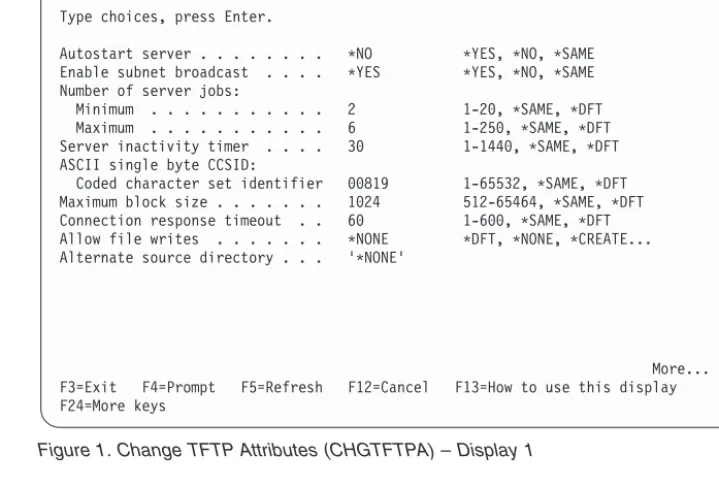
TochangetheTrivialFileTransfer Protocol(TFTP)serverattributes,usetheChangeTCP/IPTFTP Attributes(CHGTFTPA) command.
Thefollowingaretwodifferentwaystogettothis commandprompt: v
SpecifytheCHGTFTPAcommand.
v Selectoption3 ontheConfigureTCP/IPApplications(CFGTCPAPP) display.
Note: Youmust have*IOSYSCFGspecialauthoritytomakechanges totheTFTPattributeswiththe
Server
ports
and
client
ports
TheTrivialFileTransferProtocol(TFTP)serverusesasubnet-directedbroadcastaddressasthe destinationaddress.
Italsousesawell-knownportastheportofdatagramssenttoclientsthathaverequestedthesubnet broadcastoption.Theclientslistenforandreceivedatagramsonthewell-knownport.Thekeyword for thewell-knownportissubntbcst_tftp,and itsdecimal valueis247.
TheTFTPserversendssubnet-directedbroadcastdatagrams toclientsthatrequestthesubnet broadcast option.ThesourceportsfromwhichtheTFTPserversendsthesedatagramsdo nothavetobe unique. Theycanbearbitrarily allocated.
Someroutersfilterorblocksubnet-directedbroadcastdatagrams.Insupportof routerfilters,youcan definerestrictedports fortheQTFTP profile.Ifyoudefinerestrictedports fortheQTFTP profile,the TFTPserverusesonlythedefinedrestrictedportsasthesourceportsforthesubnet-directedbroadcast datagrams.Networkadministratorsdefinerouterfilteringrulestoallowsubnet-directedbroadcast datagramstopassthrough routerfiltersbased onthesourceportof subnet-directeddatagramsbeingone oftherestrictedportsdefinedfortheQTFTPprofile.
TFTP
Transfer
Size
option
ByusingtheTransferSizeoption,theclientcandeterminehow muchdataistransferredona read request(RRQ).
Change TFTP Attributes (CHGTFTPA)
Type choices, pressEnter.
Autostart server .. . . *NO *YES, *NO, *SAME
Enable subnet broadcast . . . . *YES *YES, *NO, *SAME
Number of server jobs:
Minimum . . . .. . . 2 1-20, *SAME, *DFT Maximum . . . .. . . 6 1-250, *SAME, *DFT
Server inactivitytimer . . . . 30 1-1440, *SAME, *DFT
ASCII single byteCCSID:
Coded characterset identifier 00819 1-65532, *SAME, *DFT
Maximum block size. . . 1024 512-65464, *SAME, *DFT
Connection responsetimeout . . 60 1-600, *SAME, *DFT
Allow file writes . . . *NONE *DFT, *NONE, *CREATE...
Alternate source directory. . . ’*NONE’
More...
F3=Exit F4=Prompt F5=Refresh F12=Cancel F13=How to use this display
F24=More keys
Figure1.ChangeTFTPAttributes(CHGTFTPA)–Display1
Change TFTP Attributes (CHGTFTPA)
Type choices, pressEnter.
Alternate targetdirectory . . . ’*NONE’
Figure2.ChangeTFTPAttributes(CHGTFTPA)–Display2
Thisisusefulforrequestingasubnet broadcastofa file.Theclientfindsthesizeofthebufferitneedsin ordertostorethefileinmemory.Drawingfromthisblocksize,theclient determinesthenumber of blocksforthetransfer.Thenumberofblocksishelpfulinformationfor trackingtheblocksthathavebeen received.Youcanalsouseit forthelastblockacknowledgment(ACK),whichmustbe senttoenda transfernormally.WithouttheTransferSizeoption,determiningthesizeandthelastblockofthetransfer requirestheclienttowait forablocktobereceivedthatissmallerthantheblocksizeofthetransfer. Note: For filestransferredinnetasciimode, thisoptionmight notbe asusefulif youare convertingthe
dataduring thetransfer inaway thatchangesitssize.Also,thesystemmight requireadditional processingtimetodeterminethetransfersize duetoconversionofthefiletotheappropriate coded characterset identifier(CCSID).
TFTP
Subnet
Broadcast
option
Broadcaststormsareaperformance problemthatmight occurwhenlargenumbersofsystemsstartfrom thenetwork.TrivialFileTransferProtocol(TFTP)SubnetBroadcastoptionhelpssolvethisproblem. Thesebroadcaststormsoccur whenlargenumbersofclients requesttheir bootcodeatthesametime. Whenhundredsofsystemsarestarted,thesamedatamustbe routedthrougheachhopinthenetwork betweeneachsystemandtheTFTPserver.
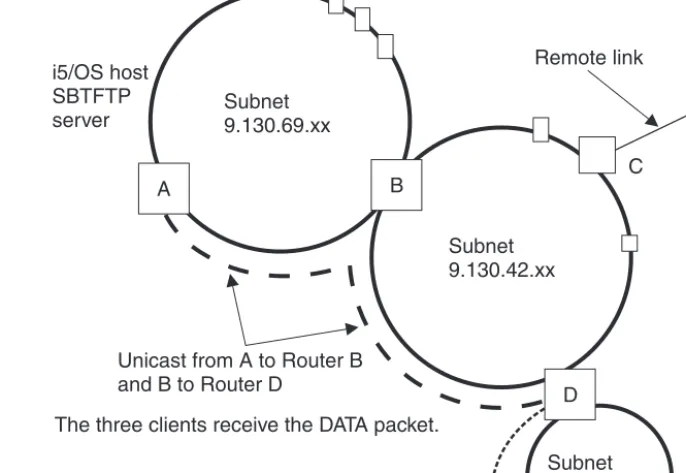
TheTFTPSubnetBroadcastoptionallows theservertobroadcasttheboot codetosystemsona subnet basis.Using subnet-directedbroadcast,SubnetBroadcastdatapacketsaretransmittedbetweenrouters untiltheyreachthesubnetonwhichthesystemsreside.Thepacketstransmissionisunicast.Atthis point,therouterat thedestinationsubnet broadcaststhedatapacketstothesystemsonthesubnet. Disinterestedhostsonthesubnetthrowthedatapacketsaway.Thepacketsaretypicallythrownawayby thehost’sIPlayerafter itdeterminesthatnoapplicationsare interestedinreceivingdataontheportto whichthebroadcastwas directed.SeeFigure3 onpage5foranillustrationofa subnet-directed
broadcast.Thissolutioncandrasticallyreducethenetworktrafficaswell asthetimethatittakesmany systemstostart (whenstartingsimultaneously).
TheTFTPSubnetBroadcastoptionenablesclientstojoina broadcastingfilegroup.Italsoallowsclients toreceiveall subsequentblocksfora fileuntil theclient becomesthemasterclient.Aclientbecomesthe masterclientwhenitreceivesanOptionAcknowledge(OACK)packetfromtheTFTPserverthat indicatesthatitisthemasterclient.Aclientmustkeeptrackofblocksthatitreceives.Aftera client becomesthemasterclient,it canrequesttheblocksthatithasnotreceived. Themasterclientrequests blocksbysendingACKpacketsthatincludetheblocknumber oftheblockbefore theblockthatthe masterclientrequires.For example,iftheclientwantsblock5, itsendsanACKwith ablocknumberof 4.
Whena clientreceivesanOACKpacketthatindicatesthatit isthemasterclient,theclientmustsendan ACKthatrequeststhefirstblockitrequires.From thenon,theclientmustrequestblocksinascending, butnotnecessarilyconsecutiveorder.AmasterclientcontinuestosendACKpacketstotheserverto indicatethenext blockthatit requires.Whenthemasterclientreceivesall oftheblocks itrequires,it sendsanACKwith thenumber ofthelastblockonthefilebeingtransferred.Aftertheserverreceivesan ACKwiththelastblocknumberofthefilebeingtransferred,thetransfertotheclientsendingtheACKis consideredcomplete.AclientcanstopitstransferatanytimebysendinganACKforthelastblockorby sendinganError(ERR) packet.Aclientcanendthistransfer regardlessofwhetherit isthemasterclient. Note: ThisTFTPSubnetBroadcastoptionisdesignedtoimprovesimultaneous transferoflargefilesto
multiple clientsonacommon subnet.Thisoptiondoesnothelpwith filesthatrequireonlyafew blockstotransfer orsingleclienttransfers.
Client-to-server
TFTP
Read
Request
options
Thisinformationincludestheclient-to-serverTrivialFileTransferProtocol(TFTP)ReadRequestoptions anda descriptionoftheiruse.
ToviewthestandardTFTPrequestparametersand theirmeanings,refertoInternetRequestfor Comments(RFC)1350.FormoreinformationabouttheTFTPoptions,seeRFCs1782,1783,and1784. InternetRFC2090describestheTFTPmulticastoption,whichhassomesimilaritiestotheSubnet Broadcastoption.However,theTFTPMulticastoption isnotsupportedatthistime. TheTFTPMulticast optionRFCismentionedhereasareferencetohelp understandtheSubnetBroadcastoption.
Hereisalistofsupportedoptionsandtheirdescriptions: blksize
Null(0h)terminatedkeywordblksize thatisfollowedbytherequestedblocksizeand represented asanull-terminatedASCIIstring.Thisoptionrequestsablocksize fortherequestedfiletransfer insteadofusingthedefaultof 512.
sbroadcast
Null-terminatedkeywordsbroadcastthatisfollowedbythesubnetmaskofthesubnet towhichthe clientisconnected.Thisoptionindicatesthattheclientwantstoparticipateina subnet-directed broadcastgroup.Thesubnetmaskthatisincludedwiththisoption isusedwiththeclient’sIP addresstodeterminetheclient’ssubnetaddress.
tsize
Null-terminatedkeywordtsizethatisfollowedbya null-terminatedASCIIrepresentationof0 (30h). Thisoption isa requestfortheservertoreturnthefilesizeinan OptionAcknowledgment(OACK).
Related reference
Figure3.Exampleofbroadcastingoversubnets
“Server-to-clientTFTPoption acknowledgment”
TheTrivialFileTransfer Protocol(TFTP)serversendsanoptionacknowledgment(OACK)toaclient inresponsetoeithera readrequestorawriterequestthatincludesadditionalTFTPoptionsas describedinclient-to-server TFTPReadRequest(RRQ)options.
Server-to-client
TFTP
option
acknowledgment
TheTrivialFileTransferProtocol(TFTP)serversendsan optionacknowledgment(OACK)toaclientin responsetoeither areadrequestora writerequestthatincludesadditionalTFTPoptionsasdescribedin client-to-serverTFTPReadRequest(RRQ)options.
AnOACKthattheserverssendsinresponsetoa transferrequestincludesonlyresponsestorequested optionsthattheserversupports.Theservercanalso sendanOACKtoa clientsubsequentlytothestart ofasubnet broadcasttransfer.Thisisdonetoindicatetotheclientwhetheritisthemasterclientina subnetbroadcastfilegroup.An OACKpacketthattheserversendssubsequentlytothestart ofasubnet broadcasttransferincludesthesbroadcastoption.
Hereisalistofsupportedoptionsandtheirdescriptions: blksize
Null(0h)terminatedblksizekeyword thatisfollowedbytheblocksizethatisusedforthisfile transfer.Itisrepresentedasa null-terminatedASCII string.Thisistheresponsetoa requestedblock size,andthevaluereturnedherecanbelessthantherequestedblocksize.Theserverdeterminesthe blocksize forthetransferbasedontherequestedblocksize,themaximumconfiguredblocksize,and possiblythesubnetbroadcasttransfersthatarealreadyinprogress.
sbroadcast
Null-terminatedsbroadcastkeywordthatisfollowedbyanull-terminatedASCIIstringthatincludes thefollowingfields separatedbycommas:
port
TheASCIIrepresentation oftheportto whichthesubnet-directedbroadcastdatagramsare broadcast.Thisisthewell-knownportthatisregisteredwiththeInternetAssignedNumber Authority(IANA)with thekeyword ofsubntbcst_tftpandadecimal valueof247.Thisfield mightbe emptyinOACKpacketsthattheserversendssubsequentlytothestartof asubnet broadcasttransfer.
sbid
TheASCIIrepresentation ofa decimal number thatiscalled thesubnetbroadcast identifier. Possiblevaluesare0through 4294 967295 (FFFFFFFFh).Thisisusedalongwith theserver sourceporttodetermineif asubnet-directedbroadcastdatagramispart ofarequestedtransfer. Thisfieldcanbe emptyinOACKpacketsthattheserversendssubsequentlytothestartof a subnet-basedbroadcast transfer.
mc
ThisiseitheranASCII(31h)1orASCII0(32h)toindicatetotheclientwhetherit iscurrentlythe masterclient.Avalueof1 indicatesthattheclientisthemasterclient,anda valueof0 indicates thattheclientisnotthemasterclient.
InresponsetoanOACK,themasterclientmustsendanACKtotheserver.Themasterclientsets theblocknumberin thisACKtothenumberof theblockbeforethefirst blockthatisrequiredby themasterclient.
Themasterclientacknowledgessubnet broadcastdata(BDATA)packetsbysendinganACKto theserver.Themasterclientsetstheblocknumber inthisACK totheblockbeforethecurrent blockthatthemasterclientrequires.
Clientsthatarenotindicatedasbeingthemasterclientrespond toanOACKpacketwith anACK thathastheblocknumbersettozero.
Note: TheblocknumberinACKpacketsisthe2-bytebinaryrepresentation ofthenumber in
networkbyteorder. tsize
Thenull-terminatedtsizekeyword thatisfollowedbythenull-terminatedASCIIrepresentation of thedecimal numberthatrepresentsthefilesizeoftherequestedfile.Theclient usesthis information toensurethatithasenough spacetostorethefileandtodeterminethelastblocknumberofthefile. Note: Theclientcanalsodeterminethefilesizeandlast blockofa transferwhenit receivesa block
thatcontainsless datathantheblocksize.
Related concepts
“Client-to-serverTFTPReadRequestoptions”onpage5
Thisinformationincludestheclient-to-serverTrivialFileTransfer Protocol(TFTP)ReadRequest optionsanda descriptionoftheiruse.
Server-to-client
broadcast
data
packets
Thisinformationexplainsthefieldsin abroadcastdata(BDATA)packetindetail. block#
2–bytebinarynumber inthenetworkbyteorderthatindicatesthenumber ofaparticularblockof data.
sbid
4–bytebinarynumber inthenetworkbyteorderthatiscalledthesubnetbroadcastidentification.This mustbe comparedwiththesbidthatwasreturnedintheOACKresponsetoa readrequest(RRQ) withtheSubnetBroadcastoption.Alongwith thesourceport,thisuniquely identifiesa Subnet BroadcastFileTransfer.ThesourceportoftheBDATApacketmust becompared withthesourceport oftheinitialOACKpacketthatwas receivedforthis transfer.OnlyBDATApacketsthatmatchon boththeSBIDandsourceports areconsideredpart oftherequestedtransfer.AllotherBDATA packetsmustbeignored.
data
Thisisthedataforthisblockofthefiletransfer. Withtheexceptionofthelastblockofthefile,the sizeofthedataisequaltotheblocksizeforthetransfer.Thelastblockofthefilemust belessthan theblocksize,evenifitmeansthatthelengthofthedatainthelastblockiszero.However, the servermightnotbedonebroadcasting blocksafterthelastblockofthefileisbroadcast.Controlcan betransferredto anotherclientinthesubnet broadcastfilegroupthathasnotyetreceivedallthe blocksinthefile.
Exit
points
for
controlling
TFTP
server
Anexit pointisaspecific pointintheTrivialFile TransferProtocol(TFTP)programwhere controlcan passtoanexitprogram.Anexit programisaprogramtowhichtheexitpointpassescontrol.Withtheuse ofexitprograms,theexperiencedprogrammercancreatecustomizedprocessingwhenanapplicationis running.
IftheTFTPserverfindsa programregisteredtoone oftheexit pointsforthesystem,itcallsthat programusingparametersthataredefinedbytheexitpoint.
Foreachexitpoint,thereisan associatedprogramminginterface,calledanexit pointinterface.Theexit pointusesthisinterfacetopassinformationbetweentheTFTPapplication andtheexitprogram. Each exitpointhasa uniquename.Eachexitpointinterfacehasanexitpointformatnamethatdefineshow informationispassed betweentheTFTPapplicationand thecustomer-written exitprogram.
Differentexitpoints canshare thesame exitpointinterface.Whenthis isthecase,multiple exitpoints cancalla singleexitprogram.
Toallowtheexitprograms toworkproperly,youmustinstalland registeryourexitpointprograms.If yourprogramsare nolongerneeded,youmustproperlyremovetheexitpoint programstopreventtheir futurefunctioning.
Exit
point
performance
Thefollowingtablelistsexitpoints thatgiveyouadditional controlovertheTFTPserver.
Table1.TFTPexitpointandformat
TCP/IPexitpoint Application Exitpointformat Briefdescription
QIBM_QTOD_SERVER_REQ TFTP VLRQ0100 TheTCP/IPrequest
validationexitpoint providesadditional controlforrestrictingan operation.
Notes:
v Thesameinterface formatisusedforrequestvalidation fortheFile TransferProtocol(FTP)
client,FTPserver,REXECserver,and TFTPserver.Thisallowstheuseofoneexitprogramfor requestvalidationofanycombinationoftheseapplications.
v Thesameinterface formatisusedforserverlog-onprocessingfortheFTPserverandTFTP
serverapplications.Thisallowstheuseofoneexitprogramtoprocesslog-onrequestsforboth ofthese applications.
Related concepts
Appendix.
Notices
Thisinformationwas developedforproductsand servicesofferedintheU.S.A.
IBMmaynotoffertheproducts,services,orfeaturesdiscussedin thisdocumentinothercountries. ConsultyourlocalIBM representativeforinformationontheproductsandservices currentlyavailable in yourarea.AnyreferencetoanIBM product,program,orserviceisnotintendedtostateorimplythat onlythatIBM product,program,orservicemaybe used.Anyfunctionallyequivalentproduct, program, orservicethatdoesnotinfringeanyIBM intellectualpropertyrightmaybe usedinstead.However, itis theuser’sresponsibility toevaluateandverifytheoperationofanynon-IBMproduct, program,or service.
IBMmayhavepatentsorpending patentapplicationscoveringsubjectmatterdescribedinthis
document.Thefurnishing ofthisdocumentdoesnotgrantyouanylicensetothesepatents.Youcansend licenseinquiries, inwriting,to:
IBMDirectorof Licensing IBMCorporation
NorthCastleDrive Armonk,NY 10504-1785 U.S.A.
Forlicenseinquiriesregardingdouble-byte(DBCS)information,contacttheIBMIntellectualProperty Departmentinyourcountryorsendinquiries, inwriting,to:
IBMWorldTradeAsiaCorporation Licensing
2-31Roppongi3-chome,Minato-ku Tokyo106-0032,Japan
Thefollowing paragraphdoesnot applytotheUnited Kingdomoranyothercountrywheresuch provisionsareinconsistentwithlocallaw:INTERNATIONALBUSINESSMACHINESCORPORATION PROVIDESTHISPUBLICATION“ASIS”WITHOUT WARRANTYOFANYKIND,EITHEREXPRESS ORIMPLIED,INCLUDING,BUTNOT LIMITEDTO,THEIMPLIEDWARRANTIESOF
NON-INFRINGEMENT,MERCHANTABILITYORFITNESSFORAPARTICULARPURPOSE.Some statesdonotallowdisclaimerofexpressorimpliedwarrantiesincertaintransactions,therefore, this statementmaynotapplytoyou.
Thisinformationcould includetechnicalinaccuraciesortypographicalerrors.Changes areperiodically madetotheinformationherein;thesechanges willbe incorporatedinneweditions ofthepublication. IBMmaymakeimprovements and/orchangesintheproduct(s)and/or theprogram(s)describedin this publicationatanytimewithoutnotice.
Anyreferencesinthisinformationtonon-IBMWebsitesare providedforconvenienceonlyand donotin anymannerserveasanendorsementofthoseWebsites.Thematerials atthoseWebsitesare notpart of thematerialsforthisIBMproductanduseofthoseWebsitesisatyour ownrisk.
IBMmayuseordistributeanyoftheinformationyousupplyinanyway itbelievesappropriatewithout incurringanyobligationtoyou.
Licenseesofthisprogramwhowishtohaveinformationaboutitforthepurposeof enabling:(i)the exchangeofinformationbetweenindependentlycreated programsandotherprograms(includingthis one)and(ii)themutualuseoftheinformationwhichhasbeen exchanged,shouldcontact:
IBMCorporation
SoftwareInteroperabilityCoordinator,DepartmentYBWA 3605Highway52N
Rochester,MN55901 U.S.A.
Suchinformationmaybeavailable, subjecttoappropriatetermsandconditions, includinginsomecases, paymentofafee.
Thelicensedprogramdescribed inthisinformationandalllicensedmaterialavailablefor itareprovided byIBM undertermsoftheIBMCustomerAgreement,IBMInternationalProgramLicenseAgreement, IBMLicenseAgreementforMachineCode,oranyequivalentagreementbetweenus.
Anyperformance datacontainedhereinwasdeterminedinacontrolled environment.Therefore,the resultsobtainedinotheroperatingenvironmentsmayvarysignificantly.Some measurementsmayhave beenmadeondevelopment-levelsystemsand thereisnoguaranteethatthesemeasurements willbe the sameongenerallyavailablesystems.Furthermore,somemeasurements mayhavebeen estimatedthrough extrapolation.Actualresultsmayvary.Users ofthisdocumentshouldverifytheapplicabledatafortheir specificenvironment.
Informationconcerning non-IBMproductswasobtainedfromthesuppliersofthose products,their publishedannouncementsorotherpubliclyavailable sources.IBMhasnottestedthoseproductsand cannotconfirmtheaccuracyofperformance,compatibility oranyotherclaims relatedtonon-IBM products.Questionsonthecapabilitiesof non-IBMproductsshouldbeaddressedtothesuppliersof thoseproducts.
AllstatementsregardingIBM’sfuturedirectionorintentare subjecttochange orwithdrawalwithout notice,and representgoalsandobjectivesonly.
Thisinformationcontains examplesofdataandreports usedindailybusinessoperations.Toillustrate themascompletelyaspossible,theexamples includethenamesofindividuals,companies,brands,and products.Allofthese namesare fictitiousandanysimilaritytothenamesandaddressesusedbyan actualbusinessenterpriseisentirelycoincidental.
COPYRIGHTLICENSE:
Thisinformationcontains sampleapplication programsinsourcelanguage,whichillustrateprogramming techniquesonvariousoperatingplatforms.Youmaycopy, modify,anddistributethese sampleprograms inanyform withoutpaymenttoIBM,forthepurposesofdeveloping,using,marketingordistributing applicationprogramsconformingto theapplication programminginterfacefortheoperatingplatformfor whichthesampleprogramsarewritten.Theseexampleshavenotbeenthoroughly testedunderall conditions.IBM,therefore,cannotguaranteeorimplyreliability,serviceability,orfunction ofthese programs.
Eachcopyoranyportion ofthesesampleprogramsoranyderivative work,must includea copyright noticeasfollows:
©(yourcompanyname)(year).Portionsofthiscodearederived fromIBMCorp.Sample Programs.© CopyrightIBMCorp. _entertheyearoryears_.Allrightsreserved.
Ifyouare viewingthis informationsoftcopy,thephotographsandcolorillustrationsmaynotappear.
Programming
Interface
Information
ThisTFTPpublicationdocumentsintended ProgrammingInterfacesthatallowthecustomertowrite programstoobtaintheservicesofIBMi5/OS.
| | |
Trademarks
ThefollowingtermsaretrademarksofInternationalBusiness MachinesCorporation intheUnitedStates, othercountries,orboth:
i5/OS IBM IBM (logo) iSeries System i
Othercompany,product,andservicenamesmaybe trademarksorservicemarksofothers.
Terms
and
conditions
Permissionsfortheuseofthesepublicationsisgrantedsubjecttothefollowingtermsand conditions. PersonalUse:Youmayreproducethesepublicationsforyourpersonal,noncommercialuseprovidedthat allproprietarynoticesarepreserved.Youmaynotdistribute,displayormake derivativeworksofthese publications,oranyportionthereof,withouttheexpressconsentofIBM.
CommercialUse:Youmayreproduce, distributeanddisplaythesepublicationssolelywithinyour enterpriseprovidedthatall proprietarynotices arepreserved.Youmaynotmakederivativeworks of thesepublications,orreproduce, distributeordisplaythesepublicationsoranyportionthereofoutside yourenterprise, withouttheexpressconsentofIBM.
Exceptasexpresslygrantedinthispermission,nootherpermissions,licensesorrightsare granted,either expressorimplied, tothepublicationsoranyinformation,data,softwareorotherintellectualproperty containedtherein.
IBMreservestherighttowithdraw thepermissionsgrantedhereinwhenever,initsdiscretion,theuseof thepublicationsisdetrimentaltoitsinterestor,asdeterminedbyIBM,theaboveinstructionsare not beingproperlyfollowed.
Youmaynotdownload, exportorre-exportthis informationexceptinfullcompliancewith allapplicable lawsand regulations,includingallUnitedStatesexportlawsandregulations.
IBMMAKESNOGUARANTEEABOUTTHECONTENTOF THESEPUBLICATIONS.THE PUBLICATIONSAREPROVIDED″AS-IS″ANDWITHOUTWARRANTY OFANYKIND,EITHER EXPRESSEDORIMPLIED,INCLUDINGBUTNOT LIMITEDTOIMPLIEDWARRANTIESOF MERCHANTABILITY,NON-INFRINGEMENT,ANDFITNESSFORAPARTICULARPURPOSE.
Appendix.Notices
11
| | | | |