Technical Documentation
MX-2424
The MX-2424 is an incredibly revolutionary product bringing together 24 tracks of 24 bit audio, a 12 track 96kHz recording mode, full synchronization capabilities, complete editing, a graphical user interface, and advanced SCSI recording and back-up capabilities. Add to that the OpenTL playlist which offers direct read and write compatibility with other DAWs and digital sequencers, a host of affordable archive options, plus the rock solid reliability of TASCAM products and you've got a beastie of a
multitrack. Best of all, this recorder is priced within reach of the average musician.
• 24 Track, 24 Bit Hard Disk Recorder
• 12 Track Mode Allows 24 Bit / 96kHz High Resolution • Unlimited Virtual Tracks
• 100 Point Auto-Locator Built-In
• TL-Bus Provides Sample Accurate Lock of 32 MX-2424 Machines For Up To 768 Sample Accurate Tracks • Uses Macintosh™ and Windows™ Formatted Drives • Uses Sound Designer II and .WAV Format Audio Files • Built-In 9 Gigabyte Drive for Approximately 45 Minutes of Solid Record Time
• Front Panel Drive Bay Accepts Additional SCSI Drives, Removable Drive Carriers, or DVD-RAM for Back-up • Rear Panel SCSI Wide Port Allows Connection of More Target Media or DVD-RAM/Tape Back-Up Drives • Punch-In Port Accepts Alesis LRC for Transport Control
...and MUCH, MUCH MORE!!!
• 100MBit Ethernet Port For Interconnection with Computers for ViewNet GUI and Firmware Updates • Standard AES/EBU and SPDIF Ports With
Sample Rate Conversion
• SMPTE Time Code Generating and Chasing With In/Out/Thru Ports
• MIDI In/Out/Thru for MMC, MTC, MIDI Clock • Word Sync In/Out/Thru
• Video Sync In/Thru
• Optional Analog I/O Offers 24 Channels of High Quality 24 Bit / 96kHz A/D and D/A
• Optional AES/EBU Card Offers 24 Channels of I/O, and is Compatible With Bit-Split or Fast 96kHz • Optional TDIF and Lightpipe Multitrack Digital I/O • Optional RC-2424 Remote Control
PRODUCT OVERVIEW
Personal and Project Studios
Studios for hire are always under pressure to deliver state of the art sound quality on a shoe string budget. The MX-2424 brings aboard 24 tracks of 24 bit recording, plus a 12 track, 96kHz mode for the very best audio around. For time code applications, the MX-2424's time code chasing will keep accurate lock with any source. For flying audio tracks from verse to verse or compiling multiple takes into a single track, the on-board editing and unlimited virtual tracks will offer the ultimate flexibility. If you can't afford the remote, that's OK. You can access all of the recorder's functions from the front panel. If you still want to have a remote, you can use MMC from your sequencer or mixer, or plug in an Alesis LRC into the footswitch port for transport control. When moving projects between studios, total compatibility afforded by the OpenTL playlist with popular DAWs and digital sequencers make swapping projects to different platforms effortless. Plus, you can make
affordable, robust back-ups with DVD-RAM and tape drives.
Post Production
In many professional studios, the MX-2424's video sync and word clock ports are needed for advanced synchronization as well as digital studio integration. For users who need multiple machines, synchronizing multiple MX-2424s together can be done with a simple TL-Bus cable. Plus, the same GUI (ViewNet) application can be used to address up to 65,000 individual MX-2424 machines on a single network. ViewNet can also handle machine set-up through user friendly screens. These machine set-up screens can also capture "profiles," so different studio set-ups can be stored for later use. Even better, these profiles can be broadcast to multiple machines simultaneously, saving a lot of repetitive motion.
If you need 9-pin control, or want to achieve sample accurate lock between the MX-2424 and DTRS machines and/or ADATs, TASCAM's TL-SYNC will handle that and more. TL-SYNC also has an ethernet port on the back for profiles and set-ups on a computer.
Hard disk recording technology is something that takes a serious investment in time and engineering. Plus, it takes real world testing to make sure the system is reliable and ready for the mass market.
The MX-2424 is based on the TASCAM's MMR-8 film dubbers that have been in service since 1998. While you may not be familiar with these machines, you are familiar with what they have done and who is using them. The MMR line has been installed in numerous film and television production houses, including Skywalker Sound, Disney, Universal Studios, and other busy studios around the world. When you take the MX-2424 into your studio, you are getting a recorder that has benefited from roughly a decade of investment in technology and many years of proven reliability in demanding studio environments.
PROVEN TECHNOLOGY
TASCAM's MX-2424 (top) and MMR-8 (bottom)
Shuttle/Scrub Wheel 100 Point Auto Locator Edit Function Keys Machine Status LED Matrix
MX-2424 OPERATIONS
The MX-2424 is very easy to operate. The front panel and remote allow you to run the MX-2424 just like a reel to reel machine during tracking, yet still offers the editing features typically associated with advanced hard disk recorders. A great deal of effort has gone into making this interface accessible to the analog veteran, yet flexible enough for the editing power user.
Standard tape functions will make tracking a breeze. Large, solid transport buttons allow the user to watch the talent, and not have to focus on locating the buttons. A dedicated matrix for input select and track arming keys, as well as "Select All" and "All Safe" functions make quick work of track status for overdub sessions. The 100 point auto locator makes project navigation a breeze. Plus, the Shuttle/Scrub wheel allows scrubbing of the audio just like scrubbing a reel of tape for easy location of really tight edit points.
A machine set-up LED matrix gives complete indications of recording and time code status. Dedicated lights will show sample rate, time code frame rate, bit depth of recorded tracks, the format of the hard drive (Mac or PC), plus separate time code status for Word Clock, time code in, and TL-BUS Status. This efficient, yet complete matrix allows you to know exactly what the MX-2424 is configured for without looking at any menus. This is a tremendous time saver when setting up or troubleshooting.
Editing is made easy. With 100 levels of undo, you can feel free to experiment with different versions without fear of losing your original version.
Any edit you need to make is defined by an in and out point, and which track(s) you want the edit to affect. So, if you want to cut a vocal part out, place the in and out points around the part you want to remove, select that track for editing, then press clear. That's it.
Any editing function can be made in a way that affects the time line of the project (ripple editing), or they can keep the time spacing the same (static editing). For example, when cutting a part from a vocal track as mentioned in the
previous example, we want all the audio around that region to remain exactly where it was. However, if we were altering a drum loop, we may want all the audio after the edit point to meet up with the audio before the edit to avoid dead space. A simple example of this difference is Clear vs Delete. Clear removes the audio between the in and out points and replaces it with blank space, so the time line of the other events is not affected. However, Delete will remove any audio between the in and out points, and move all the audio after the edited region right up to the in point. Additionally, you can reference "sync points" when flying audio to perform "back-time" editing. When an edit is being made, the in and out point surround the audio you want to change. You can also create a marker within or outside of the audio region for the MX-2424 to line up the audio in the new point.
For instance, if you are adding a car crash to your audio, the crash is the event you want to line up. So, place the in and out around the entire effect, then set a marker over the crash itself. Then, play the audio back and stop where you want the crash to be, and "Sync Paste" the part in. The MX-2424 will automatically calculate the in and out points for you. These types of advanced editing features work extremely well for both music and video applications.
CLEAR DISCARD SPLIT COPY CUT LOCAL CUT PASTE SYNC PASTE INST SYNC INSERT OPEN IN NOW UNDO REDO INP 0 2 4 9 • • 16 -18-20 25 35 45 50 SIG SEL REC • • INP 0 2 4 9 • • 16 -18-20 25 35 45 50 SIG SEL REC • • INP 0 2 4 9 • • 16 -18-20 25 35 45 50 SIG SEL REC • • INP 0 2 4 9 • • 16 -18-20 25 35 45 50 SIG SEL REC • • INP 0 2 4 9 • • 16 -18-20 25 35 45 50 SIG SEL REC • • INP 0 2 4 9 • • 16 -18-20 25 35 45 50 SIG SEL REC • • INP 0 2 4 9 • • 16 -18-20 25 35 45 50 SIG SEL REC • • INP 0 2 4 9 • • 16 -18-20 25 35 45 50 SIG SEL REC • • INP 0 2 4 9 • • 16 -18-20 25 35 45 50 SIG SEL REC • • INP 0 2 4 9 • • 16 -18-20 25 35 45 50 SIG SEL REC • • INP 0 2 4 9 • • 16 -18-20 25 35 45 50 SIG SEL REC • • INP 0 2 4 9 • • 16 -18-20 25 35 45 50 SIG SEL REC • • SHTL JOG SCRUB CAPT EVENT NUDGE ERROR STATUS BUSY DISK MIDI 44100
SAMPLE RATETIME CODE RECORD MODESYNC
48000 PULL DOWN NON STD 2 X TRIM SETUP TEMPO NEW UNLOAD VIEW PROJ SCRUB 30 29.97 25 24 DROP 24-BIT TAPEMODE MAC AUTO INPUT PC SAMPLE LOCK CHASE LOCK MX SLAVE TC CHASE MX MASTER SMART CARD +/-0 1 2 3 7 8 9 4 5 6 CAPT CLEAR CANCEL STORE YES RCL NO SHIFT OUT IN FROM LOCATE TO LOOP ONLINE TC READER OFFSET NEXT PREV LENGTH LAST REH REC 1 2 3 4 5 6 7 8 9 101112 13141516 171819 202122 2324 24 23 22 21 20 19 18 17 16 15 14 13 12 11 10 9 8 7 6 5 4 3 2 1 MOUNT UNMOUNT EDIT ALL INPUT ALL ALL SAFE AUTO INPUT ALL RECSEL POWER MX-2424
Every studio is configured differently. Some people need analog I/O for interfacing with analog consoles or direct recording from mic preamps. Others need digital I/O for interfacing with digital consoles or transfers from MDMs (Modular Digital Multitracks) and DAWs (Digital Audio Workstations). Whatever your need, the MX-2424 can be configured to serve you.
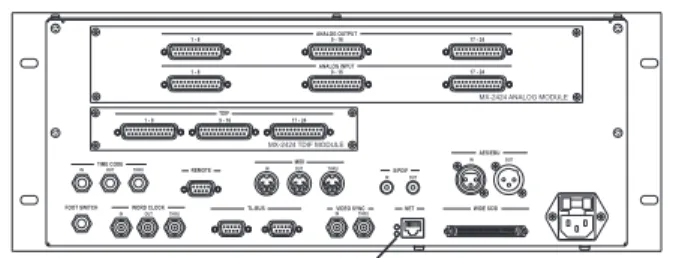
On the back panel of the MX-2424, there are two option slots. The top slot accepts the analog I/O card, and the bottom slot can accept any of the digital I/O cards. Digital cards are available in TDIF, Lightpipe, and AES/EBU formats. Note that analog and digital options can be installed and operated simultaneously.
Standard on every MX-2424 is an AES/EBU I/O and SPDIF I/O. For convenience, these have sample rate conversion built-in, so you can freely import any digital two track information directly into your project.
For the ultimate flexibility in a project, the analog card, digital card, and two track I/O's can all be used
The AN-2424 analog I/O option offers 24 channels of balanced I/O on DB25 connectors. All A/D and D/A converters are 24 bit, 96kHz.
Months of design and testing were dedicated to this card. Different capacitors were experimented with, high voltage power rails were installed, and lots of listening tests guided development of this I/O. It wasn't left to a theoretical oscilloscope experiment, this is first rate gear that will appeal to even the most die-hard analog aficionado.
The AE-2424 AES/EBU module was designed with extra features making the card not just an I/O, but also an
simultaneously. For instance, you can feed 8 channels of drum mics from a digital console into tracks 1-8, run a keyboard into the AES/EBU port to tracks 9-10, and lay down a vocal track fed from a mic preamp into the analog port of track 11, etc.. This kind of flexibility lets you focus on fulfilling the needs of your production, not figuring out the technical aspects of how to get there.
I/O CONFIGURATIONS
Digital I/O Option Slot Analog I/O Option Slot
Standard SPDIF and AES/EBU Ports w/ Sample Rate Conversion
I/O CARDS
AN-2424: 24 Channel Balanced Analog I/O
ANALOG OUTPUT 1 - 8 OUT THRU IN OUT THRU IN OUT THRU THRU IN OUT IN IN OUT IN 9 - 16 17 - 24 1 - 8 ANALOG INPUT9 - 16 17 - 24 TIME CODE FOOT SWITCH REMOTE TL-BUS WORD CLOCK MIDI S/PDIF AES/EBU WIDE SCSI NET VIDEO SYNC MX-2424 ANALOG MODULE 1 - 8 9 - 16TDIF 17 - 24 MX-2424 TDIF MODULE ANALOG OUTPUT 1 - 8 9 - 16 17 - 24 1 - 8 ANALOG INPUT9 - 16 17 - 24 MX-2424 ANALOG MODULE
TD-2424: 24 Channel TDIF I/O
LP-2424: 24 Channel Lightpipe I/O AE-2424: 24 Channel AES/EBU I/O
1 - 8
IN OUT IN9 - 16OUT IN17 - 24OUT
MX-2424 LIGHTPIPE MODULE
1 - 8 AES/EBU9 - 16 17 - 24
MX-2424 AES/EBU MODULE
1 - 8 9 - 16TDIF 17 - 24
MX-2424 TDIF MODULE invaluable session-saving tool. On board, you will find sample rate conversion on all 24 channels. Also, the AES/EBU card is capable of both popular forms of 96kHz communication. It
can use bit split high resolution (2 wire), or 96kHz fast (1 wire). Of course, there is also the TD-2424, a 24 channel TDIF interface, as well as the LP-2424, the 24 channel Lightpipe interface. These cards are fully compatible with other
TDIF and Lightpipe devices. These cards enable cost effective connections to digital consoles, or even simple digital transfers to other digital multitracks. This photo is for the analog buffs. The large
capacitors you see lined up just behind the front panel were the subject of months of listening tests. We double stacked the cards for maximum flexibility and better heat characteristics. Then, we added in some high voltage power rails, and what we came up with was a set of A/D and D/A that will stand up
to most any dedicated outboard converter units. Don't forget that these are all 24 bit, 96kHz A/D and D/A all the way through. We know
you are serious about your sound, so we didn't try to jam all the analog components on a little computer card. After all, if you're spending good money on mic preamps or a good analog console, you don't want to sell yourself short at the doorstep of your recorder.
HARD DRIVES & BACK-UP OPTIONS
A whole bunch of ones and zeros, that's what digital recording boils down to. All of those ones and zeros need to be stored somewhere. The MX-2424 was designed from day one to offer inexpensive storage solutions, while still offering top performance and flexibility.The MX-2424 ships with an internal 9GB high performance SCSI drive. This internal drive is totally dedicated to audio; there is no firmware or operating system stored on this drive. If you want to replace it with a larger one, you can do so easily.
Additional devices can be installed in the front panel drive bay of the MX-2424, or they can be connected to the rear panel SCSI port. (A list of approved drives is available on the TASCAM web site.)
If you are in a busy studio where you need to move projects in and out quickly, or if you will want to take the drive out of the MX-2424 and mount it on a computer frequently, the Kingston Rhino Jr carrier might be the way to go. The Rhino Jr offers a protective carrier that can slide into a receiver to swap drives around. The Rhino Jr system also uses a quiet push-pull fan system to keep the drives cool in demanding situations. These drive sleds make swapping drives very simple, and they offer some protection to the drive while being carried
around. The front panel has LED indicators for drive activity and SCSI ID number, plus a lock to prevent accidental removal.
Also, since the MX-2424 uses standard Macintosh and Windows formatted drives, you can move the drive from the MX-2424 to the computer platform of your choice, and you can use any back-up media you choose. For many home users, the best option may be to take the internal drive out of the MX-2424, install it in a Rhino Jr carrier, and move it between the MX-2424 and the computer. (Remember, the MX-2424 does not need the internal hard drive for the operating system or firmware.)
and perform to the specifications of the added drive. (Using non-LVD SCSI drives negates the added flexibility of the LVD standard, but this backwards compatibility really helps those who already made an investment in a collection of drives.) For those who have SCSI Narrow drives, the MX-2424 can also identify and use SCSI narrow drives with the appropriate terminations. For detailed information on SCSI terminations, go to the MX-2424 users group on the TASCAM web site: http://www.tascam.com/mx2424usersgroup/
If you are simply trying to archive projects, the MX-2424 directly supports DVD-RAM and Data Tape systems. These systems offer very inexpensive media, and increased product longevity. In fact, DVD-RAM disks are rated with a shelf life of at least 30 years.
The MX-2424 utilizes LVD Ultra 2 SCSI protocol. LVD stands for Low Voltage Differential. LVD enhances your SCSI performance by using common mode noise rejection; that's the same principle that balanced audio lines to offer improved performance and much longer cable runs. This hot-rodded SCSI bus can deliver data bursts of up to 80 MB/sec, accepts up to 15 devices on the bus, and allows bus lengths of up to 40'. If your hard drive is noisy, run a long SCSI cable down the hall. It won't affect the MX-2424's performance at all!
If you have existing SCSI drives that are not LVD equipped, the SCSI bus will accept your older drives
Kingston Rhino Jr Removable Drive Carriers allow users to swap drives quickly and safely. Systems like these have been in use in busy graphic houses, data centers, and professional studios for some time. (Internal kit shown.)
Rhino Jr Sled Front Panel
DVD-RAM offers an inexpensive, durable back-up solution. Several major studios are using DVD-RAM as the back-up media of choice.
LVD SCSI
Either additional target drives or back up media can be installed in the front panel drive bay, or attached to the back panel SCSI wide port.
CLEAR DISCARD SPLIT COPY CUT LOCAL CUT PASTE SYNC PASTE INST SYNC INSERT OPEN IN NOW UNDO REDO INP 02 4 9• • 16-18-20 25 35 4550 SIG SEL REC • • INP 02 4 9• • 16-18-20 25 35 4550 SIG SEL REC • • INP 02 4 9• • 16-18-20 25 35 4550 SIG SEL REC • • INP 02 4 9• • 16-18-20 25 35 4550 SIG SEL REC • • INP 02 4 9• • 16-18-20 25 35 4550 SIG SEL REC • • INP 02 4 9• • 16-18-20 25 35 4550 SIG SEL REC • • INP 02 4 9• • 16-18-20 25 35 4550 SIG SEL REC • • INP 02 4 9• • 16-18-20 25 35 4550 SIG SEL REC • • INP 02 4 9• • 16-18-20 25 35 4550 SIG SEL REC • • INP 02 4 9• • 16-18-20 25 35 4550 SIG SEL REC • • INP 02 4 9• • 16-18-20 25 35 4550 SIG SEL REC • • INP 02 4 9• • 16-18-20 25 35 4550 SIG SEL REC • • SHTL JOG SCRUB CAPT EVENT NUDGE ERROR STATUS BUSY DISK MIDI 44100 SAMPLE RATETIME CODE RECORD MODESYNC
48000 PULL DOWN NON STD 2 X TRIM SETUP TEMPO NEW UNLOAD VIEW PROJ SCRUB 30 29.97 25 24 DROP 24-BIT TAPEMODE MAC AUTO INPUT PC SAMPLE LOCK CHASE LOCK MX SLAVE TC CHASE MX MASTER SMART CARD +/-0 1 2 3 7 8 9 4 5 6 CAPT CLEAR CANCEL STORE YES RCL NO SHIFT OUT IN FROM LOCATE TO LOOP ONLINE TC READER OFFSET NEXT PREV LENGTH LAST REH REC 1 2 3 4 5 6 7 8 9101112131415161718192021222324 24 23 22 21 20 19 18 17 16 15 14 13 12 11 10 9 8 7 6 5 4 3 2 1 MOUNT UNMOUNT EDIT ALL INPUT ALL ALL SAFE AUTO INPUT ALL REC SEL POWER MX-2424
SYNCHRONIZATION
The MX-2424 has a powerful array of synchronization features built in to handle most any situation. In many studio applications, the recorder's synchronization capabilities will not only empower the MX-2424 to chase timecode from other sources, but it can also correct problems from other devices in the studio.
If you need to lock up multiple MX-2424 recorders, the easiest and most accurate way to do that is through TL-Bus line.
With TL-Bus, you can achieve sample accurate lock of up to 32 MX-2424 machines, offering 768 tracks of sample accurate recording, editing, and playback. The TL-Bus will also keep all the machines locked when scrubbing audio, so when the scrub and shuttle transport activates, all 32 machines will march together like soldiers.
For times when you need to integrate with other recorders and players, SMPTE chasing and generating are standard on
the MX-2424. This is an area where the MX-2424 really shines.
Most DAWs and digital sequencers offer the ability to chase time code. But unless additional hardware is purchased, all these stations are doing is timing the start of the audio. From that point on, there is no clocking of the audio track to the time code. It is very similar to pressing a trigger on a sampler. This can cause serious drift on longer regions over time if you are locking to unstable sources.
The MX-2424 can actually derive a word clock from the incoming time code and reclock the audio. This way, no matter how long the audio regions get, the MX-2424 will keep your audio locked in time with video machines, two inch analog machines, or whatever you've got. The time code out of the MX-2424 can be used to broadcast time code if the MX-2424 is the master. It can also be used to generate an offset from incoming time code, or to re-shape deteriorated time code from old tapes. These additional features can keep a session on track that would have otherwise come to a screeching halt.
The time code thru port is hard wired to the time code in. This passes the incoming time code to another device without any delay. This is handy if you don't have a time code distributor or are simply adding one more device in the studio temporarily.
If you try to go from the time code in to the out on most recorders, the time code must pass through the time code engine. There, the engine processes the incoming time code, and regenerates the code for the output. This process of regenerating the time code induces what is called propagation delay. Each machine that is added to the line adds a little more delay which can create a noticeable problem with very few patches. The time code thru port avoids this problem by hard wiring the thru to the in, thereby avoiding the time code engine itself. MIDI ports are available for MMC
(MIDI Machine Control), MTC (MIDI Time Code) and MIDI Clock applications. This is handy for
users who want to use the MX-2424 with MIDI sequencers. You do not have to use a track for striping time code, and you don't have to buy an extra box to generate the code. It's all built in.
As an added bonus, the MX-2424 can also chase MIDI Time Code. Most professionals know that SMPTE is much more accurate than MTC and therefore would never suggest chasing MTC. At the same time, most professionals will remember sessions where they had to jerry-rig something. (This is especially true at the project studio level.) Think of this as insurance that you won't get stuck is a session where MTC is the only choice. The MX-2424 is the "yes-you-can" box. Word Clock in, out and thru are
available to help integrate the MX-2424 into larger digital environments. As with the time
code ports, dedicated in, out and thru ports are available for professional flexibility.
Video Sync is available for users working in post production for television and film for locking to blackburst. Dedicated in and thru ports are available for
capturing and passing the signal down the line.
MIDI ports allow the MX-2424 to respond to MMC (MIDI Machine Control), generate MIDI Clock, as well as generate and lock to MTC (MIDI Time Code.)
Video Sync is standard for video applications that require sync to blackburst.
Time Code IN, OUT and THRU ports can be used to generate and chase SMPTE time code, as well as regenerate degraded code and create offsets. Unlike many budget hard disk recording systems, the audio is constantly reclocked in reference to the time code, allowing the most accurate time code chase possible. Also, the THRU port is available for passing time code from the in port without any propagation delay. Word Clock IN, OUT and THRU are all on board to enable integration into larger digital audio environments.
TL-Bus allows sample accurate lock of up to 32 MX-2424s. Sample accurate lock applies not only for general play, but also when engaging the machines in shuttle and scrub for editing or scanning.
ANALOG OUTPUT 1 - 8 OUT THRU IN OUT THRU IN OUT THRU THRU IN OUT IN IN OUT IN 9 - 16 17 - 24 1 - 8 ANALOG INPUT9 - 16 17 - 24 TIME CODE FOOT SWITCH REMOTE TL-BUS WORD CLOCK MIDI S/PDIF AES/EBU WIDE SCSI NET VIDEO SYNC MX-2424 ANALOG MODULE 1 - 8 9 - 16TDIF 17 - 24 MX-2424 TDIF MODULE OUT THRU IN MIDI OUT THRU IN TIME CODE OUT THRU IN WORD CLOCK THRU INVIDEO SYNC TL-BUS
GRAPHIC USER INTERFACE (ViewNet)
the MX-2424. This makes moving from ViewNet to the MX-2424 and back an easy step.
Also, user profiles can be set-up for different projects, allowing you to load in the profile for a project, and broadcast it to all the machines at the same time. You truly only have to set up the machine once.
Virtual track management could not be easier than this. Browse your MX-2424 drives just like a hard drive. The once you've found the track you want to load into the machine, simply select the track you want to load it in at the bottom, and you're done!
System set-up is made easy with ViewNet. The screens are arranged in the same logical groupings as in ViewNet is a Graphical User Interface (GUI) that ships with the MX-2424. ViewNet is written in Java, so it will run on a Macintosh or Windows machine. The connection between the computer and the MX-2424 is a 100MBit ethernet connection, so standard ethernet hubs and cables can be used to make the links.
ViewNet is a wonderful tool offering a visual image of the audio on your MX-2424. ViewNet can be used to streamline editing functions, allowing on-screen manipulation of audio blocks. ViewNet also offers advanced machine set-up capabilities, as well as simplified virtual track management.
In multiple machine set-ups, a single ViewNet station can individually address all the machines in the network.
Up to 65,000 machines can exist on the same network. For busy studios, this centralized control of the entire network makes system administration easy. You can set-up machines from across the building, and do it all with user defined profiles.
Standard 100MBit Ethernet port is built in to the MX-2424
Time Code Registers show Current Playhead Position, Punch/Edit In and Out Points, and Capture Registers
Dedicated Edit Function Buttons
Edit Macro Functions store up to 99 steps for quick recall of repetitive edits.
Track Status indicates if tracks are armed for record or editing, or if the track is monitoring input. This icon takes you to the virtual track menu, allowing you to browse virtual tracks just like a normal hard drive. (After all, it is a normal hard drive.)
Network Menu shows all MX-2424 recorders connected on the network with their current status. You can select which MX-2424 to view from this list. (Up to 65,000 can be on the network at any time.)
Track Edit Screen shows all regions in the session on the given machine. The Track Edit Screen will display the region names, fades, and even break point automation.
Global View shows the entire project. This function makes navigating the project easy... simply click and drag across the area you want to see in the Track Edit Screen, and it will appear zoomed to fit your selection in the top screen.
Machine Status information is displayed at the bottom of the screen. This is helpful if the MX-2424 is not in a convenient line of sight. Transport Controls offer total control over the MX-2424. There is
even a slider to control the shuttle wheel for use in scrubbing audio.
ANALOG OUTPUT 1 - 8 OUT THRU IN OUT THRU IN OUT THRU THRU IN OUT IN IN OUT IN 9 - 16 17 - 24 1 - 8 ANALOG INPUT9 - 16 17 - 24 TIME CODE FOOT SWITCH REMOTE TL-BUS WORD CLOCK MIDI S/PDIF AES/EBU WIDE SCSI NET VIDEO SYNC MX-2424 ANALOG MODULE 1 - 8 9 - 16TDIF 17 - 24 MX-2424 TDIF MODULE
INDUSTRY STANDARD PLAYLIST - OpenTL
OpenTL stands for Open Track List. TASCAM has madethe playlist format written by the MX-2424 available to all the manufacturers of DAWs, digital sequencers, and other dedicated hard disk recorders. What this does is allows end users to freely create projects on a system that implements OpenTL, and move it to another station that supports OpenTL. Here's how it works: Every time you record audio on a hard disk recorder, each track of each take is stored in a sound file, typically a .WAV or Sound Designer II format. Since the audio is stored in random locations on the hard drive, the system must have a way to keep track of where the individual files go. This information is typically stored in a separate file called a Play List, Track List, or an EDL (Edit Decision List).
While all the workstations support the same audio file formats, just about every workstation uses proprietary play lists. In order to move files between hard disk recorders, each audio file must be individually put into place. This is an incredibly tedious process.
OpenTL changes all of that. By using software and hardware that support OpenTL, you can have simple plug-and-play compatibility between the MX-2424 and all the digital sequencers and digital audio workstations supporting the standard.
OpenTL actually goes beyond simple placement of files, but also supports automation moves on tracks, fades and crossfades, track names, and region names. We already have a number of companies signed on to support the OpenTL standard, and we are adding even more. For a complete up-to-date listing of companies supporting the OpenTL, format, check out the MX-2424 users group in the TASCAM web site at:
http://www.tascam.com/mx2424users/
Currently, the companies signed on to support OpenTL include Digital Sequencing companies like Steinberg, as well as DAW companies like WaveFrame and SADiE.
Playlist Explanation
5 sec 10 sec
1 Drums (L)
2 Drums (R)
3 Bass Guitar
7 Lead Vocal take 5
4 Synth Slides Synth Slides take 2
5 Crunch Guitars (L)
6 Crunch Guitars (R)
8 Oohs & Aahs Back-up Vocal 1
0 sec
Each track of each project can be made up of several separate audio files. The playlist keeps track of all the files, and where they are to play in the song. Below we have a very basic example of how a playlist represents the location of the audio regions in a project.
Each block in the above grid represents a section of audio in the project. For this file, a bare bones project would show the start of each file, track number, and location of the file to be played.
OpenTL play lists offer much more detailed information. OpenTL includes capabilities for sections of regions within the master audio file, track names, region names, level automation and fades. This extended capability greatly enhances smooth interaction between the MX-2424 and any other devices supporting the OpenTL standard.
Track 1 2 3 8 4 5 6 7 4 8
File Name & Disk Path
new_song/tracking/Drums (L).WAV new_song/tracking/Drums (R).WAV new_song/tracking/Bass_Guitar.WAV new_song/overdubs/Oohs_&_Aahs.WAV new_song/midi_parts/Synth_Slides.WAV new_song/tracking/Crunch_Guitars_(L).WAV new_song/tracking/Crunch_Guitars_(R).WAV new_song/overdubs/Lead_Vocal_take_5.WAV new_song/midi_parts/Synth_Slides_take_2.WAV new_song/overdubs/Back-up_Vocal_1.WAV Start 00:00:00:00000 00:00:00:00000 00:00:00:00000 00:00:00:38742 00:00:01:00473 00:00:03:27543 00:00:03:27543 00:00:04:19735 00:00:07:06485 00:00:07:07832
OMF stands for the Open Media Format. It was designed by Avid and Digidesign to allow file interchange between their various workstations. TASCAM will provide an application to convert OpenTL format play lists into OMF format so users can take advantage of direct file interchange between the MX-2424 and the popular workstations developed by Avid and Digidesign.
This application will be available online through TASCAM, and will be posted in the MX-2424 Users area of the web site. Currently, both Macintosh and Windows platform versions are planned.
One item to note about OMF... there are many versions of it. Avid and Digidesign occasionally change their OMF implementation to handle new proprietary information. Since the OMF standard changes frequently, we are not planning to incorporate the OMF interpreters inside the MX-2424.
The details of OpenTL and OMF translation will be made available with the introduction of the translating application. Introduction dates will be announced on the TASCAM web site in the MX-2424 Users Group shortly.
REMOTE CONTROL
While the front panel of the MX-2424 provides access to all of the functions inside the unit, you may still want control of the MX-2424 from across the room. The MX-2424 can be controlled remotely in several ways.
only have to learn one interface. However, the RC-2424 does have some additional features worth mentioning. Dedicated Editing Keypad - Our product design crew actually spent quite a bit of time on many different DAWs experimenting with tracking and editing functions. Editing on many systems proved cumbersome from a hardware point of view, which prompted the concept for this keypad. Large buttons for setting up and auditioning edits were added, and they were arranged in a logical fashion. The result is a layout that will allow you to burn right through edits whether it's cleaning up dialog tracks, or flying a vocal part to another chorus.
Multiple Machine Control - The MX-2424 can individually address up to six MX-2424s. Single button switching offers instant access to each individual machine for quick navigation. Select and Record Status LEDs for each of the six machines offer constant status information of the entire rig.
Macro Functions - The RC-2424 offers eight macro memories. Each one of these macros can store custom sequences of up to 99 keystrokes, allowing you to perform routine functions with the push of a button.
Total Control of the TL-SYNC - The TL-SYNC is TASCAM's next generation synchronizer. The RC-2424 is the primary remote control for the TL-SYNC as well, offering complete control of detailed synchronizer functions. See the TL-SYNC literature for more information about this.
FIRMWARE UPDATES
As with most other hard disk recorders, the MX-2424 will have firmware updates over time. TASCAM has made it incredibly easy to update your MX-2424. The firmware will be available for download from the TASCAM web site. Once you've downloaded the file, transfer it from your computer into the MX-2424 through the Ethernet port. If you don't have a computer to transfer the information into the MX-2424, then you can obtain a Smart Card from TASCAM which will have the new firmware updates. Simply slide into the Smart Card slot on the front panel. It's as easy as that. The first Smart Card ships with the MX-2424, so you'll always have a back-up as well.
The home and project studio will really appreciate the ability to plug an Alesis LRC into the footswitch port of the MX-2424 for basic transport control. For those using digital mixers or sequencers, MMC (MIDI Machine Control) will be a wonderful way to control the MX-2424 without buying any additional hardware. Of course, ViewNet has total control over an MX-2424 as well. If you can't decide which way to control your recorder, plug 'em all in! We also have a full featured remote designed for the MX-2424 called the RC-2424. The layout of this remote is almost identical to the front panel of the MX-2424 itself, and includes the 100 point auto locator, shuttle/scrub controls, all project management controls, and the LED matrix offering detailed readouts of the machine's information. Since it is so similar to the front panel, you
TASCAM's RC-2424 Remote Foot Switch port can accept TASCAM's
RC-30P punch-in pedal for hands free punch-in recording, or an Alesis LRC for transport control.
Smart Card Slot in front panel can be used for firmware updates. Also, software updates can be downloaded from the TASCAM web site, and loaded in directly through the Ethernet port on the back panel.
The Ethernet port connects to ViewNet, the graphic user interface which can control the MX-2424 through a network. The dedicated remote port can accept
TASCAM's RC-2424 remote, which duplicates all the front panel control.
MIDI ports allow standard MMC (MIDI Machine Control) from digital consoles and sequencers.
ANALOG OUTPUT 1 - 8 OUT THRU IN OUT THRU IN OUT THRU THRU IN OUT IN IN OUT IN 9 - 16 17 - 24 1 - 8 ANALOG INPUT9 - 16 17 - 24 TIME CODE FOOT SWITCH REMOTE TL-BUS WORD CLOCK MIDI S/PDIF AES/EBU WIDE SCSI NET VIDEO SYNC MX-2424 ANALOG MODULE 1 - 8 9 - 16TDIF 17 - 24 MX-2424 TDIF MODULE CLEAR DISCARD SPLIT COPY CUT LOCAL CUT PASTE SYNC PASTE INST SYNC INSERT OPEN IN NOW UNDO REDO INP 0 2 4 9 • • 16-18-20 25 35 45 50 SIG SEL REC • • INP 0 2 4 9 • • 16-18-20 25 35 45 50 SIG SEL REC • • INP 0 2 4 9 • • 16-18-20 25 35 45 50 SIG SEL REC • • INP 0 2 4 9 • • 16-18-20 25 35 45 50 SIG SEL REC • • INP 0 2 4 9 • • 16-18-20 25 35 45 50 SIG SEL REC • • INP 0 2 4 9 • • 16-18-20 25 35 45 50 SIG SEL REC • • INP 0 2 4 9 • • 16-18-20 25 35 45 50 SIG SEL REC • • INP 0 2 4 9 • • 16-18-20 25 35 45 50 SIG SEL REC • • INP 0 2 4 9 • • 16-18-20 25 35 45 50 SIG SEL REC • • INP 0 2 4 9 • • 16-18-20 25 35 45 50 SIG SEL REC • • INP 0 2 4 9 • • 16-18-20 25 35 45 50 SIG SEL REC • • INP 0 2 4 9 • • 16-18-20 25 35 45 50 SIG SEL REC • • SHTL JOG SCRUB CAPT EVENT NUDGE ERROR STATUS BUSY DISK MIDI 44100 SAMPLE RATETIME CODE RECORD MODESYNC
48000 PULL DOWN NON STD 2 X TRIM SETUP TEMPO NEW UNLOAD VIEW PROJ SCRUB 30 29.97 25 24 DROP 24-BIT TAPEMODE MAC AUTO INPUT PC SAMPLE LOCK CHASE LOCK MX SLAVE TC CHASE MX MASTER SMART CARD +/-0 1 2 3 7 8 9 4 5 6 CAPT CLEAR CANCEL STORE YES RCL NO SHIFT OUT IN FROM LOCATE TO LOOP ONLINE TC READER OFFSET NEXT PREV LENGTH LAST REH REC 1 2 3 4 5 6 7 8 9101112131415161718192021222324 24 23 22 21 20 19 18 17 16 15 14 13 12 11 10 9 8 7 6 5 4 3 2 1 MOUNT UNMOUNT EDIT ALL INPUT ALL ALL SAFE AUTO INPUT ALL REC SEL POWER MX-2424 CLEAR DISCARD COPY SPLIT CUT LOCALCUT MACRO THRU INOUT SELECT/RECORD STATUS PASTE SYNC PASTE INST SYNC INSERT OPEN IN NOW UNDO REDO +/-0 1 2 3 7 8 9 4 5 6 CAPT CLEAR CANCEL STORE YES RCL NO SHIFT OFFSET LAST NEXT LOCATEPREV LOOP ONLINE TC READER STATUS ERROR BUSY MIDI ROLLBACK SYNCP REF LENGTH LAST ALL REH REC CAPT IN OUT FROM TO MOUNT UNMOUNT RC-2424 SHTL JOG SCRUB CAPT EVENT NUDGE TRIM SETUP TEMPO NEW UNLOAD VIEW PROJ SCRUB EDIT ALL INPUT ALL 8 7 6 5 4 3 2 1 MAST T SYNC 6 5 4 3 2 1 F E D C B A ALL SAFE AUTO INPUT ALL REC SEL 24 23 22 21 20 19 18 17 16 15 14 13 12 11 10 9 8 7 6 5 4 3 2 1 ALL MX SYSTEM LOCK CHASE TSYNC 1 INPUT REC OVLD SEL 2 INPUT REC OVLD SEL 3 INPUT REC OVLD SEL 4 INPUT REC OVLD SEL 5 INPUT REC OVLD SEL 6 INPUT REC OVLD SEL 7 INPUT REC OVLD SEL 8 INPUT REC OVLD SEL 9 INPUT REC OVLD SEL 10 INPUT REC OVLD SEL 11 INPUT REC OVLD SEL 12 INPUT REC OVLD SEL 13 INPUT REC OVLD SEL 14 INPUT REC OVLD SEL 15 INPUT REC OVLD SEL 16 INPUT REC OVLD SEL 17 INPUT REC OVLD SEL 18 INPUT REC OVLD SEL 19 INPUT REC OVLD SEL 20 INPUT REC OVLD SEL 21 INPUT REC OVLD SEL 22 INPUT REC OVLD SEL 23 INPUT REC OVLD SEL 24 INPUT REC OVLD SEL 44100 SAMPLE RATETIME CODE RECORD MODESYNC
48000 PULL DOWN NON STD 2 X 30 29.97 25 24 DROP 24-BIT TAPEMODE MAC AUTO INPUT PC SAMPLE LOCK CHASE LOCK MX SLAVE b CHASE MX MASTER
FRONT AND BACK PANELS
SPECIFICATIONS
CLEAR DISCARD SPLIT COPY CUT LOCAL CUT PASTE SYNC PASTE INST SYNC INSERT OPEN IN NOW UNDO REDO INP 0 2 4 9 • • 16 -18-20 25 35 45 50 SIG SEL REC • • INP 0 2 4 9 • • 16 -18-20 25 35 45 50 SIG SEL REC • • INP 0 2 4 9 • • 16 -18-20 25 35 45 50 SIG SEL REC • • INP 0 2 4 9 • • 16 -18-20 25 35 45 50 SIG SEL REC • • INP 0 2 4 9 • • 16 -18-20 25 35 45 50 SIG SEL REC • • INP 0 2 4 9 • • 16 -18-20 25 35 45 50 SIG SEL REC • • INP 0 2 4 9 • • 16 -18-20 25 35 45 50 SIG SEL REC • • INP 0 2 4 9 • • 16 -18-20 25 35 45 50 SIG SEL REC • • INP 0 2 4 9 • • 16 -18-20 25 35 45 50 SIG SEL REC • • INP 0 2 4 9 • • 16 -18-20 25 35 45 50 SIG SEL REC • • INP 0 2 4 9 • • 16 -18-20 25 35 45 50 SIG SEL REC • • INP 0 2 4 9 • • 16 -18-20 25 35 45 50 SIG SEL REC • • SHTL JOG SCRUB CAPT EVENT NUDGE ERROR STATUS BUSY DISK MIDI 44100SAMPLE RATE TIME CODE RECORD MODE SYNC 48000 PULL DOWN NON STD 2 X TRIM SETUP TEMPO NEW UNLOAD VIEW PROJ SCRUB 30 29.97 25 24 DROP 24-BIT TAPEMODE MAC AUTO INPUT PC SAMPLE LOCK CHASE LOCK MX SLAVE TC CHASE MX MASTER SMART CARD +/-0 1 2 3 7 8 9 4 5 6 CAPT CLEAR CANCEL STORE YES RCL NO SHIFT OUT IN FROM LOCATE TO LOOP ONLINE TC READER OFFSET NEXT PREV LENGTH LAST REH REC 1 2 3 4 5 6 7 8 9 10 11 12 13 14 15 16 17 18 19 20 21 22 23 24 24 23 22 21 20 19 18 17 16 15 14 13 12 11 10 9 8 7 6 5 4 3 2 1 MOUNT UNMOUNT EDIT ALL INPUT ALL ALL SAFE AUTO INPUT ALL REC SEL POWER MX-2424 OUT THRU IN OUT THRU IN OUT THRU THRU IN OUT IN IN OUT IN TIME CODE FOOT SWITCH REMOTE TL-BUS WORD CLOCK MIDI S/PDIF AES/EBU WIDE SCSI NET VIDEO SYNC
FRONT PANEL DRIVE BAY
Accepts DVD-RAM, Fixed Drives, or Removable Drive Carriers
ANALOG I/O OPTION SLOT
Accepts AN-2424. (24 channel, 24 bit/96kHz analog I/O card)
DIGITAL I/O OPTION SLOT
Accepts TD-2424, LP-2424, or AE-2424
(TDIF CARD) (LIGHTPIPE CARD) (AES/EBU CARD)
Physical Tracks: Virtual Tracks:
Supported Sample Rates: Supported Bit Depths: Internal Drive: Record Time: Hard Drive Formats: Audio File Formats: Playlist Format: SCSI Bus Protocol: SCSI Bus Speed: Max Devices Supported: Max SCSI Bus Length:
24@48kHz, 12@96kHz 999 Freely Assignable
44.1kHz, 48kHz, 88.2kHz, 96kHz, plus pull up & pull down rates 16 bit, 24 bit (projects can support multiple bit depths)
9.1GB Quantum Atlas V Approximately 45 minutes 24 tk x 24 bit x 48kHz = 200MB/min Windows™ Format: Fat32
Macintosh™ Formats: HFS, HFS+ Broadcast Wave, Sound Designer II OpenTL
LVD Ultra 2 SCSI 80MB/sec maximum burst 15 if all devices are LVD 7 if any device is non-LVD 25 meters (82'), ≤2 LVD IDs 12 meters (39' 3"), ≤15 LVD IDs
Standard Digital I/O: Optional I/O Slots: TL-Bus Control: Time Code Ports: MIDI Ports: Functions: Word Clock Ports: Video Sync Ports: Footswitch Port: Remote Port: EtherNet:
More specifications will be available closer to the MX-2424 shipment date. 12 Track 96kHz mode and MIDI Clock will be implemented in software v2, which should be available approximately 120 days after the first shipment date of the MX-2424. (The upgrade will be a free download from the TASCAM Web site.)
AES/EBU & SPDIF I/O w/ Sample Rate Conversion
(1) Analog I/O Slot, (1) Digital I/O Slot Sample Accurate Lock of 32 Machines 1/4" TRS for IN / OUT / THRU 5 pin DIN for IN / OUT / THRU Generate SMPTE, MTC, MIDI Clock Chase SMPTE, MTC
Regenerate SMPTE, MTC
IN / OUT / THRU, Self Terminating BNC 75 Ohm IN / THRU, Self Terminating BNC 75 Ohm Accepts RC-30P punch-in pedal or Alesis LRC remote
Accepts RC-2424 Remote 100MBit - RJ45 Connection