A Project
Presented to the faculty of the Department of Computer Science California State University, Sacramento
Submitted in partial satisfaction of the requirements for the degree of
MASTER OF SCIENCE
in
Computer Science
by
Hetalben Laljibhai Savaliya SPRING
ii © 2015
Hetalben Laljibhai Savaliya ALL RIGHTS RESERVED
iii
A MOBILE APPLICATION FOR DATA WAREHOUSE COURSEWARE
A Project
by
Hetalben Laljibhai Savaliya
Approved by: __________________________________, Committee Chair Dr. Meiliu Lu __________________________________, Second Reader Dr. Du Zhang ____________________________ Date
iv Student: Hetalben Laljibhai Savaliya
I certify that this student has met the requirements for format contained in the University format manual, and that this project is suitable for shelving in the Library and credit is to be awarded for the project.
__________________________, Graduate Coordinator ___________________
Dr. Jinsong Ouyang Date
v Abstract
of
A MOBILE APPLICATION FOR DATA WAREHOUSE COURSEWARE by
Hetalben Laljibhai Savaliya
Data warehouse is the concept of data extracting from resources and made available for ad-hoc queries and report generation to enable business intelligent activities. Data warehouse is one of the most important parts of data mining.
The objective of this project is to provide an on-hand information to the beginning data warehouse designer to reinforce the key concept of data warehouse. Additionally this mobile application for data warehouse courseware will be a platform for students to find other related and useful information.
A mobile application for data warehouse also includes case study and quiz for better understanding of the data warehouse concept. Case study for finding restaurants is perfectly explained with interactive designs for each approaches of data warehouse. We use Yelp API for restaurant search data. Along with learning materials, this application does not required Internet connection for learning data warehouse. Only the case study requires the Internet connection.
In this courseware, we build the data warehouse systematically using four different demonstrations, which covers the topics of fundamentals, design principle of data mart
vi
prototype and data mart refinement, building an enterprise data warehouse using an incremental approach and aggregation. Each demonstration contains case study and quiz for generating result for the end users upon their request. The courseware is designed to be a supplementary part of CSC177: Data Warehousing and Data Mining at CSU Sacramento.
_______________________, Committee Chair Dr. Meiliu Lu
_______________________ Date
vii
ACKNOWLEDGEMENTS
I do take the opportunity to acknowledge and honor the contribution of my project advisor, Dr. Meiliu Lu for her support and guidance throughout the project. I thank her for providing benevolent direction, valuable suggestions and time worthy interactions. Her elaborated comments were beneficial throughout the project design and development.
My sincere thanks to Dr. Du Zhang for his detailed review and productive remarks on the project report. I also thank Dr. Jinsong Ouyang for his review and advice for the successful completion of this project.
Finally my special thanks and appreciation to my family and friends, without their love and support I could not complete this difficult endeavor.
viii TABLE OF CONTENTS Page Acknowledgements ... vii List of Figures ... ix Chapter 1. INTRODUCTION ...……….. 1 2. BACKGROUND ... 4
2.1 Purpose and Scope ... 4
2.2 Project Design and Development Process Overview ... 5
3. RESEARCH AND ANALYSIS ... 8
4. COURSEWARE DESIGN AND DEVELOPMENT ...10
5. DATA WAREHOUSE COURSEWARE IMPLEMENTATION ... 21
5.1 Data Mart Prototype ... 21
5.2 Data Mart Refinement ... 30
5.3 EDW: Enterprise Data Warehouse ... 36
5.4 Aggregation ... 42
6. EVALUATION ... 51
7. CONCLUSION ... 53
Appendix A. Web Service Introduction ... 54
Appendix B. Source Code ... 57
ix
LIST OF FIGURES
Figures Page
1. Figure 1. A KDD Process of Data Mining ………. 2
2. Figure 2. Use-Case Diagram of Data Warehouse Courseware ……..…………11
3. Figure 3. MVC Design Pattern in IOS ... ……… 12
4. Figure 4. Courseware Sitemap ……….………. 13
5. Figure 5. Launch Screen of Application ….……….………. 14
6. Figure 6. Data Warehouse Demonstrations ………....….………. 15
7. Figure 7. Demonstration Steps and Detail ….………16
8. Figure 8. Search Page for Demo ……….……… ... ………17
9. Figure 9. Demo Result Page ……….……… ... ………. 18
10. Figure 10. Sample Quiz Demo ... .……… 19
11. Figure 11. Sample Quiz Result .... ………... 19
12. Figure 12. Data Mart Prototype Steps... .……. … 22
13. Figure 13. Dimension Table: Location …….……… 26
14. Figure 14. Dimension Table: Restaurant ….………. 27
15. Figure 15. Fact Table for Restaurant Data Mart ………..……. 28
16. Figure 16. Star Schema for Restaurant Data Mart ….………29
17. Figure 17. New Dimension Table: Customer Geographic . ………. 32
18. Figure 18. Refined Fact Table ... 33
x
20. Figure 20. Demo Result after Refinement ... 35
21. Figure 21. EDW Steps ... 37
22. Figure 22. Review Table ... 39
23. Figure 23. Review Fact Table ... 40
24. Figure 24. EDW Star Schemas for Restaurant ... 41
25. Figure 25. EDW Steps for Aggregation ... 43
26. Figure 26. Dimension Table: Location ... 46
27. Figure 27. Dimension Table: Review ... 46
28. Figure 28. Aggregation Fact Table ... 47
29. Figure 29. Aggregation Star Schema ... 48
Chapter 1 INTRODUCTION
We are living in the world where large amount, Terabytes of megabytes [1], of data are collected daily from business, science and engineering, medicine and almost all other perspectives of our daily life. This explosive growing, widely available, gigantic body of data archives and rarely visited because a direct and complete understanding of these data has exceeds the human ability. As a result, important decisions are made based on decision maker’s intuition, which can harm the business. To automatically uncover the valuable information from the tremendous amount of data and to transform such a data into organized knowledge, we need powerful and versatile tools [1]. This necessity gives birth of data mining.
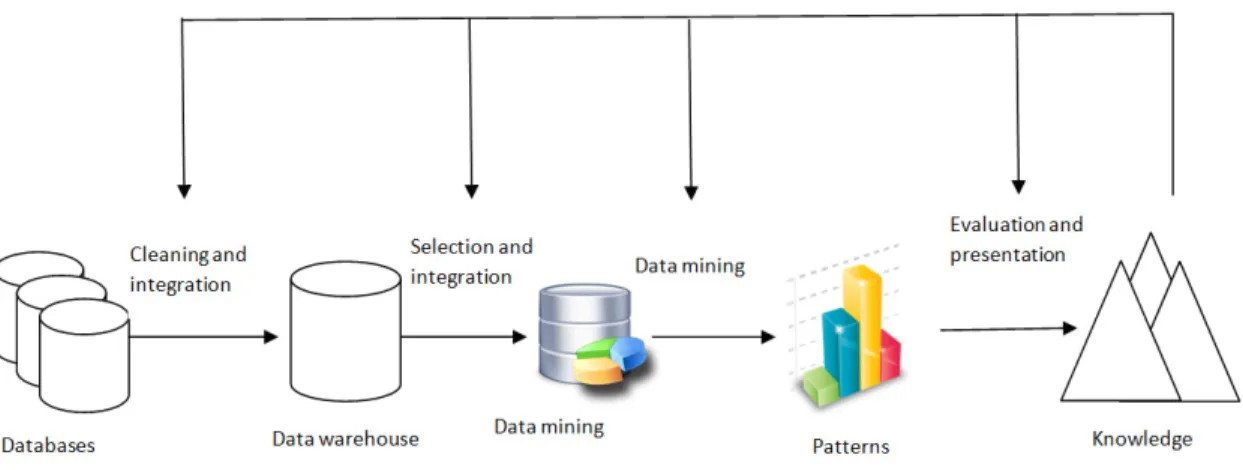
Data mining is the process of extracting data from different source of data and makes that data as a knowledgeable. Data mining process is also treated as a KDD (knowledge discovery) process, which includes the sequence of steps: Data cleaning, data integration, data selection, data transformation, data mining, pattern evaluation, and knowledge presentation. Figure 1 shows the steps of data mining.
Here the data cleaning, data integration and data transformation together work as data warehousing. Data warehousing is very important part in data mining. Data warehousing provides architectures and tools for business executives to systematically organize, understand, and use their data to make strategic decisions [1].
A data warehouse is designed for query and analysis rather than for transaction processing, and usually contains historical data derived from transaction data [2]. It also includes data from outside of database like internally developed systems, purchased applications, third-party data syndicators and other sources. This helps for organizations to take business decision-making activities, like, maintaining historical records, analyzing the data to gain a better understanding of the business and to improve the business, increase customer focus and many more [1, 2, 3].
A data warehouse is an Online Analytical Processing (OLAP) system [1, 4] that is vital to an enterprise for making business decisions and responding to analytical questions crucial for a business process. Hence, a data warehouse becomes more resourceful for a business process than the Online Transaction Processing (OLTP) systems [4].
In this project, we have developed a mobile application for data warehouse courseware to explain the systematic method for designing a data warehouse. Courseware word is the combination of “course” and “software” [3] and is widely used in education system all around the world as a trainer or a tutorial for students. This approach of study provides students with possibility of learning at their own pace. It provides with learning material and implementation examples to follow. Similarly, this project provides a quick learning toolkit for data warehouse. This application is an e-learning tool and will be supplemented into a course for a Computer Science, CSC 177: Data warehousing and Data Mining, in California State University, Sacramento as a supplementary material to the students.
Chapter 2 BACKGROUND
Data warehouse is a database designed to enable business intelligence activities: it exists to help users to understand and enhance their organization’s performance. Data warehouse is storage of historical data for a business, an experiment or any other enterprise. It consists of selectively extracted data from a primary source or any other source inter-related with the primary data [3]. It reduces the cost-per-analysis due to the simpler and standardized structures in contrast to the application databases.
In first chapter, we introduce concept and significance of data warehouse to the data mining and business process. In this chapter, we provide the comprehensive overview of project design and development process.
2.1 Purpose and Scope
Motivation for this project comes from my own experience while studying the course CSC 177: Data Warehousing and Data Mining at California State University, Sacramento. While studying this course, we have to implement term project on data warehouse. Reading the book was not enough for summarizing data warehouse process. There was already one courseware implemented by a previous student, which explains steps for designing data warehouse, but that application is browser dependent and required Internet connection to read. My friend and I were working on campus job and hoping if there is some way to read and understand without opening computer or internet connection, it would be helpful and convenient. This incident gives me idea to make
mobile application for explaining data warehouse with an interesting example, so student or beginners of data warehouse designer can learn anywhere anytime.
The purpose of the data warehouse is to provide aggregate data, which is in suitable format for specific decision-making.
The main purpose of the project is to provide on-hand information in your mobile for designing data warehouse to audience who is interested in learning concept of data warehousing. Additionally it serves as a platform for learning database concept.
2.2 Project Design and Development Process Overview
The courseware divides the topics for designing a data warehouse into four sections. Each section explains step-by-step process with example. There is also final demo of data warehouse progress after completing the each step to see the progressively view of resultant view.
Project starts with basic introduction about data warehouse, which includes the basic concept, and applications where data warehouse is useful, basic architecture and different data modeling techniques used in data warehousing process.
Section 1 explains how to identify the purpose and the requirements. This section also explains the information for selecting business process and implement basic data mart. This section helps the beginner to understand from where we should start data warehouse once we get data source. The second section helps to recognize the purpose of refining data mart and demonstrate the refining process using the previous section 1. The third demonstration shows the method of building an enterprise data warehouse using the
data mart design from the former section. This also explains how to merge different data mart together and get answer of multiple queries of business process. The fourth section, gives the idea of aggregation technique in amplifying the performance of the data warehouse.
In addition to the topic explanation, each section also includes case study of implementing data warehouse for restaurant search. Each demonstration provides interactive user sessions to generate summary reports as per the user specifications [10]. The idea of using case study is supported by Dr. Meiliu Lu, when I was proposing the project. She gives me idea of using interactive example which reader loves to read and easy to understand. Each restaurant has their own data and if some restaurants have multiple branches, then each branch has its own data. End user or marketing people needs all data together for better understanding of user interest and business progress to make future decision. Therefore, we realize that using a restaurant example is easy to explain and useful for end users for searching restaurant and finding people reviews in their daily life as well as helpful for marketing people to make business decision.
Restaurant search case study can helps to get answer of searching restaurants near 20 miles of current location or search using area name. The result gives information of restaurant location, contact number, food category and people review about resultant restaurants. We use Yelp APIs to get restaurant data source. For more detail about each restaurant, like map, direction, detail information about each reviews etc. are provided by redirecting to the yelp website [14].
Both courseware and sample implementations will be discussed in later chapters of this report. In next chapter, we will see what research has done during project design and development. Additionally I will present courseware coverage details in next chapter.
Chapter 3
RESEARCH AND ANALYSIS
Research and analysis are the most import part of any project and it took most of the time for implementing this project. Research includes market research, product usage research, product requirements, implementation and many more.
For making product successful, it is very important to research that who will use this product and how is the future of the product before start implementation [5]. So first, we understand why we need data warehouse and what future of data warehouse is. Based on current era of computer, data warehouse is very important in data analysis and in data mining process. Data warehouse is the foundation for any successful business intelligence. Although it cost money – big money, it delivers enhanced business intelligence, enhances data quality and consistency, saves time and provides historical intelligence. Today all big companies like Google, Apple, eBay, Walmart, Salesforce and many more use the data warehouse techniques [7]. Based on all these research we come to the point that the future of the data warehousing is bright. Therefore, if we make project, which includes basic information about data warehousing, it will helps lot of people who wants to develop their skills in the process data warehousing [13].
After finalizing the objective, I started the systematic process for implementing the project. As a first step, I decided the technology to use for this project. For mobile application, there are many different technologies are used in different smart phones like, Android, IOS or Window. Selecting the technology is very hard because people are using all three technologies equally. However, after searching the past analytics and my
technical skill, I decided to go with IOS technology. Next step was to finalize the case study example.
For case study dataset, I have read many articles and online video to understand the data warehouse concept and process. Then I did internet research for getting best datasets to understand data warehouse process. I was looking for the data set, which not only suits for the data warehouse concept but also should be easy to understand for beginners. After doing lot of research and professor’s help, I decided to go with nearby restaurants example. Accurate dataset for restaurants based on user’s current location was very hard and not available in internet. Therefore, I decided to go with yelp or Google restaurant data set. Doing more research on finding data set helps me to go with Yelp restaurant APIs, as this is easily available and flexible to implement.
For implementing this technology, I need to have knowledge of technology like, Objective C, JSON, PHP, MySQL, SQLite and Microsoft office [7, 11]. I was little familiar with all these technology, but only basic knowledge was not enough for implementing this project. Therefore, to get deep understanding of these technologies, I study with Stanford course videos and other related materials from internet.
My research paves the path towards my design and development phase. I concluded my research with list of topics required to include in courseware, data set and technology to use for this project. Next task is to come with courseware design and implementation steps.
Chapter 4
COURSEWARE DESIGN AND DEVELOPMENT
Courseware is computer based education software, which helps the students to self-learn. This online education material sharing system helps to distribute the knowledge to any corner of the world. Sometimes student or any technical people cannot go to college to attend the course and understand the new technology because either they are busy or cannot afford. Attending the course online is also very time consuming. While courseware is online and helps to understand the basics of technology, beginners get basic idea and help to decide their interest about the technology whether they want to deep dive into it or not. In addition, they can learn based on their convenience.
Idea here is to come up with something that helps student learn concept of data mining specially focused on data warehousing. Along with theoretical concept description of data warehouse process, some practical example and quiz is very helpful to understand. Considering this, I have included some examples and quiz for better understanding.
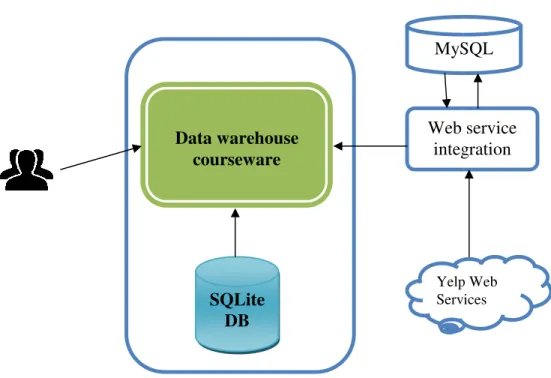
A courseware is implemented based on the principles of mobile application using IOs technology. This courseware is compatible to all IOS device including iPod, iPhone and iPad. To develop the IOS mobile application [13], I use Objective C as programming language, SQLite as database and Xcode IDE tool. For case study example, I use Yelp API and integrate with PHP to retrieve the restaurants data. Following figure 2 gives the top-level use case diagram of the application.
A mobile application is developed using MVC design pattern. MVC refers to three separate roles: Model, view and controller.
objects play in the application, it
Each of the three types of objects is separated from the others by abstract boundaries and communicates with objects of the other types across those boundaries
this modular architecture is that the separation of roles allows us to make modification easily and with fewer bugs.
development.
Model Object: Model
encapsulate the data specific to an application and define the logic and computation that manipulate and process that data
Figure 2. Use
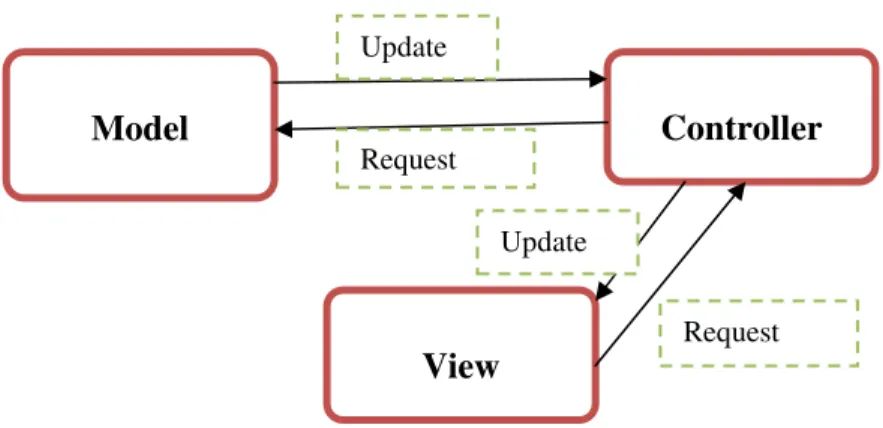
A mobile application is developed using MVC design pattern. MVC refers to three separate roles: Model, view and controller. The pattern defines not only the roles objects play in the application, it defines the way objects communicate with each other. Each of the three types of objects is separated from the others by abstract boundaries and communicates with objects of the other types across those boundaries [13
this modular architecture is that the separation of roles allows us to make modification easily and with fewer bugs. Figure 3 shows the MVC design pattern used in IOs
Model represents the data in your application.
encapsulate the data specific to an application and define the logic and computation that manipulate and process that data.
Data warehouse courseware SQLite DB Yelp Web Service Web service integration MySQL
Figure 2. Use-Case Diagram of Data Warehouse Courseware
A mobile application is developed using MVC design pattern. MVC refers to The pattern defines not only the roles defines the way objects communicate with each other. Each of the three types of objects is separated from the others by abstract boundaries and 13]. The beauty of this modular architecture is that the separation of roles allows us to make modification shows the MVC design pattern used in IOs
represents the data in your application. Model objects encapsulate the data specific to an application and define the logic and computation that
Yelp Web ervices Web service
integration MySQL
View Object: View object is the user interface. A major purpose of view objects is to display data from the application’s model objects and to enable the editing of that data. Controller Object: Controller object manages the communication between the view and model. It takes the data from the model and communicates it to the view for display.
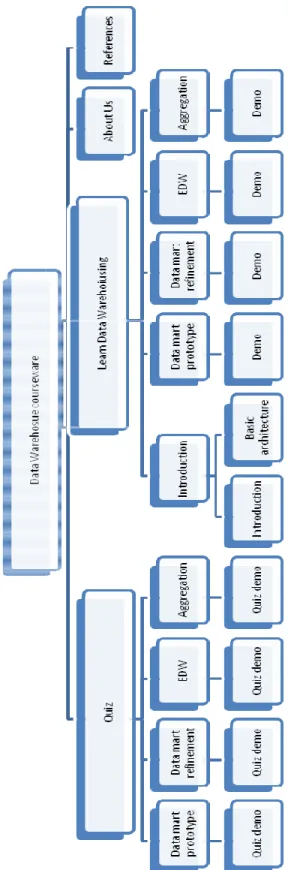
In the presentation part of the application, it presents the how to design the restaurants data warehouse through the main four demonstrations: (1) fundamentals of data warehouse, (2) data warehouse design principle, (3) building an enterprise data warehouse using an incremental approach, and (4) aggregation. Each demonstration is explained systematic process with diagram, example and resultant demo. Furthermore, courseware also provides the set of quiz for self-evaluation. With the detail information about data warehouse, we have also added about references section, to read more about the related concepts and us. Figure 4shows the sitemap of courseware application, which gives the basic content organization idea.
Model Controller View Request Update Request Update
F ig u re 4 . C o u rs ew ar e S it em ap
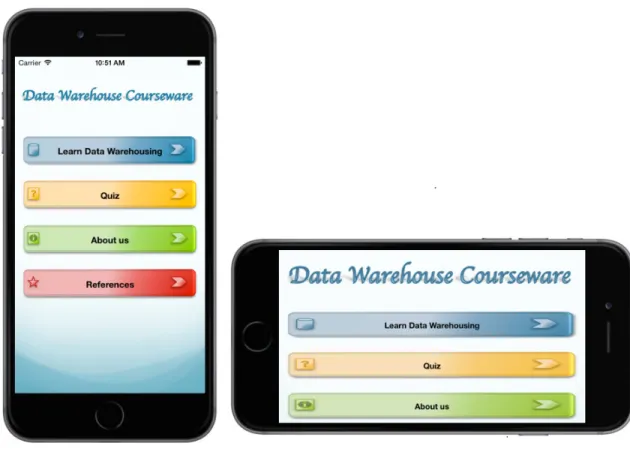
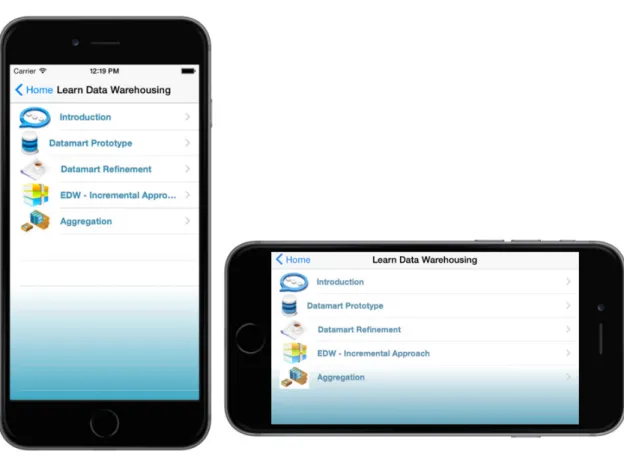
Figure 5 shows the home screen of the application and figure 6 explains the sub-section respectively, where each sub-section has different theme and special icons to separate the sections and visually remember the information for long time. First section contains information about data warehouse techniques, while second steps contains quiz for each data warehouse section.
Each section has sub section based on four major concepts of data warehouse techniques: data mart prototype, data mart refinement, enterprise data warehouse – incremental approach and aggregation.
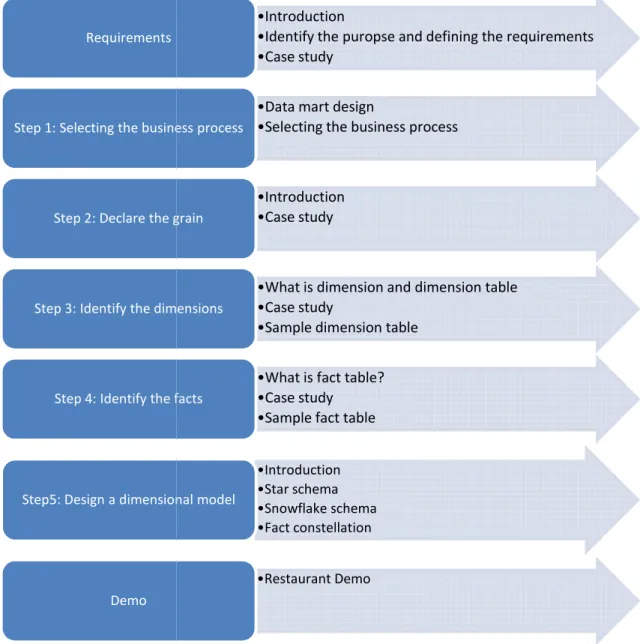
Each sub category contains the demonstration with step-by-step information about the process with diagram, case-study example and live demo. Figure 7 shows the application design steps of each demonstration. First demonstration represent the objective of data building data warehouse and what are the pre-steps to consider before starting the data warehouse process. Second demonstration shows the initial data mart design using the information gathered in first demonstration. Section 3 represents the data refinement process where we refine the data mart build in previous demonstration. In addition, Section 4 introduces how we can aggregate and improve the performance by filtering and merging the data mart.
Figure 7.
Though these demonstration, we commenced the design of the data warehouse using a restaurant search case study example, where we use Yelp
retrieve the dataset. Figure 8 shows the result screen.
Figure 8 shows the demonstration screen where restaurants can be search by location or nearby places within 20 miles. Location can be search by address or city. addition, this application is portrait ad landscape oriented.
Figure 8. Search Page for Demo
Though these demonstration, we commenced the design of the data warehouse restaurant search case study example, where we use Yelp web service
retrieve the dataset. Figure 8 gives the sample demo from the application
Figure 8 shows the demonstration screen where restaurants can be search by location or nearby places within 20 miles. Location can be search by address or city.
this application is portrait ad landscape oriented. Figure 8. Search Page for Demo
Though these demonstration, we commenced the design of the data warehouse web service [15] to gives the sample demo from the application and figure 9
Figure 8 shows the demonstration screen where restaurants can be search by location or nearby places within 20 miles. Location can be search by address or city. In
As you can see in Figure 5, we separated quiz section form the main data warehouse concept. Separate quiz section allows the student or beginners to do self-evaluation anytime after studying or before studying to test their understanding. In addition, this section demonstrates the result with correct answers. Figure 10 shows the sample screens from the application.
All required data to show in application is integrated in mobile application itself using SQLite database. Data are local in application, so student can run and play the application anywhere without using internet bandwidth. Only the restaurant demo requires the internet connection because restaurant data set is very wide and needs users’ current -
Figure 10. Sample Quiz Demo
Figure 11. Sample Quiz Result Figure 10. Sample Quiz Demo
location to find the restaurants nearby. Restaurant case study web services are implemented using PHP technology.
We will describe the detail description of each major data warehouse concepts in next chapter.
Chapter 5
DATA WAREHOUSE COURSEWARE IMPLEMENTATION
Data warehouse is defined as the central repository for a business to an enterprise [5]. To understand the key concept, principle and functionality of the data warehouse, it is very important to understand major seven topics of the data warehouse. Seven major steps are: (1) fundamentals of data warehouse, (2) data warehouse design solution, (3) building enterprise data warehouse, (4) interviewing for data warehouse, (5) data warehouse aggregates, (6) designing aggregates and (7) using aggregation. This courseware includes all these seven concepts with examples and demonstration. For better understanding, we grouped these topics into four demonstrations: data mart prototype, data mart refinement, EDW: enterprise data warehouse and aggregation. Each of these demonstrations is described here.
5.1 Data Mart Prototype
In this demonstration, we describe the initial process for designing the data mart. Before starting the data warehouse, it is very important to understand the requirements and identify the purpose behind the data warehouse design. Requirements help to understand the importance of the project. After getting clear concept of business requirement, next major step is to selecting the process to implement the data warehouse. Figure 12 shows the design steps included in demonstration 1.
Step 1: Identify the purpose and defining the requirements.
Identify which business process needs to model is the very important point. A process us a natural business activity performed in your organization that typically is
Requirements
Step 1: Selecting the business process
Step 2: Declare the grain
Step 3: Identify the dimensions
Step 4: Identify the facts
Step5: Design a dimensional model
Demo
Figure 12. Data Mart Prototype Steps
Step 1: Identify the purpose and defining the requirements.
Identify which business process needs to model is the very important point. A process us a natural business activity performed in your organization that typically is
•Introduction
•Identify the puropse and defining the requirements •Case study
•Data mart design
•Selecting the business process
Step 1: Selecting the business process
•Introduction •Case study
Step 2: Declare the grain
•What is dimension and dimension table •Case study
•Sample dimension table
Step 3: Identify the dimensions
•What is fact table? •Case study
•Sample fact table
Step 4: Identify the facts
•Introduction •Star schema •Snowflake schema •Fact constellation
Step5: Design a dimensional model
•Restaurant Demo
Figure 12. Data Mart Prototype Steps
Identify which business process needs to model is the very important point. A process us a natural business activity performed in your organization that typically is
supported be a source data collection system [7]. Talking to the people who knows the process helps to gain the deep understanding of the process. Interviewing and listening to users is the most efficient means for selecting the business process [7, 8]. Interview shapes the data warehouse.
The end user for this courseware is the student who will use this application and restaurant search data warehouse. Hence, we started to talk with the students of CSC 177, data warehousing and data mining, about the concept and their thoughts. We also talk with the instructor of the course. A few question-answer sessions held between students and instructor helps to initiate the design of the enrollment data warehouse. Based on the talk with students and friends, I understand that end users are mostly interested in getting the answer of the following question:
1. How many restaurants are near to my location or in particular area? 2. What type of food they are serving?
3. How is users review about particular restaurant? 4. How far is the restaurant form the location?
5. Does there any discount coupon or special menu available?
Step 2: Selecting business process
Once the requirements are gathered, next step is to decide the data modeling technique. Answering the question that ‘how should we design an efficient data warehouse?’ can helps to decide the modeling technique. Data warehouse contains mainly two data modeling techniques: ER modeling and Dimensional modeling.
ER modeling produces a data model of the specific area of interest, using two basic concepts: entities and the relationships between those entities. Detailed ER models also contain attributes, as properties of either the entities or the relationships. The ER model is an abstraction tool because it can be used to understand and simplify the ambiguous data relationships in the business world and complex systems environments [5]. Dimensional modeling uses three basic concepts: measure, facts, and dimensions [5]. Dimensional modeling is powerful in representing the requirements of the business user in the context of database tables. Both ER and dimensional modeling can be used to create an abstract model of a specific subject. However, each has its own limited set of modeling concepts and associated notation conventions.
A dimensional modeling technique is the most useful techniques now a day. Hence, we also use the same technique here for designing the restaurant data warehouse.
The first step in the design is to decide what business process to model by combining an understanding of the requirements with available data. In our restaurant case study, end user want to compare the restaurants and management wants the better understanding of customers’ interest. Thus, the business processes are we going to model is people’s review and ratings about each restaurant.
Step 3: Declare the grain
As we decide the data modeling techniques from step 2, we will go with each major steps of data modeling: declare the grain, identify the dimension and identify the facts.
Once the business process and data has been decided, the data warehouse team faces a serious decision about the granularity. The granularity of a fact is the level of detail. If data is to be analyzed effectively, it must all be at the same level of granularity. As a rule, the granularity of the data should be highest (most detailed) level. This is because we cannot change data to a higher level than what you have decided to keep. However, we can always roll up (summarize) the data to create a table with a lower level of granularity. [9]
In our case study, we can consider that how much detail we want to show to end-users. For example, do we have to show top 15 restaurants only? For each restaurant, we have to show only restaurant category like pizza, vegetarian, family friendly or do we have to show the menu with food name and drinks?
Step 4: Identify the dimensions
The requirements that have been collected must represent the two key elements of this analysis: what is being analyzed, and the evaluation criteria for what is being analyzed. We refer to the evaluation criteria as measures and what is being analyzed as dimensions [9]. Parameter by which facts (measurements) can be declared is called the dimensions.
From the requirement gathering process, we know that user wants to get information about restaurants for particular location. Therefore, to get answer for that query, we should know the restaurant and their location information. So whenever users search by location, they can see the list of restaurants. Here, if we dived all theses
information in sub categories, we can say that street address, area name and area code can be grouped as a location and restaurant information can be considered as a restaurant to simplify. This subset or group of attributes can be considering as dimensional table like location, restaurant.
Similarly, we can consider other requirements into different categories like menu, customer ratings, and time to get the answer of user's query. The attributes that differentiate the restaurants are based on time and review. In this demonstration, we can give LOCATION_ID as a unique, primary key for dimension table named 'Location' as shown in figure 13. For informative reporting, it is desired that the dimension tables are rich with attributes. The design of dimension table may also determine the relation of dimensions to the facts and their appearance in the reports [10]. Sample dimension table for restaurant search case study with required attributes is shown in figure 14:
Location
LOCATION_IDStreet
Area
State
Area Code
Restaurant
RESTAURANT_IDName
Phone Number
Rank
Description
Food type
Step 5: Identify the Facts:
Facts are the measurements that evaluate the process [2] and attributes of the facts are clustered into the fact table [10]. Facts are mostly contains numerical values. With measurement, fact table also shows the relationship with each related dimension for particular data mart. The fact table are usually sparse and deep i.e. they can have large number of rows that are typically additive.
Figure 15 shows the columns of the restaurant fact table. The primary key of dimensional table is here as reference key. In addition to that, fact table also contains the opening hours and food types.
Fact Table
FACT_ID
LOCATION_ID
RESTAURANT_ID
OPENING HOURS
Family friendly restaurant
Pizza restaurant
Coffee and snack
Restaurant
Vegetarian Restaurant
Step 6: Design the Model
Once the dimension, Fact and grain are defined, next step is to define the relationship between them. There are three basic dimension models, which used to data modeling in data warehouse, Star Schema, Snowflake schema and fact constellation schema. Star schema is widely used dimensional model because it is simplest kind of data warehouse schema. It usually has one large central (fact table) with no redundancy and a set of attribute tables (dimensional table) in radial pattern around central table.
We design the restaurant star schema to optimize the query that has large data access. It consists of one fact table as restaurant facts and the dimension tables, restaurants and location. Dimension tables and fact tables are linked through the corresponding foreign key relationship. Queries against such a schema include a variety
of combinations among facts and dimensions. Hence, star schema not only facilitates RDBMS capabilities but also add the ability to answer variety of management or end user
questions [2].Figure 16 show the initial design of data mart for the restaurant data warehouse design in the form of star schema.
After designing the star schema, we show the demo to call yelp web services to get the restaurant data based on the parameter passed. Mobile application integrates with Yelp dataset by calling web service, which returns the response in JSON format. Mobile application parses the JSON format data and retrieves the result. The sample response in JSON format that web service is explained in appendix A.
5.2 Data Mart Refinement
Data warehouse first demonstration gives the end users the facility to extract the restaurant data according the location name. Now let us suppose the end user wants to get the data according to restricted miles from their current location. To get same data with different request, we can use refinement process. Refinement helps meet additional user requirements such as omission of old data values or integrate of new data source [10]. The main purpose of refinement is to get all the relevant data into the data mart in conformance to the initially designed mode [5, 10]. Refinement helps to increase the capability to answer more management questions, include missing data and expand the model structure [5, 2, 10]. Refinement helps to answer the following user’s query in the restaurant data mart:
1. How far is the restaurant from his current location? 2. How many restaurants are open in my area?
4. How many restaurants are there within specific miles?
Data refinement process is critical because we iterate the steps on the initial design to refine the model with more relevant subject area. Refinement process includes the major steps of adding new dimensional table, refining fact table, and refining the data model, which describes in this chapter in detail.
Step 1: New addition in design
From the refinement process we discuss previous, we learn that capturing historical data and process of interviewing helps us to get relevant information to subject area. Here, in our case study, we need to know user's location to get more information about restaurants as a user perspective and user's feedback as a manager perspective to improve the management and restaurant rank.
We design the new dimension table for users review the same fashion as we did for restaurant and location in first demo. A customer geographic dimension may require the attribute like, location, altitude, latitude, Accuracy of latitude and longitude, Altitude, Accuracy of altitude, radius filter. Figure 17 shows the new dimension table which we added for restaurants geographical information.
Geographic location table helps to get restaurant information based on user’s current location. For our demo, we will retrieve the restaurants in maximum 20 miles from the user’s location. For that device should have internet access. Here, we add one dimension table based on our requirements, but sometime it may be required to add multiple dimension tables.
Step 2: Refining the fact table.
Once we add new dimension table, we also have to modify the fact table to establish the relation with new table. As we know based on demonstration 1, that fact table uses primary key of dimension table to make relationship between tables. Here, we added the new restaurant geographic information, we will add geographic id into the fact table.
Figure 18 shows the new modified fact table. In geographic table, we do not have any measurements or counts in any field. So we do not need to add extra field in fact table, except the primary key of the table.
Step 3: Refining star schema:
Refined star schema includes previous dimension tables and new additional dimension table changes. During refinement, we make all changes in previous fact table. So now star schema contains refined fact table in place of previous one. While designing new refine fact table, we should keep in mind that new star schema confirms to the previously design star schema. Figure 19 shows the refined star schema of the restaurant data mart based on first demonstration.
After refining the data mart, not the data warehouse design can helps the end users to get restaurant information
particular mile from their current location. This nearby features is very helpful for end users, because mostly we need restaurant information when we are new to particular are and we do not have more detail about particular location. This information also helps management people to keep track of the restaurants if any new is open.
the resultant demo after refinement process.
Figure 20. Demo Result after Refinement
refining the data mart, not the data warehouse design can helps the end get restaurant information using location name, but also able to search within particular mile from their current location. This nearby features is very helpful for end because mostly we need restaurant information when we are new to particular are have more detail about particular location. This information also helps management people to keep track of the restaurants if any new is open.
e resultant demo after refinement process.
Figure 20. Demo Result after Refinement
refining the data mart, not the data warehouse design can helps the end using location name, but also able to search within particular mile from their current location. This nearby features is very helpful for end because mostly we need restaurant information when we are new to particular are have more detail about particular location. This information also helps Figure 20 shows
5.3 EDW: Enterprise Data Warehouse
Section 5.2 and 5.2 includes the three of the major concept of data warehouse, fundamentals of data warehouse, interviewing for data warehousing and data warehouse design solutions. This section will cover another major concept, building the enterprise data warehouse. EDW consolidates data from multiple sources in support of business requirements wide decision making and related information needs such as reporting, analysis, and planning [2, 8, 10]. The design process clarifies how to expand the dimensional modeling design over an enterprise and conform to the design of restaurant data warehouse.
The EDW (enterprise data warehouse) mainly integrates data from various systems. This data in combination is more valuable and can satisfy user queries that are unanswerable by any other operational system. The EDW updates the data periodically. Consequently, the underlying architecture of the EDW develops a query processing support offering efficiency and performance to the data warehouse [10, 2]. The major steps of the enterprise data warehouse is shows in figure 21.
Step 1: Incremental approach
Initially there was a traditional approach fir EDW design, where a large comprehensive design be completed before loading the data. Which was mainly the reason of failure because loading the data in final stage creates major issues and rework if does not work. Another approach was to build the subject area at a time and load the first
subject area as soon as technically possible. This approach creates the design through an aggressive feedback cycle with users, called incremental approach [8, 1].
Step 1: Incremental approach Initially there was a t
comprehensive design be completed before loading the data. Which was mainly the reason of failure because lo
does not work. Another approach w
EDW
Step 1: Incremental
approach
Step 2: New dimension
table
Step 3: New fact table
Step 4: Incremental star
schema
Demo 3
subject area as soon as technically possible. This approach creates the design through an aggressive feedback cycle with users, called incremental approach [8, 1].
Step 1: Incremental approach
Initially there was a traditional approach fir EDW design, where a large comprehensive design be completed before loading the data. Which was mainly the
of failure because loading the data in final stage creates major issues and rework if Another approach was to build the subject area at a time and load the first
Figure 21. EDW Steps
•What is EDW:Incremental Approach
•Purpose of incremental approach •What is incremental approach? •Case study
Step 1: Incremental
•Dimension table
Step 2: New dimension
•Fact table
Step 3: New fact table
•New star schema
Step 4: Incremental star
•Restaurant demo
subject area as soon as technically possible. This approach creates the design through an aggressive feedback cycle with users, called incremental approach [8, 1].
raditional approach fir EDW design, where a large comprehensive design be completed before loading the data. Which was mainly the ding the data in final stage creates major issues and rework if as to build the subject area at a time and load the first
subject area as soon as technically possible. This approach creates the design through an aggressive feedback cycle with users, called incremental approach [8, 1].
Incremental approach merges different subject area in incremental way. If we consider section 5.1 and 5.2, we took one subject area for searching the restaurant information. However, when we design the data warehouse, searching for only restaurant information is not only one main goal behind creating data warehouse. This data warehouse should also helps the marketing, financial, sales and many more departments of restaurant, to know summarized information, which can help to increase the restaurant’s profit. End user is also interested to predict the rank and food review, which helps to get the answer of following question:
1. How many customers where predicted to visit restaurants in next quarter? 2. What is customer’s review?
3. What are the average ratings of the restaurant? 4. What is the rank of the restaurants?
Adding the new subject area of customer information and review into the 2nd demonstration helps to get to the incremental approach. Here, we use the dimension modeling principles to increment the design for the restaurant EDW.
Step 2: New dimension table
To add new subject are into the previously build data mart, we may have to either add new dimension table or have to make changes in previously designed table. Here, we need information for restaurant visitors and their review. Here to get answer of the
question list mentioned in Step 1 needs restaurant and visitor’s information. Therefore, if we use the same approach as we used in Section 5.1 and 5.2, we need mainly 3-dimension table, restaurant, location and visitor’s information.
Restaurants and location table should be the same as in demonstration 1 and 2. Additional review table is as shown in figure 22.
Step 3: New fact table
To predict the answer for different question related to restaurant management may require creating separate fact table, which contains information like number of reviews, average ratings, number of reviews of same ratings and many more. This information also helps the management team to predict the next year profit and restaurants’ rank. In addition to the fact table mentioned in section 5.2, we need the review fact table as shown in figure 23.
Step 4: Incremented star schema
Now as EDW contains the data from different subject area, it contains multiple subjective star schemas and resultant star schema contains combination of dimension and fact table of different subject are and relationship between them. In incremented star schema, we merge different subjective area.
For our case study regarding restaurant search, we are including and merging dimension table and fact table from the demonstration 2 and new information gather in this section. The resultant refined dimension model including all dimensions, their attributes, and fact table, modeled into one star schema as shown in figure 24.
This demonstration allows the end users to get visitor’s review with restaurants information. In this section, we show how to build a series of interlocking star schema [4] where each star schema corresponding to one subject area [10]. In next section, we discuss the performance of the data warehouse and describe the performance improvement techniques called aggregation.
5.4 Aggregation
As we seen from section 5.3, incremental approach is used to improve the data warehouse. In incremental approach, we seen that fact table is being expanded and becoming large. If fact table become larger and larger, query performance will get degraded. Therefore, if we summarize this fact table, we can make tremendous benefits in performance. This process of summarizing the fact table and getting very significant effect on performance is called the aggregation. [11] Aggregation is the most powerful weapon to improve the data warehouse performance. Aggregates are used in dimensional models of the data warehouse to produce dramatic positive effects on the time it takes to query large sets of data [1, 11, 13].
When we execute the query, which contains sum, max, total number, average, we have to execute all rows even though the resultant values of these queries are not used as a result. Sometime these queries also contain multiple requests, which take a lot of time to execute the query. However, what if we have one summary table, which has number of pre-calculated data rows for these types of queries instead of accessing all rows? We can get better performance, right? This summary table is called the aggregate table. Because
of the process of storing pre aggregates are sometimes referred
the different steps of Aggregation process in data warehouse design.
Aggregation
Step 1: Identify the
potential useful
aggregation
Step 2: Defining grain for
aggregation table
Step 3: Applying the
design principles of
aggregates
Step 4: Aggregate Star
schema
Demo 4
Figure 25. EDW Steps for Aggregation
of the process of storing pre-computed, partially summarized data into single table, aggregates are sometimes referred to as pre-calculated summary data.
the different steps of Aggregation process in data warehouse design.
•Introduction •Aggregation table
Aggregation
•Approaches
•Identify aggregation
Step 1: Identify the
potential useful
aggregation
•Approches
•Defining grain, dimensions and fact based on base schema
Step 2: Defining grain for
aggregation table
•Introduction
•Design principle for aggregation dimension table •Case study
•Design principle for aggregate fact table
Step 3: Applying the
design principles of
aggregates
•Introduction •Sample star schema
Step 4: Aggregate Star
•Restaurant demo
Figure 25. EDW Steps for Aggregation
computed, partially summarized data into single table, Figure 25 shows
Defining grain, dimensions and fact based on base
Design principle for aggregation dimension table Design principle for aggregate fact table
Step1: Identify the potential useful aggregates.
There are different approaches for aggregation: no aggregation, selective aggregation, and exhaustive aggregation. In some cases, the volume of data in the fact table will be small enough that performance is acceptable without aggregates. That time we do not need to go through the aggregation process. However, in a typical data warehousing, the data volumes will be large enough that this will not be the case.
Other approach is exhaustive approach. Though this approach gives optimal query result, as it requires minimum no. Of rows to execute, this approach is not practically used because the processing required producing all possible aggregates and the storage required storing them [11]. For example, if we have two dimension table: Location and Restaurant, we have total no. of aggregates = no. of columns into Location table * no. of columns into Restaurant table => 4*5=20.
Creating a large number of aggregates will take a lot of processing time, even on a large system. So identify the potential useful aggregates are the preferred approach. Interview and base schema serves the best source for finding the aggregates.
In our case study of restaurant data warehouse, we can find the aggregates into base schema at different places:
- During the base schema design, different numerous values give clues to potentially valuable aggregates.
- The next place to look is base schema itself. Looking at fact tables that will be used together in “drill-across” reports will suggest aggregates that are quite likely to be among the most valuable [11].
- Last, once our base schema is in production, we can consult a large number of new artifacts as existing reports and their summary pages.
Step2: Defining the grain, fact and dimensions based on the base schema
A more common use of aggregates is to take a dimension and change the granularity of this dimension. When changing the granularity of the dimension the fact table has to be partially summarized to fit the new grain of the new dimension, thus creating new dimensional and fact tables, fitting this new level of grain [14]. Here, we have seen that the aggregate schema is nothing more than a star schema itself, differing from the base schema only in terms of its dimensional grain.
Step 3: Applying the design principles of aggregates
When we aggregate dimension, we should keep some of the information in mind as following:
- Must be a perfect subset of attributes from a base dimension except its key. - The values taken on by attributes of the aggregate dimension must be identical
to those present in the base dimension.
- There must be exactly one row in the aggregate dimension that corresponds to each combination of its attribute values in the base dimension, and no others. In our case study of restaurant data warehouse, we should identify the dimensions of the aggregate table accordingly. The dimensions are derived from or are same as the base dimensions: Location, restaurant and review. According to the management
requirements of aggregates, we derive these dimensions. For location, if we are doing aggregates with area code, we need not required to store other information as each country has unique area code for each area. In review table, we save review and ratings both. But when we show the list of restaurants, we need only ratings and review. Here, we can remove review content and date. Figure 26 and figure 27 shows the dimension tables of location and review respectively after applying aggregation principles.
Same way as dimension table, we should also some of the basic principles when we build aggregate fact table. Aggregate fact table is similar to base fact table except that the facts are the aggregate values. Some of the points we should consider while designing the fact table are as following:
- The main attributes present in a fact table are the facts and foreign keys to the dimensions.
- Grain of the fact table should dictate the dimension key.
- Each aggregate fact should summarize a fact from the base fact table.
Figure 27. Dimension Table: Review Figure 26. Dimension Table: Location
- Unlike dimension table, the aggregate fact may have a different data type that its counterpart in the base schema (the number may be much larger)
Figure 28 shows the aggregate fact table of restaurant data warehousing.
Step 4: Aggregate star schema
An aggregate star schema is similar to base schema with aggregate fact table and base or aggregate dimension table. For our case study of restaurant, Figure 28 shows the aggregate star schema.
From the resultant schema show in figure 29, we can see that now the number of review is in fact table rather than counting from review table. Aggregate fact table stores the pre-aggregated value which otherwise are aggregated during query execution. After -
aggregates, if we need the review of each restaurant, we can directly get from the fact table rather than making the count (*) from review query. This aggregation helps to improve performance by reducing the scanning rows.
Retrieving the no. of reviews from the review table need to go through the following sample query:
SELECT Location Dimension Table Address, SUM (1 star ratings+ 2 star ratings + 3 star ratings+ four star ratings+ five star ratings) AS Total ratings, COUNT (*) AS Scanned rows
FROM Restaurant Fact Table
INNER JOIN Location Dimension Table ON Restaurant Location ID = Location ID INNER JOIN Review Dimension Table
ON Restaurant Review Class ID = Review Class ID INNER JOIN Restaurant Dimension
ON (Restaurant Restaurant ID = restaurant ID) WHERE restaurant ID
IN (SELECT restaurant ID FROM restaurant Fact Table WHERE restaurant Location ID
IN (SELECT Location ID FROM Location Dimension Table WHERE City = ‘Sunnyvale’ and State = ‘CA’)
AND Review ID
IN (SELECT Review ID FROM Review Dimension WHERE Ratings >0))
Above query scanned every rows of review table to get number of reviews for each restaurant. Here, if one restaurant has total 50 reviews, this query scans each 5o rows to get total 5o. However, if we put the no. of reviews from the fact table, we do not need to join Review table more. We can get all data from the Fact table. Sample query to retrieve the number of reviews from the fact table is following which scans only one row.
SELECT Location, total review, COUNT (*) AS scanned rows FROM Restaurant Aggregate Fact
WHERE Location = ‘Sunnyvale, CA’ GROUP BY Location;
We execute both queries multiple times to measure the performance and every time we get the better performance with aggregate star schema.
Chapter 6 EVALUATION
In the earlier chapter, we describe the complete process of the implementing a mobile application for data warehouse courseware. In this chapter, we will describe the assessment result of the project. The success of the project depends on the use of the application. As a part of this project, we carried out a study on testing the effectiveness of the courseware tool.
My professor, Dr Meiliu Lu, wants to use this application as supplementary part into the CSC 177: Data warehousing and data mining at California State University as a learning tool to implement term project. This class is for the upper division of the undergrad and graduate students of the computer science department. We show my projects to some of the graduate students and take their feedback. I also talked to my friends group, who is not familiar with data warehouse. Their feedback is also very important because this application is for beginners who do not have basic knowledge of data warehouse.
We achieved the positive feedback from the students and other technical people. They found that this courseware is very handy, easy accessible and helpful to understand the data warehousing process. They are very impressed with the example taken to explain the process. This project is available in tune: https://itunes.apple.com/us/app/data-warehouse-courseware/id979090468?ls=1&mt=8.
We did not get chance to take feedback from the students of the class CSC 177, because this course is not available to register for this spring semester, but the previous
application’s, which is already implemented by other students, feedback helps me to evaluate their interest and needs from this project. I understand that when they start the data warehouse project, they may understand the project steps, but they do not know form where to start the project. Once the data set is get, how should we evaluate that data set to implement the data warehouse technique? This question helps me to improve my application and add some data pre-processing steps. I add the process of data cleaning and pre-processing steps to give them answer to their question.
As a part of the feedback, I also integrate the feedback section into the application. This feedback section is inside the about us category. So anytime in future, if there is any improvement required, they can directly send their feedback to us. Therefore, we will integrate in application in future version. It also allows the user to offer constructive suggestions to us in an on-going basis. It makes the courseware more efficient and durable, while offering it the scope of improvement. Figure 30 shows feedback screen.
Chapter 7 CONCLUSION
The purpose of a courseware is to deliver information related to specific topic and improve readers learning. In this project, we have seen how this courseware will be effective for the students learning concepts of data warehouse implementation. Although there are other web based courseware available for data warehouse, but none of the courseware is available yet for mobile application [5]. The main advantages of this mobile-based courseware are the usefulness, accessibility and impressive examples.
Therefore, as a conclusion to this project report, we can say that we have achieved primary goal defined at the initiation. This courseware provides theoretical concepts related to data warehouse and implementation phase provides details on how to design the data warehouse. It offers a systematic method to design a data warehouse using the case based approach.
The courseware provides enormous amount of opportunity for development. There are many areas for the future research to extending this project. We implemented this project for IOS technology, which works on Apple products like iPad, iPhone and iPod. However, there is not any courseware available for android phones. So the future researcher can make Android version of this project with stronger case study examples. In the next version of this project, we can implement the sharing quiz result on social websites for encourage students to use this application and learn the technology.
APPENDIX A
WEB SERVICE INTRODUCTION
Web services describe the standardized way to integrate same business logic with multiple devices, running on different platform and frameworks, using internet protocols. On the conceptual level, a service is a software component provided through a network [14] and uses messages to exchange invocation request and response information using XML, JSON and html format. Mainly two types of web services are implemented: (1) SOAP Based web service and (2) Rest full web services. The major difference between this two web service is in request and reply format. For yelp web services integration [15], we use Restful web service. The primary purpose of Restful web service is to manipulate XML or JSON representation of web resources using HTTP stateless protocol.
Yelp web service is Authentication based web service and have to follow the required constrains while applying. The complete guide for Yelp web service integration is written on Yelp developer site. We made the following sample request and reply web service call. Request is done using URL and Response is in JSON format.
Request: http://api.yelp.com/v2/search?term=food&location=San+Francisco Response: { "region":{ "span":{ "latitude_delta":0.063848983027611439, "longitude_delta":0.086716023612893878 }, "center":{
"latitude":37.365325464358449, "longitude":-122.03313362563051 } }, "total":4941, "businesses":[ { "is_claimed":true, "rating":4.5, "mobile_url":"http://m.yelp.com/biz/dishdash-sunnyvale", "rating_img_url":"http://s3-media2.fl.yelpcdn.com/assets/2/www/img/99493c12711e/ico/stars/v1/stars_4_half.png", "review_count":2575, "name":"DishDash", "snippet_image_url":"http://s3-media3.fl.yelpcdn.com/photo/X_sitfjvk8ZOBzqikOG3xw/ms.jpg", "rating_img_url_small":"http://s3-media2.fl.yelpcdn.com/assets/2/www/img/a5221e66bc70/ico/stars/v1/stars_small_4_half. png", "url":"http://www.yelp.com/biz/dishdash-sunnyvale", "menu_date_updated":1387608734, "phone":"4087741889",
"snippet_text":"Nom Nom Nom!\n\nMy Chicken Shawarma Appetizer
Zahra, either vegetarian or with Cubed Chicken (it comes with Lamb but I'm not a big L amb...", "image_url":"http://s3-media3.fl.yelpcdn.com/bphoto/YZuhZsHC8alkVb47MZMUgg/ms.jpg", "categories":[ [ "Middle Eastern", "mideastern" ], [ "Mediterranean", "mediterranean" ] ], "display_phone":"+1-408-774-1889", "rating_img_url_large":"http://s3-media4.fl.yelpcdn.com/assets/2/www/img/9f83790ff7f6/ico/stars/v1/stars_large_4_half.p ng", "menu_provider":"single_platform", "id":"dishdash-sunnyvale",
"is_closed":false, "location":{ "city":"Sunnyvale", "display_address":[ "190 S Murphy Ave", "Sunnyvale, CA 94086" ], "geo_accuracy":9.5, "postal_code":"94086", "country_code":"US", "address":[ "190 S Murphy Ave" ], "coordinate":{ "latitude":37.376261999999997, "longitude":-122.03014899999999 }, "state_code":"CA" } } ] }