ISSN: 1693-6930, accredited First Grade by Kemenristekdikti, Decree No: 21/E/KPT/2018
DOI: 10.12928/TELKOMNIKA.v18i4.14836 2169
Semi-supervised auto-encoder for facial attributes recognition
Soumaya Zaghbani1, Nouredine Boujneh2, Med Salim Bouhlel31National Engineering School of Gabès, University of Gabès, Tunisia 2Faculty of Sciences of Gabès, University of Gabès, Tunisia 3High Institute of Biotechnology, University of Sfax, Tunisia
Article Info ABSTRACT
Article history: Received Dec 6, 2019 Revised Mar 19, 2020 Accepted Apr 7, 2020
The particularity of our faces encourages many researchers to exploit their features in different domains such as user identification, behaviour analysis, computer technology, security, and psychology. In this paper, we present a method for facial attributes analysis. The work addressed to analyse facial images and extract features in the purpose to recognize demographic attributes: age, gender, and ethnicity (AGE). In this work, we exploited the robustness of deep learning (DL) using an updating version of autoencoders called the deep sparse autoencoder (DSAE). In this work we used a new architecture of DSAE by adding the supervision to the classic model and we control the overfitting problem by regularizing the model. The pass from DSAE to the semi-supervised autoencoder (DSSAE) facilitates the supervision process and achieves an excellent performance to extract features. In this work we focused to estimate AGE jointly. The experiment results show that DSSAE is created to recognize facial features with high precision. The whole system achieves good performance and important rates in AGE using the MORPH II database
Keywords: Age estimation Deep learning Gender recognition Softmax classifier Supervised autoencoder
This is an open access article under the CC BY-SA license.
Corresponding Author: Soumaya Zaghbani,
National Engineering School of Gabès, University of Gabès, Tunisia.
Email: [email protected]
1. INTRODUCTION
Recently with the growth and the development of technologies, intelligent and recommended systems became in the center of researches. We are in the epoch when systems must know and understand his/her current user. Nowadays user identification is an essential challenge for researchers; it presents a necessity in new technologies in many domains such as security, computer access control, e-commerce, banking, human machine interaction (HMI), medicine, social media, applicant identification, civil protection, crimes, terrorism, and most recently the fight against social fraud, etc. [1].
In HMI, the response for the question “who is the user?” is very complicated and need an excellent precision because it is different from an area to another. Generally, in user analysis including user profiling and user modeling, we need to know the user’ age, gender, race, emotion, actual behavior, cultural level, sensory abilities, and his/her experiences. It is a big and multidisciplinary challenge but very important because we need to make machines able to understand, analyze the user’s needs and also to adapt itself to his needs and capabilities [2]. The challenge of these new technologies is to increase the effectiveness and robustness and give the precise, right and exact response in the right moment even were the conditions. To know this user and understand his/her sensorial capabilities, physical abilities, affective state, social and cultural level, many researchers used faces as an important stimulus for their works due to the particularity and distinctiveness
features [3]. Facial features have the advantage of being unique and permanent and cannot be falsified unlike conventional means such as passwords or badges. The face is an essential informer of identity and a basis for identifying people (identity photography, anthropometry, facial recognition. In this work we present an algorithm for user identification focuses on determining the AGE. This paper is organized as follows: in the next section, related works are described. In section 3, we present the proposed method. In section 4, performance and results are reported. Finally, conclusions are drawn in section 5.
2. RELATED WORKS
In this section, we review the existing AGE recognition works. All the presented previous work cited in this section based on the use of DL architectures. In age estimation researches, posture vocabulary and intonation present significant elements to predict the age of interlocutor, but face still the most important source of information to estimate the real age; we can extract an efficient modulation of the individual just by looking to his face. In HCI, age plays an important role in producing effective and robust interfaces in the recommended system, adaptive interface, smart technologies and embodied recognition. Gender recognition is also an important factor in user identification, and many researchers exploit different biometric techniques for gender identification. Gender recognition, based on 2D or 3D images, is part of biometric technologies that can be efficient information to precise the individual identity. Such as age and gender recognition, ethnicity presents an important attribute in user identification in many types of research, especially in security.
The notion of ethnicity was used from the eighteenth years to differentiate individual groups having different physical criteria. In literature, many researchers exploit facial features to estimate AGE, for example in their article, Jordi et al. [1] presented a novel method for gender identification using the deep neural network (DNN), the new architecture proposed in their work based on the use of local features using small overlapping region. The Local DNN was tested on LFW and Gallagher’s database and gives an important result especially using four layers; the difference was substantial compared with the network with one layer. In 2016 Manepali et al. presented a novel method of age estimation with a real image, different poses and different emotions using LFW, Groups, and FERET datasets. In this method, a dictionary is produced from the training phase, and matching is completed by rebuilding the testing image using a sparse dictionary. Kaya et al. [2] presented an algorithm of AGE recognition for children throw speech they used a dataset contains the sequence for children with ages between three and seven years in a different emotional state (comfort, discomfort and neutral).
The classification process was applied using extreme machine learning (EML) with a single layer feedforward network (LFN). In their article Antipov et al. [3] present an algorithm of age and gender classification using convolutional neural network (CNN); they used three popular benchmarks LFW, FG-NET, and MORPH for the training process. In 2017 Lei Cai et al. [4] present a new architecture for gender recognition for pedestrians; to address the problem of illuminations, occlusion and poor-quality researchers used an effective HOG-assisted deep feature learning (HDFL). They exploit the deep-learned and weighted HOG feature extraction branches simultaneously on the input images.
3. PROPOSED METHOD
3.1. Overview of the proposed classification algorithm
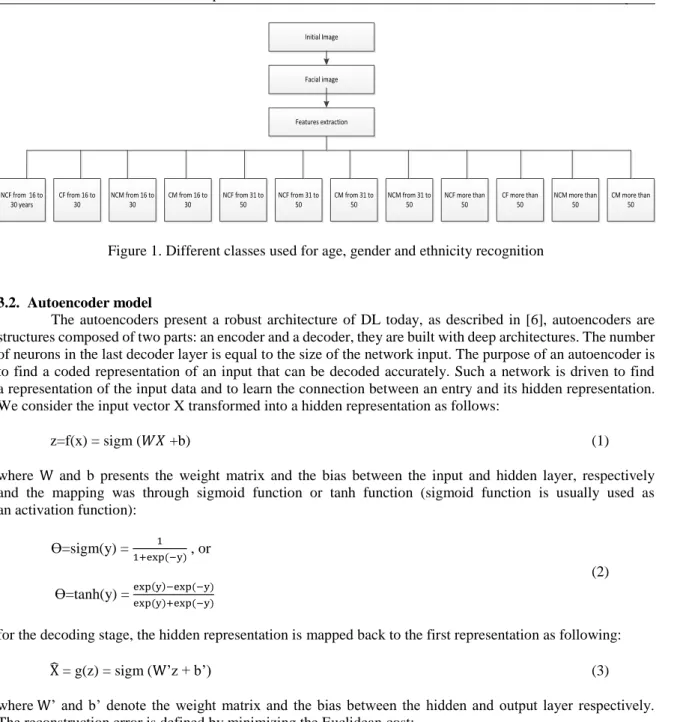
In the age estimation process, our goal is not to find the exact age but to find the age group. Therefore we describe three age groups; youth (16-30), senior (31-50) and elderly (51-over). For the ethnicity process, we classify the race into two classes: Caucasian and not Caucasian. We have three classes for ages, two for ethnicity and two for gender. The number of final classes is 12 as described in Figure 1 and organized as follow: not Caucasian female (NCF) from 16 to 30, not Caucasian from 31 to 50, not Caucasian female more than 50, caucasian female (CF) from 16 to 30, Caucasian female from 31 to 50, Caucasian female more than 50, Not Caucasian male (NCM) from 16 to 30, not Caucasian male from 31 to 50, not Caucasian male more than 50, Caucasian male (CM) from 16 to 30, Caucasian male from 31 to 50, Caucasian male more than 50. In this work, we start by data pre-processing: The first step in our work is to extract the face from the images, for this reason, we used the AdaBoost framework of Viola P. and Jones [5] published on July 13 2001.
The second step is to crop up faces. Finally, an in-plane rotation is applied to adjust the head orientation because it could influence the algorithm performance. The preprocessing applied to the two frameworks AGER and ER. In machine learning process, the main problem of classification is to distinguish to which of a set of groups a new sample belongs, by extracting features of a training set of data which contain some observations whose class membership is already known. In this axis, the revolution that artificial intelligence and especially machine learning are experiencing today, DL is at the forefront. Methods exploiting the theory of DNN in automatic learning have proved their robustness on complex tasks in the fields of imaging and acoustic processing.
Initial Image NCF from 16 to 30 years Features extraction NCF from 31 to 50 NCF from 31 to 50 CM from 31 to 50 NCM from 31 to 50 NCF more than 50 CM from 16 to 30 NCM from 16 to 30 CF from 16 to 30 Facial image CF more than 50 NCM more than 50 CM more than 50
Figure 1. Different classes used for age, gender and ethnicity recognition
3.2. Autoencoder model
The autoencoders present a robust architecture of DL today, as described in [6], autoencoders are structures composed of two parts: an encoder and a decoder, they are built with deep architectures. The number of neurons in the last decoder layer is equal to the size of the network input. The purpose of an autoencoder is to find a coded representation of an input that can be decoded accurately. Such a network is driven to find a representation of the input data and to learn the connection between an entry and its hidden representation. We consider the input vector X transformed into a hidden representation as follows:
z=f(x) = sigm (𝑊𝑋 +b) (1)
where W and b presents the weight matrix and the bias between the input and hidden layer, respectively and the mapping was through sigmoid function or tanh function (sigmoid function is usually used as an activation function): Ɵ=sigm(y) = 1 1+exp(−y) , or (2) Ɵ=tanh(y) = exp(y)−exp(−y) exp(y)+exp(−y)
for the decoding stage, the hidden representation is mapped back to the first representation as following:
X
̂ = g(z) = sigm (W’z + b’) (3)
whereW’ and b’ denote the weight matrix and the bias between the hidden and output layer respectively. The reconstruction error is defined by minimizing the Euclidean cost:
argminW,w′‖X − X̂‖2
2
(4) The purpose of an autoencoder is to establish some correlation for the input data for dimensionality reduction after that a classification process is established. In literature, many types of autoencoders were presented and discussed; for example, progressive, sparse and denoising autoencoders. The sparse coding method presents a good representation and performance. In fact, the term sparse is used to indicate that we need hidden neurons with the same probability of activation. The number of neurons of the hidden layers is smaller than that of the input and output layers. It will be important to compress data and try to find a correlation between the data and therefore classify them according to this correlation. The minimized function of sparse autoencoder presented as following [6, 7]:
argminW,W′‖X − W′Ɵ(WX)‖F2+β ∑mj=1KL(ρǁρ̂j) (5)
where m is the number of hidden nodes, and β is a coefficient that determines the weight of sparsity penalty item.
value nearing zero:ρ̂j= 1
N∑ hi(xi)
N
i=1 denotes the average activation of hidden node j, and the Kullback-Leibler
divergence can be defined by:
KL(ρǁρ̂j) = ρ log ρ ρ ̂j+ (1 − ρ) log 1−ρ 1−ρ̂j
The purpose of training a sparse autoencoder is to learn the algorithm to automatically extract features from unlabeled data. Recently, many researchers considered that autoencoders may be semi-supervised because they could be more performant when they specify classes, their researches denote the performance of this new architecture and results shown the robustness of supervised autoencoders than many other ordinary networks [8-11]. In this work we used the sparse autoencoder in a semi-supervised manner to predict age, gender, ethnicity from facial images. In fact, the idea of semi supervised autoencoders or class specific autoencoder is to incorporate information about classes in the basic architecture of autoencoders in the purpose to improve the supervision process. We keep the same architecture of un-supervision process and we add labeled data to supervise the autoencoder and learn features such that the illustrations of samples referring to a class are equal to the mean representation of the same class. From the first researchers who worked with autoencoders in a supervised manner we cite Gao et al. in 2015 [10]; they modified denoising autoencodders to optimize the performance of identification.
Specifically, the idea of semi-supervised autoencoder to manually specify the input features x given to the algorithm. Once a good feature representation is given, a learning algorithm can do well. The class-spesific autoencoder makes the features consist to the same class similaraty, in fact, it extracts more efficient features for the same group representation. As described previously, in the first step, we suggest to learn features such us they have the same sparsity signature across every class. For a given input X, the loss function in the traditional architecture of autoencoder is given as mentioned in the (4). In their work Majumdar et al. propose [12, 13] 11 norm for regularization presented as follow:
argminW,W′‖X − W′Ɵ(WX)‖F2+λ||WX||1 (6)
to incorporate the supervision into the classic architecture of autoencoders we have to pass from the unsupervising to the supervising by labelling data, however the training data could be presented us following:
X= [x1,1|. . |x1,n1x2,1|. . |x2,n2..xc,1|. . |xc,nc]
where the training data is divided into classes (c). The idea is to learn features into common sparse support. and WXi will be row sparse. This is achieved by incorporating l2,1 norm regularization as following:
argminW,W′‖X − W′Ɵ(WX)‖F2+λ∑c=1c ||WXc||2,1+β ∑cc=1KL(ρǁρ̂c) (7)
where ‖v‖2,1=∑ ‖vj j→‖2 is the sum of l2-norms of the rows. We note that the input X appartain to class c during
the classification phases, then taking into consederaion all classes we optimize w and w’ leading to a minumum of objectif function. The inner l2-norm promotes a dense (non-zero) solution within the selected rows, but
the outer l1-norm (sum) enforces sparsity in selecting the rows [6, 13]. The proposed solution shown in (7) improuve row-sparsity within every group. The architecture of the proposed method is described in Figure 2.
4. EXPERIMENTAL RESULTS
4.1. MORPH II dataset
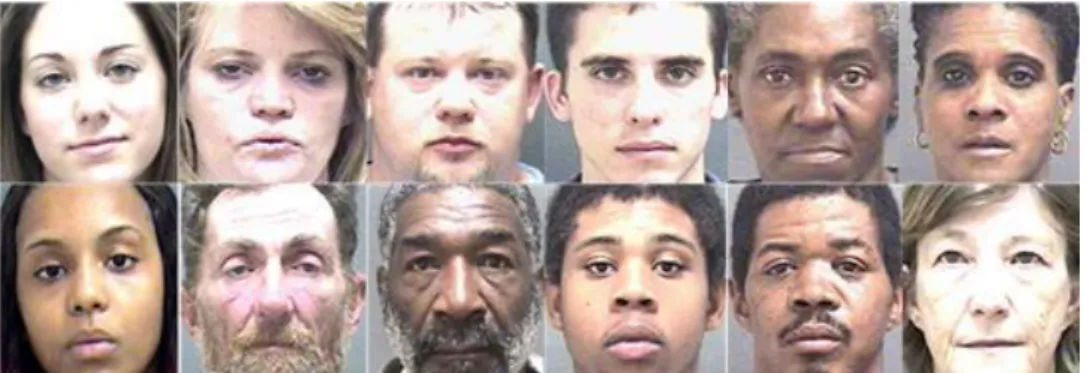
For AGE we used the MORPH II and FG-NET database. MORPH II benchmark holds 55,000 images of more than 13,000 volunteers individuals, pass over from 2003 to late 2007. Ages group from 16 to 77 with a median age of 33. The average time taken between photos is 164 days and the average number of images per individual is 4 (the minimum being one day and the maximum is 1681 days). The standard deviation of days between images is 180. In literature, MORPH II database offers the most extensive database that combines AGE. The distributions of the face images are shown in Table 1. Differently, of previous studies on MORPH II, that divide the whole MORPH II database W into three sets, S1, S2, and S3, we split the facile images into 12 classes as shown in Figure 2. Some examples of facial images extracted from MORPH II dataset are shown in Figure 3, from different ages and ethnicities. In every image, we detect and crop the face area, and the image is dimensioned into 32*32. Only two ethnics groups are used for this work (Caucasian and not Caucasian we note that for elderly classes we added more than 350 images for each class because of the little
number of images for elderly in comparison with other groups. The illustration of facial images used in the test phase for the MORPHII databases is described in Table 1.
+ 1 . . . . . . . . . + 1 So ft m ax R eg re ss io n Em ot io n R ec og ni ti on
Initial image Face detection
. . . x1 Wi 𝑋 ̂ 1 +1 . . . . . . . . . x2 x3 x4 xn +1 bi 𝑋 2 𝑋 3 𝑋 4 … 𝑋 𝑛 Wi +1 . . . . . . . . . x2 x3 x4 xn bi 𝑋 2 𝑋 3 𝑋 4 xn +1 . . . . . . x2 x3 x4 xn bi W i Input Feature 1 Input Output Output Input Features 2 Output Feature 2 Softmax classifier
Figure 2. Pipeline of the proposed method
Figure 3. Examples of facial images of MORPH II database.
Table 1. The illustration of facial images used in the test phase for the MORPHII databases
Method Year MAE(MORPH)
Flexible overlapped AAM+LPQ [6] 2015 5.68
ODLF [12] 2017 3.12 CSC+STD Pooling [14] 2017 3.66 CSC+Max Pooling [14] 2017 3.78 GA-DFL [15] 2016 3.37 D2C [16] 2017 3.06 Net VGG [17] 2017 2.96 Mohammed et al. [18] 2019 3.17 Taheri et al. [19] 2019 2.81 Proposed method - 3.26
4.2. Age, gender and ethnicity recognition (AGER)
This section is dedicated to evaluate the presented study on AGE and carry out the various comparisons with other recognition methods. Results of AGE presented separately in Table 2, Table 3 and Table 4. The accuracies of AGE estimation jointly presents 73.5%. The best rates are given for NCM (30-50), CM (50+) and NCF (50+) with respectively 78.7%, 83.1% and 84.4%. The difficulty in the comparison of the proposed method (AGER jointly) with others is the lack of models estimating the AGE jointly. We used the DSSAE also to estimate AGE separately on the MORPH II database, and we compare with other DL models, as well as with some other approaches on MORPH II and other benchmarks. Let us look at the age estimation results shown in Table 2. Firstly, for testing and evaluating the proposed method, we used the Mean Absolute Error (MAE) to define the algorithm performance in age estimation it is calculated as follow:
Ε= ‖y′−y‖2
N (8)
where y’ and y present the predicted and real age value respectively and N denotes the number of the testing facial images. The purpose from our work is not to extract exactly the age but we look to just classify ages into three ranges, youth (16-30), senior (31-50) and elderly (51-over). The proposed method obtains an MAE of 3.26 years, which is considerable very important compared with other methods. This low MAE is even smaller considering the age estimation is performed on a very large database, this error reduction rate is statistically significant. The approach shown the performance on young and senior groups, the MAE presents the best result with less than and 3.26.
Table 2. Accuracy of age recognition for MORPH II dataset (%)
Method Year MAE(MORPH)
Flexible overlapped AAM+LPQ [6] 2015 5.68
ODLF [12] 2017 3.12 CSC+STD Pooling [14] 2017 3.66 CSC+Max Pooling [14] 2017 3.78 GA-DFL [15] 2016 3.37 D2C [16] 2017 3.06 Net VGG [17] 2017 2.96 Mohammed et al. [18] 2019 3.17 Taheri et al. [19] 2019 2.81 Proposed method - 3.26
Table 3. Comparison of gender accuracy with the state-of-the-art methods (%)
Method Year Accuracy
Duan et al. [8] 2017 88.20 Guo et al. [10] 2014 98.40 Dhomne et al. [16] 2018 95.00 Srinivas et al. [17] 2017 84.70 Lee et al. [20] 2017 88.50 Huang et al. [21] 2017 89.60 Benini et al. [22] 2019 98.59 Fang et al. [23] 2019 98.80 Proposed method - 95.00
Table 4. Accuracy of ethnicity recognition for MORPH II dataset (%)
Method Year Accuracy
Guo et al [10] 2014 99.00 Uddin et al [13] 2016 95.40 Srinivas et al [17] 2017 33.33 Mohammed et al [18] 2019 93.3 Hocquet et al [24] 2016 97.50 Mohammed et al [25] 2017 94.60 Proposed method - 98.20
In our study, we classified gender with and without ethnicity consideration. The accuracy of gender recognition without ethnicity consideration with the DSSAE is 95%, this accuracy is considered an exciting result for two reasons. Firstly, the state of arts demonstrates that this rate is significant in comparison with other methods, such as mentioned in Table 3. Secondly, due to the composition of MORPH II benchmark,
this database contains facial images of different people with different looks such as a man with long hair females with short hair. Table 5 shows the confusion matrix of gender recognition with consideration of ethnicity. Facial images were devised into four classes; NCF, CF, NCF and CM. the accuracy increased by about 2% in comparison with gender recognition without ethnicity consideration. For ethnicity estimation, we only reported accuracies for the Caucasian and Not Caucasian, since other race groups like Asian and Indian race were not used in training because the number of images is very small. The classification groups into two ethnicity classes. The accuracy obtained is 98.2%; this rate is interesting in comparison with other methods as described in Table 4.
In this article, we used the DSSAE as a classifier; we measured the accuracy that occurs when a classifier is tested with different hidden layers. The parameters of the deep neural network are investigated by altering the number of hidden layers, the number of neurons and the size of the training set. We carried out extensive experiments to determine the optimum parameters. The number of layers in the DNN is crucial for about 15.000 images. In this article, we used two models with a different number of hidden layers, and we examine the final results: we have the first model called mod1: we have two hidden layers and the second one called mod2 with Three layers. The results are summarized in Table 6.
Table 5. Confusion matrix of gender throws ethnicity recognition (MORPH II)
NCF CF NCM CM
Not Caucasian Female 92.4 2.0 4.2 2.0
Caucasian Female 2.1 94.6 0.0 3.2
Not Caucasian Male 3.9 0.0 91.5 0.0
Caucasian Male 1.6 3.4 4.3 94.8
Table 6. Parameters used for the DSSAE architecture Parameters Layers size Regularization
term (λ) Sparsity parameter (ρ) Weight sparsity penalty (
β) Accuracy Age, gender and
ethnicity jointly
Layer 1 50 0.002 0.5 5
73.5%
Layer 2 25 0.003 0.8 5
The presented work showed an improvement performance using DSSAE. This performance is explained by the two important metrics: firstly; the use of supervision under classes improved the accuracy. Results in our work and in literature shown that using the AE is very interesting in supervision manner. The second metric is the use of L1 and L2 norm to regularize the model. This metric helped us to regularize the model and reduce the overfitting problem. In other hand, the solution used in this work, enhances the sparsity in every class and consequently it improves the generalization of features for every class. The major problem encountered in this work is the number of samples used under every class, because dividing samples between the three attributes will decrease the total number in every class.
This explain the low rate found in elderly class where we have very low number of samples make the model unable to extract more features and generalize. This why we added samples in elderly classes as explained in section (4.1) and the accuracy was increased from 52.25% to 63.57% (NCM 50+). It can be explained as kind of data augmentation metric. In the young and senior classes we have found a rate for more than 80% for all attributes. In these classes we have large number of samples perform the model to generalize. But in comparison of these rates with found results for facial attributes separately is more interesting.
5. CONCLUSION
In this article, we present a method for AGE. We used autoencoders for classification. The work consists of using faces from MORPH II databases to recognize AGE jointly by classifying facial images into 12 classes to find three demographic attributes (age, gender and ethnicity). The classification model was based on updating version of autoencoder called DSSAE. In this model we are trying to exploit the advantages of supervised and unsupervised learning in the same time. The experiments are conducted on an extensive database containing more than 55,000 face images. And they show the robustness of our method as classification model to find the three attributes separately.
REFERENCES
[1] M. Jordi et al., “Local deep neural networks for gender recognition,” Pattern Recognition Letters., vol 70, pp. 80-86, January 2016.
[2] H. Kaya, et al., “Emotion, age, and gender classificationin children’s speech by humans and machines,” Computer Speech & Language, vol. 46, pp. 268-283, November 2017.
[3] G. Antipov, et al., “Effective training of convolutional neural networks for face-based gender and age prediction,”
Pattern Recognition, vol. 72, pp. 15-26, December 2017.
[4] L. Cai, et al., “HOG-assisted deep feature learning for pedestrian gender recognition,” Journal of the Franklin Institute, vol. 355, no. 4, pp. 1991-2008, March 2018.
[5] P. Viola, et al., “Robust real-time face detection,” International Journal of Computer Vision, vol.57, pp. 137-154, 2004. [6] S. Zaghbani et al., “Age Estimation using Deep Learning,” Computers & Electrical Engineering, vol. 68,
pp. 337-347, May 2018.
[7] M. Singh, et al., “Are you eligible? Predicting adulthood from face images via class specific mean autoencoder,”
Pattern Recognition Letters, vol. 119, pp. 121-130, March 2019.
[8] M. Duan, et al., “A Hybrid Deep Learning CNN-ELM for Age and Gender ClassiÞcation,” Neurocomputing, vol. 275, pp. 448-461, January 2018.
[9] S. Zaghbani et al., “Facial Emotion Recognition for Adaptive Interfaces Using Wrinkles and Wavelet Network,” 2017 IEEE/ACS 14th International Conference on Computer Systems and Applications (AICCSA), pp. 342-349, 2017. [10] G. Guo, et al.,”A Framework for Joint Estimation of Age, Gender and Ethnicity on A Large Database,” Image and
Vision Computing, vol. 32, no. 10, pp. 761-770, October 2014.
[11] H. Gao, et al., “Single Sample Face Recognition via Learning Deep Supervised Autoencoders,” IEEE Transactions on Information Forensics And Security, vol. 10, no. 10, pp. 2108-2118, Oct 2015.
[12] S. Zaghbani, et al., “Real time hand gesture recognition using features extraction,” International conference ICMV (International Conference on Machine Vision), 2017.
[13] A. Majumdar, et al., “Face Verification via class sparsity based supervised encoding,” Transactions on Pattern Analysis and Machine Intelligence, vol. 39, no. 6, pp. 1273-1280, June 2017.
[14] K. Jhony, et al., "A Flexible Hierarchical Approach For Facial Age Estimation Based on Multiple Features," Pattern Recognition, vol. 54, pp. 34-51, June 2016.
[15] K. Li, et al., “D2C: Deep cumulatively and comparatively learning for human age estimation,” Pattern Recognition, vol. 66, pp. 95-105, June 2017.
[16] A. Dhomne, et al., "Gender recognition through face using deep learning," Procedia Computer Science, vol. 132, pp. 2-10, 2018.
[17] N. Srinivas, et al., “Age, Gender, and Fine-Grained ethnicity prediction using convolutional neural networks for the east asian face dataset,” IEEE 12th International Conference on Automatic Face & Gesture Recognition, pp. 953-960, 2017.
[18] N. Mohammed, et al., “Two-stages based facial demographic attributes combination for age estimation, “ Journal of Visual Communication and Image Representation, vol. 61, pp. 236-249, May 2019.
[19] S. Taheri, et al., "On the use of DAG-CNN architecture for age estimation with multi-stage features fusion,"
Neurocomputing, vol. 329, pp. 300-310, February 2019.
[20] S. H. Lee, et al., “Age and gender estimation using deep residual learning network,” 2018 International Workshop on Advanced Image Technology (IWAIT), pp. 1-3, 2018.
[21] C. Huang,et al., "Age/gender classification with whole-component convolutional neural networks," Annual Summit and Conference, pp. 1282-1285, 2017.
[22] S. Benini, et al., "Face analysis through semantic face segmentation, "Signal Processing: Image Communication, vol 74, pp. 21-31, May 2019.
[23] J. Fan, et al., "Muti-stage learning for gender and age prediction," Neurocomputing, vol. 334, pp. 114-124, March 2019.
[24] G. P. Mabuzaa-Hocquet, et al., “Ethnicity prediction and classification from iris texture patterns: a survey on recent advances,” International Conference on Computational Science and Computational Intelligence, pp. 818-823, 2016. [25] A. S. Mohammad, et al., “Towards Ethnicity Detection using Learning Based Classifiers,” 2017 9th Computer