Lightweight and Physically Secure Anonymous
Mutual Authentication Protocol for Real-Time Data
Access in Industrial Wireless Sensor Networks
Prosanta Gope,
Member, IEEE
, Ashok Kumar Das,
Senior Member, IEEE
,
Neeraj Kumar,
Senior Member, IEEE
, and Yongqiang Cheng
Abstract—Industrial Wireless Sensor Network (IWSN) is an emerging class of a generalized Wireless Sensor Network (WSN) having constraints of energy consumption, coverage, connectivity, and security. However, security and privacy is one of the major challenges in IWSN as the nodes are connected to Internet and usually located in an unattended environment with minimum human interventions. In IWSN, there is a fundamental require-ment for a user to access the real-time information directly from the designated sensor nodes. This task demands to have a user authentication protocol. To satisfy this requirement, this article proposes a lightweight and privacy-preserving mutual user authentication protocol in which only the user with a trusted device has the right to access the IWSN. Therefore, in the proposed scheme, we considered the physical layer security of the sensor nodes. We show that the proposed scheme ensures security even if a sensor node is captured by an adversary. The proposed protocol uses the lightweight cryptographic primitives, such as one way cryptographic hash function, Physically Unclonable Function (PUF) and bitwise exclusive (XOR) operations. Security and performance analysis shows that the proposed scheme is secure, and is efficient for the resource-constrained sensing devices in IWSN.
Index Terms—Industrial Wireless Sensor Network, Mutual authentication, Key agreement, Physically unclonable function, Security.
I. INTRODUCTION
The Industrial Wireless Sensor Network (IWSN) value proposition has evolved from simply extending or replacing wired networks to cloud-connected smart object intelligence. Internet Protocol (IP) addressability to the node, reliable mesh networking, field-bus tunneling, proven battery lifetime, and new cloud capabilities are now part of the IWSN landscape. Due to the advancement of the sensing technology, WSNs are becoming important as the Internet provides access to digital information anywhere. Today’s sensor networks can provide remote interaction with the outside physical world. This proliferation of WSNs has enabled several new classes of applications that benefit a large number of applications [1].
P. Gope is with the Department of Computer Science and Technology, University of Hull, Cottingham Rd, Hull HU6 7RX, United Kingdom (e-mail: [email protected], [email protected]).
A. K. Das is with the Center for Security, Theory and Algorithmic Research, International Institute of Information Technology, Hyderabad 500 032, India (e-mail: [email protected], [email protected]).
N. Kumar is with the Department of Computer Science and Engineering, Thapar University, Patiala 147 004, India (e-mail: [email protected]). Y. Cheng is with the Department of Computer Science and Technology, University of Hull, Cottingham Rd, Hull HU6 7RX, United Kingdom (e-mail: [email protected]). Corresponding author: P. Gope
Many industrial control systems use WSN in the following applications:
• Environmental sensing: It is one of the basic WSN
applications, which is widely used in almost every field of industry. The main objective in the environmental sensing is an efficient information gathering used both for the prevention (real-time or postponed) as well as analysis.
• Condition monitoring: It covers the applications of structural condition monitoring [2], [3], health monitoring in Wireless Body Sensor Network (WBSN) [4] and also machine condition monitoring in an industrial control system.
• Process automation:It provides the information regard-ing the resources for the production and service provision [5]. In some cases, WSNs can be used for the production performance monitoring, evaluation and improvement. In IWSNs, the collaborative nature allows many potential advantages over traditional wired industrial monitoring as well as control systems, such as self-organization, flexibility, rapid deployment and inherent intelligent-processing capability [21]. Thus, WSN plays a crucial part in building a highly depend-able and self-healing industrial system that can answer to the real-time events in quick time. Hence, it is argued that in order to realize the visualized industrial applications and effective communication protocols, we require the advantages potential gains of WSN [21]. Because of unique characteristics and technical challenges, developing a WSN for industrial applications needs a combination of expertise from various stakeholders (Academia and industry) which are outlined as below [21]:
• The industrial expertise as well as knowledge are needed
for application-specific domain.
• The sensor-technology expertise is required to understand
various issues related to sensor calibration, transducers as well as clock-drift.
• The Radio Frequency (RF) design and propagation envi-ronment expertise is needed to deal with the communi-cation challenges and RF interference issues in industrial environments.
• The networking expertise is also essential in order to understand the hierarchical network architectures, which are required for IWSNs to furnish adaptable and scalable architectures for the heterogeneous applications.
Recently, there is a rapid growth of global IWSN market which is mainly attributed to high reliability of wireless tech-nology compared to wired techtech-nology. Furthermore, growing trend of smart factories, low cost of wireless sensor nodes and faster deployment are predicted in favor of the WSN market growth. Moreover, growing security concern for automation industry coupled with increasing adoption of sensor networks in order to monitor various processes spurs the demand of IWSNs. On the contrary, availability of multiple wireless communication standards is also expected to have an adverse impact on IWSNs market. The technological advancements in wireless communication and energy consumption without losing accuracy are some of the factors that may disclose new avenues for IWSN market in the near future.
A. Related Work
Since the sensor nodes in IWSN have limited computational and storage capabilities, a lightweight authentication and key agreement protocol is preferred in such a network. In 2006, Wong et al. [6] presented a user authentication scheme for IWSN based on symmetric-key cryptography. In 2007, Tseng
et al. [7] showed that the scheme presented by Wong et al. is susceptible to various attacks (e.g., replay and forgery attacks). Independently, Das [8] found that Wong et al.’s scheme is vulnerable to stolen-verifier attacks and then he introduced a new protocol. However, this protocol cannot ensure some of the important security properties, such as mutual authentication and key agreement. Moreover, later studies [9], [10] revealed that the protocol presented in [8] is also vulnerable to insider attacks and impersonation attacks. In 2012, Daset al. [11] and Xueet al. [12] separately proposed two lightweight authentication protocols. However, Turkanovic and Holbl [13] proved that Das et al.’s scheme has some security flaws. In 2013, Li et al.[14] also demonstrated that Xue et al.’s scheme is vulnerable to insider attacks, and they proposed a new scheme to address the vulnerabilities found in Xueet al.’s scheme. In 2014, Turkanovicet al.[15] proposed a new authentication scheme. Chang et al. later pointed out that Turkanovicet al.’s scheme is vulnerable to impersonation attacks. After that, they presented an improved scheme. After thoroughly investigating, we find that the protocol presented in [16] cannot ensure untraceabilty property, because, in the login message, the parameterMIi is fixed for two different sessions.
Therefore, an adversary can easily comprehend that both mes-sages belong to the same user. In this way, an adversary can trace the activities of the user. Recently, Gope and Hwang [17] introduced an anonymous mutual authentication protocol for the real-time data access in IWSN. However, their scheme does not support the anonymity of the sensor nodes. The sensors in IWSN are often deployed in the open hostile environment. Hence, there is a possibility of physical and cloning attacks. However, like the other existing protocols in WSN, Gope and Hwang’s scheme cannot ensure the physical security of the sensor nodes either.
B. Motivation
IWSNs offer several benefits in many industrial control systems and various real-time applications. In IWSNs, the
sensor devices share the information with each other using a public channel (i.e., the Internet). Therefore, security and privacy of the shared sensing data remains a paramount concern in IWSNs. An intruder (adversary) can gather and aggregate the traffic information in order to make the profile of an industrial plant’s activities (i.e., production status). For sensitive applications in IWSNs (for example, IWSN-based healthcare environment), this type of profile making is dangerous. In addition, if the confidential industrial plant’s information is leaked, the private information can be also exposed to some malicious users. As a result, the security and privacy are important in IWSN-based applications.
In order to access the real-time information directly from some designated sensor nodes in IWSNs, a user first needs to be authenticated by the gateway. Only after mutual authen-tication among the user and the accessed sensor node with the help of the gateway node, both parties establish a session key between them. Using the established session key, they can communicate securely each other. A user authentication is very much needed in IWSNs to protect the security and privacy, because the private (confidential) industrial plant’s information must be preserved and protected from any adversary. However, designing such a user authentication scheme in IWSNs is a challenging task due to resource-limitations of the sensor nodes and vulnerability of physical capturing of the sensor nodes by an adversary.
C. Research Contributions
This article proposes a lightweight and physically secure anonymous mutual authentication protocol for real-time data access in IWSN. The proposed scheme is based on lightweight cryptographic primitives, such as one-way cryptographic hash function, physically unclonable function (PUF) [18] and bit-wise XOR operations, which have limited computational over-head, and hence, it is suitable for the resource-constrained sensing devices in IWSN. The key contributions of this article are summarized as follows:
• A computationally efficient lightweight mutual authen-tication scheme has been designed that allows only a legitimate user with a trusted device to access the IWSN.
• Physical security of the user’s device as well as the
sensor nodes deployed in the open hostile environment is ensured in the proposed scheme.
• In the proposed scheme, we do not require to store any
sensitive information, such as secret credentials on the sensing devices.
• The formal security analysis under the widely-used Real-Or-Random (ROR) model [20] ensures the session key (SK) security of the proposed scheme. To further strengthen the security of the proposed scheme, the infor-mal (non-mathematical) security analysis is also carried out.
• A detailed performance analysis and comparison with the existing schemes show that the proposed scheme is suitable for the resource-constrained sensor nodes.
D. Paper Outline
The rest of the paper is constructed as follows. In Section II, we define the system and adversary models applied for the proposed scheme. In addition, we also provide a brief intro-duction to PUFs in this section. In Section III, the proposed scheme is described in detail. The security and performance analysis of the proposed scheme are discussed in Section IV and Section V, respectively. Finally, we conclude the paper in Section VI.
II. PRELIMINARIES
In this section, we first discuss the system model for IWSN and then the adversary model needed for the proposed scheme. Moreover, we briefly discuss the important properties of PUFs.
A. System Model
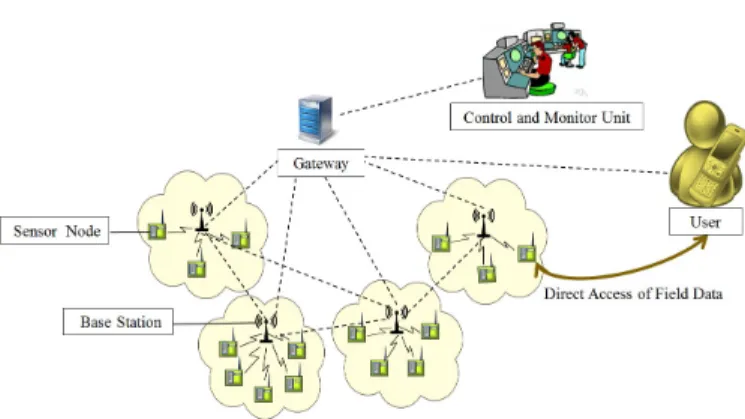
As shown in Fig. 1, our system model for IWSN consists of five major entities: a set of sensors, a set of base stations, a gateway node, a control and monitoring unit, and a set of users. A user may wish to access the real-time data directly from the sensor nodes. A set of sensors are deployed in a target field (e.g., industrial plant) for environmental and condition moni-toring and/or process automation purpose. Sensors collect data from their surrounding environment and periodically transmit them to the gateway (via the nearest base station). After that, the gateway forwards the collected data to the control and monitoring unit through a secure channel. Before receiving any data, the gateway needs to validate the legitimacy of the sensor nodes. In this regard, the gateway also checks whether a sensor node has been physically tampered or not. On the other hand, in many critical applications [4], [17], the users from outside may require to obtain access of the real-time information directly from the sensor nodes instead of the gateway node. An example includes the IWSN-based healthcare environment, where sensors collect the real-time information, such as temperature, blood pressure and pulse rate from a patient’s body. After that, a legitimate medical professional, say a doctor, with a trusted device can get access of these data directly from the sensor nodes. However, before offering any secure direct access of a sensor node, the gateway needs to verify the legitimacy of the user and the gateway also needs to help both the user and the sensor node to establish a session key. So that, they (user and the sensor node) can securely communicate.
B. Adversary Model
We assume that an adversaryAcan intercept the transmitted messages communicated over public channel. In addition, A can alter or delete the message contents transmitted over the insecure public channel as per as the Dolev-Yao (DY) threat model [22]. We further assume that sensors may be deployed out in the open environment and these are not physically protected. Therefore, A can easily access the sensors and these are subject to physical and cloning attacks. Besides, it is assumed that the user’s device is not physically protected. A having the access to the user’s trusted device may try
Figure 1. System model for an industrial wireless sensor network
to extract information stored in the device. In addition, A may also attempt to extract sensor data by using an untrusted device. Here, the A’s objective is to launch an undetectable attack to authenticate itself with the gateway or any one of the registered deployed sensors, which could be dangerous for IWSN applications. For example, if A can authenticate itself and gain access to a sensor connected to a patient’s pacemaker in the IWSN-based healthcare environment, he/she can cause danger to the life of the patient. Finally, as in [24], the gateway needs to be physically secured by putting it under a locking system inside the IWSN so that the physical capture of the gateway will be much difficult as compared to that for the sensor nodes and the user’s device. Thus, the gateway is considered as a fully trusted node and it will not be compromised byA.
C. Evaluation Criteria
The authors in [34] made a substantial step towards breaking the vicious “break-fix-break-fix" cycle in the existing two-factor authentication research domain for IWSNs. Wang and Wang [35] provided a criteria set, which is originally proposed for a generic client-server architecture. Later, Wanget al.[34] also suggested a comprehensive criteria set of the following independent evaluation metrics for designing a user authenti-cation scheme in IWSNs:
• No password verifier-table: Neither the gateway nor the sensor nodes should store the passwords related information in the verifier-table.
• Password friendly:A user should be permitted to select his/her password and also to change it freely at any time.
• No password exposure: A user’s password should not
be extracted or derived by the privileged administrator even if the administrator is treated as a trusted authority in the network.
• No smart card loss attack: Having the lost or stolen
smart card of a registered authorized user, an adversary should not be able to change the password, recover the password in offline, online or hybrid guessing attacks. In addition, having the extracted information from the lost/stolen smart card, the adversary should not be able to impersonate a victim to login to the system. Hence, it is important that a user authentication should be resilient against the smart card loss attack.
• Resistance to various attacks: A user authentication scheme in IWSNs should protect various attacks, such as impersonation, offline guessing, replay, man-in-the-middle, parallel, key control, stolen verifier, unknown key share and known key attacks.
• Provision of key agreement: A registered user and a sensor node should be able to establish a session key among them after their mutual authentication for subsequent communication.
• Sound repairability: A user authentication scheme should support smart card revocation and dynamic sensor node addition phase after the initial deployment of the sensor nodes in IWSNs.
• No clock synchronization: A user authentication needs not be affected by clock synchronization and time delay. Hence, the sensor nodes, users and gateway nodes need not be synchronized always in the design of a user authentication scheme in IWSNs.
• Mutual authentication:A user, the gateway node and a
sensor node in IWSNs can authenticate each other during the authentication process.
• Timely typo detection: In the event of wrong input credentials of a user, such as identity and password by mistakes, he/she will be timely notified.
• Forward secrecy:A user user authentication scheme de-signed for IWSNs should provide perfect forward secrecy.
• User anonymity and untraceaility: A user authenti-cation scheme in IWSNs should provide user identity protection as well as untraceability.
Next, devices in IWSN are often deployed in the open and public places, which may cause them to be vulnerable to physical and cloning attacks. Therefore, it is important that any security solution designed for IWSN should not only consider all the aforesaid evaluation metrics but also detect any violations of physical security of the IWSN devices.
D. Physically Unclonable Function (PUF)
In this section, we provide a short description of PUF. A PUF is a one-way function that maps a set of challenges to a set of responses based on the unique physical micro structure of a device. In general, an ideal PUF has the following properties:
• The output of the PUF always depends on a physical system.
• It is easy to evaluate and construct.
• PUF output is unpredictable and works as a random function.
• PUF is uncloneable.
A challenge-response pair (CRP) is used to characterize a PUF. It takes a random bit-string as an input challenge and produces an arbitrary bit-string, called the response. The responseR of a PUF, say P to a challengeCcan be defined as R=P(C). PUFs are a result of the manufacturing process of Integrated Circuits (ICs) which introduces random physical variations into the microstructure of an IC, making it unique. These variations in the microstructure of an IC cannot be controlled, making them virtually impossible to clone or duplicate. PUFs
Table I NOTATIONS
Notation Definition
U A user in IWSN
Sn A sensor node in IWSN
IDu Identity of U
pswu Password ofU
βu Biometric thumb impression ofU
IDSn Unique identity ofSn TIDu Temporary identity ofU
PID Pseudo identity ofU
CRP(C,R) Challenge-response pair P Physically uncloneable function
h(.) One-way cryptographic hash function
⊕ Bitwise XOR operator
|| Concatenation operator
are ICs which use their internal structure to provide a one-way function that cannot be duplicated. The fact that PUFs are hard to predict but easy to construct and evaluate makes them a good choice for use as security primitives for lightweight devices. Since the PUF output depends on its unique physical characteristics, any attempt to tamper with the PUF alters behavior of the device and renders the PUF useless [18].
III. THEPROPOSEDSCHEME
In this section, we present our proposed scheme which consists of four phases: i) user registration phase, ii) sensor node registration phase, iii) authentication phase, and physical-temper checking, and iv) secure periodical data collection phase.
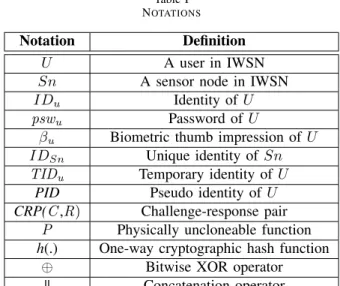
The important notations used to describe the proposed scheme are listed in Table I. In the proposed scheme, a user’s biometric thumb impression and password have been used for local authentication of password and biometric by the user’s device. Nowadays, most of the mobile devices can be equipped with the biometric scanner so that a user’s biometric thumb impression can be imprinted easily in the devices to overcome the cost of sensing infrastructure in our proposed scheme. Hence, the proposed scheme is suitable for use with the critical applications as well as general purpose applications in the IWSN domain.
A. Assumptions for the Proposed Scheme
In our proposed scheme, we make the following assump-tions:
• Each user device and the sensor consist of a microcon-troller attached to a PUF.
• It is also impossible to tamper with the communication between the micro-controller and its PUF [18], [19].
• User device and sensors have limited resources while the gateway has no such limitations.
B. Phase I: User Registration Phase
Assume that a user U wants to obtain the real-time data access in IWSN. Then, he/she needs to register his/her trusted device D in the gateway. As shown in Fig. 2, the procedure of user registration is described as follows.
Step 1: U selects an identity IDu and transmits {IDu,
Regreq} to the gateway through a secure channel, where
Regreq denotes the registration request.
Step 2: Upon receiving the registration request message, the gateway generates a random challenge Cu for normal
authentication process. To address the issue of desynchroniza-tion or Denial-of-Service (DoS) attacks [17], the gateway also generates a set of new challenges Csyn
u = {c1, . . ., cn} for
resynchronization with the user U and sends the information {Cu,Cusyn} toU through the secure channel.
Step 3:After receiving {Cu,Cusyn}, theU’s trusted device
extracts the PUF outputs Ru = PD(Cu), Rsynu (r1, r2, . . .,
rn) =PD(Cusyn) and sends {Ru,Rusyn} to the gateway. Step 4:Hereafter, the gateway randomly generates a unique temporary identity TIDu and a set of unlinkable pseudo
identitiesPID ={pid1,pid2,. . .,pidn} and transmits {TIDu,
PID} to U. The gateway stores {(IDu,TIDu, (Cu, Ru),
(Csyn
u ,Rsynu ),PID} for further communication withU. Step 5: Upon receiving {TIDu, PID}, U stores them
in his/her device. Next, U inputs his/her biometric thumb impression βu into the device. The device extracts αu = PD(βu) and then the user U selects a password pswu, and
inputspswu into the device. The device computes and stores
δ=h(αu||pswu) for user verification.
Figure 2. Registration phase of a userU
C. Phase II: Sensor Node Registration Phase
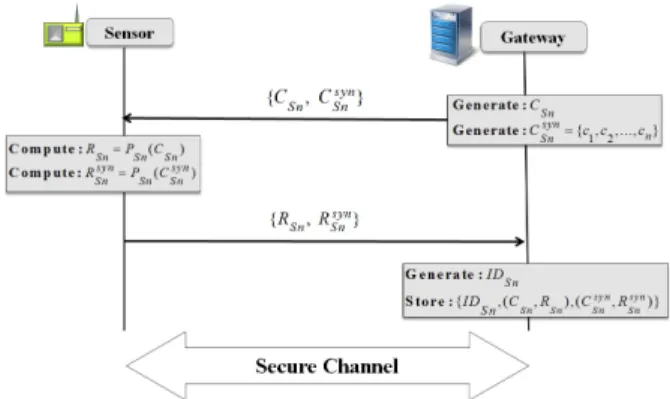
While a new senor node Sn is deployed, it is needed to registerSn in the gateway. The entire registration process of a new sensor node can be discussed as follows.
Step 1: The gateway first generates a challenge CSn for
the interaction with the sensor node Sn. Next, to address the issue of desynchronization or DoS attacks, the gateway also generates a set of new challenges CSnsyn = {c1, . . ., cn} for
resynchronization withSnand transmits {CSn,C syn Sn } toSn
through a secure channel.
Figure 3. Registration phase of a sensor nodeSn
Step 2: Sn extracts the PUF outputs RSn = PSn(CSn),
RsynSn =PSn(C syn
Sn ) and sends {RSn,R syn
Sn } to the gateway. Step 3. Next, the gateway generates a unique identity IDSn for the sensor Sn and stores {IDSn, (CSn, RSn),
(CSnsyn,CSnsyn)} in its database for further interaction withSn. However,Sn does not require to store any secret credentials in its memory. The summary of this phase is depicted in Fig. 3.
D. Phase III: Authentication Phase
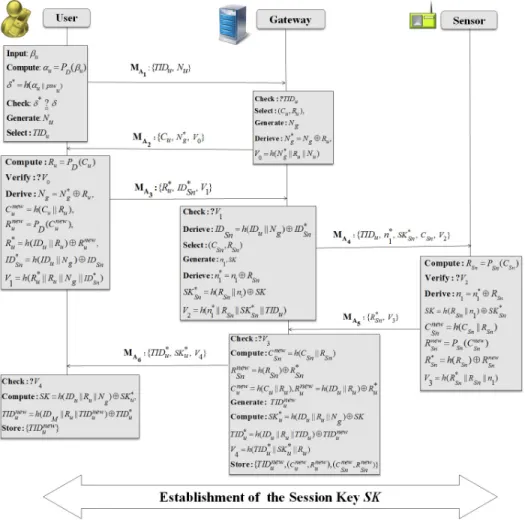
Assume that a user U wants to obtain real-time data access directly from a particular sensor node in IWSN, then he/she requires to accomplish mutual authentication with the gateway and the desired sensor node. The process of mutual authentication and key agreement is described as follows. The summary of this phase is also provided in Fig. 4.
Step 1: U first inputs his/her biometric thumb impression βu into his/her device. After that, the device extracts the PUF
output αu = PD(βu) and asks the user U to enter his/her
password.Uthen inputs his/her passwordpswuinto the device and the device calculates δ∗ = h(αu|| pswu) and compares
the computedδ∗ with the stored δ. If they are not equal, the device terminates the session. Otherwise, the device believes U as a legitimate user. Next, the device generates a nonce Nu and selects the temporary identity of the userU asTIDu,
and sends the login message {TIDu, Nu} through a public
channel.
Step 2:After receiving the login message, the gateway first locates the TIDu in its database. The gateway then selects
the CRP (Cu, Ru) and generates a nonce Ng, and calculates
Ng∗ = Ng⊕Ru, V0 = h(Ng∗||Ru||Nu). Finally, the gateway
composes the authentication request messageMA2: {Cu,N ∗ g,
V0} and sends it to the userU through a public channel.
Step 3:Upon receiving the messageMA2, theU’s trusted
device extracts Ru = PD(Cu) and verifies the parameter
V0. If the verification is successful, the device calculates Ng = Ng∗⊕Ru, Cunew = h(Cu|| Ru), Rnewu = PD(Cunew).
Next, the device asks U to input his/her identity IDu and
the identity IDSn of the accessed sensor node, say Sn,
that he/she wants to access. The device then computes R∗u = h(IDu||Ru)⊕Rnewu , IDSn∗ = h(IDu||Ng)⊕IDSn, V1=
h(R∗
Figure 4. Lightweight and physically secure anonymous authentication protocol for secure real-time data access in IWSN
message MA3: {R ∗
u, IDSn∗ , V1} to the gateway through a
public channel.
Step 4: After receiving the authentication response mes-sage MA3, the gateway verifies the key-hash output V1. If
the verification is successful, the gateway derives IDSn =
h(IDu||Ng)⊕IDSn∗ and selects the CRP (CSn, RSn). Next,
the gateway generates a random number n1 and the ses-sion key SK, and then calculates n1∗=n1⊕RSn, SKSn∗ =
h(Rsn||n1)⊕SK, V2 =h(n1∗||RSn||SKSn∗ ||TIDu). Finally, the
gateway composes a message MA4: {TIDu,n ∗
1,SKSn∗ ,CSn,
V2} and sends it to the sensorSnthrough a public channel. Step 5: Upon receiving the messageMA4, the sensor Sn
first extracts the PUF output RSn = PSn(CSn) and then
verifies the parameter V2. After successful verification, the
sensorSncomputesn1=n1∗⊕RSn,SK=h(Rsn||n1)⊕SKSn∗ ,
CSnnew = h(CSn|| RSn), RnewSn = PSn(CSnnew), R∗Sn =
h(RSn)⊕RSnnew, V3 = h(R∗Sn||RSn||n1). Next, the sensor
composes a message MA5: {R ∗
Sn, V3} and sends it to the
gateway through a public channel.
Step 6:On receiving the messageMA6, the gateway verifies
the parameterV3. If the verification is successful, the gateway calculates CSnnew = h(CSn|| RSn), RnewSn = h(RSn)⊕R∗Sn,
Cunew = h(Cu|| Ru) and Runew = h(IDu||Ru)⊕Ru∗. The
gateway also generates a new temporary identity for the user U as TIDnew
u and computes SKu∗ = h(IDu|| Ru||
Ng)⊕SK,TIDu∗ =h(IDu||Ru|| TIDu)⊕TIDunew andV4= h(TIDu∗||SKu∗||Ru). Finally, the gateway composes a message
MA6: {TID ∗
u, SKu∗, V4} and sends it to the user U through
a public channel. After that, the gateway stores {TIDunew,
(Cnew
u , Runew), (CSnnew, R new
Sn )} for further interactions with
the user U and the sensor nodeSn.
Step 7: Upon receiving the message MA6, the user U’s
device validates the parameter V4. If the validation is suc-cessful, the device computes the session key SK = h(IDu||
Ru|| Ng)⊕SKu∗,TIDunew = h(IDu|| Ru|| TIDu)⊕TIDu∗ and
stores TIDunew for the further communication with the user
U.
Remark 1: It is worth noting that in case if the gateway cannot find theTIDuin its database, the gateway will ask the
device to try with a valid unlinkable pseudo identity pidj ∈
PID. In that case, the gateway will select one of the unused
CRP from (Cusyn, Rsynu ). Similarly, if there is any loss of
synchronization between the sensor nodeSnand the gateway, this can be apprehended if the gateway cannot receive the response messageMA5 within the maximum round-trip time
period. Then, the gateway will select of the unusedCRPfrom (CSnsyn,CSnsyn) for authentication process and after completion of the authentication process, the gateway needs to delete that particular usedCRP from its database.
Figure 5. Physical-temper checking and secure periodical data collection phase
E. Phase IV: Physical-temper Checking and Secure Periodical Data Collection Phase
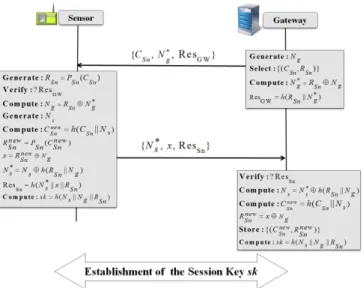
In this phase, the gateway will periodically check whether a sensor nodeSnhas been physically tampered or not. More-over, by using the following mechanism, both the gateway and sensor Sn mutually authenticate each other and establish the session key sk between them. Then, the sensor Sn will use this session key skfor securely sending its collected data to the gateway. As shown in Fig. 5, the procedure of this phase associated with the proposed scheme is described as follows.
Step 1: The gateway generates a nonce Ng and selects
the CRP (CSn, RSn). Next, the gateway calculates Ng∗ =
RSn⊕Ng, ResGW = h(RSn||Ng∗) and sends the message
{CSn,Ng∗,ResGW} to the sensorSnthrough a public channel. Step 2: Upon receiving {CSn, Ng∗, ResGW}, the sensor
Sn first extracts the PUF output RSn =PSn(CSn) and then
verifies the parameterResGW. If the verification is successful, Sn generates a nonce Ns and calculates Ng = RSn⊕Ng∗,
Cnew
Sn =h(CSn||Ns),RSnnew =PSn(CSnnew),x =RnewSn ⊕Ng,
Ns∗ = Ns⊕h (RSn||Ng), ResSn = h(Ns∗||x||RSn), and the
session keysk =h(Ns ||Ng||RSn). Finally, theSncomposes a
message {Ns∗,x,ResSn} and sends it to the gateway through a public channel.
Step 3: After receiving the response message from the sensor nodeSn, the gateway first verifies the parameterResSn. If the validation is successful, the gateway computes Ns
=Ns∗⊕h(RSn|| Ng), CSnnew =h(CSn|| Ns),RSnnew =x⊕Ng,
and the session keysk =h(Ns||Ng||RSn). Finally, the gateway
stores {Cnew
Sn , RnewSn } for further interaction with the sensor
node Sn.
Remark 2:Wang and Wang [29] analyzed several two-factor authentication schemes in WSNs and came up with a general principle that the public-key techniques are intrinsically in-dispensable to build a two-factor authentication scheme for supporting user anonymity property. In the proposed three-factor authentication scheme, the temporary identityT IDu of
a user U is used instead of using the original identity IDuin
the communicating messages to provide user anonymity prop-erty. Also, the temporary identity is renewed for each session to provide the untraceability property. Thus, considering the resource limitations of sensor nodes in IWSN, the lightweight operations like one-way hash function h(·) and PUF are used instead of using expensive public-key techniques. Of course, the Elliptic Curve Cryptography (ECC) is feasible for resource-constrained WSNs [30] though it is not as lightweight as one-way hash function and PUF. Hence, to achieve a strong user anonymity property it is required to use public key techniques (for example, ECC) for IWSN [31].
Remark 3: In this article, we have constructed a privacy-preserving scheme by using lightweight hash functions and PUFs, and pre-loading a pool of pseudonym identities. If the pseudonym ID pool is large, the large storage capacity is needed. If the pool is small, the device of a user U needs to update frequently. Since the device is not resource-limited as compared to a smart card, the approach of pre-loading pseudonym identities in the proposed scheme will not be a limitation.
IV. SECURITYANALYSIS OF THEPROPOSED SCHEME
In this section, we formally analyze the security of the proposed scheme. In this context, we consider the broadly-accepted Real-Or-Random (ROR) model provided in [20]. Moreover, we also informally (non-mathematically) analyze the security of the proposed scheme.
A. Security Model
We now discuss the ROR model [20] in the following.
Participants: Let ΠtSn
j be the t-th instance of the sensor
nodeSnj,ΠuUi theu-th instance of the userUi andΠ
v GW the
instancevof the gateway GW.
Partnering:Πt
Snj is said to be partner ofΠ
u
Ui when partial
transcript of all messages exchanged between the userUi and
the sensorSnj is unique. The communication for the current
session is defined by a session idsid.
Freshness: If the session key SK between Ui andSnj is
not divulged to an adversaryA, the instanceΠu Ui orΠ
t Snj is
said to be fresh.
Adversary: Under the ROR model, A cannot only read the transmitted messages, but also can modify, delete or change the message contents during the communication. In other words, A is allowed to have full control over the communication. Moreover,A will have access to the queries defined below:
• Execute(Πt,Πu): With the help of this query, the
trans-mitted messages between the valid parties Ui and Snj
are intercepted byA. It is modeled as an eavesdropping attack.
• Send(Πt,m):This query helps a participant instanceΠtto transmit a messagemand also receives a message, which is modeled as an active attack.
• CorruptDevice(Πu): It implements the user’s lost/stolen device attack. Using this query, the secret credentials stored in device are revealed toA.
• CorruptSensor (Πt): This query models an attack in
which security credentials stored in the sensor node Snj
are also compromised.
• Test(Πt,Πu): The semantic security of session key SK
betweenUi andSnj following the indistinguishability in
the ROR model [20] is implemented under this query. At first, an unbiased coin cis flipped prior to beginning of the game and the output is only secret toA. This value is later utilized to verify whether the output of theTestquery is consistent. IfAexecutes this query and it is found that the session key SK is fresh,Πt orΠu deliversSK when
c = 1 or a random number when c = 0; otherwise, it delivers⊥(null).
Semantic security of session key. Based on the ROR model, the adversary A has to distinguish between an instance’s actual session key and a random secret key. A can make the
Test queries to either Πt or Πu, and its output is checked for consistency against the random bit c. Once the game is over, A judges a guessed bit c’ for winning purpose. A can win the game when c’ = c. The advantage of A in breaking the semantic security of the proposed authenticated key agreement protocol, sayP in timetis denoted and defined byAdvAKE
P (t) =|2.P r[Succ]−1|, whereSuccrepresents an
event that Acan win the game.
Random Oracle: In this article, the participants and the adversary A have access to a collision resistant one-way cryptographic hash function h(.) and the secure PUF function
P(.), which are further modeled by the random oracles.
B. Formal Security Analysis
To prove the semantic security of the proposed scheme, we first define collision-resistant one-way hash function h(.), the PUF function P(.) and also the properties of Zipf’s law in passwords [26].
Definition 1 (Collision-resistant one-way hash function):
A collision-resistant one-way hash function h:{0,1}∗ → {0,1}n is a deterministic mathematical function that takes
a variable length input string and produces a fixed length output string, say n bits. If AdvHash
A (rt) denotes the
ad-vantage of an adversary A in finding a hash collision, AdvHash
A (rt)=P r[(i1,i2)∈RA:i1 6=i2, h(i1) =h(i2)]. An
(, rt)-adversary A attacking the h(·)’s collision resistance means that AdvHash
A (rt)≤with at most run timert. Definition 2 (Secure PUF function): We say PUF is a secure PUF if the following requirement holds. For arbitrary inputs C1,C2 ∈ {0,1}k, the variation from the same inputs
is at mostd1 and the variation from the different outputs is at leastd2, whered1andd2are security parameters. This implies that for any two PUFs, sayPUF1(.) andPUF2(.), and for any
inputC1∈ {0,1}k,Pr[HD(PUF1 (C1),PUF2(C2))> d] =
1−ε, where HD denotes the hamming distance and dis the error-tolerance threshold value.
The study conducted in [32] comprises anonymized pass-word histograms representing almost 70 million Yahoo! users, mitigating privacy concerns while enabling analysis of dozens of subpopulations based on demographic factors and site usage characteristics. Wang et al. [26] used the Zipf’s law that is
a vastly different distribution from the uniform distribution for the user-chosen passwords. Actually the size of password dictionary is much constrained in the sense that the users may not use the whole space of passwords, but rather a small space of the allowed characters space [26]. We use the Zipf’s law in proving the session key security of the proposed scheme in Theorem 1, which is also applied in many recent authentication protocols [27], [28].
Theorem 1:LetAbe a polynomial time adversary running in timet against our protocol P andlbe the number of bits in the biometric thumb impressionβu. Then the advantage of
A in breaking the semantic security of the proposed scheme for deriving the session key SK is estimated by
AdvPAKE(t)≤ q 2 h |Hash|+ q2 P |P U F|+ 2 max C0·qss0,qs 2l , whereqh,qP, qs, |Hash| and|P U F| denote the number of
hash queries, the number of PUF queries, the number ofSend
quires, the range space of h(.) and the range space of P(.), respectively, andC0 ands0 are the Zipf’s parameters [26].
Proof 1: We follow the similar proof as presented in [27], [28]. A sequence of five games, denoted byGi, where
i = [0,4], are defined for proving the session key security of the proposed scheme. These games are essentials where Succi denotes the event wherein the adversaryAsucceeds in
guessing the bit c in game Gi. The detailed description of
each game is given below.
GameG0: It is considered as an actual attack byAagainst
the proposed authentication key exchange (AKE) scheme P in the ROR model. Since the bit cneeds to be chosen at the start of G0, it is clear that
AdvPAKE(t) =|2.P r[Succ0]−1|. (1)
Game G1: This game is modeled as an eavesdropping
attack in which Aintercepts the transmitted messages MA1:
{TIDu, Nu}, MA2: {Cu, N ∗ g, V0}, MA3: {R ∗ u,IDSn∗ , V1}, MA4: {TIDu, n ∗ 1, SKSn∗ , CSn, V2}, MA5: {R ∗ Sn, V3}, and MA6: {TID ∗
u, SKu∗, V4} during the authentication phase.
Under this game, A invokes Execute(Πt,Πu) query. After that A makes the Test query to verify whether it is the real session key SK or a random number. In our proposed scheme, SK is computed as SK = h(IDu||Ru|| Ng)⊕SKu∗
=h(Rsn||n1)⊕SKSn∗ . In this regard, the computation of SK
demands the exposure of the secret credentials IDu, Ru
and Rsn, and these credentials are unknown to A, where
only a legitimate user’s device and the intended legitimate sensor node can compute the desired response Ru or Rsn.
Therefore,A’s probability in winingG1 by eavesdropping on
the exchanged messages in not increased. It then follows that P r[Succ1] =P r[Succ0]. (2)
Game G2: The difference between this game and the
previous gameG1 is that the simulations of theSendandhash
queries are included inG2. Therefore, it can be treated as an
active attack where A may try to fool a legitimate entity to accept a message modified byA. Since all messagesMA1,. . .,
and no hash collision happens whenAmakesSendquery with help of h(.) query (see Definition 1). According to birthday paradox, we have the following relationship:
|P r[Succ2]−P r[Succ1]| ≤qh2/(2|Hash|). (3)
Game G3: The difference between G2 and G3 is that
simulations of theSend and PUF queries are included inG3.
Therefore, in a similar argument posed in G2, due to the
secure PUF function (see Definition 2) we have the following relationship:
|P r[Succ3]−P r[Succ2]| ≤qP2/(2|P U F|). (4)
GameG4: In this final game, the simulationCorruptDevice
andCorruptSensorare included. In this context,Acan obtain the information {TIDu, PID, δ} stored in the device of
the user Ui. But A cannot obtain any information from CorruptSensor since the sensor nodes do not store any secret credentials in our proposed scheme. A user uses both password pswu and the biometric thumb impression βu ∈ {0,1}l.
Due to use of PUF, the probability of guessing the thumb impressionβu is 21l [23].
Acan try to guess low-entropy passwords using the Zipf’s law on passwords [26]. If we only consider the trawling guessing attacks, the actually the advantage ofAwill be over 0.5whenqs= 107or108[26], [32]. When we further consider
the targeted guessing attacks (in whichAcan make use of the target user’s personal information), the advantage ofAwill be over 0.5 when qs≤106 [33].
We also impose a restriction on the limited number of wrong password inputs in the system. Since the games G3 and G4 are identical in the absence of the guessing attacks, it follows that
|P r[Succ4]−P r[Succ3]| ≤maxC0·qss0,
qs
2l
. (5)
Next, since all queries are made by theA, the last resource for winning the game is random guessing the bitc after invoking theTestquery. Therefore, we have,
P r[Succ4] = 1
2. (6)
(1), (2) and (6) give the following relationship: 1 2.Adv AKE P (t) = |P r[Succ0]− 1 2| = |P r[Succ1]− 1 2| (7) = |P r[Succ1]−P r[Succ4]|. Applying the triangular inequality, and (3), (4) and (5), we
have the following result:
|P r[Succ1]−P r[Succ4]| ≤ |P r[Succ1]−P r[Succ3]| +|P r[Succ3]−P r[Succ4]| ≤ |P r[Succ1]−P r[Succ2]| +|P r[Succ2]−P r[Succ3]| +|P r[Succ3]−P r[Succ4]| ≤ qh2/(2|Hash|) (8) +qP2/(2|P U F|) + maxC0·qss0,qs 2l . Finally, solving (7) and (8), we obtain the required result: AdvPAKE(t)≤ q 2 h |Hash|+ q2 P |P U F| + 2 max C0·qss0,qs 2l .
C. Informal Security Analysis
In this section, we also informally (non-mathematically) analysis the security of the proposed scheme for the following security features and attacks.
1) Attainment of Mutual Authentication: In the authentica-tion phaseof the proposed scheme, the user authenticates the gateway by using key hash outputV0and the gateway also au-thenticates the user by checking whetherh(Ru∗||Ru||Ng||IDSn∗ )
matches with the received V1. However, without knowing Ru it will be computationally infeasible for an adversary A
to forge the authentication message of a legitimate user or gateway. Similarly, the sensor authenticates the gateway by checking whether h(n1∗||RSn||SKSn∗ ||TIDu) matches with the
receivedV2, and the gateway also authenticates the sensor by
verifying whetherh(R∗
Sn||RSn||n1) matches with the received
V3. On the other hand, in the physical-temper checking and secure periodical data collection phase of the proposed scheme, the sensor node authenticates the gateway by checking whether h(RSn||Ng∗) matches with the received ResGW, and the gateway also authenticates the sensor node by verifying whether h(Ns∗||x||RSn) matches with the received ResSn. In
this way, the proposed scheme ensures mutual authentication property among the communicating parties.
2) Attainment of User Anonymity with Untracebility: In order to accomplish user anonymity with untraceability, the proposed scheme employs temporary identity TIDu as an
identifier in the transmitted message instead of the user’s real identityIDu. Therefore, except the gateway, no one can
identify the user U. Moreover, since the temporary identity (TIDu) of the userU is randomly generated and changes after
completing of each session. Therefore, it is computationally infeasible for an adversary to revive the user’s real identity from the transmitted messages. On the other hand, in case loss of synchronization or DoS attacks, the userU needs to use one of the used pseudo identitypidj ∈ PID, and after that both
the gateway and the user need to delete that pseudo identity. In this way, the proposed scheme ensures user anonymity along with untraceability properties.
3) Attainment of Sensor Anonymity: In the proposed scheme, when a userU needs to obtain data from a particular sensor Sn, U encodes the real identity of the sensor Sn as
Table II
COMPARISONBASEDONSECURITYFEATURES
Scheme I1 I2 I3 I4 I5 I6 I7 I8 I9 I10 I11 I12 I13 I14 I15
Daset al. [11] X X × X × × X X X X X × × × ×
Turkanovicet al. [15] X X × × × × × X X X X × × X X
Chang-Le [16] × X X X X × X X × X X X × X ×
Gope-Hwang [17] X × X X X × X X X X X × × X X
Our X X X X X X X X X X X X X X X
Note: I1: user anonymity with untracebility; I2: sensor anonymity; I3: forward secrecy; I4: replay attack;I5: loss of device attacks; I6: physical attacks; I7: man-in-the-middle attack; I8: no password verifier-table; I9: password friendly; I10: no password exposure; I11: provision of key agreement; I12: sound repairability; I13: no clock synchronization; I14: mutual authentication; I15: timely typo detection.
X: a scheme is secure against an attack or preserves a feature;×: a scheme is insecure against an attack or it does not preserve a feature.
Table III
COMPARISONBASEDONCOMPUTATIONCOST
Scheme User Device Gateway Sensor Node
Daset al.[11] 11NH 11NH 6NH
Turkanovicet al.[15] 8NH 8NH 6NH
Chang-Le [16] 2NExp+7NH 9NH 2NExp+5NH
Gope-Hwang [17] 8NH 9NH 6NH
Our 3NP+ 6NH 9NH 2NP + 4NH
IDSn∗ = h(IDu||Ng)⊕IDSn and sends IDSn∗ to the gateway.
Except the gateway, no one can decodeIDSn from theIDSn∗ .
Moreover, the random number Ng changes in each session.
Therefore,h(IDu||Ng) is used as an effective one-time pad to
encode IDSn due to collision resistant property of one-way
hash function h(·) (see Definition 1). Hence, no adversary can differentiate ID∗
Sn=h(IDu||Ng)⊕IDSn from a randomly
chosen string. As a result, the proposed scheme preserves the senor anonymity too.
4) Attainment of Forward Secrecy: In the proposed scheme, suppose an adversary A has obtained the PUF responses Ru
and RSn. However, A still cannot revive the session key SK. After each successful session, the gateway also updates its database with the new PUF responses Rnew
u and RSnnew,
which can not be obtained by A (see Definition 2). Hence, the proposed scheme ensures forward secrecy property.
5) Protection Against Physical Attacks: Suppose an adver-sary wants to perform physical tampering on the user’s trusted device or a sensor node for his/her own profit. However, any such attempt to tamper with the PUF will change the behavior of the device and it will render the PUF useless. Due to this, during the execution of the Phases IV and V in the proposed scheme, the PUFs will not be able to produce the desired outputs Ru = PD(Cu) and RSn = PSn(CSn). Therefore,
the gateway can comprehend such attempt of tempering, and accordingly, it will take necessary action. Also, PUFs are safe against cloning and a PUF cannot be recreated [19]. Therefore, the proposed scheme is resilient against cloning attack.
6) Resistance to Loss of Device Attacks: In the proposed scheme, only a legitimate user with his/her trusted device has the right to access the IWSN. Suppose the user’s trusted device
is lost or stolen. Now, an adversary Amay attempt to imper-sonate as the legitimate user to get access the IWSN. In this regard, when the device will askAto input his/her biometric thumb impression,Acannot input the same biometric thumb impression βu into the device. Moreover, A does not know
the passwordpswu. Eventually, the device cannot compute the same value of δ as stored in its internal memory and it will not be able to incorporate with A to impersonate as a legal user. Next, assume that A will try to perform side channel attacks in order to obtain all the information stored in the device. However, as we mentioned before, any such attempt will change the PUF behavior [18] and it will render the PUF useless. Therefore, the PUF will not be able to produce the desired outputRu =PD(Cu), which is essential to convince
the gateway and get access of the IWSN. It then follows that the proposed scheme is resilient against lost/stolen device attacks.
V. PERFORMANCEANALYSIS ANDCOMPARISON
In this section, we evaluate the performance of the proposed scheme in terms of security features, computation, communi-cation, and storage costs. To manifest the advantages of the proposed scheme, we first compare our scheme with some of the recently proposed schemes, such as the schemes of Das et al. [11], Turkanovic et al. [15], Chang and Le [16], and Gope and Hwang [17]. From Table II, we can see that Chang and Le’s scheme [16] cannot ensure user anonymity property (as discussed in Section I-A). In Gope and Hwang’s scheme [17], the anonymity of the sensor nodes has not been considered. It is also worth noticing that Das et al.’s scheme [11] does not support the features I3, I5, I6 and I12-I15, Turkanovicet al.’s scheme [15] does not support the features I3-I7, I12 and I13, Chang and Le’s scheme [16] does not support the features I1, I6, I9, I13 and I13, and Gope and Hwang’s scheme [17] does not also support the features I2, I6, I12 andI13. Nevertheless, none of the existing protocols in WSNs can ensure the physical security of the sensor nodes and user device. On the other hand, only the proposed scheme designed in this article can prevent several imperative attacks and fulfill the desirable security features.
Table IV
COMPARISONBASEDONOVERALLCOMPUTATION ANDCOMMUNICATIONCOSTS OFUSER ANDGATEWAY
Scheme Computation Cost (User) Computation Cost (Gateway) Communication Cost (User) Communication Cost (Gateway)
Das et al. [11] 15.07 ms 7.48 ms 84 bytes 120 bytes Turkanovic et al.[15] 10.96 ms 11.96 ms 80 bytes 136 bytes Chang-Le [16] 25.31 12.64 ms 112 bytes 174 bytes Gope-Hwang [17] 10.96 ms 6.12 ms 88 bytes 152 bytes
Our 10.8 ms 6.12 ms 88 bytes 160 bytes
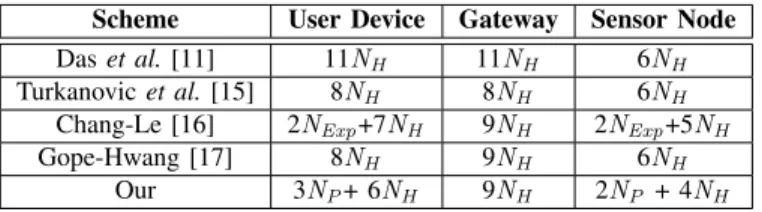
Next, we compare the computation cost of the proposed scheme with the prior related schemes [11], [15], [16], [17]. Table III shows the number of hash operationsNH, modular
exponentiation operations NExp and PUF operations NP
re-quired by the proposed scheme and other schemes [11], [15], [16], [17]. The results in this table show that the computation cost of the proposed scheme is quite similar to that in the scheme [17]. To evaluate the performance of the proposed scheme in terms of the computation costs at the user and gateway, we first simulate the cryptographic operations used in the proposed scheme and other schemes [11], [15], [16], [17] on an Ubuntu 12.04 virtual machine with an Intel Core i5-4300 dual-core 2.60 GHz CPU (operating as the gateway). To simulate the user’s device, we use a single core 798 MHz CPU and 256 MB of RAM. The simulation uses JCE library to evaluate the execution time of several cryptographic operations used in the proposed scheme and other schemes [11], [15], [16], [17]. Here, for hash operation we consider the SHA-256 [25]. In that case, each hash operation at the user device and the gateway takes 1.37 ms and 0.68 ms, respectively. Besides, for the PUF operation we consider the simulation of an 128-bit arbiter PUF circuit on the MSP430 micro-controller machine with 798 MHz CPU, where each PUF operation takes 0.43 ms. From Table IV, we can see that Chang-Le’s scheme [16] takes more computation cost than other schemes, where each modular exponential operation takes 16.84 ms. On the other hand, Table IV shows that although the communication cost of the proposed scheme is little higher than some of the schemes, the computation cost of the proposed scheme at the user and gateway is lower than the other schemes. Next, we consider the computation and the communication cost at the sensor node in the proposed scheme and other existing schemes [11], [15], [16], [17]. In this regard, we simulate the cryptographic operations used in the proposed scheme and other existing schemes [11], [15], [16], [17] on a modular sensor board MSB-430 with the T1 MSP430 micro-controller and the temperature sensor- TMP36. Here, for the PUF operation we consider the simulation of an 128-bit arbiter PUF circuit on the MSP430 micro-controller machine. Based on the simulation results, the execution time of a hash operation (SHA-256), modular exponentiation operation, PUF operation are 1.37 ms, 16.84 ms and 0.43 ms, respectively. Table V shows that the proposed scheme takes only 6.34 ms to execute 2NP +4NH operations, which is significantly less
than that for the scheme [16] and other schemes. From Table V, we can also see that in the proposed scheme a sensor node needs to bear less communication cost as compared to other schemes. Furthermore, since in the proposed scheme the
Table V
COMPARISONBASEDONSENSORNODE’SCOMPUTATION, COMMUNICATION,ANDSTORAGECOSTS
Scheme Computation Communication Storage Cost (in ms) Cost (in bytes) Cost (in bits)
Daset al.[11] 8.22 35 256
Turkanovicet al.[15] 8.22 35 256 Chang-Le [16] 40.53 51 378 Gope-Hwang [17] 8.22 35 128
Our 6.34 32 Nil
sensor node does not require to store any secret credentials in its memory, the storage cost of the proposed scheme is nil
for the sensor node point of view. Conclusively, from Tables II, III, IV and V we can argue that the performance of the proposed scheme is better than other schemes [11], [15], [16], [17], and hence, it is more suitable for designing any secure IWSN as compared to other schemes.
VI. CONCLUSION
This article proposes a lightweight and physically secure mutual authentication protocol for IWSN. In the proposed protocol, we used lightweight cryptographic primitives, such as one-way hash function, physically uncloneable function and bitwise XOR operations. In the comparative summary, we demonstrated that the proposed scheme ensures several im-perative security features and incurs lower computation, com-munication, and storage costs. Hence, the proposed scheme is more suitable for IWSN security in comparison to the other existing schemes.
REFERENCES
[1] M. Erdelj, N. Mitton, E. Natalizio, “Applications of Industrial Wireless Sensor Networks,”CRC Press, 2012.
[2] G. P. Hancke, “Industrial Wireless Sensor Networks: Applications, Protocols, and Standards,”CRC Press, 2013.
[3] E. A. Basha, S. Ravela, and D. Rus, “Model-based monitoring for early warning flood detection,” Proc. 6th ACM Conference on Embedded Network Sensor Systems (SenSys ’08, pages 295–308, New York, NY, USA, 2008.
[4] P. Gope and T. Hwang, “BSN-Care: A Secure IoT-based Modern Healthcare System Using Body Sensor Network,”IEEE Sensors Journal, vol. 16, no. 5, pp. 1368 – 1376, 2016.
[5] P. Jiang et al. “A Mosaic of Eyes,” IEEE Robotics & Automation Magazine, vol. 18, no. 3, pp. 104 –113, 2011.
[6] K. H. M. Wong, Y. Zheng, J. Cao, and S. Wang, “A dynamic user authentication scheme for wireless sensor networks,” Proc. IEEE Int. Conf. Sens. Netw. Ubiq. Trustworthy Comput., vol. 1, pages 244–251, 2006.
[7] H. R. Tseng, R. H. Jan, and W. Yang, “An improved dynamic user authentication scheme for wireless sensor networks,”Proc. IEEE Global Telecommun. Conf., 2007, pp. 986–990.
[8] M. L. Das, “Two-factor user authentication in wireless sensor networks,” IEEE Trans. Wireless Commun., vol. 8, no. 3, pp. 1086–1090, 2009.
[9] M. K. Khan and K. Alghathbar, “Cryptanalysis and security improve-ments of two-factor user authentication in wireless sensor networks,” Sensors, vol. 10, pp. 2450–2459, 2010.
[10] D. He, Y. Gao, S. Chan, C. Chen, and J. Bu, “An enhanced two-factor user authentication scheme in wireless sensor networks,”Ad Hoc Sens. Wireless Netw., vol. 10, no. 4, pp. 361–371, 2010.
[11] A. K. Das, P. Sharma, S. Chatterjee, and J. K. Sing, “A dynamic password-based user authentication scheme for hierarchical wireless sensor networks,”J. Netw. Comput. Appl., vol. 35, no. 5, pp. 1646–1656, 2012.
[12] K. Xue, C. Ma, P. Hong, and R. Ding, “A temporal-credential-based mutual authentication and key agreement scheme for wireless sensor networks,”J. Netw. Comput. Appl., vol. 36, no. 1, pp. 316–323, 2013. [13] M. Turkanovic and M. Holbl, “An improved dynamic password-based
user authentication scheme for hierarchical wireless sensor networks,” Electron. Elect. Eng., vol. 19, no. 6, pp. 109–116, 2013
[14] C. -T. Li, C. Y. Weng, and C. C. Lee, “An advanced temporal credential-based security scheme with mutual authentication and key agreement for wireless sensor networks,”Sensors, vol. 13, pp. 9589–9603, 2013. [15] M. Turkanovic, B. Brumen, and M. Holbl, “A novel user authentication
and key agreement scheme for heterogeneous ad hoc wireless sensor networks, based on the Internet of Things notion,”Ad Hoc Netw., vol. 20, pp. 96–112, 2014.
[16] C. C. Chang and H. D. Le, “A provably secure, efficient, and flexible authentication scheme for ad hoc wireless sensor networks,”IEEE Trans. Wireless Commun., vol. 15, no. 1, pp. 357–366, 2016.
[17] P. Gope and T. Hwang, “A Realistic Lightweight Anonymous Authen-tication Protocol for Securing Real-Time Application Data Access in Wireless Sensor Networks,” IEEE Trans. Ind. Electron., vol. 63, pp. 7124–7132, 2016.
[18] P. Gope, J. Lee, and T~Q. S. Quek, “Lightweight and Practical Anonymous Authentication Protocol for RFID Systems Using Physically Unclonable Functions,”IEEE Transactions on Information Forensics and Security,vol. 13(11), pp. 2831-2843, 2018.
[19] P. Gope, and B. Sikdar, “Lightweight and Privacy-Preserving Two-Factor Authentication Scheme for IoT Devices," ” IEEE Internet of Things Journal, DOI:10.1109/JIOT.2018.2846299, 2018 .
[20] M. Abdallaet al., “Password-based authenticated key exchange in the three-party setting, ”Proc. Public key Cryptogr., pp. 65-84, 2005. [21] V. C. Gungor and G. P. Hancke, “Industrial Wireless Sensor Networks:
Challenges, Design Principles, and Technical Approaches,”IEEE Trans. Ind. Electron., vol. 56, no. 10, pp. 4258–4265, 2009.
[22] D. Dolev and A. Yao, “On the security of public key protocols,”IEEE Transactions on Information Theory, vol. 29, no. 2, pp. 198–208, 1983. [23] V. Odelu, A. K. Das, and A. Goswami, “A Secure Biometrics-Based Multi-Server Authentication Protocol using Smart Cards,”IEEE Trans-actions on Information Forensics and Security, vol. 10, no. 9, pp. 1953– 1966, 2015.
[24] M. Wazid, A. K. Das, V. Odelu, N. Kumar, and W. Susilo, “Secure Remote User Authenticated Key Establishment Protocol for Smart Home Environment,” IEEE Transactions on Dependable and Secure Computing, 2017, DOI: 10.1109/TDSC.2017.2764083.
[25] “Secure Hash Standard,” FIPS PUB 180-1, National Institute of Standards and Technology (NIST), U.S. Department of Commerce, April 1995. http://nvlpubs.nist.gov/nistpubs/FIPS/NIST.FIPS.180-4.pdf. Accessed on June 2018.
[26] D. Wang, H. Cheng, P. Wang, X. Huang, and G. Jian, “Zipf’s Law in Passwords,”IEEE Transactions on Information Forensics and Security, vol. 12, no. 11, pp. 2776–2791, Nov 2017.
[27] K. Park, Y. Park, Y. Park, A. Goutham Reddy, and A. K. Das, “Provably Secure and Efficient Authentication Protocol for Roaming Service in Global Mobility Networks," IEEE Access, vol. 5, pp. 25110-25125, 2017.
[28] S. Roy, A. K. Das, S. Chatterjee, N. Kumar, S. Chattopadhyay, and J. J. Rodrigues, “Provably Secure Fine-Grained Data Access Control over Multiple Cloud Servers in Mobile Cloud Computing Based Healthcare Applications,”IEEE Transactions on Industrial Informatics, 2018, DOI: 10.1109/TII.2018.2824815.
[29] D. Wang and P. Wang, “On the anonymity of two-factor authentication schemes for wireless sensor networks: Attacks, principle and solutions,” Computer Networks, vol. 73, pp. 41-57, 2014.
[30] S. H. Seo, J. Won, S. Sultana, and E. Bertino, “Effective Key Man-agement in Dynamic Wireless Sensor Networks,"IEEE Transactions on Information Forensics and Security, vol. 10, no. 2, pp. 371-383, 2015. [31] C. Ma, D. Wang, and S. Zhao, “Security flaws in two improved remote
user authentication schemes using smart cards,"Int. J. Communication Systems, vol. 27, no. 10, pp. 2215-2227, 2014.
[32] J. Bonneau, “The Science of Guessing: Analyzing an Anonymized Corpus of 70 Million Passwords,"Proc. IEEE Symposium on Security and Privacy (S&P’12), San Francisco, CA, USA, 2012, pp. 538-552. [33] D. Wang, Z. Zhang, P. Wang, J. Yan, and X. Huang, “Targeted Online
Password Guessing: An Underestimated Threat,"Proc. ACM Conference on Computer and Communications Security (CCS’16), Vienna, Austria, 2016, pp. 1242-1254.
[34] D. Wang, W. Li and P. Wang, “Measuring Two-Factor Authentication Schemes for Real-Time Data Access in Industrial Wireless Sensor Networks," IEEE Transactions on Industrial Informatics, vol. 14, no. 9, pp. 4081-4092, Sept. 2018.
[35] D. Wang and P. Wang, “Two Birds with One Stone: Two-Factor Authen-tication with Security Beyond Conventional Bound,"IEEE Transactions on Dependable and Secure Computing, vol. 15, no. 4, pp. 708-722, 1 July-Aug. 2018.
Prosanta Gope (M’18) received the PhD degree in Computer Science and Information Engineering from National Cheng Kung University (NCKU), Tainan, Taiwan, in 2015. He is currently working as a Lecturer in the Department of Computer Science (Cyber Security) at the University of Hull, United Kingdom. Prior to this, Dr. Gope was working as a Research Fellow in the Department of Computer Science at National University of Singapore (NUS). His research interests include lightweight authenti-cation, authenticated encryption, access control sys-tem, security in mobile communication and cloud computing, lightweight security solutions for smart grid and hardware security of the IoT devices. He has authored over 50 peer-reviewed articles in several reputable interna-tional journals and conferences, and has four filed patents. He received the Distinguished Ph.D. Scholar Award in 2014 from the National Cheng Kung University, Tainan, Taiwan. He currently serves as an Associate Editor of the IEEE SENSORS JOURNAL, the SECURITY AND COMMUNICATION NETWORKS and the MOBILE INFORMATION SYSTEMS JOURNAL.
Ashok Kumar Das (M’17–SM’18) received the Ph.D. degree in computer science and engineering, the M.Tech. degree in computer science and data processing, and the M.Sc. degree in mathematics from IIT Kharagpur, India. He is currently an Asso-ciate Professor with the Center for Security, Theory and Algorithmic Research, IIIT Hyderabad, India. His research interests include cryptography and net-work security. He has authored over 180 papers in international journals and conferences, including more than 155 reputed journal papers. He was a recipient of the Institute Silver Medal from IIT Kharagpur.
Neeraj Kumar (M’16–SM’17)received the Ph.D. degree in computer science and engineering from Shri Mata Vaishno Devi University, Katra (J&K), India, in 2009. He was a Post-Doctoral Research Fellow at Coventry University, Coventry, U.K. He is currently an Associate Professor with the Depart-ment of Computer Science and Engineering, Thapar University, Patiala, India. He has authored more than 200 technical research papers in the above areas.
Yongqiang Chengreceived the Ph.D. degree from School of Engineering, Design and Technology, the University of Bradford, UK. He is currently a senior lecturer with the department of computer science and technology at the University of Hull, UK. His research interest includes digital healthcare technologies, embedded systems, control theory and applications, AI and data mining.