Temporal Integration in Visual Memory
Vincent Di Lollo
University of Alberta, Edmonton, Canada SUMMARY
Iconic memory has often been likened to a sensory store whose contents drain away rapidly as soon as the inducing stimulus is turned off. Instances of short-lived visible persistence have been explained in terms of the decaying contents of iconic store. A fundamental requirement of this storage model is that strength of per-sistence should be a decreasing function of time elapsed since the cessation—not since the onset—of the inducing stimulation. That is, strength of visible persistence may be directly related—but not inversely related—to the duration of the inducing stimulus.
Two complementary paradigms were utilized in the present studies. In the first paradigm performance was facilitated by visible persistence in that the task required the bridging of a temporal gap between two successive displays. In the second paradigm (forward visual masking by pattern), performance was impaired by lingering visible persistence of the temporally leading mask. Both paradigms yielded evidence of an inverse relationship between duration of inducing stimulus and duration of visible persistence.
More specifically, in a task requiring temporal integration of a pattern displayed briefly in two successive portions, performance was severely impaired if the dura-tion of the leading part exceeded about 100 msec. This suggests an inverse reladura-tion- relation-ship between duration of inducing stimulus and duration of sensory persistence and allows the inference that visual persistence may be identified more fittingly with ongoing neural processes than with the decaying contents of an iconic store. In keeping with this suggestion, two experiments disconfirmed the conjecture that lack of temporal integration following long inducing stimuli could be ascribed to emergence of unitary form separately in the two portions of the display or to the triggering of some sort of discontinuity detection mechanism within the visual system. In added support of a "processing" model, two further studies showed that the severity of forward masking by pattern declines sharply as the duration of the leading mask is increased.
This pattern of results is equally unsupportive of a storage theory of iconic persistence as of perceptual moment theory in any of its versions. This is so because both theories regard interstimulus interval rather than stimulus-onset asynchrony as the crucial factor in temporal integration. Neither can the results be explained in terms of receptor adaptation or of metacontrast suppression. The theory of inhibitory channel interactions can encompass the more prominent aspects of the results but fails to account for foveal suppression and for some crucial temporal effects.
Copyright 1980 by the American Psychological Association, Inc. 0096-3445/80/090l-0075$00.75
76
Why is it that two sequential visual dis-plays, separated by a brief temporal gap, often appear to be temporally contiguous or overlapping? Two classes of answers have been suggested. One states that visual per-sistence, in the form of iconic memory (Neisser, 1967), is the basis for the per-ceptual bridging of the gap. According to this theory, the contours of the temporally leading display are stored in a sensory register (Atkinson & Shiffrin, 1968), also called iconic store (Neisser, 1967), whose contents fade over several hundred milli-seconds from the termination of the inducing stimulus. If the temporal gap does not exceed the duration of iconic persistence, the two displays will be seen as temporally overlapping, because the fading icon of the first will still be perceptually available at the time the second is presented (Eriksen & Collins, 1967; Haber, 1971).
Alternately, the perceptual moment hy-pothesis assumes that the visual system quantizes incoming stimulation into tempo-rally successive bundles, or "moments" of finite duration, often estimated at about 100 msec (e.g., Allport, 1968). Visual events that fall within the same moment are held to be temporally integrated. Several versions of the perceptual moment hypothesis have been proposed. Among the "discrete mo-ment" hypotheses (White, 1963), one ver-sion assumes that the train of moments is self-paced and that it is possibly linked to the alpha rhythm of the electroencephalo-gram (EEC) (e.g., Kristofferson, 1967; Murphree, 1954; Walter, 1950). A closely related version, noted by Haber and Hersh-enson (1973), is that the timing sequence may be stimulus dependent in that its initia-tion may be time locked to the onset of the inducing stimulus. On this alternative, the
Portions of this article were presented at the meeting of the Lake Ontario Visionary Establish-ment, Niagara Falls, Ontario, Canada, February
1977.
This research was supported by National Re-search Council of Canada Grant A0269.
Requests for reprints should be sent to Vincent Di Lollo, Department of Psychology, Biological Sciences Building, University of Alberta, Edmon-ton, Alberta, Canada T6G 2E9.
train of moments would begin at the onset of a stimulus and would cease at the termina-tion of the moment containing the trailing edge of the inducing stimulus. A third ver-sion is Allport's (1968) "travelling mo-ment," which is conceptualized as a moving temporal window containing all the informa-tion registered by the visual system during the preceding 100 msec or so; with the passage of time, new events enter the window and old events drop out. Despite their differences, all versions provide the same answer to the initial question: Two sequential stimuli separated by a temporal gap are perceived as temporally contiguous or overlapping if the trailing portion of the first stimulus falls within the same moment as the leading portion of the second.
Neither iconic theory nor the perceptual moment hypothesis has remained entirely unchallenged (e.g., Efron, 1970; Holding, 1975). The results of the experiments reported below are equally unsupportive of a "storage" theory of iconic memory and of any version of the perceptual moment hy-pothesis. Instead, the present results, as well as other results reported in the literature, suggest that except for retinal afterimages, visual persistence may be more properly regarded as the product of ongoing neural processes of finite duration. This interpre-tation of sensory persistence is articulated and examined in the remainder of this article.
Experiment 1
Experiment 1 is a replication and expan-sion of a recent study (Di Lollo, 1977) that investigated perceptual integration of a con-figuration whose parts were displayed in two sequential portions separated by a temporal gap. The technique, first described by Hog-ben and Di Lollo (1974), employed an oscil-loscopic display consisting of a square matrix of 25 dots arranged in five rows and columns. One of the 25 dots, chosen randomly on every trial, was not plotted. The subject's task was to name the coordinates of the missing dot within the matrix. The display sequence consisted of three steps: First, an aggregate of 12 dots, chosen randomly from the matrix, was displayed for a period that
varied between 10 and 200 msec; next, a 10-msec temporal gap was allowed to elapse with no dots shown on the screen; and finally, the remaining 12 dots were displayed for 10 msec. The only temporal factor that varied across conditions was the duration of the first portion of the display. Since there were no contextual cues outlining the frame-work of the matrix, identification of the location of the missing dot depended on the simultaneous perceptual availability of the total matrix form (see Hogben & Di Lollo, 1974).
Simply stated, success at this task depends upon the bridging of the temporal gap be-tween the two portions of the display. According to iconic theory, the brief 10-msec gap should be easily filled by the iconic per-sistence of the first 12 dots. More impor-tantly, although a longer exposure duration of the leading portion of the display may well lead to improved performance (perhaps by establishing a sharper icon), it should never produce an impairment in performance. This follows from the joint considerations that the icon is said to begin fading from the termination of the inducing display and that the duration of the temporal gap remained unaltered throughout the experiment.
Predictions based on perceptual moment theory depend on which version is con-sidered. According to the "travelling mo-ment" hypothesis (Allport, 1968), incre-ments in the duration of the leading display should neither facilitate nor impair perform-ance ; since the temporal separation between the trailing edge of the first display and the leading edge of the second was the same in every condition, both should appear within the "temporal window" for a period that depends on the width of the window, not on the duration of the leading display. Accord-ing to "discrete moment" interpretations (White, 1963), increments in the duration of the leading display should yield a non-monotonic performance curve that oscillates discretely between a high level when both displays share portions of the same moment and a low level when the temporal gap straddles two separate moments.
Neither iconic theory nor perceptual
moment theory could predict a rapid and severe impairment in performance when the duration of the leading display exceeded about 100 msec. Yet this is what the results unambiguously showed.
Method
The equipment and method for producing the stimuli have been described in detail by Hogben and Di Lollo (1974). Briefly, a display consisting of 24 dots of the 25 dots defining a 5 X 5 square matrix was displayed on a gridless Tektronix 602 point plotter equipped with fast PIS phosphor. Displays were generated by a PDP-8/L computer, which also performed all the timing and scoring functions.
The subject sat inside a light-proof cubicle and viewed the dimly lit display surface binocularly through a Tektronix Model 016-0154-00 viewing hood. From the viewing distance of 42 cm, the dot matrix subtended a visual angle of approximately 4.1°. The subject pressed a button to initiate a trial consisting of the following sequence of events: First, 12 matrix dots, chosen randomly on each trial, were displayed for either 10, 40, 80, 120, 160, or 200 msec; next, an interstimulus interval (ISI) of 10 msec was allowed to elapse; finally, another 12 dots (chosen randomly from the remaining 13 matrix locations) were displayed for 10 msec. The subject's task was to identify the location of the missing dot and to name its row and column coordinates through an intercom to the experi-menter, who entered them on a teletypewriter.
An experimental session consisted of 120 ran-domly ordered trials composed of 20 presentations of the dot matrix for each of the six experimental conditions defined by the six durations of the leading portion of the display. The 120 trials occurred in a different random order for each session and were completed within 15 min. Data were collected on five separate sessions from each of three subjects: the author, a male graduate (RGB) and a female undergraduate student (SKP). All had normal or correct-to-normal vision.
Brightness cq^lalisation procedures. For stim-ulus durations shorter than about 100 msec, per-ceived brightness depends jointly on the intensity of the stimulus and on its duration. Time-intensity reciprocity over this range of stimulus durations has been found at threshold levels of intensity (Bloch's law) and at suprathreshold levels (Butler, 1975).
In five of the six experimental conditions described above, the duration of the leading display far exceeded that of the trailing display. The resultant brightness mismatch between the two portions of the display could interfere with accuracy of performance (Eriksen & Collins, 1967). More importantly, the level of interference due to
78 100 90 80 70 60 50 40 30 20 10 ROB 40 8O ISO I6O DURATION OF FIRST PORTION
OF DISPLAY (MSEC)
200
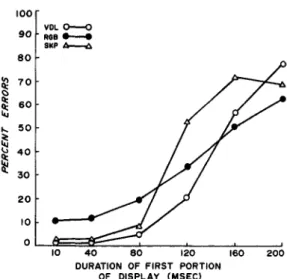
Figure 1. Percentage of errors plotted separately for each subject at each of the six durations of the leading portion of the display.
brightness mismatch would increase with incre-ments in the duration of the leading display and would thus entirely confound the effects of the independent variable.
Brightness mismatch was eliminated as an important source of confounding through computer-controlled modulation of the intensity of each display. The longer displays were plotted at lower intensity values so that all displays appeared of the same brightness regardless of duration. Technically, this was made possible by an analog-to-digital converter on the z axis of the display interface, which allowed independent variation of the intensity of each dot from minimum (invisible) to maximum (flaring) in 256 steps. The intensity values appro-priate for each duration were determined separately for each subject in a preliminary psychophysical task. The procedure, similar to that used by Serviere, Miceli, and Galifret (1977) has been described in detail by Di Lollo (1979).
Results and Discussion
Figure 1 shows the percentage of errors at each duration of the leading display sep-arately for each subject. Performance was essentially errorless at leading-stimulus dur-ations up to about 100 msec, but it deterio-rated rapidly and markedly thereafter. The phenomenal appearance of the display should be noted: At the briefer durations of the leading portion, all dots in the matrix were seen simultaneously, but at the longer dur-ations the display was seen in two discrete parts separated by a noticeable temporal gap.
Casual observations in the laboratory showed that the two portions of the display were still perceived as discrete and that perform-ance remained severely impaired even at leading-stimulus durations of several sec-onds. This was true regardless of practice, whether the observer was a regular subject or a naive visitor in the laboratory. Also, it must be noted that entirely similar results were obtained without employing the bright-ness-equalization procedure described above. Allowing the brightness of the leading dis-play to covary with its duration produced some degree of brightness mismatch, but the response curves remained essentially unaltered.
Surprisingly, apparent-motion effects were weak or totally absent even at values of stimulus-onset asynchrony (SOA) well within the broad range of values (50-100 msec) where optimal apparent motion has been reported (Kahneman, 1967). This could be due to the lack of any systematic spatial relationship between the locations of the dots in the first portion of the display relative to the dots in the second portion. Thus, apparent motion in one predominant direction could occur only very rarely when, by chance, most dots in the trailing display happened to occupy matrix locations that were consistently to one side of the dots in the leading display. On most trials, no clear impression of motion was readily apparent even between pairs of dots: At the briefer values of SOA, the two sets of dots were seen simultaneously; at the longer values of SOA, the compelling perception was not one of motion but one of replacement of the first set of dots by the second set.
Since the experimental task was practically impossible unless the two portions of the display were actually seen as one, it seems likely that some sort of visual persistence was necessary for bridging the temporal gap. If some form of persistence is assumed, the results strongly suggest that persistence was available when the inducing display was brief but not when it was long. Although this suggestion is consonant with similar infer-ences drawn by other investigators (Efron, 1973; Haber, 1971), it is entirely inconsistent
with the view that visual persistence is pro-duced by an iconic store whose contents begin to fade upon termination of the induc-ing stimulus (Neisser, 1967; Sakitt, 1976; Sperling, 1960), Rather, this pattern of results suggests that visual persistence begins at the onset of the display and continues for a fixed duration (about 100 to 150 msec) independent of the duration of the inducing stimulus.
Theoretical implications of this view of sensory persistence are elaborated at the end of the present article, where the possible roles of metacontrast masking and of inhibi-tory channel interactions (Breitmeyer & Ganz, 1976) are also considered. Here it may be helpful to anticipate the main aspects of the argument so as to permit a coherent statement of the reasoning behind the experi-mental work. In this reasoning, visual per-sistence would be identified more fittingly with the activity of sensory coding mech-anisms engaged in an early phase of visual information processing (here referred to as
recruiting phase) than with the contents of
an iconic store. The mechanisms in this phase would be activated by the onset of a display, and activity would continue to the end of the phase whether or not the inducing stimulus was still on display. Thus, visual persistence would be available only for induc-ing stimuli whose duration did not exceed the period of early sensory coding activity, and its duration would correspond to the difference between the duration of the induc-ing stimulus and the duration of the encod-ing process. On this account, the extent to which two sequential stimuli are seen to overlap temporally would depend on the period for which the two stimuli are con-currently active within the recruiting phase. Support for the argument that the first 12 dots were no longer visible at the termina-tion of the longer leading displays is supplied by an examination of the incidence of errors relative to the two portions of the display. An error was made when the subject named a matrix location where a dot had actually been plotted instead of naming the matrix location that had been left empty. On any given trial, an incorrect response could
LEADING DISPLAY w £
i
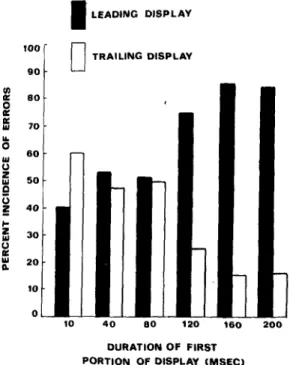
K UJ U o I-111 U K ID a 120 16O 200 DURATION OF FIRST PORTION OF DISPLAY (MSEC)Figure 2. Mean proportions of errors made by incorrectly identifying as missing a dot that had actually been plotted in the first portion of the display (filled bars) or in the second portion of the display (unfilled bars). (The data were averaged over the three subjects, separately at each duration of the leading stimulus.)
result from naming a dot that had been plotted either in the first or in the second portions of the display. Figure 2 shows the percentage of errors attributable to either the first or the second portions of the dis-play at each of the six exposure durations of the leading stimulus.
Proportions of errors in the leading and trailing displays were approximately equal for leading-stimulus durations up to about 100 msec, but diverged sharply thereafter, with most errors being attributable to the leading portion. These results are clearly consonant with the present claim that the sensory persistence of the contents of the leading display diminished sharply after exposure durations greater than about 100 msec.
Before we pursue this line of reasoning, it should be recognized that failure of tem-poral integration at the longer exposure durations could be brought about by factors
other than termination of an early phase of processing. The next two experiments examined the role of emergence of unitary form and of visual masking as possible determinants of the effect.
Experiment 2
It may be suggested that at exposure durations longer than about 100 msec, the visual system can integrate the 12 elements of the leading display into a unitary config-uration, which, in turn, may exhibit a tend-ency to remain perceptually segregated from the configuration formed by the 12 elements of the trailing display. According to this argument, lack of integration between the two portions of the display would be due not to lack of visual persistence of local spatial detail (i.e., of the individual dot) but to the emergence of unitary form, which would override the effect of persistence of the component elements.
One way of examining this alternative is to vary the local spatial detail while leaving overall configuration unaltered. In Experi-ment 2, each matrix eleExperi-ment consisted of a small equilateral triangle defined by three dots. Twelve elements, chosen randomly on every trial, were displayed for the same durations as in Experiment 1 and were followed, after an ISI of 10 msec, by the remaining 12 elements, which were plotted for 10 msec. Allowing for the fact that triangles instead of single dots were used as matrix elements, this procedure was identical to that of Experiment 1 and served as a control condition in Experiment 2. The major departure from the previous study was provided by an experimental condition identical to the control condition except in one respect: During the last 10 msec of exposure of the leading display, the three dots defining each of the 12 elements were replaced by another three dots which, instead of an upward-pointing triangle, formed a downward-pointing triangle. This procedure changed the local detail of the display but left unaltered the overall config-urations that happened to be made by the leading 12 elements on any given trial. It was reasoned that, in so far as level of
per-formance is affected by emergence of unitary form rather than by exposure duration of local detail, the two conditions should yield similar results.
Method
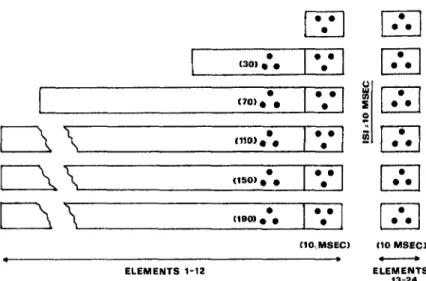
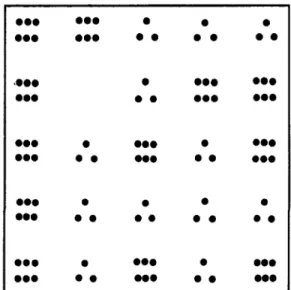
Method, subjects, and procedures of Experiment 2 were the same as for Experiment 1 with the following exceptions: Each matrix element was made up of three dots arranged in the form of an equilateral triangle pointing upward; the angular separation between pairs of dots in a triangle was .38°; and the total matrix subtended a visual angle of approximately 4.4°. The control condition was an exact replication of Experiment 1 with triangles rather than single dots as matrix elements. The experimental condition was the same as the control condition except that 10 msec before the termina-tion of the leading display, the three dots in each of the 12 elements were replaced by three new dots that defined an equilateral triangle with the tip pointing downward. This was equivalent to instantly rotating the triangles by 180°. The exact sequence of events at each of the six durations of the leading configuration in the experimental con-dition is illustrated in Figure 3. Data were collected in five experimental and five control sessions from each subject in a different random sequence.
Results and Discussion
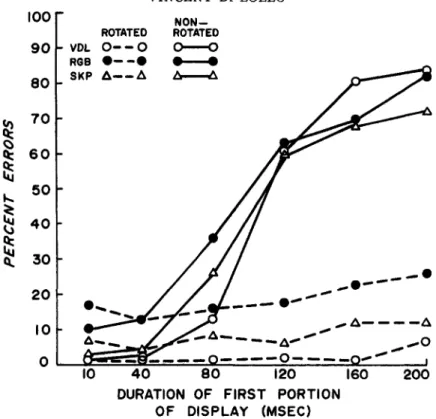
The results illustrated in Figure 4 are unambiguous: The performance curves ob-tained with the "unrotated" triangles (solid lines, Figure 4) were entirely similar to the results of Experiment 1 (Figure 1 ) ; in contrast, the performance curves obtained with the "rotated" triangles (segmented lines, Figure 4) were essentially flat through-out the domain. The results of the "rotated" condition suggest that sufficient visual per-sistence was available to permit temporal integration of the total matrix form irrespec-tive of the duration of the leading (pre-rotation) display. In turn, these results sug-gest that visual persistence is an attribute of each individual dot rather than of the overall configuration formed by the first 12 elements. The phenomenal appearance of the "rotated" displays was in accordance with this conclusion. At the briefer durations of the leading portion, the appearance of the total display corresponded to a temporal integration of all its parts; that is, each of
C30J ,*. (70). . \ \ (110),*, \ \ (ISO)/. \ \ "BO) .*. • • • • • • • • • • • • • • • • • • o u in 0 2 • • • • • • • • • • • • • • • • • • (10 MSEC) (10 MSEC) ELEMENTS 1-12
Figure 3. Display sequence at each of the six stimulus durations in the experimental condition. (In the five sequences in which the duration of the leading configuration exceeded 10 msec, the initial 12 matrix elements were in the form of upright triangles plotted for the number of milliseconds shown in parentheses. The upright triangles were replaced by downward triangles for the last 10 msec of the leading configuration. After an interstimulus interval [ISI] of 10 msec, the remaining 12 elements were shown for 10 msec.)
the first 12 elements appeared as an aggre-gate of six dots resulting from the temporal integration of an upright and a downward triangle. This aggregate was then temporally integrated with the trailing 12 elements to form a total representation similar to that shown in Figure 5. At durations of the lead-ing display exceedlead-ing about 100 msec, the display seemed to consist of two sequential portions: 12 elements (upward triangles) were seen first and were then followed by 24 other elements (12 upward and 12 down-ward triangles) from which the missing matrix element could be chosen. Regardless of the duration of the leading display and of the phenomenal appearance of the total con-figuration, identifying the location of the missing element was an invariably easy task in the rotated condition.
As a whole, these results strongly impli-cate exposure duration of local detail rather than exposure duration of overall config-uration as the more potent determinant of sensory persistence. A change in local detail (rotated condition) generated a new lease of persistence, which enabled perceptual bridging of the temporal gap despite the unchanged overall configuration of the lead-ing display.
Experiment 3
Very similar experimental designs were employed in Experiment 1 and in the "un-rotated" condition of Experiment 2: In both cases the display consisted of two flashes separated by a temporal interval. Opera-tionally, this sequence of events is akin to the sequence of test and masking stimuli in forward or backward visual masking. According to this account, it is necessary to consider whether the impairment in per-formance found in Experiments 1 and 2 could be ascribed to masking effects.
Since there is no a priori reason for defin-ing either portion of the display as test stimulus or mask, both forward and back-ward masking should be considered. It is immediately obvious, however, that forward masking is an untenable alternative, because, as shown in Figure 2, almost 90% of all errors were due to confusions between the empty matrix location and one of the ele-ments in the leading portion of the display. Clearly, if the results reported thus far are to be interpreted in terms of masking, the leading display must be designated as the test stimulus and the trailing display as the mask. This leads to the compelling but
82
I
100 90 80 70 60 50 30 20 10 0 ROTATED - VDL O O R6B • • SKP A A NON-ROTATED 10 40 80 120 160 DURATION OF FIRST PORTIONOF DISPLAY (MSEC)
200
Figure 4. Percentage of errors plotted separately for each subject at each duration of the leading configuration in the experimental ("rotated") and in the control ("nonrotated") conditions.
hardly tenable proposition that in Experi-ments 1 and 2, the severity of masking increased as the exposure duration of the test stimulus was increased.
Nevertheless, it is conceivable that a degree of perceptual interference may have arisen at the longer duration of the leading display, perhaps through the triggering of some form of discontinuity-detection mech-anism in the visual system that effectively segregated the two portions of the display one from the other (Eriksen & Collins, 1968; Granit, 1947). This alternative was ex-amined in Experiment 3. The principal aim was to examine the relationship between stimulus duration and duration of sensory persistence under conditions designed to avoid the possibility of perceptual interfer-ence arising from the two-flash display mode of Experiments 1 and 2. This was achieved in Experiment 3 by altering the display sequence: Instead of displaying the matrix in two flashes of 12 dots, each of the 24 dots was briefly displayed only once in random
sequence at a regular inter-dot interval (with one exception as noted below). As has been shown by Hogben and Di Lollo (1974), if the inter-dot interval is such that the total duration of plotting of the 24 dots exceeds about 120 msec, the matrix appears to have several missing elements. Interest-ingly, Hogben and Di Lollo (1974) found that the apparently empty locations were those where a dot had been plotted more than about 120 msec before the termination of the display; that is, the persistence of the dots plotted early in the sequence had van-ished before the last dot had been shown.
In Experiment 3, each dot was shown only once for 1.5 //.sec, except for the 12th dot in the sequence, which was plotted for 100 msec. It was reasoned that if sensory persistence is an attribute of each separate dot and if its duration is inversely related to the duration of the inducing stimulus, the 12th dot should have negligible persistence and should hence be easily confused with the truly missing dot. Experiment 3 was a
repli-cation and expansion of a recent study (Di Lollo, 1977).
Method
The display consisted of the dot matrix described in Experiment 1. In the control condi-tion, each of the 24 dots was plotted only once for 1.5 jusec in a random sequence that changed on every trial. The temporal interval between two successive dots was 10 msec. This yielded a total plotting interval of approximately 230 msec from the onset of the first dot to the termination of the 24th dot. The experimental condition was the same as the control condition except for the 12th dot in the plotting sequence, which remained on view from the time of plotting of the second dot until 10 msec after the plotting of the llth dot, a total of 100 msec. The brightness of the 12th dot was made indistinguishable from that of all other dots through the compensation procedure described in Experiment 1. The plotting sequence was randomized on every trial so that each of the 25 matrix locations had an equal probability of being the 12th. Data were collected from three subjects (the author, a male student unaware of the purpose of the research, and an experimentally naive paid female subject) in five experimental and five control sessions sequenced randomly for each subject. One session consisted of 100 trials and was completed in about 10 min.
Results and Discussion
On every error trial the computer pro-gram identified the ordinal position in the plotting sequence of the dot that had been erroneously named as missing. The propor-tion of trials on which a dot shown at each of the 24 ordinal positions was incorrectly identified as missing is shown in Figure 6 separately for each subject. In every case, the 12th dot in the plotting sequence was named as missing much more frequently when its duration was long than when it was brief (Figure 6, experimental vs. control conditions). Similar results were obtained with several other subjects, and congruent results were obtained with the "long" dot in different ordinal positions within the plotting sequence.
Spreading the dots regularly over the entire plotting interval obviated any masking effects possibly associated with the two-flash mode of presentation. In addition, the error distributions plotted in Figure 6 deny that
Figure 5. Phenomenal appearance of the display sequence in the experimental ("rotated") condition at exposure durations of the leading configuration (10-80 msec) that permitted perceptual integration of the total display sequence.
the termination of the 12th dot might have triggered some sort of discontinuity-detec-tion mechanism within the visual system. Had this been so, all dots plotted before the termination of the 12th dot would have become perceptually segregated from the remaining dots. On the contrary, the dots that were plotted just before or just after the 12th dot were named as missing much less frequently than the 12th dot.
What the results strongly suggest is, first, that increasing the exposure duration of a given element leads to a decrement in the duration of sensory persistence of that ele-ment, and second, that the effect is confined to a given element and does not interfere with the sensory persistence or with the perceptual availability of temporally neigh-boring elements in the display sequence.
Though these considerations are con-sonant with a "process" theory of visual persistence, it must be noted that activity of sensory coding mechanisms at an early stage of processing is unlikely to have been the sole determinant of the results of Experi-ment 3. Had this been so, the proportion of errors due to naming the 12th dot as missing should have been precisely the same as the proportion of errors involving the second
84 .16 [ .14 .12 • .10-.08 .06 • .04 • .02 0 . SUBJECT PDS 6 B 1O 12 14 16 18 20 22 24 .22 .20 .18 in
I"
Jj .14 IL O .12 .08 .06 .04 .02 0• • DURATION OF 12th DOT. 1OO MSEC O O CONTROL
SUBJECT LDC
10 12 14 16 18 20 22 24
2 4 6 8 1O 12 14 16 18 2O 22 24 ORDINAL SEQUENCE OF PLOTTING OF THE DOTS
dot in the sequence (Figure 6). Instead, overall, the 12th dot was named as missing about as frequently as the fourth dot. This implies a discrepancy in duration of per-sistence of the order of about 20 msec and is clearly in need of explanation. But the size of the discrepancy is minor in compari-son with the massive differences between experimental and control conditions with respect to the 12th dot. These differences are counterintuitive and are consonant with a "process" theory—as distinct from a "stor-age" theory—of visual persistence.
Collectively, the results of Experiments 1, 2, and 3 cannot be explained either in terms of emergence of unitary form or in terms of visual masking. This is not to say that these and similar factors were entirely irrelevant to the outcome. Indeed, the pos-sible effects of metacontrast and of inhibitory channel interactions (Breitmeyer & Ganz, 1976) are examined in detail later in this article. On the other hand, the results are consistent with the inference that duration of visual persistence is inversely related to the duration of the inducing stimulus. This inference, based on the present indirect esti-mates is entirely consonant with the results of direct estimates of persistence in vision and in other sensory modalities.
For example, Efron (1973) presented a brief, dimly lit disk and an auditory click in rapid succession and required the subjects to synchronize the click with the termination of the light disk. He found that when the duration of the disk was less than about 130 msec, the subjects adjusted the click at about 130 msec after the onset of the disk. Efron reasoned that the dark interval that necessarily elapsed between the two stimuli under these circumstances was rilled by the sensory persistence of the first display. Of even greater interest was Efron's finding that the subjects' performance was entirely accurate for first-stimulus durations greater than about 130 msec; that is, the subjects
adjusted the onset of the click to coincide exactly with the termination of the light disk. On the basis of these results, Efron suggested that the duration of sensory per-sistence combined additively with the dur-ation of the inducing stimulus up to a maximum of about 130 msec. Thus, a stim-ulus of 10 msec duration will induce sensory persistence of about 120 msec, but a 100-msec display will induce sensory persistence of only 30 msec duration.
An inverse relationship between stimulus duration and sensory persistence has also been reported by Haber (1971) and his co-workers. Although the exact estimate of sensory persistence varied with the experi-mental paradigm and may have been affected by variations in response criterion (Haber & Hershenson, 1973), Haber reported that the duration of sensory persistence decreased as the duration of the inducing stimulus increased.
Some degree of perplexity, however, may arise regarding the generality of these find-ings. The present studies and the studies of Efron (1973) and Haber (1971) employed structurally simple stimuli (e.g., the present dot matrix or Haber's disk-shaped display). It may well be asked whether an inverse relationship between exposure duration and visual persistence would also be obtained with more complex or more meaningful displays. The next two experiments were designed to answer this question and to examine the inverse relationship with yet another experimental paradigm.
Experiment 4
Sensory persistence may be assumed to have facilitated performance in the preceding three studies by allowing perceptual inte-gration of successive stimuli. However, perceptual integration need not always be helpful: Visual persistence of a leading display may actually impair performance if
Figure 6. Temporal distribution of errors for each subject in the experimental and In the control conditions. (The abscissa indicates the ordinal position of the dots in the plotting sequence, irrespective of spatial location within the matrix. The ordinate shows the proportion of trials in which a dot plotted in the indicated ordinal position was incorrectly identified as missing.)
86
the experimental task requires unencumbered perception of a trailing stimulus. Precisely this requirement is made in studies of for-ward masking, in which a leading set of masking contours impairs perception of a trailing test stimulus. Indeed, a common interpretation of forward masking effects in patterned displays is that the perceptual representations of masking and test stimuli are temporally integrated as in a photo-graphic double exposure (Eriksen, 1966; Scheerer, 1973). In turn, identification of the test stimulus is impaired because the visual system cannot disentangle the test contours from the contours of the mask.
Perception of the test stimulus would be facilitated if the visual persistence of the leading mask could be reduced or eliminated. On a storage theory of visual persistence, this could be achieved by allowing a suffi-cient temporal interval between the termina-tion of the mask and the onset of the test stimulus. But an alternative and less intui-tive procedure is suggested by the results of the three experiments reported above: The duration of visual persistence of the leading mask may be reduced by increasing its exposure duration. Since, according to the present viewpoint, long stimuli have little or no persistence, it should be expected that forward masking due to perceptual integra-tion of contours would take place if the mask were brief but not if it were long.
Method
Equipment and viewing conditions were the same as in the previous studies. The test stimulus was an uppercase alphabetic character, similar to Letraset No. 8831, chosen randomly on every trial from the full set of the English alphabet. The character was plotted within an imaginary square subtending approximately .5° of visual angle, immediately above a fixation dot located in the center of the screen. The masking stimulus was an aggregate of portions of alphabetic characters corresponding roughly to three whole characters in amount of contour. The mask was shown within the same spatial confines as the test stimulus. A new set of masking contours was assembled on every trial.
In response to a button press by the subject, the masking stimulus was displayed for either 20, 40, 80, 160, 320, or 640 msec and was followed immedi-ately by the test stimulus, which was displayed in
the same location as the mask for 20 msec in every case. In an additional control condition, both the test stimulus and the masking stimulus were dis-played simultaneously for 20 msec. Each of the seven conditions appeared 20 times in each experi-mental session. The 140 trials were sequenced in a different random order in every session and were completed in less than IS min. The brightness of the displays was equalized according to the pro-cedure described in Experiment 1. Data were collected from four subjects: the author and three undergraduate students unaware of the purpose of the research. Each subject served in five experi-mental sessions spaced over several days.
On any given trial, the sequence of events was as follows: When the subject pressed a hand-held button, the fixation point disappeared and the appropriate display was shown. The subject identi-fied the test character (or guessed if not sure) and communicated the response over an intercom to the experimenter who entered it on a teletypewriter. The computer scored the response, set up the condi-tions for the next display, and then turned on the fixation point to indicate readiness for a new trial. Results and Discussion
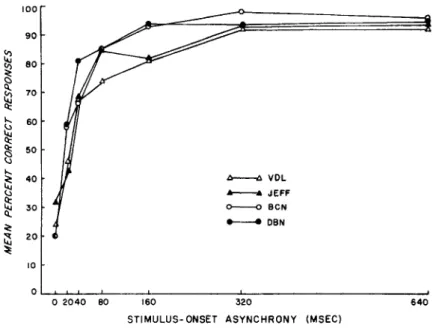
Figure 7 shows the results separately for each subject. In every case, performance improved rapidly as the duration of the lead-ing mask was increased. These results are clearly inconsistent with a storage theory of iconic persistence, which would demand an undiminished level of masking throughout the domain. It must be noted that the improvement in performance was the result of increasing the duration of the mask, an operation generally regarded as leading to increased severity of masking in other para-digms. In this sense, the results are incon-sistent with a simple masking interpretation though ostensibly consistent with the hypoth-esis of inhibitory channel interactions as discussed below.
Though they defy explanation in terms of a storage theory of persistence, these results can easily be interpreted in terms of the duration of sensory coding events taking place at an early (recruiting) phase of information processing: As duration of the leading mask was increased, the interval during which the two stimuli were being processed concurrently within the recruiting phase diminished. In other words, as the duration of the mask was increased, its visual persistence diminished while leaving
the persistence of the test stimulus un-affected. At exposure durations of the mask that exceeded the duration of the recruiting phase, the two displays did not overlap at all within that phase. This meant, in present terms, that the mask's persistence was ex-hausted, and hence it could not merge with (and degrade) the representation of the trailing test stimulus. The phenomenal appearance of the display was precisely as would be expected on this interpretation: At zero SOA, test stimulus and mask were seen as a single set of contours. The two displays appeared to begin and to end simultaneously. As the SOA was lengthened, the contours of the test stimulus appeared to outlast the con-tours of the mask by an increasingly long margin, which, in turn, facilitated identifica-tion of the test character.
If we pursue this line of reasoning a step further, it becomes clear that test and mask-ing stimuli need not be displayed separately in time for the test character to be easily identifiable. Accurate performance should be possible even if test and masking stimuli were displayed simultaneously provided that the combined display was immediately pre-ceded by a display of the masking contours alone for at least 100 msec. This follows
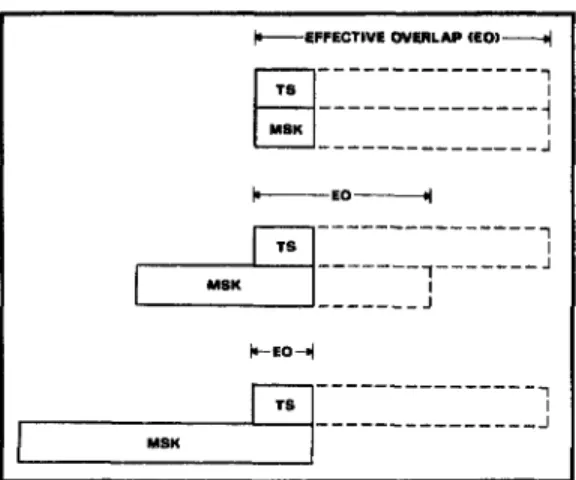
from the joint premises that duration of visual persistence is inversely related to the duration of the inducing stimulus and that persistence is an attribute of local detail, rather than of the overall configuration. Based on these premises, two displays having different durations but simultaneous termi-nations should exhibit the type of relation-ships illustrated in Figure 8. Namely, if both stimuli are displayed briefly and simulta-neously, there should be entire overlap be-tween both stimuli and their persistence (Figure 8, upper portion). If the duration of the masking contours is increased, the sensory persistence of the mask will be diminished by a corresponding amount (Figure 8, middle portion). The diminished effective overlap should produce less inte-gration between the two sets of contours and thereby less masking. Finally, if the leading masking contours are displayed for longer than the duration of the recruiting phase (Figure 8, lower portion), the effec-tive overlap between the two stimuli would be diminished to an irreducible minimum (i.e., the duration of physical overlap) and so would the severity of masking. These predictions are examined in Experiment 5.
Displaying the stimuli in the sequence just
100 90 80 70 60
I
50 40 30 20 10 0 0 2040 80 160 320STIMULUS-ONSET ASYNCHRONY (MSEC)
640
Figure 7. Percent correct responses plotted separately for each subject at each of the seven levels of stimulus-onset asynchrony.
MSK TS T ~ ~~ 1 _ J Experiment 5 Method
Figure 8. Schematic representation of the hypoth-esized relationship between exposure duration of a stimulus (solid contours) and the duration of visual persistence induced by that stimulus (seg-mented contours). ("Effective overlap" refers to the time interval during which test and masking stimuli are held to be perceptually available at the same time. TS = test stimulus ; MSK = masking stimulus.)
described allows the introduction of a fur-ther control condition. It could be suggested that the improvement in performance in Experiment 4 may have been due, at least in part, to an improvement in the visual system's readiness to process temporally trailing contours. That is, at the longer dur-ations of the leading mask there may have been more time in which to perform the essential tasks of focusing, convergence, and rapid adaptation before the onset of the test stimulus. With this option, performance may have improved with increments in mask duration because the visual system, having been primed for some time by the leading display, may have been more attuned to processing the contours of the test stimulus. In Experiment 5, this alternative was tested as follows: Test and masking stimuli were always presented in a simultaneous display preceded by a variable-duration display con-taining either the contours of the masking stimulus (experimental condition) or a set of contours totally unrelated to the masking contours (control condition). It was rea-soned that performance in the control condi-tion would provide an index of whatever effects priming per se might have on identi-fication of the test stimulus.
Subjects, method, and procedure in Experiment 5 were the same as in Experiment 4 with the following exceptions. In the experimental condi-tion all stimuli terminated with a combined 20-msec display of test and masking contours. The combined display was immediately preceded by a display of the masking contours alone for either 0, 20, 40, 80, 160, 320, or 640 msec. The control condition was the same as the experimental condi-tion except that an entirely new set of masking contours replaced the original set simultaneously with the onset of the test stimulus. In the six temporal conditions where the combined display was preceded by a display of the mask, one set of masking contours was shown during the initial period and a completely different set was shown for the last 20 msec of the display. Every subject served in five experimental and five control sessions in a different random sequence.
Results and Discussion
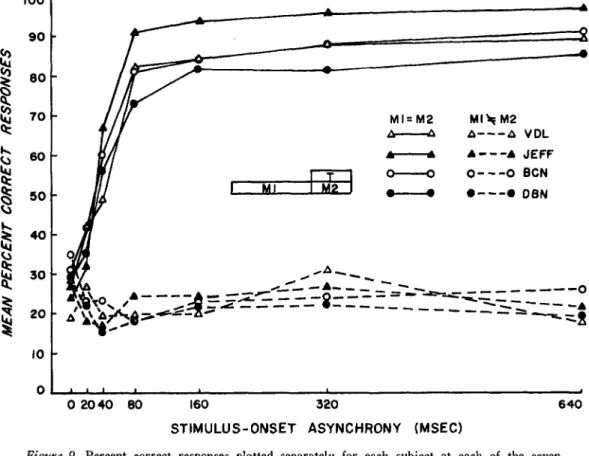
Individual results illustrated in Figure 9 clearly show that temporal separation between masking and test stimuli is not necessary for unimpeded perception of the latter, provided the masking contours have been on view alone for some time. This result is entirely consonant with the view-point outlined in the preceding discussion and illustrated in Figure 8, but not with a simple "storage" theory of visual persistence. That is, it is not immediately obvious why, of two stimuli that terminate simultaneously, one (the briefer one, at that) should have greater iconic prominence and longer per-sistence than the other.
Changing the masking contours simul-taneously with the onset of the test stimulus completely nullified the facilitatory effects of a long leading display (Figure 9, segmented lines). This strongly suggests that "prim-ing" action by the longer leading displays was a negligible determinant of the improve-ment in performance in the experiimprove-mental condition (Figure 9, continuous lines).
Expectations from the perceptual moment hypothesis are uniformly disconfirmed. Test stimuli were always shown embedded within the masking stimuli or, to say it with Turvey (1978), the two configurations always bore a "post-during" relationship one to the
other. Under these display conditions the two stimuli would invariably coincide within the same moment and should thus be max-imally integrated. These would be just the conditions in which impairment in identifica-tion of the test stimulus should be most severe. Yet, through most of the domain (Figure 9), performance was virtually unimpeded. This result as well as the results of the preceding four studies are utterly unexplainable in terms of perceptual mo-ments. Additional evidence strongly refut-ing the perceptual moment hypothesis has been reported by Di Lollo and Wilson
(1978).
More generally, the difficulty encountered by the perceptual moment hypothesis is that it regards temporal integration as principally dependent upon the interstimulus interval (ISI), whereas the data reported in the
foregoing experiments clearly implicate stim-ulus-onset asynchrony (SOA). (The ISI is the "blank" temporal interval elapsing between the termination of a leading stim-ulus and the onset of the next stimstim-ulus; SOA refers to elapsed time between the onsets of two successive stimuli irrespective of stimulus duration.) Given that temporal integration follows an SOA—rather than an ISI—law, no extant version of the percep-tual moment hypothesis can remain tenable.
General Discussion
Throughout this article the main theo-retical rationale for the experimental work was provided by a juxtaposition of two theories of sensory persistence: a simple storage theory and a processing theory. Dis-cussion of other plausible explanations of
100
r
901°
IM 80 70 60 5040
Sg
30\
20 10 A A JEFF O O BCN • • DBN O 0 2040 80 160 320STIMULUS-ONSET ASYNCHRONY (MSEC)
640
Figure 9. Percent correct responses plotted separately for each subject at each of the seven levels of stimulus-onset asynchrony in the experimental (continuous lines) and in the control (segmented lines) conditions. (In the experimental condition, the two sets of masking contours [Ml and M2] were identical; in the control condition, they were different, T = test stimulus.)
90
the results has been postponed in order to highlight the juxtaposition and to expedite reporting of the data.
In a nutshell, the finding to be explained is the immediate loss of perceptual availabil-ity upon termination of a display that has been on view for longer than about 100 msec. Besides the hypotheses already dis-cussed, two alternative explanations suggest themselves: receptor adaptation and per-ceptual suppression.
Receptor Adaptation
Explanation of the present results in terms of receptor adaptation is based on the evidence that a receptor's level of responding diminishes as the duration of the inducing stimulus is increased. On this basis, the inverse relationship between duration of leading display and degree of perceptual integration with the trailing display is explained by assuming that the responsive-ness of the receptors exposed to the leading stimulus had waned by the time the second stimulus was displayed.
But this interpretation is severely weak-ened by the fact that receptor adaptation typically requires levels of stimulation either of far greater intensity or of far greater duration than the stimuli used in these stud-ies (e.g., Brown, 1965). That is to say, if receptor adaptation played a role in the present work, that role must be regarded as quite limited because the phenomena appeared conspicuously, despite the low levels of stimulus intensity, even when the duration of the first display was only 100 msec.
Incidentally, it should be noted that receptor aftereffects provide a somewhat ambiguous explanatory principle, in that continued activity could be expected just as plausibly as underactivity upon termination of the inducing stimulus. Consider the brief yet clear positive afterimages produced by prolonged or intense stimulation of photo-receptors. Such aftereffect would obviously have a facilitatory rather than a hindering effect on temporal integration of successive displays. At any rate, bearing in mind the brief durations and the relatively low
intensities of the stimuli, neither type of aftereffect is likely to have played a major role in the present experiment.
Let us now consider the option that failure of perceptual integration at the longer durations of the leading stimulus may be ascribed to an active process of perceptual suppression induced by the presentation of the second stimulus. Three classes of events where some form of perceptual suppression has been implicated are examined below. They are apparent motion, metacontrast masking, and inhibitory channel interactions.
Apparent Motion and Metacontrast
Suppressive effects of apparent motion and of metacontrast masking appear to follow similar time courses and, largely for this reason, have been linked theoretically one to the other (Fehrer, 1966; Kahneman, 1968). Although, as noted above, there was very little phenomenal evidence of apparent motion in the visual displays, it could be argued that some perceptual suppression might nevertheless have taken place. How-ever, the temporal parameters of apparent motion do not seem to fit well with the present data. Optimal apparent motion is obtained within SOA ranges of 50-100 msec (Kahneman, 1968) with the effect lessening thereafter. Now consider the results of Experiments 1 and 2, where deterioration in performance did not even begin until SOAs of at least 100 msec and showed no sign of abating at much longer SOA values. Clearly, if these results are to be ascribed to the suppressive effect of apparent motion, then it must also be explained why the suppres-sive effects were weakest at those SOAs where apparent motion would be expected to be strongest, and vice versa.
Similar considerations appear to conflict with an interpretation of these results in terms of metacontrast masking. Although, in keeping with the present data, severity of metacontrast masking is known to be a func-tion of SOA rather than ISI, the most severe masking is obtained at SOAs of 50-100 msec (Kahneman, 1968). Thus, were the results of Experiments 1 and 2 to be explained in terms of metacontrast masking,
it should be expected that performance would be the worst when the second portion of the display was presented 50-100 msec after the onset of the first portion. But the data (Fig-ures 1, 2, and 4) offer a strikingly different picture.
Additional considerations make a meta-contrast explanation even less likely. It has been known for some time (Alpern, 1953) that metacontrast suppression is weak or entirely absent for stimuli displayed within the fovea. This would create difficulties for a metacontrast interpretation of Experi-ments 4 and 5, in which the stimuli were entirely foveal. Furthermore, informal repli-cations of Experiment 1 using a dot matrix no larger than 2° of visual angle yielded results entirely comparable to those obtained with the larger stimuli. Finally, even though both the stimuli and the tasks employed in the present studies are unlike those used in the most common class of metacontrast experiments (cf. Weisstein, 1972), it is notable that the curves obtained in the present work are "Type A" monotonic func-tions (Breitmeyer & Ganz, 1976; Kolers, 1962), whereas metacontrast curves are invariably "Type B" nonmonotonic func-tions.
Inhibitory Channel Interactions
Information-processing theories have been developed in which the visual system is regarded as a multichannel processor (Breit-meyer & Ganz, 1976; Merikle, 1977; Weis-stein, Ozog, and Szoc, 1975). These theories can explain instances of perceptual suppres-sion in terms of patterns of interference arising within and between processing channels.
It is known that (e.g., Breitmeyer & Ganz, 1976), as part of the total neural response initiated by a visual display, at least two separate neural networks are activated within the visual system: the transient and the sustained networks. Transient cells have very brief latencies and are attuned to low spatial frequencies, which mediate detection of a visual event but are not attuned to the high spatial frequencies that mediate percep-tion of the contours of a display. In contrast,
sustained cells have longer latencies (up to several hundred milliseconds) and are attuned to higher spatial frequencies. It is also known that a burst of activity in a transient channel inhibits activity in a neighboring sustained channel (Singer & Bedworth, 1973). Such interchannel differ-ences in response latencies have been utilized to explain perceptual suppression of the first of two rapidly successive displays (Breit-meyer & Ganz, 1976).
For example, consider two patterned visual stimuli presented in rapid succession. The temporally leading stimulus (Stimulus A) is shown for, say, 150 msec and is fol-lowed immediately by the second stimulus (Stimulus B) which is shown for, say, 20 msec. According to theory, the onset of Stimulus A generates an immediate and short-lived burst of activity in the transient channels that subsides within less than 100 msec from the onset of the stimulus. Under these circumstances, transient-channel activ-ity would have no inhibitory consequences because no sustained channels would be active at the same time (i.e., the field of view had been blank just before the onset of Stimulus A). About 100 msec after the onset of Stimulus A, activity is initiated in the sustained channels in response to the higher spatial frequencies (i.e., contours or edges) of the display. Undisturbed, activity in the sustained channels would continue and would ultimately permit identification of the contours of the stimulus, but the on-set of Stimulus B generates a burst of transient-channel activity that inhibits on-going activity in the sustained channels concerned with Stimulus A and thus impairs perception of its contours. As a consequence of such inhibitory interchannel interaction, at the end of the display sequence, the visual system has available the contours of only Stimulus B.
Inhibitory interactions of this kind would not arise were the onsets of A and B simul-taneous or within a few milliseconds from each other. In this case, all transient-channel activity would have subsided before the beginning of activity in the sustained chan-nels ; and, according to theory, most
within-92
channel interactions are integrative rather than inhibitory.
The parallel between this example and the experiments reported here need hardly be elaborated: If two visual displays in these studies started within less than about 100 msec from each other, they tended to be perceived in the form of a composite stimulus as a result of integrative within-channel interactions; if, however, the SOA between them exceeded about 100 msec, perception of the leading contours was terminated instantly as a result of inhibitory between-channel interactions.
Even Experiment 2 (Figures 3, 4, and 5) can easily be explained in terms of inter-channel inhibitory effects. In the control (nonrotated) condition, performance was highly accurate at brief levels of SOA but began to deteriorate at levels of SOA greater than about 100 msec. This would be expected on the basis of intrachannel integrative effects at the briefer SOAs and interchannel inhibitory effects at longer SOAs, as ex-plained above. In the experimental (rotated) condition, performance was never impaired because, given their temporal relationship (Figure 3), the micropatterns shown during the last 10 msec of the leading display always bore an intrachannel integrative relationship and never an interchannel inhibitory rela-tionship with the micropatterns of the trailing display.
Interpretation of the results of Experi-ment 3 (Figure 6) would follow much the same line of reasoning. Transient-channel activity induced by any given dot would inhibit sustained-channel activity induced by dots plotted about 100 msec earlier. A moment's reflection will show that under these circumstances, only the dots plotted during the last 100 msec would remain perceptually available at the end of the display sequence. And, since interchannel inhibition follows SOA (not ISI) rules, the "long" dot in the experimental condition would be subject to the same level of inhibition by later plotted dots as a "brief" dot plotted simultaneously with its onset.
Clearly, the theory of inhibitory channel interactions can provide a satisfactory
account of the more prominent aspects of the present results. Yet, serious difficulties are encountered with other less obvious features. For example, it has been known for some time that metacontrast suppression effects, although robust in the periphery of the retina, are weak and highly unstable at the fovea (Alpern, 1953; Kolers & Rosner, 1960). From the viewpoint of inhibitory channel interactions, this result is to be expected because the concentration of tran-sient channels in the fovea is extremely low, whereas that of sustained channels is very high (Fukuda & Stone, 1974; Hoffman, Stone, & Sherman, 1972). Such imbalance in relative concentrations ensures that inter-channel inhibitory effects would be negligible at the fovea but pronounced at the periphery where the opposite imbalance in relative concentrations is found.
Paucity of foveal transient channels is a natural empirical basis on which to explain the fragility of interchannel inhibitory effects at the fovea. Now, consider the results of Experiments 4 and 5, bearing in mind that the stimuli were displayed entirely within the fovea. It is obvious that the powerful effects obtained in these experi-ments (Figures 7 and 9) cannot be ex-plained in terms of interchannel inhibition without marked theoretical inconsistency. In fact, it seems reasonable that the thinly scattered foveal transient channels should induce only weak interchannel inhibitory effects, such as are found in foveal meta-contrast—not the powerful effects that would have to be hypothesized to account for the present data. This is not to deny the importance of interchannel inhibitory effects, particularly in the processing of parafoveal stimuli, but the effects obtained in Experi-ments 4 and 5 are quantitatively beyond what could be fully interpreted on the basis of inhibitory channel interactions.
A second comparison not easily handled by multichannel theory is between ments 1 and 2 on the one hand and Experi-ments 4 and 5 on the other. As can be seen in Figures 7 and 9, recovery from masking is evident at SOAs as brief as 20 msec and is well developed at 40 msec. In contrast,
decisive evidence of impairment in the matrix task did not develop until SOAs of about 100 msec or beyond (Figures 1 and 4). If both sets of results are to be ascribed to perceptual suppression arising from inhibitory channel interactions, then an explanation should also be given of the pro-nounced discrepancy in the time courses of the two sets of events.
It could be argued that the effects in Ex-periments 4 and 5 might have been enhanced by the close spatial proximity between the contours of the leading and of the trailing displays. But this argument would ignore the scarcity of transient channels in the fovea. Indeed, contrary to the findings, an explanation based on interchannel inhibi-tion could well favor more vigorous effects in Experiments 1 and 2 on the grounds that, unlike the alphabetic stimuli in Experiments 4 and 5, the matrix configuration extended to parafoveal areas where the concentra-tion of transient channels is known to be far greater than in the fovea. At any rate, these arguments speak principally to the relative magnitudes of the effects, not to their rela-tive time courses; multichannel theory has no ready way of handling the latter.
In summary, the present argument is not that the theory of inhibitory channel inter-actions is disconfirmed by the present data, nor even that it was totally irrelevant to the outcome of the experiments. Rather, the suggestion is offered that the effects re-ported here are, in varying degrees, outside the class of events that the theory purports to encompass. It is suggested instead that a more coherent account of this pattern of results can be given by regarding sensory persistence as an outcome of neural activity at an early phase of visual information pro-cessing. This viewpoint was outlined earlier in this article and is elaborated below.
A Sensory-Coding Approach
Perceptual events whose principal tem-poral correlate is SOA rather than ISI have been explained in terms of information-pro-cessing events that take place during the SOA (e.g., Kahneman, 1967; Sperling,
1971). In broad outline, the same approach is taken in this article with respect to the duration of visual persistence.
Assume that perception of form emerges from a number of processing operations— some performed serially, others in parallel— and that such operations can be broadly categorized in two successive phases of sen-sory coding, recruiting and interpreting phases. In the first phase (recruiting), the stimulus configuration becomes encoded in terms of as yet meaningless features such as dots, bars, edges, and discontinuities. The "feature-encoded" stimuli that emerge from the recruiting phase are available to the second (interpreting) phase of sensory cod-ing in which identification and categorization operations are performed. The "meaning-encoded" items that emerge from the inter-preting phase may then be available for more complex processes of organization and for more permanent forms of memory. The principal function of each phase is to produce a new level of sensory coding of the initial display. Ultimately, the purpose of the pro-cessing sequence is to arrive at a level of coding that permits comparison between the newly encoded stimulus and other long-term memories.
Although it is assumed that the two phases occur sequentially in the flow of information processing, the possibility is not discounted that processing of some stimulus dimen-sions (e.g., brightness, color, contour) may be completed before others (cf. Cheatham, 1952; Fehrer & Raab, 1962; Kahneman, 1967). Nor is the possibility discounted of feedback loops between stages.
Some of the distinguishing characteristics of the recruiting phase are held to be (a) faithful maintenance of stimulus geometry with initial retinal configuration; (b) virtu-ally unlimited processing capability; (c) mainly parallel processing; (d) masking through integration of contours (as distinct from interruption of processing; cf. Scheerer, 1973) ; and (e) sensory persistence (namely the maintenance of physical, as distinct from informational, aspects of the display). The corresponding characteristics of the inter-preting phase are held to be (a) mainly
94
serial processing; (b) little if any corre-spondence between stimulus geometry and initial retinal configuration; (c) masking by interruption of processing (cf. Scheerer, 1973) ; and (d) maintenance of informational rather than physical aspects of the display (i.e., absence of visual persistence). The interpreting phase may be regarded as performing some of the functions of the lim-ited-capacity "central processor" hypothe-sized by Posner and Klein (1973). Exam-ples of events taking place at the level of the interpreting phase are the instances of visual masking without spatial proximity of test and masking stimuli (Di Lollo, Lowe, & Scott, 1974) and the incidence of backward masking of ISIs exceeding about 100-150 msec (Scheerer, 1973; Spencer & Shuntich,
1970).
Conceptually, this schema is clearly re-lated to other multistage formulations (e.g., Atkinson & Shiffrin, 1968; Dick, 1974; Haber, 1971; Neisser, 1967; Scheerer, 1973; Turvey, 1973, 1978). There are, however, two distinctive aspects. First, the suggested correlative classification between levels of sensory coding (recruiting and interpreting phases) and types of visual masking (inte-gration or interruption) provides a rationale for the reconciliation of the two theories of masking and for subsuming processing and masking effects within the same class of events. And second, visual persistence is re-garded not as the content of a rapidly fading store but as the product of the activity of sensory coding mechanisms engaged in the formation of "feature-encoded" stimuli.
Defining visual persistence in terms of activity at an early phase of sensory process-ing raises a problem with respect to stimuli whose duration exceeds the duration of the processing phase. To be precise, it has been suggested in this article that, assuming a recruiting phase of 100 msec, a 20-msec display would have visual persistence of 80 msec, whereas a 130-msec display would have no persistence at all. However, in the case of the 130-msec display, stimulation would keep on entering the visual system up to 30 msec beyond the presumed termina-tion of the recruiting phase. Should this
ad-ditional stimulation be expected to initiate a new processing cycle and thus generate a new period of persistence lasting about 70 msec? The data clearly deny this prospect. Were this to be so, the relationship between duration of inducing stimulus and duration of visual persistence would be a recurring sawtooth function with period corresponding to the duration of the recruiting phase. The results of the present studies offer no hint of such a relationship. It must therefore provisionally be concluded that, once pro-cessed, a given display does not keep on ing reprocessed if it remains on view be-yond the hypothesized duration of the re-cruiting phase.
This is tantamount to saying that the visual system can distinguish "new" from "old" contours (i.e., contours that have just entered the recruiting phase from contours that have been "feature-encoded" but that are still externally on display). Separation between new and old contours could be achieved in a variety of ways. An appealing possibility is some form of autocorrelation performed on incoming stimulation. In es-sence, this would correspond to setting up an input filtering mechanism such that in-coming features that do not match those of the filter (i.e., new contours) would be sent on for processing at the recruiting level; all other features would bypass the recruiting phase and would serve as a signal to higher levels in the visual system that nothing has changed.
Neither autocorrelation nor filtering is a new notion in visual information process-ing. Dodwell (1971) and Uttal (1975) have suggested autocorrelation as the processing basis for the emergence of contour. Von Hoist's (1954) description of a perceptual filter was as follows:
The efference (to the effector) leaves an "image" of itself somewhere in the CNS to which the re-afference . . . compares as the negative of a photo-graph compares to its print; so that . . . when the efference copy and the reafference exactly com-pensate one another, nothing further happens. When, however, the efference is too small or lacking [or] too great . . . the difference . . . can ascend to a higher centre and produce a perception, (p. 91)