(IJSBAR)
ISSN 2307-4531
(Print & Online)
http://gssrr.org/index.php?journal=JournalOfBasicAndApplied
---
A Fuzzy Linguistic VIKOR Multiple Criteria Group
Decision Making Method for Supplier Selection
Jamil Ahmad
a, Juiping Xu
b*,Muhammad Nazam
c, Muhammad Kashif Javed
dUncertainty Decision-Making Laboratory, Sichuan University, Chengdu 610064, P. R. China
a Email: [email protected] b Email: [email protected] c Email: [email protected] d Email: [email protected] Abstract
One of the important stages in supply chain management is called supplier selection. It is a highly important multiple criteria group decision making problem because the supplier performance has become a crucial element in a company’s quality success or failure and clearly influences the responsiveness of the industry or company. They have a key role on cost, delivery, quality and service in achieving the objective of the company in supply chain process. In this study, a multiple criteria group decision making (MCGDM) technique based on fuzzy set theory and fuzzy linguistic VIKOR method is presented to solve the supplier selection problem. Fuzzy linguistic VIKOR method is developed to deal with conflicting and non-commensurable criteria. The defuzzification can be carried out immediately after the aggregation of individual preference or after computing the separation values. Linguistic variables are also used by decision makers to assess the weights and ratings for the given criteria. A numerical example of the selection of suitable supplier for Lucky Cement Factory Limited (LCL) in Pakistan is used to illustrate the application of the proposed approach.
Keywords: Multiple criteria group decision making; Supplier selection in Supply chain management;Triangular fuzzy variables; Linguistic VIKOR
--- * Corresponding author Tel: +86-028-85418191, Fax: +86-28-85415143. E-mail address: [email protected]
1.Introduction
In today's world, the increasing complexity of the socio-economic atmosphere has a strong effect on the management and engineering fields. Therefore, multiple criteria decision making (MCDM) techniques or methods have been used to provide a better aspect to solving practical problems in daily life. In decision making process, each decision maker is identified by his own personal experience. In general, the decision makers used different layout and descriptions to express their preferences or choices for each alternative in a group decision making problem [1, 2, 3].
In today’s highly global markets, most industries or companies attempt to meet demand, increase quality, and decrease cost so the Selection of a proper supplier can significantly reduce costs, decrease production lead time, increase quality and customer satisfaction. The way for determining the most suitable suppliers in the supply chain has been regarded as a key strategic consideration in recent years [4]. Companies and their decision makers must consider environmental issues in all of their administrative activities [5], including the role of the supply chain [6] and the firm’s selection of suppliers [7]. One of the most important and difficult decisions in supplier selection process is the commitment to environmental causes [8]. Furthermore, The overall objective of the supplier selection process is to reduce purchase risk, maximize overall value to the purchaser, and build the closeness and long-term relationships with customers because in supply chain process all the activities from the purchasing of raw material to final delivery of the product is the supplier selection process. The improper selection of suppliers may unfavorably affect the company’s competitiveness strategy.
Several studies have been investigated for supplier selection in supply chain management. Boran et al. [9] integrated a multi-criteria intuitionistic fuzzy group decision making for supplier selection with TOPSIS method. Dursun and Karsak [10] presented a QFD based fuzzy MCDM approach for supplier selection. Kilic [11] developed an integrated approach for supplier selection in multi-item or multi-supplier environment. Liao and Kao [12] proposed supplier selection model using Taguchi loss function, analytical hierarchy process and multi-choice goal programming. Rezaei et al. [13] presented a supplier selection in the airline retail industry using a funnel methodology: Conjunctive screening method and fuzzy AHP. Dargia et al. [14] integrated a fuzzy-ANP Approach for supplier selection. You et al. [15] developed a group multi-criteria supplier selection using an extended VIKOR method with interval 2-tuple linguistic information. Lima et al. [16] presented a comparison between fuzzy AHP and fuzzy TOPSIS methods for supplier selection.In this study, we present the VIKOR method for solving the MCDM problem for supplier selection. This method is very useful for decision makers to reach a final decision. It focuses on ranking and selecting a set of alternatives and gives a compromise solution in a MCDM problem with deferent criteria. VIKOR method stands for VIse Kriterijumska Optimizacija i Kompromisno Resenje and was first proposed by Opricovic and Tzeng [17, 18].
In previous researches, the VIKOR method has been widely investigated. Bazzazi et al. [19] proposed a VIKOR method to derive the preference order of open pit mines equipment. Jahan et al. [20] presented a comprehensive VIKOR method for material selection. Kuo and Liang [21] integrated a VIKOR with GRA technique to evaluate a service quality of airports under fuzzy environment. Shemshadi et al. [22] developed a fuzzy VIKOR method on entropy measure for objective weighting for a best supplier selection. Yüenur and Demirer [23] proposed an
extended VIKOR method to solve the insurance company problem under fuzzy environment. Ju and Wang [24] presented an extension of VIKOR method for multiple criteria group decision making problem under linguistic information. Wan et al. [25] developed an extended VIKOR method for multi-attribute group decision making with triangular intuitionists fuzzy numbers. Chang [26] applied a fuzzy VIKOR method for the evaluation of hospital service quality in Taiwan. Kim and Chung [27] proposed a fuzzy VIKOR modal to estimate the approach for assessing the vulnerability of the water supply to climate change and variability in South Korea. Safari [28] identified and evaluated the enterprise architecture risks using FMEA and fuzzy VIKOR.
From the literature, there have been a lot of approaches addressing the supplier selection problem. However, such problems often involve multiple decision makers and therefore take in group decision making (GDM) case. The selection of best supplier definitely involves several departments such as the production department, finance department and maintenance department in the company concerned. Therefore, it is better to include several experts both from the internal and outside the company to complete the selection decision process. A GDM is understood as the process of reducing deferent individual preferences among objects to a single collective preference. However, there are few papers discussed GDM case for supplier selection. In addition, the selection problem is a MCDM problem and the VIKOR method is very suitable to solve such a MCDM problem with conflicting criteria. Further, there is a great concern that where the defuzzification process should be done after computing the separation values for the fuzzy VIKOR method. Therefore, the objective of this study is to present a fuzzy linguistic VIKOR method in group decision setting to solve the supplier selection problem. The rest of this paper is précised as follows. Some preliminaries are introduced in Section 2. In Section 3, the traditional VIKOR method is extended to fuzzy linguistic case and GDM case. A numerical example of supplier selection for Lucky Cement Limited in Pakistan is provided in Section 4 to demonstrate the computational procedure of the proposed approach. In the end some conclusion and discussion are made.
2. Preliminaries
A fuzzy set is a set of any objects in which there has no predefined boundary between the objects that are not a member of the set. It was first presented by Zadeh [29] to address the uncertainty in the preferences of human judgments. Fuzzy sets provide a powerful tool to deal with the MCDM problemwith linguistic information. Decision maker express their opinions in linguistic data and then these linguistic information is converted into fuzzy numbers with the help of membership function.
Definition 1A fuzzy set A͂ in a universe of discourse X is described by amembership function µA͂ (X) which
affiliates with each element x in X a real number in the interval [0,1]. The function value µA͂ (X) is termed the
grade of membership of x inA͂ [30].
1 1 1 2 2 1 3 2 3 3 2 3 0, , , , ( ) , , 0, A x a x a a x a a a x a x a x a a a x a
µ
< − ≤ ≤ − = − ≤ ≤ − > (1) 3Where 0 show the minimum and 1 show the maximum degree of membership and all values between 0 and 1 show the degree of partial membership. Here µA͂ (X) represents the degree of membership of X. Trapezoidal and
triangular fuzzy numbers are commonly used in deferent types of problem. Triangular type is more common because of their easier feature and calculation. Triangular fuzzy numbers are also used in fuzzy decision-making and fuzzy control. In this study, for symbolizing the linguistic variables the triangular fuzzy numbers are used. A triangular fuzzy number can be denoted as à = (a1, a2, a3) and its membership function µA͂ (X) from X shown in
Fig. 1 is defined as the following.
1
0
a1 a2 a3
Fig. 1 Triangular fuzzy number
Enlargement of fuzzy principle, the given results from the sum and subtraction of any two triangular fuzzy numbers are also triangular fuzzy numbers. The multiplication result of any two triangular fuzzy numbers is also approximately represented by the triangular fuzzy number.
Let à and B̃ be two positive triangular fuzzy numbers à = (a1, a2, a3) and B̃ = (b1, b2, b3). Some
algebraicoperations can be expressed as follows [31].
1 1 2 2 3 3
:
[
,
,
]
Scalar summation A
⊕ =
B
a
+
b a
+
b a
+
b
(2) 1 1 2 2 3 3:
[
,
,
],
Scalar subtraction A
B
=
a
−
b a
−
b a
−
b
(3) 1 1 2 2 3 3:
[
,
,
],
Scalarmultiplication A
⊗ =
B
a b a b a b
(4) 1 1 2 3:
[1 /
,1 /
,1 /
],
Scalardivision A
−=
a
a
a
(5)( )
Ax
µ
4The operation˄ for minimum and ˅ for maximum are shown as [32] 1 1 2 2 3 3
:
[
,
,
],
Operator MIN A
∧ =
B
a
∧
b a
∧
b a
∧
b
(6) 1 1 2 2 3 3:
[
,
,
],
Operator MAX A
∨ =
B
a
∨
b a
∨
b a
∨
b
(7)Linguistic variables are those kind of variables whose values are defined with any words or sentences in a natural or artificial language. For example, weight is a linguistic variable and its possible values are expressed as follows: low, very low, medium, very high and high, etc. Fuzzy numbers are used to represent these linguistic values. They can be identified by triangular fuzzy numbers.
Suppose that
S
=
{
s
α|
α
=
0,..., } { , ,
g
=
s s s
0 1 2,...,
s
g}
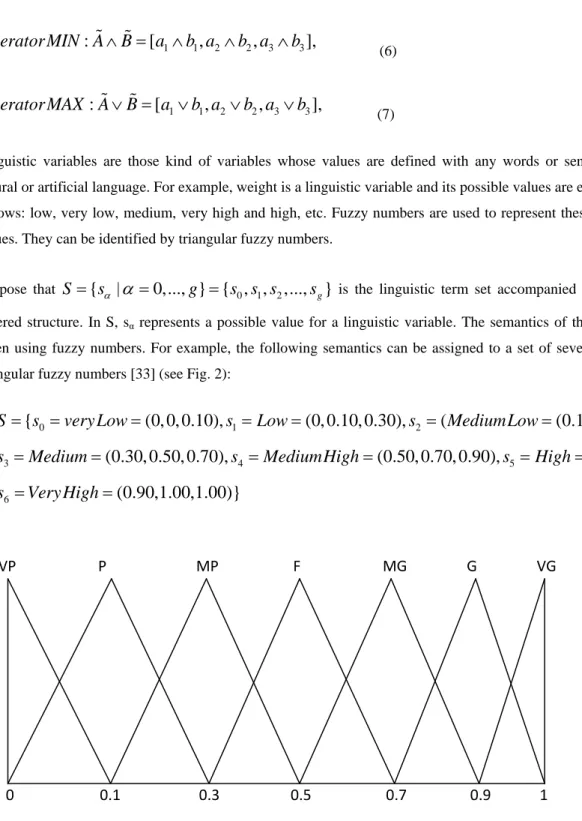
is the linguistic term set accompanied with a pre-ordered structure. In S, sα represents a possible value for a linguistic variable. The semantics of the terms aregiven using fuzzy numbers. For example, the following semantics can be assigned to a set of seven terms via triangular fuzzy numbers [33] (see Fig. 2):
0 1 2
{
(0, 0, 0.10),
(0, 0.10, 0.30),
(
(0.10, 0.30, 0.50),
S
=
s
=
very Low
=
s
=
Low
=
s
=
MediumLow
=
3
(0.30, 0.50, 0.70),
4(0.50, 0.70, 0.90),
5(0.70, 0.90,1.00),
s
=
Medium
=
s
=
MediumHigh
=
s
=
High
=
6
(0.90,1.00,1.00)}
s
=
Very High
=
VP P MP F MG G VG
0 0.1 0.3 0.5 0.7 0.9 1
Fig. 2 The set of seven linguistic terms with their semantics
3. Fuzzy linguistic VIKOR for group decision making
The proper or suitable supplier selection is a very difficult multiple criteria group decision making problem. A
fuzzy VIKOR method is a persuasive decision approach for solving such a complex MCGDM problem. This technique is used to make the ranking list, give the weight and provide a compromise solution. The compromise solution is an achievable solution, which is closest to the ideal. A compromise solution means an agreement established by mutual adjustment [34].
In the problem, let DK, K = (1, 2, 3, . . . ,t)be the committee of various decision makers. The Cj(j = 1, 2, 3 . . .
n)and Ai = ( i = 1, 2, 3, . . . , m ) represent the different criteria and alternatives respectively. The fij is a value of
jth criteria for the ith alternatives. The VIKOR method is started with the following form of Lp-metric.
* * 1/ , 1
[{
(
) / (
)} ]
n p p p i j j ij j j jL
w f
f
f
f
− ==
∑
−
−
(8)Here, 1 ≤ P ≤ ∞. The measures Lp,ishows that the distance between alternative Aiand the positive ideal solution.
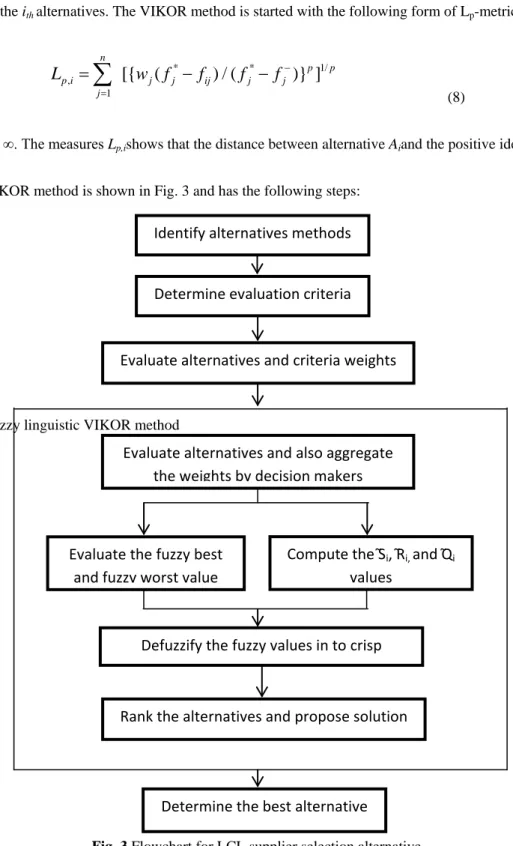
The fuzzy VIKOR method is shown in Fig. 3 and has the following steps:
Implement fuzzy linguistic VIKOR method
Fig. 3 Flowchart for LCL supplier selection alternative
Determine evaluation criteria Evaluate alternatives and criteria weights
Evaluate alternatives and also aggregate the weights by decision makers
Defuzzify the fuzzy values in to crisp Evaluate the fuzzy best
and fuzzy worst value
Compute the S̃i, R̃i, and Q̃i values
Rank the alternatives and propose solution
Determine the best alternative Identify alternatives methods
Step 1: Arranging the committee of decision making group and defining a finite set of criteria and alternatives.
Step 2: Describing the appropriate linguistic variables. These linguisticvariables are expressed by triangular fuzzy numbers. In this step the suitable linguistic variables for importance weights of criteria and the fuzzy ratings of alternatives for each criterion are also expressed.
Step 3: In this step the decision maker’s aggregate fuzzy ratings of mth alternatives and fuzzy weights of nth
criteria. The fuzzy weight of each criterion is calculated with the following equation.
(1) (2) (3) ( )
1
[
...
t]
j j j j jw
w
w
w
w
k
=
⊕
⊕
⊕ ⊕
(9) The aggregated fuzzy ratings of each alternative are calculated as the following equation.(1) (2) (3) ( )
1
[
...
t]
ij ij ij ij ijx
x
x
x
x
k
=
⊕
⊕
⊕ ⊕
(10)Without loss of generality, the equal weights for the decision makers are assumed. However, different weights can be allowed to aggregate the individual information preferences.
Step 4: In this step calculate the fuzzy best values f̃j* and the fuzzy worst values f̃j- for all criteria. When jis
associated with benefit criteria, it follows that.
*
max
,
min
j ij j ij
f
=
x
f
−=
x
(11)
When j is associated with cost criteria, it follows that.
* ,
min
max
j ij j ijf
=
x f
−=
x
(12)Step 5: Calculate the index S̃i, which refers to the separation measure of ith alternative with the fuzzy best value
and also calculate the index R̃i, which refers to the separation measure of ith alternative to the fuzzy worst value.
w̃j is the fuzzy weight of the jth criteria.
* * 1
[(
) / (
)],
n i j j ij j j jS
w
f
x
f
f
− ==
∑
−
−
(13) * *max[
(
) / (
)].
i j j ij j jR
=
w f
−
x
f
−
f
− (14)Note that from (8), S̃i is L1,iand R̃i is L∞,i. The solution obtained by R̃i is with the maximum individual regret
while the solution obtained by S̃i is with a maximum group utility.
Step 6: Calculate the values Q̃iwith the following equation.
min min
max min max min
(1
)
i i iS
S
R
R
Q
v
v
S
S
R
R
−
−
=
+ −
−
−
(15) Where max , min ,{
max
imin
i i iS
=
S S
=
S
(16)max
max
i, minmin
i,}
i i
R
=
R R
=
R
andv is the strategy weight of maximum group utility while 1-vshows the weight of individual regret.
Step 7: Defuzzification is a mathematical procedure, which is used to change the fuzzy values into crisp values. There are several defuzzification techniques to convert the fuzzy values into crisp numbers and in our study the best non-fuzzy performance (BNP) method is used. The BNP values are calculated by using the center of area (COA) method such that for a triangular fuzzy number à = (a1, a2, a3),[35] we have.
1 2 3
( )
3
a
a
a
BNP A
=
+
+
(17) After defuzzification the values of S̃i, R̃iand Q̃i are denoted as Si, Riand Qirespectively.Step 8: Rank the alternatives sorting by the crisp values S, R and Q in ascending order. The results are three ranking lists {A}S, {R}R, {A}Q. The index Qi implies the separation measures of the ith alternative Ai from the best
alternative. That is, the smaller the value Q, is the best alternative.
Step 9: Propose a compromise solution. The alternative denoted as A(1) which is the best ranked by the measure Q (minimum) is considered as a promise solution if the following two conditions are satisfied:
Cond1: Acceptable Advantage: Adv = ≥ DQ
Adv = Q(A(M))-Q(A(1)) ≥ 1/(m-1) (18)
Where Adv is the advantage of the alternative A(1) ranked first, A(2) is the alternative with the second position in {A}Q and DQ = 1/ (m-1) is the threshold.
Cond2: Acceptable Stability in decision making: The alternativeA(1) must also be the best ranked by S or/and R.
If one of the two conditions is not satisfied, then a set of compromise solution is proposed, which consists of: a) Alternative A (1) and A (2) if only the Cond2 is not satisfied;
b) Alternative;A (1), A (2), . . . ,A(M) if the condition Cond1is not satisfied.
A (M) is determined by the relation Q (A (M)) - Q (A(1))<DQ for maximum M. This implies that the positions of
these alternatives are \in closeness" and therefore A(1) , A(2), . . . ,A(M) are the set of alternatives to be further considered.
4. Application of the proposed method
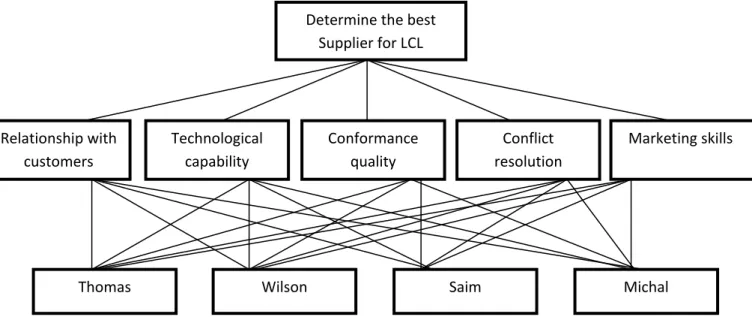
A suitable supplier isvery important for supply chain management system in the global market place. It is complex and time consuming problem for companies or industries. In a supply chain management, the decision makersneed a lot of criteria to be considered and a large amount of data to be analyzed. In this section, the modal presented in figure 4; will be used to evaluate and select the most suitable supplier for Lucky Cement Limited (LCL) Pakistan. This company is largest producer and leading exporter of quality cement with the production capacity of 7.75 million tons per year. The company is listed on Karachi, Lahore, Islamabad and London Stock Exchanges. Over the years, the Company has grown substantially and is expanding its business operations with production facilities at strategic locations in Karachi to cater to the Southern regions. For this purpose the factory management wants to select a suitable supplier for the expanding of the business and sell of LCL.
Figure 4: The hierarchy of evaluating the best alternative for LCL supplier selection.
In this problem the four suppliers Thomas(A1),Wilson(A2), Saim (A3), and Michal (A4) and five benefit
criteria,relationship with customers (C1), technological capability (C2), conformance quality (C3), conflict
Relationship with customers Technological capability Conformance quality Conflict resolution Marketing skills
Thomas Wilson Saim Michal
Determine the best Supplier for LCL
resolution (C4)and marketing skills (C5)are considered (see Fig. 4). A committee of three decision makers D1,
D2, D3 is constructed for the selection of best or suitable supplier. These criteria’s and alternatives are extracted
from the literature. The proposed fuzzy linguistic VIKOR modal is utilized to solve this MCDGM problem with the following steps:
Step 1: Making a committee of decision makers and then describing a finite set of criteria and alternatives. In the specified selection problem, we have five criteria, C1, C2, . . . , C5 and four alternatives, A1, A2, . . . , A4 and
three decision makers D1, D2, D3.
Step 2: In this step, the appropriate linguistic variables for importance weights of criteria and the fuzzy ratings of three alternatives with regard to five criteria are given in Table 1 and 2. The decision maker used linguistic variables shown in Table 1 and 2 to express their preferences. The evaluation for theimportance weight of criteria is given in Table 3. The fuzzy decision matrixes are given in Table 4. Note in Table 4, all the values under the cost criterionhave been transformed by the negative operator Neg. Therefore, all the values are normalizedthe bigger the better.
Table 1 Linguistic variables for importance weight of each criterion.
Table 2 Linguistic variables for rating of alternatives.
Linguistic variables Fuzzy numbers
S0 = Very Low (0.00,0.00,0.10) S1 = Low (0.00,0.10,0.30) S2 = Medium Low (0.10,0.30,0.50) S3 = Medium (0.30,0.50,0.70) S4 = Medium High (0.50,0.70,0.90) S5 = High (0.70,0.90,1.00) S6 = Very High (0.90,1.00,1.00)
Linguistic variables Fuzzy numbers
Very Poor (VP) (0.00,0.00,0.10) Poor (P) (0.00,0.10,0.30) Medium Poor (MP) (0.10,0.30,0.50) Fair (F) (0.30,0.50,0.70) Medium Good (MG) (0.50,0.70,0.90) Good (G) (0.70,0.90,1.00) Very Good (VG) (0.90,1.00,1.00) 10
Table 3 The weight of each criterion. DM1 DM2 DM3 C1 S6 S4 S4 C2 S2 S4 S2 C3 S6 S5 S6 C4 S5 S5 S4 C5 S6 S5 S6
Table 4 Fuzzy rating of alternatives over each criterion.
Criteria Alternatives DM1 DM2 DM3 C1 A1 G VG VG A2 F F MG A3 MG MP F A4 VG F VG C2 A1 MP G G A2 G MG MG A3 VG F VG A4 F VG MG C3 A1 MG F G A2 G MG G A3 G G VG A4 VG P F C4 A1 G MG MG A2 VG G VG A3 G VG MG A4 F MG F C5 A1 MP MG MP A2 VG MG F A3 G VG MG A4 MG F VG
Step 3: Aggregate individual's preferences into the group preferences. The linguistic variables are converted into triangular fuzzy numbers. The fuzzy weights of C1, C2. . . , C5 are computed as follows according to the
equation (9). The group decision matrix shown in table 5 is calculated according to theequation (10).
1 2 3
{
(0.63, 0.80, 0.93),
(0.30, 0.50, 0.70),
(0.83, 0.97,1.00),
Fuzzyweight
=
C
=
C
=
C
=
4
(0.63, 0.83, 0.97),
5(0.83, 0.97,1.00)}
C
=
C
=
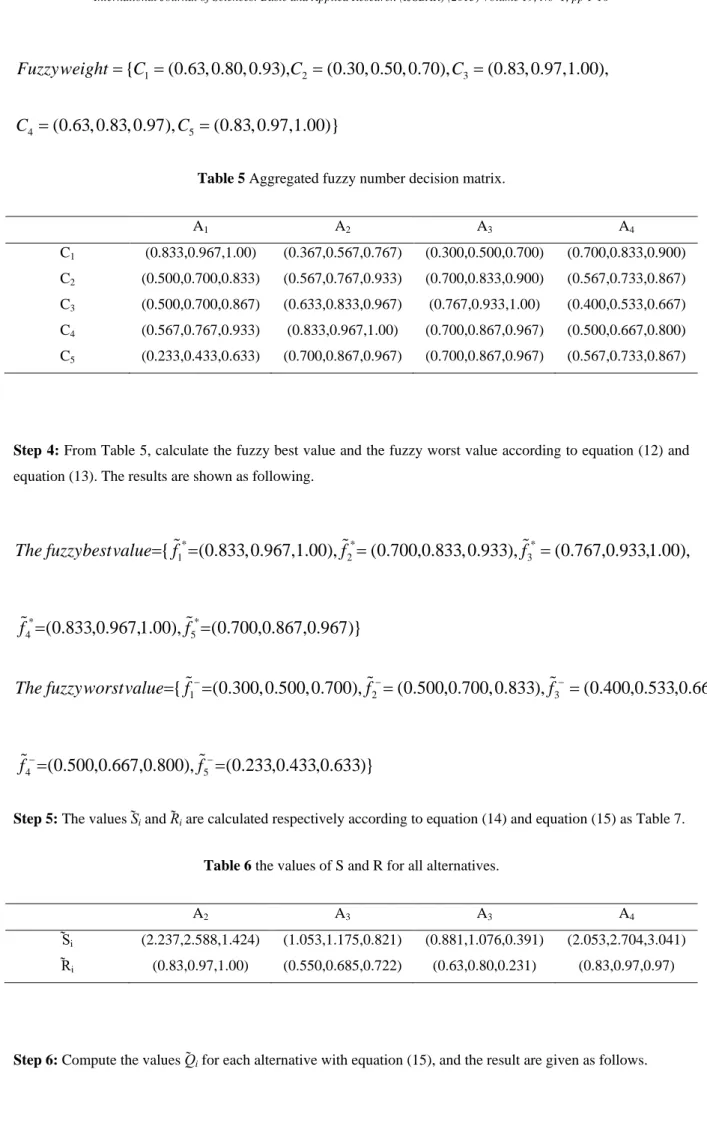
Table 5 Aggregated fuzzy number decision matrix.
A1 A2 A3 A4 C1 (0.833,0.967,1.00) (0.367,0.567,0.767) (0.300,0.500,0.700) (0.700,0.833,0.900) C2 (0.500,0.700,0.833) (0.567,0.767,0.933) (0.700,0.833,0.900) (0.567,0.733,0.867) C3 (0.500,0.700,0.867) (0.633,0.833,0.967) (0.767,0.933,1.00) (0.400,0.533,0.667) C4 (0.567,0.767,0.933) (0.833,0.967,1.00) (0.700,0.867,0.967) (0.500,0.667,0.800) C5 (0.233,0.433,0.633) (0.700,0.867,0.967) (0.700,0.867,0.967) (0.567,0.733,0.867)
Step 4: From Table 5, calculate the fuzzy best value and the fuzzy worst value according to equation (12) and equation (13). The results are shown as following.
* * * 1 2 3
{
(0.833, 0.967,1.00),
(0.700,0.833, 0.933),
(0.767,0.933,1.00),
The fuzzybestvalue
=
f
=
f
=
f
=
* * 4(0.833,0.967,1.00),
5(0.700,0.867,0.967)}
f
=
f
=
1 2 3{
(0.300, 0.500, 0.700),
(0.500,0.700, 0.833),
(0.400,0.533,0.667),
The fuzzyworstvalue
=
f
−=
f
−=
f
−=
4(0.500,0.667,0.800),
5(0.233,0.433,0.633)}
f
−=
f
−=
Step 5: The values S̃i and R̃i are calculated respectively according to equation (14) and equation (15) as Table 7.
Table 6 the values of S and R for all alternatives.
A2 A3 A3 A4
S̃i (2.237,2.588,1.424) (1.053,1.175,0.821) (0.881,1.076,0.391) (2.053,2.704,3.041)
R̃i (0.83,0.97,1.00) (0.550,0.685,0.722) (0.63,0.80,0.231) (0.83,0.97,0.97)
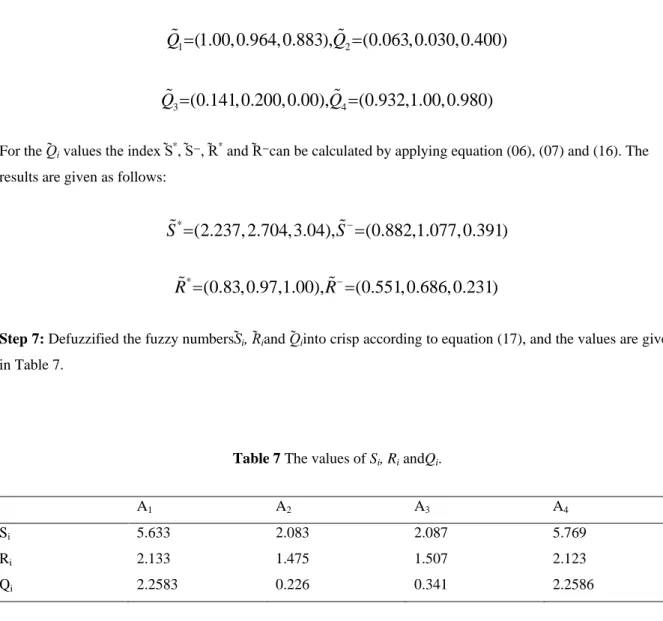
Step 6: Compute the values Q̃i for each alternative with equation (15), and the result are given as follows.
1
(1.00, 0.964, 0.883),
2(0.063, 0.030, 0.400)
Q
=
Q
=
3
(0.141, 0.200, 0.00),
4(0.932,1.00, 0.980)
Q
=
Q
=
For the Q̃i values the index S̃*, S̃−, R̃* and R̃−can be calculated by applying equation (06), (07) and (16). The
results are given as follows:
*
(2.237, 2.704,3.04),
(0.882,1.077, 0.391)
S
=
S
−=
*(0.83, 0.97,1.00),
(0.551, 0.686, 0.231)
R
=
R
−=
Step 7: Defuzzified the fuzzy numbersS̃i, R̃iand Q̃iinto crisp according to equation (17), and the values are given
in Table 7.
Table 7 The values of Si, Ri andQi.
A1 A2 A3 A4
Si 5.633 2.083 2.087 5.769
Ri 2.133 1.475 1.507 2.123
Qi 2.2583 0.226 0.341 2.2586
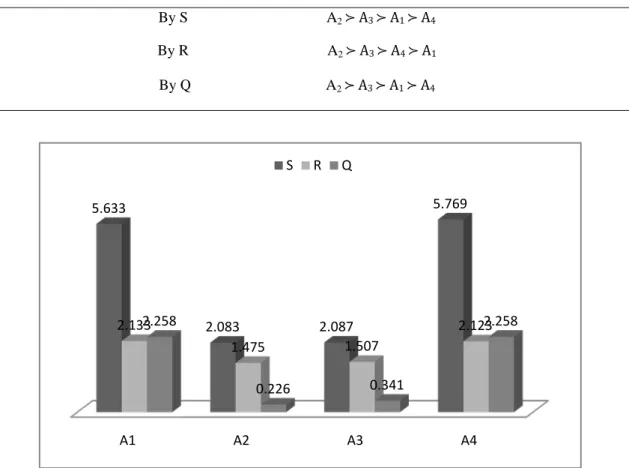
Step 8: According to Table 7, rank the alternatives sorting by the crisp values S, R and Q in ascending order and theresults are shown in Table 8 and also in Fig. 5.
Step 9: Since (4) (2)
1
(
)
(
)
2.032
0.25
4 1
Q A
−
Q A
=
≥
=
−
The Cond1is satisfied and the alternative A2 is also the best ranked by S or/and R and therefore A4 meets the
acceptable stability. Since both Cond1 and Cond2are verified, it is suggested that the alternative A2, that is, the
supplier Wilson has better performance rather than A1,A3 and A4 .
Table 8 Ranking the values by S, R and Q in ascending order
The ranking order
By S A2 ≻ A3 ≻ A1 ≻ A4
By R A2 ≻ A3 ≻ A4 ≻ A1
By Q A2 ≻ A3 ≻ A1 ≻ A4
Fig. 5 Graph ranking ofS, R and Q values.
5. Conclusion
It is clear that the selection of a proper or suitable supplier in supply chain management includes a large number of considerations because the supplier selection process deploys a tremendous amount of a firm’s financial resources. In return, firms expect significant benefits from contracting with suppliersoffering high value. In this study, the integration of fuzzy linguistic VIKOR with the support of triangular fuzzy set theory is proposed for the selection of suitable alternative supplier of LCL in Pakistan. Some steps of the extended fuzzy VIKOR method are discussed to show there are other possible extensions. It is an effective and simple tool to solve the imprecise, vague, intangible information for MCGDM problem. The verified example concerning the LCL supplier selection shows that the proposed method is very useful for the selection of best alternative. The proposed approach is applicable to other management decision problem. As a future scope, a consensus reaching process can be incorporated into the fuzzy VIKOR method under GDM setting to obtain a more robust version of VIKOR model. Acknowledgements A1 A2 A3 A4 5.633 2.083 2.087 5.769 2.133 1.475 1.507 2.123 2.258 0.226 0.341 2.258 S R Q 14
This research was supported by National Natural Science Foundation of China (Grant No. 70831005) and also supported by Research Fund for the Doctoral Program of Higher Education of China (Grant No. 20130181110063).
References
[1] S. Massenet, J.V. Riera, J. Torrens, E.H. Viedma, “A new linguistic computational model based on discrete fuzzy numbers for computing with words’’ Information Sciences, 258277-290, (2014).
[2] Z. Xu “Group decision making based on multiple types of linguistic preference relations’’Information Science, 178 (15) 452-467, (2008).
[3] L.A. Zadeh, “The concept of a linguistic variable and its application to approximate reasoning’’Information Science, 8 (3) 199-249, (1975).
[4] C.-T. Chen, C.-T. Lin, S.-F. “Huang, A fuzzy approach for supplier evaluation and selection in supply chain management’’International Journal of Production Economics, 102 (2) 289-301, (2006).
[5] A. Marcus, A. Fremeth, “Green management matters regardless’’The Academy of Management Perspectives, 23 (3) 17-26, (2009).
[6] J.D Linton, R. Klassen, V. Jayaraman, “Sustainable supply chains: An introduction’’ Journal of Operations Management, 25 (6) 1075-1082, (2007).
[7] A. Genovese, S.C Lenny Koh, G. Bruno, E. Esposito, “Greener supplier selection: State of the art and some empirical evidence’’ International Journal of Production Research, 51 (10) 2868-2886, (2013).
[8] R. Dekker, J. Bloemhof, I. Mallidis, “Operations research for green logistics An overview of aspects, issues, contributions and challenges’’ European Journal of Operational Research,219 671-679, (2012).
[9] F.E. Boran, S. Gen, M. Kurt, D. Akay, “A multi-criteria intuitionistic fuzzy group decision making for supplier selection with TOPSIS method’’ Expert System with Application 36 (8) 11363-11368, (2009).
[10] M. Dursun, E.E. Karsak, “A QFD based fuzzy MCDM approach for supplier selection’’Applied Mathematical Modeling, 37 5864-5875, (2013).
[11] H.S. Kilic, “An integrated approach for supplier selection in multi-item or multi-supplier environment’’ Applied Mathematical Modeling, 37 7752-7763, (2013).
[12] C-N. Liao H-P. Kao, “Supplier selection model using Taguchi loss function, analytical hierarchy process and multi-choice goal programming’’ Computers and Industrial Engineering, 58 571-577, (2010).
[13] J. Rezaei, P.B.M. Fahim, L. Tavasszy, “Supplier selection in the airline retail industry using a funnel methodology: Conjunctive screening method and fuzzy AHP’’Expert Systems with Applications, 41 8165-8179, (2014).
[14] A. Dargia, A. Anjomshoaea, M.R. Galankashia, A. Memaria, M.B. Md. Tapa, “Supplier Selection: A Fuzzy-ANP Approach’’Procedia Computer Science 31 691- 700, ( 2014 ).
[15] X-Y. You, J-X. You, H-C Liu, L. Zhen, “Group multi-criteria supplier selection using an extended VIKOR method with interval 2-tuple linguistic information’’Expert Systems with Applications, 42 1906-1916, (2015). [16] F.R. Lima Junior, L. Osiro, L.C.R. Carpinettia, “ A comparison between Fuzzy AHP and Fuzzy TOPSIS methods to supplier selection’’ Applied Soft Computing, 21 194-209, (2014).
[17] S. Opricovic, G.H. Tzeng, “Multiple criteria planning of post-earthquake sustainable reconstruction”Journal of Computer-Aided Civil and Infrastructure Engineering, 17 (3) 211-220, (2002).
[18] S. Opricovic, G.H. Tzeng, “Compromise solution by MCDM methods: a comparative analysis of VIKOR and TOPSIS”European Journal of Operational Research, 156 (2) 445-455, (2004).
[19] A.A Bazzazi,M. Osanloo, B. Karimi, “Deriving preference order of open pit mines equipment through MADM methods: application of modified VIKOR method’’ Expert Systems with Applications, 38 (3) 2550-2556, (2011).
[20] A. Jahan,F. Mustapha, M.Y. Ismail, S.M. Sapuan, and M. Bahraminasab, “A comprehensive VIKOR method for material selection’’Material Design, 32 (3) 1215-1221, (2011).
[21] M.S. Kuo, G.S. Liang, “Combining VIKOR with GRA techniques to evaluate service quality of airports under fuzzy environment’’ Expert Systems with Applications, 38 (3) 1304-1312, (2011).
[22] A. Shemshadi, H. Shirazi, M. Toreihi, M.J. “Tarokh, A fuzzy VIKOR method for supplier selection based on entropy measure for objective weighting’’Expert System with Application, 38 (10) 12160-12167, (2011). [23] G.N. Yüenur, N.C. Demirel, “Group decision making process for insurance company selection problem with extended VIKOR method under fuzzy environment’’ Expert System with Application, 39 (3) 3702-3707, (2012).
[24] Y.B. Ju, A. Wang, “Extension of VIKOR method for multiple criteria group decision making problem with linguistic information’’ Applied Mathematical Modeling, 37 (5) 3112-3125, (2013).
[25] S.P.Wan, Q.Y. Wang, J.Y. Dong, “The extended VIKOR method for multi-attribute group decision making with triangular intuitionistic fuzzy numbers’’ Knowledge-Based Systems, 52 65-77, (2013).
[26] T.H. Chang, “Fuzzy VIKOR method: A case study of the hospital service evaluation in Taiwan’’ Information Sciences, 271 196-212, (2014).
[27] Y. Kim, E.S. Chung, “Fuzzy VIKOR approach for assessing the vulnerability of the water supply to climate change and variability in South Korea’’Applied Mathematical Modeling, 37 (22) 9419-9430, (2013).
[28] H. Safari, Z. Faraji, S. Majidian, “Identifying and evaluating enterprise architecture risks using FMEA and fuzzy VIKOR”Journal of Intelligent Manufacturing, DOI: 10.1007/s10845-014-0880-0, (2014).
[29] L.A. Zadeh, “Fuzzy sets’’Information and Control, 8 (3) 338-353, (1965).
[30] A. Kaufmann, M.M. Gupta, “Introduction to Fuzzy Arithmetic: Theory and Applications’’ Van Nostrand Reinhold, New York 1991.
[31] S.J. Chen, C.L. Hwang, “Fuzzy Multiple Attribute Decision Making’’ Methods and Application, Springer Berlin Heidelberg, New York, 1992.
[32] M. Sakawa, & R. Kubota, “Fuzzy programming for multiobjective job scheduling with fuzzy processing time and fuzzy duedate through genetic algorithms’’ European journal of Operational Research, 120 (2) 393-407, (2000).
[33] E.H. Viedma, L. Martinez, F. Mata, F. Chiclana, “A consensus support systems model for group decision making problems with multigranular linguistic preference relations’’IEEE Transactions on Fuzzy Systems, 13 644-658, (2005).
[34] S. Opricovic, G.H. Tzeng, “Extended VIKOR method in comparison with outranking methods” European Journal of Operational Research, 178 (2) 514-529, (2007).
[35] P. Moeinzadeh, A. Hajfathaliha, “A combined fuzzy decision making approach to supply chain risk assessment’’ International Journal of Human and Social Sciences, 5 859-875, (2010).