Vol. 2, No. 4, December 2013, pp. 240~251
ISSN: 2089-3191 240
Adaptive E-Learning Based on Learner's Styles
Hazem M. El-Bakry*, Ahmed A. SalehDept. of Information Systems, Faculty of Computer Science and Information Systems Mansoura University, Egypt
*Corresponding author, e-mail: [email protected]
Abstract
In this paper, a new model for adaptive e-learning based on learner's styles is presented. In the previous work, the dimensions of learner's styles given by Felder-Silverman did not consider some important issues of the learner himself. Here, new learner's parameters such as his social environment, health conditions, psychological and economical states are taken into account. Such parameters greatly affect the ability of student to learn and understand. Therefore, in order to perfectly recognize the ability of the student to be interactive in the leaning environment and accept information, new learner's styles are added to the dimensions of Felder-Silverman learning style model and our previous work [24]. The new proposed model is applied for logic gates and functions used in data encoding and computer networks. Such model presents suitable courses for each student in a dynamic and adaptive manner using existing database and workflow technologies. Furthermore, it is powerful, user friendly and easy to interpret. Moreover, it suggests a learning strategy and appropriate electronic media that match the learner’s preference.
Keywords: adaptive learning, learning styles, teaching strategies
1. Introduction
The popularity of electronic learning programs enforces us to think about what advanced technologies can enhance learning depth, involve learners with the material, and increase material retention.
Different humans have different learning ways. Some can assimilate knowledge in a better way when received auditory, visually or through another sense [1]. Traditional teaching styles tend to use one of these presentations more than others [2]. It is extremely difficult for a teacher to apply all multiple teaching strategies in a classroom. Nowadays, adaptive learning provide new ways to break of the traditional educational models one size fits all approach and make it possible to customize down to the individual [3]. An adaptive system adapts itself or another system in order to deal with different situations and fit to various circumstances [4]. Adaptive learning systems endeavor to transform the learner from passive receptor of information to collaborator in the educational process [5]. Those learning systems' primary application is in education, but another popular application is business training.
Without knowing anything about the user, a system would perform in an exactly the same way for all users [6]. To individualize, personalize or customize actions a user profile is needed. The user information is stored and managed in form of user profile. Thus a user profile represents the system's beliefs about the user. The behavior of an adaptive system differs according to data in this profile. Based on this data we identify a person's individual learning style by using the learning styles dimensions. Then the system is rendering suitable course content in a dynamic form for each student, and adapting instructions toward that learner's strengths and preferences. Each course is divided into units. After a particular unit in a course is completed, a quiz is provided. The displayed course material to the user will be personalized with respect to his character. This is to enable him learn the subject in the most effective way and in the shortest possible time.
Our model covers the concept of digital design course. In fact most of our modern life technologies deal with the concept of digital design [7]. Digital logic has important use in all of today's digital computers and devices. It has such a prominent role in every day life in recent digital age [8]. Digital systems are used in communication, traffic control, medical treatment,
space guidance, weather monitoring, the Internet and other huge enterprises [9]. Also the digital electronic circuits are the engines of digital cameras, computers, cell phones, MPEG players, GPS displays, handheld devices and other products using information in digital formats. Our proposed model can be used as an adaptive e-learning model not for logic design course only but also for all educational courses as image processing, computational models, principles of programming languages, compiler design, and other related courses.
Important topics are covered in our proposed environment. Such topics are integrated into a single environment using visual basic. So it appears to be portable, and machine independent, which makes it a useful tool for interactive and collaborative learning environment. The environment integrates several different materials to support the learners’ preferred style. It includes a starting form used to gather information about user, a movie-like welcome component, an animated hyper-text introduction for the basic concepts, self assessment system, a logical simulator, and a set of visual examples for learners’ motivation. The proposed model is designed by integrating visual basic, flash, Microsoft access, and other effective tools.
Before writing this paper, several classroom experiments were carried out for the framework as a model of adaptive learning based on user learning styles, teaching strategies and implementation of electronic media. The preliminary results were clear in improving the learners understanding, performance, and increase their motivation. It is proved that the proposed model facilitates and personalizes the learning process, which provides easy and attractive use for learners.
2. Related Work
There are different tools used to categorize each person according to their learning styles: Kolb questionnaire, honey and Mumford questionnaire [10-11], GRSLSS questionnaire [11], Myers-Briggs type indicator [12], and finally Felder-Silverman.
In [12], the authors suggested new teaching strategies on e-learning context matching with learner's personality using the Myers-Briggs Type Indicator tools. There are several studies focus on the effectiveness of multimedia and learning styles in the educational systems [13-14]. But few give an idea of which combinations of learning styles and electronic media are more effective than others.
Another study in [15] described the development of learning styles integration taxonomy, teaching strategies and the proper implementation of electronic media to personalize the learning process. The design of this personalized teaching environment based on an adaptive taxonomy using Felder and Silverman's learning styles. The adaptation in Tangow [16] lies in presenting a different sequence of alternative contents of the concepts. Concepts can be represented by example and exposition. The system uses only the Sensing-intuitive dimension from the Felder-Silverman learning style model. The PHP programming course [17] provided different representations for each learner, and used different types of resources such as theory, colors, text, slideshows, audio, etc. One disadvantage of PHP programming course was that electronic media is limited to graphics, audio, video, and hypertext and that doesn't integrate teaching strategies. The course presented in [18] achieved adaptation by providing different representations for each learner. Also different types of resources were used. In this sense, our proposed model is significantly different from the previous efforts done in this field.
Due to the importance of digital design and the growth within internet based technologies, the authors in [19] realized a Java programmed testing system. Such system which is a component in an Internet based Digital Logic Design Virtual Laboratory realized to the stage of tasks delivery. A set of virtual instruments are at the disposal of the laboratory. Each instrument is designed to be used by the students to present the decisions of tasks of distinct type. The test consists of a number of tasks. Every teacher defines a desired number of tasks which are stored in a database. Another application presented in [20] based on Adobe Flash and SCORM within a MOODLE learning environment. It provides individualized assignments for students learning digital systems. The assignments are evaluated automatically and the result is reported to the MOODLE platform. Since the tasks are solved by the students remotely and unattended, students get their personalized assignment by selecting one from the pool of available assignments based on the student’s unique learner id. While the authors in [7] presented an overview of an e-learning system and discussed some web-based tools for teaching the basics of digital logic in such a system. Also the authors in [21] presented a
web-based system for teaching logic design concepts and practices for computer science and engineering students. Such system was implemented by using LabVIEW. The experiments which included digital logic gates, combinational logic circuits, seven segment display, sequential logic and counters were easily constructed and performed, both in traditional and online setups. Vladimir Mateev [22] provided a Web-based virtual instrument for testing students’ knowledge to construct truth tables of analytically-defined Boolean functions. It was a component of the testing subsystem of the Internet based Digital Logic Design Virtual Laboratory (DLDVL) that can be used from authorized users only. The instrument was realized as a Java applet.
3. The Proposed Model
The presented model provides a basic treatment of digital circuits and the fundamental concepts in their design. It is suitable for use as an introductory course in an electrical engineering, computer engineering, or computer science curriculum. Learners usually found logical design materials boring and complex. That's because the learners find materials difficult to visualize or even interact with. Especially when material includes coverage of low level electronics, electronic circuits, Boolean function, combinational logic and Karnaugh map then learners can lose interest or perceive higher levels of complexity.
The choices of effective e-learning tools are seemingly endless, according to availability of multiple tools. We integrate visual basic (version 6) with flash and other tools as an example of simple adaptive learning tools that improves the learner's performance in classes.
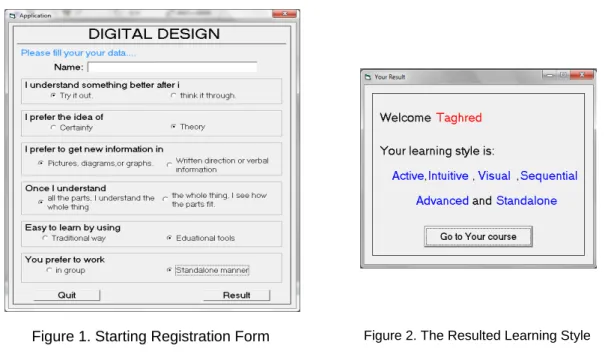
The first component of our implemented framework is the starting registration form. It contains simple questions to be filled by current user in addition to his name as shown in Figure 1. When the user presses result, Figure 2 appears.
We present explicit feedback at the starting of our framework in order to prevent interrupting the normal process of learning. While simple questions increase the interest for complete filling the questionnaire.
The questionnaire answers are sent to the system. The system gathers information about the learner and environment in a direct manner. Then all user-related data stored in the users’ profiles, including personal information, preferences, and interaction with system. These properties are stored after assigning them values that may be final or change over time. Each learner has his own user profile which enables the system to deliver customized instruction, on the basis of the student’s learning style. Learning style is defined as the characteristics, strengths and preferences in the way people receive and process information [23]. It refers to the fact that every person has different level of motivation, attitudes, and responses.
Several tools are used to determine learners’ learning styles. We use our modified dimensions based on Felder and Silverman's model. This model rates the student’s learning style in a scale of six dimensions. Our model classifies learners into six axes: active vs. reflective, sensing vs. intuitive, visual vs. verbal, sequential vs. global, Traditional vs. Advanced and Work in group vs. Standalone. Table 1 shows those learning styles dimensions.
The active learners gain information through a learning by doing style, discussing or explaining it to others, while reflective learners gain information by thinking about it quietly first. Sensing learners tend to learn facts through their senses, while intuitive learners prefer discovering possibilities and relationships. Visual learners prefer images, diagrams, and graphics, while verbal learners remember what they’ve heard, read or said. Sequential learners gain understanding from logical continuous steps, while global learners take big intuitive leaps with the information.
Table 1. Our Modified Learning Styles Dimensions Models
LEARNING STYLE DIMENSION TYPE DESCRIPTION Processing (LSD1) Active (A)
Learning by doing style. Reflective
(Re)
Learning by thinking about information. Perception
(LSD2)
Sensitive
(S)
Rather deal with facts, raw data and experiments, they’re patient with details.
Intuitive
(I)
Rather deal with principles and theories, are easily bored when presented with details.
Entry Channel
(LSD3)
Visual
(Vi)
Easy to remember what they see: images, diagrams, time tables, etc.
Verbal
(Ve)
Remember what they’ve heard, read or said. Understanding
(LSD4)
Sequential
(Seq)
Follow a lineal reasoning process when solving problems and Global
(G)
Take big intuitive leaps with the information. Realistic
(LSD5)
Traditional
(T)
Not prefer educational tools Advanced
(Ad)
Easy to learn by using educational tools Behavior
(LSD6)
Work in group
(W)
Prefer working in groups Standalone
(St)
Prefer working alone Healthcare
(LSD7
Strong
(Sg)
Has the ability to be active and cooperate Weak
(We)
Not ready to learn because of health problems Social
Environment
(LSD8)
Helpful
(He)
Social environment such as family and friends support him to learn and understand
Not comfortable
(Nc)
Not helpful (ex. Generate noise, speaking with loud voices) psychological state (LSD9) Ready to understand (Rs)
Ready to learn and understand
Not ready to understand
(Nu)
Not ready to learn and understand
Economical State
(LSD10)
Poor students are serious
(Ps)
Poor students do their best to success
Rich students do not care
(Rc)
Rich students do not care because they can learn in private schools and universities
Traditional learners could assimilate information better using the traditional learning way without using illustrative educational tools, While advanced are keen to try things out, They tend to be impatient with long discussions and are practical and down to earth. Work in group
S:Simulator T:Theory E:Examples P:Practical exercise
learners tend to like group work and become more effective and motivated, While Standalone learners prefer working alone or in a small group contains only few persons so they could understand better.
We have 10 learning style dimensions LSD= {LSD1, LSD2, LSD3, LSD4, LSD5, LSD6, LSD7, LSD8, LSD9, LSD10}, Each dimension is a combination of six values, see Table I, LSD= {(A/Re),(S/I), (Vi/Ve), (Seq/G), (W/St), (T/Ad), (Sg/We), (He/Nc), (Rs/Nu), (Ps/Rc)}. Then, there are 1024 (210) learning styles combinations.
This does not mean that a person possesses only 10 styles, but that the six styles show a greater presence than their counterparts. For example everybody is active sometimes and reflective sometimes. The preference for one category or the other may be strong, moderate, or weak.
Our applied modification on learner's styles dimensions help learner to develop vital skills. Additional dimensions used to reduce the probabilities of error in determining the learner's learning styles. The process of selecting learner's style became more precise and specific. Thus, it could be used by college instructors and students in engineering and the sciences, although it could be applied in a broad range of disciplines.
Figure 3. Learning Strategies
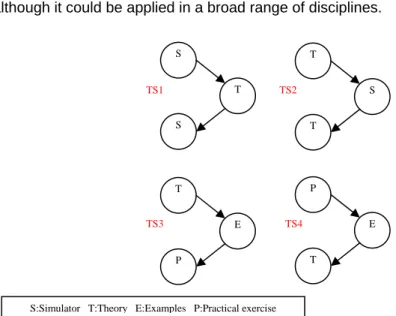
The teaching strategies designed to encourage learners to observe, analyze, express an opinion, look for a solution and facilitate a deeper understanding of the information. The process of selecting suitable teaching strategy based on the resulted learning style. Our frame work suggests four strategy paths as in Figure 3. LSC can be associated with a teaching strategy (TSi): TS = {TS1, TS2, TS3, TS4}. Teaching strategies hold a one-to-many relationship with the learning styles. There can be one or many teaching strategies that accommodate one learning style. Teaching strategies are given to learners to facilitate a deeper understanding of the information. The emphasis relies on the design, programming, elaboration and accomplishment of the learning content.
The strategies make use of all resources, elements and components which have been integrated into a single environment. The first teaching strategy TS1 tends to use the Simulator-Theory-Simulator approach. The system starts by presenting the Simulator as an Application. The learners attempt to analyze and solve the problem without the benefit of the upcoming course's theory. Therefore, the teacher presents the chapter's theory or ideas, and the system presents additional applications to make the learning process so easy. The second teaching strategy TS2 uses the approach Theory-Simulator-Theory. System starts by presenting the chapter’s theory before simulator related. The learners attempt to analyze and solve the problem using the course's knowledge. They can reuse the theory to facilitate the learning process. In the third one, the system starts by presenting the chapter’s theory or idea before
S T S T S T T E P P E T TS1 TS2 TS3 TS4
examples related. Afterwards additional practical exercise and problem solving will be presented. The last strategy TS4 uses the opposite teaching of TS3.
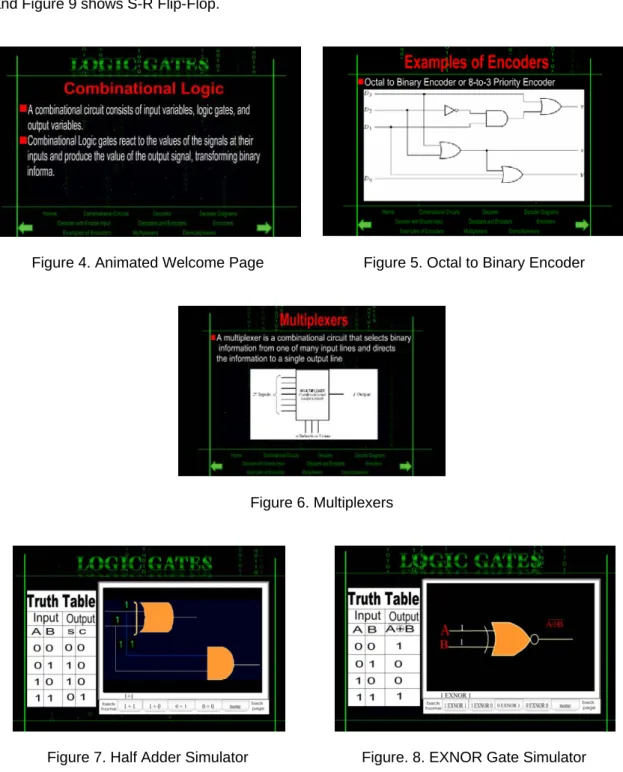
The logic gates simulator constitutes the second component of the framework. It contains an animated welcome page (movie like) illustrated with text, pictures, animation, and speech as in Figure 4. Our simulator defines combinational circuits, common logic gates found in digital circuits, and demonstrates course concepts. We provide links to pages where the learner can view symbols, truth tables, animation of particular logic gates. The combinational logic simulator includes encoders, decoders, multiplexer, and demultiplexer. The combinational logic gates react to the values of the signals at their inputs and produce the value of the output signal, transforming binary information from the given input data to a required output data. Figure 5 shows the octal to binary encoder and Figure 6 shows the multiplexer. Logic gates include AND, OR, NOT, NAND, NOR, EXOR, and EXNOR gates, in addition to Half Adder, Full Adder, and S-R Flip-Flop. In Figure 7 shows the half adder, Figure 8 shows the EXNOR gate and Figure 9 shows S-R Flip-Flop.
Figure 4. Animated Welcome Page Figure 5. Octal to Binary Encoder
Figure 6. Multiplexers
Figure 9. S-R Flip-Flop Simulator
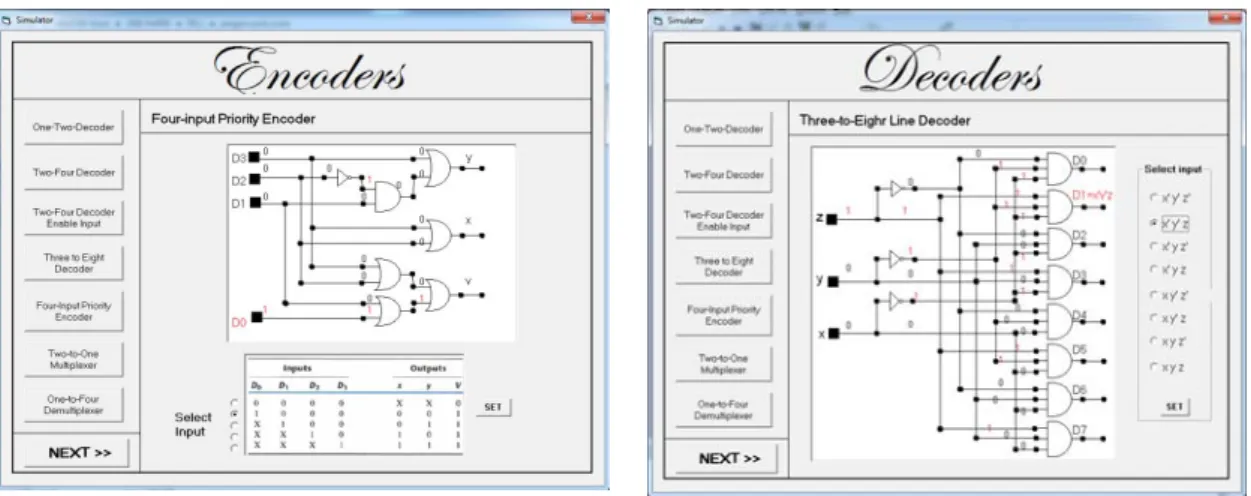
In our simulation learners choose the input and see animated path through gate getting output in a repeated form. Learners not only watching how gates work but they can get immediate help at any step in the learning process through navigation in the introduction components. Combinational circuits' simulators are presented in Figure 10, Figure 11, and Figure 12. A practical exercise is one of the environment resources. It presents visual examples that demonstrate many of the fundamental concepts of digital design; it includes simplification of Boolean functions, Complement of a Function, Minterms, Maxterms, and Karnaugh map. Figure 13 shows a practical example. The question solved in a step-by-step manner, which can help the learner to interact with examples in an amusing way.
Figure 10. Encoders Simulator Figure 11. Decoders Simulator
Figure 12. Demultiplexer Simulator Figure 13. Example on Simplification of a Boolean unction
Some learners master a material course by studying it once. Other learners may not understand a material from the first time, so the situation must be different. Therefore our framework provides an examination mechanism. Such mechanism leads to other situations according to the exam results.
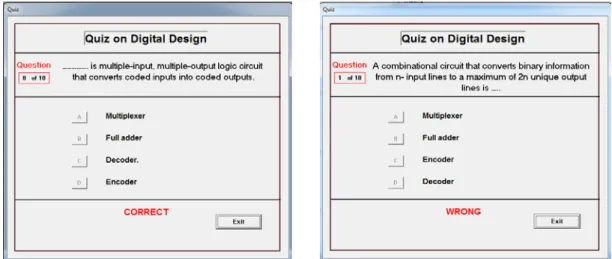
Figure 14. Displayed Message if Answer is Correct
Figure 15. Displayed Message if Answer is Wrong
Figure 16. Score Sheet and Pass Percentage
The framework provides examination within 10 questions as a multiple choice questions that selected randomly from database contains pool of questions and their answers. The questions organized by concepts. For each concept a set of standard questions was prepared capable to assess learning level of the learner. A learner may fail to passes the same examination more than one time, or may be multiple learners examined at same time and place. So, the system generates different examination pages each time. It checks the answers by comparing the learner’s answer to the correct answer in the database. It displays "Wrong" as a message supported by audio in case of invalid answer, and if the answer is true "Correct" message supported by audio will be displayed. The displayed messages according to answers are shown in Figure 14 and Figure 15. After the termination of the exam, the system counts passed and failed questions. It displays the final result in a score sheet and gives a comment on results. According to the result of the examination, the system decides the next course that will be learned.
1. If a learner's pass percentage of the examination of a unit is 100%, then the next unit will be provided.
2. If a learner's pass percentage of the examination of a unit is 70% or 90% because of frequently wrong answers, then the special course materials will be provided. It includes course material that should be studied when learner makes popular mistakes in the examination
3. If a learner's pass percentage of the examination of a unit is 60% or less, the system presents another teaching style and so on until the score becomes acceptable. The learner profiles will be adjusted, and the next unit will be the unit that the student has tried but never passed.
System can select suitable learning style with attention to the behavior and interest of the user as in Figure 16. Although it pays attention to the results of exams and tests, this does not form the basis of decision making about the selected learning style.
4. Experimental Results
We carried out experiments in order to evaluate the effectiveness of our proposed tools on the learning process. Thirty students were randomly selected from different classrooms. They were divided into two groups, each one contains 15 students. The students of first group have already completed the logical design course and done their exams in a traditional learning process. Then each one of the first group was given the questionnaire in TABLE 2.
The questionnaire measure five criteria named as increased motivation, flexibility, fairness, enjoyable, and pinpoint weakness. Five options were given for responses: (N) No answer, (1) Poor, (2) Below average, (3) Good, (4) Excellent. The responses are shown in Table 3.
Table 2. Questionnaire Given for Students
Select suitable value for each question
Questions N 1 2 3 4 Do you find the learning process increases your
motivation in learning logic design? Do you find the learning process flexible? Do you find the marks given to you fair? Do you find the learning process enjoyable? Could you identify your weaknesses in this course?
N= ”No answer”, 1= ”Poor”, 2= ”Below average”, 3= ”Good”, 4= ”Excellent”
Table 3. Results of the First Group
Select suitable value for each question
Questions N 1 2 3 4 Do you find the learning process increases your
motivation in learning logic design?
0 4 4 5 2 Do you find the learning process flexible? 1 4 5 3 2 Do you find the marks given to you fair? 0 2 7 3 3 Do you find the learning process enjoyable? 2 6 2 4 1 Could you identify your weaknesses in this course? 0 4 5 5 1
N= ”No answer”, 1= ”Poor”, 2= ”Below average”, 3= ”Good”, 4= ”Excellent”
Table 4. Results of the Second Group
Select suitable value for each question
Questions N 1 2 3 4 Do you find the learning process increases your
motivation in learning logic design?
0 1 2 6 6 Do you find the learning process flexible? 0 1 1 5 8 Do you find the marks given to you fair? 0 0 1 6 8 Do you find the learning process enjoyable? 1 0 1 9 4 Could you identify your weaknesses in this course? 1 0 2 7 5
We demonstrate our model and visual examples for the second group of students. They have been allowed to use self assessment testing system, and each of them has been given the same questionnaire. Their responses are listed in Table 4.
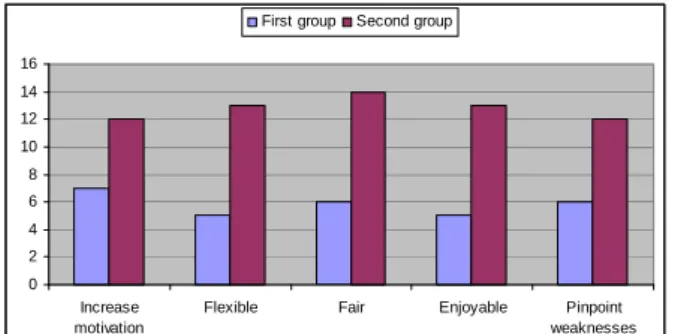
The questionnaire indicates that 80% of respondents conclude that the system helps increase their motivation level in learning logic design. The result also shows that 86.6% of the respondents thought of flexibility of the system. And 93.3% of the respondents agreed the marks awarded by the system were fair. 86.6% of the students found the experience enjoyable, two student did not like the experience at all, and. Finally 80% of respondents think the system could help them pinpoint their weaknesses in logic design course, while one student doesn't answer. We compare results of the first group without using our model, and the other group used our model. For choices N, 1, and 2, if the number of response decreased, it indicates a positive response, which is what occurred. While for choices 3, and 4, the increasing numbers of responses indicates positive response, which also occurred as in Figure 15.
Figure 15. Comparison between the Results of the Two Groups
Table 5. Results of the Modified Learning Styles Test
Learning Style Dimension STYLE NUMBER OF STUDENTS Processing Active 9 Reflective 6 Perception Sensitive 9 Intuitive 6 Entry Channel Visual 12
Verbal 3 Understanding Sequential 10
Global 5 Realistic Traditional 3
Advanced 12 Behavior Work in group 4
Standalone 11 Healthcare Strong 14
Weak 1 Social Environment Helpful 11
Not comfortable 4 psychological state Ready to understand 10
Not ready to understand 5 Economical State Serious 13
Do not care 2
After the students of the second group answer the test in the Starting registration form, we make a survey to count the results of the modified learning styles test. They had to answer this test to obtain their learning styles in order to get a chance to explore the system. The results were shown in Table 5. The system treats different student's styles with different ways. The most important differences appear in the visual and verbal dimensions. The system shows pictures or tables for a visual style's student. While for the verbal style student shows plain text. For the other dimensions as the active or reflective, it shows very similar materials since they
0 2 4 6 8 10 12 14 16 Increase motivation
Flexible Fair Enjoyable Pinpoint
weaknesses First group Second group
were answered exercises. For the sensitive or intuitive dimensions, the materials were examples with a few explanations about them.
We found that the active students were more than reflective. Comparing the sensitive and intuitive dimensions the majority of the students were sensitive. The greatest gap was found between the visual and verbal dimensions. Where 12 students were visual and the rest were verbal. The 12 Advanced students prefer the educational tools while 3 Traditional students not prefer. Also the majority of students preferred standalone and only 4 students like working in groups. Finally, for the sequential and global dimensions, the preponderance was sequential.
5. Conclusion
A modified approach for adaptive e-learning has been presented. Such approach is simple and easy to be implemented by using simple tools to support adaptive e-learning systems. The proposed approach consists of five main parts, starting registration form, self learning materials, visualization in an interesting way, practical examples, and self testing. The use of profiling, explicit feedback and learning styles in an adaptive e-learning environment has been introduced. It has been applied for digital logic educational material. In addition, it can be used in other courses such as image processing, computational models, information theory, information engineering and digital communications. Furthermore, the proposed approach finds a better way to engaging learners in the learning process. To deeply recognize the learner's styles, new items have been added to both the dimensions of Felder-Silverman learning style model and our previous work. Moreover, it identifies user's strengths and weaknesses and then adapting user's study sessions to his personal needs. Through the results of our experiment, it has been shown that modified approach improves the learning process, and affects the students in a positive way.
References
[1] Y Tamura, T Yamamuro, T Okamoto. Distributed and Learner Adaptive E-Learning Environment with Use of Web Services. Proceedings of the Sixth International Conference on Advanced Learning Technologie. 2006.
[2] P Kanaksabee, MP Odit, A Ramdoyal. A Standard-Based Model For Adaptive E-Learning Platform For Mauritian Academic Institutions. Journal of International Education Research. 2011; 7(1): 109-118. [3] TI Wang, KT Wang, YM Huang: Using a style-based ant colony system for adaptive learning. ESWA.
2449-2464 (2008).
[4] Yasir Eltigani Ali Mustafa, Sami Mohamed Sharif. An approach to Adaptive E-learning Hypermedia System based on Learning Styles (AEHS-LS): Implementation and evaluation. International Journal of Library and Information Science. 2011; 3(1): 15–28.
[5] Paramythis, Reisinger. Adaptive Learning Environments and e-Learning Standards. Electronic Journal of eLearning 2004. http://www.ejel.org/volume-2/vol2-issue1/issue1-art11-paramythis.pdf.
[6] Fröschl, Fröschl C. User modeling and user profiling in adaptive e-learning systems: an approach for a service-based personalization solution for the research project ADELE (Adaptive e-Learning with eye-tracking). Master's Thesis. Institute for Information Systems and Computer Media (IICM), Faculty of Computer Science, Graz University of Technology, Graz, Austria. 2005.
[7] Robal, T Kalja A. Applying e-Environments in Teaching the Basics of Digital Logic. IEEE International Conference on Microelectronic Systems Education (MSE'07). 2007; 41-42.
[8] Al-Zoubi, Abdullah, Jeschke, Sabina, Natho, Nicole, Pfeiffer, Olivier, Nsour, Jarir. Integration of an Online Digital Logic Design Lab for IT Education. In: Proceedings of the 2008 ACM Information Technology Education Conference. ACM. ISBN 978-1-60558-329-7. 2008; 237-241.
[9] Damm M, Bauer F, Zucker G. Solving Digital Logic Assignments with Automatic Verification in SCORM Modules. ICL. 2009.
[10] M Grigoriadou, Papanikolaou, K Kornilakis. INSPIRE: an intelligent system for personalized instruction in a remote environment. 3rd Workshop on Adaptive Hypertext and Hypermedia. Sonthofen, Germany. 2001.
[11] K Logan K, P Thomas. Learning style in Distance Education Students Learning to Program. Proc. Work. Psy. Prog. Int. group, Brunel University. 2002; 29-44.
[12] E El Bachari, E Abdelwahed, M El Adnani. Design of an Adaptive E-learning Model Baased on Learner's Personality. International Conference, Rabat-Morocco. 2010.
[13] YC Liao. Effects of hypermedia on students achievement: A meta-analysis. Journal of Educational Multimedia and Hypermedia. 1999: 255-277.
[14] LJ Najjar. Multimedia information and learning. Journal of Educational Multimedia and Hypermedia. 1996: 129-150.
[15] AL Franzoni AL, S Assar. Student Learning styles Adaptation Method on Teaching strategies and Electronic Media. Edu. Tech. Soc. 2009; 12(4): 15-29.
[16] P Paredes, P Rodriguez. Considering sensingintuitive dimension to exposition-exemplification in adaptive sequencing. Proceedings of the AH2002 Conference. Malaga, Spain. 2002: 556-559.
[17] Hong, Hong, Kinshuk. Adaptation to Student Learning Styles in Web Based Educational Systems. Proceedings of ED-MEDIA 2004 - World Conference on Educational Multimedia, Hypermedia & Telecomunications. Lugano, Switzerland: L. Cantoni & C. McLoughlin. 2004: 21-26.
[18] AL Franzoni, S Assar. Using Learning Styles to enhance an e-Learning System. Proceedings of the 6th European Conference on e-Learning (ECEL 2007). Academic conference management (ACI), Copenhagen, Denmark. 2007: 235-244.
[19] Vladimir Mateev, Svilena Todorova, Angel Smrikarov. Test system in digital logic design virtual laboratory: tasks delivery. Proceedings of the 2007 international conference on Computer systems and technologies. Bulgaria. 2007.
[20] Damm M, Bauer F, Zucker G. Solving Digital Logic Assignments with Automatic Verification in SCORM Modules. ICL. 2009.
[21] Al-Zoubi, Abdullah, Jeschke, Sabina, Natho, Nicole, Pfeiffer, Olivier, Nsour, Jarir. Integration of an Online Digital Logic Design Lab for IT Education. Proceedings of the 2008 ACM Information Technology Education Conference. 2008; 237-241. ISBN 978-1-60558-329-7.
[22] Vladimir Mateev. Virtual Instrument for Truth Table Construction of Analytically-defined Boolean Functions International Conference on Computer Systems and Technologies (CompSysTech’08), 2008.
[23] RM Felder, LK Silverman. Learning and Teaching Styles in Engineering Education, EE. 1988; 78(7): 674-681.
[24] Hazem M El-Bakry, Ahmed A Saleh, Taghreed T Asfour. A Novel Adaptive E-Learning Model Based on Developed Learner's Styles. World Academy of Science, Engineering and Technology. 2011; 60: 1946-1953.