Recommended citation:
Wong, B. S., & Kang, L. (2012). Mastery learning in the context of university education. Journal of the NUS Teaching Academy, 2(4), 206-222.
I
NSTRUCTIONALA
RTICLEMastery learning in the context of university education
WONG Bin Sheng
1, KANG Lifeng
11 Department of Pharmacy
National University of Singapore
Address for Correspondence: Dr Lifeng Kang, Department of Pharmacy, Faculty of Science, National University of Singapore, 18 Science Drive 4, S4-02-18, Singapore 117543. Email: lkang@ nus.edu.sg
Abstract
Developed by Benjamin Bloom in the 1970s, Mastery Learning (ML) is a pedagogical approach that aims to circumvent the problems of conventional group-based teaching and one-to-one individual tutoring, so that better academic performance can be achieved in a more realistic and cost-effective manner. While ML has consistently produced positive effects on the students’ academic and affective outcomes, the amplitude of its benefit has been the subject of frequent contentions. The discrepancies are primarily due to the interplay of multiple extraneous factors that can either diminish or promote the success of ML. Bearing in mind the numerous factors capable of inf luencing the overall effectiveness of ML, is ML still amendable for university education in the 21st century? This review
will first provide background to ML, followed by the merits and issues associated with its use. Different factors that can affect the effectiveness of ML will subsequently be examined. Lastly, modifications to better tailor ML for university education will be suggested and discussed. It was found that several unique features of the university curriculum promote the use of ML. ML can be further modified to better suit university education by combining with modern information technology and other effective teaching methods.
AIMS OF STUDY
Mastery Learning (ML) refers to a pedagogical approach that combines the qualities of conventional group-based teaching and one-to-one individual tutoring to achieve better academic performance in a more realistic and cost-effective manner. While ML has been around in the education landscape for over half a century, there is still a lack of literature that investigates the suitability and effectiveness of adopting ML to higher education.
Recent attempts at incorporating ML into the realm of university education have been demonstrated with encouraging results. One report by Klecker and Chapman compiled an annotated bibliography of the various studies involving the use of ML in higher education (Klecker & Chapman, 2008). While their
Mastery learning in the context of university
education
paper has provided a succinct summary of these studies, it simply listed down their results, without analysis of the suitability and applicability of ML in the context of university education. Moreover, the article only selected studies on Learning for Mastery (LFM) and did not include another important variant of ML, which is Keller’s Personalized System of Instruction (PSI).
Recognising the lack of comprehensive literature on the issues of ML application in the context of university education, the aims of this paper are as follows. Firstly, the two different methods of implementing ML, namely LFM and PSI, will be discussed and their key differences will be clearly delineated. Secondly, a comprehensive analysis of the various factors that can impact, either positively or negatively, on the effectiveness and applicability of ML will be provided. Lastly, potential reasons for the suitability of ML for university education and practical solutions to tailor and facilitate the implementation of ML in universities will be analysed.
ESSENTIALS OF MASTERY LEARNING
The concept of ML could be dated back to 1963, when John B Carroll first described the radical proposition that aptitude, instead of being a proxy of intelligence, is a measure of the amount of time needed for a person to learn, suggesting that all students are able to achieve the same degree of learning if sufficient time and learning opportunities are provided (Carroll, 1963, 1989). Inspired by Carroll’s learning paradigm, Benjamin Bloom later developed the theory of ML. Contrary to conventional group-based teaching where uniform instruction results in learning variation, ML sets an achievement goal and provides students with individualised instruction and varying instructional time to attain the predetermined achievement level. Bloom considered how teaching was conducted in one-to-one individual tutoring and examined the study techniques of high achievers in conventional group-based classrooms. It was revealed that the key to higher grades lies in prompt feedback where the students’ mistakes were analysed and corrected (Bloom, 1968; Guskey, 2001). As people possess varying degrees of intellectual capabilities, it is impossible to expect equal achievement outcomes from a standardised didactic approach (Kazu, Kazu, & Ozdemir, 2005). Conventional group-based instruction further widens initial individual differences because slower learners are unable to acquire the cognitive and affective prerequisites to master subsequent units with the limited amount of instructional time provided. Slower learners, therefore, require more time and additional assistance in order to attain similar achievement outcome and minimise the achievement gap (Arlin, 1984b).
Two essential features of ML have been defined. The first is feedback, both corrective and for enrichment (Guskey, 2007). Unlike summative assessments, which are used solely for the purpose of ranking students, the assessments administered in ML are diagnostic and prescriptive. Students receive feedback on their mistakes and they are paired with specific correctives to address errors. Enrichments are provided for stronger students, who manage to score above the mastery criterion on their first attempt, so as to enhance their learning. The second defining feature of ML is alignment of objectives (Guskey, 2007). All three components of teaching, namely lear ning goal, instr uction and evaluation, should focus on the same objective. For instance, if one expects his students to learn a particular skill, he should provide the students with ample opportunities to engage in that skill during the instructional process; the final evaluation should also assess the degree to which the students have mastered the specific skill. Other unique characteristics of ML include frequent testing and the establishment of a mastery criterion, where students can only proceed to the next level if they have satisfied the criterion (Slavin, 1987).
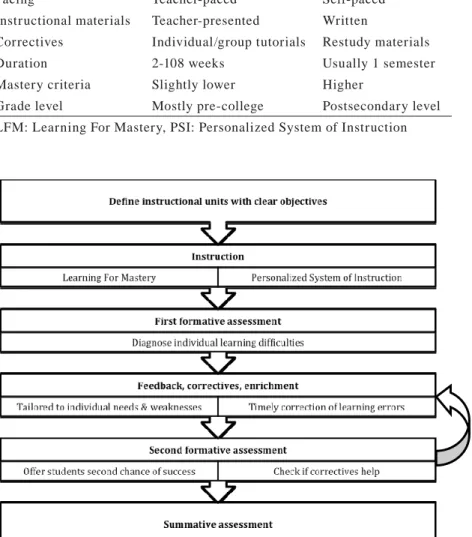
The general procedure of ML is summarised in Figure 1 (Guskey, 2001, 2007). Instructors are first required to divide a topic into smaller instructional units and define them with clear objectives. Instruction, which can be done via either LFM or PSI, then ensues. A formative assessment is given after the initial instruction to assess students and diagnose individual learning difficulties. Students then receive specific and individualised feedback, with corrective and enrichment activities based on the results of the formative assessment. Following feedback and correctives, a second formative assessment is administered to offer students a second chance of achieving success and to check if the correctives are working. The process of remedial work and reassessment continues till all students have achieved the mastery criterion. A conventional summative assessment is administered in the end to evaluate students’ overall mastery and understanding of that particular topic.
As mentioned, ML can be implemented in two different ways, namely LFM and PSI. Developed by Bloom himself, LFM involves small groups of around 30 students, where the teacher is the main knowledge imparter and pacer. Though LFM is more widely used due to its ease of adaptation to conventional classrooms, where instructional time and the curriculum are relatively fixed, it is more difficult to ensure that all students in a group are rendered a sufficient amount of time and attention (Guskey & Pigott, 1988). PSI was designed by Fred Keller in 1968 to mitigate this problem. It consists of small self-paced modularised units of instructions where written materials, instead of teachers, direct learning (Fox, 2004). Lectures are supplementary and optional in PSI, because unlike lectures, which are ephemeral, students can easily access written
materials repeatedly, thereby enabling self-pacing. Students undertake formative assessments when they are ready. They can take the tests, each time similar but not identical, as many times as they wish until the mastery criterion is achieved (Slavin, 1987). Proctors are employed to provide students with individualised feedback and specific correctives in PSI. The major differences between LFM and PSI are presented in Table 1 (Kulik, Kulik, & Bangert-Drowns, 1990).
Table 1. Differences between learning for mastery and personalized system of instruction
LFM PSI
Class setting Group-based Individual-based
Pacing Teacher-paced Self-paced
Instructional materials Teacher-presented Written
Correctives Individual/group tutorials Restudy materials
Duration 2-108 weeks Usually 1 semester
Mastery criteria Slightly lower Higher
Grade level Mostly pre-college Postsecondary level LFM: Learning For Mastery, PSI: Personalized System of Instruction
Fig. 1. General procedures of Mastery Learning (ML).
MERITS OF MASTERY LEARNING
ML has proven to be effective in a wide variety of subject areas, including mathematics, science, language, social science, athletics training and medical education (Fox, 2004; Guskey & Monsaas, 1979; McGaghie, Issenberg, Cohen, Barsuk, & Wayne, 2011; Schellhase, 2008). In addition, ML has also been extensively applied across different grade levels and institutions, ranging from elementary schools, high schools, and colleges to hospitals, militaries, prisons and business companies (Fox, 2004; Guskey & Gates, 1986; Kulik et al., 1990). ML is highly f lexible because only the general framework, but not the minor details, in which instruction should be carried out is specified (Guskey, 1980). One of the major claims of ML is the high level of educational outcome. Numerous studies have indeed supported the positive effects of ML on academic achievements (Block & Airasian, 1971; Block & Burns, 1976; Burns, 1979; Hyman & Cohen, 1979). Specifically, Bloom and his students demonstrated that ML was able to raise the students’ mean scores to at least one standard deviation greater than that of conventional group-based instruction (Bloom, 1984). Various meta-analyses conducted over the years, though they reaffirm the positive impacts of ML, were unable to reproduce the high effect size (ES) of one standard deviation achieved by Bloom. In addition, large variations in the mean ES of ML computed by different reviewers were also apparent (Guskey & Gates, 1986; Kulik et al., 1990; Slavin, 1987). In fact, it might even be inappropriate to measure a central tendency due to the extremely variable nature of ML (Guskey & Pigott, 1988). These inconsistencies can be attributed to a multitude of factors, such as different focus, inclusion criteria and analytical procedures used in each review. The existence of multiple confounding factors in a typical classroom setting can also augment or diminish the overall effectiveness of ML (Anderson & Burns, 1987; Kulik et al., 1990).
Aside from higher level of educational outcome, ML also contributes significantly to knowledge retention, demonstrating better scores on follow-up examinations (Block, 1972; Wentling, 1973). The favourable effects of ML are also transferable to other subjects. Students were able retain the effective learning strategies of ML and apply them to other subjects and more advanced courses even after ML was discontinued (Jones, Gordon, & Schectman, 1975).
Lastly, ML exerts significant improvements on the affective and emotional well being of both students and teachers. Through correctives and re-assessments, ML offers students multiple opportunities to achieve success, leading to increased self-confidence and improved readiness to learn (Damavandi & Shekari, 2010). Students generally acquired a more positive learning attitude, accepted greater
Table 2. Factors affecting the effectiveness of mastery learning
Factors Remarks
Test type Experimenter-made tests favour ML
Time cost Additional time spent on feedback and correctives can be substantial Ability level ML favours students with lower aptitude
Subject areas ML works better with hierarchically ordered subjects
Age Younger learners respond better to ML, but older students are more self-disciplined
Study duration Shorter duration promotes treatment fidelity Teacher quality Good teachers may mask the effects of ML
Materials quality High quality instructional materials are needed for ML Mastery level Higher mastery criterion leads to higher academic performance ML: Mastery Learning
learning responsibility and were better prepared cognitively and emotionally for the subsequent learning tasks (Guskey & Gates, 1986; Guskey & Pigott, 1988; Livingston & Gentile, 1996). At the same time, teachers also felt better about teaching and accepted more responsibility for their students’ achievement (Guskey, 1984). A few studies, however, indicated that ML was more stressful and could diminish individual self-esteem, as slower students were perceived to be intellectually inferior for participating in correctives (Cox & Dunn, 1979; Frick, Frick, Coffman, & Dey, 2011). Critics have also cited short study duration, lack of follow-up study and a possible Hawthorne effect, which means that people modify their behaviours simply because they know they are being studied but not as a result of the experimental treatment, to account for the highly favourable effects of ML on the students’ affect (Guskey & Gates, 1986; Guskey & Pigott, 1988).
FACTORS A FFECTI NG TH E EFFECTI V ENESS OF M ASTERY LEARNING
There are many factors that can inf luence the effectiveness of ML and hence its applicability and suitability for university education. The different factors discussed in this review are summarised in Table 2.
Experimenter-made tests are able to generate higher ES than standardised tests for ML, because experimenter-made tests are usually more specific and aimed at the objectives taught in ML (Slavin, 1987). The insignificant impact of ML on
standardised tests has been indicated in many studies (Anderson, 1976; Slavin & Karweit, 1985). There is also a concern regarding possible trade-off between content mastery and coverage, since ML encourages students to delve deeper into mastering certain objectives and, as a result, neglect some other essential objectives (Torshen, 1977). However, this claim is not supported because ML students still scored at least as well as, and sometimes even better than, the students of conventional group-based instruction on standardised tests (Kulik et al., 1990).
While it is undeniable that experimenter-made tests may be biased toward ML, it is in fact in line with the basic ML principle of objective alignment. ML focuses both teachers and students on a clearly defined set of objectives to be mastered (Guskey, 1980). The results of formative assessments focus teachers on the objectives that their students have not mastered and help them prepare better and more specific corrective materials to assist their students to master those missed objectives (Zimmerman & Dibenedetto, 2008). Both types of assessment have their own advantages and disadvantages and it would be premature to discredit either one of them, as both are able to provide valuable and useful information about students (Kulik et al., 1990).
In terms of university education, experimenter-made tests are a more dominant form of evaluation than standardised tests. It is rare for different universities to share a single set of examination questions, even if both institutions are offering the exact same course. Faculties usually exercise autonomy and design the test papers themselves to include questions that examine specific objectives that were taught in class. The more favourable effect demonstrated by ML on experimenter-made tests may enhance the effectiveness of ML in universities. One major criticism of ML is its substantial time cost. While some studies argued that ML improved academic performance and reduced achievement variability by providing significantly more time to slower students (Arlin, 1973; Arlin & Webster, 1984), there are also others who believed that the increased instructional time was modest and reasonable (Guskey & Pigott, 1988; Kulik et al., 1990). Supporters of the latter claim often cite the following two reasons to bolster their arguments. Firstly, the additional time required for ML can be derived from the increased quality of learning time, as ML was able to increase students’ engaged time, reduce off-task behaviours and improve class time efficiency (Anderson, 1976; Dillashaw & Okey, 1983; Fitzpatrick, 1985; Tennyson, Park, & Christensen, 1985). Secondly, unequal provision of time is only a temporary inconvenience (Garner, 1978). Weaker students who require more time initially will need progressively less time as they acquire the necessary prerequisites and entry behaviours to master subsequent units (Arlin, 1984a). With more
students attaining a similar level of proficiency, the teaching pace of later units can be more rapid (Guskey, 2007). This is known as the Vanishing Time Hypothesis. Although some studies have supported this hypothesis (Block, 1970; Merrill, Barton, & Wood, 1970), detractors have expressed harsh criticisms, demonstrating instead stable or even increasing learning time variability with ML (Arlin, 1984a, 1984b; Livingston & Gentile, 1996).
ML t rades achievement equalit y for time inequalit y. Lear ning rate may eventually replace academic grades as the new criterion to rank and stratify individuals (Arlin, 1984b; Mueller, 1976). While the idea of the vanishing time hypothesis is enticing, additional time for feedback and correctives, be it substantial or modest, is certainly inevitable.
Students with higher aptitude tend to benefit less with ML because they have to wait for their peers to complete and master the concepts that they have already mastered (Arlin, 1984b; Johnson & Henning, 1979). Even though enrichment activities are available to engage students with higher aptitude while their peers are receiving remediation, it is challenging to develop good enrichment activities that can benefit the students without boring or causing them to advance too fast (Kazu et al., 2005). Indeed, ML has only provided marginal benefits to students with higher aptitude (Arlin & Webster, 1984; Kulik et al., 1990; Wyckoff, 1974). It was postulated that students with higher aptitude might have already endorsed the right learning strategies and learning goals that enable them to achieve success regardless of the instructional method used (Ironsmith & Eppler, 2007). ML essentially shifted learning from high to low achievers, replacing artificial differences with artificial similarities. This phenomenon is known as the Robin Hood Effect (Arlin, 1984b).
In order to eliminate the Robin Hood Effect, individualised and self-paced ML programme such as PSI can be employed. Unlike LFM, which is group-based and teacher paced, faster students will no longer be held back because students of PSI learn at their own paces and decide if they are ready to proceed to the next unit themselves.
Based on the principle of mastering certain prerequisites before proceeding to the next and more advanced unit, it is expected for ML to perform better with subjects that can be hierarchically organised, such as mathematics and foreign language (Gagné, 1973; Slavin, 1987). ML is also more beneficial for subjects where students possess minimal prior knowledge, as there will be less learning deficiency to correct (Block & Airasian, 1971).
Instinctively, one might suppose ML to be better suited for mathematics and science, as these subjects are more objective and sequentially ordered. Reviews
have, however, observed slightly superior academic improvements in language arts and social studies as compared to mathematics and science (Guskey & Gates, 1986; Guskey & Pigott, 1988). It was suggested that some elements of ML might have already been incorporated into the conventional way of teaching mathematics and science, as they are highly ordered by nature. Since language arts and social studies are less well defined and more subjective, the use of ML might have led to a more drastic improvement in the way the content of these subjects was delivered.
In a university setting where students are majoring in one or two specific subject area(s), many university courses are in fact hierarchically ordered. For instance, a mathematics student would have to complete linear algebra 1 before he is allowed to take linear algebra 2; a medical student would have to first understand the basics of human physiology before learning about the diseases that alter normal human physiology. Therefore, ML may be more effective for university courses where comprehensive understanding of previous units are pivotal for the mastery of subsequent units.
Generally, ML works better for younger students in earlier grade levels. Higher mean effect sizes were observed in elementary and high schools as compared to colleges (Cabezon, 1984). This can be attributed to the fact that it is more difficult to modify the cognitive entry behaviours of more mature students due to extensive accumulation of learning deficiencies over the years from uniform group-based instruction (Guskey & Gates, 1986; Guskey & Pigott, 1988). While ML may seem to be less effective in universities where the students are slightly older, one advantage that older age offers is maturity and self-discipline, which are vital for the success of PSI. Younger students often lack the sophistication and motivation necessary to be effective self-managers of learning (Guskey & Gates, 1986).
It was also observed that studies with shorter duration tend to engender slightly higher ES than those of longer duration. This is because treatment fidelity might be more difficult to maintain in longer term and larger-scale studies (Guskey & Pigott, 1988; Kulik et al., 1990). The relatively shorter duration of a semester, as compared to the typical yearlong academic calendar of elementary and high schools, may allow for more faithful implementation of ML in universities. Students who were aware that they were participating in ML tended to achieve higher achievements than those who were unaware (Ritchie & Thorkildsen, 1994). Students also performed better if they were familiarised with the feedback and corrective process of ML (Guskey, 1980). Therefore, in order to augment the effects of ML, specific information sessions can be organised to explain the concept and process of ML to students before initiating ML.
Teacher quality can also have a significant impact on the effectiveness of ML. Most studies employed dedicated and experienced teachers, which tends to overestimate the ES of ML (Kulik, Jaksa, & Kulik, 1978; Martinez & Martinez, 1999). On the other hand, the effects of ML could be masked if a single excellent teacher was used to teach both control and ML groups. This is because good teachers might have employed certain principles of ML unconsciously even when they were teaching the control group, hence leading to diminished or insignificant academic differences between ML and conventional group-based instruction (Kulik, Kulik, & Cohen, 1979; Martinez & Martinez, 1988). In addition to the quality of instructors, the quality of instructional materials is also critical to the success of ML. These materials should be qualitatively different from the initial instr uction, creative, attractive and specif ically designed for the needs of individual students (Guskey, 2010). The difficulty levels of the instructional and corrective materials must also be modulated to prevent over-practicing of simple questions (MacLaren & Koedinger, 2002). Lastly, higher levels of cognitive skills such as problem solving, principle application, analytical skills and creativity, should also be incorporated, as these skills, unlike plain information, are more likely to be retained and utilised long after instruction (Guskey, 2001).
As students are not allowed to proceed to the next unit of instruction unless they have met the mastery criterion, the higher the mastery criterion, the higher the academic performance (Kulik et al., 1990). However, ceiling effects may be observed if the mastery criterion is set too high since it is not possible to exceed the maximum mark, which can lead to perceived lower levels of variation (Anderson & Burns, 1987; Mevarech, 1991). As such, ways to eliminate the ceiling effects, such as the inclusion of examination questions that are slightly outside but still related the syllabus, should be developed, so that test scores will not be artificially restricted (Chan & Cole, 1987).
APPLYING MASTERY LEARNING TO UNIVERSITY EDUCATION
The usage of ML in universities is promoted by the predominance of experimenter-made tests and hierarchically sequenced units in the university curriculum. PSI emerged as a more superior choice than LFM for the implementation of ML because it allows a student to master concepts at a rate commensurate with his or her own ability and prevents teachers from holding faster students back. The older age of university students further makes PSI viable for universities because PSI demands higher self-discipline and individual initiative, which are often absent or lacking in younger learners. Indeed, some efforts of adopting
ML to higher education have been demonstrated over the years (Klecker & Chapman, 2008).
It would, however, be challenging to implement PSI in universities due to the considerable amount of time and effort needed to design and organise such programmes (Fox, 2004). To reduce this burden, faculty members can develop the instructional and corrective materials together in groups (Martinez & Martinez, 1999). The advent of information technology can also help to relieve some of the administrative stress of implementing ML. Computer programs, for instance, can be engaged to present instructional materials, administer assessments and provide feedback (Baker & O’Neil, 1994; Kulik & Kulik, 1991; Kulik, Bangert, & Williams, 1983). An example of such program would be the Examination Library Folder (ELF), a courseware designed to manage assessment questions (Kang, 2011). Questions can be categorized by their respective attributes such as difficulty levels and types as defined by the users. It can be a useful tool for the implementation of ML as instructors would have the f lexibility to choose certain type of questions to draw students’ attentions towards a particular topic and reinforce certain learning objectives. Web-based learning provides convenient and easy access to instructional materials that are beyond time and space boundaries (Lin, Liu, & Yuan, 2005). With advanced algorithms, a cognitive tutor can be developed to track students’ performance and provide individualised feedback. The Advanced Cognitive Tutor, for example, is able to monitor the student’s progress in two different ways (Corbett, 2001). The first mode of monitoring is called ‘model tracing’, where the programme follows a student’s solution to a problem and provides immediate feedback upon error detection. The second way of monitoring is ‘knowledge tracing’. By monitoring the student’s overall performance, the programme presents the student with additional questions on skills that she has missed and only allows her to proceed to the next unit when complete mastery of the current unit is demonstrated. A cognitive tutor simplifies the implementation of ML and has been shown to be effective in raising academic performance and reducing instructional time (Corbett, 2001).
Procrastination is another major problem of self-paced instructional programmes like PSI. A slightly lower level of course completion was observed in college level PSI courses as compared to conventional group-based instruction (Guskey & Pigott, 1988; Kulik et al., 1990). Several strategies, such as the use of deadlines, have been proposed to minimise procrastination and ensure timely course completion (Fox, 2004). Contingency contracting can be conducted to renegotiate deadlines if a student is having trouble meeting them. Incentives and bonus points can also be awarded to students who complete all learning tasks before the stipulated deadline.
Pu re PSI is not amendable for cou rses that require st udents to interact and collaborate with each other (Fox, 2004). Cooperative Lear ning (CL) can be combined with ML to resolve this problem. CL promotes positive interdependence, individual accountability, face-to-face interaction, social skills and group processing by requiring students to work in small heterogeneous groups on specific learning tasks assigned by the teacher (Guskey, 1990). CL and ML naturally complement each other. ML provides a system of feedback and correctives that CL lacks, while CL offers high quality correctives and enrichment activities needed for ML. A combination of ML and CL involves more task interdependence than ML and higher individual accountability than CL. Combination of CL and ML has resulted in impressive achievement gains that are greater than either one method used alone (Baker, King, & Wulf, 1989; Mevarech, 1985). Unlike ML, which favours students with lower aptitude, the hybrid of CL and ML, in addition to helping the slower learners, also benefits students of higher aptitude when they act as tutors to guide their peers during correctives (Mevarech, 1985).
Other strategies to improve the effectiveness and feasibility of ML and PSI include the introduction of stimulation-based activities. The combination of ML and stimulation-based learning allows students to practice in a controlled, safe and forgiving environment, and is extremely useful for the acquisition and retention of clinical skills, such as advanced cardiac life support and catheter insertion skills, where a high degree of competency and low failure rate are required (Barsuk, Ahya, Cohen, McGaghie, & Wayne, 2009; Barsuk, Cohen, McGaghie, & Wayne, 2010; Wayne et al., 2006). More teachers and proctors can also be recruited to decrease class size and reduce the administrative burden (Abakpa & Iji, 2011). To better adapt PSI in a conventional university setting where lectures predominate, complete elimination of lectures and their replacement with written materials should be avoided (Fox, 2004). Elements of PSI, such as the use of written materials for self-directed learning, higher frequency of assessment and the provision of individualised feedback and correctives, can be applied in conjunction with the conventional lecturing system of the university.
CONCLUSION
The use of ML has produced tremendous improvements in both academic and affective outcomes. While the effects of ML vary widely, they are nonetheless consistently positive. Several unique features of the university education, such as the prevalence of experimenter-made assessments and hierarchically ordered instructional units, synergise with ML and promote its use in universities. Some
of the inherent limitations of group-based ML can also be moderated with the use of PSI. Employing modern information technology and combining it with other teaching methods such as CL and stimulation-based learning, ML, specifically PSI, can be further improved to reduce the administrative burden and enhance its effectiveness in universities and tertiary institutions.
REFERENCES
Abakpa, B. O., & Iji, C. O. (2011). Effect of mastery learning approach on senior secondary school students’ achievement in geometry. Journal of the Science Teachers Association of Nigeria, 46(1), 165-177.
Anderson, L. W. (1976). An empirical investigation of individual differences in time to learn. Journal of Educational Psychology, 68(2), 226-233.
Anderson, L. W., & Burns, R. B. (1987). Values, evidence, and mastery learning. Review of Educational Research, 57(2), 215-223.
Arlin, M. (1973). Learning rate and learning rate variance under mastery learning conditions (Unpublished doctoral dissertation: University of Chicago, Department of Education). Arlin, M. (1984a). Time variability in mastery learning. American Educational Research
Journal, 21(1), 103-120.
Arlin, M. (1984b). Time, equality, and mastery learning. Review of Educational Research, 54(1), 65-86.
Arlin, M., & Webster, J. (1984). Time costs of mastery learning. Journal of Educational Psychology, 75(2), 187-195.
Baker, E. L., & O’Neil, H. F. (1994). Technology assessment in education and training. Hillsdale, NJ: L. Earlbaum Associates.
Baker, O., King, R., & Wulf, K. M. (1989). The missouri comprehensive statewide project for improving student achievement. Paper presented at the Annual Meeting of the American Educational Research Association, San Francisco.
Barsuk, J. H., Ahya, S. N., Cohen, E. R., McGaghie, W. C., & Wayne, D. B. (2009). Mastery learning of temporary hemodialysis catheter insertion by nephrology fellows using simulation technology and deliberate practice. American Journal of Kidney Diseases, 54(1), 70-76.
Barsuk, J. H., Cohen, E. R., McGaghie, W. C., & Wayne, D. B. (2010). Long-term retention of central venous catheter insertion skills after simulation-based mastery learning. Academic Medicine, 85(10 Suppl), S9-12.
Block, J. H. (1970). The effects of various levels of performance on selected cognitive, affective, and time variables. (Unpublished doctoral dissertation: University of Chicago, Department of Education).
Block, J. H. (1972). Student learning and the setting of mastery performance standards. Educational Horizons, 50(4), 183-191.
Block, J. H., & Airasian, P. W. (1971). Mastery learning: theory and practice. New York, NY: Holt, Rinehart and Winston.
Block, J. H., & Burns, R. B. (1976). 1: Mastery learning. Review of Research in Education, 4(1), 3-49.
Bloom, B. S. (1968). Learning for mastery. (UCLA-CSEIP) Evaluation Comment, 1(2), 1-12. Bloom, B. S. (1984). The 2 sigma problem: The search for methods of group instruction as
effective as one-to-one tutoring. Educational Researcher, 13(6), 4-16.
Burns, R. B. (1979). Mastery learning – Does it work? Educational Leadership, 37(2), 110-113. Cabezon, E. (1984). The effects of marked changes in student achievement pattern on the students, their teachers, and their parents: The Chilean case. (Unpublished doctoral dissertation: University of Chicago).
Carroll, J. B. (1963). A model of school learning. Teaching College Record, 64(8), 723-733. Carroll, J. B. (1989). The Carroll model: A 25-year retrospective and prospective view.
Educational Researcher, 18(1), 26-31.
Chan, K. S., & Cole, P. G. (1987). An aptitude-treatment interaction in a mastery learning model of instruction. Journal of Experimental Education, 55(4), 189-200.
Corbett, A. T. (2001). Cognitive computer tutors: Solving the two-sigma problem. Paper presented at the 8th International Conference on User Modeling 2001.
Cox, W. F., & Dunn, T. G. (1979). Mastery learning: A psychological trap? Educational Psychologist, 14(1), 24-29.
Damavandi, M. E., & Shekar i, K. Z. (2010). Effect of master y lear ning method on performance, attitude of the weak students in chemistry. Procedia - Social and Behavioral Sciences, 5(0), 1574-1579.
Dillashaw, F. G., & Okey, J. R. (1983). Effects of a modified mastery learning strategy on achievement, attitudes, and on-task behavior of high school chemistry students. Journal of Research in Science Teaching, 20(3), 203-211.
Fitzpatrick, K. A. (1985). Group-based master y learning: A robin hood approach to instruction? Paper presented at the 69th Annual Meeting of the American Educational Research Association, Chicago.
Fox, E. J. (2004). The Personalized System of Instruction: A f lexible and effective approach to mastery learning. In D. Moran & R. Malott (Eds.), Evidence-Based Educational Methods (pp. 201-221). San Diego: Elsevier Academic Press.
Frick, L. J., Frick, J. L., Coffman, R. E., & Dey, S. (2011). Student stress in a three-year doctor of pharmacy program using a mastery learning educational model. American Journal of Pharmaceutical Education, 75(4), 64.
Gagné, R. M. (1973). The conditions of learning. New York: Holt, Rinehart & Winston. Garner, W. T. (1978). The public economics of mastery learning. Paper presented at the 63nd
Annual Meeting of the American Educational Research Association Toronto, Ontario, Canada.
Guskey, T. R. (1980). Mastery learning: Applying the theory. Theory Into Practice, 19(2), 104-111.
Guskey, T. R. (1984). The inf luence of change in instructional effectiveness upon the affective characteristics of teachers. American Educational Research Journal, 21(2), 245-259. Guskey, T. R. (1990). Cooperative mastery learning strategies. The Elementary School
Journal, 91(1), 33-42.
encyclopedia of the social & behavioral sciences (pp. 9372-9377). Oxford: Pergamon. Guskey, T. R. (2007). Closing achievement gaps: Revisiting Benjamin S. Bloom’s “learning
for mastery”. Journal of Advanced Academics, 19(1), 8-31.
Guskey, T. R. (2010). Lessons of mastery learning. Educational Leadership: Interventions That Work, 68(2), 52-57.
Guskey, T. R., & Gates, S. L. (1986). Synthesis of research on mastery learning in elementary and secondary classrooms. Educational Leadership: Frameworks for Teaching Thinking, 43(8), 73-80.
Guskey, T. R., & Monsaas, J. A. (1979). Mastery learning: A model for academic success in urban junior colleges. Research in Higher Education, 11(3), 263-274.
Guskey, T. R., & Pigott, T. D. (1988). Research on group-based mastery learning programs: A meta-analysis. The Journal of Educational Research, 81(4), 197-216.
Hyman, J. S., & Cohen, A. (1979). Learning for mastery: ten conclusions after 15 years and 3000 schools. Educational Leadership, 37(2), 104-109.
Ironsmith, M., & Eppler, M. A. (2007). Faculty forum: Mastery learning benefits low-aptitude students. Teaching of Psychology, 34(1), 28-31.
Johnson, J. R., & Henning, M. J. (1979). Bloom’s mastery learning model: An economically valid approach. Paper presented at the Annual Meeting of the American Educational Research Association, San Francisco.
Jones, E. L., Gordon, H. A., & Schectman, G. L. (1975). Mastery learning: A strategy for academic success in a community college. ERIC Clearinghouse for Junior Colleges, University of California.
Kang L. (2011). The examination library folder (ELF): A courseware to manage examination questions. CDTL Brief, 14, 5-8
Kazu, I. Y., Kazu, H., & Ozdemir, O. (2005). The effects of mastery learning model on the success of the students who attended “usage of basic information technologies” course. Journal of Educational Technology & Society, 8(4), 233-243.
Klecker, B. M., & Chapman, A. (2008). Advocating the implementation of mastery learning in higher education to increase student learning and retention. Paper presented at the Meeting of the Mid-South Educational Research Association Knoxville, TN.
Kulik, C.-L. C., & Kulik, J. A. (1991). Effectiveness of computer-based instruction: An updated analysis. Computers in Human Behavior, 7(1), 75-94.
Kulik, C.-L. C., Kulik, J. A., & Bangert-Drowns, R. L. (1990). Effectiveness of mastery learning programs: A meta-analysis. Review of Educational Research, 60(2), 265-299. Kulik, J. A., Bangert, R. L., & Williams, G. W. (1983). Effects of computer-based teaching
on secondary school students. Journal of Educational Psychology, 75(1), 19-26. Kulik, J. A., Jaksa, P., & Kulik, C.-L. C. (1978). Research on component features of Keller’s
personalized system of instruction. Journal of Personalized Instruction, 3(1), 2-14. Kulik, J. A., Kulik, C.-l. C., & Cohen, P. A. (1979). A meta-analysis of outcome studies
of Keller’s personalized system of instruction. American Psychologist, 34(4), 307-318. Lin, H., Liu, Z., & Yuan, S. (2005). The constr uction of web-based mastery learning
system. In R. Kwan & J. Fong (Eds.), Web-based Learning: Technology and Pedagogy - Proceedings of the 4th International Conference (pp. 75-82). World Scientific Pub Co Inc. Available at http://www.worldscientific.com/worldscibooks/10.1142/5907#t=toc
Livingston, J. A., & Gentile, J. R. (1996). Mastery learning and the decreasing variability hypothesis. The Journal of Educational Research, 90(2), 67-74.
MacLaren, B., & Koedinger, K. R. (2002). When and why does mastery learning work: Instructional experiments with ACT-R “SimStudents”. Paper presented at the 6th International Conference on Intelligent Tutoring Systems.
Martinez, J. G. R., & Martinez, N. C. (1988). “Hello, teacher”: An argument for reemphasizing the teacher’s role in PSI and mastery learning. American Journal of Education, 97(1), 18-33.
Martinez, J. G. R., & Martinez, N. C. (1999). Teacher effectiveness and learning for mastery. Journal of Educational Research, 92(5), 279-285.
McGaghie, W. C., Issenberg, S. B., Cohen, E. R., Barsuk, J. H., & Wayne, D. B. (2011). Medical education featuring mastery learning with deliberate practice can lead to better health for individuals and populations. Academic Medicine, 86(11), e8-e9.
Merrill, M. D., Barton, K., & Wood, L. E. (1970). Specific review in learning a hierarchical imaginary science. Journal of Educational Psychology, 61(2), 102-109.
Mevarech, Z. R. (1985). The effects of cooperative mastery learning strategies on mathematics achievement. The Journal of Educational Research, 78(6), 372-377.
Mevarech, Z. R. (1991). Learning mathematics in different mastery environments. The Journal of Educational Research, 84(4), 225-231.
Mueller, D. J. (1976). Mastery learning: Partly boon, partly boondoggle. Teachers College Record, 78(1), 41-52.
Ritchie, D., & Thorkildsen, R. (1994). Effects of accountability on students’ achievement in mastery learning. Journal of Educational Research, 88(2), 86-90.
Schellhase, K. C. (2008). Applying mastery learning to athletic training education. Athletic Training Education Journal, 3(4), 130-134.
Slavin, R. E. (1987). Mastery learning reconsidered. Review of Educational Research, 57(2), 175-213.
Slavin, R. E., & Kar weit, N. L. (1985). Effects of whole class, ability grouped, and individualized instruction on mathematics achievement. American Educational Research Journal, 22(3), 351-367.
Tennyson, R. D., Park, O., & Christensen, D. L. (1985). Adaptive control of learning time and content sequence in concept learning using computer-based instruction. Journal of Educational Psychology, 77(4), 481-491.
Torshen, K. P. (1977). The mastery approach to competency-based education. New York, NY: Academic Press.
Wayne, D. B., Butter, J., Siddall, V. J., Fudala, M. J., Wade, L. D., Feinglass, J., & McGaghie, W. C. (2006). Mastery learning of advanced cardiac life support skills by internal medicine residents using simulation technology and deliberate practice. Journal of General Internal Medicine, 21(3), 251-256.
Wentling, T. L. (1973). Mastery versus nonmastery instr uction with varying test item feedback treatments. Journal of Educational Psychology, 65(1), 50-58.
Wyckoff, D. B. (1974). A study of mastery learning and its effects on achievement of sixth grade social studies students. (Unpublished dissertation: Georgia State University). Zimmer man, B. J., & Dibenedetto, M. K. (2008). Master y lear ning and assessment:
Implications for students and teachers in an era of high-stakes testing. Psychology in the Schools, 45(3), 206-216.