Three-dimensional parallel vortex rings in Bose-Einstein condensates
Lucian-Cornel Crasovan,1,2Víctor M. Pérez-García,3 Ionut Danaila,4Dumitru Mihalache,2 and Lluis Torner1 1
ICFO–Institut de Ciencies Fotoniques, and Department of Signal Theory and Communications, Universitat Politecnica de Catalunya, ES 08034 Barcelona, Spain
2
Department of Theoretical Physics, Institute of Atomic Physics, P.O. Box MG-6, Bucharest, Romania 3
Departamento de Matemáticas, ETSI Industriales, Universidad de Castilla–La Mancha, 13071 Ciudad Real, Spain 4Laboratoire Jacques-Louis Lions, Université Paris 6, 175 Rue du Chevaleret, 75013 Paris, France
(Received 21 April 2004; published 17 September 2004)
We construct three-dimensional structures of topological defects hosted in trapped wave fields, in the form of vortex stars, vortex cages, parallel vortex lines, perpendicular vortex rings, and parallel vortex rings, and we show that the latter exist as robust stationary, collective states of nonrotating Bose-Einstein condensates. We discuss the stability properties of excited states containing several parallel vortex rings hosted by the conden-sate, including their dynamical and structural stability.
DOI: 10.1103/PhysRevA.70.033605 PACS number(s): 03.75.Lm, 03.65.Ge, 05.45.Yv
Vortices have been a source of fascination for scientists for centuries. Many interesting problems related to vortices and vortex lines are yet open in the many application fields of these objects, such as classical fluids, high-Tc
supercon-ductors, classical superfluids, light propagation, dilute Bose-Einstein condensates (BECs) made of alkali-metal gases, cosmology, biosciences, or solid-state physics[1–6]. Specifi-cally, the analysis of vortices in a dilute-gas BEC has been a very hot topic in recent years, especially after their experi-mental generation with different setups [7]. The reason is that this is a highly controllable system whose theoretical description is simple and which allows us to gain more in-sight into superfluidity and other properties associated to vor-tices in a macroscopic system with quantum properties.
In addition to the simpler two-dimensional (2D) point vortices, two types of individual topological defects in three-dimensional BECs have focused attention of the scientific community in recent years: vortex lines(straight[5,8–10]or bent[11–14]) and vortex rings [8,15–18]. The vortex rings have been observed during the decay of an unstable dark soliton[15]. Other generation methods based on the drag on an object moving through the condensates have also been proposed[8,16]. The new phase-engineering capabilities, re-cently developed by the MIT group[19], open many possi-bilities for the generation of topological defects, making even more interesting the question of finding theoretical methods for the design of new types of topological defects.
In this paper, we start constructing a variety of three-dimensional structures of globally linked topological defects hosted in trapped noninteracting wave fields, in the form of vortex stars, parallel vortex lines, parallel vortex rings, and perpendicular vortex rings. We then focus on the case of states featuring several parallel vortex rings, and analyze their existence as excited collective states of nonrotating Bose-Einstein condensates. We study the properties of such states and find them to be dynamically and structurally stable. As expected, in the presence of dissipative perturba-tions they finally decay to the ground state, but could persist for a long time, as already observed in the case of vortex lattices[20].
THE MODEL
We consider a dilute gaseous BEC in the zero-temperature limit. This system is described by the Gross-Pitaevskii mean field equation(GPE)
iប⌿/=关−ប22/2m + V共r兲+ 4aSប2/m兩⌿兩2兴⌿, 共1兲
where V共r兲=21m2兺3j=1jrj
2
is the external potential which confines the condensate, aS is the s-wave scattering length
for the binary collisions within the condensate, and N =兰兩⌿兩2dr is the number of atoms in the condensate. We de-fine a new set of units based on the harmonic-oscillator length, a0=
冑
ប/ m, and its period T = 1 /and we scale the variables as xj= rj/ a0 and t =/ T and 共r , t兲 =⌿共x ,兲/共a0−3/2冑
N兲. Then the GPE becomesi t = − 1 2ⵜ 2+ 1 2
兺
j=1 3 j 2 xj2+ U兩兩2, 共2兲 where U = 4NaS/ a0. A system in which U艋1 corresponds to a weakly interacting condensate, as opposed to a strongly interacting condensate in which UⰇ1 [21].THE LINEAR CASE
When U = 0, the general solution of Eq.(2)is
共x1,x2,x3,t兲=
兺
j cje−iEjt兿
k=1 3 Hjk共k 1/2x k兲e−kxk 2/2 , 共3兲 where j stands for the triplet j =共j1, j2, j3兲, Ej=1j1+2j2 +3j3+共1+2+3兲/ 2, and Hjk共x兲 are the Hermitepolyno-mials. Let us define the linear differential operator L = −12ⵜ2+1
2兺jj
2x
j
2 and denote by 共L兲 its spectrum. For a given real number E苸共L兲, we define the index space J
1,2,3共E兲 as the set of indices j苸N⫻N⫻N for which Ej
=E, i.e., which give us the values of the energy for which a degeneracy exists. In a generic case(i.e., forj
incommen-surable), J
1,2,3共E兲 consists of a single element (point).
happens in traps with any type of symmetry, the index space has an infinite number of elements (points) and thus it is possible to generate nontrivial stationary structures as super-positions of these functions.
To simplify subsequent equations, we denote hereafter x = x1, y = x2, z = x3, and factorize the wave functions as
共x , y , z兲=共x , y , z兲e−兺k=x,y,zkxk
2
/2, with a polynomial con-taining all the information about the structure.
SYMMETRIC TRAPS: LINEAR LIMIT
Let us first consider symmetric traps withx=y=z= 1.
The simplest idea to generate new three-dimensional con-figurations is to extend the 2D vortex cluster solutions pre-sented in Ref. [22] to three dimensions (see Fig. 1). For instance, the configuration
共x,y,z兲= H2共x兲H0共y兲H0共z兲+ iH0共x兲H2共y兲H0共z兲 =共4x2− 2兲+ i共4y2− 2兲 共4兲 corresponds to a stationary solution with four parallel straight vortex lines(since we are considering the case with no rotation, this is an “excited state”). Note that the vortex lines are antiparallel, the phase-field around two of them having right-hand circulation whereas around the other two it
is a left-hand one. This is only an example of many other possibilities to generate vortex structures.
Following the same methodology, we find other solutions such as the vortex “stars”[Fig. 1(a)]given explicitly by
star= H2共x兲H0共y兲H0共z兲− H0共x兲H2共y兲H0共z兲 + i关H2共x兲H0共y兲H0共z兲− H0共x兲H0共y兲H2共z兲兴 = 4关共x2− y2兲+ i共x2− z2兲兴. 共5兲 Other stationary solutions in spherically symmetric traps are those including vortex rings. For instance,
储= H2共x兲H0共y兲H0共z兲+ H0共x兲H2共y兲H0共z兲+ H0共x兲H0共y兲H2共z兲 + iH0共x兲H0共y兲H2共z兲 =关共4x2+ 4y2+ 4z2− 6兲+ i共4z2− 2兲兴, 共6a兲 ⬜= H2共x兲H0共y兲H0共z兲+ H0共x兲H2共y兲H0共z兲 + H0共x兲H0共y兲H2共z兲+ iH1共x兲H1共y兲H0共z兲 =关共4x2+ 4y2+ 4z2− 6兲+ 4ixy兴 共6b兲 correspond to pairs of parallel [Eq. (6a), Fig. 1(b)] or per-pendicular[Eq.(6b), Fig. 1(c)]vortex rings.
ASYMMETRIC TRAPS: LINEAR LIMIT
Asymmetric traps are richer in the sense that many other configurations are possible. A straightforward generalization of the vortex dipoles studied in Ref. [23], for the case of pancake-type condensates, is the antiparallel vortex lines that can be found forx=z= 1 and y= 2[see Fig. 1(d)],
共x,y,z兲= H2共x兲H0共
冑
2y兲+ iH0共x兲H1共冑
2y兲= 4x2− 2 + 2i
冑
2y . 共7兲Takingx=y= 1 andz= 2 / n, the lifted degeneracy in the z
direction provides one additional degree of freedom, making possible, for instance, the construction of stationary n-vortex rings[see Fig. 1(e)for n = 1] that is not possible in a sym-metric trap,
共x,y,z兲= H0共
冑
2/nz兲关H2共x兲H0共y兲+ H0共x兲H2共y兲兴 + iH0共x兲H0共y兲Hn共冑
2/nz兲= 4共x2+ y2− 1兲+ iHn共
冑
2/nz兲. 共8兲Note that the surfaces Re共兲= 0 and Im共兲= 0 given implic-itly by the equations 4共x2+ y2− 1兲= 0 and H
n共
冑
2 / n z兲= 0correspond to a cylinder and n parallel planes given by z =n, with Hn共
冑
2 / nn兲= 0.PARALLEL VORTEX RINGS IN THE STRONG INTERACTION REGIME
Up to now, we have considered three-dimensional topo-logical defects in the noninteracting regime. However, our primary interest lies in the applications of the concept to interacting Bose-Einstein condensates. This is a challenging problem for which no general results are available. There-FIG. 1.(Color online)Isosurface plots of the vortex “cores” of
some examples of three-dimensional topological defects in the non-interacting limit UN = 0.(a)Vortex star given by Eq.(5),(b)parallel vortex rings[Eq.(6a)],(c)perpendicular vortex rings[Eq.(6b)],(d) two antiparallel vortex lines in an asymmetric trap[Eq.(7)], and(e) a vortex ring in an asymmetric trap[Eq.(8)]. In the latter two cases, we plot also the shape of the atomic cloud to stress the asymmetry [for(d)x=z= 1,y= 2, and for(e)x=y= 1,z= 2].
fore, in this paper from now on we concentrate solely in the potential existence of structures featuring several parallel vortex rings which might be hosted as excited, three-dimensional collective states of the condensates. As already mentioned, we address the case of nonrotating condensates. We tackled this problem numerically using a continuation method. Starting from the linear solution as an initial guess, we generate solutions in the nonlinear situation for large UN values. Here we will restrict ourselves to nonlinear states with axial symmetry. The numerical method proceeds using an iterative Newton method to solve the two-dimensional differential nonlinear eigenvalue problem obtained from Eq.
(2)under the symmetry assumptions mentioned above. Other methods such as functional minimization of the energy func-tional, E共兲=1 2
冕
dr冋
兩ⵜ兩 2+兺
j=1 3 j 2 x2j兩兩2+ U兩兩4册
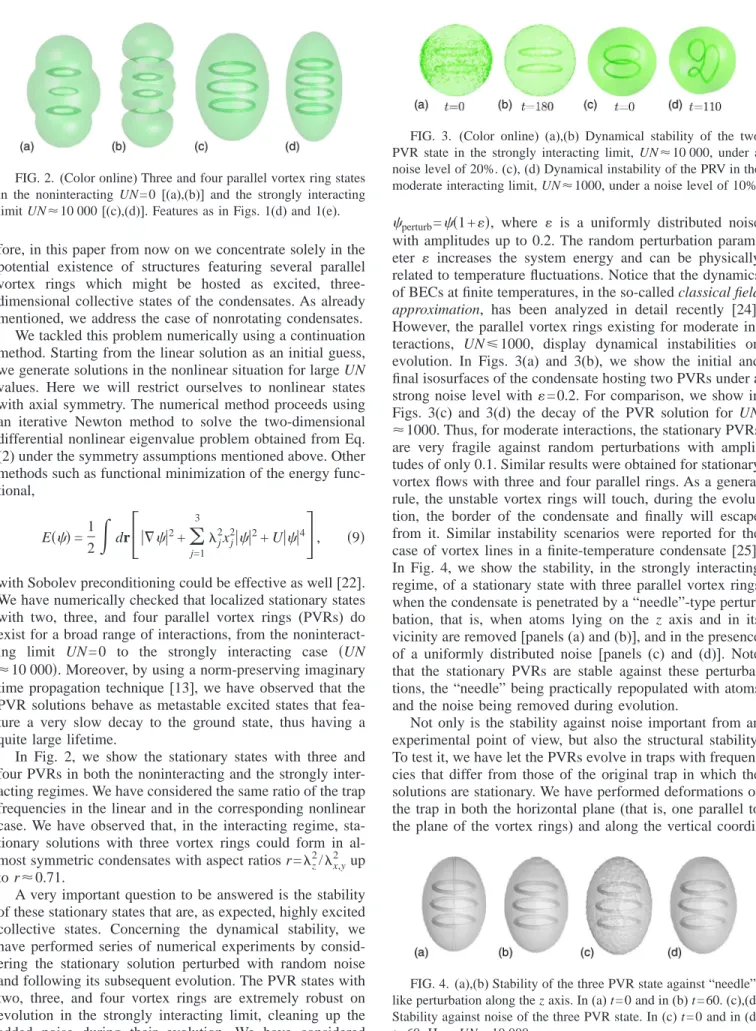
, 共9兲 with Sobolev preconditioning could be effective as well[22]. We have numerically checked that localized stationary states with two, three, and four parallel vortex rings (PVRs) do exist for a broad range of interactions, from the noninteract-ing limit UN = 0 to the strongly interactnoninteract-ing case 共UN ⬇10 000兲. Moreover, by using a norm-preserving imaginary time propagation technique[13], we have observed that the PVR solutions behave as metastable excited states that fea-ture a very slow decay to the ground state, thus having a quite large lifetime.In Fig. 2, we show the stationary states with three and four PVRs in both the noninteracting and the strongly inter-acting regimes. We have considered the same ratio of the trap frequencies in the linear and in the corresponding nonlinear case. We have observed that, in the interacting regime, sta-tionary solutions with three vortex rings could form in al-most symmetric condensates with aspect ratios r =z2/x,y2 up to r⬇0.71.
A very important question to be answered is the stability of these stationary states that are, as expected, highly excited collective states. Concerning the dynamical stability, we have performed series of numerical experiments by consid-ering the stationary solution perturbed with random noise and following its subsequent evolution. The PVR states with two, three, and four vortex rings are extremely robust on evolution in the strongly interacting limit, cleaning up the added noise during their evolution. We have considered
perturb=共1 +兲, where is a uniformly distributed noise with amplitudes up to 0.2. The random perturbation param-eter increases the system energy and can be physically related to temperature fluctuations. Notice that the dynamics of BECs at finite temperatures, in the so-called classical field approximation, has been analyzed in detail recently [24]. However, the parallel vortex rings existing for moderate in-teractions, UN艋1000, display dynamical instabilities on evolution. In Figs. 3(a) and 3(b), we show the initial and final isosurfaces of the condensate hosting two PVRs under a strong noise level with= 0.2. For comparison, we show in Figs. 3(c) and 3(d) the decay of the PVR solution for UN ⬇1000. Thus, for moderate interactions, the stationary PVRs are very fragile against random perturbations with ampli-tudes of only 0.1. Similar results were obtained for stationary vortex flows with three and four parallel rings. As a general rule, the unstable vortex rings will touch, during the evolu-tion, the border of the condensate and finally will escape from it. Similar instability scenarios were reported for the case of vortex lines in a finite-temperature condensate[25]. In Fig. 4, we show the stability, in the strongly interacting regime, of a stationary state with three parallel vortex rings when the condensate is penetrated by a “needle”-type pertur-bation, that is, when atoms lying on the z axis and in its vicinity are removed[panels(a)and(b)], and in the presence of a uniformly distributed noise [panels (c) and (d)]. Note that the stationary PVRs are stable against these perturba-tions, the “needle” being practically repopulated with atoms and the noise being removed during evolution.
Not only is the stability against noise important from an experimental point of view, but also the structural stability. To test it, we have let the PVRs evolve in traps with frequen-cies that differ from those of the original trap in which the solutions are stationary. We have performed deformations of the trap in both the horizontal plane(that is, one parallel to the plane of the vortex rings)and along the vertical coordi-FIG. 2.(Color online)Three and four parallel vortex ring states
in the noninteracting UN = 0 [(a),(b)] and the strongly interacting limit UN⬇10 000[(c),(d)]. Features as in Figs. 1(d)and 1(e).
FIG. 3. (Color online) (a),(b) Dynamical stability of the two PVR state in the strongly interacting limit, UN⬇10 000, under a noise level of 20%.(c),(d)Dynamical instability of the PRV in the moderate interacting limit, UN⬇1000, under a noise level of 10%.
FIG. 4.(a),(b)Stability of the three PVR state against “needle”-like perturbation along the z axis. In(a)t = 0 and in(b)t = 60.(c),(d) Stability against noise of the three PVR state. In(c)t = 0 and in(d) t = 60. Here UN⬇10 000.
nate(perpendicular to the plane of the vortex rings). Figure 5 shows the relevant result that the two PVRs in the strongly interacting limit UN⬇10 000 are stable to strong structural instabilities (up to 10%) perpendicular to the vortex rings plane and to moderate, up to 2%, structural instabilities in the vortex rings plane. We actually show three representative snapshots of the condensates taken in the initial, middle, and final stage of the pulsation. The periodic persistent pulsations of the atomic cloud in the direction of the perturbations due to the change in the background field are observed for sev-eral hundreds of time units. However, when the condensate lays into the moderate interacting limit, UN⬇1000, or even when it lays into the strongly interacting regime but the structural perturbation in the vortex rings plane is quite strong, the PVRs cannot survive the perturbation and even-tually they decay into the condensate ground state that
real-izes the energetic minimum. To generate parallel vortex ring structures in real experiments, one has to first generate single vortex ring states in multicomponent BECs(which, as shown before, can be stationary in oblate traps) and then to make both a shifted physical superposition of these states hosting single vortex rings in a fully symmetric trap and a full trans-fer of all atoms to one of these states.
CONCLUSIONS
We have found that three-dimensional structures consist-ing of several parallel vortex rconsist-ings exist as stationary and robust excited states in Bose-Einstein condensates. Starting from the linear limit and using a numerical continuation method, we have obtained stationary solutions with embed-ded vorticities in the strongly interacting regime. We have also constructed globally linked three-dimensional structures of topological defects hosted in trapped wave fields, in the form of vortex stars, vortex cages, or parallel vortex lines, which might also exist as excited states of interacting Bose-Einstein condensates, a challenging question that we leave open for future research.
ACKNOWLEDGMENTS
We acknowledge useful discussions with Ignacio Cirac. This work has been partially supported by the Generalitat de Catalunya, by the Spanish Government under Grants No. BFM2003-02832, No. BFM2002-2861; and by Consejería de Ciencia y Tecnología de la Junta de Comunidades de Castilla–La Mancha under Grant No. PAC02-002. D.M. is supported by the Institució Catalana de Recerca i Estudis Avancats(ICREA).
[1]P. G. Saffman, Vortex Dynamics(Cambridge University Press, Cambridge, 1992).
[2]H. J. Lugt, Vortex Flow in Nature and Technology(Krieger, Malabar, FL, 1995).
[3]L. M. Pismen, Vortices in Nonlinear Fields(Clarendon, Ox-ford, UK, 1999).
[4]A. Ashkin, Opt. Photonics News 10(5), 41(1999); M. E. J. Friese et al., Nature(London) 394, 348(1998); M. J. Padgett and L. Allen, Contemp. Phys. 41, 275(2000); L. Paterson et al., Science 292, 912(2001).
[5]F. Sols, Physica C 369, 125(2001).
[6]P. Chatelain, D. Kivotides, and A. Leonard, Phys. Rev. Lett.
90, 054501(2003).
[7]M. R. Matthews et al., Phys. Rev. Lett. 83, 2498(1999); K. W. Madison et al.,ibid. 84, 806(2000); F. Chevy, K. W. Madison, and J. Dalibard, ibid. 85, 2223(2000); J. R. Abo-Shaeer et al., Science 292, 476(2001).
[8]B. Jackson, J. F. McCann, and C. S. Adams, Phys. Rev. A 60, 4882(1999); 61, 013604(1999).
[9]P. C. Haljan et al., Phys. Rev. Lett. 86, 2922(2001). [10]M. Guilleumas and R. Graham, Phys. Rev. A 64, 033607
(2001).
[11]P. Rosenbusch, V. Bretin, and J. Dalibard, Phys. Rev. Lett. 89, 200403(2002).
[12]J. J. García-Ripoll and V. M. Pérez-García, Phys. Rev. A 63, 041603(2001); 64, 053611(2001); A. Aftalion and T. Riviere, ibid. 64, 043611(2001).
[13]A. Aftalion and I. Danaila, Phys. Rev. A 68, 023603(2003);
69, 033608(2004).
[14]D. L. Feder et al., Phys. Rev. Lett. 86, 564(2001). [15]B. P. Anderson et al., Phys. Rev. Lett. 86, 2926(2001). [16]J. Ruostekoski and J. R. Anglin, Phys. Rev. Lett. 86, 3934
(2001).
[17]S. Komineas and N. Papanicolaou, Phys. Rev. Lett. 89, 070402(2002).
[18]M. Guilleumas et al., Phys. Rev. A 65, 053609(2002). [19]A. E. Leanhardt et al., Phys. Rev. Lett. 89, 190403(2002). [20]J. R. Abo-Shaeer, C. Raman, and W. Ketterle, Phys. Rev. Lett.
88, 070409(2002).
[21]In other contexts, the term “weakly interacting condensates” is used to refer to gaseous condensates as opposed to “strongly interacting condensates” or liquid condensates made of HeII. Notice that we always refer to gaseous condensates and our FIG. 5. (Color online) Structural stability of the two PVRs
against trap perturbations in the vortex-rings plane as ⌬x2/x2 = 2%(upper row)and in the plane perpendicular to the vortex-rings plane as⌬z2/z2= 10%(bottom row). Here UN⬇10 000.
use of weak and strong corresponds only to the value of the relevant parameter U.
[22]G. Molina-Terriza et al., Opt. Lett. 26, 1601(2001); L.-C. Crasovan et al., Phys. Rev. E 66, 036612(2002).
[23]L.-C. Crasovan et al., Phys. Rev. A 68, 063609(2003). [24]A. Sinatra, C. Lobo, and Y. Castin, Phys. Rev. Lett. 87,
210404 (2001); M. J. Davis, S. A. Morgan, and K. Burnett,
ibid. 87, 160402(2001); Phys. Rev. A 66, 053618(2002); K. Góral, M. Gajda, and K. Rzążewski, ibid. 66, 051602(R) (2002); M. J. Davis and S. A. Morgan, ibid. 68, 053615 (2003).
[25]H. Schmidt et al., J. Opt. B: Quantum Semiclassical Opt. 5, S96(2003).