Education and Human Development Master's
Theses Education and Human Development
Spring 5-8-2017
Technology Reading Programs and Their Impact
on Listening Comprehension
Meghan C. Schott
Follow this and additional works at:http://digitalcommons.brockport.edu/ehd_theses Part of theEducation Commons
To learn more about our programs visit:http://www.brockport.edu/ehd/
This Thesis is brought to you for free and open access by the Education and Human Development at Digital Commons @Brockport. It has been accepted for inclusion in Education and Human Development Master's Theses by an authorized administrator of Digital Commons @Brockport. For more information, please [email protected].
Repository Citation
Schott, Meghan C., "Technology Reading Programs and Their Impact on Listening Comprehension" (2017).Education and Human Development Master's Theses. 745.
Technology Reading Programs and Their Impact on Listening Comprehension Meghan C. Schott
The College at Brockport Capstone Project
Technology Reading Programs and their Impact on Listening Comprehension: submitted to the department of Education and Human Development of The College at Brockport, State University of New York, in partial fulfillment of the requirements for the degree of
Master of Literacy Education May 8, 2017
Table of Contents
Abstract………...4
Introduction ………...5
Topic and Research Topic ………..6
Significance of Problem ………..9 Rational ……….10 Purpose of Study ………...11 Research Questions ………...12 Literature Review ………...12 Comprehension ……….13 Listening comprehension ………..14
Listening comprehension and the Common Core Standards ………16
Educational Technologies ……….17
One-to-one initiative ……….17
Technology Reading Programs ……….19
RazKids reading program ……….20
TumbleBooks ………20
Bookflix ………21
The Goal of the Reading Programs ………...21
Online Assessments ………..22 Summary ………...23 Methodology ………23 Participants ………24 Setting ………...24 Researchers Personality ………25 Data Collection ……….26 Observations ……….27
Student assessment data and artifacts ………... ...27
Student interviews ………28
Procedures ……….28
Data Analysis ………...30 Finding 1 ………...32 Finding 2 ………...35 Finding 3 ………...44 Discussion ………47 Conclusion ………47
Conclusion 1: Body language and location of reading ……….48
Conclusion 2: Student preference & program features ………...49
Conclusion 3: Student choice and experience………...50
Implications ………...50
Classroom location ………51
Reading levels and programs go hand-in-hand ……….51
Student choice of eBook matters ………..52
Limitations ………52
Future Research ………53
Closing ………..54
References ………55
Abstract
This qualitative study explores the impact technology reading programs have on second grade students’ listening comprehension as well as, their experiences with the programs. Student participants used three reading programs daily on an iPad to assess student listening comprehension through five question assessments. The three programs used in this study were RazKids, TumbleBooks and Bookflix. Data were collected for a 5-week period using observational notes, assessment results, from all three reading programs, and student interviews. Results suggest that student engaging student body language, specific program features and student preference of reading program impacted listening comprehension results. Additional research should be conducted to determine benefits of specific reading programs for student literacy learning.
Key words: Listening comprehension, technology, RazKids, TumbleBooks, Bookflix, assessments
Introduction
Since I can remember, technology has been a part of my personal and professional life. When I was young, operating my father’s large IBM desktop was a privilege.
However, as time progressed operating the computer became mundane for the reason that the screen was too small and the desktop was stationary. Within my own classroom, student desktops are no longer used for learning and in their place enter iPads, laptops and smartphones. During my primary years, my teachers taught using chalk, white boards, and the always-reliable pencil and paper. As a current educator, the classroom tools utilized have evolved and because of this a new focus on education has emerged which has affected my practices.
As noted above, within my second grade classroom, twenty students read and write using technological devices. These devices are a part of their technological experience into the twenty-first century. According to researchers, Cheung & Slavin (2013), “educational technology, is defined as a variety of electronic tools and
applications that help deliver learning content and support the learning process” (pg. 3). In a second grade classroom these “educational technologies” (Cheung & Salvin, 2013) consist of iPads, and various applications embedded in the devices designed for literacy learning growth. The iPad offers different features that are unmatched to those of earlier technologies such as the desktop (Hutchinson, Beschorner & Schmidt-Crawford, 2012). These unique features include touch screen and interactive elements, and endless amounts of applications for pleasure and academia (Hutchinson, Beschorner & Schmidt-Crawford, 2012). The use of technology, such as the iPad, has allowed students’ learning to become specific and is meant to create independence for student learners. These new aspects of
educational technologies (Cheung & Salvin, 2013) have enhanced student learning and these enhancements have lead teachers and educators to explore the purpose of
technology use in the classroom. Topic and Research Problem
It is because of the implementation of iPads and other technological devices that administrators, school districts, and teachers, like myself, are interested in exploring the impact on student literacy learning. Technology is widely used across vocations,
classrooms, and individuals’ personal lives. According to a survey conducted in 2015 from the PEW Research Center, “up to 92% of adults in 2015 owned and used a smart phone device, and up to 72% owned and used a computer in their daily life” (Jenkins, 1995). To keep up with a consistently evolving technological society and workforce, schools have provided students with technology devices to foster their academic growth and build their understanding of the tools (Herold, 2016). Therefore, it only seems natural that schools incorporate technology into the classroom to keep up with the high demands of a technology driven society.
Researchers and educators have developed a system of implementation to assist teachers with technology use in the classroom. This implementation is evident in the TPACK system or, Technological Pedagogical Content Knowledge. This system of technology implementation is based on the pedagogical content knowledge system created by Lee Shulman in 1986 (Koehler & Mishra, 2009). TPACK is critical to building a technological foundation in the classroom because it combines the use of content, and good teaching practices with the implementation of technology use. According to Koehler and Mishra (2005), “Good teaching with technology, therefore,
cannot be achieved by simply adding a new piece of technology upon existing structures. Good teaching, with technology, requires a shift in existing pedagogical and content domains”(p. 3). The use of TPACK in classroom planning and instruction has helped to create a connection between content and technology use, which has lead to a push in the purchasing of technological devices across school districts.
According to the popular education site, Education Week, “Schools purchased more than 23 million devices for classroom use in 2013 and 2014 alone” (Herold, 2016). As a result of these devices, students are using the new technological tools, iPads, laptops, and eReaders to engage in typical learning techniques, such as, reading stories, and writing using the Internet. The implementation at a state level, of these technological devices in the classroom, opens up a variety of academic tools to educators.
This research study is conducted in a Conklin Country (pseudonym), New England classroom. Each student in the district is provided an iPad used specifically for arithmetic, typing skills and reading programs. One of the most useful features of iPads is, applications for interactive and digital books (Hutchinson, 2012). In this study, students choose texts from a large library of online books from, picture to chapter books. Furthermore, students in my class have the ability to choose books based on their topic of interest, reading level and specific program. Students can listen to and read books from different programs such as TumbleBooks, RazKids and BookFlicks.
These programs are chosen and implemented at the district and classroom levels for literacy instruction and assessment. Multiple studies assert these programs offer texts that have created new modes of reading, and with that have created new modes of reading comprehension (Hutchinson, A., Beschorner, B., & Schmidt-Crawford, D., 2012;
Hutchison, A., Woodward, L., 2014; Pearman, C. J., 2008). With the use of these programs in schools, and in this study, understanding how these programs affect student comprehension and comprehension learning is of great importance. The implementation of these devices according to Mcjenna, Reingling, Labbo & Keiffer, (1999) stems from the transition of information from print to electronic form, where books are becoming increasingly available in electronic representations. These electronic representations of text are making it more likely that students will be exposed to the new formats of literacy. The increase in visual elements is only one aspect of eBooks that is unlike traditional print.
In addition to the visual and aural elements of eBooks the manipulation of the device is largely different from traditional print. As previously stated in Ciampa (2012) eBooks create interest in reading; however, students using the reading programs view the text through a new mode of reading comprehension. Although the manipulation of text is far different from the past it is evident that students need to develop additional reading and comprehension skills when using these programs.
As students use these technological tools less are reaching for pencil, paper and books. As an educator fostering student growth and academic learning, using these technologies poses a new challenge: Are these tools hindering or aiding in primary students understanding of the basic literacy skills? What are the affects these
technological tools have on literary growth in reading and listening comprehension? To determine the significance technology and literacy, this paper seeks to explore these questions and ideas through practitioner researcher.
Significance of Problem
It is easy to see the appeal the iPad and technology provide to students and educators because of the numerous applications for the classroom and personal use. According to the National Center for Education Statistics 2016 (NCES) “In 2013, 71 percent of the U.S. population age 3 and over used the Internet” (pg. 1). Furthermore, Benjamin Herold (2016) of Education Week asserts that public schools in the United States have spent more than 3 billion dollars a year on digital programs for students (pg. 1). Many schools today have become technologically driven and continue to push the use of these technological tools in classrooms across the country (Herold, 2016). With such a technologically driven society, how do educators instruct and select these tools and programs to benefit their students?
For teachers this question means, guiding graduates to become technology proficient across all academic areas. It is the goal for many school districts to graduate students proficient in technology, for example, in New York State; Governor Cuomo approved funds and government resources as “a technology investment” in several New York State schools. With the implementation of these technology tools, educators must now determine how to incorporate them to their instruction. Determining the usage and purposes of these tools has created some difficulty for educators; a lack of educational support and knowledge has been explored about the influence and impact technology programs have on student literary growth. According to Hutchinson, Beschorner, & Schmidt-Crawford (2012), teachers continue to struggle with technology implementation in the classroom. Therefore, in what ways can educators decide how these technology-reading programs affect and impact student literacy learning? This study seeks to
determine how these technology reading programs influence and impact student comprehension through the use of iPad devices.
Rational
Educators are researching new instructional strategies and programs to foster student understanding across content areas. According to Hutchinson (2012) digital texts can require different comprehension strategies; retelling details, determining main idea, and decoding unknown words are some of the examples of strategies that differ, when using technology-reading programs. These new strategies are called New Literacies (Hutchinson, Beschnorner & Schmidt-Crawford, 2012). These New Literacies create different ways to read and comprehend digital texts. These devices, such as, the iPad, laptop, and eReaders, are implemented to further student learning through the use of technological reading programs. Furthermore, teachers within this school have a choice of which technological reading programs to implement into their curriculum and literacy learning. This case study, seeks to determine which technological programs have affects on student literacy learning and understanding in both reading and listening
comprehension, and what students say about these programs and their experiences. School districts nationwide look at second grade comprehension skills as an essential piece to literacy learning. Each of these reading programs provides literary support for primary grade students. At this time a reading standard and expectation for a second grade students, according to the New York Common Core, is to read for learning and understanding, instead of learning how to read.
There are extensive online reading programs that provide a wide range of components to assess and instruct student learning. RazKids (Version 3.3.0, RazKids
Inc., 2016) is a popular reading program that provides student access to a wide variety of texts, organized by Fountas and Pinnell (2016) reading levels, age and grade levels. This program provides comprehension quizzes to assess student understanding of the texts. Similar to RazKids (2016), TumbleBooks (TumbleBooks Inc., 2015) is an online reading program, which provides interactive texts and listening assessments to determine student-reading comprehension. BookFlix (Scholastic, 2016) is an Scholastic program providing interactive videos and stories that connect fiction and nonfiction texts.
All of these reading programs offer various tools, applications and features that are designed to benefit students’ progress in reading. With increased access to the technology reading programs via student iPads, I seek to better understand the implication of technology in the literary program at my school. I want to identify the impact of the reading programs; RazKids (2016), TumbleBooks (2015), and Bookflix (2016) have on student comprehension by exploring which programs best support the literary growth of my students.
Purpose for Study
This study discusses and explores the current instructional practices of technology reading programs widely used in primary classrooms, and in my own classroom, and whether they support students’ reading and understanding. The affect the programs have on student’s listening and reading comprehension is vital for student literacy growth because the results are measured by the state and reflect the literacy academic growth of the district. Therefore, since little research has been conducted regarding technology reading programs and their affect on comprehension, this study will explore the impact these reading programs have on primary students’ listening comprehension, to help
provide a clear choice and purpose for the usage of these programs in primary classrooms.
Research Questions
Through an understanding of literary comprehension, an iPad, and analysis of three reading programs this study has allowed me to explore the following research questions.
1. What influence do technological reading programs have on primary students’ listening comprehension?
2. How do students’ reported experiences with the different reading programs employed at my school, affect their listening comprehension?
Literature Review
The following literature review explores academic concepts that concern this study and support my research questions. The academic concepts reviewed in the follow sections include: comprehension, educational technologies. Additionally, this section explores the use of three technology-reading programs and their effect on education in classrooms today, as well as in my own classroom. Technology has grown to become an important aspect of individuals’ professional and personal lives; therefore, technology has become important for schools. An additional importance in schools today is the use of comprehension and assessing students’ literacy understanding of a text.
Comprehension and technology are both supported by the Common Core State Standards (CCSS) and are practiced across content areas and grade levels. To support the CCSS and assessments, technology-reading programs are designed and implemented to support student comprehension and literacy learning in the classroom. Both, technology and
comprehension are implemented within in the classroom discussed in this study. By exploring the importance of comprehension on student literary growth, with the use of technology devices like the iPad, this section explores the connection between both concepts and how the influence students literary experiences and understanding. Comprehension
Comprehension is an important part of a students’ literacy understanding and learning. It is considered a complex cognitive task in which a student draws on a variety of skills to maintain an understanding of texts and topics (Carretti, Caldarola, Tencati, Cornoldi, 2014). When students are learning to read they focus on print and alphabetic principle; however, when students read for comprehension they are reading to answer questions, unlock new ideas as well as create their own. This study focuses on
comprehension because it is the basis for understanding and is a large focus in the classroom across grade levels, specifically in my own classroom.
There is an emphasis for comprehension in education, as seen through the
Common Core Standards (2016) and the implementation of TPACK (Koehler & Mishra, 2009) in my school district; however, there are multiple forms of comprehension
including, listening and reading, both of which will be focused on in this study. Additionally, there are new academic and technological tools used to aid in
comprehension; for example, books are now in digital form and these digital texts have fostered an exploration of “new literacies” (Arellano-Osuna & et al., 2009) in which students’ comprehension of these digital texts is altered because the text is no longer in traditional print. However, the importance of comprehension remains the same, it is the basis for learning.
Listening comprehension. There are a variety of definitions for the term “listening comprehension.” For example, Hamouda (2013) define listening
comprehension as interactive and where ideas originate. This definition directly reflects individuals’ abilities to understand material for the purpose of gaining knowledge. This process can occur through a variety of modalities including, conversations,
announcements, speeches, stories and radio (Gilajani & Sabouri, 2016). Individuals engage in listening comprehension daily and often consider the activity to be a passive form of learning. However, according to Shi (2015) listening requires active engagement. The active engagement of listening comprehension has made it an important skill within student literacy learning. An additional definition of listening comprehension according to Hamouda (2013), discusses comprehension as demonstrating understating through repetition. This form of listening comprehension analyzes verbal skills and the ability to follow directions from a speaker. Although all of the definitions of listening
comprehension differ, the underlining goal of each is to gain knowledge and understanding.
For the purpose of this study, I will focus on Gilajani and Sabouri’s definition of listening comprehension, understanding material for the purpose of gaining knowledge. This definition directly relates to the purpose of reading in my classroom, where students are asked to demonstrate their knowledge of a book or topic. Additionally, students are asked to demonstrate and acquire that knowledge through discussions, questions and a variety of reading sources and modalities, in which Gilajani and Sabouri describe in their definition of listening comprehension. Although there are various comprehension
skill in students’ literacy learning and understanding.
The essential skill of listening comprehension is noted in a several studies (See list citations: Ahn & Kang, 2016; Hemmati, Gholamrezapur, & Hessamy, 2015; Ciampa, 2012) and is seen in the Common Core State Standards (CCSS) across content and grade levels. One study by Wolgramm, Suter & Goksel (2016), explores the importance of listening comprehension for English Language Learners during instruction. This study found that listening plays an important role in students’ reading comprehension, in that it becomes a precursor for reading comprehension for many students (Wolggramm, Suter, & Goksel, 2016). The importance of listening comprehension is also evident in the CCSS where speaking and listening standards are spread throughout all content areas, including, science and mathematics. The comprehension findings of Wolggram, Suter, and Goskel (20126) study, indicate that students gain knowledge of topics, prior to being able to read. Furthermore, students gain listening skills through model and application of listening strategies.
Additionally, Wolgramm, Suter & Goksel (2016), discuss the importance of listening strategies, such as, concentration and using the metacognitive skills to focus on directions and oral material. The process of concentration requires teaching individuals the importance of remaining focused on the material being coded, processed, and then stored for further analysis (Wolfgramm, Suter, & Goksel, 2016). Students learning to read and comprehend often need assistance with reading strategies and concentration when staying focused on the reading material. Schools follow the CCSS as a guide for educators in their instruction of listening strategies to teach students how to comprehend, concentrate and understand material. As these concepts are also stressed in my school,
learning comprehension is important because it measures understanding, and this is evident in the CCSS.
Listening comprehension and the Common Core State Standards. Instructing students to concentrate and use comprehension strategies when listening is a part of the CCSS teaching standards in all grade levels, across all content areas. These standards found in the CCSS are implemented in school districts from Pre-Kindergarten to 12th Grade and across several states. There are CCSS skills and applications centered on listening comprehension skills. A specific example of a listening comprehension in prekindergarten standards (2016) states, “With guidance and support, confirm understanding of a text read aloud or information presented orally or through other media by asking and answering questions about key details and requesting clarification if something is not understood” (pg. 13). This specific CCSS standard illustrates the importance of listening skills as it relates to listening comprehension. Within my classroom listening comprehension standards are listed in specific categories, such as speaking and listening, where students are asked to comprehend, analyze and critic information presented orally. When students listen to an eBook, the information is
presented orally; therefore, assessing comprehension of material being presented orally is an important aspect of a students’ overall comprehension skill.
Embedded within the CCSS literacy standards (2016) are technological skills and applications designed to teach students necessary skills needed for college and the workforce. Technology is seen within the CCSS standards in all literacy concepts
including, reading, writing, speaking and listening. With this push towards technological standards districts, educators and students are beginning to utilize educational
technologies in the classroom (Cheung & Salvin, 2013). This push towards technology is seen in my second grade classroom, with the implementation of iPads. To meet the CCSS technology standards teachers are using these iPads for assessments and instruction. Educational Technologies
Educational Technologies are defined as, “a goal oriented problem-solving approach utilizing tools, techniques, theories, and methods from multiple knowledge domains” (Luppicini, 2005, p. 103). These domains consist of resources that help facilitate learning and growth, such as, programs, and search engines. The specific types of programs vary depending upon the district, school and educator; however,
technologies are prominent because of the wide range of abilities and options offered to improve student learning. Technologies improve student learning across all content areas, including literacy education and comprehension.
According to Cheung & Slavin (2003) “educational technologies” have become a popular tool used to aid struggling readers. These specific tools range from, computers to iPads and individual handheld devices. These devices are used to improve student
fluency, decoding strategies and comprehension. In theory, technological devices can adapt to individual students’ educational needs. For example, the technologies help fill academic learning gaps across content areas (Cheung & Slavin, 2005). The devices that are seen implemented in many school districts across America are computers, iPads, eReaders and Smart boards. Although new technologies are not as widely used in classrooms today, there are initiatives schools and districts are implementing to support student growth digitally.
benefit student learning and academic growth. A one-to-one initiative provides a
technological tool to students across all grades, within their districts (Sauers & McLeod, 2012). Although not all schools systems have adapted this practice a variety of research has been conducted to support the implementation of these devices to each student.
Suhr, Hernandex, Grimes & Warschauer (2010), in their study the participants had observed academic gains in both writing and literacy standards. Researchers
observed gains in what they called “the fourth grade slump,” where students are begin to reading for knowledge and understanding, instead of learning how to read. Suhr,
Hernandex, Grimes & Warschauer (2010), found that students with a laptop device made greater strides in literacy responses than students without a laptop device. The evidence of a greater literacy response indicates the students’ growth in comprehension
development when reading which is beneficial to students’ literacy learning. An
additional technology study by Dunleavy & Heinecke (2007) found, academic growth in math and sciences. In this study, students improved their scores on the science
achievement test when using a laptop device. In support of academic growth across content areas another study (Light, McDermott, & Honey, 2002) found, that “after several years of one-to-one laptop use students scored higher than their peers across all subject areas” (p. 3). According to these studies, students have demonstrated positive growth using a technological device. As discussed in the various studies these laptops and personal devices support academic growth across content areas when used by students (Dunleavy, & Heinecke, 2007, Light, McDermott, & Honey, 2002). These findings would indicate support for students to consistently utilize electronic devices for academic growth.
The school district, in this case study, implements a one-to-one initiative in order to promote academic growth across all grade levels. This initiative provides students of all grade levels with iPads for academic use. The goal of the initiative is to improve student learning, specifically student literacy learning, improve technological
development to meet CCSS standards and state goals. The implementation is new, only having been practice for two years. Although the implementation is new, students are adapting well to the educational technology, using the iPads daily for literacy and mathematics instruction and assessment. These iPads provide software programs and applications that are designed to support student growth across content areas. Although technological devices are key in individual education the programs and applications themselves are critical in enhancing student literacy learning. Therefore, it is important to have a clear understanding of the history of the one-to-one initiative in order to
understand my participants and study’s context. Technological Reading Programs
Technological software programs, according Cambridge International
Examinations (2013) “are the most popular for both teaching and learning” (p. 2). The popular use of applications has lead researchers to analyze specific software programs, created to benefit student learning. According to Cheung & Slavin (2013), “the potential use of these technology programs, to enhance student learning specifically to help students who are struggling to learn to read, have been anticipated for many years” (p. 278). There are many programs to count, created to aid students in their literacy learning, specifically their decoding, fluency and comprehension in reading. For the purpose of this study, three programs, used by participants in the second grade classroom, are analyzed
for the impact on students’ listening comprehension. These programs are RazKids, TumbleBooks and BookFlix.
RazKids reading program. RazKids is a popular reading program designed to provide leveled stories and assessments to students across grade levels (RazKids Inc, 2015). A major benefit to this reading program is the over 800 leveled eBooks, across a wide range of topics and electronic assessments that measure student comprehension. In my second grade classroom students are assigned a reading level and access their leveled books through the RazKids application on the iPads. Each student chooses an eBook from their leveled library in which they can read independently, or listen to the story from a narrator. Educators across the district use the program daily, as well as, 165 countries around the world, to improve and analyze student reading and literacy growth. (RazKids Inc, 2015). A similar program, TumbleBooks, provides a wide range of eBooks for students.
TumbleBooks. TumbleBooks is an eBook resource, which contains over 1000 titles and genres of literature. Individuals and school districts that subscribe to the online reading program are offered eBooks and additional resources such as games, puzzles and quizzes (TumbleBooks Inc, 2015). Similarly to RazKids, TumbleBooks offers a tracking feature in which educators are able to personalize the students’ reading programs and track their comprehension achievement using an online profile. An additional benefit to this reading program is that students are able to monitor and track their own progress by examining their comprehension assessment results (TumbleBooks Inc, 2015). Students are able to review previously taken exams, reflect on difficult questions, and self monitor their progress. TumbleBooks library offers a variety of interactive stories in which
characters move and students may click on objects within the story. This interactive feature offers some similarity to the final online reading program, Bookflix.
Bookflix. Bookflix, a Scholastic online reading program for grades pre-K through third, assists students and educators on developing early reading skills (Scholastic, 2016). This program has a variety of similar features to TumbleBooks (2015) and RazKids (2016), such as, interactive videos, digital texts, puzzles, lesson plans and assessments. The unique feature this program contains is a book pairing in which “the paring of fiction and nonfiction has been shown to be an effective way to develop critical reading and comprehension skills” (Scholastic, 2016). At the end of each paring lesson students may play an educational game that directly assesses their knowledge from both the fiction and nonfiction texts. Although students are able to access these pairing assessments directly from electronic devices, there is no feature in which students are able to track their assessment results. Although assessments and results are unable to be tracked electronically, an interesting element the program offers is an organization of stories through the use of social and science themes. Some of these themes are, family and community, music and rhyme, animals and nature and earth and sky (Scholastic, 2016). Educators can use these themes and stories, to connect social subjects, science and social studies, to literacy.
The Goal of the Reading Programs
With an emphasis on comprehension, as seen in the CCSS and in the school district of this study, the goal and purpose of each of these reading programs: RazKids, TumbleBooks and Bookflix, is to provide student readers engaging and interactive stories that assess student reading and understanding. These programs are chosen because they
are provided and used by the district of each second grade student in this study. According to the popular teacher site, Edutopia (2012), RazKids has altered student-reading growth significantly by building a solid student-reading foundation with leveled texts. Additionally the site recommends the program for daily reading use. The programs have similarities and differences but the ultimate goal of each program is to aid students in their literacy learning and comprehension. Each program attempts to accomplish and monitor, this goal through the use of online assessments.
Online Assessments
Online reading assessments are dynamic forms of print that can change the content displayed (Coiro, 2011). Differently are offline assessments that provide static information in print form (Coiro, 2011). Few educators and districts have considered the affects of online assessments on student understanding (Cioro, 2009). Many standardized tests are beginning to move digital for easy measuring capabilities to track student data and growth. Although assessments are beginning to be offered online, Cioro (2009), discusses the important notion that students will need new literacy skills to comprehend these online assessments. Furthermore, according to Caney, (1999) and Snyder & Bulfin (2008), “Online information texts also introduce infinite numbers of intertextual
connections and intercultural negotiations that prompt new complexities for readers trying to synthesize and communicate information across globally linked Internet texts” (As cited in Coiro, 2011, p. 357). Both of these reports suggest that students need additional supports when completing assessments using a technological device. Although there is a need for additional reading strategies when completing online assessments, there are additional benefits to the online programs.
As previously mentioned, with the introduction of “new technologies” (Cheung & Salvin, 2013) the implementation of online assessments will begin to make it easier for teachers to track student understanding and assessment results. With these additional results educators and districts may alter their teaching strategies to benefit students, and to create an individualized literacy-learning program, designed to enhance student comprehension.
Summary
Wolggramm, Suter, & Goksel (2016) discuss how listening becomes a precursor for reading comprehension with students. Students gain knowledge of topics by listening to stories and individuals before reading text independently; however, listening
comprehension has become an additional reading skill with the wide use of digital texts. These digital programs offer a variety of texts in different forms that offer engagement, manipulation and assessment. All three reading programs discussed, RazKids (2016), TumbleBooks (2015) and Bookflix (2016), offer interactive videos, voices, and
assessments to engage the reader. As previously stated in Coiro, (2009), with the use of these online assessments and features, students will need additional assessments skills separate from those taught with offline assessments. With these concepts in mind, this study will explore listening comprehension and the impact three online reading programs have on student comprehension, and their experiences using each program.
Methodology
This qualitative study, examines the influence of technology reading programs on student listening comprehension, and how experiences with these programs affect student
listening comprehension. The following sections discuss the participants of this case study and the methods used to collect data. Data was collected for an eight-week period using a variety of collection methods. The various data methods include: student
observations, student interviews and listening comprehension assessments, created by, each of the online technological reading programs. The following sections outline the specific participants, setting, and data collection that has occurred across a four-week period.
Participants
The participants in this study were chosen because they were all second grade students in my classroom during the 2016-2017 school year. In my classroom there were twenty students of mixed race, religion and ethnicity. There were nine males and eleven females, and of the four students selected for this study three were male, and one was female. The participants in this study were chosen at random, from a pile of informed consent documents to prevent bias. An important academic aspect of each participant was his or her independent reading level. Students were assessed for reading levels regularly, biweekly, using Fountas and Pinnell’s benchmark reading program (Heinemann, 2016). Information regarding this reading program can be found in the Data Collection section of the Methods.
Setting
The setting for this study was in a second grade classroom located in an urban-suburban elementary school that included grades K-2nd in Conklin County (pseudonym) New England. The school was vibrant and full of young, energetic learners. The vibrancy was seen in each classroom, where students were engaging in a variety of academic
activities with movement, all taught by passionate teachers. I was the sole instructor in the second grade classroom and for all content areas including: Reading, Writing and Mathematics.
Within my classroom space students were seated in pairs to provide collaborative and independent workspace. In the corner of the classroom was the library where students browsed for traditional print text. Located at each students’ desk was a labeled bin for individual iPads. Students listened and used these iPads in two locations within the classroom. The locations were, their desks and at the carpet in front of a smart board (See Appendix A). During silent reading time, when students listened to various reading programs on the iPad, students were seated at their desks ready to complete the story assessment when the EBook was finished.
Researcher’s Personality
As the lead researcher and classroom teacher my role and responsibilities directly influence this study; therefore, my background with technology and my personal belief in technology use, will help me to explore my research questions. I grew up in a Caucasian middle class, suburban house hold with two working parents. I was fortunate enough to be provided with technological tools and supports, which provided me with success, in the classroom and at home. The use of technology at home and within my schools has shaped my background with technology. I was able to use technology programs for pleasure and academics, which allowed me to familiarize myself with different programs and their components.
Additionally, as an educator in a district that has adopted a “one to one initiative” I am directly influenced by technology use in the classroom. I am expected and expect
my students to use the iPads on a regular basis for literacy instruction and assessment. With this expectation I believe technology instruction should be used within the classroom across all content areas. The use of technology not only creates engaged learners, as seen from my experiences, but it also teaches students skills needed in many twenty first century careers.
Data Collection
This research study was qualitative, and data was collected in the form of observations, student artifacts and student interviews. During the school day students participated in 15 minutes of silent independent reading. At this time students listened to one of three online reading programs: RazKids, TumbleBooks, BookFlix, and then completed a listening comprehension mini assessment of five multiple-choice, fill in the blank, and short answer questions. The data collection took place during this designated time of the school day. At this time, students were participating in the same task, but with varied leveled readers and topics of both interest and need.
To ensure that students were reading leveled book choices, students were assessed for reading levels regularly using Fountas and Pinnell’s benchmark reading program (Heinemann, 2016). Students entering second grade, according to Fountas and Pinnell, should be reading at a level J-N. These levels are determined through a system of characterizations on a variety of texts that analyze, structure, vocabulary, sentence
complexity, theme and content (Fountas and Pinnell, 2016). These levels indicate that the students are reading grade level material. The following table lists the participants
reading levels during the study, and indicates the grade level students should have been reading.
Table 1 Reading Levels of Participants
Participant Reading Level Grade Level (According to
Fountas & Pinnell, 2016).
Student 1 N J-N
Student 2 H J-N
Student 3 N J-N
Student 4 J J-N
These levels vary based on Running Reading Records (Clay, 2013) analysis of miscues. Although these levels did not affect student participation of this study it is important to note that the various participants were reading at different levels and therefore; had been reading and listening to different eBooks in this study. The following sections explain the various collection tools used within this study.
Observations. Student observations were conducted during silent reading time using a narrative observation from (See Appendix B). I observed students, daily during silent reading time for 15 minutes. I observed the participants for reading strategies used when listening to text, such as, finger pointing, flipping back and forth between pages, and mouthing and mimicking the story. Additionally, I observed student attention and focus using each program, being mindful of book choice, time of day, and eye contact with the iPad and eBook. These observations sought to explore student experiences with the text and the influence their experiences may have on listening comprehension.
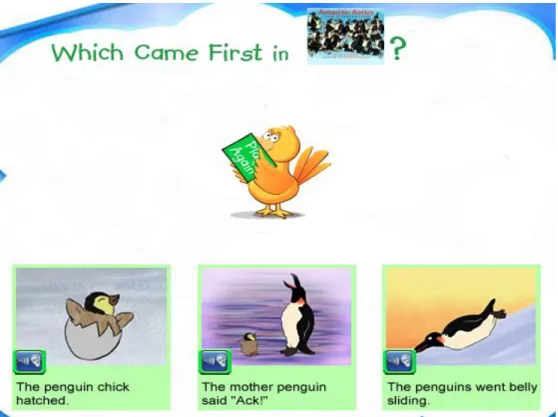
Student assessment data & artifacts. Student assessment data and artifacts were collected during the silent reading time as students finished listening to the reading program and eBook. The assessment was administered differently depending upon the reading program. Students that listened to an eBook using RazKids and TumbleBooks, had an assessment administered on the iPad following the end of the story (See Appendix C & D). Students listening to text using BookFlix were administered the listening
assessment questions in print form and then collected for further review and analysis (See Appendix E). These artifacts were administered after each completed eBook, daily. It took student participants between 5-10 minutes to complete the assessments. The artifacts were collected to explore the influence the eBooks and programs have on student
listening comprehension.
Student interviews. Student interviews were analyzed for attitude and
experiences relating to each technology-reading program. The interview sheet was semi-structured and was given once a week for 5 minutes with each participant (See Appendix F). The interviews were given to determine students’ experiences with each reading program, and how the programs influence or affected, his or her, listening
comprehension. These semi-structured interviews explored students’ overall experiences with each eBook, discussing specifics about each story and how they felt after listening to the story.
Procedures
The following procedures were conducted over a six-week period in one-second-grade classroom. During the second one-second-grade class’ silent reading period I administered and selected technology-reading programs for each participant. The participants were to use the reading program on their iPad for 15-minutes. Participants were assigned these reading programs on a three-day cycle, to ensure that each program was used frequently. After each student completed one eBook from the reading programs, RazKids,
TumbleBooks and BookFlix they completed a comprehension assessment. These assessments were administered directly after the eBook was complete in both hard copy and electronic. The RazKids comprehension assessment was given electronically using
the RazKids application on the iPad. All results were collected and sent electronically to my classroom data using the RazKids site. Similarly, TumbleBooks comprehension assessment was given electronically using the application. The results were collected and sent electronically to my classroom data using the TumbleBooks site. Lastly, BookFlix assessments were administered in a hard copy that students printed and took after they have completed the eBook. These student artifacts were collected each day and analyzed for listening comprehension.
This study follows a similar procedure to a study by Caimpa (2012), researching the effects of online reading programs on first grade students, in which students are observed using e-readers during reading instruction. In this study Ciampa (2012), observes the participant as they interact with the digital e-readers and programs. The research analyzes the students’ overall interactions with the program, looking for engagement and motivation. Therefore, I arranged and held daily observations of five participants using iPad-reading programs, during silent and independent reading time. Students were observed using narrative notes. These notes were collected each day for 15 minutes as students read and listened to each of the technology reading programs.
In addition, student interviews were conducted once a week during literacy intervention. During the literacy intervention period on Fridays students and participants in the classroom were assessed for reading levels using Running Reading Records (Clay, 2013). Additionally, at this time I conducted a semi-structured interview with the
participants to discuss the technology-reading program used during silent independent reading. Each interview conducted was recorded using a smart phone and transcribed at the end of the day.
The timeline for each assessment, interview and observation was clearly stated for each participant (See Appendix G). As the sole educator in the classroom, it was
important that each of these collection methods was performed ethically to maintain professionalism and confidentiality of the participants.
Trustworthiness
To ensure that my study was safe and ethical, The Institutional Review Board at the SUNY Brockport reviewed and approved my research proposal. Trustworthiness of this study was established through the use of triangulation; for that reason, I collected data sources from multiple types of data, including; observational notes, interviews and assessments (Clark, & Creswell, 2015). In order to prevent bias I conduct non-bias observations of each participant, and conduct these observations each day. To maintain student confidentiality of assessment artifacts, interviews and observations, participants were given a pseudonym to protect his or her identifies from study results and analysis. Although this study is qualitative and cannot be replicated, similar procedures and methods could be conducted in additional studies.
Data Analysis
The research analysis in this section focused on the importance of several theories in education today. As noted in the literature review, listening comprehension is
prominent in classrooms today, and in the CCSS. With the incorporation of the “one-to-one” initiative of technology in classrooms, reading programs are designed to improve and assess student comprehension. The following section will discuss my findings, as a result of the following research questions; what influences do technological reading programs have on primary listening comprehension? How do students’ reported
experiences with the different reading programs employed at my school, affect their listening comprehension? Using my research questions I developed my findings through analysis, codes and themes.
I reached the three following conclusions as a result of data analysis from observational notes, listening assessment results, and student interviews. I coded the observational notes for reading behaviors associated with listening to one of the three reading programs. According to Clark and Creswell (2015), I developed codes based on participants’ behaviors and feelings or experiences while listening to one of the three technology reading programs. Additionally I created themes based on similar codes from the observational notes of the students’ behaviors while reading which brought me to my first finding. These themes were developed through analysis of similar codes in the observational notes. (Clark and Creswell, 2015). I developed two reading behavior themes as a result of the observational notes, “engaging and disengaging reading behaviors.” Additionally, I analyzed the listening assessment results for correct and incorrect answers, in all three reading programs. I developed open codes using the student interviews, where I categorized the data into standard academic terms (Clark & Creswell, 2015). These open codes were based on my analysis of student preferences on each reading program used. I generalized student preference into two academic terms, either, enjoyment or lack of enjoyment when listening to a specific book or specific reading program. As a result of the coding and analysis I discovered three findings explained in the following sections.
Finding 1: The Impact of Engaging Body Language on Listening Comprehension During initial observations I observed participants listening to one of the reading program on their iPads. However, throughout my observations I began to notice
participants displayed specific reading behaviors while listening with their iPads. These behaviors indicated engagement or lack of engagement with their text on the iPad. I noticed the students with “engaging body language” demonstrated greater listening comprehension, based on their listening assessment results, than those who exhibited “distracting body language.” These reading behaviors were themes I observed and identified across the data, during the silent reading process in the classroom. These behaviors indicated whether the student found the text on the iPad to be considered engaging or disengaging based on their display of body language while reading. The following table identified the following behaviors observed for all the participants. It was through the use of these observations that engagement influenced student listening comprehension
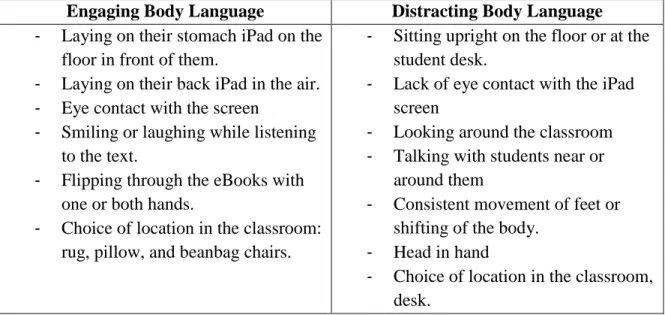
Table 1. Body Language Indicators from Observational Notes
Engaging Body Language Distracting Body Language
- Laying on their stomach iPad on the floor in front of them.
- Laying on their back iPad in the air.
- Eye contact with the screen
- Smiling or laughing while listening to the text.
- Flipping through the eBooks with one or both hands.
- Choice of location in the classroom: rug, pillow, and beanbag chairs.
- Sitting upright on the floor or at the student desk.
- Lack of eye contact with the iPad screen
- Looking around the classroom
- Talking with students near or around them
- Consistent movement of feet or shifting of the body.
- Head in hand
- Choice of location in the classroom, desk.
As noted in Table 1, student choice of reading location in their classroom
influenced their use of “engaging and disengaging reading behaviors” This also impacted listening comprehension. The various locations students read in the classroom included, student desks, tables, and classroom library with pillows, front rug, and beanbag chairs (See Appendix A). Based on Students 1, 2 and 3 choice of location their body language was affected as they listened to one of the three online reading programs. Student 2 demonstrated “engaging reading behaviors” and scored well on her listening assessment results. Student 4 exhibited “distracting reading behaviors” and scored poorly on the listening comprehension assessment results.
For instance, Student 2 listened to the reading program TumbleBooks and chose to sit on the rug in the front of the classroom (See Appendix A). While on the rug I observed Student 2 lying on her back and stomach laughing while listening to the story, all of which are indicators of “engaging reading behavior.” She stayed focused
throughout the entire story and her assessment results demonstrated good listening comprehension. As indicated in Figure 1 below, Student 2 was able to answer 5/5
questions correctly after listening to her eBook on the iPad. Her engaging body language supported her listening comprehension.
Similarly, Student 3 listened to the reading program Bookflix and chose to sit in a beanbag chair. During my observations he maintained focus on the iPad screen, and did not move around in the beanbag chair. Student 3 exhibited relaxed body language, slumping himself all the way in the beanbag and laid his head back as if there was a pillow present. His attention and relaxing body language all indicated my theme of “engaging body language” and at the end of the silent reading time I had to ask Student 3 to stop listening to the stories; however, since he had continued to listen to additional stories, I provided extended time for him to complete the listening assessment. Student 3 demonstrated good listening comprehension by completing all of the assessment
questions from the program Bookflix correctly with the additional time. Student 3’s assessment results are represented in Figure 2 below.
On the other hand, I observed Student 4, exhibiting “distracting reading
behavior”, which affected his listening comprehension negatively. I observed Student 4 listening to a story on the reading program RazKids. He was sitting at his desk, with his hands in his head, flipping the electronic pages with his other hand. On this day, during silent reading time, several students in the classroom walked by Student 4 at his desk. As students passed by, Student 4 would glance up from his eBook to watch them. At one point Student 4 began kicking the floor beneath his desk, all while getting his foot caught between the desk and the chair leg. He spent additional time staring at his feet and fixing his foot, all while listening to the story on the iPad. As a result, Student 4 did poorly on his assessment results for RazKids scoring only a 3/5 on the listening assessment.
Therefore, student experiences and their engagement with the reading program coupled with their “engaging reading behavior” had an affect on his or her listening comprehension. If a student participant was not engaged with the program or story, their body language reflected this, and their lack of engagement discouraged them from listening to the content in the story. As previously stated, listening requires active engagement with the text (Shi, 2015). Without active engagement, the student participants did not comprehend the material no matter the reading program being accessed.
Finding 2: Student Preference of Reading Program and the Features Influence Listening Comprehension
All four participants in this study actively used the three reading programs in my classroom. Each program utilized a variety of features to benefit student readers and to improve their decoding, and comprehension skills. The student assessment results
indicated that, student participants’ listening comprehension was influenced due to the specific features implemented in each program. Additionally, student participants’ preference for each program and the features they provide influence their listening comprehension. Student participants indicated a preference for several reading programs due to the features and supports they provided the reader when listening to the eBooks. These features offered assistance to students when they completed the assessments, which impacted their listening comprehension. Specifically, in the reading program RazKids, students have the option of having the assessment questions read aloud from a recorded narrator, this feature is also found in the reading program Bookflix. This feature may assist students with understanding the comprehension question. However,
TumbleBooks provides the reader with highlighted text during the story, where students are able to pause the story and replay the text for further understanding. Regardless of the reading program used by the students, the programs provide assisting features that
benefited student learning and comprehension of the text.
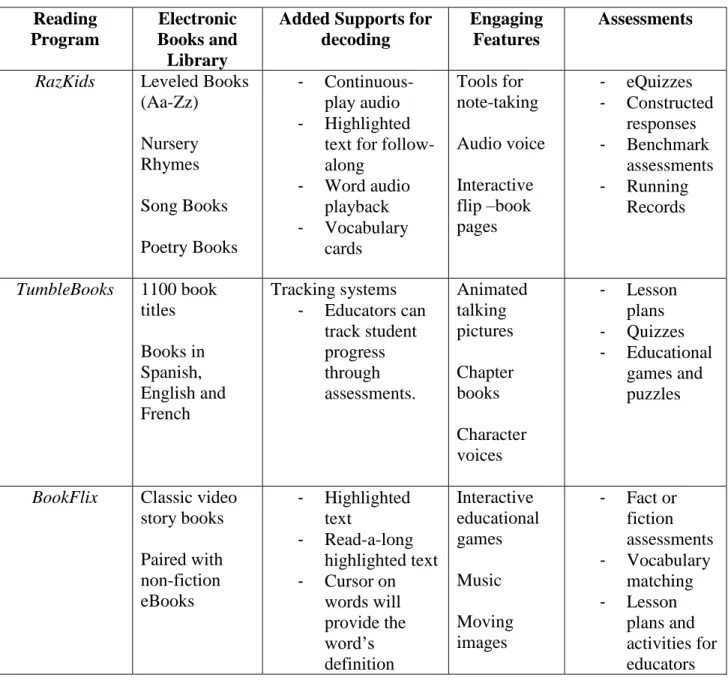
The following table outlines the features included in each of the reading programs used in this data collection. It is important to note, that I did not analyze the three reading programs’ features in my data analysis. However, these features offer insight into student listening comprehension results and preference of reading programs and are important to understand what each program provides their readers. Based on the use of the reading programs and their reading features, student participants’ listening assessment results varied.
Table 2: Reading Program Features: RazKids, TumbleBooks, Bookflix Reading Program Electronic Books and Library
Added Supports for decoding
Engaging Features
Assessments
RazKids Leveled Books
(Aa-Zz) Nursery Rhymes Song Books Poetry Books - Continuous-play audio - Highlighted text for follow-along - Word audio playback - Vocabulary cards Tools for note-taking Audio voice Interactive flip –book pages - eQuizzes - Constructed responses - Benchmark assessments - Running Records TumbleBooks 1100 book titles Books in Spanish, English and French Tracking systems - Educators can track student progress through assessments. Animated talking pictures Chapter books Character voices - Lesson plans - Quizzes - Educational games and puzzles
BookFlix Classic video
story books Paired with non-fiction eBooks - Highlighted text - Read-a-long highlighted text - Cursor on words will provide the word’s definition Interactive educational games Music Moving images - Fact or fiction assessments - Vocabulary matching - Lesson plans and activities for educators
Student 1. Using the Fountas and Pinnell Benchmark Reading System, Student 1 was reading at a level N. This is considered a second grade reading level. Student 1 was an active reader, who spent free time from instructional assignments reading at his desk. He frequently read series books including, Diary of a Wimpy Kid, and Beezes and
able to provide the correct answer with additional support from the text. During my notation of the student assessment I noticed Student 1 consistently scored high on all of the listening assessments, regardless of the reading programs features. The following table outlines Student 1’s listening comprehension assessment results. The assessment results were scored differently, due to their differences in questioning. RazKids or RK was scored out of five possible questions, as well as, TumbleBooks or TB. Bookflix or BF was scored with an x for nothing correct, - for some correct, and + for all correct.
Student 1 Assessment Results:
Week Monday Tuesday Wednesday Thursday
1 RK 5/5 TB 4/5 BF - Absent
2 TB 5/5 BF - RK 5/5 TB 5/5
3 BF + RK 3/5 TB 5/5 No School
4 No School No School No School RK 5/5
5 TB 5/5 BF + RK 4/5 TB 4/5
Based on the assessment results from each program, Student 1 successfully demonstrated good listening comprehension by scoring well on each assessment. When prompted during the student interviews, Student 1 suggested that he felt confident when listening to RazKids books.
Researcher (me): How do you feel when you listen to a story on the iPad? Student 1: I feel good, I guess.
Researcher: How did you feel listening to “The Mystery Wind” on RazKids? You said that book was your favorite this week.
Student 1: Um, confidant! (Puffing up his chest and smiling)
Researcher: Confidant, wow that’s great, why did you feel confident?
Student 1: If I need help the book helps me, it is all there for me to use, so it is helpful like teachers.
Researcher: I am so glad that the book helps you, but tell me how does the book help you?
Student 1: If I don’t know something then it tells me, like the word says it for me, and then it tells me all the options for the test and stuff.
From this interview and discussion of the text, Student 1 indicated that the reading program RazKids provided him with help, when reading and answering the assessment questions, in which Student 1 describes the feeling of confidence. Student 1’s feeling of confidence translated into the use of the features RazKids provides students when listening to the text and completing the listening assessment. Student 1’s assessment scores for RazKids also reflects his understand of the text and his feeling of confidence in the features as a means for support when completing the assessment.
Student 2. Using the Fountas and Pinnell Benchmark Reading System, Student 2 was reading at a level H. This is considered a first grade reading level. Student 2 was a “socially butterfly” within the classroom, always communicating with her classmates. She struggled with decoding skills and was receiving additional reading support from a reading specialist. She enjoyed reading stories about animals, specifically horses. During silent reading she often chose to sit in a variety of locations in the classroom, changing her location on a regular basis. I observed on several occasions, she displayed “distracted reading behavior,” at times she would talk to the student sitting near her, on Wednesday
March 1, she spent time getting up from her reading to show me specific images of horses from the text she was listening to on RazKids. Although, Student 2 was distracted during her reading time, her listening assessment displayed a variety of scores; she often scored high when completing RazKids assessments rather than TumbleBooks or
Bookflix. The following table outlines Student 2’s listening comprehension assessment results. The assessment results were scored differently, due to their differences in questioning. RazKids or RK was scored out of five possible questions, as well as,
TumbleBooks or TB. Bookflix or BF was scored with an x for nothing correct, - for some correct, and + for all correct.
Student 2 Assessment Results
Week Monday Tuesday Wednesday Thursday
1 RK 5/5 TB 3/5 BF - RK 5/5
2 TB 4/5 BF - RK 4/5 TB 2/5
3 BF - RK 5/5 TB 3/5 No School
4 No School No School No School RK 5/5
5 TB 3/5 BF X RK 4/5 TB 4/5
Based on the assessment results for Student 2, she demonstrates positive listening comprehension skills for the reading program RazKids, which all of her scores indicated a 4/5 or a 5/5 for understanding. However, during an interview with Student 2 she indicated that the use of the reading program Bookflix made her understanding of the material more difficult.
Student 2: It was Diary of a Worm.
Researcher: What reading program is that book on? Student 2: Bookflix (Smiles)
Researcher: Please, tell me more about this Diary of a worm. Student 2: Well it is about a worm that does stuff everyday. Researcher: What type of stuff does this worm do?
Student 2: I’m not sure, like goes to school and plays with friends. Researcher: How did you feel when you listened to this book? Student 2: I felt happy because it is like watching a movie. (Smiles)
Researcher: A movie? Wow, that is nice but isn’t this suppose to be a book?
Student 2: I think so but it looks and sounds like a movie, there is people talking and music playing, so it makes me feel like I am at the movies, not a book.
Through this interaction Student 2 indicated that the book she listened to felt more like a movie than a story. She mentioned the features of music, and “people talking” in her explanation of the story. Also, her assessment results for Bookflix indicate a lack of listening comprehension understanding, since she scored nothing (X) or some correct (-) in her assessment results.
Student 3. Using the Fountas and Pinnell Benchmark Reading System, Student 3 was reading at a level N. This is considered a second grade reading level. Student 3 was an avid reader, who enjoyed reading during independent student time. He spent a lot of time discussing books with his peers and enjoyed reading all different types of non-fiction. During my silent reading observations, he actively chose to sit in the classroom library or on the classroom rug. Based on his assessment results, there was no indication
that any book features hindered or supported his listening comprehension. On all three reading programs he scored high on the listening comprehension assessments. The following table outlines Student 3’s listening comprehension assessment results. The assessment results were scored differently, due to their differences in questioning.
RazKids or RK are scored out of five possible questions, as well as, TumbleBooks or TB. Bookflix or BF are scored with an x for nothing correct, - for some correct, and + for all correct.
Student 3 Assessment Results
Week Monday Tuesday Wednesday Thursday
1 RK 5/5 TB 5/5 BF + RK 4/5
2 TB 5/5 BF + RK 5/5 TB 5/5
3 BF + RK 4/5 TB 5/5 No School
4 No School No School No School RK 5/5
5 TB 5/5 BF + RK 4/5 TB 4/5
Although there is no indication that Student 3 used any supporting features from the text, his consistent demonstration of positive listening assessment results indicated that through the use of all three reading programs he was able to understand the text presented in the eBooks regardless of his preference for the reading program or the features they provide.
Student 4. Using the Fountas and Pinnell Benchmark Reading System, Student 4 was reading at a level J. This is considered an early second grade reading level. Student 4 did not display a love of reading. During whole class read aloud he appeared distracted
and unable to answer any prompting comprehension questions. He loved to be active and enjoyed socializing with his classmates. My observations of this student during silent reading indicated that others often distracted him. However, when Student 4 completed listening assessments using the program RazKids and Bookflix he scored higher than when using the program TumbleBooks. The following table outlines Student 4’s listening comprehension assessment results. The assessment results were scored differently, due to their differences in questioning. RazKids or RK was scored out of five possible
questions, as well as, TumbleBooks or TB. Bookflix or BF was scored with an x for nothing correct, - for some correct, and + for all correct.
Student 4 Assessment Results
Week Monday Tuesday Wednesday Thursday
1 RK 4/5 TB 2/5 BF - RK 4/5
2 Absent Absent Absent TB 3/5
3 BF - RK 3/5 TB 4/5 No School
4 No School No School No School RK 5/5
Dinosaur Book Assessment
5 TB 5/5 BF - RK 4/5 TB 1/5
Using the assessment results I coded my interviews with Student 4 to determine any connections between RazKids, Bookflix and their assessment features with Student 4’s understanding of the text. On several interviews with Student 4 he indicated that RazKids made reading easier and often offered more books on topics he enjoyed listening and reading about, than TumbleBooks and Bookflix. Such topics included, animal