Abstract—Specific features of large scale, long term simulation tasks in agro-environmental and agri-food systems are discussed in the limelight of existing approaches of multiscale, hybrid, dynamic modeling. As an alternative solution, the recently developed new generic framework of the extensible Direct Computer Mapping is introduced. The application of this methodology is illustrated by two, dynamic balance model examples for the patch analysis of a rural watershed area, as well as for the simulation based quantitative tracking and tracing of a trans-sectorial agri-food process network.
Index Terms—complex process network, multiscale hybrid process, Direct Computer Mapping, generic agro-environmental modeling, simulation based agri-food transparency
I. INTRODUCTION
Agricultural and environmental engineering has the advantage of last arriving in the implementation of the nowadays developed tools of ICT. These sectors, in lack of previously introduced, old generation solutions, can start with the newest ICT methods and tools "from scratch", especially in the less developed parts of world. Obviously, data collection and data acquisition based methods go ahead, while predictive simulation models have to be developed further for the solution of the large scale and long term tasks of agro-environmental and agri-food problem solving.
Right now, we have more and more data from GIS, from remote sensing, from sensor networks, from process and production control, as well as from the mandatory data service for the authorities. It supports the fast development of data acquisition based reasoning (like data mining, Process Analytical Technology, etc.). However, the excellent data mining and statistical methods are not enough either for the interpretation of the rare and slow changes in control, or for the predictive analysis of long term multidisciplinary problems in strategic planning.
Consequently, we need also ‘a priori’ predictive dynamic modeling and simulation methodologies for the underlying multidisciplinary, multiscale and hybrid systems.
Manuscript received July 10, 2015; revised July 28, 2015. This work was supported in part by the REG-DD-09-2-2009-0101, TÁMOP-4.2.2.A-11/1/KONV-2012-0038, and TÁMOP-4.2.2.D-15/1/KONV-2015-0028 projects.
M. Varga works at Research Group on Process Network Engineering, Kaposvár University, Kaposvar 7400 Hungary (phone: +36-82-505-950, e-mail: [email protected]).
B. Csukas works at Research Group on Process Network Engineering, Kaposvár University, Kaposvar 7400 Hungary (e-mail: [email protected]).
There are various approaches for model based problem solving of complex agro-environmental systems. One part of the methodologies (e.g. Systems Dynamics and its implementations, e.g. [1], [2], [3]) tries to apply simplified, but general mathematical frameworks. Another part (e.g. agent based methodology [4]) utilizes the communication among the freely programmable computational modules. Another approach develops standardized interfacing amongst the heterogeneous, but sophisticated modules of various disciplines (e.g. OpenMI [5], [6]).
Considering the sector spanning transparency of agri-food processes, the usual solution is based on information systems, applying identifiers according to the principle of the "one step back, one step forward" [7]. Recently, the transparency related activities are to be integrated into more comprehensive organizational frameworks [8], [9].
In our understanding agro-environmental and agri-food systems can be interpreted as special process systems.
The functional models of process systems can usually be described by sets of algebraic, differential and/or integral equations (e.g. [10], [11]). In the conventional way of transforming the cognitive model to the computerized solution, first we compose a theoretically well established mathematical construct that cannot usually be solved analytically. Therefore we must decompose it into the discrete elements of a numerical algorithm, executed by the computer. Nevertheless there is not a viable, plausible relation between the elements of the cognitive model and the elements of the numerical algorithm.
From another viewpoint, the essential structural features of process models can be represented by networks and nets. In the past decades, extensive efforts have been made for the implementation of quantitative, time- and event driven functionalities in the structural models, e.g. in the form of higher order Quantitative Petri Nets [12], [13].
II. COMMON SPECIFIC FEATURES OF AGRO-ENVIRONMENTAL AND AGRI-FOOD MODELS
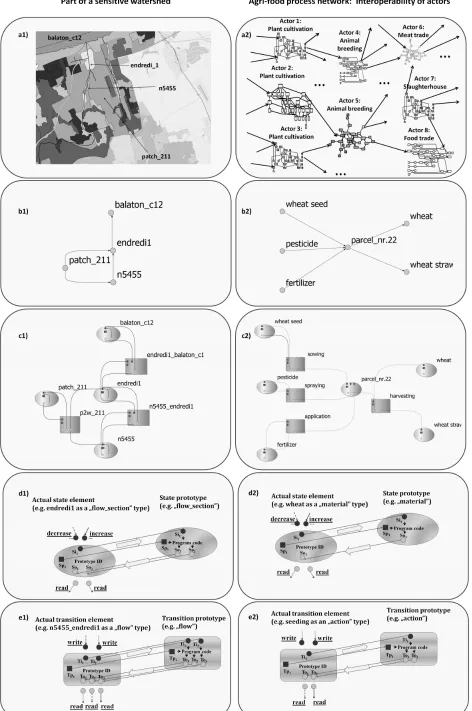
Let us start from two example problems of agro-environmental and agri-food processes, illustrated in Fig. 1. It is the part of a sensitive watershed area (a1), where human municipalities, agriculture, fishery and forestry are affected by environmental (e.g. climate) changes, as well as controlled also by the environmental protection. There are local agri-food chains (or rather networks), consisting of various actors from seed production, through plant cultivation, animal husbandry, and food industry to the food market (see a2 in Fig. 1) also with multiple environmental connections. In addition, there are possible interactions between the two systems (e.g. agri-food side uses and might
Simulation of Agro-environmental Processes
by Direct Computer Mapping
contaminate water resources). Left and right sides of Fig. 1 show the decomposition of the two, different systems to the unified set of building and connecting elements in sense of our M&S methodology, described in Chapter III. Using these examples, first we analyze the specific and common features of agro-environmental and agri-food process networks from M&S points of view.
A. Large and multi-scale, holistic network structures The agro-environmental system (a1) consists of land patches, flow sections and lake compartments. For example the studied whole watershed contains 38 sub-watersheds, 20 lake compartments of the large shallow lake, 57 small lakes, 121 water sections, and 17 kinds of land patches according to CORINE land cover system in each sub-watershed. Nevertheless the model is scalable according to the sub-watersheds and/or the land patch types. The various water sections and land patches can be described by different models of various disciplines. Water flow related connections amongst the patches and water sections determine the backbone network structure of the system.
The agri-food system (a2) consists of interconnected actors, while each of them can be described by a time varied dynamic network (timed flowsheet) of the underlying processes. The natural scalability is given by the actors, as well as by the inside structure of the larger actors. The actors have very heterogeneous data service abilities from sophisticated ERP systems to the small family farms with a paper notebook. Material flow related connections inside and between the actors define the backbone structure of the system.
The simplest representation of water flow and material flow related structures can be solved by directed networks, as the small details of b1 and b2 show them in Fig. 1, respectively. Regardless to the usefulness of popular network representation of biosystems, ecosystems and social systems, they show only the surface of the more complex dynamic nets, which are signed with c1 and c2 in Fig. 1. These structures of the multiscale, hybrid models are more sophisticated, than the apparently similar State Transition Nets, because there might be various kinds of connections between the various slots (small circles inside the rectangles or ellipses), determining also the causal relationships. Local parameters, as well as locally interpretable and executable prototype programs can be associated with the net elements. The respective models will be discussed in Chapter III more detailed.
B. Time-driven and event-driven long term processes in
changing environment
Agro-environmental models usually have a long time horizon, because studying the effects of the changing meteorology, vegetation and human-built environment needs more time. In addition there might be sudden changes to be taken into consideration in time-driven or event-driven modes (e.g. extreme weather, suddenly appearing contaminations, etc.).
The agri-food transparency models need the continuous incrementation of the actual transformations inside the actors' processes, as well as the actual transportations between the actors, respectively.
The process models have to be prepared for the mixed use of quantitative (balance based) and qualitative (rule based) elements and connections, as well as for the various kinds of temporal characteristics.
C. Structural and functional extensibility in space and in time
Considering the long term applications, the M&S methodology of agro-environmental and agri-food systems must tolerate the changing structure of the model in multiple level. It is impossible to prepare the model for all of the ad hoc appearing components (e.g. contaminants) in advance, but they have to be added in any place and time with automatic forwarding them along the structure. Also new connections have to be added to the existing slots at any time. Finally, some elements can be added or removed in time, while the complete states of the model must be systematically saved, of course.
III. DIRECT COMPUTER MAPPING BASED IMPLEMENTATION OF THE AGRO-ENVIRONMENTAL MODELS
Multiscale, hybrid processes contain more complex elements and structures, than the theoretically established mathematical constructs.
Having recognized these problems, in our approach, called Direct Computer Mapping (DCM) of process models [14], [15] we began to develop a process modeling methodology that maps the very structural and functional elements of the process onto the respective elements of an executable program, directly, without transforming them into any specific mathematical construct. Starting from the analysis of conventional (chemical and other industrial) process systems, recently we have extended the methodology for the modeling of a broad range of process models from cellular biosystems [16] through non-conventional technological processes [17], to complex environmental systems [18]. Based on these experiences we developed a new generic framework that can be applied also for agro-environmental and agri-food systems.
A. Generic framework of model generation
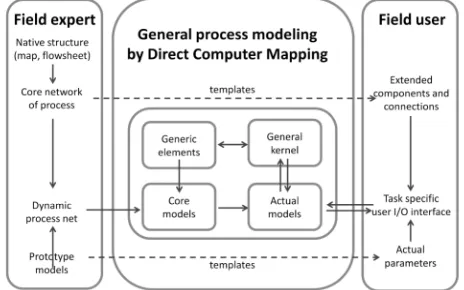
The architecture of the generic framework is illustrated in Fig. 2. There is a standardized set of generic state, transition and connection elements, while the general kernel is prepared for the execution of these elements.
The state (ellipses in d1 and d2 of Fig. 1 ) and transition (rectangles in e1 and e2 of Fig. 1) elements are distinguished only functionally. Both kinds of prototypes have slots: for optional number of unified input data list structures (small darker circles within ellipses and rectangles); for optional number of unified output data list structures (small circles within ellipses and rectangles); for optional number of unified (local) parameter list structures (small rectangles within ellipses and rectangles) and for optional number of local program declarations (small rhomboids within ellipses and rectangles). Many elements may use identical programs, declared in the prototype for the given subset of elements. The local program alternatives, declared in the prototype elements, autonomously determine the respective output data with the knowledge of the actual parameters and input data.
distinguished state → transition and transition → state, slot specific data flows. The connections carry data from an output slot to an input slot, while the connections define also the operators, determining the inputting (e.g. read, decrement) and outputting (e.g. decrease, increase, overwrite, etc.) of the carried content.
Fig. 2. Generic framework of Direct Computer Mapping The field specific expert modeling starts from the building of a GRAPHML [19] represented backbone network model from the native sources (e.g. GIS objects, flowsheet elements, etc.). Next the expert, utilizing the standardized generic elements, prepares the field specific prototypes. The GRAPHML description of the actual process net structure can be prepared from the network, with the knowledge of the prototypes in a semi-automatic routine procedure. Finally a general purpose interpreter transforms this GRAPHML description into the declarative facts and clauses of the core model.
B. General purpose simulation of unified elements
The user, with the knowledge of the structural and functional templates, generated also by the model interpreter configures the core model with the task specific input, resulting the actual model.
The actual model can be executed by the general kernel in the following, cyclically repeated steps: (1) The modifying connections change the content of the input slots of the state elements, according to the respective receiving operator; (2) The state elements execute the associated program prototypes, which determine the new outputs of the states; (3) The reading connections read the content of the various state output slots, according to the prescribed sending operator; (4) The reading connections change the content of the input slots of the transition elements, according to the respective receiving operator; (5) The transition elements execute the associated program prototypes, which determine the new outputs of the transitions; (6) The modifying connections read the content of the output slots of the transition elements, according to the prescribed sending operator.
C. Easy use of multiple temporal and spatial scales Temporal behavior of the states, transitions and connections can be described by individual timing of the elements. The spatial scale of the elements can be identified by an optional list of integers (tree structure), accordingly the connections contain the respective scale identifiers both
at the receiving and at the sending side. The event driven operation of the multiscale processes is controlled by reading/writing connections.
D. Easy extensible incrementation
The methodology can easily be applied for the long term running and stepwise, real time incrementing of the model based information system.
In the case of agro-environmental models it means that the measured historical data are continuously supplemented and there is an automatic, incremental simulation, while the complete states of the simulated model are saved periodically. The user can initiate simulation from any point of time and, the calculation will start from the closest previously saved time. In the future related simulations the model can use either appropriate estimated boundary (e.g. meteorological) conditions or the user can add hypothetical series of the past data. As another kind of extension, the user can add new (optionally decomposable) components to the list of any state element at any time, while the simulation will forward them according to the possible flows. Finally the expert (and limitedly also the user) can modify, add and delete some elements in the dynamic partitions of the model, temporarily or finally.
The agri-food transparency models are systematically (e.g. daily) supplied by the new transportations and transformations, reported by the actors. The incremented model is simulated day by day automatically, while the complete states of the simulated model are saved periodically. In simulation based tracking, and tracing investigations the user can add hypothetical or really measured components to the list of any state element at any time. Also the base model of the actors can be upgraded, by changing of the respective dynamic facts and clauses.
E. Possible, causally right backwards simulation
The applied model representation makes possible the causally right backwards (reverse) simulation of the balance based, quantitative models. This can be solved by reversing the signs of all changes and by starting from a previously obtained state with backwards temporal steps. In backward (reverse) simulation the causal execution of the local programs is the same, only the time is stepping backwards, as well as the mass increases and decreases are replaced for decreases and increases, vice versa. Also the extending of individuals is replaced for removing and removing for extending, respectively. This makes possible the qualitative and quantitative tracing.
IV. EXAMPLE APPLICATIONS
A. Examples for the elements of DCM models
elements correspond to the storages, represented by nodes of in the network. The sowing, spraying, fertilizing and harvesting elements in the prescribed points of time read the respective storages, calculate the changes and decrease or increase the mass in the given parcel.
Parts d1 and e1 in Fig. 1 show examples for actual and prototype state ("flow_section") and transition ("flow") elements from the net c1. Similarly parts d2 and e2 illustrate examples for actual and prototype state ("material") and transition ("action", actually seeding) elements from the net c2.
Both state and transition elements get input data from the input connections to their input slots. The interpretation of the data is determined by the sending operator of the connections (marked with bold underlined worlds), and by the respective input slots. The actual elements according to their Prototype ID unify the input data and the parameters to the input variables in the input slots of the respective prototypes. Next, local program is executed, and the output variables are determined for the output slots. The resulted values unify to the output slots of the actual elements.
[image:5.595.307.549.64.393.2]Finally, the output connections get values from the output slots. The interpretation of the data is determined by the receiving operator of the connections (marked with bold underlined worlds), and by the respective output sots.
Fig. 3.Spreading of a contaminant in the watershed
B. Dynamic simulation of spreading of a contaminant
As an example for the simulated results of an agro-environmental system, in a hypothetical case study (Fig. 3) we assumed that a certain amount of contamination (10 kg/day) gets into a flow section (signed with a dark circle in Fig. 3) during a 15 days long period in March 10-24, 2013. The contamination goes through a couple of water courses, fishponds and lakes, right to the large lake. In the small diagrams we can follow how this component dilutes through
the water sections, as it reaches lake within a few days.
Fig. 4. Quantitative tracing by backward simulation
C. Dynamic simulation based tracking and tracing of the
trans-sectorial agri-food processes
The qualitative tracking and tracing can be solved by forward and backward dynamic simulation of simplified balance models, while the complexity of the problem solving is less, than in the case of usual graph route search. In addition, with the knowledge of the known, measured or estimated stoichiometries, the method can easily be extended with ad hoc added components for the quantitative tracking or tracing of the studied harmful or useful ingredients.
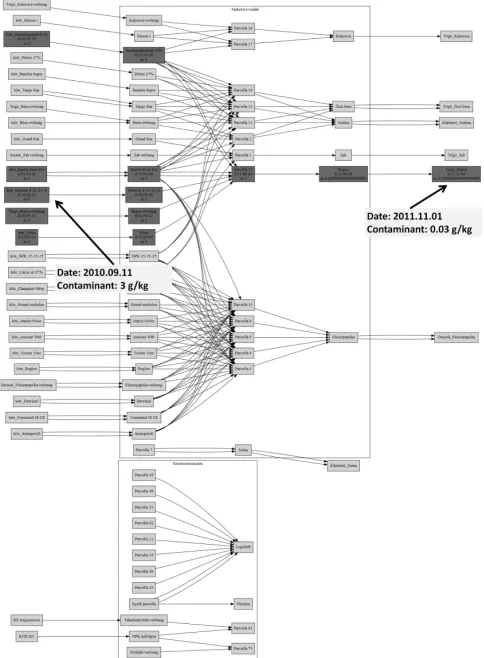
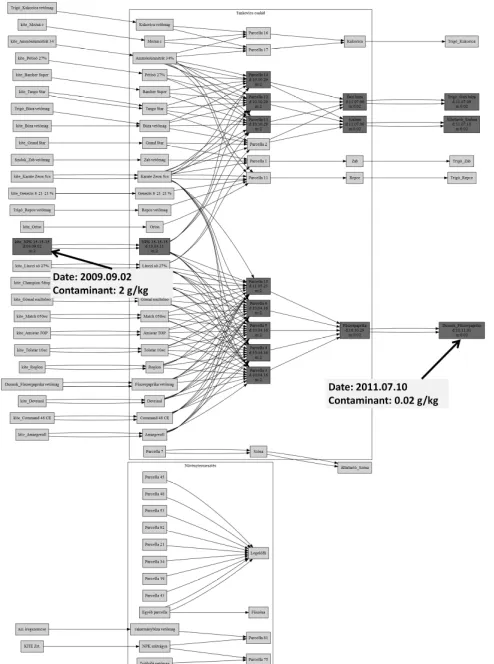
Fig. 4 illustrates a tracing study in small part of a sector spanning agrifood transparency system. The highlighted elements show how a diluted test contamination, detected on Nov 1, 2011, can be traced back to the possible origins on Sept 11, 2010. Fig. 5 shows a tracking in the same process network. According to the highlighted elements the concentrated test contamination on Sept 2, 2009 spreads through the various pathways and can be detected on July 10, 2011.
[image:5.595.47.291.353.656.2]Fig. 5. Quantitative tracking by forward simulation V. CONCLUSION AND OUTLOOK
Recently, agricultural and environmental engineering can adopt the up-to-date ICT tools. Consequently, data collection and data acquisition based methods go ahead, while predictive simulation models have to be developed further for the solution of underlying processes. Direct Computer Mapping (DCM) based methodology supports the model generation and the real time simulation of large scale, long term, time-driven and event-driven, as well as extensible agro-environmental and agri-food systems.
Regarding the future tasks, we presume that Direct Computer Mapping of these multiscale, hybrid processes might contribute to build an adequate collaboration between data-driven and model-driven problem solving in the given fields. Nowadays we have Big Data without a systemic background on the one hand, and Large Models with lack of appropriate (kinetic, stoichiometric, etc.) parameters on the other. The synergic solution would be to develop a mutual evaluation feedback between data-driven and model-driven approaches. In this cooperative solution the simulator could identify the process model by utilizing the information, coming from statistical methods, while data based reasoning could be extended stepwise by the capabilities of the continuously evolving dynamic simulator.
REFERENCES
[1] Randhir, T. O., Hawes, A. G., “Watershed land use and aquatic ecosystem response: Ecohydrologic approach to conservation policy”, Journal of Hydrology, vol. 364, pp. 182-199, 2009.
[2] Rivers, M. R., Weaver, D. M., Smettem, K. R. J., Davies, P. M., “Estimating farm to catchment nutrient fluxes using dynamic
simulation modelling – Can agri-environmental BMPs really do the job?”, Journal of Environmental Management, vol. 130, pp. 313-322, 2013.
[3] Vidal-Legaz, B., Marínez-Fernández, J., Picón, A.S., Pugnaire, F. I., “Trade-offs between maintenance of ecosystem services and socio-economic development in rural mountainous communities in southern Spain: A dynamic simulation approach”, Journal of Environmental Management, vol. 131, pp. 280-297, 2013.
[4] Gimblett H. R. (ed.) Integrating Geographic Information Systems and Agent-Based Modelling Techniques for Simulating Social and Ecological Processes. Oxford University Press, 2001.
[5] Moore, R. V., Tindall, C. I. “An overview of the open modelling interface and environment (the OpenMI)”, Environmental Science & Policy, vol. 8(3), pp. 279-286, 2005.
[6] Knapen, R., Janssen, S., Roosenschoon, O., Verweij, P., de Winter, W., Uiterwijk, M. “Evaluating OpenMI as a model integration platform across disciplines”, Environmental Modelling & Software, vol. 39, pp. 274-282, 2013.
[7] Regulation 178/2002: Regulation (EC) No 178/2002 of the European Parliament and of the Council of 28 January 2002, laying down the general principles and requirements of food law, establishing the European Food Safety Authority and laying down procedures in matters of food safety. Available: http://eur-lex.europa.eu/LexUriServ/LexUriServ.do?uri=OJ:L:2002:031:0001:0 024:en:PDF
[8] Adam, B. D. and Buser, M. D. Whole-chain traceability: from gate to plate and back again. Ag Econ News. Spring 2014.
[9] Golan, E., Krissoff, B., Kuchler, F., Calvin, L., Nelson, K., Price, G. "Traceability in the U.S. Food Supply: Economic Theory and Industry Studies", Agricultural Economic Report No. (AER-830) 56 pp,
March 2004, Available:
http://www.ers.usda.gov/media/806613/aer830_1_.pdf
[10] Marquardt, W. “Trends in Computer-aided Process Modelling”, Computers & Chemical Engineering, vol. 20(6/7), pp. 591-609, 1996. [11] Yang A., Braunschweig B., Fraga E. S., Guessoum Z., Marquardt W., Nadjemi O., Paen D., Pinol D., Roux P., Sama S., Serra M., Stalker I., “A Multi-agent System to Facilitate Component-based Process Modeling and Design”, Computers & Chemical Engineering, vol. 32(10), pp. 2290-2305, 2008.
[12] Chen M, Hofestädt R. „Quantitative Petri net model of gene regulated metabolic networks in the cell”, In Silico Biol, vol. 3(0029), pp. 347– 365, 2003.
[13] Peleg, M., Rubin, D., Altman, R. B. “Using Petri tools to study properties and dynamics of biological systems, Journal of the American Medical Informatics Association, vol. 12(2), pp. 181-199, 2005.
[14] Csukas, B. ”Simulation by Direct Mapping of the Structural Models onto Executable Programs” in AIChE Annual Meeteng, Miami, Paper 239/9, 1998
[15] Csukas, B., Varga, M., Balogh, S. “Direct Computer Mapping of Executable Multiscale Hybrid Process Architectures” in: Proceedings of Summer Simulation Multiconference’2011, Den Haag. The Netherlands, 2011, pp. 87-95.
[16] Csukas B, Varga M, Prokop A. “Direct Computer Mapping Based Modeling of a Multiscale Process Involving p53/miR-34a Signaling”, In: Systems Biology: Integrative Biology and Simulation Tools, Prokop A, Csukás B (eds.). Dordrecht: Springer Science+Business Media,
[17] Csukas B, Varga M., Miskolczi N., Balogh S., Angyal A., Bartha L. “Simplified Dynamic Simulation Model of Plastic Waste Pyrolysis in Laboratory and Pilot Scale Tubular Reactor”, Fuel Processing Technology, vol. 106, pp. 186-200, 2013.b.
[18] Varga M, Csukas B, Balogh S.”Transparent Agrifood Interoperability, Based on a Simplified Dynamic Simulation Model” In: ICT for Agriculture, Rural Development and Environment: Where we are? Where we will go? Mildorf T, Charvat K (eds.) Prague: Czech Centre for Science and Society, pp. 155-174, 2012.