Stacking for Statistical Machine Translation
∗Majid Razmara and Anoop Sarkar
School of Computing Science Simon Fraser University
Burnaby, BC, Canada {razmara,anoop}@sfu.ca
Abstract
We propose the use of stacking, an ensem-ble learning technique, to the statistical machine translation (SMT) models. A diverse ensem-ble of weak learners is created using the same SMT engine (a hierarchical phrase-based sys-tem) by manipulating the training data and a strong model is created by combining the weak models on-the-fly. Experimental results on two language pairs and three different sizes of train-ing data show significant improvements of up to4BLEU points over a conventionally trained SMT model.
1 Introduction
Ensemble-based methods have been widely used in machine learning with the aim of reduc-ing the instability of classifiers and regressors and/or increase their bias. The idea behind ensemble learning is to combine multiple mod-els, weak learners, in an attempt to produce a
strong model with less error. It has also been successfully applied to a wide variety of tasks in NLP (Tomeh et al., 2010; Surdeanu and Man-ning, 2010; F. T. Martins et al., 2008; Sang, 2002) and recently has attracted attention in the statis-tical machine translation community in various work (Xiao et al., 2013; Song et al., 2011; Xiao et al., 2010; Lagarda and Casacuberta, 2008).
In this paper, we propose a method to adopt
stacking (Wolpert, 1992), an ensemble learning technique, to SMT. We manipulate the full set of training data, creating k disjoint sets of held-out
andheld-indata sets as ink-fold cross-validation
and build a model on each partition. This creates a diverse ensemble of statistical machine transla-tion models where each member of the ensemble has different feature function values for the SMT log-linear model (Koehn, 2010). The weights of model are then tuned using minimum error rate training (Och, 2003) on the held-outfold to pro-vide k weak models. We then create a strong
∗This research was partially supported by an NSERC,
Canada (RGPIN: 264905) grant and a Google Faculty Award to the second author.
model by stacking another meta-learner on top of weak models to combine them into a single model. The particular second-tier model we use is a model combination approach called ensemble decoding
which combines hypotheses from the weak mod-els on-the-fly in the decoder.
Using this approach, we take advantage of the diversity created by manipulating the training data and obtain a significant and consistent improve-ment over a conventionally trained SMT model with a fixed training and tuning set.
2 Ensemble Learning Methods
Two well-known instances of general framework of ensemble learning are bagging and boosting. Bagging (Breiman, 1996a) (bootstrap aggregat-ing) takes a number of samples with replacement from a training set. The generated sample set may have 0, 1 or more instances of each
origi-nal training instance. This procedure is repeated a number of times and the base learner is ap-plied to each sample to produce a weak learner. These models are aggregated by doing a uniform voting for classification or averaging the predic-tions for regression. Bagging reduces the vari-ance of the base model while leaving the bias rela-tively unchanged and is most useful when a small change in the training data affects the prediction of the model (i.e. the model is unstable) (Breiman, 1996a). Bagging has been recently applied to SMT (Xiao et al., 2013; Song et al., 2011)
Boosting (Schapire, 1990) constructs a strong learner by repeatedly choosing a weak learner and applying it on a re-weighted training set. In each iteration, a weak model is learned on the training data, whose instance weights are modi-fied from the previous iteration to concentrate on examples on which the model predictions were poor. By putting more weight on the wrongly predicted examples, a diverse ensemble of weak learners is created. Boosting has also been used in SMT (Xiao et al., 2013; Xiao et al., 2010; Lagarda
Algorithm 1: Stacking for SMT
Input: D={hfj, eji}Nj=1 .A parallel corpus
Input: k .# of folds (i.e. weak learners) Output: STRONGMODELs
1: D1, . . . ,
Dk
←SPLIT(D,k) 2: fori= 1→kdo
3: Ti
← D − Di .Use all but current partition as training set.
4: φi←TRAIN(Ti) .Train feature functions. 5: Mi←TUNE(φi,Di) .Tune the model on the
current partition. 6: end for
7: s←COMBINEMODELS(M1,. . .,Mk).Combine all the base models to produce a strong stacked model.
and Casacuberta, 2008).
Stacking (or stacked generalization) (Wolpert, 1992) is another ensemble learning algorithm that uses a second-level learning algorithm on top of the base learners to reduce the bias. The first level consists of predictors g1, . . . , gk where gi : Rd → R, receiving input x ∈ Rd and produc-ing a prediction gi(x). The next level consists of a single function h : Rd+k → R that takes
hx, g1(x), . . . , gk(x)ias input and produces an en-semble predictionyˆ=h(x, g1(x), . . . , gk(x)).
Two categories of ensemble learning are ho-mogeneous learningandheterogeneous learning. In homogeneous learning, a single base learner is used, and diversity is generated by data sam-pling, feature samsam-pling, randomization and pa-rameter settings, among other strategies. In het-erogeneous learning different learning algorithms are applied to the same training data to create a pool of diverse models. In this paper, we focus on homogeneous ensemble learning by manipulating the training data.
In the primary form of stacking (Wolpert, 1992), the training data is split into multiple dis-joint sets of held-out andheld-in data sets using
k-fold cross-validation and k models are trained on the held-in partitions and run on held-out par-titions. Then a meta-learner uses the predictions of all models on their held-out sets and the actual labels to learn a final model. The details of the first-layer and second-layer predictors are consid-ered to be a “black art” (Wolpert, 1992).
Breiman (1996b) linearly combines the weak learners in the stacking framework. The weights of the base learners are learned using ridge regres-sion: s(x) = Pkαkmk(x), where mk is a base model trained on thek-th partition of the data and sis the resulting strong model created by linearly
interpolating the weak learners.
Stacking (aka blending) has been used in the system that won the Netflix Prize1, which used a multi-level stacking algorithm.
Stacking has been actively used in statistical parsing: Nivre and McDonald (2008) integrated two models for dependency parsing by letting one model learn from features generated by the other; F. T. Martins et al. (2008) further formalized the stacking algorithm and improved on Nivre and McDonald (2008); Surdeanu and Manning (2010) includes a detailed analysis of ensemble models for statistical parsing: i) the diversity of base parsers is more important than the complexity of the models;ii)unweighted voting performs as well as weighted voting; andiii)ensemble models that combine at decoding time significantly outperform models that combine multiple models at training time.
3 Our Approach
In this paper, we propose a method to apply stack-ing to statistical machine translation (SMT) and our method is the first to successfully exploit stacking for statistical machine translation. We use a standard statistical machine translation en-gine and produce multiple diverse models by par-titioning the training set using the k-fold
cross-validation technique. A diverse ensemble of weak systems is created by learning a model on each
k−1fold and tuning the statistical machine
trans-lation log-linear weights on the remaining fold. However, instead of learning a model on the output of base models as in (Wolpert, 1992), we combine hypotheses from the base models in the decoder with uniform weights. For the base learner, we use Kriya (Sankaran et al., 2012), an in-house hier-archical phrase-based machine translation system, to produce multiple weak models. These mod-els are combined together usingEnsemble Decod-ing (Razmara et al., 2012) to produce a strong model in the decoder. This method is briefly ex-plained in next section.
3.1 Ensemble Decoding
SMT Log-linear models (Koehn, 2010) find the most likely target language output e given the source language inputf using a vector of feature functionsφ:
p(e|f)∝expw·φ
Ensemble decoding combines several models dynamically at decoding time. The scores are combined for each partial hypothesis using a user-defined mixture operation⊗over component models.
p(e|f)∝expw1·φ1⊗w2·φ2⊗. . .
We previously successfully applied ensemble decoding to domain adaptation in SMT and showed that it performed better than approaches that pre-compute linear mixtures of different mod-els (Razmara et al., 2012). Several mixture oper-ations were proposed, allowing the user to encode belief about the relative strengths of the compo-nent models. These mixture operations receive two or more probabilities and return the mixture probabilityp(¯e|f¯) for each rulee,¯ f¯used in the
decoder. Different options for these operations are:
• Weighted Sum (wsum)is defined as:
p(¯e|f¯) ∝
M
X
m
λm exp wm·φm
where m denotes the index of component
models, M is the total number of them and λmis the weight for componentm.
• Weighted Max (wmax)is defined as:
p(¯e|f¯) ∝ max
m λm exp wm ·φm
• Prodorlog-wsumis defined as:
p(¯e|f¯) ∝ exp
M
X
m
λm(wm·φm)
• Model Switching (Switch): Each cell in the
CKY chart is populated only by rules from one of the models and the other models’ rules are discarded. Each component model is con-sidered as an expert on different spans of the source. A binary indicator functionδ( ¯f , m)
picks a component model for each span:
δ( ¯f , m) =
1, m= argmax
n∈M
ψ( ¯f , n)
0, otherwise
The criteria for choosing a model for each cell, ψ( ¯f , n), could be based on max
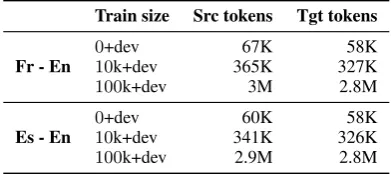
Train size Src tokens Tgt tokens
Fr - En 010+devk+dev 365K67K 327K58K
100k+dev 3M 2.8M
Es - En 010+devk+dev 341K60K 326K58K
[image:3.595.318.514.63.150.2]100k+dev 2.9M 2.8M
Table 1: Statistics of the training set for different systems and different language pairs.
(SW:MAX), i.e. for each cell, the model that
has the highest weighted score wins:
ψ( ¯f , n) =λnmax
e (wn ·φn(¯e,
¯f))
Alternatively, we can pick the model with highest weighted sum of the probabilities of the rules (SW:SUM). This sum has to take into
account the translation table limit (ttl), on the number of rules suggested by each model for each cell:
ψ( ¯f , n) =λn
X
¯
e
exp wn·φn(¯e,¯f)
The probability of each phrase-pair(¯e,f¯)is
then:
p(¯e|f¯) =
M
X
m
δ( ¯f , m)pm(¯e|f¯)
4 Experiments & Results
We experimented with two language pairs: French to English and Spanish to English on theEuroparl
corpus (v7) (Koehn, 2005) and used ACL/WMT 20052data for dev and test sets.
For the base models, we used an in-house implementation of hierarchical phrase-based sys-tems, Kriya (Sankaran et al., 2012), which uses the same features mentioned in (Chiang, 2005): forward and backward relative-frequency and lex-ical TM probabilities; LM; word, phrase and glue-rules penalty. GIZA++ (Och and Ney, 2003) has been used for word alignment with phrase length limit of10. Feature weights were optimized using
MERT (Och, 2003). We built a 5-gram language model on the English side of Europarl and used the Kneser-Ney smoothing method and SRILM (Stol-cke, 2002) as the language model toolkit.
Direction k-fold Resub Mean WSUM WMAX PROD SW:MAX SW:SUM
Fr - En 24 18.0818.08 19.6721.80 22.3223.14 22.4823.48 22.0623.55 22.8321.70 21.8122.95 8 18.08 22.47 23.76 23.75 23.78 23.02 23.47
Es - En 24 18.6118.61 19.2321.52 21.6223.42 21.3322.81 21.4922.91 22.8121.48 21.5122.92 8 18.61 22.20 23.69 23.89 23.51 22.92 23.26 Table 2: Testset BLEU scores when applying stacking on the devset only (using no specific training set).
Direction Corpus k-fold Baseline BMA WSUM WMAX PROD SW:MAX SW:SUM
Fr - En 10100k+devk+dev 611 / 51 28.7529.53 29.7529.49 29.8734.00 29.7834.07 33.1129.21 34.0529.69 29.5933.96
[image:4.595.92.506.169.234.2]Es - En 10100k+devk+dev 611 / 51 28.2133.25 33.4428.76 29.5934.21 29.5134.00 33.1729.15 34.1929.10 29.2134.22
Table 3: Testset BLEU scores when using10k and100k sentence training sets along with the devset.
4.1 Training on devset
We first consider the scenario in which there is no parallel data between a language pair except a small bi-text used as a devset. We use no spe-cific training data and construct a SMT system completely on the devset by using our approach and compare to two different baselines. A natu-ral baseline when having a limited panatu-rallel text is to do re-substitution validation where the model is trained on the whole devset and is tuned on the same set. This validation process suffers seriously from over-fitting. The second baseline is the mean of BLEU scores of all base models.
Table 2 summarizes the BLEU scores on the testset when using stacking only on the devset on two different language pairs. As the table shows, increasing the number of folds results in higher BLEU scores. However, doing such will generally lead to higher variance among base learners.
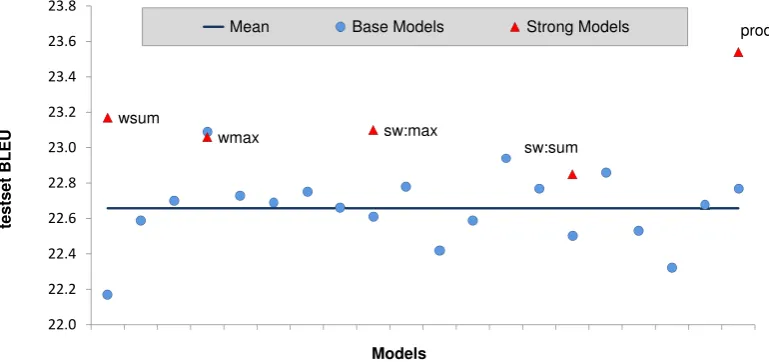
Figure 1 shows the BLEU score of each of the base models resulted from a 20-fold partitioning
of the devset along with the strong models’ BLEU scores. As the figure shows, the strong models are generally superior to the base models whose mean is represented as a horizontal line.
4.2 Training on train+dev
When we have some training data, we can use the cross-validation-style partitioning to create k
splits. We then train a system onk−1folds and
tune on the devset. However, each system eventu-ally wastes a fold of the training data. In order to take advantage of that remaining fold, we concate-nate the devset to the training set and partition the whole union. In this way, we use all data available to us. We experimented with two sizes of
train-ing data: 10k sentence pairs and100k, that with
the addition of the devset, we have12k and102k
sentence-pair corpora.
Table 1 summarizes statistics of the data sets used in this scenario. Table 3 reports the BLEU scores when using stacking on these two corpus sizes. The baselines are the conventional systems which are built on the training-set only and tuned on the devset as well asBayesian Model Averaging
(BMA, see§5). For the100k+dev corpus, we
sam-pled 11 partitions from all 51 possible partitions
by taking every fifth partition as training data. The results in Table 3 show that stacking can improve over the baseline BLEU scores by up to4points.
Examining the performance of the different mixture operations, we can see that WSUM and WMAX typically outperform other mixture
oper-ations. Different mixture operations can be domi-nant in different language pairs and different sizes of training sets.
5 Related Work
Xiao et al. (2013) have applied both boosting and bagging on three different statistical machine translation engines: phrase-based (Koehn et al., 2003), hierarchical phrase-based (Chiang, 2005) and syntax-based (Galley et al., 2006) and showed SMT can benefit from these methods as well.
wsum
wmax sw:max
sw:sum
prod
22.0 22.2 22.4 22.6 22.8 23.0 23.2 23.4 23.6 23.8
te
s
ts
e
t
B
L
E
U
Models
[image:5.595.105.490.71.252.2]Mean Base Models Strong Models
Figure 1: BLEU scores for all the base models and stacked models on the Fr-En devset with20-fold cross validation. The horizontal line shows the mean of base models’ scores.
sentence. Though, they do not combine the hy-potheses search spaces of individual base models. Our work is most similar to that of Duan et al. (2010) which usesBayesian model averaging
(BMA) (Hoeting et al., 1999) for SMT. They used
sampling without replacement to create a num-ber of base models whose phrase-tables are com-bined with that of the baseline (trained on the full training-set) using linear mixture models (Foster and Kuhn, 2007).
Our approach differs from this approach in a number of ways: i)we use cross-validation-style partitioning for creating training subsets while they do sampling without replacement (80%of the training set);ii)in our approach a number of base models are trained and tuned and they are com-bined on-the-fly in the decoder usingensemble de-codingwhich has been shown to be more effective than offline combination of phrase-table-only fea-tures;iii)in Duan et al. (2010)’s method, each sys-tem gives up20%of the training data in exchange
for more diversity, but in contrast, our method not only uses all available data for training, but pro-motes diversity through allowing each model to tune on a different data set;iv)our approach takes advantage of held out data (the tuning set) in the training of base models which is beneficial espe-cially when little parallel data is available or tun-ing/test sets and training sets are from different do-mains.
Empirical results (Table 3) also show that our approach outperforms the Bayesian model averag-ing approach (BMA).
6 Conclusion & Future Work
In this paper, we proposed a novel method on ap-plying stacking to the statistical machine transla-tion task. The results when using no,10k and100k
sentence-pair training sets (along with a develop-ment set for tuning) show that stacking can yield an improvement of up to4BLEU points over
con-ventionally trained SMT models which use a fixed training and tuning set.
Future work includes experimenting with larger training sets to investigate how useful this ap-proach can be when having different sizes of train-ing data.
References
Leo Breiman. 1996a. Bagging predictors. Machine Learning, 24(2):123–140, August.
Leo Breiman. 1996b. Stacked regressions. Machine Learning, 24(1):49–64, July.
David Chiang. 2005. A hierarchical phrase-based model for statistical machine translation. In ACL ’05: Proceedings of the 43rd Annual Meeting on As-sociation for Computational Linguistics, pages 263– 270, Morristown, NJ, USA. ACL.
Nan Duan, Mu Li, Tong Xiao, and Ming Zhou. 2009. The feature subspace method for smt system combi-nation. In Proceedings of the 2009 Conference on Empirical Methods in Natural Language Process-ing: Volume 3 - Volume 3, EMNLP ’09, pages 1096– 1104, Stroudsburg, PA, USA. Association for Com-putational Linguistics.
23rd International Conference on Computational Linguistics, COLING ’10, pages 304–312, Strouds-burg, PA, USA. Association for Computational Lin-guistics.
Andr´e F. T. Martins, Dipanjan Das, Noah A. Smith, and Eric P. Xing. 2008. Stacking dependency parsers. In Proceedings of the 2008 Conference on Empiri-cal Methods in Natural Language Processing, pages 157–166, Honolulu, Hawaii, October. Association for Computational Linguistics.
George Foster and Roland Kuhn. 2007. Mixture-model adaptation for smt. InProceedings of the Sec-ond Workshop on Statistical Machine Translation, StatMT ’07, pages 128–135, Stroudsburg, PA, USA. ACL.
Michel Galley, Jonathan Graehl, Kevin Knight, Daniel Marcu, Steve DeNeefe, Wei Wang, and Ignacio Thayer. 2006. Scalable inference and training of context-rich syntactic translation models. In
Proceedings of the 21st International Conference on Computational Linguistics and the 44th annual meeting of the Association for Computational Lin-guistics, ACL-44, pages 961–968, Stroudsburg, PA, USA. Association for Computational Linguistics.
Tin Kam Ho. 1998. The random subspace method for constructing decision forests. IEEE Trans. Pattern Anal. Mach. Intell., 20(8):832–844, August.
Jennifer A. Hoeting, David Madigan, Adrian E. Raftery, and Chris T. Volinsky. 1999. Bayesian Model Averaging: A Tutorial. Statistical Science, 14(4):382–401.
Philipp Koehn, Franz Josef Och, and Daniel Marcu. 2003. Statistical phrase-based translation. In Pro-ceedings of the Human Language Technology Con-ference of the NAACL, pages 127–133, Edmonton, May. NAACL.
P. Koehn. 2005. Europarl: A parallel corpus for statis-tical machine translation. InMT summit, volume 5.
Philipp Koehn. 2010.Statistical Machine Translation. Cambridge University Press, New York, NY, USA, 1st edition.
Antonio Lagarda and Francisco Casacuberta. 2008. Applying boosting to statistical machine translation. InAnnual Meeting of European Association for Ma-chine Translation (EAMT), pages 88–96.
Joakim Nivre and Ryan McDonald. 2008. Integrat-ing graph-based and transition-based dependency parsers. In Proceedings of ACL-08: HLT, pages 950–958, Columbus, Ohio, June. Association for Computational Linguistics.
Franz Josef Och and Hermann Ney. 2003. A sys-tematic comparison of various statistical alignment models. Comput. Linguist., 29(1):19–51, March.
Franz Josef Och. 2003. Minimum error rate training for statistical machine translation. InProceedings of the 41th Annual Meeting of the ACL, Sapporo, July. ACL.
Majid Razmara, George Foster, Baskaran Sankaran, and Anoop Sarkar. 2012. Mixing multiple transla-tion models in statistical machine translatransla-tion. InThe 50th Annual Meeting of the Association for Compu-tational Linguistics, Proceedings of the Conference, July 8-14, 2012, Jeju Island, Korea - Volume 1: Long Papers, pages 940–949. The Association for Com-puter Linguistics.
Erik F. Tjong Kim Sang. 2002. Memory-based shal-low parsing. J. Mach. Learn. Res., 2:559–594, March.
Baskaran Sankaran, Majid Razmara, and Anoop Sarkar. 2012. Kriya an end-to-end hierarchical phrase-based mt system. The Prague Bulletin of Mathematical Linguistics, 97(97), April.
Robert E. Schapire. 1990. The strength of weak learn-ability. Mach. Learn., 5(2):197–227, July.
Linfeng Song, Haitao Mi, Yajuan L¨u, and Qun Liu. 2011. Bagging-based system combination for do-main adaption. InProceedings of the 13th Machine Translation Summit (MT Summit XIII), pages 293– 299. International Association for Machine Transla-tion, September.
Andreas Stolcke. 2002. SRILM – an extensible lan-guage modeling toolkit. In Proceedings Interna-tional Conference on Spoken Language Processing, pages 257–286.
Mihai Surdeanu and Christopher D. Manning. 2010. Ensemble models for dependency parsing: cheap and good? In Human Language Technologies: The 2010 Annual Conference of the North American Chapter of the Association for Computational Lin-guistics, HLT ’10, pages 649–652, Stroudsburg, PA, USA. Association for Computational Linguistics. Nadi Tomeh, Alexandre Allauzen, Guillaume
Wis-niewski, and Franc¸ois Yvon. 2010. Refining word alignment with discriminative training. In Proceed-ings of The Ninth Conference of the Association for Machine Translation in the Americas (AMTA 2010). David H. Wolpert. 1992. Stacked generalization.
Neu-ral Networks, 5:241–259.
Tong Xiao, Jingbo Zhu, Muhua Zhu, and Huizhen Wang. 2010. Boosting-based system combina-tion for machine translacombina-tion. InProceedings of the 48th Annual Meeting of the Association for Com-putational Linguistics, ACL ’10, pages 739–748, Stroudsburg, PA, USA. Association for Computa-tional Linguistics.