
Differential Relationships among Facets of Alexithymia
and BDNF- and Dopamine-Related Polymorphisms
Nancy S. Koven, Leah H. Carr
Program in Neuroscience, Bates College, Lewiston, USA. Email: [email protected]
Received December 5th, 2011; revised January 29th, 2012; accepted February 16th, 2012
ABSTRACT
Alexithymia refers to a cluster of emotion-related deficits such as difficulty attending to and identifying one’s feelings. Although not a diagnosable psychiatric condition, alexithymia is considered a personality risk factor for multiple pa-thologies, including somatoform, substance use, eating, and mood disorders. Evidence suggests heritability, but few studies have examined the influence of specific genes on alexithymic traits. Candidate genes explored thus far include those involved in modulation of brain-derived neurotrophic factor (BDNF) and dopamine, two neurotransmitters whose func-tions have been implicated in human emotion processing. This study investigated the relafunc-tionship between the C270T polymorphism of the BDNF gene, facets of alexithymia, and possible interactions with the COMT, DAT1, and ANKK1 genes in a sample of 130 healthy adults. Given the multidimensionality of the alexithymia construct and its overlap with the related constructs of emotional intelligence and mood awareness, we used principal components analysis to derive Clarity of Emotion and Attention to Emotion as specific facets of alexithymia. Results showed that the C270T C/C genotype group had lower Clarity of Emotion scores relative to the C/T genotype group, even after covarying for COMT, DAT1, and ANKK1 genotypes. Dopamine-related genes had no association with alexithymia dimensions, nor did they interact with the C270T polymorphism to predict Clarity of Emotion. Although the molecular mechanisms by which this polymorphism influences BDNF are unknown, this study suggests a role for BDNF in modulating aspects of alexithymia. We discuss these results in the context of BDNF’s trophic effects in the nervous system.
Keywords: Brain-Derived Neurotrophic Factor; Alexithymia; Dopamine; Polymorphism
1. Introduction
As a trait composed of emotion-related deficits involving difficulty attending to and identifying one’s feelings, ale- xithymia has been associated with problematic coping patterns across a range of medical and psychiatric illnesses, including chronic pain, breast cancer, somatization disor- ders, substance use disorders, eating disorders, and mood disorders [1]. Alexithymia can arise from brain trauma, sexual assault, and childhood exposure to an emotionally dysfunctional family [2-4]. However, with estimates of alexithymia at 10% of the general population [5], alexithy- mia also manifests in individuals without any of the above risk factors, necessitating other etiological explanations. While results of twin studies suggest genetic factors [6,7], very few studies to date have examined the influence of specific genes on alexithymic traits.
Candidate genes explored thus far include those in- volved in modulation of brain-derived neurotrophic fac- tor (BDNF) and dopamine (DA), two neurotransmitters whose functions have been implicated in human emotion processing [8]. BDNF has received considerable atten-
tion in the neurogenetic literature for its trophic effects on dopaminergic, cholinergic, and serotonergic neurons. Several polymorphisms of the BDNF gene, located on chromosome 11p14.1, have been identified: a dinucleo- tide repeat (GT)n polymorphism, a Val66Met (196G/A)
the A1 allele of ANKK1 gene located on chromosome 11q22-q23, which has been linked to reduced receptor binding potential of the D2 receptor [12], is associated
with alexithymia [9].
The interaction of BDNF 66Met and ANKK1 A1 geno- types as predictors of alexithymia has inspired a multi- step theoretical model postulating that reduced BDNF levels lead to reduced dopaminergic activity in the D2
mesocortical pathway to the anterior cingulate cortex (ACC). Walter and colleagues [9] theorize that two consequences of diminished ACC activity are poor conscious emotional awareness and the inability to attribute bodily sensations of arousal to consciously perceived emotions; these con- sequences are, respectively, suggestive of the two most common features of alexithymia, inattention to emotion and poor clarity of emotion. Corroborating this model are neuroimaging data that implicate a compromise in ACC structure and function across facets of alexithymia [13-16]. The extant neurogenetic work is promising in light of the Walter et al. [9] theory, but more research is needed to explicate the relationships between BDNF- and DA-re- lated genes in the alexithymia phenotype. To date, no one has examined the BDNF C270T polymorphism in the context of alexithymia or its related processes, although research is beginning to explore relationships between C270T and cognition in psychiatric and neurological populations [17-20]. The current study addresses this gap by examining the C270T polymorphism in relation to alexithymic dimensions and its potential interactions with three DA-related genes: the COMT and ANKK1 genes, as described earlier, and a gene coding for the dopamine transporter (DAT) that modulates DA availability. DAT, which is responsible for DA reuptake from extracellular space, is regulated by the DAT1 gene, located on chro- mosome 5p15.3. The DAT1 gene displays a polymorphic variable number of tandem repeats (VNTR) within the 3’ untranslated region where 40 base pairs are repeated be- tween three and thirteen times [21]. The 9- and 10-repeat genotypes are the most common in the general popula- tion [22], with the 10-repeat form associated with de- creased DA transmission relative to the 9-repeat form [23]. As DAT is described as the most efficient way to clear the synapse of DA [24], examination of the DAT1 gene will help characterize any relationship between BDNF, DA, and alexithymic processes.
The multidimensionality of the alexithymia construct, however, complicates interpretation of genotype/phenotype data, as there is considerable overlap of alexithymia with the related constructs of emotional intelligence and mood awareness [25]. Factor analytic research has suggested that different facets of alexithymia have unique cognitive and emotion processing correlates [25,26]. Therefore, rather than measure alexithymia at the superordinate level, this study makes use of empirically-derived dimensions, re-
sulting from principal components analysis of three closely- related self-report scales, to permit analysis of gene/alexi- thymia relationships at the facet level. As alexithymia is a dimensional personality trait, much in the same way as are extroversion and neuroticism, sampling from a nor- mal population is appropriate for the present study. In order to control for the effects of confounding variables, we specifically chose a sample of community adults who were free of neurological and psychiatric conditions (e.g., traumatic brain injury, neurodegenerative disorders, post- traumatic stress disorder, addictions) for which alexithy- mia is among the known sequelae [27]. The reported asso- ciation between the BDNF Val66Met polymorphism and alexithymia leads us to anticipate a similar relationship involving the BDNF C270T polymorphism. However, without knowing the intracellular mechanisms by which C270T exerts an influence on BDNF, it is difficult to predict a priori whether C or T allele carriers will have elevated scores and, if so, in which alexithymia-related domain(s). Given the previous research that implicates decreased dopaminergic function in alexithymia, we hy- pothesize interacting effects with the COMT, ANKK1, and DAT1 genes such that COMT Val, ANKK1 A1, and DAT1 10-repeat carriers, respectively, will exhibit greater emotion processing deficits.
2. Method
2.1. Participants
A community sample of 130 (79 women; 51 men) ge- netically-unrelated adults was recruited through newspa-per advertisements. Ethnic diversity was consistent with local population norms: 87% White or Caucasian, 5% Black or African-American, 6% Asian or Asian-American, and 2% Hispanic/Latino. Age ranged from 18 to 64 yr (M = 32.3, SD = 13.4), and educational achievement ranged from 11 to 26 yrs (M= 15.8, SD= 2.6). The pro- tocol was consistent with ethical guidelines of the Dec- laration of Helsinki and was approved by the local Insti- tutional Review Board. Written informed consent was ob- tained per participant. Rule-out criteria for participation included English as a second language, color-blindness, presence of a diagnosed psychiatric illness and/or history of psychiatric treatment, history of significant neurologi- cal illness or brain injury, history of medical conditions with known cognitive or emotional sequelae, substance abuse history, and use of psychoactive substances within the last month. Psychiatric screening was done with the Mini International Neuropsychiatric Interview (M.I.N.I.) [28].
2.2. Procedure
ronto Alexithymia Scale (TAS-20) [1], the Trait Meta Mood Scale (TMMS) [29], and the Mood Awareness Scale (MAS) [30]. DNA was obtained for some partici- pants (n = 105) with peripheral blood samples, drawn via standard venipuncture by a certified phlebotomist, and with cheek buccal swabs for other participants (n = 25). All participants completed the protocol in individual ses- sions.
2.3. Self-Report Measures
The TAS-20 is a 20-item scale that consists of three sub- scales: Difficulty Identifying Feelings (e.g., “When I am upset, I don’t know if I am sad, frightened, or angry”), Difficulty Describing Feelings (e.g., “It is difficult for me to find the right words for my feelings”), and Externally- Oriented Thinking (e.g., “I find examinations of my feel- ings useful in solving personal problems”). Higher sub- scale scores reflect worse ability. Each subscale has shown adequate internal consistency, with alpha coefficients of 0.78, 0.75, and 0.66, respectively [31]. The TAS-20 has also demonstrated good test-retest reliability in nonpa- tient samples across cultures [32].
The TMMS is a 30-item scale that consists of three subscales: Attention to Feelings (e.g., “I don’t think it’s worth paying attention to your emotions or moods”), Cla- rity of Feelings (e.g., “Sometimes I can’t tell what my feelings are”), and Mood Repair (e.g., “No matter how bad I feel, I try to think about pleasant things”). Lower subscale scores indicate worse ability. The TMMS has shown adequate internal consistency (full scale alpha coefficient = 0.82), and internal reliabilities per subscale (0.86, 0.87, and 0.82, respectively) [29].
The MAS is a 10-item scale of meta-emotion skills that consists of two subscales: Mood Monitoring (e.g., “I am sensitive to changes in my mood”) and Mood Label- ing (e.g., “Right now I know what kind of mood I’m in”). Lower subscale scores reflect worse ability. Both sub- scales have respectively shown adequate internal consis- tency (0.88 and 0.77) and test-retest reliability (0.94 and 0.76) [33].
2.4. Genoptying
DNA extraction was completed with the Gentra Puregene Blood Kit (Qiagen: Valencia, California, USA) or with the QIAmp DNA Mini Kit (Qiagen), as appropriate. Geno- typing for BDNF C270T, COMT (rs4680), and ANKK1 (rs1800497) was done at Dartmouth-Hitchcock Medical Center in Lebanon, New Hampshire, USA with TaqMan assays using pre-designed, allele-specific primer and probes from Applied Biosystems (Foster City, California, USA). All primers and probes were used at final concentrations of 900 nM and 200 nM, respectively, in 1× TaqMan Universal PCR Master Mix (Applied Biosystems) on a
7500 Fast Real-Time PCR System using allelic discrimi-nation analysis with the 7500 Software v2.0 (Applied Bio-systems).
Genotyping for DAT1 was completed at Bates College in Lewiston, Maine, USA. The polymerase chain reac- tion (PCR) was run on an Eppendorf Mastercycler Pro thermal cycler (Hauppauge, New York, USA) using the following primers: DATVNTRF: 5’-TGT GGT GTA GGG AAC GGC CTG AGA-3’ and DATVNTRR: 5’-CTT CCT GGA GGT CAC GGC TCA AGG-3’. Re- actions were carried out in volumes of 50 μL containing 22 μL of sterile H2O, 8 μL of 4 mM MgCl2 (New Eng-
land BioLabs: Ipswitch, Massachusetts, USA), 5 μL of 10X Taq Buffer (New England BioLabs), 5 μL of dNTP mixture containing 10 mM of each nucleotide (New England BioLabs), 2 μL of each 0.5 μM primer (Inte- grated DNA Technologies: Coralville, Iowa, USA), 5 μL of DNA solution (QIAmp Qiagen kit), and 1 μL of 5 U/μL Taq DNA polymerase (New England BioLabs). Each reaction underwent an initial denaturation at 94˚C for 5 minutes, followed by 30 cycles of denaturation at 94˚C for 30 seconds, annealing at 59˚C for 30 seconds, and extension at 72˚C for 45 seconds, with a final extension at 72˚C for 10 minutes. Gel analysis used 2% low-melt agarose (BioRad: Hercules, California, USA) containing ethidium bromide. Genotypes were determined by com- parison to a standard 100 base-pair ladder (New England BioLabs).
3. Results
3.1. Genotyping Distributions
years of education (all p = ns).
3.2. Data Reduction of Alexithymia Variables
Principal component analysis (PCA) was performed to identify the latent factors among the TAS-20, TMMS, and MAS subscales. The questionnaire data met the stan- dards of the Kaiser-Meyer-Olkin measure of sampling ade- quacy (0.82) and Bartlett’s test of sphericity (approximate
χ2 = 575.4, df = 28, p < 0.001) recommended for PCA
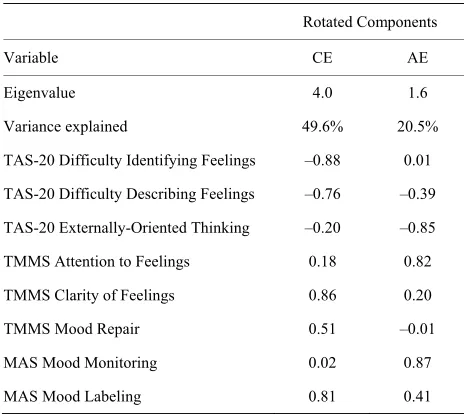
[35]. Varimax rotation was used, and the number of fac- tors retained was determined by the Kaiser criterion and visual inspection of the Scree plot. Two factors emerged, which together accounted for 70.1% of the total variance. Based on the pattern of factor loadings (Table 1), the first
and second components were renamed Clarity of Emo- tion and Attention to Emotion, respectively. Given a mod- est sample size in relation to the number of subscale vari- ables entered into PCA, we employed a rigorous cut-off criterion of |0.8| for factor loading interpretation as re- commended by Stevens [36] and Guadagnoli and Velicer [37]. The factor score coefficients were estimated using the Anderson-Rubin method [38], a modification of the Bartlett method that ensures orthogonality of the estimated factors. Like z-scores, these factor score coefficients have a mean of 0 and SD of 1 such that positive and negative values of the Clarity of Emotion and Attention to Emo- tion variables reflect above and below average skills, re- spectively.
3.3. Simple Correlations
Point-biserial correlations (two-tailed) were performed to provide an initial assessment of the relationships between genotypes, the extracted PCA factors, and demographic variables of age, sex, and level of education. The BDNF C270T polymorphism was related to Clarity of Emotion,
r = 0.26, p = 0.008, but not to Attention to Emotion, r = 0.04, p = ns. The COMT, DAT1, and ANKK1 polymor- phisms showed no relationship with either emotion vari- able. There was no association among the genotypes groups and any of the demographic variables.
3.4. BDNF C270T Effects
A multivariate analysis of variance (MANOVA) with C270T genotype as a grouping factor was conducted for the extracted PCA factors. The full model was significant, Wilks’ λ = 0.93, F (2, 101) = 3.80, p = 0.03, partial η2 =
0.07. Tests of between-subjects effects revealed that the C/C group had lower Clarity of Emotion scores relative to the C/T group, F (1, 102) = 7.27, p = 0.008, partial η2
= 0.07 (Table 2). Attention to Emotion score was compa-
rable across groups. The full model remained significant after covarying for COMT, DAT1, and ANKK1, Wilks’
[image:4.595.306.538.100.307.2]λ = 0.89, F (2, 86) = 5.32, p = 0.007, partial η2 = 0.11,
Table 1. Factor loadings for alexithymia-related measures.
Rotated Components
Variable CE AE
Eigenvalue 4.0 1.6
Variance explained 49.6% 20.5%
TAS-20 Difficulty Identifying Feelings –0.88 0.01
TAS-20 Difficulty Describing Feelings –0.76 –0.39
TAS-20 Externally-Oriented Thinking –0.20 –0.85
TMMS Attention to Feelings 0.18 0.82
TMMS Clarity of Feelings 0.86 0.20
TMMS Mood Repair 0.51 –0.01
MAS Mood Monitoring 0.02 0.87
MAS Mood Labeling 0.81 0.41
[image:4.595.307.536.365.588.2]Note. Component loadings ≥ |0.8| were considered significant. CE = Clarity of Emotion; AE = Attention to Emotion; TAS-20 = Toronto Alexithymia Scale; TMMS = Trait Meta-Mood Scale; MAS = Mood Awareness Scale.
Table 2. Subscales across BDNF C207T genotype groups.
C/C group C/T group
Variable M SD M SD
TAS-20 Difficulty Identifying Feelings 13.8 5.4 11.6 3.6
TAS-20 Difficulty Describing Feelings 12.6 4.6 11.0 4.1
TAS-20 Externally-Oriented Thinking 17.7 4.9 17.3 4.7
TMMS Attention to Feelings 51.9 7.5 52.9 8.8
TMMS Clarity of Feelings 40.0 7.4 44.0 6.5
TMMS Mood Repair 22.7 4.6 23.9 4.7
MAS Mood Monitoring 18.2 6.3 19.5 6.2
MAS Mood Labeling 22.3 4.3 24.5 4.2
Clarity of Emotion latent factor score –0.2 1.1 0.3 0.8
Attention to Emotion latent factor score –0.1 1.0 0.0 1.1
Note. TAS-20 = Toronto Alexithymia Scale; TMMS = Trait Meta-Mood Scale; MAS = Mood Awareness Scale.
with the C/C group again showing lower Clarity of Emo- tion scores relative to the C/T group, F (1, 87) = 8.80, p
= 0.004, partial η2 = 0.09.
3.5. Gene-Gene Interaction Effects
type (10/10 versus a combined 9/9 and 9/10 group), and ANKK1 genotype (G/G versus A carrier groups), respec- tively, as the other. Attention to Emotion was dropped as a dependent variable given its negligible relationship with C270T. Clarity of Emotion was retained as the single dependent variable of interest. Similar to other explora- tory behavioral genetics studies [10,39] and given that a relationship between C270T and alexithymia has not pre- viously been established in the literature, we chose not to apply a Bonferroni correction for multiple comparisons (p < 0.05/3 = 0.017) in these analyses; adjusting the alpha threshold for significance might inappropriately increase the possibility that a real effect is missed among these data [40]. In all three analyses, a main effect emerged of C270T polymorphism on Clarity of Emotion, but there was no interaction between C270T and any of the COMT, DAT1, or ANKK1 genotypes1.
4. Discussion
This study is the first known exploratory investigation of the BDNF C270T polymorphism in the context of alexi- thymia. In consideration of a theory [9] that postulates dopaminergic activity as an important mediating step be- tween BDNF and alexithymia, we included three DA-re- lated genes in our analysis: the COMT, DAT1, and ANKK1 genes. Mindful of the multidimensional nature of alexi- thymia and its substantial overlap with the concepts of emotional intelligence and mood awareness, we used PCA to identify latent factors common to all three constructs. These principal components, Clarity of Emotion (i.e., the degree to which one understands and can label emotional states) and Attention to Emotion (i.e., the degree to which one attends to emotions), demonstrated different rela- tionships with the BDNF C270T polymorphism, which is consistent with other research that highlights unique sets of external correlates for these affective dimensions [25,26].
In the present sample, the C270T C/C genotype group exhibited lower Clarity of Emotion scores relative to the C/T genotype group, and this effect held after covarying for COMT, DAT1, and ANKK1 genotypes, a finding that was not confounded by age, gender, or education differ- ences. The three DA-related genes themselves did not relate to either alexithymia facet, nor did these genes interact with the C270T polymorphism to predict Clarity of Emotion scores. As the C270T polymorphism explains up to 11% of the variance in Clarity of Emotion, there clearly are other variables that account for the rest. These other variables, however, do not appear to include the COMT, DAT1, and ANKK1 genes. It is also unlikely
that psychiatric or neurological variables contribute dif- ferentially to this effect, as only healthy adults, screened for conditions that are often comorbid with alexithymia, were included in this study.
Despite a modest, multiethnic sample, the present study suggests a role for BDNF in modulating aspects of alexi- thymia, particularly the tendency to have poor insight into one’s emotional states. The relationship between the C270T polymorphism and Clarity of Emotion is broadly consis- tent with the recent finding by Walter et al. [9] of a con- nection between the BDNF Val66Met polymorphism and the TAS-20 subscale Difficulty Identifying Feelings. Taken together, this is evidence of an association between two different BDNF polymorphisms and nearly identical phe- notypic traits. Although C270T appears to be functional, we do not yet know the molecular mechanisms by which it exerts an effect. Like Met substitution for Val66Met (for review, see [41]), the C/C genotype might lead to trafficking defects in BDNF secretory pathways and, subsequently, reduce BDNF availability in the synapse. Future research with transgenic animal models is neces-sary to characterize the intra- and intercellular conse-quences of the genotypes. It is also important that future research on the BDNF gene should simultaneously assay the C270T and Val66Met polymorphisms to determine if they are being inherited as a haplotype.
When assessing a phenotypic change in tandem with a genetic variant, it is difficult to determine whether the genotype in question has a direct effect on the phenotype or whether the effect is mediated through a downstream functional change or interaction with another gene [41]. Walter and colleagues [9] address this possibility when they advance the idea that ACC activity is a proximal con- tributor to emotional clarity, which itself is governed in part by dopaminergic activity in the D2 mesocortical path-
way, which, in turn, is influenced by varying BDNF lev- els. In this model, the BDNF genotype is a distal agent in a multi-step biological pathway. Contrary to our hypothe- sis and contrary to this model, we did not find an interac- tion between C270T and any of the DA-related genes. Although this is a major point of difference between the two studies, the present findings do not necessarily ne- gate the Walter et al. [9] theory. Three possibilities exist to reconcile the discrepant results. First, it is possible that the C270T polymorphism, in its action on BDNF and in- dependently of state-like changes in dopaminergic active- ity, leads to structural changes beyond the anterior cin- gulate (e.g., PFC, medial temporal lobe, caudate nucleus) that are associated with alexithymia. Second, it is possi- ble that some change in the DA system is still an impor- tant intermediary but that the C270T polymorphism in- teracts with genes outside of COMT, DAT, or ANKK1 (e.g., DRD1, DRD3, and DRD4). Third, it is possible that there is a non-DA neurotransmitter intermediary (e.g.,
1Although the majority of participants are of European ancestry, there
serotonin, acetylcholine) that links the C270T polymer- phism to clarity of emotion.
This list is by no means exhaustive, but it does high- light the neuropharmacological complexity of BDNF that makes interpretation of relationships between genetic vari- ants and facets of emotion processing so challenging. Fu- ture research is needed not only to characterize the mo- lecular basis of altered BDNF function by C270T but also to map structural and functional brain differences be- tween C/C and C/T groups. Description of where and un- der what conditions these groups differ at the level of the brain will be an important step to refine theories of how BDNF influences alexithymia and why the C270T poly- morphism shapes the clarity of emotion facet alone.
5. Acknowledgements
This work was supported by grants from Bates College and the Maine Institute of Human Genetics and Health (to N.S.K.) and Sigma Xi Scientific Research Society (to L.H.C.). The authors would like to thank Mary E. Hughes of Bates College in Lewiston, ME USA for phlebotomy and Gregory Tsongalis, Ph.D., Mary C. Schwab, Ph.D., Joel A. Lefferts, Ph.D., and Claudine L. Lefferts, Ph.D. of Dartmouth-Hitchcock Medical Center in Lebanon, New Hampshire, USA for genotyping consultation.
REFERENCES
[1] G. B. Taylor, M. Bagby and J. D. Parker, “Disorders of Affect Regulation: Alexithymia in medical and Psychiat-ric Illness,” Cambridge University Press, New York City, 1997. doi:10.1017/CBO9780511526831
[2] J. L. King and B. Mallinckrodt, “Family Environment and Alexithymia in Clients and Non-Clients,” Psychotherapy
Research,Vol. 10, No. 1, 2000, pp. 78-86.
doi:10.1080/713663595
[3] S. Koponen, T. Taiminen, K. Honkalampi, M. Joukamaa, H. Vinnamaki, T. Kurki, et al., “Alexithymia after Trau- matic Brain Injury: Its Relation to Magnetic Resonance Imaging,” Psychosomatic Medicine,Vol. 67, No. 5, 2005, pp. 807-812. doi:10.1097/01.psy.0000181278.92249.e5 [4] S. B. Zeitlin, R. J. McNally and K. L. Cassiday, “Alexi-
thymia in Victims of Sexual Assault: An Effect of Re- peated Traumatization?” American Journal of Psychiatry, Vol. 150, No. 4, 1993, pp. 661-663.
[5] J. K. Salminen, S. Saarijärvi, E. Äärelä, T. Toikka and J. Kauhanen, “Prevalence of Alexithymia and Its Associa-tion with Sociodemographic Variables in the General Population of Finland,” Journal of Psychosomatic
Re-search,Vol. 46, No. 1, 1998, pp. 75-82.
doi:10.1016/S0022-3999(98)00053-1
[6] M. M. Jørgensen, R. Zachariae, A. Skytthe and K. Kyvik, “Genetic and Environmental Factors in Alexithymia: A Population-Based Study of 8,785 Danish Twin Pairs,”
Psychotherapy and Psychosomatics,Vol. 76, No. 6, 2007,
pp. 369- 375. doi:10.1159/000107565
[7] E. M. Valera and H. Berenbaum, “A Twin Study of Alexithymia,” Psychotherapy and Psychosomatics, Vol. 70, No. 5, 2001, pp. 239-246. doi:10.1159/000056261 [8] H. M. Abdolmaleky, C. L. Smith, J. R. Zhou and S.
Thiagalingam, “Epigenetic Alterations of the Dopaminer-gic System in Major Psychiatric Disorders,” Methods in
Molecular Biology,Vol. 448, 2008, pp. 187-212.
doi:10.1007/978-1-59745-205-2_9
[9] N. T. Walter, C. Montag, S. A. Markett and M. Reuter, “Interaction Effect of Functional Variants of the BDNF and DRD2/ANKK1 Gene Is Associated with Alexithymia in Healthy Human Subjects,” Psychosomatic Medicine, Vol. 73, No. 1, 2011, pp. 23-28.
doi:10.1097/PSY.0b013e31820037c1
[10] B. J. Ham, M. S. Lee, Y. M. Lee, M. K. Kim, M. J. Choi, K. S. Oh, et al., “Association between the Catechol- O-Methyltransferase Val108/158Met Polymorphism and Alexithymia,” Neuropsychobiology,Vol. 52, No. 3, 2005, pp. 151-154. doi:10.1159/000087846
[11] S. Hermes, J. Hennig, M. Stingl, F. Leichsenring and F. Leweke, “No Association between Catechol-O-Methyl- Transferase val158met Polymorphism and Alexithymia,” Zeitschrift fur Psychosomatische Medizin und
Psycho-therapie, Vol. 57, No. 1, 2011, pp. 51-61.
[12] T. Pohjalainen, J. O. Rinne, K. Någren, P. Lehikoinen, K. Anttila, E. K. Syvälathi, et al., “The A1 Allele of the Human D2 Dopamine Receptor Gene Predicts Low D2 Receptor Availability in Healthy Volunteers,” Molecular
Psychiatry,Vol. 3, No. 3, 1998, pp. 256-260.
doi:10.1038/sj.mp.4000350
[13] H. Gündel, A. Lopez-Sala, A. O. Ceballos-Baumann, J. Deus, N. Cardoner, B. Marten-Mittag, C. Soriano-Mas,
et al., “Alexithymia Correlates with Size of the Right An-
terior Cingulate,” Psychosomatic Medicine, Vol. 66, No. 1, 2004, pp. 132-140.
doi:10.1097/01.PSY.0000097348.45087.96
[14] H. Karlsson, P. Näätänen and H. Stenman, “Cortical Ac-tivation in Alexithymia as a Response to Emotional Stim-uli,” British Journal of Psychiatry, Vol. 192, 2008, pp. 32-38. doi:10.1192/bjp.bp.106.034728
[15] N. S. Koven, R. M. Roth, M. A. Garlinghouse, L. A. Flashman and A. J. Saykin, “Regional Gray Matter Cor- relates of Perceived Emotional Intelligence,” Social,
Cog-nitive, and Affective Neuroscience,Vol. 6, No. 5, 2010,
pp. 582-590. doi:10.1093/scan/nsq084
[16] C. Montag, B. Weber, E. Jentgens, C. Elger and M. Reuter, “An Epistasis Effect of Functional Variants on the BDNF and DRD2 Genes Modulates Grey Matter Volume of the Anterior Cingulate Cortex in Healthy Humans,”
Neuropsychologia,Vol. 48, No. 4, 2010, pp. 1016-1021.
doi:10.1016/j.neuropsychologia.2009.11.027
[17] H. Kunugi, A. Ueki, M. Otsuka, K. Isse, H. Hirasawa and K. Kato, “A Novel Polymorphism of the Brain-Derived Neurotrophic Factor (BDNF) Gene Associated with Late- Onset Alzheimer’s Disease,” Molecular Psychiatry, Vol. 6, No. 1, 2001, pp. 83-86. doi:10.1038/sj.mp.4000792 [18] A. Parsian, R. Sinha, B. Racette, J. H. Zhao and J. S.
with Familiar Parkinson’s Disease,” Parkinsonism and
Related Disorders,Vol. 10, No. 4, 2004, pp. 213-219.
doi:10.1016/j.parkreldis.2003.12.003
[19] A. Szczepankiewicz, M. Skibińska, J. Hauser, A. Leszc- zyńska-Rodziewicz, M. Dmitrzak-Weglarz, P. M. Czerski,
et al., “Association Study of the Brain-Derived
Neuro-trophic Factor (BDNF) Gene C-270T Polymorphism with Bipolar Affective Disorder,” Archives of Psychiatry and
Psychotherapy,Vol. 8, 2006, pp. 31-39.
[20] G. Szekeres, A. Juhász, A. Rimanóczy, S. Kéri and Z. Janka, “The C270T Polymorphism of the Brain-Derived Neurotrophic Factor Gene Is Associated with Schizo- phrenia,” Schizophrenia Research, Vol. 65, No. 1, 2003, pp. 15-18. doi:10.1016/S0920-9964(02)00505-4
[21] M. Nakatome, K. Honda, Z. Tun, Y. Kato, S. Harihara, K. Omoto, et al., “Genetic Polymorphism of the 3’ VNTR Region of the Human Dopaminergic Function Gene DAT1 (Human Dopamine Transporter Gene) in the Mon-golian Population,” Human Biology, Vol. 68, No. 4, 1996, pp. 509-515.
[22] A. M. Kang, M. A. Palmatier and K. K. Kidd, “Global Variation of a 40-bp VNTR in the 3’ Untranslated Region of the Dopamine Transporter Gene (SLC6A3),”
Biologi-calPsychiatry, Vol. 46, No. 2, 1999, pp. 151-160.
doi:10.1016/S0006-3223(99)00101-8
[23] J. Mill, P. Asherson, C. Browes, U. D’Souza and I. Craig, “Expression of the Dopamine Transporter Gene Is Regu-lated by the 3’ UTR VNTR: Evidence from Brain and Lymphocytes Using Quantitative RT-PCR,” American
Journal of MedicalGenetics, Vol. 114, No. 8, 2002, pp.
975-979. doi:10.1002/ajmg.b.10948
[24] A. Diamond, “Consequences of Variations in Genes that Affect Dopamine in Prefrontal Cortex,” Cerebral Cortex, Vol. 17, No. 1, 2007, pp. 161-170.
doi:10.1093/cercor/bhm082
[25] E. Coffey, H. Berenbaum and J. G. Kerns, “The Dimen-sions of Emotional Intelligence, Alexithymia, and Mood Awareness: Associations with Personality and Perform-ance on an Emotional Stroop Task,” Cognition and Emo-tion,Vol. 17, No. 4, 2003, pp. 671-679.
doi:10.1080/02699930302304
[26] N. S. Koven and W. Thomas, “Mapping Facets of Alexi- thymia to Executive Dysfunction in Daily Life,”
Person-ality and Individual Differences,Vol. 49, No. 1, 2010, pp.
24-28. doi:10.1016/j.paid.2010.02.034
[27] R. Becerra, A. Amos and S. Jongenelis, “Organic Alexi- thymia: A Study of Acquired Emotional Blindness,”
Brain Injury, Vol. 16, No. 7, 2002, pp. 633-645.
doi:10.1080/02699050110119817
[28] D. V. Sheehan, Y. Lecrubier, K. Harnett-Sheehan, P. Amorim, J. Janavs, E. Weiller, et al., “The Mini Interna-tional Neuropsychiatric Interview (M.I.N.I.): The Devel-opment and Validation of a Structured Diagnostic Psy-chiatric Interview for DSM-IV and ICD-10,” Journal of
Clinical Psychiatry, Vol. 59, No. 20, 1998, pp. 22-23.
[29] P. Salovey, J. D. Mayer, S. L. Goldman, C. Turvey and T. P. Palfai, “Emotional Attention, Clarity, and Repair:
Ex-ploring Emotional Intelligence Using the Trait meta- Mood Scale,” In: J. W. Pennebaker, Ed., Emotion,
Dis-closure, and Health,American Psychological Association,
Washington DC, 1995, pp. 125-154. doi:10.1037/10182-006
[30] A. Swinkles and T. A. Giuliano, “The Measurement and Conceptualization of Mood Awareness: Monitoring and Labeling One’s Mood States,” Personality and Social
Psychology Bulletin, Vol. 21, No. 9, 1995, pp. 934-950.
[31] R. M. Bagby, G. J. Taylor and J. D. A. Parker, “The Twenty-Item Toronto Alexithymia Scale: II. Convergent, Discriminant, and Concurrent Validity,” Journal of
Psy-chosomatic Research,Vol. 38, No. 1, 1994, pp. 33-40.
doi:10.1016/0022-3999(94)90006-X
[32] C. G. Kooiman, P. Spinhoven and R. W. Trijsburg, “The Assessment of Alexithymia: A Critical Review of the Lit-erature and a Psychometric Study of the Toronto Alexi- thymia Scale-20,” Journal of Psychosomatic Research, Vol. 53, No. 6, 2002, pp. 1083-1090.
doi:10.1016/S0022-3999(02)00348-3
[33] M. B. Harris, “Correlates and Characteristics of Boredom Proneness and Boredom,” Journal of Applied Social
Psy-chology,Vol. 3, No. 3, 2000, pp. 576-598.
doi:10.1111/j.1559-1816.2000.tb02497.x
[34] M. Garcia-Garcia, F. Barceló, I. C. Clemente and C. Escera, “The Role of the Dopamine Transporter DAT1 Genotype on the Neural Correlates of Cognitive Flexibil-ity,” EuropeanJournal of Neuroscience, Vol. 31, No. 4, 2010, pp. 754-760.
doi:10.1111/j.1460-9568.2010.07102.x
[35] B. G. Tabachnick and L. S. Fidell, “Using Multivariate Statistics” 5th Edition, Pearson Education, Boston, 2007. [36] J. P. Stevens, “Applied Multivariate Statistics for the
Social Sciences,” 4th Edition, Lawrence Erlbaum Associ-ates, Mahwah, 2002.
[37] E. Guadagnoli and W. F. Velicer, “Relation of Sample Size to the Stability of Component Patterns,”
Psycho-logical Bulletin,Vol. 103, No. 2, 1988, pp. 265-275.
doi:10.1037/0033-2909.103.2.265
[38] R. D. Anderson and H. Rubin, “Statistical Inference in Factor Analysis,” Proceedings of the 3rd Berkeley
Sym-posium of Mathematical Statistics and Probability,Vol. 5,
1956, pp. 111-150.
[39] H. A. Wishart, R. M. Roth, A. J. Saykin, H. Rhodes, G. J. Tsongalis, K. A. Pattin, et al., “COMT Val158Met Geno-type and Individual Differences in Executive Function in Healthy Adults,” Journal of the International
Neuropsy-chological Society,Vol. 17, No. 1, 2011, pp. 174-180.
doi:10.1017/S1355617710001402
[40] K. J. Rothman, “No Adjustments Are Needed for Multi-ple Comparisons,” Epidemiology,Vol. 1, No. 1, 1990, pp. 43-46. doi:10.1097/00001648-199001000-00010
[41] K. G. Bath and F. S. Lee, “Variant BDNF (Val66Met) Impact on Brain Structure and Function,” Cognitive,
Af-fective, and Behavioral Neuroscience,Vol. 6, No. 1, 2006,
![Issues of informed consent for intrapartum trials: a suggested consent pathway from the experience of the Release trial [ISRCTN13204258]](data:image/gif;base64,R0lGODlhAQABAIAAAP///wAAACH5BAEAAAAALAAAAAABAAEAAAICRAEAOw==)