The high nutritional properties of eggs make them ideal for humans with special dietary re-quirements. They are also suitable for nutritional improvement of several kinds of foods since they have four major nutritional components: proteins, lipids, all necessary vitamins (except vitamin C), and minerals. Eggs are classified among the rich protein foods together with milk, meat, poultry, and fish. The nutritional value of egg proteins, which has been extensively evaluated, is the result of an ideal balance of nutritionally indispensable amino acids. Eggs are also an excellent source of essential fatty acids. The high nutritional value, the low caloric content, blandness, and the easy digestibility are the characteristics that make eggs ideal for young or old people, healthy or conva-lescent (GUTIERREZ et al. 1997).
At the present stage, around 30% of the eggs produced are processed in the egg industry. Eggs are used in the preparation of many food prod-ucts. The three most well-known uses of eggs are based on that: liquid eggs coagulate or solidify
when heated (cakes, breads, crackers); whipping of egg white produces lighter and airier products (meringues, angel cake); and emulsifying egg yolk phospholipids and lipoproteins produces mayon-naise, salad dressing and sauces (Davis & Reeves 2002).
Mechanism and components of foam formation
Egg albumen has excellent food foaming proper-ties. Such properties are determined by the ability to rapidly adsorb on the air-liquid interface during whipping or bubbling, and by its ability to form a cohesive viscoelastic film by way of intermolecular interactions (MINE 1995). Protein molecules act as hydrophilic and hydrophobic groups. The hy-drophilic groups are arranged towards the water phase and the hydrophobic groups towards the air phase. During the whipping process air comes into the solution to form bubbles, the hydrophobic regions facilitate the adsorption at the interface, a
A Study of the Factors Affecting the Foaming Properties
of Egg White – a Review
KATERYNA LOMAKINA and KAMILA MÍKOVÁ
Department of Food Chemistry and Analysis, Faculty of Food and Biochemical
Technology, Institute of Chemical Technology Prague, Prague, Czech Republic
Abstract
LOMAKINA K., MÍKOVÁ K. (2006): A Study of the factors affecting the foaming properties of egg white – a review. Czech J. Food Sci., 24: 110–118.
Many foods are prepared using egg white, most of them being based on the foaming properties of egg white which are due to albumen proteins ability to encapsulate and retain air. Therefore, many scientists aim to find new methods to improve the volume and the stability of egg white foam. This paper is a review of various factors affecting the foam-ing ability of egg white.
process that is followed by partial unfolding (sur-face denaturation). This change in the molecular configuration results in the loss of solubility or precipitation of some proteins, which collect at the liquid-air interface. The attendant reduction in surface tension facilitates the forming of new interfaces and more bubbles. These partially un-folded molecules then associate to form a stabil-ising film around the bubbles, which is essential for the stability of the foam.
Excessive whipping of the protein solution pro-duces a higher concentration of smaller bubbles resulting in more unstable foams. This instability depends on the decrease in the bubble elastic-ity; it results from excessive insolubilisation of proteins at the air-albumen interface (JOHNSON & ZABIK 1981).
Foam collapses by three principal mechanisms. The first is the bubble disproportionation as a function of time, the bubbles reduce in size with time due to air diffusion from the interior which is a region of higher pressure. The second is the lamellae rupture – bubbles coalesce quickly due to pushing and pulling forces causing holes formation between two bubbles. And the third is the drainage – water around the bubbles naturally drains down to the liquid layer removing proteins from the film around the bubble, which eventually becomes too thin to support the bubble.
Intermolecular protein-protein interaction en-hances the cohesive nature of the film, therefore imparting stability and elasticity to the membrane; this interaction appears to be dependent on the presence of a high ratio of nonpolar/polar side chains in the protein (JOHNSON & ZABIK 1981).
The structure of egg albumen (composite mix-tures of proteins) allows it to perform well in foams because each component carries out a different function (STADELMAN & COTTERILL 1994). Globu-lins are excellent formers but the foaminess is significantly affected by the protein interactions with ovomucin, lysozyme, and, to a lesser extent, ovomucoid, ovotransferrin, and ovalbumin. But each of them alone has little or no foaming capac-ity (JOHNSON & ZABIK 1981).
Measuring the properties of foams Properties of foams vary with the methods and equipment used for their preparation. Foam is formed in a blender or mixer type whipping ap-paratus or by sparging gas through the protein
solution. Foaming properties are evaluated by foaming capacity (FC) and foam stability (FS) (FERREIRA et al. 1995). The volumes of foam and of the liquid phase are measured in stoppered graduated cylinders. For the determination of FC and FS the following formulae are used:
FC (%) = (FV/ILV) × 100%
FS (%) = [(ILV − DV)/ILV] × 100% Drainage (ml) = LVM − LVS
where:
FV – volume of foam
ILV – volume of the initial liquid phase
DV – volume of drainage
LVM – volume of the liquid phase at t = 60 min after foaming was finished
LVS – volume of the liquid phase at t = 30 s after foam- ing was finished (CHANG & CHEN 2000)
After FERREIRA et al. (1995), drainage is ex-pressed as % of the initial foam mass drained and its time starts immediately after whipping.
HAMMERSHØJ and LARSEN (1999) suggested to measure the foam overrun (OR) and foam stability against liquid drainage (FL) as:
OR = Vf0/Vli (ml/ml) FL = (Vli − Vlt)/(Vli − Vl0) (ml/ml)
where:
Vf0 – foam volume at time t = 0 after foaming was fin- ished
Vli – initial liquid volume before foaming
Vlt – liquid volume at time t after foaming was fin- ished, where t = 0–90 min
Vl0 – liquid volume at time t = 0 after foaming was fin- ished
PHILLIPS et al. (1987) proposed the calculation of the foam stability as the time to 50% drainage and the foam overrun by the following equation:
OR =wt
protein – wt foam
100 ml 100 ml × 100%
wt foam 100 ml
KATO et al. (1983) established a new method to estimate the foaming properties of protein from the conductivity of foams using a glass column with a conductivity cell. The foaming power was determined by measuring the conductivity of foam produced immediately after air has been introduced into the protein solution for 15 s, initial conduc-tivity (Ci). The foam stability was represented as the foam stability index, C0×∆t/∆C, where ∆C is the change in conductivity C, occurring during the time interval ∆t, and C0 is the conductivity at time t = 0 obtained from the extrapolation of linear C vs. t plot after 1 min. The foam stability index indicates the time of the disappearance of the foam.
Factors affecting foaming properties of egg white
Since egg white proteins are extensively utilised as ingredients in the food processing, the researche of many scientists is directed towards the improve-ment of the functionality of egg white proteins, but not all factors used increase consistently the foaming ability of egg white.
Season.There were no marked differences exist in the volume ratios of cakes prepared from eggs collected throughout the year, in spite of the fact that the internal “quality” of eggs is higher during the spring months. It follows that the variation encountered in the chemical composition of the egg white failed to influence the functional capacity of the albumen (CUNNINGHAM et al. 1960).
Hen age.With the use of eggs collected from eight hens aged from 24–71 weeks, HAMMERSHØJ and QVIST (2001) found that the foam overrun of thin albumen significantly decreased with the increasing hen age. However, the foam overrun of thick albumen did not significantly depend on the hen age. In contrast, both albumen fractions showed a higher stability with the increasing hen age because the liquid incorporated during foam-ing was retained to a higher degree in albumen from older hen eggs. They suggested that with the increasing hen age, the thinning of egg albumen and the decreasing of albumen height are due to bonding of part of ovomucin in a complex with
lysozyme. The content of free ovomucin in both
thick and thin albumen may increase which can make the protein more available for the adsorp-tion on the film surface of the foam. This also reduce the surface tension and thereby stabilises
the foam of both thick and thin albumens against liquid drainage. The whipping volume of the whole albumen increased slightly with the increasing age of the hen, so albumen height is negatively associ-ated with the whipping volume (SILVERSIDES & BUDGELL 2004).
Storage time.It has been known that pH in-creases with storage and as a consequence, part of the egg white n-ovalbumin is transformed into s-ovalbumin (less hydrophobic then n-ovalbumin). This interferes with the formation of a cohesive film on the air-water interface, causing a decrease in foam stability, and thus the correlation between s-ovalbumin content and the volume of drained liquid is positive (ALLEONI & ANTUNES 2004).
Storage has a relatively great negative effect on the albumen height and a positive effect on pH with a moderately positive effect on the whip-ping volume of total egg albumen (SILVERSIDES & BUDGELL 2004). In contrast to these results, the storage time of eggs at 4°C does not have a significant effect on the foam overrun of albumen parts. However, the thick albumen foam overrun has a logarithmic behaviour, whereas the essential effect on the foam stability against liquid drainage as a function of storage time is exerted by thin albumen only (HAMMERSHØJ & QVIST 2001).
HATTA et al. (1997) provided another explana-tion of the influence of the freshness of egg white on the foam stability. They found a change of the thick egg albumen into the thin during storage from its content of 50% in fresh hen egg to 30% after 12 days storage at 25°C which caused a decrease in the viscosity of egg white.
Beating time.The foam volume increases as a function of the beating time (BALDWIN 1986). Egg albumen forms unstable, dry foams after prolonged whipping, which results in a drained material of poor whipping quality (FORSYTHE & BERGQUIST 1951; NAKAMURA & SATO 1964a).
Blending. Blending increased the beating rate and the volume of cakes as a result of the de-crease in the ovomucin fiber length (FORSYTHE & BERGQUIST 1951).
Homogenisation. This pretreatment reduced the whipping time and the volume of angel cakes. Homogenisation also effects on the physical state of ovomucin − slightly reducing the fiber length (FORSYTHE & BERGQUIST 1951).
It can be assumed that the shear forces present during the operation of the continuous type bowl result in the decrease in the whipping quality (FORSYTHE & BERGQUIST 1951).
Temperature. GIRTON et al. (1999) pointed to the absence of any significant effect of the initial temperature on the foaming time, but earlier ST. JOHN and FLOR (1931) had stated that the egg products foam more quickly at the room tempera-ture than at the refrigeration temperatempera-ture. At the room temperature, the foaming starts quickly and a greater volume is attained than at the refrigera-tion temperature. This results from the surface tension elevation of the albumen at the lower temperature. However, the foam stability was little affected by the change in temperature from 20°C to 34°C (STADELMAN & COTTERILL 1994).
Pasteurisation. Pasteurisation of egg albumen decreases the foaming ability and results in the reduction of the quality and volume of angel cake; this is caused by denaturation of ovotransferrin on pasteurisation at 53°C. For the increase of its denaturation temperature and the improvement of the foaming properties of egg albumen after pasteurisation, the addition is used of metallic ions (Fe, Cu, Al, or other), and salts of phosphoric and citric acids (HATTA et al. 1997). STADELMAN and COTTERILL (1994) reported that pasteurised egg white requires a longer whipping to attain a foam comparable in specific gravity to the foam from unpasteurised albumen. This is a consequence of an irreversibly denatured ovomucin-lysozyme network, and when it is removed the normal foam-ing ability of egg white is restored.
Production of dried egg albumen. The study of the functional properties of egg albumen through-out processing steps from the initial raw albumen to the final dried albumen powder indicated a twofold increase of the foam overrun during the three final steps, i.e. ultrafiltration, spray-drying, and dry-pasteurisation. However, the foam stabil-ity decreased, i.e. the drainage and foam volume breakdown rates increased (HAMMERSHØJ et al. 2004).
Dry heating. For the heat treating of dried egg white, 55÷65°C is commonly used to reduce the microbial number (MINE 1995). KATO et al. (1994) heated the egg white in a dry state (7.5% moisture) at 80°C for 10 days and found that the foaming power and foam stability increased almost fourfold without an associated loss of the solubility. They revealed that the heating of dried egg white in
the dry state caused a substantial increase in its molecular flexibility and surface hydrophobicity, faster unfolding and greater intermolecular inter-action at the interface forming a more cohesive film (KATO et al. 1990).
pH through an acidity or alkalinity.By the ad-dition of a small amount of 1N H2SO4 or NaOH to the liquid egg white (pH values: 9.5, 8.6, 6.3, 4.7, 3.1, 1.0), NAKAMURA and SATO (1964b) obtained a great foaming capacity at the neutral and acidic pHs except at the exceedingly acidic pH (pH 1.0). The foam stability was high at pH 8.6, the pH of the natural egg white, and decreased with chang-ing pH.
With an aqueous egg albumen solution, HAM-MERSHØJ and LARSEN (1999) established that the foam overrun was the highest at pH 4.8 and the lowest at pH 10.7. The foam stability against drainage was the best at pH 7.0 after 30 min, but on a long-term scale the foam at pH 4.8 was the most resistant to drainage. This is the result of the more rigid behaviour of the surface at pH 4.8 and the formation of small bubbles, therefore a slow drainage of liquid from the foam, lower dynamic surface tension causing the high overrun.
BARMORE (1934) reported that Ca(OH)2, NaOH, and Na2SO4 have little, if any, effects on the egg white foaming capacity, whereas acids and acid salts improved the stability of albumen foam (STA-DELMAN & COTTERILL 1994).
CHANG and CHEN (2000) examined the foaming properties of liquid whole egg at pH 6.5, 7.0, 7.5, 8.0, 8.5 and 9.0 as adjusted with 1N NaOH or 1N HCl, and found that the foaming capacity and the foam stability altered slightly as pH changed, the trend being nonlinear.
Water. The volume of egg white can be increased by adding up to 40% additional water before whip-ping without reducing the foam stability. However, if more water is added, it begins to separate from the foam while standing (BALDWIN 1986).
maltose, especially the last three (STADELMAN & COTTERILL 1994).
Egg yolk. The influence of egg yolk on the foaming properties of egg white is a very important problem because it is practically impossible to produce completely yolk-free white on a commercial basis. The presence of even small quantities of yolk de-creases the albumen foaming ability (KIM & SETSER 1982). One drop of yolk caused a reduction from 135 to 40 ml in the volume of egg white foam (ST. JOHN & FLOR 1931). The triglyceride fraction of egg yolk is more detrimental than the cholesterol and phospholipids fractions. Hydrolysis of the glyceride fractions of yolk by pancreatic lipase lowers the inhibitory substances. The hydrolytic products of triglycerides, glycerin, and fatty acids were used either independently or in association with other materials or conditions to improve the functional properties of egg white (COTTERILL & FUNK 1963). The detrimental influence of yolk on albumen can be explained by the formation of a complex of a yolk component with ovomucin. Therefore the heat treatment, responsible for the dissociation of this complex, is beneficial for the foaming properties of egg white containing yolk (CUNNINGHAM & COTTERILL 1964).
Oil. The presence of oil reveals a similar det-rimental effect on the foaming properties of egg white as yolk (KIM & SETSER 1982). The addition of 0.01 to 1.0% refined cottonseed oil resulted in the reduction of the volume of egg white foam and the tendency of the foam structure to break down during continued beating. The stability of the foam was not affected unless the amount of oil exceeded 0.5%, whereas, after DIZMANG and SUNDERLING (1933), cottonseed oil along with corn and coconut oils are fats lacking the power to inhibit the formation of stiff foam. Butterfat, cream, and nonhomogenised raw milk were all classified as possessing pronounced inhibitory effects (STADELMAN & COTTERILL 1994).
Gamma irradiation. MA et al. (1994) explored the effect of irradiation of shell eggs and egg prod-ucts on the whipping properties of egg white. They reported that the overrun of albumen from irradi-ated shell eggs was not significantly changed by irradiation at 0.97 kGy but was increased at 2.37 and 2.98 kGy. The time for 50% drainage, an index of the foam stability, was increased by irradiation with higher dosages indicating improvement in the foam stability (Table 1). In the frozen egg white, irradiation caused a decrease in the overrun at
4 kGy but no change in the foam stability. Both the overrun and the foam stability of spray-dried egg white increased significantly by irradiation (Table 2).
[image:5.595.304.531.517.732.2]Ultrasound. A significant increase in the foaming power was observed as the result of the combined process involving ultrasound and high pressure which was more effective than the application of high pressure or the combination of high pressure and nisin (Table 3). The greater increase of the foaming power observed in the case of ultrasound-high pressure combination may be explained by the homogenisation effect of ultrasound. Ultrasound usually disperses the protein and fat particles in liquid egg white more evenly which may improve the foaming capacity of liquid egg white (KNORR et al. 2004).
Table 1. Whipping properties of albumen from non-irra-diated and gamma irranon-irra-diated shell eggsa
Dosage (kGy)
(m2/g) Overrun (%) Time for 50% drainage (min)
0 1146 30
0.97 981 35
2.37 1354 42
2.98 1446 52
SEM 91.3 3.4
aaverages of two or three determinations; SEM – standard
error of the mean
Table 2. Whipping properties of non-irradiated and irra-diated egg productsa
Dosage (kGy)
(m2/g) Overrun (%) Time for 50% drainage (min) Frozen egg white
0 815 40
1 870 35
2.5 779 42
4 666 42
SEM 19.3 1.8
Spray-dried egg white
0 627 27
2 848 29
5 953 30
8 1105 34
SEM 22.0 0.70
aaverages of two or three determinations; SEM – standard
Stabilisers and surfactants. KIM and SETSER (1982) investigated the foaming ability and stability of fresh and commercially dried egg blends with one-third normal yolk content plus the additions of 1% xanthan gum (XG) and 1% sodium stearoyl lactylate (SSL) with sodium lauryl sulfate (SLS) (0.25, 0.50, or 0.75%) and water (100, 200, or 300% more than in the low-yolk foams without stabilis-ers), with two whipping times applied (1 and 3 min additional time after adding sugar). The results of the investigations of fresh egg foams was that the addition of stabilisers and water to the low-yolk mixture decreased the foam specific gravity, while viscosity increased as the levels of SLS increased, and also foam specific volumes increased. The addition of stabilisers with water increased at all levels the stability of low-yolk foams markedly, and no drainage was found in any of the treatments. Viscosity of dried egg foams increased as the levels of SLS and the whipping time increased, and the specific volume also increased significantly (P≤ 0.05). These results, on drainage resemble those with fresh eggs. In conclusion, dried egg foams had lower viscosities and higher specific gravi-ties than fresh egg foams, and the foam specific volumes of dried egg foams were markedly lower than those of fresh egg foams.
Chemical modifications. MA et al. (1986) modi-fied spray – dried egg white solids (EWS) with succinic anhydride at two levels – 10:1 and 50:1 (protein:anhydride), and carbodiimide – promoted amide formation (water soluble carbodiimide, 1-ethyl-3 (3-dimethylaminopropyl) carbodiimide (EDC) and glycine methyl ester at two different concentrations, 20 and 50mM). The foamabil-ity and foam stabilfoamabil-ity decreased significantly by succinylation, and slightly improved by carboxyl modification (Table 4).
With liquid egg white, the addition of 5, 10, 15, 20, and 25 moles of acetic or succinic anhydride improved the foaming ability by both acylation and succinylation reactions, while foam drip vol-ume was not very different (Table 5) (BALL et al. 1982).
Effect of CuSO4 .The foam overrun obtained with fresh egg albumen containing copper was lower at both 5 and 10 min whipping time. The reason may reside in that the generated copper-ovotransfer-rin complex is more resistant to denaturation and probably less amenable to the film formation, thus it takes longer to whip egg white to the maximum overrun in the presence of copper. Egg white protein and fresh egg albumen with 1mM CuSO4 formed more stable foams (PHILLIPS et al. 1987).
[image:6.595.64.290.114.208.2]Metallic cations. The assumption that metal-lic cations may affect the egg white functional performance in foams was based on the ability of ovotransferrin to react with many polyvalent cations including aluminum, copper, iron, and zinc, forming with them complexes with increased heat stability. COTTERILL et al. (1992) examined Table 3. Effects of combined processes on the foaming
capacity of liquid whole egg
Process (% overrun)Power (% stability)Stability
Control 479 52
High pressure 490 56
[image:6.595.305.532.114.227.2]Nisin-high pressure 484 55 Ultrasound-high pressure 638 50
Table 4. Foaming properties of unmodified and modified EWS
Foam ability
(%) Foam stability (%)1
Unmodified 200 ± 10 33 ± 2
Succinylated (24.5%)2 145 ± 5 23 ± 2 Succinylated (91.6%) 140 ± 5 20 ± 1 Carboxyl-modified (25.2%) 210 ± 10 35 ± 2 Carboxyl-modified (68.5%) 225 ± 15 37 ± 1
1foam remaining after 60 min; 2modification
Table 5. Foam performance of acetylated and succinylated liquid egg white
Foam volume
(ml) Drip volume (ml)
Control 838 ± 13 18 ± 3
Acetic anhydride
10 mole 979 ± 69 17 ± 5
20 mole 1.002 ± 95 15 ± 11 Succinic anhydride
10 mole 1.065 ± 18 9 ± 2
[image:6.595.305.531.606.755.2]the role of these ions on the foaming properties of spray-dried egg white before and after heat treatment at 54°C for 10 days. They added vari-ous amounts of 0.01M ZnCl2, CuCl2, FeCl3·H2O, and AlCl3·H2O solutions to the fermented (glu-cose-free) liquid egg white before drying to obtain 0.0, 0.05, 0.10, 0.50, and 1.00mM concentrations. Some significant differences occurred between both the unheated and heated spray-dried egg white samples. The most effective was Cu2+. The higher foam volumes of the heated spray-dried egg white samples may partially be explained by the protective effect of metallic cations on the heat denaturation of ovotransferrin. The addition of Cu2+ at various levels consistently increased the foam firmness. Concentrations of the other cations were less effective, but some significant effects were found. The least effective was Zn2+ in both systems.
At the two supersaturated ionic levels of Cu2+ (0.50, 1.00) no drainage occurred in the heated spray-dried egg white. Also Zn2+ showed a consis-tent improvement as a function of the cation con-centration. It can be suggested that trace amounts of copper would be suitable ingredients in both unheated and heated spray-dried egg white. Fe3+and Al3+ caused some improvement but the adverse red colour of the Fe-ovotransferrin complex would negatively affect its use.
Proteolytic enzymes. The REGENSTEIN’s et al. (1978) experiments suggested that the foam vol-ume of albvol-umen is influenced by the addition of enzymes in various amounts, i.e. 0.001%, 0.05%, 0.1%, and 0.3% Sigma Type II ficin, bromelin, papain, trypsin, and protease (638 ml/100 g albu-men for the no-enzyme control up to 767 ml/100 g albumen for 0.05% ficin). Greater volumes were obtained with higher enzyme concentrations. The foam stability of albumen decreased from 25–50 ml drainage/100 g control up to 70–71 ml/100 g as a
result of the treatment with 0.01% of protease or with, 0.05% or more of other enzymes, except for trypsin. The foam stability of no-enzyme albumen treated with 0.05% trypsin was still comparable to albumen without the enzyme treatment.
The molecules of proteins hydrolysed with pep-sin which have a large hydrophobic region on the surface are more absorbable on the surface than those with smaller ones. This can be explained by a strong tendency to avoid surrounding by water. Further, the former need more energy than the latter to pull the absorbed molecule back into the water from the surface. As a result, the molecules are more concentrated on the surface and the foam is more stabilised (HORIUCHI &FUKUSHIMA 1978).
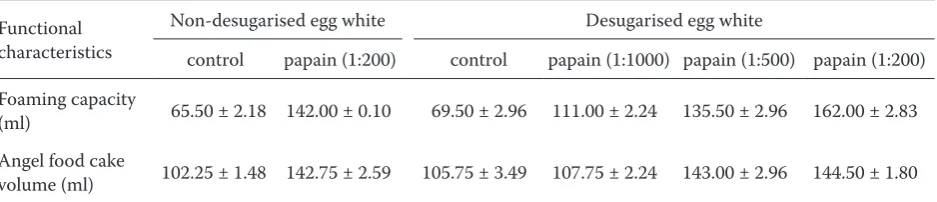
Non-desugarised and desugarised liquid egg whites treated with papain prior to drying showed an increase in the foaming capacity, regardless of the desugarisation method. The results of this study also indicated that an increased amount of papain produced a higher foaming capacity. Simi-lar to the foaming capacity, the papain treatment provided a positive effect on the angel food cake volume performance of egg white solids. Higher cake volumes of egg white solids prepared by hy-drolysis with papain were obtained in comparison with those of non-treated controls (Table 6) (LEE & CHEN 2002).
[image:7.595.65.534.654.755.2]Effect of proteose-peptone.This effect was tested using additions of small amounts of proteose-pep-tone (0.01−0.10%), separated from raw skim milk, to 5% egg white dispersion. It was found that the foam overrun decreased from the original value of 1010% with the control to 750% following the addition of 0.01% proteose-peptone. The stability of the foam enhanced, as a result of the reduction in gas pressure in the foam. At higher levels of pro-teose-peptone, the foam had markedly fewer bubbles and the moisture drained freely suggesting a rapid breakdown in the foam (PHILLIPS et al. 1987).
Table 6. Functional characteristics of non-desugarised and desugarised egg white solids processed by papain treat-ment
Functional characteristics
Non-desugarised egg white Desugarised egg white
control papain (1:200) control papain (1:1000) papain (1:500) papain (1:200) Foaming capacity
(ml) 65.50 ± 2.18 142.00 ± 0.10 69.50 ± 2.96 111.00 ± 2.24 135.50 ± 2.96 162.00 ± 2.83 Angel food cake
References
ALLEONI A.C.C., ANTUNES A.J. (2004): Albumen foam stability and s-ovalbumin contents in eggs coated with whey protein concentrate. Revista Brasileira de Ciência Avícola, 6: 105–110.
BALDWIN R.E. (1986): Functional properties of eggs in foods. Charp 16. In: STADELMAN W.I., COTTERILL O.J. (eds): Egg Science and Technology. 3rd Ed. AVI Publishing Co., New York: 346.
BALL H.R., WINN J.R., WINN S.E. (1982): Acylation of egg white proteins with acetic and succinic anhydride. Poultry Science, 61: 1041–1046.
BARMORE R.E. (1934): The influence of chemical and physical factors on egg white foams. Colorado Expe-rimental Station Technical Bulletin, 9: 418–434. Cited in: STADELMAN W.I., COTTERILL O.J. (eds) (1994): Egg Science and Technology. Food Product Press, Haworth Press Inc., Binghamton.
CHANG Y.I., CHEN T.C. (2000): Functional and gel charac-teristics of liquid whole egg as affected by pH alteration. Journal of Food Engineering, 45: 237–241.
COTTERILL O.J., FUNK E.M. (1963): Effect of pH and lipase treatment on yolk contaminated egg white. Food Technology, 17: 1183–1188.
COTTERILL O.J., CHANG C.C., MCBEE L.E., HEYMANN H. (1992): Metallic cations affect functional performance of spray-dried heat-treated egg white. Journal of Food Science, 57: 1321–1322, 1347.
CUNNINGHAM F.E., COTTERILL O.J, FUNK E.M. (1960): The effect of the season and age of bird 3. On the per-formance of egg white in angel cakes. Poultry Science,
39: 1446–1450.
CUNNINGHAM F.E., COTTERILL O.J. (1964): Effect of centrifuging yolk contaminated liquid egg white on functional performance. Poultry Science, 43: 283– 291.
DAVIS C., REEVES R. (2002): High value opportunities from the chicken egg. RIRDC Publication, No. 02/094. DIZMANG D.K., SUNDERLING G. (1933): The effect of
milk on the whipping quality of egg white. Cited in: STADELMAN W.I., COTTERILL O.J. (eds) (1994): Egg Science and Technology. Food Product Press, Haworth. U.S. Egg and Poultry Magazine, 39(11): 18–19. FERREIRA M., BENRINGER R., JOST R. (1995): Instrumental
method for characterizing protein foams. Journal of Food Science, 60: 90–93.
FORSYTHE R.H., BERGQUIST D.H. (1951): The effect of physical treatment on some properties of egg white. Poultry Science, 30: 302–311.
GIRTON A.R., MACNEIL J.H., ANANTHESWARAN R.C. (1999): Effect of initial product temperature and initial
pH on foaming time during vacuum evaporation of liquid whole eggs. Poultry Science, 78: 1452–1458. GUTIERREZ M.A., TAKAHASHI H., JUNEJA L.R. (1997):
Nu-tritive evaluation of hen eggs. In: YAMAMOTO T., JUNEA L.R., HATTA H., KIM M. (eds): Hen Eggs: Their Basic and Applied Science. CRC Press, Boca Raton: 25– 35.
HAMMERSHØJ M., LARSEN L.B. (1999): Foaming of oval-bumin and egg albumen fractions and the role of the disulfide bonds at various pH levels. In: CAVALCHINI G.C., BAROLI D. (eds): Proceeding of VII European Symposium on the Quality of Eggs and Egg Products. Bologna, 19–23 September: 351–357.
HAMMERSHØJ M., QVIST K.B. (2001): Importance of hen age and egg storage time for egg albumen foa-ming. Lebensmittel-Wissenschaft & Technologie, 34: 118–120.
HAMMERSHØJ M., PETERS L.V., ANDERSEN H.J. (2004): The significance of critical processing steps on the production of dried egg albumen powder on gel tex-tural and foaming properties. Journal of the Science of Food and Agriculture, 84: 1039–1048.
HANNING F.M. (1945): Effect of sugar or salt upon de-naturation produced by beating and upon the ease of formation and the stability of egg white foams. Iowa State College Journal Science, 20: 10–12. Cited in: STADELMAN W.I., COTTERILL O.J. (eds) (1994): Egg Science and Technology. Food Product Press, Haworth Press Inc., Binghamton.
HATTA H., HAGI T., HIRANO K. (1997): Chemical and physicochemical properties of hen eggs and their appli-cation in foods. In: YAMAMOTO T., JUNEA L.R., HATTA H., KIM M. (eds): Hen Eggs. Their Basic and Applied Science. CRC Press, Boca Raton: 117–134.
HORIUCHI T., FUKUSHIMA D. (1978): Studies on enzyme- modified proteins as foaming agents: effect of structure on foam stability. Food Chemistry, 3: 35–41.
JOHNSON T.M., ZABIK M.E. (1981): Ultrastructural exa-mination of egg albumen protein foams. Journal of Food Science, 46: 1237–1240.
KATO A., TAKAHASHI A., MATSUDOMI N., KOBAYASHI K. (1983): Determination of foaming properties of proteins by conductivity measurements. Journal of Food Science, 48: 62–65.
KATO A., IBRAHIM H.R., WATANABE H., HOUNMA K., KOBAYASHI K. (1990): Enthalpy of denaturation and surface functional properties of heated egg white pro-teins in the dry state. Journal of Agricultural and Food Chemistry, 38: 32–37.
Uses and Processing Technologies. New Developments. CAB International, Wallingford: 250–267.
KIM K., SETSER C.S. (1982): Foaming properties of fresh and commercially dried eggs in the presence of stabilizers and surfactants. Poultry Science, 61: 2194–2199.
KNORR D., ZENKER M., HEINZ V., LEE D.-U. (2004): Ap-plication and potential of ultrasonics in food processing. Trends in Food Science & Technology, 15: 261–266. LEE W.C., CHEN T.C. (2002): Functional characteristics of
egg white solids obtained from papain treated albumen. Journal of Food Engineering, 51: 263–266.
MA C.-Y., POSTE L.M., HOLME J. (1986): Effects of chemi-cal modifications on the physicochemichemi-cal and cake-baking properties of egg white. Canadian Institute od Food Science and Technology Journal, 19: 17–22. MA C.-Y., SAHASRABUDHE M.R., POSTE L.M.,
HAR-WALKAR V.R., CHAMBERS J.R., O’HARA K.P.J. (1994): Gamma irradiation and physicochemical properties of eggs and egg products. In: SIM J.S., NAKAI S. (eds.): In Egg Uses and Processing Technologies. New Develop-ments. CAB International, Wallingford: 283–299. MINE Y. (1995): Recent advances in the understanding
of egg white protein functionality. Trends in Food Science & Technology, 6: 225–232.
NAKAMURA R., SATO Y. (1964a): Studies on the foam-ing property of the chicken egg white. Part IX. On the
coagulated proteins under various whipping conditions (The mechanism of foaminess (1)). Agricultural and Biological Chemistry, 28: 524–529.
NAKAMURA R., SATO Y. (1964b): Studies on the foam-ing property of the chicken egg white. Part X. On the role of ovomucin (B) in the egg white foaminess (The mechanism of foaminess (2)). Agricultural and Biological Chemistry, 28: 530–534.
PHILLIPS L.G., HAQUE Z., KINSELLA J.E. (1987): A method for the measurement of foam formation and stability. Journal of Food Science, 52: 1074–1077.
REGENSTEIN J.M., GRUNDEN L.P., BAKER R.C. (1978): Proteolytic enzymes and the functionality of chicken egg albumen. Journal of Food Science, 43: 279–280. SILVERSIDES F.G., BUDGELL K. (2004): The relationships
among measures of egg albumen height, pH, and whip-ping volume. Poultry Science, 83: 1619–1623. STADELMAN W.I., COTTERILL O.J. (1994): Foaming.
In: Egg Science & Technology. Food Product Press, HaworthPress Inc., Binghamton: 418–434.
ST. JOHN J.L., FLOR I.H. (1931): A study of whipping and colaguation of eggs of varying quality. Poultry Science, 10: 71–82.
Received for publication October 7, 2005 Accepted after corrections November 19, 2005
Corresponding author:
Mgr. KATERYNA LOMAKINA, Vysoká škola chemicko-technologická v Praze, Fakulta potravinářské a biochemické technologie, Ústav chemie a analýzy potravin, Technická 5, 166 28 Praha 6, Česká republika