Received 24 September 2019 Accepted 4 October 2019
Edited by A. J. Lough, University of Toronto, Canada
Keywords:crystal structure; dihydrothiazine; hydrogen bond;-stacking; Hirshfeld surface.
CCDC reference:1957875
Supporting information:this article has supporting information at journals.iucr.org/e
Crystal structure, Hirshfeld surface analysis and
interaction energy and DFT studies of (2
Z
)-4-benzyl-2-(2,4-dichlorobenzylidene)-2
H
-1,4-benzo-thiazin-3(4
H
)-one
Nada Kheira Sebbar,a,bBrahim Hni,bTuncer Ho¨kelek,cMohamed Labd Taha,a Joel T. Mague,dLhoussaine El Ghayatib* and El Mokhtar Essassib
aLaboratoire de Chimie Applique´e et Environnement, Equipe de Chimie Bioorganique Applique´e, Faculte´ des Sciences, Universite´ Ibn Zohr, Agadir, Morocco,bLaboratoire de Chimie Organique He´te´rocyclique URAC 21, Poˆle de Compe´tence Pharmacochimie, Av. Ibn Battouta, BP 1014, Faculte´ des Sciences, Universite´ Mohammed V, Rabat, Morocco, cDepartment of Physics, Hacettepe University, 06800 Beytepe, Ankara, Turkey, anddDepartment of Chemistry, Tulane University, New Orleans, LA 70118, USA. *Correspondence e-mail: [email protected]
The title compound, C22H15Cl2NOS, contains 1,4-benzothiazine and
2,4-di-chlorobenzylidene units, where the dihydrothiazine ring adopts a screw-boat conformation. In the crystal, intermolecular C—HBnz OThz (Bnz = benzene
and Thz = thiazine) hydrogen bonds form corrugated chains extending along the
b-axis direction which are connected into layers parallel to the bc plane by intermolecular C—HMethy SThz (Methy = methylene) hydrogen bonds,
enclosing R44(22) ring motifs. Offset -stacking interactions between
2,4-di-chlorophenyl rings [centroid–centroid = 3.7701 (8) A˚ ] and-interactions which are associated by C—HBnz (ring) and C—HDchlphy (ring) (Dchlphy =
2,4-dichlorophenyl) interactions may be effective in the stabilization of the crystal structure. The Hirshfeld surface analysis of the crystal structure indicates that the most important contributions for the crystal packing are from H H (29.1%), H C/C H (27.5%), H Cl/Cl H (20.6%) and O H/H O (7.0%) interactions. Hydrogen-bonding and van der Waals interactions are the dominant interactions in the crystal packing. Computational chemistry indicates that in the crystal, the C—HBnz OThz and C—HMethy SThz hydrogen-bond
energies are 55.0 and 27.1 kJ mol1, respectively. Density functional theory (DFT) optimized structures at the B3LYP/6-311G(d,p) level are compared with the experimentally determined molecular structure in the solid state. The HOMO–LUMO behaviour was elucidated to determine the energy gap.
1. Chemical context
1,4-Benzothiazine derivatives constitute an important class of heterocyclic systems. These molecules exhibit a wide range of biological applications, indicating the fact that the 1,4-benzo-thiazine moiety is a template potentially useful in medicinal chemistry research and therapeutic applications, such as the anti-inflammatory (Trapani et al., 1985; Gowdaet al., 2011), antipyretic (Warren & Knaus, 1987), antimicrobial (Armenise
et al., 2012; Rathore & Kumar, 2006), antiviral (Malaguet al., 1998), anticancer (Guptaet al., 1985; Gupta & Gupta, 1991) and anti-oxidant (Zia-ur-Rehmanet al., 2009) areas. They have also been reported as precursors for the syntheses of new compounds (Sebbaret al., 2015a; Vidalet al., 2006) possessing antidiabetic (Tawadaet al., 1990) and anticorrosion activities (Ellouzet al., 2016a,b; Sebbaret al., 2016a). They also possess biological properties (Hni et al., 2019a,b; Sebbaret al., 2017; Ellouzet al., 2017a,b, 2018). As a continuation of our research on the development of N-substituted 1,4-benzothiazine
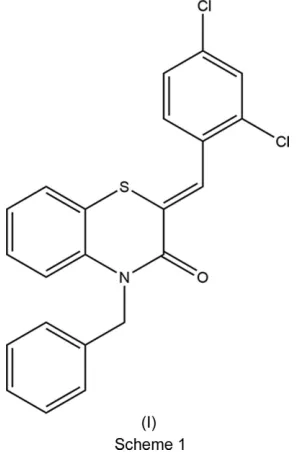
vatives and the evaluation of their potential pharmacological activities, we report here the synthesis of (2Z )-4-benzyl-2-(2,4-dichlorobenzylidene)-2H-1,4-benzothiazin-3(4H)-one, (I), by the reaction of benzyl chloride with (Z )-2-(2,4-dichloro-benzylidene)-2H-1,4-benzothiazin-3(4H)-one and potassium carbonate in the presence of tetra-n-butylammonium bromide (as catalyst). The molecular and crystal structures, together with the Hirshfeld surface analysis, the intermolecular inter-action energies and density functional theory (DFT) compu-tational calculations were carried out at the B3LYP/6-311G(d,p) and B3LYP/6-B3LYP/6-311G(d,p) levels, respectively, for (I) (see Scheme 1).
2. Structural commentary
The title compound, (I), contains 1,4-benzothiazine and 2,4-dichlorobenzylidene units (Fig. 1), where the dihydrothiazine ring, B (atoms S1/N1/C1/C6–C8), adopts a screw-boat
conformation with puckering parameters (Cremer & Pople, 1975) of QT = 0.4331 (10) A˚ , = 68.34 (16) and ’ =
333.95 (17). The planar ringsA(C1–C6),C(C10–C15) andD
(C17–C22) are oriented at dihedral angles ofA/C= 60.49 (4),
A/D= 79.69 (4)andC/D= 41.29 (4). Atoms Cl1 and Cl2 are
0.0156 (3) and 0.0499 (4) A˚ from ring Cand so are almost coplanar.
3. Supramolecular features
In the crystal, intermolecular C—HBnz OThz(Bnz = benzene
and Thz = thiazine) hydrogen bonds form corrugated chains extending along theb-axis direction which are connected into layers parallel to the bc plane by intermolecular C— HMethy SThz(Methy = methylene) hydrogen bonds, enclosing
R4
4(22) ring motifs (Bernsteinet al., 1995) (Table 1 and Fig. 2).
Offset -stacking interactions between 2,4-dichlorophenyl rings C [atoms C10–C15; Cg3 Cg3i, where Cg3 is the centroid of ringC; symmetry code: (i)x,y+ 1,z+ 1], may further stabilize the structure, with a centroid–centroid distance of 3.7701 (8) A˚ , together with-interactions,i.e.C— HBnz (ring) and C—HDchlphy (ring) (Dchlphy =
2,4-di-chlorophenyl). The Hirshfeld surface analysis of the crystal
research communications
Acta Cryst.(2019). E75, 1650–1656 Sebbaret al. C
[image:2.610.315.567.118.185.2]22H15Cl2NOS
1651
Figure 2A partial packing diagram, viewed along thea-axis direction, with C— HBnz OThzand C—HMethy SThz(Bnz = benzene, Thz = thiazine and
[image:2.610.97.245.221.447.2]Methy = methylene) hydrogen bonds shown, respectively, as black and light-purple dashed lines.
Figure 1
[image:2.610.316.561.523.707.2]The molecular structure of the title compound with the atom-numbering scheme. Displacement ellipsoids are drawn at the 50% probability level.
Table 1
Hydrogen-bond geometry (A˚ ,).
Cg1 and Cg4 are the centroids of rings A (C1–C6) and D (C17–C22), respectively.
D—H A D—H H A D A D—H A
C4—H4 O1ix 0.936 (19) 2.51 (2) 3.3346 (17) 147.7 (15) C16—H16B S1v 0.945 (16) 2.852 (16) 3.7011 (13) 149.9 (12) C3—H3 Cg4ix 0.938 (17) 2.901 (17) 3.6428 (15) 136.8 (13) C14—H14 Cg4x 0.971 (19) 2.710 (18) 3.5593 (15) 146.8 (14) C18—H18 Cg1xi 0.979 (18) 2.969 (18) 3.6759 (16) 130.0 (13)
Symmetry codes: (v)x;yþ1
2;z12; (ix)xþ1;y12;zþ12; (x)x1;y12;z12;
[image:2.610.51.295.529.714.2]structure indicates that the most important contributions for the crystal packing are from H H (29.1%), H C/C H (27.5%), H Cl/Cl H (20.6%) and O H/H O (7.0%) interactions. Hydrogen-bonding and van der Waals inter-actions are the dominant interinter-actions in the crystal packing.
4. Hirshfeld surface analysis
In order to visualize the intermolecular interactions in the crystal of (I), a Hirshfeld surface (HS) analysis (Hirshfeld, 1977; Spackman & Jayatilaka, 2009) was carried out using
CrystalExplorer(Version 17.5; Turneret al., 2017). In the HS plotted overdnorm(Fig. 3), the white surface indicates contacts
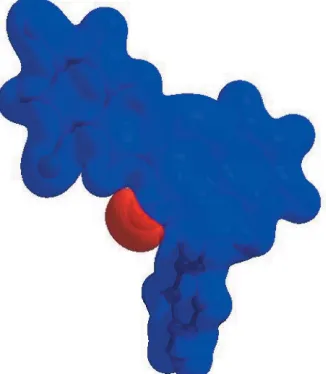
with distances equal to the sum of the van der Waals radii, and the red and blue colours indicate distances shorter (in close contact) or longer (distinct contact) than the van der Waals radii, respectively (Venkatesan et al., 2016). The bright-red spots appearing near atoms O1, S1 and H4 indicate their roles
as the respective donors and/or acceptors; they also appear as blue and red regions corresponding to positive and negative potentials on the HS mapped over electrostatic potential (Spackman et al., 2008; Jayatilaka et al., 2005), as shown in Fig. 4. The blue regions indicate the positive electrostatic potential (hydrogen-bond donors), while the red regions indicate the negative electrostatic potential (hydrogen-bond acceptors). The shape-index of the HS is a tool to visualize the
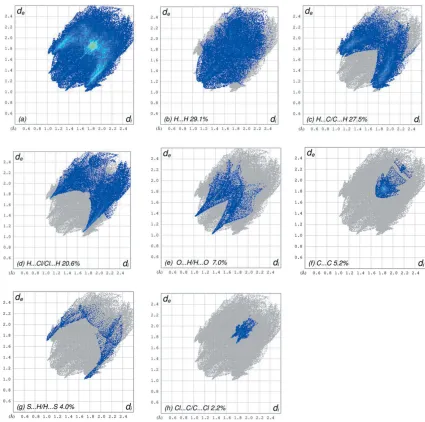
–stacking by the presence of adjacent red and blue trian-gles; if there are no adjacent red and/or blue triangles, then there are no–interactions. Fig. 5 clearly suggest that there are–interactions in (I). The overall two-dimensional (2D) fingerprint plot (Fig. 6a) and those delineated into H H, H C/C H, H Cl/Cl H, O H/H O, C C, S H/ H S and Cl C/C Cl contacts (McKinnonet al., 2007) are illustrated in Figs. 6(b)–(h), respectively, together with their
Figure 3
View of the 3D Hirshfeld surface of the title compound, plotted over
[image:3.610.69.273.74.219.2]dnormin the range0.1634 to 1.5051 a.u.
Figure 4
[image:3.610.313.565.88.323.2]View of the 3D Hirshfeld surface of the title compound, plotted over electrostatic potential energy in the range0.0500 to 0.0500 a.u., using the STO-3G basis set at the Hartree–Fock level of theory. Hydrogen-bond donors and acceptors are shown as blue and red regions around the atoms corresponding to positive and negative potentials, respectively.
Figure 5
Hirshfeld surface of the title compound plotted over shape-index.
Table 2
Selected interatomic distances (A˚ ).
Cl1 Cl1i 3.2439 (5) C6 C22 3.4830 (18) Cl1 C14ii 3.4981 (14) C6 C12v 3.5828 (18) Cl1 H9 2.647 (16) C7 C22 3.4391 (18) Cl2 H19iii 2.96 (2) C10 C12ii 3.4871 (18) Cl2 H9ii 3.044 (16) C14 C20iv 3.572 (2) Cl2 H4iv 3.138 (18) C5 H16A 2.563 (16) S1 Cl2v 3.5832 (5) C6 H22 2.904 (15) S1 Cl2v 3.5832 (5) C8 H15 2.929 (18) S1 N1 3.0801 (11) C16 H5 2.556 (18) S1 C15 3.1625 (14) C17 H5 2.829 (18) S1 C13v 3.6033 (13) C18 H3vi 2.998 (17) S1 H15 2.578 (18) C21 H12i 2.845 (18) O1 C17 3.2096 (16) H14 C20iv 2.964 (18) O1 C4vi 3.3346 (17) H14 C21iv 2.899 (18) O1 H9 2.406 (16) H14 C22iv 2.990 (18) O1 H16B 2.345 (16) H15 C19iv 2.951 (18) O1 H4vi 2.51 (2) H16B S1v 2.852 (16) N1 S1 3.0801 (11) H16B C1v 2.973 (16) N1 H22 2.552 (15) H18 C6v 2.934 (19) C1 C12v 3.4639 (18) H5 H16A 2.16 (2) C1 C13v 3.4372 (18) H12 H21i 2.46 (3) C2 C12v 3.541 (2) H15 H21viii 2.51 (3) C3 C3vii 3.485 (2) H16B H18 2.51 (2) C5 C22 3.4988 (19) H18 H22v 2.53 (2) C5 C17 3.4201 (18)
Symmetry codes: (i) xþ1;yþ1;zþ1; (ii) x;yþ1;zþ1; (iii)
x1;y;zþ1; (iv)x1;yþ1 2;zþ
1
2; (v)x;yþ 1 2;z
1
2; (vi)xþ1;yþ 1 2;zþ
1 2;
[image:3.610.92.255.508.695.2] [image:3.610.336.539.588.728.2]relative contributions to the Hirshfeld surface. The most important interaction is H H, contributing 29.1% to the overall crystal packing, which is reflected in Fig. 6(b) as widely scattered points of high density due to the large hydrogen content of the molecule with the tip atde=di= 1.17 A˚ , due to
the short interatomic H H contacts (Table 2). In the presence of C—H interactions, the pairs of characteristic wings resulting in the fingerprint plot delineated into H C/ C H contacts (Fig. 6c), with a 27.5% contribution to the HS, arises from the H C/C H contacts (Table 2) and are viewed as pairs of spikes with the tips at de + di = 2.82 and
2.78 A˚ for thin and thick spikes, respectively. The pair of scattered points of the wings resulting in the fingerprint plots delineated into H Cl/Cl H (Fig. 6d), with a 20.6% contribution to the HS, has a symmetrical distribution of points with the edges at de + di = 2.78 A˚ arising from the
H Cl/Cl H contacts (Table 2). The pair of characteristic wings resulting in the fingerprint plot delineated into O H/ H O contacts (Fig. 6e), with a 7.0% contribution to the HS, arises from the O H/H O contacts (Table 2) and is viewed as a pair of spikes with the tips atde+di= 2.35 A˚ . The C C
contacts (Fig. 6f) have an arrow-shaped distribution of points with the tip atde=di= 1.7 A˚ . Finally, the characteristic wings
resulting in the fingerprint plots delineated into S H/H S and Cl C/C Cl contacts (Figs. 6g and 6h), with 4.0 and 2.2% contributions to the HS, arise from the S H/H S and Cl C/C Cl contacts (Table 2) and are viewed with the tips atde=di= 2.70 A˚ andde+di= 3.46 A˚ , respectively.
The Hirshfeld surface representations with the function
dnorm plotted onto the surface are shown for the H H,
H C/C H, H Cl/Cl H, O H/H O, C C and S H/H S interactions in Figs. 7(a)–(f), respectively.
research communications
Acta Cryst.(2019). E75, 1650–1656 Sebbaret al. C
[image:4.610.92.517.283.705.2]22H15Cl2NOS
1653
Figure 6The full 2D fingerprint plots for the title compound, showing (a) all interactions, and delineated into (b) H H, (c) H C/C H, (d) H Cl/Cl H, (e) O H/H O, (f) C C, (g) S H/H S and (h) Cl C/C Cl interactions. Thedianddevalues are the closest internal and external distances (in A˚ )
The Hirshfeld surface analysis confirms the importance of H-atom contacts in establishing the packing. The large number of H H, H C/C H, H Cl/Cl H and O H/H O interactions suggest that van der Waals interactions and hydrogen bonding play the biggest roles in the crystal packing (Hathwaret al., 2015).
5. Interaction energy calculations
The intermolecular interaction energies are calculated using CE–B3LYP/6-31G(d,p) energy model available in Crystal-Explorer (CE) (Version 17.5; Turner et al., 2017), where a cluster of molecules would need to be generated by applying crystallographic symmetry operations with respect to a selected central molecule within a default radius of 3.8 A˚ (Turneret al., 2014). The total intermolecular energy (Etot) is
the sum of the electrostatic (Eele), polarization (Epol),
disper-sion (Edis) and exchange-repulsion (Erep) energies (Turneret
al., 2015), with scale factors of 1.057, 0.740, 0.871 and 0.618, respectively (Mackenzie et al., 2017). Hydrogen-bonding interaction energies (in kJ mol1) were calculated as20.3 (Eele),2.6 (Epol),79.4 (Edis), 60.7 (Erep) and 55.0 (Etot)
for C—HBnz OThzhydrogen-bonding interactions, and5.8
(Eele),1.0 (Epol),51.0 (Edis), 39.3 (Erep) and 27.1 (Etot)
for C—HMethy SThzhydrogen-bonding interactions.
6. DFT calculations
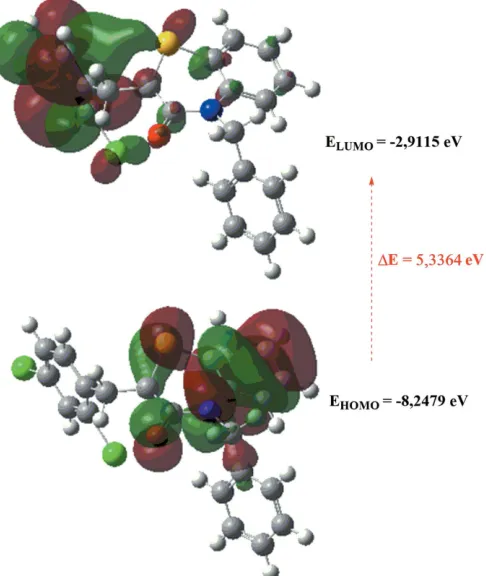
The optimized structure of (I) in the gas phase was generated theoreticallyviadensity functional theory (DFT) using stan-dard B3LYP functional and 6-311G(d,p) basis-set calculations (Becke, 1993), as implemented inGAUSSIAN09(Frischet al., 2009). The theoretical and experimental results were in good agreement (Table 3). The highest-occupied molecular orbital (HOMO), acting as an electron donor, and the lowest-unoc-cupied molecular orbital (LUMO), acting as an electron acceptor, are very important parameters for quantum chem-istry. When the energy gap is small, the molecule is highly polarizable and has high chemical reactivity. The DFT calcu-lations provide some important information on the reactivity
Figure 8
[image:5.610.47.290.71.361.2] [image:5.610.314.565.92.250.2]The energy band gap of the title compound.
Figure 7
The Hirshfeld surface representations with the function dnorm plotted
onto the surface for (a) H H, (b) H C/C H, (c) H Cl/Cl H, (d) O H/H O, (e) C C and (f) S H/H S interactions.
Table 3
Comparison of the selected (X-ray and DFT) geometric data (A˚ ,).
Bonds/angles X-ray B3LYP/6–311G(d,p)
Cl1—C11 1.7357 (13) 1.80981 Cl2—C13 1.7382 (13) 1.80489
S1—C8 1.7525 (12) 1.80120
S1—C1 1.7561 (13) 1.82629
O1—C7 1.2228 (16) 1.23968
N1—C7 1.3759 (16) 1.38157
N1—C6 1.4192 (16) 1.41776
[image:5.610.52.295.433.721.2]and site selectivity of the molecular framework. EHOMOand
ELUMOclarifying the inevitable charge exchange collaboration
inside the studied material, electronegativity (), hardness (), potential (), electrophilicity (!) and softness () are recorded in Table 4. The significance ofandis to evaluate both the reactivity and stability. The electron transition from the HOMO to the LUMO energy level is shown in Fig. 8. The HOMO and LUMO are localized in the plane extending from the whole molecule. The energy band gap (E = ELUMO –
EHOMO) of the molecule was about 5.3364 eV, and the frontier
molecular orbital (FMO) energies, EHOMOandELUMO, were
8.2479 and2.9115 eV, respectively.
7. Database survey
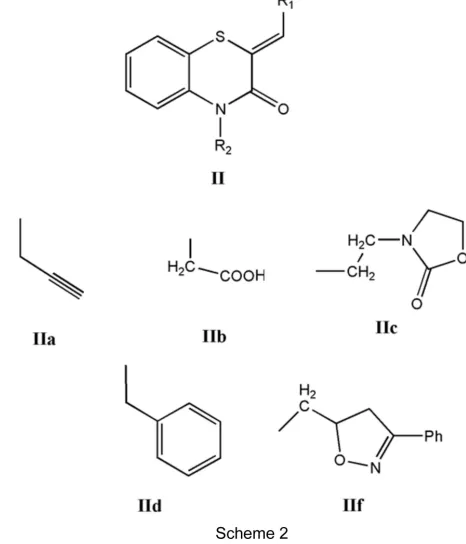
A search in the Cambridge Structural Database (Groomet al., 2016; updated to June 2019) for compounds containing the fragment II (withR1= Ph andR2= C; see Scheme 2) gave 14
hits. WithR1= Ph andR2= CH2C CH (IIa) (Sebbaret al.,
2014a), CH2COOH (IIb) (Sebbaret al., 2016c),
2-(2-oxo-1,3-oxazolidin-3-yl)ethyl (IIc) (Sebbar et al., 2016b) and (3-phenyl-4,5-dihydro-1,2-oxazol-5-yl)methyl (IIf) (Sebbaret al., 2015b)] (Scheme 2), there are other examples withR1 =
4-FC6H4andR2= CH2C CH (IIa) (Hniet al., 2019a),R1=
4-ClC6H4andR2= CH2Ph2 (IId) (Ellouzet al., 2016c), andR1=
2-ClC6H4 and R2 = CH2C CH (IIa) (Sebbar et al., 2017)
(Scheme 2). In all compounds, the configuration about the benzylidene-group C CHC6H5bond isZ, and in the majority
of these, the heterocyclic ring is quite nonplanar, with the dihedral angle between the plane defined by the benzene ring plus the N and S atoms, and that defined by the N and S atoms and the other two C atoms separating them ranging fromca29 (forIIa) to 36(for
IIf). The other two (IIaandIIc) have the benzothiazine unit nearly planar, with corresponding dihedral angles ofca3–4.
8. Synthesis and crystallization
To a solution of (Z)-2-(2,4-dichlorobenzylidene)-2H -1,4-benzothiazin-3(4H)-one (3.21 mmol), benzyl chloride (6.52 mmol) and potassium carbonate (6.51 mmol) in di-methylformamide (DMF; 17 ml) was added a catalytic amount of tetra-n-butylammonium bromide (0.33 mmol). The mixture was stirred for 24 h. The solid material was removed by filtration and the solvent evaporated under vacuum. The solid product was purified by recrystallization from ethanol to afford colourless crystals in 82% yield.
research communications
Acta Cryst.(2019). E75, 1650–1656 Sebbaret al. C
[image:6.610.45.296.93.224.2]22H15Cl2NOS
1655
Table 5Experimental details.
Crystal data
Chemical formula C22H15Cl2NOS
Mr 412.31
Crystal system, space group Monoclinic,P21/c Temperature (K) 150
a,b,c(A˚ ) 9.0373 (7), 16.6798 (13), 12.511 (1)
() 95.982 (2)
V(A˚3) 1875.6 (3)
Z 4
Radiation type CuK
(mm1) 4.25
Crystal size (mm) 0.150.130.09
Data collection
Diffractometer Bruker D8 VENTURE PHOTON 100 CMOS
Absorption correction Numerical (SADABS; Krauseet al., 2015)
Tmin,Tmax 0.59, 0.70 No. of measured, independent and
observed [I> 2(I)] reflections
48886, 3847, 3650
Rint 0.038
(sin/)max(A˚
1
) 0.625
Refinement
R[F2> 2(F2)],wR(F2),S 0.026, 0.070, 1.05 No. of reflections 3847
No. of parameters 304
H-atom treatment All H-atom parameters refined
max,min(e A˚
3
) 0.22,0.26
Computer programs: APEX3 (Bruker, 2016), SAINT (Bruker, 2016), SHELXT
(Sheldrick, 2015a), SHELXL2018(Sheldrick, 2015b), DIAMOND (Brandenburg & Putz, 2012) andSHELXTL(Bruker, 2016).
Table 4
Calculated energies..
Molecular Energy (a.u.) (eV) Compound (I)
Total EnergyTE(eV) 62249, 6662
EHOMO(eV) 8.2479
ELUMO(eV) 2.9115
GapE(eV) 5.3364
Dipole moment,(Debye) 3.4723 Ionization potential,I(eV) 8.2479
Electron affinity,A 2.9115
Electro negativity, 5.3364
Hardness, 2.6682
Electrophilicity index,! 5.8340
Softness, 0.3748
[image:6.610.318.551.336.608.2]9. Refinement
The experimental details, including the crystal data, data collection and refinement, are summarized in Table 5. H atoms were located in a difference Fourier map and refined freely.
Acknowledgements
The support of NSF-MRI for the purchase of the diffract-ometer and Tulane University for support of the Tulane Crystallography Laboratory are gratefully acknowledged.
Funding information
Funding for this research was provided by: NSF-MRI (grant No. 1228232); Hacettepe University Scientific Research Project Unit (grant No. 013 D04 602 004 to TH).
References
Armenise, D., Muraglia, M., Florio, M. A., Laurentis, N. D., Rosato, A., Carrieri, A., Corbo, F. & Franchini, C. (2012).Mol. Pharmacol. 50, 1178–1188.
Becke, A. D. (1993).J. Chem. Phys.98, 5648–5652.
Bernstein, J., Davis, R. E., Shimoni, L. & Chang, N. L. (1995).Angew. Chem. Int. Ed. Engl.34, 1555–1573.
Brandenburg, K. & Putz, H. (2012). DIAMOND. Crystal Impact GbR, Bonn, Germany.
Bruker (2016).APEX3,SAINT,SADABSandSHELXTL. Bruker AXS Inc., Madison, Wisconsin, USA.
Cremer, D. & Pople, J. A. (1975).J. Am. Chem. Soc.97, 1354–1358. Ellouz, M., Elmsellem, H., Sebbar, N. K., Steli, H., Al Mamari, K.,
Nadeem, A., Ouzidan, Y., Essassi, E. M., Abdel-Rahaman, I. & Hristov, P. (2016b).J. Mater. Environ. Sci.7, 2482–2497.
Ellouz, M., Sebbar, N. K., Boulhaoua, M., Essassi, E. M. & Mague, J. T. (2017a).IUCrData,2, x170646.
Ellouz, M., Sebbar, N. K., Elmsellem, H., Steli, H., Fichtali, I., Mohamed, A. M. M., Mamari, K. A., Essassi, E. M. & Abdel-Rahaman, I. (2016a).J. Mater. Environ. Sci.7, 2806–2819. Ellouz, M., Sebbar, N. K., Essassi, E. M., Ouzidan, Y., Mague, J. T. &
Zouihri, H. (2016c).IUCrData,1, x160764.
Ellouz, M., Sebbar, N. K., Fichtali, I., Ouzidan, Y., Mennane, Z., Charof, R., Mague, J. T., Urrutigoı¨ty, M. & Essassi, E. M. (2018). Chem. Cent. J.12, 123.
Ellouz, M., Sebbar, N. K., Ouzidan, Y., Essassi, E. M. & Mague, J. T. (2017b).IUCrData,2, x170097.
Frisch, M. J.,et al.(2009).GAUSSIAN09. Gaussian Inc., Wallingford, CT, USA.
Gowda, J., Khader, A. M. A., Kalluraya, B., Shree, P. & Shabaraya, A. R. (2011).Eur. J. Med. Chem.46, 4100–4106.
Groom, C. R., Bruno, I. J., Lightfoot, M. P. & Ward, S. C. (2016).Acta Cryst.B72, 171–179.
Gupta, R. R., Kumar, R. & Gautam, R. K. (1985).J. Fluor. Chem.28, 381–385.
Gupta, V. & Gupta, R. R. (1991).J. Prakt. Chem.333, 153–156. Hathwar, V. R., Sist, M., Jørgensen, M. R. V., Mamakhel, A. H.,
Wang, X., Hoffmann, C. M., Sugimoto, K., Overgaard, J. & Iversen, B. B. (2015).IUCrJ,2, 563–574.
Hirshfeld, H. L. (1977).Theor. Chim. Acta,44, 129–138.
Hni, B., Sebbar, N. K., Ho¨kelek, T., El Ghayati, L., Bouzian, Y., Mague, J. T. & Essassi, E. M. (2019b).Acta Cryst.E75, 593–599. Hni, B., Sebbar, N. K., Ho¨kelek, T., Ouzidan, Y., Moussaif, A., Mague,
J. T. & Essassi, E. M. (2019a).Acta Cryst.E75, 372–377.
Jayatilaka, D., Grimwood, D. J., Lee, A., Lemay, A., Russel, A. J., Taylor, C., Wolff, S. K., Cassam-Chenai, P. & Whitton, A. (2005). TONTO - A System for Computational Chemistry. Available at: http://hirshfeldsurface.net/.
Krause, L., Herbst-Irmer, R., Sheldrick, G. M. & Stalke, D. (2015).J. Appl. Cryst.48, 3–10.
Mackenzie, C. F., Spackman, P. R., Jayatilaka, D. & Spackman, M. A. (2017).IUCrJ,4, 575–587.
Malagu, K., Boustie, J., David, M., Sauleau, J., Amoros, M., Girre, R. L. & Sauleau, A. (1998).Pharm. Pharmacol. Commun.4, 57–60. McKinnon, J. J., Jayatilaka, D. & Spackman, M. A. (2007).Chem.
Commun.pp. 3814–3816.
Rathore, B. S. & Kumar, M. (2006).Bioorg. Med. Chem.14, 5678– 5682.
Sebbar, N. K., Ellouz, M., Essassi, E. M., Ouzidan, Y. & Mague, J. T. (2015a).Acta Cryst.E71, o999.
Sebbar, N. K., Ellouz, M., Essassi, E. M., Saadi, M. & El Ammari, L. (2015b).Acta Cryst.E71, o423–o424.
Sebbar, N. K., Ellouz, M., Essassi, E. M., Saadi, M. & El Ammari, L. (2016a).IUCrData,1, x161012.
Sebbar, N. K., Ellouz, M., Mague, J. T., Ouzidan, Y., Essassi, E. M. & Zouihri, H. (2016c).IUCrData,1, x160863.
Sebbar, N. K., Ellouz, M., Ouzidan, Y., Kaur, M., Essassi, E. M. & Jasinski, J. P. (2017).IUCrData,2, x170889.
Sebbar, N. K., Mekhzoum, M. E. M., Essassi, E. M., Zerzouf, A., Talbaoui, A., Bakri, Y., Saadi, M. & Ammari, L. E. (2016b).Res. Chem. Intermed.42, 6845–6862.
Sebbar, N. K., Zerzouf, A., Essassi, E. M., Saadi, M. & El Ammari, L. (2014a).Acta Cryst.E70, o614.
Sheldrick, G. M. (2015a).Acta Cryst.A71, 3–8. Sheldrick, G. M. (2015b).Acta Cryst.C71, 3–8.
Spackman, M. A. & Jayatilaka, D. (2009).CrystEngComm,11, 19–32. Spackman, M. A., McKinnon, J. J. & Jayatilaka, D. (2008).
CrystEngComm,10, 377–388.
Tawada, H., Sugiyama, Y., Ikeda, H., Yamamoto, Y. & Meguro, K. (1990).Chem. Pharm. Bull.38, 1238–1245.
Trapani, G., Reho, A., Morlacchi, F., Latrofa, A., Marchini, P., Venturi, F. & Cantalamessa, F. (1985).Farmaco Ed. Sci.40, 369– 376.
Turner, M. J., Grabowsky, S., Jayatilaka, D. & Spackman, M. A. (2014).J. Phys. Chem. Lett.5, 4249–4255.
Turner, M. J., McKinnon, J. J., Wolff, S. K., Grimwood, D. J., Spackman, P. R., Jayatilaka, D. & Spackman, M. A. (2017). CrystalExplorer17. University of Western Australia.
Turner, M. J., Thomas, S. P., Shi, M. W., Jayatilaka, D. & Spackman, M. A. (2015).Chem. Commun.51, 3735–3738.
Venkatesan, P., Thamotharan, S., Ilangovan, A., Liang, H. & Sundius, T. (2016).Spectrochim. Acta A Mol. Biomol. Spectrosc.153, 625– 636.
Vidal, A., Madelmont, J. C. & Mounetou, E. A. (2006). Synthesis, 2006, 591–593.
Warren, B. K. & Knaus, E. E. (1987).Eur. J. Med. Chem.22, 411–415. Zia-ur-Rehman, M., Choudary, J. A., Elsegood, M. R. J., Siddiqui, H.
supporting information
sup-1 Acta Cryst. (2019). E75, 1650-1656
supporting information
Acta Cryst. (2019). E75, 1650-1656 [https://doi.org/10.1107/S2056989019013586]
Crystal structure, Hirshfeld surface analysis and interaction energy and DFT
studies of (2
Z
)-4-benzyl-2-(2,4-dichlorobenzylidene)-2
H
-1,4-benzothia-zin-3(4
H
)-one
Nada Kheira Sebbar, Brahim Hni, Tuncer H
ö
kelek, Mohamed Labd Taha, Joel T. Mague,
Lhoussaine El Ghayati and El Mokhtar Essassi
Computing details
Data collection: APEX3 (Bruker, 2016); cell refinement: SAINT (Bruker, 2016); data reduction: SAINT (Bruker, 2016);
program(s) used to solve structure: SHELXT (Sheldrick, 2015a); program(s) used to refine structure: SHELXL2018
(Sheldrick, 2015b); molecular graphics: DIAMOND (Brandenburg & Putz, 2012); software used to prepare material for
publication: SHELXTL (Bruker, 2016).
(2Z)-4-Benzyl-2-(2,4-dichlorobenzylidene)-2H-1,4-benzothiazin-3(4H)-one
Crystal data
C22H15Cl2NOS
Mr = 412.31 Monoclinic, P21/c
a = 9.0373 (7) Å
b = 16.6798 (13) Å
c = 12.511 (1) Å
β = 95.982 (2)°
V = 1875.6 (3) Å3
Z = 4
F(000) = 848
Dx = 1.460 Mg m−3
Cu Kα radiation, λ = 1.54178 Å Cell parameters from 9943 reflections
θ = 4.4–43.5°
µ = 4.25 mm−1
T = 150 K Block, colourless 0.14 × 0.13 × 0.09 mm
Data collection
Bruker D8 VENTURE PHOTON 100 CMOS diffractometer
Radiation source: INCOATEC IµS micro-focus source
Mirror monochromator
Detector resolution: 10.4167 pixels mm-1
ω scans
Absorption correction: numerical (SADABS; Krause et al., 2015)
Tmin = 0.59, Tmax = 0.70 48886 measured reflections 3847 independent reflections 3650 reflections with I > 2σ(I)
Rint = 0.038
θmax = 74.6°, θmin = 4.4°
h = −11→11
k = −20→20
l = −15→15
Refinement
Refinement on F2 Least-squares matrix: full
R[F2 > 2σ(F2)] = 0.026
wR(F2) = 0.070
S = 1.05
3847 reflections 304 parameters 0 restraints
sup-2 Acta Cryst. (2019). E75, 1650-1656
Hydrogen site location: difference Fourier map All H-atom parameters refined
w = 1/[σ2(F
o2) + (0.0379P)2 + 0.6937P] where P = (Fo2 + 2Fc2)/3
(Δ/σ)max = 0.001 Δρmax = 0.22 e Å−3 Δρmin = −0.26 e Å−3
Special details
Geometry. All esds (except the esd in the dihedral angle between two l.s. planes) are estimated using the full covariance
matrix. The cell esds are taken into account individually in the estimation of esds in distances, angles and torsion angles; correlations between esds in cell parameters are only used when they are defined by crystal symmetry. An approximate (isotropic) treatment of cell esds is used for estimating esds involving l.s. planes.
Refinement. Refinement of F2 against ALL reflections. The weighted R-factor wR and goodness of fit S are based on F2,
conventional R-factors R are based on F, with F set to zero for negative F2. The threshold expression of F2 > 2sigma(F2) is used only for calculating R-factors(gt) etc. and is not relevant to the choice of reflections for refinement. R-factors based on F2 are statistically about twice as large as those based on F, and R- factors based on ALL data will be even larger.
Fractional atomic coordinates and isotropic or equivalent isotropic displacement parameters (Å2)
x y z Uiso*/Ueq
Cl1 0.32725 (3) 0.51603 (2) 0.51778 (3) 0.03318 (9)
Cl2 −0.08376 (4) 0.45362 (2) 0.78449 (3) 0.03443 (10)
S1 0.15102 (3) 0.21109 (2) 0.37534 (2) 0.02451 (9)
O1 0.29675 (11) 0.36735 (6) 0.18264 (8) 0.0318 (2)
N1 0.36671 (11) 0.23777 (6) 0.20360 (8) 0.0231 (2)
C1 0.29233 (13) 0.14621 (7) 0.34225 (10) 0.0235 (2)
C2 0.30706 (15) 0.07308 (8) 0.39669 (11) 0.0287 (3)
H2 0.2413 (19) 0.0621 (10) 0.4526 (14) 0.033 (4)*
C3 0.41257 (16) 0.01777 (8) 0.37140 (12) 0.0327 (3)
H3 0.4187 (18) −0.0323 (10) 0.4058 (13) 0.030 (4)*
C4 0.50780 (16) 0.03719 (8) 0.29531 (13) 0.0330 (3)
H4 0.579 (2) −0.0001 (12) 0.2780 (15) 0.042 (5)*
C5 0.49570 (15) 0.11045 (8) 0.24245 (11) 0.0285 (3)
H5 0.5655 (19) 0.1230 (11) 0.1921 (13) 0.035 (4)*
C6 0.38507 (13) 0.16533 (7) 0.26301 (10) 0.0233 (2)
C7 0.29726 (13) 0.30575 (7) 0.23567 (10) 0.0237 (2)
C8 0.22305 (13) 0.30312 (7) 0.33731 (10) 0.0223 (2)
C9 0.20587 (14) 0.37330 (7) 0.38765 (10) 0.0241 (2)
H9 0.2472 (18) 0.4183 (10) 0.3553 (13) 0.031 (4)*
C10 0.13615 (13) 0.38965 (7) 0.48567 (10) 0.0232 (2)
C11 0.18203 (13) 0.45583 (7) 0.55067 (10) 0.0239 (2)
C12 0.11763 (15) 0.47512 (8) 0.64272 (11) 0.0266 (3)
H12 0.152 (2) 0.5194 (11) 0.6845 (14) 0.040 (5)*
C13 0.00202 (14) 0.42783 (8) 0.67128 (10) 0.0261 (3)
C14 −0.04785 (15) 0.36229 (8) 0.61082 (11) 0.0283 (3)
H14 −0.130 (2) 0.3302 (11) 0.6306 (14) 0.038 (4)*
C15 0.01925 (15) 0.34384 (8) 0.51908 (11) 0.0271 (3)
H15 −0.019 (2) 0.3021 (11) 0.4758 (15) 0.042 (5)*
C16 0.43514 (15) 0.24544 (8) 0.10287 (10) 0.0261 (3)
H16A 0.4342 (18) 0.1915 (10) 0.0694 (13) 0.029 (4)*
supporting information
sup-3 Acta Cryst. (2019). E75, 1650-1656
C17 0.59004 (14) 0.28115 (7) 0.11411 (10) 0.0235 (2)
C18 0.65243 (16) 0.30239 (9) 0.02058 (11) 0.0311 (3)
H18 0.593 (2) 0.2943 (11) −0.0487 (15) 0.039 (5)*
C19 0.79411 (17) 0.33523 (9) 0.02566 (13) 0.0384 (3)
H19 0.835 (2) 0.3503 (12) −0.0383 (16) 0.050 (5)*
C20 0.87604 (17) 0.34739 (9) 0.12401 (14) 0.0382 (3)
H20 0.973 (2) 0.3695 (12) 0.1271 (15) 0.046 (5)*
C21 0.81497 (16) 0.32701 (8) 0.21707 (13) 0.0334 (3)
H21 0.874 (2) 0.3354 (11) 0.2875 (14) 0.040 (5)*
C22 0.67257 (15) 0.29448 (8) 0.21258 (11) 0.0273 (3)
H22 0.6283 (17) 0.2799 (9) 0.2793 (12) 0.024 (4)*
Atomic displacement parameters (Å2)
U11 U22 U33 U12 U13 U23
Cl1 0.02604 (16) 0.03290 (17) 0.04160 (19) −0.00735 (12) 0.00829 (13) −0.00211 (13)
Cl2 0.03839 (18) 0.03495 (18) 0.03231 (17) 0.00967 (13) 0.01489 (13) 0.00164 (12)
S1 0.02266 (15) 0.02109 (15) 0.03075 (17) −0.00207 (11) 0.00738 (12) 0.00098 (11)
O1 0.0405 (5) 0.0264 (5) 0.0303 (5) 0.0018 (4) 0.0116 (4) 0.0066 (4)
N1 0.0226 (5) 0.0248 (5) 0.0224 (5) −0.0006 (4) 0.0050 (4) 0.0000 (4)
C1 0.0225 (6) 0.0217 (6) 0.0261 (6) −0.0018 (5) 0.0009 (5) −0.0017 (5)
C2 0.0297 (7) 0.0241 (6) 0.0321 (7) −0.0029 (5) 0.0017 (5) 0.0022 (5)
C3 0.0349 (7) 0.0215 (6) 0.0406 (8) 0.0005 (5) −0.0015 (6) 0.0025 (5)
C4 0.0295 (7) 0.0245 (6) 0.0446 (8) 0.0037 (5) 0.0022 (6) −0.0047 (6)
C5 0.0253 (6) 0.0267 (6) 0.0337 (7) −0.0007 (5) 0.0044 (5) −0.0047 (5)
C6 0.0225 (6) 0.0214 (6) 0.0255 (6) −0.0026 (5) 0.0004 (5) −0.0020 (5)
C7 0.0223 (6) 0.0241 (6) 0.0247 (6) −0.0015 (5) 0.0025 (5) 0.0010 (5)
C8 0.0194 (5) 0.0231 (6) 0.0246 (6) 0.0002 (4) 0.0034 (4) 0.0033 (4)
C9 0.0229 (6) 0.0224 (6) 0.0276 (6) 0.0000 (5) 0.0051 (5) 0.0036 (5)
C10 0.0228 (6) 0.0207 (6) 0.0265 (6) 0.0038 (5) 0.0041 (5) 0.0034 (4)
C11 0.0201 (6) 0.0224 (6) 0.0293 (6) 0.0025 (4) 0.0034 (5) 0.0033 (5)
C12 0.0259 (6) 0.0242 (6) 0.0293 (6) 0.0039 (5) 0.0015 (5) −0.0006 (5)
C13 0.0265 (6) 0.0260 (6) 0.0267 (6) 0.0083 (5) 0.0069 (5) 0.0042 (5)
C14 0.0279 (6) 0.0238 (6) 0.0350 (7) 0.0014 (5) 0.0111 (5) 0.0048 (5)
C15 0.0281 (6) 0.0222 (6) 0.0318 (7) −0.0001 (5) 0.0075 (5) 0.0002 (5)
C16 0.0273 (6) 0.0315 (7) 0.0196 (6) −0.0010 (5) 0.0033 (5) −0.0020 (5)
C17 0.0256 (6) 0.0215 (6) 0.0240 (6) 0.0032 (5) 0.0062 (5) 0.0002 (4)
C18 0.0344 (7) 0.0333 (7) 0.0271 (7) 0.0065 (6) 0.0104 (5) 0.0039 (5)
C19 0.0385 (8) 0.0330 (7) 0.0476 (9) 0.0061 (6) 0.0232 (7) 0.0101 (6)
C20 0.0270 (7) 0.0262 (7) 0.0630 (10) −0.0002 (5) 0.0123 (6) 0.0026 (6)
C21 0.0290 (7) 0.0262 (7) 0.0442 (8) −0.0002 (5) −0.0002 (6) −0.0042 (6)
C22 0.0294 (6) 0.0261 (6) 0.0265 (6) −0.0009 (5) 0.0042 (5) −0.0013 (5)
Geometric parameters (Å, º)
Cl1—C11 1.7357 (13) C10—C11 1.4076 (18)
Cl2—C13 1.7382 (13) C11—C12 1.3814 (18)
sup-4 Acta Cryst. (2019). E75, 1650-1656
S1—C1 1.7561 (13) C12—H12 0.940 (19)
O1—C7 1.2228 (16) C13—C14 1.3781 (19)
N1—C7 1.3759 (16) C14—C15 1.3874 (19)
N1—C6 1.4192 (16) C14—H14 0.971 (19)
N1—C16 1.4661 (16) C15—H15 0.928 (19)
C1—C2 1.3967 (18) C16—C17 1.5143 (18)
C1—C6 1.4000 (18) C16—H16A 0.993 (17)
C2—C3 1.387 (2) C16—H16B 0.945 (16)
C2—H2 0.981 (18) C17—C22 1.3899 (18)
C3—C4 1.387 (2) C17—C18 1.3965 (18)
C3—H3 0.938 (17) C18—C19 1.388 (2)
C4—C5 1.388 (2) C18—H18 0.979 (18)
C4—H4 0.94 (2) C19—C20 1.383 (2)
C5—C6 1.3990 (18) C19—H19 0.95 (2)
C5—H5 0.960 (18) C20—C21 1.382 (2)
C7—C8 1.4988 (17) C20—H20 0.95 (2)
C8—C9 1.3458 (18) C21—C22 1.392 (2)
C9—C10 1.4616 (17) C21—H21 0.993 (18)
C9—H9 0.948 (17) C22—H22 0.992 (16)
C10—C15 1.4024 (18)
Cl1···Cl1i 3.2439 (5) C6···C22 3.4830 (18)
Cl1···C14ii 3.4981 (14) C6···C12v 3.5828 (18)
Cl1···H9 2.647 (16) C7···C22 3.4391 (18)
Cl2···H19iii 2.96 (2) C10···C12ii 3.4871 (18)
Cl2···H9ii 3.044 (16) C14···C20iv 3.572 (2)
Cl2···H4iv 3.138 (18) C5···H16A 2.563 (16)
S1···Cl2v 3.5832 (5) C6···H22 2.904 (15)
S1···Cl2v 3.5832 (5) C8···H15 2.929 (18)
S1···N1 3.0801 (11) C16···H5 2.556 (18)
S1···C15 3.1625 (14) C17···H5 2.829 (18)
S1···C13v 3.6033 (13) C18···H3vi 2.998 (17)
S1···H15 2.578 (18) C21···H12i 2.845 (18)
O1···C17 3.2096 (16) H14···C20iv 2.964 (18)
O1···C4vi 3.3346 (17) H14···C21iv 2.899 (18)
O1···H9 2.406 (16) H14···C22iv 2.990 (18)
O1···H16B 2.345 (16) H15···C19iv 2.951 (18)
O1···H4vi 2.51 (2) H16B···S1v 2.852 (16)
N1···S1 3.0801 (11) H16B···C1v 2.973 (16)
N1···H22 2.552 (15) H18···C6v 2.934 (19)
C1···C12v 3.4639 (18) H5···H16A 2.16 (2)
C1···C13v 3.4372 (18) H12···H21i 2.46 (3)
C2···C12v 3.541 (2) H15···H21viii 2.51 (3)
C3···C3vii 3.485 (2) H16B···H18 2.51 (2)
C5···C22 3.4988 (19) H18···H22v 2.53 (2)
C5···C17 3.4201 (18)
supporting information
sup-5 Acta Cryst. (2019). E75, 1650-1656
C7—N1—C6 125.51 (10) C11—C12—H12 120.1 (11)
C7—N1—C16 115.14 (10) C13—C12—H12 121.4 (11)
C6—N1—C16 119.20 (10) C14—C13—C12 121.49 (12)
C2—C1—C6 120.71 (12) C14—C13—Cl2 119.70 (10)
C2—C1—S1 117.26 (10) C12—C13—Cl2 118.79 (10)
C6—C1—S1 122.02 (10) C13—C14—C15 118.94 (12)
C3—C2—C1 120.17 (13) C13—C14—H14 120.9 (10)
C3—C2—H2 121.4 (10) C15—C14—H14 120.1 (10)
C1—C2—H2 118.5 (10) C14—C15—C10 122.24 (12)
C4—C3—C2 119.47 (13) C14—C15—H15 118.7 (12)
C4—C3—H3 120.7 (10) C10—C15—H15 118.9 (12)
C2—C3—H3 119.8 (10) N1—C16—C17 115.04 (10)
C3—C4—C5 120.59 (13) N1—C16—H16A 107.3 (9)
C3—C4—H4 119.6 (12) C17—C16—H16A 111.3 (9)
C5—C4—H4 119.7 (12) N1—C16—H16B 108.1 (10)
C4—C5—C6 120.71 (13) C17—C16—H16B 109.4 (10)
C4—C5—H5 118.7 (10) H16A—C16—H16B 105.2 (13)
C6—C5—H5 120.6 (11) C22—C17—C18 118.42 (12)
C5—C6—C1 118.24 (12) C22—C17—C16 123.41 (11)
C5—C6—N1 120.50 (11) C18—C17—C16 118.16 (12)
C1—C6—N1 121.26 (11) C19—C18—C17 120.85 (14)
O1—C7—N1 120.68 (11) C19—C18—H18 120.7 (11)
O1—C7—C8 120.54 (11) C17—C18—H18 118.5 (11)
N1—C7—C8 118.78 (10) C20—C19—C18 120.29 (14)
C9—C8—C7 117.09 (11) C20—C19—H19 119.3 (12)
C9—C8—S1 124.79 (10) C18—C19—H19 120.4 (12)
C7—C8—S1 117.88 (9) C21—C20—C19 119.32 (14)
C8—C9—C10 129.48 (12) C21—C20—H20 120.6 (11)
C8—C9—H9 114.8 (10) C19—C20—H20 120.1 (11)
C10—C9—H9 115.7 (10) C20—C21—C22 120.69 (14)
C15—C10—C11 116.15 (11) C20—C21—H21 119.2 (11)
C15—C10—C9 123.53 (12) C22—C21—H21 120.1 (11)
C11—C10—C9 120.29 (11) C17—C22—C21 120.43 (13)
C12—C11—C10 122.68 (12) C17—C22—H22 118.7 (9)
C12—C11—Cl1 117.23 (10) C21—C22—H22 120.9 (9)
C10—C11—Cl1 120.08 (10)
C8—S1—C1—C2 155.71 (10) S1—C8—C9—C10 4.6 (2)
C8—S1—C1—C6 −25.73 (11) C8—C9—C10—C15 −29.8 (2)
C6—C1—C2—C3 −1.12 (19) C8—C9—C10—C11 152.34 (13)
S1—C1—C2—C3 177.47 (10) C15—C10—C11—C12 0.42 (18)
C1—C2—C3—C4 3.0 (2) C9—C10—C11—C12 178.46 (11)
C2—C3—C4—C5 −1.7 (2) C15—C10—C11—Cl1 179.25 (9)
C3—C4—C5—C6 −1.5 (2) C9—C10—C11—Cl1 −2.71 (16)
C4—C5—C6—C1 3.35 (19) C10—C11—C12—C13 −0.78 (19)
C4—C5—C6—N1 −175.72 (12) Cl1—C11—C12—C13 −179.64 (9)
C2—C1—C6—C5 −2.05 (18) C11—C12—C13—C14 0.72 (19)
sup-6 Acta Cryst. (2019). E75, 1650-1656
C2—C1—C6—N1 177.02 (11) C12—C13—C14—C15 −0.33 (19)
S1—C1—C6—N1 −1.50 (17) Cl2—C13—C14—C15 178.27 (10)
C7—N1—C6—C5 −158.93 (12) C13—C14—C15—C10 0.0 (2)
C16—N1—C6—C5 16.29 (17) C11—C10—C15—C14 0.00 (19)
C7—N1—C6—C1 22.03 (18) C9—C10—C15—C14 −177.97 (12)
C16—N1—C6—C1 −162.76 (11) C7—N1—C16—C17 84.01 (14)
C6—N1—C7—O1 174.42 (12) C6—N1—C16—C17 −91.69 (14)
C16—N1—C7—O1 −0.96 (17) N1—C16—C17—C22 9.68 (18)
C6—N1—C7—C8 −5.15 (18) N1—C16—C17—C18 −169.73 (11)
C16—N1—C7—C8 179.46 (10) C22—C17—C18—C19 0.7 (2)
O1—C7—C8—C9 −23.67 (18) C16—C17—C18—C19 −179.87 (13)
N1—C7—C8—C9 155.91 (11) C17—C18—C19—C20 0.1 (2)
O1—C7—C8—S1 150.91 (10) C18—C19—C20—C21 −0.4 (2)
N1—C7—C8—S1 −29.52 (15) C19—C20—C21—C22 0.1 (2)
C1—S1—C8—C9 −145.73 (11) C18—C17—C22—C21 −1.06 (19)
C1—S1—C8—C7 40.15 (10) C16—C17—C22—C21 179.53 (12)
C7—C8—C9—C10 178.71 (12) C20—C21—C22—C17 0.7 (2)
Symmetry codes: (i) −x+1, −y+1, −z+1; (ii) −x, −y+1, −z+1; (iii) x−1, y, z+1; (iv) x−1, −y+1/2, z+1/2; (v) x, −y+1/2, z−1/2; (vi) −x+1, y+1/2, −z+1/2; (vii) −x+1, −y, −z+1; (viii) x−1, y, z.
Hydrogen-bond geometry (Å, º)
D—H···A D—H H···A D···A D—H···A
C4—H4···O1ix 0.936 (19) 2.51 (2) 3.3346 (17) 147.7 (15)
C16—H16B···S1v 0.945 (16) 2.852 (16) 3.7011 (13) 149.9 (12)
C3—H3···Cg4ix 0.938 (17) 2.901 (17) 3.6428 (15) 136.8 (13)
C14—H14···Cg4x 0.971 (19) 2.710 (18) 3.5593 (15) 146.8 (14)
C18—H18···Cg1xi 0.979 (18) 2.969 (18) 3.6759 (16) 130.0 (13)