Interdiffusion in
Solid Solution of the Al-Cu-Mg-Ag System
Tomoshi Takahashi
1, Koji Hisayuki
2, Toshimi Yamane
2, Yoritoshi Minamino
3and Takanori Hino
11Department of Materials Science and Engineering, Niihama National College of Technology, Niihama 792-8580, Japan 2Department of Mechanical Engineering, Hiroshima Institute of Technology, Hiroshima 731-5143, Japan
3
Department of Adaptive Machine systems, Graduate School of Engineering, Osaka University, Suita 565-0871, Japan
Quaternary and ternary interdiffusion experiments of Al-richAl-Cu-Mg-Ag alloys have been performed in the temperature range from 793 to 853 K. The concentration profiles indicate that the diffusion distance of Cu is shorter than those of Mg and Ag in the solid solutions. The direct and indirect interdiffusion coefficients are positive in the ternary and quaternary alloys. The ratio of indirect coefficient to direct one suggests that repulsive interactions exist between Cu and Mg atoms in the Al-Cu-Mg-Ag alloys. In addition, the ratio values of converted interdiffusion coefficients in the quaternary alloys suggest that the interactions between Al(solvent) and Cu atoms are attractive in the present alloy.
(Received July 22, 2003; Accepted September 8, 2003)
Keywords: aluminum-copper-magnesium-silver alloy, quaternary diffusion, diffusion couple, thermodynamic interaction
1. Introduction
Most important and practical alloys are composed of multi-components. In particular, extensive studies about the metallography and materials structure have been carried out in Al-Cu-Mg-Ag alloys, because these alloys originated from duralmin are the promising structural materials.1)In order to obtain their superior mechanical properties of such aluminum alloys, the alloys are heat-treated for recovering, recrystal-lization, homogenization, aging, precipitation, etc. Diffusion is a basic and important factor for understanding and discussing the phenomena and the heat treatments. Therefore, it is necessary to obtain the information on the diffusion in such Al-base quaternary alloys.2)
Many experimental studies of diffusion in Al-base binary alloys have been performed2–4)in order to determine the only one interdiffusion coefficient. On the other hand, some investigations of diffusion have been made in Al-base ternary alloys5–8) in which the four coefficients were required to represent interdiffusion. Number of studies on diffusion in the ternary Al-Cu-Mg alloys as the practical materials is small in spite of its importance, and the interdiffusion coefficients in the ternary alloys have been reported only by the present authors.5,6)In particular, a study on the diffusion in the quaternary Al-Cu-Mg-Ag alloys has been not inves-tigated yet9) because the nine interdiffusion coefficients should be evaluated.
The purposes of the present work are (a) to determine the ternary interdiffusion coefficients in the-phase region of the ternary Al-Cu-Mg system in a temperature range from 793 to 853 K, (b) to determine the quaternary interdiffusion coef-ficients in the quaternary Al-Cu-Mg-Ag system at 813 K, and
(c) to discuss the thermodynamic interactions between solute atoms (solvent-solute atoms) in Al-Cu-Mg-Ag solid solutions.
2. Experimental Procedures
The Al-Cu, Al-Mg, Al-Cu-Mg and Al-Cu-Mg-Ag alloys for diffusion couples were prepared from 99.99 mass%Al, 99.99 mass%Mg, 99.99 mass%Ag, and a Al-39.61 mass%Cu mother alloy by high frequency induction melting in an argon atmosphere. These alloy ingots were annealed at 773 K for 432 ks for homogenization and grain coarsening. These alloys have a single phase of-phase solid solution and the grain diameter more than about 0.7 mm. The alloy ingots were cut into diffusion plates of 1010
3mm3 in size. The surfaces of the alloy plates were
metallographically polished by SiC paper and 0.3mm alumina powder. The polished plates for diffusion couples were hold together by means of stainless steel clamps. The terminal compositions of diffusion couples are listed in Table 1. The terminal compositions of ternary Al-Cu-Mg diffusion couples have been reported in elsewhere.5)
[image:1.595.39.551.721.787.2]The assembled diffusion couples were placed in a Pyrex tube with Ti powder enclosed an aluminum foil. They were evacuated, and then sealed. The diffusion couples were annealed in a temperature range from 793 to 853 K for 12.6 to 96.3 ks. After diffusion annealing, the couples were quenched in ice water and then mounted in synthetic resin. The diffusion couples were cut at their center parallel to the diffusion direction in order to expose sections which had no oxidation and evaporation of elements. The exposed section of each couple was metallographically polished. Solute
Table 1 Terminal compositions of diffusion couples in Al-Cu-Mg-Ag alloys.
Couple name Compositions (at%) Equivalent
concentration
J1 Al-0.42Cu-2.09Mg-1.74Ag/Al-1.88Cu-1.98Mg-1.48Ag Mg, Ag
J2 Al-1.16Cu-0.95Mg-1.45Ag/Al-1.13Cu-3.12Mg-1.35Ag Cu, Ag
J3 Al-1.31Cu-2.37Mg-0.42Ag/Al-1.20Cu-1.78Mg-3.25Ag Cu, Mg
concentration profiles in these diffusion couples were measured by a JEOL JXA-8900 electron microanalyzer (EPMA). The characteristic X-ray intensities of Cu, Mg and Ag were corrected for atomic number, absorption and fluorescence effects, and were converted into concentration values of Cu, Mg and Ag using the bulk alloy compositions at the ends of the couples as standards.10,11)
The interdiffusion coefficients in the Al-Cu-Mg alloys have been evaluated by using the extended Matano-Kirkaldy method to the ternary alloy system described in elsewhere.5,6) On the other hand, nine interdiffusion coefficients in a 4-components alloy system can be obtained from the diffusion profiles by using the extended Matano-Kirkaldy method to the 4-component alloy system.12,13)
Z Ci
Cið1Þ
xdCi¼ 2t
X3
k¼1
~ D
D4ik@Ck=@x ði¼1;2;3Þ; ð1Þ
whereCi(i=1, 2, 3) is the concentration of solute i,Cið1Þ and Ciðþ1Þ: the terminal compositions at the ends of the diffusion couples,DD~4ii(i=1,2,3) are the direct interdiffusion coefficients, DD~4ik: the indirect interdiffusion coefficients,t: the diffusion time, and x: the distance from the Matano interface located at x¼0, which can be determined for diffusion profile from the relation:
ZCiðþ1Þ
Cð1Þ i
xdCi¼0 ði¼1;2;3Þ: ð2Þ
For the 4-component system, three independent diffusion couples are needed, in general, for determination of nine interdiffusion coefficients at one common composition of intersection of the diffusion paths. In other words, the extended Matano-Kirkaldy method for quaternary system requires us to prepare three independent diffusion couples whose diffusion paths intersect at one common composition. It is quite difficult to satisfy this experimental condition.
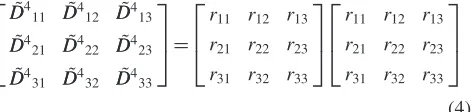
Recently, an elegant method for the determination of the diffusion coefficients has been presented by Thompson and Morral14)under the assumption of ‘‘constant diffusivity’’ in the reaction zone of the multicomponent alloys. By defini-tion, the diffusivity matrix [DD~] is related to its square root diffusivity matrix [r]
½DD~ ¼ ½r½r ð3Þ
The relation betweenDD~4
ijandrij(i, j=1, 2, 3) in quaternary alloys of this experiments is;
~ D
D411 DD~412 DD~413
~ D
D4
21 DD~422 DD~423
~ D
D431 DD~432 DD~433
2 6 4
3 7
5¼
r11 r12 r13
r21 r22 r23
r31 r32 r33
2 6 4
3 7 5
r11 r12 r13
r21 r22 r23
r31 r32 r33
2 6 4
3 7 5
ð4Þ
The values ofr11tor33can be obtained experimentally from
the following eqs. (5) and (6).
Si¼ ðt=Þ0:5ðri1C1þri2C2þri3C3Þ ð5Þ
Ci¼Cðþ1Þi C
ð1Þ
i ði¼1;2;3Þ ð6Þ
The terms, S1, S2 and S3, represent the amounts of solute
which have crossed the initial interface, and Ci is the
difference in the initial concentrations on the right and left sides of the couples.
3. Results and Discussion
3.1 Concentration profiles and diffusion paths
Typical concentration profiles of the J1, J2 and J3 couples annealed at 813 K for 86.03 ks are shown in Figs. 1(a), (b) and (c), respectively. The diffusion distance of Cu is shorter than those of Mg and Ag. The concentration profiles indicate that the diffusion rate of Cu is smaller than those of Mg and Ag in the Al-Cu-Mg-Ag alloys. Since the J1, J2 and J3 couples have nearly equal concentrations of the two solute elements in the terminal alloys as listed in Table 1, the concentration distribution of such elements are almost constant over the entire diffusion zone.
Figures 2(a) and (b) show the projections of the diffusion
0 200 400 600 800 1000 1200 0.4
0.8 1.2 1.6 2.0 2.4
Concentration,
C
(at%)
Distance, X /µm Cu Mg
Ag
813 K J1
(a)
0 200 400 600 800 1000 1200 0.8
1.2 1.6 2.0 2.4 2.8 3.2
Concentration ,
C
(at%)
Distance, X/µm
Mg
Ag
Cu 813 K J2
(b)
0 200 400 600 800 1000 1200
0.0 0.4 0.8 1.2 1.6 2.0 2.4 2.8 3.2 3.6
Concentration
,
C
(at%)
Distance , X /µm
Cu Mg
Ag 813 K J3
(c)
[image:2.595.55.291.627.683.2]paths for the quaternary J1, J2 and J3 couples at 813 K onto theCMg-CCu plane and theCAg-CCu plane, respectively.
3.2 Concentration dependence of interdiffusion coeffi-cients
By using the extended Matano method to ternary diffusion (Matano-Kirkaldy method), the interdiffusion coefficients of
~ D
DAl
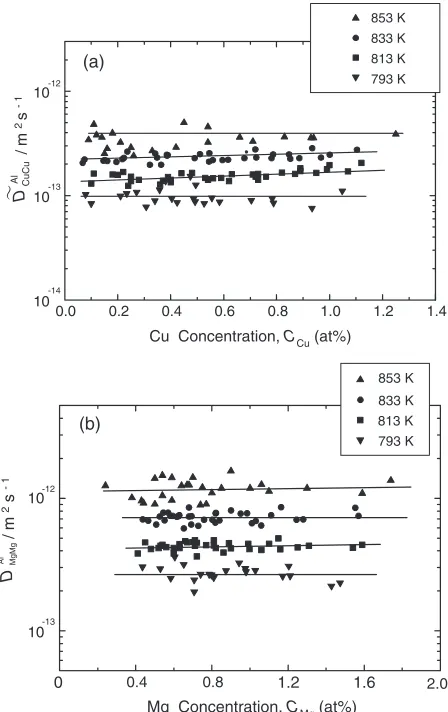
CuCu and DD~AlMgMg are evaluated at the intersection compositions of the diffusion paths5) in the ternary Al-Cu-Mg alloys in the temperature range from 793 to 853 K. These coefficients are shown in Figs. 3(a) and (b). The interdiffu-sion coefficients are not sensitive to the solute concentrations in theAl-Cu-Mg solid solutions.
Table 2(a) lists the values of the nine interdiffusion coefficients in the quaternary Al-Cu-Mg-Ag alloys evaluated from the concentration profiles of the diffusion couples (J1, J2, J3) at 813 K by the Thompson-Morral method. The direct interdiffusion coefficients DD~4
CuCu, DD~4MgMg and DD~4AgAg are positive, and the other indirect coefficients are positive. The direct interdiffusion coefficientDD~4
CuCu is the smallest value among the direct ones. Table 2(b) shows the comparison of the values of the interdiffusion coefficients in the binary Al-Cu, Al-Ag alloys,15,16)the ternary Al-Cu-Mg alloy and the quaternary Al-Cu-Mg-Ag alloy. The direct interdiffusion coefficient DD~4
MgMg in the quaternary alloy does not almost change in comparison with the values of the binary and ternary alloys, but the direct coefficientsDD~4AgAg andDD~4CuCu increase slightly.
0.4 0.8 1.2 1.6 2.0 1.0
1.5 2.0 2.5 3.0 3.5
Mg Concentration,
CMg
(at%)
Cu Concentration, CCu (at%) J1
J2 J3 (a) 813 K
0.2 0.4 0.6 0.8 1.0 1.2 1.4 1.6 1.8 2.0 0.0
0.5 1.0 1.5 2.0 2.5 3.0 3.5
Ag Concentration,
CAg
(at%)
Cu Concentration, CCu (at%) J1 J2
(b) 813 K J3
Fig. 2 Projections of diffusion paths for quaternary diffusion couples J1, J2 and J3 at 813 K for 86.03 ks: (a) projections onto theCMg-CCuplane and (b) projections ontoCAg-CCuplane.
0.0 0.2 0.4 0.6 0.8 1.0 1.2 1.4
10
-14
10-13
10-12 793 K
D
Al CuCu
Cu Concentration, CCu (at%)
/ m
2 s
- 1
833 K 813 K (a)
853 K
0.4 0.8 2.0
10-13 10-12
853 K
833 K 813 K 793 K
D
Al MgMg
/ m
2 s
- 1
Mg Concentration, CMg (at%) 1.6
0 1.2
(b)
Fig. 3 Concentration dependence of direct interdiffusion coefficients (a) ~
D DAl
[image:3.595.316.540.72.428.2]CuCuand (b)DD~AlMgMgof ternary Al-Cu-Mg system in a temperature range from 793 to 853 K.
Table 2 (a) Interdiffusion coefficients of quaternary Al-Cu-Mg-Ag system at 813 K and (b) Comparison of binary, ternary and quaternary interdiffusion coefficients at 813 K.
(a) 813 K (Thompson-Morral method)
Units108m/s0:5
inj Cu Mg Ag
½rij Cu 53.8 0.9 2.3
Mg 4.7 64.6 0:05
Ag 16.4 4.4 58.0
Units1014m2/s
inj Cu Mg Ag
[DD~ij] Cu 29.4 1.2 2.5
Mg 5.5 41.7 0.05
Ag 18.6 5.6 34.0
(b) 813 K (k=Al or 4) (1014m2/s)
Al-Cu Al-Mg Al-Ag Al-Cu-Mg Al-Cu-Mg-Ag ~
D Dk
CuCu 13.3 * * 15.5 29.4
~ D Dk
MgMg * 42.2 * 43.9 41.7
~ D Dk
AgAg * * 27.3 * 34.0
~ D Dk
CuMg * * * 1.8 1.2
~ D Dk
MgCu * * * 3.5 5.5
~ D Dk
MgAg * * * * 0.05
~ D Dk
[image:3.595.66.273.72.374.2] [image:3.595.304.550.531.784.2]3.3 Thermodynamic interactions among the solute com-ponents
Kirkaldyet al.17)have approximately derived the relation between DD~ij3=DD~ii3 and Wagner’s interaction parameter,"i(j) for very dilute solutions in the ternary alloy systems.
~ D
Dij3=DD~ii3¼ f1þ"i(j)gNi: ði;j¼1;2Þ ð7Þ
The similar equation can be derived in the quaternary alloys.18)From the phenomenological theory and Fick’s 2nd law, the diffusion flux of component i is given by the following equations,19)respectively,
Ji¼
X3
j¼1
LijXj ð8Þ
Ji¼
X3
k¼1
~ D
D4ik@Ck=@x ði¼1;2;3Þ: ð9Þ
whereLij are the phenomenological coefficients,Xi are the driving force (thermodynamic force). The driving force Xj are given by:
Xj¼
X3
j¼1
ðijþViCj=V4C4Þ@i=@x ð10Þ
whereijis the Kronecker symbol, 0 when i6¼j, 1 when i=j,
Vi is the partial molar volume of component i, and j the chemical potential of component i. For example, the chemical potential1of component 1 is expressed by
1¼01þRTflnN1þln01þN1"1ð1Þ
þN2"1ð2ÞþN3"1ð3Þg ð11Þ
where N1 is the mole fraction of component 1, 01 is the
activity coefficient at infinite dilute solution. In eq. (8), we assume Lij¼0 (i 6¼ j) for very dilute solutions in the quaternary alloy systems.13)SubstitutingXj [eq. (10)] in eq. (8), and comparing factors of@Ck=@xin eq. (8) and eq. (9), we obtain eq. (12) relating to the quaternary system. For solute atoms 1 and 2 (i = 1, j = 2),
~ D
D124=DD~114¼ fN1ðN1þN4Þ"1ð2ÞþN1ð1þN2"2ð2ÞÞ
þN1N3"3ð2Þg=fðN1þN4Þð1þN1"1ð1ÞÞ
þN1N2"2ð1ÞþN1N3"3ð1Þg: ð12Þ
If eq. (12) is rearranged with eq. (13); in dilute solutionNi¼ 0(i=1,2,3),
N1N2¼0; N1N3¼0; N2N3¼0; N4 ¼1; ð13Þ
it becomes the following equation; ~
D
D124=DD~114 ¼ f1þ"1ð2ÞgN1=f1þ ð1þ"1ð1ÞÞN1g: ð14Þ
In particular, for highly dilute solution, it reduces the relation,17)
~ D
D124=DD~114¼ f1þ"1ð2ÞgN1: ð15Þ
The equation in the quaternary alloys is the same equation as eq. (7) in ternary alloys derived by Kirkaldyet al.17)
Also, Tanaka et al.20,21) have derived a method for evaluation of interaction parameter in dilute liquid alloy in a ternary A-B-C alloy on the basis of the free volume theory
by Shimoji and Niwa.22)
"B(C)¼ fð@GEx=@NC@NBÞNB!0;NC!0g=kT
¼ ðB(C)TB(C)Þ=kT ð16Þ
whereGExis the excess Gibbs free energy, k the Boltzmann constant, B(C) and B(C) are the enthalpy and entropy interaction parameters, respectively.20) The values of B(C) can be calculated by using Miedema’s enthalpy23)of solution at infinite dilution relating the constituent elements. In addition, the values ofB(C)can be evaluated on the basis of molar volume21,24) of the constituent elements, the melting point, and the coefficient ( )25) to transfer the solid state frequency to that in the liquid at the melting point.
In accordance with eq. (7), the relation between ~
D
DAl
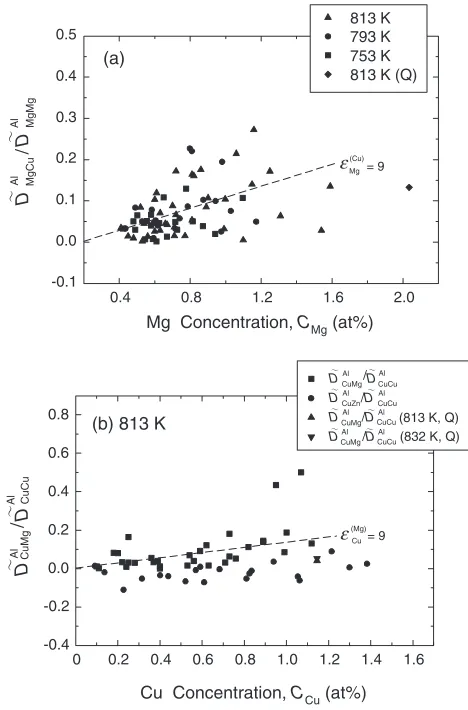
MgCu=DD~AlMgMg and Mg concentration in the Al-Cu-Mg system at 753, 793 and 813 K is plotted in Figs. 4(a). This figure also includes the ratio ofDD~Al
MgCu=DD~AlMgMgat 813 K in the quaternary Al-Cu-Mg-Ag alloy. Figure 4(b) shows the relation between DD~AlCuMg=DD~AlCuCu and Cu concentration at 813 K and also shows the similar ratio values at 813 and 832 K in the quaternary Al-Cu-Mg-Ag alloys. In addition, the ratios ofDD~AlCuZn=DD~AlCuCu at 813 K in the ternary Al-Cu-Zn alloy7) are plotted by the closed circles in Fig. 4(b). The broken lines are drawn by eq. (7) with the values of"Mg(Cu)
0.4 0.8 1.2 1.6 2.0
-0.1 0.0 0.1 0.2 0.3 0.4 0.5
813 K 793 K 753 K 813 K (Q)
D
Al MgCu
/
D
Al MgMg
Mg Concentration, CMg (at%)
εMg
(Cu) = 9 (a)
0 0.2 0.4 0.6 0.8 1.0 1.2 1.4 1.6 -0.4
-0.2 0.0 0.2 0.4 0.6 0.8
DAl CuMg/D
Al CuCu
DAl CuZn/D
Al CuCu
DAl CuMg/D
Al
CuCu(813 K, Q)
DAl CuMg/D
Al
CuCu (832 K, Q)
D
Al CuMg /D Al CuCu
Cu Concentration, CCu (at%) (b) 813 K
εCu
(Mg) = 9
Fig. 4 (a) Relation betweenDD~Al
MgCu=DD~AlMgMg and Mg concentration in Al-Cu-Mg system at 753, 793 and 813 K. (b) Relation between
~ D DAl
[image:4.595.308.542.384.739.2]and "Cu(Mg)¼ þ9 in Al-Cu-Mg alloys, respectively. The experimental values of DD~Al
MgCu=DD~AlMgMg and ~
D
DAl
CuMg=DD~AlCuCuincrease with the Mg and Cu concentration in the Al-Cu-Mg alloys, although they scatter around the line of"Cu(Mg) ¼ þ9. The (ratio) values ofDD~AlMgCu=DD~AlMgMgand
~ D
DAl
CuMg=DD~AlCuCu in the quaternary Al-Cu-Mg-Ag alloy exhibit the positive values.
While eq. (16) is applied for the calculation of interaction parameters, one has "Cu(Mg)¼ þ2:2 and "Cu(Zn)¼ þ1:5 in the solid solution of Al-Cu-Mg and Al-Cu-Zn alloys, respectively. These positive"Mg(Cu)and"Cu(Mg)indicate that repulsive interactions exist between Cu and Mg atoms. Similarly, the positive sign of"Mg(Cu)["Cu(Mg)] in eq. (7) is in agreement with that of value obtained by eq. (16) ("Cu(Mg)¼2:2). It is evident that the repulsive interactions between Mg and Cu atoms exist in the ternary system. In the quaternary system, the DD~Al
MgCu=DD~AlMgMg and ~
D
DAl
CuMg=DD~AlCuCu have large positive values. These facts indicate that the interactions between Mg and Cu atoms have a repulsive force in the quaternary alloys as well as ternary ones, and that the silver element has a small influence on the interaction between Cu and Mg elements.
The converted equations relating to the ternary interdiffu-sion coefficients have been reported by Sabatier and Vignes.26)Their equations can be extended to the quaternary alloy system. When the component of ‘solvent’ is 4 (=Al), for example, the diffusion flux of component 1 is expressed by the following equation,
J1¼ DD~411@C1=@xDD~412@C2=@xDD~413@C3=@x: ð17Þ
In addition, the component 2 (=Mg) is considered as the solvent,
J1¼ DD~211@C1=@xDD~213@C3=@xDD~214@C4=@x: ð18Þ
X4
i¼1
CiVi¼1 ð19Þ
On the assumption that the partial molar volumesViof 1, 2, 3 and 4 are constant, eq. (19) is differentiated with respect tox, and then is substituted in eqs. (17) and (18). When both equations are compared in the diffusion coefficient terms, the quaternary converted equations similar to the ternary system can be obtained as follows
~ D
D211¼DD~411 ðV1=V2ÞDD~412; ð20Þ
~ D
D213¼DD~413 ðV3=V4ÞDD~412; ð21Þ
and
~ D
D214¼ ðV4=V2ÞDD~412 ð22Þ
For instance, by using the equation DD~142=DD~112¼
f1þ"1ð4ÞgN1, the effect of 4 (=Al) on 1 (=Cu) can be
considered. The interaction parameter"Cu(Al) is found from the calculation to be 2:0 by using the quaternary inter-diffusion coefficients in Table 2(a). The values ofV1(1=Cu),
V2(2=Mg), V3(3=Ag) and V4(4=Al) calculated from the
data of the lattice parameters are 7.1, 14.0, 10.3 and 10.0 (106m3mol1). From the value of"Cu(Al), it is thought that the interactions between Al and Cu atoms have attractive force in the quaternary alloys. If the component 1 (=Cu) and
3(=Ag) are considered as the solvent, the equations similar to eqs. (20) through (22) are derived, and the interactions between Al and Mg (or Ag) can be discussed.27)However, the discussion is beyond the scope of this paper.
4. Summary
Quaternary and ternary interdiffusion experiments of Al-rich Al-Cu-Mg-Ag alloys have been performed in the temperature range from 793 to 853 K. The results are summarized as follows.
(1) The direct and indirect interdiffusion coefficients are positive in the quaternary alloys. The direct coefficient
~ D
D4CuCuis the smallest value among the direct ones. The direct coefficient DD~4MgMg in the quaternary alloy does not almost change in comparison with the values of the binary and ternary alloys, but the direct coefficientsDD~4
AgAg andDD~4CuCu increase slightly.
(2) From the ratio values of indirect coefficient to direct one, it is suggested that repulsive interactions of Cu-Mg atoms exist in the Al-Zn-Mg-Cu alloys. In addition, from the converted equations relating to the interdiffusion coefficients in the quaternary alloys, it is thought that the interactions between Al and Cu atoms have attractive force in the present alloy.
Acknowledgments
This work was financially supported by the Light Metal Educational Inc., Osaka 541-0056, Japan. The authors are deeply indebted to the support. Chemical analysis of the aluminum alloys was performed by Showa Aluminum Co. Ltd., Oyama 323. The authors would like to thank Mr. Satoshi Hozumi of the company for his assistance of the chemical analysis.
REFERENCES
1) See, for example, T. Sato:The Structure and Property in Aluminum Alloys(Japanese), (Japan Inst. Light Metals, Tokyo, 1991) pp. 192-217. 2) K. Hirano: The Problems of Diffusion in Materials Development (Japanese), Seminar Text of The Japan Inst. Metals, Japan, (1991) pp. 1-5.
3) K. Hirano: Fundamentals and Application of Diffusion(Japanese), Seminar Text of The Japan Inst. Metals, Japan, (1984) pp. 1-17. 4) Y. Minamino and T. Yamane: Diffusion in Materials (Japanese),
Seminar Text of The Japan Inst. Metals, Japan, (1993) pp. 21-27. 5) T. Takahashi, M. Katoh, Y. Minamino and T. Yamane: J. Japan Inst.
Light Metals39(1989) 287-292.
6) T. Takahashi, A. Takahashi, H. Araki, T. Tanaka, Y. Minamino, Y. Miyamoto and T. Yamane: J. Japan Inst. Metals58(1994) 1364-1371. 7) T. Takahashi, H. Yasuda, H. Araki, Y. Minamino, T. Yamane and S.
Saji: J. Japan Inst. Light Metals44(1994) 69-74.
8) T. Takahashi, T. Yamane, H. Araki, Y. Minamino, T. Inoue, Y. Miyamoto and A. Takahashi: J. High Temperature Society of Japan23
(1997) 275-281.
9) M. A. Dayananda: Diffusion in Solid Metals and Alloys, Landolt-Boernstein Ed., by H. Mehrer, (Springer-Verlag, Berlin, 1991) pp. 372-436.
10) I. Uchiyama, A. Watanabe, S. Kimoto: X-ray Micro Analyzer (Japanese), (Nikkan Kogyo Newspaper Co., Tokyo, Japan, 1974) pp. 127-196.
12) J. S. Kirkaldy: Can. J. Phys.35(1957) 435-440.
13) J. S. Kirkaldy, J. E. Lane and G. R. Masson: Can. J. Phys.41(1963) 2174-2186.
14) M. S. Thompson and J. E. Morral: Acta Metall.34(1986) 2201-2203. 15) Y. Minamino, T. Yamane and T. Takahashi: J. Mater. Sci., Letters4
(1985) 797-798.
16) Y. Minamino, T. Yamane, A. Shimomura, M. Shimada, M. Koizumi and N. Ogawa: J. Japan Inst. Light Metals34(1984) 174-181. 17) J. S. Kirkaldy, Zia-Ul-Haq and L. C. Brown: ASM Trans. Q.56(1963)
834-849.
18) Y. Minamino, Y. Koizumi, N. Tsuji, T. Yamada and T. Takahashi: Mater. Trans.44(2003) 63-71.
19) A. Vignes and J. P. Sabatier: Trans. AIME245(1969) 1795-1802.
20) T. Tanaka, N. V. Gokcen, P. J. Spencer, Z. Morita and T. Iida: Z. Metallkde.84(1993) 100-105.
21) T. Tanaka, N. V. Gokcen, K. C. Hari Kumer, S. Hara and Z. Morita: Z. Metallkde.87(1996) 779-783.
22) M. Shimoji and K. Niwa: Acta Metall.5(1957) 496-501.
23) A. K. Niessen, F. R. De Boer, R. Boom, p.F. de Chatel; W.C.M. Mattens and A. R. Miedema: Calphad7(1983) 51-70.
24) T. Iida and R. I. L. Guthrie: The properties of Liquid Metals, (Clarendon press, Oxford, 1988) pp. 14-71.
25) T. Iida and R. I. L. Guthrie: The properties of Liquid Metals, (Clarendon press, Oxford, 1988) pp. 14-100.