STUDIES ON THE WATER VASCULAR SYSTEM OF
REGULAR ECHINOIDS
Alan Michael Raymond
A Thesis Submitted for the Degree of PhD
at the
University of St Andrews
1979
Full metadata for this item is available in
St Andrews Research Repository
at:
http://research-repository.st-andrews.ac.uk/
Please use this identifier to cite or link to this item:
http://hdl.handle.net/10023/14551
ABSTRACT
T h e w a t e r v a s c u l a r s y s t e m is a h i g h l y m o d i f i e d m e s o c o e l
w h i c h is u n i q u e to the p h y l u m E c h i n o d e r m a t a . H y p o t h e s e s for
t he e v o l u t i o n of t h e w a t e r v a s c u l a r s y s t e m a n d its r e l a t i o n s h i p
to th e m e s o c o e l of o t h e r o l i g o m e r o u s a n i m a l s a r e d i s c u s s e d . A
s c a n n i n g e l e c t r o n m i c r o s c o p e s u r v e y of th e s k e l e t a l s t r u c t u r e s
a s s o c i a t e d w i t h th e w a t e r v a s c u l a r s y s t e m p r o v i d e s t h e f i r s t
d e s c r i p t i o n of the u l t r a s t r u c t u r e of th e m a d r e p o r i t e , t e r m i n a l
t u b e f o o t p l a t e , p e r i s t o m i a l t u b e f o o t p l a t e , t u b e f o o t ( p e r i -s t o m i a l a n d a m b u l a c r a l ) d i -s k e l e m e n t -s .
T h e r e l a t i o n s h i p b e t w e e n the s t r u c t u r e a n d f u n c t i o n of
s k e l e t a l e l e m e n t s is d i s c u s s e d , w i t h p a r t i c u l a r e m p h a s i s on the
m a d r e p o r i t e a n d d i f f e r e n c e s b e t w e e n t h e p o r e s a n d d i s k e l e m e n t s
of a m b u l a c r a l a n d p e r i s t o m i a l t u b e feet.
T h e f i n e s t r u c t u r e a n d i n n e r v a t i o n of t he f o l l o w i n g i n t r a t h e c a l r e g i o n s of t he w a t e r v a s c u l a r s y s t e m w e r e i n v e s t i g a t e d :
m a d r e p o r i t e , a x i a l o r g a n , s t o n e c a n a l , c i r c u m o e s o p h a g e a l and
r a d i a l w a t e r c a n a l s .
It is p o s t u l a t e d th a t the w a t e r v a s c u l a r s y s t e m h a s an
i m p o r t a n t r o l e in t he t r a n s p o r t , p r o c e s s i n g a n d r e m o v a l of
a m o e b o c y t e s . T h e P o l i a n v e s i c l e s a n d a x i a l o r g a n a r e m a j o r s i t e s
f o r a m o e b o c y t e c o l l e c t i o n a n d th e a x i a l o r g a n p r o c e s s e s a m o e b o
c y t e s p r i o r to t h e i r r e m o v a l v i a t h e m a d r e p o r i t e . It is p r o p o s e d
t hat th e m a d r e p o r i t e is a n e x c r e t o r y s t r u c t u r e a n d n e c r o t i c
a m o e b o c y t e s a n d w a s t e m a t e r i a l s a r e e v a c u a t e d b y the c i l i a r y
a c t i v i t y o f t h e e n d o t h e l i a l c e l l s l i n i n g the m a d r e p o r i t e c a n a l .
O n t h e b a s i s of u l t r a s t r u c t u r e a n d f l u o r e s c e n c e h i s t o
ProQuest N um ber: 10167215
All rights reserved INFORMATION TO ALL USERS
The q u a lity of this re p ro d u c tio n is d e p e n d e n t u p o n the q u a lity of the c o p y s u b m itte d . In the unlikely e v e n t that the a u th o r did not send a c o m p le te m a n u s c rip t and there are missing p a g e s , these will be n o te d . Also, if m a te ria l had to be re m o v e d ,
a n o te will in d ic a te the d e le tio n .
uest.
P roQ uest 10167215
Published by ProQuest LLC(2017). C o p y rig h t of the Dissertation is held by the A u tho r.
All rights reserved.
This work is p ro te c te d a g a in s t u n a u th o riz e d c o p y in g under Title 17, United States C o d e M icro fo rm Edition © ProQuest LLC.
ProQuest LLC.
789 East Eisenhower Parkw ay P.O. Box 1346
b a s i e p i t h e l i a l p l e x u s h a v e a c i l i o - e f f e c t o r r o l e a n d th u s
r e s p i r a t o r y c u r r e n t s g e n e r a t e d b y c i l i a t e d e p i t h e l i a l c e l l s a r e
u n d e r n e u r o n a l c o n t r o l .
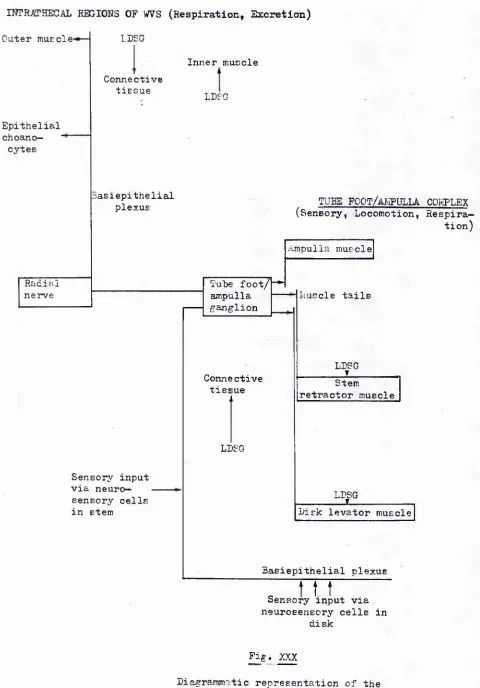
T h e f i n e s t r u c t u r e a n d i n n e r v a t i o n of t h e t u b e f o o t / a m p u l l a
c o m p l e x w a s i n v e s t i g a t e d . T h e t h r e e m u s c l e g r o u p s o f th e c o m p l e x c o n s i s t of t he d i s k l e v a t o r m u s c l e ( D . L . M . ) , s t e m r e t r a c t o r
m u s c l e s ( S . R . M . ) a n d a m p u l l a m u s c l e s . It is p r o p o s e d t h a t the
D . L . M . a n d a m p u l l a m u s c l e s a r e s t r u c t u r a l l y / f u n c t i o n a l l y d i s t i n c t
f r o m t h e S . R . M . w i t h r e s p e c t to e n d u r a n c e , s p e e d of c o n t r a c t i o n
a n d r a n g e . It is a l s o p r o p o s e d that the ’’c h a n g i n g a c t i n g
p a r t n e r s " m o d e l f o r m o l l u s c a n s m o o t h m u s c l e can a l s o b e a p p l i e d
to e c h i n o d e r m s ' s m o o t h m u s c l e .
T h e i n n e r v a t i o n o f t h e t u b e f o o t / a m p u l l a c o m p l e x is r a t h e r
u n u s u a l a n d it is p r o p o s e d t h a t a t u b e f o o t / a m p u l l a g a n g l i o n
o c c u r s at the b a s e of t h e t u b e foot w i t h i n th e p e r r a d i a l p o r e .
M o d i f i e d m u s c l e p r o c e s s e s t e r m e d m u s c l e t a i l s p a s s i n t o th e
p e r r a d i a l p o r e a n d a r e i n n e r v a t e d b y m o t o n e u r o n s w i t h i n the tu b e f o o t / a m p u l l a g a n g l i o n . In a d d i t i o n , p e r i p h e r a l n e u r o n s
t e r m e d L . D . S . G . c e l l s i n n e r v a t e d S . R . M . , D . L . M . , a n d c o n n e c t i v e
t i s s u e of t u b e fe e t a n d t h e i n n e r m u s c l e l a y e r a n d c o n n e c t i v e
t i s s u e of the a x i a l o r g a n a n d P o l i a n v e s i c l e s .
T h e L . D . S . G . c e l l s h a v e b e e n c h a r a c t e r i s e d h i s t o c h e m i c a l l y
a n d c y t o c h e m i c a l l y a n d it is p r o p o s e d t h a t t h e y e l a b o r a t e a
g l y c o p r o t e i n w h i c h h a s an i m p o r t a n t r o l e in r e g u l a t i n g c a t i o n
f l u x e s w i t h i n the c o n n e c t i v e t i s s u e a n d m u s c u l a t u r e . T h e h i s t o
c h e m i s t r y a n d c y t o c h e m i s t r y o f t u b e f o o t c o n n e c t i v e t i s s u e w a s
i n v e s t i g a t e d a n d the r e l a t i o n s h i p b e t w e e n c o l l a g e n f i l a m e n t s a n d
■ M l in maw,... *
_ ..
A U H KICK LI E YKGS1
flatty Karin# Laboratoryt T&e Unlvarcity,
f .Y :T • • f fifa.
Luip::Kvr<.Rn c-r t i/i c.t s
I certify that Alan Michael Raynond her fulfilled the conditions laid dovn undar Ordinance No# 16 of the University Courtf St# \ndrewe, and ir accordingly qualified tc eubedt thie thecis for the decree of Doctor of IhiloeopJhy#
I declare that the work reported in this thesis Ik my own and has not previously been eubmitted for any other degree#
v i t v;
I was educated at la; ten worth Oruraa&r i; chool (Latclivorth,
Ackn owle dgsraent s CHAPTER 1.
CHAPTER 2. CHAPTER 3.
CHAPTER 4 .
CHAPTER 5,
CHAPTER 6.
CHAPTER 7. 3I9LI0GRAPHY
General Introduction Methodology
Morphology of skeletal elements associated with the WV3*
Fine structure and innervation of intrathecal regions of the W S l Evidenoe for the neuronal control of ciliary activity*
Myoneural anatomy and physiology of the tube foot/ampulla complex* Histochemical and EM Cytochemioal studies an the tube foot connective tissue, LDSC cells and musculature. The phenomenon of connective tissue plasticity*
The Finale
Tables (1-9) ooour within the text*
Line figures (I—XXX) occur at the end of each relevant ohapter* Micrographs and chart recordings (1-199y ooour within PART 2*
2 - 1 4
15 - 37
38
- 6263 - 90 1
91-131
132-153
154-161
1.
This study was carried out with the financial support of the
Science Research Council, under the supervision of Professor ?T.S* Laverack anl I woul* like to express ray gratitude to both for their aseietance and encouragement during ray postgraduate training.
I am grateful for the invaluable aseietance of various people in the •Catty* and other departments within the University; particularly I must mention Dr. J.L.S. Cobb, Dr. D.B. Scott, Dr. C. Uuir, Dr. P.A.V. Anderson, Dr. C. Pvans, Professor J.W. Smith, Idn'a McQueen and Dr. A. Serafini-Praoassini.
I would like to thank Dr. A.C. Campbell (University of London) for the specimens of a variety of echinoids, a n ’ Dr. H.Y. Siler (University of Glasgow) for his invaluable assistance with obtaining X-ray microanalysis lata. Many thanks also to Christina Lamb for deciphering my hieroglyphics so efficiently!
last but not least, this thesis would not have been completed without the marvellous co-operation of Baby Anna and the encouragement of ray wife
V.hy study the echinoid w~ter vascular system?
•fthy not* would, of course, he the simpler but rather negative and unoonstructive anewer* In order to provide a cogeut explanation of the rationale for this present study it it necessary to give some perspective of the phylum Echinodermota mid tc ditcues it© relationships with other phyla*
The phylum Lchinodennata consists of 5»3Cf knows species (B
1966} which are mostly marine (some inhabit br ckish waters) and mainly benthic# There it some confusion over the precise taxonomic divisions of the phylum as most standard Zoology text© still use a claceification bared upon the mode of life of the echinoderm* In thir way the sessile, attached echinoderms, including the extant crincide and several extinct groups
(e.g* eccrinoide, eyetoids, blaetoidc etc*) were grouped under the cub-phylun T elmatozcu. Free living echinodernr such at the achincidt, asteroids, ophiuroidr and holothuroide were grouped under the sub-phylum leutherozoa* however, this system of classification is not corroborated by palaeontological evidence and does not take into account the comparative raorpaology of the various group©.
o. ;* y idarl
e.g. •Typical* e -urchin..
9«g« c taschiM » '
Dd
dollar;;
e.g. e i r t urchin
.. J3 i- 1
Cl*. ification of the major taxonomic diva— on of the cl : chinoidea. ul y ext nt
group re hown.
The more primitive ec hi no id group 1 the Peri chooch;no ice of which there i; only one ext n t orccrt the id -..ri:eg The cub cl a hchino dc include il other extent echinoid nd 1 divided ^nto two di tinct group , the .egulorf. rnd rregtl ri • egul r echinoi typically poose: a nbaphericnl te t. The irregul r gnotho tom ta nd
telo tors t botn have b i l >tor I yometry econ rily uperimpo eo upon the b : ic pent nerou • body p ttern producing a d i tinct ntero— po terior
jci • ’he development of the irregular body fora i i ocl ted with a burrowing mode of life.
fe sture un que to 11 extant ech] noid , except the telo tom >t 9 in a complex c *.lc reou. feeding ’pp. r tu termed ri totle* i n t e m #
ub—c t .. . erischoecra.no. ae rcer Cid ro^da ub— cl ;.c uecn.n o ; de
* egul r ( uper-order I i ade ua tace ;
[ uper-order chino de rro ul a-. ( uper— order gaa thos tornate*
The arterosoone comprise two claeeei, .eteroidea and Cphiurcidea, both of which have many extant rpeciec* The echinozouni compriee two extant cluster, chinoidea and Kolothurcidea, which include the moot cuccetoful extant echinodeww;* Per the purposes of this rtudy an outline of the clarification of the chinoideais noce: nary and if. rhewn in Table 1* Character!ctic features of the phylum chinodermata are:
1* Fentamerour radial cyametry 2* Calcarecut theca
3* I
euteroetomatottcs development 4. Later vascular systeml) I enta erou: radial t-ymmetgy
Thir ir secondarily derived and ie not phyletically related to other radially symmetrical phyla such ac tho Porifera and Cnidaria* The only
other example of possible pentamery in the animal kingdom ir in rriapulur cauri'-tuc where the pharyngeal teeth occur in whorls of five* I \ rome extant groupi ruch ac the kolothuroidea and the irregular echincids there ir a return to bilaterality which it associated with a burrowing mode of life* In there latter groups the batic pentameric body org nication ir still clearly pretent* nlCTICL: (1966) has difcatred the varioue hypcthecet for the origin of pentamery, none of them being entirely satisfactory* A pentagon reprerente the only regul r polygon in which the number of tides
The development of the aboral (apical) region of the theca is very similar in all eckinodcrmr and consists of a central plate, accommodating the arras, surrounded by a ring of five plater which later form the five genital
plates* 'ICHCU argu©E that five plates are laid down in order tc obviate linec of weakness along suture lines* With a pentamerour arrangement the length and number of euture liner, in kept to a minimum and not one suture is located directly opposite another*
£} Calcarecoi- ti.aca
All ochinociermt: poss ess a thee- consisting of calc-reoue os t i d e s which may or may not articulate with one smother* Holothuroidu show a reduction in the number and size of os a i d e s which allows a greater degree of movement of the theca during burrowing activities:* In common vdth tlie chordatec and unlike other invertebrates, echinoderm skeletal oseiclet are of mesodermal origin* The echinoderm skeleton ir, unicue in rtructure, conristing of a fenestrate Bi8chwerk or ’stereom**
3) : «at«ro; tcpatoui! development
Echinoderm ova are homolecithal and after fertilization, early embryology is quite uniform throughout the phylum and displays the baric fe lures of deuterostomitou! development, i*e* the blastopore fonnr the arcs ,
cleavage is r-cial and indetertnin te, and the coelomic cavities arise by enterccoclus pouching*
4) qgtter y..; c l r system
Unique tc the echinoderme is a series of ccelomic canals which
radial veerele parting from it to supply the tube feet and a single axial veer el pasting from the ring towards the apical tide of the body.
A more detailed description of the regular echincid water vascular system aid its relationship with the nervcur f ystec. is diagrammatically illustrated in Fig. I. Communicating with the exterior via the mudroporite ir the axial complex and parting from it to the circurnoe: oph&gaal water ring it the rtone canal. rising radially from the water ring are five email evagiaaticnr termed Pollan vericier. Arising interradially are five radial water canalc, each of which hat a ringle recurrent branch which bifurcates and terrain .ter ae a pair of peristomial tubefeet protruding through the peristomial membrane. Lateral branches off the radial oanale pars through ambulacral region: of the theca terminating ar ambulacral tube feet. Finally, each radial canal terminator ar a terminal tube foot.
Associated with each peristomial and ambulacral tube foot ir a muscular eac, the ampulla, which it responsible for the extension of water vascular fluid into the tube foot thereby extending it. Each tube foot © o m i r t c of a elender stem which expands dirtally forming a dick. Copiue production of a mucoid bioadhesive by the dick epithelia enables attachment of the tube feet to the substratum. The dicks of ambulacral tube feet are further modified by the development of musculature vhich can raise the dirk surface forming a tucker. Ferietomial tub© feet are shorter and stouter than
ambulacral tube feet and do not show the same degree of extendon. Terminal tube feet are considerably reduced in cize aid arc ncn-cuckered.
ic far, only the general structures of the water vascular system has
been dircutcedj what of itc function?
the operation of tube feet* feoondnrily it may alee serve other function; which utilize the clot e proximity of the water vascular fluid with the surrounding re* water#••* Thur in the echinozoanr and acterosc snr, the prime role* of the watttr vascular cystem are locomotion and respiration#
Ae with all generali
2
ationsr there ir an exception! one group of hclcthuriont have secondarily lost the tube feet and consequently this group hue been termed the poda* Tube foot lore in the Apoda it artociated with the incre-ted importance of the body wall in the burrowing activity of holo-thuriune.It ir known from palaeontological evidence that the e jpliett a id
moot primitive ochinode rear were ©rinozount* If we excuiiine living representa tives of this group, the crinoidr, then we observe that the tube feet play
an insportiuit role in filter feecing, not locomotion# rrinozoanr are
associated with thin change, the water vas culur system undertake: an
important role ai a locomotor eyetern* Fort authors emphasize there changee in the water vascular system but do not diccure the significance of a
censor? role for the system* In crinozoaxn: the tube feet play' an important role in the detection of food and til a stimulation of raucous production by the epithelin in order tc package particles into a food bclur which in purred down the pinnule: and a m to the mouth. The re-eery capacity' of crinozoan tube feat is turoly a significant pre-adaptation tc their subsequent role in ochinozoans ©na atterosoane* The co-ordinuted locomotor activities of tube feet would not be possible without a considerable degree of sensory' feedback which would in turn provide information about the external environ ment*
hs tube feot are thin walled and protrude in great narabert from the echinoderm theca then they v4.ll provide a considerable surface area fcr the exchange of gases and metabolites* itdXiK/. HKul U (l96t; a d I,XL (197 ) havo shown that oxygen will diffUEO into an echinoderm through the theca for a depth of 1-3 mm only* Thus the growth of the theca and its increased calcification forming a rigid test will havo a potential *cui’fo-crtien* effect in the echincidi • In modern eeklnoidc thii if overcome by mcdificnticnr of the tube fc ot/ampulla complex euch that, in addition to itf Icooractor and eenecry rcle> , it functions at a retpiri tcry structure*
A major evolutionary' trend among palaeozoic echinod'.rmt is the
The functional efficiency of a respiratory surface can theoretically reach its fauxiaw*i value and achieve 10C.' t atur-tion of the internal fluid if a counter current convection system it in operation (F^Ul 1977)•
I alneo tologicul evidence for counter current cyotenn it diffic ult to sub stantiate but good ’indica tor:# are teparate entruucee end exits for the passage of opposing currents. :,uch etructurcB first appeared quite early in eehinodera evolution, in the I iddle Cambrian, with the occurrence of cliplcporec in a group of crinosoane, appropriately named the liploporita.
Tcwever, palaeontologists do not appear to have Eufi'icient evidence ar to determine whether water vascular fluid flowed through the diplopores (as opposed to perivisceral coelorsic fluid}#
PAUL (1977}
port lates
thatthe lack of protection of diploporeo by opines (e#f# tube feet in echincidr) may account for the extinction of the liploporita in the hidule levoni-n# It m s act until the Middle Ordovician that the ohinoidca appeared with counter current convection in a tube foct/ampulla complex#
In echinoidi the tubo foot/ampulla connection consist; of two oonals which pace through two eepurute pores, the perradial and adr-dial pcrct# The diporoue arrangement of tube feet io unique to echinoidi, both extant ;o*d extinct* V I ; (1973) invectigated counter current convection in the water vat colar system of both regular -aid irregular echincidt• The reoultr. of this t tudy are diagrammatically illustrated in lg# I I I # Fluid circulation within the tube fcot/am*. ull complex consists of an excurrent flow of fluid paeting via the adrudial pore and incurrent flow vi \ the perradial pore# ( *S. The perr.dial pore ie nearest to the radial canal}#
toward6 the radial water canal and then paEc from the canal deeper into the coalcra.
The water vascular ryeten it a tubular coelomic eyeterr. a .d that constitutes a rather unusual modification of a coelomic cavity. Crucial ctageo in the evolution of the eaetasea were the appearance of secondary body cavities and net meric t egmentation. (bnrequently a na^or theme in the evolution of the otetazoa has been the elaboration of the coelom into a variety of faydrcekeletal rtruct-ree. It if therefore important tc consider the water vascular eytteia ae a coelom, aid to dircure ite evolution in relation to the ooelomic cavities of other phyla*
Comparative anatomy and embryology indicate that the e chi node m body io oligomerou*; i.e* divided into three regions, the proto-, neto- and netapomer* The oligomerouo phyla include all other deutcrof. tomei
(Hen 1 chord at e r , Urochordator, I rotoohcrdatoi and Chord ter.) and the lophopherate pro tor tome: (3 ctoproctf, horonidr, end Drachicpodt ). The oligomorour condition of echincdennr it best exemplified in the dipleurula l o m f an early stage of 1 rv .1 development which ir comr.cn to nil
hydro, and romatecoelr respectively* An invagination of the dorsal turf.ce of the larva open: into the axo/hydrocool forming the hytiropore, Faring rubr eque it development the axocoel fuxec with the hydrccoel fcrmia the water vns cular system and the iiydroporo develop© into the madreporite. The roar.tocoel forme the peri visceral coelom, genital sinuses, haemal and perih-.emal canals,
A major problem in dealing with the evolution of the water vaccular
t ye tern and the interrelationships between echinodermt and other phyla, is the effect pent merour symmetry has on late larval development and the adult forms, Notwithstanding ther e difficulties, it ir more productive to
consider the water vaccular eyetea as a metocoel and relate it to the mere— ccelic cavities of other oligomerous phyla*
Throughout the evolution of the ccelota te phyla the merocoel developF ae a hydrostatic mechanism for the support and extrurion of ©oft tentacular structures. In a review of the function: of the coelom Cl HK (19610 hac discussed the various hypotheses reg&rdin, the origin© of the echinoderm water vascular system a id the following outline of these hypothece© ie
largely bated cn that work (see Cl.hk VJC7 for detail© of the original papers) Close similarities betw.ee . the torn aria larva of enioropneuftet and
the bipinnaria of asteroids and auricular!a
02
' holothurians provide evidence for a close relationship be twee1
hersi chord, it es and echinod^rmc. Consequently a major concept in deuterestome evolution is that the ancestral deutcra;tomewas oligomerous#bilaterally symmetrical aid akin to the echinoderm dipleurulu.
Thus the hypothetical ancestor was named as the liplcurula.
The lipleurula theory was first proposed by ffftCH in 188( and vae
adoption of i
re
: lie mode oflife,
5uppo
&' that the right sideof the nterior enf of the n im 1 bee me att chec to whe ub tr tua . nr .ubrequont torsion of the gut produced hypertrophy on the loft side nr degeneration of the right rxo/hydrocoelo ( oe fig. v). .he primitive
'pclm .tor.om* echinodexa thu. had cor; 1 mouth nc dor o— L ter tl nu (i\Lg,/I 3 riliih p r o p o e d that during 1 ter cevelopnont three tentaculiferou -roove.s :rone froo the mouth rad two . ub oquently divider’ producing • total of five, five evagin;tion s of the hydroooel ccomp nied the groove forming tlie r- xli 1 canals.
However, C r, K de. cribeo eriou dr wb cka to thi hypothe-is which include:—
i) fhe •... trong overtone, of TI KCKIlT^s theory of rec pitul tion*. ii) I’he : ipleurui ; i *..•little more than the lov?© t conmon
/ conomin tor of echinoderm nC hmichordate 1 rv ,e iii) fhe 1 ck of ny e::pl n tion for the function of the
tentsc ul ifo u g r o o v e ,
iv) ’he 1 ck of any evidence of ,;rroove in embryology,
n alternative hypothe i of taiOK, which w c exp nde< by BtTuY in 1095 and K CBRE'a in 1096, or© te.. mother liypothetic.lL aim.-1, the e n t x t u l
(fig* YIl)« in ; free-living, bilateral ymmetric.l pentactul. the w ter v acul r .y ton ceveiopec a ring of f ve hollow tent .cle which cont Jne branches of the hydrocoel. In imil r m nner to the diplaurul , the
pentactul . ettled on the ub tr turn nr un 'er.ont torsion becoming r di lly y m e t r i c 1. However the ra in dr wb ck of thi hypothe i ore:
i) The 1. ck of expl n tion of the origin of the circuraoesoph goal ring voa, el of the hydrocoel*
In order to provide a comprociir.e betwee the dipleurula and pent&ctula theories, V
XT;
TIDE ir* 1£9C a d 1914 proposed that the dipleurula poteeered five tentacular outgrowths from each hydrocoel (Tig.VIII). After s ettlement and toreion the right axo/hydroooe1 degenerates and the left hyurocoeldevelops into a circumoral ring of tentacles. However, HACBRI1A*e •compromise*
£>u. 1 doer not provide any explanation of the function of the tentacular act©— growths from the hydrocoel#
It is apparent that the dipleurula/ pentactula. theories are far from eatirfactory and the whole concept of a free-living, ciliated orgu.iien doer net accom. odc.te the functions of coelomic cavities (CL Kfc ^ t % ) 9 The hydro coal may have the function of supporting the tentacles but what of the
uxccoclc and ecmatocoelc? It ie likely that an ecbinodenn ancestor io more akin to a hemichordc.t©, particularly the pterobrunche.
The p terobmnch origin of echinoderstr was firr.t proposed by QRCBDE in 1923 and ie supported by HIHAH (1955} and CL HK (1967)* CL hi con: id ere that the •modified1 dipleurula of KACBHIDE ic ver similar to a pterobr^mch with a paired lophophore cuprortin, five te
it
cler in each rid*.. (Fig.IX ).
In both the dipleurula and the pterobrunch the tentacles, are supported by the meseooel (hydrocoel). It ic proposed that the pterobranch ancestor underwent torrion producing a reduction of the right side of the lophophore. NICHCLf (1572) postulate* that the external opening of the pterobr&neh
meecccel ic •equivalent* to the echinodenn faydropore. ICT! LT further
propose* that the opening of the circumcral branchial canal of the b n chiopod lophophore may aleo be •equivalent* to the hydropore.
The essential difference between the pterobraach ancestor ruicl the dipleurula ir that the former ie relatively cedentary. The coelomic
13.
ICHCI;' (1967) has alrc pot tul ted that echinodermr; rany have eve]ved from a cipunculia-like ancector# F W t u r e © ruch ac a recurved gut, and a tentaculiferouu, proboecif which ic in ccm, unication with a circuurcral ve^ cel are very fitailar to an echinodoxm# 1C-'.; II proposed that the muscular
compensation tacr from the circuaoral veiael are responsible fcr the
extension of the proboscis and te taelan, a situation apparently similar to that in ochinodarr.t • ipunculid features cuch a;, the tentacle arrangement, protct tow ntouo development, trockophore iarv . a..d metunephridiu chow
similarities to the lopnophorate phyla# ICH-Ik f.ug eets that tne develop ment of a theca to support an e.largiJV lophophore would produce a structure quite similar tc
a
crinoid 1ret#In a later discussion, ICHCLi (lSt£) it more cautiouc about this hypothesis aid triontiona that clmll r modes of life may produce convergence, and Lipunculidr do have a totally different embryonic dovelopaent to
eckinodercns and all other deutoro.tomoe# ipunculid:: are a rat .er e iginntic rroup bacuu. e of their lack of j ogmont-ticn. The formation of an ’annelid crocs* auxin; their early embryology indicates possible an .elid affinities# It is inters. ting to note that 1C CL • (1967) hypothesee of probot cic e v e n ion do ;ot agree with ctudier. on ipu :culu: nudas (von Uh JCULL, 19C3,
zoom »raa. i»c) <«a
' • £ , & s s & l s a t r i P H t ? r M -(?••«*: *
iS33)i*i«* *hc*
that the proboscis it everted by contraction of the posterior half of the body wall muicul ture#
bespits all the drawbacks of the theories regarding dcaxnoderm origins it is quite cle >r that the w ter vascular eye tea represents.: a nighly
specialised a.al unui ual modification cf a wo.ocoelic cavity#
a) They show the highest development of the tube foot/ampulla complex*
b) They have a highly developed rJceletal cyotem which forms inters; i in# rclsticnchipr with the v-ter vascular eye tom. In particular, the regular echinoidr were c oten because: a) They are eacy tc collect :uid mnint in in acnarla, unlike
the irreg -1 r echinoidr*
b) The irregular echinoide exhibit a wide rpectr m of tube foot structure and function and this: alone would ju> tify a whole investigation*
lA^or region: of the water vascular rye tern have been investigated ueing a variety of techniques and some of the results ob ninsd provide evidence for inter#; ting phenomena sueh as con .active t i t u e pi c ticity and the neural control of ciliary activity. Perhapt the most significant result® provide a characterisation of a .ovel type of neuro.. and evidence for an unusual soae of inaerv&tion c: the tube foot musculature*
£* M O Q Sf> > *• *»
x & ^ H e-* o
tf 5? K SJ -J *9 ®I?
|
♦1 » £ H* g £I
H P a f9 f ►* Stj M n o t-* t 0 a n £ a ar2
o cf-H E£ 3
P
T
'
p
o
x
n
t
f
t
o
x
r"\ pJ P> *+• *■*>o M
*T» i O fll P" o b*ia
<6 «+ (9 n
M b*- o trb ►i
M- a O’ *> P 4
«+ H- H - H* &
P «+■ Cf*
H*
g * c+ fi V"
n • r f <r+ *-b P
a © a fi)
P-. M»
JF* ( * H
M- © P* i--* O
a c+- e+ C H- o
t r t r o P
e*- «+
M- r f f-* M- o
O
c+ o p . «+o
y—*P~< ►i £r M* *1
«< O P
«+ a h-» +i
r+ p . o
s M- H
< + * i S M a
J * * .
1
I
i « +f t ©
I
C t rE
£ ** «♦
s
* 1 £
► i a
f
& M & a <* a H*5
o £ ‘a & *-» * CD 3 P. M* E 01
s
o
3
£
O r+ O © M, e?3
S’ P 8© gi 4k ^
• • • • • • 8
§
o* £ A f a O ►* c* p H-H o o a.$
g* 8 r» ff o?
Ct»s
r © o HI
Aa
o M TJ o *“•5 3. 3f t«+
s
r+ Aa
o *1 s-A$ 3 if P a a # n 3 3 3 ?
8
1
U-> fO -* TO
.-V
s? ts
I?
88 H
5 a
TO TO
M* *1 8 S'
*< TO & S» 5 o tfa P «+ *5> TO TO & P & r+ © Cl 5* C* 3 sr
!
m cfs
«♦ TOa a A 3i - *
§ » t* 8
X)
*
ff
C- o.
i
?
o ►TO g c*-TO H P.
f
►TO3
TO H*8 M-n o
a i
•©
£ 3
■ n
St to
■>
a? i -$ $ s i: tfl • O H
i
o0
Cl-O C' £ & * «5.
S-g S M I Ks
8II
f? 1 g S* ix tr 4s
o err a o p * - * 'n i ? 3* K' <I
S O dfta a $
K~J
Ie
ir2
be
r
o
n
t
a
c
t
u
l
-.
t
h
e
o
r
y
of
or
ig
n
of
e
c
h
i
n
o
c
i
e
r
n
;
.
:
(
a
f
t
e
3 ft
3
I
<S «+15
f o o •9 O 3 «+• tr pE
*s & o »1 & ft **1 3 ft ‘a ** <5 o. I n p 3 ev c o cr o 3. ca sr rVi
!
3
i
p-3
3
ft ft
1
3
a sr
f i
*
o •o o *5 ft I Mi
s
t t ,4 . o oa
<6
<» ►«»
2 «
* § cf «+ ^ S s5 3 »-•
p ft
S M Ct.
MSIMI
keletal structures
oft tissue
2* TI3I
a; Diesection
b)
Ixation
c) :
©calcification
dj S» bloc staining
•) ;
ehydration Infiltration
-J
nbedding
f) Ultraaicrotoray and taining
3. II .TOLtOGY
) p« ) *
araffin wax section
©ad—thin epoxy re
a
in
a M U o n o
c
) x
’
not
oral
oro&raphy
4.
5» J£L
a) iiistocheoical localisation of
biogenic monoaalnee
b) Ilii toohenical localisation of peptides
c) Histocbeedcal localisations of glycoproteins and proteo glycans
d)
Histochomical localisation. of neurosecretory factorial a) Xytocheedcal localisation ofbiogenic aanoaarinea
b)
Dytocheaical localisation of glycoproteinsc) Cytochuaical localisation of proteoglycans
d) Cytocheaical localisation of
cations and X-ray microanalysi:
6.
a) Intracellular
b
) i
xtracollular
-H -H
X3 O* CQ CQ GQ
4 4 •ri 4 3 • P rH Pi •ri O
a. 4 r i 4 CQ Q •ri CQ CD m o Oi Ctf •H •H 4 4 -P 4 4 4 Pi ca ® -1-3 «-i p X3 O -P CQ -P -p
m E a •H •H S3 P Pi O •ri O o
•ri 3 4 >—<r Pi U 6 ® 4 • Pi CQ Pi Pi Pi 4 o rj {? i—l E i—1 -P 4 -P p
4 • •H 4 m > CQ 4 X3 S3 ® c? a S3
X) P Pi H ® ffl 4 O 4 O ® •ri ® 4 ®
•H ® 4 •ri p CQ © S3 CD Pi o x: o -P o
o CQ x3 i—1 gq 4 -P -ri ® + » 4 o o o 4 o 4
-ri 4 S3 4 x: ® 3 rH 4 r i Pi r i X3
3 ffl 4 O 4 ® •ri 4 o CQ £ c >; >■. 4 •H
4 *rt E o •H S3 x ! ® ® 4 o •ri ® t*C a W r i
S3 Pi « a O a . o S3 E S3 S3 XJ S3 O S3 Pi S3 r i
® 4 X* ® Si o ® a £ •ri -ri O O Pi o 4 O 4
CJ x3 4 «—i •P r i t* •H 4 XJ XJ ® Pi XJ Pi a Pi a
*H •rl 4 Pi o Pi Pi CQ o o > P p -P
o P> CO S3 ►-J Oi w w w to CO CO
® 4 rW •H
§
x) © 4 XJ ® 5 -SI 3
© a Tl ®
CO H •ri (X)
P* CO ® 4 xJ •H •H O % U *4 © 4 XJ -ri P o
® © Q Pi
4 4 4 p
xJ xJ Xj c
•ri •H •ri ©
Pj -P Pi o
4 m © P o
® 4 4 ® r i
r i © x3 s
a S3 t i O C*0
o Q, S3 S3 S3
c o •H •H O
E X x3 X3 Pi
& &io WO Wo PCO
4 xJ 4 xJ 4 tS •H 0 4* 4 1 •rl Q 4 t3 •H O •H a ® H 4 CO 4 •H O
3
Pi 4 x3 •H Pi 4 ® H & O ® E-» 4 X3 XJ O w CM w £ £ ^ Pi « ® § -E CO O 4 ® x» S3 •H XJ o g -4 o a ® a. 4 © a 4 P 4Oa S
•3
5
4 x3 tH O
15
I. T CUhCGI’
Two species of regular .chino id, chinur ercleatur a d i t .larechinuE Bilinrle* were ured throughout the major pa rt of the work described in thir theric*
♦ e culentus war, obtained by f CUBA Bet hod t: off v riouc localities in North -art ^ife, in particular, the ft* ndrevc Bay are • Specimens were easily found mot t of the year, many occurring within kelp fore?tr. lor in,; the latter part of the rummer cpecimenr were mainly found fu ther offsnore at depths exceeding 1C metre** This correlates with the migration of * esculent ut popul tione chorewards during winter in order to spawn*
r» miliaric was collected from rock poole in the Fife Nc b b area at low tidec*
Both there specie* survived for ; evcral months after collection, in circulating tea water aquaria* Important f ctors influencing mortality rate were handling during collection and time of expo? ure to air.
For the study of the morphology of skeletal structures a;t ociatod pith the ViV*" , ceveral rpeciec of regular achincid were ured (listed in Table 2)* Fort of there specimens were alcohol fined or dried te:tr*
:
»
T;:CLC
The following techniques were used in order tc investigate the structures? and function of the -chinoid V r ;
1 frivs.'
a) Lkeletal i tructurec?*
[image:44.546.58.491.80.722.2]eonic&tor for 3 minutes at 9C»C0C c.p.t'. After sonicating again in
distilled water, pieces v
.
’
ere rimed with absolute methanol, -ir dried and
attached to specimen ttube with double tided •Bellotupe* and carbon paint.
The pro
cert of contention proved tc be too vigorous: for the email
delicate structures occurring within tube foot dicks;. arid, subsequently a
f
lightly different method was used for preparing these structures.
Excised tube feut were placed in
asmall drop of IfaCCl in
apetri
dish. After 15 minutes the aCCl was replaced with distilled water and
then removed using a pipette* After air drying the small
skeletalstructures
verc manipulated ontc
a 4(C mesh
Tohgrid using a fine hair attached
tc ahypodermic neeule, and then transferred to stubs covered with double tided
• eel
lotope
f*b) Ioft Ticcue
Attempts were mace at *ER studies of tub© foot dicks. Unfortunately, conventional methods of preparation proved unsuccessful due tc tve factors. Firetlyf the dehydration procore of gr ded acetone eerier followed by
critical point drying produced shrinkage of ©oft tissue© around the skeletal struct ire© leading: to c r ckin of the tit. ue. Secondly, a nucoid bioadherive ir produced by the tube fcot diok and this proved extroruely di ficult to remove. Flacin undar a stream of ©aline prior to fixation wa>. ineffective,
kisym. tic di, action utin Hyaluronldaee (Bovine teeticul .r) or Lyrocyme had deletcrioui effects on the toft tier ue.
The moot effective method, although thit produced far from ontitfactory
results, war
jlacin. the tic sue under a
ttreatsof C.C1 Ethyl
ene-diamine-tetra acetic acid (SET ) for approximately 5 minutet. prior to fixation.
The following procedure war finally ucedj
ii) Fixation? 1 hear 0-4°C in Z ‘ C$ (C*2i: Fhcrph te pH 7.4) iii) Rapid rinr© in buffer
iv) I©hydrate through ascending eeriec of Ethanol (3C mint* each) v) Pace through thanel/< my 1 acetates 3 s 1 1 1?1t 1?3 (3C nin; • each) vi) 30 minr • Jmyl acetate
vii) Transfer via .jayl ,-cetatc to Critical j oint drying apparatuc • Piecec of tie sue wore attached to ftubi with n&il varnirh and carbon paint#
i-11 i tube were sputter coated with gold and examined in a C abridge Ltereoscon i— 600 operating at 15 hV.
2. Till
For Tl; the following procedure wae ured for tirtuc preparation? a) lit rection
b) Fixation
c} Fecalcification d) ji bloc i taining
o) iehydrition-Infiltratio -Embedding f) Ultrar.icrctcny c»nd taining
a) Dierection
In order tc dirrect cut intrathecal regionr of the V , the tect woe cut in half around the acibitur (i.e. the vide: t part of the tect) and then the tvo ha Ivor care ally tepar ted and inrieried in cold tea water.
Tube feet were excited frcin the tect in cold tea v^tcr. For fixation in an extended state, tube foot were either ligatured with cotton thread or the whole animal vae narcoticed with 1:1 Isotonic Mg01,y ea valor (Fantin 1969)* Terit tomial tube foot plates were direected out from the
b) Fixation
dchinouem tii-cuet, h ve deservedly acquired considerable
notcroity became of difficulties in producing cont i; tently good fixation*
However, cyiteck-tic trials of anay methods leu tc the use of five different
methodo, each cf which had their faults
andineritfc*
i* Method I (Fix l):
1 hour* t—4°C in 2 CdC^/C.2!' Fborphate pli
l » i3 minute rinse in distilled vater
ii* Method II (Fix II)I
1 hcurf room temperature in
2*5 G1
utaraldehyde/O
• 2 1 1Fhocphate pH 7*6 * 0*211
- a (1
3 minute rinr e in Photphute/NaCl
1
hour, C«4°C in 2 0,sS^/C*2K Thorphete pi! 7*6
3 minute rinse in dis tilled water
iii* Method III (Fix III):
1 hour, O<40C in the following mixture:—
1
Fart 2*3. Clutar ldehyde/G*2H syro-collidino pi: 7*4
♦21- h a d
1 1 art 4
O s® .A
5 minute rim_e in C*2K ;yr>*ccllidine pH 7,4 ♦ 114 .aCl
iv* Method IV (ilx IV)t
1
hour, t—4°C in the following mixture:
1
Part 2*3/ Glutaraldehyde/C*FII sym-collidine pH 7*4 «■ 2! NnCl
1Tart 6/ Tara
formaldehyde
1
F rt
A'4 C,sC'4
3 minut© rinse in C*2M eyra-collidine pH 7*4 4
11aCl*
£ P.
ir formaldehyde it prepared by di: solving 2g* Par:
formaldehyde
few drop© of 1K aOH and then allowed to cool, v. Method V (Fix V):
1 hour, C-4c C in the l'ollowia mixture s-1
I
artC.lh
tyT»-collidino pH 7*4+ 2k
aCl 1 Fart 6 F&raform&ldeiiyde + 211 aCl1 Fart 4 ' CsC.
> 4
5 minute rinse in 0.£K nya-cfllidin> pH 7*4 + 1W faCl.
The former two fixation method© are quite oonve tionul hat the 1 ttcr three are unusual in that the Aldehyde and Camion fixatives are need
rinultanocurly. Jn order to prevent rapid reduction of the Camion tetroxide by the aldehyde it is important that the *eparate part? of the mixture-are not brought toge her until required. Alto, the fin .3 mixture: nu; t be maintained at U 4 C.
The firct published accounts of Clutaraldehyde and Osmium tetrexide being employed simultaneously are by B a n n e d & VSeireenfel® (1965) and
Trump & Bulger (1966). Hirsch, &. Pedoroko (IS 6c} employed a Clutaraldehyde-C ami urn tetroxide mixture and then *pOtt fixed* (i.e. e bloc stained; with Uranyl acetate. Finally, per tor mi cat ion after ©imultcueour Glotaruldehyd©-Ccmium tetroxide prefixation war developed b Tranke et al. (1969).
There appear to be no published account: of Paraformaldehyde being employed t imul tone our ly with Osmium tetroxide and Glutar-ldehydo.
c) lecalcification
Another compile ting factor in the preparation cf echir.cdorm tit cues for T'.l ie the preronce of a calcareous eudciJceleton.
20
The disndvautsge of deca) cifiction is the reduction of ultr^—
structural preservation
tcvarying degrees- depending
©ntype of ti rue raid
deoelcifiCation method
cm;1
eyed* Two methods wer usee end compared*
rSIZTi (after Uarchawcky & Poore 1969} and Ascorbic acid (after Dietrich <f
’
ont'iine 1575)* The latter proved tc be far superior in decalcification and
ultrafitructural preservation*
i * EDTA*
After fixation (?ix
III)and riming9 small
pieces. of iisu.ue wore left for 2 day® at C—4°C
with continuous agitation in
0*3K (BDT)•
The tonicity of the solution m r increased by
adding C*1 to 1K FaCl*
ii* Ascorbic i
dds
After prolonged fixation (Fix II9 double
fixation tiraec), mall piece. of tircue were placed
in a 5CCml* beaker containing 50ml* 1 Ascorbic
acid/C*17F FaCl and continuous ly agitated fcr £4-36
heart: at
ream temperature uring a Gallenkamp
agitator*
The tclution
warchanged cix timer (e cfc solution
it prepared freshly) and the beaker war kept in
adark bag since Ascorbic -cid relation decomposes
photochemically
*
After dccalcificrvticn ties uer were quickly
n
blocrtaining
•xporure of tirru^c to he vy met ruch ar Uranism before embedding cai improve ultract rue tur 1 precervation a id contract of rectionr (Hayat 1970).
?
0't tireuer were en bloc rtained for 1-2 hours at room temperature
in ? aqueous- Uranyl acetate. decalcified tionuer: were en bloc ft ined
during the dehydration schedule by the
aditicn of
7 "Unmyl acetate in
the 3( Ethanol stage.
e) i «hydr;.tion-In filtration- imbedding
Two different
dehydrationand infiltration schedule.-
wereuetd
depending on the nature of the eicbeddin'
medium.
i«
a w ecupan embedding
s
3C# % , 70, £
0
, 2 x K C ' Acetone(5 ai utee each) Acetcne/lurcupan 1:1 (30 minutes)Acetcne/rurcupan
1
j3
(Overnight)
lurcupan
(1 hour)
Turcupan - polymerire for
40
hours at 6C°C. ii. I purr embeddingj3Ci
5 0, 70,
90, 2 x 100'
thanol(10 minutoc each)
Ethanol
A purr1:1
(3C minutec)
J-thanol/Spurr 1*3 (30 minuter)
Spurr (Overnight)
o
! purr - polymerise for 30 hcurr, at 6C C
tissue rheath in tube feet etc*) due to its extremely lov vlicoeity • Ihe •ftandard* medium of purr (1$c9) proved aoct tatirfactory*
f) Ultramicrctocy arid Ftai :ing
Ultratkin sections were cut on an LKE ultratcme ocing glare k Ives and supported on 3CC oech copper grids* factions wore stained with ; Uranyl acetste (aqueous or in 56 methanol] followed by lead citrate
(p.aynoldt 1963 & Venable A Cog, ©shall 1965) ♦
J ethuaclic Uranyl acetate produced more inton re staining but war more prone to oontamination• Reynolds lead citrate produced more contra?t» bat ir more difficult to prepare and loir ttable than the Venable <? Co eshall etain*
- 11 recti one were e xfc*...ia©u in a.. .XI EIlcB and heicc k$ operating at 6(kV urine 2yfJi and l)ifi objective apertures*
3* hi- hCGY
a) Paraffin wax rectione
For routine airtologio.l £tudlor of different region? of the V:
tircuer were processed a: follows:—
Fix for 4^ hcure in c©awater .cuin
Bistre in several changer of 76. Hethane1 for £4 houre
ehydr te in aeceading I ethanol eeriet, clear with ylene and embed in paraffin wax
7jx recti c m were dewaxed in Xylenet rehydrated in descending
methancl eerier and ft lined by either Heider:hain*i zan (Grimrtone & kaer 1972) or K o l l o r y H Rapid 'inchrcBie (Humaron 1972)*
tQ O S
§
*-3 W *4e
EE>a
B
6«
ra OJ£
!«
&
I
•
0
I
w O aa
o r-l O O§
r'‘ «*¥
1
*
k
« I 2
*' E
m
§
£
a,
i
•S r
s
sX
» M ►-»«
| «
1
£
|
I
5?
4* fai s
s a
rH V J> rn 0) §3 o eS u i*-
I s i
U fa ®
£ § I s £ s
H Cu O t ~ c3 ^
W •» «4 » &• •*
23
b) I enitkin epo:QT re tin sections
esiithin (vl^i) sections of all ti: raer prepared for ? . were obtained and examined by convention 1 laethodr*
The following si.iuinj method* wore ut.edt i. 0*1.' Toluidina Blue in 2/ orax (Tol* Blue)
ii, Tol, Blue - . it tilled
water
rinte-. ry-*1. ^zuro (Tol* Blue/ .zure)iii* -*aure 2— * it tilled water rin^ o- ry— 1/ cid Buchria ( sure, B; iv* sure 2-.. it tilled water rin e- rv-1 Basic Fuchein ( sure/ )
v* 0.1 Kethyleno luo in 2 Borax (Meth* Blue)
vi* sure 2 - it tilled water r i n e— Beth, Blue ( zure, I B) vii, raera<tojxylin — . ooin, after Chang 1972 (H&em/ )
viii, sure 2 - l istilled water rinre - oein (Asure/ )
The rumo Be sin solution it tu ed for H. .-.era, a and sure/.-methods*
c) rhoto&icrc gr&phy
Ibotooicrographic methods for reccrding histological aid Attc— chemical data are thewn in Table 3*
} laadc.rciL.-tic and 1 lanapockrcja tic objective lentoi were utod«
:<4C and 1C0 objectives were used under oil inter! ion. All filar vere of the 3>a»n formnt •
4. I- T» C. i 1 1 ::
a) Hit to chemical localisation of bio enic monoamines*
The technique of freezing* frecze-diying aid treatment of iittue blocks with paraformaldehyde vapour wai applied to all regions of the Vf in order to dement trr te the pretence cf ouinergic neurone*
---24.
i.
Remove ticnuor and immerse rapidly in liquid propane (coded
with liquid nitrogen);cr 1 minute.
ii.
Iranefer tie;uet via liquid nitrogen tc f
reeae-drying apparatus
and freese-dry for 5 day® at -40 C, 10"*' borr.
iii. 3xpoee tiftuec tc paraformaldehyde equilibrated to a relative
humidity of 7C for 1 hour at SOct.
iv.
Vacuum embed ticnue blocks
inparaffin w ax*
v.
ffix
7]* *ectlons: tc albumen co tod glare ciidar, remove excere
wax with liquid paraffin
andmount rectionr in liquid paraffin.
I i addition tc the above procedure, a slightly different method
waratte j ted in order tc irr,prove the localisation cf 5 T (after urne
&Jonaro i
1967)* After it
age iii, tieouer were farther expoced tc para fora
aldehyde at
a relative humidity of 9^ for 1 hcur at 60°C.
All cecticnr were examined in a Zeiss fluorescence icrcrccpe using
Zeies BC12 excitation filter and Zeirx 44 <1 53 barrier filters.
*Ihe specificity of tissue fluorescence vac determined by the rodium
monoborchydride reduction test (Corrodi et al. 1964}*
b)
Hittochemical localisation of peptides
In recent yeart the v
Flue
reexamine technique* has acquired increaeing
are ar a method for the localisation cf polypeptide secreting cells (bareron
et al. 1975). 'Therefore, thii technique ver employed to demonstrate possible
peptidergic
cellswithin tube feet.
7|u secticn of tissuei prep red fcr me oumine lot lit tic were prccerred
in the following manner (after Kakonrcn et al. 1974)t
Zinte in C.2F Phosphate pH f.0 fcr 3 minutes.
Immerse In
?mg. Fluorerc mine (dicreolved in 1C mJL. of acetone)
l’
cr 15 ceoende.
2 5.
tectionr were examined in a Pelts fluorescence microt cope using all portible combination* of barrier aid excitation filters*
c) Kii tochenical localir ntion of proteoglycans and glycoprotein*
Various hi; tochemical technique! vere employed for the demon: tration of different c.rbohycr -te-protein cotnplexee (•mucorubttarcei•} within the connective tietue and other cellular elamentr of ar-bul *nml tube feet*
A. tribal acral tube feet wore excised from the ter.t of h» eeculentuc* freeze-uried, formaldehyde vapcur fixed and vacuum embedded in paraffin wax
(i.e* iamo prccocure ac monoamine localisation)*
eectione were procetted bt, the foliowin; sethodi (rearre 1972*»
Chapter 1C and Appendix 1C provides an excellent ucccoat
01
the methodologies.: i* Periodic Acid ; chif; (PA )I chiff fe reagent w-ie prepared b,, the he Tomeei or Barger and Lamater methods, the latter proved more efficacious. ome sections were ccnnter-rtttined with Heidenhain,e aematoxylin (< ../Haea) and control eucticm vere blocked by Acetylution*
Vcetylatioa procedure:
lidoe immersed in 2:3 Acetic Anhydride/ Jihydrout Tlyridine for 1C hours .-at rooai temperature*
R i m e slides veil in distilled water <*nd process for ?Af * ii* Alcian Blue - Periodic A d d hchiff (AB/t )
iii* Alcian Blue pH 1*0 (AB 1*0) iv* Alcian Blue pH 2*5 ( -B 2*5)
v* Alcian Blue - Critical lectrclytic Concentration (A?«*C2C) vi. Lthanclic Toluidine Blue (n*iol*Blue)
In addition, fome hirtochemical teste were applied to so. itkin sections of tissues prepared for T h .
Epoxy retan w-i removed using commercially av liable 1 odium methoxide (Aldrich Chemical Co. to.)* After 2— 3 minuter in Sodium metnoxide, toilr>e were rinred with Keth&nol followed by di* tilled water#
w i l d e r were processed by the following methodsi i.
PAr
or fAc/PaomVftor the method of Lane & -uropa (1965} Control section?s Acetylation block ii. AB 1.0 or AS ?.5
f'lide? were left In the Bfiiae solution? used for methods AB 1.C and
A» 2.0.
d} Histochemical localisation of neororecretory material.
In order to demonstrate the presence of po :ible nearer ocretcry cells i:i tube feet, 3 classic methods of staining aeuroeecr?tory material were
employed.
Ambulacra! tube feet were excised from the tort of A. e culentu: aid prccer ted for paraffin wax nit to logy. 7ji eect^cne were et lined by the following methods:—
1. Chrome kaemitoxylin I hlcxia (C !. }
loth the Gomori (Gomori
1941)
uad Bargmonn(Pearse 1572a)
method.- were attempted, ii. Paraldehyde Fuchcia (Far)
PAP preparation from fuohtin, and tabeequent raethc&clogy after
Habe (1966).
iii. .-lcian Blue/, lei an Yellow (AB/AY)