AUTOMATIC SEMIGROUPS : CONSTRUCTIONS AND
SUBSEMIGROUPS
Luis Descalço
A Thesis Submitted for the Degree of PhD
at the
University of St Andrews
2002
Full metadata for this item is available in
St Andrews Research Repository
at:
http://research-repository.st-andrews.ac.uk/
Please use this identifier to cite or link to this item:
http://hdl.handle.net/10023/15122
Subsemigroups
Luis Descalço
Ph.D. Thesis
University of St Andrews
ProQuest Number: 10166189
All rights reserved INFORMATION TO ALL USERS
The quality of this reproduction is dependent upon the quality of the copy submitted. In the unlikely event that the author did not send a com plete manuscript and there are missing pages, these will be noted. Also, if material had to be removed,
a note will indicate the deletion.
uest
ProQuest 10166189
Published by ProQuest LLO (2017). Copyright of the Dissertation is held by the Author. All rights reserved.
This work is protected against unauthorized copying under Title 17, United States C ode Microform Edition © ProQuest LLO.
ProQuest LLO.
789 East Eisenhower Parkway P.Q. Box 1346
Declarations iv
Abstract vi
Acknowledgem ents vil
1 Introduction 1
1 Regular languages and a u to m a ta ... 3 2 S em igroups... 7 3 Automatic sem igroups... 9
2 Syntactic monoids and the free group 18
1 Automatic structure ... 18 2 Syntactic monoids... 23 3 Green’s r e la tio n s ... 27
3 Generalized sequential machines 30
1 Introduction... 30 2 Preserving reg u larity ... 31 3 Concatenation of padded languages... 35
4 Rees m atrix semigroups 41
1 The Rees matrix co n stru ctio n ... 41 2 Automaticity of a Rees matrix sem igroup... 42
3 On the automaticity of the base sem igroup... 47
4 P-automaticity of the base sem igroup... 50
5 Rees matrix semigroups with z e r o ... 54
5 Other semigroup constructions 57 1 Bruck-Reilly extensions ... 57
2 Wreath p r o d u c ts ... 66
6 Subsemigroups 73 1 Subsemigroups of a free semigroup ... 73
2 Subsemigroups of free p r o d u c ts ... 78
7 Subsemigroups of the bicyclic monoid B 91 1 Distinguished su b sets... 92
2 The main theorem ... 94
3 Auxiliary results ... 96
4 Two-sided subsemigroups... 101
5 Upper subsemigroups...106
6 Computation of p a ra m e te rs ... 109
8 Properties of the subsemigroups of B 120 1 Finite g en eratio n ... 120
2 A u to m aticity ...122
3 Finite presentability ...129
4 Residual finiteness ... 137
A Semigroups 141
B G AP program 145
Declarations
I, Luis Descalço, hereby certify that this thesis, has been written by me, that it is the record of work carried out by me and that it has not been submitted in any previous application for a higher degree.
S ig n atu re ... N am e Luis Descalço D ate 10/07/2002
I was admitted as a research student in October, 1999 and as a candidate for the degree of Doctor of Philosophy in October, 2000; the higher study for which this is a record was carried out in the University of St Andrews between 1999 and 2002.
S ig n atu re ... N am e Luis Descalço D ate 10/07/2002
I hereby certify that the candidate has fulfilled the conditions of the Resolution and Regulations appropriate for the degree of Doctor of Philosophy in the Uni versity of St Andrews and that the candidate is qualified to submit this thesis in application for that-de^ree.
S ig n a tu re ... N am e Nik Ruskuc D ate 10/07/2002
In submitting this thesis to the University of St Andrews I understand that I am giving permission for it to be made available for use in accordance with the regulations of the University Library for the time being in force, subject to any copyright vested in the work not being affected thereby. I also understand that the title and abstract will be published, and that a copy of the work may be made and supplied to any hona fide library or research worker.
Abstract
In this thesis we start by considering conditions under which some standard semigroup constructions preserve automaticity. We first consider Rees matrix semigroups over a semigroup, which we call the base, and work on the following questions:
(i) If the base is automatic is the Rees matrix semigroup automatic?
(ii) If the Rees matrix semigroup is automatic must the base be automatic as well?
We also consider similar questions for Bruck-Reilly extensions of monoids and wreath products of semigroups.
Then we consider subsemigroups of free products of semigroups and we study conditions that guarantee them to be automatic.
Finally we obtain a description of the subsemigroups of the bicyclic monoid that allow us to study some of their properties, which include finite generation, automaticity and finite presentability.
Acknowledgements
In first place I would like to thank Nik Ruskuc for all his help and encouragement during the period I have been studying in St Andrews and for successfully trying to be such a good Supervisor, Specifically for being able to adapt himself to my way of working, in particular by always having regular meetings with me, for his interest and capability for finding interesting problems and for helping me to solve them and for being so efficient on reading and improving the written work I gave him. I thank him as well for all his help and understanding about the practical aspects of living in Scotland with my family.
I also acknowledge the University of St Andrews for financing a visit to St Andrews before I had decided to become a student, and the University of Aveiro, in particular Prof. Antonio Joao Breda, for giving me the opportunity of studying in Scotland.
And finally I would like to acknowledge the support of the Fundaçao para a Ciencia e a Tecnologia, Portugal (grant number PRAXIS XXI/BD/19730/99).
Chapter 1
Introduction
The notion of an automatic group appears in the 1980’s, beginning with the paper [4] by G. Baumslag, S. M. Gersten, M. Shapiro and H. Short and the book [12] by J. W. Cannon, D. B. A. Epstein, D. F. Holt, S. V. F. Levy, M. S. Paterson and W. P. Thurston, and from then many results about automatic groups have been published; see for example [17, 18, 19, 36, 44, 47]. In the end of the 1990’s, the notion was generalized for semigroups and, in the paper [11] by C. M. Campbell, E. F. Robertson, N. Ruskuc and R. M. Thomas, the authors established the basic properties and obtained the first results about automatic semigroups. More work about automatic semigroups was done since then; see for example [9, 10, 13, 16, 23, 33, 34, 35, 48, 49].
CHAPTER 1. INTRODUCTION 2
class of semigroups, that contains many known semigroups, and where some properties of automatic groups naturally hold while others either require different proofs or do not hold. The idea of defining a class of semigroups using the concept of a regular language is quite natural and establishes an interesting connection between semigroups and formal languages that allows us in particular to use tools from formal languages to obtain results about semigroups; for example, in this thesis, we often use the concept of a generalized sequential machine to deal with semigroup constructions.
It is worth mentioning the work in [23] where four alternative definitions of ’’automatic semigroup” have been considered, that are equivalent when applied to groups, but that determine four different classes of semigroups. In this context we can say that our work is about one of those four classes, the one considered in [11].
In this thesis we start by studying conditions under which some standard semigroup constructions preserve automaticity. Then we consider automaticity of subsemigroups of free products and finally we obtain a description of the sub semigroups of the bicyclic monoid and study their properties, in particular their automaticity.
We first have a short introduction, containing the essentials about regular languages, semigroups and automatic semigroups that we will need in the thesis. We start, in Chapter 2, by considering an example of an automatic semigroup, the free group in n generators, and by studying in detail its automatic structure. In Chapter 3 we establish some results regarding regular languages, that will be useful when constructing automatic structures from known automatic structures. In Chapter 4 we consider Rees matrix semigroups over a semigroup, which we call the base, and work on the following questions:
(i) If the base is automatic is the Rees matrix semigroup automatic?
In Chapter 5 we consider similar questions for Bruck-Reilly extensions of monoids and wreath products of semigroups. Subsemigroups of free products of semi groups are studied in Chapter 6, where we start by considering subsemigroups of free semigroups. Finally in Chapters 7 and 8 we obtain a description of the sub semigroups of the bicyclic monoid and we study some of their properties which include finite generation, automaticity and finite presentability.
1 Regular languages and automata
In this section we present the more relevant definitions and known results about regular languages and automata we will require in this thesis and we establish our notation. Further results, that are only used in a single chapter, will be stated in that chapter.
Let A be a finite set. We define
j^+ „ ,.. cLj^ : d i,... ,CLji G A, n E N},
where N is the set of the positive integers, to be the set of all finite sequences of elements of A (with at least one element). We say that A is an alphabet and the elements of A'^ are called words. Civen w E A+ we denote by |w| the length of w, which is the number of elements of A that form the word w. We define A* = A+ U {e}, where e is not an element of A'^, and we call language any subset of A*. We define the operation concatenation on A* by
A* X A* A*]
d\ . . . dfi * b\ . . . bjji — d\ . . . a.p^b'i . . . bjyi (?r, m G N ) , . . . dfi ' € = 6 ' Q i . . . dji ~ di . . . üfi (n E N),
e • e = e,
and we often write WiW2 instead of w\ • Wg for wi,W2 E A*. It is convenient to see
e as a sequence with no elements and so we call e the empty word and we have |e| = 0, by convention. Hence we can write
CHAPTER 1. INTRODUCTION 4
For w E A* v/e define = e and = w - w"' (n G No). We observe that the operation • is an associative operation, i.e. we have {wi • wg) ■ 1^3 = • (wg • w^) for any Wi, Wg, Wg G A*.
Given two languages L ,K C A* we define their concatenation L • K hy
L ' K ~ {wi ' W2 wi E L,v)2 E K }
and we often write L K instead of L • A . Given a language L we define
= {4 .
L-+1= L - U ‘ { n e N o ),
L * = U ^ o -ï:" = {««1 • ^«2 • • ■ • • : «'1, W 2 , . . . , t«„ € L , n 6 N o }
and we call * the Kleene star operation.
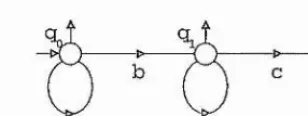
We say that a language is regular if it can be obtained from finite subsets of A* by finitely many applications of U (union), • (concatenation) and * (Kleene’s star operation). For example, if we define A — {6, c}, then the language M = {^n^m : 7^^ 772, Ç is regular because we have M = {c}* • {&}*.
A finite state automaton (or simply an automaton) is a quintuple
A = (Q, A, p,, %,T)
where Q is a finite set called the set of states, A is an alphabet called the input alphabet, /i is a function p : Q x A P(Q) called the transition (we denote by V(Q) the set of all subsets oî Q), qo E Q is called the initial state and T Ç Q is the set of terminal states. The situation q' E (q,a)p, for q,q' E Q, a E A, can be intuitively understood the following way: if A is in state q and reads input a then it can move to state q'.
An automaton can also be seen as a directed graph with vertices Q and an edge {q,a,q') for each q,q^ E Q, a E A such that q' E {q,a)p. We represent an edge {q, a, q') by ç A q'. We define a path tv in the automaton to be a sequence of edges
b
Figure 1.1: An automaton recognizing {c^b^ : n,m G No}
where q i , , Qn+i G Q, a i , ..., G A, and we represent it by
^1, Û2. Ûn. /i i \
7T : Çl —> f?2 —^ Çn+lî (1.1)
or a single triple {q, e, g), with ç G Q, that we represent by 7T : q q.
We say that a path is a successful path if it starts in the initial state and ends in a terminal state. We say that the path tt above is labeled by a i ... a„ (or by e). We write simply
w. /
TT : Ç Ç ,
with w G A*, to mean that tt is a path in A from state q to state q' labeled by w.
We say that a word w G A* is recognized by the automaton A if there exists a successful path tt in A labeled by w; we observe that the empty word e is recog nized if and only if the initial state is a terminal state. The language recognized by the automaton A is the set of all words that are recognized by A; we denote it by vC(A). A language is recognizable if there exists an automaton that recognizes it. For example, the language M defined above, is recognized by the automaton given by Figure 1.1; the figure also illustrates how an automaton can be defined by a picture: the incoming arrow marks the initial state % and the two outgoing arrows mark the two terminal states % and q\. It is well known that the classes of regular and recognizable languages coincide (see for example [28]) and we will use both terms as synonyms.
[image:16.612.219.373.128.186.2]CHAPTER 1. INTRODUCTION 6
deterministic automaton we can write q' = qw^ if there is a path from state q to state q’ labeled by the word w. We say that an automaton is complete if for any ç G Q, a G A the set (g, a)/i has at least one element. We note that if an automaton is deterministic and complete then the transition (j, can be seen as a function from Q x A to Q. It is known that if a language is regular then there exists a deterministic and complete automaton recognizing it; see [28]. Figure 1.1 is an example of a deterministic and complete automaton; we can remove state Ç2 and the arrows arriving to it, to obtain an example of a non deterministic automaton recognizing the same language.
We say that a state q is accessible if there exists a path from the initial state to q and co-accessible if there exists a path from g to a terminal state. If q is a non co-accessible state and (ç, a),u Ç {g} for all a G A we say that g is a fail state. In Figure 1.1, the state g2 is a fail state.
For a word w — a i.. .On with a i , . . . , G A, given t G No, we define w{t) = a i .. .at for t < n and w{t) = w otherwise. For a language L Ç A* we define
Pref(L) = {w{t) : G L,^ G No} = {w G A* : ww' G L for some w' G A*}, Suff(L) = {w e A* : w'w G L for some w' G A*},
Subw(T) = {w G A* : w'ww”G L for some words w \w '' G A*}.
We now present some known results about regular languages that we will need in the thesis. The proofs of these results can be found in [27], for example.
P ro p o sitio n 1.1 Let A be an alphabet. Then we have: (i) 0, A+ and A* are regular;
(ii) Any finite subset of A* is regular;
(iii) If L ,K Ç A* are regular, then LU K , LC\ K , L — K , L K , L*, Pref(T), Suff(L) and Subw(T) are regular.
Lemma 1.2 (The Pum ping Lemma) Let L he an infinite recognizable lan guage in A*. Then there exists a positive integer N such that every word z in L of length exceeding N can be factorized as z ~ uvw in such a way that:
(i) u,w e A*, V G A+;
(ii) \uv\< N;
(iii) uv'^w G L for every m > 0.
This lemma is normally useful to prove that a language is not regular. For example, the language L = {c^b^ : n G N} Ç {6, c}+ is not regular. Suppose it is regular and let N by the constant given by the Pumping Lemma. If we take a word G L with n > N then, by the lemma, there exist numbers i ,j G No and ^ G N such that i j -\- k = n and the words of the form belong to L for every m > 0. In particular we would have ^ with i -P j < n which is not true.
2 Semigroups
For an introduction about semigroup theory we refer the reader to [29]. In this section we introduce the more relevant definitions and results about semigroups for this thesis. In Appendix A we include the remaining semigroup theory we require.
CHAPTER 1. INTRODUCTION 8
Let S ,T be two semigroups. A function ijj : S T is à {semigroup) ho momorphism if it satisfies {siS2)i(j — {sii})){s2ip) for all si,S2 G S. If S ,T are
monoids we say that : 5 -> T is a monoid homomorphism if it is a semigroup homomorphism and preserves the identity, i.e., the image of the identity of S by ijj is the identity of T.
We say that a semigroup F is free on a finite set A if: (i) there is a function a \ A F\ (ii) for every semigroup S and every function (j) : A S there exists a unique homomorphism ip : F S such that aip = (p (we observe that most of the times we write function symbols on the right and by aip we mean the function aip : A —> 5'; a t-)- {aa)^). The semigroup A+ satisfies this definition (taking a to be the identity function A -> A+; a i-> a) and we often refer to A+ as the free semigroup on A. A free monoid can be defined similarly, just replacing ’’semigroup” by ’’monoid” and ”homomorphism” by ’’monoid homomorphism” in the definition of free semigroup, and we refer to A* as the free monoid on A.
Let 5' be a semigroup, let A be a finite set and let ^ : A -4 5" be a function. If the unique extension of ^ to a homomorphism 'ip : A+ —> S is surjective, we say that A is a {semigroup) generating set for S {with respect to ip). If 5 is a monoid and the unique extension of 0 to a monoid homomorphism ?/; : A* —)• S' is surjective then we say that A is a {monoid) generating set for S' {with respect to Ip). When it is clear which homomorphism is associated with the generating set A we say simply that A is a generating set for S' and we write S = (A).
We observe that, since we consider languages on A*, it is not convenient to see the generating set A as a subset of the semigroup S, and in fact we do not even require the function ^ : A —> S' to be injective. Nevertheless, whenever possible, we will not make explicit use of the homomorphisms associated with the generating sets, in order to simplify notation. For two words W\,W2 G A* we
write Wi = W2 to mean that Wiip = W2'^p and we write Wi = W2 to mean that w\
and W2 are equal as words in A*. We also write w = s and s — w with w e A*
Xi ^ A u S {i = 1,.. . ,n) is considered as a product in A* if all factors belong to
A and as a product in S otherwise.
Given a semigroup S and a generating set A for S with respect to the homo morphism Ip : A'^ -4 S' we say that L Ç A+ is a set of normal forms for S' if Lip = S'. If the restriction 'ip [i, is injective we say that L is a set of unique normal forms for S'. We observe that the multiplication in the semigroup is defined when we know how the normal forms multiply. A similar definition applies for monoids and monoid homomorphisms.
3 A utom atic sem igroups
In this section we give the definition of automatic semigroup and some examples, we give further results about regular languages and we list known results about automatic semigroups we will need in the thesis.
To be able to deal with automata that accept pairs of words and to define automatic semigroups, given an alphabet A, we need to define the set
A (2, $) = ((A U {$}) X (A U {$}))\{($, $)}
where $ is a symbol not in A (called the padding symbol) and the function 6^ :
A* X A* —> A(2, $)* defined by
(ûi... cijTx, b \.,. bn)dj^ — <
€ if 0 = m = n
(a i,b i).. .{am,bm) if 0 < m = n (fli, 6i) . . . {chffi, ^m)(^3 ^m4l) ■ • ' (^5 ^n) if 0 ^ TÏI TL ^ (ni,6i ) ... (a„,6n)(an+i,$)... (a^,$) if m > n > 0. We often omit the subscript A and write Ô instead of Ôa
-D efinition 1.3 Let S' be a semigroup and A a finite generating set for S with respect to the homomorphism ip : A+ - 4 S. The pair (A, L) is an automatic
CHAPTER L INTRODUCTION 10
(i) L is a regular language on A+ and Lip = S;
(ii) = {{a,P)0A : a;,/3 G L, a = /?} is a regular language in
A(2,$)+;
(iii) For each a G A, the language La = {{a,fi)0A : a, e L ,aa = p}
is regular in A(2, $)+.
If a semigroup S has an automatic structure {A, L) for some A and L then we say that S is automatic.
We observe that the definition of ” automatic” in [4] uses a set of monoid generators instead of a set of semigroup generators. This distinction does not make any difference as to whether a group (or monoid) is automatic (see [11]) and we will use the definition with monoid generators whenever it is more convenient, which is normally the case when we are working with monoids.
We should say however that, as shown in [16], if we consider the definition with semigroup generators, then an automatic monoid has an automatic structure (A, L) for any generating set A, and this is not true if we consider the definition with monoid generators. Hence, working with semigroup generators, the existence of an automatic structure for a monoid does not depend on the generating set, as it is well known to happen for automatic groups; see [4].
E xam ple 1.4 Let A be an alphabet. Then A+, the free semigroup on A, is automatic. We can consider the regular language L = A~^ and the pair (A, L) is an automatic structure for the semigroup A+. In fact we have
L= = {(ui, t t i ) . . . (ufc. Ok) : A: G N, a i , . . . , G A}
which is a regular language and, for each generator a G A, we have
La = {((%!, Ui)... (aA,a&)($,a) ' k e N ,a i ... ,ak £ A}
Our next example is the bicyclic monoid B, which is defined by the monoid presentation {b,c \ be = 1) (see Appendix A). A natural set of unique normal forms for B is : i ,j > 0} and we shall identify B with this set. The normal forms multiply according to the following rule:
E xam ple 1,5 Let A = {&, c} and L = {cV : i ,j > 0}. Since the regular language L — {c}*{6}* is a set of unique normal forms for B, we have
= {{w,w)Sa : w e L},
which is a regular language, by Proposition 1.6. Since we have
^6 = { (c,c)r{ (6,6)F { ($ ,6)}
and
i'c = {(c, c) }• {(6,6)}*{(6, $)} U {(c, c)}• {($, c)},
the languages Lb and Lc are regular and therefore (A, L) is an automatic structure for B.
We have the following further results about regular languages.
P ro p o sitio n 1.6 Let A and B be two alphabets. We have the following:
(i) If L C A* and K Ç B* are a regular languages and ip : A* B* is a monoid homomorphism, then Lip and Kip~~^ are regular languages;
(ii) If L ,K Ç A* are regular languages, then {L x K)5a is a regular language;
CHAPTER L INTRODUCTION 12
P r o o f . See for example [27] and [4]. H
We need the following result about finite semigroups:
T heorem 1.7 Let S he a finite semigroup, X be a finite set and ip : S be a surjective homomorphism. For any s £ S the set sip~^ is a regular language.
Pr o o f. For an arbitrary s £ S we can define the automaton
~ (Q) -^3 b") %3 {^1)3
where Q = 5 U {go} is the set of states and the transition is defined by
(qo,x)p = Si if xip — Si (si e S', a; G X) {si,x)ia = S2 if si{xip) — 8 2 (si, S2 £ S ,x £ X ).
As we will see, this automaton is in fact the Cayley graph of the semigroup S with respect to X , with the added initial state go and with terminal state s. Given w £ X"*" there exists a successful path go ^ s if and only if wip = s. So we have C{As) — sijj~^ and therefore sip~^ is a regular language. S
We say that (A, L) is an automatic structure with uniqueness for a semigroup S if (A, L) is an automatic structure for S and L is a set of unique normal forms.
The results from [11] we will need follow.
P ro p o sitio n 1.8 If (A, L) is an automatic structure for a semigroup S then there is an automatic structure (A, K) with uniqueness for S.
Pr o o f. Let us choose an ordering on the finite set A. Then we can define the
shortlex ordering on A* by:
and define
K = {a £ L : (V^ £ L){a,P)ÔA £ Oi < p}.
The language K is regular by [12, Theorem 2.5.1], and the result follows from
[11, Propostion 5.3]. M
P ro p o sitio n 1.9 Let S be a semigroup and let A be a generating set for S with respect to the homomorphism ip : A+ S. If there exists an automatic structure (A, L) for S then for any 7 £ A~^ the language
Ly = = {(a, P )0a : a, P £ L ,a ^ = P } is regular.
P r o o f . Let 7 = a i ... a„. The languages L a y , . . . , La^ are all regular. So the languages
^aia-2. = { (a, «2) G L X L : there exists a i G L such th a t ( a , G Lay, {<^1,0:2)ba G
Taia2as — { («) %) G L X L : there exists a2 £ L such th a t
{ a , a2)6A G Laya2i (0:2, G Lafi\bA,
Laia2...an ={(«,/?) G L X L : there exists CK^-i G L such th a t
{ a ,a n - i) Ô A G Lay...an~iA^n-l, P)bA G LafijÔA
are regular by Proposition 1.13; in particular, Ly is regular as required. M
P ro p o sitio n 1.10 Let S be a semigroup with an automatic structure (A, L) and let a £ A"*". If K = LU {a}, then (A ,K ) is an automatic structure for S.
CHAPTER 1. INTRODUCTION 14
P ro p o sitio n 1.12 Suppose that S is a semigroup with an automatic structure (A,L) and let B = A U {6} where b ^ A. For any word a G A+, we have an automatic structure {B, K) for S, where K = L and b is mapped to the element of S represented by a.
We have stated these results for semigroups and semigroup homomorphisms but we note that the same results apply for monoids and monoid homomorphisms.
P ro p o sitio n 1.13 Let A be an alphabet and let U and V be subsets of A* x A* such that the languages U6a and V5a ore regular. Let
W = { (a, 7) G A* X A* : there exists P £ A* such that {a,p} £ U and (P ,j) £ V}.
Then W5a is regular.
P ro p o sitio n 1.14 Let S be a semigroup. Then is automatic if and only if S is automatic.
We also need the following more general result, from [24]:
P ro p o sitio n 1.15 Let S be a semigroup and T be a subsemigroup of S such that the set S \T is finite. Then S is automatic if and only if T is automatic.
We will now prove another useful result:
T heorem 1.16 Let S be an automatic semigroup such that = S. Then S has an automatic structure with uniqueness (A, K ) such that K O A —
P r o o f . Let (A, L) be an automatic structure with uniqueness for S, where L Ç A+. Suppose that there exists a word w £ LC\ A. Let s be the element of S represented by w. Since = S there exist Si,S2 G S such that s — S1S2. Let Wi,W2 £ L he words representing the elements Si and S2, respectively. Defining
w' — W\W2 we have w' = s and w ^ A. Letting L' = L u {w '} we know by Propo
regular language L" = U \{w }. Since L" = L'^ D {L" x L")5 and, for any a £ A, L" — L'^ n {L" X D')ô, the pair (A, L") is also an automatic structure for S (with
uniqueness). We can repeat this process until there are no more elements of the
finite set A in our language. H
The direct product of semigroups was considered in [10] where the authors have proved the following:
P ro p o sitio n 1.17 Let S and T he automatic semigroups.
(i) If S and T are infinite, then S x T is automatic if and only if = 5" ond = T.
(ii) If S is finite and T is infinite, then S x T is automatic if and only
In [41], the authors have established necessary and sufficient conditions for the direct product of semigroups to be finitely generated:
P ro p o sitio n 1.18 Let S and T be two semigroups. If both S and T are infinite then S x T is finitely generated if and only if both S and T are finitely generated, — S and = T. If S is finite and T is infinite then S x T is finitely generated if and only if 3 “^ = S and T is finitely generated.
Using this proposition. Proposition 1.17 has the following equivalent formula tion:
P ro p o sitio n 1.19 The direct product of automatic semigroups is automatic if and only if it is finitely generated.
The answer to the following converse question is not known even for groups: If the direct product G\ x G2 is automatic are both factors Gi and G2 necessarily
CHAPTER 1. INTRODUCTION 16
We now present the generalization for semigroups, considered in [11], of the group concepts of the Cayley graph and the fellow traveller property. Let S be a semigroup generated by a finite set A. The (right) Cayley graph F of S' with respect to A is the directed graph with vertex set S and an edge with label a from s to sa for every vertex s E S and every a G A. If 5 and t are vertices of F, then an (undirected) path from s to t is just a sequence of edges from 5 to t (regardless of direction), and the length of the path is the number of edges it contains. We define the distance d{s, t) from s to i to be the smallest length of a path from s to t if such path exists, and to be infinite otherwise. Let L C A~^ be a regular set of normal forms for S', then F is said to have the fellow traveller property with respect to L if there exists a constant K such that, whenever a,/3 e L with d{a,/3) < 1, we have d{a{t),p{t)) < K for all t > 1. The fellow traveller property characterizes automatic groups (see [4]) and for semigroups we still have the following:
Proposition 1.20 If S is a semigroup with an automatic structure (A, L) and if F is the Cayley graph of S with respect to A, then F has the fellow traveller property with respect to L.
Pr o o f. See [11]. M
As observed in [11], any non automatic semigroup with a zero, for example, has the fellow traveller property, and so the converse of this proposition is not true.
Finally, we say that a semigroup is prefix-automatic or p-automatic if it has an automatic structure {A, L) such that the set
Lh = {[wi,W2)dA : wi E L,W2 E Pref(L), = W2}
Chapter 2
Syntactic monoids of an
autom atic structure for the free
group
We will consider the free group in n generators, as an example of an automatic semigroup. We start by defining a natural automatic structure for the free group. Then we study the syntactic monoids associated with the regular languages that constitute this automatic structure.
1 A utom atic structure
Let G be the free group in the n group generators &i,..., In order to define an automatic structure for G we consider the set of monoid generators A = {ai, ...,a2n} and the monoid presentation
( c i i , . . . , t t 2 n I ® i ^ 2 n + l — i ~ ^ 2 7 i + l — ~ 1 — I j • ♦ • ) ^ ) ) *
The language we consider to represent the elements of G is then formed by the sequences of generators from A such that a generator does not precede its inverse
which, according to our monoid presentation, can be simply written as
L = A* — { A* aia2n+i-i A*).
We will prove that the pair (A, L) is an automatic structure for the free group G. This is a well known result (see [12]), but we include it for completeness. The language L is clearly regular and, since L is a set of unique normal forms for the free group, the language L - is regular as well. Let us fix a generator in A and prove that the language
= { { Wi , W2 ) 0 a : W i , W 2 e L^WiÜh = W2}
is regular. We take an arbitrary word W\ E L and find out which words W2 E L
we can obtain multiplying Wi by the generator ah on the right. If the last letter in the word wi is not the inverse, a2n+i-/*, of o,h then we have W2 = WiO/*. But if
the last letter in wi is G2m+i-A then we have Wi = w[a2n+i-h, where the prefix w[
of Wi is a word in L that does not end with letter a/i, and so W2 = Therefore
we can write
U {{w,w)ÔA-{^,ah) :w E {e}U{LnA*aj)}U
l<j<2n J7^2n4-l-/i
[ J {(w, w ) 6a • (a2n+i-/i, $) :w E { e } U { L n A*aj)}.
l<i<2n
To prove that La^ is regular it now suffices to prove that each set in this finite union is regular. The sets appearing in the union are obtained concatenating a set of the form {(w, w)hA : w E {e}U {LC[A*aj)}, which is regular by Proposition 1.6, with a singleton set and therefore they are regular.
Instead of proving that the languages L and La,^ are regular by building them using simpler languages that we know are regular we can define automata that recognize the languages. We will do that, to illustrate this alternative way of proving regularity but also because we will use the automata in the following section to obtain the syntactic monoids of our languages. Let
CHAPTER 2. SYNTACTIC MONOIDS AND THE FREE GROUP 20
be an automaton, where Q = {ço, • • • ,Ç2n+i} is the set of states, Qq is the initial state, the alphabet A is our generating set, the transition /i : Q x A Q is defined by
(%, = Q2n+i if%G {2n + 1, 2?t, + 1— j}
(qi, aj)jj, ~ Qj otherwise
where i = 0,..., 2n + 1; j — 1,..., 2n, and the set of terminal states is T = Q\{ç2n+i}- We observe that the automaton has only one non terminal state, which is the fail state q2n+i- This automaton, for M = 2, is illustrated in Figure
2.1 (note that, for clarity, we did not represent the arrows ending in the fail state). The only way to enter the fail state is by an arrow labeled by aj starting from a state q2n+i-j, for some j, and the only way to enter state Ç2n+i~j is by an arrow
labeled by a2n+i~j^ Therefore, a word in w E A* will take us from the initial state
go to the fail state q2n+i if and only if w has the form w'a2n+i~jdjw" for some
words w'^w" E A*, which means that w ^ L. We conclude that C{JP) = L. We now define automata to recognize the languages La,^ {ah G A),
- (<Q', A(2,$),^/„çq,T0,
where Q' = { g o , , g2n+2} is the set of states, go is the initial state, A is again the monoid generating set for G, the transition jj,h is defined by
(g%, {aj, aj))fj,h = Qj if ^ ^ + 1 - j, 2n + 1, 2n + 2} (g^, ($, ah))lJ-h —q2n+ 2 if î ^ {2n + 1 — /i, 2n + 1,2n + 2}
(%, (a2n+i~/7, $))m/i =Q2n+ 2 if i t {h, 2n + 1,2n + 2}
(Qi)P)ldh ~Q2n+i in all other cases
for Ï = 0,..., 2n T 2; j — 1,..., 2n and p E A(2, $), and the set of terminal states is V = {g2u+2}.
Observing Figure 2.2, where the automaton A i is represented forn = 2 (again the arrows ending in the fail state g2n+i are not represented), we see that this automaton is very similar to A. If w E L, then the word {w, w)6a will move us
w
a4
a.3
CHAPTER 2. SYNTACTIC MONOIDS AND THE FREE CROUP 22
^<9-,
the terminal state following an arrow labeled by (tt2n+i-/i, $) if j h or following an arrow labeled by ($, %) if j ^ 2n -F I ~ h. It is clear, from the definition of /U/i, that there is no other way to construct a successful path and so we have
~ ^cth'
2 Syntactic monoids
The characterization of regular languages in terms of their syntactic monoids, is described in Chapter 3 of [28], and this reference constitutes our motivation to study syntactic monoids. We start by reproducing the definitions and results from [28] we will need. Let A be a finite alphabet and let L Ç A*. The syntactic congruence gl on A* is defined by
<^L = {(w, z) G A* X A* : (Vw, VG A*) uwv G T if and only if uzv G L},
and the syntactic monoid of L, denoted by Syn(L), is A * / a We say that a language L is recognized by a monoid M if there exists a morphism 'if) : A* M and a subset P of M such that ijj~^{P) = L. A language is always recognized by its syntactic monoid and we have
P ro p o sitio n 2.1 Let A be a finite alphabet and let L Ç. A*. The following statements are equivalent:
(i) L is a rational subset of A*; (a) Syn(L) is finite;
(Hi) L is recognized by a finite monoid M.
Given a deterministic automaton A = (Q, A, pL, T) we define the congruence <7 on A* by
waz if and only if (Vg G Q) qw — qz.
The monoid A*/a is finite and denoting by w the cr-class of w we can define an action of A*/cr on Q by the rule that
CHAPTER 2. SYNTACTIC MONOIDS AND THE FREE GROUP 24
Since we have the implication
(Vg G Q, qw — qz) = > w — z^
each element w G A*/a can be seen as a different transformation in Tq and we call the submonoid A*/a of Tq the transformation monoid of the automaton
A and denote it by TM(A). For each g G Q let us denote the subset {w G
A* \ qw Ç. T} of A* by and let us define the equivalence relation p on Q by /) = {(gi,g2) G Q x Q : qf^T — q^^T}, We say that the automaton A is
reduced if p is the identical relation on Q, i.e., if qf^T — q^^T qi = g 2-Given a regular language L we call minimal automaton for L the complete, deterministic, accessible, reduced automaton recognizing L, which is unique up to an isomorphism (see [28, Theorem 3.3.10]), and by [28, Theorem 3.5.1] we. have
P ro p o sitio n 2.2 Let A he a finite alphabet and let L be a regular language on A*. The syntactic monoid of L coincides with the transformation monoid of the minimal automaton for L.
The automata A and A h (%& G A ) defined in the previous section are complete,
deterministic and accessible. We need to prove that they are also reduced. To see that A is reduced it sufiices to observe that 1"^ • T = L, q^n-^i • T = 0, and that
for 2G {1,..., 2n} we have aj G q~^ - T for j ^ 2n F 1 - i and a2n+i-i f qfi^ • T,
which implies that q f^ 'T ^ q^^ - T for any states qi ^ q2- Similarly, the automata
La,^ are reduced because 1“^ • V = La,^, q2n+i 'T ' = (Ù, g^+2 ' T' = {e}, and for
2G {1,..., 2n} we have {qi{a2n+i~i, a2n+i-i))~^ • T' = 0 and for all j 2n + 1 - 2
we have {qfiaj, aj))~^ • T' ^ 0 which implies qf^ ‘ T' ^ • T' for any states qi + Ç
2-We will now obtain the transformation monoid TM(A) which, by the previous proposition, is the syntactic monoid of the language L. We define the transfor mations in 7q,
f>jk : g g^ if g ^ {g2?H-l-A, 92n+l-t, <Z2»+1 ^ q2n+l\
for j, A: e {1,.. •, 2n} and we will prove that
TM(A) = {1, (j)jk, z : j , k e { I , . 2n}}.
By definition of TM(A) it is clear that this monoid is generated by the set
Y = {Q-1, . . , Ci2n} ~ {^11} • • • 5 4^2n,2n} ;
which is contained in M = {1, (/)jk, 2; : j, A; 6 { 1 , , 2n}}. We have
(/>jk(fim = 4>ik if i 7^ 2n + 1 - m,
because
Q2n+l—k4*jk^lm ~ Q2n+l(fjk4^lm ~ Q2n+l4^lm ~ Q2n+l
and for q ^ {q2n+i~k, (?2n+i} w e have
q^jk^lm ~ qj4^lm — qi‘
Otherwise, if j = 2n 4- 1 — m, we have (j)jk(j>im — 'S;. Since z acts as a zero in M, it follows that M is a monoid and therefore TM(A) Q M. To show that M C TM(A) it suffices to prove the following identities
<l>jk = (/>kk^jj (A: 7^ 2n + 1 - j)
4^jPn+l—j ~ 4^2n+l—j,2 n + l—j4*j,k ^ { jj 2 n F 1 J?})
^ ~ 4^kk4^jj ~ 2n T 1 j).
The first identity holds because: ^kk maps any state q ^ {g2n+i-A:j ^2n+i} to % and, since A; / 2n + 1 — j, the state g* is mapped by (j)jj to g^; all the other states are mapped by (p^k, and therefore by (j>kk<Pjjy to the fail state g2n+i* To check the second identity we observe that both transformations (f)j^2n+i-j and <f)2n+i-jfin+i-j
map the states qj and g2n+i to the fail state. All the other states are mapped by to qj and by 4)2n+i-j,2n+i-j to g2n+i-j and, since k ^ j, we have
2n + 1 — j 7^ 2n + 1 — A; and q2n+i-j is mapped to qj by (pj^k- The third identity
holds because cpkk maps all states to either the fail state or to q2n+i-j and so
CHAPTER 2. SYNTACTIC MONOIDS AND THE FREE GROUP 26
We consider now the transformation monoid TM(A/i) and, defining the trans formations in Tq' ;
Ipjk : q ^ Qj i f q ^ {g 2 n + l-fc j ?2n + l) ?2n +2}j
q2n+2-ky q 2 n + l ,q 2 n + 2 ^ q2n+l]
7]j : g 1-4 g2n+ 2 if q ^ {q2n+l-j)q2n+l,q2n+2},
Ç 2n + l-j5 Ç 2n+lî ^2n+2 ^ <?2n+i;
2; : g M- g2n-M» we will prove that
T M (A ) = {1, 'ijjjk, Vj, z : j , k e { I ,. .. , 2n}}.
The transformation monoid TM(A/J is generated by T — {p : p G A(2, $)} and, observing the definition of p h , w e have
Y ((%!, û i) , . . . , (tt2n5 ^2%%), (U/i, $), ($, Q.2n4-1—/i); (^1, <^2)} ) '02n 2n? V2n+l—h)
The generating set Y is contained in the set TV = {1, 'ipjk, z : j. A: G {1,..., 2n}} and we will now show that AA is a monoid. The product of two transformations of the form 'ipjk is either a transformation of this form or it is z, as is the case with the analogous transformations ^jk in TM(A). A product of the form ipjkVi is in N because, if j ^ 2n + l —/ then ipjkPi = % and otherwise 'ipjkTji = z. Moreover, since multiplying an element from 7V\{1} on the left by a transformation rji we obtain z and since 2: acts as a zero in AA, we conclude that AA is closed for multiplication and therefore is a monoid, implying TM(A/i) = (Y) Ç N.
In order to show that N C TM(A/J we will prove that, for any j , k G {!,..., 2n}, we have the following identities
V 'jt = V'&kV'jj (A; / 2yt - H - ; ),
V'j,2n+l-j = 'd^2n+l-j,2n+l-j'fpj,k {k ^ {j, 2n + 1 — j})>
^ (A: = 2?% 4 - 1 - ; ),
The first three identities are similar to those obtained for the transformations (pjk G TM(A). To prove the fourth identity we observe that the transformation ipkj maps q to qk if q ^ 92»+i, 92»+2} and, since k ^ 2n F I - h, qk is
mapped to the terminal state g2n+2 by phy and the remaining states q2n+i-j, q2n+i
and q2n+ 2 are mapped by ipkj (and therefore by ipkjWi) to the fail state g
2n+i-3 Greenes relations
In this section we determine the Green’s relations of the monoids TM(A) and TM(A/i) obtained in the previous section.
We start with the monoid M = TM(A). In order to determine relation C we first show that
M(f)jk • • • J 4^j,2ni (j) k G {1,. • • ) ). (2.2)
For any m = 1, . . . , 2n we can choose some I7^ 2nT 1 — A: and write (pjm = (pim^Pjk and, with / = 2n + 1 — A; we obtain z, implying {(pji^..., (pjpn^ z} Ç Mcpjk. Since z acts as zero in the monoid, we also have the other inclusion. It is clear that Li — {!}, — {%} and so we have = {<56^1,. . ., 4>j,2n} for any j. A; G {1,..., 2n}.
A similar argument shows that
^jk^I — • • • J (p2n,k') ^ ^ {!)■••} 2??.})
from which follows that Ri — {!}, Rz = {z} and = {(pik, • - • ■,(f>2n,k} and
relation R is determined as well. We have then three D-classes, Di = {!}, D2 — {(pjk : Â A: G 2n}} and D3 = {z} and the eggbox of class D2 is
{4>2i} ••• { 0 2 n ,l} {(pu} {(P2 2} . ' • {<^2»,2}
n}-CHAPTER 2. SYNTACTIC MONOIDS AND THE FREE GROUP 28
D
...
* *
^.2 ^22 ...
; : : :
* *
D
D
D
Figure 2.3: D-classes of the monoid TM(X/i)
Observing that any permutation is idempotent for j 2n + l — k and = z otherwise, representing by 1 the trivial groups and z by 0, the eggbox of D-class Dg is
1 1 . . . 1 0
1 1 . . . 0 1
1 0 . . . 1 1
0 1 . . . 1 1.
that, as in M, we have Li = {!}, = {z} and L^.f^ = We will now prove that Nr]j = {?^i,..., z}. We have already seen that the direct inclusion holds and, since for any k G 2n}, we can write r]k = '4’ikVj with
/ 7^ 2n + 1 — j, the converse inclusion holds as well. So Ljj. = For the relation 71 we have Ri = {!}, Rz — {z} and R^. = { r j j } , and we will now
show that 'i/jjkN = {tpik, ..., 'ijj2n,k, Vk, z} for any j , k E 2n}. We have, as
in M,
z : j , A; e { 1 , . . . , 2?%}} = . . . , z }
and a product of the form ipjkVt is either r]k if j 7^ 2 n + l —/ or z otherwise. We have the same 19-classes Di — {I}, D2 = {i^j,h : j, A: E 2n}} and Dg = {z} as in
M, and the class £>4 = { % , . . . ,%»}- The eggboxes of the D-classes of TM(^/i) are shown in Figure 2.3.
Although, the syntactic monoids for an automatic structure for the free group, are the only syntactic monoids studied in this thesis, observing their Green’s rela tions, it appears to be an interesting research subject, the study of the connection between automatic structures and their syntactic monoids in general.
Anticipating further research in this area we ask:
Q uestion 2.3 What are the syntactic monoids of other (all) automatic struc tures for the free group?
Chapter 3
Generalized sequential machines
and regular languages
It is known that the fellow-traveller property, which characterizes automatic groups, does not characterize automatic semigroups. So we have to use directly the definition and work with regular languages instead of the Cayley graph to prove that a semigroup is automatic. When working with semigroup construc tions, we usually have to construct automatic structures from known automatic structures. For that purpose we use the concept of a generalized sequential ma chine.
1 Introduction
A generalized sequential machine {gsm for short) is a six-tuple
A = (Q,A,B,ii,qo,T)
where Q, A and B are finite sets (called the states, the input alphabet and the output alphabet respectively), ^ is a (partial) function from Q x A to finite subsets oi Q X B*, qQ e Q is the initial state and T Ç Q is the set of terminal states. The inclusion (ÿ,u) G (ç, a)/j, corresponds to the following situation: if A is in state
We can interpret X as a directed labelled graph with vertices Q, and an edge q q' for every pair {q\ u) G (ç, a)jjL. For a path
( a i , « i ) ( a 2 , W 2 ) ( a n , « n ) ,
7T ; q i --- ^ (?3 • • • ^ Çîi+1
we define
<h(7r) = ttiGg . . .
For q,q' e Q, u E A+ and u G we write q ÿ to mean that there exists a path 7T from q to q' such that 4>(7t) = u and S(7t) = v, and we say that (u, v) is the label of the path. We say that a path is successful if it has the form qo t with t e T.
The gsm A induces a mapping : V{A'^) — > B(B+) from subsets of A+ into subsets of B+ defined by
Xr)A = {t) e B + : ( 3 « £ X ) { 3 t £ T ) ( % - ^ + ( ) } .
It is well known that if X is regular then so is Xr}X'> s e e [27, Theorem 11.1 and
Example 11.1]. Similarly, A induces a mapping : V{A'^ xA~^) — )■ V {B ^ x B ^ ) defined by
y ^ A = {(w, z) G B + X B + : (3(w,d) G y )(w G urjA & z G
vr]A)}-The next theorem asserts that, under certain conditions, the mapping Ça also preserves regularity.
Theorem 3.1 Let A — (Q, A, B, /i, %, T) be a gsm, and let tta : (A* x A*)(5^ —>
A* X A* be the inverse of Ôa - Suppose that there is a constant C such that for
any two paths ai, ag in A, we have
| 0 ( a i ) | = | 0 ( a g ) | = > | | 2 ( m ) l - |i:(o^2)|| < c . (3.1)
If M Ç (A~^ X A'*')5a is a regular language in A(2, S)'^ then N = MttaCa^b is a
CHAPTER 3. GENERALIZED SEQUENTIAL MACHINES 32
P ro o f . To prove that N is regular we will define a gsm 6 such that Mt]b ~ N.
First we define three functions with domain B* x B* that will be used in the definition of B:
. . ftz+i • • • if k ^ I ... G/u, Oi ... bijA = ^
e otherwise,
bk+i. . . k i l l > k (gj . .. G^j b \. . . bij p ^
e otherwise,
(gi ... Gjt, 5i ... bi)K, = (gi, bi)... (gs, bs), s — mm{k, I).
We now let B = {R, A(2, $), B(2, $),%/, Tq, Z), where
R = Q x Q x W x W , W = (U ho^*’) U {$}, '•O = (?o,5o,e.e), Z = T x T X {($, $)}.
In order to define the transition u, we first extend the transition p to allow input $:
{q, a)p if G G A {(ç,e)}if G = $.
( ç , a ) / i — <
Now the transition v is defined by
(k , g%w,w'),(G,G3)z/ =
U {((Çlj (ww, w'u')X , {wu, w ’u')p), {wu, w'u')k) ,
(gi,tt)e(ç,a)/I Wi
((çi, q[, $, $), {wu, w'u')6b)} for
w, w' G W \{$} and
(g, a' E A or (g = $ and |w| > \w'u'\) or (g' = $ and \w^\ > |w%|)) provided ||tüu| — < C,
U {((g, (Iv $, e), (w, w'u')5b), ((g, q[, $, $), {w, w'u')Ôb)} for
{{q,q',w,w'), (a, $))%/ =
I J {(ki, q', e, $), {wu, w')6b), {{qi, q\ $, $), {wu, for
{qi,u)e{q,a)iJ.
a E A and {w' = $ or \w'\ < \wu\) where g, ÿ G Q.
Intuitively, the machine works the following way: when it receives a word from M, in each transition it outputs everything possible from the corresponding word in N, and memorizes in its states the remaining suffix of the component which is longer at that moment. This can be done because condition 3.1 holds.
We now prove that N Ç M %. Let {v,v')6b G N. By definition of N there
is {u,u')5a G M such that {v,P) E {(w,w')}C.4- So f G urjA and v' E u'rjA’ This means that in A there are paths of the form
%-i ——\ % (% = 1,... ,m, aiE A, wi E B*) gLi gj (% = 1,..., 71, G| G A, wj G B*),
with
V = Wi... Wm, u' = a'^, v' = w[... w'^, q'g = qm, q'n G T.
We now show that there is a successful path in B of the form
/ f f \ ■ i \
(%—1 ) (?i—1 ) Zj—i, y (%; Zj, (% 1, . . . , pj, where p = max(m, n) and
q-m = qm+l = = 9»+! = • * • = <^m+l ~ — 0,p — ==. .. — Cbp =■ $,
such that the output ... Wp is equal to {v, v')Sb
CHAPTER 3. GENERALIZED SEQUENTIAL MACHINES 34
and zj is equal to the remaining letters of if > \zi-\Wi\ (otherwise it is e). We note that |z^|, \z\\ < C because of assumption (3.1). So after transition i, the complete output produced is the longest prefix of {wi.. .Wi,w[ ... w()(^g that belongs to {B x B)*.
If m = n then transition r is to the terminal state (ç?-, $, $) and produces output cOr = (Zj._i7ü,., z'_iu;j.)(^s, i.e., the output in this last transition is the remainder of {v,v')6b- The machine ends in the terminal state (%-, $, $) and
the complete output is {v,v')6b^
Let us now consider the case where n > m (the other case is similar). In this case, transition m is similar to the previous ones and the remaining input is ($, G^+i) ...($, a 'n ). If \zm\ > then, for i > m and while |z^_i| > |z-_iu;-| {i < n), we can continue visiting the states from the set Q x Q x (IT\{$}) x (W\{$}), the output u>i in these transitions is the longest prefix of (z^_%, z{_iu;()(^g that belongs to (B x B)*, z% is equal to the remaining letters in Zi_i and z{ — e. We observe that in these transitions we have |z%|, |zj| < \zr\ < C. Intuitively, in these transitions, the memory for the left hand side encoded in the states has more letters then those to be output on the right and so after producing the output there will still be letters memorized for the left. If for i = n we still have \zi^i\ > \Zi_iWi\ then last transition is to the terminal state ($, $, Çm? (?n) produces output {zn-i, z'^_iw'^)Ôb being {v,v')Ôb the total output produced. If we have |zj_i| < |z'_^u;'-| for some j, this means intuitively that the memory for the left hand side can be now be emptied and it is safe to output $ symbols on the left since the following inputs are of the form ($, a). So the path will now visit states from the set {q^} x Q x {$} x {e} and each transition produces output (e,zl_iwl)ÔB‘ Last transition is to the terminal state (g^, (/L $) and the total output produced is again {v,P)Ôb
one of the two situations occurs: a $ has appeared as input on the same side and the corresponding ’’memory” is empty; in the last transition. So there is no way to output a letter after a $ on the same side, being the input from (A* x A*)ÔA‘ Hence, let {v,v')5b be an arbitrary element from M % . So there is a successful path in B with label {{u,u')Sa, {v,P)5b) with {u,u^)Ôa G M. We will prove that V G ut]a and v' G u'tja to conclude that
{v,v')Ôb e {{u,u')0A}7rACA^B Q MttaCa^b = N,
as required. Let
w = Gi... am, u' = a [ . .. G^, p = max(m, n).
By definition of z/ a successful path in B labeled by {{u,u^)Ôa, (v,v')Ôb) has the form
/ / f \ (qi,qi,Wi,wU (i =/ / /\ / ■ 1 l,...,p),\
where Qq = %, Çp, Çp E T, am+i — ... — Gp = ^n+i — • • • — qm — » - - — qp, gjj = ... = gp, and coi.. .cOp = {v,v')Sb- This yields successful paths
% (7 = l , . . . , m ) gLi gj (% = 1;..., Tt)
in A, with v = z i ... Zm and v' = z [ ... zÇ. So v E up a and v' E u’p a, completing
the proof of the theorem. H
3 Concatenation of padded languages
In this section we fix an alphabet A, consider two regular languages M, N in {A* X A*)^, and give a sufficient conditions for the padded prvduct of languages
CHAPTER 3. GENERALIZED SEQUENTIAL MACHINES 36
to be regular, which we will prove by using a gsm. We start by observing that the set M O AI is not regular in general, when M, N are regular, as the following example shows.
E xam ple 3.2 Let A = {a, b}, M = {(a, : n G N} and N — {(6,6)” : n G N}. Then M O N = {{a^b^,b^)ô : n ,m E No} is not regular. To see that we can assume that M G AI is regular, and fix K to be the number of states of an automaton accepting M 0 AI. If we take a word (a, 6)"(6, $)’^ E M Q N with n > K then, by using the Pumping Lemma, we know that there exist z, /c G Nq with A; > 0 and i ^ j + k = n such that the words (a, 6)*(a, bY^{a, b)^{b, $)” also belong to M 0 AI, for any I E Nq. In particular we have (a, 6)*(o, 6)^(6, $)” =
E M q N with z +A: < n which is impossible, and therefore M E )N is not regular.
The following theorem gives a sufficient condition for M 0 W to be regular.
T heorem 3.3 Let A be an alphabet and let M, N be regular languages on {A* x A*)^. If there exists a constant C such that, for any two words Wi,W2 G A* we
have
{Wi,W2 ) 6 E M \\wi\ - \W2\\ < C,
then the language M Q N is regular.
P r o o f . We assume, w ithout loss of generality, th a t the languages M and N do not contain the em pty word e. Defining
Mk = {{wi,W2 ) 6 E M : \ w i \ - |wg| - A;},
for each k = —C , ..., C, we can w rite M = [Jk=-c % we observe th a t, each set
Mfc = M n ((A X A)+ • {(gi, $)... (Gfc, $) : Gi,..., Gfc G A})
is regular. Therefore, defining
we can write c
N E) M = Ok
k=-C
and we only need to prove that, for each k — —C, ..., C, the set Ok is regular. We have Oq = Mq • N and so Oqis regular, and the two cases where k is positive and negative are similar. We will then consider only the case where k is positive and,
to prove that Ok is regular, we will define a gsm A such that {Mk ' N )pa =
Ok-We will define a machine such that an input of the form
(gi, bf)... bfi)(^C\, $)... (c/j, $)(dj... dp, e \... Gq) 0
will determine a unique successful path and produce output
■ ■. Ckd\ •. ■ dp, ... eq)ô,
where cl^, . , , , clji, bi, . . , , b^n, C]^, . . ., Ck, d\ , . . . , dp, e \,..., Sq G A and n,p, g G • Intuitively, our machine will receive input (ai, 61) .. . (a^, &n) and reproduce it
as the output, then it will receive input (ci, $)... (c*, $), produce no output
and memorize the word Ci... c* encoded on its states, and finally the input (di... dp. Cl... eq)5 will produce the remaining output (ci... Ckdi... dp, e i ... e,)6 with only last transition being to the unique terminal state. Formally, let
Wk = {vj E A* : |w| < k}
and let
A — {Q, A{2, $), A(2, $), A, go, {x})
be a gsm where
CHAPTER 3. GENERALIZED SEQUENTIAL MACHINES 38
is the set of states, % is the unique terminal state and A is a partial function from
Q X A(2, $) to finite subsets of Q x A(2, $)* defined by the following equations
(z) (%, W , G2))A = {(go, (&!, Gg))} (a i,0 2G A),
(zz) (go, (ai,$)A = {(ai,e)} (gi G A),
(zzz) {w, {ai,$))X = {{wai,e)} (ai G A, w G % , \w\ < k), {iv) {bw, (ai,G2))A = {(znai, (6, Gg)), (%, (6zggi, Gg)^)}
(6, Gi, Gg G A, w G Wk, \bw\ = k),
(v) {bw, (gi, $))A = {((uzGi, r), {b, $)), (%, {bwai,e)d)}
{b, ai e A ,w E Wk, \bw\ — k),
(m ) ( 6w , ($ , Gg ))A = { ( ( w , Z), ( 6 , G g )), ( x , ( 6w , G g )^ )} {b, Gg G A, w G Wk, \bw\ ~ k), {vii) {{bw,r), (gi, $))A = {((zugi, r), (6,$)), (x, {bwai,e)6)}
{b, ai E A ,w E Wk, \bw\ = k),
(mzz) ((6w, /), ($, Gg))A = {((w, f), (6, Gg)), (x, (6w, Gg)d)}
{b, Ü2 E A ,w E Wk),
{ix) ((e, I), ($, Gg))A = {((e, I), ($, G g )), (x, ($, <^2))} («g G A),
(æ) (g, (a;i, a;g))A = 0 in all other cases.
To prove that {Mk ' N)pa C: Ok let
(gi, b\)... {oifi,^7i)(cj, S )... (c/j, $)(d%... dp, 6%... eq)0
be an arbitrary element of Mk • N. We will first consider the case where p — g. The input (gi, 61) . . . (g„, 6„) will leave us on the initial state, by using equation
(z), and produces output (gi, 4 ) • • • (a», 4 ) . Then, the input (ci, $)... (c&, $)
will take us through the states Ci,CiCg,..., Ci... c& G Wk, by using equation
(zz) once and equation (zzz) A; — 1 times, and produces no output. Now, the
input (di,ei) • • • {dq,Cq) forces us to use equation (zz;) g times, but only the last transition is to state x for the path to be successful, and produces output