Rethinking the “mirroring” hypothesis: implications for technological
modularity, tacit coordination, and radical innovation
Bin Hao
East China University of Science and Technology
Yanan Feng University of Nottingham
Vincent Frigant University of Bordeaux
Final version accepted by R&D Management
26-09-2014
Abstract: Studies of the “mirroring” hypothesis have demonstrated the relationships between technological modularity and explicit coordination, yet little is known about the “mirroring” relationship between technological modularity and tacit coordination, and how the “mirroring” relationship may affect radical innovation. This paper contributes to the “mirroring” hypothesis by identifying the interaction mechanisms embedded in and surrounded over the mirroring relationships. Using survey data of 121 high-tech firms in China, our study indicates that technological modularity enhances interfirm tacit coordination between module-makers (“mirroring” hypothesis), and will also positively influence radical innovation (“outcome” hypothesis). Moreover, tacit coordination negatively moderates the impact of technological modularity on radical innovation (“interaction” hypothesis), indicating that the “mirroring” relationship may offset the benefit obtained from
modularization. It also suggests that, in a high technology industry in underdeveloped areas, tacit coordination could lead to exposure of hidden knowledge, thus lowering module-makers’ motivation for technology breakthrough.
Key words: “Mirroring” hypothesis; Technological modularity; Tacit coordination; Radical innovation.
1. Introduction
The relationship between technology and organization has been of great concern for scholars of strategy (Schilling, 2000; Tiwana, 2008; Furlan et al., 2014), technology and innovation management (Henderson and Clark, 1990; Frigant and Talbot, 2005; Fixson and Park, 2008; Wincent et al., 2009) and economics (Sturgeon, 2002; Baldwin, 2008). This stream of research stems from examining the interdependencies between different parts of a complex system (Simon, 1962), emphasizing that when the technological architecture is redesigned to deal with the interdependencies, there are supposed to be some corresponding changes in the extent of looseness of organization (Sosa et al., 2004; Fixson and Park, 2008; Lovell, 2011), which is widely recognized as the “mirroring” hypothesis. From this point of view, a number of studies suggest a one-to-one map for such relationship (Henderson and Clark, 1990;
Sanchez and Mahoney, 1996; MacCormack et al., 2012), arguing that organizations must know how to manage the embedded knowledge of the technological system when developing their modular products (Sosa et al., 2004) in order to expand the space for identifying
solutions (MacCormack et al., 2012).
To test the “mirroring” hypothesis, the mainstream literature focuses on interdependencies among modules, indicating that modularization changes the way partner firms coordinate with each other, and thus, the efficiency of knowledge creation and innovation (Henderson and Clark, 1990; Pil and Cohen, 2006; Tiwana, 2008), highlighting coordination mechanism as a proxy of organizational property in the “mirroring” system. Within this body of research, some scholars argue that technological modularity creates an “embedded coordination mechanism” that reduces the need for explicit, ongoing communication (Sanchez and Mahoney, 1996; Brusoni et al., 2001). Although some other scholars have been looking for evidence that explicit coordination still exists within the context of technological modularity (e.g., Brusoni, 2005; Cataldo et al., 2006), it is widely acknowledged that the interaction knowledge that was originally acquired by face-to-face communication has been encapsulated into the standardized component interfaces. Nevertheless, the reduced explicit coordination may hamper firms’ knowledge searching and learning across organizational boundaries, especially in the frame of information hiding which is “characterized by (the) knowledge of design decisions that (a firm) hides from all others” (Parnas, 1972, p.1056).
This consideration entails two unsolved issues in relation to the “mirroring” hypothesis. First, given the reduced explicit coordination, are there other alternative organizational mechanisms that can guarantee interfirm knowledge exchange in a modular production network? This issue calls for the exploration of new “mirroring” relationships. Pil and Cohen (2006) indicated the importance of common knowledge in shaping the design of a product. Common knowledge as a proxy of tacit coordination mechanism has been recognized for facilitating information sharing (Srikanth and Puranam, 2011). We thus propose that module-makers (i.e., the companies that each takes charge of the production of one or several
modules) rely on tacit coordination to exchange knowledge and make improvements to their components.
knowledge exploration (i.e., innovation) across organizational boundaries? Specifically, the firms may adjust coordination mechanisms in response to technological changes
(MacCormack et al., 2012), or technological configurations in response to organizational changes (Fixson and Park, 2008). Such dynamic mirroring relationship reflects that firms have to change their channels for knowledge acquisition and learning and patterns for mixing and matching among components. Therefore, we propose the “mirroring” interactions
between technological modularity and coordination mechanisms influence innovation performance, especially radical innovation which refers to fundamental improvements of existing technologies (Abernathy and Utterback, 1978).
Based on these two issues, a primary aim of the present study is to contribute to the “mirroring” hypothesis by focusing attention on the interactions among technological modularity, tacit coordination and radical innovation. More specifically, we address the following research questions: (1) does technological modularity mirror tacit coordination? (2) If so, how does this mirroring relationship affect radical innovation?
We test our hypotheses using a large-scale survey of 121 high-tech firms in Shanghai, China, which is appropriate for our study. First, Shanghai provides us with a rich context for exploring radical innovation. As a highly open economy and a major gateway to the whole Chinese market, Shanghai has gathered tens of thousands of local and foreign enterprises fiercely competing with other. Radical innovation has become an important strategy for obtaining competitive advantage in this area. Second, as China’s window opening up to the global economy, Shanghai plays a vital role in bridging industrial division between other areas of China and developed economies, especially in the frame of modularization. The activities of outsourcing and components supplement widely connect Shanghai local firms with firms from other areas of China and from overseas, thereby allowing us to explore the phenomenon of technological modularity in this setting.
We begin by conducting a review of relevant literature in explaining existing research on the “mirroring” hypothesis. Then, we illustrate the research constructs and set up the
theoretical framework before proposing the “mirroring” hypotheses between technological and organizational constructs. In the following section, we describe our methodology,
followed by a summary of the main empirical results. We conclude by discussing the findings and contributions.
2. The ambiguity of the “mirroring” hypothesis
that product modularity would be more likely to appear in a loosely coupled organizational form rather than in a tightly coupled one at the industry level. In line with this, a latest research by MacCormack and colleagues (2012) found that the product modularity is closely related to a more loosely coupled organization.
However, Hoetker (2006, p.514) found only partial support for this relationship, that “the increased product modularity enhances reconfigurability of organizations more quickly than it allows firm to move activities out of hierarchy”, implying that the relationship between product modularity and outsourcing is not as salient as we expect. Colfer (2007) also pointed out that “the conventional view on mirroring is too simplistic” and there must be some contingent relationships between technological architecture and organizational structure, explaining when the mirroring holds, as well as when and why it may not hold. Following this research, Colfer and Baldwin (2010) suggested that the situation changes according to
different levels of the organization. This is confirmed by Cabigiosu and Camuffo (2012) who argued that supplier relations for loosely coupled components (product modularity) would be characterized by less information sharing (organizational modularity) at the component level, whereas such relationship at the firm level might be either less or more, depending on
different hypotheses in each condition. Recently, Furlan et al. (2014) examined if and to what extent the “mirroring” hypothesis is contingent on technological change. Their findings revealed that the “mirroring” hypothesis does not hold for technologically dynamic components and the associated supply relationships.
Even within the production system, whether technological modularity mirrors
organizational coordination is still debatable. The standardized component interface or design rule is considered to reduce the necessity of coordination or communication across the
organization (Schilling, 2000). However, a study by Sosa and colleagues (2004) identified a strong tendency for communication to be associated with key design interfaces. Cataldo et al. (2006) and Gokpinar et al. (2010) also found that tasks could be completed rapidly and effectively when their communication within the team was congruent with technological architecture and linkages between components, highlighting the role of interdependency between components of a system. According to Sosa et al. (2007), whilst the indirect linkages in the architecture increase the risk of unforeseeable design iterations, the corresponding communication network facilitates knowledge sharing and supported more interdependencies between components.
The embedded coordination mechanism in modular systems changes the way a firm organizes the process of knowledge acquisition and exploration (Sanchez and Mahoney, 1996). Langlois and Robertson (1992) asserted that such mechanism offers “potential for autonomous innovation …… driven by the division of labor and provides the opportunity for rapid trial-and-error learning” (p.297). Galunic and Eisenhardt (2001) also found that
As the debates still continue, it is necessary to extend our view on the “mirroring” hypothesis by providing a natural way of integrating multiple insights, exploring the interaction mechanisms embedded in and surrounded over the mirroring relationships.
3. Theory and constructs
We frame our discussion by discomposing the “mirroring” system. Here we identify two types of elements within the “mirroring” system: technological architecture and
organizational coordination. The former refers to technological modularity of a whole product system, and the later is confined to tacit coordination here in our study. We consider radical innovation as an outcome of the interaction between the two sides of the “mirror”.
3.1 The technology side of the “mirror”: technological modularity
Technological architecture is conceptualized here as a structural description of hierarchical technological sub-systems which constitute the overall system and the manner in which the different technological sub-systems are linked together, referring to the scheme of a product’s functions allocated to its components (Ulrich, 1995; Zwerink et al., 2007). An integral
technological architecture could be partitioned into a set of components and become a loosely coupled system, such as the modular architecture (Henderson and Clark, 1990). The degree of looseness is a proxy of the situation of variables in common or not (Glassman, 1973), or separateness and identity between elements in one system (Weick, 1976).
Modularity is a special form of design that helps us capture the interrelatedness of components within a technological architecture. Technological modularity refers to “the intentional decoupling of interoperating subsystems of a larger system” (Tiwana, 2008, p. 770). The more modular the technological architecture is, the fewer the components are directly in interaction, especially in case that the interdependencies between components are unnecessary. A component is characterized as “a module” in a modular architecture (Ulrich, 1995), representing a high degree of looseness that ensures high interoperability. It is
accepted that technological modularity relates to the standardized component interface which cuts down well-understood interdependencies (Sanchez and Mahoney, 1996). Well-developed standardized component interface embeds interactions of individuals or teams into
technological architecture, making it easy to divide the labor; whilst poor standardized component interface makes it unclear about what it is and how it works and derives more interactions within the technological system. Critical components of a technological architecture, which depend on many other components—like many interfaces—for functionality, imply a low degree of technological modularity (Mikkola, 2003).
Transformation from tightly coupled technological architecture to loosely coupled one is determined by the way the design decisions are allocated to teams (Orton and Weick, 1990; Howells et al., 2008).
3.2 The organization side of the “mirror”: tacit coordination
al., 2001). A tightly coupled organizational architecture represents high extent of coordination and information sharing, whilst a loosely coupled one entails low extent of coordination and information sharing. Interfirm coordination happens when partner firms communicate with each other to optimize interfirm collaboration processes, and when they introduce common knowledge for joint activities (Ring and Van De Ven, 1992; Srikanth and Puranam, 2011). Because the ways partner firms coordinate with each other may affect knowledge transfer, we here distinguish between explicit and tacit coordination. Explicit coordination represents information transfer and feedback by direct communication, dealing with interdependencies between components where a change in one component would inevitably lead to change in another (Ulrich, 1995). In contrast, tacit coordination refers to arrangements that “enable the formation and leverage of common ground without the need for direct, ongoing
communication” (Srikanth and Puranam, 2011, p. 850). For example, two partner firms working together on a joint R&D project are supposed to know each other’s past behaviors, expertise, and interests, and thus could easily understand partners’ actions so as to adjust their own behaviors to facilitate the joint task completion even in the absence of ongoing
communication. Tacit coordination enables synchronization of partners’ actions based on common knowledge about what others in the relationship are likely to do (Stasser and
Wittenbaum, 1995), thereby acting as a mechanism for improving, facilitating and optimizing interfirm knowledge sharing. Generally, three kinds of common knowledge enable tacit coordination: the environment (such as technology, market, competition, etc.), the system’s knowledge about linkages between elements, and each partner’s “inner workings procedures of the modules” (Srikanth and Puranam, 2011, p. 856). Common knowledge of the
environment enables partners to know the elements that influence their actions, whilst common knowledge about each other’s inner workings enables partners to capture how they collaborate in corresponding to the dynamic surroundings.
We expect that tacit coordination could be helpful in promoting information sharing and exchange in modular systems. However, it is unclear whether tacit coordination has been reduced by modularization, as happened to explicit, ongoing coordination (Sanchez and Mahoney, 1996; Brusoni, 2005), and how it may affect innovation in such setting. We thus examine the role of tacit coordination in driving radical innovation within modular production networks in the present study.
3.3 The outcome of the “mirror”: radical innovation
innovation, which is conceived as minor improvements or simple adjustments in current technology (Veryzer, 1998), significantly relates to the way technological modules can be mixed and matched (Schilling, 2000). Similarly, radical innovation, the unique and state-of-the-art technological advance that significantly changes the consumption pattern of a market (Abernathy and Utterback, 1978), has also been acknowledged to have close relationship with technology design (Verganti, 2008).
A radical innovation represents a clear departure from existing practice and a significant improvement over the previous technology (Duchesneau et al., 1979; Dosi, 1982). The new products that were developed with disruption of existing technologies are not able to replace with substitutes by using old technologies. According to Chandy and Tellis (1998), a radical innovation not only refers to the extent to which the product incorporates a new technology, but also concerns fulfilling customer needs better than existing products. Markets with radical innovations would be restructured and replaced by entirely new product categories (Rice, Kelly, Peters, and O'Connor, 2001). This study analyzes the role of technological modularity in radical innovation, especially for the situations in which tacit coordination widely exists.
4. Hypotheses
4.1 The “mirroring” hypothesis: the link between technological modularity and tacit coordination
As pointed out by Baldwin and Clark (2000), modular systems are significantly more difficult than interconnected systems to design. In the first phase of design modularization, the
interface connections are generally unforeseen, and the interdependencies between
components are unknown for much of its design and development (Colfer, 2007). Since the designers need to know more than they make (Brusoni et al., 2001), it would be difficult to standardize all of the interface knowledge. To capture the technological or process knowledge that can not be embedded into the standardized component interfaces, module-makers will rely on information that reveals partners’ awareness, meanings, and decision-making procedures (Bechky, 2003; Gutwin et al., 2004). Such information builds a common ground for the transformation of understanding on the dispersed integration processes, implying that tacit coordination facilitates information sharing and transfer within modular systems.
Moreover, changing context necessitates mutual adjustment of components, calling for tacit coordination that guarantees high extent of predictability and understandability of partners’ knowledge-related actions. The common knowledge about technology vocabularies, tools, as well as decision-making procedures (Srikanth and Puranam, 2011) facilitates the learning of new knowledge about technologies or markets, so that one would always know how to make progress in the components and keep pace with the whole modular system.
pattern of communication is less flexible when adjusting the degree of technological modularity over time (Kratzer et al., 2008), the knowledge and information processing structure may respond to these dynamics and become more adaptive (Henderson and Clark, 1990). Otherwise, the firm would not be able to undertake the changing interfaces and keep strategic flexibility (Sanchez and Mahoney, 1996). From this perspective, the degree of technological modularity is positively related to the necessity of tacit coordination.
Hypothesis 1: Technological modularity is positively associated with tacit coordination.
4.2 The “outcome” hypothesis: the architecture-driven radical innovation
The extent of looseness of technological architecture is widely acknowledged as a means to influence environmental adaptation and competitive learning (Sosa et al., 2007; De Weerd-Nederhof et al., 2007). Technological modularity facilitates division of knowledge by, (1) flexibly adjusting the information-processing structure within the technological system; (2) maintaining stabilities of knowledge sets in the boundaries of organizations over time; and (3) highly matching between technological actions and organizational decisions (Cabigiosu and Camuffo, 2012). These structural characteristics enable firms to make changes and
improvements faster and more effectively. Meanwhile, leading firms may adjust
organizational and technological configurations in response to market dynamics (Bao, Chen, and Zhou, 2012). Since firms may adjust organizational processes in response to
technological changes (MacCormack et al., 2012), or technological configurations in response to organizational changes (Fixson and Park, 2008), they will have to change their channels for knowledge acquisition and learning and patterns for mixing and matching among
components. As the degree of technological modularity changes, the conditions and processes of innovation may also change. For higher degree of technological modularity, firms can develop more flexible information-processing capacities (Cabigiosu and Camuffo, 2012), enabling more extensive knowledge searching for radical innovation (Kim and Park, 2013).
Technological modularity provides a natural path to understanding architectural knowledge and the way of acquiring it (Henderson and Clark, 1990). Firms could then be more capable of searching and acquiring knowledge from the surroundings, including the demands, the competition, and supplier relations, so that they may make significant changes to existing product architecture. From the component level, the entire information-processing structure could be under the control of the module-makers. As independent decision-makers, the module-makers may confront the surroundings directly and adjust its information-processing structure flexibly and quickly if necessary (Sanchez and Mahoney, 1996), making possible a radical innovation at the component level. Since there are few interdependencies between partner firms, a firm can experiment with and dramatically alter its own module design strategies without modifications to other components (Pil and Cohen, 2006). Specialized knowledge configuration expands the amount of investment a firm could make in a specific technological area. By focusing on its own technological modules, a firm could more easily make significant changes to existing technology, with lower cost and risk (Hoetker et al., 2007), than those who have to innovate for a specific interconnected system.
the same time reserves the channels from which diversified knowledge can be mixed and matched (Schilling, 2000). Module-makers could then easily be involved in each other’s technological advances in developing disruptive ideas for the development of key modules. As the division of labor in modular production systems leads to increasing number of module-makers (i.e., a higher market thickness) competing for the production of specific modules, the knowledge base could be significantly extended, thus allowing for extensive exploration in uncertain technological areas (Verganti, 2008).
Hypothesis 2: Technological modularity is positively associated with radical innovation.
4.3 The “interaction” hypothesis: the role of tacit coordination in architecture-driven radical innovation
Before using tacit coordination it is necessary that the inner workings of the modules turn into common ground. Indeed, such knowledge sharing facilitates the interfirm process integration and operational coordination. In theory, compared to explicit coordination, tacit coordination enables more knowledge transfer from inside of the modules, because the shared inner workings provide more direct accesses (see Srikanth and Puranam’s (2011) mortgage processing example, p.856) with fewer possibilities of misunderstanding than ongoing communication. An example of this situation is the recruitment of a partner’s employees. Based on a loosely coupled technological architecture, tacit coordination enables a firm to get access to different parts of a technological system, searching for both architecture-level and component-level knowledge (Henderson and Clark, 1990). By absorbing knowledge from other modules and embedding it into the structure of their own modules, firms could make adjustments to exiting technologies for better functionality. Especially, when partner firms geographically locate together (e.g., industry parks), they normally learn quickly through tacit coordination within the cluster to improve their modules over time (Whittington et al., 2009). Further, tacit coordination allows that information about technological advances will be shared among partners, particularly when it may change the way modules assemble together. For example, in a geographically gathered modular production network, identical
technological vocabularies ensure that module-makers instantly acquire information about technology improvements of components or the whole technological architecture, and correspondingly adjust its own R&D activities to guarantee compatibility and
competitiveness.
The loose coupling provides opportunities for introducing as much diversified technologies as possible, highlighting the role of information-processing capacity in pursuing radical innovation. Tacit coordination acts as a driving force of such processes as it facilitates interfirm diffusion of technology (Gutwin et al., 2004). Shared knowledge about the inner workings of the modules helps firms to understand partner firms’ knowledge configurations, whereas shared knowledge about work conventions helps firms to grasp how they get access to partner firms’ knowledge. Thereafter, extensive tacit coordination creates a tight
specification enabling cross boundaries knowledge creation and synergy through loosely coupled technological architecture which allow creativity to flourish (Wincent et al., 2009). As a result, partner firms develop increasingly advanced technologies that support disruption of existing knowledge configurations and sustain the focus of exploring potential
relationship between technological modularity and radical innovation is positively moderated by tacit coordination.
Hypothesis 3: Tacit coordination positively moderates the relationship between technological modularity and radical innovation.
5. Methodology
5.1 Data collection
We collected data by conducting survey because it exerts fewer confinements on the theorizing than second-hand data, allowing us to flexibly develop the theoretical framework for extending current perspectives on the “mirroring” hypothesis. We randomly selected a sample of 300 high technology companies located in Shanghai, the most developed area in Mainland China. Shanghai has become regional headquarters of 78 Fortune 500 Companies by 2012. More than 330 multi-national corporations, such as Cisco, Intel, IBM, and
Microsoft, have set up research and development (R&D) centers in Shanghai. In each firm, we selected one senior manager, and one middle manager from R&D or marketing
department, to ensure that respondents were familiar with their firms’ technological
knowledge and innovation and interfirm activities. The senior managers provided information about tacit coordination, while the middle managers were asked questions about technology and innovation. Different sources of information can be helpful in minimizing common method bias. We firstly contacted the managers by telephone, explaining the purpose of the survey and inviting their participation. To ensure the suitability of the sample, we asked them if their companies involve in activities that relate to modularity such as R&D outsourcing, components supplement, or decomposition and integration of products (see, Schilling, 2000; Tiwana, 2008; Miozzo and Grimshaw, 2005) before formally deciding on the interview. Most of the companies that agreed to join the interview meet the requirement of our study, with only 7 exceptions which haven’t been included in our sample. To ensure a high response rate, we administered the questionnaire on-site, asking the respondents to fill in the questionnaires based on their own situations. The use of on-site interview also helped respondents correctly understand the meanings of each item, and was helpful in acquiring valid, high quality data. To avoid the satisfaction bias in which respondents decline to select the options that could satisfy the interviewer, we explained to the respondents that there was no right or wrong about the items, and the options that were closest to the exact situations were the best for our
research.
We received 121 fully completed and valid questionnaires from several high technology industries (new energy and new material 14.1%; mechanical and electronic equipment 23.1%; information technology 47.9%; new pharmaceutical and bioengineering 8.3%; and others such as aerospace and semiconductor 6.6%), with a response rate of 40.3 percent (121/300). We compared the responding firms and non-responding firms in terms of firm size, firm age, and sales, and found no significant difference, indicating no notable response bias.
5.2 Measures
We measured technological modularity with four items adapted from Tiwana (2008). The
scale indicates the extent to which the technological connections between a firm’s technology system and the partners’ technology system are characterized as: (1) loosely coupled, (2) stable, well-defined interface, (3) well-understood interdependence, and (4) minimal unnecessary interdependence. This measurement captures the looseness of technological architecture by investigating the situations of standardizing interfaces, minimizing interdependence, and enhancing loose coupling, which is consistent with the
conceptualization of modularity by Sanchez and Mahoney (1996). It also focuses on the technological aspect of modularity rather than others by highlighting the technological connections between two related technology systems of an analyzed product. Tacit coordination was measured by three items: respectively, the frequency of using the arrangement that entails understanding of each other’s decision-making procedures, development of identical technology vocabularies for facilitating knowledge sharing and technology tools for enabling actions to be transparent. We started with Srikanth and
Puranam’s (2011) scale which was developed for measuring investment in tacit coordination in the setting of distributed work in an organization. To precisely capture the practice of tacit coordination in the interfirm context, we refined the item pool and deleted the items that could not accurately reflect the activities of interfirm interaction. To ensure unequivocality and meaningfulness, we iteratively refined the items through feedback from twelve professionals. Following Zhou and Li (2012), we measured radical innovation by three items that assessed the extent to which an innovation (1) involves a fundamentally major improvement over the previous technology, (2) leads to products that difficult to replace with substitute using older technology, and (3) brings in substantial transformation in consumption patterns in the market. The three measures were assessed with five-point Likert scales, ranging from 1= strongly disagree to 5= strongly agree.
Control variables. To capture other factors that may affect our model, we controlled for a number of other effects. At the firm level, we controlled for firm size, firm age, ownership, and type of industry. Firm size and age may be associated with the level of managerial competencies of a firm in launching innovations (Huergo and Jaumandreu, 2004), while ownership and type of industry are important background factors to its external relationship (Xia, 2013) which relate to resource or policy advantages when carrying out R&D activities. Respondents were asked to indicate the number of employees in their firms, the number of years since the firm founded, if their firms were state-owned or non state-owned, and which industries they belonged to. As nearly half of the sample was from the information technology industry, we thus followed Li and Zhang (2007), and coded the information technology
environmental variables: technological turbulence and market predictability (Cabigiosu and Camuffo, 2012; Zhou and Li, 2012), as they may relate to radical innovation. Technological turbulence referred to the speed and frequency of product technology changes. Market predictability referred to the extent to which the market demand for the analyzed technology is predictable.
Construct validity. All the constructs exhibit sufficient convergent validity and reliability, as the composite reliability (CR) of all constructs are greater than 0.8, and all average variances extracted (AVE) range from 0.56 to 0.79, exceeding the benchmark value of 0.5. We run a series of chi-square difference tests for all constructs in pair to test discriminant validity. The result shows that the chi-square differences are highly significant, suggesting
discriminant validity (e.g., technological modularity vs. radical innovation: △χ2=34.18,
p=0.000). In addition, the AVE of each construct is higher than its highest shared variance with other constructs, also indicating discriminant validity. The constructs correlations, means, and standard deviations are summarized in table 1.
---Insert Table 1 about here.
---5.3 Analytical technique
We tested for heteroskedasticity to identify if OLS (ordinary least squares) was an
appropriate analytical technique for our study. The result of the White test showed that the null hypothesis of no heteroskedasticity was rejected (χ2 (42) = 68.18, P = 0.007). The Breusch and Pagan test for random effects also rejected the null hypothesis that all effects are not different from zero (χ2 (8) = 25.48, P = 0.001), indicating that the OLS estimation
procedure is not appropriate. We thus chose weighted least squares (WLS) for testing our theory, as it provides a more efficient estimate of the standard error and parameter than OLS under these circumstances (Weisberg, 1985).
We mean-centered the independent variables and created the interaction by multiplying them to minimize possible collinearity. We checked the Variance Inflation Factors for the following models in table 2 and 3, which all fall in the interval between 1.02 and 1.81, showing that multicollinearity is not a problem.
6. Analysis and results
Table 2 shows the result of WLS regression taking tacit coordination as dependent variable, indicating that technological modularity is positively related to tacit coordination (b=0.37,
p<0.001). Hypothesis 1 is thus supported.
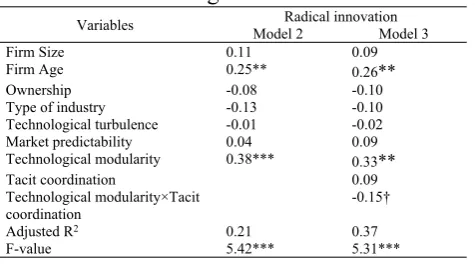
---Table 3 presents the result of hierarchy moderated regression taking radical innovation as dependent variable (model 2 and model 3). Model 2 includes control variables and main effect, and model 3 adds interaction effect.
---Insert Table 3 about here.
---According to the result of model 2, Hypothesis 2, proposing that technological modularity will be positively associated with radical innovation, is supported (b=0.38, p<0.001).
Surprisingly, according to model 3, the interaction between technological modularity and tacit coordination is negatively associated with radical innovation (b=-0.15, p<0.1), which is contrary to the prediction of Hypothesis 3, indicating that tacit coordination significantly reduces the effect of technological modularity on radical innovation. Furthermore, tacit coordination is not a predictor of radical innovation (b=0.09, n.s.). Both in Model 2 and 3, we find a positive relationship between firm age and radical innovation (b=0.25, p<0.01, and
b=0.26, p<0.01, respectively).
7. Discussion and conclusion
This study attempted to extend the existing view of the “mirroring” hypothesis by conducting an empirical analysis from the aspects of technological modularity, tacit coordination and radical innovation. Drawing on existing literature, we posited that technological modularity can be a predictor of tacit coordination, and the interaction between these two variables may affect radical innovation. With a sample of China’s high technology industries, we examined the “mirroring” relationship. We found that technological modularity has a positive
relationship with tacit coordination. This finding provides evidence that coordination widely exists within modular production networks, but in a rather tacit way. It suggests a solution for the debates on the relationship between technological modularity and coordination
mechanisms (Sanchez and Mahoney, 1996; Hoetker, 2006). The information embedded into the standardized component interface is mostly knowledge about how components mix and match with each other. While module-makers still need to understand how partners within the modular production network could be consistent with each other in decision-making and strategic actions, tacit coordination can be considered as a proxy of information sharing that facilitates interaction and integration.
We also found that technological modularity has a positive effect on radical innovation, which is in support of the “outcome” hypothesis. This finding provides evidence that a modular context enables access to diverse and novel knowledge, which allows modular-makers to break the limit of existing technology configuration. It also develops the
Our empirical analysis surprisingly revealed that tacit coordination negatively moderates the relationship between technological modularity and radical innovation, which is opposite to our “interaction” hypothesis. This may be attributed to the sample we collected from China. As the institutional settings in China are still underdeveloped, tacit coordination may facilitate firms’ misappropriation of the partners’ knowledge because such behaviors may not be punished by law (Lin et al., 2009). Any component-level innovation could be imitated by other network partners. The risk of imitation in modular system (see, Ethiraj et al., 2008) may thus be expanded. As a result, module-makers prefer not to take the risk to launch radical innovation. This finding raises a new topic for future research: the role of institution in the “mirroring” hypothesis.
The results also highlighted the importance of firm age as a control variable in our framework. Our analysis suggested a positive relationship between firm age and radical innovation. It may be attributed to the increasing investments (e.g., venture capital), technical experts, and government supports. This is because in the setting of our data source,
technological uncertainty hampers high-tech new ventures’ social financing, indicating that an investment to an older firm is supposed to have less risk.
Our findings also have implications for R&D management. Since technological modularity promotes radical innovation, module-makers should not only focus on making minor
improvements to the components, but also aim to launching disruptive changes. In this case, a loosely coupled structure can be helpful for organizing R&D activities. Because tacit
coordination ensures that module-makers keep updating information about the changes in other components or even the whole system architecture, it increases the possibility that R&D investment pays off. Especially for those who outsource the R&D activities, tacit coordination helps to transfer information about technological improvements and the corresponding
feedbacks into manufacturing and engineering. However, too much tacit coordination may hinder outsourcees’ ambition of developing novel conceptions, since it may foster knowledge misappropriation as discussed in our study.
This study contributes to literature in several ways. First, following Colfer’s (2007) call, we have offered a new landscape of the “mirroring” hypothesis by examining the one-to-one map between technological modularity and tacit coordination, and how such “mirroring”
relationship affects radical innovation. We extended the conventional perspective which considers the “mirroring” issue as a proxy for solving interdependencies from the perspective of explicit coordination, providing a new insight on understanding how technology and organization “mirror” each other. In addition to considering the “mirroring” theory as a one-to-one map, we have also explored the outcome of the “mirroring” relationship, suggesting an alternative perspective to understand the essence of the “mirroring”. This is meaningful since we need to explore not only how the “mirroring” hypothesis may hold, but also why it may hold (Colfer, 2007). It can also be helpful in guiding further exploration of more targeted research approaches.
Second, we deepened our understanding of coordination in modular production networks by exploring the role of tacit coordination. We suggest that a more loosely coupled
powerful explanation for some empirical studies which insist that coordination still exists in modular organizations (e.g., Brusoni, 2005; Tiwana, 2008), implying that managers of modular firms cannot thoroughly rely on the standardized component interfaces, but need to develop a series of common knowledge to ensure effectiveness of outsourcing or interfirm collaboration.
Third, we contributed to the existing literature by identifying the role of technological modularity in radical innovation (the “outcome” hypothesis). Our arguments develop the research on modularity and innovation (Henderson and Clark, 1990; Pil and Cohen, 2006), arguing that technological modularity not just benefits minor improvements based on existing architecture and components, but also promotes the development of disruptive technologies.
Some limitations must also be acknowledged. First, our sample was limited to high
technology corporations in Shanghai, China. Obviously there is no reason to assume that this sampling frame is applicable to other countries and regions, but it does provide a reasonable starting point. A natural way to overcome this limitation would be to compare the “mirroring” relationships between developed settings and underdeveloped settings. Second, the
measurement of radical innovation in the current study is based on managers’ perceptions. Although the measurement has been adopted by Zhou and Li (2012), it may still lead to an overestimation of the sample firms’ innovation abilities (Hurmelinna-Laukkanen et al., 2008). Future research could corroborate our findings by adopting objective measures. Third, apart from the contingent factors in this study, the “mirroring” relationships may also be influenced by other systems, such as institution, culture system, industrial ecosystem (e.g., “What kind of industrial cluster is suitable to more loosely coupled organization system?”). A further
exploration of relative systems can be meaningful in developing a more systematic framework of the “mirroring” hypothesis.
References
Abernathy, W.J. and Utterback, J.M. (1978) Patterns of industrial innovation. Technology Review, 80, 7, 40-47. Baldwin, C.Y. and Clark, K.B. (2000) Design Rules: The Power of Modularity. MIT Press: Cambridge, Massachusetts. Baldwin, C.Y. (2008) Where do transactions come from? Modularity, transactions, and the boundaries of firms. Industrial and Corporate Change, 17, 1, 155-195.
Bao, Y., Chen, X. and Zhou, K.Z. (2012) External learning, market dynamics, and radical innovation: Evidence from China's high-tech firms. Journal of Business Research, 65, 8, 1226-1233.
Bechky, B. (2003) Sharing meaning across occupational communities: the transformation of understanding on a production floor. Organization Science, 14, 3, 312-330.
Brusoni, S. (2005) The limits of specialization: Problem solving and coordination in “modular networks”. Organization Studies, 26, 12, 1885-1907.
Brusoni, S., Prencipe, A. and Pavitt K. (2001) Knowledge specialization, organizational coupling, and the boundaries of the firm: Why do firms know more than they make? Administrative Science Quarterly, 46, 597-621.
Cabigiosu, A. and Camuffo, A. (2012) Beyond the “mirroring hypothesis”: product modularity and interorganizational relations in the air conditioning industry. Organization Science, 23, 3, 686-703.
Chandy, R.K. and Tellis, G.J. (1998) Organizing for radical product innovation: the over- looked role of willingness to cannibalize. Journal of Marketing Research, 35, 4, 474–487.
Chesbrough, H. and Teece, D. (1996) When is Virtual Virtuous: Organizing for Innovation. Harvard Business Review, 74, 1, 65-74.
Colfer, L. (2007) The mirroring hypothesis: Theory and evidence on the correspondence between the structure of products and organizations. Working paper, Harvard Business School, Boston.
Colfer, L. and Baldwin, C. (2010) The mirroring hypothesis: Theory, evidence and exceptions. Working Paper 10-058, Harvard Business School, Boston.
Dewar, R.D. and Dutton, J.E. (1986) The adoption of radical and incremental innovations: An empirical analysis.
Management Science, 32, 11, 1422-1433.
Dosi, G. (1982) Technological Paradigms and Technological Trajectories: A Suggested Interpretation of the Determinants and Directions of Technical Change. Research Policy, 11, 3, 147-162.
Duchesneau, T.D., Cohn, S.E. and Dutton, J.E. (1979) A study of innovation in manufacturing, determinants, processes and
methodological issues. Vol.Ⅰand Ⅱ, the social science research institute, University of Maine, Orono.
Ethiraj, S.K., Levinthal, D. and Roy, R.R. (2008) The dual role of modularity: Innovation and imitation. Management Science, 54, 5, 939-955.
Frigant, V. and Talbot, D. (2005) Technological Determinism and Modularity: Lessons from a Comparison between Aircraft and Auto Industry in Europe. Industry and Innovation, 12, 3, 337-355.
Fixson, S.K. and Park, J.-K. (2008) The power of integrality: Linkages between product architecture, innovation, and industry structure. Research Policy, 37, 8, 1296-1316.
Furlan, A., Cabigiosu, A. and Camuffo, A. (2014) When the mirror gets misted up: modularity and technological change.
Strategic Management Journal, 35, 789-807.
Galunic, D.C. and Eisenhardt, K.M. (2001) Architectural innovation and modular corporate forms. Academy of Management Journal, 44, 6, 1229-1249.
Glassman, R.B. (1973) Persistence and loose coupling in living systems. Behavioral Science, 18, 83-98.
Gokpinar, B., Hopp, W.J. and Iravani, S.M.R. (2010) The impact of misalignment of organization structure and product architecture on quality in complex product development. Management Science, 56, 3, 468-484.
Gutwin, C., Penner, R. and Schneider, K. (2004) Group awareness in distributed software development. In Proceedings of the ACM 2004 Conference on Computer Supported Cooperative Work. ACM Press: New York, 72–81.
Henderson, R. and Clark, K.M. (1990) Architectural Innovation: The Reconfiguration of Existing Product Technologies and the Failure of Established Firms. Administrative Science Quarterly, 35, 1, 9-30.
Hoetker, G. (2006) Do modular products lead to modular organizations? Strategic Management Journal, 27, 6, 501-518. Hoetker G., Swaminathan, A. and Mitchell, W. (2007) Modularity and the impact of buyer-supplier relationships on the survival of suppliers. Management Science, 53, 2, 178-191.
Howells, J., Gagliardi, D. and Malik K. (2008) The growth and management of R&D outsourcing: evidence from UK pharmaceuticals. R&D Management, 38, 2, 205-219.
Huergo, E. and Jaumandreu, J. (2004) How does probability of innovation change with firm age? Small Business Economics, 22, 3, 193–207.
Hurmelinna-Laukkanen, P., Sainio, L.-M. and Jauhiainen, T. (2008) Appropriability regime for radical and incremental innovations. R&D Management, 38, 3, 278-289.
Kim C. and Park, J.-H. (2013) Explorative search for a high-impact innovation: the role of technological status in the global pharmaceutical industry. R&D Management, 43, 4, 394-406.
Langlois, R.N. and Robertson, P.L. (1992) Networks and innovation in a modular system: Lessons from the microcomputer and stereo component industries. Research Policy, 21, 4, 297-313.
Lin, Z., Peng, M.W., Yang, H. and Sun, S.L. (2009) How do networks and learning drive M&As? An institutional comparison between China and the United States. Strategic Management Journal, 30, 1113-1132.
Li, H. and Zhang, Y. (2007) The role of managers’ political networking and functional experience in new venture performance: evidence from China’s transition economies. Strategic Management Journal, 28, 791-804.
Lovell, K. (2011) Technology and Organisation: finding 'fit' in a mature system. Working paper, Jelcodes:L14,O33, DRUID 2011, Denmark.
MacCormack, A., Baldwin, C. and Rusnak, J. (2012) Exploring the duality between product and organizational architectures: a test of the mirroring hypothesis. Research Policy, 41, 1309-1324.
Mikkola, J.H. (2003) Modularity, component outsourcing, and inter-firm learning. R&D Management, 33, 4, 439-454. Miozzo, M. and Grimshaw, D. (2005) Modularity and innovation in knowledge-intensive business services: IT outsourcing in Germany and the UK. Research Policy, 34, 1419-1439.
Orton, J.D. and Weick, K.E. (1990) Loosely coupled systems: A reconceptualization. Academy of Management Review, 15, 2, 203-223.
Parnas, D. L. (1972) On the criteria to be used in decomposing systems into modules. Communications of the ACM,. 15, 12, 1053-1058.
Pil, F.K. and Cohen, S.K. (2006) Modularity: implications for imitation, innovation, and sustained advantage. Academy of Management Review, 31, 4, 995-1011.
Rice, M.P., Kelly, D., Peters, L.S. and O'Connor, C.G. (2001) Radical innovation: Triggering intuition of opportunity recognition and evaluation. R& D Management, 31, 4, 409-420.
Ring, P.S. and Van de Ven, A.H. (1992) Structuring cooperative relationships between organizations. Strategic Management Journal, 13, 7, 483-498.
Sanchez, R. and Mahoney, J. (1996) Modularity, Flexibility, and Knowledge Management in Product and Organization Design. Strategic Management Journal, Winter Special Issue, 17, 63-76
Schilling, M.A. (2000) Toward a general modular systems theory and its application to interfirm product modularity.
Academy of Management Review, 25, 2, 312-334.
Schilling, M.A. and Steensma, H.K. (2001) The use of modular organizational forms: an industry-level analysis. Academy of Management Journal, 44, 6, 1149-1168.
Simon, H. (1962) The Architecture of Complexity. Proceedings of the American Philosophical Society, 106, 6, 468-482. Sosa, M., Eppinger, S., and Rowles, C. (2004) The Misalignment of Product Architecture and Organizational Structure in Complex Product Development. Management Science, 50, 12, 1674-1689.
Sosa, M., Gargiulo, M. and Rowles, C. (2007) Component Modularity, Team Network Structure, and the Attention to Technical Interdependencies in Complex Product Development. INSEAD Working Paper 2007/08/TOM/OB. Srikanth, K. and Puranam, P. (2007) Coordination in distributed organizations. Working paper, available at SSRN: http://ssrn.com/abstract=939786.
Srikanth, K. and Puranam, P. (2011) Integrating distributed work: comparing task design, communication and tacit coordination mechanisms. Strategic Management Journal, 32, 849-875.
Stasser, G. and Wittenbaum, G. M. (1995) Tacit coordination in teams: Using task, social, and self knowledge. In R. L. Moreland (Chair), Learning by groups: Socially shared cognition atwork. Symposium conducted at the annual meeting of the Midwestern Psychological Association. Chicago, IL.
Sturgeon, J.T. (2002) Modular Production Networks: A New American Model of Industrial Organization. Industrial and Corporate Change, 11, 3, 451-496.
Ulrich, K.T. (1995) The role of product architecture in the manufacturing firm. Research Policy, 24, 419-440.
Verganti, R. (2008) Design, Meanings, and Radical Innovation: A Metamodel and a Research Agenda. Journal of Product Innovation Management, 25, 436-456.
Veryzer, R.W. (1998) Discontinuous innovation and the new product development process. Journal of Product Innovation Management, 15, 4, 304-321.
Weick, K.E. (1976) Educational organizations as loosely coupled systems. Administrative Science Quarterly, 21, 1-19. Weisberg, S. (1985) Applied linear regression (2nd ed.). New York: Wiley.
Whittington, K.B., Owen-Smith, J., and Powell, W.W. (2009) Networks, Propinquity, and Innovation in Knowledge-intensive Industries. Administrative Science Quarterly, 54, 90-122.
De Weerd-Nederhof, P.C., Wouters, M.J.F, Teuns, S.J.A. and Hissel, P.H. (2007) The Architecture Improvement Method: cost management and systemic learning about strategic product architectures. R&D Management, 37, 5, 425-439. Wincent, J., Anokhin, S. and Boter, H. (2009) Network board continuity and effectiveness of open innovation in Swedish strategic small-firm networks. R&D Management, 39, 1, 55-67.
Xia T. (2013) Absorptive capacity and openness of small biopharmaceutical firms – a European Union–United States comparison. R&D Management, 43, 4, 333-351.
Zhou, K.Z. and Li, C.B. (2007) How does strategic orientation matter in Chinese firms? Asia Pacific Journal ofManagement,
24, 4, 447-466.
Zhou, K.Z. and Li, C.B. (2012) How knowledge affects radical innovation: knowledge base, market knowledge acquisition, and internal knowledge sharing. Strategic Management Journal, 33, 1090-1102.
Table 1 Correlation matrix and basic descriptive statistics
Variables Mean S.D. 1 2 3 4 5 6 7 8 9
1.Firm Size 3.47 1.43 ―
2.Firm Age 3.53 1.35 0.23* ―
3.Ownership 0.37 0.49 0.05 -0.05 ―
4. Type of industry 0.52 0.50 -0.03 -0.07 -0.02 ―
5.Technological turbulence 3.45 1.31 0.11 -0.01 -0.04 0.13 ―
6.Market predictability 3.70 1.15 0.19* -0.02 0.01 0.01 0.45** ―
7.Technological modularity 3.69 0.78 -0.18* -0.05 -0.09 -0.00 -0.04 0.01 ―
8.Radical innovation 3.88 0.80 0.02 0.21* -0.15 -0.13 0.02 0.07 0.51** ―
9.Tacit coordination 3.82 0.85 -0.06 -0.10 0.11 -0.05 -0.02 -0.12 0.47** 0.35** ―
a. N=121
b. ** p<0.01; * p<0.05
Table 2 WLS regression for H1 Tacit coordination
Variables
Model 1
Firm Size 0.15
Firm Age -0.11
Ownership 0.14
Type of industry -0.04
Technological turbulence 0.04 Market predictability -0.16 Technological modularity 0.37***
Adjusted R2 0.12
F-value 3.32**
a. N=121
[image:19.595.182.420.365.497.2]b. *** p<0.001; ** p<0.01; * p<0.05; † p<0.1
Table 3 WLS regression for H2 and H3 Radical innovation
Variables Model 2 Model 3
Firm Size 0.11 0.09
Firm Age 0.25** 0.26**
Ownership -0.08 -0.10
Type of industry -0.13 -0.10
Technological turbulence -0.01 -0.02
Market predictability 0.04 0.09
Technological modularity 0.38*** 0.33**
Tacit coordination 0.09
Technological modularity×Tacit coordination
-0.15†
Adjusted R2 0.21 0.37
F-value 5.42*** 5.31***
a. N=121
b. *** p<0.001; ** p<0.01; * p<0.05; † p<0.1
Appendix: Measure items
Measure items Loading
Technological modularity (CR=0.83, AVE=0.56)
How well do the following characterize the technological connections between the technology system of the analyzed product in your company and the corresponding technology applications of the partners:
(1) highly interoperable 0.85
(2) stable, well-defined interfaces 0.80
(3) well-understood interdependencies 0.58
(4) minimal unnecessary interdependencies 0.74
Tacit coordination (CR=0.86, AVE=0.66)
To what extent do you agree that the following activities have been frequently used between your company and the partners regarding the analyzed product:
(1) we make arrangements that help partners to understand each other’s decision-making procedures 0.84 (2) we develop identical technology vocabularies to facilitate knowledge sharing 0.85 (3) we encourage investment in technology tools to enable actions to be transparent 0.75
Radical innovation (CR=0.92, AVE=0.79)
In terms of research and development of the analyzed product, your company has introduced innovation that
(1) involves a fundamentally major improvement over the previous technology 0.90 (2) leads to products that are difficult to replace with substitute using older technology 0.84 (3) brings in substantial transformation in consumption patterns in the market 0.92
(1) Over the last 5 years, we see that in the industry of the analyzed product, the product technologies and/or process technologies have changed rapidly and frequently
Market predictability