In navigating to a goal, animals have several mechanisms at their disposal. Some of these are now well understood. For example, sun compasses have been precisely elucidated, particularly in the case of honeybees and desert ants (Wehner, 1989, 1992). Animals can also navigate using path integration; however, devoid of input from the position of remembered landmarks, this mechanism accumulates errors (Potegal, 1982; Müller and Wehner 1988; Wehner, 1992; Séguinot et al. 1993). Similarly, compasses are limited in only providing directional information to animals. Invariably then, for successful navigation to occur in real-world environments, some memory of the position of landmarks is also required. How is this spatial information stored and integrated in memory?
In the case of desert ants, and honeybees in simplified spatial environments, experiments involving manipulation of landmark features have revealed some of the crucial features (e.g. Collett et al. 1992; Wehner, 1992; Lehrer, 1994). However, for animals navigating in more complex spatial environments, much less is known. To make rapid progress in this area, it is essential to have hypotheses with clear behaviourally testable predictions. Over the last half century, a dominant focus of research has been determining whether animals have ‘cognitive maps’. As there remains widespread confusion over what actually constitutes a cognitive map and which animals have cognitive maps, this paper focuses particularly on these issues. I extend earlier discussions on cognitive maps (e.g. Collett, 1987; Wehner and Menzel, 1990;
Wehner, 1992) by drawing on the literature from humans, rodents, birds and arthropods, and by dealing with Gallistel’s (1993, 1994) definitions of a cognitive map.
My terminology will be that adopted by Papi and Wallraff (1992) and Wehner (1992) although, for simplicity, I will consider that ‘landmarks’ can only be perceived visually by animals.
Choices and constraints
Any point in space can be specified by its location from an infinite number of other points. As a consequence, there are numerous choices open to an animal when attempting to remember the location of a goal. Constraining the choices of real-world animals are physical properties of the natural environment. For example, short landmarks will tend to become obscured by intervening objects, so we expect that animals will tend not to remember them (Bennett, 1993a; Lehrer, 1994), and under some circumstances we would not expect animals to remember moving landmarks (Bennett, 1993b; Biegler and Morris, 1993). Also constraining choices are probable limits to the total amount of spatial information that can be remembered. For this reason, there are likely to be trade-offs, sensu Stephens and Krebs (1986), between the number of landmarks used to remember the location of each goal, the accuracy with which each goal is remembered and the number of goals that can be remembered. Clearly then, as JEB0088
Drawing on studies of humans, rodents, birds and arthropods, I show that ‘cognitive maps’ have been used to describe a wide variety of spatial concepts. There are, however, two main definitions. One, sensu Tolman, O’Keefe and Nadel, is that a cognitive map is a powerful memory of landmarks which allows novel short-cutting to occur. The other, sensu Gallistel, is that a cognitive map is any representation of space held by an animal. Other definitions with quite different meanings are also summarised. I argue that no animal has been conclusively shown to have a cognitive map, sensu Tolman, O’Keefe and Nadel, because simpler explanations of the crucial novel
short-cutting results are invariably possible. Owing to the repeated inability of experimenters to eliminate these simpler explanations over at least 15 years, and the confusion caused by the numerous contradictory definitions of a cognitive map, I argue that the cognitive map is no longer a useful hypothesis for elucidating the spatial behaviour of animals and that use of the term should be avoided.
Key words: cognitive map, route, representation of space, spatial memory.
Summary
DO ANIMALS HAVE COGNITIVE MAPS?
ANDREW T. D. BENNETT
Department of Pure Mathematics, University of Adelaide, Adelaide SA 5005, Australia, Department of Zoology, South Parks Road, Oxford OX1 3PS, UK and *School of Biological Sciences, University of Bristol, Woodland Road,
Bristol BS8 1UG, UK
*Present address.
an animal moves around in its environment, it is faced with numerous decisions about the type of spatial information to remember. Two processes can be distinguished. The first involves decisions about the types of landmarks to remember. The second concerns the geometrical properties of space that are specified by the remembered landmarks.
Perhaps because humans often use paper maps to find their way around, ‘cognitive maps’ have often been invoked to explain this latter aspect of memory, particularly when the feats appear remarkable. A search of the literature reveals that humans have frequently been attributed with cognitive maps (e.g. Tolman, 1948; Péruch et al. 1989; Herman et al. 1987; Coucelis et al. 1987; Baker, 1989; Gärling, 1990; Gallistel, 1993), as have other mammals, particularly rats, dogs and chimpanzees (e.g. Tolman, 1948; O’Keefe and Nadel, 1978; Thinus-Blanc, 1988; Gallistel, 1993; Menzel, 1973), birds (e.g. Wallraff, 1974; Gould, 1982; Baker, 1984; Wiltschko and Wiltschko, 1987; Gallistel, 1993) and more recently even insects (Gould, 1986; Gallistel, 1993, 1994; Poucet, 1993). But what are the essential features of a cognitive map?
The cognitive maps of Tolman, O’Keefe and Nadel The term ‘cognitive map’ was first coined by Tolman (1948), who defined it as a representation of the environment which indicated the routes, paths and environmental relationships that an animal uses in making decisions about where to move. As well as the ability to learn right from left, a feature of a cognitive map, according to Tolman, was the ability to make novel short-cuts between two points. Anecdotal reports of rats escaping from mazes and running directly to the goal, along with experiments he conducted in a ‘sun-burst’ maze which occasionally resulted in novel short-cutting, convinced Tolman that rats, at least, had cognitive maps. The essential feature of a cognitive map, Tolman suggested, was the ability to make such novel short-cuts between two points. This novel short-cutting definition was developed in detail by O’Keefe and Nadel (1978). Using characteristics they thought were used by humans when navigating on land, they suggested that the simpler alternative to a cognitive map was a ‘route’. In this model, goals were always at (or very near to) landmarks, so that an animal reached a goal simply by moving straight towards a landmark, or approximately so. An animal could make a long and winding journey through environments using routes by remembering a series of such landmarks. O’Keefe and Nadel (1978) suggested that whereas a route provides a fairly inflexible line of movement to the goal, it can be easily disrupted if some landmarks are removed and it must be undertaken in the correct sequence, a cognitive map, by contrast, is highly flexible, resistant to destruction by removal of a few landmarks and allows different lines of movement towards the goal. As a corollary, they argued that a cognitive map contains a much larger amount of information about the environment than does a route; similarly, they argued that travel via a route was faster, because the calculations involved were simpler, whereas with a cognitive map, travel was slower.
O’Keefe and Nadel (1978) further hypothesised that distinct learning and memory properties were associated with routes and maps. They called the route properties a ‘taxon’ and the cognitive map properties a ‘locale’ system, with learning in the latter gradual and in the former ‘all-or-nothing’. The essential feature that behaviourally distinguished animals with cognitive maps from those with routes, and thus the feature which operationally defined animals with cognitive maps, O’Keefe and Nadel (1978) suggested, was the ability of the animal to make novel short-cuts.
Thinus-Blanc and cognitive maps
Thinus-Blanc (1988) defined a cognitive map as an ‘allocentrically organised representation of environmental features’. Citing Tolman’s interest in novel short-cutting as a key element of a cognitive map, she went on to describe experimental tests of short-cutting (Chapuis et al. 1983, 1987), which she claimed provided clear evidence of cognitive maps in dogs and golden hamsters. However, in both of these studies, simpler alternatives can explain the behaviour. If objects at the goal were learnt during training, all the animal had to do in the short-cut test was to recognise them from a new angle and to move directly towards them – that is, using a ‘route’ sensu O’Keefe and Nadel (1978). Even if landmarks exactly at the goal were not learnt during training, the animal could still recognise a familiar landmark near the goal, move straight towards this landmark and, upon arriving in the familiar area, revert to the method of navigation it used during the training trials (whatever that was) for finding the goal. No special cognitive map abilities are required for this process.
A further difficulty with Thinus-Blanc’s (1987, 1988) definition of a cognitive map lies with her definitions of egocentric and allocentric information. According to Thinus-Blanc (1988 and personal communication), egocentric information is some vector or route (sensu O’Keefe and Nadel, 1978) that is seen currently or remembered from previous occasions. By contrast, allocentric information is derived from computing a novel vector or route (i.e. one that has not previously been traversed). Thus, allocentric information can be obtained simply by summing two egocentric vectors (Thinus-Blanc, 1988 and personal communication). Cartwright and Collett’s (1983) ‘snapshot’ model of spatial memory was formulated as a simpler alternative to the cognitive map. In this model, an animal matches its current retinal image of the environment with a library of 360 ˚ snapshots of the environment. Associated with each snapshot is a vector towards the goal. The model predicts that animals are able to perform novel short-cuts simply by adding these vectors, which represent previously visited and learnt paths. Consequently, Thinus-Blanc’s (1987, 1988) definition of a cognitive map is logically no different from Cartwright and Collett’s (1983) snapshot model – which was explicitly formulated as a simpler alternative to a cognitive map.
according to the dynamic nature of the cognitive mapping system, maps should be subjected to continuous changes and hence are difficult for investigators to grasp’. In short, it appears that a cognitive map sensu Thinus-Blanc is a vague concept that cannot be behaviourally tested.
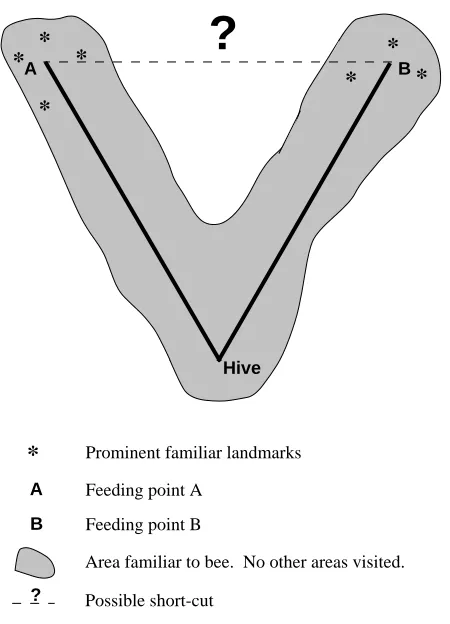
Simpler explanations for novel short-cutting At around the same time, considerable controversy was generated when it was claimed by Gould (1986) that honeybees had cognitive maps. The conclusion was based on experiments which found novel short-cutting between two foraging sites (Fig. 1). However, in extensive subsequent experiments, several groups (Menzel et al. 1990; Wehner et al. 1990; Wehner and Menzel, 1990; Dyer, 1991) were either unable to replicate Gould’s findings or could do so only when prominent landmarks were visible on the other side of the ‘V’ across which bees made their short-cut (Fig. 1). Furthermore, several studies (Cartwright and Collett, 1983; Collett, 1987; Wehner and Menzel, 1990; Bennett, 1991; Dyer, 1991; Wehner, 1992) argued that there were much simpler explanations of the novel short-cutting and, that if this was so, then it was unjustified to conclude that bees had an advanced form of landmark memory in the form of a cognitive map (sensu Tolman, O’Keefe and Nadel).
What are these simpler explanations of novel short-cutting that need to be eliminated before we can conclude that an animal has a cognitive map? First, one needs to be certain that the animal has never crossed the V before, that is, that the apparently novel short-cut is truly novel. This may seem obvious, but in the case of wild animals, to be certain requires tracking of the animal prior to the experiment and, therefore, can be extremely time consuming or even impossible. Thus, in several experiments where novel short-cutting is claimed, it is difficult to see how the authors can be certain that the animals had not performed the short-cut previously.
One must also be certain that path integration is not being used to perform the short-cut. Path integration, or dead reckoning, is the mechanism of integration of distance and direction when moving that allows an animal to make a straight-line return to the starting point. Several experiments have now shown that it can be performed without access to any previously seen landmarks, acting through either optic flow or internal acceleration detectors (Wehner and Srinivasan, 1981; Potegal, 1982; Müller and Wehner, 1988, 1994; Etienne et al. 1990). Path integration then does not require memory, special or otherwise, of previously seen landmarks. Thus, the possibility that animals make short-cuts using path integration must be eliminated before one can conclude from novel short-cutting that an animal has a special form of landmark memory in the form of a cognitive map. Path integration appears to be widespread amongst animals (Potegal, 1982; Wehner, 1992), so it would be prudent to consider that most animals potentially can short-cut using path integration.
There is a another method of performing novel short-cuts without a cognitive map, sensu Tolman, O’Keefe and Nadel, which was mentioned briefly in discussion of the results of
Chapuis et al. (1983, 1987). Consider the V with the two feeding sites A and B at the top of each arm (Fig. 1). Bees have learnt to feed at sites A and B, and a small area around the V represents the space that is familiar to the bees. According to the Tolman, O’Keefe and Nadel definition, a cognitive map would be indicated by the ability to short-cut from A to B, or vice versa. However, short-cutting from A to B could more simply be achieved by recognising familiar landmarks at B when at A, and moving straight towards them. Then, when in the familiar area near to B, the animal could revert to the method of navigating (whatever this was) for finding the goal at B. Under this scenario, the animal is clearly moving towards landmarks as in a ‘route’, sensu O’Keefe and Nadel (1978), a model that was specifically formulated to be a simpler alternative to a cognitive map. Obviously then, the possibility that animals perform their short-cutting in this way needs to be eliminated.
In summary, there are three simpler explanations of apparent novel short-cutting that must be eliminated before one can conclude from experiments that an animal has a cognitive map, sensu Tolman, O’Keefe and Nadel. These alternatives are (1) that the apparently novel short-cut is not truly novel; (2) that path integration is being used; and (3) that familiar landmarks are being recognised from a new angle, followed by movement towards them. In all claims of cognitive maps for insects, birds,
Hive
A B
?
*
*
*
Area familiar to bee. No other areas visited.
Possible short-cut
A B
*
*
*
*
Feeding point B Feeding point A
?
[image:3.609.331.556.67.379.2]*
Prominent familiar landmarksrodents, primates and humans (for references, see earlier), I found that in no cases were all three of these simpler alternatives eliminated (Bennett, 1991). Indeed, even if one accepts the authors’ assertions that the short-cuts were truly novel (and thus remove the need to eliminate alternative number one), in no cases were just the last two alternatives eliminated (Bennett, 1991). Consequently, I argue that no animals have been shown to have a cognitive map, sensu Tolman, O’Keefe and Nadel.
Gallistel and cognitive maps
In lengthy discussions of representation of space by animals, Gallistel (1989, 1993, 1994) provides a fundamentally different definition of a cognitive map from that given by Tolman, O’Keefe and Nadel. According to Gallistel, ‘A cognitive map is a record in the central nervous system of macroscopic geometric relations among surfaces in the environment used to plan movements through the environment. A central question is what type of geometric relations a map encodes’. In summary, for Gallistel (1989, 1993), a cognitive map is how space is represented in the animal’s brain; since all animals have a representation of space, according to him, all animals have a cognitive map. Thus, even using routes (sensu O’Keefe and Nadel, 1978) would be a demonstration of a cognitive map sensu Gallistel.
Gallistel (1989, 1993) suggested that the form of cognitive map possessed by any animal can be specified by one of four geometries: Euclidean, affine, projective or topological. There are, unfortunately, errors in his definitions of these geometries (O’Keefe and Bennett, 1994) and good reasons for thinking that many other geometries not mentioned by Gallistel might better describe how an animal represents space (A. T. D. Bennett and C. M. O’Keefe, in preparation). However, the geometric approach advocated by Gallistel (1989, 1993), which in essence suggests testing an animal’s representation of space against predictions derived from geometry, is likely to be fruitful and should be pursued and developed (O’Keefe and Bennett, 1994). First, the approach has the advantage that the effort expended by mathematicians in formalising how space can be described can be exploited in spatial memory research. Second, it has the advantage that one can test an animal’s behaviour against precise mathematical models, rather than relying on loose verbal hypotheses, as has so often been the case, and which has the inherent problems described earlier.
Gallistel (1993) accepts at face value the conclusions of Gould (1986) and, on the basis of experiments that he and Cheng conducted on rats (Cheng and Gallistel, 1984), in which affine and Euclidean properties of space were manipulated, comes to the conclusion that all animals have Euclidean cognitive maps. He does, however, suggest that the cognitive maps of ‘lower’ animals have less information on them than the cognitive maps of ‘higher’ animals.
To summarise, by starting with a much broader definition of a cognitive map and by accepting at face value a number of experiments which I have shown have simpler alternative
explanations, Gallistel (1989, 1993, 1994) comes to a conclusion about the content of cognitive maps which is fundamentally different from that of other workers on spatial memory. A cognitive map sensu Tolman, O’Keefe and Nadel is a powerful representation of space, which is indicated by the ability to make novel short-cuts. By contrast, according to Gallistel (1989, 1993, 1994), a cognitive map is any representation of space held by an animal. No novel short-cutting is thus necessary; even using routes (sensu O’Keefe and Nadel, 1978) would be a demonstration of a cognitive map, according to Gallistel (1989, 1993, 1994).
Other definitions
Other quite different definitions of cognitive maps can also be found in the literature. For example, Downs and Stea (1973) state, ‘Cognitive maps are convenient sets of shorthand symbols that we all subscribe to, recognise, and employ: these symbols vary from group to group, and individual to individual, resulting from our biases, prejudices, and personal experiences’. They go on, ‘Cognitive mapping is a process composed of a series of psychological transformations by which an individual acquires, codes, stores, recalls, and decodes information about the relative locations and attributes of phenomena in his everyday spatial environment’. Obviously such definitions are of little use, since they do not make clear behavioural predictions.
Durst et al. (1993) reveal that, ‘All countries have a cognitive map...’! According to (Laukkanen, 1994) ‘...key elements in managerial and organisational cognitions can be usefully captured by cognitive mapping’, whilst Wellman (1994) argues that ‘...cognitive maps can be viewed in the context of more recent formalisms for qualitative decision modelling’. Clearly, the term ‘cognitive map’ has been used to describe a wide variety of concepts.
The ability to take novel short-cuts, without using routes or path integration, is not stressed in the human spatial memory literature. In fact, I have been unable to find any experiment that attempts to demonstrate such abilities. Triangular completion tasks undertaken over a few metres by blindfolded subjects (e.g. Loomis et al. 1993) can be explained by path integration. Similarly, experiments in which subjects are walked around for up to 2 km in unfamiliar areas, and are then asked to estimate the direction and distance to the starting point (reviewed in Baker, 1989), can be explained by path integration and/or recognition of familiar landmarks near the starting point. In general, a cognitive map in the human spatial memory literature means ‘mental representation of the environment’. Investigations centre on the characteristics of this representation, particularly (1) systematic distortions in the cognitive map (e.g. Golledge and Hubert, 1982; Gärling et al. 1991; Tversky, 1992), (2) the hierarchical nature of the cognitive map (e.g. Stevens and Coupe, 1978; Hirtle and Jonides, 1985; McNamara et al. 1989), and (3) the type of reference points used in the cognitive map (e.g. Sadalla et al. 1980; Gärling, 1990).
Conclusions
The term ‘cognitive map’ has been used to describe a wide variety of concepts. Many of these are contradictory. Others are too imprecise to make clear behavioural predictions. There are, however, two main definitions in the literature. One, sensu Gallistel, is that a cognitive map is any representation of space possessed by animals. The other, sensu Tolman, O’Keefe and Nadel, is that it is a powerful memory of landmarks which allows novel short-cutting to occur. There are two simpler explanations of novel short-cutting which must be eliminated before one can conclude that an animal has a cognitive map, sensu Tolman, O’Keefe and Nadel. These alternatives are: (1) short-cutting by dead reckoning, and (2) short-cutting by recognition of familiar landmarks from a new angle, followed by movement towards them. A survey of the literature reveals that in all claims of cognitive maps for humans, primates, rodents, birds and arthropods, in no cases were both these simpler alternatives excluded. Consequently, I argue that no animals have been shown to have a cognitive map, sensu Tolman, O’Keefe and Nadel. Owing to the repeated inability of experimenters to eliminate simpler explanations for novel short-cutting and the numerous contradictory definitions of the term cognitive map, I suggest that the cognitive map is no longer a useful hypothesis for elucidating the spatial behaviour of animals, and that use of the term should be avoided.
This work was funded by the ARC (Australia), the Royal Commission for the Exhibition of 1851 and the BBSRC (UK). It benefited from discussions with Tom Collett, Innes Cuthill, Marian Dawkins, Reginald Golledge, John Krebs, Jack Loomis, Randolf Menzel and Christine O’Keefe; thanks also to Miriam Lehrer, Christine O’Keefe, Sandra Ray, David Sherry and Rudiger Wehner for useful comments on earlier drafts.
References
BAKER, R. R. (1984). Bird Navigation: The Solution of a Mystery. Sevenoaks: Hodder & Stoughton.
BAKER, R. R. (1989). Human Navigation and Magnetoreception. Manchester: Manchester University Press.
BENNETT, A. T. D. (1991). The ecology of spatial memory in european jays. DPhil thesis, Oxford University.
BENNETT, A. T. D. (1993a). Spatial memory in a food storing corvid.
I. Near tall landmarks are primarily used. J. comp. Physiol. A 173, 193–207.
BENNETT, A. T. D. (1993b). Remembering landmarks. Nature 364, 293–294.
BIEGLER, R. ANDMORRIS, R. G. M. (1993). Landmark stability is a prerequisite for spatial but not discrimination learning. Nature 361, 631–633.
CARTWRIGHT, B. A. ANDCOLLETT, T. S. (1983). Landmark learning in
bees: experiments and models. J. comp. Physiol. A 151, 521–543. CHAPUIS, N., DURUP, M. ANDTHINUS-BLANC, C. (1987). The role of
exploratory experience in a shortcut task by golden hamsters
Mesocricetus auratus. Anim. Learn. Behav. 15, 174–178.
CHAPUIS, N., THINUS-BLANC, C. ANDPOUCET, B. (1983). Dissociation
of mechanisms involved in dogs’ oriented displacements. Q. J. exp.
Psych. 35B, 213–219.
CHENG, K. ANDGALLISTEL, C. R. (1984). Testing the geometric power of an animal’s spatial representation. In Animal Cognition (ed. H. L. Roitblatt, T. G. Bever and H. S. Terrace), pp. 409–423. London: Erlbaum Associates.
COLLETT, T. S. (1987). Insect maps. Trends Neurosci. 10, 139–141. COLLETT, T. S., DILLMANN, E., GIGER, A. ANDWEHNER, R. (1992).
Visual landmarks and route following in desert ants. J. comp.
Physiol. A 170, 435–442.
COUCELIS, H., GOLLEDGE, R. G., GALE, N. ANDTOBLER, W. (1987). Exploring the anchor-point hypothesis of spatial cognition. J. env.
Psychol. 7, 99–122.
DOWNS, R. M. AND STEA, D. (1973). Cognitive maps and spatial
behavior: Process and products. In Image and Environment:
Cognitive Mapping and Spatial Behavior (ed. R. M. Downs and D.
Stea), pp. 8–26. Chicago: Aldine Publishing.
DURST, R., MINUCHIN, I. S. ANDJABOTINSKY, R. K. (1993).
‘Brain-fag’ syndrome: Manifestation of transculturation in an Ethiopian Jewish Immigrant. Israel J. Psych. rel. Sci. 39, 223–232.
DYER, F. C. (1991). Bees acquire route-based memories but not cognitive maps in a familiar landscape. Anim. Behav. 41, 239–246. ETIENNE, A. S., TERONI, E., HURNI, C. ANDPORTENIER, V. (1990). The
effect of a single light cue on homing behaviour of the golden hamster. Anim. Behav. 39, 17-41.
GALLISTEL, C. R. (1989). Animal cognition, the representation of space, time and number. A. Rev. Psychol. 40, 155–189.
GALLISTEL, C. R. (1993). The Organization of Learning. Cambridge,
MA: MIT Press.
GALLISTEL, C. R. (1994). Space and time. In Animal Learning and
Cognition (ed. N. J. Mackintosh), pp. 221–253. London: Academic
Press.
GÄRLING, T. (1990). Is elevation encoded in cognitive maps? J. env.
Psychol. 10, 341–351.
GÄRLING, T., BÖÖK, A., LINDBERG, E. ANDARCE, C. (1991). Evidence of a response-explanation of noneuclidean cognitive maps. Profess.
Geog. 43, 143–149.
GOULD, J. L. (1982). The map sense of pigeons. Nature 296, 205–211.
GOULD, J. L. (1986). The locale map of honey bees: Do insects have cognitive maps? Science 232, 861–863.
HERMAN, J. F., MILLER, B. S. ANDSHIRAKI, J. H. (1987). The influence of affective associations on the development of cognitive maps of large environments. J. env. Psychol. 7, 89–98.
HIRTLE, S. C. AND JONIDES, J. (1985). Evidence of hierarchies in
cognitive maps. Memory Cognition 13, 208–217.
LAUKKANEN, M. (1994). Comparative cause mapping of
organizational cognitions. Org. Sci. 5, 322–343.
LEHRER, M. (1994). Spatial vision in the honeybee: the use of
difference cues in different tasks. Vision Res. 34, 2363–2385. LOOMIS, J. M., KLATZKY, R. L., GOLLEDGE, R. G., CICINELLI, J. G.,
PELLIGRINO, J. W. ANDFRY, P. A. (1993). Nonvisual navigation by blind and sighted: assessment of path integration ability. J. exp.
Psychol. 122, 73–91.
MCNAMARA, T. P., HARDY, J. K. ANDHIRTLE, S. C. (1989). Subjective
hierarchies in spatial memory. J. exp. Psychol. 15, 211–227. MENZEL, E. W. (1973). Chimpanzee spatial memory organization.
Science 182, 943–945.
MENZEL, R., CHITTKA, L., EICHMÜLLER, S., GEIGER, K., DAGMAR, P. ANDKNOLL, P. (1990). Dominance of celestial cues over landmarks disproves map-like orientation in honey bees. Z. Naturforsch. 45c, 723–726.
MÜLLER, M. ANDWEHNER, R. (1988). Path integration in desert ants,
Cataglyphis fortis. Proc. natn. Acad. Sci. U.S.A. 85, 5287–5290.
MÜLLER, M. ANDWEHNER, R. (1994). The hidden spiral: systematic
search and path integration in desert ants, Cataglyphis fortis. J.
comp. Physiol. A 175, 525–530.
O’KEEFE, C. M. ANDBENNETT, A. T. D. (1994). Book review of The
Organisation of Learning. By Charles R. Gallistel. MIT Press,
Cambridge MA (1993). Anim. Behav. 48, 1492–1493.
O’KEEFE, J. ANDNADEL, L. (1978). The Hippocampus as a Cognitive
Map. Oxford: Oxford University Press.
PAPI, F. ANDWALRAFF, H. G. (1992). Birds. In Animal Homing (ed.
F. Papi), pp. 263–319. London: Chapman & Hall.
PÉRUCH, P., FIRAUDO, K.-D. AND GÄRLING, T. (1989). Distance
cognition by taxi drivers and the general public. J. env. Psychol. 9, 233–239.
POTEGAL, M. (1982). Vestibular and neostriated contributions to spatial orientation. In Spatial Abilities: Developmental and
Physiological Foundations (ed. M. Potegal), pp. 361–387. New
York: Academic Press.
POUCET, B. (1993). Spatial cognitive maps in animals, new hypotheses
on their structure and neural mechanisms. Psychol. Rev. 100, 163–182.
SADALLA, E. K., BURROUGHS, W. J. AND STAPLIN, L. J. (1980). Reference points in spatial cognition. J. exp. Psychol.: Human
Learning and Memory 6, 516–528.
SÉGUINOT, V., MAURER, R. AND ETIENNE, A. S. (1993). Dead
reckoning in a small mammal: the evaluation of distance. J. comp.
Physiol. A 173, 103–113.
STEPHENS, D. W. AND KREBS, J. R. (1986). Foraging Theory. Princeton, NJ: Princeton University Press.
STEVENS, A. AND COUPE, P. (1978). Distortions in judged spatial relations. Cog. Psychol. 10, 422–437.
THINUS-BLANC, C. (1987). The cognitive map concept and its consequences. In Cognitive Processes in Animal and Man (ed. P. Ellen and C. Thinus-Blanc), pp. 1–19. The Hague: Martinus Nijhoff, N.A.T.O. A.S.I. series
THINUS-BLANC, C. (1988). Animal spatial cognition. In Thought
without Language (ed. L. Weiskrantz), pp. 371–395. Oxford:
Oxford University Press.
TOLMAN, E. C. (1948). Cognitive maps in rats and men. Psychol. Rev.
55, 189–208.
TVERSKY, B. (1992). Distortions in cognitive maps. Geoforum 23,
131–138.
WALLRAFF, H. G. (1974). Das Navigationssystem der Vögel. Ein
theoretischer Beitrag zur Analyse ungeklärter Orientierungsleistungen. Schriftenreihe Kybernetik, Oldenbourg,
München.
WEHNER, R. (1989). Neurobiology of polarization vision. Trends
Neurosci. 12, 353–359.
WEHNER, R. (1992). Arthropods. In Animal Homing (ed. F. Papi), pp.
371–395. London: Chapman & Hall.
WEHNER, R., BLEULER, S., NIEVERGELT, C. ANDSHAH, D. (1990). Bees
navigate by using vectors and routes rather than maps.
Naturwissenschaften 77, 479–482.
WEHNER, R. ANDMENZEL, R. (1990). Do insects have cognitive maps?
A. Rev. Neurosci. 13, 403–414.
WEHNER, R. ANDSRINIVASAN, M. V. (1981). Searching behavior of desert ants, genus Cataglyphis (Formicidae, Hymenoptera). J.
comp. Physiol. A 142, 315–338.
WELMANN, M. P. (1994). Inference in cognitive maps. Math. Comput.
Simul. 36, 137–148.
WILTSCHKO, W. AND WILTSCHKO, R. (1987). Cognitive maps and
navigation in homing pigeons. In Cognitive Processes and Spatial
Orientation in Animal and Man I (ed. P. Ellen and C. Thinus-Blanc),