ISSN Online: 1913-3723 ISSN Print: 1913-3715
A Systems-Theoretic Security Model for Large
Scale, Complex Systems Applied to the US Air
Transportation System
Joseph R. Laracy
Department of Mathematics and Computer Science, Seton Hall University, South Orange, NJ, USA
Abstract
Classical risk-based or game-theoretic security models rely on assumptions from reliability theory and rational expectations economics that are not ap-plicable to security threats. Additionally, these models suffer from serious de-ficiencies when they are applied to software-intensive, socio-technical sys-tems. A new approach is proposed in this paper that applies principles from control theory to enforce constraints on security threats thereby extending techniques used in system safety engineering. It is applied to identify and mi-tigate the threats that could emerge in critical infrastructures such as the air transportation system. Insights are provided to assist systems engineers and policy makers in securely transitioning to the Next Generation Air Transpor-tation System (NGATS).
Keywords
Air Transportation, Security, Systems Engineering, Control Theory, System Dynamics
1. Introduction
The increasing complexity and interconnectedness of large scale systems have introduced new vulnerabilities to those infrastructures. Large scale, complex systems require physical, communication, computer, information, and opera-tional security. Vulnerabilities often emerge in an engineering system when one or more of the aforementioned aspects are omitted. Attackers rarely choose to directly engage the most secure aspects of a system, such as the cryptographic algorithms. The interdisciplinary nature of the security problem is one of the key factors that make the solution so elusive. Traditional, disciplinary approaches, on their own, are often insufficient to accomplish the security goals of a complex
How to cite this paper: Laracy, J.R. (2017) A Systems-Theoretic Security Model for Large Scale, Complex Systems Applied to the US Air Transportation System. Int. J. Communications, Network and System Sciences, 10, 75-105.
https://doi.org/10.4236/ijcns.2017.105005
Received: April 23, 2017 Accepted: May 28, 2017 Published: May 31, 2017
Copyright © 2017 by author and Scientific Research Publishing Inc. This work is licensed under the Creative Commons Attribution International License (CC BY 4.0).
system. Only a comprehensive methodology has the potential to succeed [1].
2. Next Generation Air Transportation System (NGATS)
In 2004, the US Congress passed the Vision 100—Century of Aviation Reautho-rization Act in response to pressures on the current US air transportation system (ATS). Post 9/11 economics and demand asymptotically approaching capacity at many key airports necessitated a radically new approach. A senior policy team made up of the Secretary of Transportation (Chair), Secretary of Defense, Secre-tary of Homeland Security, SecreSecre-tary of Commerce, Director of the Office of Science and Technology Policy, Administrator of the National Aeronautics and Space Administration (NASA), and Administrator of the Federal Aviation Ad-ministration (FAA) was formed to provide policy guidance. Also, a Joint Pro-gram Development Office (JPDO) was created to manage the development of the Next Generation Air Transportation System (NGATS).
The United States ATS faces challenges in three areas: security, gridlock, and maintaining global leadership. In light of these realities, the customs service has been forced to substantially modify its procedures to accommodate a major in-crease in international passenger and cargo volume. Gridlock is already a major problem at US metropolitan airports and one hour wait times are often encoun-tered by millions of Americans. Preliminary economic models predict that the cost due to congestion for US consumers could easily reach into the billions. If the congestion issue is not resolved, same-day travel and reliable scheduled tra-vel will exist only in people’s memories.
The variety of transportation options is also expected to increase in the coming decades. UAVs, micro-jets (5 passengers), super jumbo-jets (600 passengers +), and other 21st century innovations may radically change US airspace. Small
per-turbations in how people travel and transport goods will require major overhauls of the transportation infrastructure. According to the JPDO, “a shift of 2% of today’s commercial passenger to micro-jets that seat 4 - 6 passengers would re-sult in triple the number of flights in order to carry the same number of passen-gers” [2].
The JPDO has three performance goals [2]:
1. Satisfy future growth in demand (up to three times current levels) and opera-tional diversity
2. Reduce transit time and increase predictability (domestic curb-to-curb tran-sit time cut by 30%)
3. Minimize the impact of weather and other disruptions (95% on time)
However, the uncertainty associated with the profile of aircraft in the coming decades makes it difficult to develop a strategy. Parallel runways, improved wake vortex sensing, and relaxation of single runway occupancy restrictions are being considered to improve system throughput. Without expensive ground-based equipment, the JPDO hopes to have precision approaches available on every US runway.
goals of NGATS. In some cases, co-pilots will be replaced by computers; in oth-ers, there will be no pilot at all. UAVs will be subject to reduced separation standards, and more flexible spacing will be applied to both aircraft in-flight and on the ground. Additionally, a paradigmatic shift is planned for air traffic con-trol (ATC). Concon-trollers will move from concon-trolling individual aircraft to man-aging airspace based on flows. There exists a large body of knowledge around optimization of network flows that will surely guide these efforts. For example, much work has been done at the Draper Laboratory that offers powerful tech-niques for UAV route planning, e.g. [3]. Other changes include the elimination of voice communication (under normal conditions) from data link capable air-craft, and the incorporation of new technologies that make two sets of flight procedures (instrument and visual) unnecessary.
Given the proposed changes, the pressing question remains: “How can the US transition to NGATS in such a way that security improves, rather than wor-sens?” With the goal of assisting JPDO leaders in making an informed decision, this research provides a systematic review of the threats that could emerge. Also, acknowledging the colossal failure of the FAA’s Advanced Automation System in the mid-1990s resulting in $2.9 billion spent on a system that was never dep-loyed [4], the JPDO must not allow complexity to grow out of control. The au-thor’s hypothesis is that the new method, outlined later in this paper, provides valuable insights into such security problems.
3. Traditional Techniques
3.1. Classical ApproachesA variety of approaches exist both in industrial practice and the academic litera-ture for conducting security analyses on large infrastruclitera-ture systems. These me-thods include “best practice engineering”, quantitative risk assessment, game theory, and red teaming. The four classical approaches each have their own strengths and weaknesses, but unfortunately do not provide total coverage for the system security problem.
The most common security technique is simply to apply best practices. This approach is usually conducted in an unsystematic way and reduces or removes only the most obvious vulnerabilities [5]. If a systematic approach is taken to develop a comprehensive body of best practice literature, the best practice ap-proach would be far more useful to engineers developing large systems. Usually, security engineers will employ one or more of the following methods to supple-ment best practice approaches.
3.2. Risk Analysis
pers-pective. Whether part of a preliminary hazard analysis or an accident recon-struction activity, the reliability engineer attempts to understand the potential or actual accident by identifying the events or faults that could initiate the accident. Such fault and event trees are usually part of a method called probabilistic risk assessment (PRA). The goals of PRA are to estimate both the likelihood and se-verity of a risk. PRA was developed in the mid-1970s to improve nuclear power plant safety. Professor Norm Rasmussen of MIT chaired the Reactor Safety Study that was the first real probabilistic risk assessment [6].
A probabilistic risk assessment is a four step process: 1. Identify undesirable events.
2. Identify accident scenarios (sequences of events).
3. Estimate the probability of each scenario either based on statistical testing data, or expert judgment if scenarios are rare.
4. Rank the accident scenarios according to likelihood.
The framework yields a probability for each undesirable event identified in the first stage.
PRA turned out to be very successful for assessing risks in nuclear power shut-down systems. Such systems were historically very simple, electro-me- chanical systems designed to minimize unnecessary complexity, and used prov-en analog electrical technologies. PRA carries with it a number of important as-sumptions:
1. The events or faults at each node in the trees are collectively exhaustive—all possible events are identified.
2. The events or faults at each node in the trees are mutually exclusive—they cannot occur simultaneously.
3. The probability of each scenario is accurate enough to be useful to decision makers.
In a reactor shut-down system, nuclear engineers with decades of experience can probably develop trees that satisfy the first two assumptions due to their in-timate knowledge of reactor design and operation. Furthermore, component technologies such as electrical relays could be extensively tested in the laboratory to compute reliability metrics such as mean time between failures (MTBF).
However, when complex systems like the Space Shuttle are considered, serious questions arise regarding the appropriateness of PRA. For instance, how does software change the picture? How can the MTBF of unique digital electronics be estimated? How many events or faults must be accounted for? Herein lies the problem of applying PRA to software-intensive systems [7]. Software does not wear out and fail; it only implements a set of requirements that may or may not be correct. In practice, PRA analysts utilize subjective probability (expert judg-ment) when thousands of laboratory MTBF tests cannot be carried out. Howev-er, software in one environment may produce desirable behavior, while in a slightly different one it may lead to disaster. Therefore, the meaning of the sub-jective probability value is not clear. Additionally, if a spacecraft computer has 128 MB of memory, or 230 bits, then it has 2number of bits or 30
2
each state cannot be analyzed.
Before the Space Shuttle Challenger disaster, NASA headquarters reported the probability of a failure with loss of vehicle and human life as 10−5[8]. Before the
Space Shuttle Columbia disaster, the reported probability was 1/250 [9]. Ac-cording to NASA space operations spokesman, Allard Beutel, the revised post- Columbia figure became 1/100 [10]. Recently, researchers in the field of PRA acknowledged that PRA should not be the sole basis for decision making and that the quantitative results should be part of risk-informed, not risk-based deci-sions. They acknowledge that human factors, software, safety culture, and design errors are not well handled by PRA [11].
Given the central role of human factors, software, culture, and design errors in security, PRA’s applicability to security problems is also dubious. Donn Parker makes an insightful observation in this regard [12]:
Security risk is not measurable, because the frequencies and impacts of fu-ture incidents are mutually dependent variables with unknown mutual de-pendency under control of unknown and often irrational enemies with un-known skills, knowledge, resources, authority, motives, and objectives— operating from unknown locations at unknown future times with the possi-ble intent of attacking known but untreated vulnerabilities that are known to the attackers but unknown to the defenders.
See [13] for a review of the work of a variety of researchers who have at-tempted to supplement pure, reliability-based PRA with other techniques to make it relevant to security.
3.3. Game Theory
Bier [14] asserts that managing risks from intelligent adversaries is very different from other types of risk and suggests game theory over decision theory. Previous work in this area focused on “policy insights” such as the relative merits of de-terrence and other protective measures [15]. Sandler and Arce [16] present a number of compelling reasons for the applicability of game theory to security problems:
1. Game theory captures the strategic interactions between terrorists and a tar-geted government, where actions are interdependent and, thus, cannot be analyzed as though one side is passive.
2. Strategic interactions among rational actors, who are trying to act according to how they think their counterparts will act and react, characterize the in-terface among terrorists or among alternative targets.
3. In terrorist situations, each side issues threats and promises to gain a strateg-ic advantage.
4. Terrorists and governments abide by the underlying rationality assumption of game theory, where a player maximizes a goal subject to constraints. 5. Game-theoretic notions of bargaining are applicable to hostage negotiations
6. Uncertainty and learning in a strategic environment are relevant to all as-pects of terrorism, in which the terrorists or government or both are not completely informed.
However, game theory requires strong assumptions about the availability of mutual information and the rationality of opponents [17]. As mentioned earlier, empirical work by Tversky and Kahneman [18] has shown that these assump-tions often break down in reality. Additionally, traditional games are organized to pursue a minimax solution for a two-person, zero-sum game. However, as Banks and Anderson point out, such a model is only an approximation because defender and attacker will value successful and failed attacks differently [17].
Many game-theory models of security carry the traditional, simplifying as-sumption that the probability of a successful terrorist attack on a location is a convex function of the defensive resources. Some security measures, such as re-locating a facility to a more secure location, are inherently discrete. Discretiza-tion introduces step changes into the funcDiscretiza-tion so there is no longer a smooth, convex function due to declining marginal returns on defensive investments. Also, if a particular level of defensive investment completely deters an attack, the probability of terrorist success drops rapidly beyond that point. This scenario would also produce a non-convex function in certain regions. When non-convex functions are permitted, multiple local optima may emerge, thereby complicat-ing the defense resource allocation problem [17]. In order to populate payoff matrices with values, statistical techniques from quantitative risk assessment are usually used [20].
According to Fricker [19], game theory’s role in security focuses on analyses related to:
1. Assessing strategies for how national antiterrorism expenditures, 2. Measuring how military strategies encourage/discourage terrorism, 3. Assessing insurance risks,
4. Evaluating the effects of focusing either on deterrence or preemption. As the list above indicates, game-theoretic models focus on strategic decision making. They do not directly support the design and operation of infrastructure systems that may be the target of terrorist attacks.
3.4. Red Teams
Red teaming is an excellent activity to complement other security analyses as well as reduce the complacency that often sets in after extended periods without attacks. The goal of any red team is to challenge the plans, programs, and as-sumptions of the client organization. Teams may challenge organizations at strategic, operational, or tactical levels depending on the area that needs the most attention. The words of William Schneider, Jr., Chairman of the Defense Science Board, best capture the state of red teaming: “Red teams can be a po-werful tool to understand risks and increase options. However, the record of use of red teams in DoD is mixed at best” [20].
catastrophic surprises”. A good red team is capable of elucidating a deeper un-derstanding of an adversary’s options, and identifying vulnerabilities in con-cepts, programs, plans, postures, and strategies. Red teams also challenge “the accepted assumptions and accepted solutions” as well as identify inexperience. They may function as surrogate adversaries, devil’s advocates, or simply as sources of independent judgment.
Schneider also points out that “red teaming is important but it is not easy nor often done very well”. He identifies the following causes of failure [20]:
The red team:
1. Does not take its assignment seriously. 2. Could lose its independence.
3. Could be too removed from the decision making process.
4. Could have inadequate interaction with the “blue” (team) and be viewed as just another sideline critic.
5. Could destroy the integrity of the process and lose the confidence of decision makers by leaking its findings to outsiders.
Red team effectiveness is easily impaired by a corporate culture that does not value criticism and challenge, managers that do not want issues to arise that may “rock the boat”, dysfunctional interaction between red and blue teams, unquali-fied red team staff, and calling in a red team when the problem has already grown out of control. The red team must have independence with accountabili-ty, as well as a process that enables the game results to be seriously considered by senior management [20]. Unfortunately, the red teaming process failed misera-bly before 9/11/2001. Testimony by Bogdan Dzakovic, a FAA Red Team veteran, to the National Commission on Terrorist Attacks upon the United States, on May 22, 2003, reveals how a good red team can become completely ineffective in the face of management resistance.
The Presidential Commission investigating the bombing of Pan Am 103 in 1990 created the FAA red teams that are in place today. After the TWA 800 crash, Congress passed the FAA Reauthorization Act of 1996. The law states that “…the Administrator [of FAA] shall conduct periodic and unannounced inspec-tions of security systems of airports and air carriers to determine the effective-ness and vulnerabilities of such systems…” Later, in 1997, a White House Com-mission stated that “…Red Team testing should also be increased by the FAA, and incorporated as a regular part of airport security action plans. Frequent, so-phisticated attempts by these Red Teams to find ways to dodge security meas-ures are an important part of finding weaknesses in the system and anticipating what sophisticated adversaries of our nation might attempt” [21].
Unfortunately, as Dzakovic’s testimony indicates, the value of these red teams has been seriously undercut [21]:
no-tification of when we would be conducting our “undercover” tests and what we would be checking.
For example, in the late 1990s, over two-thirds of red teams breached airport security with firearms undetected. This revelation led the FAA to stop testing with guns. According to Dzakovic, managers at the highest levels of the FAA chose to ignore warnings such as these: “What happened on 9 - 11 was not a failure of the system, it was a system designed for failure. FAA very consciously and deliberately orchestrated a dangerous façade of security”. [21]
Compelling evidence existed prior to 9/11 of the likelihood and severity of this threat. In testimony to the US Senate Committee on Commerce, Science, and Transportation Subcommittee on Aviation Security on April 6, 2000, the Asso-ciate Administrator of the FAA for Civil Aviation Security stated: “Moreover, members of foreign terrorist groups and representatives from state sponsors of terrorism are present in the United States. There is evidence that a few foreign terrorist groups have well-established capability and infrastructures here” [21]. Additionally, many of the 9/11 hijackers were identified by the Computer As-sisted Passenger Pre-Screening Systems (CAPPS). CAPPS is a system that auto-matically researches anyone that buys an airplane ticket and generates a risk score based on a variety of factors.
The following hijackers in Table 1 were flagged by CAPPS [22].
Such a failure is not surprising when one learns that a FAA Security Special Agent wrote a letter to the Department of Transportation Inspect General in 1999 saying that “…Logan International Airport is in a critical state of non- compliance with Federal Aviation Security Regulations…” [22].
This paper presents a security model that does not rely on the assumptions of quantitative risk assessment, considers issues at a level closer to system design and operation compared to game theory, and supports successful red teaming.
4. Systems Theory and Complexity
4.1. Foundational PrinciplesBefore explaining the systems-based methodology, it is important to understand its theoretical underpinning. In contrast to the traditional scientific method that relies on analytic reduction, systems theory states that complex systems must be considered holistically. The theory was well developed by Bertalanffy, Ashby,
Table 1. 9/11 terrorists identified by CAPPS.
Hijacked Aircraft Terrorists
American Airlines Flight 11 (Logan) Wail al-Shehri, Satam al-Suqami, Waleed al-Shehri, Mohamed Atta
American Airlines Flight 77 (Dulles) Hani Hanjour, Khalid al-Mihdhar, Majed Moged, Nawaf al-Hazmi, Salem al-Hazmi
United Airlines Flight 93 (Newark) Ahmad al-Haznawi
and Wiener in the 1940s and 50s in response to challenges encountered in biol-ogy, communication, and control. During this time, scientists and engineers be-gan to recognize a new type of complexity.
Organized simplicity is exhibited in traditional, deterministic systems that easily can be decomposed into subsystems and components such as in structural mechanics. The re-synthesis of the subsystems does not yield any unexpected properties because the component interactions are well defined and often linear. Conversely, it is not straightforward or useful to decompose systems that exhibit unorganized complexity. However, statistical techniques are applicable because of the regularity and randomness that characterize the network structure. The Law of Large Numbers becomes applicable and average values can be computed such as in statistical mechanics (e.g. ideal gases in chemistry). The “new” plexity theory, organized complexity, describes systems with a sufficiently com-plex structure to make it impractical or impossible for them to be modeled with analytic reduction, and not random enough to be modeled using statistics [23]
see Figure 1.
Systems characterized by organized complexity exhibit strong, non-linear in-teractions and coupling between subsystems and components. Therefore, a top-down approach needs to be applied to such systems. Two underlying con-cepts provide insight into these complex systems: emergence & hierarchy and communication & control.
[image:9.595.244.507.488.714.2]Abstractions for complex systems often involve layers. In the case where the abstraction is hierarchical, the level of organization increases as one moves to-ward higher layers. Additionally, the step from level n to n + 1 yields new prop-erties that are not discernable at level n. This phenomenon is referred to as emergence, or emergent properties. For example, “The shape of an apple, al-though eventually explainable in terms of the cells of the apple, has no meaning
at that lower level of description”. [23] Security is an emergent system property. For example, it is not possible to completely evaluate the security of an individu-al personindividu-al computer in isolation.
The security of a PC can only be determined by its relationship within a broader context, i.e. a socio-technical system. A PC might be considered “secure” when it is sitting isolated at home. However, once that computer is brought to work, connected to the LAN, and therefore the Internet, a whole new class of vulnerabilities emerges. An individual computer may be bolted to a desk, require a boot-up password, and have an encrypted file system. However, a security ex-pert would never classify such as system as “totally secure”. This is because secu-rity is a system property. A computer network is more than the sum of individu-al PCs, the behavior of the PCs in isolation does not tell us individu-all the possible beha-viors it may exercise in connection with other computers, and the performance of a network cannot be characterized by a simple additive composition of PCs.
As Graham, Baliga, and Kumar point out, over the last 50 years, the fields of communications, control, and computation have converged [24]. The resulting theoretical foundations are contained in systems theory and directly relevant to the goals of system safety and security. One especially sees the need for commu-nications to coordinate required control in open systems [23]. Control is exer-cised in complex systems by imposing constraints on lower levels in the hie-rarchy. According to Peter Checkland [25]:
Control is always associated with the imposition of constraints, and an ac-count of a control process necessarily requires our taking into acac-count at least two hierarchical levels. At a given level, it is often possible to describe the level by writing dynamical equations, on the assumption that one par-ticle is representative of the collection and that the forces at other levels do not interfere. But any description of a control process entails an upper layer imposing constraints upon the lower. The upper level is a source of an al-ternative description of the lower level in terms of specific function that are emergent as a result of the imposition of constraints.
Ashby provides four conditions that are required to exercise control over a system [26]:
1. Goal condition—The controller must have a goal or goals.
2. Action condition—The controller must be able to affect the state of the sys-tem.
3. Model condition—The controller must be (or contain) a model of the sys-tem.
4. Observability condition—The controller must be able to ascertain the state of the system.
Figure 2. Generic control loop. Image source [26].
4.2. Systems Thinking
Systems thinking is the application of systems theory to mental models and thought. It acknowledges that learning is a feedback process and views problems through the lens of interconnected networks governed by systems of non-linear relationships. System thinkers advocate holism over the traditional reductionism found in modern science. Operations Researcher, Russell Ackoff, and Computer Engineer, Jay Forrester, developed the approach in the late 1950s in response to challenges encountered in studying complex, socio-technical systems. Forrester created the System Dynamics modeling technique, which is based on the theory of non-linear dynamics. His successors include Peter Senge, who applies systems thinking to organizational learning [27], and John Sterman, who uses it to im-prove managerial decision-making in complex systems [28].
Ackoff’s system thinking is best understood as carrying on the spirit of Opera-tions Research as it was practiced in the 1950s and 60s before mathematical me-thods overtook problem framing and formulation as the forte of OR specialists
[29]. Ackoff’s successor is Jamshid Gharajedaghi, the leader of the Interactive Design (ID) movement. ID focuses on human choice in socio-technical systems and incorporates iterative inquiry and operational thinking. Iterative inquiry theory suggests that to gain understanding in complex systems, a successive technique of investigating function, structure, process, and context can lead to greater understanding.
Operational thinking requires a system scientist to think about how systems actually work as opposed to how they could theoretically work. Non-operational thinking is best captured in econometric models that seek to predict milk con-sumption but do not factor in cows [30]. Overall, ID advocates participatory de-sign and offers an approach both for formulating problems and developing solu-tions in teams [31].
understand-ing of the complex social system.
Systems thinking have yielded significant results in the Engineering Systems Division at MIT. In particular, it has proven to be very useful for the investiga-tion of cultural and organizainvestiga-tional factors that jeopardize the safety and security of complex engineering systems [32].
5. System Theoretic Accident Models and Processes for
Security (STAMP-Sec)
5.1. Introduction to STAMP
STAMP-Sec views security incidents as the result of inadequate control, rather than strictly a failure, such as a cryptographic device breaking [33] or a cracked-code. Security is an emergent property that is achieved through the enforcement of constraints. This perspective allows security problems to be transformed into control problems for which powerful tools can be employed. Control structures are defined to capture the communication and control in the system and illu-strate the presence or absence of feedback. They are hierarchal in nature and need to be constructed both for system development and system operation.
Security must be designed into a system as well as be part of how it is operat-ed. Historical examples of large systems where security was added in “after the fact” have been plagued by systemic security risks. For example, current ap-proaches to information security suffers from serious deficiencies as evidenced by the influence of SPAM, Internet worms, viruses, phishing, and other attacks that plague the common Internet user. This is largely a result of the fact that network research in the 1960s through the 1980s focused on achieving perfor-mance (e.g. throughput and robustness) objectives with little emphasis on secu-rity. As a result, when new threats began to emerge in the 1990s, Internet securi-ty was approached from an ad-hoc perspective—applying patches to vulnerabili-ties already identified by attackers. The problem remains that the underlying architecture was not designed to support strong security.
A STAMP control structure informs design by defining the necessary com-munication and control between subsystems and components to enforce security constraints. Effective communication between levels of the hierarchy is essential to successful system security. Layer n + 1 must be able to assert goals, policies, and constraints through a reference channel and layer n must be able to com-municate operational experience through a measuring channel.
The five steps of STAMP-Sec are provided below. 1. Identify the system level threats.
2. Write security constraints for the threats.
3. Define the static control structure to prevent or mitigate the threats.
a.Assign constraints to the system components responsible for implementing them.
b.Define the control actions for the components that prevent or mitigate the threats.
4. Identify inadequate control actions that could lead to an insecure state. 5. Determine ways that constraints could be violated and attempt to eliminate
them. In particular, use System Dynamics to consider how and why the secu-rity control structure might change over time, potentially leading to ineffec-tive controls.
5.2. Analysis of Pre-9/11 System
In “The Law of Loopholes in Action”, David Gelernter argues that “every loo-phole will eventually be exploited; every looloo-phole will eventually be closed” [35]. According to Fricker [19]:
The effect of the Law of Loopholes, as anyone that flies regularly today knows, is an ever-expanding set of security measures and requirements put in place, generally in response to past security breaches. Such rules and re-quirements are useful for helping prevent a reoccurrence of a particular in-cident. But, to the extent a determined adversary’s focus is on causing de-struction and mayhem, these types of rules and requirements simply mean that as one loophole is plugged the adversary shifts its attention and ener-gies to looking for and then trying to exploit a different loophole.
Instead of participating in the Law of Loopholes game, a STAMP-based analy-sis takes a top-down approach to proactively design and operate systems to meet security requirements and prevent the instantiation of system-level threats. Air transportation systems must control against the following threats:
1. A terrorist takes control of or disrupts an aircraft or persons onboard. 2. A terrorist takes control of or impersonates air traffic control. 3. A terrorist sabotages an aircraft.
4. A terrorist shoots an aircraft down.
5. A terrorist disrupts the critical infrastructure of the air transportation system (e.g. destroy a runway or radar).
6. A terrorist interferes with the aircraft communication, navigation, or surveil-lance systems.
However, before a threat assessment of the Next Generation Air Transporta-tion System is conducted, the existing socio-technical control structure must be analyzed. It is useful to understand the lessons of 9/11 and keep them in mind in the evolution toward NGATS.
carried out by the attacker as well as the constraints that were violated. After that, the taxonomy of inadequate controls is used to identify the dysfunctional interactions that enabled the violation of security constraints. In general, for each component in the control structure, the following items are provided [23]: 1. Constraints
2. Controls 3. Context
a.Roles and Responsibilities
b.Environmental and Behavior Shaping Factors 4. Flaws in the Controlled Process
5. Dysfunctional Interactions, Failures, Flawed Decisions, and Erroneous Con-trol Actions
6. Reasons for Flawed Control Actions and Dysfunctional Interactions a.Control Algorithm Flaws
b.Incorrect Process, Interface, or Mental Models c.Inadequate Coordination among Multiple Controllers d.Reference Channel Flaws
e.Feedback Flaws
This model is a useful tool to understand how and why the security con-straints were violated.
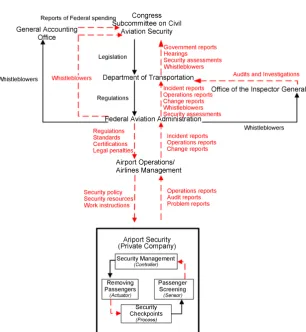
The security control structure for air transportation in the US in 2001 is shown below in Figure 3. The red, dotted lines indicate instances of inadequate communication and control.
To illustrate the technique, the Airport Security component on the above dia-gram is examined below:
Airport Security
In 2001, private companies were contracted to perform the passenger and baggage screening function at US Airports. Airports and carriers provided poli-cies, resources, and instructions, but a clear line of accountability was not present to ensure that these directives were successfully executed.
Security Constraint Violated: Security personnel must remove passengers that are judged to be a risk to the air transportation system and contact law enforcement officials.
Controls: Computer Assisted Passenger Pre-Screening Systems (CAPPS), verification of ID, metal detectors, and X-Ray bag screening were the pri-mary controls in place to enforce the constraint.
Context: The FBI and FAA were responsible for administering CAPPS. Those tagged by the system would then be subject to more rigorous baggage screening for explosives. CAPPS did not specify special screening of the passengers themselves.
Flaws in the Controlled Process: CAPPS, and the passenger screening system in general, did not have a specified mechanism to prevent high risk passengers from boarding an aircraft.
Figure 3. A high level control structure for pre-9/11 air transportation system.
Control Actions: At Logan International Airport, Wail al-Shehri and Sa-tam al-Suqami were chosen for special screening of their checked bags, be-fore they boarded American Airlines Flight 11. CAPPS identified Waleed al-Shehri but he did not check any luggage. Portland Airport identified Mohamed Atta. The hijackers of AA Flight 77, Hani Hanjour, Khalid al-Mihdhar, and Majed Moqed were also identified by CAPPS. Nawaf al-Hazmi and Salem al-Hazmi were chosen because of insufficient identifi-cation. United Airlines Flight 93’s hijacker, Ahmad al-Haznawi, was flagged but none of the hijackers of United Airlines Flight 175 were identified by CAPPS [36].
the past”. [36] Finally, screeners have a very monotonous job and are paid a low wage. These environmental conditions do not enable motivated, dili-gent execution of duties.
There are many ways that inadequate control can lead to a security system being compromised. STAMP provides a useful categorization scheme that cap-tures most control flaws. Broadly, they fall into one of three categories: Inade-quate enforcement of constraints, inadeInade-quate execution of control actions, or inappropriate or missing feedback [37]. The introduction of a malicious agent does not violate the assumption of the taxonomy originally developed for safety. In a safety scenario, poor engineering or management may offer inadequate en-forcement of constraints, execution of control actions, or feedback such that a hazard that is “exploited” inadvertently in system operations. In a security sce-nario, poor engineering or management may offer inadequate enforcement of constraints, execution of control actions, or feedback such that a vulnerability is created that may be intentionally exploited in system operation. Whether one is concerned with safety or security, the problem is inadequate control. STAMP- Sec extends the safety list to capture security issues:
1. Inadequate Enforcement of Constraints (Control Actions) 1.1. Unidentified threats
1.2. Inappropriate, ineffective, or missing control actions for identified threats
1.2.1. Design of control process does not enforce constraints 1.2.1.1. Flaws in creation process
1.2.1.2. Process changes without appropriate change in control (asynchronous evolution)
1.2.1.3. Incorrect modification or adaptation 1.2.2. Process models inconsistent, incomplete, or incorrect
1.2.2.1. Flaws in creation process
1.2.2.2. Flaws in updating process (asynchronous evolution) 1.2.2.3. Time lags and measurement inaccuracies not accounted for 1.2.3. Inadequate coordination among controllers and decision makers (boundary and overlap areas)
2. Inadequate Execution of Control Action 2.1. Communication flaw
2.2. Inadequate actuator operation 2.3. Time lag
3. Inadequate or missing feedback
3.1. Not provided in system/organizational design 3.2. Communication flaw
3.3. Time lag
3.4. Inadequate detection mechanisms
5.3. Analysis of Post-9/11 System
Now that the STAMP framework has been used to understand the attack of 9/11/2001, one can begin to study the air transportation system since then. Im-provements have certainly been made over the last years. The creation of the Terrorism Threat Integration Center, a more vigilant civil defense program, an improved port and commercial shipping inspection program, hardened cock-pits, and other changes have changed the security landscape. As a result, many attacks have been thwarted since 9/11 [22]. This is due to improvements in the security of the ATS as well as increased “human vigilance, unprecedented law enforcement, security, and intelligence cooperation, and the worldwide hunt for Al Qaeda, denying the group time, space, and resources to plan and mount spectacular attacks” [38].
However, this is certainly not the time for complacency to set in. Since 9/11, the State Department has warned that Al Qaeada (Sunni Islamists), Hizballah (Shia Islamists), Al Gama’a Al-Isalamiyya (Egyptian Islamists), Kahane Chai (Israeli extremists), Mujahdein e-Khalq (Marxist-Islamists) are believed to be operating in the US. Fortunately, many of the major flaws in the control processes and the dysfunctional interactions identified above have been corrected.
With regard to the Airport Security component example above, a number of changes have been made. The Department of Homeland Security (DHS) was es-tablished on November 25 by the Homeland Security Act of 2002. This decision introduced organizational complexity to the ATS because two executive depart-ments share control of the ATS. The Transportation Security Administration (TSA) was created to replace the private companies that airlines contracted to perform passenger and baggage screening. As a part of DHS, the Administrator of the TSA is an Assistant Secretary of Homeland Security. With a cabinet level department focused on security, there is greater likelihood that poor red team results and whistleblowers will not be ignored. Additionally, the TSA imposes security policies, shares security resources, and informs work instructions for the airports and airlines. While the transformation of passenger screening from a private entity to the government does not necessarily improve security, it is pre-ferable to have the screening organization reporting to the DHS rather than the airlines. DHS can impose the necessary control on TSA without being concerned about airline profitability.
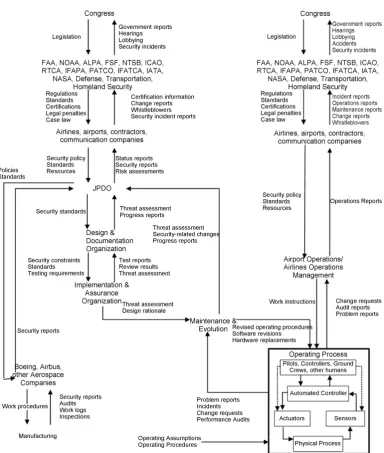
The pressing question that arises in the context of developing NGATS is: How can the JPDO evolve the current systems such that security does not de-grade and perhaps even improves?
Figure 4. NGATS socio-technical control structure.
Risks emerge in a system when “basic inadequacies in the way individual components in the control structure fulfill their responsibilities” or when the “coordination of activities and decision-making can lead to unintended interac-tions and consequences” [40]. Therefore, the components in the control struc-ture above should be analyzed to identify these risks. In general, a controller can provide four types of inadequate control [23]:
1. A required control action is not provided. 2. An incorrect control action is provided.
wrong time).
4. A correct control action is stopped too soon.
The four inadequate controls are applied to the component responsibilities below to prevent poor engineering and management decision-making from enabling an attack.
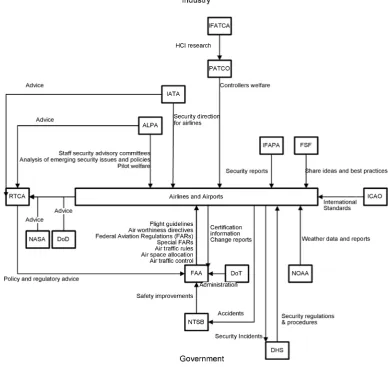
[image:19.595.150.539.355.722.2]To illustrate the technique, consider the level in the control structure that in-cludes government regulatory agencies, industry associations, unions, courts, and other stakeholders which exert control over airports and airlines. They receive information from certification reports, incident reports, and whistleblowers. The Federal Aviation Administration (FAA), NOAA’s Aviation Weather Service, Air Line Pilots’ Association (ALPA), Flight Safety Foundation (FSF), National Transportation Safety Board (NTSB), International Civil Aviation Organization (ICAO), Radio Technical Commission for Aeronautics (RTCA), International Federation of Air Line Pilots Association (IFAPA), Professional Air Traffic Controller Organization (PATCO), International Federation of Air Traffic Con-trollers’ Association (IFATCA), and International Air Transport Association (IATA) all influence the creation of standards, regulations, and certifications.
Figure 5 is a control structure diagram showing the lines of communication
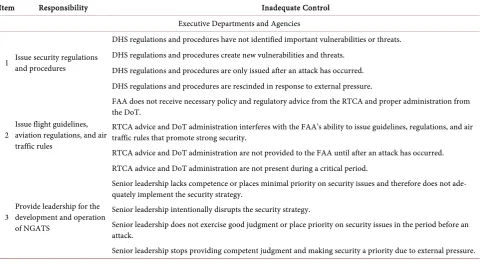
and control for the airlines and airports in the pre-NGATS environment. As the system evolves and NGATS is implemented, it is important that security-critical feedback is not lost. For example, the Radio Technical Commission for Aero-nautics (RTCA) plays an important role by synthesizing the interests and advice of industry associations, unions, airlines, airports, and governmental entities, and developing policy and regulatory advice for the FAA to influence the airlines and airports. The alignment of stakeholders on security objectives is essential to success. Key responsibilities and risks for Executive Departments and Agencie-sare shown below in Table 2.
Once the organizational risks have been elucidated, it is appropriate to con-sider the security implications of two major changes to operation of the aircraft themselves: removal of human(s) and removal of voice communications as a standard communication medium. There is no question that the removal of hu-mans eliminates an entire class of security vulnerabilities. Nevertheless, automa-tion has not been shown to be inherently more secure. When done improperly, automation can inject vulnerabilities. Similarly, voice communications are often involved in security incidents. However, any PC user that has gotten a virus or been involved in a distributed denial of service (DDoS) attack knows that com-puter-to-computer digital communication is often not secure. Leveson explains the need for humans in automated systems in [41]:
[image:20.595.58.544.472.743.2]Computers and other automated devices are best at trivial, straightforward tasks. An a priori response must be determined for every situation: An al-gorithm provides predetermined rules and procedures to deal only with the set of conditions that have been foreseen. Not all conditions are foreseeable,
Table 2. Inadequate controls for executive agencies.
Item Responsibility Inadequate Control
Executive Departments and Agencies
1 Issue security regulations and procedures
DHS regulations and procedures have not identified important vulnerabilities or threats. DHS regulations and procedures create new vulnerabilities and threats.
DHS regulations and procedures are only issued after an attack has occurred. DHS regulations and procedures are rescinded in response to external pressure.
2 Issue flight guidelines, aviation regulations, and air traffic rules
FAA does not receive necessary policy and regulatory advice from the RTCA and proper administration from the DoT.
RTCA advice and DoT administration interferes with the FAA’s ability to issue guidelines, regulations, and air traffic rules that promote strong security.
RTCA advice and DoT administration are not provided to the FAA until after an attack has occurred. RTCA advice and DoT administration are not present during a critical period.
3
Provide leadership for the development and operation of NGATS
Senior leadership lacks competence or places minimal priority on security issues and therefore does not ade-quately implement the security strategy.
Senior leadership intentionally disrupts the security strategy.
Senior leadership does not exercise good judgment or place priority on security issues in the period before an attack.
however, especially those that arise from a combination of events, and even those that can be predicted are programmed by error-prone humans… Human operators are included in complex systems because, unlike com-puters, they are adaptable and flexible… Humans can exercise judgment and are unsurpassed in recognizing patterns, making associative leaps, and operating in ill-structured, ambiguous situations.
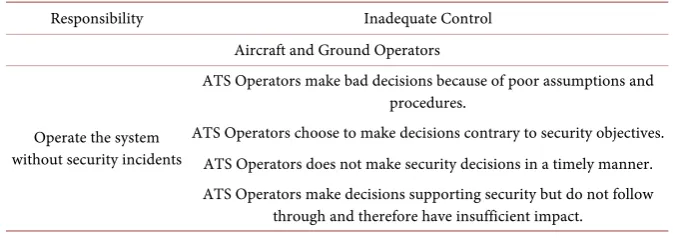
Pilots, air traffic controllers, radio operators, and others involved in the oper-ation of aircraft must be aware of four classes of inadequate control actions that could interfere with their primary responsibility of operating the system without security incidents. For example (see Table 3)
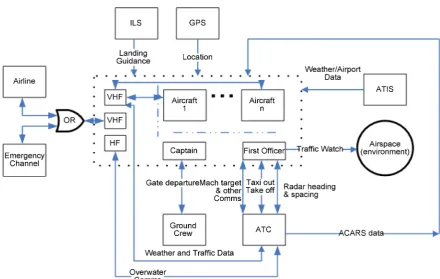
Midkiff et al. [42] offer a detailed overview of aircraft operation procedures. Historically, these procedures have not been exploited to accomplish terrorist objectives. The reason for this is that attackers will almost always pursue the vulnerability that is most easily exploited. In this case, the vulnerabilities asso-ciated with passenger and cargo screening were blatantly obvious and enabled (suicide) hijackers to board an aircraft and take control. The current control structure for aircraft operations is shown below. The essential communication and control between aircraft, ground assets, and satellites are highlighted. As a representative example, threat six:
A terrorist interferes with the aircraft communication, navigation, or surveil-lance systems
will be analyzed. see Figure 6.
During a flight, the airline communicates with an aircraft over a VHF radio. In the event of an emergency, if the aircraft is out of communication range with the airline, the cockpit may attempt to communicate with other aircraft or ground assets over the emergency channel. The second VHF radio is used to communicate with other aircraft in flight or air traffic control. Weather and traf-fic data is passed along over this channel. Finally, a HF radio is also required to provide over-water communications with ATC.
[image:21.595.204.541.620.740.2]A variety of digital data links also exist to send data between aircraft and ground assets. The Aircraft Communication Addressing and Reporting System (ACARS) enables aircraft to transmit location (from GPS), altitude, and velocity information stored in the Flight Management System procedures (FMS) com-puter to ATC over a satellite link. Similarly, ATC can send messages back to the
Table 3. ATS operator security.
Responsibility Inadequate Control
Aircraft and Ground Operators
Operate the system without security incidents
ATS Operators make bad decisions because of poor assumptions and procedures.
ATS Operators choose to make decisions contrary to security objectives. ATS Operators does not make security decisions in a timely manner. ATS Operators make decisions supporting security but do not follow
Figure 6. Current aircraft/ATC control structure.
FMS. Vital communications during the final phases of flight include position data from the Instrument Landing Systems (ILS) and automated audio record-ings of non-control airport data (e.g. weather conditions) from the Automatic Terminal Information Service (ATIS).
Not surprisingly, the captain and first officer also play a key role in the control structure. Prior to takeoff, the captain coordinates activities with the ground crew while the first officer receives taxi out and take off information from ATC. Once the aircraft is airborne, the captain controls the aircraft as the first officer provides visual traffic watch, inputs the radar heading and spacing, sets the mach target, and handles any other additional communications with ATC.
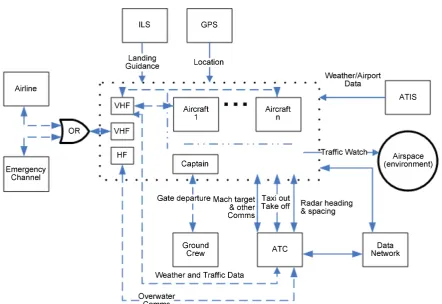
With the drastic changes made to the ATS socio-technical control structure following 9/11, terrorists will likely be more inclined to instantiate threats in the operation of aircraft procedures. Many of the changes in the control structure for NGATS are captured in Figure 7 below.
Immediately, one notices the fact that the traffic watch and early phase com-munications fall to the Captain. Additionally, a data network will be incorpo-rated and used in place of voice communications (although voice communica-tion equipment will still be onboard). The security requirements, control accommunica-tions, and potential inadequate controls for the three principal components in this control structure are provided next.
Cockpit Crew (Captain and First Officer) Security Constraints:
Figure 7. Possible NGATS aircraft/ATC control structure.
2. Pilots shall make setting the appropriate velocity a top priority. 3. Pilots shall make resetting the altimeter a top priority.
4. Pilots shall confirm over secure voice communications any suspicious ACARS data.
5. Cockpits shall display ATIS data visually as well as audibly.
6. Cockpits without crews (i.e. UAVs) shall have preprogrammed runways and landing information to be executed if communication with ATC is lost dur-ing descent, terminal area arrival, final approach, or landdur-ing.
Control Actions:
1. Regulation—Design: All new aircraft shall be designed to satisfy this security requirement. If the collision avoidance system is disabled, it is much easier for a terrorist to orchestrate a collision.
2. Regulation—Training and Standard Procedures: Operating procedures, flight simulators, and mandatory training shall equip pilots to set the appropriate velocity despite interruptions and distractions at different times. If the correct velocity is not set, it is much easier for a terrorist to orchestrate a collision. 3. Regulation—Training and Standard Procedures: Operating procedures, flight
simulators, and mandatory training shall equip pilots to reset the altimeter despite interruptions and distractions at different times. If the correct alti-tude is not set, it is much easier for a terrorist to orchestrate a collision. 4. Regulation—Training and Standard Procedures: Operating procedures, flight
ACARS data over voice communications.
5. Regulation—Design: Human factors experts will be responsible for ATIS subsystem design. If a terrorist distracts a pilot in the later phases of flight and he misses important ATIS information, a text-based version of the report will allow him to quickly get the necessary data.
6. Regulation—Design: All UAVs certified for operations in the NGATS shall be designed to satisfy the preprogrammed runway requirement. In the event that communication between ATC and a UAV is jammed, the UAV must still successfully land. One way to do this is to preprogram before takeoff an assigned runway as well as other details necessary for the UAV to reach its destination airport if communication is lost.
Potential Inadequate Controls: 1. TCAS
a.Design regulations do not prohibit TCAS deactivation in the cockpit. b.Design regulations require TCAS deactivation in the cockpit.
c.Design regulations prohibiting TCAS deactivation go into effect after NGATS certified aircraft are built.
d.Design regulations prohibiting TCAS deactivation are suspended during NGATS operations.
2. Setting Velocity
a.Procedures and training are insufficient to direct pilots to ensure that the correct velocity is set after they are interrupted.
b.Procedures and training form pilots that are careless about setting the target velocity.
c.Good procedures and training for setting the velocity target are developed too late.
d.Procedures and training for setting the velocity target are withdrawn. 3. Resetting Altimeter
a.Procedures and training are insufficient to direct pilots to ensure that the al-timeter is reset at the proper time after they are interrupted.
b.Procedures and training form pilots that are careless about resetting the al-timeter.
c.Good procedures and training for resetting the altimeter are developed too late.
d.Procedures and training for resetting the altimeter are withdrawn. 4. ACARS Data
a.Procedures and training are insufficient to direct pilots to ensure that suspi-cious ACARS data is verified with voice communications.
b.Procedures and training form pilots that do not verify suspicious ACARS data over voice communications.
c.Good procedures and training for verifying suspicious ACARS data over voice communications are developed too late.
d.Procedures and training for verifying suspicious ACARS data are with-drawn.
a.Design specifications do not require visual presentation of ATIS informa-tion.
b.Design specifications do not allow visual presentation of ATIS information. c.Design specifications that mandate visual and audible presentation of ATIS information are created too late.
d.Design specifications that mandate visual and audible presentation of ATIS information are withdrawn.
6. UAVs
a.Design specifications do not require preprogrammed landing routines. b.Design specifications do not allow preprogrammed landing routines.
c.Design specifications that mandate preprogrammed landing routines are created too late.
d.Design specifications that mandate preprogrammed landing routines are withdrawn.
The final step of a STAMP-based analysis is System Dynamics (SD) modeling. System Dynamics is used to understand how the static control structure de-signed in the earlier stages and the attackers themselves could evolve. In partic-ular, one is interested in evolution to insecure states such that security con-straints would no longer be enforced by components in the socio-technical sys-tem. Unlike system safety engineering in which many risks and hazards are “generated” endogenously within the socio-technical system, security engineer-ing risks and threats often develop exogenously. While the “insider-threat” must be addressed, malicious actors outside of the ATS must be modeled. Terrorist groups such as Al Qaeda, are an example of an exogenous factor. To illustrate the SD modeling approach, a causal loop diagram model of terrorism and the outside factors that influence it was developed and analyzed.
System Dynamics theoretical basis comes from control systems and non- linear dynamics. Complex systems, whether they are technical, organizational, or some combination, often exhibit highly non-linear behavior where the relation-ship between cause and effect is not intuitively obvious. According to Marti-nez-Moyano et al. [43]:
System Dynamics is a computer-aided approach to policy analysis and de-sign that applies to dynamic problems arising in complex social, manageri-al, economic, or ecological systems. Dynamic systems are characterized by interdependence, mutual interaction, information feedback, and circular causality.
System Dynamics models are constructed by a combination or positive (rein-forcing) and negative (balancing) feedback loops in addition to state and rate va-riables [28].
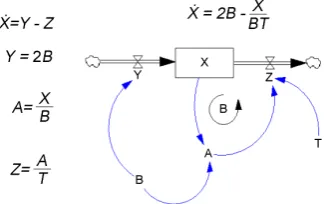
of a differential equation. While this level of understanding is not necessary for policy makers and managers to benefit from causal loop diagrams, the diagram is shown to assist scientists and engineers learning System Dynamics. The state variable, X, is controlled by two rate variables, Y and Z. Three auxiliary variables also are also provided, A, B, and T, that define Y and Z and each other. This SD model integrates the differential equation shown over the state variable, X. See
Figure 8 below.
The following quote by John Sterman, a leading scholar in the field, commu-nicates the philosophy of System Dynamics [44]:
While it’s hard to define what system dynamics is, I don’t have any trouble answering why it is valuable. As the world changes ever faster, thoughtful leaders increasingly recognize that we are not only failing to solve the per-sistent problems we face, but are in fact causing them. All too often, well-intentioned efforts to solve pressing problems create unanticipated “side effects”. Our decisions provoke reactions we did not foresee. Today’s solutions become tomorrow’s problems. The result is policy resistance, the tendency for interventions to be defeated by the response of the system to the intervention itself. From California’s failed electricity reforms, to road building programs that create suburban sprawl and actually increase traffic congestion, to pathogens that evolve resistance to antibiotics, our best ef-forts to solve problems often make them worse. At the root of this pheno-menon lies the narrow, event-oriented, reductionist worldview most people live by. We have been trained to see the world as a series of events, to view our situation as the result of forces outside ourselves, forces largely unpre-dictable and uncontrollable… System dynamics helps us expand the boun-daries of our mental models so that we become aware of and take responsi-bility for the feedbacks created by our decisions.
The “well-intentioned efforts to solve pressing problems create unanticipated ‘side effects’” mentioned above will be explored in this paper’s terrorism model.
Initially, in a model building activity, simple causal loop diagrams are devel-oped that elucidate the non-linear cause-effect relationship. These qualitative models suggest policies that acknowledge feedback in the system and can pre-vent delayed unintended consequences. Causal loop diagrams, and more gener-ally system archetypes [27] anchor the development of high fidelity, quantitative
Figure 8. A differential equation implement-
models that allow the use of simulation to explore scenarios and rigorously in-vestigate dynamic hypotheses [45]. The causal loop diagram below (Figure 9) corresponds to Level 1 in the Owens-Dulac hierarchy [32]. It was developed by the author in a modeling activity with John Sterman and Kim Thompson.
The model contains the major feedback loops that govern the behavior of ter-rorists, such as those that would attack the ATS. In order to accomplish the goal of minimizing the Attractiveness of Terrorism, one must examine the reinforc-ing and balancreinforc-ing loops that influence terrorist behavior.
Retaliation Works (Balancing Loop)
The first balancing loop is called Retaliation Works. In this loop, one sees that as the Attractiveness of Terrorism increases, Terrorist Attacks increase, Fear in Target Nation increases, and so does Retaliation. The net effect of this is that At-tractiveness of Terrorism decreases. This result was certainly not intended by the terrorists involved, but nonetheless has shown to be true in some instances (e.g. Barbary Pirates in 1815 and the Taliban Government in 2001).
Greater Isolation (Reinforcing Loop)
However, an increase in retaliation also has the potential to reinforce the At-tractiveness of Terrorism. Retaliation has the effect of reducing the Conventional Military and Political Power of Terrorist States, thereby increasing the attrac-tiveness of asymmetric warfare, such as the attack on 9/11. Part of this causal loop also has the potential, with a delay, to increase the Ideological Acceptability of Terrorism, thus increasing the Attractiveness of Terrorism.
[image:27.595.86.541.403.712.2]Sanctions Work (Balancing Loop)
Instead of retaliation, Sanctions are another option to be explored to mitigate the threat of terrorism. An increase in the Attractiveness of Terrorism will lead to an increase in the Fear in Target Nation, an increase in Sanctions, and finally a decrease in the Attractiveness of Terrorism.
Deepening Hatred (Reinforcing Loop)
However, Sanctions can also lead to deepening hatred. Sanctions may fuel Terrorist Grievances and therefore increase the Attractiveness of Terrorism. In the latter half of the twentieth century, economic sanctions against Middle East-ern states that support terror have been a cause for terrorists to incite popula-tions against the United States.
Getting What They Want (Balancing Loop)
Another loop can create the situation where the increase in Terrorist Attacks leads to an increase in Fear in Target Nation that leads to an increase in Negotia-tions/Concessions. Negotiations/Concessions reduce Terrorist Grievances and finally reduce the Attractiveness of Terrorism. The terrorist attack in Spain on March 11, 2004 days before the national election led to the selection of a gov-ernment sympathetic to the causes of Jihadists and the cessation of terrorist at-tacks in that country.
New strategies must be developed to prevent an attack as well as manage the aftermath. Informal, ad hoc approaches will almost certainly fall short of accom-plishing the desired goal of little to no casualties [5]. A rigorous, systematic me-thod is necessary to develop an appropriate approach. Traditional mathematical modeling has made significant contributions to this end. However, according to John Sterman, “The greatest potential for improvement comes when the model-ing process changes deeply held mental models”. [28] The author proposes an approach that brings the power of control theory in an accessible way to security professionals and policy makers involved in the US ATS. In consultation with air transportation security experts, future work in this area would involve defining the references modes for the key variables described above and instantiating a simulation model.
6. Conclusions
STAMP-Sec addresses many of the pitfalls associated with applying quantitative risk assessment and game theory to security problems. Additionally, it implicitly supports the use of red teaming to test that the socio-technical system has not evolved in such a way that security constraints are no longer enforced.
engage-ment between the attacker and the defender of the system has not been exces-sively simplified (e.g. abstracting the engagement to a two-stage Markov process) to facilitate modeling. Finally, the intelligence of the adversary is appre-ciated unlike reliability-based approaches that apply the 80/20 rule [14].
Similarly, the STAMP approach does not share the inherent weaknesses of game-theoretic security modeling. Game theory models of security often make simplifying assumptions, e.g. the attacker can only execute one attack at a time. STAMP-Sec does not engage in these types of assumptions. The fact that de-fenders and attackers may value targets differently is not relevant and no inap-propriate mathematical assumptions are made such as the fact that the probabil-ity of an attack is a convex function of the defensive resource spending. If a STAMP-based executable simulation is developed, sensitivity analysis of System Dynamics models mitigates the uncertainty that initially exists with quantitative model parameters. Lastly, unlike game theory’s emphasis on strategy, STAMP-Sec informs both the design and tactical operation of complex engineering systems.
STAMP-Sec provides concrete information that can be directly incorporated into requirements and design documents. Furthermore, it provides recommen-dations for how to address these security issues through the definition of con-straints, responsible components, and control actions. Finally, the possible in-adequate controls and causes for constraint violation are explored. Information-al, operationInformation-al, and physical security issues are addressed holistically. Notably, many of the security issues identified in this paper are not associated with the failure of any device or subsystem. Rather, threats emerge from inadequate con-trol. By showing where communication and feedback could be lost in the transi-tion from the current ATS to NGATS, many risks are identified. Additransi-tionally, given the use of increased automation in NGATS, STAMP-Sec is particularly applicable because it acknowledges the role that software plays in security inci-dents. In conclusion, the aforementioned strengths, sustained by the valuable results obtained for the Next Generation Air Transportation System, support the hypothesis that STAMP-Sec provides insight into security problems and moti-vates future research to further categorize its strengths and weaknesses.
References
[1] Anderson, R. (2001) Security Engineering. Wiley Computer Publishing, New York. [2] JPDO (2004) Next Generation Air Transportation System Integrated Plan. Joint
Planning and Development Office.
[3] Krenzke, T. (2006) Ant Colony Optimization for Agile Motion Planning. MIT, Cambridge.
[4] Barlas, S. (1996) Anatomy of a Runaway: What Grounded the AAS. IEEE Software, 13, 104-106. https://doi.org/10.1109/MS.1996.476294
[5] Laracy, J. (2006) A Systems Theoretic Accident Model Applied to Biodefense. De-fense and Security Analysis, 22, 301-310.
https://doi.org/10.1080/14751790600933905
[7] Laracy, J. (2007) Addressing System Boundary Issues in Complex Socio-Technical Systems. Proceedings of the 5th Annual Conference on Systems Engineering Re-search, Hoboken, NJ.
[8] Feynman, R.P. (1986) Rogers Commission Report: Appendix F—Personal Observa-tions on the Reliability of the Shuttle. NASA.
[9] Stamatelatos, M.G. (2002) New Thrust for PRA at NASA.
[10] Scottberg, E. (2006) NASA Says Shuttle Risk Overstated; Yet Some Risk Unavoida-ble. Popular Mechanics, 30 June 2006.
[11] Apostolakis, G.E. (2004) How Useful Is Quantitative Risk Assessment? Risk Analy-sis, 24, 515-520. https://doi.org/10.1111/j.0272-4332.2004.00455.x
[12] Parker, D.B. (2007) Risks of Risk-Based Security. Communications of the ACM, 50, 120. https://doi.org/10.1145/1226736.1226774
[13] Laracy, J.R. (2007) A System-Theoretic Security Model for Large Scale, Complex Systems Applied to the Next Generation Air Transportation System (NGATS). Master of Science Thesis, MIT, Cambridge.
[14] Bier, V.M. (2005) Game-Theoretic and Reliability Methods in Counter-Terrorism and Security Modern Statistical and Mathematical Methods in Reliability: Series on Quality, Reliability and Engineering Statistics. World Scientific Publishing Co., Singapore.
[15] Frey, B.S. and Luechinger, S. (2003) How to Fight Terrorism: Alternatives to Deter-rence. Defense and Peace Economics, 14, 237-249.
https://doi.org/10.1080/1024269032000052923
[16] Sandler, T., Daniel, G. and Arce, M. (2003) Terrorism and Game Theory. Simula-tion and Gaming, 34, 317-337. https://doi.org/10.1177/1046878103255492
[17] Banks, D.L. and Anderson, S. (2007) Combining Game Theory and Risk Analysis in Counterterrorism: A Smallpox Example. In: Wilson, A.G., Wilson, G.D. and Olwell, D.H., Eds., Statistical Methods in Counterterrorism: Game Theory, Modeling, Syn-dromic Surveillance, and Biometric Authentication, Springer, New York.
[18] Tversky, A. and Kahneman, D. (1974) Judgment under Uncertainty: Heuristics and Biases. Science, 185, 1124-1131. https://doi.org/10.1126/science.185.4157.1124
[19] Fricker, R.D. (2005) Game Theory in an Age of Terrorism: How Can Statisticians Contribute? In: Wilson, A.G., Wilson, G.D. and Olwell, D.H., Eds., Statistical Me-thods in Counterterrorism: Game Theory, Modeling, Syndromic Surveillance, and Biometric Authentication, Springer, Berlin.
[20] Schneider, W. (2003) The Role and Status of DoD Red Teaming Activities. Paper presented at the Defense Science Board, September 2003.
[21] Dzakovic, B. (2003) Statement of Bogdan Dzakovic to the National Commission on Terrorist Attacks upon the United States.
[22] NCTAUS (2004) 9/11 Commission Report. Paper presented at the National Com-mission on Terrorist Attacks upon the United States.
[23] Leveson, N. (2002) System Safety Engineering: Back to the Future. Cambridge. [24] Graham, S., Baliga, G. and Kumar, P.R. (2004) Issues in the Convergence of Control
with Communication and Computing: Proliferation, Architecture, Design, Services, and Middleware.43rd IEEE Conference on Decision and Control, 2, 1466-1471. [25] Checkland, P. (1981) Systems Thinking, Systems Practice. John Wiley & Sons, New
York.
![Figure 1. System organization and complexity. Image source [23].](https://thumb-us.123doks.com/thumbv2/123dok_us/7755198.710908/9.595.244.507.488.714/figure-organization-complexity-image-source.webp)
![Figure 2. Generic control loop. Image source [26].](https://thumb-us.123doks.com/thumbv2/123dok_us/7755198.710908/11.595.261.488.71.199/figure-generic-control-loop-image-source.webp)