http://www.scirp.org/journal/ojn ISSN Online: 2162-5344
ISSN Print: 2162-5336
Development and Evaluation of Korean Nurses’
Core Competency Scale (KNCCS)
Won-Hee Lee
1, Sanghee Kim
2*, Jihyoun An
31College of Nursing, Yonsei University, Seoul, South Korea
2College of Nursing & Mo-Im Kim Nursing Research Institute, Yonsei University, Seoul, South Korea 3Severance Hospital, Yonsei University Health System, Seoul, Korea
Abstract
Purpose: The purpose of this study was to develop and evaluate a Korean Nurses’ Core Competency Scale (KNCCS). Methods: This methodological re-search was conducted over two major steps. The first step involved developing a preliminary 70-item KNCCS based on an extensive literature review and the standards and criteria proposed by the Korean Accreditation of Nursing. The second step involved evaluating validity and reliability of the KNCCS. 528 newly graduated nurses recently employed in nine major hospitals were parti-cipated in this research for validation. Results: The final KNCCS consisted of 70 items. The exploratory factor analysis identified five subscales under which each item could be categorized: 1) human understanding and communication skills; 2) professional attitudes; 3) critical thinking and evaluation; 4) general clinical performance; and 5) specific clinical performance. Conclusion: The KNCCS shows good reliability and validity. However, the test of both crite-rion and construct validity were recommended further.
Keywords
Competency, Scale, Nursing Education, Korea
1. Introduction
Nurses compose over a third of the workforce in hospitals, providing clinical and nursing care around the clock often in a collaborative multidisciplinary
ap-proach [1] [2]. The competence of nursing students is related to the quality of
nursing care they provide, their cooperation with individuals from other discip-lines and services, and, ultimately, patient health and safety. Inasmuch the pro-fessional standards of nurses rely on their competency, evaluating nurses’ com-petence is an important and fundamental issue in healthcare.
Nursing education programs provide the education and training needed to How to cite this paper: Lee, W.-H., Kim,
S. and An, J. (2017) Development and Eval-uation of Korean Nurses’ Core Competen-cy Scale (KNCCS). Open Journal of Nurs-ing, 7, 599-613.
https://doi.org/10.4236/ojn.2017.75045
Received: March 20, 2017 Accepted: May 23, 2017 Published: May 26, 2017
Copyright © 2017 by authors and Scientific Research Publishing Inc. This work is licensed under the Creative Commons Attribution International License (CC BY 4.0).
foster strong core competencies in nursing students. The vast amount of litera-ture on measuring nursing core competency and factors related to it indicates how importance of such performance indicators for health professionals. This is unsurprising because the core competency of nurses is a measure of their ability to carry out nursing tasks at a professional level. Core competency is known to be influenced by various factors such as clinical environment, knowledge,
tech-nical skills, decision-making skills, and abilities of a nurse [3]. In nursing
educa-tion, it is defined as the performance level a candidate must demonstrate to graduate from the baccalaureate nursing education program. The assessment of the core competencies of graduating nurses has been based on variables such as education goals and the curricula of baccalaureate nursing education programs [4] [5].
Notwithstanding this, the assessment of nurses’ core competency, as shown in the Korean literature, has been performed without an agreement on competence domains among researchers, leading to difficulties in generalization and
appli-cability of findings [6]. This has also resulted in inconsistencies in terminology
and their definitions. For instance, terms such as nursing core competence [7],
professional nursing competence [8], and clinical competency [9] [10] [11] have
been used interchangeably without clear grounds to do so. In addition, most scales that assess nursing core competency lack a clear conceptual framework or have applied those of foreign scales without making the necessary adaptations to the educational context specific to Korea. Thus, there is a clear need for a stan-dardized rigorously validated core competency scale that accurately assesses how well equipped are graduating baccalaureate nurses in the Korean context.
To this end, we developed a scale that quantitatively measures the core com-petencies of Korean nurses on the basis of an extensive literature review of preexisting tools by a pilot test of a preliminary competency scale. A validation of the KNCCS was carried out in this actual study to assess its reliability and va-lidity.
2. Methods
1. Study design
This study was designed with methodological study for developing and eva-luating the instrument to measure nurses’ core competencies of nurses in Korea.
2. Participants
3. The instrument
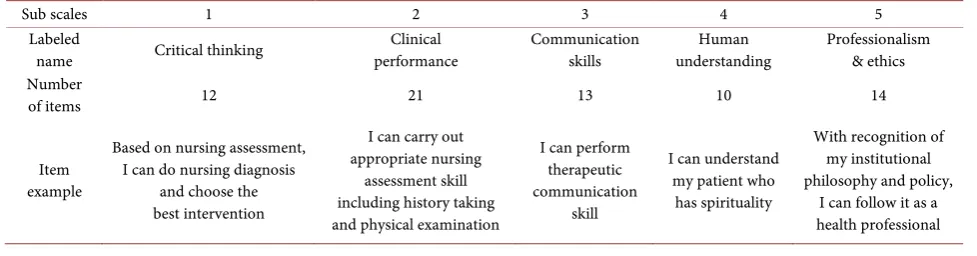
We developed a preliminary scale composed of a self-assessed questionnaire on general characteristics and core competencies. This preliminary KNCCS was based on core and clinical competence scales developed in other countries. Con-tent validity of the preliminary scale was assessed by a conCon-tent expert panel con-sisting of nursing professors and of educators from health care institutions who coach novice nurses. The 70 item-preliminary scale was constructed into 5 sub-domains or subscales (critical thinking, clinical performance,
communica-tion skills, human understanding, and professionalism and ethics) (Table 1),
and each item was rated using a 5-point scale with the following rating
conti-nuum (1 = strongly disagree; 2 = disagree; 3 = neutral; 4 = agree; and 5 =
strongly agree). We developed seven binary or multiple-choice items pertaining to general characteristics: specifically, age, sex, religion, and the type of nursing education programs and three items on a 5-point scale on self-efficacy including self-appraisals of their performance during the baccalaureate program; self-ap- praisals of their nursing competence during clinical training; and the level of confidence in their own competence.
4. Data collection and analysis
For the data collection, we recruited participants from nine nursing depart-ments of either secondary or tertiary major hospitals in Seoul or Gyeonggi re-gion. Recently graduated nurses who approved the study rationale and volun-teered to participate were recruited. By choosing the hospitals that employ nurses without regional discrimination, we were able to eliminate any geograph-ical bias in the participant selection process. We explained the rationale of the study and the overall plan to the nursing managers of the hospitals and received their approval for participant recruitment, after which the same explanation was given to newly graduated nurses awaiting their practical orientation at the hos-pital. We distributed our preliminary KNCCS to the participants who after self-assessment, sealed the questionnaire into an envelope themselves and placed it into a deposit box anonymously. The collected responses were codified and statistically analyzed. The explanatory factor analysis was performed using SPSS program.
5. Ethical considerations
[image:3.595.55.544.613.741.2]The study was approved by the college’s Institutional Review Board (IRB
Table 1. Proposed preliminary Korean nurses’ core competency scale.
Sub scales 1 2 3 4 5
Labeled
name Critical thinking performance Clinical Communication skills understanding Human Professionalism & ethics Number
of items 12 21 13 10 14
Item example
Based on nursing assessment, I can do nursing diagnosis
and choose the best intervention
I can carry out appropriate nursing
assessment skill including history taking and physical examination
I can perform therapeutic communication
skill
I can understand my patient who
has spirituality
With recognition of my institutional philosophy and policy,
2009-0018). We ensured that the participant recruitment process permitted only those who gave their informed consent. Data collection and data analysis were conducted in a way that guaranteed protection of sensitive, personally identifia-ble data and anonymity of participants. And the following instructions were ad-hered to: 1) the patients’ informed consent forms were collected separately from the questionnaires; 2) the self-assessed questionnaires were sealed and placed in a deposit box by the participants themselves. Additionally, although the nurses had not even begun the hospital practical orientation at the time of self-assess- ment, we still made clear that participants declared any potential conflicts of in-terest between them and the institutions; and lastly; 3) the questionnaires and its parts were handled as unique codes for analysis purposes.
3. Results
1. Developing the KNCCS 1) Development of the KNCCS
We developed a preliminary scale to assess Korean nurses’ core competency. This pilot instrument in the form of a questionnaire was structured into a 5- domain framework as an outcome of an extensive literature review. The items in the scale were created following the frameworks already outlined in nursing core competence scales developed elsewhere.
Our questionnaire comprised five main competence domains: 1) Critical thin- king; 2) Clinical performance; 3) Communication skills; 4) Human understand-ing; and 5) Professionalism and ethics.
We defined Critical thinking as the process of problem-solving and
deci-sion-making, drawing upon various cognitive skills as the process requires, such as analyzing, evaluating, and collecting; inference, inductive, and deductive rea-soning; prioritizing; and applying knowledge. Items used to measure this do-main covered ideas of problem perception, evidence-based nursing practice, prioritizing issues, applying standards to multiple complex principles, clinical
decision-making, and holistic nursing. We defined Clinical performance to
con-stitute clinical application of the nursing process (including patient data collec-tion), basic nursing skills, and teaching and supervising. Items on patient as-sessment, application of the nursing process, technical and clinical skills, use of medical equipment, documentation and information technology, clinical inter-vention, understanding and applying complementary alternative medicine, emergency and critical care, nursing of dying patients, nursing education, and
transitional care were used to measure this domain. Communication skills refer
to the ability to communicate with patients and their families, with colleagues, with nursing students, and with interdisciplinary teams. The items used to measure this domain included content on communication and on modes of
communication. We defined Human understanding as the ability to make a
social, and spiritual needs of patients and, hence, to provide differential nursing
based on this needs assessment. Professionalism and ethics refers to the conduct
of good nursing practice following legal and ethical principles, to continual pro-fessional development, to the provision of the highest standard of nursing care through collaboration, social participation, and quality improvement. Specifi-cally, items measuring professionalism covered topics on ethical nursing prtice; professional development; and professional attitudes. Those measuring ac-countability covered areas of delegation and personal and professional
develop-ment. Specific examples of items in each domain are shown in Table 1.
2) Validity of the scale using the content validity index
The content validity of the scale was confirmed using the method devised by
Polit & Beck [12]. We measured the content validity index of the overall scale
(S-CVI), the proportion of items on a scale that achieves a relevance rating of 3 or 4 by all content experts (S-CVI/UA), the average of the I-CVIs for all items on the scale (Scale-CVI/Ave), and the content validity index of individual items
(I-CVI) [12]. The seven expert panels who evaluated the relevance of each item
in the scale were nursing professors with at least 20 years’ experience in nursing education. The scale’s content was rated in terms of its relevance to the construct being measured with a questionnaire developed by Lynn (1986). Each item was
rated on a 4-point scale to avoid having an ambivalent midpoint (1 = not
rele-vant, 2 = somewhat relevant, 3 = quite relevant, 4 = highly relevant), and the
in-dividual I-CVI ratio was computed as the number of 3 or 4 ratings, thus
dicho-tomizing the scale into either relevant or not relevant[13].
The content validity analysis of the KNCCS revealed only 30 items whose content was judged as being relevant by seven expert panels unanimously, scor-ing an S-CVI/UA of 0.43. The S-CVI/Ave was 0.86, and the range of the I-CVI was 0.14 - 1.0. Our validity testing also showed that seven items had an I-CVI of less than 0.7 (item 17; item 24; item 26; item 38; item 54; item 55; and item 56).
2. Validating the KNCCS
1) General characteristics of respondents
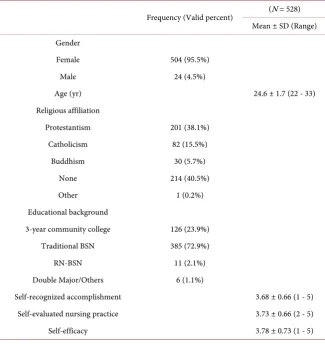
The participants for the pilot testing of KNCCS included 528 graduating nurses. The majority of participants were women (95.5%), and the mean age of the graduating nursing students was 24.6 ± 1.7 years (range, 22 - 33 years). The majority of participants were either Christians or Catholics (53.6%). We found that 75% of respondents were baccalaureate graduates from either a traditional BSN program or a RN-BSN program. On a rating continuum from 1 to 5 (1 = least competent; 5 = most competent), the participants self-appraised their per-formance during the baccalaureate program as 3.68 ± 0.66; their nursing
com-petence as 3.73 ± 0.66; and their level of confidence as 3.78 ± 0.73 (Table 2).
2) Reliability
Table 2. General characteristics of respondents.
Frequency (Valid percent) (N = 528) Mean ± SD (Range) Gender
Female 504 (95.5%)
Male 24 (4.5%)
Age (yr) 24.6 ± 1.7 (22 - 33)
Religious affiliation
Protestantism 201 (38.1%)
Catholicism 82 (15.5%)
Buddhism 30 (5.7%)
None 214 (40.5%)
Other 1 (0.2%)
Educational background
3-year community college 126 (23.9%) Traditional BSN 385 (72.9%)
RN-BSN 11 (2.1%)
Double Major/Others 6 (1.1%)
Self-recognized accomplishment 3.68 ± 0.66 (1 - 5) Self-evaluated nursing practice 3.73 ± 0.66 (2 - 5)
Self-efficacy 3.78 ± 0.73 (1 - 5)
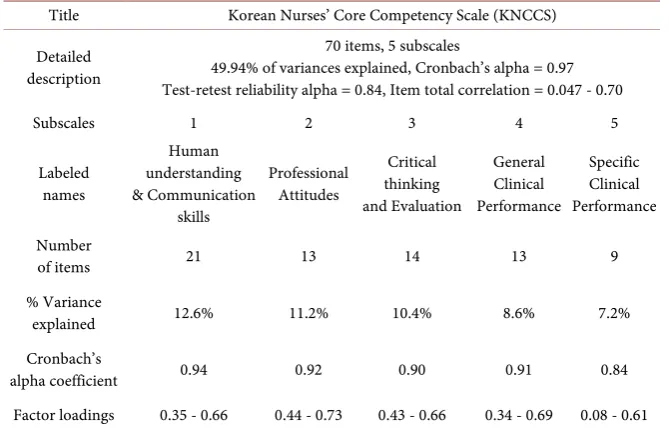
computed the initial reliability, we found that our preliminary KNCCS showed a Cronbach’s alpha coefficient of 0.97. To check the consistency of results, 42 nurses from one hospital (8% of the study population) were asked to repeat the questionnaire. The retesting was performed within a period of 10 days of the first testing (still before their practical orientation, to calculate the test-retest re-liability; the resulting correlation coefficient was 0.84 (Confidence Interval =
0.65 to 0.93, p < 0.001) (Table 3). All statistical analyses were performed using
SPSS 18.0.
3) Exploratory factor analysis
We used explanatory factor analysis to determine the factor structure of the responses of our 70-item preliminary scale. To do this, we performed a principal component analysis with Varimax rotation and Kiser Normalization. We found that the Kaiser-Meyer-Olkin (KMO) measure of sampling adequacy was 0.97 (marvelous) and that the Bartlett’s test of sphericity was 0.000, thereby, demon-strating the suitability of our data for factor analysis.
Table 3. The finalized Korean nurses’ core competency scale.
Title Korean Nurses’ Core Competency Scale (KNCCS)
Detailed description
70 items, 5 subscales
49.94% of variances explained, Cronbach’s alpha = 0.97 Test-retest reliability alpha = 0.84, Item total correlation = 0.047 - 0.70
Subscales 1 2 3 4 5
Labeled names
Human understanding & Communication
skills
Professional Attitudes
Critical thinking and Evaluation
General Clinical Performance
Specific Clinical Performance
Number
of items 21 13 14 13 9
% Variance
explained 12.6% 11.2% 10.4% 8.6% 7.2%
Cronbach’s
alpha coefficient 0.94 0.92 0.90 0.91 0.84 Factor loadings 0.35 - 0.66 0.44 - 0.73 0.43 - 0.66 0.34 - 0.69 0.08 - 0.61
greater than 5.1. We found that the five domains explained 49.94% of the
va-riance. The sub-domains derived from the factor analysis were named as Human
understanding and communication skills; Professional attitudes; Critical think-ing and evaluation; General clinical performance; and Specific clinical perfor-mance. And after the validation of the scale through reliability and validity
test-ing of items and of subscales, we were able to develop the final scale (Table 3).
The results of the analysis show that 69 items had a factor loading of more than 0.03 in at least one factor. Only one item (item 29) had a factor loading of
less than 0.3, which had a factor loading of 0.08 (Table 3).
4) The final KNCCS
On the basis of the reliability and validity testing, we finalized the KNCCS that would be used to measure the core competency of recently registered baccalau-reate nurses in Korea. Of note, we agreed not to omit the subscale concerning ‘spiritual care’, although it was associated with a factor loading of less than 0.3, because we considered it an integral part of good nursing practice. Thus, the
fi-nal KNCCS contains 70 items structured in 5 subscales; Human understanding
and communication skills (21 items); Professional attitudes (13 items); Critical thinking and evaluation (14 items); General clinical performance (13 items); and Specific clinical performance (9 items) (Appendix 1).
4. Discussion
In this methodological study, we developed the KNCCS and evaluated its relia-bility and validity. Here, we discuss why it is important to measure core compe-tencies of Korean nurses, appraise the content of the selected items, and, on the basis of this appraisal, evaluate the appropriateness of the scale in measuring core competency.
1. Rationale for measuring Korean nurses’ core competency
considered the following concepts integral to the definition of nursing compe-tency: 1) knowledge derived from information, education, and training; 2) ac-tions in ability, patterns, procedures, and techniques; 3) professional standards; 4) organizational policies affecting responsibility, attitudes, autonomy, motives, and self-regulation; and 5) dynamics such as societal change and constant
quali-ty improvement [14].
A pre-requisite to acquiring these competencies relies heavily on receiving education and all ancillary skills that come with receiving an education. Specifi-cally, this means that nurses must 1) earn the relevant nursing education de-grees; 2) have clear standards of their activities and actions; and 3) show ac-countability, all of which should in line with the knowledge that they have at-tained through the nursing education program. Evidence of having achieved the level of core competency expected in nurses includes improved safety of pa-tients, provision of patient care of the utmost standard, application of key knowledge, and self-driven professional development through continuing
edu-cation [14]. Graduating nurses should be equipped with the appropriate core
competency by the time they graduate so that the outcomes of their cultivated skills are directed to the right end-consumer, which is the patient. For these rea-sons, there is a need to assess the core competency of Korean nurses and develop tools to do so.
2. Composition of the KNCCS
We reviewed literature and compared the frameworks of preexisting tency scales so that we could analyze the trends and composition of core compe-tencies of nurses. With the advent of the Six-Dimension Scale of Nursing
Per-formance Scale (Six-D Scale) [15], a plethora of similar scales with subscales
adapted in accordance to the specific needs and context of each country was de-veloped. The Six-D Scale contains 52 items grouped into six subscales on lea-dership, critical care, teaching/collaboration, planning/evaluation, interpersonal relations/communications, and professional development. A study validated the Six-D Scale on 914 newly registered US nurses and 587 supervisors and reported it as a highly reliable performance evaluation instrument. This scale has been adapted and translated into Korean and tested on nursing students and
regis-tered nurses in Korea to evaluate their clinical performance [8] [10].
The Finnish Nurse Competence Scale (NCS) contains 73 items rated on a 4- point scale. It has been validated on 498 Finnish nurses. The conceptual
frame-work of NCS was derived from Benner’s From Novice to Expert competency
framework [16]. Subscales include responsibilities of the collaborator, teaching
and diagnostic function, situational management, treatment interventions,
maintaining quality care, and accountability [17].
identified two components of core competencies, namely humanity/responsibi- lity and cognitive/performance. And the scale was validated using the responses
of 802 nursing students pending graduation [5].
The Australian National Competency Standard Inventory (ANCI) national competency standards for enrolled nurses were developed by the Australian Nursing Council. The 51-item ANCI national competency standards are struc-tured into 14 elements covering four domain competencies: professional prac-tice, critical thinking and analysis, management of care, and enabling. Further, the self-assessed levels of competence (of 116 Australian nurses) derived from the ANCI national competency standards were shown to have a statistically
sig-nificant relationship with those derived from the NCS (r = 0.75) [18],
demon-strating convergent validity of ANCI.
The Competency Inventory for Registered Nurses (CIRN) for Chinese regis-tered nurses is a scale based on the ICN Framework of Competencies for the Generalist Nurses developed by the International Council of Nurses (ICN), which categorizes nursing competencies into three domains: Professional, ethi-cal, and legal practice; Care provision and management; and Professional, per-sonal, and quality development. The CIRN scale contains 58 items rated on a 5-point Likert scale. Through a validation study on 533 registered nurses in Ma-cao, the overall CIRN scale was found to have an internal consistency of a Cronbach’s alpha of 0.908. Their confirmatory factor analysis indicated a 7-fac- tor structure for this scale with 55 items, where three items with low factor loading were eliminated. The seven subscales were clinical nursing, leadership, interpersonal skills, legal and ethical responsibilities, professional development,
education and coaching, and critical thinking and research attitudes [19].
Ideally, the core competency of nurses should be acquired through a formal baccalaureate program in nursing. And the standards identified by international nursing councils or associations should form the basis of the conceptual frame-work of core competency scales. Conceptualizing and integrating competencies such as critical thinking, professional attitudes and ethics, interpersonal skills, and communication skills are important to make scales as context-relevant as possible. In other words, the scale must be a reflection of not only the Korean nursing education and assessment system but also the common set of constructs considered as core nurses competencies domestically and internationally. In this
study, the final scale generated a total of five subscales: human understanding
and communication skills; professional attitudes; critical thinking and evalua-tion; general clinical performance; and specific clinical performance. Thus, our set of subscales reflect the nursing competencies commonly measured in other countries and those that the Korean Accreditation Board of Nursing regard as essential (application of nursing knowledge, communication and collaborative skills, critical thinking, awareness of legal and ethical responsibilities, leadership, research skills, and adapting to global public health policy changes).
3. Psychometric evaluation of the KNCCS
the test-retest reliability as our indicator of stability and reliability. Our findings showed high internal consistency and high stability, demonstrating the reliability of KNCCS. However, a few limitations to our performance evaluation instru-ment were found through content validating testing. We found that there were seven items that failed to reach an I-CVI of 0.7, covering important areas of nursing competency such as complementary and alternative therapy, critical care, supervision of nursing students, genetic nursing, and tailored nursing. Ad-ditionally, the explanatory factor analysis showed factor loading of less than 0.3 of item was one item #29 which was about the importance of spiritual care in nursing.
A core competency scale must represent essential competencies not only dealt in nursing education but also those that reflect the future. This is because nurses face challenges adapting to and keeping abreast of both societal and healthcare
changes [20]. Nursing education must be constantly reviewed and developed to
remain relevant so that nurses are prepared to the effects of globalization, changing patient characteristics, technological developments, progression of healthcare, and developments in policies and in the economy. Specifically,
He-garty et al. proposed that nursing education should address areas of transcultural
nursing, patient-orientated care, chronic disease self-management, evidence- based nursing, leadership development, ethical and legal issues pertaining to
pa-tient healthcare, and international nursing standards [20]. Accordingly, as the
instrument measuring the readiness of nurses to meet these challenges, the KNCCS should cover areas of multi- and trans-cultural society, complexities in healthcare, and technological advancement in a manner appropriate to the Ko-rean context and should be continually reviewed and refined to reflect the changing healthcare environment.
5. Conclusion
References
[1] Ko, Y.K., Lee, T.W. and Lim, J.Y. (2007) Development of a Performance Measure-ment Scale for Hospital Nurses. Journal of Korean Academy of Nursing, 37, 286- 294. https://doi.org/10.4040/jkan.2007.37.3.286
[2] Lee, E.M. (2008) Development of Nursing Performance Appraisal Instrument [Dis-sertation]. Master Thesis, the Graduate School, Department of Nursing, Kyung Hee University, Seoul.
[3] Campbell, B. and Mackay, G. (2001) Continuing Competence: An Ontario Nursing Regulatory Program That Supports Nurses and Employers. Nursing Administration
Quarterly, 25, 22-30. https://doi.org/10.1097/00006216-200101000-00006
[4] American Association of Colleges of Nursing (2009) The Essentials of Baccalaureate Education for Professional Nursing Practice. American Association of Colleges of Nursing Website. http://www.aacn.nche.edu/education/pdf/baccessentials08.pdf. [5] Hsu, L.L. and Hsieh, S.I. (2009) Testing of a Measurement Model for Baccalaureate
Nursing Students’ Self-Evaluation of Core Competencies. Journal of Advanced
Nursing, 65, 2454-2463. https://doi.org/10.1111/j.1365-2648.2009.05124.x
[6] Ahn, Y.H., Park, K.S., Yang, S.O., Shin, K.R. and Kim, M.J. (2005) Development of Standards and Criteria for Accreditation of Baccalaureate Nursing Education Pro-gram. Journal of Educational Evaluation for Health Professions, 2, 87-103.
https://doi.org/10.3352/jeehp.2005.2.1.87
[7] Kim, M. (2006) Development of Objectives in Nursing Clinical Education Based on the Nursing Core Competencies. Journal of Korean Academy of Nursing, 36, 389- 402. https://doi.org/10.4040/jkan.2006.36.2.389
[8] Sung, M.-H. and Eum, O.B. (2009) Relationships between Critical Thinking Dispo-sition, Professional Nursing Competence and Job Satisfaction in Clinical Nurses. Journal of Korean Academy of Nursing Administration, 15, 26-36.
[9] Kang, K.-S., Kim, C.-J., Lee, W.-H., Oh, E.-G. and Park, H.-O. (2004) A Study for the Evaluation of Students on a Practical Performance of the Home Health Care. The Journal of Korean Academic Society of Home Care Nursing, 11, 44-56. [10] Lee, W.H., Kim, C.J., Yoo, J.S., Hur, H.K., Kim, K.S. and Lim, S.M. (1990)
Devel-opment of a Clinical Competency Measurement Tool for Student. Journal of Nurs-ing Science, 13, 17-29.
[11] Choi, E. (2009) A Study on the Relationship between Career Identity and Clinical Competency in Nursing Students. Journal of Korean Academic Society of Nursing
Education, 15, 15-21. https://doi.org/10.5977/JKASNE.2009.15.1.015
[12] Polit, D.F. and Beck, C.T. (2006) The Content Validity Index: Are You Sure You Know What's Being Reported? Critique and Recommendations. Research in
Nurs-ing & Health, 29, 489-497. https://doi.org/10.1002/nur.20147
[13] Lynn, M. (1986) Determination and Quantification of Content Validity Index.
Nursing Research, 35, 382-386. https://doi.org/10.1097/00006199-198611000-00017
[14] Axley, L. (2008) Competency: A Concept Analysis. Nursing Forum, 43, 214-222.
https://doi.org/10.1111/j.1744-6198.2008.00115.x
[15] Schwirian, P.M. (1978) Evaluating the Performance of Nurses: A Multidimensional Approach. Nursing Research, 27, 347-350.
https://doi.org/10.1097/00006199-197811000-00004
[16] Benner, P. (1982) From Novice to Expert. American Journal of Nursing, 82, 402- 407. https://doi.org/10.1097/00000446-198282030-00004
https://doi.org/10.1111/j.1365-2648.2004.03071.x
[18] Cowin, L.S., Hengstberger-Sims, C., Eagar, S.C., Gregory, L., Andrew, S. and Rolley, J. (2008) Competency Measurements: Testing Convergent Validity for Two Meas-ures. Journal of Advanced Nursing, 64, 272-277.
https://doi.org/10.1111/j.1365-2648.2008.04774.x
[19] Liu, M., Yin, L., Ma, E., Lo, S. and Zeng, L. (2009) Competency Inventory for Reg-istered Nurses in Macao: Instrument Validation. Journal of Advanced Nursing, 65, 893-900. https://doi.org/10.1111/j.1365-2648.2008.04936.x
[20] Hegarty, J., Walsh, E., Condon, C. and Sweeney, J. (2009) The Undergraduate Edu-cation of Nurses: Looking to the Future. International Journal of Nursing EduEdu-cation
Appendix 1. Korean Nurses’ Core Competency Scale (KNCCS).
Item
no. Subscales and item titles loading Factor
Subscale 1–Human understanding and communication skills
34 Help patients to articulate thoughts and emotions about their health. 0.66
40 and thoughts relating to the nursing practice. Verbally communicate issues, emotions, 0.62
50 Recognize patients as spiritual beings requiring spiritual care. 0.62 39 Exchange constructive feedback and criticism between colleagues. 0.59
37 autonomy through sufficient consultations. Help families of patients to respect patient 0.58
48 Recognize the support and the help that colleagues need. 0.58
36 listening skills, restating patients’ accounts, and clarifying an issue. Demonstrate therapeutic communication skills, such as sympathy, 0.55
41 Establish productive working relationships with colleagues and within the healthcare institution. 0.54
49 Explain coherently the physical, the mental, and the social needs of a patient. 0.54 38 Support nursing students to reach the objectives of their clinical training. 0.53
51 culturally diverse backgrounds in a cross-cultural society. Understand the different needs of patients from 0.51
47 Recognize the values, the strengths, and the weaknesses of self. 0.51
45 nursing resources (including human resources). Seek help to relevant persons for 0.49
52 Incorporate the needs of the individual into the nursing plan or adapt it as necessary. 0.49
43 education with relevant members of the healthcare team. Assess the progress of nursing care or patient 0.43
46 Document medical records to promote better communication between team members. 0.43
54 Teach patients through appropriate educational mediums or those preferred by the patient. 0.42
35 Communicate to patients the procedural aspects, contents, and purposes of the medical service that they will receive. 0.41
53 Provide a differential approach to patient education according to the developmental stage of the patient. 0.40
42 Plan nursing interventions that reflect opinions of multidisciplinary teams. 0.35
44 during ward rotations or during delegation or transfer of roles. Give a comprehensive report of the patient’s condition 0.35
Subscale 2–Professional attitudes
59 Practice in accordance to the philosophy, the policies, and the values of the healthcare institution. 0.73
60 Adhere to the legal and ethical roles and responsibilities of a nurse. 0.72 64 Display a positive attitude, take initiatives, and set an example to others. 0.70
58 Participate actively in educational and research activities for personal and professional development. 0.70
Continued
63 becoming involved in nursing associations or council activities. Participate in enhancing the nursing profession by 0.67
57 Have a clear professional identity as a nurse. 0.65
62 necessary quality improvements to prevent harm. Identify hazards to patient safety and make the 0.64
65 Use self-reflective practice to prevent exhaustion of personal mental and physical resources. 0.60
66 Delegate nursing responsibilities appropriately and accept accountability for the consequences. 0.51
68 Recognize the importance of quality improvement and perform actions relating to this. 0.47
70 society and as an expert in the medical healthcare profession. Communicate opinions on health policy as a member of 0.46
69 Understand and perform the needs of socially-disadvantaged and vulnerable groups as their advocates. 0.44
Subscale 3–Critical thinking and evaluation
7 knowledge acquired from nursing education programs. Make nursing and intervention decisions based on 0.66
6 Prioritize nursing interventions as relevant to the patient. 0.62 2 Interpret both subjectively and objectively-collected patient data. 0.60
4 Practice evidence-based nursing care. 0.60
3 Identify and use resources required for nursing care. 0.59
9 Consider the specific situation of the patient when making decisions in nursing care. 0.58
10 Judge the relevance of the decisions or instructions of various multidisciplinary experts. 0.54
1 Predict potential clinical hazardous situations of a patient. 0.53 8 Make decisions in nursing care that takes into account ethical values. 0.52 5 Use findings of nursing research in nursing practice. 0.51 15 Assess changes in patients continuously. 0.50 17 Systematically evaluate results of nursing care and level of patient satisfaction. 0.49 11 Provide nursing care that integrates needs of patients and their families. 0.47
12 Undertake decisions about the most optimal care for patient in multiple perspectives. 0.43
Subscale 4–General clinical performance
20 Use mechanical devices required for nursing care. 0.69 22 Administer drugs safely and accurately. 0.63 19 Perform the basic nursing techniques in nursing practice. 0.63 21 Use information technology in nursing care. 0.61
32 techniques relating to this to patients impending discharge. Share appropriate knowledge of self-care and teach 0.55
23 potential adverse effects of a drug and monitor the outcome accordingly. Have knowledge of the pharmacological effects and of the 0.54
Continued
13 Be knowledgeable enough to understand the pathophysiological state of a patient. 0.42
33 Provide discharging patients with information to resources of the local community and of community health centers. 0.40
30 Adapt teaching to the needs of the patient and family. 0.40
14 history and physical examination through questioning. Practice accurate nursing assessment such as nursing 0.39
16 Practice following a plan of nursing care. 0.37 18 Comply with nursing standards and protocols of the healthcare institution. 0.34
Subscale 5–Specific clinical performance
56 Plan a tailored nursing intervention that considers the patient’s genetic characteristics. 0.61
26 Perform nursing care required by critically ill patients. 0.59
27 management in patients approaching their end of life. Practice physical nursing that includes symptom 0.58
25 situations as a member of the medical team. Take appropriate actions in emergency 0.56
55 Understand the genetic properties of patients. 0.56
24 who are receiving complementary alternative medicine receives it. Understand and evaluate the basis of which patients 0.51
67 Have knowledge of and follow regulations pertaining to emergency situations. 0.43
28 emotional needs of patients and their families. Demonstrate end-of-life care and meet the 0.34
29 Use resources to address the spiritual needs of patients. 0.08
Submit or recommend next manuscript to SCIRP and we will provide best service for you:
Accepting pre-submission inquiries through Email, Facebook, LinkedIn, Twitter, etc. A wide selection of journals (inclusive of 9 subjects, more than 200 journals)
Providing 24-hour high-quality service User-friendly online submission system Fair and swift peer-review system
Efficient typesetting and proofreading procedure
Display of the result of downloads and visits, as well as the number of cited articles Maximum dissemination of your research work
Submit your manuscript at: http://papersubmission.scirp.org/