Efficient 3D data compression through parameterization of
free-form surface patches
RODRIGUES, Marcos <http://orcid.org/0000-0002-6083-1303>, ROBINSON,
Alan and OSMAN, Abdulsslam
Available from Sheffield Hallam University Research Archive (SHURA) at:
http://shura.shu.ac.uk/5195/
This document is the author deposited version. You are advised to consult the
publisher's version if you wish to cite from it.
Published version
RODRIGUES, Marcos, ROBINSON, Alan and OSMAN, Abdulsslam (2011). Efficient
3D data compression through parameterization of free-form surface patches. In:
Signal Process and Multimedia Applications (SIGMAP), Proceedings of the 2010
International Conference on. IEEE, 130-135.
Copyright and re-use policy
See
http://shura.shu.ac.uk/information.html
EFFICIENT 3D DATA COMPRESSION THROUGH
PARAMETERIZATION OF FREE-FORM SURFACE PATCHES
Marcos A Rodrigues, Alan Robinson and A. Osman
Geometric Modelling and Pattern Recognition Research Group, Sheffield Hallam University, Sheffield, UK [email protected], [email protected], [email protected]
Keywords: 3D data compression, surface parameterization, 3D reconstruction
Abstract: This paper presents a new method for 3D data compression based on parameterization of surface patches. The technique is applied to data that can be defined as single valued functions; this is the case for 3D patches obtained using standard 3D scanners. The method defines a number of mesh cutting planes and the intersection of planes on the mesh defines a set of sampling points. These points contain an explicit structure that allows us to define parametrically bothxandycoordinates. Thezvalues are interpolated using high degree polynomials and results show that compressions over 99% are achieved while preserving the quality of the mesh.
1
INTRODUCTION
Cheap storage and secure transmission of 3D data bring advantages to a number of applications in se-curity, engineering, CAD/CAM collaborative design, medical visualization, entertainment and e-commerce among others. We have developed and demonstrated original methods and algorithms for fast 3D scanning for a number of applications with particular focus on security (Robinson, 2004), (Brink, 2008), (Rodrigues, 2008), (Rodrigues, 2009). Our algorithms can per-form 3D reconstruction in 40ms and recognition in near real-time, in just over one second per subject.
This paper is concerned with compression of 3D data for fast transmission over the Internet. A re-alistic scenario we are exploring involves 3D facial biometric verification at airports. The method is non-intrusive and aims at minimal disruption and is based on our past experience with 3D biometrics at Heathrow Airport (London, UK) in 2005. An enroll-ment shot is taken and reconstructed in 3D at an au-tomated check-in desk, where a new database is cre-ated for each flight. At the gate, before boarding the plane another 3D shot is taken for verification. The created databases are transmitted to the local Police who would perform a search against their records. If the Police find no information to warrant keeping the data for longer, all data must be erased after a time
lapse, normally within 24 hours. For international flights and where no mechanisms for sharing infor-mation between Police Forces are available, the data can be transmitted to the destination Police authorities
beforethe flight actually arrives at the destination. A significant constraint of this scenario is that 3D files are very large; a high definition 3D model of a person’s face is around 20MB. For a flight with 400 passengers, this would mean to dispatch 8GB of data. If we consider the number of daily flights in a medium sized airport, we soon conclude that this may be un-workable. It is clear that methods to compress 3D data would be beneficial to the scenario considered here but, more importantly, would represent an enabling technology for a potential large number of other ap-plications.
tra-verse the mesh for local compression of polygonal re-lationships.
Compression methods are focused on represent-ing the connectivity of the vertices in the triangu-lated mesh. Examples include the Edgebreaker al-gorithm (Szymczak, 2000) and (Szymczak, 2002). Products also exist in the market that claim a 95% lossless file reduction such as from 3D Compression Technologies Inc (3DCT, 2010) for regular geomet-ric shapes. Other techniques for triangulated models include the work of (Shikhare, 2002) and vector quan-tization based methods (Hollinger, 2010) where rates of over 80:1 have been achieved.
The 3D compression method proposed in this pa-per was devised from our research on fast 3D acquisi-tion using light structured methods (Robinson, 2004), (Rodrigues, 2008), (Brink, 2008), (Rodrigues, 2009). The 3D scanning method is based on splitting the pro-jection pattern into light planes. Each plane hits the target object as a straight line and the apparent bend-ing of the light due to the position of the camera in relation to the projection allows us to calculate the depth of any point along the projected light plane. Taking full advantage of such properties, our method is closer to polygonal mesh compression but with sig-nificant differences as it does not depend on search-ing for local relationships that are most susceptible to compression. We have achieved compression rates of free-form surface patches that drastically reduce the original 3D data by over 99% to a plain text file. Once in plain text, it can be encrypted and securely trans-mitted over the network and reconstructed at the other end.
This paper is organized as follows. Section 2 presents the method and Section 3 describes the in-stantiation of the method to surface patches. The data are compressed and reconstructed and a comparative analysis of polynomials of various degrees is pro-vided. Finally a conclusion is presented in Section 4.
2
METHOD
2.1
The Surface Patch as an Explicit
Function of Two Variables
The method presented here applies to surface patches acquired by standard 3D scanning techniques. Any such patch can be described as a single valued shape in one dimension where their values are represented as an explicit function of two independent variables. The height of a point is represented by theirz-value and we can say that the height of a function (x,y)
is some function f(x,y). The advantage of a single-valued function is that it has a simple parametric form,
P(u,v) = (u,v,f(u,v)) (1)
with normal vector n(u,v) = (−δf/δu,−δf/δv,1).
Bothuandvare the dependent variables for the func-tion and u-contours lie in planes of constantx, and
v-contours lie in planes of constant y. When such patch is visualized in 3D using quads, each edge of the polygons is a trace of of the surface cut by a plane withx=k1andy=k2for some values ofk1andk2.
2.2
Sampling and Reconstruction
Given a randomly oriented surface patch described in relation to a global coordinate system, it is necessary to orient the surface using the properties of its bound-ing box. Geometric algorithms exist to approximate a minimum bounding box of a 3D object defined by a set of points, e.g. (Lahanas, 2010). The patch must be rotated until its minimum bounding box edges are aligned with thex-,y-, andz-axes of the global coor-dinate system. Normally, the smallest dimension of the bounding box is aligned with thez-axis. The pro-posed method is based on sampling surface points at the intersection of horizontal and vertical mesh cut-ting planes.
Horizontal and vertical planes are defined as par-allel to one of the x or y-axes with normal vectors
(1,0,0)and(0,1,0)respectively. The intersection of any two planes defines a line, and the points where such lines intersect the mesh are sampled. A problem here is that we cannot guarantee that the intersection of two planes on the mesh will rest on a vertex. More likely, it will intersect somewhere on a polygon’s face somewhere between vertices. A good approximation is to find the three vertices on the mesh that are the nearest to the intersection line. Such vertices define a plane and it then becomes straightforward to deter-mine the intersection point. Assume that the line has a starting pointSand directionc. The intersection line is given by
L(t) =S+ct (2) The solution only involves finding the intersection point with the generic plane (Hill, 2001). The generic plane is thexy-plane orz=0. The lineS+ct inter-sects the generic plane whenSz+czti=0 wheretiist
“intersection”:
ti=− Sz cz
(3)
From equation (2), the line hits the plane at pointPi:
Pi=S−c(Sz
cz
The vector of all points on the mesh belonging to a particular plane is a sub-set of the sampled points. Depending on the characteristics of the surface patch, either the set of points lying in the horizontal or ver-tical planes can be selected. If the selected points lye in planes with normal vector(1,0,0), the distance between each sampled point is the distance between planes with normal(0,1,0)and vice-versa. Calling these distancesD1andD2, thexandycoordinates of
any sampled point can be recovered for all planesk:
xr={rD1,|r=1,2, . . . ,k1} (5) yc={cD2,|c=1,2, . . . ,k2} (6)
where(r,c) are the indices of the planes. This is a significant outcome of the proposed method, as it is not necessary to save the actual values(x,y)of each vertex; instead, onlyD1,D2,k1andk2are kept. This
allows us to discard 2/3 of the data. To illustrate the compactness of this representation, a mesh with 100,000 vertices means that we have to keep 300,000 values for the set (x,y,z). We instantly eliminated 200,000 values replacing them by 4 numbers only.
We now turn our attention to thez-values. These can be expressed as in equation (1) as a single valued function and estimated using equation (4) for each combination of (xr,yc). If we choose to represent these as the set of points belonging to planes with normal(1,0,0)this is reduced to a 2D case in which on the horizontal axis we have exactlyk2points with
constant step ofD2and on the vertical axis we have
their correspondingz-values. This can be expressed as ann-th-degree polynomial inz
a0+a1z+a2z2+· · ·+anzn (7)
A high degree polynomial fitting is performed on each of such curves using thez-values as “control points”. The desired outcome is a polynomial that passes ex-actlythrough each control point. The coefficients of the polynomial are saved for each curve together with the indices of thekplanes for the first and last valid vertices. This is so because we may have several plane intersections that do not intersect the mesh and such combination of indices(kr,kc)must be marked
as invalid vertices.
The reduction in data is substantial: using the ear-lier example of 100,000 vertices, if we cut the mesh with 100 planes we need to keep a set of 100 polyno-mial coefficients together with the first and last valid vertex indices. Assuming that we are using a polyno-mial of degree 25, we need to keep 28 numbers for each plane: 26 coefficients plus 2 vertex indices. This is a reduction from 100,000 to 2,800 numbers. To re-construct the original mesh, the polynomials used in equation (7) are evaluated for each plane within their
boundaries (first and last valid vertices), and the(x,y)
values are evaluated for each combination of (r,c)
plane indices through equations (5) and (6).
3
RESULTS
In this section we describe a step by step application of the method described in Section 2 with compara-tive analysis of interpolation using various high de-gree polynomials.
3.1
Data Compression
[image:4.595.328.469.300.426.2]The steps and the parameters used for data compres-sion are as follows.
Figure 1: Original 3D mesh with 48,672 vertices and 78,043 faces. The size of the file (OBJ format) is 4.83MB with texture mapping and 4.0MB with no texture.
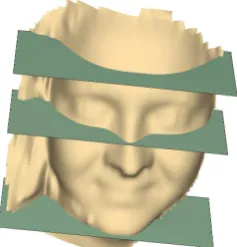
Figure 2: 72 horizontal planes with normaln= (1,0,0)are cut through the mesh, from top to bottom (only 3 are shown here).
[image:4.595.362.481.480.604.2]Figure 3: 676 vertical planes with normaln= (0,1,0)are cut through the mesh, from left to right (only 3 are shown here).
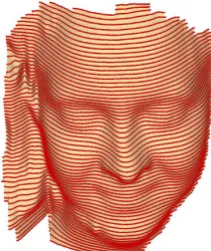
Figure 4: The intersection points of each horizontal and ver-tical planes on the mesh are estimated and marked with a point in red. The shown model has 39,743 valid vertices or intersection points.
2. A numberk1of horizontal planes with normaln=
(1,0,0)T cut the mesh as shown in Figure 2 (only
3 planes are shown). These planes are parallel to the Y-Z plane of the coordinate system in Figure 1.
3. A numberk2of vertical planes with normaln=
(0,1,0)T cut the mesh as shown in Figure 3 (only
3 planes are shown). These planes are parallel to the X-Z plane of the coordinate system.
4. The intersection of each planekrwith planekc
de-fines a line. For each line determine the pointPr,c
where the line intersects the mesh through equa-tion (4). These are the heights of the single-valued function.
5. For each planekr,kcmake a list of the intersection pointsPr,c.
6. The distance between each horizontal plane is de-fined as a constantD1and the distance between
vertical planes is defined as a constantD2.
7. Perform polynomial interpolation and save the co-efficients and the plane indices of the first and last valid points.
Figure 4 depicts the intersection of all horizontal and vertical planes where each intersection is marked with a red point. The structure of the mesh isk1×k2,
whose choice depends on the characteristics of the model and the accuracy required. For the face mod-els, we normally chose 8 to 10 times more vertical planes than horizontal ones due to the characteris-tics of our scanner (Robinson, 2004). Ultimately, the number of planes is based on experience; we deter-mined that between 50–80 horizontal planes across the face provide for good reconstruction. The number of vertical planes was determined at around 10 times the horizontal scale; this provides a large number of data points for polynomial interpolation and results in a grid 72×676 for the face model shown (for differ-ent models these dimensions can vary or remain the same). The horizontal planes are quite noticeable in the picture, while the vertical planes are less so due to their proximity.
A polynomial interpolation is suggested of degree 20 or higher as we wish to find a polynomial that goes as close as possible through all control points. In order to be able to reconstruct the set of points later on, we save together with each set of coefficients the first and last valid points of each list of points, the size k1,k2 of the sampled 3D data structure and the
distance between planesD1andD2. This information
is organized in the file header:
k1 72
k2 676
D1 3.3
D2 0.3
8.0960151e-031 ... 6.7726253e+002 382 482
...
1.8712059e-032 ... 1.0464188e+007 143 437
3.2
3D Reconstruction
[image:5.595.129.235.285.411.2]Figure 5: Top row: the original face model is shown on the left with file size of 4MB; right, with polynomial interpo-lation of degree 20 reducing the file size to 26KB. Bottom row: left, polynomial interpolation of degree 30 reducing the file size to 37.2KB; right, degree 40 reducing to 48.5KB.
Figure 6: Left, the original face model; right, interpolation with polynomial degree 80. It is noted that the model be-comes unstable.
[image:6.595.324.517.180.340.2]Figure 5 show results for polynomial interpolation of degrees 20, 30, and 40. Figure 6 shows the origi-nal face model on the left together with a compres-sion and reconstruction with a polynomial of degree 80. It is noted that the model becomes unstable for interpolation of very high degrees. For a polynomial interpolation of degree 20, the file size in OBJ format has been reduced from 4MB to 26KB. This is a reduc-tion of 99.35% and similar reducreduc-tions were achieved for other polynomials also; a summary is presented in Table 1.
3.3
Evaluating the Fit
Determining the quality of a polynomial regression or how well the recovered data points fit the original data can involve a number of tests including statistics sum-maries. By far the most meaningful way is by plotting the original and regression data sets and visually as-sess its quality. By visually analyzing the models of Figure 5, it is suggested that a polynomial interpola-tion of degrees 20 to 40 describes well the data and
Table 1: Compression rates in percentage.
Degree 20 30 40 50 80 Rate 99.35 99.07 98.79 98.53 97.66
[image:6.595.95.270.327.401.2]can be well-suited for most applications.
Figure 7: Scatter plot of Predicted Values against Residuals. For a good fit, it should show no patterns and no trends. The plot shows what looks like random noise indicating a good fit.
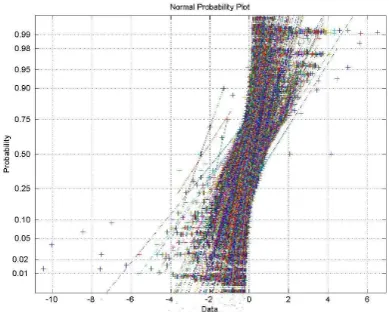
Figure 8: The normal-probability plot of the residuals. A good fit should describe a straight line for each polynomial curve which is verified by the plot indicating a good fit.
[image:6.595.321.516.426.582.2]the fit is good, a normal-probability plot of the resid-uals should display a straight line. The plot depicted in Figure 8 shows that for most polynomials evalu-ated at each plane, indeed they describe a straight line indicating a good fit.
There are a number of statistical measures to as-sess the quality or the appropriateness of a model such as the coefficient of determination also known asR2
that indicates the percent of the variation in the data that is explained by the model. This can be estimated by first calculating the deviation of the original data set which gives a measure of the spread. While the to-tal variation to be accounted for (SST) is given by the sum of deviation squared, the variation that isnot ac-counted for is the sum of the residuals squared (SSE). The variation in the data explained by the model is given by
R2=1−SSE
SST (8)
expressed as percentage. TheR2values for some in-terpolated models are described in Table 2. The ta-ble shows a trend of increasingR2as the polynomial degree increases, peaking at around degree 30. For higher degrees,R2decreases monotonically, and this is also confirmed by visual inspection of the 3D re-constructed models whose quality deteriorates as they become unstable for high degree polynomials.
Table 2: The coefficients of determinationR2for polyno-mial fits of degrees 20–80 for the given data.
Degree 20 30 40 50 80
R2 0.9995 0.9996 0.9995 0.9994 0.9909
4
CONCLUSIONS
We have presented a new method of data compres-sion applied to surface patches that can be defined as a single valued function. This is the case of 3D data ac-quired using standard 3D scanning technologies. The method was described based on mesh cutting planes oriented with the global coordinate system with con-stant step. The points where the plane intersections intersect the mesh are sampled and this automatically allows the recovery of all(x,y) coordinates for all vertices. Thez-values are subject to polynomial in-terpolation of various degrees. Results demonstrate that the method is effective and can reduce the mesh over 99%. Both close visual inspection and statisti-cal measures demonstrate that optimal performance is achieved for polynomials of degree between 20 to 40 – it seems that the optimal value is around 30, but this obviously depends on the characteristics of the data.
There seems to be intrinsic limitations using poly-nomials to approximate complex real world surface patches. In the future we will investigate the use of splines as it is possible to get more accurate results than with polynomials but the price we pay is that it will generate larger files as we need to keep the coef-ficients of all polynomials between the control points. A more promising approach is to investigate the use of PDEs and research is under way and will be reported in the near future.
REFERENCES
3DCT (2010). 3D Compression Technologies Inc. available at http://www.3dcompress.com/web/default.asp Brink, W., A. Robinson, and M. Rodrigues (2008). Indexing
Uncoded Stripe Patterns in Structured Light Systems by Maximum Spanning Trees,British Machine Vision Conference BMVC 2008, Leeds, UK, 1–4 Sep 2008 Hill, F.S. Jr (2001). Computer Graphics Using OpenGL,
2nd edition, Prentice-Hall Inc, 922pp.
Hollinger, S.Q., A.B. Williams, and D. Manak (2010). 3D data compression of hyperspectral imagery using vectorquantization with NDVI-based multiple code-books, available athttp://sciencestage.com
Lahanas, M. (2010). Optimal Oriented Bounding Boxes, http://www.mlahanas.de/CompGeom/opt bbox.htm, last accessed April 2010.
Rodrigues, M.A. and A. Robinson (2010). Novel Methods for Real-Time 3D Face Recognition,6th Annual ternational Conference on Computer Science and In-formation Systems, 25–28 June 2009, Athens, Greece. Rodrigues, M.A., A. Robinson, and W. Brink (2008). Fast 3D Reconstruction and Recognition, inNew Aspects of Signal Processing, Computational Geometry and Artificial Vision, 8th WSEAS ISCGAV, Rhodes, 2008, p15–21.
Robinson, A., L. Alboul and M.A. Rodrigues (2004). Meth-ods for Indexing Stripes in Uncoded Structured Light Scanning Systems,Journal of WSCG, 12(3), 2004, pp 371–378.
Szymczak, A., D. King and J. Rossignac (2000). An Edgebreaker-Based Efficient Compression Scheme for Regular Meshes, 12th Canadian Conference on Computational Geometry, pp 257–265.
Szymczak, A., J. Rossignac, and D. King (2002), Piecewise Regular Meshes, Graphical Models 64(3-4), 2002, 183–198.