© 2019, IRJET | Impact Factor value: 7.211 | ISO 9001:2008 Certified Journal
| Page 343
MULTI-RESPONSE PARAMETRIC OPTIMIZATION DURING TURNING OF
EN-31 BAR USING GREY RELATIONAL ANALYSIS
Ravinder Rawat
1, Shanti Prakash
21
M.Tech Student of HEC Jagadhri,
2Assistant Professor of HEC Jagadhri
---***---Abstract -
Quality and productivity play significant rolein today’s manufacturing market. From customers’ viewpoint quality is very important because the extent of quality of the procured item (or product) influences the degree of satisfaction of the consumers during usage of the procured goods. Therefore, every manufacturing or production unit should concern about the quality of the product. Apart from quality, there exists another criterion, called productivity which is directly related to the profit level and also goodwill of the organization. Every manufacturing industry aims at producing a large number of products within relatively lesser time. But it is felt that reduction in manufacturing time may cause severe quality loss. In order to tackle such a multi-objective optimization problem, the present study applied extended Taguchi method through a case study in straight turning of EN-31 steel bar using HSS tool. The study aimed at evaluating the best process environment which could simultaneously satisfy requirements of both quality and as well as productivity with special emphasis on reduction of cutting tool flank wear. Because reduction in flank wear ensures increase in tool life. The predicted optimal setting ensured minimization of surface roughness, height of flank wear of the cutting tool and maximization of MRR (Material Removal Rate).
Keywords: Turning, EN-31, DOE, ANOVA, GRA, MRR & SR.
1 Turning Operation
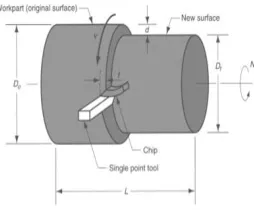
Removal of metal from the outer periphery of the rotating cylindrical work piece is usually performed using the turning operation. Basically, turning operation is performed to minimize the diameter of the work piece as per the required dimensions and also to obtain smooth finished work piece. Usually work pieces will be turned to obtain neighboring section of different diameters [16]. Turning relates to a machining process which frequently produces cylindrical products. This process is typically performed on the external surface of the metal and stated as the machining of external surfaces. Process includes followings:
1. A rotating work piece.
2. A single-point cutting tool. 3. Tool feed.
[image:1.612.391.518.309.414.2]When the cutting tool is placed at an angle with respect to work piece the process of turning is referred as taper turning. Similarly when the distance of the tool is changed with respect to work piece in order to obtain contour surfaces, the process is named as contour turning [3].
Fig 1: Parameters in turning operation
Apart from the single-point tool, the process also includes the provision of multiple-tool setups in which each tool operates independently as a single-point cutter.
1.1 Material Removal Rate
The material removal rate (MRR) in turning operations is the volume of material/metal that is removed per unit time in mm3/min. For each revolution of the work piece, a ring shaped layer of material is removed.
MRR = (v. f .d ×1000) mm3 / min
1.2
Surface Roughness
© 2019, IRJET | Impact Factor value: 7.211 | ISO 9001:2008 Certified Journal
| Page 344
∑
1.3 Material Used
EN-31 steel is used widely in aerospace, pressure vessels, aircraft turbine and compressor blades and disks, surgical implants etc. Turning is one of the most commonly used machining processes in the shaping of EN-31 steel now days. It has considerable economic importance because it is usually among the finishing steps in the fabrication of industrial mechanical parts.
1.4 Grey Relational Analysis Method:-
Grey relational analysis method uses an exact model of information as it defines situations through no information as black, and those by way of perfect information as white. In actual situations involvement of these extremes can be described as living being grey, hazy or fuzzy. Therefore, a grey system means that a system in which part of information is known and part of information is unknown. With this definition, information quantity and quality form a continuum from a total lack of information to complete information – from black through grey to white. Since uncertainty always exists, one is always somewhere in the middle, somewhere between the extremes, somewhere in the grey area [27].
Grey analysis then comes to a clear set of statements about system solutions. At one extreme, no solution can be defined for any system with no information available. On the other extreme, a system with perfect information has a unique solution. In the middle, grey systems will give a variety of available solutions. Grey analysis does not attempt to find the best solution, but does provide techniques for determining a good solution, an appropriate solution for real world problems.
Let
x
i(
k
)
is the value of the number i listed project and the number k influence factors.Usually, three kinds of influence factors are included, they are:
1. Benefit – type factor (the bigger the better), 2. Defect – type (the smaller the better)
3. Medium – type, or nominal-the-best (the nearer to a certain standard value the better).
2. Literature Survey
Rajiv Chaudhary et al. (2015) studied on the investigations made on drilling using Taguchi Techniques.
They found that Taguchi method has the best tool for finding the optimum machining conditions, improving performance characteristics such as (tool life, cutting force, surface roughness), their main effect & find out other significant factor. They found that at quite large cutting speeds with smaller feed rate, good surface quality as well as dimensional accuracy can be obtained.
Sachin Jhangra et al. (2016)discussed Most of modern day machining is carried out by computer numerical control (CNC), in which computers are used to control the movement and operation of various machines like milling machine, lathes, and other cutting machines. This Study aims to establish the relation between those process parameters and conditions of CNC turning machine and their dependency on performance parameters. The input factor considered for this research work are speed, feed and DOC where the output parameters are Surface roughness and MRR. It is used to find the effect of various process parameters on the CNC turning process. Permanent is used to find the dependency of parameters on process or performance.
3. Problem Formulation & Methodology
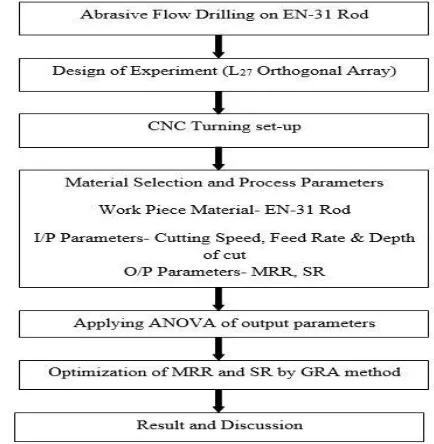
[image:2.612.336.553.457.679.2]Keeping all the Literature Gap Analysis in mind the present work will study the influences of different Parameters of “CNC turning for Material Removal Rate and Surface roughness, while machining of EN-31 Rod”. Further an expert system will be developed for future predictions of the phenomenon.
© 2019, IRJET | Impact Factor value: 7.211 | ISO 9001:2008 Certified Journal
| Page 345
4. Experimental Work
[image:3.612.335.569.81.223.2]Material used for Work piece: EN-31 Bar is use as work material for this research work. It is a high strength steel [19]. It has significant better weld ability and can easily be welded. It has also better strength properties and machinability. The turning operation done on CNC Machining with different parameters.
Fig 3: CNC Machine
4.1
Design of Experiment:
Designs of experiments are prepared for conducting the experiment.
Table No 1: Design of Experiment
Exp. No. Cutting speed Feed rate Depth of cut
1 61 0.7 0.3
2 61 0.7 0.5
3 61 0.7 0.8
4 61 0.9 0.3
5 61 0.9 0.5
6 61 0.9 0.8
7 61 1.1 0.3
8 61 1.1 0.5
9 61 1.1 0.8
10 78 0.7 0.3
11 78 0.7 0.5
12 78 0.7 0.8
13 78 0.9 0.3
14 78 0.9 0.5
15 78 0.9 0.8
16 78 1.1 0.3
17 78 1.1 0.5
18 78 1.1 0.8
19 110 0.7 0.3
20 110 0.7 0.5
21 110 0.7 0.8
22 110 0.9 0.3
23 110 0.9 0.5
24 110 0.9 0.8
25 110 1.1 0.3
26 110 1.1 0.5
27 110 1.1 0.8
4.2
Material Removal Rate (MRR)
It is defined as the weight of material eroded from work piece surface per unit time. It is measured as:
4.3
Surface Roughness
(R
a)
It is the arithmetic average roughness of the deviations of the roughness profile from the central line along the measurement.
Surface Roughness (Ra) = ∫ | |
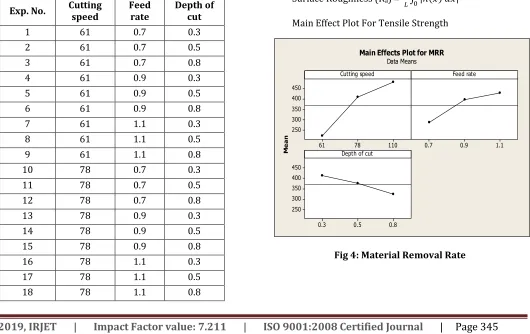
Main Effect Plot For Tensile Strength
110 78
61 450 400 350 300 250
1.1 0.9
0.7
0.8 0.5
0.3 450 400 350 300 250
Cutting speed
M
e
a
n
Feed rate
Depth of cut
[image:3.612.48.281.186.300.2]Main Effects Plot for MRR Data Means
[image:3.612.50.580.410.744.2]© 2019, IRJET | Impact Factor value: 7.211 | ISO 9001:2008 Certified Journal
| Page 346
110 78
61 7.0 6.5 6.0 5.5 5.0
1.1 0.9
0.7
0.8 0.5
0.3 7.0 6.5 6.0 5.5 5.0
Cutting speed
M
e
a
n
Feed rate
Depth of cut
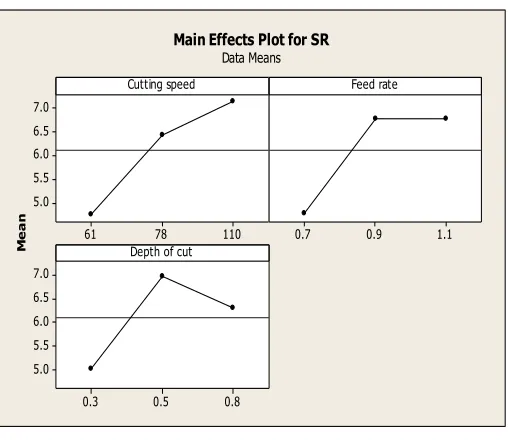
[image:4.612.37.291.79.299.2]Main Effects Plot for SR Data Means
[image:4.612.318.581.80.163.2]Fig 5: Surface Roughness
Table No. 2: Result for GRA Coefficient & Rank
Exp.
No. Cutting speed Feed rate Depth of cut Coefficient Rank GRA
1 61 0.7 0.3 0.494 15
2 61 0.7 0.5 0.476 20
3 61 0.7 0.8 0.471 25
4 61 0.9 0.3 0.477 19
5 61 0.9 0.5 0.467 27
6 61 0.9 0.8 0.478 17
7 61 1.1 0.3 0.469 26
8 61 1.1 0.5 0.479 18
9 61 1.1 0.8 0.474 22
10 78 0.7 0.3 0.499 13
11 78 0.7 0.5 0.490 16
12 78 0.7 0.8 0.473 23
13 78 0.9 0.3 0.512 9
14 78 0.9 0.5 0.513 10
15 78 0.9 0.8 0.510 8
16 78 1.1 0.3 0.530 6
17 78 1.1 0.5 0.505 11
18 78 1.1 0.8 0.500 12
19 110 0.7 0.3 0.495 14
20 110 0.7 0.5 0.475 21
21 110 0.7 0.8 0.472 24
22 110 0.9 0.3 0.546 5
23 110 0.9 0.5 0.514 7
24 110 0.9 0.8 0.559 3
25 110 1.1 0.3 0.588 2
26 110 1.1 0.5 0.554 4
27 110 1.1 0.8 0.667 1
4.4 Predicting Optimum performance
To calculate the optimum output characterstics for Material removal rate and Tool Wear Rate by using the realtion:
Predicted Mean= N+ (A3-N) + (B3-N) + (C3-N)
Where N= Total mean of output characteristics (MRR & SR).
A3 = Mean of MRR at Cutting speed at optimal levels.
B3 = Mean of MRR at Feed rate at optimal levels.
C2 = Mean of MRR at Depth of cut at optimal levels.
Predicting Mean MRR
= 370.74+ (484.10370.74) + (452.87 370.74) + (478.18 -370.74)
= 673.67 mm3/min.
Predicting Mean SR
= 6.10 + (7.13- 6.10) + (5.78- 6.10) + (6.49 -6.10)
= 6.50 micron.
REFERENCES
[1] Yogendra Tyagi, Yogendra, Vedansh Chaturvedi, Jyoti Vimal(2012),“Parametric Optimization of Drilling Machining Process using Taguchi Design and ANOVA Approach ,” Int. J. of
Emerging Technology and Adv.
Engineering,Vol2,PP.339-347.
[2] Murthy B.R.N, Lewlyn L.R. Rodrigues* and Anjaiah Devineni (2012),“Process Parameters Optimization in GFRP Drilling through Integration of Taguchi and Response Surface Methodology”, Research Journal of Recent Sciences, Vol. 1(6),PP.7-15
© 2019, IRJET | Impact Factor value: 7.211 | ISO 9001:2008 Certified Journal
| Page 347
coated HSS drills”, Journal Homepage, Vol.45,PP.1547-1557..
[4] T. Raj Mohan, K.Palanikumar, M. Kathirvel (2012),“Optimization of machining parameters in
drilling hybrid aluminum metal matrix
composites”, Trans. NonferrousMet. Soc. China, Vol. 22 (2012), PP.1286-1297.
[5] Shravan Kumar Singh, Beant Singh, Rashpal Singh (2012), Optimization Of Axial Force In Drilling Process On Mild Steel By Taguchi‟s Approach , International Ejournal Of Mathematics And Engineering Vol-162 ,PP. 1502 – 1508. [6] Turgay KIVAK1, Kasım HABALI , Ulvi SEKER
(2012), The Effect of Cutting Paramaters on The Hole Quality and,Tool Wear During The Drilling of
Inconel 718, Gazi University Journal of Science, Vol-25(2), PP-533-540
[7] Y. Tyagi, V. Chaturvedi, and J. Vimal (2012), Parametric Optimization of Drillingusing Taguchi Design and ANOVA Approach, Journal of Emerging Technology and Advanced Engineering,Vol. 2, pp. 339-347.
[8] Munia Raj, Sushil Lal Das, K. Palani kumarr (2013), “Influence of Drill Geometry on Surface Roughness in Drilling of AL/SiC/Gr Hybrid Metal Matrix Composite”, Indian Journal of Science & Technology, ISSN: 0974-6846.
[9] Tamilselvan, Raguraj (2014), “Optimization of Process Parameter of Drilling in Ti- Tib composite
using Taguchi Technique”, ISSN: 2321-5747, Vol.2, No.4.
[10] Gaurav Chaudhary, Manoj kumar, Santosh Verma, Anupam Srivastav(2014), “ Optimization of drilling parameter of hybrid metal matrix composite using Response Methodology”, Procedia Material Science, Vol.6, pp. 229-237. [11] Sunil Hansda, Simul Banerjee (2014),
“Optimizing Multi Characteristics in drilling of GFRP Composite using Utility Concept with Taguchi Approach”, ProcediaMaterial Science, Vol.6, pp.1476-1488.
[12] Prakash Rao C.R. *, Bhagya shekar M.S, Narendra viswanath (2014), “Effect of Machining Parameter on Surface Roughness While Turning Particulate Composite”,ProcediaEngg. Vol.97, pp. 421-431.
[13] Kapil Kumar Goyal, Vivek Jain, SudhaKumari (2014), “Prediction of Optimal Process Parameter for Abrasive Assisting Drilling of SS304”, Procedia Materials Science, Vol.6, pp. 1572-1579.
[14] Rajiv Chaudhory, M.S Ranganath, R.C Singh, Vipin (2015),“Experimental Investigations & Taguchi Analysis with Drilling Operation: A Review”, International Journal of Innovation & Scientific Research, Vol.13, pp.126-135.