Computational Analysis of Mixing Guide Vane Effects on
Performance of the Supersonic Ejector-Diffuser System
Fan Shi Kong1, Heuy Dong Kim1*, Ying Zi Jin2, Toshiaki Setoguchi3
1School of Mechanical Engineering, Andong National University, Andong, Korea
2College of Mechanical Engineering & Automation, Zhejiang Sci-Tech University, Hangzhou, China 3Department of Mechanical Engineering, Saga University, Saga, Japan
Email: *[email protected]
Received June 5,2012; revised July 8, 2012; accepted August 2, 2012
ABSTRACT
The flow field in the ejector-diffuser system and its optimal operation condition are hardly complicated due to the complicated turbulent mixing, compressibility effects and even flow unsteadiness which are generated inside the ejector- diffuser system. This paper aims at the improvement in ejector-diffuser system by focusing attention on entrainment ratio and pressure recovery. Several mixing guide vanes were installed at the inlet of the secondary stream for the purpose of the performance improvement of the ejector system. A Computational Fluid Dynamics (CFD) method based on Fluent has been applied to simulate the supersonic flows and shock waves inside the ejector. A finite volume scheme and density-based solver with coupled scheme were applied in the computational process. Standard k-ω turbulent model, implicit formulations were used considering the accuracy and stability. Previous experimental results showed that more flow vortexes were generated and more vertical flow was introduced into the stream under a mixing guide vane influence. Besides these effects on the secondary stream, the mixing guide vane effects on the shock system of the primary stream were also investigated in this paper. Optimal analysis results of the mixing guide vane effects were also carried out in detail in terms of the positions, lengths and numbers to achieve the best operation condition. The comparison of ejector performance with and without the mixing guide vane was obtained. The ejector-diffuser system performance is discussed in terms of the entrainment ratio, pressure recovery as well as total pressure loss.
Keywords: Ejector-Diffuser System; Mixing Guide Vane; Shock Wave; Compressible Flow; Supersonic Flow
1. Introduction
Supersonic ejector-diffuser system makes use of high pressure primary stream to propel the secondary stream through pure shear action for the purposes of transport or compression of fluid. Since the first ejector was invented at 1900s, the supersonic ejector-diffuser system was rapidly developed and widely used in many industrial applications. It has many advantages compared with other mechanical devices, such as no moving parts, structural simplicity, and even increasing pressure without me- chanical energy [1]. Indeed, it can be used in many com- plex progresses as a compressor, a fluid transport com- ponent or a vacuum pump [2-4]. Along the development of solar industry, the ejector application in solar refrig- eration and solar desalination was growing rapidly. At the same time, the ejector-diffuser system was increas- ingly considered as the most important equipment in these energy industries [1,5-7].
At the inlet of the supersonic ejector-diffuser system,
the primary stream with high pressure and high speed flowed out from the supersonic nozzle exit. Secondary stream was entrained by the primary stream and mixed up in the mixing chamber. At the end of the mixing chamber, two streams were completely mixed and the pressure was assumed to be constant until they reached the diffuser section [8,9]. The mixing stream pressure was elevated again and exhausted with a higher pres- sure than the previous secondary stream. Two impor- tant coefficients were used to describe the performance: mass flow ratio of two streams and the pressure re- covery between inlet and outlet [9]. Low efficiency and complex turbulent flow are like big obstacles restrict the studies on the ejector. Many researching works have been done to increase the performance of the ejector, but results were still unsatisfactory, compared with other industrial machineries [4,6]. Considering the complexity and difficulty on the researching, how to enhance the performance of ejector effectively became a significant task.
many significant works based on ejector geometry,
nozzle design, and fluid selection. Huang et al. [10]
carried out a 1-Dimensional axis analysis for the per- formance of the ejector and the working fluid is an ideal
gas. Similar method was used by Rogdakis et al. [11],
who studied the possibility for mixing and supersonic compression in the mixing chamber. Aphornratana and Eames [12] performed an experiment to study refrigera- tor using a small scale steam ejector with a supersonic nozzle. Similar experiment has also been performed by [1,9,13] based on nozzle design. Ouzzane and Aidoun [14] invented a new mathematical model of the ejector; detailed structure was analyzed using 1-Dimensional compressible flow. At the same time, a series of ex- perimental works have been carried out to study the ef- fect of ejector performance, especially in the effect of working fluids [15]. In the present works, the modeling technique based on numerical software has been used to investigate the flow factors inside the ejector. Barto- siewicz et al. [16] compared static pressure distribution between experimental results and numerical simulation in different turbulence models. Many recent studies [16, 17] showed that computational results were expected to provide a reasonable cost and a visual display of local flow filed.
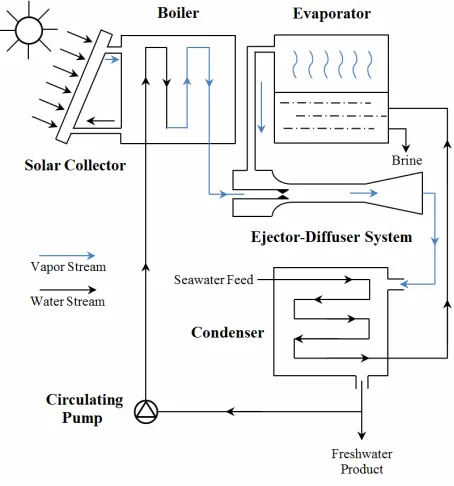
Researchers got a lot of good results based on geomet- rical optimization, but the study of internal structure has got little attention [18,19]. In the Texas A & M Univer-sity, a researching team put forward a good optimal method with a mixing guide vane installed at the inlet of ejector [20]. A productive experimental work of this ejector has been made by Manohar [21], and Somsak W. [22,23] has finished the basic computational analysis in his doctoral dissertation. The geometrical model they were used was widely applied in the solar desalination industrial. The schematic of supersonic ejector-diffuser system in a solar desalination circulation was illustrated in the Figure 1. In the solar desalination process, the ejector-diffuser system can be used in reducing the pres-sure of evaporator and propelling incondensable gas into the condenser. From their experimental and numerical results, the mass flow rate of secondary stream was de-creased under the negative influence of guide vanes. That’s why optimal works of mixing guide vane were urgently needed in the following researching.
[image:2.595.310.537.86.329.2]In the present work, a numerical method based on Fluent has been applied to simulate supersonic flows and shock waves of the ejector internal flow. The geometry model of supersonic ejector-diffuser system was used in the Manohar and Somsak’s work [21-23]. Exactly same geometrical model was created to validate the results of experimental data. Several new mixing guide vanes were designed and installed at the inlet of the secondary stream for the purpose of the performance improvement
Figure 1. The supersonic ejector-diffuser system in a solar desalination circulation (Ref. [21]).
of the ejector system, especially entrainment ratio. Ex- perimental appliance model was illustrated schematically in the Figure 2. A typical ejector system (Figure 2(a)) and the position of mixing guide vane (Figure 2(b)) were illustrated.
Optimal analyses were put into use to improve the per- formance of the supersonic ejector-diffuser system: the optimized position and length of the mixing guide vane are discussed to increase the performance of the ejector; the operation characteristics of the ejector system with different numbers of inlet guide vanes are analyzed in detail. Then, the mixing guide vane effects on perfor- mance of the ejector were investigated in detail based on the optimal geometry. In these all cases, the ejector-dif- fuser system performance is discussed in terms of the entrainment ratio, pressure recovery as well as total pres- sure loss.
2. Numerical Analysis
2.1. Computational Flow Model
(a) (b)
Figure 2. Geometrical schematic of supersonic ejector-diffuser system. (a) Without mixing guide vane; (b) With mixing guide vane.
Secondary Stream Inlet Nozzle Exit
(P2) (P1) (Pe)
Ejector Exhaust Mixing Guide Vane
Diffuser (LD)
Mixing Chamber (LM)
y
x Ls
DM D
E
D2 D1
Figure 3. Schematics of the supersonic ejector with mixing guide vane.
and mixing section (DM) were kept constant as shown in
Table 1. At the same time, length of mixing chamber (LM) and diffuser (LD) were also fixed.
Commercial software Gambit was used in the present research to create mesh domain. A structure mesh was employed in this case and quadrilateral cells were used in the mesh creation. Boundary layer effects were consid- ered by making finer grid densely clustered close to the walls. The solutions of grid-independent were shown in the Table 1. All these cases were simulated based on the model a, without mixing guide vane installed. The per- centage deviation was the difference of total mass flow rates between the CFD analysis and experimental results. The first (coarse) grid with y+ of about 4.6 has 156,527 cells. The second (medium) grid set has 232,325 cells with a y+ of about 2.7. The third (fine) set grid is gener- ated using the same minimum space as the second set has 345,235 cells. From Table 3 of Grid-independence check list, the difference between CFD analysis and experi-mental results was less than 4%. Hence, the grid inde-pendence was also checked. The computational domain with 232,325 cells was chosen because of its less com-putational time and more accurate result.
Figure 4 represents the geometrical model of mixing guide vane. Initially, the mixing guide vane was built as a circular truncated cone, while diameters of front end and after end of the mixing guide vane were not equal (DV1 > DV2). As the innovation of the optimal works, the
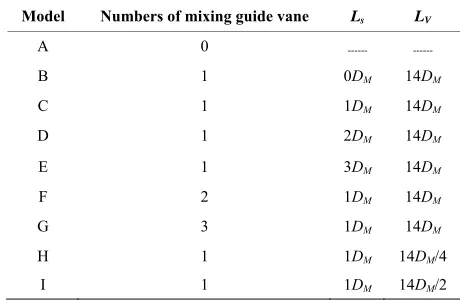
mixing guide vane effects on performance of the ejector were discussed in terms of positions (Ls), lengths (LV) and numbers, as shown in Table 2. While LV represents
the length of mixing guide vane, and Ls is the distance between mixing guide vane and supersonic nozzle exit. According to these adjustable parameters in different models, the effects of positions (from model ABCDE), lengths (from model CHI) and numbers (from model ACFG) will be discussed.
2.2. Numerical Method
For the CFD software, ANSYS Fluent 13.0 was chosen to simulate internal flows of ejector. Ideal gas was used as the working fluid in all cases. A finite volume scheme and density-based solver with coupled scheme were ap- plied in the computational process. Standard k-ω turbu- lent model, implicit formulations were used considering the accuracy and stability.
Boundary conditions and operating pressures of inlet and exit were illustrated in the Figure 5. A two-dimen- sional axis-symmetric model was applied in the present
LV
DV2 DV1
Second-order upwind scheme was used for turbulent kinetic energy as well as spatial discretizations. Gener- ally speaking, the working fluid used in the solar desali- nation process was vapor only, but ideal gas was used in the present computational works. Because they can get a similar result after simulation progress, and less compu- tational time is needed with ideal gas fluid.
Figure 4. Geometry model of the mixing guide vane. Table 1. Geometrical parameters used in simulations.
D1 D2 DM DE LM LD
Table 2. Adjustable parameters in different models.
Model Numbers of mixing guide vane Ls LV
A 0 --- ---
B 1 0DM 14DM
C 1 1DM 14DM
D 1 2DM 14DM
E 1 3DM 14DM
F 2 1DM 14DM
G 3 1DM 14DM
H 1 1DM 14DM/4
[image:4.595.308.538.104.213.2]I 1 1DM 14DM/2
Table 3. Grid-independence investigation. Grid numbers ṁ (CFD) ṁ (Exp.) Percentage deviation
156,527 0.339 kg/s 8.34%
232,325 0.384 kg/s 3.78%
345,235 0.385 kg/s
0.370 kg/s
4.05%
Pressure inlet B.C
12DM
6D
M
Axis-symmetric B.C
Pressure outlet B.C Pressure outlet B.C
Figure 5. Boundary conditions applied in the present study.
numerical simulation works. Pressure inlet boundary condition was set at nozzle exit of the ejector. Values of computational boundary condition of primary inlet were given in the Table 4. Totally 5 different cases were in- volved in the numerical simulation. All models in Table
2 were calculated based on these conditions only. The
secondary inlet and outlet of ejector were extended to stabilize the computational results. Pressure outlet bound- ary conditions with 1 bar were used at both secondary inlet and outlet of the ejector. Therefore, the secondary stream inlet and ejector exit were taken from ambient conditions of an atmospheric pressure.
The total pressure at nozzle exit (Pt) and static pressure (Ps) can be calculated isentropically to give the Mach number. As shown in the Table 4, related initial values can be calculated in these equations:
1 2 1 1 2 s t P M P
(1)
1 2 1 1 2 s t T M T
Table 4. Computational boundary conditions.
Case (1) Case (2) Case (3) Case (4) Case (5)
V(m/s) 411 449 490 528 563
M 1.20 1.30 1.43 1.54 1.66
Pt(MPa) 0.25 0.29 0.35 0.41 0.48
V M
RT
(3)
Mass flow rate
m is so important to compare with the experimental data. As one of the indispensable values to describe the ejector-diffuser system performance, the entrainment ratio (Rm) is also obtained from mass flow rate. Entrainment ratio is a ratio between the mass flow rate of secondary flow
m2 and primary flow
m1 .The calculation method of these values can be repre- sented by the following equations:
m VA (4)
2 1 m Rm m
(5)
Pressure recovery (ΔP) can be defined as the differ- ence between static pressure at the secondary stream inlet (Ps2) and static pressure at the outlet of ejector-diffuser
system (Pse). Sometimes, the pressure recovery ratio
P Pd
will be used as a non-dimensional value to de- scribe it.2
se s
P P P
(6)
2
2 0.5 se s d P P P
P V
(7)
Total pressure loss ratio (η) can be considered as the difference between total pressure at the nozzle exit (Pt1)
and total pressure at the outlet of ejector-diffuser system (Pte). The calculation of the total pressure loss ratio (η) can be represented by the following equation:
100 % t te t P P P (8)
2.3. Validation
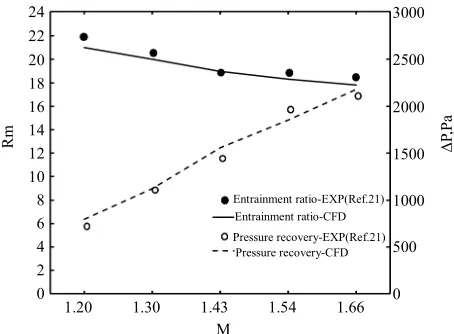
The comparisons between computational and experi- mental results of entrainment ratio & pressure recovery
were shown in the Figure 6. Good agreements were
found between CFD and experimental data. The devia- tions in entrainment ratio were less than 4.6%. The same values of pressure recovery were less than 8.2%. Along the Mach number increasing, Pressure recovery was ele- vated smoothly. A trend of rising can be found even at the point of maximum Mach number. However, entrain- ment ratios were decreased along the pressure recovery
[image:4.595.59.286.279.438.2]24 22 20 18 16 14 12 10 8 6 4 2 0
Δ
P,
Pa
Rm
3000
2500
2000
1500
1000
500
0 Entrainment ratio-EXP(Ref.21)
Entrainment ratio-CFD Pressure recovery-EXP(Ref.21)
Pressure recovery-CFD
[image:5.595.59.286.84.251.2]1.20 1.30 1.43 1.54 1.66 M
Figure 6. Comparisons between CFD and experimental results of entrainment ratio & pressure recovery (Model A).
increasing from the figure. Since accurate prediction of numerical solution was obtained obviously, the data of CFD results of Model A was used to compare with other models. The ejector geometrical model without mixing guide vane was validated to the experimental results. Several new mixing guide vanes would be designed and installed at the inlet of the ejector. Optimal works have been done based on new mixing guide vane. The CFD and Experimental data of the model without guide vane
used in following contents can be obtained from Figure
6.
3. Results and Discussion
As mentioned in the Section 2.3, the ejector geometrical model without mixing guide vane (Model A) was vali- dated to the experimental results Figure 6. In the results and discussion, Mixing guide vanes were designed newly to achieve a better performance of the ejector. The ef- fects of the mixing guide vane were divided into 3 parts, such as the effects of positions (from model ABCDE), lengths (from model CHI) and guide vane numbers (from model ACFG). The performance of the ejector-diffuser was discussed in terms of entrainment ratio, pressure recovery and total pressure loss ratio. Then, detail dis- cussion and analysis of mixing guide vane effects were investigated based on the flow physics.
3.1. Effects of Positions of Mixing Guide Vane
In the present study of effects of positions, the entrain- ment ratio for 4 different positions of mixing guide vane
is shown in Figure 7 where the Mach number ranges
from 1.20 to 1.66. Firstly, the model B with Ls = 0DM has a negative influence on the entrainment ratio, in a per-
centage decrease of 3.3%. Model D and model E with Ls
[image:5.595.312.533.87.270.2]= 2DM and 3DM have very little influence on the en- trainment ratio. Both models are similar with the model
Figure 7. Entrainment ratio vs. position of mixing guide vane.
without mixing guide vane. Meanwhile, the model C with Ls = 1DM shows better result of entrainment ratio than the model without mixing guide vane. Indeed, the percentage increase of average entrainment ratio is about 2.7%, and the maximum amplitude of increase achieved is 6.3% in case 1. The increase amplitude in entrainment ratio becomes larger when the primary stream Mach numbers decrease.
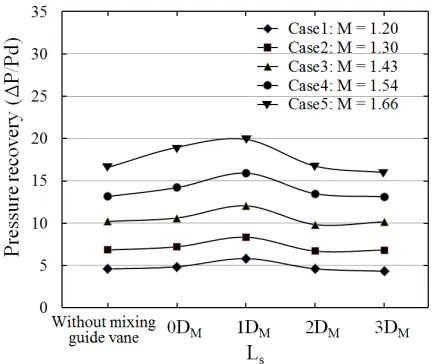
The pressure recovery of the ejector-diffuser system for different cases is showed in Figure 8. With the inlet stream Mach number increasing, the pressures recovery gradually becomes larger in all 5 models. The mixing guide vane effects show better results of pressure recov- ery in almost all cases except some points such as Ls =
2DMand 3DM. Model C shows best pressure recovery
than other models. When the Ls equal 1DM, The differ- ence of pressure recovery compared with the model without mixing guide vane is about 21.6%, and the
maximum value of increase achieved is 27.0% when M =
1.66. The increase in amplitude of pressure recovery be- comes larger when the primary stream Mach number increased. Results of all the models announce that mixing guide vane has a positive influence on pressure recovery. The average value of increase achieves 6.7%.
Figure 8. Pressure recovery vs. position of mixing guide vane.
Figure 9. Comparison of total pressure loss between with and without mixing guide vane.
shows optimal results, which will be used in the follow- ing geometries.
3.2. Effects of Lengths of Mixing Guide Vane
In this part, the performance of the ejector-diffuser and effects of the mixing guide vane were discussed in ef- fects of lengths. The distance to nozzle exitwas stabled to a constant of 1DM while lengths of mixing guide vane were changed.
The entrainment ratio under lengths effects is illus- trated in Figure 10. Following the position moving, the models with LV = 14DM/4 (model H) and LV = 14DM/2 (model I) show similar results, and the model with LV = 14DM/2 show better results compared with another model. In model I, The increment of entrainment ratio is 6.8%, and the maximum value of increase achieved 7.5% when Mach number equaled 1.43. Following the lengths
changing, the mixing guide vane effects are found in different trends.
[image:6.595.63.282.310.487.2]Figure 11 represents the pressure recovery under LV effects. All the models show resemble results compared with the model A. Along the length increases, the pres- sure recovery is increasing in all the models. The average value of increase achieves 20.33%. Compared all the 3 cases, the model with LV = 14DM shows better results compared with another model. The increment of pressure ratio is 21.6% in average, and the maximum value of increase achieves 27% when Mach number equal 1.66. The increase amplitude in pressure recovery becomes larger when the primary stream Mach numbers decrease.
Figure 12 shows the comparison of total pressure loss between with and without mixing guide vane. Along the
[image:6.595.315.532.338.501.2]LV decreasing, the negative influence on frictional force becomes weaker. That’s why the total pressure loss is decreased along the LV decreasing, but still larger than the model without mixing guide vane. Although the mixing guide vane really helps to mix the primary &
Figure 10. Entrainment ratios under lengths effects.
[image:6.595.315.534.530.718.2]Figure 12. Total pressure loss under lengths effects.
secondary stream, but the frictional force will be in- creased. When the Mach number of primary stream in- creases from 1.20 to 1.66, the increase in amplitude of total pressure loss becomes larger.
With a mixing guide vane, the energy transfer of mix- ing between two streams is increased effectively, which enhances the performance of the ejector-diffuser system to higher level. Compared all the results in the previous researching, the model I with LV=14DM 2 gets higher
entrainment ratio, and model C with LV = 14DMgets
higher pressure recovery. The model C with LV = 14DM is chosen in the following geometries.
3.3. Effects of Numbers of Mixing Guide Vane
In the present study, the entrainment ratio under number
effects was shown in Figure 13. The effects of mixing
guide vanes and the influence on the system can be easily found. All computational results based on 5 different Mach numbers of nozzle exit were compared. The geo- metry of each mixing guide vane was created exactly same with the model C, while Ls = 1DM and LV = 14DM.
In the Figure 13, the entrainment ratio under number effects is shown. Along the number increase, different effects of mixing guide vane are shown as follows: the model with 1 mixing guide vane has a positive influence on the ejector, the average increment is 2.7% and maxi- mum value is 6.3%. In the model F with 2 mixing guide vanes and model G with 3 mixing guide vanes, they get a negative influence on the entrainment ratio, in a percent- age decrease of 4.0% and 9.4%. At the same time, when
M ranges from 1.20 to 1.66, it is found that the difference of entrainment ratio tends to decrease. Compared with all 4 models, the model C shows optimal results. The maxi- mum increment of entrainment ratio in the model C is 6.3%, when the Mach number equals 1.20.
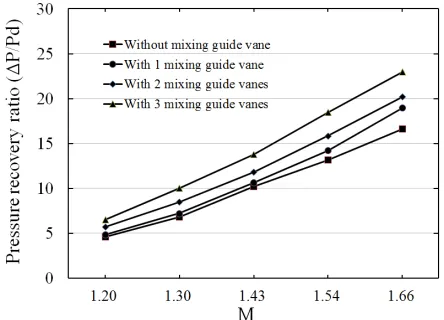
[image:7.595.311.538.88.260.2]In the Figure 14, the pressure recovery under number effects is illustrated. The effects of mixing guide vane
Figure 13. Entrainment ratio vs. numbers of mixing guide vane.
Figure 14. Pressure recovery ratio vs. numbers of mixing guide vane.
geometry are also investigated in these graphics. Along the Mach number increasing, the pressure recovery be- comes larger gradually. With the number increase, ef- fects of mixing guide vane are shown in resemble ways, all 3 models with mixing guide vanes show better results in pressure recovery than the model without mixing guide vane. Among them, the model with 3 mixing guide vanes has a best influence on the ejector, with an average increment of 30.5%, and the maximum amplitude is 36.3%.
[image:7.595.312.534.304.464.2]investigate the deeper effects of mixing guide vane. Due to the characteristics of compression flow, shock wave should occur in the internal flow section when the Mach number is larger than 1. In this paper, the ejector has a special feature that the length-diameter ratio is very high, the total length of mixing section is almost 15DM, and the total length of ejector is nearly 30DM. That is a typical ejector structure which has a shorter mixing process compared with the long geometrical model. Pri- mary stream and secondary stream were mixed up fully in the early beginning in the mixing chamber. Further- more, a very small diameter of supersonic nozzle can be found in the geometrical model.
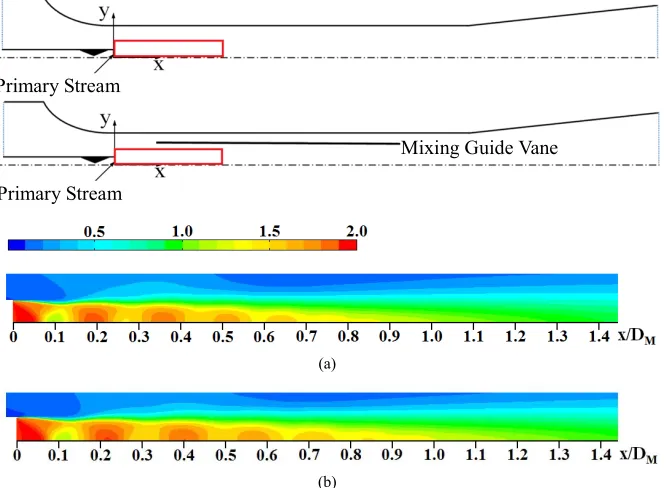
[image:8.595.61.285.80.244.2]Considering all these features and characteristics of the supersonic ejector-diffuser system, the researching upon the shock system are more significant and meaningful, especially the shocks around the nozzle exit of primary stream. Besides, after compared all different contours graphics, contours of Mach number show more obvious results of shock system. The contours of Mach number compared model A (without mixing guide vane) and model C (optimal mixing guide vane) were illustrated in the Figure 16. All these figures were based on case 5 with a Mach number of 1.66, which showed more obvi- ous results. Model C got the highest in the entrainment ratio, mixing guide vane effects will be more significant to compare the model A and model C.
Figure 15. Comparisons of total pressure loss ratio with and without mixing guide vane.
3.4. The Ejector Performance with an Optimal Mixing Guide Vane
From the comparison of these models (Table 2) under
different cases (Table 4), the area of the mixing section and the productive capacity of primary stream were changed. Generally speaking, with a mixing guide vane, more flow vortexes were generated and more vertical flow was introduced into the stream [21,23]. Therefore, rotary stream passed through the mixing chamber and introduced more shear stress to propel the secondary stream into the ejector-diffuser system, which effectively enhanced the performance of the ejector-diffuser system. Furthermore, more researching works were needed to
In the Figure 16, the upper figures show the position of the Mach number variation, marked in a red quadril- ateral. For lower figures, the first field represents the
Primary Stream
Primary Stream
Mixing Guide Vane
(a)
(b)
[image:8.595.134.468.465.709.2]Figure 17. Static pressure distributions along the ejecto
omputational results for the model A without m
e figures, a strong first shock can be found. C
a computational method was carried
f m gu
The effects on performance of the supersonic ejector-
, the mixing guide vane effects on sec- on
RENCES
[1] K. Chunnanon “Ejectors: Applica-
tions in Refrig enewable and
Sus-r axis.
c ixing tainable Energy Reviews, Vol. 8, No. 2, 2004, pp. 129-
155.
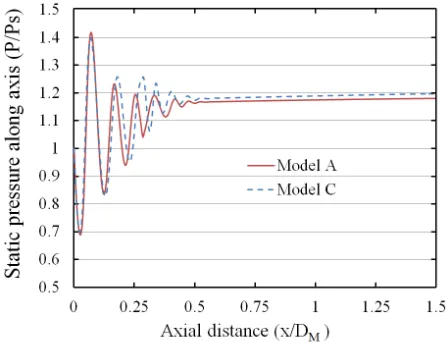
guide vane. The scales of these contours are exactly same to each other, in order to compare in a same standard. Both figures are illustrated in a same continuous varia- tion of the distance begin from the supersonic nozzle exit, from 0DM to 1.4DM. Figure 17 shows the flow structures from other hand of distributions of static pressure. Ana- logous conclusions also can be found in the figure. As the results of energy exchange between both streams, shock systems are influenced and elevated by mixing guide vanes compared with the model without mixing guide vane.
From thes
ontinuous shock cells were created as following. The differences were concentrated on the mixing guide vane effects of shock waves. The model C with a distance of
1DM showed better influence on the shock system, and
more shock cells can be found in this model. Hence, it should be easy to get an opinion that a longer sub-critical area created a better promotion in the entrainment ratio [18].
4. Conclusions
In the present paper,to simulate the internal flow of an ejector-diffuser system. The mixing guide vane effects on the performance of the ejector were investigated. The optimal position and length of mixing guide vane were given. The effects of mixing guide vane numbers were studied. Both models with and without guide vane were compared. Numerical results were confirmed by previous experimental data.
4 different positions, 3 lengths, 3 numbers o ixing
ide vane were involved in the present research. As the conclusion of an optimal model, the entrainment ratio was improved 7.5% as the maximum value, and the maximum increment of pressure recovery achieved 36.6%.
diffuser system were obvious. At the same time, all the models with mixing guide vane showed better results to increase the pressure recovery. On the other hand, total pressure loss ratio was increased under the mixing guide vane influence.
Actually, according to the research from W. Somsak and etc. [22,23]
ddary inlet was investigated in the experimental re- search. From present computational analysis of mixing guide vane effects, the guide vane influence on shock system was also obvious, which involve more secondary stream as a consequence.
REFE
d and S. Aphornratana, eration Technology,” R
doi:10.1016/j.rser.2003.10.001
[2] Z. Aidoun and M. Ouzzane, “The Effect of Operating Conditions on the Performance of a Supersonic Ejector for Refrigeration,” International Journal of Refrigeration, Vol. 27, No. 8, 2004, pp. 974-984.
doi:10.1016/j.ijrefrig.2004.05.006 [3] Y. Bartosiewicz, Z. Aidoun and Y.
ical Assessment of Ejector Opera
Mercadier, “Numer- tion for Refrigeration Applications Based on CFD,” Applied Thermal Engi- neering, Vol. 26, No. 5-6, 2006, pp. 604-612.
doi:10.1016/j.applthermaleng.2005.07.003 [4] J. Yan, S. Shao, J. Liu and Z. Zhang, “Exper
Analysis on Performance of Steam-Driven Jet Injector for iment and District-Heating System,” Applied Thermal Engineering, Vol. 25, No. 8-9, 2005, pp. 1153-1167.
doi:10.1016/j.applthermaleng.2004.09.001 [5] C. J. Korresa, A. T. Papaioannoub, V. Ly
Koumoutsosb, “Solar Cooling by Thermal geroub and N. G. Compression:
for Detailed Ejector Analysis and The Dependence of the Jet Thermal Compressor Effi- ciency on the Compression Ratio,” Energy, Vol. 27, No. 8, 2002, pp. 795-805.
[6] M. Ouzzane and Z. Aidoun, “Model Development and Numerical Procedure
Design,” Applied Thermal Engineering, Vol. 23, No. 18, 2003, pp. 2337-2351.
doi:10.1016/S1359-4311(03)00208-4
[7] A. Selvaraju and A. Mani, “Analysis of an E
Environment Friendly Refrigerants,” Applied Thermal jector with Engineering, Vol. 24, No. 5-6, 2004, pp. 827-838. doi:10.1016/j.applthermaleng.2003.08.016
[8] Y. M. Chen and C. Y. Sun, “Experimental Study of Performance Characteristics of a Steam-Ejector Refrig- the eration System,” Experimental Thermal and Fluid Sci- ence, Vol. 15, No. 4, 1997, pp. 384-394.
doi:10.1016/S0894-1777(97)00006-X
[9] B. J. Huang and J. M. Chang, “Empirical Corre Ejector Design,” International Journa
doi:10.1016/S0140-7007(99)00002-X [10] B. J. Huang, J. M. Chang, C. P. Wang
“A 1-D Analysis of Ejector Performan
and V. A. Pe ce,” International
trenko,
Journal of Refrigeration, Vol. 22, No. 5, 1999, pp. 354- 364.doi:10.1016/S0140-7007(99)00004-3
[11] E. D. Rogdakis and G. K. Alexis, “Design and Parametric Investigation of an Ejector in an Air-Conditioning Sys- tem,” Applied Thermal Engineering, Vol. 20, No. 2, 2000, pp. 213-226. doi:10.1016/S1359-4311(99)00013-7 [12] S. Aphornratana and I. W. Eames, “A Small Capacity
Steam-Ejector Refrigerator: Experimental Investigation of a System using Ejector with Movable Primary Nozzle,” International Journal of Refrigeration, Vol. 20, No. 5, 1997, pp. 352-358. doi:10.1016/S0140-7007(97)00008-X [13] Y. J. Chang and Y. M. Chen, “Enhancement of a Steam-
Jet Refrigerator using a Novel Application of the Petal Nozzle,” Experimental Thermal and Fluid Science, Vol. 22, No. 3-4, 2000, pp. 203-211.
doi:10.1016/S0894-1777(00)00028-5 [14] R. Yapıcı and H. K. Ersoy, “Perform
of the Ejector Refrigeration System
ance Character Based on the
Con-istics
stant Area Ejector Flow Model,” Energy Conversion and Management, Vol. 46, No. 18-19, 2005, pp. 3117-3135. doi:10.1016/j.enconman.2005.01.010
[15] I. W. Eames, “A New Prescription for the Design of Su-personic Jet-Pumps: The Constant Rate of Momentum Change Method,” Applied Thermal Engineering, Vol. 22, No. 2, 2002, pp. 121-131.
doi:10.1016/S1359-4311(01)00079-5
[16] Y. Bartosiewicza, Z. Aidouna, P. Desevauxb and Y. Mercadierc, “Numerical and Experimental Investigations on Supersonic Ejectors,” International Journal of Heat and Fluid Flow, Vol. 26, No. 1, 2005, pp. 56-70. doi:10.1016/j.ijheatfluidflow.2004.07.003
[17] V. Lijo, H. D. Kim, S. Matsuo and T. Setoguchi, “A Study of the Supersonic Ejector-Diffuser System with an Inlet Orifice,” Aerospace Science and Technology, 2011. [18] N. H. Aly, A. Karameldina and M. M. Shamloulb,
“Mod-elling and Simulation of Steam Jet Ejectors,” Desalina- tion, Vol. 123, No. 1, 1999, pp. 1-8.
doi:10.1016/S0011-9164(99)00053-3
[19] M. T. Kandakure, V. G. Gaikar and A. W. Patwardhan, “Hydrodynamic Aspects of Ejectors,” Chemical Engi- neering Scien`ce, Vol. 60, No. 22, 2005, pp. 6391-6402. doi:10.1016/j.ces.2005.04.055
[20] M. T. Holtzapple, “High-Efficiency Jet Ejector,” Texas A
er Using a High-
h-Efficiency Jet Ejec-
- & M University, College Station, 2001.
[21] D. V. Manohar, “Desalination of Seawat
Efficiency Jet Ejector,” Master Thesis, Texas A & M University, College Station, 2005.
[22] W. Somsak, “Optimization of a Hig
Nomenclature
A Cross-sectional area of supersonic nozzle exit
D Diameter of particular position
L Length of particular position
Ls Distance between nozzle exit and mixing guide vane
M Mach number at primary stream nozzle exit
P Pressure
Ps Static pressure of particular position (or static pressure at nozzle exit if no subscript)
Pt Total pressure of particular position (or total pressure at nozzle exit if no subscript)
ΔP Pressure recovery: Difference between static pressure at the secondary stream inlet and exit of ejector-diffuser system
ΔP′ Pressure recovery with mixing guide vane
R Gas constant
Rm Entrainment ratio: Ratio of two mass flow rates of primary and secondary stream
Rm′ Entrainment ratio with mixing guide vane
T Temperature
V Velocity of primary stream
Special characters
η Total pressure loss ratio: Percentage difference between total pressure at the primary stream nozzle exit and exit of ejector-diffuser system
η′ Total pressure loss ratio with mixing guide vane
γ Ratio of specific heats
ṁ Mass flow rate of particular position (or mass flow rate at nozzle exit if no subscript) Density
y+ Non-dimentional distance
Subscripts
1 1st: Values at supersonic nozzle exit
2 2nd: Values at Secondary stream inlet
e, E Exit: Supersonic ejector-diffuser system exit
M Mixing chamber of ejector-diffuser system
D Diffuser section of ejector-diffuser system
t Total values
V Mixing guide vane
V1 Front end of the mixing guide vane