‘Future Factories’: developing individualised production
methods
UNVER, Ertu, DEAN, Lionel T. and ATKINSON, Paul
<http://orcid.org/0000-0002-6633-7242>
Available from Sheffield Hallam University Research Archive (SHURA) at:
http://shura.shu.ac.uk/8666/
This document is the author deposited version. You are advised to consult the
publisher's version if you wish to cite from it.
Published version
UNVER, Ertu, DEAN, Lionel T. and ATKINSON, Paul (2003). ‘Future Factories’:
developing individualised production methods. In: AED 2003 : 3rd International
Conference on Advanced Engineering Design. Prague, Czech Republic, Process
Engineering Publisher, 1-9.
Copyright and re-use policy
See
http://shura.shu.ac.uk/information.html
‘FUTURE FACTORIES’: DEVELOPING INDIVIDUALISED PRODUCTION METHODS
©Dr Ertu Unver, Lionel T. Dean, and Paul Atkinson, 2003
School of Design Technology
Huddersfield University
Queensgate, Huddersfield HD 3DH
United Kingdom
KEYWORDS
Mass Customisation, Mass Individualization, Rapid Prototyping, Virtual Reality, Virtual Merchandising, Animation, Organic design, Interactive, Computer Generated, 3D modelling, 3D Printing.
ABSTRACT
'Future Factories' is an exploration of the possibilities for flexibility in the manufacture of artefacts inherent in digitally driven production techniques. The concept considers individualised production – in which a random element of variance over parameters such as the relative positioning of features, scale, proportion, surface texture, and the like is introduced by the computer within a parameter envelope defined by the designer. This paper is the feasibility study of, and design of, a production system for the 'Future Factories' concept.
In 'Future Factories', a production system is envisaged in which the consumer is presented with a 3D digital model of the design. The design is presented as an animation showing the design morphing within a parameter envelope specified by the designer. At any given point the consumer may freeze the design, place an order, and generate the relevant digital production files (.stl etc.). A unique, individual artefact will then be manufactured using Rapid Prototyping techniques. This may be achieved directly, via Stereo Laser Sintering in a suitable material for example, or indirectly via the production of a single use tool or pattern.
This paper presents results from research conducted as part of the Designer in Residence project at the School of Design Technology, University of Huddersfield. Firstly a selection of design concepts with associated parameter envelopes are created using relevant 3D design software. Animations are then created showing the design moving within its parameter envelope. A new computer program is being developed to enable the generation of digital production files direct from a selected animation frame. There will be a study of existing rapid prototyping techniques with regard to their suitability for direct manufacture of this type and speculation on future potential.
INTRODUCTION
The School of Design Technology at the University of Huddersfield recently decided to allocate an amount of research funding to provide an ‘Artist-in-Residence’ to work alongside Fine Art students, and a ‘Designer-in-Residence’ to work alongside Product and Transport design students for a period of one year. The work currently being undertaken by the Designer in Residence along with contributions made by other academic staff are the subject of this paper. The title of the project ‘Future Factories’ describes an exploration of the creative potential inherent in digital design and manufacture to offer more than a single discrete 3D outcome. The outputs from this practice-based research project are expected to consist of a number of inspirational products which will be exhibited in a traditional gallery environment and later digitally – either on-line or by CD-ROM dissemination. Alongside the practice-based research outputs there will be a number of different academic papers (such as this one) addressing the different technical, theoretical and contextual issues raised by the content of the ‘Future Factories’ project.
THE 'FUTURE FACTORIES' CONCEPT
Rapid Prototyping technologies, developed to compress product development cycles, offer the potential for much more. Layer-build production processes allow for the direct transfer of virtual CAD models to real objects. As in reprographics, model files can be emailed to an agency for production or desktop printed on machines using inkjet technology. Through direct digital production a revolution is underway in 3D Product Design that is likely to be as radical as that already seen in Graphic Design.
The variance introduced may be over factors such as the relative positioning of features, scale, proportion, surface texture, pattern, and the like. These variable factors may be multiple and interrelated. The intention is to achieve subtly different aesthetics around a central theme rather than mere differentiation that might be achieved by, say, scale or colour change alone. We do not claim here that the notion of computer generated random form is in itself an original one. Perhaps some of the best-known computer generated forms are those resulting from the collaboration between the artist William Latham and the mathematician and computer graphics expert Stephen Todd. Although the resulting ‘sculptures’ were only ever intended to be seen as 2D representations of complex 3D models presented as art in a gallery context, the principle behind it can just as easily be used to create variations on ‘usable’ forms to produce designs for ‘anything from buildings to shampoo bottles’ (Computer Artworks 2003). The potential of this proposition has not yet been fully realised. The ‘Future Factories’ concept explores an aspect of this potential.
MASS CUSTOMIZATION
It is perhaps pertinent here to specify what 'Future Factories' is not - and it is not 'Mass Customization'. The term 'Mass Customization’ was coined by Stan Davies in his book Future Perfect (Davies 1987). The term is deliberately paradoxical. There are many different models for mass customization suiting different products and market sectors. They are all however, consumer driven. Products are "decomposed" into modular components or subsystems that can be recombined to more nearly satisfy consumer needs.' (Crayton 2001: 78). In contrast to mass customization, the 'Future Factories' model derives no input from the consumer. Where mass customization consists of consumer selection and specification, 'Future Factories' allows the consumer only to select the moment at which the process of form generation is arrested.
DESIGN FORMULA
In the 'Future Factories' model, rather than specify a discrete design solution, the designer sets up a series of rules and relationships that achieve a desired aesthetic over a potentially infinite range of outcomes. This is achieved using parametric CAD software. The aim is a degree of random mutation. This does not mean a series of staccato jumps as one random value is replaced by another. The model should appear to ‘grow’ with one mutation flowing seamlessly into the next. Each solution is intended to be unique and not repeated in a cycle, however long. The desired result can be achieved by setting variables to cycle through specified ranges. Different variables are set to cycle at different rates, with the differential providing the random element. In addition, the rates of change can themselves vary, increasing or decreasing at random (though with smooth implementation) over time.
EXAMPLE OF THE RANDOM ELEMENT GENERATION PRINCIPLE
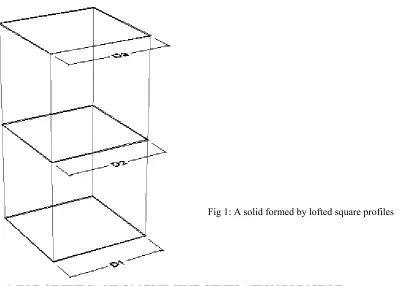
[image:3.595.73.483.463.749.2]To understand the principles proposed we can start with a simple box, as illustrated in figure 1, this will become a product structural leg. A simple solid model is created by ‘lofting’ three square sections. ‘Lofting’ is the
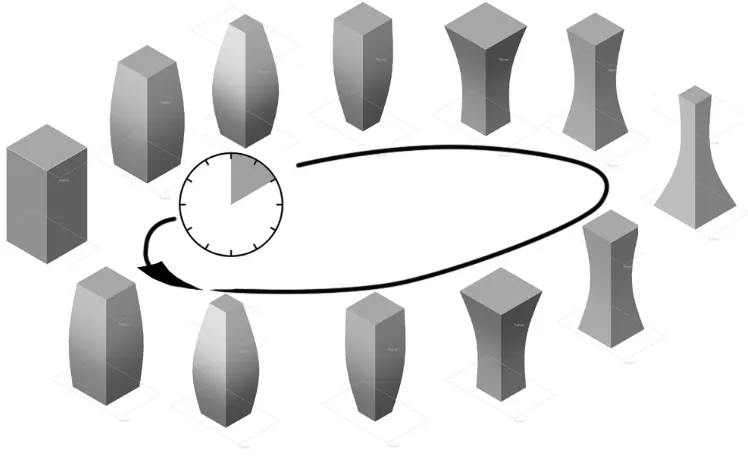
creation of a 3D transitional form between usually 2D profiles and is a common feature in high end CAD. The dimension value of each the squares (D1, D2, D3) is allowed to cycle 100% - 70%. Figure 2 shows the effect of this applied to D3.
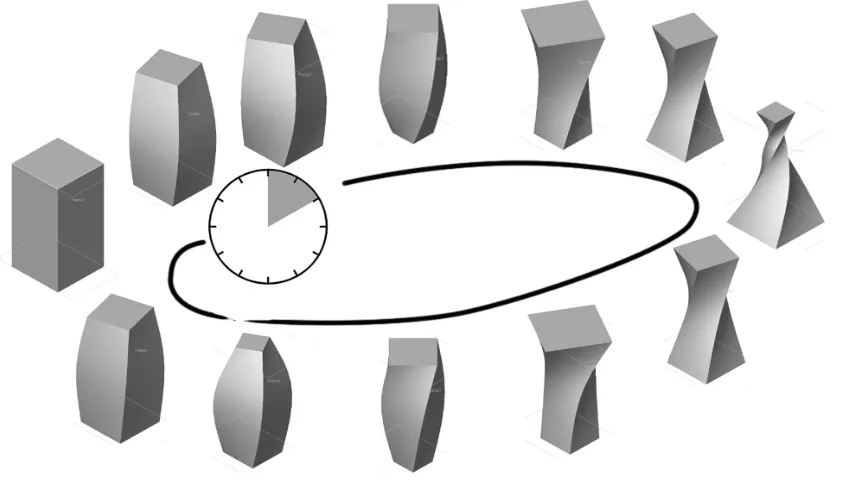
The cycling of the variable D3 is set at a given rate. The other two variables, D1 and D2 are set to cycle though the same value range but at different rates. The effect of this is illustrated in figure 3.
[image:4.595.59.489.135.284.2]Another element of variance that could be considered is the addition of a twist about a vertical axis formed by rotating the horizontal profiles relative to each other as illustrated in fig 4.
[image:4.595.90.464.352.587.2]Fig 2: The effect of scale variance on one lofted profile
Fig 3: The effect of differing scale variance on all three lofted profiles
[image:4.595.72.501.670.768.2]So far the mid-profile of the loft construction has always been located mid-way up the form, but this profile can be allowed to rise or fall (figure 5).
The rotation about the vertical axis and the asymmetric placement of the mid profile are assigned ranges and independent rates of change. These transformations are overlaid on the earlier figure 3 model, and the resulting forms illustrated in figure 6.
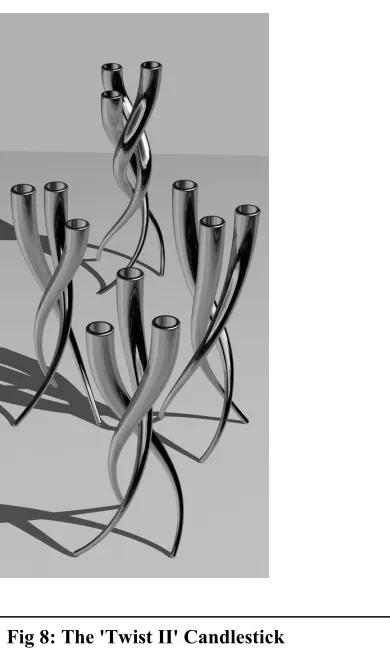
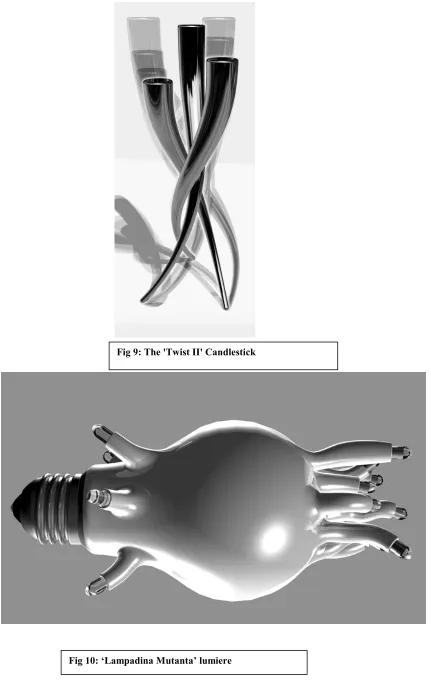
[image:5.595.60.472.133.217.2]The Twist II candlestick (figure 7) was developed using these principles. The design has three legs which meet at the top. Each of the legs has elements of variance similar to those used in the box example (figures 1-6). The three legs morph independently but with a constraint to ensure the tops match. The legs are equally spaced at a separation specified for stability. The footprint of the legs is allowed to both twist about a vertical axis and move in a horizontal plane relative to the top to create further distortions. It can be seen that the scope for variance is vast. It is important to highlight, however, that the changes in form are not arbitrary. Each of the variables has been applied so that through their combination a desired aesthetic is achieved in an organic form.
Fig 5: The effect of altering the height of the central lofted profile
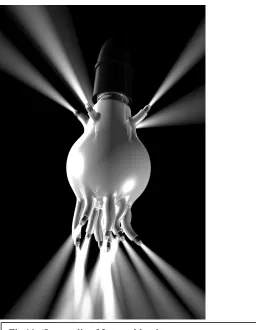
[image:5.595.60.483.313.557.2]Other models developed for the project include the Twist I candlestick (figures 8 and 9) and Lampadina Mutanta (figures 10 and 11). Lampadina Mutanta is a luminaire with a light source of high intensity white Light Emitting Diodes (LED's). The LED's are mounted in the ends of ‘tentacles’ which appear to grow at random from the bulb form. The end of each ‘tentacle’ is dimensionally constrained to accept an LED and the direction in which the LED points restricted to certain angles from the vertical (to avoid glare).
Fig 7: The 'Twist II' Candlestick
[image:6.595.201.396.428.760.2]PRESENTATION
Each organic design is defined by a production formula which can yield an infinite range of equally valid outcomes – How should such a design be presented to both clients and consumers? To appreciate their organic nature the designs must be seen continuously ‘morphing’ in real time - this requires animation. A video clip played on demand would not be sufficient as there is no cycle to the mutations. The consumer must be offered a ‘webcam’ window onto a design which is changing whether they are watching or not. Clearly the project lends itself to some form of ‘virtual’ web-based merchandising. A system is envisaged in which the consumer is presented with a 3D animated model of the artefact via a website. The consumer may access the website directly or via a sales outlet, at a gallery or in a department store for example. The web site, the ‘Future Factory’ itself, would have a series of ‘production lines’ corresponding to different products. When a particular production line is selected the user is presented with a computer animation showing that particular product in metamorphosis. At any given point the consumer may freeze the animation, effectively creating a one-off design on screen. Should the consumer wish, they might then proceed with an order, in which case the relevant digital production files (stl etc.) would be generated automatically and sent to the appropriate RP production facility. The unique, one-off would then be manufactured using layer additive manufacturing (Rapid Prototyping) techniques. This may be achieved directly, via laser sintering in a suitable material for example, or indirectly via the production of a single use tool or pattern. It should be pointed out that the intention is not for the consumer to use the animation to adjust design features to their liking. The animation is changing in real time and is outside their control (this is part of the allure of the process). A variant can be ‘designed’ for them and they can choose to order it or not. Visitors to the website must therefore be able to ‘read’ the designs, to appreciate the form of the artefact with which they are being presented. This is made difficult by the fact that the object is changing. A Virtual Reality experience would help overcome this difficulty, enabling the consumer to ‘move around’ the design in their own time and at will.
WEB-BASED VIRTUAL REALITY (VR)
[image:8.595.174.430.80.410.2]"Virtual Reality" refers to technology used to provide computer-based experience that mimics real experience. The two primary characteristics of such an experience are that it is three-dimensional and that it is interactive. At its simplest, it is a 3D image of a single object that the user can rotate to see from various angles. At a middle level, it can be an entire scene or virtual world that the user enters and interacts with. High-end VR requires the
user to wear special goggles and gloves that make the illusion of reality more complete, this is the province of games or specialised applications like military training, which are not typically Web-based. VR applications on the Web include entertainment, education, medicine, marketing, training and, as in this application, merchandising.
VIRTUAL MERCHANDISING
Conventional marketing usually centres around a glossy photograph of the product shown from its best angle. VR content enables websites to bring the products 'to life' with 3D models, user interactivity, animation, sound, and detailed views. An interactive image allows the product to be seen from all angles. Potential customers are able to examine the design in the form of a 3D model moving, rotating, and zooming in and out at will. This ‘hands-on’ interaction allows something of a “try before you buy” experience. Internet shoppers have been reported to spend 50% more time in the part of the site that offers interactive 3D images (Mike Hurwicz, 2000), yet VR on the Web is not yet mainstream or widespread. Why has this exciting technology made such slow progress? This may be due to the fact that VR content is costly to develop, mostly because the expertise to create it is still rare, and a direct link to sales revenue is as yet unproven. In addition, content creators typically make a substantial investment in computers, software, and digital equipment. Technical difficulties have discouraged the take up of website based VR marketing. The technology is most convincing and pleasing when it uses realistic textures, lighting and sounds. The use of these elements requires large files which leads to slow performance, and web designers fight a constant battle between high graphical appeal and slow download times. High-resolution graphics and elaborate animations are notoriously slow to download, especially through a dial-up connection. Add to that bandwidth limitations and the possibly unreliable connections of the Web, and you have the potential for a deeply dissatisfying experience.
INHERENT LIMITATIONS OF VR
We can assume that consumers will always prefer hands-on experience with a product before purchase. Barring cumbersome and expensive gloves and goggles, VR is still strictly an audiovisual experience. Even gloves have serious limitations in that they cannot provide a tactile experience of texture. This might be solved if the website access was via a retail outlet and samples were available. It would also avoid ‘user end’ technical issues. VR content cannot be viewed with a standard browser - a special-purpose browser or a plug-in is required. In addition there is no single viewer that can handle all VR content. The requirement to download additional software merely to, in effect, browse a shopping catalogue is a severe disincentive. The user may not even have administrator rights to the computer or the desire to involve themselves in IT issues. The lack of an industry standard also affects content creators (and their cost), as each viewer typically has its own authoring tool. There is no single tool that a programmer can learn with any expectation of addressing more than a fraction of Web users. The limitations of computers and the technological demands of VR should not be exaggerated however. VR files are not necessarily huge. Files consisting mostly of vector graphics are relatively small. Problems of speed and resolution will be solved over time as standard-issue desktop computers gain speed and are optimized for 3D graphics. Higher-bandwidth and more reliable connections to the Internet will also become more common. Proprietary viewer and content creation software offer increasingly high-quality images within compact, efficient files.
HTML, SGML, VRML, XML and X3D
can achieve minimal compatibility by testing only with the Core Profile. The VR community has recognized the growing success of XML, compared to the very limited success of VRML. In response, the Web3D Consortium (http://www.web3d.org), in concert with the W3C (World Wide Web Consortium), has defined an XML-compliant 3D standard for the web: "Extensible 3D" (X3D). X3D extends the capabilities of VRML and provides a means of expressing the geometry and behaviour capabilities of VRML using XML.
3D MODELLING IN THIS STUDY
In this study a series of organic product designs have been created using Alias Wavefront, Solidworks and 3D Studio Max. Domestic interior products, principally lighting and tableware, have been considered for the project thus far. Domestic interior products is a market well used to paying a premium for design and materials technology. Lighting and tableware have been selected to keep the artefacts relatively small. This consideration is based on cost rather than capacity - the largest laser sintering machine commercially available in the UK is 700 x 500 x 350mm for manufacture in one piece, and building in sections could also be considered. The designs selected thus far are for production in cast metal. They make use of layer additive production methods to achieve complex forms almost impossible to achieve with multiple use tooling. This necessitates the use of investment casting, with the wax patterns for use in the process being produced by a layer additive process.
ANIMATION AND PUBLISHING TO THE WEB
There were two options for publishing the designs to the Web. The first was to employ a high end programming language Java3D (an application programming interface, API, for drawing 3D graphics using the Java language) or C++. We evaluated this option in our study using Parasolid Kernel to access the 3D information directly from CAD and then animating/manipulating coordinates using C++ codes. This proved difficult and time consuming. Large file size was also problem as no optimisation procedure was easily available. The adoption of this methodology would require the designer to work via a specialist computer programmer.
The second option was to employ a proprietary ‘plug-in’. We have already generated 3D CAD data (using Alias Wavefront format in this instance), which can be exported and animated (we used 3DStudio Max). Several ‘plug-ins’ are readily available for the publication to the web of 3D content including animations. One such package, Viewpoint, was used in this study. Animation and interactive 3D files were created and exported to Viewpoint for the creation of interactive 3D mtx files using Media Export Utility. These files were then edited using Viewpoint Scene Builder to set the required controls for scene animation in Javascript. The model was then transferred to the web using HTML with embedded Viewpoint XML.
CONCLUSIONS
It is clear that the implications of the widescale adoption of such techniques by industry are potentially serious, and are such that moves to protect the process via patents have been made. The system has the potential to change the perception of design by consumers and manufacturers alike, and to influence considerably the education and training of designers. Despite the philosophical questions the process raises for the definitions of terms such as 'design' and 'designer', (which are potentially misleading in this context), and the scope for confusion as to whether the end results of the process are 'art', 'craft', or 'computer generated' (which are, perhaps, topics for debate in a different arena to this one), there are a number of more pragmatic considerations. The potential for the process to impact on manufacturing and retail industries should not be overlooked. 'Future Factories' allows for the economic large scale production of artefacts while providing important reductions in wastage arising from the over-production of unwanted items, while promoting the move from reductive to additive manufacturing processes. As such, it may point the way to a more sustainable model of a consumer society than the one we take for granted today.
REFERENCES
Carey, R and Bell, G (1997) The annotated VRML 2.0 Reference Manual
Computer Artworks (2003) http://www.artworks.co.uk/index2.htm
Computer Artworks (1995) Organic Art software, GT Interactive http://www.artworks.co.uk
Crayton, T (2001) 'The Design Implications of Mass Customisation' in Architectural Design, April 2001 Davies, S (1987) Future Perfect, New York, Addison-Wesley
Hurwicz, M VRML or XML?, Web virtual reality and 3D, June 2000
Todd S & Latham W (1992) Evolutionary Art and Computers, Academic Press Ltd, London http://www.web3d.org/