www.wjpr.net Vol 4, Issue 4, 2015. 1010
DEVELOPMENT AND
IN VITRO
EVALUATION OF PERINDOPRIL
FLOATING TABLETS
Srinivas Martha*
Department of Pharmaceutics, Joginpally B.R Pharmacy College, Yenkapally (v), Moinabad
(M), Hyderabad- 500075, Telangana, India.
ABSTRACT
The purpose of this research was to develop a novel gastro retentive
floating tablets of Perindopril. Perindopril has half life (1-17 hrs) so an
attempt has been made to Sustain the drug release by the incorporation
of hydrophilic swellable polymer such as Hydroxy propyl
methylcellulose and present it in the form of gastro retentive floating
tablets, which after oral administration are designed to provide the
desired controlled and complete release of drug for prolonged period of
time in the treatment of high blood pressure. Floating effervescent
tablets were formulated by using various materials like Hydroxy
propyl methylcellulose, xanthan gum, and gas generating agents like
sodium bicarbonate. The concentration of these agents was also
optimized to get desired controlled release of drug. The floating tablet
formulations were evaluated for physical characterization, hardness,
friability, weight variation, drug content uniformity, swelling index and buoyancy studies.
The results indicated that the floating tablets formulation (F4) prepared by direct compression
with Drug: Xanthan gum (40%) at a ratio of 1: 8 could be suitable for extending the drug
release up to 12 hrs. In-vitro drug release kinetics evaluated using the linear regression
method was found to follow the Higuchi followed by Korsemeyer and Peppas equation.
KEYWORDS: Perindopril, gastro retentive, intragastric floating tablets, buoyancy, Floating
drug delivery, controlled release.
INTRODUCTION
Oral drug delivery has been known for decades as the most widely utilized route of
administration among all the routes that have been employed for the systemic delivery of
drug via various pharmaceutical products of different dosage forms. The reasons that the oral
Volume 4, Issue 4, 1010-1021. Research Article ISSN 2277– 7105
Article Received on 19 Jan 2015,
Revised on 14 Feb 2015, Accepted on 10 Mar 2015
*Correspondence for
Author
Srinivas Martha
Department of
Pharmaceutics,
Joginpally B.R Pharmacy
College, Yenkapally (v),
Moinabad (M),
Hyderabad- 500075,
www.wjpr.net Vol 4, Issue 4, 2015. 1011
route achieved such popularity may be in part attributed to its ease of administration. Oral
sustained drug delivery system is complicated by limited gastric residence times (GRTs).
Rapid GI transit can prevent complete drug release in the absorption zone and reduce the
efficacy of the administered dose since the majority of drugs are absorbed in stomach or the
upper part of small intestine. Dosage forms that can be retained in the stomach are called
gastro retentive drug delivery systems (GRDDS). GRDDS can improve the controlled
delivery of drugs that an absorption window by continuously releasing the drug for a
prolonged period of time before it reaches its absorption site, thus ensuring its optimal
bioavailability. Perindopril is a long-acting ACE inhibitor. It is used to treat high blood
pressure, heart failure or stable coronary artery disease in the form of a Perindopril
arginine (tradenames include Coversyl, Coversum) or Perindopril erbumine (trade name
Aceon). It is actively absorbed from the lower part of the gastro intestinal tract. The drug has
a relatively long acting half life (1-17 hrs) and it undergoes first pass metabolism. Thus, it is a
suitable drug for the development of gastro retentive drug delivery system.
The objective of this work is to design a controlled floating release oral dosage form of
Perindopril to obviate the demerit of the limited residence time of the controlled release
dosage form in the gastro intestinal tract and hence to increase the duration of release.
Floating system has a bulk density less than gastric fluids and so remain buoyant in the
stomach without effecting the gastric emptying rate for a prolonged period of time. While the
system is floating on the gastric contents, the Perindopril released slowely and after release of
drug, the residual system is emptied from the stomach. This results in an increased GRT
(gastric residence time) and better control of fluctuations in plasma drug concentration.
MATERIALS AND METHODS
MATERIALS
Perindopril was received as a gift sample from Aurobindo pharma ltd., Hyderabad. HPMC
K4M, Xanthan gum, Sodium bicarbonate, Micro crystalline cellulose, talc, Magnesium
stearate were purchased from Signet Chemicals, Mumbai.
METHOD
Perindopril tablets were prepared by Direct compression method. All the ingredients were
weighed accurately Perindopil, polymer HPMCK4M, sodium bi-carbonate and diluent were
www.wjpr.net Vol 4, Issue 4, 2015. 1012
magnesium stearate. And then the powder mixture was compressed by employing 10 mm
round shaped die with Lab india 12 station tabletting machine to get tablets.
[image:3.595.79.517.164.325.2]Formulation design
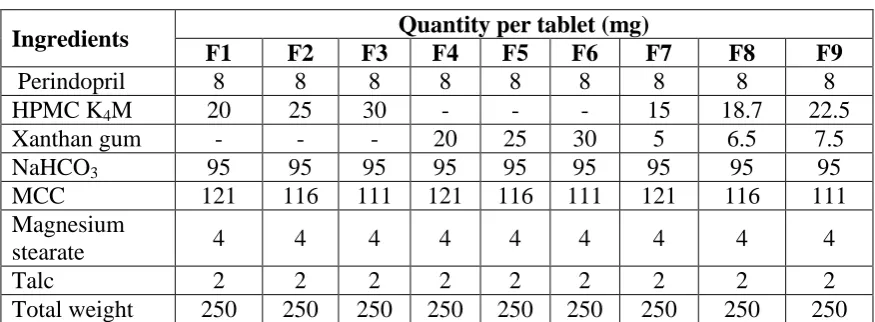
Table 1: Formulation of Perindopril floating tablets
Ingredients Quantity per tablet (mg)
F1 F2 F3 F4 F5 F6 F7 F8 F9
Perindopril 8 8 8 8 8 8 8 8 8
HPMC K4M 20 25 30 - - - 15 18.7 22.5
Xanthan gum - - - 20 25 30 5 6.5 7.5
NaHCO3 95 95 95 95 95 95 95 95 95
MCC 121 116 111 121 116 111 121 116 111
Magnesium
stearate 4 4 4 4 4 4 4 4 4
Talc 2 2 2 2 2 2 2 2 2
Total weight 250 250 250 250 250 250 250 250 250
Evaluation of Perindopril floating Tablets
The formulated tablets were evaluated for the following physicochemical characteristics.
a) Physical appearance
The general appearance of tablets, its visual identity and overall elegance is essential for
consumer acceptance. The control of general appearance of tablet involves measurement of
number of attributes such as tablet size, shape, color, presence or absence of odor, taste,
surface texture and consistency of any identification marks.
b) Hardness test
Hardness of the tablets was determined by using Monsanto hardness tester. The tablet to be
tested is held in fixed and moving jaw and reading of the indicator adjusted to zero. Then
force to the edge of the tablets was gradually increased by moving the screw knob forward
until the tablet breaks. The reading was noted from the scale which indicates the pressure
required in kg to break the tablet. The hardness of the tablets depends on the weight of the
materials used, space between the upper and lower punches at the time of compression and
pressure applied during compression.
c) Tablet size and Thickness
Control of physical dimensions of the tablets such as size and thickness is essential for
consumer acceptance and tablet-tablet uniformity. The diameter size and punch size of tablets
www.wjpr.net Vol 4, Issue 4, 2015. 1013
measured by Vernier Calipers scale. The thickness of the tablet related to the tablet hardness
and can be used as initial control parameter. Tablet thickness should be controlled within a
±5%. In addition thickness must be controlled to facilitate packaging.
d) Friability
The Roche friability test apparatus was used to determine the friability of the tablets.
Randomly selected twenty pre-weighed tablets were placed in the apparatus and operated for
100 revolutions and then the tablets were reweighed. The acceptable limits of the weight loss
should not be more than 1%. The percentage friability was calculated according to the
following formula.
%friability = (initial weight – final weight) / initial weight * 100
e) Average weight of Tablets
It is desirable that all the tablets of a particular batch should be uniform in weight. If any
weight variation is there, that should fall within the prescribed limits:
±10% for tablets weighing 300mg or less
±7.5% for tablets weighing 300mg to 315mg
±5% for tablets weighing more than 315mg
Twenty tablets were taken randomly and weighed accurately. The average weight is
calculated by
Average weight = weight of 20 tablets
20
f) Floating lag time and Total floating time
Floating characteristics of the prepared formulations were determined using the 0.1N HCL.
The tablets were placed in a 100ml beaker containing 0.1 N HCL at 37 ± 0.50 C. The time
required for the tablet to rise to the surface and float on solution (Floating lag time) and the
time during which dosage form remains buoyant on the solution (Total floating time) was
measured.
g) Drug Content uniformity
Over ten tablets were selected randomly and average weight was calculated. Tablets were
crushed in a mortar and accurately average weighed amount of tablets triturate was taken for
www.wjpr.net Vol 4, Issue 4, 2015. 1014
The content was shaken well and kept for 30 minutes for dissolving the drug and appropriate
dilutions were made. The drug content was estimated by recording the absorbance at 285nm.
h) In-Vitro Dissolution studies
In vitro drug release study of the samples was carried out by using USP – type II dissolution
apparatus (Paddle type). The 0.1 N HCL was used as the dissolution medium. The 900ml of
0.1N HCL was placed into the dissolution flask maintaining the temperature of 37 ± 0.50 C
and 50 RPM. 5 ml of sample was withdrawn after 0.5, 1, 2, 4, 6, 8, 10, and 12 hours and the
same was replaced with fresh dissolution medium (37oC). Collected samples were analyzed
at 285 nm using 0.1 N HCL as blank. The drug release experiments were conducted in
triplicate.
Table 2: In vitro dissolution studies
Drug Name
Dosage Form
Dissolution Apparatus
Speed
(RPMs) Medium
Medium Volume (ml)
Sampling intervals (hrs)
Perindopril Tablets USP-II
Paddle type 50RPM
0.1N
HCL 900
0.5,1,2,4,6, 8,10,12
Stability studies: The purpose of stability testing is to provide evidence on how the quality
of a drug substance or drug product varies with time under the influence of a variety of
environmental factors, such as temperature, humidity etc.
Objective: To generate documented evidence that the tablets manufactured comply with the
finished product specifications under accelerated and long term stability conditions.
Design plan: Accelerated study: The product is subjected to accelerated stability studies at
550C for two weeks and 400C±20C / 75 % ±5% RH for six months. Long term study: The
product is subjected to long term studies at 250C±20C / 60 % ±5% RH for 12 months.
RESULTS AND DISCUSSION
Pre compression parameters
The Pre compression parameters were the primary requirements to determine whether the
specific material was suitable for the targeted formulation or not. The aim was to formulate
the tablet formulation with direct compression method, so it was mandatory to know the bulk
density, tapped density, Carr’s index, Hausner’s ratio and angle of repose as those were the
official requirement while choosing any material for its dosage form formulation. Table 3
www.wjpr.net Vol 4, Issue 4, 2015. 1015
Hausner’s ratio, Angle of Repose for various tablet formulations. The result of evaluation
parameters clearly indicates its suitability to be the material of choice for formulation.
Table 3: Pre compression parameters of Perindopril Powder blend formulated with
different concentrations of HPMC K4M & Xanthan gum
Formulation Bulk Density (gm/cc) Tapped Density (gm/cc) Carr’s Index Hausner’s ratio Angle of repose (0)
F1 0.499 0.531 5.89 1.06 25.11
F2 0.437 0.471 7.14 1.07 26.30
F3 0.508 0.570 10.9 1.12 27.70
F4 0.507 0.530 4.39 1.04 27.56
F5 0.399 0.428 6.76 1.07 28.73
F6 0.433 0.472 8.32 1.14 28.95
F7 0.502 0.533 5.86 1.06 27.49
F8 0.402 0.442 8.96 1.09 28.53
F9 0.481 0.560 13.98 1.16 27.63
Post compression parameters
All the prepared batches were evaluated systematically. The obtained results of the evaluated
post compression parameters were represented in the bellow table i.e. in Table 4. The results
of all the trial batches were compared and found satisfactory, as per the reported
specification. Finally the comparison parameters were keenly observed to finalize for
selection of the optimized batch and formula. Hardness of tablets was found to be in the
range of 3.8 to 4.4 kg/cm2 shown in Table 4. The friability of all tablets was found to be in
the range of 0.58 to 0.75 which is less than 1% that showed good mechanical strength.
Floating lag time and total floating time is increased when xanthan gum is used.
Table 4: post compression parameters of Perindopril floating tablets.
Formulation Average Weight (mg)
Hardness (kg/cm2)
Friability (%) Thickness (mm) Drug content (%) Floating lag time (sec) Total Floating time (hrs)
F1 246 3.8 0.75 3.5 101.0 0.09 >10
F2 243 3.8 0.74 3.8 99.05 0.12 >10
F3 251 3.9 0.72 3.6 98.92 0.89 >10
F4 254 4.0 0.58 4.1 99.85 1.52 >12
F5 239 4.3 0.59 4.0 100 2.14 >12
F6 246 4.3 0.58 3.9 99.06 2.89 >12
F7 252 4.1 0.65 4.2 98.95 1.95 >12
F8 250 4.3 0.66 4.5 98.08 2.80 >12
www.wjpr.net Vol 4, Issue 4, 2015. 1016 FTIR graphs
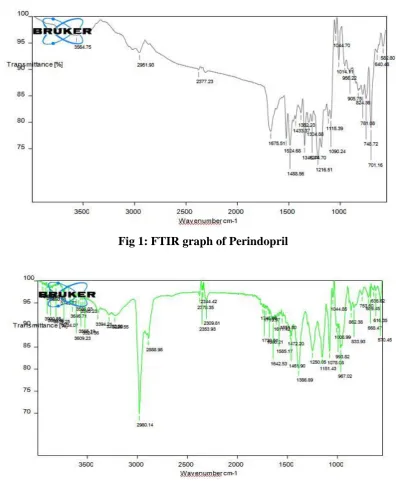
Drug-excipients interactions play a vital role in the release of drug from formulation. The
pure Perindopril and its mixture with HPMC K4M, xanthan gum, talc, magnecium stearate,
MCC, sodium bicarbonate were mixed separately and were scanned over a range of 400–
4500 cm−1 using FTIR. The drug exhibits peaks due to ketonic group, alcohol group,
secondary amine, terminal CH3 group, and C=O stretching in COOH and CONH. It was
observed that main peaks of Perindopril were present in mixture of drug and polymer, and no
change in main peaks of the drug IR spectra in a mixture of drug and polymers was found in
[image:7.595.94.491.259.741.2]Fig 1 & 2.
[image:7.595.99.492.272.484.2]Fig 1: FTIR graph of Perindopril
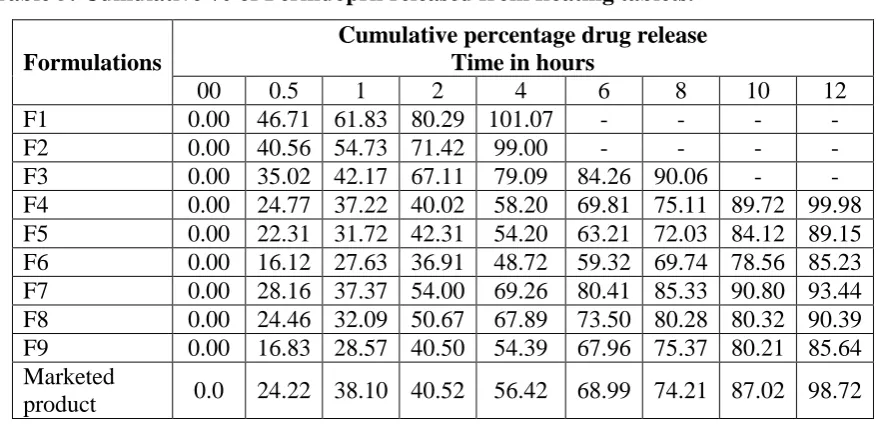
[image:7.595.106.485.523.736.2]www.wjpr.net Vol 4, Issue 4, 2015. 1017 Table 5: Cumulative % of Perindopril released from floating tablets.
Formulations
Cumulative percentage drug release Time in hours
00 0.5 1 2 4 6 8 10 12
F1 0.00 46.71 61.83 80.29 101.07 - - - -
F2 0.00 40.56 54.73 71.42 99.00 - - - -
F3 0.00 35.02 42.17 67.11 79.09 84.26 90.06 - -
F4 0.00 24.77 37.22 40.02 58.20 69.81 75.11 89.72 99.98 F5 0.00 22.31 31.72 42.31 54.20 63.21 72.03 84.12 89.15 F6 0.00 16.12 27.63 36.91 48.72 59.32 69.74 78.56 85.23 F7 0.00 28.16 37.37 54.00 69.26 80.41 85.33 90.80 93.44 F8 0.00 24.46 32.09 50.67 67.89 73.50 80.28 80.32 90.39 F9 0.00 16.83 28.57 40.50 54.39 67.96 75.37 80.21 85.64 Marketed
product 0.0 24.22 38.10 40.52 56.42 68.99 74.21 87.02 98.72
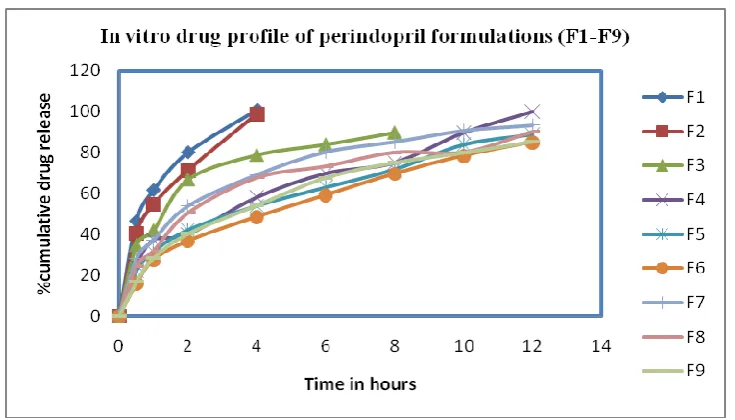
The in-vitro drug release profile of tablets from each batch (formulation F1-F9) was carried
in 0.1N HCl having pH 1.2, for 12 hours by using paddle type. The F1,F2,F3 formulations
were done with HPMC K4M which is showing controlled release in which the total drug was
released at the end of below 8 hours. To overcome this problem xanthan gum was used with
forming rate controlling gel within few minutes and F4, F5, F6 formulations were prepared.
F4 was having good controlled release throughout the dissolution period and release 99.98%
of the drug at the end of 12 th hour. F5 & F6 having xanthan gum in more amount was
controlled more and released approximately 87% of drug at the end of 12 th hour.F7, F8, F9
formulations are made in combination of HPMC K4M and xanthan gum. The % cumulative
drug release showed that the release is less when compared to the formulation using only
xanthan gum at the end of 12 th hour. Only 80% of drug is released for F7, F8, F9
formulations at the end of 12 th hour.all the formulations were shown in Fig 3. The
dissolution studies for the optimized formulation F4 and the marketed formulation is
compared. Results showed that % cumulative release of developed optimized formulation
www.wjpr.net Vol 4, Issue 4, 2015. 1018 Fig 3: % Cumulative drug profile of Perindopril tablets formulations (F1-F9)
0 20 40 60 80 100 120
0 5 10 15
%
CD
R
time in hrs
F4
[image:9.595.155.445.323.476.2]Innovator
Fig 4: Invitro drug release of Perindopril for innovator and optimized F4 formulations
in 0.1N HCl
Kinetics of drug release
Table 6: In vitro drug release kinetic data of Perindopril tablets formulated with
different concentrations
Formulation Zero order (R2)
First order (R2)
Higuchi order(R2)
Peppas (R2)
Hixon crowell (R2)
F1 0.871 0.974 0.994 0.994 0.939
F2 0.912 0.938 0.989 0.978 0.897
F3 0.883 0.960 0.992 0.982 0.933
F4 0.899 0.981 0.997 0.994 0.963
F5 0.963 0.987 0.998 0.996 0.977
F6 0.936 0.989 0.989 0.986 0.988
F7 0.925 0.936 0.997 0.933 0.988
F8 0.966 0.992 0.991 0.988 0.975
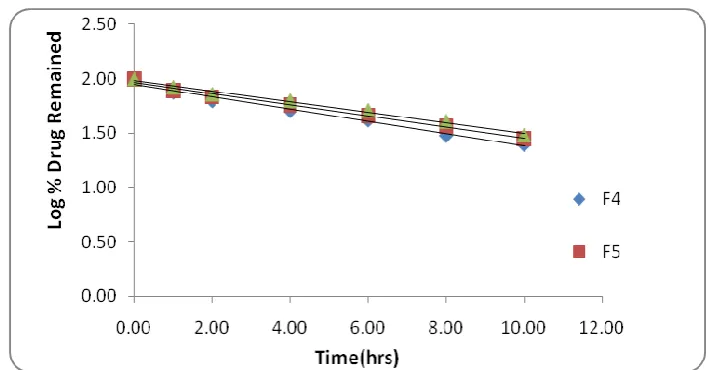
[image:9.595.63.536.606.762.2]www.wjpr.net Vol 4, Issue 4, 2015. 1019 Fig 5: Comparative First order plots of Perindopril floating tablets formulated with
different concentrations of Xanthan gum
Stability studies: It was found that there are no changes in the physical and chemical
parameters of Perindopril tablets of formulation F4 after 1 month at 250C/60% RH ,
400C/75% RH.There is no significant difference in the percentage of drug release of
Perindopril tablets of formulation F4 after 1 month at 250C/60% RH , 400C/75% RH given in
Table 7&8.
Table 7: Dissolution profiles of Perindopril tablets for formulation F4 after one month
at 250c/60% RH
Time interval(min) Percentage of drug release
INITIAL FINAL
0 0 0
0.5 24.77 24.69
1 37.22 37.20
2 40.02 40.00
4 58.20 58.18
6 69.81 69.78
8 75.11 75.06
10 89.72 89.66
12 99.98 99.97
Table 8: Dissolution profiles of Perindopril tablets for formulation F4 after one month
at 400c/75% RH
Time interval(min) Percentage of drug release
INITIAL FINAL
0 0 0
0.5 24.77 24.68
[image:10.595.119.474.68.253.2] [image:10.595.87.508.475.639.2]www.wjpr.net Vol 4, Issue 4, 2015. 1020
2 40.02 40.00
4 58.20 58.16
6 69.81 69.76
8 75.11 75.04
10 89.72 89.65
12 99.98 99.96
CONCLUSION
Studies have been carried out to develop Floating tablets of Perindopril with natural polymers
HPMC K4M, xanthan gum and combination of HPMC K4M and xanthan gum. The powder
blend was evaluated for various micromeritic properties. Nine different formulations were
made and the formulations were tested for floating characterization like floating lag time and
floating time, in-vitro dissolution studies. Based on the results of floating and dissolution
studies and marketed with innovators. F4 was found to be the best among trials. The % drug
release was found to be 99.98% the marketed product gave 98.72% of drug release in 12th
hours of dissolution study. The formula F4 with 99.98% of drug release has better control
over release of drug when compared with marketed product.
ACKNOWLEDGEMENT
The authors sincerely express thanks to the Management, Department of pharmaceutics of
joginpally B.R Pharmacy College and Jawaharlal Nehru Technological University,
Hyderabad for providing facilities to carry out this research work. Authors are thankful to
Pharma Train Labs, Hyderabad, India for providing Drug and other Excipients.
REFERENCES
1. Sanjay Dey, Snigdha Dutta, Bhasker Mazumder, “Formulation and in vitro evaluation of
Floating matrix tablets of Atenolol for gastro retentive drug delivery”, International
Journal of Pharmacy and Pharmaceutics, 2012; 4(3): 433-437.
2. M. Mohan Varma and S. Vijaya, "Development and evaluation of gastro retentive
Floating drug delivery system of Atenolol”, International Journal of Pharmaceutical and
Chemical Sciences, 2012; 1(2): 867-876.
3. Mothilal M, Shaik Nelofar, Swati. P. S, Damodharan. N and Manimaran V,
“Development and characterization of floating tablets of Atenolol”, Der Pharmacia Lettr,
2012; 4(2): 571-578.
4. Tushar A, Premchandini, Bakthi B. Barki, “Preparation and statistical optimization of
alginate based stomach specific Floating microspheres of Simavastatin”, Acta Poloniae
www.wjpr.net Vol 4, Issue 4, 2015. 1021
5. A.Pandey, G.Kumar, P.Kothiyal, Y.Barshiliya, “Formulation and Evaluation of Gastro
Retentive Microspheres of Verapamil”, Asian Journal of Pharmacy and Medical Science,
2012; 2(3): 48-54.
6. Abhijeet A. Durgavale, Archana R. Dhole, Shrinivas K.Mohite, Chandrakant S.Magdum,
“Formulation and in vitro evaluation of Floating microspheres of Captropil using
different gas generating agents”, American Journal of PharmTech Research, 2012; 2(2):
565-575.
7. Rakesh Pahwa, Sumit Jindal1, Lovely Chhabra1, Himanshu Dutt1 and Rekha Rao,
“Development and in vitro characterization of effervescent Floating drug delivery system
of Famotidine”, International Journal of Pharmaceutical Sciences and Research, 2012;
3(1): 241-246.
8. Devarajan Krishnarajan, Rangasamy Manivannan, Chandroth Nidhin, Natesan
Senthilkumar, “Design and characterization of floating tablets of Ranozoline”,
International Research Journal of Pharmacy, 3 (4), 268-272Elnawawy T. M, Swailem
A.M, Ghorab D. M, Nour S. A, “Flaoting tablets as a controlled release stomach targeted
drug delivery system Diltiazem Hydrochloride”, Journal Pharmaceutical Research and
Opinion, 2012; 2(11): 173-183.
9. Atul Kumar Sahu, Shailendra Kumar Singh, and Amita Verma, “Formulation and
development of Buoyant controlled release tablets containing Chitosan: Optimization of
in vitro dissolution and release kinetics” International Journal of Pharmacy and
Pharmaceutical Sciences, 2011; 3(2): 81-85.
10.Surrender Varma, Neha Narang, “Development and in vitro evaluation of Floating matrix
tablets of Anti Retroviral drug”, International Journal of Pharmacy and Pharmaceutical
Sciences, 2011; 3(1): 208-211.
11.J. Padmavathy, D. Saravanan, D. Rajesh, “Formulation and in vitro evaluation of
Ofloxacin Floating tablets using HPMC”, International Journal of Pharmacy and
Pharmaceutical Sciences, 2011; 3(1): 170-173.
12.Nirav S Sheth, “Formulation and evaluation of floating drug delivery system”,