May,
1964
4 REASONS FOR BUYING ONLY PREMIUM TAPE
(Memo~e,(,
off
cOIUl~se~)
Reduced maintenance down-time. Premium tape increases head life and reduces head replace· ment. Its better adhesion of oxide coating and tougher, smoother coating surface minimize operat-ing interruptions resultoperat-ing from oxide build-up on heads and guides.
Memorex magnetic tape is premium tape.
Greater reliability. Premium tape remains error
free - pass after pass, reel after reel- and pro·
vides greater security of data in demanding routines. Despite the somewhat higher price of premium tape, few users can afford to miss the economy inherent in its greater reliability.
Memorex magnetic tape is premium tape.
Memorex tape is premium tape. No need to pre-check it. You can place Memorex computer tape directly in service-reel after service-reel.
Memorex certification means what it says: Memorex
com-puter tape ~ error-free. Extra care, extra steps and
scrupu-lous attention to every detail make it that way. We know the importance to you of having a tape you can depend on.
Longer life. Premium tape minimizes tape strip· ping. It assures error-free performance long after inferior tape breaks doWn and becomes loaded with dropouts. The more severe the use, the more the economies afforded by premium tape's tougher, smoother coating.
Memorex. magnetic tape is premium tape.
No rejects. Premium tape provides freedom from rejects because it is always read-pass perfect- reel after reel. Its price is higher, perhaps. But its effec· tive cost is less because premium tape delivers machine·time savings by eliminating pre-testing and maximizing error·free operation.
Memorex magnetic tape is premium tape.
Are you on our mailing list to receive the Memorex Monograph Series of informative technical literature? Write 1176 Shulman Road, Santa Clara, California
MEMOREX
PRECISION MAGNETIC TAPECircle No. 5 on Readers Service Card
~.
If you're using
your telephone service
only for "people talk"",
COMPUTERS and AUTOMATION for May, 1964
you may be only half using it!
Once, business phones were strictly for
people-to-people communicating.
Not so today. Bell System
DATA-PHONEservice
has changed that. It has made it possible to speed
volumes of operating data-payrolls, invoices,
in-ventories-over the same telephone lines you use
to plan a meeting or arrange a business luncheon.
Combine
DATA-PHONEtransmission with your
regular telephone service-and you achieve an
inte-grated information-handling system that can help
you save time, control costs and minimize
paper-work throughout your operation.
One of our Communications Consultants will
bring you all the details. Just call your Bell
Tele-phone Business Office and ask for his services.
Bell Telephone System
Serving you
This is Computape reel #8741-11
o :
Reel
#8741-11
was part
of an order
shipped to
the Engineering
Department of a leading University. There
it was selected at random and subjected
to a continuous wear test. In
268,853
passes no perll1anent dropouts were
ex-perienced.
Ii
Yes, outstanding ... But
another example of the longer wear
qualities
of
COOlputape. Longer wear, less
static build-up, greater reliability than
ever before.
Test it yourself. Against any other tape.
Id-'
I ,
COMPUTRON INC.
c:::
122 CALVARY STREET, WALTHAM, MASSACH USETTS Circle No. 7 on Readers Service CardOur front cover shows a mltlti-color computer-controlled display made by General Dynamics. The mall is looking at a map of the San Diego region projected on the Screell from a slide il1 the rear of the cathode ray tube. On this map immediate data on aircraft in the region is displayed electronically, directly under the control of the associated computer. More information on this and other display devices is contained in the articles by Johnson and Weisberg in this isstte.
MAY, 1964 Vol. XIII, No.5 editor and publisher
EDMUND C. BERKELEY assistant editors MOSES M. BERLIN NEIL D. MACDONALD LINDA LADD LOVETT contributing editors ANDREW D. BOOTH NED CHAPIN JOHN W. CARR, III AlSTON S. HOUSEHOLDER PETER KUGEL advisory committee T. E. CHEATHAM, JR. GEORGE E. FORSYTHE RICHARD W. HAMMING ALSTON S. HOUSEHOLDER HERBERT F. MITCHELL, JR. associate publisher PATRICK J. MCGOVERN production manager ANN B. BAKER art director RAY W. HASS circulation manager VIRGINIA A. NELSON, 815 Washington St. Newtonville, Mass. 02160, DEcatur 2-5453 advertising representatives New York 18, BERNARD LANE 37 West 39 St., BRyant 9-7281 Chicago 11, COLE, MASON AND DEMING 737 N. Michigan Ave., SU 7-6558 Los Angeles 5, WENTWORTH F. GREEN 300 S. Kenmore Ave., DUnkirk 7-8135 San Francisco 5, A. S. BABCOCK 605 Market St., YUkon 2-3954 Elsewhere, THE PUBLISHER 815 Washington st., DEcatur 2-5453 Newtonville, Mass. 02160
computers and data processors: the design, applications, and implications of
information processing systems.
REPORT
ON COMPUTER DISPLAYS
lIZ
This Issue
12 DIGITAL DATA DISPLAY SYSTEMS: AN ASSESSMENT
by Robert W. Johnson
19 DISPLAY SYSTEM PICTORIAL REPORT
29 COMPUTER-CONTROLLED GRAPHICAL DISPLAY: ITS APPLICATIONS
22
32
38
AND MARKET
by David E. Weisberg
STANDARDS FOR COMPUTER PROGRAMMING (PART 2)
by Dick H. Brandon and Frederick Kirch
THE IBM SYSTEM/3GO
by Neil Macdonald
COBAL - COMPUTERDOM'S ONE BASIC AUTHORIZED LANGUAGE
In Every Issue
across the editor's desk
49 COMPUTING AND DATA PROCESSING NEWSLETTER
editorial
7 "What Happens to the Quality and Character of an Intellectual Job When It Gets Mechanized?
9
editor's scratchpad
,'ettders' and editor's forum
8 Keeping One's "Feet on the Ground" and Computers
8 "Splatter Diagram" Copies
40 A Question of Perspective
70 Calendar of Coming Events
47
capital report
reference information
64 Monthly Computer Census
index of notices
44 Advertising Index
COMPUTERS AND AUTOMATION IS PUBLISHED MONTHLY AT 815 WASHINGTON ST., NEWTONVILLE 60, MASS., BY BERKELEY ENTERPRISES, INC. PRINTED IN U.S.A. SUBSCRIPTION RATES: UNITED STATES, $15.00 fOR 1 YEAR, $29.00 fOR 2 YEARS, INCLUDING THE JUNE DIRECTORY ISSUE; CANADA, ADD SOc A YEAR fOR POSTAGE; fOREIGN, ADD $1.50 A YEAR fOR POSTAGE. ADDRESS ALL EDITORIAL AND SUBSCRIPTION MAIL TO BERKELEY ENTERPRISES, INC., 815 WASHINGTON ST., NEWTONVILLE, MASS., 02160. SECOND CLASS POSTAGE PAID AT BOSTON, MASS.
POSTMASTER: PLEASE SEND ALL FORMS 3579 TO BERKELEY ENTERPRISES, INC., 815 WASHINGTON ST., NEWTONVILLE, MASS., 02160. C!:) COPYRIGHT, 1964, BY BERKELEY ENTERPRISES, INC. CHANGE OF ADDRESS: If YOUR ADDRESS CHANGES, PLEASE SEND US BOTH YOUR NEW ADDRESS AND YOUR OLD ADDRESS (AS IT APPEARS ON THE MAGAZINE ADDRESS IMPRINT), AND ALLOW THREE WEEKS FOR THE CHANGE TO BE MADE.
See new "rear window" display console
at Spring Joint Computer Conference
The first public demonstration of a unique new display console will take place in Washington April 21 to 23 at the Spring Joint' Computer Conference. It is the new S-C 1090 which combines simultaneous cathode ray presentations and film frames on the face of the same tube.
A prime advantage of the new display console is that valuable computer and dynamic display time is not wasted on infre-quently changing background data. Maps, business or engineer-ing forms, etc., may be projected on the face of the tube from the inside, in color or black and white, using the built-in film projector. Changing information is superimposed on this image by a CHARACTRON® Shaped Beam Tube. Specific film frames can be selec'ted manually or automatically by the computer. The new development uses a "rear window" tube, so called because the filmed data is projected through a small window located next to the cathode ray gun. The film image is projected onto the inner phosphor-covered surface of the tube from the back and is easily visible from the outside.
The special CHARACTRON Shaped Beam Tube forms al-phanumeric or symbolic characters for display on the face of the tube at high speeds. A metal matrix placed within the neck of these tubes produces characters of great clarity. A bright, high resolution spot writing beam is also available to display data from analog inputs simultaneously.
In a typical application, such as tactical air operations, var-ious maps of the tactical area can be produced on film and projected on the screen of the S-C 1090 Console. The computer is then free to present only dynamic data such as movement of aircraft with associated descriptive information.
In business or engineering applications, forms may be pro-jected onto the tube face and filled in with alphanumeric data by the character generator. This compact film projector is offered as a custom option on the standard· S-C 1090 Direct View Display Console. For additional information, write to Dept. E-26, General Dynamics I Electronics, Post Office Box 1271 San Diego, California 92112.
GENERAL DYNAMICS
I
ELECTRONICSGIIIII.
IIID
SAN CUSGOb
"I "'"
Circle No. 9S on Readers Service Card
c&a
EDITORIAL
~~What
Happens
an
Intellectual
to
Job
tbe Quality
When
it
and Character of
Gets Mechanized
?"
rhis "important question is asked in a stimulating edi-torial by Robert Colborn, editor, in the April 1964 issue of "International Science and Technology" published by Conover Mast Publications, New York, N. Y.
He gives several examples: • Information
retrieval-"What happens in an automated library to the ser-endipity that every browser among documents has experienced, finding the right answer in the wrong document?"
• Automated measuring instrume.nts:
"I know at least one physicist who is sitting on a mas-sive set of computer calculations he's unwilling to publish . . . there is no way he can tell what it means that the figures go one way rather than an-other ... he says, 'The aim of science is to under-stand, not to raise a specific question and get a specific answer.' "
• The artificiality of focusing data into a chance to get at the computer:
" . . . the time in the forties when Von Neumann worked partial differential equations by monitor-ing an early computer's intermediate results, chang-ing the input assumptions as he went along-how many get a chance to work that way today?" Colborn concludes: "We had damned well better under-stand and allow for the characteristics of automated thought."
A number of things happen to the quality and character of an intellectual task when it gets mechanized, and nearly all of them are for the better.
When an intellectual task is capable of being mechanized, and is placed on a computer, it becomes more definite, more anchored to reality, it becomes less fuzzy, less insubstantial. This aspect of thought is alluded to in the words of Leo-nardo da Vinci:
It seems to me that those sciences which are not born of experience, the mother of all certainty, and which do not end in known experience-that is to say, those sciences whose origin or process or end does not pass through any of the five senses-are vain and full of errors.
and in the words of John Ruskin:
The work of science is to substitute facts for appearances and demonstrations for impressions.
As a result of the mechanization of many intellectual tasks, there is less room for hunch, armchair thinking, opinions, feelings, authoritative pronunciamentos, the so-called con-sidered judgments of experienced persons, etc. Instead, there is the fact that with computers a proposed theory (mathematical, logical, scientific, etc.) can be tried out by the hundreds and thousands of cases, to see how it works-to see if a proposed solution will actually meet the given requirements. This change is advanta!?;eous. Methods for going from a poor solutIOn to an improved solution, meth-ods of successive approximation, can be used with great power and great effect. Computer people are familiar with
COMPUTERS and AUTOMATION for May, 1964
Monte Carlo methods, linear programming methods, criti-cal path methods, and other methods for dealing with intellectual tasks which for the first time became practical with large numbers of variables because of the powers of modern computers.
Even if there is an automated library, it does not require the non-automated library to disappear. People who wish to browse in books will still be able to browse in books. But browsing with a computer facility at your elbow is likely to become ten times and perhaps a hundred times more efficient than ordinary library browsing. It will be as if you had the world's most informed and most patient pro-fessor at your elbow, able to answer almost any kind of sensible question that you can ask him.
In regard to automated measuring instruments, and their reports, it is quite possible to give the readings to a com-puter and entrust it with a most sophisticated technique for searching and analysis, so that it will glean the under-standing that one seeks to gain. The astronomer Johann Kepler spent over ten years calculating with the observa-tions of Tycho Brahe, in order to propose his three laws of planetary motion; with the aid of a modern computer, an astronomer nowadays should be able to discover laws much faster than that.
As to the artificiality of focusing data into an opportunity for access to the computer: the increase in the number of computers, the availability of secondary time, the decrease in the cost of computer time, and the growth of time-shar-ing on computers-all arc maktime-shar-ing it easier and not harder to obtain computing power just when one wants it. This obstacle is only temporary.
In fact, the way in which Dr. von Neumann used the com-puter for mathematical investigation by interacting with a computer's "quick looks," will in a few more years become one of the regular ways of using a computer (see "The Time-Sharing of Computers" by Edward Fredkin in the November, 1963 issue of Computers and Automation).
Several thousand years ago almost no one could" read and write, and so the memory of minstrels was very extensively trained, in order that they might recite and chant epics for hours at a time, as they entertained an audience in the eve-ning, gathered around a fire in the great hall. As the new technique of reading and writing became more widespread, think of the dislike and distrust it received from the minstrels!
We need to be perceptive to the advantages and disad-vantages of each new technique that comes along to affect human thought. There is no escaping from change. And there is no rule that says we must stop using memory, or pencil and paper.
If
we remain sensible and adaptable, we should be able to gain benefits from automated thought without losing benefits from unautomated thought.~c:.~
EDITOR
KEEPINC ONE'S "FEET ON THE CROUND"
AND COMPUTERS
1. From Otis Minot
Minot Informatic Devices 1776 Massachusetts Avenue
Lexington 73, Mass.
In reference to your editorial "Let's Keep Our Feet on the Ground" in your February issue, while I agree that ten years from now we shall probably still have men driving buses, it does seem possible that the jobs of many bus driv-ers will be affected considerably by computdriv-ers. I would not go along with "Fortune" and say the jobs will be "very different," but this is disagreement on degree.
8
We can envision computers as tied in with:
1. Reservations for and scheduling of bus trips, espe-cially in long distance service, and local charter service.
2. Bookkeeping concerned with maintenance, repair, economy, etc. of buses.
3. Production of bodies, engines, controls, fuels, parts, etc., which will be reflected in over-all design, comfort, speed, rates, etc.
4. Ticketing, fare collection, luggage registration, carry-ing of packages, etc. (particularly as trains dis-appear).
5. Pay, promotion and other bookkeeping.
6. Recording of times, distances, speeds, economics, etc. by automatic device, with records fed to computers. 7. Concentration of business, schools, etc. partly in
re-sponse to the desirability of central data proces-sing facilities. (Maybe the communication industry will free us from this worry, but communication still costs money).
8. Computer-aided studies of traffic. 9. Computer control of traffic.
10. Automatic control of bus steering and automatic
collision prevention, on major routes, involving various computing systems or parts.
II. Personnel testing, health records, health examina-tions, etc.
c&a
READERS' & EDITOR'S FORUM
Surely it seems, however, that the person-to-person
as-pect~ of the job will remain similar. Unless they are all readmg Computers and Automation, the students will prob~
ably all be scuffling, singing and shouting. Or will the computer have proved that a TV set in every bus is eco-nomically sound, its cost being 1/10 that of wear and tear on bus and driver?
II. From the Editor
Many of the observations of Mr. Minot are certainly cor-rect, and the job of a bus driver will certainly be influenced to some extent by the growth of computer technology. But ten years from now, a man will still drive a school bus, in spite of computers.
In regard to Point 10 above, the automatic control of bus steering on major routes, and automatic collision preven-tion, seem to be a very remote possibility; the easy way to accomplish this is to put the buses on rails, and this of course produces a railroad. As to the disappearance of trains, this is most unlikely for something as useful and effi-cient as they can be; even the ordinary wooden lead pencil has not disappeared; and the hourglass of the ancients may be found today in a department store as a three-minute egg timer.
"SPLATTER DIACRAM" CO'PIES
Eugene Smith
Electronic Associates, Inc. Long Branch, N. J.
In reference to requests from your readers for copies ot the "Splatter Diagram," which was used as the front cover for "Computers and Automation" in August, 1963, and
which won your first prize in your computer art contest: Our company docs have prints of this diagram available, and we shall be glad to supply copies to your readers on re-quest. They are available, thus correcting your remarks in the March, 1964 issue, page 8.
THE MEANING OF THE THIRD GENERATION: •••• •••• ARE BIRTHDAYS IN ORDER? This issue carries a rather extensive report on the much anticipated new IBM computer series, the System/.360.
The announcement date for this computer, Ap-ril 7th, has been hailed by IBM as the birthday of a new concept in computers. Is this a fair assessment?
Certainly the new IBM System/.360 represents a new concept in the administration of a computer system development project. The System/.360 com-bines over three years of R&D efforts at IBM Laboratories in Stockholm, LaGaude (France), and other foreign centers as well as from San Jose, Calif., Yorktown, Fishkill, Endicott, Poughkeepsie, and Kingston, N.Y. and other U.S. IBM research groups. This is a remarkable accomplishment in itself.
Certainly the System/.360 represents a new concept in computer system announcement planning. With admirable efficiency, IBM's huge marketing force presented the details of the System/.360 to over 200 reporters at a press conference in Pough-keepsie, to over 90,000 customers and prospects in 165 U.S. cities, and to over 50,000 foreign cus-tomers and prospects in 90 cities, all in the same day.
Certainly, the System/.360 represents a major step forward in offering mass memory capacity with access times compatible with computer operation speeds. With any of 8 million directly address-able characters availaddress-able in 8 usec., one can do a whale of a lot of high-speed data structuring and sorting ~lthough at a lease cost of $1.3,000 per month per two million characters) •
Certainly the System/.360 represents a major plunge ahead in tunneling through the input/out-put cost and capacity barriers. One example is the offering of a low cost inquiry display termin-al ($275 per month) and another is the expansion in the capacity of selector channels so that the System/.360 can communicate and control up to 256 I/O units per channel.
However, the idea of a compatible family of computers is not new as the existing GE 400 series will attest. The idea of using hybrid circuits is not new, for both hybrid and fully integrated circuits have been offered in several aerospace computers for over a year now.
COMPUTERS and AUTOMATION for May, 1964
EDITOR'S
SCRATCHPAD
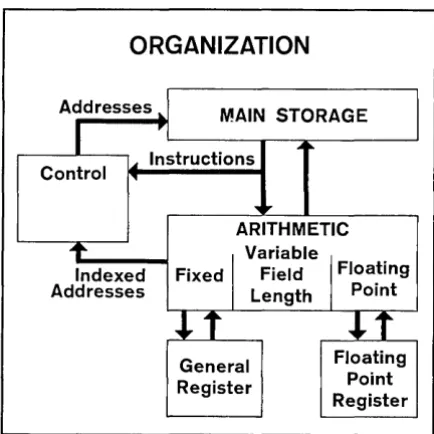
The system organization of the System/.360 is not new but rather follows the classic pre-ENIAC computer organization, with modifications to re-flect the need for high-speed storage registers to hold intermediate results.
The System/.360 is an impressive achievement by the leading manufacturer in the computer field. However, we feel that it falls short of being a new concept in computers ••• rather it notes a new mark of maturity in the development of v~rsatile,
economic computer systems. We are happy to wel-come it to the computer field.
SYSTEM!.360 RESHUFFLES COMPUTER ORDERING PATTERN Regular readers of our monthly computer cen-sus will note we have moved the cut off date for this month's installment back to April 6th. This was done for two reasons: (1) we are printing this issue early in order to have copies ready for the Spring Joint Computer Conference, and (2) we don't feel that reasonably reliable "on order" figures can be compiled during the dynamic compu-ter ordering activity immediately following the IBM System/.360 announcement on April 7th.
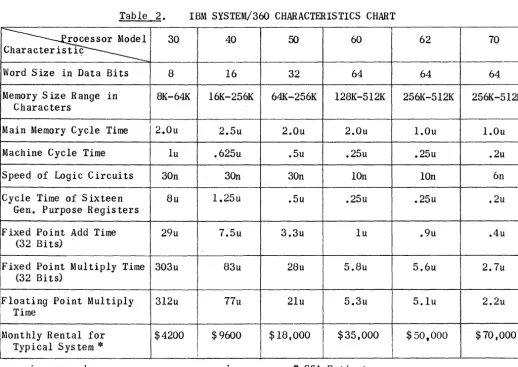
However, in an effort to get some feel for ordering activity on the System/.360 we made a tele-phone survey of a random selection of EDP users during the three days following the April 7th an-nouncement. We found that the System/.360 is appar-ently being warmly received by current 7000 series users. The higher end of the System/.360 offers compiling capacities from 15 to 20 times that of the largest computers in the 7000 series, and 6 to 10 times the throughput for equivalent system costs. The model 50 processor system is being rather heav-ily ordered by the 500 or so existing users of the IBM 7044 and 7070, 2, 4 computer systems. Several 7090, 4 users mentioned that they are ordering the model 50 to be linked up with a model 70 in a multi-computer system.
mod-els 30 and 40 is cut in half when handling 1401 instructions in this manner.
The rapid appearance of computers with 1401 program translators and 1401 simulators such ~s
the H-200, GE-415 and B200 series is causing many 1400 series users to consider carefully the
advan-t~ges of converting currently to a competitive system rather than waiting eighteen to twenty
~onths for a System/360 which might be behind the state-of-the-art when ready for delivery.
NEW COMPUTER LOOK-~qeAD
IBM judiciously chose to start the numbering on the central processors of the System/360 at 30 and end at 70 to allow for upward and downward ex-pansion.
Upward expansion is already underway as IBM is currently negotiating for orders to build two prototypes model 90 super-scale systems, which it believes will become the most powerful computers in the world. As though by reflex, IBM is propos-ing one of the systems to the people at the Law-rence Radiation Laboratory to add to their collec-tion of "most powerful" computers (currently in-cluding LARC, STRETCH, and the CDC 6600).
Honeywell is planning to announce at the SJCC what it now calls the H-20OS, a scientific version of the highly successful H-200. The word length is 24-bits, and the processing speeds will be in the vicinity of 2 usec. for a fixed point addition and 8 usec. for a floating point multiply. System rental cost for the new coJmDuter is expec-ted to be about $4,000 per month. •
lQ has just unveiled its newest computer, the DDP-224. This machine is considerably faster than the DDP-24 (260,000 additions per second vs. 100,000; 6.4 usec. multiply time vs. 31 usec.; 1.9 usec. memory cycle time vs. 5 usec.). The new com-puter features special options which make it possi-ble to combine several 224's into a multi-computer system with common memory, control and arithmetic. The 224 with 4096 words of core memory sells for $96,000, or just slightly more than the $87,000 ba-sic price for the 24, although the 224 has from three to four times the throughput capacity of the 24. To reflect this difference, 3C is believed to be planning to lower the price on the 24 shortly.
A CrJHPUTER BY ANY OTHER NAME ••.•
One of the special arts in the genial trade of news release reading is the ability to quickly perform a code conversion anQ data reduction pro-cessing on an incoming release. The goal of this
p~ocessing step is to deflower the verbal green-ery, and deflate the promotional superlatives so that each piece of neWS information can be treated with a relatively balanced outlook.
However, sometimes our ID<3ntal processing comes up with a blank when some eager beaver" press re-lease writer has been able to envelop his product in cryptographic terms for which, try as we may, we can find no key. An example of the latter occured recently in a news release which described its sub-ject as a device which lIper forms the same operations
for rocket design as a room full of electronic com-puters, both digital and analog. In essence, it is a computer that is inexpensive anQ can be used at a desk or in the field. In fact, it is a roomful of computers that the engineer can carry in one hand"! !
What can it be? •• a marvel of microelectro~
ics? •• a miniature optical computer compacting mil-lions of bits of information in a laser beam? No ••• further searching reveals it to be nothing more won-drous than a book of nomographs! Who says that the word computer is being spread too thin!!
MEANWHILE, BACK AT COMPARISONVILLE •••
Readers of our February, 1964, issue will remember Norm Statland's article on "Methods of Evaluating Computer Systems Performance" which offered some very sensible suggestions for yard-sticking the effectiveness of a particular com-puter system on a proposed application. Norm, who works for the Auerbach Corp., has kindly given us permission to publish some of the re-sults of the computer system performance measure-ments his group has been making for their refer-ence series, the Standard EDP Reports, published by Info, Inc., a subsidiary of the Auerbach Corporation. The chart below gives the results of computer system performance comparisons on two data processing activities, one a general file processing problem, and the other a matrix inversion. For users interested in getting a gage on the processing power of some medium class computer systems currently available, this chart provides some interesting perspectives.
SYSTEM PERFORMANCE COMPARISONS-MONTHLY RENTAL BETWEEN $10,000 AND $30,000
GENERALIZED FILE MATRIX INVERSION
PROCESSING PROBLEM A (See Users' Guide 4:200.300) CONFIGU· (See Users' Guide 4:200.100) Standard E"stimate
RATION
MONTHLY
SYSTEM NUMBER
RENTAL, Activity Array Size
IDENTITY (See Users'
Guide $
4:030.100) 0.0 0.1 1.0 10 20 40
Minutes per 10,000 Records Minutes
Honeywell 1400 VI A 14,530 1.6 2.8 20. 0.035 0.26 2.0
RCA 301 VI A 12,880 1.5 4.3 32. 0.020 0.15 1.0
GE 225 VI A 12,805 1.6 2.5 25. 0.033 0.24 1.7
Honeywell 1400 nI 12,290 1.6 2.8 20. 0.16 1.2 8.5
IBM 1410 m 12,240 1.4 2.0 20. 0.17 1.3 9.0
GE 235 m 11,870 1.5 2.5 25. 0.07 0.47 3.5
IBM 1460 m 11,735 1.4 3.6 26. 0.17 1.3
--IBM 1401 IV 11,540 2.0 2.6 20. 0.33 2.5
--Honeywell 1400 n 11,150 1.6 3.7 24. 0.16 1.2 8.5
This is
a new productl
- ' J 1 .. '
-i • • .
i.
Fabri-Tek's 300-nanosecond thin-film memory system has been on the market
for well over a year now, so we refuse to call it "new." Some people are just
catching up to the memory system technology we offered last year, but they
still haven't caught up with the Fabri-Tek Series FFM-202 Magnetic Film
Memory System.
If you have such applications as scratch pad storage, index registers, real time
data processing, or any of the new exotic data processing problems where high
speed with reliability is needed, then here is your answer .
• 300 nanoseconds full cycle .200 nanoseconds read or write only • 150
nanoseconds access time. Read only, write only, read-restore,
read-modify-write operating modes • Capacities up to 512 words of 36 bits each • Full
Fabri-Tek quality, realiability, and maintenance ease
Why wait for others to announce their new products when you can have the
answer to your high-speed memory problems today. Write, call, or wire Robert
E. Rife, Fabri-Tek Incorporated, Amery, Wisconsin. COngress 8-7155 (Area
715). TWX: 715-292-0900.
FABRII==TEI~
Circle No. 8 on Readers Service Card
DIGITAL DATA DISPLAY SYSTEMS:
AN ASSESSMENT
Robert W. Johnson
Data Display) Inc. St. Paul 8)
Minn.
Digitally commanded cathode-ray-tube displays have found increased applications with computer systems since the mid 1950's. At present an industry within the com-puter industry exists for the production of these devices. For 1963 this display industry probably accounted for a sales volume of more than 40 million dollars.
The bulk of the applications of digital data displays have been oriented to the defense effort or are related to other government-sponsored programs, These have ranged from complex, multiple-station, on-line displays for command and control systems to single recording displays used to record graphical and tabular data from scientific computa-tions.
The commercial use of display systems has only recently become significant. Commercial applications, such as in-formation retrieval programs, data-processing recording. etc., are beginning to become a significant part of the display industry.
A digital data display system is a device which receives digitally encoded command information fr0nY a computer or other digital data source, and transforms these com-mands into visible displays of symbolic or graphical infor-mation. The primary output media of these displays is the cathode ray tube, although other media have been investi-gated or have found relatively limited applications.
Along somewhat arbitrary lines, the digital data display may be divided into three functionally distinct types of systems:
I. The General-Purpose Console Display 2. The High-Speed Film Recorder
:L
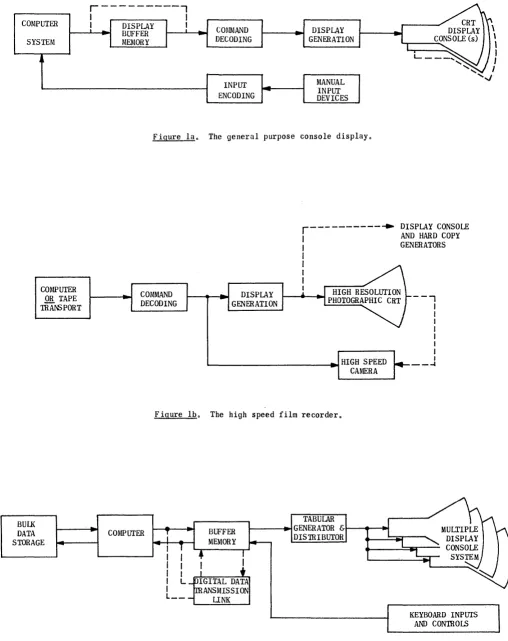
The Information Retrieval SystemThe distinction between these groups is not always pres-Cllt, since more than one function may be combined in a sillgle system. The functional configuration of each of these display types is shown in Figure 1.
12
The General-Purpose Console Display
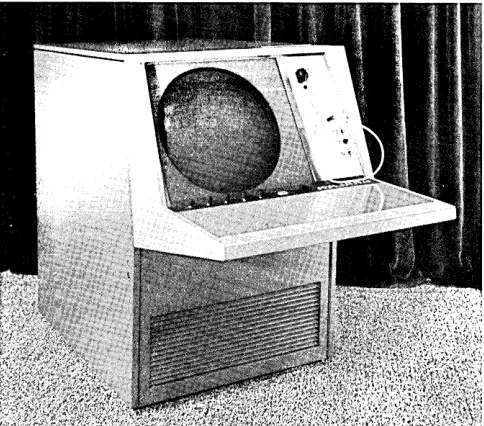
This kind of system is typified by the console stations in a large-scale military command-and-control system. The systems may range all the way from a set of complex dis-plays with symbol and vector generation, buffer memory, keyboards, light pens, switch inputs, and background gen-erators-to a single unbuffered displayable to present a single symbol or point capability only. Some typical sys-tems in this category are shown in Figure 2.
The key element of the general purpose console is the technique of display generation. Typically this consists of functionally separate units to generate characters or symbols and vectors (or line segments) and the techniques of symbol generation are typically proprietary to each display manu-facturer.
Each of these techniques may be rated in terms of reper-toire, speed, and quality. The display 'repertoires of typical General Purpose Displays allow a set of 64 or 128 symbols to be selected, and the symbol generation speeds range from 25,000 to 200,000 symbols per second. Short persistence phosphors arc normally used for the console displays and a refresh rate of 40 cycles per second or more is required to avoid flicker when used in normal lighting conditions. Therefore the speed range of 25,000 to 200,000 characters per second enables simultaneous display of 600 to 5,000 symbols.
The generation of lines or vectors under computer con-trol is accomplished by simultaneously varying the hori-zontal and vertical deflection signals to the CRT drive, in synchronization with control of the beam brightness. The requirement for straight lines with precisely controlled terminations and line width, in combination with a high writing rate, is the design challenge for the vector gener-ator. In order to control the relative intensity or line width
r---,
COMPUTER
I
I DISPLAYI
I~--'--I~ BUFFER DISPLAY GENERATION SYSTEM
COMPUTER OR TAPE lRAl'SPORT
BULK DATA STORAGE
MEMORY
COMPUTER
INPUT ENCODING
Figure lao The general purpose console display.
r---...
I
I
I I
I
I
I
"--_ _ _ _ _ _ _ _ _ -I~ HIGH SPEED CAMERA
Figure lb. The high speed film recorder.
I
I
I
I
I I
L __
Figure lc. The information retrieval display system.
COMPUTERS and AUTOMATION for May, 1964
DISPLAY CONSOLE AND HARD COPY GENERATORS
--..,
I
I
I
I I
I
I
I
--~
\
\
\
I
I
" I
'.J
[image:13.613.58.566.65.706.2] [image:13.613.71.554.69.171.2]General Dynamic's SC 1 090
Data Display dd13
Figure 2
of simultaneously displayed vectors, the vectors are drawn at constant writing rate, or have a programmed means of ,varying the intensity signal as a function of vector length. The vector generation techniques which are available under these design conditions allow generation at speeds of 0.1 to 3.0 inches per microsecond.
Command Decoding
The basic format for generation of a display specifies a position, a character and ce'rtain other information in each word transmitted to the display. For example, Format (I) may consist of a 30-bit machine word:
X / Y / C / M
where X and Yare unsigned 10 bit numbers specifying the location of the character on the rectangular display area of the CRT, C consists of the bits specifying the character, and M is a set of control bits which may establish: the
14
character size; if the character is intensified; if it is to blink; and other control functions.
If a vector generator is included, two basic methods are used to specify these parameters. One method is to use Format (1) above and to designate with M (or with a re-served character code) that a vector is to be drawn from the previously specified X-V (in the preceding word) tc this (final) X-V position. The second method would use thE M code to designate a different interpretation of the data word, in this case using Format (2):
D,X] / D, y. / D,X2 / D, Y 2 / M
Using the D,X, D, Y format a vector is drawn from the pre-viously specified X-V position in the direction specified by boX and boY.
Each pair of D,'S are digitally accumulated to define the starting point of the following vector. Typically, this method of specification limits the vector length to a per-centage of the full display screen dimensions. This format is efficient where a large number of connected segments are to be drawn, such as map displays or curved line configura-tions. The first method (end point specification) typically allows any vector length within the display area to be spec-ified, and is most efficient for grid systems and displays utilizing long vectors.
If the display is to contain a considerable amount of textual or tabular information, Formats (1) and (2) are in-efficient. Thirty or more bits would have to be transmitted to the display to position and specify each character. Also the computer would be required to compute an X-V for each character and to assemble words in Format (1). So, instead, a "typewriter-like'" format is used allowing the efficiency of the display to be increased; in this case For-mat (3) is:
Cl / C2 / C3 / C4 / C5
Here the position of Cl, or the initial character in a string, is specified in a F orma't (1) word, which also specifies an M code. Subsequent words are interpreted in Format (3), Each character in the Format (3) word is then automatically spaced in a distance X from the previous position and dis-played in sequence. This continues until a reserved char-acter code, i.e., a program-escape charchar-acter, is encountered, and the following word is again interpreted according to Format (1).
Many features may be added to the typewriter format, Format (3), to allow some degree of control without leaving this mode. For example, a reserved character code may cause a "carriage return" to the initial X position and "line feed" or "change" in the Y position. "Tab" codes, codes to change brightness, to select italics or to perform other operations may also be reserved.
For specific General Purpose Console applications, these possible formats, and others, may he considered and selected on the basis of the information to be displayed and on the computer requirements and capabilities. The display sys-tem with a simple minimum command format will cost
signifi~antly less" than a display with a sophisticated com-mand structure.
Time-Sharing-Multiple Monitors
Since the cost of a display system is a function of its ele-ments, the ability to time-share a central buffer and display generator between several stations is an economical ap-proach to systems where several independent displays are required.
Normally this method of time-sharing is simple: all of the display fields are painted in sequence by a centralized display generator, and the common deflection signals are transmitted directly to each of the consoles. The intensity, or unblank signals are selectively gated to each console ac-cording to a digital control, such as the use of the M bits
[image:14.612.43.285.45.258.2]in Format (1) and an independent display on each console fesults. This method of time-sharing is illustrated in Figure 3.
DIGITAL SIrALS
1
ANALOG SIGNALS
x DISPLAY COMMANDS
v
INTENSITY SIGNAL
CONSOLE SELECTION
Figure 3. Method for time sharing a central display generator.
The time-sharing technique is most valuable where the display generation speeds are capable of maintaining the desired amount of flickerless information on each console. However, the technique also has cost advantages when multiple, centrally located display generators are used to drive many consoles.
The Buffer Memory
The primary use of a buffer memory is to unload the computer or data source by refreshing the display. For ex-ample, if a display field of 2,000 symbols is to be refreshed at 40 cycles per second, 80,000 words assuming Format (1) must be transmitted from the data source to an unbuffered display each second. This rate and duty cycle would nor-mally tie up a buffered output channel on a modern computer.
With a display memory buffer, the load on the computer output channel may typically be reduced by a factor of a thousand, even for a display whose content is rapidly chang-ing. The choice of a buffered vs. unbuffered display is therefore a function of display loading, the characteristics of the data source, and the cost of a buffer unit. There are also positive reasons to use the available core memory in a general purpose computer as a display buffer memory, if this is possible from a cost and performance viewpoint.
Display memory buffers are typically of the core memory type and are less often recirculating delay lines, discs, or drums. The core buffer is used because the times to ac-complish varied display operations such as indicated by Formats (1), (2), and (3) may vary over a range of 10 to I, and significant compromises in display rate or format would be required to use a synchronous type memory. The effec-tive cycle times of the core memory do not have to exceed the display rates, and typically range from 5 to 10 micro-seconds. A method of interleaving the loading from the computer with output to the display generator is normally included in the buffer memory logic in order to avoid a perceptible blink upon loading.
Special logical features may be incorporated to facilitate the use of a buffer memory. For example, it would be an unnecessary burden on a computer to fill a memory with non-display instructions when a display using only part of
COMPUTERS and AUTOMATION for May, 1964
the buffer capacity is stored. A memory jump instruction allows this problem to be effectively handled, and also al-lows the display programmer flexibility for other opera-tions. If this jump instruction is predicated on the settings of switches on the console, the console operator may now easily select and assemble varied display fields. Another cOllllllon feature of the buffer memory is the ability to select an address upon loading.
In some systems, the buf[er memory is also used to ac-cumulate information for transfer from manual input de-vices to the computer. A string of key hoard character codes may be accumulated into a message before transmission, etc. The payoff for this use of a memory is a reduction in inter-rupt signals to the computer. This· is a relatively small advantage in comparison to the amount of special logic re-quired to provide an input buffering capability and restric-tive input procedures are also inferred.
At some point the use of a small general-purpose com-puter for input and output buffering and for manual input functions becomes attractive. This is particularly so where the data source is a telephone bandwidth channel or is otherwise restricted in transmission capacity. Such a buffer / computer may perform light-pen tracking, message as-sembly, format conversion, and other operations as well as perform as a buffer.
Manual Inputs
In addition to its unique characteristics as a data-output device the general-purpose display console has facility for effectively accepting manual inputs, related to the dis-played information.
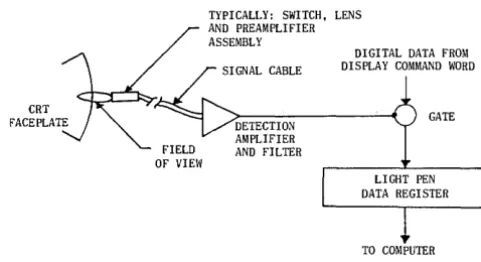
The light pen (also called a light pencil or light gun) is a manual input device unique to a cathode ray tube dis-play system. Figure 4 illustrates the functional operation of a light pen. The light pen consists of a pen shaped as-sembly attached to the display console by a wire or fiber optic cable. It has a small field of view-projecting longi-tudinally from its point-and detects a rapid change of light intensity within this field of view.
CRT FACEPLATE
TYPICALLY: SWITCH, LENS AND PREAMPLIFIER ASSEMBLY
DETECTION AMPLIFIER AND FILTER
DIGITAL DATA FROM DISPLAY COMMAND WORD
TO COMPUTER Figure 4. Functional arrangement of a light pen.
The light pen is positioned by the console operator to view a displayed point that he wishes to designate to the computer. The pen is aimed and at the time of detection (resolved within microseconds), the display command word and/ or current memory address are gated into a light-pen data register (if the display is refreshed from a computer, the light pen may be required only to interrupt the com-puter and halt the display sequence). The comcom-puter may therefore receive information as to the X and Y position of the designated item, character code, or the command word in memory. Subsequent action Illay he taken by the com-puter program to "feed-back" to tlu: operator the results
[image:15.617.62.297.101.279.2] [image:15.617.325.566.470.601.2]of his operation, such as blinking or intensifying the se-lected symbol, calling up additional related data, moving the display center to the designated point, etc.
The light pen may be used in numerous programs to achieve input effects. A tracking program, for example, will allow an operator to input points or draw curves at high, but controlled rates. A cursor feedback program will cause a special displayed symbol to accurately follow the light pen's position. Many general purpose consoles incorporate special raster generating instructions to additionally facili-tate operations with a light pen.
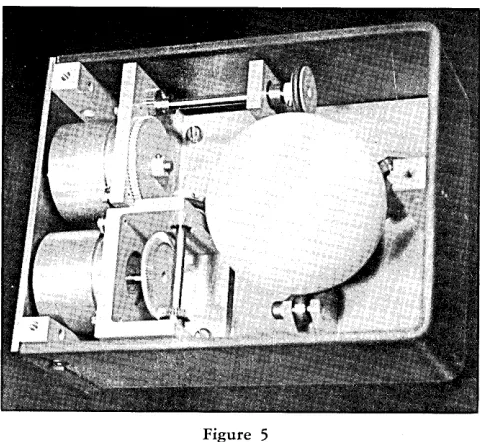
The trackball consists of an assembly such as is shown in Figure 5, JI\()ullted ill the cOllSole shelf so that the upper portion of the 3-inch phenolic sphere protrudes from the shelf and is easily moved by the operator in any direction.
Figure 5
Rotation of the ball around the two orthogonal axes is di-rectly coupled to drive two digital shaft encoders. The computer may sample the outputs of these encoders and may, in turn, at regular time intervals display a cursor symbol at the position coordina te corresponding to the shaft encoder outputs. If this is accomplished at a suffi-ciently high rate, in excess of 10 times per second, the cursor will appear to continuously follow the trackball input, and the operator will be able to precisely position the cursor. Operation of switches or a keyboard in conjunction with the cursor will allow functions similar to light pen opera-tions to be performed.
Other manual input devices include typewriter-like key· boards and switch/ indicator units used with coded snap-on overlays for flexible function marking. The general pur-pose display console operates effectively with these devices as well, since it is adapted to perceptibly instant feedback of the input effects on the CRT display.
The general purpose CRT display may be suitable to many applications requiring on-line communication be-tween operations and a computer system. By design selec-tion of the features included in the display system, it may be easily optimized for specific tasks without loss of its gen· eral purpose display characteristics. It is well adapted to changing with varying requirements of applications, both
by modification of its supp~)rting software, or its hardware feature.
The High-Speed Film Recorder
The combination of the high-speed digital CRT display and a digitally controlled recording camera res1Ilts in a
com-16
puter output device combining speed and a very high degree of flexibility. These systems are typified by the Gen-eral Dynamics SC4020 and the Data Display model dd80 shown in Figure 6 and 7. The display generation principles for the film recorder are the same as for the general purpose console, except that information is typically recorded onto film in a single display pass without repetition. Operation may be off-line from a magnetic tape unit as well as on-line.
Figure 6
Figure 7
The High-Speed Film Recorder may ettectlvely perform data recording conventionally accomplished by two devices: the high-speed printer, and the electro-mechanical graph plotter. A tabular comparison of the features of these three systems is presented in Table 1.
The features of each type of device are difficult to com-pare on an exact basis except for very specific applications. However, the film recorder offers some very significant ad-vantages in terms of over-all speed, format flexibility and general purpose capabilities. It also possesses inherent dis-advantages in its inability to directly record multiple copy in page-size hard cop)" although film may be copied rapidly and inexpensively.
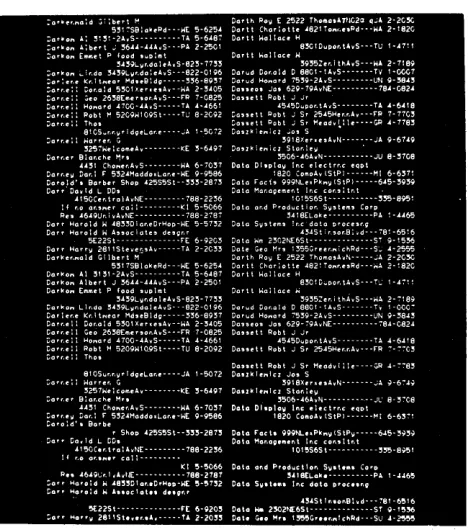
Accompanying this article are illustrations of output from high-speed digital recorders, and they show the ability of this type of system to record both tabular data and vectors.
[image:16.612.305.549.128.565.2] [image:16.612.43.283.199.420.2] [image:16.612.307.547.345.567.2]I. Character or Symbol Set
2. Type Variation (Digi tally Controlled)
3. Characters per Line
4. Speed in Lines per minute
5. Format
6. Speed: Vectors per sec.
7. Graphic Accuracy
8. Output Availability
9. Multiple Copy Capabi Ii ty 10. Media
TABLE I
COMPARISON OF RECORDINr, DEVICES
High Speed Line Printer (1000 line/min.)
64 None 130+ 1000 line-at-a-time None Seconds Yes Paper
EI ec tromechan I ca I
Graph Plottor
8-10 typl cally
None
page-at-a-time
5-10
0.1% Absolute 0.05% Relative
Seconds
No
Paper
High Speed Film Recorder
(100 000 Char./see.) 1213
size, italics, intensi ty
128 typically
30,000 approximately
page-at-a-time
50,000 typically
1.0% Absolute 0.2% Relative
From minutes to hours, except seconds wi th hard copy units
No - except by processing methods
Film or photographic
paper
Applications in fact have gone to the point where record-ing system users are producrecord-ing stereographic movies of three-dimensional constructions (the November issue of
Cornputers and Automation shows one half of a stereo pair
produced on a film recorder).
The film recorder may also be made to operate as a gen-eral purpose display console through addition of a large screen display. Devices to produce page-size hard copy rapidly and directly, but without the throughput capability of film are offered as options. The SC4020, for example, offers a dual hard-copy option with both a quick-look capa-bility and an off-line developing option.
Approximately 50 high-speed film recording systems are now in operation, primarily used for scientific computing operations. Extensive software is available for many of these units when operated with specific computer systems. The major obstacle to extensive commercial use is effective integration of the recorder techniques into office systems. Commercial applications also involve consideration of film storage and retrieval methods, printing methods, and other operational procedures.
The Digital Information Retrieval System
Triggered by the development of low-cost mass-memory
techniques, a new generation of digital data-display systems has evolved: the information retrieval display system. This system allows many operators at physically separated sta-tions to simultaneously interrogate a large memory. The prime consideration in this type of system is to achieve a low cost per station, and this in return dictates a fixed dis-play format of alphanumeric data only. Each station of an information retrieval display system is independent and fully buffered and allows entry from a typewriter-like key-board into the memory.
Typically, one station in this type of information re-trieval system would have the following sequence of events occur in an inquiry process:
I. The operator types in a coded inquiry and observes it on his screen.
2. He commands the transmission of the inquiry from the display memory to the computer.
3. The computer interprets the inquiry, retrieves the re-quested data, formats the reply, and transmits the reply message to the display memory.
4. The operator views the reply message on his screen. The time from step (2) to step (4) is typically less than a second. One of the significant advantages of the CRT dis-play for information retrieval is this high speed in
accept-COMPUTERS and AUTOMATION for May, 1964
,;:::::::
r··.-·.
I
•• -::::=' _ ::'."'.' _ " .. :,0; .. ;~.' 0;1;; _.'" "'" ~::I::I:l ~:,'.' •• '.::.. "
U M . ••• _ _ L _ _ • _ , . _ . . . _ _ • _ • ..,'& ... 4
.-.. ~~ .••• _ •• , •.• · ... " .. 'U· __ . I .... ' .... _ ...
'_.11.', ._ ...
U"'_ ... ,.:Ot'ke-r.ho:d ~ i :be-t't foil
5!1l75B:okePd·--IoIE. 5-625" ;ot'kO" A: !ll!5l-2A~5-·---·----TA 5'6"67 :;ot'ko" ... : bet' t .; 56 .... - .. ,.u~S-- -PA 2-2501 :;orko" [lIIw.et P food '100:1111
!I .. '9Lwr.do 1 eA~S'82'-77"
:;ot'kO" .... ir,do ''''9L'Jf,do:eA.vS---822-0196
:;0": er,e I(r, i t"eo" ~d.eB:dg--· --~~6-8951
:;one:: Cor,old 550nenuAv--WA 2-'!I"05 Corr,e:: ~eo 26'56[1IIeT'.or,AvS---F'R 1-0825 Corr,e:: Ho"ot'd .. 1CO- .. A.vS----·TA "-"661 :;one:: Robt t'" 5209Wl09St-·--TL.: 8-2C92 Cone:: Thol
8!CSwr,r,Wt'idgeLof,e'--'';A I -5C12 :;oH,e:: Wot'rer, G
525";"We:collleA~---I(E 5-6"91 OOH,er Btor.cl'le "1t' •
.... 'I Cho"er,AvS·---WA. 6-10'!l1 Corr,ell Cor.: F' 552"ModdOILor,e-WE. 9-9586 C01'old'l Barber 51'100 "25555t--:53:5-2813 Dor1" DavId L ODs
.. , 50Cer. t ra~A'ONE.-- - -- - - - -188-2236 If r,O or,s"",er coil---KI 5-5066 Res "6"9Ur. i ..,AvN[- - - - --- - - - -788-2787 Oorr Harold W "633Dior.eDrHoo-IoIE 5-5732 Dorr Harold W Associates desgr,r
5E22S'---rE 6-92C3
Dorr Horr\ol 281 15le'Oe_~sA~---TA 2-2C33 Corker,,,,,,oid Gi Iberl M
53'7SBlokeRd---WE 5-625" D01'ko"", Al 3131-2A~S---TA 5-6461 D01'ko"", Albert J 5644-44A~S---PA 2-2501 Dorko" Ellllllel P food suolmt
3439Lw r.doleA..,S-823-7733 Dorko" Lir.da 3439L)!ndaleA~S---822-0196
Corter,e Kr,lt"",ear MdseBldg---336-8931 Donel: Dor,old 5301Xen:esAv--IoIA 2-3405 Dane: i Geo 2638Emel"sar.AvS---F'R1-0625 Cone: I Honard 4100-4A'05---TA .4-4661 Danel i Robt M 5209WtO.95t----TU 6'-2092 Corr,el: Tl'lol
8105wr,r,)!rldgeLar.e----JA 1-5072 Carr,e: 1 Worrer. G
5251We:comeA~---KE '-6491 Corr,er elor.che Mr.
4431 Cho"",er,A~S---WA 6-1031 Cone)! Cor.: r 5524ModdoILar,.-WE 9-9586 Cot'old' I Bot' be
t' 5hoD 4255551--3'!13-281, Cor t' Do~ I d L CC.
4 150C.r, t t'o 1 AvNE- -- - -- - - -768-2256 If r,oor, .... r
coll---K\ ~-~066
R . . 4649\Jr.i.AvHE----~--~-~-188-2181
:;'0"" Harold W 4B330lar .• CrHOD-W[ ~-5152
Cot', ~O'Q:d W A •• oclgte. d •• or.r
Dar tl'l 1=10\01 E 2522 TholllosA7f1C2a qJA 2-2C~
Oortt Charlotte 4821To ... uRd--~ ... A 2-182G
Dartt Wallace H
83CIOupor.tA~S---TU 1- .. 1~1
Oortt holloce W
59352'er,ithA'I5---WA 2-7189 Oorud Dor,old 0 86Cl-IA..,S---T'V 1-0001 Oorud Ho .. ord 7559-2AvS---U,.~ 9-3S":!I Dan eo. Jell 629-19AvNE---78 .. -082A Dossett Robt J Jr
4545Cwpor,tA'tS---TA "'-6"'6 Cossell Robt J Sr 2545Her,r,Av---rl=1 1-17C' Cossetl Pobt J Sr Meodv~lle----GR 4~118!5
Coszkie .. ie: JosS
591eXerlesA~N---JA 9-6149 DoukieniclSlor,lel,l ,
3506-46AvN- - - - -. -- - - -JU 8-!5106 Data OI.p!0'J Inc electrr,c eQot
~e20 COllloA..,{StPJ---Hi 6-6311 Dolo F'octt. 999NLe.Pkn!,l tStPl ---645-'959
Dolo Mor,Qgl!mtr.t ir.c cor.s: tr,t 1015565 t -. - - - ---335-895l Dolo or,d Product ior. Systems Corp
3418ELoke-·-·---PA l-A465 Dota So,I3tems !r,c' dato procesr,g
43A5t ir,30r,S;.d-·-'78l-65:6
Dolo Wm 23G2NE6Sl--·--·---·ST 9-1536 Dole Geo Mrs L555Greer,l'tichRd---S:": "'-2555 Darth Ro':ol E 2522 Thome.AvN---.;A 2-2C3C Dartt Choriotte .482:Tonr,esRd---,.A 2-:82C Dortl WoI lace H
830ID .. por,tAv$---T:; , -47:: oortl Wallace h
5935:er.i tI'lAv5---WA 2-7:89 Dorud Dor,aid 0 eeOl-IAwS---n 1 -CCG: DOfud HOl'lord 7559-2Av5---UN 9-38"£'
Da~neos J03 629-i9AwNE---··---76.l-C82.4 Dossett Robt J Jt'
4545Dupor.tA~S---TA -4-6.&18 Dassett Robt J 5r 25-45Her,r,Av---F'R 7-7':'(,3
Dossett Robt J Sr Meodv!lle----GR -4-7783 OaUkle"",Icz Jo. 5
5918XerlflsAvN---.;A ~-6':""'~ Oaszld~"IcZ 5tor.le\ol
3506-46A..,N- - - -.- -JL' 8- !I-:"C6 Ooto OI'Dlow Inc eleclnc eqDt
1820 COllloA~t5tP)---t·H 6-657! Doto F'ocl. 999"lL •• Pk"."t5tP ... ---6.l5~3~3~
Dolo Mor.o".III.r.t Jr.c cor.,I\r.t
I Ol~S6S ,- - -- - - -"5-8.51
Dolo or.d Prodl.lcllor. S\oI.h ... CorD 5418£Loke---·PA 1-.£.£65 Dolo 5 .... h"'. Ir.c doto pt'ocur,,,
4!4St 'r.sor.91 ~ d- - -~81 -61516
5£2?S'---·---rE 6-920' 0.' . . . . 2~2tl[6S'---ST 9-I~~
:'ort' Mort'W 28"Shw., .• AoI--·-·TA 2-20!' Doh Geo "',. 1~Gt'.er,"'c"'Ad--·SU .£.~
ing a response (typically 10,000 to 100,000 characters per second). Because of this speed, total retrieval problems may be solved with significantly fewer stations (and operators) than for slower retrieval techniques.
The ability to drive a large number of stations with in-dependent, buffered operations on each is basic to the digital information-retrieval display system. Also, these sta-tions may ·have to be remote from the central computer/ memory equipment. Design tradeoffs are specifically quired in this type of display to allow stations to be re-moted at distances to several thousand feet. Long-distance remote operation, i.e., greater than a mile, requires com-patibility with telephone data transmission equipment, and generally the storage and display generation equipment must also be located at the remote termination. The trans-mission rates of a voice-grade telephone channel limit the display acceptance to 200 to 300 characters per second; this rate is normally sufficient to retain the significant speed advantage of the information retrieval display.
Important, perhaps even revolutionary. applications of digital display devices are on the way, and specialized tech-niques to meet the requirements are rapidly evolving.
[image:17.612.329.563.243.508.2]DISPLAY SYSTEM PICTORIAL REPORT
S-C 1090 DIRECT VIEW DISPLAY CONSOLE General Dynamics/Electronics
San Diego, Calif.
A special version of the CHARACTRON® Shaped Beam Tube enables the S-C 1090 Direct View Display Console to simultaneously present computer-generated information and film-projected data. The special cathode ray tube, capable of gen-erating a million alphanumeric characters per second, has an optical window built into the rea r of the tu be. Fi 1m frames proj ected through the window onto the inner phosphor-covered sur-face of the tube sur-face are visible from the out-side. The film frames are thus superimposed over the information generated by the computer. In an air traffic control application, various maps of the t raffi c a rea can be produced on f 11m and projected on the display screen. The com-puter is then free to present only changing data such as identification and movements of aircraft in the area. In other applications, business and engi neeri ng forms may be proj ected onto the tube face. The computer is only required to present changing alphanumeric information to complete the form. In addition, a multicolor display may be presented by using colored film. (For more information, circle 76 on the Readers Service Card.)
IBM 2250 DISPLAY UNIT IBM Corporation White Plains, N.Y.
The IBM 2250 display unit provides a visual presentation of information stored in the computer or in storage files, drums and tapes. It is designed to operate with the new IBM System/360 described elsewhere in this issue. The 2250 can be used as the computer operator console, for engineering record keeping and updating, as a time-shared scientific computing terminal, for information retrieval, data acquisition monitoring, data reduction display, pro-cess control supervision, order entry, inventory inquiry and updating. Corrections may be made directly on the displayed information with a built-in electronic marker, and the corrections are immediately stored. The major element of the 2250 is a console with a 12-inch square display screen (a 21-inch cathode ray tube) on which tables, graphs, charts, alphanumeric characters, or the lines and curves of drawings can be displayed as a series of points. When the full display area is used, 3848 alpha-numeric characters can be viewed. Buffer storage is avail-able in 4096 and 8192 character capacities. These units may be read from or written at a maximum rate of 238,095 characters a second. The 2250 also has a typewriter-like keyboard for entry of all alphanumeric information and control of the electronic marker; a light pen for communi-cation between the operator and processor; the IBM 2840 display control which permits up to eight display units to operate in a time-sharing configuration; a keyboard which makes interpretive operations possible; and an operator control panel for processors where the display is used in place of the typewriter control console.
(For more information, circle 78 on the Readers Service Card. )
dd 10 DATA ENTRY AND RETRIEVAL SYSTEM Data Display, Incorporated
St. Paul, Minn.
The dd 10 system permits a console operator to enter and retrieve data from a central digital data source in a fraction of a second. It op-erates independently of the computer until, the message has been verified, then goes on line to retrieve data at on line speeds. The dd 10 displays a 500 character message on a cathode ray tu be in les s than a second. The system may consist of up to 64 electronic typewriter input devices with cathode ray tube displays connected to a central control unit. The control unit is capable of handling more than 20,000 operations per hour. Interfaces are available for most digital computers, mass memories and telephone subsets. The flexible dd 10 may be used in any situation where there is frequent reference to a central data source such as airlines, insur-ance companies, financial institutions, and governmental agencies.
(For more information, circle 77 on the Readers Service Card.)
TYPE 340 PRECISION INCREMENTAL DISPLAY Digital Equipment Corporation
Maynard, Mass.
Digital computer data is rapidly converted into graphic and tabular form by the Type 340 Precision Incremental Display. It has an incremental plotting rate of 1.5 microseconds per point and a random plotting rate of 35 microseconds per point. Four operating modes provide flexibility and make it suitable for a wide range of applications. A random point plotting mode allows points to be plotted at random loca-tions on the tube face; an increment mode permits rapid plotting of curvilinear data output; a vector mode provides a fast means of displaying straight lines between two points without specifying in-between points; and an optional character mode is available to display up to 128 different alph'anumeric characters. The Type 340, wi th bui 1 t in con-trol and power supplies, requires only logic level inputs for operation. It can be easily connected to any digital system. It is shown at the right on-line with a
Program~ed Data Processor-4 computer.
(For more information, circle 81 on the Readers Service Card.)
COMPUTER CONTROLLED DISPLAYS RMS Associates, Inc.
Mount Vernon, N.Y.
RMS Computer Controlled Display systems plot ~_point at a loca-tion designated by the computer. Oploca-tional character and vector writing features allow the computer to program charts, graphs, maps and other presentations. Four b3sic systems are available: the standard speed and high speed MONOFLEC Displays (no elec-trostatic channel) and the standard speed and high speed DUAL-FLEC Displays (with electrostatic channels). 'Customized sys-tems to meet almost any requirement can be assembled from the basic displays by adding optional features. Interfaces are available for most 12, 18, 24 and 36 bit data word computers. Up to 2300 points or formatted characters can be plotted at a flicker-free rate of 30 frames per second on the high speed Display. Continuous line symbols, generated by the CURVILINeID character generator (up to 100,000 characters per second), can be any size between 3/32" to 1/2" without breaking up into il-legible dots or scanning lines. Simulation, computer monitor-ing and trouble-shootmonitor-ing, and machine-aided design are some of the applications for the large screen (21" rectangular) display systems.