21 All Rights Reserved © 2012 IJARCSEE
BLIND DIGITAL VIDEO WATERMARKING
TECHNIQUE FOR VIDEO AUTHENTICATION BY
USING DISCRETE WAVELET TRANSFORM
V.SRIDHAR 1 M.J.SUCHARITHA2
1
Assistant Professor, ECE, VIDYA JYOTHI INSTITUTE OF TECHNOLOGY, AZIZ NAGAR, India
2
Assistant Professor, ECE, VIDYA JYOTHI INSTITUTE OF TECHNOLOGY, AZIZ NAGAR, India
ABSTRACT: In recent times, Internet is being increasingly used as the platform for distribution of digital multimedia content. The inherent flexibility of Internet facilitates users to transact with one another to create, distribute, store, peruse, subscribe, enhance, modify and trade digital content in various forms like text documents, databases, e-books, still images, audio, video, computer software and games. The use of an open medium like Internet gives rise to concerns about protection and enforcement of intellectual property (IP) rights of the digital content involved in the transaction. In addition, unauthorized replication and manipulation of digital content is relatively trivial and can be done using inexpensive tools, unlike the traditional analog multimedia content. Copyright abuse is the motivating factor in developing new encryption technologies. One such technology is Digital watermarking. A digital watermark is a signal embedded in digital data that can be used to establish ownership or to ensure the integrity of the data. The watermark is capable of carrying such information as authentication or authorization codes, or a legend essential for image interpretation. This capability is envisaged to find application in image tagging, copyright enforcement, counterfeit protection, and controlled access. Digital watermarking describes the process of embedding additional information into a digital media, without compromising the media‟s value.
Digital watermarks should be difficult to remove; resist a variety of signal processing attacks including compression, cropping, printing, transmission, rotation, scaling, etc.; and be difficult to forge. We propose in this paper an algorithm which will embed watermark into a video. We are implementing this project in frequency domain technique of watermarking using Discrete Wavelet Transform (DWT).Matlab environment was used for simulation of proposed algorithm.
Keywords: DWT, IP, MATLAB,VIDEO, DIGITAL WATER MARKING
I . INTRODUCTION
In the early days, encryption and control access techniques were used to protect the ownership of media. The watermarking techniques have been used to keep the copyright of media. The spread of computer networks and the further research and progress in multimedia technologies have raised the concern over the legal claim (copyright) and security of the digital data.The digital watermarking techniques have been proposed in years to protect the copyright of the digital data. The rapid growth of the Internet and multimedia systems in distributed environments, it is easier for digital data owners to transfer multimedia documents over Internet. These techniques, however, do not protect against unauthorized copying after the media have been successfully transmitted and decrypted. Thus, watermark techniques are utilized to maintain the copyright .
The techniques earlier used were Cryptography and Steganography. Cryptography classically handles multimedia and network security issues. However, cryptography ensures confidentiality, authenticity, and integrity only when a message is transmitted through a public channel such as an
open network. It does not protect against unauthorized copying after the message has been successfully transmitted. Digital watermarking is an effective way to protect copyright of multimedia data even after its transmission.
1.1 What is watermarking?
Watermarking is a concept of embedding a special pattern, watermark, into a digital data (image, video, audio etc.) also called as cover signal, so that a given piece of copyright information is permanently attached to the data [4]. This information is useful to identify the
ownership, identify an unauthorized person,
dissemination through the network, or simply inform users about the rights-holder or the permitted use of data.
22 All Rights Reserved © 2012 IJARCSEE
watermarking. The researchers nowadays started to explore more research on Digital Video Watermarking. Image watermarking schemes developed by the researches have been used to propose video watermarking schemes. The concept is that the techniques of image watermarking are directly applied to raw video or compressed video. However, these schemes do not provide security and are not capable of adequately protecting video data.
Video watermarking introduces some issues which are not present in image watermarking. A video as we know is a sequence of redundant frames, with frames with no or little motion being same frame after frame, thus, video signals are highly susceptible to pirate attacks, such as frame averaging, frame dropping, frame swapping, and statistical analysis [8,9]. Applying a fixed image watermark to each frame in video leads to problem of maintaining statistical and perceptual invisibility. Furthermore, such an approach is necessarily video independent; as the watermark is fixed while the frame changes. Applying independent watermarks to each frame also presents a problem. Motionless regions may be statistically compared or averaged to remove independent watermarks. In addition, video watermarking schemes must not use the original video during watermark detection as the video usually is in very large size and it is inconvenient to store it twice [1].
2. DIGITAL WATERMARKING:
This age may be referred to as the digital age. Technology is changing at a faster pace than ever before and today‟s technology is becoming obsolete tomorrow. During past few years there is revolutionary change in technology and thus digital media is easily reproduced due to the rapid growth of internet and the multimedia technologies.
This has resulted in deep concern and an urgent need to resolve the security and ownership (copyright) protection issues. Therefore, the field of digital watermarking has attracted many researchers from all over the world and has now become an exciting field of research.
Digital watermarking is a technique in which we embed a special pattern that uses an algorithm to insert a watermark. These techniques have been extensively used to protect and provide copyright of the digital data. Two most important properties have to be satisfied by any digital watermark technique.
First, embedded watermark should be perceptually invisible and does not distort the digital data. The second property is that the embedded watermark must be difficult for an attacker to remove. It should be susceptible against several signal processing attacks. The watermark must be robust particularly when the digital data is compressed with MPEG and stored and distributed in compressed form for DVD
(Digital Versatile Disk), VOD (Video on Demand) and such other applications [2].
Watermarking is a branch that deals with the hiding some information that is used to claim authenticity, or proprietary information in digital media like photographs, digital video and digital audio etc. The concept involved here is that, a digital watermark is embedded containing some auxiliary information into a digital signal by making small changes that are not perceptible to its intended recipient.
However the introduction of watermark, in the case of multimedia watermarking, the hidden signal should not result in any visible or audible distortions so that the quality of the digital media is retained even after the introduction of watermark. These embedded signals enable invisible tags to be attached to digital documents; watermarks are powerful tools that will play a role in solving the growing digital property identification problem [1].
2.1 Cryptography and Steganography
The technology of Cryptography can be considered as a crude form of data hiding technique that makes the use of private-key. It can be defined as the processing of information into encrypted form for the purpose of secured transmission with the help of use of key the encrypted message can be decrypted to retrieve the original message. It is the most popular technology that content owners would rely upon.
It is probably the most common method of protecting digital documents and certainly one of the best developed as a science. Another technology that is well known from ancient ages is that of Steganography. One of the best known examples is that of Greek messengers who used to have messages tattooed on their shaved heads and used to conceal the message to the authorised person once their hair finally grew back.
In cryptography, the content is encrypted before transmission and the decryption key is provided only to those authorised persons who have permission to access the legitimate copies of the content.
The encrypted file can be made available through the Internet, but would be of no use to a pirate or a hacker without appropriate key. The encrypted structure of the message is changed and is meaningless and unintelligible unless it is decrypted by the authorised user [1].
23 All Rights Reserved © 2012 IJARCSEE
However, the watermarking system demands an additional requirement of robustness.
There are two kinds of cryptosystems,
1. Symmetric and,
2. Asymmetric
Symmetric cryptosystems and Asymmetric cryptosystems can be distinguished from the use of key, Symmetric cryptosystems use a key known as the secret key, both to
encrypt and decrypt a message, and Asymmetric
cryptosystems use one key, named as public key, to encrypt a message and a different key, named as private key, to decrypt it. Asymmetric cryptosystems are also called public key cryptosystems [3].
Symmetric cryptosystems faces a problem: “how do you guarantee that the transport of secret key from the sender to the recipient is secure and in a tamper proof fashion?”
Then the obvious thought that comes in mind is that if we can send the secret key securely, then instead of sending the key why not simply use that secure channel to send the message instead of encrypting the message with symmetric cryptosystem.
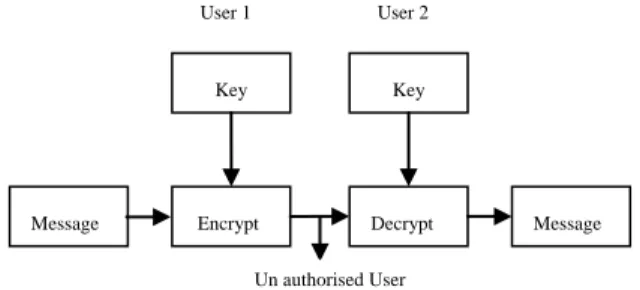
One example using symmetric cryptosystem is shown in figure 2.1. User 1 and User 2 want to communicate in secret, while unauthorized user wants to eavesdrop. User 1 and User 2 want to share some secret information or just friends trying to have a private conversation .
Figure 2.1: Symmetric cryptosystem
. They cannot stop the unauthorized user listening to radio signals, so they exchange a digital key, so they both know it, but it is otherwise secret. User 1 uses this key to encrypt messages she sends, and User 2 reconstructs the original messages by decrypting with the same key. The encrypted messages are useless to unauthorized user, who does not know the key, and so cannot reconstruct the original messages. With a good encryption algorithm, this scheme can work well, but exchanging the key while keeping it secret from unauthorized user is a problem.
Asymmetric cryptosystem is another more efficient and reliable solution. Asymmetric cryptosystem is different, because it splits the key for decryption. It is not possible to determine the secret key from the public key.
Figure 2.2: Asymmetric cryptosystem
In figure 2.2, User 2 generates a pair of keys and tells everybody, including the unauthorized user, his public key, while only he knows his secret key. Anyone can use User 2‟s public key to decrypt it. This scheme allows User 1 and User 2 to communicate in secret without having to meet.
3. THE DISCRETE WAVELET TRANSFORM:
The Wavelet Series is just a sampled version of CWT and its computation may consume significant amount of time and resources, depending on the resolution required. The Discrete Wavelet Transform (DWT), which is based on sub-band coding, is found to yield a fast computation of Wavelet Transform. It is easy to implement and reduces the computation time and resources requiredThe foundations of DWT go back to
1976 when techniques to decompose discrete
time signals were devised. Similar work was done in speech signalcodingwhichwas named as sub-band coding. In 1983, a technique similar to sub-bandcodingwas developed which was named pyramidal coding. Latermanyimprovements were made to these coding schemes which resulted in efficient multi-resolution analysis schemes. In CWT, the signals are analyzed using a set of basis functions which relate to each other by simple scaling and translation. In the case of DWT, a time-scale representation of the digital signal is obtained using digital filtering techniques. The signal to be analyzed is passed through filters with different cut-off frequencies at different scales.
Public
Key
Secret
Key
MESSAGEMMM
MMess
age
Messag
e
MMM
MMess
age
DecryptDEDec
ryp
t
Encrypt
EEEncr
ypt
Encrypt
ENCR
YPT
Encrypt
Key
generat
or
User
2
User
1
User 2 Public Key
Message
Key Key
Message Encrypt Decrypt Message User 2
User 1
24 All Rights Reserved © 2012 IJARCSEE
4. DIGITAL VIDEO WATERMARKING TECHNIQUES:
Video may defined as reconstruction of a sequence of still images representing scenes in motion.It is the technology of electronically capturing, recording, processing, storing, and transmitting of information. The term video ("video" meaning "I see", from the Latin verb "videre").It refers to several storage formats for moving pictures: digital video formats, including Blu-ray Disc, DVD, QuickTime, and MPEG-4; and analog videotapes, including VHS and Betamax.
The difference between video and static images is that the video sequence has change characters. Research on psychological visual indicates that, about the fast moving object, optical sensitivity of the human beings will decrease. Otherwise human vision system HVS is influenced by luminance, has masking character, texture complexity etc. The brighter the background is, the more detail information included and the higher levels masking is.
Thus, we can conclude that people are not sensitive to the parts which include complex texture and fast changing along the time axis. Based on all those visual characters, the video watermark can be embedded in moving fast and complex texture areas.
The number of still pictures per unit of time of video is considered as a frame rate. It ranges from six or eight frames per second (frame/s) for old mechanical cameras to 120 or more frames per second for new professional cameras. PAL (Phase Alternate Line) used in Europe, Asia, Australia, etc., and SECAM (Sequential Color with Memory) used in France, Russia, parts of Africa etc.
The standards specify 25 frame/s, while NTSC (USA, Canada, Japan, etc.) specifies 29.97 frame/s. Film is shot at the slower frame rate of 24 photograms/s, which complicates slightly the process of transferring a cinematic motion picture to video. The minimum frame rate to achieve the illusion of a moving image is about fifteen frames per second.
The basic idea behind applying a watermark to a video remains same as that of applying a watermark to a still image.
Many researchers have proposed different digital
watermarking schemes in the literature for still images and videos. Most of them operate on uncompressed videos, while the others embed watermarks directly into compressed videos [5].
4.1 Video Watermarking
Recently, researchers mainly focus on the video watermarking techniques that are robust and invisible. These schemes can be distinguished on the basis of the domain in which the watermark being embedded or detected, their
capacity, real-time performance, and their resistance to particular types of attacks.
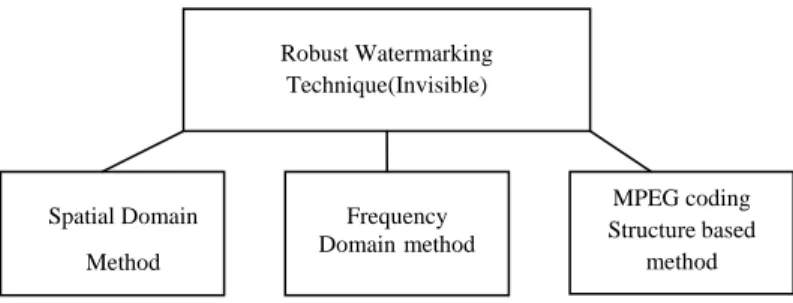
A classification map of existing video watermarking techniques is presented in Figure 4.1. The video watermarking techniques can be divided into 3 main groups based on the domain that the watermark is embedded; they are
1. spatial domain
2. frequency domain and
3. MPEG coding structure based.
As we know a video is a collection of frames, the video watermarking schemes are based on the image watermarking and applied to raw video or compressed video.
The following sections discuss each algorithm in brief and salient features of each algorithm, the important idea, strength and limitations introduced by these schemes are also presented.
Figure 4.1: Classification map of existing digital video watermark techniques.
4.2 Spatial Domain Watermarks
The spatial domain video watermarking techniques generally use spatial domain approach, also called native domain: its embedding and detection are performed on spatial pixels values (luminance, chrominance, and color space) or on
the overall video frame.
The watermark is applied in the pixel or coordinate domain and during the embedding no transforms are applied to the host signal. The watermark is then derived from the message data via spread spectrum modulation. The procedure here is simple and is based on simple operations in the pixel domain.
The watermark can be detected by correlating the expected pattern with the received signal. The pixel domain methods are easy to implement and are conceptually simple and have
25 All Rights Reserved © 2012 IJARCSEE
very low computational complexities. As a result they have proven to be most attractive for video watermarking applications where real-time performance is a primary concern. Any algorithm will have advantages as well as disadvantages and so is the case with spatial domain method i.e., they also exhibit some major limitations such as multiple frame collusion, high perceptual visibility etc. This class can be distinguished by the dimensionality of the watermark pattern and the techniques proposed are 1D and 2D spread spectrum modulation, and 3D Code Division Multiple Access (CDMA) modulation. [5].
Several different methods enable watermarking in the spatial domain. The simplest is to just to change lowest-order bit of chosen pixels in a grey scale or colour image. This will work well only if the image is subjected to any human or noisy modification. A more robust watermark technique is to add paper that superimposes a watermark symbol over an area of the picture and then add some fixed intensity value for the watermark to the varied pixel values of the image. The resulting watermark may be visible or invisible depending upon the value (large or small, respectively) of the watermark intensity. The spatial domain technique however is susceptible to picture cropping, which is a common operation of image editors, and can be used to eliminate the watermark.
Another technique in spatial watermarking is using colour separation. The watermark appears in only one of the colour bands. The image is considered to be a two dimensional array and certain pixels based on their spatial domains in array are manipulated. The technique may be as simple as flipping the least significant bit (LSB) or may be a complex superposition of watermarking symbols over an area of the image. In the second technique a lot of flexibility exists in terms of placement, size and intensity of the watermark. The watermark is visibly subtle so that it is difficult to detect under regular viewing. However, the watermark appears immediately when we use the colours that are separated for printing. This renders the document useless to the printer unless the watermark can be removed from the colour band.
5.DIGITALVIDEOWATERMARKINGINWAVELET DOMAIN:
One of the techniques for watermark embedding is that of the wavelet domain. DWT (Discrete Wavelet Transform) has been most frequently used in digital watermarking than other transforms. Some of the salient features this transform provides are excellent spatial localization, frequency spread, and multi-resolution characteristics, which are similar to the theoretical models of the HVS (Human Visual System) [10]. These properties have been proved useful to establish an efficient relationship between the transform and coefficients and visual masking properties of the HVS. This has greatly helped for the development of many imperceptible and robust
DWT based watermarking algorithms. The following section deals with the wavelet decomposition of the image.
5.2 Wavelet decomposition of an Image
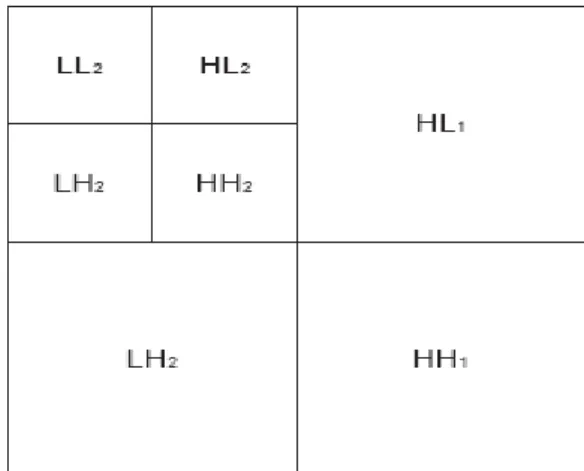
An image of x x y pixels is decomposed into four sub bands LL, LH, HL, and HH by the ordinary wavelet transform, and the LL component with the size of x/2 x y/2 is further is decomposed into four sub bands with x/4 x y/4. In other words the image is thus separated into an image of a lower resolution approximation image (LL) as well as horizontal (HL), vertical (LH) and diagonal (HH) detail components. The process can be repeated to compute multiple “scale” wavelet decomposition, as in the 2 scale wavelet transform shown below in Figure 5.1[11].
Figure 5.1: Two scale 2-dimensional discrete wavelet transform.
The advantage of using the wavelet transform is that it is known to more accurately model the aspects of the Human Visual System (HVS) as compared to the FFT or DCT. The higher energy watermarks are thus used in regions that the Human Visual System (HVS) is known to be less sensitive to, such as the high resolution detail bands (LH, HL, HH). These regions allow us to embed the watermark such that there is an increase in the robustness with a little or no impact on image quality [8].
One of the most straightforward techniques is to use similar embedding technique to that used in the DCT. This can be easily extended to multiple bit messages by embedding multiple watermarks into the image.
26 All Rights Reserved © 2012 IJARCSEE
made low by appropriate amplitude and the number of added samples.
It is also possible to subtract the PN signal from the host data. In this case, the correlation receiver will calculate high-negative correlation in the detection process. Thus, by using addition or subtraction process it is possible to convey one-bit of information. By sequential adding of several such bits, it is possible to convey arbitrary information.
As in the spatial version, a separate seed is used for each PN sequence, which is then added to the detail coefficients. During detection, if the correlation exceeds threshold for a particular sequence a “1” is recovered; otherwise a “0”. The recovery process then iterates through the entire PN sequence until all the bits of the watermark have been recovered.
Furthermore, as the embedding uses the values of the transformed value in embedded, the embedding process should be rather adaptive; storing the majority of the watermark in the larger coefficients.
5.3 Digital Video Watermarking in Wavelet Domain
As we know DWT (Discrete Wavelet Transform) separates an image (Fig.4.2) into a lower resolution approximation image (LL) as well as horizontal (HL), vertical (LH) and diagonal (HH) detail components. The process can then be repeated to compute multiple “scale” wavelet decomposition, as in the 2 scale wavelet transform shown in figure 5.1. Wavelets are special functions for representing signals which are in the form of sines and cosine terms that are analogous to the sine and cosines terms present in Fourier series. When we apply DWT for 2-D images the image is processed by 2-D filters in each dimension. The filters divide the image into four non overlapping multi resolution sub bands LL, LH, HL and HH respectively. The LL sub band represents the coarse-scale DWT coefficients, while the LH, HL, and HH sub bands represent the fine scale DWT coefficients. If the LL sub band is further processed then next coarser scale of wavelet coefficients are obtained.
This process is continued until some fine scale N is reached. Thus we can have 3N+1 sub bands consisting of multi resolution sub bands LLN and LHX, HLX, and HHX
respectively, where x ranges from 1until N. The excellent spatial frequency localization of DWT enables us to identify the areas of the original image where the watermark can be embedded effectively.
Most of the image energy is concentrated at the lower frequency sub bands LLX so if the watermark is embedded in
these sub bands the quality of the image may be degraded significantly. However, the robustness will be increased significantly. The human eye is not generally sensitive to changes in the high frequency sub bands HHX that include
edges and textures of the image. Thus, a watermark embedded in these sub bands will not be perceived by the human eye. The proposed watermarking algorithm embedded the watermark in the middle frequency sub bands LH and HL respectively wherein imperceptibility and robustness will be achieved. One of the most straightforward techniques is to use a similar embedding technique to that used in the DCT, the embedding of a CDMA sequence in the detail bands
according to the equation shown:
HH
LL
v
u
W
LH
HL
v
u
x
W
W
I
i i i i v u W,
,
,
,
,
,
Where, Wi denotes the coefficient of the transformed image,
xi the bit of the watermark to be embedded,
and
a scaling factor.The proposed DWT based watermarking algorithm consists of two procedures, first one is to embed the watermark in the original image and then to extract the watermark 5.3.1 Watermark embedding procedure:
The watermark embedding procedure can be summarized in the following steps as shown in figure 5.2
Step 1: As a first step in watermark embedding procedure, DWT is applied to the original host image producing multi resolution level sub bands. We embed the watermark in cH1 and cV1 components.
Step 2: Represent the grey scale watermark image in a vector of zeros and ones
Step 3: Generate a pseudo random sequence (PN) using a secret key. The PN sequence is used to embed the zero watermark bit in the host image. The PN sequence in the selected sub band is embedded with a gain factor α.
The number of elements in the PN sequence and the elements in the selected sub band must be equal for the embedding to take place. If we denote the coefficient matrix of the selected sub band as Y then embedding is done according to the equations as shown
If the watermark bit is a 0 then:
Y‟ = Y + α * PN
If the watermark bit is 1 then:
27 All Rights Reserved © 2012 IJARCSEE
Step 4: Apply inverse DWT (IDWT) on the DWT transformed image, to produce the watermarked image.
Figure 5.2: Flowchart for embedding watermark in an image.
5.3.2Watermark extraction/retrieval procedure:
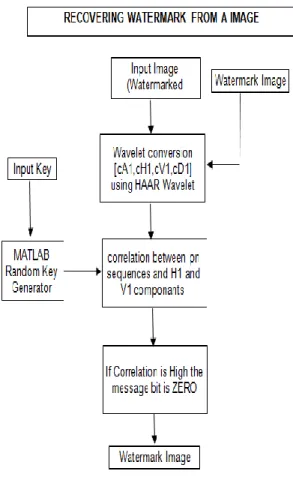
The watermark extraction /retrieval procedure can be summarized in the following steps as shown in figure 5.3.
As the proposed watermarking algorithm is a blind watermarking algorithm, the original host image is not required in the watermark extraction procedure.
Step 1: Apply DWT to the watermarked image such that it produces the sub bands
Step 2: Select the sub bands in which watermark was embedded.
Step 3: Generate the pseudo random (PN) sequence using the same seed that was used while the watermark was embedded.
Step 4: We calculate the correlation between the bands where watermark was embedded and the generated pseudo random (PN) sequence.
Step 6: Repeat the procedure the number of times equal to the number of bits in the watermark vector.
Step 7: If the correlation value crosses a certain fixed threshold value then the extracted watermark bit is a 0, otherwise it is taken as 1
Step 8: The watermark image is reconstructed using the extracted watermark bits and the similarity between the original and extracted watermark is compared
Figure 5.3: Flowchart for recovering watermark from an
28 All Rights Reserved © 2012 IJARCSEE
6. Simulation results:
Figure 6.1: Matlab Command Window.
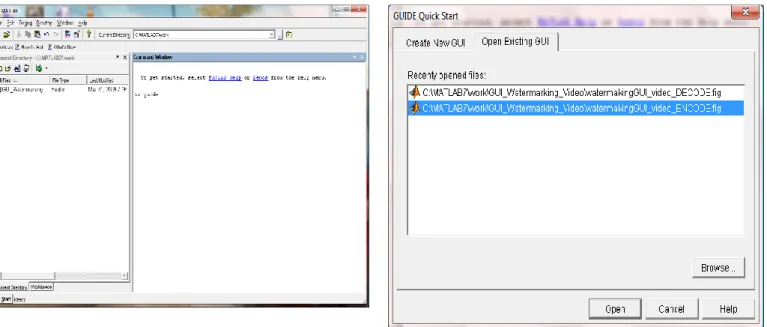
The figure 6.1 above shows the Matlab command window when we start. As can be seen the file name is GUI_watermarking.
Figure 6.2: Current directory before encoding.
The figure 6.2 shows the current directory before encoding and it also shows different MATLAB files, logos folder, video folder etc. used in the project.
Figure 6.3: Opening existing GUI for encoding process.
Figure 6.3 shows the existing GUI for the encoding process. The file which is selected is highlighted, as can be seen form the figure.
Figure 6.4: Encoding Process.
29 All Rights Reserved © 2012 IJARCSEE
Figure 6.5: Current Directory after encoding.
Figure 6.5 shows the current directory after encoding process. It can be seen clearly that after we embed the watermark in the cover signal two new items are displayed, dwt_watermarked that is the cover signal we have selected and the watermarked image denoted as watermark. These two items will be generated after the encoding process only. These items were not seen in the previous figure, figure 6.2.
Figure 6.6: Opening existing GUI for decoding process.
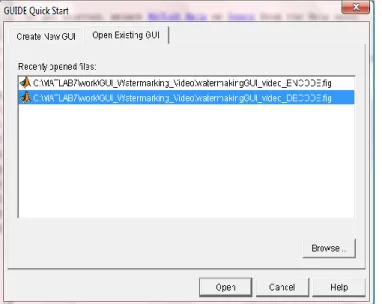
The figure 6.6 shows the existing GUI for the decoding process. The file which is selected is highlighted as can be seen form the figure.
Figure 6.7: Decoding process and final result.
Figure 6.7 shows the decoding process. Here the video with watermark embedded in it i.e., watermark.avi is selected along with the watermark image. When we click the “Decode” option we get the recovered watermark image which is the final result.
The watermark that is recovered appears to be same as the inserted watermark. However, there is some difference between the original watermark and what is recovered. The analysis is done and the differences are observed.
30 All Rights Reserved © 2012 IJARCSEE
The logo used for inserting the watermark is “isi.bmp”. As can be seen from the above figure the size of the logo is 45 x 66 i.e., 2970 elements using 2970 bytes.
The video used is “sample1.avi” consisting of a total of 25 frames, with 30.0003 frames per second, with a width and height of 640 and 480 respectively.
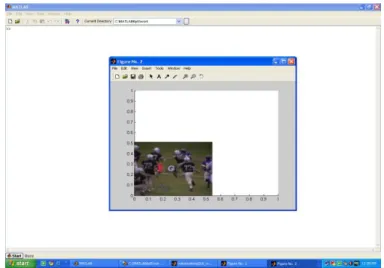
The figure 6.9 shows the watermarked video, that is; the video in which the watermark is embedded is shown. The figure 6.10 shows the recovered watermark image from the watermarked video.
Figure 6.10 Recovered watermark image
Figure 6.11 Histogram of original watermark image
The above figure shows the histogram of original watermark image. In grey scale bitmap image each pixel is stored as a byte, value between 0 to 255. Thus there are more pixels with value 255 and fewer pixels with value 0.
Figure 6.12 below shows the histogram of the recovered watermark image.
31 All Rights Reserved © 2012 IJARCSEE
Figure 6.13 Difference between original and recovered watermark images
The above figure shows the difference between the original and the recovered watermark image.
As another example, a video of a rugby match was
taken as the cover signal and the watermark was inserted. The video was of poor quality and thus the recovered watermark has noise which can be seen.
Figure 6.14 Details of rugby match video
The logo used for inserting the watermark is “isi.bmp”. The size of the logo is 45 x 66 i.e., 2970 elements using 2970 bytes.
The video used is “rugby.avi” consisting of a total of 150 frames, with 15.0002 frames per second, with a width and height of 240 and 176 respectively.
The figure 6.15 shows the watermarked video, that is; the video in which the watermark is embedded, is shown. The figure 6.16 shows the recovered watermark image from the watermarked video. In the recovered watermark the presence of noise is clearly seen.
Figure 6.15 Watermarked rugby video “watermark.avi”
32 All Rights Reserved © 2012 IJARCSEE
Figure 6.17 Histogram of original watermark image
The above figure shows the histogram of original watermark image. In grey scale bitmap image each pixel is stored as a byte, value between 0 to 255. Thus there are more pixels with value 255 and fewer pixels with value 0. Figure 6.18 below shows the histogram of the recovered watermark image.
Figure 6.18 Histogram of recovered watermark image
Figure 6.19 Difference between original and recovered watermark images
The above figure 6.19 shows the difference between the original and recovered watermark images.
5.5 Conclusion:
Watermarking is a concept of embedding a special pattern, watermark, into a document. Watermarking is a key process for the protection of copyright ownership of electronic data. Recent advancements in computer technologies offer many facilities for duplication, distribution, creation, and manipulation of digital contents. Encryption is useful for transmission but does not provide a way to examine the original data in its protected form.
Watermarking is a technology that can serve a wide variety of applications, each of which may have different requirements. Each application requires different trade-off between the properties of robustness, tamper resistance fidelity etc. Purely these properties are totally dependent on application. This study has introduced a technique for the watermarking of digital video, as well as touching on the limitations and possibilities of each. Although only the very surface of the field was scratched, it was still enough to draw several conclusions about digital watermarking.
33 All Rights Reserved © 2012 IJARCSEE
requirements. The wavelet domain may be one of the most promising domains for digital watermarking yet found.
Although not discussed here, the counters proposed to these attacks typically rely on discovering the exact rotation, or shifting used in the attack, and then transforming the image back into its pre-attack state. Typically these techniques are computationally pricey, and unpredictable. However no technique is resistant to all types of attacks. This remains one of the major problems in the development of robust digital watermarking for digital media.
We further conclude that there cannot be a single set of standards proposed for all watermarking systems. However, a separate set of standards should be applied to each system according to application for which it is intended. Digital watermarking and its technological advancements should continue to be researched and developed.The future of digital watermarking relies on setting standards and creating applications so that creators of digital content can easily implement it. In this paper covers a brief introduction to Digital Video Watermarking, Classification of different video watermarking techniques, comparison between the techniques, have been discussed in brief. Finally watermark technology is very demand in now a days in image processing. This chapter discusses the results that have been obtained by the watermarking algorithm. Some of the videos that have been used are shown along with the results.
VIII References:
[1] I.J. Cox, M.L. Miller, J.M.G. Linnartz, T. Kalker, “A Review of Watermarking Principles and Practices” in Digital Signal Processing for Multimedia Systems, K.K. Parhi, T. Nishitani, eds., New York, New York, Marcel Dekker, Inc., 1999, pp 461-482.
[2] J.A. Bloom, I.J. Cox, T. Kalker, J.M.G. Linnartz, M.L. Miller, C.B.S. Traw, “Copy Protection for DVD Video” in Proceedings of the IEEE, vol. 87, pp 1267,1272-1275, July 1999.
[3] R.C. Gonzalez, R.E. Woods, “Digital Image Processing”, Upper Saddle River, New Jersey, Prentice Hall, Inc., 2002.
[4] M. Kutter, F. Hartung, “Introduction to Watermarking Techniques” in Information Techniques for Steganography and Digital Watermarking, S.C. Katzenbeisser et al., Eds. Northwood, MA: Artec House, Dec. 1999, pp 97-119.
[5] G. Langelaar, I. Setyawan, R.L. Lagendijk, “Watermarking Digital Image and Video Data”, in IEEE Signal Processing Magazine, Vol 17, pp 20-43, September 2000.
[6] Ingemar J. Cox, Matt L. Miller and Jeffrey A. Bloom, “International Conference on Information Technology „2000, Las Vegas, 2000.
[7] Pik Wah Chan, Michael R Lyu, Roland T Chin, “A Novel Scheme for Hybrid Digital Video Watermarking: Approach, Evaluation and Experimentation, IEEE Transactions on Circuits and Systems for Video Technology, Vol 15, No. 12, December 2005.
[8] O.Dumitru, M. Mitrea, and F. Prêteux, “Theoretical limits in DWT video watermarking”, Mathematics of Data/Image Pattern Recognition, Compression, and Encryption with Applications, San Diego, USA, Proc. SPIE, Vol. 7075, 70750C (2008) .
[9] Sadik A.M. Al-Taweel, Putra Sumari, "Digital Video
Watermarkinginthe Discrete Wavelet Transform Domain," pp.133-137, 2009
Sixth International Conference on Computer Graphics, Imaging and Visualization, 2009.
[10] Chetan K R Raghavendra K.“DWT Based Blind Digital Video Watermarking Scheme for Video Authentication. International Journal of Computer Applications 4(10):19–26, August 2010.
34 All Rights Reserved © 2012 IJARCSEE
Authors Biography:
VARADALA SRIDHAR is from HYDERABAD,
Completed M.TECH in ECE with specialization
(WIRELESS AND MOBILE COMMUNICATION SYSTEMS) from vardhaman college of engineering affiliated by JNTUH in 2011.he has completed M.Sc (IT)from Nagarjuna University, guntur, AndhraPradesh.and B.TECH
in ECE from vidya jyothi institute of technology affiliated by
JNTUH in 2007. Currently he is working as an Assistant professor in ECE department at Vidya Jyothi Institute of Technology, Hyderabad from 2010.he is having more than 2 years experience as an assistant professor. His areas of
research interests include Wireless and Mobile
communicationsystems,Digitalsignalprocessing, Imageprocessing,Telecommunications,communication systems, Signal processing,Embedded systems. He is
Lifetime Membership of ISTE, IETE.
M.J SUCHARITHA still working as an Assistant Professor
in ECE department at Vidya Jyothi Institute of Technology, Hyderabad from 2007.she is having more than 3years experience as an assistant professor. Her areas of research