© 2019, IRJET | Impact Factor value: 7.211 | ISO 9001:2008 Certified Journal
| Page 3844
HIGH CAPACITY REVERSIBLE DATA HIDING IN ENCRYPTED IMAGES BY
MSB PREDICTION METHOD
Aswathy Lekshmi. S
1, Hari. S
2, Netha Merin Mathew
31
PG Student, Dept. Of Electronics and Communication Engineering, Mount Zion College of Engineering, Kerala,
India
2
Assistant Professor, Dept. Of Electronics and Communication Engineering, Mount Zion College of Engineering,
Kerala, India
32
Assistant Professor, Dept. Of Electronics and Communication Engineering, Mount Zion College of Engineering,
Kerala, India
---***---Abstract -
Data Privacy has received considerable attentionin all fields. In the last few years, data and visual privacy has become a major problem. Because of this, Reversible Data Hiding (RDH) in encrypted image has a lot of attention from the communities of privacy, security and protection. The previous RDH methods are not able to hide a large amount of information with very high embedding capacity as well as it does not provide a very good reconstructed image quality. This paper presents a high efficient reversible data hiding in encrypted image by MSB prediction method. In this method RDH is a process to embedded useful data into a cover media or encrypted image using MSB prediction. It is a two step data hiding procedure, first embed data inside a media file and second, the hidden data and the original image can be loss lessly extracted. Here present two approaches: (1) High Capacity Reversible Data Hiding on MSBs with Correction of Prediction Error (CPE – MHCRDH), (2) High Capacity Reversible Data Hiding on MSBs with Embedded Prediction Errors (EPE – MHCRDH). Before transmitting the data embedded image to the receiver we can use image compression techniques to reduce the amount of data required to represent an image. With these methods, the results are better than those obtained in the previous method.
Key Words: Reversible Data Hiding (RDH), Embedding Capacity, Compression, MHCRDH, MSB Prediction.
1. INTRODUCTION
Communication of digital information becomes frequent nowadays, because of its fast access capability. A wide range of technologies for end-to-end protection are needed to resist the security threats in modern communication. Two main techniques for secure communication is Data hiding and Cryptography. In cryptography, the plain data is changed into an unreadable form called cipher data. The limitation of cryptography is that the third party is always conscious about the communication. In data hiding, the data is hidden in a cover file and it will be transmitted over the network [2] - [6]. Hiding the existence of secret information is the main advantage of data hiding technique over cryptography. Therefore, hacker or eavesdropper, and other, does not
access the original message or any other type of information transmitted through the public networks such as internet.
Data hiding is a process to embed useful data (information) into a cover media. RDH is a data hiding techniques. Reversible Data Hiding can be defined as an approach where data is hidden in the cover media that may be an image. It is a two-step data hiding procedure: first, embed (hide) data inside a media file and second, the hidden data and the original image can be loss lessly extracted. A reversible data hiding is an approach, which can recover the original image loss lessly after the data have been extracted from the cover image.
This paper introduces an effective approach for Data Hiding in Encrypted domain. We suggest embedding the secret message by two bit MSB substitution. As the values of the replaced MSB are lost during the data hiding phase, it is necessary to be able to predict them without errors during the decoding phase. In our design uses two methods for reversible data hiding, i.e., CPE – MHCRDH and EPE – MHCRDH.
© 2019, IRJET | Impact Factor value: 7.211 | ISO 9001:2008 Certified Journal
| Page 3845
proposed scheme provides a good security level and can beused to preserve the original image content confidentiality, while offering authenticity or integrity. It improves the reconstructed image quality as well as the embedding capacity.
The rest of the paper is organized as follows. Section II gives an overview of related work on reversible data hiding in encrypted images. Then, the proposed method is described in detail in Section III. Experimental results and analysis are provided in Section IV. Finally, the conclusion is drawn in Section V.
2
.
RELATED WORK
Reversible data hiding (RDH) is particularly suitable for authentication and data enrichment. It consists of embedding a hidden message into an image. After that, it is possible to extract the secret data and to loss lessly recover the original image. The methods are based on lossless compression appending, difference expansion [10], [11], histogram shifting [12], [13], [9] or a combination of these schemes [8], [15]. Also, by altering the content of an original image, encryption provides a particular visual confidentiality. Cryptosystems can be divided into two groups.
In [2], Pauline Puteaux and William Puech propose a reversible data hiding in encrypted images based on adaptive local entropy method. The original image is firstly encrypted with AES cryptosystem in ECB mode to ensure image content confidentiality. In fact, we suggest adapting the Shannon entropy measurement in order to be able to perform a significant local analysis. During the reconstruction phase, we use this statistical metric instead of standard deviation to loss lessly recover each block of 4 × 4 pixels from the original image. In this approach, the payload is quite small (0.0625 bpp).
In [3], this paper proposes a novel scheme of reversible data hiding (RDH) in encrypted images using distributed source coding (DSC). After the original image is encrypted using a stream cipher by the content owner, the data - hider compresses a series of bits selected from the encrypted image to make a room for the secret data. The bit selected from encrypted image is Slepian - Wolf encoded using low density parity check (LDPC) codes. On the receiver side, the secret bits can be extracted if the receiver has the embedding key only. In case were the receiver has only the encryption key, they can recover the original image using an image estimation algorithm. If the receiver has both the data hiding and encryption keys, they can recover both secret data and the original image using the distributed source decoding.
Wien Hong, Tung-Shou Chen, and Han-Yan Wu in [4], this letter proposes an improved version of Zhang’s
reversible data hiding method in encrypted images. The work divides the encrypted image into blocks, and each block carries one bit by replacing three LSBs. The data extraction and image recovery can be achieved by analyzing the block smoothness. Zhang’s work is not fully utilizing the pixels for calculating the smoothness of each block. Also does not consider the pixel correlations in the border of neighboring blocks. These two issues reduce the correctness of the data extraction. This paper gives a better scheme for measuring the smoothness of the blocks, and uses the side-match techniques to decrease the error rate of extracted-bits.
In [5], Zhang et al. encrypted the cover image by using public key cryptography with probabilistic and homomorphic properties. After the encryption phase, they embed data in the LSB planes of the encrypted pixels. During the decoding phase, as the introduced distortion was quite low, the embedded data is extracted and the original image was recovered loss lessly.
Chao-Yung Hsu, Chun-Shien Lu, and Soo-Chang Pei propose a privacy-preserving realization of the SIFT method based on homomorphic encryption. Security analysis is based on the discrete logarithm problem and RSA that PPSIFT is secure against cipher text attack only and known plaintext attack. Experimental results of proposed homomorphic encryption-based privacy-preserving SIFT obtained from different cases gives comparably to the original SIFT. Also this method is useful in SIFT-based privacy-preserving applications [6].
Ma et al. were the first to describe a RRBE technique [7]. They proposed to release a part of the original image by applying a RDH method of histogram shifting. After that, they encrypted the image and then inserted information by substituting some LSB values in the encrypted image. With this method, the payload is higher than in previous methods but the reconstructed image is altered when compared with the original.
In [8], prediction-error expansion (PEE) based reversible data hiding gives better exploiting image redundancy usually provides a superior performance. In this paper, an efficient RDH scheme based on pair wise PEE is proposed. The pair wise PEE is a novel reversible mapping that utilizes the correlations among prediction- errors. With the help of this type of correlations, the distortion can be controlled at a low level, and thereby the proposed scheme outperforms some state-of-the-art RDH algorithms.
2
.
PROPOSED SYSTEM
© 2019, IRJET | Impact Factor value: 7.211 | ISO 9001:2008 Certified Journal
| Page 3846
storage. For these reason, Here present a new high capacityreversible data hiding scheme for encrypted images based on MSB (two most significant bits) prediction with a very high capacity. Also we can use image compression techniques to reduce the amount of data required to represent an image and reducing the bandwidth required to transmit it.
We present two approaches, these are: high capacity reversible data hiding on MSBs with correction of prediction errors (CPE-MHCRDH) and high capacity reversible data hiding on MSBs with embedded prediction errors (EPE-MHCRDH). In CPE-MHCRDH, it is possible to embed a secret message in the MSB of the encrypted image. At the decoding phase, the original image is reconstructed perfectly, but the secret message becomes distorted.
In EPE – MHCRDH
method, it is possible to embed a secret message in the
MSB of the encrypted image. At the decoding phase, the
original image becomes distorted, but the secret
message can be reconstructed perfectly.
2.1 CPE-MHCRDH
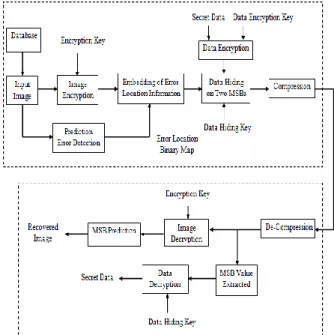
[image:3.595.40.282.453.696.2]In the CPE-MHCRDH approach, as shown in Fig 1. In this method, we propose to embed the secret message (2 bit per pixel) by MSB substitution with very high embedding capacity and visual quality. The goal of our proposition is that an original image I, could be encrypted by using a secret key Ke and that another person could embed a message by using a data hiding key Kw, without knowing Ke [1].
Fig - 1: Blockdiagram of CPE-MHCRDH Method The encoding phase consists of four steps: the prediction error detection, the image encryption, the 2 bit data hiding by MSB substitution and compression as shown in fig 1.
1. Prediction error detection:
In this method, the input image is taken from the data base. First predict all the prediction errors in the input image i.e., we can embed the secret message (2 bit per pixel) by MSB substitution, the original MSB values are lost after the data hiding step. It is important, during the decoding phase, to be able to predict them without any errors. Indeed, in order to reconstruct the original image, we propose to use the previous pixels to predict the current pixel value [1].
Consider the current pixel P(i, j), with 0 ≤ i < m and 0 ≤ j < n, and its inverse value, which is inv(i, j) = (P(i, j) + 128) mod 256.
From the previously scanned neighbors of P(i, j), compute the value Perror (i, j).
(1)
Calculate the absolute difference between Perror(i, j) and P(i, j) and its inv(i, j).
(2)
Compare the values of ∆ and ∆inv. If ∆ < ∆’, there is no prediction error.
After the prediction error detection phase, we propose to pre-process the original image I in order to obtain an image I’ without any prediction errors.
(3)
2. Image Encryption:
In order to make the original image I unreadable, we encrypt it by using an encryption key Ke. The elements of this key are used as parameters of a chaotic generator, based on the Piecewise Linear Chaotic Map (PWLCM) [14]. By using this chaotic generator, a sequence of pseudo-random bytes S(i, j) is obtained and the encrypted pixels Pe(i, j) can be calculated through exclusive-or (XOR) operation:
(4)
3. Data embedding :
© 2019, IRJET | Impact Factor value: 7.211 | ISO 9001:2008 Certified Journal
| Page 3847
and the MSB of each available pixel is substituted by two bitbT, with 0 ≤ T< m × n, of the secret message:
(5)
Note that only the first pixel cannot be marked because its value is not predictable, thus its value must not be changed.
4. Compression:
After this process, we can compress the data embedded image using image compression techniques. Image compression is reducing the size without degrading the quality of the image to an unacceptable level. Here we use LZ77 compression technique. LZ77 compression works by finding sequence of data that are repeated. The sequence of characters to be compressed is identical to the characters found within the sliding window. The sequence of characters is replaced by two numbers: a distance is representing how far back into the window the sequence starts, and a length, is representing the number of characters for which the sequence is identical.
5. Data extraction and image recovery
For the decoding phase, since our method is separable, we can extract the secret message and reconstruct the clear image IR separately. Before that we can decompressed the data embedded image. If the recipient has a key Kw, the pixels from the decompressed image are scanned in the scan line order and the MSB of each pixel are extracted in order to retrieve the encrypted secret message:
(6)
If the recipient only has Ke, the image IR can be reconstructed and the secret data can be extracted by using the following steps:
The encryption key Ke is used to generate the sequence S (i, j), with m × n pseudo-random bytes.
The pixels of the decrypted image are scanned in the scan line order, and for each pixel, the seven LSB are retrieved by XORing the decrypted value Pdata(i, j) with the associated binary sequence S(i, j) in the pseudo-random stream:
(7)
The MSB value is predicted:
With the values of the previously decrypted adjacent pixels, the value of the predictor Perror(i, j) is computed.
The pixel value is considered with MSB = 0 and with MSB = 1 and the differences between each of these two values and Perror(i, j) are calculated. These values are recorded as ∆0 and ∆1.
(8)
The smallest value between ∆0 and ∆1 gives the searched pixel value:
(9)
2.2 EPE – MHCRDH
[image:4.595.320.545.397.624.2]In this method the original image is directly encrypted, but after the encryption step, the location of the prediction errors is embedded (EPE). During the data hiding phase, in both approaches, the MSB of each available pixel is substituted in the encrypted image by 2 bit of the secret message that embedded image can be loss lessly compressed.
Fig - 2:Block diagram of EPE-MHCRDH Method
© 2019, IRJET | Impact Factor value: 7.211 | ISO 9001:2008 Certified Journal
| Page 3848
(CPE) before encryption and in EPE – MHCRDH method thelocation of the prediction errors is embedded (EPE) [1].
1.
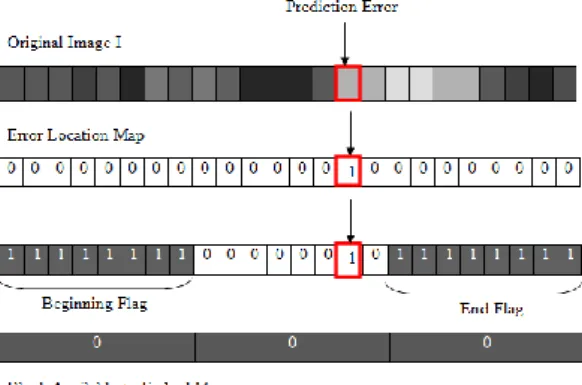
Embedding of the error location binary map: [image:5.595.64.260.376.509.2]During prediction error detection [1], the location of the prediction errors is stored in the error location binary map. Then, the original image I is encrypted by using Eq. (4). Before the embedding step, the encrypted image Pe is adapted to avoid prediction errors. The encrypted image Pe is then divided into blocks of eight pixels and scanned, block by block, in the scan line order. If at least one prediction error is identified in a block according to the error location binary map, the current block is surrounded by two flags by replacing the MSB of each pixel in the previous and the following blocks by 1. If there are errors in two adjacent blocks, the flag which indicates the end of the error sequence is shifted until the next block without error as indicated in Fig. 3. In the case where there is no error in the current block and if it does not serve as a flag, then the eight pixels of this block are used for data hiding i.e., the available block with 0 represent the block is not used for data hiding if there is 1 represent the block is used for data hiding.
Fig - 3:Finding available block for data hiding
2.
Data extraction and image recovery:In this phase, three cases are considered: (1) the recipient has only the data hiding key, (2) the recipient has only the encryption key and (3) the recipient has both the encryption and the watermarking keys. In the first case, the recipient can extract the secret message by following these steps
The pixels of the decompressed image are scanned in the scan line order and for each pixel; the MSB value is extracted, according to Eq. (6), and stored. Before the first sequence of eight MSB equal to 1, the extracted values are bits of the embedded message.
When such a sequence is encountered, it indicates the beginning of an error sequence: the next pixels
were not marked during the data hiding step. So, scan pixels until the next sequence of eight MSB equal to 1, which indicates the end of the error sequence.
Repeat this process until the end of the image.
Finally, use the data hiding key to obtain the clear text of the secret message
In the second case, the recipient can reconstruct the original image I by using MSB prediction:
Use the encryption key to generate the pseudo-random chaotic sequence.
Scan the pixels of the decompressed image in the Scan line order and for each pixel, retrieve the seven least significant bits (LSB) of P(i, j) by XORing Pdata(i, j) with binary sequence in the chaotic stream. Predict the MSB value
Consider P(i, j)MSB=0 and P(i, j)MSB=1 as the pixel value with MSB = 0 and MSB = 1, respectively.
Calculate the absolute difference between each of these two values with P(i, j −1) and with P(i−1, j) is Perror(i, j). These values are recorded as ∆0 and ∆1 using Eq. 8.
The smaller value gives the original pixel value by using the Eq. 9. Finally, if the receiver has both the data hiding and encryption keys, they can extract the secret message and reconstruct the original image.
3.
RESULT
© 2019, IRJET | Impact Factor value: 7.211 | ISO 9001:2008 Certified Journal
| Page 3849
Fig - 3: Original image I
(a) (b)
(c) (d)
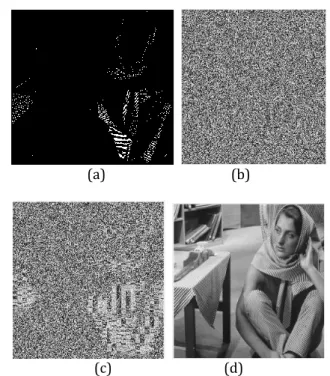
(e) Fig - 4: Illustration of our proposed CPE – MHCRDH method on the test image Barbara (512 x 512), (a) Binary error location map with predicted error, (b) Pre-processed
image I’ (Error corrected image), (c) Encrypted image Pe(i, j), (d) Data embedded image (2 bit per pixel) with 1.999985 capacity, (e) Recovered image, PSNR=44.699724
dB, SSIM= 0.996905
In the CPE-HCRDH approach (Fig. 4.a), they are pixels of the original image whose the MSB would be badly predicted if we do not adapt their values during the pre-processing phase. After this pre-pre-processing step, the adapted images are obtained. This is similar to original image. The compression reduces the number of bits required to represent an image. The size before compression is 524288 and the size after compression is 89570. Therefore the percentage of compression is 82%. At the decoding phase the compressed image can be decompressed then extract the data and the image. Finally, after data extraction, reconstructed images are exactly the same as pre-processed images and very similar to original images, even when some pixel values were changed during the preprocessing step. In these cases, PSNR is high and SSIM is close to 1: PSNR = 44.699 dB, SSIM = 0.9969 and PSNR and SSIM for other image are similar with this result.
(a) (b)
[image:6.595.301.549.56.345.2]
(c) (d)
Fig - 5: Illustration of our proposed EPE – MHCRDH method on the test image Barbara (512 x 512), (a) Binary
error location map with predicted error, (b) Encrypted image Pe(i, j), (d) Data embedded image (2 bit per pixel)
with 1.999985 capacity, (e) Recovered image, PSNR=43.999652 dB, SSIM= 0.995837
In the EPE-HCRDH approach (Fig. 5.a); they indicate all the pixels which will not be marked. Indeed, in addition, in grey we show the pixels which are not used to embed bits of the secret message because they serve as flags or are part of an error sequence. Note that the prediction errors are often on the edges and there is sometimes more than one error in the same block and, in these cases, the loss in terms of embedding capacity decreases.
[image:6.595.37.250.96.468.2]© 2019, IRJET | Impact Factor value: 7.211 | ISO 9001:2008 Certified Journal
| Page 3850
4. CONCLUSION
In this paper, we propose a high capacity reversible data hiding method in encrypted images based on the MSB prediction. Indeed, by replacing all the MSB in the image, it is possible to hide two bit per pixel. In addition to this excellent embedding capacity, the reconstructed image quality is high. By analyzing the content of the original image, all the prediction errors are highlighted and the encrypted image is modified accordingly. After that, by substituting most of the MSB values in the image, it is possible to hide a large message and compression reduces the number of bit used to represent an image. There for we can reduce the bandwidth required to transmit and receive an image. Finally, in the extraction phase, the compressed image is decompressed and the original image is reconstructed without any errors and the secret message is perfectly extracted
ACKNOWLEDGEMENT
We thank the anonymous reviewers and the editors for the thorough reviews and comments. Also thanks the Head of Electronics and communication Department Professor Rangit Varghese and the M.Tech co-coordinator Asst. Prof. Shahana Habeeb Mohammed. Express our sincere gratitude internal supervisor, Asst Prof. Hari S for rendering us all the facilities for the completion of the project. Also like to express our thanks to all other faculty members of Electronics and Communication Department at Mount Zion College of Engineering, Kadammanitta for the valuable help provided by them.
REFERENCES
[1] Pauline Puteaux, and William Puech, “An Efficient MSB
Prediction-Based Method for High-Capacity Reversible Data Hiding in Encrypted Images” IEEE Transactions on Information Forensics and Security, 2018.
[2] Pauline Puteaux and William Puech “ Reversible Data
Hiding in Encrypted Images based on Adaptive Local Entropy Analysis” IEEE, 2017
[3] Z. Qian and X. Zhang, “Reversible data hiding in
encrypted images with distributed source encoding,” IEEE Transactions on Circuits and Systems for Video Technology, vol. 26, no. 4, pp. 636–646, 2016.
[4] W. Hong, T.-S. Chen, and H.-Y. Wu, “An improved
reversible data hiding in encrypted images using side match,” IEEE Signal Processing Letters, vol. 19, no. 4, pp. 199–202, 2012.
[5] X. Zhang, J. Long, Z. Wang, and H. Cheng, “Lossless and
reversible data hiding in encrypted images with public-key cryptography,” IEEE Transactions on Circuits and Systems for Video Technology, vol. 26, no. 9, pp. 1622– 1631, 2016.
[6] C.-Y. Hsu, C.-S. Lu, and S.-C. Pei, “Image feature
extraction in encrypted domain with privacy-preserving
SIFT,” IEEE Transactions on Image Processing, vol. 21, no. 11, pp. 4593–4607, 2012.
[7] K. Ma, W. Zhang, X. Zhao, N. Yu, and F. Li, “Reversible
data hiding in encrypted images by reserving room before encryption,” IEEE Transactions on Information Forensics and Security, vol. 8, no. 3, pp. 553–562, 2013
[8] B. Ou, X. Li, Y. Zhao, R. Ni, and Y.-Q. Shi, “Pairwise
prediction-error expansion for efficient reversible data hiding,” IEEE Transactions on Image Processing, vol. 22, no. 12, pp. 5010–5021, 2013
[9] W.-L. Tai, C.-M. Yeh, and C.-C. Chang, “Reversible data
hiding based on histogram modification of pixel differences,” IEEE Transactions on Circuits and Systems for Video Technologyy, vol. 19, no. 6, pp. 906–910, 2009
[10]J. Tian, “Reversible watermarking by difference
expansion,” in Proceedings of Workshop on Multimedia and Security, vol.19,2002.
[11] ——, “Reversible data embedding using a difference expansion,” IEEE Transactions on Circuits and Systems for Video Technology, vol. 13, no. 8, pp. 890–896, 2003. [12] X. Gao, L. An, Y. Yuan, D. Tao, and X. Li, “Lossless data embedding using generalized statistical quantity histogram,” IEEE Transactions on Circuits and Systems for Video Technology, vol. 21, no. 8, pp. 1061– 1070, 2011.
[13] Z. Ni, Y.-Q. Shi, N. Ansari, and W. Su, “Reversible data hiding,” IEEE Transactions on Circuits and Systems for Video Technology, vol. 16, no. 3, pp. 354–362, 2006. [14] S. Li, G. Chen, and X. Mou, “On the dynamical
degradation of digital piecewise linear chaotic maps,” International Journal of Bifurcation and Chaos, vol. 15, no. 10, pp. 3119–3151,2005.