warwick.ac.uk/lib-publications
Original citation:
Rolls, Edmund T., Cheng, Wei, Gilson, Matthieu, Qiu, Jiang, Hu, Zicheng, Ruan, Hongtao, Li, Yu, Huang, Chu-Chung, Yang, Albert C, Tsai, Shih-Jen, Zhang, Xiaodong, Zhuang, Kaixiang, Lin, Ching-Po, Deco, Gustavo, Xie, Peng and Feng, Jianfeng (2018) Effective connectivity in
depression. Biological psychiatry. Cognitive neuroscience and neuroimaging, 3 (2). pp.
187-197. doi:10.1016/j.bpsc.2017.10.004
Permanent WRAP URL:
http://wrap.warwick.ac.uk/100276
Copyright and reuse:
The Warwick Research Archive Portal (WRAP) makes this work by researchers of the University of Warwick available open access under the following conditions. Copyright © and all moral rights to the version of the paper presented here belong to the individual author(s) and/or other copyright owners. To the extent reasonable and practicable the material made available in WRAP has been checked for eligibility before being made available.
Copies of full items can be used for personal research or study, educational, or not-for-profit purposes without prior permission or charge. Provided that the authors, title and full bibliographic details are credited, a hyperlink and/or URL is given for the original metadata page and the content is not changed in any way.
Publisher’s statement:
© 2018, Elsevier. Licensed under the Creative Commons Attribution-NonCommercial-NoDerivatives 4.0 International http://creativecommons.org/licenses/by-nc-nd/4.0/
A note on versions:
The version presented here may differ from the published version or, version of record, if you wish to cite this item you are advised to consult the publisher’s version. Please see the ‘permanent WRAP URL’ above for details on accessing the published version and note that access may require a subscription.
1
Effective connectivity in depression
Edmund T. Rolls1,2, #; Wei Cheng1,3 #; Matthieu Gilson13, #; Jiang Qiu4,5, #; Zicheng Hu7,8,9,#; Hongtao Ruan3,6; Yu Li5; Chu-Chung Huang7; Albert C. Yang11; Shih-Jen Tsai11; Xiaodong Zhang7,8,9; Kaixiang Zhuang5; Ching-Po Lin3,7, 15,*; Gustavo Deco13,14; Peng Xie8,9,10, *;Jianfeng Feng1, 3, 6,12, *
1. Department of Computer Science, University of Warwick, Coventry CV4 7AL, UK 2. Oxford Centre for Computational Neuroscience, Oxford, UK
3. Institute of Science and Technology for Brain-inspired Intelligence, Fudan University, Shanghai, 200433, PR China
4. Key Laboratory of Cognition and Personality (SWU), Ministry of Education, Chongqing, China
5. Department of Psychology, Southwest University, Chongqing, China
6. School of Mathematical Sciences, Fudan University, Shanghai, 200433, PR China 7. Institute of Neuroscience, National Yang-Ming University, Taipei, Taiwan 8. Institute of Neuroscience, Chongqing Medical University, Chongqing, China 9. Chongqing Key Laboratory of Neurobiology, Chongqing, China
10. Department of Neurology, The First Affiliated Hospital of Chongqing Medical University, Chongqing, China
11. Department of Psychiatry, Taipei Veterans General Hospital, Taipei, Taiwan
12. School of Life Science and the Collaborative Innovation Center for Brain Science, Fudan University, Shanghai, 200433, PR China
13. Center for Brain and Cognition, Computational Neuroscience Group, Department of Information and Communication Technologies, Universitat Pompeu Fabra, Roc Boronat 138, Barcelona, 08018, Spain Brain and Cognition, Pompeu Fabra University, Barcelona, Spain. 14. Institució Catalana de la Recerca i Estudis Avançats (ICREA), Universitat Pompeu Fabra, Passeig Lluís Companys 23, Barcelona, 08010, Spain.
15. Brain Research Center, National Yang-Ming University, Taipei, Taiwan
# These authors contributed equally to this work.
Short title: effective connectivity and depression
Keywords: depression; effective connectivity; orbitofrontal cortex; functional connectivity; resting state functional neuroimaging; medial temporal lobe; precuneus
ORCID ID of Edmund T Rolls: 0000-0003-3025-1292
Rolls, E. T., Cheng,W., Gilson,M., Qiu,J., Hu,Z., Ruan,H., Li,Y., Huang,C-C., Yang,A.C., Tsai,S-J., ZhangX., Zhuang,K., Lin,C-P., Deco,G., Xie,P., Feng,J. (2018) Effective connectivity in depression.
2
Corresponding author: Professor Edmund T Rolls, Oxford Centre for Computational Neuroscience, Oxford, UK. [email protected] www.oxcns.org
* Correspondence may also be addressed after publication to: Professor Jianfeng Feng,
Centre for Computational Systems Biology,
School of Mathematical Sciences, Fudan University, Shanghai 200433, China, and Department of Computer Science, University of Warwick, Coventry CV4 7AL, UK E-mail: [email protected]
or
Professor Peng Xie, Department of Neurology, The First Affiliated Hospital of Chongqing Medical University,
Chongqing, 400016, PR China E-mail: [email protected]
or
Professor Ching-Po Lin, Institute of Neuroscience, National Yang-Ming University, Taipei, Taiwan E-mail: [email protected]
3 Abstract
Background.
We go beyond resting state functional connectivity which reflects correlations in the activity between brain areas, to effective connectivity between different brain areas to measure directed influences of human brain regions on each other, and compare the results in depression and controls.
Methods.
We utilize a new approach to the measurement of effective connectivity in which each brain area has a simple dynamical model, and known anatomical connectivity is used to provide constraints. This helps the approach to measure the effective connectivity between the 94 AAL2 brain areas using resting state functional magnetic resonance imaging. Moreover, we show how the approach can be used to measure the differences in effective connectivity between different groups of individuals, using as an example effective connectivity in the healthy brain and in individuals with depression. The first brain-wide resting state effective-connectivity neuroimaging analysis of depression, with 350 healthy individuals, and 336 patients with major depressive disorder, is described.
Results.
Key findings are that the medial orbitofrontal cortex, implicated in reward and subjective pleasure, has reduced effective connectivity from temporal lobe input areas in depression; that the lateral orbitofrontal cortex, implicated in non-reward, has increased activity (variance) in depression, with decreased effective connectivity to and from cortical areas contralateral to language-related areas; and that the hippocampus, implicated in memory, has increased activity (variance) in depression and increased effective connectivity from the temporal pole.
Conclusions.
4 Introduction
Resting state functional connectivity measured with functional magnetic resonance imaging and which reflects correlations in the activity between brain areas is widely used to help understand human brain function in health and disease (1, 2). Here we go beyond functional connectivity to effective connectivity between different brain areas to measure directed influences of human brain regions on each other. Effective connectivity is conceptually very different, for it measures the effect of one brain region on another in a particular direction, and can in principle therefore provide information more closely related to the causal processes that operate in brain function, that is, how one brain region influences another. In the context of disorders of brain function, the effective connectivity differences between patients and controls may provide evidence on which brain regions may have altered function, and then influence other brain regions, and thereby be important in understanding the disorder.
In this paper we utilize a new approach to the measurement of effective connectivity in which each brain area has a simple dynamical model, and known anatomical connectivity is used to provide constraints (3). This helps the approach to measure the effective connectivity between the 94 automated anatomical atlas (AAL2) (4) brain areas using resting state functional magnetic resonance imaging. Moreover, we show how the approach can be used to measure the differences in effective connectivity between different groups of individuals, using as an example effective connectivity in the healthy brain and in individuals with depression. This results in the first brain-wide resting state effective-connectivity neuroimaging analysis of depression, with 350 healthy individuals, and 336 patients with major depressive disorder.
Major depressive disorder is ranked by the World Health Organization as the leading cause of years-of-life lived with disability (5-8). Major depressive episodes, found in both major depressive disorder and bipolar disorder are pathological mood states characterized by persistently sad or depressed mood. Major depressive episodes are generally accompanied by: (a) altered incentive and reward processing, evidenced by amotivation, apathy, and anhedonia; (b) impaired modulation of anxiety and worry, manifested by generalized, social and panic anxiety, and oversensitivity to negative feedback; (c) inflexibility of thought and behavior in association with changing reinforcement contingencies, apparent as ruminative thoughts of self-reproach, pessimism, and guilt, and inertia toward initiating goal-directed behavior; (d) altered integration of sensory and social information, as evidenced by mood-congruent processing biases; (e) impaired attention and memory, shown as performance deficits on tests of attention set-shifting and maintenance, and autobiographical and short-term memory; and (f) visceral disturbances, including altered weight, appetite, sleep, and endocrine and autonomic function (5, 7).
Patients with depression show impairments in the coordinated activity of several brain regions considered to be important for several domains of mental functioning such as emotional processing (amygdala, subgenual anterior cingulate and pallidum) (9, 10), self-referential processes (medial prefrontal cortex (MPFC), precuneus and posterior cingulate cortex) (10-12), cognitive functions such as memory (hippocampus, parahippocampal cortex) (13), visual processing (fusiform gyrus, lingual gyrus and lateral temporal cortex) (14), and attention processing (dorsolateral prefrontal cortex, anterior cingulate cortex, thalamus and insula) (15).
5
functional connectivity in depression was based on seed based studies each with tens of participants, and described hypoconnectivity within a frontoparietal network, and hyperconnectivity within the default mode network, a network believed to support internally oriented and self-referential thought (17). For comparison, a recent study included almost as many participants as this meta-analysis, was not forced because of small numbers of participants to rely on a priori, seed-based analyses, and was able given the voxel-based approach to provide detailed information about the exact brain regions involved (2), rather than brain systems identified for example as the ‘default mode network’ or ‘fronto-parietal control systems’. In that first investigation using a voxel-based unbiased brain-wide association study (BWAS) approach on resting-state functional magnetic resonance imaging (fMRI) data in 421 patients with major depressive disorder compared to 488 controls (2), we found decreased functional connectivity between the medial orbitofrontal cortex (which has functions related to reward) with medial temporal lobe memory-related areas including the perirhinal cortex BA 36 and entorhinal cortex BA 28. We also found that the lateral orbitofrontal cortex BA 47/12 (which has functions related to non-reward and punishment) had increased functional connectivity with the precuneus, the angular gyrus, and the temporal visual cortex BA 21 (2). In the present research, we go beyond the functional connectivity (FC) approach, which reflects the inter-region correlations of the observed activity, to effective connectivity (EC), which estimates causal/directed interactions between brain regions. In essence, our model-based approach infers two sets of parameters from FC: the local fluctuating activity for each ROI (e.g., excitability, described by the diagonal parameters of the matrix Σ) and the matrix of EC weights between the ROIs (the existence of connections is determined from DTI data beforehand). Our dynamic model combines these parameters to generate FC, taking network effects into account at the whole-brain level. This approach may be useful in understanding the changes underlying depression, as it is not clear whether causes are circumscribed to the activity of a few nodes, or connectivity within a subnetwork. The new method that we use (3, 18) has advantages and limitations compared to dynamic causal modelling (DCM) (19-21), and is described in the Supplementary Material.
To help understand some of the implications of the new findings described here, we note that there is considerable evidence that the medial and middle orbitofrontal cortex is involved in reward, and that the lateral orbitofrontal cortex is involved in non-reward and punishment (2, 8, 22-24). The hypotheses being investigated were that effective connectivity might be different in patients with depression, and that the identification of which effective connectivities were different may be useful in understanding the neural bases of depression.
Methods
The methods are described in the Supplementary Material.
Results
The fMRI resting state effective connectivity analyses were performed with 336 patients with a diagnosis of major depression, and 350 controls, and this large population was sufficient to allow FDR corrected statistics as described in detail elsewhere (2, 25, 26) with the 94 areas in the AAL2 brain atlas (4) (see Table S1 for the abbreviations for each area).
6
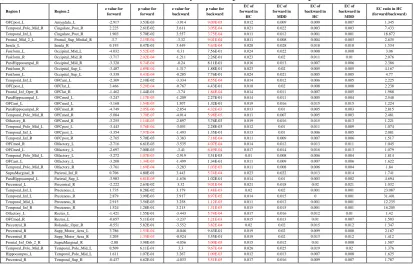
The results of the comparison of Effective Connectivity between patients with Major Depressive Disorder (MDD) and controls are shown in Fig. 1 and Table 1. The results shown are those with significantly different effective connectivity links after FDR p<0.05 correction, and with a threshold for the EC >=0.01 in either or both healthy controls and patients with depression. (This thresholding on effect size precludes reporting trivial effects.) In Table 1, the forward direction is the direction with the higher effective connectivity (see Supplementary Material for further explanation). In Table 1, the results are grouped usefully according to the target region of the altered effective connectivity. We use this grouping by target brain regions to help describe the results for the main groups of differences of effective connectivity between patients and controls. The matrices of Effective Connectivity are shown in Fig. S1 for reference. We focus below on Figures of the brain and tables showing the differences in effective connectivity, but Fig. S1 shows for example that temporal lobe areas 85-94 in AAL2 (Table S1) tend to have high effective connectivity directed to the orbitofrontal areas (25-32) in healthy controls. Another interesting effect is that the functional connectivity from frontal areas including the inferior frontal gyrus (3-12) and lateral orbitofrontal cortex (31, 32) are strong in the direction to supramarginal and angular gyri (65-70). Thus effective connectivity provides useful information, emphasizing that medial orbitofrontal cortex areas receive from the temporal cortex, and that the lateral orbitofrontal cortex / inferior frontal gyrus has strong forward connections to language areas. We emphasize that for most links that are different in depressed patients, the differences are in both the forward and backward effective connectivities (see Table 1 and Fig. S2, FDR corrected p<0.05). What is especially new about the findings presented here is the direction of the forward vs the backward connectivity of these links that are different in depression, and this is emphasized in Fig. 1 by larger arrow heads in the direction of the forward connectivity, defined as the direction with the greater effective connectivity.
We summarize some of the main points evident by inspection of Fig. 1, and then provide a more detailed analysis referring also to Table 1 below. One feature apparent in Fig. 1 is that in depression a number of areas including the parahippocampal gyrus, inferior temporal gyrus, and temporal pole have decreased effective connectivity directed to the medial and middle orbitofrontal cortex areas. Another feature is that the fusiform gyrus (FFG) has decreased effective connectivity directed to earlier visual cortical areas (occipital).
Medial and Middle Orbitofrontal Cortex
The AAL2 regions included in this group and shown in Table 1 are the OFC_med, OFC_ant, OFC_post, Rectus, and OLF (the ‘olfactory tubercle’ region at the posterior end of the orbitofrontal cortex). This medial and middle orbitofrontal cortex region has decreased effective connectivity (shown by a negative value for z in Table 1 and a blue arrow in Fig. 1 into the target) from brain regions including the parahippocampal gyrus, temporal pole, inferior temporal gyrus, and amygdala. This implies less strong positive driving influences of these regions on the medial and middle orbitofrontal cortex (see columns 7 and 8 of Table 1). Many of these effective connectivities were much greater in the forward direction into the medial orbitofrontal cortex than in the backward direction (Table 1). Both the forward and the backward effective connectivities were in general lower in the depressed group than in the controls (Table 1).
There is also reduced effective connectivity between some of these different AAL2 regions in the medial and middle orbitofrontal cortex (see Table 1).
7
The AAL2 regions included in this group and shown in Table 1 are the OFC_lat and Frontal_Inf_Orb. The OFC_post (one of the middle OFC areas) has increased effective connectivity directed to the OFC_lat. Given that the medial orbitofrontal cortex (which includes OFC_post) tends to be activated by rewards and the lateral orbitofrontal cortex by non-rewards and punishers (23, 27) and even that they are reciprocally activated by reward and loss (28), we sought to elucidate the interpretation of this increase in effective connectivity from medial to lateral orbitofrontal cortex in depression. The effective connectivity measure does not specify whether this should be interpreted as increased excitatory input from the medial to the lateral orbitofrontal cortex; or an increased connectivity which might reflect that any change in medial OFC produces a larger change, but in the opposite (reciprocal) direction. We reasoned that the functional connectivity between the medial and lateral orbitofrontal cortex might provide relevant evidence. What we found in summary is that all the medial orbitofrontal cortex areas (OFCmed, OFCant, OFCpost, Rectus, and OLF) have a high functional connectivity with each other that is on average 0.58 (std 0.13) (in the control group). Similarly, the two lateral orbitofrontal cortex areas (OFClat and IFG_Orb) have high functional connectivity with each other that is on average 0.68 (std 0.08). However, the mean FC between the medial orbitofrontal cortex areas and lateral orbitofrontal cortex areas was much lower, 0.36 (std 0.16), and the difference was significant (t test, p<10-12). Further, this relates to an average functional connectivity value across all pairs in the brain of 0.35. This evidence provides an indication that the medial and lateral orbitofrontal cortex areas are not positively coupled to each other, but can operate in opposite directions, and even could operate reciprocally. We thus interpret the increased effective connectivity from medial to lateral orbitofrontal cortex as consistent with the hypothesis that underactivity in the medial orbitofrontal cortex in depression (2, 8) may be one of the causes of lateral orbitofrontal cortex activity being high in depression for which evidence is described below and elsewhere (2, 8).
In addition, the Inferior frontal gyrus opercular part back-connection to the lateral orbitofrontal cortex is reduced in depression. The Supramarginal gyrus has decreased effective connectivity with the Frontal_Inf_Orb_2 in depression. The Supramarginal gyrus_R also has decreased effective connectivity in both directions with OFClat_R.
Temporal lobe
The temporal lobe areas with different effective connectivity in depression include the temporal pole, inferior, and middle temporal gyrus. Most of these areas have reduced forward effective connectivity directed to medial and middle orbitofrontal cortex areas including OFCmed and OFCant. (Although Table 1 shows significant increases in the backprojection to the temporal areas from the precuneus, we discount these because these backprojection ECs are so very low.)
Hippocampus and parahippocampal gyrus
The effective connectivity directed from the temporal pole to the hippocampus is increased in depression. As noted above, the effective connectivity from the parahippocampal gyrus to the medial orbitofrontal cortex areas (and to the superior parietal lobule) is decreased in depression.
Precuneus
8
ratio of > 20 (Table 1). (It is noted that separately each of these forward links did not quite reach the threshold required for FDR correction, although the strengths in the backward direction did.)
Sensori-motor cortical areas
The precentral gyrus (motor cortex) has increased EC directed to some other motor areas including the Supplementary Motor Area.
Differences in both forward and backward effective connectivity in depression
The results of the comparison of EC (forward - backwards) between MDD and HC are shown in Fig. S2. The main implication of this Figure is that links change similarly in both directions in depression. That is, if an effective connectivity link is stronger in one direction in depression, it is likely to be stronger in the other direction too; and if a link is weaker in one direction in depression, it is likely to be weaker in the opposite direction too (r=0.44, p<0.0001).
Differences in Σ, the spontaneous activity parameter, between patients with Major Depressive Disorder and controls
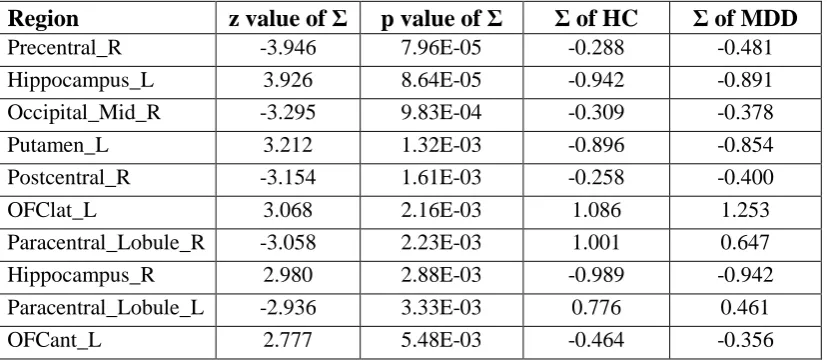
The results of the comparison of Σ between MDD and HC are shown in Fig. 2 and Table 2. Σ values for AAL2 regions significantly different (FDR corrected p<0.05) between depressed patients and controls are shown.
One point of particular interest is that Σ for the right and left hippocampus is significantly increased in patients with major depressive disorder. This is in the context that the effective connectivity directed from the temporal pole to the hippocampus is increased in depression.
A second point of particular interest is that Σ for the lateral orbitofrontal cortex (OFClat_L) is significantly increased in patients with major depressive disorder. This effect spread as far medially as at least a part of OFCant_L. For comparison, the value of Σ for OFClat_R was also increased in depression (p<0.05 uncorrected).
These findings are consistent with the hypothesis that in depression there is increased activity in the lateral orbitofrontal cortex (a region involved in non-reward and punishment), and the hippocampus (a region involved in memory) (2, 8).
Correlations between the effective connectivity links and the depression severity
Correlations between the effective connectivity links and the depression symptom severity scores, in particular, the illness duration, are shown in Table S2. These results provide an indication that the differences in effective connectivity that were found are related to the severity of the depression. Further evidence consistent with this is that some of the effective connectivity links were correlated with the scores on the Beck Depression Inventory (BDI), the Hamilton Depression rating scale D) and the Hamilton Anxiety rating scale (HAM-A), as shown in as shown in Table S2. (This information is provided to help interpret the findings, though we do not rely on these correlations because they are not corrected for multiple comparisons.)
9
A summary of the networks that show different effective connectivity in patients with depression is shown in Fig. 3. A decrease in effective connectivity is shown in blue, and an increase in red.
Discussion
The main findings include the following in this investigation of effective connectivity with 336 patients with major depressive disorder and 350 controls. The key findings are that the medial orbitofrontal cortex, implicated in reward and subjective pleasure, has reduced effective connectivity from temporal lobe areas in depression; that the lateral orbitofrontal cortex, implicated in non-reward, has increased activity in depression, with decreased effective connectivity to and from areas contralateral to language-related areas (including supramarginal gyrus); and that the hippocampus, implicated in memory, has increased activity in depression, and increased effective connectivity from the temporal pole.
In more detail, it was found that effective connectivity directed to the medial orbitofrontal cortex from areas including the parahippocampal gyrus, temporal pole, inferior temporal gyrus, and amygdala were decreased in depression. This is the forward direction for most of these links. This implies less strong positive driving influences of these input regions on the medial and middle orbitofrontal cortex, regions implicated in reward, and thus helps to elucidate part of the decreased feelings of happy states in depression (8). The forward links from temporal cortical areas to the precuneus are increased in depression (and are close to significant after FDR correction), and this may relate to representations of the sense of self (29), which become more negative in depression (2, 8). The lateral orbitofrontal cortex areas have reduced effective connectivity with the (mainly right) inferior frontal gyrus opercular part and directed to the supramarginal gyrus. In addition, the lateral orbitofrontal cortex, an area implicated in non-reward and punishment, had an increased level of activity as reflected in Σ in the depressed group. A notable finding was that Σ was also increased in the right and left hippocampus of patients with depression, reflecting it is suggested some type of heightened memory-related processing. This is in the context that the effective connectivity directed from the temporal pole to the hippocampus is increased in depression. Together these differences are consistent with the hypothesis that some aspects of hippocampal processing, perhaps those related to unpleasant memories, are increased in depression (2, 8), and that the influence of temporal lobe memory systems on specifically the medial orbitofrontal cortex is reduced in depression. The value of effective connectivity in understanding the operation of these systems in depression is that although the functional connectivity (which reflects correlations) between these areas has been shown to be reduced in depression (2), it is only by using effective connectivity that we understand better the direction of the major influence between these brain regions (from the temporal lobe to the medial orbitofrontal cortex), and for example that this directed connectivity is reduced in depression (Fig. 3 and Table 1).
10
A very interesting finding of the investigation is that the medial (which include the middle) orbitofrontal cortex-related areas receive forward projections from the temporal cortex areas as shown by the effective connectivity measure. This is consistent with macaque neuroanatomy (30, 31), and with the fact that these medial orbitofrontal cortex areas have responses to visual, taste, olfactory, somatosensory and auditory inputs, which must originate from temporal, insular, olfactory etc areas. The medial orbitofrontal cortex areas have neuronal responses in macaques and fMRI activations in humans which show that they represent the reward value of these stimuli (22, 23, 27, 32). The implication is that the reduced forward inputs into the medial orbitofrontal cortex in depression relate to the decrease in positively affective states that are present in depression, and that this is one of the key brain changes related to depression (2, 8, 33-35). This hypothesis is supported by the finding that the decrease in the effective connectivity to the anterior orbitofrontal cortex from temporal lobe areas is correlated with the severity of the depression as assessed by the duration of the illness (Table S2).
With respect to the lateral orbitofrontal cortex, we previously reported that there is increased functional connectivity between the lateral orbitofrontal cortex and the precuneus, angular gyrus, and inferior temporal cortex (2). In the context of the functions of the lateral orbitofrontal cortex in non-reward and punishment (8, 24), this increased functional connectivity was related to increased negative value of the self (low self-esteem) (precuneus), to increased language-based negative thoughts (rumination) (angular gyrus), and to increased aversive or non-rewarding effects of some visual stimuli (inferior temporal cortex) (2). The new findings presented here provide supporting complementary evidence. For example, the activity as reflected by Σ was increased in the lateral orbitofrontal cortex of patients with major depressive disorder (Table 2), consistent with increased non-reward / aversive processing in depression being implemented by the lateral orbitofrontal cortex (8, 24). The right Inferior frontal gyrus opercular part (area 44) connection from the lateral orbitofrontal cortex is reduced in depression. The Frontal_Inf_Orb_2_R (a lateral part of the lateral orbitofrontal cortex) has reduced effective connectivity from the Supramarginal gyrus_R. Thus the lateral orbitofrontal cortex has a number of reduced effective connectivities with areas mainly contralateral to language-related areas. The most interesting finding was the increase in activity (assessed by Σ) in the lateral orbitofrontal cortex in depression, which taken with the increased functional connectivity with the precuneus and language areas in depression (2), support the hypothesis of low self-esteem and high rumination being related to the connections to these two areas in depression.
The link from the inferior temporal gyrus and temporal pole to the right posterior cingulate cortex is increased in depression. These complementary findings serve to draw attention to the altered functioning of the precuneus (and connected posterior cingulate cortex), which is involved in representations of the self (29), in depression. The relevant circuit may include the lateral orbitofrontal cortex, precuneus, posterior cingulate, and temporal lobe cortical areas.
11
between patients and controls shown in Fig. 1 were found in depressed patients whether or not they were receiving medication. Further details are provided in the Supplementary Material.
12 Contributors
Edmund T. Rolls, Matthieu Gilson, Wei Cheng and Jianfeng Feng contributed to the design of the study. Jiang Qiu, Zicheng Hu, Hongtao Ruan, Yu Li, Chu-Chung Huang, Albert C. Yang, Shih-Jen Tsai, Xiaodong Zhang, Kaixiang Zhuang, Ching-Po Lin and Peng Xie contributed to the collection of the data. Wei Cheng, Edmund T. Rolls, and Matthieu Gilson contributed to the analysis of the data and the preparation of the manuscript. Edmund T. Rolls, Wei Cheng, and Matthieu Gilson participated in writing the paper, with Gustavo Deco involved in the interpretation of the findings. All collaborators had an opportunity to contribute to the interpretation of the results and to the drafting of the manuscript.
Declaration of interests.
All authors declare no competing interests.
Acknowledgements
13
Table 1. Effective connectivity links between depressed patients and controls. Forward
refers to the direction in which the link is strongest, in the direction from AAL2 Region
1 to Region 2. Links are shown if their EC value in either direction exceeds the
threshold of 0.01, and if there is a significant
difference
in at least one direction using
FDR correction for multiple comparisons, for which the significance level must be
p<1.6E-02. Significant differences are shown in red font. A negative value for z
indicates a weaker effective connectivity link in patients with depression.
Region 1 Region 2 z value for forward
p value for forward
z value for backward
p value for backward EC of forward in HC EC of forward in MDD EC of backward in HC EC of backward in MDD
14
Table 2. Σ values for AAL2 regions significantly different (FDR corrected) between
depressed patients and controls. The Σ of HC shown is the mean after normalization
within each participant.
Region
z value of Σ
p value of Σ
Σ of HC
Σ of MDD
Precentral_R -3.946 7.96E-05 -0.288 -0.481
Hippocampus_L 3.926 8.64E-05 -0.942 -0.891
Occipital_Mid_R -3.295 9.83E-04 -0.309 -0.378
Putamen_L 3.212 1.32E-03 -0.896 -0.854
Postcentral_R -3.154 1.61E-03 -0.258 -0.400
OFClat_L 3.068 2.16E-03 1.086 1.253
Paracentral_Lobule_R -3.058 2.23E-03 1.001 0.647
Hippocampus_R 2.980 2.88E-03 -0.989 -0.942
Paracentral_Lobule_L -2.936 3.33E-03 0.776 0.461
15 Figure legends
Figure 1. Differences in Effective Connectivity between patients with major depressive disorder and controls. MDD and HC. The links shown are those with significantly different effective connectivity after FDR p<0.05 correction. Red indicates that the effective connectivity is increased in patients, and blue that it is decreased. The direction of the stronger effective connectivity is indicated by an arrow head in only one direction. If a link is decreased in strength in one direction in patients with depression, it is usually decreased in strength in the other direction, as shown in Table 1; and vice versa. If the effective connectivities were similar (the ratio was less than 1.5), then arrow heads are shown in both directions. The exact values and statistics for these links are provided in Table 1. Table 1 shows for example that although the forward connectivity from the visual areas classed as calcarine to the orbitofrontal cortex is increased in patients, the actual values for this effective connectivity are small. Only AAL2 regions are shown that have significantly different EC values in patients and controls on at least one side of the brain. The glass brains were generated using BrainNet Viewer (36).
Figure 2. The results of the comparison of Σ between patients with major depressive disorder and healthy controls. This figure shows the significant AAL2 areas after FDR 0.05 correction. Normalisation of Σ was used, applied in the same way as for the effective connectivity. Red-yellow indicates AAL2 regions with increased Σ, and blue with decreased Σ (see Table 2).
16
References
1. Deco G, Kringelbach ML (2014): Great expectations: using whole-brain
computational connectomics for understanding neuropsychiatric disorders.
Neuron
.
84:892-905.
2. Cheng W, Rolls ET, Qiu J, Liu W, Tang Y, Huang CC, et al. (2016): Medial reward
and lateral non-reward orbitofrontal cortex circuits change in opposite directions in
depression.
Brain
. 139:3296-3309.
3. Gilson M, Moreno-Bote R, Ponce-Alvarez A, Ritter P, Deco G (2016): Estimation
of directed effective connectivity from fMRI functional connectivity hints at
asymmetries in the cortical connectome.
PLoS Comput Biol
. 12:e1004762.
4. Rolls ET, Joliot M, Tzourio-Mazoyer N (2015): Implementation of a new
parcellation of the orbitofrontal cortex in the automated anatomical labeling atlas.
Neuroimage
. 122:1-5.
5. Drevets WC (2007): Orbitofrontal cortex function and structure in depression.
Ann
N Y Acad Sci
. 1121:499-527.
6. Hamilton JP, Chen MC, Gotlib IH (2013): Neural systems approaches to
understanding major depressive disorder: an intrinsic functional organization
perspective.
Neurobiol Dis
. 52:4-11.
7. Gotlib IH, Hammen CL (2009): Handbook of Depression. New York: Guilford
Press.
8. Rolls ET (2016): A non-reward attractor theory of depression.
Neurosci Biobehav
Rev
. 68:47-58.
9. Disner SG, Beevers CG, Haigh EA, Beck AT (2011): Neural mechanisms of the
cognitive model of depression.
Nat Rev Neurosci
. 12:467-477.
10. Sheline YI, Price JL, Yan Z, Mintun MA (2010): Resting-state functional MRI in
depression unmasks increased connectivity between networks via the dorsal nexus.
Proc Natl Acad Sci U S A
. 107:11020-11025.
11. Kuhn S, Gallinat J (2013): Resting-state brain activity in schizophrenia and major
depression: a quantitative meta-analysis.
Schizophr Bull
. 39:358-365.
12. Price JL, Drevets WC (2010): Neurocircuitry of mood disorders.
Neuropsychopharmacology
. 35:192-216.
13. Lorenzetti V, Allen NB, Fornito A, Yucel M (2009): Structural brain abnormalities
in major depressive disorder: a selective review of recent MRI studies.
J Affect Disord
.
117:1-17.
14. Veer IM, Beckmann CF, van Tol MJ, Ferrarini L, Milles J, Veltman DJ, et al.
(2010): Whole brain resting-state analysis reveals decreased functional connectivity in
major depression.
Front Syst Neurosci
. 4.
169:693-17
703.
16. Gusnard DA, Raichle ME, Raichle ME (2001): Searching for a baseline: functional
imaging and the resting human brain.
Nat Rev Neurosci
. 2:685-694.
17. Kaiser RH, Andrews-Hanna JR, Wager TD, Pizzagalli DA (2015): Large-Scale
Network Dysfunction in Major Depressive Disorder: A Meta-analysis of Resting-State
Functional Connectivity.
JAMA Psychiatry
. 72:603-611.
18. Gilson M, Deco G, Friston K, Hagmann P, Mantini D, Betti V, et al. (2017):
Effective connectivity inferred from fMRI transition dynamics during movie viewing
points to a balanced reconfiguration of cortical interactions.
Neuroimage
.doi:
10.1016/j.neuroimage.2017.1009.1061.
19. Valdes-Sosa PA, Roebroeck A, Daunizeau J, Friston K (2011): Effective
connectivity: influence, causality and biophysical modeling.
Neuroimage
. 58:339-361.
20. Bajaj S, Adhikari BM, Friston KJ, Dhamala M (2016): Bridging the Gap: Dynamic
Causal Modeling and Granger Causality Analysis of Resting State Functional Magnetic
Resonance Imaging.
Brain Connect
.
21. Friston K (2009): Causal modelling and brain connectivity in functional magnetic
resonance imaging.
PLoS Biol
. 7:e33.
22. Rolls ET (2014):
Emotion and Decision-Making Explained
. Oxford: Oxford
University Press.
23. Grabenhorst F, Rolls ET (2011): Value, pleasure, and choice in the ventral
prefrontal cortex.
Trends Cogn Sci
. 15:56-67.
24. Rolls ET (2017): The roles of the orbitofrontal cortex via the habenula in
non-reward and depression, and in the responses of serotonin and dopamine neurons.
Neurosci Biobehav Rev
. 75:331-334.
25. Cheng W, Rolls ET, Gu H, Zhang J, Feng J (2015): Autism: reduced functional
connectivity between cortical areas involved in face expression, theory of mind, and
the sense of self.
Brain
. 138:1382-1393.
26. Cheng W, Palaniyappan L, Li M, Kendrick KM, Zhang J, Luo Q, et al. (2015):
Voxel-based, brain-wide association study of aberrant functional connectivity in
schizophrenia implicates thalamocortical circuitry.
NPJ Schizophr
. 1:15016.
27. Rolls ET, Grabenhorst F (2008): The orbitofrontal cortex and beyond: from affect
to decision-making.
Prog Neurobiol
. 86:216-244.
28. O'Doherty J, Kringelbach ML, Rolls ET, Hornak J, Andrews C (2001): Abstract
reward and punishment representations in the human orbitofrontal cortex.
Nat Neurosci
.
4:95-102.
29. Cavanna AE, Trimble MR (2006): The precuneus: a review of its functional
anatomy and behavioural correlates.
Brain
. 129:564-583.
30. Pandya DN, Seltzer B, Petrides M, Cipolloni PB (2015):
Cerebral Cortex:
Architecture, Connections, and the Dual Origin Concept
. New York: Oxford
University Press.
31. Saleem KS, Kondo H, Price JL (2008): Complementary circuits connecting the
orbital and medial prefrontal networks with the temporal, insular, and opercular cortex
in the macaque monkey.
J Comp Neurol
. 506:659-693.
18