Structural studies suggest aggregation as one of
the modes of action for teixobactin
†
Carl ¨Oster, aGrzegorz P. Walkowiak,abDallas E. Hughes,cAmy L. Spoering,c
Aaron J. Peoples,cAnita C. Catherwood,bJulie A. Tod,bAdrian J. Lloyd,b
Torsten Herrmann, dKim Lewis,eChristopher G. Dowson b
and J ´ozef R. Lewandowski *a
Teixobactin is a new promising antibiotic that targets cell wall biosynthesis by binding to lipid II and has no detectable resistance thanks to its unique but yet not fully understood mechanism of operation. To aid in the structure-based design of teixobactin analogues with improved pharmacological properties, we present a 3D structure of native teixobactin in membrane mimetics and characterise its binding to lipid II through a combination of solution NMR and fast (90 kHz) magic angle spinning solid state NMR. In NMR titrations, we observe a pattern strongly suggesting interactions between the backbone of the C-terminal
“cage”and the pyrophosphate moiety in lipid II. Wefind that the N-terminal part of teixobactin does not only act as a membrane anchor, as previously thought, but is actively involved in binding. Moreover, teixobactin forms a well-structured and specific complex with lipid II, where the N-terminal part of teixobactin assumes abconformation that is highly prone to aggregation, which likely contributes to the antibiotic's high bactericidal efficiency. Overall, our study provides several new clues to teixobactin's modes of action.
Introduction
The majority of antibiotics currently in clinical use have been discovered by screening cultivable soil bacteria. However, around 99% of microorganisms are uncultured, meaning that they do not grow under laboratory conditions. Recently, several methods to access potential antimicrobial compounds from uncultured microorganisms were developed,1–4 of which the
iChip technology led to the discovery of teixobactin from a new species ofb-proteobacteria, Eleheria terrae.5 Teixobactin was
shown to have very good activity against many difficult-to-treat bacterial pathogens, includingMycobacterium tuberculosis, and no resistant mutants were obtained in vitro with various bacteria. Teixobactin binds to both lipid II and lipid III and thus simultaneously inhibits the biosynthesis of peptidoglycan and teichoic acids, triggering synergistic effects leading to increased cell wall damage and delocalization of autolysins.5,6
Additionally, teixobactin, in contrast to vancomycin, does not bind mature peptidoglycan, which enables the efficient killing of bacteria with increased cell wall density such as vancomycin-intermediate Staphylococcus aureus (VISA) against which van-comycin is ineffective.6The biosyntheses of both peptidoglycan
and teichoic acids rely on a common lipid carrier, bactoprenol, C55-P, which is linked in both cases to a disaccharide unitvia a pyrophosphate bridge. In this work we focus on the peptido-glycan precursor lipid II, which, apart from the lipid carrier and the pyrophosphate, contains the main building blocks of peptidoglycan;N-acetylmuramic acid,N-acetylglucosamine and a pentapeptide (L-Ala-D-Glu-L-Lys/DAP-D-Ala-D-Ala; see Fig. 1d).
Lipid II biosynthesis varies, typically within the pentapeptide at position three between Gram-positive bacteria possessing lysine and Gram-negative bacteria diaminopimelic acid (DAP). Myco-bacteriaspp. possess DAP and can additionally modifyN -acetyl-toN-glycolyl-muramic acid.7Several other modications to the
peptide stem or glycan strands have been discovered and are discussed elsewhere.8,9Teixobactin is expected to interact with
the pyrophosphate of lipid II and it can thus bind both Gram-positive and Gram-negative variants of lipid II, regardless of any modications to the sugars or peptides.5Since the discovery
of teixobactin, its biosynthetic pathway and the identication of lipid II as a primary target, a large number of studies have been conducted to gain more understanding on the mode of action of teixobactin, with the goal of developing analogues with better pharmacological properties. Several groups have synthesized
aDepartment of Chemistry, University of Warwick, Coventry, CV4 7AL, UK. E-mail: j.r.
b
School of Life Sciences, University of Warwick, Coventry, CV4 7AL, UK
cNovoBiotic Pharmaceuticals, Cambridge, MA 02138, USA dUniv. Grenoble Alpes, CNRS, CEA, IBS, F-38000 Grenoble, France
eAntimicrobial Discovery Center, Northeastern University, Department of Biology,
Boston, MA 02115, USA
†Electronic supplementary information (ESI) available: Additionalgures. NMR titration data. FRET assays. NMR spectra. NMR relaxation data. PDB of the structure of teixobactin in DPC micelles. See DOI: 10.1039/c8sc03655a Cite this:DOI: 10.1039/c8sc03655a
All publication charges for this article have been paid for by the Royal Society of Chemistry
Received 16th August 2018 Accepted 19th September 2018
DOI: 10.1039/c8sc03655a
rsc.li/chemical-science
Science
EDGE ARTICLE
Open Access Article. Published on 20 September 2018. Downloaded on 10/1/2018 9:46:56 AM.
This article is licensed under a
Creative Commons Attribution 3.0 Unported Licence.
View Article Online
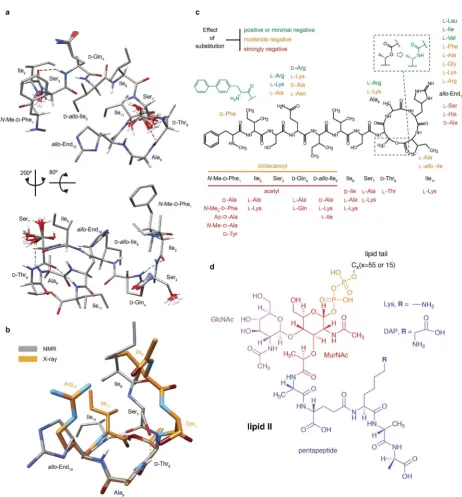
Fig. 1 Structural details of teixobactin. (a) Solution NMR structure of teixobactin in DPC micelles presented from two different views. The 20 lowest energy structures are shown. For clarity all of the protons except HN, Haand hydroxyl protons were omitted from thefigure (a PDBfile of the structure is provided in the ESI†). (b) Comparison of the“pyrophosphate binding cage”in the solution NMR structure of native teixobactin with the crystal structure of the teixobactin analogue Ac-D1–5Arg10-teixobactin.14The grey backbone represents a single conformer from the
solution NMR structure and orange represents the crystal structure. Note that the intramolecular hydrogen bond between Ser7and Ala9is
present only in a subset of the 20 lowest energy structures in the NMR structure. (c) A summary of the effect of various substitutions on the activity of teixobactin10,12–18shown with the chemical structure of teixobactin as reference. The substitutions with a positive or very small effect
on the antibacterial activity are indicated in green font. The substitutions that have a moderate effect are indicated in orange font. The substitutions that have a strong negative effect are indicated in red font. (d) Chemical structure of lipid II with building blocks highlighted in different colours: GlcNAc indicatesN-acetylglucosamine (magenta), MurNAc indicatesN-acetylmuramic acid (red), pentapeptide signifiesL -Ala-D-Glu-L-Lys/DAP-D-Ala-D-Ala (blue),CXrepresents the lipid tail withXindicating the number of carbons in the chain. There were two variants of lipid II used in this study: Gram-positive (lysine in position 3 in the pentapeptide) and Gram-negative (diaminopimelic acid (DAP) in position 3 in the pentapeptide), distinguished by the different substituent R. The Gram-negative variant of lipid II used in this study had a native C55lipid chain.
The Gram-positive lipid II variant was rendered water soluble by shortening the lipid tail to C15.
Open Access Article. Published on 20 September 2018. Downloaded on 10/1/2018 9:46:56 AM.
This article is licensed under a
[image:2.595.65.528.62.560.2]teixobactin analogues to investigate the roles of the different residues in teixobactin and potentiallynd active compounds that are easier to make and better suited for clinical use (see Fig. 1c for a summary of the effect on antimicrobial activity by substitution of amino acids). An NMR study of seven analogues showed the importance of theD-amino acids for activity.10The
residue in position 10, L-allo-enduracididine, is a
non-proteinogenic amino acid, which has been difficult to synthe-sise and hence replacing it with a naturally available amino acid is an attractive approach. Arg10teixobactin11,12 and Lys10 -teixobactin12 showed good activity and recently several other
teixobactin analogues with different alternatives in position 10 were synthesised and found to have good activity against methicillin-resistant Staphylococcus aureus (MRSA), Staphylo-coccus epidermidis andBacillus subtilis.13 Structural details of
teixobactin analogues in isolation and some initial studies involving teixobactin analogues and mimics of lipid II in dimethyl sulfoxide (DMSO) and molecular dynamics simula-tions exploring the binding space were reported in the litera-ture.10,13–15,19 However, to date no structure of wild type
teixobactin and no high resolution structural information on the interactions with actual lipid II have been reported. Here we use a combination of solution and fast magic angle spinning (MAS) solid-state NMR complemented by auorescence based assay to obtain insights on the interactions of wild type teix-obactin with both Gram-negative and Gram-positive lipid II and conformational changes of teixobactin induced by binding to lipid II. Wend that the majority of the sites interacting with lipid II are located on the backbone of teixobactin and that teixobactin assumes an aggregation proneb-strand conforma-tion for residues 2–6 upon binding lipid II. To mimic the natural membrane environment of lipid II we used dodecyl-phosphocholine (DPC) micelles but we also consider interac-tions of teixobactin with a water soluble lipid II in aqueous solution. Our data provide a rationale for understanding the behaviour of numerous analogues of teixobactin and valuable insights that should further guide efforts to engineer teix-obactin analogues.
Results
Teixobactin in solution
Since teixobactin binds lipid II in the cytoplasmic membrane of bacteria, we investigated its conformation in a simulated membrane using DPC micelles. The 20 lowest energy structures of teixobactin in DPC micelles in phosphate buffer determined by solution NMR are shown in Fig. 1a (see ESI Table 1† for details). The structures are overlaid with a crystal structure of the teixobactin analogue Ac-D1–5Arg10-teixobactin as a hydro-chloride salt14(Fig. 1b). The proposed pyrophosphate binding
cage formed by residues 8–11 is nearly identical in the NMR and crystal structures. The most obvious differences between the structures are that the bond between Ser7C0andD-Thr8N points in different directions and the side-chain of residue 10, where in the analogue the allo-enduracididine has been replaced by arginine. Additionally, the N-termini are different in the
structures since residues 1–5 were replaced by an acetyl group in the crystal structure construct.14
Structures of several analogues including teixobactin-Arg10 were also solved in DMSO by solution NMR.10In the structure
of teixobactin-Arg10and in contrast to the structure of native teixobactin in DPC micelles, presented here, residues 1–7 are largely unstructured. This discrepancy is likely due to DMSO being used as a solvent for the teixobactin analogues, as DMSO is known to destabilise the secondary structure and promote disorder.20 Since, similar to other lipid II binding
antibiotics,21 the solvent environment appears to have
a potentially large effect on the structure of teixobactin, we have also performed solution NMR experiments on teix-obactin in a phosphate buffer in the absence of micelles. A comparison of the chemical shis in the two media (i.e.
aqueous solution in the presence and absence of DPC micelles) suggests that no large conformation change (except a slight change near residues 1 & 6) occurs between them with most changes being attributable to hydrophobic interactions between teixobactin and DPC micelles (with residues 2, 6, 7 and 11 being most likely to be involved in or inuenced by binding to the micelle; see Fig. ESI1†).
It has been previously suggested that teixobactin in aqueous solution binds lipid II in a 2 : 1 ratio,5which could be
poten-tially explained if teixobactin dimerizes under these conditions. To investigate the oligomeric state of teixobactin we measured 15N NMR relaxation in aqueous solution (see Fig. ESI3, Table
ESI2†). The correlation time (sc) for the overall tumbling and subsequently the approximate size of the molecule were esti-mated from15N relaxation times. The relaxation measurements indicate that teixobactin is not monomeric in aqueous solution. The correlation time calculated from the relaxation times corresponds much better to a dimer or a trimer than to a monomer (see Fig. ESI3, Table ESI3†). The relaxation rates are also consistent with considerable local exibility of the N-terminal residues (order parameter,S2, of 0.4–0.6). Since the N-terminus appears quite mobile we have also considered whether the increased apparent hydrodynamic radius of teix-obactin in solution could be potentially explained by a mono-meric teixobactin where the molecule assumes a more extended conformation as observed for some teixobactin analogues in DMSO (though minimal changes in chemical shis between teixobactin in DPC micelles and in aqueous solution do not support such interpretation). However, all of the extended monomers we generated resulted in underestimated values for
sc(see Fig. ESI3, Table ESI3†). Because DPC micelles dominate the tumbling a similar method cannot be used to estimate the oligomeric state of teixobactin in DPC micelles (see Fig. ESI4 and Table ESI2†for relaxation data). Due to the lack of any plausible intermolecular NOEs, teixobactin in DPC micelles is assumed to be monomeric for structure calculations, which is a general assumption made for peptides in DPC micelles.
Teixobactin–lipid II interactions
Whereas teixobactin did not exhibit any particular propensity for aggregation in DPC micelles, we found that addition of lipid
Open Access Article. Published on 20 September 2018. Downloaded on 10/1/2018 9:46:56 AM.
This article is licensed under a
II resulted in rapid aggregation with peaks disappearing in the solution NMR spectra due to the large size of the aggregates. We observed the same behaviour when a water soluble variant of lipid II, C15 lipid II as opposed to the native C55lipid II, was added to teixobactin in aqueous solution in the absence of DPC micelles. This suggests that the aggregation is induced by interactions between teixobactin and lipid II and does not require a membrane environment. Previously, adding various amounts of DMSO was demonstrated to facilitate obtaining soluble antibiotic–lipid II complexes and to prevent their aggregation and precipitation.22,23However, we observe strong
aggregation in the teixobactin–lipid II complex even in solu-tions containing 80% DMSO. Since in our case DMSO does not alleviate the aggregation and because of its high potential for articially introducing disorder and suppressing potentially important interactions, we have avoided it in further experiments.
To gain insights into the aggregation process we performed a Fluorescence Resonance Energy Transfer (FRET) assay on a series of lipid II binders. Among several tested antibiotics including teixobactin, ramoplanin, deoxyactagardin B, mersa-cidin and vancomycin, only ramoplanin and teixobactin promoted aggregation of lipid II molecules (see Fig. ESI5†).
In order to determine whether the aggregation occurs due to nonspecic or specic interactions we have also sedimented the soluble aggregates formed between teixobactin and lipid II in DPC micelles using ultracentrifugation and performed fast magic angle spinning (MAS) solid-state NMR experiments. We observed only one set of resonances in the solid state NMR spectra, consistent with the presence of a single dominant conformer in the sedimented complex (see Fig. 2e and ESI6, 7†). The narrow, under the applied conditions, linewidths (at 90 kHz spinning)1H 0.2–0.4 ppm (120–240 Hz),13C 0.4–0.6 ppm (60–90 Hz) and15N0.7 ppm (45 Hz) indicate unambiguously that the aggregates are homogeneous in nature and are driven by specic rather than nonspecic interactions.24Note that even
moderate local disorder would be reected in substantial broadening.
Interestingly, in a study by Parmaret al.15no aggregation was
observed for teixobactin analogues in DMSO in the presence of geranyl pyrophosphate, a lipid II mimic possessing a pyro-phosphate and C10isoprenyl chain but no sugar moieties or the peptide stem. This result combined with our observations suggests that the interaction with the sugar moieties of lipid II may play a role in the aggregation process for the teix-obactin : lipid II complex.
To obtain a site-specic view of the effect of the binding of teixobactin to lipid II we have performed NMR titrations in solution, where changes in teixobactin spectra were followed as a function of lipid II concentration. Upon addition of lipid II we did not observe changes in chemical shis for any peaks but rather a decrease in intensities of the peaks, which is behaviour characteristic of slow exchange with dissociation constants,Kd, in the lowmM to nM range. To determine binding affinities in the presence of slow exchange, typically, one follows the build-up of peak intensities of the bound form.25 This was not
possible in the case of lipid II titrations because the resonances
for the bound form of teixobactin were broadened beyond detection due to aggregation. Instead, wetted intensities of the peaks from free teixobactin as a function of lipid II concentration to extract apparent association constants26(K
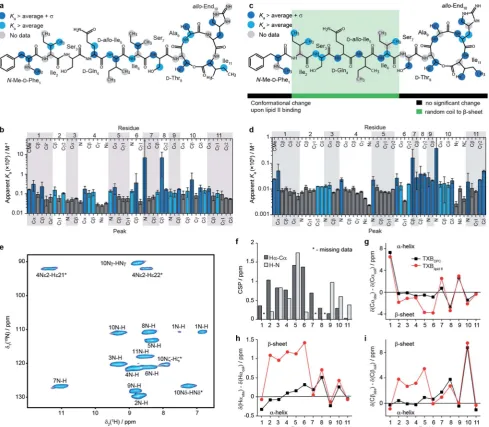
ais the inverse of Kd; see eqn (1) in methods, see Fig. ESI8–11, Tables ESI4, 5†). It should be noted that theKavalues obtained by thesets may be higher than the actualKavalues due to the effect aggregation has on the NMR spectra. However, even if the calculatedKavalues may not be quantitative, they yield quali-tative information on which sites of teixobactin are the most affected by the binding of lipid II either due to interaction or conformational change upon interaction. We performed the experiments using both native Gram-negative lipid II (dia-minopimelic acid in position 3 of the peptide stem, see Fig. 1d) with the full C55lipid tail in DPC micelles (in the following we refer to this sample as TXBDPC; see Fig. 2e) and a water soluble version of Gram-positive lipid II (lysine in position 3 of the peptide stem, see Fig. 1d) with a C15 lipid tail in aqueous solution (in the following we refer to this sample as TXBaqueous; see Fig. 2c). To facilitate the analysis, in Fig. 2b–e we have highlighted in light blue all the sites for which the apparentKa is larger than the average apparentKaand in dark blue all the sites for which apparentKais larger than the average apparent
Kaplus one standard deviation.
The apparentKavalues for TXBaqueousare approximately one order of magnitude larger than in TXBDPC, which might indicate that the peptide stem of lipid II plays a role in the binding or that the addition of DPC has an effect on the binding strength. However, due to the above-mentioned ambiguity of the Ka values obtained from tting of disappearing peaks we limit ourselves to qualitative comparisons only.
Although we see an overall difference between the binding strength in TXBDPCand in TXBaqueous, the binding mode seems to be very similar in both cases. The strongest effect appears in the same parts of teixobactin in both media. The majority of the sites strongly affected by the titration of lipid II are backbone atoms. In fact, there are backbone atoms showing strong affinity in all residues except 2 and 3; for residue 2 data are missing for N-H (TXBaqueous) and Ca-Ha (TXBaqueous and TXBDPC), for residue 3 N-H and C
a
-Hashow apparentKaabove average (light blue in Fig. 2a–d) but not signicantly above average (dark blue in Fig. 2b–e) for TXBDPC. For the side chains there are no strongly affected sites in residues 2–5, the most strongly affected side-chains include:N-Me-D-Phe1CMe,N-Me-D
-Phe1Cb(TXBaqueousonly),L-Ile6Cb,L-Ser7Cb(TXBDPConly, above average Ka for TXBaqueous), D-Thr8Cb, D-Thr8Cg2, L-End10Cb,
L-End10Cd (TXBaqueous only, above average apparent Ka for TXBDPC), L-Ile11Cg2(TXBDPConly), and L-Ile11Cd (TXBDPConly). Most sites that show strong apparent affinity (apparentKaabove average plus standard deviation) in either TXBaqueousor TXBDPC show at least apparent affinity above average in the other. The only exceptions are theN-Me-D-Phe1Cb(strong apparent affinity
in TXBaqueousonly) and the side chains of residue 11, where Cg2 and Cdshow strong affinity in TXB
DPCbut not in TXBaqueous. In the backbone ofL-Ile4Cashows strong affinity in TXBaqueous but not in TXBDPCand the NH shows strong affinity in TXBDPC but not in TXBaqueous. The deviations for the CbofN-Me-D-Phe1
Open Access Article. Published on 20 September 2018. Downloaded on 10/1/2018 9:46:56 AM.
This article is licensed under a
and for the side-chains ofL-Ile11can possibly be explained by hydrophobic interactions with the DPC micelles which are affected due to conformational changes occurring in teix-obactin when lipid II is added. The phenyl group ofN-Me-D
-Phe1 has previously been suggested to interact through hydrophobic interactions with the membrane and the lipid tail of lipid II.27The deviations for Caand NH for residue 4 could
possibly indicate slightly different backbone conformations in the two samples: NH of residue 4 is among those peaks showing largest chemical shi changes between TXBaqueous
and TXBDPC (see Fig. ESI1†). It is also possible that the different peptide stems between the Gram-negative lipid II used in the titrations to TXBDPCand the Gram-positive lipid II used in the titrations to TXBaqueoushave some effect on which sites are mostly affected but the available data are inconclusive in this respect.
In our titrations we see a strong effect on the backbone for residues 4–6, which is not seen in the titration of the teix-obactin-Ala10 analogue with geranyl pyrophosphate15 (lacking the sugars and peptide chain compared to the native lipid II). Fig. 2 Characterisation of the teixobactin–lipid II complex. (a–d) Results of solution NMR titrations of teixobactin with a water soluble C15variant
of Gram-positive lipid II in aqueous solution (a, b) and with native C55Gram-negative lipid II in DPC micelles (c, d). Panels b and d show the
measured apparentKavalues and plotted onto the chemical structure of teixobactin in a and c. Dark blue indicates sites with apparentKavalues higher than the average plus one standard deviation and light blue indicates sites with apparentKavalues higher than the average. Dark grey indicates sites with a below average apparentKa(b and d). In a and c grey circles indicate sites for which data are not available. (e) 2D1H-15N solid state NMR correlation spectrum of sedimented [U13C-15N]teixobactin in complex with natural abundance Gram-negative lipid II in DPC micelles acquired at 600 MHz1H Larmor frequency and 90 kHz magic angle spinning frequency. In panel e star indicates peaks folded in the15N dimension. The two resonances for residue 1 are due to the zwitterionic form ofN-Me-D-Phe1being the major form at pH 6.5. (f)1H-15N (light
grey) and1Ha-13Ca(dark grey) chemical shift perturbations between TXBDPCand TXBlipid II. Comparisons of secondary13Ca(g),1Ha(h) and13Cb(i)
chemical shifts between TXBDPC(black squares) and TXBlipid II(red circles).
Open Access Article. Published on 20 September 2018. Downloaded on 10/1/2018 9:46:56 AM.
This article is licensed under a
[image:5.595.54.544.48.475.2]Absence of indication of any specic interaction with geranyl pyrophosphate for these residues suggests that they might be involved in interactions with sugar moieties and possibly parts of the peptide stem in native lipid II.
As mentioned previously due to aggregation we could not detect the bound form of teixobactin by solution NMR but we could study it by fast MAS solid state NMR, which is not limited by the large size of the aggregates.24,28–30Fig. 2e shows a
cross-polarization (CP) based 1H-15N correlation spectrum of [U-13C,15N]teixobactin in a sedimented complex with unlabelled Gram-negative lipid II in the presence of DPC (in the following we refer to this sample as TXBlipid II). The high quality spectra obtained by solid state NMR allowed for complete backbone assignments of TXBlipid II and almost complete side-chain assignments (the aromatic group of residue 1 was not completely assigned).
To gain some insights into the intermolecular interactions and conformation of teixobactin in the complex we calculated chemical shi perturbations (CSPs, eqn (4) in methods) between TXBDPC(solution) and TXBlipid II(solid; see Fig. 2f) and secondary chemical shis (Fig. 2g–i). The 1H-15N CSPs are sensitive to both binding and conformational changes and 1Ha-13CaCSPs are mostly sensitive to conformational changes.
The large1H-15N CSPs for residues 3–5 and 9–10 conrm the view available from the titrations in solution that the binding of teixobactin to lipid II extends beyond the pyrophosphate binding cage formed by residues 8–11. The 1Ha-13Ca CSPs suggest that notable conformational changes take place for residues 2–7 with the conformation of residues 8–11 being very similar to what we observe in solution for isolated teixobactin. The conformational changes are more evident from the secondary chemical shis, which report on secondary structure deviations from random coil. Combined analysis of13Ca,1Ha and13Cbsecondary chemical shis suggests that residues 2–6
rearrange from a random coil like conformation to a more extendedb-strand like conformation upon binding to lipid II. Again, the back-bone conformation for residues 8–11 appears largely unchanged upon complex formation.
Discussion
The charged side chain of theL-allo-enduracididine amino acid
at position 10 was initially thought to be important for the antimicrobial activity and hence most of the initial work focused on analogues of teixobactin with positively charged side chains: End10Arg and End10Lys variants both displayed anti-microbial activity but not as good as the wild type teix-obactin.12,13 In the X-ray structure of Ac-D
1–5Arg10-teixobactin analogue the guanidinium side chain of Arg10 formed a hydrogen bond to the chloride ion14 (mimicking the
pyro-phosphate of lipid II). Interestingly, according to our titrations there is no strong interaction between the side chain nitrogens of residue 10 and lipid II. However if we look at chemical shi changes between TXBDPCand TXBlipid IIthe CSPs are large for the side-chain NH groups; 0.44, 1.36 and 0.74 ppm for Ng, Nd and Nz respectively, which, compared to the CSPs for the backbone amides, would suggest that Nd is one of the most
affected nitrogen sites. The side-chains of D-Gln4 show even larger chemical shichanges (the chemical shiin TXBDPCis 112 ppm for the N32 and 41.1 ppm in TXBlipid II and the 1H chemical shis for H321and H322are 6.8 and 7.5 ppm in TXB
DPC and 8.5 and 11.4 ppm in TXBlipid II). The large chemical shi changes for side-chain nitrogen can be explained by confor-mational changes due to interactions with the carbon side-chains in the case of End10. The unusual chemical shiforD -Gln4 side-chain nitrogen suggests interactions with charged moieties,e.g.D-Glu in the pentapeptide of lipid II: the only sites
with similar chemical shis for the systems deposited in BMRB occur for glutamines in close contact with charged, mostly negatively charged, side chains. The fact that a charged side chain for residue 10 is not required was recently demonstrated by creating teixobactin analogues where L-allo-End10 was replaced by residues with hydrophobic side chains that exhibited antimicrobial activity15,16even at the level matching
the activity of wild type teixobactin.15 Interestingly, the best
performing analogues are the ones where the side chain can assume a similar conformation to the one found for interacting sites in our titrations, End10Ile and End10Leu,15suggesting that for the side chain of residue 10 the shape is more important than the charge or hydrophobicity. The other residues of teix-obactin whose replacement in analogues did not lead to an overly detrimental effect on the antimicrobial activity include Ser3and Ala9. Residue 3 did not show any signicant interaction according to our titrations but backbone conformational changes of residue 3 appear important for the activity. Accord-ing to our titrations the side-chain of residue 9 is strongly involved in the binding to lipid II, however it has been shown that the alanine in position 9 can be exchanged to a lysine or arginine without signicant loss of antimicrobial effect14(see
Fig. 1c). This would suggest that the backbone of residue 9 is involved in the interactions but it is not important that the side-chain is hydrophobic. The N-terminus of teixobactin has been suggested to function primarily as an anchoring point to the cell membrane, however our data suggest that it could have a more involved role in the bactericidal mechanism of teixobactin by promoting aggregation, which may explain the lower activity seen in analogues where residues 1–5 were replaced by a dodecanoyl group14and why substitution of residues 1, 2, 5
and 6 is not well tolerated.16Our data suggest that most of the
sites except the aromatic ring in therst residue are involved in the interactions with lipid II both in the presence and absence of DPC micelles. The removal of the methyl group interacting with lipid II leads only to a modest reduction of the antibacterial activity17but loss of the positive charge or replacement of the
methyl group with a bulkier hydrophobic group has much greater negative impact.31In the context of our study this could
suggest that bulky substituents interfere with the interaction with lipid II. The removal of the aromatic ring, that is not interacting with lipid II according to our data, leads to loss of antibacterial activity altogether but substitution with larger hydrophobic groups has a positive effect.16,27 That larger
hydrophobic groups do not decrease the activity is consistent with the side chain of residue 1 not being involved in binding to lipid II but rather contributing to anchoring to the membrane.
Open Access Article. Published on 20 September 2018. Downloaded on 10/1/2018 9:46:56 AM.
This article is licensed under a
On the other hand, the aromatic ring could also aid the aggre-gation process. The general chemical shichanges indicative of b-strand formation for residues 2–6 and the assembly of large soluble aggregates upon interaction of teixobactin and lipid II suggest that these residues may aid in the aggregation process (exposed b-strands are involved in an important mode for protein–protein interactions linked to aggregation32), perhaps
bybril formation, as was previously reported for the ramo-planin : lipid II complex22or the type of aggregation observed
for the nisin : lipid II complex33,34(though the precise nature of
this specic aggregate is unclear and requires further studies). This highlights that exibility of the N-terminal part of teix-obactin is important for its biological activity, as has been suggested based on studies of several analogues of teixobactin involving substitutions of amino acids in this part.10However,
our data suggest that the conclusion of the mentioned study should be slightly modied: it is not the disorder that is the key (the N-terminus is mobile but well-ordered in our structure of teixobactin in DPC micelles) but rather the range of accessible conformations promoting intermolecular rather than intra-molecularb-sheet formation.
Aggregation makes it difficult to study structural aspects of the teixobactin : lipid II complex using conventional methods such as X-ray crystallography and solution NMR. However, we have shown that ultra-fast MAS solid state NMR can be used to gain valuable site-specic information in this system. More investigations into the teixobactin : lipid II complex using isotope labelled lipid II are required to resolve ambiguities in intermolecular cross-peak assignments and to gain further understanding into the structural arrangement of these large aggregates.
Conclusions
The 3D structure of teixobactin in DPC micelles conrms the presence of a C-terminal pyrophosphate binding cage previ-ously suggested in truncated teixobactin analogues. The N-terminal part of the peptide is well-structured in DPC micelles, in contrast to structures of teixobactin analogues in DMSO where it appears mostly disordered. A combination of titrations in solution NMR and solid state NMR experiments reveals that most of the teixobactin is involved in binding lipid II, either via interactions or conformational changes upon binding. The pattern of the strongest affected residues is overall very similar in both titrations using water soluble Gram-positive lipid II in the absence of DPC micelles and native Gram-negative lipid II in the presence of DPC micelles, with mostly backbone sites being affected. Residues 2–6 undergo a change from coil to bconformation upon binding of lipid II. We suggest that resi-dues 2–6 are important for the activity due to their involvement in aggregation of teixobactin–lipid II complexes, which in the cell would lead to accumulation of lipid II and inhibition of cell wall synthesis. Importantly, using solid state NMR we have for the rst time been able to study the full complex formed between native teixobactin and native lipid II, something that would not be possible with other biophysical techniques such as solution NMR and X-ray crystallography. This study paves the
way for more detailed structural analysis of aggregating anti-biotics–substrate complexes.
Experimental
Sample preparation
Lipid II was synthesized as described previously.34,35The
bio-tinylated variant of lipid II used in the FRET experiments was obtained by biotinylation of theN-acetylmuramyl-pentapeptide precursor prior to the lipid II synthesis.
Natural abundance teixobactin and [U-13C,15N]teixobactin were produced the same way by growingEleheria terraein R4 growth medium5 without (for natural abundance teixobactin)
and with (for labeled teixobactin) replacement of labeled materials (purchased from Cambridge Isotope Laboratories, Inc., Tewksbury, MA, USA). The labeled Modied Celtone R4 was prepared as 10 gD-glucose U-13C6, 1.1 g Celtone base U-13C U-15N, 0.5 gL-proline U-13C515N, 10 g MgCl2$6H2O, 4 g CaCl2
-$2H2O, 0.2 g K2SO4, 5.6 g N -[tris(hydroxymethyl)methyl]-2-aminoethanesulfonic acid (TES), and deionized H2O to 1 L and pH adjusted to 7.0 using KOH. 1 L of labelled media was inoc-ulated with biomass from an agar plate and grown at 28C for 7 days with shaking. The fermentation was centrifuged to separate the cell biomass from the supernatant. The supernatant was decanted into a new container and extracted with an equal volume of butanol, while the cell pellet was extracted with acetone and centrifuged. The acetone and butanol extracts were combined and evaporated to dryness. The resulting residue was dissolved in DMSO and separated by HPLC (water/acetonitrile/ 0.1% TFA). Of the forty eight fractions generated, fraction 23 contained the majority of the target compound. This fraction was then examined by LC-MS and the expected mass for fully13C and 15N labelled teixobactin was the major ion peak ([M + H] ¼
1315.9). This fraction was dried down, resulting in 10 mg of the desired product.
Solution NMR
For preparation of TXBDPC[U-13C,15N]teixobactin was dissolved to a concentration of 2 or 3 mM in 10 mM NaP buffer, pH 6.5, with 100 or 150 mM d38 DPC (Eurisotop). For preparation of TXBaqueous[U-13C,15N]teixobactin was dissolved to a concentra-tion of 0.3 mM in 10 mM NaP buffer, pH 6.5. 2,2-Dimethyl-2-silapentane-5-sulfonate (DSS) was used as internal reference. Lipid II was dissolved in 10 mM NaP buffer, pH 6.5, with 150 mM d38DPC. Water soluble lipid II was dissolved in 10 mM NaP buffer, pH 6.5. All solution NMR experiments were per-formed on a Bruker Avance II 700 MHz spectrometer equipped with a cryo-probe, using 3 mm NMR tubes. Experiments were performed at 25C, additional1H-15N and1H-13C correlation experiments were performed at 37C so that assignments could be compared with assignments obtained in solid state NMR experiments. Initial assignments for TXBDPC were obtained from a natural abundance teixobactin (prepared in the same way as labelled teixobactin) using 2D experiments: 1H-13C HSQC, 1H-15N SOFAST HMQC (0.3 s recycle delay), 1H-1H TOCSY (70 ms mixing time), 1H-1H COSY. Assignments were
Open Access Article. Published on 20 September 2018. Downloaded on 10/1/2018 9:46:56 AM.
This article is licensed under a
conrmed and completed from 3D experiments using [U-13C,15N]teixobactin: BEST HNCACB (0.3 s recycle delay), CCH-TOCSY (16.3 ms DIPSI-3 mixing time), CBCA(CO)NH (25% non-uniform sampling (NUS) reconstructed in TopSpin using the MDD algorithm36). The assignments were referenced to DSS
using an external reference. A 3D 15N HSQC-NOESY (200 ms mixing time) and a 2D1H-1H NOESY (200 ms mixing time) were used for distance restraints in the structure calculations.15NT1 and T2 relaxation times were measured using interleaved pseudo 3D experiments. Relaxation delays for15NT1 experi-ments (s): 0.005, 0.075, 0.1, 0.2, 0.3, 0.4, 0.5, 0.65, 0.8, 1, 1.25, 1.5. Relaxation delays for15NT2experiments (s): 0.017, 0.034, 0.051, 0.068, 0.085, 0.102, 0.136, 0.170, 0.204, 0.254, 0.339. Titrations with native lipid II to [U-13C,15N]teixobactin were measured using1H-15N SOFAST HMQC (0.3 s recycle delay) and1H-13C HSQC. Lipid II with a concentration of 15 mM was titrated to the following concentrations (mM): 0.33, 0.79, 1.5, 2, 2.7, 3, 3.4, 3.7, 4, 4.3, 4, leading to a dilution of teixobactin to anal concentration of 2 mM from an initial concentration of 3 mM. Assignments for TXBaqueous were initially transferred from TXBDPC using 2D experiments: 1H-15N SOFAST HMQC (0.3 s recycle delay) and1H-13C HSQC. The assignments were completed using 3D experiments: HNCA and CCH-TOCSY (16.3 ms DIPSI-3 mixing time). The assignments were refer-enced internally to DSS.15NT1andT2relaxation times were measured using interleaved pseudo 3D experiments. Relaxa-tion delays for15NT1experiments (s): 0.075, 0.1, 0.2, 0.3, 0.4, 0.6, 0.8, 1.1, 1.4. Relaxation delays for15NT2experiments (s): 0.017, 0.034, 0.068, 0.102, 0.136, 0.170, 0.237, 0.305. Titrations of water soluble lipid II to [U-13C,15N]teixobactin were measured using 1H-15N SOFAST HMQC and 1H-13C HSQC. Water soluble lipid II with a concentration of 2.4 mM was titrated to the following concentrations (mM): 0.05, 0.1, 0.14, 0.19, 0.23, leading to a dilution of teixobactin from 0.3 to 0.27 mM.
Solid state NMR
Aer titrations of lipid II to [U-13C,15N]teixobactin (in DPC micelles) the sample was transferred from the NMR tube, 10 mM NaP buffer pH 6.5, with 2% DSS was added up to 500mL leading to a nal concentration of approximately: 0.6 mM [U-13C,15N]teixobactin, 1.4 mM lipid II, 45 mM d38 DPC. The sample was sedimented by ultracentrifugation (Beckmann Coulter Optima MAX-XP Ultracentrifuge) for 46 hours at 700 000 g, forming a solid paste. Most of the liquid was removed and a small amount of 10 mM NaP buffer containing 2 mM gadolinium diethylenetriaminepentaacetic acid bisme-thylamide (Gd(DTPA-BMA)) and 2% DSS was added to the sediment. The sediment was packed into a 0.81 mm Samoson rotor. To keep the sample hydrated during packing small amounts of buffer with Gd(DTPA-BMA) and DSS were added to the rotor. All experiments were recorded at a 600 MHz Bruker Avance II spectrometer using a Samoson HXY 0.81 mm probe at 90 kHz magic angle spinning and a sample temperature of 39 2C measured from the water peak referenced to DSS. Proton detection with 30 ms acquisition time was used for all
experiments. The addition of Gd(DTPA-BMA) enabled a recycle delay of 0.5 s. Water suppression was achieved by 100–150 ms slpTPPM37at 22.5 kHz nutation frequency (1
4of the spinning
speed). The following spectra were acquired: 2D1H-13C inverse CP (0.4 ms CP between1H-13C and13C-1H) 2D1H-15N inverse CP (1 ms CP between 1H-15N and 0.9 ms between 15N-1H), 3D hCANH (0.4 ms CP between 1H-13C, 11 ms between 13C-15N, 0.9 ms between15N-1H), 3D hCONH (2.5 ms CP between1H-13C, 11 ms between 13C-15N, 0.9 ms between 15N-1H). 3D hCCH TOCSY (0.4 ms CP between1H-13C and13C-1H, 16.3 ms DIPSI-3 mixing time at 10 kHz nutation frequency) 3D hCOCAHA DREAM (2.5 ms CP between 1H-13CO, 0.4 ms CP between 13CA-1HA, 7 ms DREAM between13CO-13CA at 45 kHz nutation
frequency,1
2of the spinning speed).
NMR data analysis
TopSpin 3.2 was used to process all spectra. The spectra were assigned in NMRFAM Sparky.38Structure calculation of TXB
DPC was performed using UNIO 10 with Cyana 2.139as molecular
dynamics soware using NOEs as structural restraints. Raw spectra (1H-1H 2D NOESY and15N 3D HSQC-NOESY) were used as input into the structure calculation. Automatic peak picking and NOE assignments were achieved by UNIO ATNOS-CANDID.40,41
Cyana library entries for D-amino acids were produced using
CyLib:42D-glutamine (converted from DGN.cif),D-allo-isoleucine
(converted from 28J.cif), D-threonine (converted from DTH.cif).
A Cyana library entry for N-methylated-D-phenylalanine was
initially converted by Cylib from ZAE.cif and slightly modied by producing a .corle in Cyana containing the new ZAE residue as therst residue and a peptide bond to another amino acid. The amide proton was added in UCSF Chimera43and a pdble was
exported and read in MOLMOL44where coordinates were
expor-ted as a libraryle. The libraryle was edited manually in a text editor tot to the Cyana library format. The .cifles were ob-tained from http://www.bpc.uni-frankfurt.de/guentert/wiki/ index.php/Cyana_Residue_Library_Entries, except for D
-allo-isoleucine (28J.cif), which was obtained from http:// www.ebi.ac.uk/pdbe-srv/pdbechem/chemicalCompound/show/ 28J. A Cyana library entry for allo-enduracididine was produced from a drawing of the chemical structure in ChemSketch (ACDLabs Freeware 2012) including peptide bonds to residues before and aer. The chemical structure was exported as a .mol
le and converted to PDB in UCSF Chimera.43MOLMOL44was
used to write coordinateles and the Cyana library entry was
nalized by manually rearranging the atoms, adding pseudo atoms and torsion angles in a text editor (PSPAD editor).
Peak integrals from TopSpin were exported to MatLab where a single decaying exponential function was used tot theR1and
R2relaxation data. Errors were calculated by a Monte Carlo error estimation. A random number between 0 and 1 was multiplied with the integral error, which was based on the noise level compared to the signal for each peak, and added to the recal-culated integrals. Thetting was then repeated 2000 times with a new random number between 0 and 1 generated each time. Two times the standard deviations of the R1 or R2 values received from thets for each residue were used as errors.
Open Access Article. Published on 20 September 2018. Downloaded on 10/1/2018 9:46:56 AM.
This article is licensed under a
The correlation times (sc) for TXBaqueous and TXBDPCwere calculated from the15NT1andT2relaxation times and the15N resonance frequency (nN), 71 MHz at a 16.4 T NMR magnet (700 MHz1H Larmor frequency) using eqn (1):
scz 1
4pnN
ffiffiffiffiffiffiffiffiffiffiffiffiffiffiffiffiffi 6TT1
2 7 r
(1)
which is generally used for rigid protein molecules in the limit of slow molecular motion (sc [ 0.5 ns), using high magneticeld (1H Larmor frequency$500 MHz).45
To determine binding affinities the peak intensities of unbound teixobactin (TXBDPCor TXBaqueous) were measured in the titration spectra andtted to eqn (2) (based on eqn (6) in ref. 25):
P¼ m
2n½Ptð Kd ½Lt þn½PtÞ
þ ffiffiffiffiffiffiffiffiffiffiffiffiffiffiffiffiffiffiffiffiffiffiffiffiffiffiffiffiffiffiffiffiffiffiffiffiffiffiffiffiffiffiffiffiffiffiffiffiffiffiffiffiffiffiffiffiffiffiffiffiffiffiffiffiffiffiffi4Kdn½Pt þ ð Kdþ ½Lt n½PtÞ2
q
(2)
wherePis the normalized peak intensity, m¼ 1 if the point without an added ligand is included andmistted if the point without an added ligand is not included,nis the molar ratio for binding (lipid II/teixobactin), [Lt] is ligand concentration (lipid II), [Pt] is protein concentration (teixobactin). The data points used for thetting were: 0.33, 0.79, 1.5, 2, 2.7, 3 (mM) lipid II for TXBDPCand 0.05, 0.1, 0.14, 0.19, 0.23 (mM) water soluble lipid II for TXBaqueous. Thetting of the data was done by minimization of thec2target function (eqn (3)):
c2¼X Xi;calcXi;exp
2
si;exp2
(3)
whereXiare the data sets andsithe corresponding error. Errors for theKdts were calculated in the same way as for the relax-ation data using 500 steps in the Monte Carlo error estimation.
Chemical shi perturbations were calculated as Euclidian distances25(eqn (4)):
CSP¼
ffiffiffiffiffiffiffiffiffiffiffiffiffiffiffiffiffiffiffiffiffiffiffiffiffiffiffiffiffiffiffiffiffiffi 1
2
dH2þ
adX2
r
(4)
wheredis the difference in chemical shibetween TXBaqueous and TXBDPCor between TXBDPCand TXBlipid II,a¼0.14 ifx¼ 15N and
a¼0.3 ifx¼13C.
FRET. 1 mM biotinylated lipid II was labelled with streptavidin-conjugated FRET dyes (HTRF, CisBio) and incu-bated with ramoplanin, teixobactin, deoxyactagardine B, mer-sacidin and vancomycin at concentrations ranging between 0.5 and 32 mM. Samples were incubated for 30 min at ambient temperature and FRET magnitude was measured in a time-resolved manner, using the Clariostar plate reader (BMG Lab-tech). The experiments were performed in triplicates. Full reaction composition: 1 mM biotin–DAP–lipid II, 1 HTRF labelling mixture (terbium cryptate, d2), 50 mM bis–Tris propane pH 8.5, 10 mM MgCl2, 20 mM NaCl, 0.05% Triton X-100, 1% glycerol.
Author contributions
C. ¨O. and J. R. L. designed and analysed the NMR experiments and wrote the paper, C. ¨O. performed the NMR experiments, C. ¨O. and T. H. performed the NMR structure calculation. G. P. W. and C. G. D. designed and analysed the FRET experiments, G. P. W. performed the FRET experiments. C. G. D. and A. J. L. optimized lipid II synthesis and analysis, C. ¨O., G. P. W., A. C. C., J. A. T. and A. J. L. produced and characterised lipid II. D. E. H., A. L. S. and A. J. P. produced and characterised the natural abundance teixobactin and [U-13C,15N]teixobactin. The manu-script was written through contributions from all authors.
Con
fl
icts of interest
The following authors, A. J. Peoples, A. L. Spoering, D. E. Hughes, and K. Lewis declare competingnancial interests as they are employees and consultants of NovoBiotic Pharmaceuticals.
Data availability
NMR assignments were deposited in the BMRB under accession numbers 27478 (TXBDPC), 27479 (TXBaqueous) and 27480 (TXBlipid II). Raw NMR data are available from http://wrap.warwick.ac.uk/ 108554/.
Acknowledgements
The research leading to these results has received funding from the Bill & Melinda Gates Foundation (grant OPP1160394, and OPP1132809), European Research Council under the European Union's Seventh Framework Programme (FP/2007–2013)/ERC Grant Agreement 639907. J. R. L. also acknowledges funding from EPSRC Grant EP/L025906/1, BBSRC Grant BB/L022761/1 & BB/R010218/1. A. J. L., J. A. T., A. C. C. and C. G. D. acknowledge funding from AMR Cross Council funding MR/N002679/1. C. ¨O. and G. P. W. acknowledge funding from the European Union under a Marie Curie Initial Training Network FP7-PEOPLE-2012-ITN Grant Agreement Number 316630 CAS-IDP. We thank Peter G¨untert for providing the CyLib soware and Tobias Madl for providing Gd(DTPA-BMA). Molecular graphics and analyses were performed with the UCSF Chimera package. Chimera is developed by the Resource for Biocomputing, Visualization, and Informatics at the University of California, San Francisco (supported by NIGMS P41-GM103311).
Notes and references
1 T. Kaeberlein, K. Lewis and S. S. Epstein,Science, 2002,296, 1127–1129.
2 D. Nichols, N. Cahoon, E. M. Trakhtenberg, L. Pham, A. Mehta, A. Belanger, T. Kanigan, K. Lewis and S. S. Epstein,Appl. Environ. Microbiol., 2010,76, 2445–2450. 3 A. D'Onofrio, J. M. Crawford, E. J. Stewart, K. Witt, E. Gavrish, S. Epstein, J. Clardy and K. Lewis,Chem. Biol., 2010,17, 254– 264.
Open Access Article. Published on 20 September 2018. Downloaded on 10/1/2018 9:46:56 AM.
This article is licensed under a
4 E. Gavrish, C. S. Sit, S. Cao, O. Kandror, A. Spoering, A. Peoples, L. Ling, A. Fetterman, D. Hughes, A. Bissell, H. Torrey, T. Akopian, A. Mueller, S. Epstein, A. Goldberg, J. Clardy and K. Lewis,Chem. Biol., 2014,21, 509–518. 5 L. L. Ling, T. Schneider, A. J. Peoples, A. L. Spoering,
I. Engels, B. P. Conlon, A. Mueller, T. F. Sch¨aberle, D. E. Hughes, S. Epstein, M. Jones, L. Lazarides, V. a Steadman, D. R. Cohen, C. R. Felix, K. A. Fetterman, W. P. Millett, A. G. Nitti, A. M. Zullo, C. Chen and K. Lewis,
Nature, 2015,517, 455–459.
6 T. Homma, A. Nuxoll, A. B. Gandt, P. Ebner, I. Engels, T. Schneider, F. G¨otz, K. Lewis and B. P. Conlon,
Antimicrob. Agents Chemother., 2016,60, 6510–6517. 7 D. M¨unch and H. G. Sahl,Biochim. Biophys. Acta, Biomembr.,
2015,1848, 3062–3071.
8 W. Vollmer, D. Blanot and M. a. de Pedro,FEMS Microbiol. Rev., 2008,32, 149–167.
9 W. Vollmer,FEMS Microbiol. Rev., 2008,32, 287–306. 10 A. Parmar, S. H. Prior, A. Iyer, C. S. Vincent, D. Van
Lysebetten, E. Breukink, A. Madder, E. J. Taylor and I. Singh,Chem. Commun., 2017,53, 2016–2019.
11 Y. E. Jad, G. A. Acosta, T. Naicker, M. Ramtahal, A. El-Faham, T. Govender, H. G. Kruger, B. G. de la Torre and F. Albericio,
Org. Lett., 2015,17, 6182–6185.
12 H. Yang, K. H. Chen and J. S. Nowick,ACS Chem. Biol., 2016, 11, 1823–1826.
13 A. Parmar, A. Iyer, D. G. Lloyd, C. S. Vincent, S. H. Prior, A. Madder, E. J. Taylor and I. Singh,Chem. Commun., 2017, 53, 7788–7791.
14 H. Yang, D. R. Du Bois, J. W. Ziller and J. S. Nowick,Chem. Commun., 2017,53, 2772–2775.
15 A. Parmar, A. Iyer, S. H. Prior, D. G. Lloyd, E. T. Leng Goh, C. S. Vincent, T. Palmai-Pallag, C. Z. Bachrati, E. Breukink, A. Madder, R. Lakshminarayanan, E. J. Taylor and I. Singh,
Chem. Sci., 2017,8, 8183–8192.
16 K. H. Chen, S. P. Le, X. Han, J. M. Frias and J. S. Nowick,
Chem. Commun., 2017,53, 11357–11359.
17 C. Wu, Z. Pan, G. Yao, W. Wang, L. Fang and W. Su,RSC Adv., 2017,7, 1923–1926.
18 S. A. H. Abdel Monaim, S. Noki, E. J. Ramchuran, A. El-Faham, F. Albericio and B. G. de la Torre,Molecules, 2017,
22, 1–9.
19 Y. Liu, Y. Liu, M. B. Chan-Park and Y. Mu,Sci. Rep., 2017,7, 17197.
20 M. Jackson and H. H. Mantsch,Biochim. Biophys. Acta, 1991, 1078, 231–235.
21 S.-T. D. Hsu, E. Breukink, G. Bierbaum, H.-G. Sahl, B. de
Kruijff, R. Kaptein, N. A. J. van Nuland and
A. M. J. J. Bonvin,J. Biol. Chem., 2003,278, 13110–13117. 22 P. Cudic, J. K. Kranz, D. C. Behenna, R. G. Kruger,
H. Tadesse, A. J. Wand, Y. I. Veklich, J. W. Weisel and D. G. McCafferty, Proc. Natl. Acad. Sci. U. S. A., 2002, 99, 7384–7389.
23 S.-T. D. Hsu, E. Breukink, E. Tischenko, M. A. G. Lutters, B. de Kruijff, R. Kaptein, A. M. J. J. Bonvin and N. A. J. van Nuland,Nat. Struct. Mol. Biol., 2004,11, 963–967.
24 J. M. Lamley, D. Iuga, C. ¨Oster, H.-J. Sass, M. Rogowski, A. Oss, J. Past, A. Reinhold, S. Grzesiek, A. Samoson and J. R. Lewandowski, J. Am. Chem. Soc., 2014, 136, 16800– 16806.
25 M. P. Williamson,Prog. Nucl. Magn. Reson. Spectrosc., 2013,
73, 1–16.
26 M. Jenner, S. Kosol, D. Griffiths, P. Prasongpholchai, L. Manzi, A. S. Barrow, J. E. Moses, N. J. Oldham, J. R. Lewandowski and G. L. Challis,Nat. Chem. Biol., 2018, 14, 270–275.
27 Y. Zong, X. Sun, H. Gao, K. J. Meyer, K. Lewis and Y. Rao,
J. Med. Chem., 2018,61, 3409–3421.
28 A. Mainz, S. Jehle, B.-J. J. van Rossum, H. Oschkinat and B. Reif,J. Am. Chem. Soc., 2009,131, 15968–15969.
29 A. Loquet, N. G. Sgourakis, R. Gupta, K. Giller, D. Riedel, C. Goosmann, C. Griesinger, M. Kolbe, D. Baker, S. Becker and A. Lange,Nature, 2012,486, 276–279.
30 C. Gardiennet, A. K. Sch¨utz, A. Hunkeler, B. Kunert, L. Terradot, A. B¨ockmann and B. H. Meier,Angew. Chem., Int. Ed., 2012,51, 7855–7858.
31 S. A. H. Abdel Monaim, Y. E. Jad, G. A. Acosta, T. Naicker, E. J. Ramchuran, A. El-Faham, T. Govender, H. G. Kruger, B. G. de la Torre and F. Albericio, RSC Adv., 2016, 6, 73827–73829.
32 J. a. Siepen, S. E. Radford and D. R. Westhead,Protein Sci., 2003,12, 2348–2359.
33 K. M. Scherer, J. H. Spille, H. G. Sahl, F. Grein and U. Kubitscheck,Biophys. J., 2015,108, 1114–1124.
34 E. Breukink, H. E. Van Heusden, P. J. Vollmerhaus, E. Swiezewska, L. Brunner, S. Walker, A. J. R. Heck and B. De Kruijff,J. Biol. Chem., 2003,278, 19898–19903. 35 A. J. Lloyd, A. M. Gilbey, A. M. Blewett, G. De Pascale, A. El
Zoeiby, R. C. Levesque, A. C. Catherwood, A. Tomasz, T. D. H. Bugg, D. I. Roper and C. G. Dowson, J. Biol. Chem., 2008,283, 6402–6417.
36 V. Y. Orekhov and V. A. Jaravine,Prog. Nucl. Magn. Reson. Spectrosc., 2011,59, 271–292.
37 J. R. Lewandowski, J. Sein, H. J. Sass, S. Grzesiek, M. Blackledge and L. Emsley,J. Am. Chem. Soc., 2010,132, 8252–8254.
38 W. Lee, M. Tonelli and J. L. Markley,Bioinformatics, 2015,31, 1325–1327.
39 P. G¨untert, C. Mumenthaler and K. W¨uthrich,J. Mol. Biol., 1997,273, 283–298.
40 T. Herrmann, P. G¨untert and K. W¨uthrich,J. Biomol. NMR, 2002,24, 171–189.
41 T. Herrmann, P. G¨untert and K. W¨uthrich,J. Mol. Biol., 2002, 319, 209–227.
42 E. M. Yilmaz and P. G¨untert,J. Biomol. NMR, 2015,63, 21–37. 43 E. F. Pettersen, T. D. Goddard, C. C. Huang, G. S. Couch, D. M. Greenblatt, E. C. Meng and T. E. Ferrin,J. Comput. Chem., 2004,25, 1605–1612.
44 R. Koradi, M. Billeter and K. W¨uthrich, J. Mol. Graphics, 1996,14, 51–55.
45 J. Cavanagh, J. W. Fairbrother, A. G. Palmer, M. Rance and N. J. Skelton, Protein NMR Spectroscopy: Principles and Practice, Elsevier, 2nd edn, 2007.
Open Access Article. Published on 20 September 2018. Downloaded on 10/1/2018 9:46:56 AM.
This article is licensed under a