1
On the Business Models of Cloud-based Modelling and Simulation for Decision Support
Management Science Working Paper 2017:2
Lancaster University Management School
Bhakti Stephan Onggo and Kostas Selviaridis
Abstract
Simulation modelling is one of the techniques used for decision support in a wide range of domains
and cloud computing is beginning to make some impact on simulation modelling by enabling
ubiquitous, convenient and on-demand access to a variety of computing services. The cloud-based
modelling and simulation (CBMS) literature has focused on how to develop CBMS tools using
existing technologies. While this technical aspect is important, understanding the business aspect of
CBMS is instrumental for its adoption by users and for ensuring the sustainability of the broader
CBMS service supply chain. This paper presents a review of the business models adopted by vendors
that provide Web or mobile applications for simulation modelling. An analysis of the offerings of
these vendors provides some insights into how cloud services can be provided and used as part of
CBMS business models. The study is conducted by reviewing the websites of simulation vendors.
This study fills a gap in the literature on the business aspect of CBMS by providing insights into
CBMS business model patterns. It highlights the importance of developing innovative business
models that can help generate new market opportunities and revenue streams along the CBMS service
supply chain. It also stresses the role of contracting in addressing the reported challenges and risks
underpinning the provision and use of CBMS services.
2 1. Introduction
One of the grand challenges in Modelling and Simulation (M&S) is Cloud-Based Modelling and
Simulation (CBMS) (Taylor et al. 2012, Taylor et al. 2013). CBMS refers to the use of cloud
computing technologies to deliver M&S as services. In this paper, we limit the term M&S to
Discrete-Event Simulation (DES), Agent-Based Simulation (ABS) and System Dynamics (SD). The definitions
and differences between these simulation paradigms are explained in Heath et al. (2011). As for the
term cloud computing, we use the definition in Grance and Mell (2011), i.e. ‘a model for enabling
ubiquitous, convenient, on-demand network access to a shared pool of configurable computing
resources (e.g., networks, servers, storage, applications, and services) that can be rapidly provisioned
and released with minimal management effort or service provider interaction. This cloud model is
composed of five essential characteristics, three service models, and four deployment models.’ In this
paper, we will refer to the three service models as service types, so that we can use the word ‘model’
to refer to an analytic model, or else a simulation model.
The five essential characteristics of cloud computing are on-demand self-service (automatic
deployment of computing capabilities), broad network access using multiple platforms (such as
mobile devices, laptops and desktop computers), resource pooling, rapid elasticity (computing
capabilities can be scaled up or down to match fluctuations in demand) and measured service (such as
the pay-as-you-use model). Cloud computing offers three service types: software-as-a-service (SaaS),
platform-as-a-service (PaaS) and infrastructure-as-a-service (IaaS). In SaaS, users can run
applications using cloud infrastructure, while in PaaS users can create applications to be run on cloud
infrastructure (hence users have control over their applications). In IaaS, users can have control not
only over their applications but also over storage and operating systems. Finally, cloud computing can
be deployed in four models: public cloud (infrastructure can be used by the public), private cloud
(infrastructure can only be used by an individual organisation), community cloud (infrastructure can
be used by a community of users with a shared mission) and hybrid cloud (a combination of the other
3
The trend of using the Internet and the Web for M&S is not new. Early efforts utilising the Web to
support model design, model execution and the analysis of generated simulation results can be traced
back to Fishwick’s paper on Web-based simulation (WBS) in 1996. There are similarities between
CBMS and WBS. They aim to bring state-of-the-art Internet and Web technologies to the M&S
community. Despite significant advances in WBS research, its commercial applicability and adoption
by users did not grow to the desired extent. One possible reason is that the approach taken by the
WBS domain failed to take full advantage of the features of the Web, such as common standards,
interoperability, ease of navigation and use (Kuljis and Paul 2003). Furthermore, the focus of many
WBS studies was on the re-implementation of existing desktop simulation software as reflected in the
literature review done by Byrne et al. (2010). WBS should have adequately addressed what simulation
users really needed from its usage in practice. Hence, in the context of CBMS, Onggo et al. (2014)
identify two lessons that we can learn from WBS research: CBMS must not simply re-implement
existing desktop simulation software using cloud computing technologies and successful adoption of
CBMS should not be based on a technological push alone, but also on real demand from users.
Therefore, it is important to introduce new value propositions (e.g. services and features) that are
enabled by the use of cloud computing technologies for M&S and to understand the factors that affect
CBMS as a viable business proposition to potential users.
Based on the above two lessons, we believe that research into CBMS should include both
technological and business aspects. The technological aspect helps us to understand what can be
achieved using existing technology and to identify new technological requirements. The business
aspect will help us to understand how to make CBMS a viable business proposition. This includes
work to understand the behaviour of the actors involved (potential end users, simulation practitioners,
simulation vendors and other related service providers) to find suitable business models for CBMS
and to resolve non-technical but important issues through appropriate contracts.
The current literature on CBMS reflects the dominance of research into the technological aspect of
CBMS (Kiss et al. 2015). This paper fills a gap in the literature by studying the business aspect of
4
simulation vendors who make M&S services accessible through Web or mobile applications. These
vendors are chosen because they offer insights into how they can leverage cloud services to add value
to their products and services. In fact, some of them have already used cloud services as part of their
business models. To achieve the objective of the study, we review the websites of simulation vendors
listed in a number sources, including the INFORMS biennial simulation software survey (INFORMS
2015). The information on their websites offers insights into their business models, such as what they
believe to be the value propositions of their M&S services, how they deliver value propositions to
their users, and how they generate revenue from their M&S services.
The remainder of the paper is structured as follows. Section 2 provides an overview of the CBMS
literature. It starts with a summary of research into the technical aspect of CBMS that has dominated
the literature, followed by existing work on non-technical aspects of CBMS. We explain our research
methodology in Section 3. The analytical framework and the findings from the survey of the websites
of simulation vendors are presented in Section 4. Section 5 discusses the results highlighting the
importance of innovative business models along the CBMS service supply chain, and the role of
contracting in addressing challenges underpinning the provision and potential use of CBMS services.
Section 6 concludes and presents the study’s limitations and some suggestions for future research.
2. Related Work
Given that CBMS has been identified as one of the grand challenges in M&S (Taylor et al. 2012,
Taylor et al. 2013), it is not surprising that the literature has been dominated by studies of the
technical aspect of CBMS. This body of work has mainly focused on how to make simulation in the
cloud a reality by providing functionalities for users to store, share, develop and run simulation
models, as well as analyse simulation results. Many scholars have reported how a platform for CBMS
can be developed using technologies such as REST architecture (Shekhar et al. 2016, Wang and
Wainer 2016), Java-based solutions (e.g. mJADES (Cuomo et al. 2012, Rak et al. 2012) and ClouDES
(Padilla et al. 2014)), commercial platforms (e.g. Amazon EC2 (Eriksson et al. 2011, Wang and
5
Linux-based container solutions (e.g. SIMaaS (Shekhar et al. 2016)) and others. A number of scholars
have specifically focused on creating infrastructure that allows fast simulation execution in the cloud
(e.g. Fujimoto et al. 2010, D’Angelo 2011), cloud resource management (e.g. Li et al. 2013, Shekhar
et al. 2016), cloud-based model repository (Rak et al. 2012) and the use of mobile applications to
interact with a simulation server (e.g. Mancini et al. 2012, Padilla et al. 2014).
Research on the technical aspect of CBMS is essential for the existence and functionality of CBMS.
At the same time, as we have learned from WBS, in order for CBMS to be successful, we should not
simply re-implement existing desktop simulation tools using cloud computing technologies but should
also look into the business and commercial aspects of CBMS (e.g. factors affecting adoption by
users). We should also identify M&S services that can take full advantage of the features of cloud
computing technologies.
Demirkan and Delen (2013) discuss how service-oriented decision support systems (DSS) can be
developed in the cloud. They identify three DSS underlying services that can be enabled by cloud
computing: data-as-a-service, information-as-a-service and analytics-as-a-service. Data-as-a-service
allows organisations to access their data over the cloud. It provides virtualisation of data so that
organisations do not need to worry about detailed database management systems.
Information-as-a-service facilitates information delivery over the cloud. This Information-as-a-service provides a virtualisation layer that
integrates various data sources and transforms them into useful information. Analytics-as-a-service
enables organisations to use Operational Research (OR) models over the cloud. The three services
can be seen as variants of the software-as-a-service offering.
Simulation model is one of the key OR models used in DSS. Hence, Demirkan and Delen’s idea
(Demirkan and Delen 2013) has been extended to simulation modelling. Although the main focus of
the work is on how to implement CBMS software, the architecture of the CBMS software developed
by Liu et al. (2012) comprises three sub-services under the umbrella of a service type called
simulation-as-a-service. These three sub-services are modelling-as-a-service which includes services
6
like experimental design service and execution service, and analysis-as-a-service which includes
scenario design service and data collection service. Hence, Liu et al. (2012) have recognised a number
M&S services that can be delivered as software-as-a-service offerings. In his survey of existing
technologies that could be used to make CBMS a reality, Cayirci (2013) introduces an M&S service
type umbrella called modelling-and-simulation-as-a-service, which offers three (sub)services:
simulation-as-a-service, model-as-a-service and modelling-as-a-service. However, the two studies
above do not discuss the business aspect of CBMS.
Johnson and Tolk (2013) identify five aspects within CBMS research: technical, governance,
business, security and conceptual. The above literature is consistent with Kiss et al.’s (2015)
observation that there has been significant progress in the study of the technical aspect of CBMS, but
there is clearly a paucity of literature addressing the other four aspects. In line with Johnson and Tolk
(2013), we submit that all five aspects need addressing to ensure the successful implementation and
use of CBMS. The focus of this paper is on the business aspect of CBMS, specifically the business
models adopted by vendors of CBMS tools. To the best of our knowledge, the only study on the
business aspect of CBMS is one recently conducted by Kiss et al. (2015). They developed a CBMS
platform and use it as a test bed to understand how simulation providers, consultants and end users
interact in a service supply chain using their platform. They observed five patterns of interaction
emerging during their research study which led them to realise that multiple business models are
needed to make CBMS financially viable in the real world. In this paper, we complement Kiss et al.’s
(2015) study by investigating CBMS business models from the perspective of vendors who already
offer M&S services via Web or mobile applications. We employ the notion of business model as our
analytical lens, which enables us to compare the components of business models used by CBMS
vendors.
3. Methodology
To achieve the research objective, we review the websites of simulation software vendors (or
7
is because they either have already used cloud services or could make use of cloud services more
easily in the future, since Web and mobile applications are an important component of cloud
computing which is used to access and manage cloud resources. To ensure that we have not omitted
any known simulation vendors, we collated a list of simulation vendors from the following sources.
• INFORMS biennial simulation software survey (INFORMS 2015) – INFORMS carries out
this survey regularly. The latest survey was done in 2015. The survey focuses more on DES
tools.
• List of DES tools (Wikipedia, 2016a)
• Comparison of SD tools (Wikipedia, 2016b)
• Comparison of agent-based modelling tools (Wikipedia, 2016c)
• Reviews of ABS tools by Nikolai and Madey (2009) and Allan (2009)
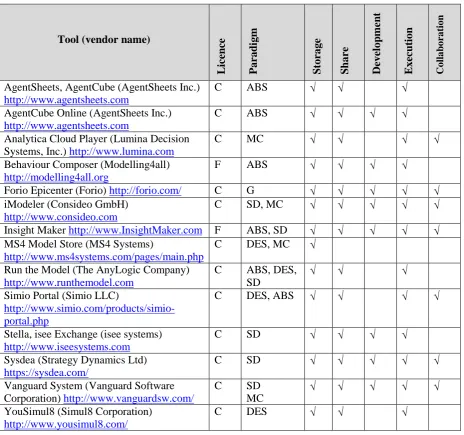
The above sources collectively list 179 unique simulation tools. Our search and review of tools
follows certain inclusion/ exclusion criteria. First, we only review simulation tools that provide online
documentation or websites in English. From their online documentation or websites, we exclude
simulation tools that do not make at least one of the following services accessible from a Web or
mobile application: model repository (i.e. upload, download), model sharing (using a platform, as an
applet, or as an HTML5 file), model development, model execution and experimentation (in a server
or browser) and collaboration (for non-collocated users, asynchronously or synchronously). The lists
of ABS tools in Nikolai and Madey (2009), Allan (2009) and Wikipedia (2016c) include tools for
multi-agent systems (MAS) which is different from ABS (i.e. MAS is used for creating software
agents). Hence, we exclude MAS tools. The final list comprises 14 tools produced by 13 vendors (see
Table 1). It should be noted that this list does not include any vendors who sell their simulation
engines (i.e. part of a simulation tool that executes a model) to buyers who can integrate them with
other software (which may use cloud-based services). This is because such information is not given in
detail on many of the vendors’ websites for our analysis and it is not possible to track what the buyers
8
Table 1: Simulation tools and vendors used in the analysis (C: Commercial, F: Free, ABS: Agent-based simulation, DES: Discrete-event simulation, G: General modelling, MC: Monte Carlo, SD: System dynamics)
Tool (vendor name)
L icen ce Pa ra di g m S tor ag e Sha re D ev el o p m en t E xe cu ti on C ol lab or at ion
AgentSheets, AgentCube (AgentSheets Inc.) http://www.agentsheets.com
C ABS √ √ √
AgentCube Online (AgentSheets Inc.) http://www.agentsheets.com
C ABS √ √ √ √
Analytica Cloud Player (Lumina Decision Systems, Inc.) http://www.lumina.com
C MC √ √ √ √
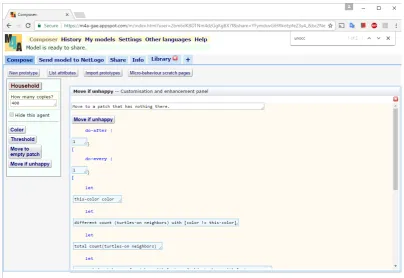
Behaviour Composer (Modelling4all) http://modelling4all.org
F ABS √ √ √ √
Forio Epicenter (Forio) http://forio.com/ C G √ √ √ √ √ iModeler (Consideo GmbH)
http://www.consideo.com
C SD, MC √ √ √ √ √
Insight Maker http://www.InsightMaker.com F ABS, SD √ √ √ √ √ MS4 Model Store (MS4 Systems)
http://www.ms4systems.com/pages/main.php
C DES, MC √
Run the Model (The AnyLogic Company) http://www.runthemodel.com
C ABS, DES, SD
√ √ √
Simio Portal (Simio LLC)
http://www.simio.com/products/simio-portal.php
C DES, ABS √ √ √ √
Stella, isee Exchange (isee systems) http://www.iseesystems.com
C SD √ √ √ √
Sysdea (Strategy Dynamics Ltd) https://sysdea.com/
C SD √ √ √ √ √
Vanguard System (Vanguard Software Corporation) http://www.vanguardsw.com/
C SD
MC
√ √ √ √ √
YouSimul8 (Simul8 Corporation) http://www.yousimul8.com/
C DES √ √ √
Most vendors in Table 1 are commercial ones. All the simulation paradigms that we are interested in
(i.e. Agent-Based Simulation (ABS), Discrete-Event Simulation (DES) and System Dynamics (SD))
are represented. It should be noted that Forio supports languages such as Python and Julia, which can
be used for general modelling (not restricted to simulation). The remaining columns show the services
provided by the tools (which we use in the inclusion criteria). In order to ensure the validity of the
[image:8.595.68.533.159.594.2]9
simulation tools (when a trial version or free (basic) version was available) or checking the tutorial
videos, user guides and reference documents. The summary of the result from the testing is given in
appendix B.
4. Results
This section first introduces the notion of business model and the analytical framework of the study,
which is based on Osterwalder and Pigneur’s (2010) concept of ‘business model canvas’. It then
applies this framework to provide an analysis of CBMS vendors’ business models.
4.1 The notion of business model
The notion of business model was originally associated with internet-based entrepreneurship and
gained prominence during the internet boom era (Magretta 2002). Since then, though, it has been
extended to other sectors of the economy to describe how any firm conducts business and adds value
(Chesbrough and Rosenbloom 2002). There is no agreement in the literature on what a ‘business
model’ is and, thus, there is a plethora of existing definitions (see Zott et al. 2011). Despite this, the
existing literature appears to converge on some fundamental characteristics of business models such
as an inter-firm network structure (e.g. focal firm, customers, suppliers and business partners) within
which value is created and exchanged; a market offering and value proposition to customers;
technological capabilities that allow producing and delivering the good or service offered; revenue
and cost structures, and payment models and incentives (Mason and Spring 2011; Spring and Araujo
2009; Osterwalder et al. 2005; Chesbrough and Rosenbloom 2002).
For the purposes of our analysis we have adopted the conceptualisation proposed by Osterwalder and
colleagues (2005) because it is one of the most popular among practitioners and it has been applied to
describe business models from a wide range of organisations. According to this conceptualisation, a
business model is “a conceptual tool that contains a set of elements and their relationships and allows
expressing the business logic of a specific firm. It is a description of the value a company offers to
10
for creating, marketing, and delivering this value and relationship capital, to generate profitable and
sustainable revenue streams.” (Osterwalder et al. 2005, p. 14-15)
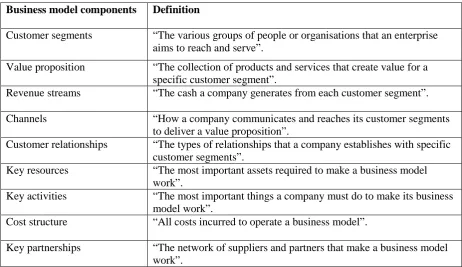
Osterwalder and Pigneur (2010) have built on the above definition to describe the key components or
elements describing a business model at the firm level. Their ‘business model canvas’ framework
consists of nine building blocks: customer segments, value propositions, revenue streams, channels,
customer relationships, key resources, key activities, cost structure, and key partnerships. Table 2
[image:10.595.66.529.296.563.2]presents these nine key components and their definitions (see Osterwalder and Pigneur 2010).
Table 2: The key components of business models (Source: Osterwalder and Pigneur, 2010, p.44)
Business model components Definition
Customer segments “The various groups of people or organisations that an enterprise aims to reach and serve”.
Value proposition “The collection of products and services that create value for a specific customer segment”.
Revenue streams “The cash a company generates from each customer segment”.
Channels “How a company communicates and reaches its customer segments to deliver a value proposition”.
Customer relationships “The types of relationships that a company establishes with specific customer segments”.
Key resources “The most important assets required to make a business model work”.
Key activities “The most important things a company must do to make its business model work”.
Cost structure “All costs incurred to operate a business model”.
Key partnerships “The network of suppliers and partners that make a business model work”.
4.2 Business models of CBMS vendors
In this section, we apply the ‘business model canvas’ (Osterwalder and Pigneur 2010) framework to
describe and analyse the business models adopted by the studied CBMS vendors (see Table 1).
Specifically, we draw on the nine components to analyse and compare existing business models for
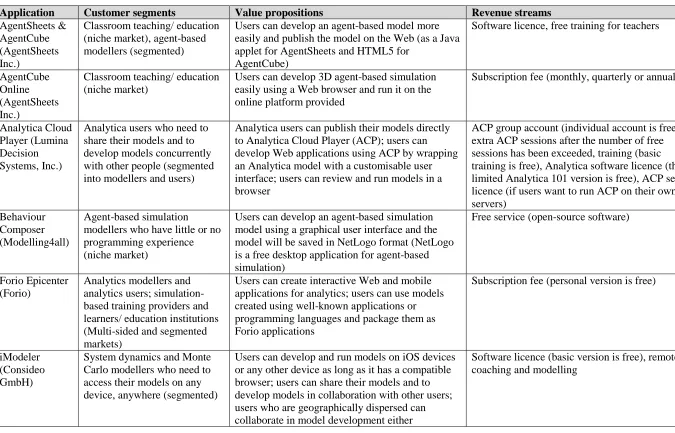
CBMS services. The results are summarised in Tables 3, 4 and 5. In the following we discuss the key
11
Table 3: CBMS business models (customer segments, value propositions, and revenue streams)
Application Customer segments Value propositions Revenue streams
AgentSheets & AgentCube (AgentSheets Inc.)
Classroom teaching/ education (niche market), agent-based modellers (segmented)
Users can develop an agent-based model more easily and publish the model on the Web (as a Java applet for AgentSheets and HTML5 for
AgentCube)
Software licence, free training for teachers
AgentCube Online (AgentSheets Inc.)
Classroom teaching/ education (niche market)
Users can develop 3D agent-based simulation easily using a Web browser and run it on the online platform provided
Subscription fee (monthly, quarterly or annually)
Analytica Cloud Player (Lumina Decision Systems, Inc.)
Analytica users who need to share their models and to develop models concurrently with other people (segmented into modellers and users)
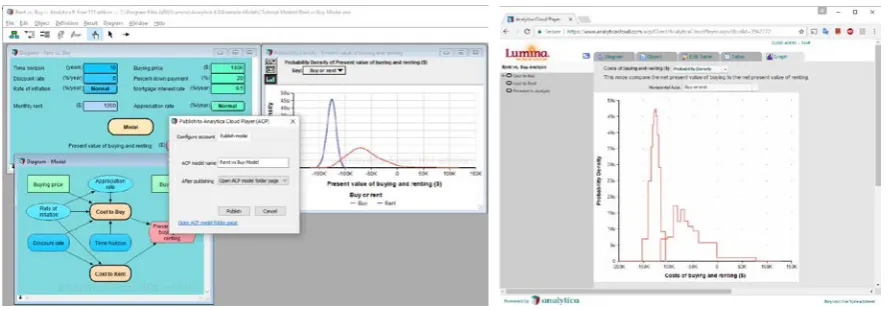
Analytica users can publish their models directly to Analytica Cloud Player (ACP); users can develop Web applications using ACP by wrapping an Analytica model with a customisable user interface; users can review and run models in a browser
ACP group account (individual account is free), extra ACP sessions after the number of free sessions has been exceeded, training (basic training is free), Analytica software licence (the limited Analytica 101 version is free), ACP server licence (if users want to run ACP on their own servers)
Behaviour Composer (Modelling4all)
Agent-based simulation modellers who have little or no programming experience (niche market)
Users can develop an agent-based simulation model using a graphical user interface and the model will be saved in NetLogo format (NetLogo is a free desktop application for agent-based simulation)
Free service (open-source software)
Forio Epicenter (Forio)
Analytics modellers and analytics users; simulation-based training providers and learners/ education institutions (Multi-sided and segmented markets)
Users can create interactive Web and mobile applications for analytics; users can use models created using well-known applications or programming languages and package them as Forio applications
Subscription fee (personal version is free)
iModeler (Consideo GmbH)
System dynamics and Monte Carlo modellers who need to access their models on any device, anywhere (segmented)
Users can develop and run models on iOS devices or any other device as long as it has a compatible browser; users can share their models and to develop models in collaboration with other users; users who are geographically dispersed can collaborate in model development either
12
synchronously and asynchronously Insight Maker System dynamics and
agent-based simulation modellers (mass market)
It provides all the functionalities needed for a full-model development life cycle as online services accessible via a browser
Free service (open-source software), donation
MS4 Model Store (MS4 Systems)
MS4 Me users (segmented) Users can share their DEVS models more easily and collaborate with other users across the Web
Free service for MS Me licence holders (users pay for the MS Me licence)
Run the Model (The AnyLogic Company)
AnyLogic users who wants to share their model as a Java applet (segmented)
AnyLogic users can publish their models as Java applets that can be run on a compatible browser; In addition, a portal for sharing the models is
provided free
Free service (users pay for the desktop application)
Simio Portal (Simio LLC)
Simio users (segmented) Simio users can share their simulation results via a browser; Simio users can run set experiments from a browser and run them using cloud services
Information is not available on the Web
Stella (isee systems)
System dynamics modellers (segmented)
Users can publish their models as HTML5 that can be run on any compatible browser. The companion web-based application (isee Exchange) provides functionalities for model development via a web browser.
Software licence
Sysdea (Strategy Dynamics Ltd)
System dynamics modellers (segmented)
It provides all functionalities needed for a full-model development life cycle as online services accessible via a browser
Subscription fee (free for teachers)
Vanguard System (Vanguard Software Corporation)
System dynamics and Monte Carlo modellers (information about market segments is not available)
Users can run their models anywhere using a compatible browser; users can run their models on a Grid Computing infrastructure
Information is not available on the Web
YouSimul8 (Simul8 Corporation)
Simul8 users who wants to share their model (segmented)
Users can publish their Simul8 models using yousimul8 platform for free
13 4.2.1 Customer segments
‘Customer segments’ refer to the key organisations or individual customers that a firm intends to
reach and serve (Osterwalder and Pigneur 2010). Table 3 shows that all commercial vendors divide
their users into several segments. Typically, they divide their users into education (schools or higher
education) and commercial sectors. Education-sector users are usually offered a discounted price (in
some cases even for free). This is a strategy commonly used by many simulation vendors to increase
their user base by targeting students who are studying related subjects. Most commercial vendors in
Table 3 further divide their commercial users into multiple segments by providing different software
versions or tiered subscription fees. This is a common strategy to reach out to users in a wider market.
Some vendors focus on a niche market (e.g. AgentSheets Inc. focuses more on users from the
education sector and Modelling4all focuses on users who have little or no programming experience).
Non-commercial vendors (Modelling4all and InsightMaker) do not divide their users into segments,
i.e. they provide one software edition.
What is clear from Table 3 is that most vendors consider simulation modellers to be their only
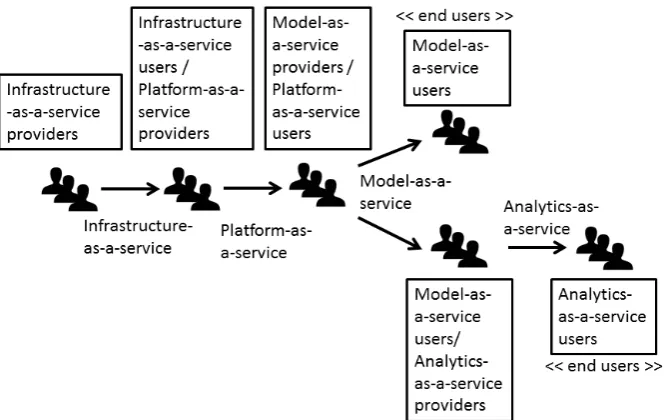
customers. CBMS provides an opportunity to extend the market to a wider audience more efficiently
because cloud services can be construed as a service supply chain in which a provider offers services
to a user; subsequently, the user can add value to the services and become a provider to another user
(and so on until it reaches an end user) as shown in Figure 1. In a cloud service supply chain, the end
user is the one who consumes a cloud service and does not transform it into another cloud service. For
example, in the CloudSME project (Kiss et al. 2015), software providers and consultants may
consume high performance computing infrastructure as a service, add value by developing simulation
14
Figure 1: CBMS as a service supply chain
4.2.2 Value propositions
The notion of value proposition refers to value creation potential for specific customer segments
through an appealing market offering (Osterwalder and Pigneur 2010). This is important to consider
because the successful adoption of CBMS depends on whether potential users can accept the value
proposition offered by CBMS services and start using them. As shown in Table 3, the most common
value proposition offered by vendors is the ability to run a model anywhere using a browser. Hence,
users do not need to install any software, apart from a browser to develop and run a model. Another
commonly stated proposition is the ability to store models in cloud storage and share models over the
Web. Since all models are accessible by users via a browser, they will always have access to the latest
models. Only a few vendors mention support for online collaborative model development as their
value proposition. Even fewer vendors explicitly highlight the ability to conduct experiments using
scalable and on-demand computing resources enabled by cloud computing (i.e. Forio and Simio LLC)
and grid computing as part of their value proposition (i.e. Vanguard Software Corporation).
The value propositions developed by CBMS vendors appear to be consistent with those developed for
cloud services in general. More specifically, cloud services allow users to access their data anytime,
15
Subashini and Kavitha 2011, Wang et al. 2010, Wyld 2009, Zhang et al 2010, Zissis and Lekkas
2012) and cloud services offer better scalability of computing resources because they can be allocated
and de-allocated on demand (Armbrust et al. 2009, Buyya et al. 2009, Katzan 2010, Marston et al.
2010, Rimal et al. 2011, Subashini and Kavitha 2011, Sultan 2011, Wang et al. 2010, Wyld 2009,
Zhang et al. 2010, Zissis and Lekkas 2012).
However, CBMS vendors do not emphasise other common value propositions from cloud services
which are relevant to CBMS. For example, cloud services reduce IT costs (Armbrust et al. 2009,
Katzan 2010, Marston et al. 2010, Benlian and Hess 2011, Rimal et al 2011, Subashini and Kavitha
2011, Sultan 2011, Wyld 2009, Zhang et al. 2010). CBMS vendors and users do not need to purchase
IT infrastructure and incur associated capital costs upfront. CBMS vendors can host their M&S
services at one of the cloud service providers. A cloud service provider can deliver the service cheaper
due to better economy of scale and can therefore pass on the benefits to other CBMS supply chain
actors.
Another relevant value proposition is that cloud services can be consumed using a pay-as-you-use
(PAYU) model (Armbrust et al. 2009, Katzan 2010, Rimal et al. 2011, Subashini and Kavitha 2011,
Sultan 2011, Wyld 2009). PAYU offers flexibility to CBMS providers because the cost for using
1,000 computers for one hour is the same as one computer for 1,000 hours. From an income tax
perspective, PAYU may be preferable to some organisations because it converts capital expenses into
operating expenses. A CBMS provider can pass on this benefit to their users. In fact, some of the
CBMS vendors (e.g. Lumina Decision Systems Inc.) have already offered PAYU to their users but do
not emphasise the benefits of PAYU.
The next relevant value proposition is that cloud services transfer the responsibility for hardware,
application software and storage facilities to cloud service providers (Armbrust et al. 2009, Katzan
2010, Marston et al. 2010, Sultan 2011, Wang et al. 2010, Wyld 2009). This means that cloud services
16
of over- or underutilising an owned resource is transferred to cloud service providers. This value
proposition allows CBMS providers and users to focus on their core business competency. This value
proposition is especially enticing for SMEs that may not have enough resources to handle the
complexity of IT infrastructure needed for their businesses. Related to this value proposition,
resources for cloud services can be deployed faster than in a conventional procurement system
(Armbrust et al. 2009, Subashini and Kavitha 2011, Wang et al. 2010, Zissis and Lekkas 2012). This
is because users can rapidly access computing resources from cloud services without any human
interaction.
The above value propositions are relevant to CBMS but our analysis suggests that they have not been
emphasized yet by CBMS vendors. The potential of these value propositions is confirmed by a
large-scale survey conducted by IBM Research on 1,090 IT decision-makers around the world shows that
cost reduction, scalability, availability, PAYU and rapid deployment of resources are perceived as the
key benefits of cloud services (IBM Smart Business 2010). The findings of another IBM survey of
572 business and technology executives of SMEs worldwide show that cost reduction and resource
scalability are perceived as the main key benefits by users (Berman et al. 2012).
4.2.3 Revenue streams
Successful commercial adoption of CBMS does not depend only on demand from users, but also on
the willingness of providers to supply the services needed. Hence, viable revenue streams for CBMS
services are of high importance. According to Osterwalder and Pigneur (2010), revenue streams refer
to cash flows generated by each customer segment. The findings in Table 3 offer insights into the
early efforts of vendors to generate such monetary flows from their M&S services. We can group
these vendors into five, non-mutually exclusive categories.
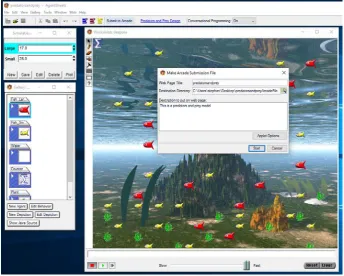
In the first category, vendors (e.g. AgentSheets Inc.) simply provide the functionality to publish
models developed using their desktop applications in formats that can be run on a browser, such as
17
vendors generate revenue from their desktop applications. Vendors in the second category provide an
online platform to add value to their desktop simulation application. Some of them do not seem to
generate revenue directly from their online platform (e.g. The AnyLogic Company, MS4 Systems and
Simul8 Corporation). Hence, it is understandable that the functionalities of their online platform tend
to be limited to model sharing. Vendors that generate revenue from their online platforms provide
more functionalities (e.g. Lumina Decision Systems Inc.). The third category of vendors provides
Web applications that support a complete simulation modelling life cycle (e.g. Forio and Strategy
Dynamics Ltd). They generate revenue from their online platform through a subscription fee and/or
usage fees. Some of them also sell desktop applications that have similar functionalities to their Web
applications. Hence, they also generate revenue from their desktop applications (e.g. isee System,
Consideo GmbH and Vanguard Software Corporation). Vendors in the fourth category provide a free
online platform (Modelling4all and InsightMaker). They generate revenue through research funding.
Vendors classified in the above four categories use a single-sided market model. The fifth category is
demonstrated by Forio, which generates revenue from a multi-sided market model via its simulation
store (similar to Apple’s App Store, Google Play or AppCentre in Kiss et al. (2015)). This type of
revenue stream is not new in a broader sense, but it is innovative within the specific CBMS context in
its targeting of end users (i.e. those who will use analytic and simulation models to support their
decision-making process). Hence, Forio can help its immediate users (i.e. model developers) to
generate revenue by selling services (model-as-a-service or analytic-as-a-service) to downstream
users. This business model enables CBMS to operate in a service supply chain (see Figure 1).
Construed as a service supply chain, CBMS can attract a wider market, from modellers to end users,
which in turn has the potential to make the whole CBMS supply chain financially viable and
18
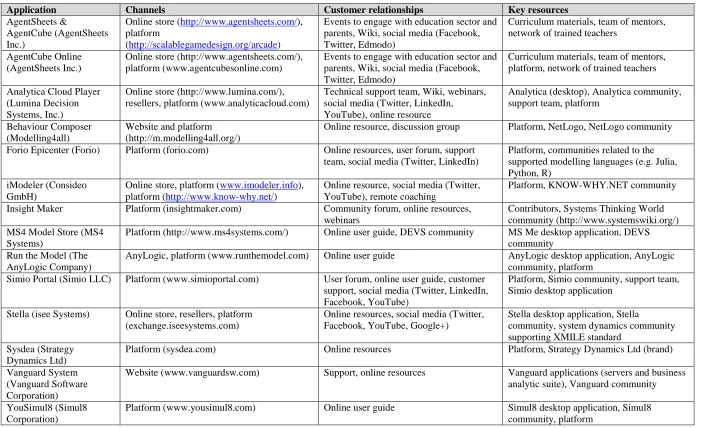
Table 4: CBMS business models (channels, customer relationships and key resources)
Application Channels Customer relationships Key resources
AgentSheets &
AgentCube (AgentSheets Inc.)
Online store (http://www.agentsheets.com/),
platform
(http://scalablegamedesign.org/arcade)
Events to engage with education sector and parents, Wiki, social media (Facebook, Twitter, Edmodo)
Curriculum materials, team of mentors, network of trained teachers
AgentCube Online (AgentSheets Inc.)
Online store (http://www.agentsheets.com/), platform (www.agentcubesonline.com)
Events to engage with education sector and parents, Wiki, social media (Facebook, Twitter, Edmodo)
Curriculum materials, team of mentors, platform, network of trained teachers Analytica Cloud Player
(Lumina Decision Systems, Inc.)
Online store (http://www.lumina.com/), resellers, platform (www.analyticacloud.com)
Technical support team, Wiki, webinars, social media (Twitter, LinkedIn, YouTube), online resource
Analytica (desktop), Analytica community, support team, platform
Behaviour Composer (Modelling4all)
Website and platform (http://m.modelling4all.org/)
Online resource, discussion group Platform, NetLogo, NetLogo community
Forio Epicenter (Forio) Platform (forio.com) Online resources, user forum, support
team, social media (Twitter, LinkedIn)
Platform, communities related to the supported modelling languages (e.g. Julia, Python, R)
iModeler (Consideo GmbH)
Online store, platform (www.imodeler.info),
platform (http://www.know-why.net/)
Online resource, social media (Twitter, YouTube), remote coaching
Platform, KNOW-WHY.NET community
Insight Maker Platform (insightmaker.com) Community forum, online resources,
webinars
Contributors, Systems Thinking World community (http://www.systemswiki.org/) MS4 Model Store (MS4
Systems)
Platform (http://www.ms4systems.com/) Online user guide, DEVS community MS Me desktop application, DEVS
community Run the Model (The
AnyLogic Company)
AnyLogic, platform (www.runthemodel.com) Online user guide AnyLogic desktop application, AnyLogic
community, platform
Simio Portal (Simio LLC) Platform (www.simioportal.com) User forum, online user guide, customer
support, social media (Twitter, LinkedIn, Facebook, YouTube)
Platform, Simio community, support team, Simio desktop application
Stella (isee Systems) Online store, resellers, platform
(exchange.iseesystems.com)
Online resources, social media (Twitter, Facebook, YouTube, Google+)
Stella desktop application, Stella
community, system dynamics community supporting XMILE standard
Sysdea (Strategy Dynamics Ltd)
Platform (sysdea.com) Online resources Platform, Strategy Dynamics Ltd (brand)
Vanguard System (Vanguard Software Corporation)
Website (www.vanguardsw.com) Support, online resources Vanguard applications (servers and business
analytic suite), Vanguard community YouSimul8 (Simul8
Corporation)
Platform (www.yousimul8.com) Online user guide Simul8 desktop application, Simul8
19
4.2.4 Channels, customer relationships and key resources
The main channels used by vendors to deliver their value propositions (Osterwalder and Pigneur
2010) are their websites, online stores and online platforms, i.e. Web or mobile applications that are
used to deliver M&S services (see Table 4). Many of the platforms are hosted by well-known cloud
service providers, such as Amazon, Google and Microsoft. Others are hosted by Web hosting
companies, some of which support cloud services.
Vendors reach out to their potential customers and maintain their relationships with current users
using various channels such as social media (Twitter and YouTube are the most popular among
them), Wikis, user forums, webinars, online resources and dedicated support teams (most vendors
charge an extra fee for this). Some vendors have organised user conferences so that users can share
their experiences with vendors and other users (e.g. AgentSheets Inc., Simio LLC and The AnyLogic
Company). Some vendors (e.g. Forio, Simio LLC, The AnyLogic Company, isee Systems, Sysdea
and Simul8 Corporation) also have a strong presence at major academic conferences. Forio offers the
functionality to import models from well-known applications such as Vensim and convert them into
Forio formats. This functionality may appeal to users from the Vensim community who need to use
cloud services for their models.
The key resources, defined as important assets that firms require to realise their business models,
(Osterwalder and Pirgneur 2010) are also presented in Table 4. For CBMS vendors selling desktop
applications the key resources include the desktop application itself (especially when the Web
application extends the functionalities of their desktop version) and the user base for the desktop
application. This is because users will need to use the desktop version for model development and a
large user base is essential to form a community of users for knowledge-sharing and feedback. The
key resource for vendors that offer Web/ mobile applications is the online platform. Some vendors
have close links to a community (e.g. InsightMaker and System Thinking World community,
Consideo GmbH and KNOW-WHY.NET community), or provide functionality that is close to that of
20
MS4 Systems and the DEVS community). Another important resource is brands, which can be the
product names (e.g. AnyLogic, InsightMaker, Simio and Simul8), vendor names (e.g. Strategy
Dynamics Ltd) or brands of key partners (e.g. University of Oxford, University of Colorado and
Stanford University). Finally, the support team is a key resource, especially for vendors that provide
21
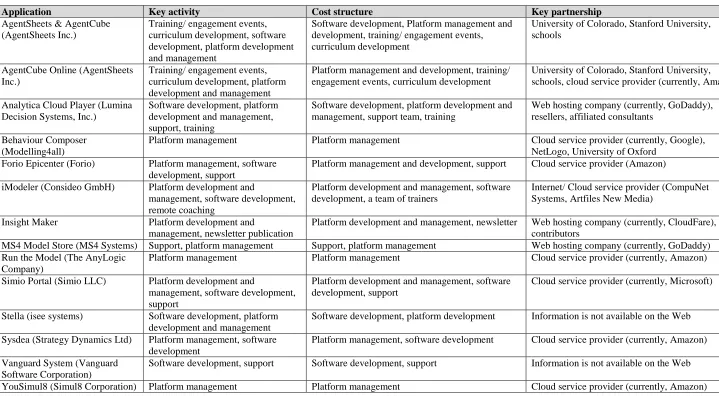
Table 5: CBMS business models (key activities, cost structure and key partnerships)
Application Key activity Cost structure Key partnership
AgentSheets & AgentCube (AgentSheets Inc.)
Training/ engagement events, curriculum development, software development, platform development and management
Software development, Platform management and development, training/ engagement events, curriculum development
University of Colorado, Stanford University, schools
AgentCube Online (AgentSheets Inc.)
Training/ engagement events, curriculum development, platform development and management
Platform management and development, training/ engagement events, curriculum development
University of Colorado, Stanford University, schools, cloud service provider (currently, Amazon) Analytica Cloud Player (Lumina
Decision Systems, Inc.)
Software development, platform development and management, support, training
Software development, platform development and management, support team, training
Web hosting company (currently, GoDaddy), resellers, affiliated consultants
Behaviour Composer (Modelling4all)
Platform management Platform management Cloud service provider (currently, Google),
NetLogo, University of Oxford
Forio Epicenter (Forio) Platform management, software
development, support
Platform management and development, support Cloud service provider (Amazon)
iModeler (Consideo GmbH) Platform development and
management, software development, remote coaching
Platform development and management, software development, a team of trainers
Internet/ Cloud service provider (CompuNet Systems, Artfiles New Media)
Insight Maker Platform development and
management, newsletter publication
Platform development and management, newsletter Web hosting company (currently, CloudFare),
contributors
MS4 Model Store (MS4 Systems) Support, platform management Support, platform management Web hosting company (currently, GoDaddy)
Run the Model (The AnyLogic Company)
Platform management Platform management Cloud service provider (currently, Amazon)
Simio Portal (Simio LLC) Platform development and
management, software development, support
Platform development and management, software development, support
Cloud service provider (currently, Microsoft)
Stella (isee systems) Software development, platform
development and management
Software development, platform development Information is not available on the Web
Sysdea (Strategy Dynamics Ltd) Platform management, software
development
Platform management, software development Cloud service provider (currently, Amazon)
Vanguard System (Vanguard Software Corporation)
Software development, support Software development, support Information is not available on the Web
22 4.2.5 Key activities, cost structure and key partnerships
Key activities that firms engage in to realise their business models and associated operating costs (see
Osterwalder and Pigneur 2010) are also analysed. Table 5 presents the key activities and costs related
to the delivery of CBMS services. It is noted that activities and costs common to most organisations
(e.g. marketing costs) are not in focus here. The key activity and cost structure for CBMS vendors that
sell a desktop application is software development. Likewise, the key activity and cost structure for
vendors that provide an online platform is platform management and development. Other activities
include customer relationship management and customer support. Most vendors do not list their key
partners on their website. However, it is clear that those that provide an online platform need to host
their platform with a service provider. A further investigation of the IP addresses of platforms
revealed that Amazon is the most popular choice. Web hosting companies, Google and Microsoft are
also used. Table 5 also offers an overview of key partners of CBMS vendors, which mainly include
cloud service providers, web hosting companies and even academic institutions.
5. Discussion
Overall, our study suggests that only a few vendors have started to use cloud services as part of their
business models, and that the potential of such CBMS business models is currently under-realised.
This may indicate that the demand for CBMS services has not yet reached critical mass. Section 4
analysed the key components of existing business models of CBMS vendors e.g. in terms of customer
segments targeted, value propositions, revenue streams, channels and key resources deployed. This
analysis also helped to unearth several issues that simulation vendors need to consider to develop truly
innovative CBMS business models. These are discussed in Section 5.1 below.
Beyond the need to develop innovative CBMS business models several challenges and risks
underpinning the provision and use of CBMS services, which are also reported in the literature, need
to be addressed. These issues, which are raised by CBMS customers and especially end users, apply to
23
More specifically, security is one of the key issues that impedes the adoption of cloud services
(Marston et al. 2010, Dillon et al. 2010, Katzan 2010, Benlian and Hess 2011, Rimal et al. 2011,
Subashini and Kavitha 2011, Sultan 2011, Wyld 2009, Zhang et al. 2010, Zissis & Lekkas 2012, Ali
et al. 2016). This is confirmed by Carrol et al. (2011) who investigated how frequently various
security concerns were raised in the literature. The loss of physical control over data is another
important factor influencing adoption, especially due to breach of privacy risks (Armbrust et al. 2009,
Katzan 2010, Marston et al. 2010, Rimal et al. 2011, Subashini and Kavitha 2011, Sultan 2011, Wyld
2009, Zissis and Lekkas 2012, Xiao and Xiao 2013). This risk is amplified when a vendor is unable to
guarantee the physical geographic location of users’ data. A simulation model is typically built from
first principles instead of a set of mathematical equations. Hence, from a simulation model, people
can see the layout of the physical system being modelled (typically in a DES model), the
decision-making rules of actors in the physical system (typically in ABS) or a mental map showing how
decision-makers view the physical system (typically in SD). In other words, in simulation modelling,
both model and data can be highly sensitive and confidential. Hence, concerns surrounding security
and privacy are highly relevant to CBMS users.
The ability of vendors to guarantee a Quality of Service (QoS) threshold within the Service Level
Agreement (SLA) has also been stressed as a main factor driving the adoption of cloud-based services
(Armbrust et al. 2009, Dillon et al. 2010, Marston et al. 2010, Rimal et al. 2011, Zissis and Lekkas
2012). This issue is even more complicated when different providers (in the CBMS supply chain) are
involved to provide services to end users, as different users may require different levels of QoS. For
example, models used for operational decision-making may need better availability than models used
for strategic decision-making. It is suggested that the above challenges and risks can be addressed
through well-designed contracts (see Section 5.2).
5.1 Business models of CBMS services
The results of our study indicate that existing CBMS business models present certain deficiencies that
24
that the majority of simulation vendors included in our study appear to rely on a rather narrow
customer basis, mainly consisting of simulation modellers. Construing CBMS as a service supply
chain which consists of multiple actors with interdependent requirements (see Figure 1) opens up new
opportunities for CBMS vendors to position themselves in the value chain and generate sustainable
and profitable market offerings.
Specifically, there are three potential customer segments of CBMS that have not been explicitly
targeted by most vendors. The first segment is organisations that use compute-intensive business
analytics. Compute-intensive business analytics is suitable for batch processing, which is one of the
best candidates to benefit from the cloud. Hence, the increase in awareness of organisations about the
benefits of analytics in the era of big data may open up the market for CBMS, especially for the
analytics-as-a-service and model-as-a-service. The second segment is existing analytic and simulation
users who have been using desktop analytic or simulation tools. There is trend in the software market
whereby desktop applications have started to offer seamless extension into online services, including
cloud services (e.g. Microsoft Office with Office 365, AutoCAD with AutoDesk 360). There are
benefits for existing analytic or simulation users from seamless extension into the cloud, such as the
ability to acquire more computing resources quickly when needed. The third segment is those who
build simulation models regularly in a team, whose members may not always be based at the same
location. Most of the respondents in the survey conducted by Onggo et al. (2014) belong to this
category. The survey shows that they appreciate the benefit of having software that has one piece that
runs on a thin client (such as a tablet or even a smartphone) and another piece that runs in the cloud.
Consequently, they are clearly potential CBMS users.
Beyond the need to target a broader customer basis, simulation vendors also need to extend their value
propositions in accordance with the ones identified in the broader field of cloud computing (see
Section 4.2.2). A prerequisite for achieving this is to understand in-depth how customers use these
simulation models and related services. The focus should particularly be on end users because they
are the ones who create the demand for upstream services. Despite our understanding of the
25
(and analytic) customers use their models is rather limited. Hamalainen et al. (2013) called for more
research into understanding the behavioural aspect of the use of OR techniques or models in decision
support. The term Behavioural OR has been proposed to capture this new and important topic. Wang
et al. (2016) in their recent survey also highlighted the need to examine the behaviours of cloud
computing users.
In the specific context of CBMS, knowledge about how customers use their analytic or simulation
models allows designing CBMS services that can add value to these simulation and analytic users.
Value propositions for CBMS that fully cater for the requirements of users are therefore essential for
CBMS adoption. The survey conducted by Onggo et al. (2014) helps us to better understand the
characteristics of CBMS users (e.g. how they work in a group, exposure to cloud applications and
mobile gadgets) and what they require from CBMS (e.g. a fast response time, support for effective
communication). However, given that most respondents were modellers (not end users), further work
is needed to understand the expectations and needs of end users. Findings from studies on the factors
affecting cloud computing adoption (see Low et al. 2011; Morgan and Conboy 2013; Park and Ryoo
2013; Yang and Lin 2015; and Schneider and Sunyaev 2016) may also shed some light on the factors
that would help drive CBMS adoption.
Expanding the customer basis and the range of value propositions to different customer segments
would work towards developing innovative business models of CBMS services, which would in turn
generate new market opportunities and revenue stream for simulation vendors. Our results suggest
that the potential for innovative business models in the context of CBMS is currently under-realised,
and that it is imperative that more successful examples such as Forio’s simulation store and the
AppCentre (Kiss et al. 2015) are developed. Vendors need to help their users not only to fulfil their
needs and requirements but also to earn revenue by becoming service providers to their downstream
users. To achieve this objective, vendors and users need to rethink their value propositions and
positioning in the CBMS service supply chain so that they extend business beyond their immediate
26
innovative business models that harness the true potential of cloud services as enablers for the
creation of new market opportunities and revenue streams.
The above essentially suggest that the development of innovative CBMS business models requires
going beyond the technical and operational aspects of CBMS service provision to consider how
economic value can be created, distributed and captured in the broader value chain (Chesbrough and
Rosenbloom 2002). More specifically, innovative business models entail connecting with customers
and suppliers in the CBMS service supply chain in creative ways to reconfigure the value network and
related service capabilities (Spring and Araujo 2009), to identify new market opportunities, to extend
value propositions and to generate sustainable and financially viable market offerings accordingly
(Osterwalder and Pigneur 2010).
5.2 Contracting for CBMS services
This section discusses the role of contracting in addressing challenges and risks underpinning the
provision and use of CBMS services. As previously outlined, the shifting emphasis on cloud
computing has raised certain challenges regarding limited user control over data access, handling and
preservation after service termination (Dhar 2012, Weinhardt et al. 2009). The literature on cloud
services has stressed the role of contracting for managing some of these risks (e.g. Bradshaw et al.
2011). In what follows we suggest ways to extend this discussion to also address challenges that are
specific to CBMS services and relate to privacy and security, ownership of models and analysis
outputs, the definition of service levels and performance metrics, incentives and risk-reward sharing,
as well as liability allocation.
Similar to other types of cloud computing, simulation services provided over the cloud entail that the
geographical location of the servers and data may not be fixed. In fact, data storage locations may
well be unknown. This creates concerns regarding country- or region-specific legal systems and
27
to which specific laws can keep up with the rapidity of technological innovation and advanced
business models (Pearson and Benameur 2010). Contracts for CBMS services should explicitly
address such aspects. For instance, contracts must stipulate the provider’s commitments and clearly
specify the geographical locations for storing data, models and analytics in order to foster trust on
CBMS vendors and facilitate adoption of such services. Contracts should also refer to acceptable legal
frameworks and mechanisms for dispute resolution in case any disagreements over data and/or model
access and use arise (see Mowbray 2009).
In service outsourcing (including IT outsourcing) formal contracts perform multiple functions, the
main one being safeguarding against opportunistic behaviour (Kern and Willcocks 2000, Williamson
1985). Accordingly, contracts for CBMS services should serve as legal and economic safeguards to
deal with security and privacy risks, such as the confidentiality of data, models and analysis results,
lack of access to data and data-handling after service termination. The reported dispute between
LinkUp and Nirvanix (Arburst et al. 2010) regarding the loss of user data is a good example
highlighting the crucial role of contracts as safeguarding mechanisms. Of particular importance is the
way sensitive data that are used as input for modelling and analysis are handled, as well as whether
providers monitor users’ use of models and analytic tools. Explicit provisions for handling such issues
should be included in service contracts.
In addition, contracting should address issues regarding the ownership status of simulation models
and outputs of analysis. Traditional IT outsourcing contracts specify the allocation of intellectual
property rights (e.g. Chen and Bharadwaj 2009). Agreements for cloud services tend to include
property rights-related clauses that recognise that data and content are (typically) owned by the user
(Bradshaw et al. 2011). Likewise, the role of contracts for CBMS services is crucial in this respect,
and they should also consider the types of services provided. For example, intellectual property
clauses should clearly specify who owns outputs of analysis in an analytics-as-a-service offering. In a
similar vein, contractual provisions should address whether vendors can reuse or adapt the developed
28
Furthermore, the contractual SLA plays an important role in terms of defining and incentivizing
service performance in outsourcing deals (Selviaridis and Norrman 2014), and CBMS services are no
exception. The designed SLAs should clearly specify the performance of CBMS services in terms of
key performance indicators (KPIs) and also allocate risks and rewards in a fair way. For instance, the
‘performance’ of an analytics-as-a-service offering should be clearly defined and it should be set apart
from the performance of a model-as-a-service offering. Specific and measurable KPIs must be
included in the SLA to enable monitoring of vendor performance. As a guideline, generic cloud
computing metrics, such as availability and uptime, can also be used in CBMS service contracts.
However, additional aspects that are specific to CBMS (e.g. the quality of modelling and data
analytics to support decision-making) should also be considered during contract design.
The design of incentive systems is another issue that also connects to payment schemes and revenue
streams for CBMS services. In line with the broader literature on business models, it is important to
note that different business models may entail differences in the allocation of risks and rewards (see
Spring and Araujo 2009) between CBMS providers and users. Contracts for CBMS services should
reflect such differences in business models. At a basic level, they may stipulate penalties for failures
to achieve specified service levels. These contractual penalties may manifest themselves in the form
of ‘service credits’ (see Bradshaw et al. 2011) or direct financial compensation to the user. Besides
penalties though, a fair contractual incentive system should also extra-reward CBMS vendors for
over-performance. These rewards can take many forms including gain-share mechanisms or bonus
payments linked to specific service level targets (Selviaridis and Wynstra 2015). For instance, the
contractual SLA could stipulate that a customer achieving cost savings by using an analytic tool over
the cloud agrees to share part of those savings with the vendor.
A related issue is the role of contracts in allocating liabilities for non-performance of CBMS services.
The existing literature on cloud services suggests that vendors attempt to cap their direct liabilities
(e.g. failure to access data). They tend to issue disclaimers for warranties and indirect liability to
ensure that they do not bear the cost of consequential economic losses arising from service failures
29
CBMS services and they may help mitigate uncontrollable risks related to service delivery. More
specifically, liability for non-performance and financial risks related to SLA penalties are affected by
service co-production effects (Sampson and Spring 2012). In essence, the performance of advanced
types of simulation-based services (model- and analytics-as-a-service) is the result of joint efforts by
the users, providers and even sub-contractors in the service supply chain. For instance, the quality of
simulation analysis to support decision-making is determined by the quality of underlying platforms,
models and analytic tools, as well as the quality of user data and how users use and interpret the
results. Hence, it is imperative that contracts for CBMS services consider the ability to attribute
performance in the broader service supply chain (Selviaridis and Norrman 2014). In cases of low
performance attribution, contracts should include provisions that limit penalties and liabilities to
service failures that can be clearly attributed to factors within the vendor’s control (Selviaridis 2016)
e.g. the quality of simulation models underlying analytic tools.
6. Conclusion
This study is concerned with the largely neglected business aspect of CBMS and contributes to the
scant literature on this topic (see Kiss et al. 2015). More specifically, we extend Kiss et al.’s (2015)
work by providing insights into the business models employed by simulation vendors that provide
cloud-enabled or Web-enabled simulation modelling services. To the best of our knowledge this is the
first study to describe and analyse the key components of existing business models of CBMS vendors
based on Osterwalder and Pigneur’s (2010) ‘business model canvas’ framework.
Our analysis has also unearthed several issues that need to be addressed by simulation vendors in
order to fully realise the potential of CBMS business models. First, most simulation vendors in the
study limit their users to simulation modellers. CBMS can become more sustainable and impactful by
being viewed as a service supply chain wherein value is created, distributed and captured among
various CBMS actors. To this end, we have identified three additional customer segments that
simulation vendors could target. Second, simulation vendors need to extend their value propositions in
30
innovative business models of CBMS is currently under-realised. The development of innovative
business models entails creative reconfiguration of the value network in the CBMS service supply
chain to identify new market opportunities and generate profitable market offerings. These findings
contribute to the existing literature by stressing the importance of developing innovative CBMS
business models. In addition, we contribute to the scant literature on the business aspect of CBMS by
stressing the role of contracting in addressing the challenges and risks underpinning CBMS provision
and use e.g. security and privacy risks and allocation of risks and rewards. Finally, CBMS is a subset
of cloud-based DSS. Hence, our study also contributes to cloud-based DSS by providing insights into
how cloud or Web services have enabled simulation vendors to deliver model-as-service and
analytics-as-a-service, as conceptualised in Demirkan and Delen (2013).
The study presents limitations which need to be addressed through further research. Specifically, the
review and analysis of simulation vendors is based on secondary data which were collected from the
firms’ websites and validated by testing the software. This approach provides only a snapshot view of
the business models of CBMS service providers. Mason and Spring (2011) have argued that business
models are dynamic and affected by changes in the technology and business environment. Future
longitudinal studies might be more appropriate to reveal the dynamics of business models in the M&S
sector. Also, while data from websites is useful to understand current market segments, value
propositions, channels, revenue streams and customer relationships of CBMS vendors, it does not
offer equally rich information about key activities, partnerships and, especially, cost structure, which
is considered sensitive by many organisations. Hence, future studies on CBMS business models
should be based on primary data from CBMS vendors and users through in-depth interviews and /or
questionnaires. Such primary data are likely to lead to a more refined understanding of the above
components and the business models of CBMS more broadly.
Acknowledgments
This research did not receive any specific grant from funding agencies in the public, commercial, or
31 References
Ali M, Khan SU and Vasilakos AV (2016). Security in cloud computing: Opportunities and
challenges. Information Sciences 305: 357–383.
Armbrust M, Fox A, Griffith R, Joseph A, Katz R, Konwinski A and Zaharia M (2009). A View of
Cloud Computing. Communications of the ACM 53(4): 50–58.
Benlian A and Hess T (2011). Opportunities and risks of software-as-a-service: Findings from a
survey of IT executives. Decision Support Systems 52: 232–246.
Berman S, Kesterson-Townes L, Marshall A and Srivathsa R (2012). The Power of Cloud. IBM
Institute for Business Value [Online]. Available at:
https://www.ibm.com/cloud-computing/us/en/assets/power-of-cloud-for-bus-model-innovation.pdf [Accessed 26/07/16].
Bradshaw S, Millard C and Walden I (2011). Contracts for clouds: Comparison and analysis of the
Terms and Conditions of cloud computing services. International Journal of Law and Information
Technology 19(3): 187–223.
Buyya R, Yeo C, Venugopal S, Broberg J and Brandic I (2009). Cloud computing and emerging IT
platforms: Vision, hype, and reality for delivering computing as the 5th utility. Future Generation
Computer Systems 25: 599–616.
Byrne J, Heavey C and Byrne PJ (2010). A review of web-based simulation and supporting tools.
Simulation Modelling Practice and Theory 18: 253–276.
Carrol M, Van der Merwe A and Kotze P (2011). Secure Cloud Computing: Benefits, Risks and
Controls. Proceedings of the 2011 Information Security South Africa (ISSA). IEEE Computer
Society: Piscataway, NJ, USA, pp. 1–9.
Cayirci E (2013). Modeling and simulation as a cloud service: a survey. Proceedings of the 2013
Winter Simulation Conference. IEEE Computer Society: Piscataway, NJ, USA, pp. 389–400.
Chen Y and Bharadwaj A (2009). An Empirical Analysis of Contract Structures in IT Outsourcing.