doi:10.4236/am.2011.26098 Published Online June 2011 (http://www.SciRP.org/journal/am)
Septic B-Spline Collocation Method for the Numerical
Solution of the Modified Equal Width Wave Equation
Turabi Geyikli, Seydi Battal Gazi Karakoc
Department of Mathematics, Faculty of Education, Inonu University, Malatya, Turkey E-mail: [email protected], [email protected]
Received March 25, 2011; revised April 20, 2011; accepted April 23, 2011
Abstract
Numerical solutions of the modified equal width wave equation are obtained by using collocation method with septic B-spline finite elements with three different linearization techniques. The motion of a single soli-tary wave, interaction of two solisoli-tary waves and birth of solitons are studied using the proposed method. Accuracy of the method is discussed by computing the numerical conserved laws error norms L2 and L∞. The
numerical results show that the present method is a remarkably successful numerical technique for solving the MEW equation. A linear stability analysis shows that this numerical scheme, based on a Crank Nicolson approximation in time, is unconditionally stable.
Keywords:Finite Element, Septic B-Spline, Collocation, Soliton, Solitary Waves
1. Introduction
This study is concerned with the numerical solution, us-ing septic B-spline functions in collocation method, of the modified equal width wave (MEW) equation, which was introduced by Morrison et al. [1] as a model equa-tion to describe the nonlinear dispersive waves. Few analytical solutions of the MEW equation are known. Thus numerical solutions of the MEW equation can be important and comparison between analytic solution can be made. Many methods have been proposed to solve the EW and MEW equation. Gardner and Gardner solved the EW equation with the Galerkin’s method using cubic B-splines as a trial and test function [2,3] and a Pet-rov-Galerkin method using quadratic B-spline element [4]. Zaki considered the solitary wave interactions for the MEW equation by Petrov-Galerkin method using quintic B-spline finite elements [5] and obtained the numerical solution of the EW equation by using least-squares method [6]. Wazwaz investigated the MEW equation and two of its variants by the tanh and the sine-cosine meth-ods [7]. Esen applied a lumped Galerkin method based on quadratic B-spline finite element has been used for solving the EW and MEW equation [8,9]. Saka proposed algorithms for the numerical solution of the MEW equa-tion using quintic B-spline collocaequa-tion method [10]. A solution based on a collocation method incorporated cu-bic B-splines is investigated by Dağ and Saka [11].
Variational iteration method is introduced to solve the MEW equation by Junfeng Lu [12]. Hamdi et al. [13] derived exact solitary wave solutions of the generalized EW equation using Maple software. D. J. Evans and K. R. Raslan [14] studied the generalized EW equation by using collocation method based on quadratic B-splines to obtain the numerical solutions of a single solitary waves, and the birth of solitons.
The modified equal width wave equation which is as a model for non-linear dispersive waves, considered here has the normalized form [1]
2 3
t x xxt
U U U U 0 (1) with the physical boundary conditions as
, where is time and
0
U
x t x is the space
coordi-nate, is a positive parameter. For this study bound-ary conditions are chosen
, 0, , 0,
, 0, , 0,
, 0, , 0
x x
xxx xxx
U a t U b t
U a t U b t
U a t U b t
,
(2)
and the initial condition as
, 0
,U x f x a x b
2. Septic B-Spline Collocation Method
The interval
a b, is partitioned into uniformly sized finite elements by the knots xi such that0 1 N
ax xx b and h
xi1xi
. The septic B-splines i
x , (i= −3(1) N + 3), at the knots xi aredefined over the interval
a b, as [15],
74 4 3
7 7
4 3 3
7 7 7
4 3 2 2
7 7 7 7
4 3 2 1 1
7 7 7 7
7 4 3 2 1
, ,
8 , ,
8 28 , ,
8 28 56 , ,
1
( ) 8( ) 28( ) 56( ) , , ,
i i i
i i i
i i i i
i i i i i
i i i i i i i
i
x x x x x
x x x x x x x
x x x x x x x x x
x x x x x x x x x x x
x x x x x x x x x x x x
h x
7 7 7
4 3 2 1
7 7
4 3 2
7
4 3 4
8 28 , ,
8 , ,
, ,
0 o
i i i
i i i
i i i
x x x x x x x x
x x x x x x x
x x x x x
2 1 1 , , , , i i i 2 3 , , , therwise. i i (3)
The set of splines,
3
x ,2
x , ,N3
x
forms a basis for functions defined over
a b, . The numerical solution UN
x t, to U x t
,
takes the form
i
3
3
, N
N i
i
U x t t x
(4)where i are unknown, time dependent quantities to be
determined from the boundary and collocation conditions and i
x are septic B-spline. Each septic B-spline covers 8 elements thus each element
x xi, i1
iscov-ered by 8 splines. A typical finite interval
x xi, i1
is mapped to the interval [0, 1] by a local coordinate trans-formation defined by h x xi, 0 1. Thereforeseptic B-splines (3) in terms of over [0, 1] can be given as
2 3 4 5 6 7
3
2 3 5 6 7
2
2 3 4 5 6
1
4 6 7
2 3 4 5 6
1
1 7 21 35 35 21 7
120 392 504 280 84 42 7
1191 1715 315 665 315 105 105 21
2416 1680 560 140 35
1191 1715 315 665 315 105 105
i i i i i 7
7
2 3 5 6 7
2
2 3 4 5 6 7
3 7 4
35
120 392 504 280 84 42 21
1 7 21 35 35 21 7 7
. i i i (5)
Since all splines apart from
3 , 2 , , 3
i x i x i
x are zero over the element [0, 1] . For the problem the finite elements are identified
with the interval
x xi, i1
. Using the nodal values, ,
i i i
U U U and Ui are given in terms of the parameter
i
by:
3 2 1 1 2
3 2 1 1 2 3
2
3 2 1 1 2 3
3
3 2 1 1 2 3
120 1191 2416 1191 120 ,
7 56 245 245 56 ,
42 24 15 80 15 24 ,
210 8 19 19 8 ,
i i i i i i i i
i i i i i i i
i i i i i i i i
i i i i i i i
U hU h U h U 3 (6)
and the variation of U over the element
x xi, i1
isgiven by 3 3 N i i i
U
We now identify the collocation points with the knots and use (6) to evaluate i and its space derivatives in (1). This leads to a set of ordinary differential equations
f the form
U
1
3 2 1 1 2 3 3 2 1 1 2
3 2 1 1 2 3
2
120 1191 2416 1191 120 21 56 245 245 56
42 24 15 80 15 24 0,
i i i i i i i h i i i i i i
i i i i i i i
Z h 3 i (7) where
23 120 2 1191 1 2416 1191 1 120 2 3 .
i i i i i i i i
Z
If time parameters i and its time derivatives i in (7) are discretized by the Crank-Nicolson formula and usual
finite difference approximation, respectively:
11 1 , 2 n n n n
i i t
We obtain a recurrence relationship between two time levels n and n + 1 relating two unknown parameters n 1 i
, n i
1 1 1 1 1 1
1 3 2 2 3 1 4 5 1 6 2 7 3
7 3 6 2 5 1 4 3 1 2 2 1 3
n n n n n n
i i i i i i i i i i i i i i
n n n n n n n
i i i i i i i i i i i i i i
1 n
(8)
where
1 2 3
4 5 6
7
2
1 , 120 56 24 , 1191 245 15 ,
2416 80 , 1191 245 15 , 120 56 24 ,
1 0,1, , ,
21 42
, .
2
i i i i i i
i i i i i
i i
EZ M EZ M EZ M
M EZ M EZ M
EZ M i N
E t M
h h
For the first linearization, we suppose that the quantity in the non-linear term
U 2
x
U U to be locally constant. This is equivalent to assuming that in (7) all Zi are
equal to a local constant. Furthermore, we can write the nonlinear term
2
x x
U U UUU (9)
and apply the Rubin and Graves [16] linearization tech-nique
n1 n1 n n1 n nx x x
UU U U U U U U
x (10)
to the UUx term in (8) and we can also apply the
Caldwell and Smith [17] linearization technique
1 1
1
2
n n n n
x x
UU U U U U 1 x
(11)
to the UUx term in (8). The system (8) consists of
linear equation in unknowns
2 3 . To obtain a unique solution to this system we need 6 additional constraints. These are obtained from the boundary conditions and can be used to eliminate
1
N
N7
1
3, 2,3. Initial State
To start evolution of the vector of parameters n, 0 can be determined from the boundary conditions and the initial condition U x
,0 . So we can rewrite approxima-tion (4) for the initial condiapproxima-tion
3
3
,0 N 0 ,
N i
i
U x x
iwhere parameters 0
i
will be determined. To determine
the parameters 0
0 0 0 0
3, 2, ,N 2,N 3
,0 NU x
, we require
the initial numerical approximation to satisfy
the following conditions:
1) it must agree with the exact initial condition
,0U x at the knots xi.
2) the first, second and third derivatives of the ap-proximate initial condition agree with those of the exact initial conditions at both ends of the range. These two conditions can be expressed as:
T,N ,N
3, 2,
and N 1, N 2, N
,0 ,0 , 0 ,
,0 ,0 0,
,0 ,0 0,
,0 ,0 0.
N N i
Nx Nx
Nxx Nxx
Nxxx Nxxx
U x U x i N
U a U b
U a U b
U a U b
(12) 3
T ,N from the set (2) which then becomes a matrix equation for the
unknowns of the form
1
N
1
0, ,1
δ
n n
A B . The matrices A and are septa-dia-
gonal matrices and so are easily
solved by septa-diagonal algorithm. B
N 1
N1
The above conditions lead to0
1536 2712 768 24 82731 210568.5 104796 10063.5
1
81 81 81 81
9600 96597 195768 96474
120 1
81 81 81 81
1 120 1191 2416 1191 120 1
96474 195768 96597 9600
1 120
81 81 81 81
10063.5 104796 210568.5 82731 1
81 81 81 81
24 768 2712 1536
K
T0
0, , , ,1 2 N 2, N 1, N
δ and
T0,0 , 1,0 , , N 1,0 , N,0
b U x U x U x U x
4. Stability Analysis
The stability analysis will be based on the von Neumann theory in which the growth factor of a typical Fourier mode
ˆ e ,
n n ijkh j
(13) where is the mode number and the element size, is determined for a linearisation of the numerical scheme. Substituting the Fourier mode (13) into the linearised recurrence relationship (8) shows that the growth factor for mod is
k k h a ib g a ib where
1208 40 3 397 5 cos
24 5 cos 2 1 cos 3
245 isin 56 isin 2 isin 3 .
a M M hk
M hk M hk
b EZ hk EZ hk EZ hk
The modulus of g is 1 therefore the linearised scheme is unconditionally stable.
5. Numerical Examples and Results
All computations were executed on a pentium 4PC in the Fortran code using double precision arithmetic. The conservation properties of (1) will be examined by cal-culating the lowest three invariants given as
1 1 2 2 2 2 1 4 4 3 1 d , d d ,b N n
j J a
b N n n
x J j x j,
a
b N n
j J a
C U x h U
C U U x h U U
C U x h U
which correspond to mass, momentum and energy re-spectively [5]. The accuracy of the method is measured by both the error norm
22 2
0
, N
exact exact
N j j
J
L U U h U U
Nand the error norm
max .
exact exact
N j Uj UN j
To implement the method, three test problems: motion interaction of two solitary ellian initial condition will be con-sidered.
6. Motion of Single Solitary Wave
tion L U U
of a single solitary wave, waves and the maxw
For this problem, we consider Equation (1) with the boundary conditions U0 as x and the
ini-ial condi t
,0 sec
0
.U x A h k x x
This problem has an exact solution of the form
, s
U x t k x
which represents t
0 ec
A h x vt
he motion of a single solitary wave with amplitudeA, here the wave velocity v A2 2 and
1
k . For this problem the analytical values of the invariants are [5]
2 2 4
1 2 3
π, , 2 2 4 .
3 3
A A kA A
C C C
k k
k
The analytical values of invariants are obtained from
(1) C10.7853982, 0.1666667, 0.0052083C2 C3
For the numerical simulation of the motion of a single wave, we have used the parameters h 0.1
.
solitary ,
0 0.05, 1, 30,
t x
inter-val 0. The computations are done until time his lenght we find error norms
0 x 8 20 and in t
t L2, L
s. In
the
thi
and and numerical
norms ob
table that the ntly small ost
creasing time as expected. Amplitude is 0.249999 at
0
t which is located at , while it is at
30
x 0.249922
20
t which is located at . The absolute difference in amplitudes at times and
30.6
0
t
x
20
t is 5
0
7.7 1 so that there is a little change between
ampli-tudes. invariants at various
tained usin nt meth
error norm
1 2 3
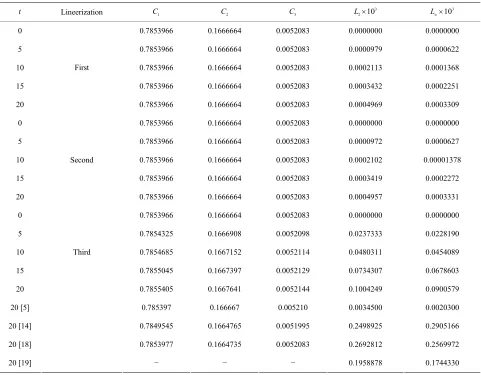
ble 1 we compare the values of the invariants and error
three different approximation and the results of [5,14, 18,19] at different times. We can easily see from s
s 2 Lare obtained suf-ficie and the quantities in the variants remain
constant during the computer run for the t second linearization techn we can not say the same for the third linearization technique. For the first and second linearization, the numerical values of invari-ants are C1 0.7853966,C2 0.1667641,C3 0.0052083
and for the third linearization numerical values of invari-ants are C10.7855405,C20.16676 ,C30.0052144 at the t20. Figure 1 shows that the proposed method perform the motion of propagation of a solitary wave satisfactorily, which moved to the right at a constant speed and preserved its amplitude and shape with in-
, , C C C
g the prese
L and
iques but
time
od with
the
firs Ta
alm
41
7. Interaction of Two Solitary Waves
For this problem, we consider (1) with boundary condi-tions as , interaction of two positive solitary waves is studied by using the initial condition
0
U x
2
1
, 0 jsec j .
j
U x A h k x x
where k 1 .
We first used the parameters h0.1, 0.025, t
1 2
1, 1, 0.5,A A
x115, 30x2 through the in- terval 0 x 80 which is used by Zaki [5]. These pa-rameters provide solitary waves of magnitudes 1 and 0.5
[image:5.595.58.539.344.719.2]t
Table 1. In
1
C
variant
Lineerization
s and error n
2
C
orms for single solitary waves.
3
C 3
2 10
L L 103
0 0.7853966 0.1666664 0.0052083 0.0000000 0.0000000
5 0.7853966 0.166666
10 0.7853966 First 0.1666664
4 0.0052083 0.0000979 0.0000622
0.0052083 0.0002113 0.0001368
03432 0.0002251
1666664 0.0052083 0.0004969 0.0003309 15
20
20 [5]
20 [14]
20 [18]
20 [19]
0.7853966 0.
Second
0.7853966 0.1666664 0.0052083 0.00
0 0.7853966 0.1666664 0.0052083 0.0000000 0.0000000
5 0.7853966 0.1666664 0.0052083 0.0000972 0.0000627
10 0.7853966 0.1666664 0.0052083 0.0002102 0.00001378
15 0.7853966 0.1666664 0.0052083 0.0003419 0.0002272
20 0.7853966 0.1666664 0.0052083 0.0004957 0.0003331
0 0.7853966 0.1666664 0.0052083 0.0000000 0.0000000
5 0.7854325 0.1666908 0.0052098 0.0237333 0.0228190
10 0.7854685 0.1667152 0.0052114 0.0480311 0.0454089
15 0.7855045 0.1667397 0.0052129 0.0734307 0.0678603
20
Third
0.7855405 0.1667641 0.0052144 0.1004249 0.0900579
0.785397 0.166667 0.005210 0.0034500 0.0020300
0.7849545 0.1664765 0.0051995 0.2498925 0.2905166
0.7853977 0.1664735 0.0052083 0.2692812 0.2569972
Figure 1. The motion of a single solitary wave.
and peak positions of them are located at and 30. The analytical invariants are [l4]
15
x
1 1 2
2 2
2 1 2
4 4
3 1 2
π 4.7123889,
8 3.3333333,
3 4
1.4166667. 3
Calculation is carried out with t
C A A
C A A
C A A
he time step
and space step over the region
0 . The experime n from
0.025
t
0 x 8 nt was ruh0.1 t0 to to allow the interaction to t ke place.
nteraction hat at
of th alle
e
55
t
shows the i can be seen t is on the left The larger inc
lapping pro and waves
a
of two positive solitary the wave with
wave with sm
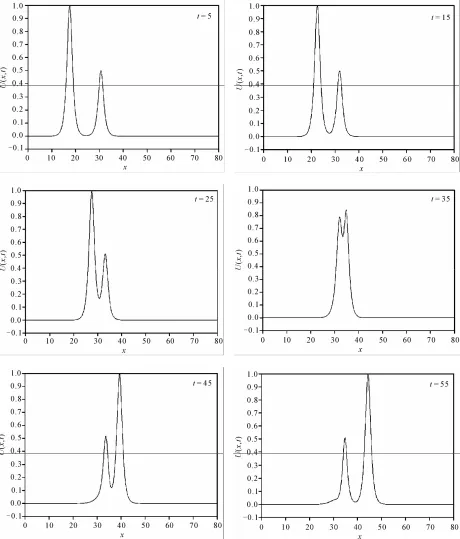
Figure 2 waves. It larger amplitude
r amplitude. as tim
5
t
e second
wave catches up with the smaller one reases. Interaction started at about time t25,
over-cesses occurred between timest25 and 40 started to resume their original shapes after time t40. For the first and second linearization tech-niques at t55, the amplitude of larger waves is
1.000149 at the point x44.4 whereas the amplitude
of the smaller one is 0.507317at the point x34.6. It is found that the absolute difference in amplitude is
3
7.3 10 for the smaller wave and 0.149103 for the larger wave for this algorithm. For the third linearization technique at t55, the amplitude of larger waves is
0.99593 t the point x44.7 whereas the amplitude
of the smaller one is 0.507477 at the point x 34.6 3 a
. It is found that the abso erence in amplitude is
3
7.4 10 for the smaller wave and 4 10 for the
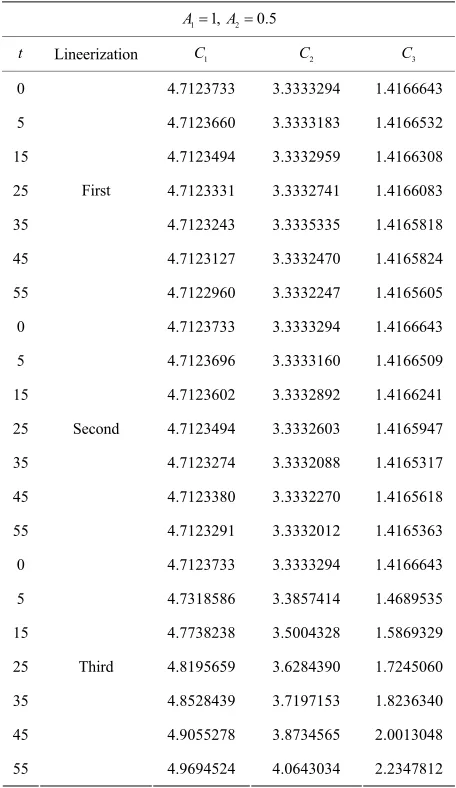
larger wave for this algorithm. In Table 2 we compares values invariants of the two solitary waves with results from first, second and third linearization. We see from the Table 2 that for the first and second linearization s, all 3 invaria conserved by less than
lute diff
3
technique nts are
5
9.9 10
that the conservatio
Table 2. Invaria
during the experiment. Thus we have found n quantities are satisfactorily constant
nts for interaction of two solitary wave.
1 1, 0.52
A A
t Lineerization C1 C2 C3
0 4.7123733 3.3333294 1.4166643
5 4.7123660 3.3333183 1.4166532
15 4.7123494 3.3332959 1.4166308
25 4.7123331 3.3332741 1.4166083
35 4.7123243 3.3335335 1.4165818
45 4.7123127 3.3332470 1.4165824 First
4.7122960 3.3332247 1.4165605
0 4.7123733 3.3333294 1.4166643 55
15 4.7123602 892 1.4166241
25 4.7123 4 3.3332 03 1.4165 7
Third
5 4.7123696 3.3333160 1.4166509
3.3332
49 6 94
35 4.7123274 3.3332088 1.4165317
45 4.7123380 3.3332270 1.4165618
55
Second
4.7123291 3.3332012 1.4165363
0 4.7123733 3.3333294 1.4166643
5 4.7318586 3.3857414 1.4689535
15 4.7738238 3.5004328 1.5869329
25 4.8195659 3.6284390 1.7245060
35 4.8528439 3.7197153 1.8236340
45 4.9055278 3.8734565 2.0013048
[image:6.595.309.537.326.720.2]
[image:7.595.69.529.81.620.2]
Figure 2. Interaction of two solitary waves at different times.
with the proposed algorithm.
We have also studied the interaction of two solitary waves with the following parameters:
allow the interaction to take place. Figure 3 shows the development of the solitary wave interaction.
As is seen from the Figure 3, at a wave with the negative amplitude is on the left of another wave with the positive amplitude. The larger wave with the negative amplitude catches up with the smaller one with
1
, x115, ime step
≤ x ≤
55
2 30 x
0.02
t
150. The
0
t
, , together with t
t from
1 2
A 5 and space ste
xperimen 2 1 A ,
p h was run
= 0.1 in the range 0
0 to
[image:8.595.68.532.77.625.2]
Figure 3. Interaction of two solitary waves at different times.
the positive amplitude as the time increases. For the first linearization technique at , the amplitude of the
smaller wave is the point
55
t
5 at
0.97469 x52.5 ,
whereas the am r one is
at the point e seco
technique at he sm
is at the point , whereas the
ampli-arger on at the point
plitude of t
122.8
, the am he large . For th
plitude of t
nd linea
1.989036
rization aller wave x
55
t
0.972778
tude of the l
122.8
52.5
x
e is 1.986701
x . It is found that the absolute difference in am-plitudes is 0.253 10 1
1
133 10
, 0.272 10 1 for the smaller
The analytical invariants by using Equation (1) can be
found as ,
he
invari-wellian initial condition breaks up into more solitary waves which were drawn in Figures 4(c)-(f) at time
1 3.1415927, 13.33333332
C C
66667. Table 3 lists the values of t
ants of the two solitary waves with amplitudes 3
22.66
C
1 2
A , d for the the computer 2 1
A . inva
It can be seen that the values obtaine riants are satisfactorily constant during run.
8. The Maxwellian Initial Condition
As a last study, we consider here is the numerical solu-tion of the Equasolu-tion (1) with the Maxwellian initial con-dition
2,0 e x
U x (14)
with the boundary conditions
20,
x
20,
20,
x
20,
0.U t U t U t U t
As it is known, Maxwellian initial condition (14) the behavior of the solution, de ends on the values of p . So we have considered various values for . For
ases
the first linearization technique the computations are carried out for the c 1, 0.5, 0.1, 0.05,0.02 and 0.005
which are used in the earlier papers [5,14]. When
1, 0.5
is used as shown Figures 4(a) and (b) at time
12
[image:9.595.306.536.190.723.2]t the Maxwellian initial condition does not cause development into a clean solitary wave. However with smaller values of 0.1, 0.05, 0.02 and 0.005 Max-
Table 3. Invariants for interaction of two solitary wave.
1 2, 2 1
A A
t Lineerization C1 C2 C3
0 −3.1415739 13.3332981 22.6665313
5 −3.1373324 13.3219118 22.6210653
15 −3.1227097 13.2806152 22.4483653
.3589494
−3.0896638 13.1922565 22.0973499
0 −3.1415739 13
13.3196543 22.6120524
15 −3.1325076 13.2805526 22.463773
3.1137210 13.1745553 8880 25 First −3.1143337 13.2581754 22
35 −3.1060334 13.2359744 22.2706624
45 −3.0978106 13.2140028 22.1834701
55
.3332981 22.6665313
5 −3.1391704
3
25 −3.1277388 13.2535359 22.3561477
35 −3.1230138 13.2268810 22.2501653
45 −3.1183416 13.2005566 22.1457584
55
Second
− 22.042
12
t . The numerical conserved quantities with
1,0.5,0.1,0.05,0.02
and are given in Table 4.
It is observed that the obtained values of the invariants remain almost constant during the computer run.
Table 4. Invariants for Maxwellian initial condition, differ-ent µ.
0.005
t C1 C2 C3
0 1.772454 2.506607 0.886227
3 1.772972 2.506836 0.886561
6 1.775116 2.512628 0.890240
2.514942 0.891795
12 1
1.776698 2.515136 0.891967
3
9 1.772451 1.879967 0.886223
0 1.772454 1. 46 0.886226
3 1.7724 1.3785 0.8861 4
6
9 0.1
0.05
0
9 1.72 1.1
12 1.710490 1.162646 0.737751 9 1.776365
0 1.772454 1.879971 0.886227
1.772452 1.879970 0.886225
6 1.772451 0.5 1.879968 0.886224
12 1.772450 1.879966 0.886222
3786
20 91 7
1.772368 1.378507 0.886054
1.772316 1.378424 0.885933
12 1.772264 1.378340 0.885813
0 1.772454 1.315980 0.886227
3 1.772266 1.315654 0.885789
6 1.771976 1.315150 0.884947
9 1.771685 1.314648 0.884107
12 1.771396 1.314147 0.883270
1.772454 1.278380 0.886227
3 1.770834 1.275265 0.880933
6 1.768546 1.271572 0.874402
9 1.766186 1.266707 0.864400
12
0.02
1.763931 1.262351 0.855782
0 1.772454 1.259581 0.886227
3 1.757684 1.254254 0.928815
6 1.738212 1.227138 0.880527
2397 71836 0.714373
0.005
[image:9.595.59.284.445.716.2]
(a) (b)
(c) (d)
[image:10.595.68.532.74.691.2]
(e) (f)
Figure 4. Maxwellian initial condition, state at time t = 12 (a) µ = 1, (b) µ = 0.5, (c) µ = 0.1, (d) µ = 0.05, (e) µ = 0.02, (f) µ = 0.005.
9. Conclusions
In this study, a numerical solution of the MEW equation based on the septic B-spline finite element has been pre-sented with three different linearization techniques. Three test problems are worked out to examine the per-formance of the algorithms. The perper-formance and accu-racy of the method were demonstrated by calculating the error norms and on the motion of a single solitary wave. For the first and second linearization tech-niques, the error norms are sufficiently small and the invariants are satisfactorily constant in all computer run. The obtained results from the first and the second lin-earization techniques are almost the same and the com-puted results show that the present method is a remarka-bly successful numerical
quation and can also be efficiently applied to other types of non-linear problem.
10. References
[1] P. J. Morrison, J. D. Meiss and J. R. Carey, “Scattering of Regularized-Long-Wave Solitary Waves,” Physica D: Non- linear Phenomena, Vol. 11, No. 3, 1984, pp. 324-336. doi:10.1016/0167-2789(84)90014-9
[8] A. Esen, “A Numerical Solution of the Equal Width Wave Equation by a Lumped Galerkin Method,” Applied Mathematics and Computational, Vol. 168, No. 1, 2005, pp. 270-282.doi:10.1016/j.amc.2004.08.013
[9] A. Esen, “A Lumped Galerkin Method for the Numerical Solution of the Modified Equal Width Wave Equation Using Quadratic B Splines,” International Journal of Computer Mathematics,Vol. 83, No. 5-6, 2006, pp. 449- 459.doi:10.1080/00207160600909918
[10] B. Saka, “Algorithms for Numerical Solution of the Mo- dified Equal Width Wave Equation Using Collocation Method,” Mathematical and Computer Modelling, Vol. 45, No. 9-10, 2007, pp. 1096-1117.
doi:10.1016/j.mcm.2006.09.012
2
L L
[11] B. Saka and İ. Dag, “Quartic B-Spline Collocation Meth- od to the Numerical Solutions of the Burgers Equatio ” Vol. 32, No. 3, May 2007, haos.2005.11.037
technique for solving the MEW e
[2] L. R. T. Gardner and G. A. Gardner, “Solitary Waves of the Regularized Long Wave Equation,” Journal of Com-putational Physics, Vol. 91, No. 2, 1990, pp. 441-459. doi:10.1016/0021-9991(90)90047-5
[3] L. R. T. Gardner and G. A. Gardner, “Solitary Waves of the Equal Width Wave Equation,” Journal of Computa-tional Physics, Vol. 101, No. 1, 1992, pp. 218-223. doi:10.1016/0021-9991(92)90054-3
[4] L. R. T. Gardner, G. A Amein, “Simulations o
I)1099-0887(199707)13:7<583::AID-C . Gardner, F. A. Ayoup and N. K. f the EW Undular Bore,” Commu-nications in Numerical Methods in Engineering, Vol. 13, No. 7, 1997, pp. 583-592.
doi:10.1002/(SIC NM90>3.0.CO;2-E
[5] S. I. Zaki, “Solitary Wave Interactions for the Modified Eual Width Equation,” Computer Physics Communica-tions, Vol. 126, No. 3, 2000, pp. 219-231.
doi:10.1016/S0010-4655(99)00471-3
[6] S. I. Zaki, “A Least-Squares Finite Element Scheme for the Ew Equation,” Computer Methods in Applied Me-chanics and Engineering, Vol. 189, No. 2, 2000, pp. 587- 594.doi:10.1016/S0045-7825(99)00312-6
[7] A. M. Wazwaz, “The tanh and sine-cosine Methods for a Reliable Treatment of the Modified Equal Width Equa-tion and Its Variants,” Communications in Nonlinear Science and Numerical Simulation, Vol. 11, No. 2, 2006, pp. 148-160.doi:10.1016/j.cnsns.2004.07.001
n,
Chaos, Solitons and Fractals, pp. 1125-1137.doi:10.1016/j.c
[12] J. F. Lu, “He’s Variational Method for the Modified Equal Width Wave Equation,” Chaos, Solitons and Frac-tals, Vol. 39, No. 5, 2009, pp. 2102-2109.
doi:10.1016/j.chaos.2007.06.104
[13] S. Hamdi, W. E. Enright, W. E. Schiesser, J. J. Gottlieb and A. Alaal, “Exact Solutions of the Generalized Equal Width Wave Equation,” Proceedings of the International Conference on Computational Science and Its Applica-tion, LNCS, Springer-Verlog, Berlin, Vol. 2668, 2003, pp. 725-734.
[14] D. J. Evans, K. R. Raslan and A. Alaal, “Solitary Waves for the Generalized Equal Width (Gew) Equation,” In-ternational Journal of Computer Mathematics, Vol. 82, No. 4, 2005, pp. 445-455.
[15] T. Geyikli, “Modelling Solitary Waves of a Fifth-Order Non-Linear Wave Equation,” International Journal of Computer Mathematics, Vol. 84, No. 7, July 2007, pp.
160701294368 1079-1087.doi:10.1080/00207
TR R-436,Washington,DC, 1975.
mber,” Applied Mathematical Modelling,Vol. 6, No. 5, October 1982, pp. 381-386.
07-904X(82)80102-9
[16] S. G. Rubin and R. A. Graves, “A Cubic Spline Ap-proximation for Problems in Fluid Mechanics,” NASA
[17] J. Caldwell and P. Smith, “Solution of Burgers’ Equation with a Large Reynolds Nu
doi:10.1016/S03
8] A. Esen and S. Kutluay, “Solitary Wave Solutions of the [1
Modified Equal Width Wave Equation,” Communications in Nonlinear Science and Numerical Simulation, Vol. 13, No. 8, 2008, pp. 1538-1546.
doi:10.1016/j.cnsns.2006.09.018