Methods of Approximation in hpk Framework for ODEs
in Time Resulting from Decoupling of Space and Time in
IVPs
K. S. Surana1*, L. Euler1, J. N. Reddy2, A. Romkes1 1
Mechanical Engineering, Department, University of Kansas, Lawrence, USA 2
Mechanical Engineering Department, Texas A&M University, College Station, USA E-mail: [email protected], [email protected]
Received March 28, 2011; revised May 26, 2011; accepted June 3, 2011
Abstract
The present study considers mathematical classification of the time differential operators and then applies methods of approximation in time such as Galerkin method (GM), Galerkin method with weak form (GM WF/ ), Petrov-Galerkin method (PGM ), weighted residual method (WRY), and least squares method or process (LSM or LSP) to construct finite element approximations in time. A correspondence is estab-lished between these integral forms and the elements of the calculus of variations: 1) to determine which methods of approximation yield unconditionally stable (variationally consistent integral forms, VC) com-putational processes for which types of operators and, 2) to establish which integral forms do not yield un-conditionally stable computations (variationally inconsistent integral forms, VIC). It is shown that varia-tionally consistent time integral forms in hpk framework yield computational processes for ODEs in time that are unconditionally stable, provide a mechanism of higher order global differentiability approxima-tions as well as higher degree local approximaapproxima-tions in time, provide control over approximation error when used as a time marching process and can indeed yield time accurate solutions of the evolution. Numerical studies are presented using standard model problems from the literature and the results are compared with Wilson’s
method as well as Newmark method to demonstrate highly meritorious features of the pro-posed methodology.Keywords: Finite Element Approximations, Numerical Studies, Time Approximation, Variationally Consistent Integral Forms
1.
Introduction, Literature Review and
Scope of Work
The quest for better, reliable, stable, accurate and effi-cient methods of approximation for obtaining numerical
solutions of the ordinary differential equations (ODEs)
in time resulting from either decoupling of space and time or using a lumped parameter approximation in spa-tial coordinates in inispa-tial value problems has been a sub-ject of writing in the numerical and computational me- thods area for over a century. Thus, the published works are voluminous. In this section we provide a summary of historical perspective of the origins of various methods, discuss more recent advances in the various approaches, discuss their merits and shortcomings with the objective
of ultimately narrowing down to a single methodology
that provides us an infrastructure to treat all ODEs in
time in a consistent but rigorous manner without any regard to specific applications or their origin.
1.1. Space-Time Decoupling in IVPs
We make a few remarks regarding a strategy for space-
time decoupling in initial value problems (IVPs) that
lead to ODEs in time. This is helpful in gaining a
bet-ter understanding regarding the origin of the ODEs.
The IVPs are generally a system of partial differential
space and time, the spatial derivatives are converted into algebraic expressions, thereby reducing the original
par-tial differenpar-tial equations (PDEs) to a system of ODEs
in time. For this purpose we can use finite difference, finite volume or finite element method in spatial coordi-nates. In a finite difference method one discretizes the spatial domain into a finite number of points. The spatial derivatives are approximated using Taylor series expan-sions of various orders of truncation errors to obtain al-gebraic expressions or the finite difference approxima-tions of the spatial derivatives. One then considers the
PDEs at each point of the discretization and substitutes
the finite difference expressions for the spatial tives. The outcome of this process is that spatial deriva-tives are replaced by dependent variable values (and/or their derivatives) at the points of the discretization and the time derivatives assume values at the points of the
discretization and thus we obtain a system of ODEs in
time. In principle, the finite volume method of decoup-ling space and time is similar. In the finite element method of decoupling space and time, one constructs a spatial discretization of the spatial domain using finite elements. We can construct an integral form over the discretized spatial domain based on the fundamental lemma [1-5]. The time derivatives for this purpose are treated as constants. One constructs an approximation over the discretized domain and thereby an approxima-tion over each spatial element of the discretizaapproxima-tion. This approximation, when substituted in the integral form, replaces the spatial derivatives with algebraic expres-sions and what remains is a system of ODEs in time.
In the following, we present some details of the finite element method of decoupling space and time.
Let
( , ) ( , ) 0,
( , ) xt x t (0, ) (0, ) A x t f x t
x t L
(1.1)
be an initial value problem with some boundary
condi-tions (BCs) and some initial conditions (ICs).
Let T e
x x
e
be a finite element discretization ofx
. Let h( , )x t be an approximation of ( , )x t over
T x
Then based on the fundamental lemma [1-5] of the
calculus of variations,
( ( , ) ( , ), ) T 0
x
h
A x t f x t v (1.2)
in which vv x( ) is the test function. v is zero where
is specified, thus vh is admissible. We can
write (1.2) over ( )T
x
as,
( ( , ) ( , ), ) e 0 x
e h e
A x t f x t v
(1.3)where e( , )
h x t
is the local approximation of ( , )x t
over e
x
. Consider ( ( , ) , ) e
x
e h
A x t f v over an ele
ment e with domain e
x
. At this point if the operator
A has even order derivatives with respect to spatial coor-dinates, then one could use integration by parts to
trans-fer half of the diftrans-ferentiation from e
h
to v (Galerkin
method with weak form in space) and then the resulting expression could be arranged as
( , ) e ( , ) ( , ) e ( )
x x
e e e e
h h
A f v B v f v l v
(1.4)
in which e( )
l v
is the concomitant. It contains the
boundary terms (secondary variables) due to integration
by parts. Let the local approximation e( , )
h x t
be given
by
1
( , ) n ( ) ( )
e e
h i i
i
x t N x t
(1.5)Consider Galerkin method with weak form, ( )
e h j
v N x , j1, 2, , n (1.6)
Substituting (1.5) and (1.6) into (1.4) we can write
(assuming that operator A has first and second order
derivatives of in time as well as the function )
1 2 3
( , ) [ ] [ ] [ ]
( )
( , ) ; 1, ,e x
e e e e e e e e h
e e
e
j
B v C C C
l v P
F f N j n
(1.7)
eP is a vector of secondary variables. Thus,
1 2 3
( , ) ([ ] [ ] [ ] ) e x e h
e e e e e e e e
A f v
C C C P F
(1.8)
Substituting from (1.7) into (1.4) we have,
1 2 3
( ) ([ ] [ ] [ ] ) 0 e x e h e
e e e e e e e
e e
e e
A f
C C C
P F
(1.9)
or
1 2 3
[ ]C [ ]C [ ]C P F (1.10)
in which
1 1 2 2 3 3
[ ] [ ], [ ] [ ], [ ] [ ],
,
e e e e
e e e
e e
e e
C C C C C C
P P F F
(1.11)and
e , , e ee e e
(1.12)these in time would yield
and thereby
e foreach element of the spatial discretization and hence, the
approximation e( , )
h x t
for an element defined by (1.5)
completely defines the evolution.
This paper considers the finite element method of
ap-proximation for a system of ODEs in time (like (1.10))
resulting from space-time decoupling in IVPs.
1.2. Literature Review
The published work addressing the methods of
approxi-mation for ODEs in time is heavily dominated by finite
difference methods or methods like finite difference methods that originate from the use of Taylor series ex-pansions at discrete points in the time domain to
ap-proximate time derivatives in the ODEs by algebraic
expressions containing function values and/or their de-rivatives at the discrete points in the time domain
[0, ]
x
. In the following we discuss some of the
commonly used approaches.
Reference [6] presents various methods of approxima-tion (primarily based on the Taylor series expansions) for
ODEs in time. In reference [7] the authors present an
account of the various methodologies for approximating
solutions of ODEs in time. These include details for
first order symmetric systems, second order symmetric systems, as well as nonlinear symmetric and
nonsym-metric systems of ODEs. One step algorithms, linear
multistep (LMS) algorithms, Houbolt method, -me-
thod and partitioning methods are considered as methods of approximation. Some discussion on convergence and stability is also presented. Perhaps the most significant work amongst the earlier works is due to Newmark [8] based on the assumption of linear acceleration in a time interval. Another parallel work by Wilson [9], Wilson’s
method, is also as significant. This is also based on
the assumption of linear acceleration in a time interval.
These two works were strictly aimed at ODEs from
decoupling space and time in structural dynamics
(sec-ond order ODEs in time). In the Newmark method the
equilibrium is considered at time t t at which the
evolution state is not known. In Wilson’s method the
linear acceleration assumption is extended to the time
interval [ , ]t t t , 1. The equilibrium is
consid-ered at time t t but the evolution is computed at
time t t. The value of is determined from the
stability analysis of the method. It is shown that for 1.37
(generally chosen 1.4), the Wilson’s
method is unconditionally stable.
Many works using the two approaches have appeared in the literature in which accuracy (amplitude decay, base elongation and phase shift of known and specified waves) and applications of these methods have been
discussed. A modification of Newmark method referred to as alpha modification is presented in reference [10]. The additional parameter alpha is introduced to achieve simultaneous second order accuracy, unconditional sta-bility and positive artificial damping. A family of “one step unconditionally stable integration schemes with im-proved numerical dissipation” is presented in reference
[11]. The “generalized -method in structural
dynam-ics” is presented in reference [12] with “user controlled
numerical dissipation”. Extensions of LMS methods to
L -stable optimal integration methods with 0u - 0v
overshoot properties in structural dynamics are given in reference [13]. This approach leads to level-symmetric
(LS) integration methods. The LS methods are
cre-ated as symmetric variants of extended three level LMS
methods ( 3L-LMS) with direct use of dynamic
equa-tions to obtain algorithmically simple integration schemes that have maximum damping of high frequency modes and thereby without overshoots. The analysis of
generalized -method for non-linear dynamic problems
is presented in reference [14]. It is shown that
general-ized α-methods have stability in the energy sense and
guaranteed energy annihilation. But, these methods ex-hibit overshoots and heavy energy oscillations in inter-mediate frequency ranges. The energy-conserving and decaying algorithms in structural dynamics based on
-method are considered in reference [15]. In a series of
papers [16-22], exhaustive developments and details are
presented related to time integration of ODEs.
A detailed discussion of various aspects, their merits and shortcomings are not relevant in view of the ap-proach presented in this paper and is also too voluminous to be included here. However, we do remark that various approaches in these papers utilize weighted residual concepts, Taylor series expansions, Taylor series
expan-sion in time and GM WF/ and consider single step and
multistep algorithms. Stability, accuracy and other fea-tures of the various proposed schemes are presented in-cluding numerical studies for model problems.
1.3. Scope of Present Work and Methodology
We want to take a very pragmatic view i.e., we pose a
question “What is our objective?” The answer of course is, we want to consider a method of approximation for
ODEs in time that has the following features.
1) The methodology must be equally applicable to all
ODEs, i.e., must be independent of the nature of the
time operator.
2) The method must be unconditionally stable regard-less of the choice of integration time step.
incre-ment of time. This is essential for computational effi-ciency in applications requiring the evolution for long periods of time as well as in applications in which a large
number of ODEs are involved.
4) The method must permit higher degree approxima-tion of the soluapproxima-tion in time for an increment of time.
5) To ensure desired global differentiability of the
ap-proximation over t we must ensure that the time
ap-proximations of higher degree for each increment of time are such that their union indeed yields desired global differentiability of the approximation in time. For
exam-ple if an ODE in time contains up to second order
de-rivatives of the dependent variable and if the theoretical solution is analytic, then the approximation of this
solu-tion over t must at least be of class
2( ) t C .
6) There must be a measure (and not estimation) of approximation errors in the computed solution regardless of whether we have a theoretical solution of the
( )
ODE s or not. This feature is essential due to the fact
that most problems of practical interest do not permit determination of a theoretical solution, yet it is essential to know the approximation errors in the computed solu-tion to determine if the computed solusolu-tion satisfies the desired requirements of accuracy.
7) There must be a mechanism to reduce the approxi-mation errors to whatever desired level so that a desired accuracy is achievable in the computed solution.
8) The methodology must permit time accurate evolu-tions. This aspect becomes intrinsic in the approach if features 6) and 7) are present.
The features described above are indeed intrinsically present in the mathematical and computational
infra-structure presented in this paper for ODEs in time.
Section 2 describes the mathematical details of the for-mulation, approximations and approximation spaces as well as details of the computational infrastructure.The requirements 1) - 8) are described in the paragraph above are all addressed in Section 2. It is shown that the finite element discretization in time in which the local
ap-proximations in time are in hpk framework permitting
global differentiability of the approximation of order
(k1) in time when used with integral forms that are
variationally consistent provides a mathematical and
computational infrastructure for ODEs in time with all
of the desired attributes. Numerical studies are presented in Section 3 for commonly used model problems and the numerical results from the present work are compared
with Newmark and Wilson’s method.
2. Finite Element Approximation of
ODEs
in Time
For presenting the mathematical details and formulations
it suffices to consider a single ODE in time.
0
Ad F
t t (0, ) ( , ) t0 (2.1)
with some initial conditions. A
is a differential
opera-tor in time or time differential operaopera-tor.
2.1. Mathematical Classification of Time Differential Operators
If (2.1) represents totality of all ODEs regardless of the
application, then we must classify time differential
op-erators A
mathematically so that we could consider
development of the methods of approximation for this classification with mathematical rigor. The simplest
possible classification of course is where the operator A
is either linear or non-linear.
Definition. 1: The time operator A
is linear if u,
A
vD
, the domain of definition of the operator
A
and
, , the following holds
( )
Auv AuAv
(2.2)
Definition. 2: If the time operator A
is not linear
then it is non-linear. This classification can be made more restrictive by considering symmetry (or lack of it)
of A
.
Definition. 3: The time operator A
is symmetric if it
is linear and if u, vDA
, the domain of
A
the
fol-lowing holds
( , ) ( , )
t t
Au v u Av
(2.3)
We note that (2.3) requires differential operator in that we transfer all of the time or time differential time
dif-ferentiation from u to v (left side of (2.3)) using
in-tegration by parts. In doing so, we obtain the following in general,
( , ) ( , ) ,
t t
Au v u A v Au v
(2.4)
A
is called the adjoint of A and Au v , is called
the concomitant which results as a consequence of inte-gration by parts. Thus, based on the definition of
sym-metry in (2.3), if A
is symmetric, then
A A
, 0 (2.5)
Au v
(2.6)
That is, the adjoint A
of the time operator must be
the same as the time operator A
and the concomitant
must be zero. When the operator A
has even order
de-rivatives in time then we could show that (2.5) holds. Thus, there are time differential oeprators for which (2.5) is possible. (2.6) contains boundary terms and hence it can be expanded.
0
, , , t
Au v Au v Au v
(2.7)
In (2.7), t0 and are the boundaries of the time
open boundary. Let us assume that based on ICs it is
possible to show that
0
, 0 t Au v
, then for symmetry
of A
we must show that Au v , 0 so that (2.6)
will hold. is an open boundary where neither the
function nor its time derivatives are known, hence it is
not possible to show that Au v,
is zero. Since an
open boundary at t exists in case of all ODEs
regardless of whether A
is linear or non-linear, for
time differential operators A
, (2.6) can not be satisfied,
hence the time differential operators can not be symmet-ric. This leads to the following two categories of mathe-matical classification for all time differential operators.
Definition. 4: If a time differential operator A
is
linear then it is non-self adjoint
Definition. 5: If a time differential operator A
is not
linear then it is obviously non-linear
2.2. Methods of Approximation in Time (Based on Time Integral Forms)
Before we consider finite element method of approxima-tion it is perhaps more prudent to consider classical
methods of approximation in time (these consider t
without discretization) for the two classes of operators
A
to determine which methods of approximation are
worthy of consideration in the finite element processes in time. We group the methods of approximation (based on integral form in time) in two categories:
1) those based on fundamental lemma [1-5]
2) those based on minimization of the residual func-tional [23,24]
2.2.1. Methods Based on Fundamental Lemma
The methods such as GM , PGM , WRM and
/
GM WF in time are the methods in this category. In
all these methods we begin by using fundamental lemma
[1-5] over t. If dn is the approximation of d over
t
, then
( , ) 0 t n
Ad F v
(2.8)
in which v is test function. v0 on if d d0
(known) on . In
GM and GM WF/ we consider
n
v . In PGM v( )t n and in WRM also
( ) n
vw t . We can write (2.8) as
( , ) ( , )
t t
n
Ad v F v
or
( , )n ( )
B d v l v (2.9)
In /GM WF we also begin with (2.8) i.e., ( , ) ( , )
t t
n
Ad v F v
(2.10)
but transfer some differentiation from dn to v to
ob-tain a weak form in time,
( , ) ( ) ( , ) ( ) t
n
B d v l v F v l v
(2.11)
Thus all these methods of approximation in time yield
a time integral form ((2.9) or (2.11)). d tn( ) is
ex-pressed as
0 1
( ) ( ) n ( )( )
n i i
i
d t N t N x t c
(2.12)in which N ti( ) are basis functions. Obviously d tn( )
must satisfy all ICs of the ODE. When (2.12) and
( ); 1, 2, , or ( ) or ( ); 1, 2, ,
n j
j j
v N t j n
v t v w t j n
(2.13)
are substituted in (2.9) or (2.11), we obtain a system of
linear or non-linear algebraic equations in ci from
which we can determine ci.
Remarks
1) These methods of approximation result in an inte-gral form that is converted to an algebraic system upon substituting the approximation. The algebraic system is
used to determine the unknowns ci. Thus in these
methods we have a “necessary condition” only.
2) Existence and uniqueness of the solution dn or the
coefficients ci is never addressed, hence must be
con-sidered for each application.
3) This situation can be corrected by establishing a correspondence between the integral forms (necessary conditions) and the calculus of variations.
2.2.2. Variationally Consistent and Variationally Inconsistent Time Integral Forms
Consider extremum of a functional I d( )n i.e., assume
that there exists a functionan I d( )n and we wish to
determine its extremum. Then,
1) Existence of I d( )n is generally by construction.
2) Necessary condition:
If I d( )n is differentiable in dn and if the
deriva-tives of all orders are continuous then, based on the
theorems of calculus of variations I d( )n is unique and
( ) 0n
I d
is a necessary condition for the existence of
the extremum of I d( )n .
3) The sufficient condition or extremum principle is given by
2
0 minimum of ( ) ( ) 0 saddle point of ( )
0 maximum of ( ) n
n n
n I d
I d I d
I d
(2.14)
When we have a unique extremum principle, then we
can show that a dn obtained from I d( ) 0n also
satisfies the Euler’s equation, a differential equation that
cor-respondence between the solutions of differential equa-tions and the elements of the calculus of variaequa-tions deal-ing with extremums of functionals. We proceed as
fol-lows. Let Ad F 0
be the ODE in time. Then
there must exist a functional I d( )n such that
( ) 0n
I d
gives the integral form (from any of the
chosen methods of approximation) and 2 ( )
n I d
yields
a unique extremum principle and the Euler’s equation
from I d( ) 0n is the ODE, then a dn that yields a
unique extremum of I d( )n is also a unique solution of
0 Ad F
Definition. . 6: Variationally consistent (VC) integral
forms. A time integral form resulting from a method of
approximation is termed VC if there exists a functional
( )n
I d such that I d( ) 0n gives the integral form
and 2 ( )
n I d
yields a unique extremum principle.
Definition. 7: Variationally inconsistent (VIC) time
integral forms. A time integral form resulting from a
method of approximation is termed VIC if it is in
vio-lation of one or more elements of the calculus of varia-tions. It is sufficient to show the following. Let there
exist a functional I d( )n such that I d( ) 0n gives
the desired integral form. Then 2 ( )
n I d
i.e. the first
variation of the integral form must yield a unique extre-mum principle.
It is straight forward to show (see [24]) that the time
integral forms resulting from GM , PGM , WRM and
/
GM WF are all variationally inconsistent.
Variation-ally consistent integral forms yield algebraic systems in which the coefficient matrices are symmetric and
posi-tive definite and uniqueness of the solution dn is
en-sured. VIC integral forms, on the other hand, yield
non-symmetric coefficient matrices that are not always ensured to be positive definite. See references [23,24] for
more details. Thus, GM ,PGM ,WRM and GM WF/
in time are not worthy of consideration for finite element processes in time as a general computational
methodol-ogy for ODEs in time as these do not ensure
uncondi-tionally stable computations due to VIC integral forms
in time.
2.2.3. Methods of Approximation Based on Minimiza- tion of Residual Functional
In this category of methods we consider least squares
method or process (LSM or LSP) in time based on
residual functional. Let
n
EAd F
t t (2.15)
define residual E over the time domain t.
1) Existence of a functional I d( )n (residual
func-tional) is by construction.
( ) ( , ) t n
I d E E (2.16)
( )n
I d is a convex function of E, regardless of the
mathematical classification of A
2) Necessary condition
( ) 2( , ) 0 t n
I d E E
(2.17)
or ( , ) ( ) 0
t n
E E g d (2.18)
3) Sufficient condition or extremum principle
2 ( ) 2( , ) 2( , 2 )
t t
n
I d E E E E
(2.19)
In the following we consider the two categories of the
mathematical classification of A
i.e., when A is
non-self adjoint and when A
is non-linear, and
deter-mine variational consistency or variational inconsistency of the time integral form given by (2.18).
Case (a): When
A is non-self adjoint
In this case the operator A
is linear, hence
2 0
E
and the extremum principle 2
I
given by
2 ( ) 2( , ) 0 t
n n
I d E E d
(2.20)
Thus, we have a unique extremum principle. (2.20)
im-plies that a dn obtained from (2.18) minimizes I d( )n
in (2.16)
Case (b): When
A is non-linear
In this case 2
E
is not zero. We note that
( ) 0n
I d
yields
( ) ( , ) 0 t n
g d E E (2.21)
in which g d( )n is a non-linear function of dn. Thus,
we must find dn iteratively such that (2.21) is satisfied.
We choose Newton’s linear method. Let 0
n
d be an
as-sumed or guess of dn then,
0
( ) 0n
g d (2.22)
Let dn be a change or a correction to dn0 such that
0
( n n) 0
g d d (2.23)
Expanding ( 0 )
n n
g d d in Taylor series about dn0
and retaining only up to linear terms in dn.
0
0 0
( ) ( ) 0
n
n n n d n
n
g
g d d g d d
d
(2.24)
From (2.24), we can solve for dn.
0
1 0
( ) n
n d n
n g
d g d
d
(2.25)
We note that
2 2 ( , ) 1 ( , ) ( , ) ( ) 2 t t t n n g
g E E
d
E E E E I d
(2.26) If n g d
ensured a unique solution dn Based on (2.26), this is
possible if we approximate 2 ( )
n I d
by [25-31]
2 ( ) 2( , ) 0, a unique extremum principle
t
n
I d E E
(2.27)
Rationale for the approximation in (2.27) has been
discussed by Surana et.al. [23-27,32,33]. Thus, with
(2.27) the LSP in time for ODEs in time in which the
differential operator A
is non-linear is variationally
consistent.
Once we find a dn using (2.25), it is helpful to
consider the following for obtaining an updated solution
n
d
0
n n n
d d d (2.28)
in which is a scalar generally between 0 and 2 and
assumes the largest value between 0 and 2 for which
0
( )n ( )n
I d I d holds. This is referred to as line search.
The entire process of solving for dn that satisfies
( ) 0n
g d is called Newton’s linear method with line
search.
2.2.4. Remarks on Methods of Approximation in Time Based on Integral Forms in Time
1) The determination of variational consistency or variational inconsistency of an integral form in time al-lows us to determine unconditional stability of the re-sulting computations which helps in deciding which in-tegral forms in time are worthy of consideration for the development of finite element method in time for the
ODEs in time.
2) The time integral forms resulting from GM ,
PGM , WRM and GM WF/ in time are all
varia-tionally inconsistent regardless of whether the time
op-erator A
is non-self adjoint or non-linear.
3) The time integral form resulting from the LSP in
time based on residual functional is variationally
consis-tent when the time differential operator A
is non-self
adjoint.
4) The time integral form resulting from the LSP in
time based on residual functional for non-linear time
operators is also variationally consistent provided a) dn
in g d( ) 0n is determined using Newton’s linear
method, and b) the second variation of the residual
func-tional is approximated by 2 ( ) 2( , )
t
n
I d E E
5) Based on (1-4), it is obvious to conclude that only
LSP in time based on the residual functional is
merito-rious of consideration as a general numerical solution methodology for developing finite element processes in
time for ODEs in time. This would be applicable to the
totality of all ODEs as it yields VC integral forms for
both non-self adjoint and non-linear operators in time.
2.3. Finite Element Processes in Time Based on Minimization of a Residual Functional: Least Squares Finite Element Process
In this section we present details of finite element proc-esses in time based on least squares method using the
residual functional. Consider an ODE in time,
0
Ad F
t t (0, ) ( , ) t0 (2.29)
with some initial conditions. Let ( )T e
t t
e
be atime discretization of t in which
e t
is a typical
element e (for example a three node p-version
ele-ment). Let d th( ) be the approximation of ( )
T t
d t
and e( ) e
h t
d t t be the local approximation of ( )d t for
an element e of the discretization such that
( ) e( )
h h
e
d t
d t (2.30)We consider the residual functional E over the
dis-cretization ( )T
t
.
n
EAd F
( )
T t t
(2.31)
1) Least squares functional over ( )T
t
( )
( ) ( , ) T ( , ) e ( )
t t
e e e e
n h
e e
I d E E
E E
I d (2.32)2) Necessary condition
( ) ( ) ( , )
2 ( , ) 2 ( , )
2 { ( )} 2 ( ) 0 e t
e e
t t
e e e e
h h
e e
e e e e
e e
e e
h h
e
I d I d E E
E E E E
g d g d
(2.33)or ( ) e( ) 0e
h h
e
g d
g d (2.34)We find a dh that satisfies (2.34), i.e., (2.34) is used to
solve for dh and thereby
e h d .
3) Sufficient condition or extremum principle:
2 ( ) h I d
gives the the extremum principle.
2
2
( ) ( ( )) ( ( ))
2 ( ( , ) )
2 ( , ) 2 ( , )
e t
e e
t t
e e
h h h
e e e e
e e e e
e e
I d I d I d
E E
E E E E
(2.35)Case (a): When
A is non-self adjoint
In this case, A
is linear, hence,
( )
e e
h
E Ad F Av
e t t
2 e ( e) ( ) 0
E E Av
(2.37)
Hence, the necessary condition becomes
( ) ( , ) e
t
e e h
e e
g d E E
( , ) e 0
t
e h e
Ad F Av
(2.38)
and the extremum principle,
2 ( ) 2 ( , )
2 ( , ) 0
e t e t e e h e e
I d E E
Av Av
(2.39)Hence, a unique extremum principle. Consider the
lo-cal approximation e( )
h d t .
1
( ) ( ) ; ( ) ( );
1, 2, , n
e e e
h i i n j
i
d t N t d v d t N t
j n
(2.40)Consider ( , ) e
t
e h
Ad F Av
in (2.38) for an element
e.
( , ) e ( , ) e
t t
e e
h h
Ad F Av Av Ad F
(2.41)
( j( ))
AvA N t
or ; { je}1, 2, , n (2.42) Av E
(2.43)
1
( ( )) { } { } n
e e e t e
h i i
i
Ad A N d E
(2.44)
Substituting from (2.43) and (2.44) into (2.41) and noting that,
( , ) e ( , ) e ( , ) e
t t t
e e
h h
Av Ad F Av Ad F Av
(2.45)
or ( , ) ({ }, { } { }) ({ }, { } ) { } ( , { }) e e t t e e t t
e e e t e
h
e e t e e
Av Ad F E E
E E F E
(2.46) or
( , e ) [ e]{ } { }e e h
Av Ad F K F
(2.47)
in which e
ij
K of [Ke] and Fie of { }Fe in are given
by
( ( ( )), ( ( )))
, 1, 2, , ( , ( ( ))) e t e t e
ij i j
e
i i
K A N t A N t
i j n
F F A N t
(2.48) e e ij ji
K K , i.e., [Ke] is symmetric, a consequence of
VC integral forms in time resulting from LSP in time
based on the residual. Substituting from (2.47) into (2.38), we obtain the following for the discretization
( )T t
.
( ) ([ e]{ } { }) 0e e h
e
g d
K F (2.49)or
[ ]{ } { }K F (2.50)
where
[ ] [ ], { } { }
and { } { }
e e
e e
e e
K K F F
(2.51)Case (b): When
A is non-linear
In this case A
is a function of d, hence
( ) ( ) ( )
( ), in which v=
h h h
h h
E Ad F A d A d
Av A d d
(2.52) and ( ) ( ) ( )
( ), in which =
e e e e
h h h
e e
h h
E Ad F A d A d
Av A d v d
(2.53) ( ) ( , )
( , ( )) 0 e t e t e e h e e e h h e
g d E E
Ad F Av A d
(2.54)Using the local approximation (2.40) and noting that { } { }e
e
, { }e being nodal degrees of freedome i
d for an element ‘e’, we have,
( ) { ({ })} 0h
g d g (2.55)
That is, g is a non-linear function of nodal degrees
of freedom { } .
Using, Newton’s linear method (as described earlier) we obtain, 0 1 0 { } ( ) { } { ({ })} ( ) g g
(2.56)
{} is the incremental change in the assumed
solu-tion { }0 . But,
2
2
( ) ( )
{ } { } 1
{ } 2
( , ) T ( , ) T
t t
g
g I
E E E E
(2.57)
Thus 0
2 1 0
1
{ } [ ] { ({ })}
2 I g
(2.58)
For a unique {}, the coefficient matrix in (2.58) must
be positive definite. This is possible if we approximate
2 I
by,
2
( )
2( , ) T 0
t
I E E
(2.59)
which yields a unique extremum principle and we have,
0
1 0
( ) { }
{ } [( , ) T] { ({ })}
t
E E g
(2.60)
An improved solution is obtained using
0
{ } { } { } (2.61)
Details of line search involving remain the same
(2.60) is
( )
( , ) T ( , ) e
t t
e e e
E E E E
(2.62)Recalling
( ) ( )
e e
h
E A v A d
(2.63)
and
({ })
({ }) ( , ) et
e e e e
e e
g
g
E E (2.64)thus the right side of (2.60) is completely defined to
de-termine {}.
The convergence of the Newton’s linear method is
checked based on gi i.e., the absolute value of
each component of { }g must be below a threshold
value representing a numerically computed zero.
2.4. Approximation Spaces
We consider local approximation functions N ti( ) in an
approximation space Vh; a subspace of
, ( ) k p e
t
H
space, i.e.
,
( ) k p( e)
i h t
N t V H (2.65)
and since
1 n
e e
h i i
i
d N d
in which ei
d are constants, we
ensure that
e
h h
d V (2.66)
k is the order of the approximation space defining
global differentiability of ( ) e( )
h h
e
d t
d t of order(k1) and p is the degree of local approximation of
( )
e h
d t . The minimum value of k for which the integrals
in the LSP in time are Rieman defines the minimally
conforming space. For value k one lower than
mini-mally conforming, the integrals become Lebesgue. These
approximation spaces permit change in h, the element
length in time, control over p, the degree of local
ap-proximation and k, the order of the space, hence
re-ferred to as hpk framework [23-27,32,33].
2.5. Benefits and Meritorious Features of the Proposed LS Finite Element Formulation
for ODEs in Time in hpk Framework
1) Due to the mathematical classification of all time operators into non-self adjoint and non-linear categories, the task of the development of the methods of
approxi-mation for ODEs in time is reduced to these two
cate-gories that address the totality of all time operators.
2) The investigation of the VC of the time integral
forms resulting from various methods of approximation reveals that only the time integral forms resulting from
the LSP in time based on the residual are variationally
consistent for both classes of differential operators. The finite element processes proposed here are based on
LSP in time, hence they yield unconditionally stable
computations for all choices of computational and physical parameters for both categories of differential operators in time.
3) The method can be obviously made time marching. One considers only one element in time and time marches in sequel to compute the entire evolution. This results in efficiency of computations.
4) The degree of local approximation p permits
de-sired polynomial for local approximation over an ele-ment in time. The local approximations can also be hier-archical. This adds additional efficiency in the
computa-tional processes for linear operators if p-levels are
in-creased progressively.
5) Since N ti( ) and hence
,
( ) ( )
e k p e
h h t
d t V H ,
the time approximation ( ) e( )
h h
e
d t
d t can be ensuredto be of any desired global differentiability in time. This helps in maintaining the integrals in the computational
process in the Riemann sense. Higher values of k than
minimally conforming permit us to incorporate higher order global differentiability of the theoretical solution in the computational process if so desired.
6) In the LSP in time, we note that a dh obtained
from 2 ( ) 0
h I d
minimizes ( )I dh due to the fact
that 2 ( ) 0
h I d
. But ( )I dh is a convex function of
E, hence its minimum is zero. Thus, when dhd,
( )h 0
I d which implies that 0 ( )T
t
E t in the
pointwise sense if the integrals in the entire process are
Riemann. Since the theoretical value of ( )I dh i.e.,
( )
I d is zero, ( )I dh is a measure of error in the
solu-tion over ( )T
t
and likewise ( )e e
h
I d are measures of
error in each element (if one uses a mesh in time).
7) In the approach presented here, we choose an
ele-ment in time (thereby choosing h) and a minimally
conforming k and conduct a p-convergence study to
ensure that ( )I dh is as closeto zero as we desire it to be.
This may also require one or more adjustments in h (generally reduction). Thus the proposed methodology has a built in mechanism for error measure and control without the knowledge of the theoretical solution.
8) If we choose an element in time and ensure step vii) before we time march, then time accuracy of the evolu-tion is evident.
In summary, we note that the proposed LS finite
element processes in time in hpk framework for a
sin-gle or a system of ODEs based on the residual has all
of ODEs in time.
3. Model Problems and Numerical Studies
In this section we consider three model problems that are commonly used as benchmark problems in the published work. For all three model problems, the evolutions
com-puted using the finite element process based on LSP in
time in hpk framework are compared with the
New-mark method and Wilson’s method.
3.1. Model Problem 1
Consider the following non-homogeneous linear ODE
in time [12,18]:
2
2 ( )
u u u f t
t (0, ) ;
ICs: (0) 0u , (0)u
This model problem is typical in finite element proc-esses in structural dynamics when space and time are
decoupled (using GM WF/ in space) and when the
decoupled ODEs are transformed to modal basis in
which the ODEs in time become decoupled [24]. This
model problem is typical of a single ODE in modal
basis.
In the numerical studies we choose ( ) 0f t and
0.1
. If we choose 2 , then the time period
2 1
T
and t t
T
, where t is the time
incre-ment, i.e., the length of the element in time. The
mini-mally conforming space Vh,
, ( ) k p e
h t
V H
is defined by k3 (p2k1) i.e., local
approxima-tion e( )
h
u t of ( )u t over e
t
, the time domain of an
element e of class C2(et) for which the integrals in
the entire finite element LSP in time are Riemann. If
we choose k2, then all integral measures are
Lebes-gue. In the numerical studies for this model problem we
only consider k3 and choose
0.1, 0.2, 0.4, 0.8, 1.6
t t T
with p-levels of 5, 7,,19.
We consider a three node p-version element in time
of length t for the first increment of time. At t0,
we have initial conditions, at 2
t
t (midside node)
and at t t the nodal degrees of freedom (as well as
those at t0 remaining after improving ICs) are
un-known and are to be computed. We compute the solution for the first time increment and study convergence of the solution and time march only upon convergence. Results
are presented and discussed in the following.
p-convergence study: For the first increment of time t
we choose t 0.1, 0.2, 0.4, 0.8 and 1.6 and
conduct a p-convergence study for each t by
pro-gressively increasing p-levels from 5 to 19 for k3
(solutions of class 2( e)
t
C ). Figure 1 shows plots of
the residual functional I versus degrees of freedom.
The results of Figure 1 are also reported in Figure 2 as
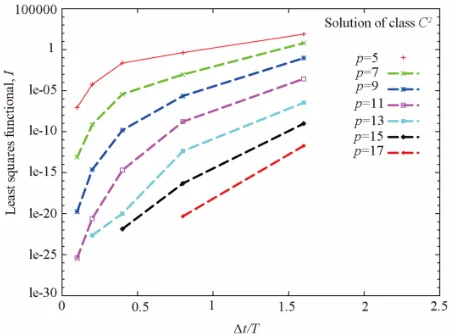
[image:10.595.310.538.296.464.2]residual functional I versus t T/ for each p-level. In
Figure 1 we note that for lower t T/ , the solution has
most accuracy (lowest values of I ) as expected. Even
for t T/ 1.6, at moderate p-levels, I is of the order
of O(10−6) or lower, confirming good accuracy of the
evolution. Approximately same slopes of the curve indi-cate that convergence rate of the process is relatively
independent of the choice of t T/ . From Figure 2 we
note that when t T/ 0.1 even at p-level of 5 I is
Figure 1. p-convergence study for the first time increment
[image:10.595.310.536.512.679.2](k3): model problem 1.
Figure 2. Least squares functional versus t T/ for
(a) (b)
(c) (d)
[image:11.595.94.504.76.570.2](e)
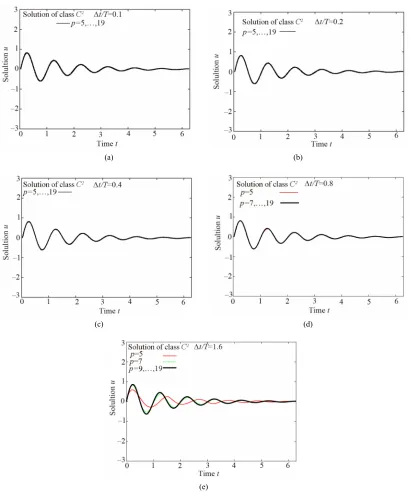
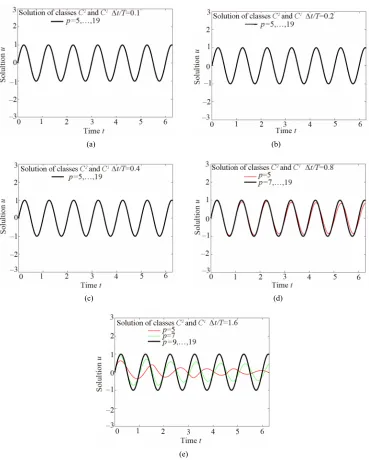
Figure 3. Evolutions for model problem 1: k3, t T/ 0.1 0.2 0.4 0.8, , , and 1.6 for varying p -levels. (a) Evolution:
/ 0.1
t T
; (b) Evolution: t T/ 0.2 ; (c) Evolution: t T/ 0.4 ; (d) Evolution: t T/ 0.8 ; (e) Evolution:
/
t T
.
of the order of O(10−6). These studies are instrumental
in deciding the choice of p-level for time marching (we
only time march when the solution for the current incre-ment has good accuracy).
Computations of the evolution: Evolutions are com-
puted using time marching for t T/ 0.1, 0.2, 0.4,
0.8 and 7.6 for p-levels of 5 to 19 using local
ap-proximations of class 2( e)
t
C . Results are shown in
Figure 3(a)-(e). For t T/ up to 0.8, p-level of 5
produces results with sufficient accuracy. Evolutions
shown in Figures 3(a)-(d) for p6 to 19 are almost
indistinguishable from those for p5. For t T/ 1.6,
p-levels between 9 to 19 are almost indistinguishable
from each other. Very low values of the residual func-
(a)
[image:12.595.66.533.63.449.2]
(b) (c)
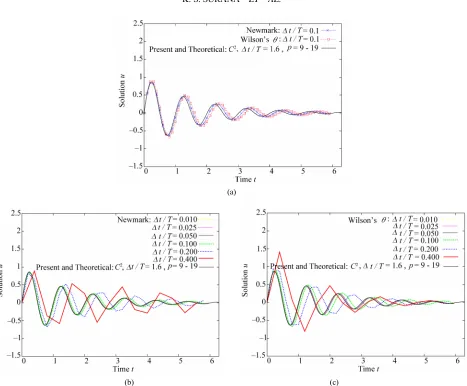
Figure 4. Comparison with the Newmark and Wilson’s methods: model problem 1, k= 3. (a) The Newmark and
Wil-son’s methods: t T/ 0.1;(b) The Newmark method; (c) Wilson’s method.
tional (of the order of O(10−5) and much lower at higher
p-levels) confirm time accuracy of the evolution.
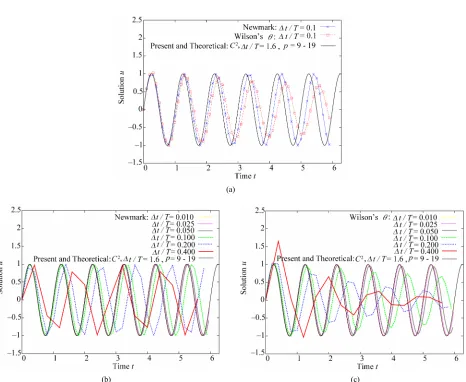
Comparison with the Newmark and Wilson’s methods: Comparison with the Newmark method and
Wilson’s method are shown in Figure 4. For the first
study we choose t T/ 0.1 in the Newmark and
Wil-son’s method (lowest value of t T/ used all of the
studies conducted using present formulation). Figure 4(a)
shows evolutions computed using the Newmark method,
Wilson’s method presents formulation (t T/ 1.6,
9
p to 19) and theoretical solution. Evolutions from
the Newmark method and Wilson’s method deviate
from the true solution but the deviations are not so
sig-nificant. Both, the Newmark and Wilson’s methods
are comparable, however, Wilson’s method has more
pronounced phase shift. Figure 4(b) and (c) present
evolutions obtained using the Newmark method and
Wilson’s method for t T/ ranging from 0.01 to
0.4 and a comparison with present solution (for
/ 1.6
t T
for p9 to 19). When t T/ is greater
than 0.1, evolution for both methods are in significant error. Quantitative assessment of amplitude decay, base elongation and phase shift is not conclusive from these graphs due to the highly diffusive mature of the theoreti-cal solution (addressed in model problem 2). A remark-able thing to note here is that in the proposed formulation, extremely high accuracy of the evolution is achievable
even for t 1.6 whereas the Newmark and Wilson’s
methods yield evolution with significant errors
be-yond t 0.1.
3.2. Model Problem 2
In this model problem we consider ([10,11,13,19]) ( )
ICs: (0) 0u , u(0)u0
This is obviously a 1-D spring, mass, damper system. In the numerical studies we choose
1
m , c0, k2, f t( ) 0
Hence, the ODE reduces to
2 0
u u
t (0, )
ICs: (0) 0u , (0)u . A theoretical solution is
given by ( ) sin( )u t t .
If we choose 2 , then time period T 2 1
and t t
T
where t is the time increment i.e., the
length of the element in time. The minimally conforming
space Vh,
, ( ) k p e
h t
V H
Figure 5. p-convergence study for the first time increment
[image:13.595.58.286.278.471.2](k= 3): model problem 2.
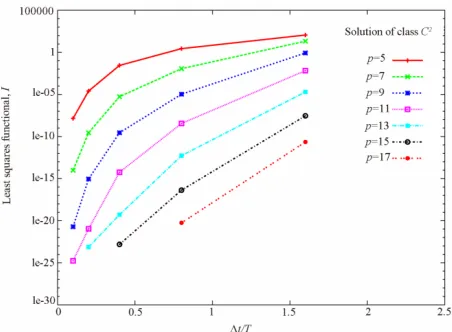
Figure 6. Least squares functional versus t T/ for
pro-gressively increasing p-levels (k= 3): model problem 2.
is defined by k3 (p2k1) i.e. local approxima-
tions e( )
h
u t of ( )u t over et , the time domain of an
element e of class 2( e)
t
C for which the integrals in
the entire finite element LSP in time are Riemann. If
we choose k2, then all integral measures are
Lebes-gue. In the numerical studies we consider k3 as well
as 2k and choose,
0.1, 0.2, 0.4, 0.8, 1.6
t t T
with p-levels of 3, 5,,19 for k2 and p-levels
of 5, 7,,19 for k3.
We consider a three node p-version element in time
of length t for the first increment of time. At t0
we have initial conditions. At 2
t
t (mid-side node)
and at t t the nodal degrees of freedom (as well as
Figure 7. p-convergence study for the first time increment
(k= 2): model problem 2.
Figure 8. Least squares functional versus t T/ for
[image:13.595.310.538.300.467.2] [image:13.595.310.538.510.679.2] [image:13.595.59.285.513.679.2]
(a) (b)
(c) (d)
[image:14.595.114.483.75.535.2](e)
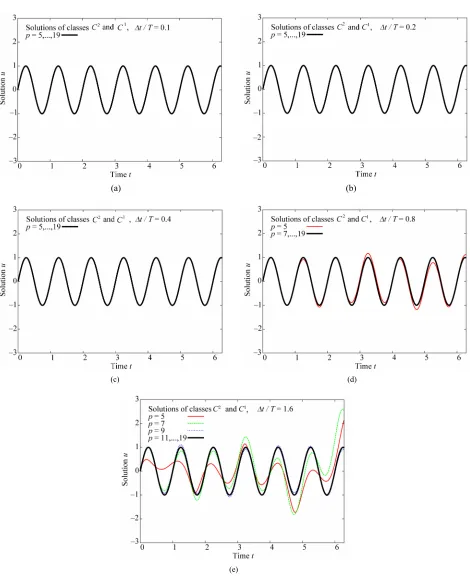
Figure 9. Evolutions for model problem 2: k= 3 and k= 2, t T/ 0.1 0.2 0.4 0.8, , , and 1.6 for varying p -levels. (a)
Evolution: /t T0.1; (b) Evolution: t T/ 0.2; (c) Evolution: t T/ 0.4; (d) Evolution: t T/ 0.8; (e) Evolution:
/
t T
.
those at t0 remaining after imposing ICs) are un-
known and are to be computed. We compute solutions for the first time increment and study convergence of the solution and time march only upon convergence. Results are presented and discussed in the following.
p-convergence study: For the first increment of time t
, we choose t 0.1, 0.2, 0.4, 0.8 and 1.6 and
conduct a p-convergence study for each t for
pro-gressively increasing p-levels from 3 to 19 for k3
(solutions of class 2( e)
t
C ) and k2 (solutions of
class 1( e)
t
C ). Figure 5 shows plots of the residual
functional I versus degrees of freedom for k3. The
results of Figure 5 are also reported in Figure 6 as the
residual functional I versus t
T
for each p-level.
Similar results for k2 (local approximation of class
1( e) t