Haar Wavelet Quasilinearization Approach for Solving
Nonlinear Boundary Value Problems
Harpreet Kaur1, R. C. Mittal2, Vinod Mishra3
1,3
Department of Mathematics, Sant Longowal Institute of Engineering & Technology, Longowal, India 2
Department of Mathematics, Indian Institute of Technology Roorkee, Roorkee, India E-mail:{maanh57, mishravinod560}@gmail.com, [email protected]
Received May 16, 2011; revised June 14, 2011; accepted June 26, 2011
Abstract
Objective of our paper is to present the Haar wavelet based solutions of boundary value problems by Haar collocation method and utilizing Quasilinearization technique to resolve quadratic nonlinearity in y. More accurate solutions are obtained by wavelet decomposition in the form of a multiresolution analysis of the function which represents solution of boundary value problems. Through this analysis, solutions are found on the coarse grid points and refined towards higher accuracy by increasing the level of the Haar wavelets. A distinctive feature of the proposed method is its simplicity and applicability for a variety of boundary condi-tions. Numerical tests are performed to check the applicability and efficiency. C++ program is developed to find the wavelet solution.
Keywords:Haar Wavelets, Quasilinearization Technique, Haar Collocation Method, Boundary Value
Problems
1. Introduction
Wavelets are mathematical tools that cut up data, func-tions or operators into different frequency components and then study each component with a resolution match-ing its scale. Much of the work on Haar functions was performed in the 1930s. In 1909, Haar discovered the simplest function now called as Haar wavelet. The inte-gral of Haar family called Haar operational matrix was derived by Chen and Hsiao [1] in 1997. Since then the solutions of dynamical systems in a wavelet framework took tremendous growth. In order to take the advantages of the local property, many authors researched the Haar wavelet to solve the linear stiff systems and differential equations [2-4].
Haar function is a rectangular pulse pair. It is infact the Daubechies wavelet of order one and is the simplest of the orthonormal wavelets with compact support. As shortcoming, Haar wavelets are not continuous; their derivatives do not exist at the points of discontinuities. Thereby direct application of Haar wavelet is not ble in solving differential equations but here one possi-bility is through integration of wavelets [2]. The pro-posed technique in this paper is based on collocation framework and utilizes the capabilities of Haar wavelet
basis which permits to enlarge the class of functions through Quasilinearization. Our main concentration on the following type of nonlinear boundary value problems defined in the interval [a, b].
, , , , n1
n
y t f t y y y (1)
subject to boundary conditions
1 2
1 3
1 2
1 3
, ,
, ,
, ,
, ,
n
n
n
n
y a y a
y a y a
y b y b
y b y b
f is a continuous function, in case of nonlinearity of f is at
most quadratic in y.
2. Preliminary Works
2.1. Haar Wavelets
177
the next. Wavelet analysis is also more flexible in sense that one can choose a specific wavelet to match the type of function being analyzed.
For a function
, defined over the real axis
,, is classed as a wavelet if it satisfies the following three properties:
1) The integral of
is zero:
t td 0
2) The integral of the square of is unity: is finite.
2 t td
3) Admissibility condition:
0ˆ
d satisfies 0 .
C
C The Haar scaling function for t
0,1 is defined as
01 if 0 1 0 elsewhere
t
h t
(2)
and corresponding wavelet function
1
1 1 if 0
2 1 1 if 0
2
0 elsewhere
t
t h t
(3)
Also the graph of is shown in Figure 1 [1].
The orthogonality property puts a strong limitation on the construction of wavelets. It is known that the Haar wavelet is the only real valued wavelet that is compactly supported, symmetric and orthogonal. Thus Haar wave-lets is orthogonal square waves family with mag-nitude i
and zero, generally written ash t
1
1 22
j
i j
k
h t h t
for 2, 2j 1, 0, 0 2 1.
i i k j k j
2.2. Multiresolution Analysis
Objective of this section is to construct a wavelet system, which is complete orthonormal set in The idea of multiresolution analysis is to represent a function f as
2L R
1 1
0 0.5
–1 t h1(t)
Figure1. First haar wavelet.
a limit of successive approximations and decomposition of the whole function space into individual subspaces
1
j j
V V . A multiresolution analysis (MRA) of L R2
is defined as a sequence of closed subspaces of Vj of
2
L R , jZ, that satisfy the following axioms:
1) MonotonicityV1V0V1
2) The spaces Vj satisfy j z VjL R2
and j zVj
0 .3) f t
V0 iff f
2jt Vj j Z i.e. the space Vjare scaled versions of the central space V0.
4) There exists V0 s.t. is a
Ri-esz basis in .
t k ,kZ
0The sequence
V
j2 j
, j k
kforms an
orthogonal basis for
2 2
t t k
j
V by using the multiresolution
analysis axioms. The space Vj is used to approximate
general functions by defining appropriate projection of these functions onto these spaces.
The vector space is the orthogonal complement of
j W
1
j j
V V . In other words, we will let be the
space of all functions in under the chosen inner product. See [5] for detail of MRA. As an example the space can be defined like
j W
j V
j V
1 1 1 2 2
0
1 1
,
j j j j j j
j J j
V W V W W V
W V
then the scaling function generates an MRA for the sequence of spaces 1
h t
Vj,jZ
by translation anddilation as defined in (2) and (3). The linearly independ-ent functions j k,
t spanning Wj are called wavelets.Original signal can be expressed as a linear combination of the box basis functions in Vj. These basis functions
have two important properties: orthogonality property with 0,0
t ,0,0
t ,1,0
t ,1,1
t and normalizationof
2
, 2j 2j , ,
j k t t k j
kZ.
3. Haar Wavelet Integration and the
Quasilinearization Approach
The wavelets corresponding to the box basis are known as the Haar wavelets.
1 for , 1 for , , 0 elsewhere
i
t
h t t
,
(4)
Here k, k 0.5, k 1, 2 ,j
m
m m m
j0,1, , .J
J indicates the level of resolution. The integer
0,1, ,
k m1 is the translation parameter. The
[image:2.595.118.229.612.707.2]minimal values . The maximal value of i is
1, 0, 2
m k i 1
2 2j m .
Consider the collocation points 0.5, 2 l l t
0 d t i
h xi x
2m d 2m2m
h x x P h
m 0,1 1, 2 l
2m2
,, 2 .m m
,1 P t 0 t
The operational matrix P which is a
square matrix is defined by
(5)
Remarkable that [3] considers integral of Haar wave-lets as
2m t , t
(6)
and operational matrix is
1
4 1
,
4 0
m m m m
m m m m
mP H m H
2m2m
P
But we have considered the integral of Haar wavelets as following:
0 for , d for 0 elsewhere t i i t th x x t t
,1
P t ,
2 2 2 ,2 i P t 21 for ,
2
1 1 for , 2
4
1 for ,1
4 0 elsewhere t t t t m t m t th n
We also introduce the following notation for specific value of function
1 ,1 ,1 0 d i iD
P tThe Quasilinearization technique [6] is an application of the Newton-Raphson-Kantrovich approximation me- thod in function space. This method is applied to solve a nonlinear order ordinary or partial differential equa-tion in N-dimensions as a limit of a sequence of linear differential equations. The idea of the method is based on the fact that how to solve the nonlinear ODE’s by Haar wavelets while there are no useful techniques for obtain-ing the general solution of a nonlinear equation in terms of a finite set of particular solutions. But we limit our-selves here for variables according to involved variables in nonlinear ordinary differential in the interval
a b, ,
.
0,
a b1
n
, 1
, 2
, 3
, , n1
,
L y t f y t y t y t y t y t t
with initial conditions
1 2 1
1 2 1
, , , , , , , ,
n
n
h y a y a y a y a
g y b y b y b y b
0 0
Here is the linear order ordinary differential operator, f is nonlinear functions of
n
L nth
y t and its n1
derivatives are j
2,y t , j1, ,n1.
The Quasilinearization prescription determines the (r
+ 1)th iterative approximation
1
r
y t to the solution of
order nonlinear ordinary differential Equations (1) as a solution of linear differential equation.
th n
11 2 1
1 1 0 1 1 , , , , ,
j , , , , ,
n r
n
r r r r
n
j j
r r
j
n
r r r
y
L y t
f y t y t y t y t t
y t y t
f y t y t y t t
where 0
r r
y t y t . The functions y j j
f f
y
are
functional derivatives of the functional
, 1 , 2 , , n1 ,
f y t y t y t y t t 0
and
1 2 1
1 2 1
1 1
, , , , , , , ,
n
n
r r r
h y a y a y a y a
g y b y b y b y b
y t y t y t
0. 0
The zeroth iteration
0
y t is chosen as Haar wavelet
basis from physical and mathematical considerations of given problem.
In [7] proved r1
r
2 that showedthe difference between exact solution and the rthiteration
is decreasing quadratically and
y t k y t
1
r
y t
for an
arbi-trary lr satisfied the following inequality:
2 1 1r
r l
y t k y t
k
the Haar wavelet series considered as function approxi-mation in Quasilinearization technique which satisfies the boundary conditions of given problem. Then Qua-silinearization procedure is adopted through Haar wave-let collocation method for getting the solution of con-cerning problems.
4. Error Analysis of Haar Wavelets
179
wavelet function of respectively, also imply the relations
2
L R
t td
t td 1, 0
(the moment properties). The following dilation relation holds:
t h
2t l
2
1
2
L
l l L
1 2
, ,L Z
(7)
with some hlR L and the family wavelets
2 ,
2 ,
2 2 ,
2 2 , ,
j j j k
j j j k
t t k
t t k j k
Z
j
P and Qj be the corresponding projections
1
, , , ,
, , , ,
, d
, d
j j j
j j k j k j k j k
j j k j k j k j
V V W
P y c c y t
Q y d d y t
kLet M M2M1 p of the supports of wavelets
and . M stands for Mth moment of wavelet
func-tion. Then according to [8], we have the following theo-rem:
Theorem. Assume the moment condition. For y
,l
C R 1 k , the following estimation holds:
2
max ,
j l j
w t M
y P y A y w j Z
whereyl
w stands for derivative of y.Remark. For Haar function, .
Let be bounded first derivative on (0,1) such that
1 21, 0, 1
M M M
2 yL R
ly w SThen error at jth level will be given
by
2kj 2 kj
j j
yP y RS y P y A A and R are suitable real constants.
5. Function Approximations
Orthogonality of Haar wavelets ensures that any square integral function over [0, 1] can be expressed as an infi-nite sum of Haar wavelets as
1
,
i i i
f t a h t
where ai’s are wavelet coefficients.
If f t
is piecewise constant or can beapproxi-mated as piecewise constant during each subinterval, then sum can be terminated to finite term as [8]
2 1
T 1j
i i i
y t a h t a H
A function f L R2
is a MRA of L R2
pro-duces a sequence of subspaces Vj of
2L R , jZ
s.t. the projection of f onto these spaces give finer
ap-proximation of the function f as j .
To demonstrate the applicability of Haar wavelets, we focus on the following nonlinear BVP’s and utilizing C++ Programming and MATLAB Software. In finite element method the approximate solution can be written as a linear combination of basis functions which consti-tute a basis for the approximation space under considera-tion.
Here in Haar collocation method the series is taken as the highest derivative of given differential equation as a linear combination of Haar wavelet basis.
2 1
1
j n
i i i
y t a h
tSubsequent integrations give lower derivatives and
y t . Substituting the values in the given equation gives
the coefficients and hence the solution.
6. Test Problems
6.1. Nonlinear Boundary Value Problems
6.1.1. Two Point Boundary Value Problem
Firstly, the application of Haar wavelets by Quasilin-earization has been performed on the second order BVP of purely mathematical nature [9] which posses analytic solution and given by:
2 2π2cos 2π sin4 π ,
0 1, 0 0 and 1 0.
y y t t t
t y y
(8)
with analytic solution
sin2
πy t t
. Approximate thesolution as yn sin
πtBy wavelet based Quasilinearization technique,
2 2sin π sin π
y t t y t 2 t
t
and Equation (8) be-comes
2 1
2 2 4
2sin π 2 sin π
sin π 2π cos 2π sin π .
a H t P t t P
t t
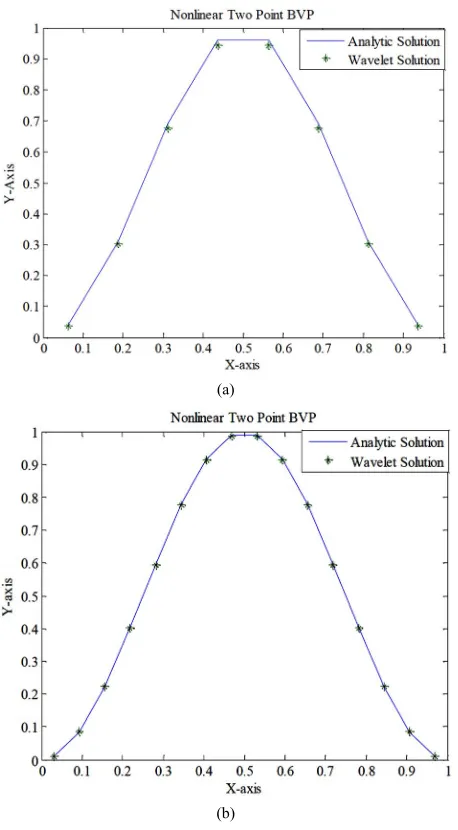
Efficiency of method for solution of second order BVP problem is depicted in Figure 2, for j = 2 and j = 3.
6.1.2. Fourth Order Boundary Value Problem
Consider the fourth order nonlinear boundary value problem [10]
2 10 9 8 7 6 4
'''' 4 4 4 8 4 120 48, 0 1.
y y t t t t t t t
t
subject to y
0 y
0 0,y
1 y
1 1.Approximate the highest derivative as Haar wavelet series
2 1
T1
'''' ij i i
y t a h t a H
2 ,2
0 0
3 ,3
0 0 0
d ,
d ,
t t
i i
t t t
i i
P t h t t
P t h t t
Solution in first iteration is shown in the Figure 3.
6.2. Linear Boundary Value Problem
Fourth Order Linear Boundary Value Problem
Consider the fourth order linear boundary value problem
(a)
[image:5.595.59.288.283.698.2](b)
Figure 2. Comparisons of solutions. (a) For j = 2, m = 4 (b) More accurate curve when j = 3, m = 8.
1
1
1
3
3 2
4 1 0 0 0 0
1 2 3 2
1 0 1 1 2 2
2 1 0 0
1 '''' 1 e ,
6
0 1, 0 1, 1 1, 1 1
d 1
6 d
2 6
d 2
j
j
j
t
t t t t
i i
i
i i i
i i i
y t ty t t t t
y y y y
t
y t a h t t t
t t
a h t t
t
a h t t
,
Solution is shown in the Figure 4.
7. Conclusions
[image:5.595.312.535.287.469.2]For nonlinear differential equations the proposed Haar
[image:5.595.315.535.508.692.2]Figure 3. Comparison of Solutions for level of resolution j = 2, 2m = 8.
181
wavelet Quasilinearization approach is adopted. The test problems of this paper demonstrate that in solving nonlinear boundary value problems the Haar wavelet method coupled with Quasilinearization approach can successfully compete with the other efficient numerical methods such as Newton-Raphson based Haar wavelet method and analytic one. The main benefits of the Haar approach are simplicity (as a small number of grid points according to the resolution guarantees the necessary ac-curacy without iterations) and universality (as almost the same approach is applicable for a wide class of higher order differential equations with different types of non- linearity).
8. References
[1] C. F. Chen and C. H. Hsiao, “Haar Wavelet Method for Solving Lumped and Distributed-Parameter Systems,”
IEE Proceedings of Control Theory & Applications, Vol.
144, No. 1, 1997, pp. 87-94. doi:10.1049/ip-cta:19970702
[2] S. ul Islam, I. Aziz and B. Sarler, “The Numerical Solu-tion of Second order Boundary Value Problems by Col-location Method with the Haar Wavelets,” Mathematical and Computer Modelling, Vol. 52, No. 9-10, 2010, pp.
1577-1590. doi:10.1016/j.mcm.2010.06.023
[3] Z. Shi, L.-Y. Deng and Q.-J. Chen, “Numerical Solution of Differential Equations by Using Haar Wavelets,” Pro-ceedings of International Conference on Wavelet Analy-sis and Pattern Recognition, Beijing, 2-4 November 2007,
pp. 1039-1044.
[4] U. Lepik, “Haar Wavelet Method for Solving Stiff Dif-ferential Equations,” Mathematical Modelling and Analy-sis, Vol. 14, No. 4, 2009, pp. 467-481.
[5] J. C. Goswami and A. K. Chan, “Fundamentals of
Wave-lets, Theory, Algorithms and Applications,” John Wiley and sons, New York, 1999.
[6] R. E. Bellman and R. E. Kalaba, “Quasilinearization and Nonlinear Boundary Value Problems,” Modern Analytic and Computational Methods in Science and Mathematics,
American Elsevier Publishing Company, New York, Vol. 3, 1965.
[7] V. B. Mandelzweig and F. Tabakin, “Quasilinearization Approach to Nonlinear Problems in Physics with Appli-cation to Nonlinear ODE’s,” Computer Physics Commu-nication, Vol. 141, No. 2, 2001, pp. 268-281.
[8] G. Vainikko, A. Kivinukk and J. Lippus, “Fast Solvers of Integral Equations of the Second Kind: Wavelet Meth-ods,” Journal of Complexity, Vol. 21, No. 2, 2005, pp. 243-273. doi:10.1016/j.jco.2004.07.002
[9] D. S. Sophianopoulos and P. G. Asteris, “Interpolation Based Numerical Procedure for Solving Two-Point Nonlinear Boundary Value Problems,” International Journal of Nonlinear Sciences and Numerical Simulation, Vol. 5, No. 1, 2006, pp. 67-78.
[10] K. N. S. K. Viswanadham, P. M. Krishna and R. S. Kon-eru, “Numerical Solutions of Fourth Order Boundary Value Problems by Galerkin Method with Quintic B- Splines,” International Journal of Nonlinear Science, Vol.
Appendix
Here we demonstrate the developed C++ program to solve the Haar wavelet based matrix systems for solu-tions of ODEs
#include<iostream.h> #include<math.h> #include<conio.h> using namespace std
double hfn(double x, double a, double b, double c) { if(x>=a && x<b) return 1;
else if(x>=b && x<c) return -1; else return 0;
}
double hp1(double x, double a, double b, double c) { if(x>=a && x<b) return x-a;
else if(x>=b && x<c) return c-x; else return 0;
}
double hp2(double x, double a, double b, double c) { if(x>=a && x<b) return pow(x-a,2)/2.; }
}
double fun(double x) { return function }
int main( )
{ int n, m; double x[64]; int i, j, k, kk;
double a, b, c, H[64][64], P1[64][64], P2[64][64], d[64];
cout<<"Enter the value of m"; cin>>m;
n=2*m;
for (i=0; i<m; i++) { j=2*i+1; x[i]= (j)/n;
cout<<"Done here\n"; do
{ c=1./k; b=(a+c)/2.; {
i++;
cout<<"Done here\n"; for(j=0;j<m;j++)
{H[i][j]=haarfn(x[j],p,q,r); P1[i][j]=haarp1(x[j],p,q,r); P2[i][j]=haarp2(x[j],p,q,r); } }}
while(k<m/2); cout<<"Done here\n"; for(i=0; i<m; i++) for(j=0; j<m; j++) A[j][i]=H[i][j]; for(i=0; i<m; i++) for(j=0; j<m; j++)
A[j][i]=A[j][i]+L.H.S vector of given problem for(i=0;i<m;i++)
d[i]=fun(x[i]); for(i=0;i<m;i++) {
for(j=0;j<m;j++) cout<<" "<<A[i][j]; cout<<"\n";
}
cout<<"Values of the coefficients d's\n"; for(i=0;i<m;i++)
cout<<d[i]<<" "; for(i=0;i<m;i++) {
for(j=0;j<m;j++) cout<<" "<<A[i][j]; cout<<"\n";
}
for(i=0;i<m;i++) cout<<d[i]<<" "; */
cout<<"\n Enter values of the d solution obtain from MATLAB below";
for(i=0;i<m;i++) cin>>d[i];
cout<<"\n Exact solution is\n"; for(i=0;i<m;i++)
cout<<exact(x[i])<<" "; getch();