The Journal of Threatened Taxa (JoTT) is dedicated to building evidence for conservation globally by publishing peer-reviewed articles online every month at a reasonably rapid rate at www.threatenedtaxa.org. All articles published in JoTT are registered under Creative Commons Attribution 4.0 International License unless otherwise mentioned. JoTT allows allows unrestricted use, reproduction, and distribution of articles in any medium by providing adequate credit to the author(s) and the source of publication.
www.threatenedtaxa.org
ISSN 0974-7907 (Online) | ISSN 0974-7893 (Print) Building evidence for conservation globally
Journal of Threatened Taxa
For Focus, Scope, Aims, Policies, and Guidelines visit https://threatenedtaxa.org/index.php/JoTT/about/editorialPolicies#custom-0 For Article Submission Guidelines, visit https://threatenedtaxa.org/index.php/JoTT/about/submissions#onlineSubmissions For Policies against Scientific Misconduct, visit https://threatenedtaxa.org/index.php/JoTT/about/editorialPolicies#custom-2 For reprints, contact <[email protected]>
Short Communication
First record of two rare brachyuran crabs:
Drachiella morum Alcock, 1896 and Quadrella maculosa
Alcock, 1898 along the Tamil Nadu coast, India
Chinnathambi Viswanathan, Sampath Goutham, Vijay Kumar Deepak Samuel, Pandian Krishnan, Ramachandran Purvaja & Ramachandran Ramesh
26 August 2019 | Vol. 11 | No. 10 | Pages: 14358–14362 DOI: 10.11609/jott.3076.11.10.14358-14362
Partner
Member
Threatened Taxa
Publisher & Host
PLATINUMOPEN ACCESS
Shor
t C
ommunica
tion
DOI: https://doi.org/10.11609/jott.3076.11.10.14358-14362 | ZooBank: urn:lsid:zoobank.org:pub:C723677B-544A-4EB9-A01A-D0D635337ACB
Editor: A. Biju Kumar, University of Kerala, Thiruvananthapuram, India. Date of publication: 26 August 2019 (online & print)
Manuscript details: #3076 | Received 30 September 2016 | Final received 01 May 2019 | Finally accepted 31 July 2019
Citation: Viswanathan, C., S. Goutham, V.K.D. Samuel, P. Krishnan, R. Purvaja & R. Ramesh (2019). First record of two rare brachyuran crabs: Drachiella morum
Alcock, 1896 and Quadrella maculosa Alcock, 1898 along the Tamil Nadu coast, India. Journal of Threatened Taxa 11(10):14358–14362. https://doi.org/10.11609/ jott.3076.11.10.14358-14362
Copyright: © Viswanathan et al. 2019. Creative Commons Attribution 4.0 International License. JoTT allows unrestricted use, reproduction, and distribution of this
article in any medium by adequate credit to the author(s) and the source of publication.
Funding: National Centre for Sustainable Coastal Management, Ministry of Environment, Forest and Climate Change, Chennai.
Competing interests: The authors declare no competing interests.
Acknowledgements: The study was undertaken as a part of the National Project on Mapping Ecologically Sensitive Areas (ESA) in India, supported by the Ministry
of Environment, Forest and Climate Change, Government of India. The authors thank Dr. R. Soundararajan, Scientific Consultant, National Centre for Sustainable Coastal Management, Chennai for reviewing the manuscript.
First record of two rare brachyuran crabs:
Drachiella morum Alcock, 1896 and Quadrella maculosa
Alcock, 1898 along the Tamil Nadu coast, India
Chinnathambi Viswanathan 1 , Sampath Goutham 2 , Vijay Kumar Deepak Samuel 3 ,
Pandian Krishnan 4 , Ramachandran Purvaja 5 & Ramachandran Ramesh 6
1–6 National Centre for Sustainable Coastal Management, Ministry of Environment, Forest and Climate Change,
Anna University Campus, Chennai, Tamil Nadu 600025, India.
1 [email protected], 2 [email protected], 3 [email protected], 4 [email protected]
(corresponding author), 5 [email protected], 6 [email protected] ISSN 0974-7907 (Online)
ISSN 0974-7893 (Print)
PLATINUM OPEN ACCESS
In recent years, biodiversity research has gained significant momentum owing to the decline of flora and fauna worldwide. Reporting the occurrence of a rare species is, thus, very important in order to update the country’s biodiversity database. The brachyuran crabs of the family Aethridae Dana, 1851 is a small group with 37 species under seven genera worldwide (Davie & Fransen 2015). Some members of the Aethridae (Actaeomorpha and Drachiella) have long been associated with the family
Leucosiidae (Ng et al. 2008). The family Trapeziidae Miers, 1886 are known as obligate commensals of corals throughout the Indo-Pacific and eastern Pacific regions (Castro et al. 2004). Trapeziidae has 43 species belonging to three subfamilies and seven genera (Davie & Türkay 2009). Both Aethridae and Trapeziidae are least studied from Indian waters since only three species of aethrids and nine species of trapezids are known from India. Previously, aethrids were reported in 1896 and 1934 (Alcock, 1896; Chopra, 1934); thereafter, no additional observation from the Indian coast has been made in the scientific reports, whereas a few trapezids were reported from Rameshwaram and Andaman Islands (Alcock 1898; Sankarankutty 1961, 1962, 1966; ZSI 2012).
In the present study, we report an Aethridae crab,
Drachiella morum and a Trapeziidae crab Quadrella maculosa for the first time from Tamil Nadu, southeastern
coast of India. The former was previously recorded in Abstract: The present report describes the first record of two
brachyuran crabs, Drachiella morum Alcock, 1896 and Quadrella maculosa Alcock, 1898 along the coast of Tamil Nadu, India. The morphological characters of the specimens are described and discussed. Among the two crabs, Q. maculosa was previously recorded only in the Andaman & Nicobar Islands.
Keywords: Crab, Drachiella morum, morphological characters,
Record of two rare brachyuran crabs from Tamil Nadu coast Viswanathan et al.
Journal of Threatened Taxa | www.threatenedtaxa.org | 26 August 2019 | 11(10): 14358–14362 14359 Odisha (Alcock 1896) and West Bengal (Chopra 1934)
and the latter was reported only in the Andaman Islands (Alcock 1898; ZSI 2012).
Materials and Methods
During the field survey, one crab belonging to the species, D. morum (female) from Kasimedu fishing harbour and two crab individuals belonging to the species, Q. maculosa (male, female) from Kottivakkam fish landing centre of Tamil Nadu, southeastern coast of India, were collected. The former was collected from a trawl bycatch while the latter was collected from a gill net. Species identification of the collected specimens was made by following the descriptions of Alcock (1896, 1898) and Galil (1986). The collected specimens were deposited in the Marine Biological Regional Centre (MBRC), Zoological Survey of India (ZSI), Chennai.
Order Decapoda Latreille, 1802 Family Aethridae Dana, 1851
Genus Drachiella Guinot, in Serène & Soh, 1976
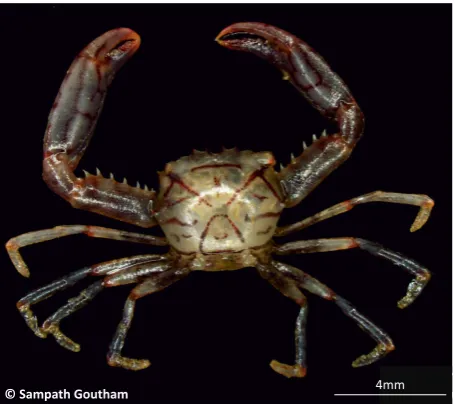
Drachiella morum Alcock, 1896 (Image 1)
Synonyms: Holotype. Actaeomorpha morum Alcock 1896: 172–173. pl. VIII, fig. 3; Ihle, 1918: 308.
Actaeomorpha morum Chopra 1934: 480–481;
Edmonson 1935: 20; Sakai 1937: 116, text-fig. 13, 1965: 35, pl. 15, fig. 3; Serene 1954: 458, pl. 7 and text-fig. 1,2; Zarenkov 1969: 16, fig. 1(1); Takeda & Miyake 1970: 218.
“Aff. Oreophorus” morum, Guinot 1966: 757.
Oreophorus rugosus Yokoya 1933, not O. rugosus
Stimpson 1858; vide Takeda & Miyake (1970). Type locality: Ganjam coast, India (Alcock 1896). Materials examined: MBRC/Reg No: D1-511, 07 September 2015, 1 female, from trawl net hauled at a depth of 20–30 m, and landed at Chennai Kasimedu fishing harbor, Bay of Bengal, Tamil Nadu, India, coll. Goutham Sampath.
Measurements: Carapace width 10.7mm; carapace length 8.6mm (details in Table 1).
Description: Carapace broader than long, quite oval. The entire surface of the body and appendages are closely covered with vesiculous granules. The carapace as a whole is segmented and isolated into regions from a broad marginal ring by sculptured groves; a narrow bridge alone connecting the front to the gastric regions. The segmented regions are elegantly isolated from each other by a) two obliquely-longitudinal channels that cut off the acutely triangular gastro-cardiac region from the reniform branchial regions, and b) a transverse channel that cuts off the semi-oval intestinal region – the channels being all connected to the marginal ring. The orbits are spherical and are entirely closed out from the antennulary fossettes, the infra-orbital lobe being in close contact with the frontal lobes. The basal antennal segment is fused with the infra-orbital lobe, but the antennal flagellum is distinct. The chelipeds and legs are closely crowded with large granules. The carpus and propodus are covered with spiniform granules. Merus in the last pair of legs is also spiniform on the posterior region.
Colour: Orange brown colour in fresh specimen. Distribution: India: Odisha and West Bengal (Alcock 1896), Tamil Nadu, India (present study); Japan (Yokoya 1933): Misaki (Sakai 1937), Sagami Bay (Sakai 1965), Kii Nagashima and Tosa Bay (Sakai 1976); East China Sea (Takeda & Miyake 1970a); South China Sea (Dai & Yang 1991); Vietnam, Thailand and Philippines (Serène & Vadon 1981; Chen 1989).
Remarks: Drachiella morum was first reported as
Actaeomorpha morum by Alcock (1896). Later, Guinot
(1966) removed the species from Actaeomorpha and classified it under Oreophorus. Serene & Sow (1976) however, included the species under Drachiella with clear illustrations. Drachiella was long associated with the family Leucosiidae (Ng et al. 2008).
Image 1. Dorsal view of Drachiella morum.
4mm
Order Decapoda Latreille, 1802 Family Trapeziidae Miers, 1886 Genus Quadrella Dana, 1851
Quadrella maculosa Alcock, 1898 (Image 2)
Synonyms: Holotype. Quadrella coronata var.
maculosa Alcock, 1898: 226
Quadrella coronata var. maculosa Alcock & Anderson,
1899, figures 2, plate 38.
Quadrella maculosa Rathbun, 1911: 235; Guinot
1967: 285; Serene 1968: 89; Garth 1969: 188; Serene 1973a: 204, figures 4, 9, 20–22, plate 3; 1975: 513; Serene et al. 1974: 24; Serene 1984: 288, figure 194, plate 41, figure E; Galil 1986c: 285, figures 5 C–F; Galil and Clark 1990: 372; Allen & Steene 1994: 162; Colin & Arneson 1995: 214, figure 1007.
Quadrella cyrenae Ward 1942: 45, figures 5,6, plate
3; Michel 1964: 30; Guinot 1967: 275.
Type locality: The Andaman Islands, India (Alcock 1898).
Materials examined: MBRC/Reg No: D1-512, 04 January 2016, 1 male, and 1 female gill net, Kottivakkam fish landing centre, Bay of Bengal, Tamil Nadu, India, coll. Goutham Sampath.
Measurements: Carapace width 4.8mm (male), 4.5mm (female); carapace length 3.8mm (male), 3.9mm (female) (details in Table 1).
Description: Carapace hexagonal, slightly wider than long; anterior margin with conspicuous triangular, teeth-like lobes. Polygonal markings in carapace and propodus of chelipeds. Epibranchial spine prominent, projecting outward. Chelipeds are massive. Merus little shorter than the carapace, and strongly granulate
on anterior margin; with eight lateral spines on each cheliped. Carpus short, rounded, prominent anterior spine on interior margin. Chelipeds 1.5x longer than carapace length, distended, tuberculate, tubercles increasing in size posteriorly, giving the posterior margin a serrate appearance. First ambulatory leg more than twice carapace’s length. Fourth ambulatory dactyl with 16 triangular teeth on posterior margin, proximally diminishing in size. Propodus and dactylus are hairy on each walking leg.
Colour: Light brown in fresh specimen.
Distribution: Red Sea; Gulf of Aden; Kenya; Madagaskar-Tuléar and south coast; Nosy Bé and Tuléar; Seychelles; Amirante Islands; Réunion; Mauritius; Cargados Carajos Islands; Maldives; Sri Lanka - Gulf of Mannar; Andaman Islands; Japan - Kuroshima, Yaeyama-retto; Taiwan; Philippines - Golo Island; Palau; Indonesia - Kepulauan Aru and Kai, Kepulauan Kai, Kepulauan Aru and Geelvinck Bay, New, Makassar Strait and Auri Island, Irian Jaya; Papua New Guinea - Madang; New Caledonia; Vanuatu; Marquesas Islands - Fatu Hiva (MSIP 2016).
Remarks: Quadrella maculosa can be differentiated from other species of Quadrella by a) having slender and long walking legs b) having a clear epibranchial spine that projects from each side of the carapace and c) merus of a cheliped that is armed with acute tubercles (Castro 1997).
Discussion
The brachyuran crab, Drachiella morum, was first reported as Actaeomorpha morum by Alcock (1896). He recorded two females (10mm CW, 12mm CL) at 28 to 30 fathoms off the Ganjam coast, Bay of Bengal, India during the “Investigator” expedition. Later, a single Table 1. Morphometric characters of the identified crabs (mm).
Characters Drachiella morum (n = 1) Quadrella maculosa (n = 2)
Carapace length 8.6 3.8, 3.9
Carapace width 10.7 4.8, 4.5
Frontal width 1 2.1, 2.2
Posterior width of carapace 2.5 2.7, 2.9
Merus length 2.3 2.9, 2.8
Merus width 1.2 1.1, 1.3
Carpus length 1.1 0.8, 0.8
Carpus width 0.9 0.5, 0.5
Propodus length 2.8 5.4, 5.3
Propodus width 1.3 1.4, 1.5
Dactylus length 1.2 1.3, 1.3
Image 2. Dorsal view of Quadrella maculosa.
4mm
Record of two rare brachyuran crabs from Tamil Nadu coast Viswanathan et al.
Journal of Threatened Taxa | www.threatenedtaxa.org | 26 August 2019 | 11(10): 14358–14362 14361 female (12.5mm CW, 10mm CL) specimen was recorded
in the mouth of the Hoogly River, West Bengal, India at >20 fathoms (Chopra 1934). Thereafter, no additional observations from the Indian coast were made in any scientific reports. Like D. morum, Q. maculosa was also first reported by Alcock (1896) from the Andaman Islands. Later, in the 1980s, scientists from the Zoological Survey of India reported its presence from the same region (ZSI 2012). Until now, there are no records from the coasts of mainland India. The specimens collected in the present study agree well with the original descriptions and illustrations of both D. morum and Q. maculosa.
The present study reports D. morum for the first time on the Tamil Nadu coast, and its presence revealed that it has been reported after eight decades from the Indian coast. The crabs belonging to the genus Quadrella Dana, 1851 are commensal with anthozoans and were collected at a depth range between 20–150 m. They are mostly obtained by bottom trawling or dredging (Shih & Mok 1996). The present specimen, Q. maculosa, was taken from the trash of gill net hauled at 30m depth, and the specimens (a male and a female) were collected attached to gorgonians. The report of Q. maculosa from Tamil Nadu coast reveals that its distribution range extends from the Andaman Islands to the mainland coast of India.
Though these species do not contribute towards commercial fishery, they might serve as food for other organisms and their larvae might also be consumed in the food web (Viswanathan et al. 2013). Moreover,
Quadrella species have a commensal relation with soft
corals where they feed on the lipid-rich coral mucus, and the crab reciprocates by cleaning and protecting the coral polyp from predators. Rediscoveries and extension of species distribution help in the biodiversity documentation for future monitoring and management practices.
References
Alcock, A.W. (1896). Materials for a Carcinological Fauna of India.
No. 2. The Brachyura Oxystomata. Journal of the Asiatic Society of
Bengal 65 2(2): 134–296.
Alcock, A.W. (1898). The Brachyura Cyclometopa. Part 1. The Family
Xanthidae. No. 3. Materials for a carcinological fauna of India, No. 3.
Journal of the Asiatic Society of Bengal 67 2(1): 67–233.
Allen, J.R. & R. Steene (1994). Indo-Pacific Coral Reef Guide. Singapore,
Tropical Reef Research, 378p.
Castro, P. (1997). Trapeziid crabs (Brachyura: Xanthoidea: Trapeziidae)
of New Caledonia, eastern Australia, and the Coral Sea. In: RICHER DE FORGES B. editor. Les fonds meubles des lagons de
Nouvelle-Caledonie (Sedimentologie, Benthos). Etudes & Theses, volume 3,
Paris: ORSTOM: 59–107.
Chen, H. (1989). Leucosiidae (Crustacea, Brachyura), pp181–263. In:
Forest, J. (ed.) Résultats des Campagnes MUSORSTOM, Volume
5. Mémoires du Muséum national d’Histoire naturelle, Paris, Series A. 144.
Chopra, B.N. (1934). On a new Dromiid and a rare Oxystomous crab
from the Sandheads, off the mouth of the Hooghly river. In: Further notes on Crustacea Decapoda in the Indian Museum - VI. Records of
the Indian Museum 36: 477–481.
Colin, P.L. & C. Arneson (1995). Tropical Pacific Invertebrates. Beverly
Hills, California, Coral Reef Press: viii+ 1–296 pp., figures 1–1354.
Dai, A. & S. Yang (1991). Crabs of the China Seas, I-Iv, 1-608, figures
1–295, plates 1–74. China Ocean Press, Beijing and Springer-Verlag, Berlin Heidelberg New York Tokyo, English edition (Translation from Chinese original 1986).
Davie, P. & C. Fransen (2015). Aethridae Dana, 1851. Accessed through:
World Register of Marine Species at http://www.marinespecies. org/aphia.php?p=taxdetails&id=240916 accessed on 28 May 2016.
Davie, P. & M. Türkay (2009). Trapeziidae Miers, 1886. Accessed
through: World Register of Marine Species at http://www. marinespecies.org/aphia.php?p=taxdetails&id=106768 accessed on 31 May 2016.
Edmonson, C.H. (1935). New and rare Polynesian Crustacea. Bernice P. Bishop Museum Occational paper 10(24): 1–40, figures 78–148. Galil, B. & P.F. Clark (1990). Crustacea Decapoda: Notes on trapeziid
crabs from New Caledonia including descriptions of two new species, pp. 369–388. In: Crosnier, A. (ed.) Résultats des Campagnes
MUSORSTOM, volume 6. Mémoires du Museum National d’Histoire
Naturelle, Paris, series A, figures 1–6.
Galil, B. (1986). Quadrella (Brachyura: Xanthoidea: Trapeziidae) review
and revision. Journal of Crustacean Biology 6(2): 275–293.
Garth, J.S. (1969). Borradaile’s Maldivian collections revisited. Journal of the Marine Biological Association of India 11: 182–190. Guinot, D. (1966). Researches preliminaries Sur Les Groupements
Naturels Chez Les Crustaces Decapodes Brachyoures. Bulletin Du
Museum National D’ Histoire Naturelle Paris, 38(5): 759–761 (In
French).
Guinot, D. (1967). La faune carcinologique (Crustacea, Brachyura) de
I’Ocean Indien occidental et de la Mer Rouge, Catalogue, remarques biogeographiques et bibliographie. In: Reunion de Specialistes C.S.A. sur les Crustaces, Zanzibar, 1964. Memoires de I’Institut
d’Afrique Noire 77: 237–352.
Ihle, J.E.W. (1918). Die Decapoda Brachyura der Siboga-Expedition. III.
Oxystomata. Calappidae, Leucosidae, Aninidae. ln: Siboga-Expeditie
Monograph 39 b2: 159–322, figures 78–148.
MSIP (Marine Species Identification Portal) (2016). Available at http://
species-identification.org/ Accessed on 30 May 2016.
Michel, C. (1964). Checklist of the Crustacea Brachyura (crabs)
recorded from Mauritius. Mauritius Institute Bulletin 6: 1-48.
Ng, P.K.L., D. Guinot, & P.J.F. Davie (2008). Systema Brachyurorum:
Part I. An Annotated checklist of extant brachyuran crabs of the world. The Raffles Bulletin of Zoology 17: 1–286.
Rathbun, M.J. (1911). The Percy Sladen Trust Expedition to the Indian
Ocean in 1905. Vol. 3. XI. Marine Brachyura. Transactions of the
Linnean Society of London (Zoology) 14: 191-261.
Sakai, T. (1937). Studies on the Crabs of Japan III. Oxystomata. Science Reports of the Tokyo Bunrika Daigaku, Section B, Volume 3,
Supplement 2: 67-192, figures 45, plates 10–19.
Sakai, T. (1965). The Crabs of Sagami Bay, collected by His Majesty the
Emperor of Japan, i–xvi, 1–206 (English text), figures 1–27, plates 1–100: 1–92 (Japanese text): 1–26 (references and index in English): 27–32 (Index in Japanese), 1 map. Maruzen Co., Tokyo.
Sakai, T. (1976). Crabs of Japan and the Adjacent Seas. (In 3 volumes:
(1) English text: i–xxix, 1–773, figs 1–379, (2) Plates volume: 1–16, plates 1–251, (3) Japanese text: 1–461, figures 1–2, 3 maps) Kodansha Ltd., Tokyo.
Sankarankutty, C. (1961). On Decapoda Brachyura from the Andaman
and Nicobar Islands. Journal of the Marine Biological Association of
India 3(1&2): 101–119.
Sankarankutty, C. (1962). On Decapoda Brachyura from the Andaman
& Nicobar Islands: 2. Family Xanthidae. Journal of the Marine
Sankarankutty, C. (1966). On Decapoda Brachyura from the Gulf
of Mannar and Palk Bay. In: Proceedings of the symposium on
Crustacea, Part 1, MBAI, 12–16 January 1965, Ernakulam. Serene, R. (1954). Sur quelques especes de Brachyures (Leucosidae)
rares de l’lndo-Pacifique. Treubia, 22(3): 453–499, figures 7, plates 4.
Serene, R. (1968). The Brachyura of the Indo-West Pacific Region. In:
Prodromus for a check list of the (non-planctonic) marine fauna of South East Asia. UNESCO, Singapore, Special publication I: 33–112.
Serène, R. (1973). Observations sur les espkces des genres Quadrella
Dana 1851 et Sphenomerides Rathbun 1898 (Decapoda-Brachyura). Bulletin de la Société zoologique de France 98(1): 191– 209, figures 1–28, plates 1–5.
Serene, R. (1975). Note additionnelle sur les especes Indo-Pacifiques
de Quadrella Dana, 1851 (Crustacea, Decapoda, Brachyura). Bulletin
de la Sociere Zoologique de France 100: 509–521.
Serène, R. (1984). Crustacés Décapodes Brachyoures de l’Océan
Indien Occidental et de la Mer Rouge, Xanthoidea: Xanthidae et Trapeziidae. Avec un addendum par A. CROSNIER : Carpiliidae et Menippidae. Faune tropicale, 24: 1–349, figures A–C + 1–243, plates 1–48.
Serene, R. & C.L. Sow (1976). Brachyura collected during the
Thai-Danish expedition (1966). Phuket marine biological center, Phuket,
Thailand, Research Bulletin No. 12, pp. 37, figures 28, plates, 8.
Serène, R. & C. Vadon (1981). Crustacés Décapodes: Brachyoures.
Liste préliminaire, description de formes nouvelles et remarques taxonomiques. In: Résultats des Campagnes MUSORSTOM, 1. Philippines (18–28 mars 1976), vol. 1, no. 5. Mémoires ORSTOM, 91: 117–140, figures 1–3, plates 1–4 (In French with English summary).
Serene, R., K. Romimohtarto & M.K. Moosa (1974). The Hippidea and
Brachyura collected by the Rumphius expedition. In: Report on the Rumphius Expedition I. Oseanologia di Indonesia I: 17–26.
Takeda, M. & S. Miyake (1970). Crabs from the East China Sea. IV.
Gymnopleura, Dromiacea, Oxystomata. Journal of the Faculty of
Agriculture, Kyushu University 16(3): 193–235, figures 1–6, plate 1. Viswanathan, C., T.V. Suresh, V. Elumalai, M. Pravinkumar & S.M.
Raffi (2013). Recurrence of a marine brachyuran crab, Parapanope euagora (Crustacea: Decapoda: Brachyura: Galenidae) from east
coast of India. Arthropods 2(2): 75–79.
Ward, M. (1942). Notes on the Crustacea of the Desjardins Museum,
Mauritius Institute, with descriptions of new genera and species.
Mauritius Institute Bulletin 2: 49–113.
Yokoya, Y. (1933). On the distribution of Decapod Crustaceans
inhabiting the continental shelf around Japan. Journal of the College
of Agriculture, Imperial University of Tokyo 12(1): 1–226, figures 71. Zarenkov, A. (1969). Leucosiidae, Ebaliinae, Iliinae R.H., 10: 16–26,
figures 1–8 (in Russian).
ZSI (2012). Fauna of Andaman & Nicobar Islands, State Fauna Series,
19 (Part-l). Zoological Survey of India, Kolkata, 236pp.
ISSN 0974-7907 (Online) | ISSN 0974-7893 (Print)
August 2019 | Vol. 11 | No. 10 | Pages: 14247–14390 Date of Publication: 26 August 2019 (Online & Print)
DOI: 10.11609/jott.2019.11.10.14247-14390
www.threatenedtaxa.org
publishing peer-reviewed articles online every month at a reasonably rapid rate at www.threatenedtaxa.org.
All articles published in JoTT are registered under Creative Commons Attribution 4.0 International License
unless otherwise mentioned. JoTT allows allows unrestricted use, reproduction, and distribution of articles in any medium by providing adequate credit to the author(s) and the source of publication.
Editorial
Wildlife’s Wonder Woman—Sally Raulston Walker (12 October 1944–22 August 2019)
– Sanjay Molur, Pp. 14247–14248
Communications
Species diversity and spatial distribution of amphibian fauna along the altitudinal gradients in Jigme Dorji National Park, western Bhutan
– Bal Krishna Koirala, Karma Cheda & Tshering Penjor, Pp. 14249–14258
The soft-release of captive-born Kaiser’s Mountain Newt Neurergus
kaiseri (Amphibia: Caudata) into a highland stream, western Iran
– Tayebe Salehi, Vahid Akmali & Mozafar Sharifi, Pp. 14259–14267
The status of waterbird populations of Chhaya Rann Wetland Complex in Porbandar, Gujarat, India
– Dhavalkumar Vargiya & Anita Chakraborty, Pp. 14268–14278
Diversity and temporal variation of the bird community in paddy fields of Kadhiramangalam, Tamil Nadu, India
– Chaithra Shree Jayasimhan & Padmanabhan Pramod, Pp. 14279–14291
First videos of endemic Zanzibar Servaline Genet Genetta servalina archeri, African Palm Civet Nandinia binotata (Mammalia: Carnivora: Viverridae) and other small carnivores on Unguja Island, Tanzania
– Helle V. Goldman & Martin T. Walsh, Pp. 14292–14300
The identification of pika and hare through tricho-taxonomy (Mammalia: Lagomorpha)
– Manokaran Kamalakannan, Kailash Chandra, Joy Krishna De & Chinnadurai Venkatraman, Pp. 14301–14308
Palynological analysis of faecal matter in African Forest Elephants
Loxodonta cyclotis (Mammalia: Proboscidea: Elephantidae) at Omo Forest
Reserve, Nigeria
– Okwong John Walter, Olusola Helen Adekanmbi & Omonu Clifford, Pp. 14309–14317
Avitourism opportunities as a contribution to conservation and rural livelihoods in the Hindu Kush Himalaya - a field perspective
– Nishikant Gupta, Mark Everard, Ishaan Kochhar & Vinod Kumar Belwal, Pp. 14318–14327
Pollination in an endemic and threatened monoecious herb Begonia
satrapis C.B. Clarke (Begoniaceae) in the eastern Himalaya, India
– Subhankar Gurung, Aditya Pradhan & Arun Chettri, Pp. 14328–14333
Multivariate analysis of elements from the microhabitats of selected plateaus in the Western Ghats, Maharashtra, India
– Priti Vinayak Aphale, Dhananjay C. Meshram, Dyanesh M. Mahajan, Prasad Anil Kulkarni & Shraddha Prasad Kulkarni, Pp. 14334–14348
Short Communications
Diversity of butterflies of the Shettihalli Wildlife Sanctuary, Shivamogga District, Karnataka, India
– M.N. Harisha, Harish Prakash, B.B. Hosetti & Vijaya Kumara, Pp. 14349– 14357
First record of two rare brachyuran crabs: Drachiella morum Alcock, 1896 and Quadrella maculosa Alcock, 1898 along the Tamil Nadu coast, India
– Chinnathambi Viswanathan, Sampath Goutham, Vijay Kumar Deepak Samuel, Pandian Krishnan, Ramachandran Purvaja & Ramachandran Ramesh, Pp. 14358–14362
Records of the Marbled Cat Pardofelis marmorata and the Asiatic Golden Cat Catopuma temminckii (Mammalia: Carnivora: Felidae) from the community forests surrounding the Dzükou Valley in Nagaland, India
– Bhavendu Joshi, Biang La Nam Syiem, Rokohebi Kuotsu, Arjun Menon, Jayanta Gogoi, Varun Rshav Goswami & Divya Vasudev, Pp. 14363–14367
Rediscovery of Calanthe davidii (Orchidaceae) after 11 decades in the western Himalaya, India
– Ashutosh Sharma, Nidhan Singh & Pankaj Kumar, Pp. 14368–14372
Notes
Range extension of the Gooty Tarantula Poecilotheria metallica (Araneae: Theraphosidae) in the Eastern Ghats of Tamil Nadu, India
– Kothandapani Raman, Sivangnanaboopathidoss Vimalraj, Bawa Mothilal Krishnakumar, Natesan Balachandran & Abhishek Tomar, Pp. 14373–14376
Some recent evidence of the presence of the Critically Endangered Gyps vulture populations in northern Shan State, Myanmar
– Sai Sein Lin Oo, Nang Lao Kham, Kyaw Myo Naing & Swen C. Renner, Pp. 14377–14380
Two new locations for the Vulnerable Black-necked Crane Grus
nigricollis (Przhevalsky, 1876) (Aves: Gruiformes: Gruidae) in Arunachal
Pradesh, India
– Rohan Krish Menzies, Megha Rao & Abhinav Kumar, Pp. 14381–14384
Aquilaria malaccensis (Malvales: Thymelaeaceae): a new host plant
record for Deudorix epijarbas cinnabarus (Lepidoptera: Lycaenidae) in Malaysia
– Kah Hoo Lau & Su Ping Ong, Pp. 14385–14387
Rediscovery of Nilgiri Mallow Abutilon neelgerrense var. fischeri T.K. Paul & M.P. Nayar (Malvaceae) after a century from southern India
– Varsha Vilasrao Nimbalkar, Arun Prasanth Ravichandran & Milind Madhav Sardesai, Pp. 14388–14390