AUSTEMPERING PROCESSES VIA COLD LIQUIDS
Intensive Technologies Ltd 68/1 Peremohy ave., Kyiv, Ukraine, 03113
ARTICLE INFO ABSTRACT
The paper discusses austempering process performed at the first step in cold environment friendly liquid and then, at the second step, quenched products go immed
equal or higher of martensite start temperature Ms. The new technology is based on discovered new characteristics of transient nucleate boiling process where surface temperature maintains at the level of boiling point
are considered: austempering process with use of cold water salt solutions of high concentration; austempering process with use of cold water solutions of inverse so
process with use of cold plain water under pressure. It is shown that core cooling rates of austempered by new technology products are 2
melted salts and alkalis
austempering temperature within 100
microstructure of highly strengthened bainite. The aim of elaboration is extending sign
of products suitable for austempering, increasing mechanical properties of a material and mak technology green.
Copyright © 2018, Nikolai I Kobasko. This is an open access distribution, and reproduction in any medium, provided
INTRODUCTION
According to authors (Liscic et al, 2010), austempering is the isothermal transformation of a ferrous alloy at a temperature below that of pearlite formation and above that of martensite formation. Steel is austemepered by:
Heating to temperature within the austenitizing range (usually 788oC – 871oC, or 1450oF –
Quenching in a bath maintained at a constant temperature which is usually in a
400oC (500oF – 750oF);
Allowing to transform isothermally to bainite in this bath (usually in melted salt or alkali);
Cooling to room temperature, usually in still air.
The process is described in detail by the inventors E.C. Bain and E.S. Davenport in US Patent 1,924,099 (Bain and Davenport, 1933). The maximum section thickness for 1080 steel that can be successfully austempered is 5 mm (0.2 in). In addition to indicated steel 1080, steels adaptable to austempering include (ASM Handbook, Vol. 4A, 2013):
*Corresponding author: Nikolai I Kobasko,
Intensive Technologies Ltd 68/1 Peremohy ave., Kyiv, Ukraine, 03113
DOI:https://doi.org/10.24941/ijcr.31294.07.2018
ISSN: 0975-833X
Article History:
Received 06th April, 2018 Received in revised form 04th May, 2018
Accepted 19th June, 2018
Published online 30th July, 2018
Citation: Nikolai I Kobasko, 2018. “Austempering processes via cold liquids
Key Words:
Austempering, cold solutions, Pressure, Increased cooling rate; Mechanical properties,
Extended size, Green technology.
RESEARCH ARTICLE
AUSTEMPERING PROCESSES VIA COLD LIQUIDS
*Nikolai I Kobasko
Intensive Technologies Ltd 68/1 Peremohy ave., Kyiv, Ukraine, 03113
ABSTRACT
The paper discusses austempering process performed at the first step in cold environment friendly liquid and then, at the second step, quenched products go immediately for tempering at a temperature equal or higher of martensite start temperature Ms. The new technology is based on discovered new characteristics of transient nucleate boiling process where surface temperature maintains at the level of boiling point of a liquid relatively a long time. In the paper three variants of austempering processes are considered: austempering process with use of cold water salt solutions of high concentration; austempering process with use of cold water solutions of inverse so
process with use of cold plain water under pressure. It is shown that core cooling rates of austempered by new technology products are 2 – 3 times larger as compared with conventional austempering in melted salts and alkalis. The new technology has several advantages. It is possible governing austempering temperature within 100oC and 450oC to provide optimal condition for achieving fine microstructure of highly strengthened bainite. The aim of elaboration is extending sign
of products suitable for austempering, increasing mechanical properties of a material and mak technology green.
access article distributed under the Creative Commons Attribution the original work is properly cited.
, 2010), austempering is the isothermal transformation of a ferrous alloy at a temperature formation and above that of martensite
Heating to temperature within the austenitizing range – 1600oF); Quenching in a bath maintained at a constant temperature which is usually in a range of 260oC –
Allowing to transform isothermally to bainite in this bath (usually in melted salt or alkali);
Cooling to room temperature, usually in still air.
The process is described in detail by the inventors E.C. Bain and E.S. Davenport in US Patent 1,924,099 (Bain and Davenport, 1933). The maximum section thickness for 1080 steel that can be successfully austempered is 5 mm (0.2 in). In steel 1080, steels adaptable to austempering include (ASM Handbook, Vol. 4A, 2013):
Intensive Technologies Ltd 68/1 Peremohy ave., Kyiv, Ukraine,
.07.2018
Plain carbon steels containing 0.50 to 1.00% C and minimum 0.60% Mn.
Chromium-nickel-molybdenum steels such as 4340 and 4350. The hardenability of these steels is so great that they can be through hardened during austempering up to 50 mm (ASM Handbook, Vol. 4A, 2013; Heat Treater's Guide, 1995).
Cast ductile irons.
Author (Bhadeshia, 2015) underlines that particular form of cast iron is where the matrix of spherical graphite pearlite, but bainite. This results in a major improvement in toughness and strength. The bainite is obtained by isothermal transformation of the austenite at temperatures below that at which pearlite forms and is known as austempered ductile cast iron. Comparison of the properties of austempered ductile iron (ADI) against ordinary steel and spherical graphite cast iron is shown in Table 1. Moreover, the Ductile Iron Casting
Iron Casting, 2018) offers designers versatility and higher performance at lower cost. It is underlined that this versatility is especially evident in the area of mechanical properties where ductile iron offers the designers the option of choosing ductility, with grades guaranteeing more than 18% elongation, or high strength, with tensile strengths exceeding 120 ksi (825 MPa). Austempered Ductile Iron (ADI) offers even greater mechanical properties and wear resistance, providing tensile strengths exceeding 230 ksi
Casting, 2018). Based on these achievements and wide use of
International Journal of Current Research Vol. 10, Issue, 07, pp.71072-71080, July, 2018
Austempering processes via cold liquids”, International Journal of Current Research
Intensive Technologies Ltd 68/1 Peremohy ave., Kyiv, Ukraine, 03113
The paper discusses austempering process performed at the first step in cold environment friendly iately for tempering at a temperature equal or higher of martensite start temperature Ms. The new technology is based on discovered new characteristics of transient nucleate boiling process where surface temperature maintains at the level of of a liquid relatively a long time. In the paper three variants of austempering processes are considered: austempering process with use of cold water salt solutions of high concentration; austempering process with use of cold water solutions of inverse solubility polymers; austempering process with use of cold plain water under pressure. It is shown that core cooling rates of austempered 3 times larger as compared with conventional austempering in . The new technology has several advantages. It is possible governing C to provide optimal condition for achieving fine microstructure of highly strengthened bainite. The aim of elaboration is extending significantly size of products suitable for austempering, increasing mechanical properties of a material and making
License, which permits unrestricted use,
Plain carbon steels containing 0.50 to 1.00% C and
molybdenum steels such as 4340 and 4350. The hardenability of these steels is so great that they can be through hardened during austempering up to 50 mm (ASM Handbook, Vol. 4A, 2013; Heat Treater's Guide, 1995).
Author (Bhadeshia, 2015) underlines that particular form of cast iron is where the matrix of spherical graphite is not pearlite, but bainite. This results in a major improvement in toughness and strength. The bainite is obtained by isothermal sformation of the austenite at temperatures below that at which pearlite forms and is known as austempered ductile cast iron. Comparison of the properties of austempered ductile iron (ADI) against ordinary steel and spherical graphite cast iron is Moreover, the Ductile Iron Casting (Ductile Iron Casting, 2018) offers designers versatility and higher performance at lower cost. It is underlined that this versatility is especially evident in the area of mechanical properties where ductile iron offers the designers the option of choosing high ductility, with grades guaranteeing more than 18% elongation, or high strength, with tensile strengths exceeding 120 ksi (825 MPa). Austempered Ductile Iron (ADI) offers even greater mechanical properties and wear resistance, providing tensile ths exceeding 230 ksi or 1600 MPa (Ductile Iron Based on these achievements and wide use of INTERNATIONAL JOURNAL OF CURRENT RESEARCH
austempered steel and cast iron in industry, there is a need to extend sizes of steels and castings at least for 2 – 3 times suitable for austempering processes.
Table 1. Comparison of the properties of austempered ductile iron (ADI) against ordinary steel and spherical graphite cast iron
(Bhadeshia, 2015)
Properties Steel Spheroid graphite iron ADI
Yield strength, MPa 740 540 830
Ultimate tensile strength, MPa 910 905 1085
Elongation in % 23 11 14
Charpy impact energy in J 325 75 140
It can be done by performing austempering process via cold liquids (UA Patent No. 109935, 2015). The selection of a quenching salt is governed primarily by the austenitizing temperature, austenitizing medium, and quenching temperature (Dubal, 2003). There are two main categories of quenching salts: nitrate-based and chloride-based, having working ranges of 150 to 595°C (300 to 1100°F) and 425 to 705°C (800 to 1300°F), respectively. Hydroxide- and carbonate - based salts are not recommended for quenching or austenitizing, because these materials adversely affect surface Chemistry. A nitrate-based salt is suitable for quenching from austenitizing temperatures up to 900°C (1650°F). Quenching from a higher temperature is not recommended unless parts are small and well separated. Even then, parts should first pass through a neutral salt bath maintained at a lower temperature. A chloride-based salt is recommended when quenching from high austenitizing temperatures like 980 to 1315°C (1800 to 2400°F), as are required for tool steels. Physical properties of nitrate – based quenching salt are discussed in Ref. (Dubal, 1999; 2003). More information on physical properties of melted salts one can find in literature (Foreman, 1993; Heat Treater’s Guide, 1995; Hayrynen, et.al., 2002). Some physical properties of nitrate – based melted salts are presented in Table 2.
Table 2. Physical properties of nitrate – based quenching salt (Dubal, 2003)
Property Value
Thermal conductivity 0.571 W/mK
Heat transfer coefficient 4500 W/m2K - 16500 W/m2K
Drag out rate 50 – 100 g/m2
[image:2.595.49.274.524.568.2]Note that small addition of water to a salt bath produces a significant increase in its quench severity, as shown in Table 3. Combination of agitation (50 cm/s (100 ft/min]) and a water addition (~3%) to melted salt increases quench severity three-fold, compared with that of a no agitated, “dry” salt bath that significantly increases surface hardness and depth of hardness. Water content of the bath typically varies from 2 to 3% at 150°C (300°F) to about 0.5% at 315°C (600°F).
Table 3. Effect of increasing water content in % in melted salt on increase quench severity (agitation 6 ft/min)
Water content in % oC/s oF/s
1 53 95
2 61 109
3 72 128
5 77 134
Note that cooling rate at the core of standard cylindrical probe (12.5 mm in diameter) at the temperature 720oC during
quenching in cold water polymer solution is 168oC/s which was calculated using equation (Kobasko, et.al., 2010):
T Tm
KaKn
v ……….(1)
Here v is cooling rate in oC/s; Kn = 0.3; 6 2
10 75 .
6 m
K ; C
T o
720
; Tm20oC.
Core cooling rate of standard probe in cold water salt and polymer solutions is 2 – 3 times larger as compared with melted salts containing water.
Self – regulated thermal process
The self – regulated thermal process was discussed many times in published literature (Kobasko, 1968; 1980; 1998; 2005; 2009; 2010; 2016). In this paragraph the main characteristics of the self- regulated process are provided. The self – regulated thermal process (SRTP) is transient nucleate boiling when film boiling is absent and surface temperature of steel parts maintains at the level of boiling point of a liquid relatively a long time and never can be below boiling point of liquid until inside temperature gradient satisfies convection mode (Kobasko, 1980; 2016). The self – regulated thermal process takes place when heat transfer coefficient (HTC) during transient nucleate boiling is very large and during convection is small (Kobasko, 2016). In this case, a big difference between HTCs acts as a relay, supporting surface temperature at the level of boiling point of a liquid. If one doesn’t agree with such notion, he will be confused with the possibility of immediate dropping of surface temperature to bath temperature Tm when HTC is very large. Only considering both HTCs simultaneously, it is possible to explain correctly the formation of “a shoulder” on the surface cooling curve. As shown in a book (Kobasko, 1980), there is a possibility to control surface temperature of steel parts during self – regulated thermal process by adjusting pressure or concentration of water salt and polymer solutions. Within the short period of time (1 – 2 sec), the surface temperature of steel parts drops from T0 to boiling point of a liquid and this short period of time, according to French (French, 1930), doesn’t depend on size of steel part (see Table 4).
Table 4. Surface temperature of steel spheres of different diameters versus time in seconds when quenching from 875oC in
5% NaOH water solution at 20oC moving with 0.9 m/s (French, 1930)
Diameter, mm 700oC 600oC 400oC 300oC 150oC
6.35 0.027 0.037 0.051 0.09 0.69
12.7 0.028 0.042 0.071 0.11 0.60
25.4 0.033 0.042 0.074 0.13 0.82
63.5 0.023 0.039 0.093 0.14 0.59
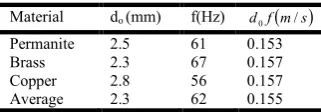
[image:2.595.323.542.617.671.2]Table 5. Effect of heated surface material on bubble departure diameter and release frequency in the case of boiling water at
normal pressure (Tolubinsky, 1980)
Material do (mm) f(Hz) d0fm/s
Permanite 2.5 61 0.153
Brass 2.3 67 0.157
Copper 2.8 56 0.157
Average 2.3 62 0.155
The higher overheat of the boundary layer is the larger number N of growing bubbles appear. According to Tolubinsky (Tolubinsky, 1980), the value
d
0f
m
/
s
doesn’t depend on the boundary layer overheat. If so, the heat transfer coefficient during boiling is evaluated as a ratio of heat flux density produced by bubbles to overheat of the boundary layer and is very large, of course. Such approach is used by thermal scientists worldwide (Kutateladze, 1963; Tolubinsky, 1980). In heat treating industry, historically the heat transfer coefficient during boiling is related to bath temperature. The first is a real heat transfer coefficient while the second is an effective HTC which can be used mainly for core cooling time evaluation. The real HTC at the beginning of boiling is very large and can reach more than 200,000 W/m2K. Convective HTC is rather small and for still water and water salt solutions is within 400 - 1200 W/m2K. Convective HTC in average is 200 times smaller as compared with the nucleate boiling process. It means that
conv
nb ornb V conv
V
Bi
Bi
………..(2)Here
Bi
Vconv is generalized Biot number during convection;nb V
Bi
is generalized Biot number during nucleate boiling process. To be more comfortable with the notion of self – regulated thermal process, let’s consider well known universal correlation (Lykov, 1967) :1
437
.
1
1
2
V V
s V
s sf
Bi
Bi
T
T
T
T
………..(3)
Here
T
sf is average surface temperature;T
V is average volume temperature.Assume that surface temperature of steel part at the initial moment of time is below saturation temperature Ts in the convection area. Taking into account Eq. (2), one can assume that
Bi
V
0
. In this case, according to Eq. (3), Tsf TV. Itmeans that surface temperature must increase immediately when it drops below Ts and occurs in convection area. Assume now that overheat of boundary layer is rather large. In this case generalized Biot number
Bi
V is very large also which tendsto infinity, i.e.
Bi
V
. According to Eq. (3), in this cases
sf
T
T
and it means no temperature overheat of a boundary layer and no nucleate boiling at all. Only one way is left. The surface temperature of steel part must be very close to boiling point of a liquid from the very beginning of cooling. Thecooling system regulates overheat
by itself which dependson size and form of a steel part. The overheat
is small as compared with the initial temperature T0. For practical use, one can formulate this behavior as:const
T
T
sf
S
………(4)Here
T
sf is surface temperature during nucleate boilingprocess;
is an average overheating responsible forboiling process. Such consideration is possible because
isvery small as compared with the initial temperature
T
0. Self – regulated thermal process takes place also during quenching steel parts in water solutions of inverse solubility polymers. In this case steel parts are covered by insulating polymeric layer. Let’s consider what is happening when cylindrical probe is covered by thin insulating layer. Temperature gradient in the insulating layer is many times larger as compared with the temperature gradient in the quenched probe (Kobasko, Liscic, 2017). Temperature gradient in the insulating layer and probe can be calculated from the conservation law of thermal energy on the boundary insulating layer – steel which can be written assl in
q
q
(5):sl sl in
in
grad
grad
………(5)or
in sl
sl in
grad grad
………(6)
Here
grad
in is a temperature gradient in the insulating layer;sl
grad
is a temperature gradient in cylinder;
in is thermalconductivity of an insulating layer;
sl is thermal conductivity of steel.easily explained by varying the thickness of the insulating layer during quenching. More information on contemporary quenching processes one can find in Ref. (Kobasko, Aronov et. al., 2010). Authors (Kobasko and Zhovnir, 1979) received an analytical solution of parabolic heat conductivity equation with the non – linear boundary condition to calculate duration of transient nucleate boiling process when quenching steel parts in water and water salt solutions. It was assumed that film boiling was completely absent. As a result, simplified equations (7), (8), and (9) were constructed to calculate duration of transient nucleate mode or self – regulated thermal process (Kobasko, 1980):
0.24
3.21ln
Inb
II
K
k
a
……….(7)
0.30
2
1
R
I I
………(8)
0.31
II
conv II uh
………..(9)ϑ0 = T0 – Ts: ϑ1 = T1 – Ts; ϑII = T2 – Ts ; ϑuh = Ts – TmT is temperature; To is initial temperature; Tm is bath temperature; Ts is saturation temperature; T1 is start nucleate boiling temperature; T2 is finish of nucleate boiling temperature; τnb is duration of transient nucleate boiling process in sec; R is radius in m; α is thermal diffusivity in m2/s
[image:4.595.336.528.110.256.2], λ is thermal conductivity of a material in W/mK; αconv is convective heat transfer coefficient in W/m2K; β =3.41; m= 10/3 k is Kondratjev (or Kondrat’ev) form factor in m2 (Kondratjev, 1952); k =1,2,3 for plate, cylinder and sphere correspondently. In this paper, effect of β on duration of transient nucleate boiling process was investigated by author (see Table 6 below).
Table 6. Effect of value on duration of transient nucleate
boiling process
nb and overheat of a boundary layer I and IIwhen quenching cylindrical probe 50 mm in diameter from 850oC in condition conv750W/m2K
I
II
nb2 33.8 14.2 65.3
3.41 20 8.19 66.9
4 17 6.95 67
5 13.64 5.54 67.4
When initial austenitizing temperature is fixed at 850oC and bath temperature at 20oC, then results of calculations, based on equations (7), (8), and (9)), can be presented in a very simple form (10) (Kobasko, 2009):
2
nb F
D k
a
. ………..(10)
The value
is a function of convective Biot number and is provided in (Kobasko, 2016). Here kF is form coefficient ; Dis thickness (diameter for Liscic/Petrofer probe); α is thermal diffusivity of a material.
Coefficients k7 for different shapes of steel parts are presented in Table 7.
Table 7. Coefficients k7 for steel parts of different shapes
Shape of steel part k7
Plate 0.1013
Cylinder 0.0432
Sphere 0.0253
Cube 0.0338
Round plate with a diameter D and height Z = D/n
n = 1 n = 2 n = 5
0.0303 0.0639 0.0926
Cylinder with a diameter D and height Z = nD
n = 1 n = 2 n = 5
0.0303 0.0391 0.0425
Transient nucleate boiling processes during quenching steel parts in water and water salt solutions were investigated by authors (French, 1930; Kobasko, 1980; 2016). However, they are not investigated yet properly when steel parts or probes are covered by insulating layer. Authors (Kobasko and Liscic, 2017) started such investigations using Liscic/Petrofer probes. Note that temperature of covered by insulating layer surface of steel parts during transient nucleate boiling (self – regulated) process maintains at the level of boiling point of a liquid that follows the Eq. (4). It was used for:
Developing IQ – 2 processes (Kobasko, Aronov,
et.al., 2010);
Austempering via cold liquids (UA Patent No. 109935, 2015);
Improvement of low temperature thermo –
mechanical treatment.
Austemering process via cold water salt solutions of high concentration
[image:4.595.40.290.205.341.2]solvent (water) and its steam, and is very weekly affected by properties of solved substances, viscosity and Prandtle number of a solution. Therefore, value of W
”
at boiling aqueous solutions can be considered in practice to be equal to W”
at water boiling. Valueβ
can be calculated as (Tolubinsky, 1980; Kobasko, 1980).2 . 0 7 . 0 * 5 . 0
5 . 0 5 . 0 ' '
Pr
)
(
)
(
75
w
r
g
………..(11)where :
a v
Pr is Prandtl criterion (number);
is heat transfer coefficient at nucleate boiling ( K m W2 );
is thermal conductivity of liquid (mK
W );
is surface tension (m N );
g
is a gravity acceleration ( 2s
m
);'
is liquid density ( 3m kg );
is steam density ( 3m
kg );
q
is heat flux density (W/m2);*
r
is latent heat of evaporation (J/kg);W
is vapor bubble growth rate (m/s);v
is kinematic viscosity (m2/s); *a
is thermal diffusivity of liquid (m2/s).As seen from Eq. (11), the main effect on value has Prandtl
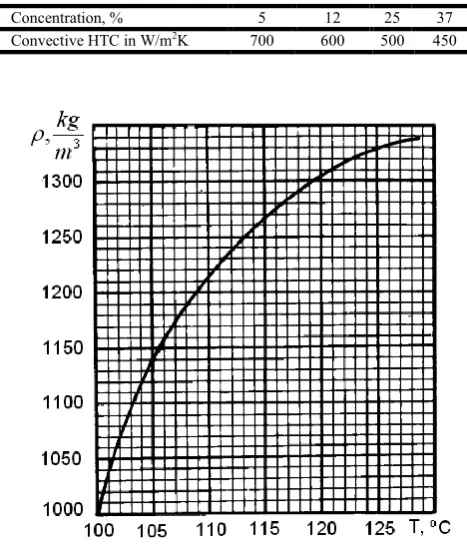
[image:5.595.182.416.80.357.2]number Pr. It increases significantly with increasing concentration of salts and decreasing bath temperature (see Table 10). Taking into account Table 4 and Eq. (4) and also increased overheat of a boundary layer, it is possible to reconstruct surface temperature of plate like, cylindrical and spherical like samples to calculate temperature field during transient nucleate boiling process. Such approach is shown in Fig. 2. Duration of transient nucleate boiling is calculated using equations (7), (8), and (9). During reconstructing temperature field in cylindrical probe, it was supposed that any film boiling was absent (see Fig. 2). By quenching steel parts in water solutions of elevated concentration, it is possible to maintain their surface temperature at the level of 150oC or higher. As known (see Fig. 3), martensite start temperature Ms for this plain high carbon steel, beginning from 1.25 %C, is equal or below 150oC. It means that austempering process for this steel one can perform using cold water salt solutions. Cooling in water salt solutions should be interrupted at the end of transient nucleate boiling process and steel parts should go immediately for tempering at a temperature higher than martensite start temperature Ms. Note that martensite start temperature and martensite finish temperature can be affected by alloy elements in steel.
Table 8. Convective heat transfer coefficient vs. concentration of CaCl2 in water (Kobasko, 1980)
Concentration, % 5 12 25 37
Convective HTC in W/m2K 700 600 500 450
[image:5.595.91.511.405.454.2]Fig. 1. Saturation temperature vs. concentration for an aqueous solution of CaCl2
Table 9. Comparison of parameters of boiling process for water and aqueous salt solutions at normal pressure (Tolubinsky, 1980)
Substance Bubble diameter
0
d , mm Frequencyf,1s Growth rate W,mms
Water 2.5 62 155
25% NaCl water solution 2.4 64.5 155
Along with performing austempering process, cold high concentration water salt solutions can be used for performing martempering processes too.
Austempering process via cold liquids under pressure: The most promising implementation is austempering process via cold water or cold water salt solutions of optimal concentration under pressure.
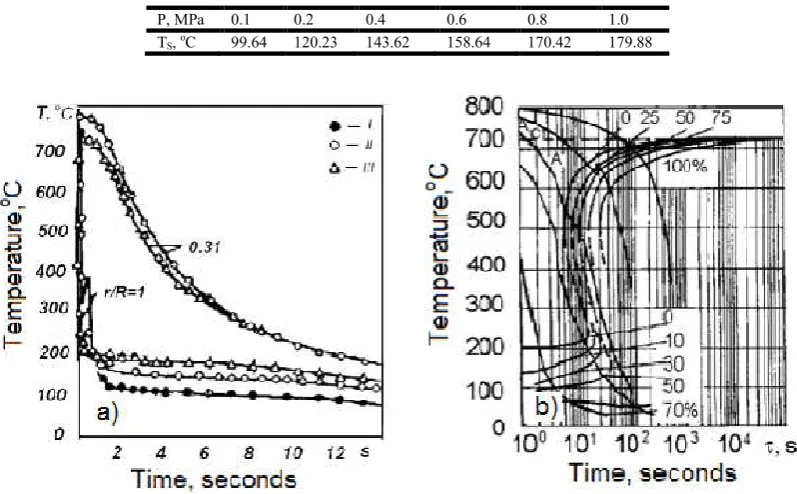
[image:6.595.59.543.66.347.2]Elevated pressure and optimal concentration of salts in water miximize critical heat flux densities and it means absence of any film boiling during quenching. Pressure increases boiling point of a liquid which can be equal to martensite start temperature Ms (see Table 11). Fig. 4 presents the experimental data concerning elevation surface temperature (a) during transient nucleate boiling process to martensite start temperature Ms of AISI W1 steel (b) by increasing pressure Table 10. Prandtl number versus temperature of water
T, oC 0 10 20 30 40 50 60 70 80 100
Pr 1 3.5 9.45 7.03 5.45 4.36 3.59 3.03 2.58 2.23 1.60
Fig. 2. Core and surface temperature versus time for cylindrical specimen 50 mm in diameter quenched in elevated concentration
of CaCl2 in water (see Fig. 1)
Fig. 3. Martensite start temperature MS and martensite finish
[image:6.595.95.494.410.657.2]temperature MF versus content of carbon in steel
Table 11. Saturation temperature in o C of water versus pressure P in MPa
P, MPa 0.1 0.2 0.4 0.6 0.8 1.0
TS, oC 99.64 120.23 143.62 158.64 170.42 179.88
Fig. 4. Effect of pressure (experimental data) on the temperature curves of a cylindrical specimen of 20-mm diameter made of steel AISI 304 (a) and CCT diagram of AISI W1 steel (b): I, 0.1 MPa; II, 0.4 MPa; III, 0.7 MPa (R is the radius of the cylinder,
r is the coordinate or distance from the core (Kobasko, 1980).
T, Co
500
400
300
200
100
20 0
-100
-200
0 0.2 0.4 0.6 0.8 1.0 1.2 1.4 1.6 1.8 C, % MF
to 0.7 MPa (Kobasko, 1980). According to obtained data, cylindrical steel parts 20 mm in diameter after quenching in water under pressure should go after 9 seconds of cooling to immediate tempering at 200oC to provide correct austempering process as discussed. The possible installation for performing austempering process via cold water under pressure is shown in Fig. 5.
[image:7.595.124.483.305.545.2]Fig. 5. presents the basic scheme of an automated process for steel heat treatment under controlled pressure. The quenching process is conducted as follows. When the mobile cover is at starting position I, the part (5), which is austenitized, is delivered to the tray (1). At this time, the driving mechanism is turned on, and the cover occupies work position II, hermetically closing the top of the quench tank. Simultaneously, through an aperture (2), compressed air is Fig. 5. Basic scheme of the automated process of steel quenching in water and aqueous solutions under pressure (Kobasko, 1980): 1, tray;
2, aperture for pumping in compressed air; 3, mobile cover; 4, case of the quench tank; 5, the part to be quenched; 6, solenoid for fixing the initial time of transformation of austenite into martensite; A, the amplifier of a signal of the martensite start; R, relay of current; G,
driving mechanism; I, starting position; II, work position
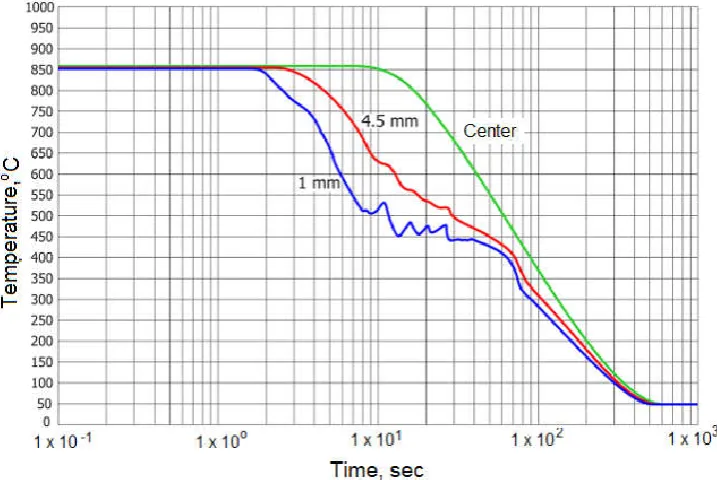
[image:7.595.127.485.613.694.2]Fig. 6. Cooling temperature curves vs. time measured by the Liscic/Petrofer probe (50 mm in diameter) quenched in a polymer solution of 35oC, with agitation (Liscic, 2016)
Table 12. Cooling rate at the core of Liscic/Petrofer probe within 700oC – 720oC during cooling in different quenching media
Quenchant Cooling rate, oC/s Comments
Melted salt at 150oC 9.5 HTC is 4500 W/m2K
Melted salt at 450oC when water is added. 11.5 HTC is 16500 W/m2K
Melted salt at 450oC 4.8 HTC is 4500 W/m2K
Water polymer solution at 35oC 9.5 See Fig.
Water salt solution of CaCl2 17 Saturation temperature is 150oC
Cold water under pressure 25 Saturation temperature is 200oC
introduced, creating the necessary pressure between the quenchant and the cover. Pressure is delivered so that the quenchant saturation temperature becomes equal to martensite start temperature Ms. After nucleate boiling is completed, the surface temperature decreases to bath temperature. The formation of the ferromagnetic martensitic phase is fixed by the solenoid (6). The signal from the solenoid is amplified by (A) and triggers the relay (R) to activate the driving mechanism (G), which moves the cover (3) to top starting position I. The part (5) is driven out from the tray (1) and delivered for immediate tempering at a temperature which exceeds Ms. A system shown in Fig. 5 can be installed in forging shops to perform direct quenching processes right after forging. They include:
Direct quenching after forging to perform high temperature thermo – mechanical treatment with and without austempering process;
Direct quenching after forging with interruption cooling process to perform low temperature thermo – mechanical treatment;
Special direct quenching after forging of optimal hardenability steels (Kobasko, 2018) to provide in surface layers of steel parts fine or nano – bainitic microstructure.
Mentioned above technologies allow obtaining super strengthened materials using plain carbon steels because cooling rate of steel parts is several times larger as compared with cooling in melted salts.
Austempering process via cold water polymer solutions of inverse solubility
Water salt solutions and quenching liquid media under pressure can be used successfully for oustempering processes when martensite start temperature Ms is equal or below 200oC. For medium carbon steel, where Ms is 350 oC, can be used water solution of inverse solubility polymers which increase surface temperature of steel parts during self – regulated thermal process up to 450oC. This problem was discussed by authors (Kobasko and Liscic, 2017) using experimental data of Prof. Liscic (Liscic, 2016). Some results of testing Liscic/Petrofer probe in water solution of polymers are presented in Fig. 6. As one can see from Fig. 6, during quenching in polymer solution temperature in surface layers of
Liscic/Petrofer probe drops approximately to 450oC and
maintains at this level relatively a long time slightly oscillating. Author (Kobasko, Liscic, 2017) explained such behavior of temperature by existing self- regulated process on the insulated surface. If so, oscillation is explained by varying depth of insulating layer during quenching. According to Fig. 6, process of cooling of cylindrical steel parts 50 mm in
diameter in agitated polymer at 35oC should be interrupted
within 60 sec when temperature in surface layer is 400oC and
put immediately for tempering at 400oC if steel parts are made
of medium carbon steel. In this case, austempering process will be fulfilled for medium carbon steels. Table 12 provides
core cooling rates of Liscic/Petrofer probe within 700oC –
720oC for different austempering processes. Table 12 shows
that core cooling rate of Liscic/Petrofer probe is two time larger during quenching in polymer solution as compared with melted salt at 450oC. Austempering processes via cold water
under pressure provide three times larger cooling rate as compared with melted salt at 150oC (see Table 12).
DISCUSSION
Austempering process via cold liquids was patented for the first time in Ukraine (UA Patent No. 109935, 2015). The paper discusses physics of austempering processes based on established new characteristics of transient nucleate boiling process presented by Eq. (4) and Eq. (10). Austempering process via cold liquids has several advantages and some disadvantages. The first includes:
Increased cooling rate during austempering;
Possibility governing austempering process within larger range of temperatures;
Provide green technology and simplify austemering processes to make them possible to install in forging shops.
The main disadvantage of proposed invention is overcooling thin elements of complicated steel parts below saturation temperature caused by shorter self – regulated thermal process in thin elements. Until this problem is not completely solved, austempering process via cold liquids will perfectly work for simple forms. Author believes that proposed invention has a great future. To make progress in this new direction, further experimental and theoretical investigations are needed. An excellent tool for further investigations of austempering processes via cold liquids is Liscic/Petrofer probe (Liscic, 2016). Currently, the mentioned problem is under investigations. At present time, self – regulated thermal process is successfully used for performing IQ- 2 processes of simple and complicated steel parts. including martempering. Authors (Aronov and Powell, 2016) received very important and promising results using direct quenching after forging.
Conclusions
Austempering in cold liquids become possible due to discovered self – regulated thermal process which states that surface temperature of product during transient nucleate boiling process maintains on the level of boiling point of a liquid and never can be below it if BiVconvBiVnb.
New austempering technology in cold liquids, patented in Ukraine (UA Patent No. 109935, (2015)), is proposed which explores water salt solutions of high concentration, water polymer solution of inverse solubility and plain cold water under pressure.
The essence of new technology consists as following. Heated to austenitizing temperature a product is immersed into cold liquid with a boiling point equal or little bit higher martensite start temperature Ms. The product is hold in a liquid until transient nucleate boiling is finished. After that the product is taken out from the liquid and put immediately for tempering at a temperature equal Ms or higher.
New austempering technology extends sizes of products suitable for austempering, increases mechanical properties of material and makes environment cleaner.
in cold liquids too and extends possibility of low temperature thermo – mechanical treatment.
REFERENCES
Aronov, M.A., Powell, J.A. 2016. Forging Process Improvement Using Intensive Quenching Immediately After Forging Operations are Completed, Proceedings of the Forging Industry Association Technical Conference, Nationwide Hotel & Conference Center, Sept. 19, Columbus., Ohio.
ASM Handbook, Vol. 4A, 2013. Steel Heat Treating, Fundamentals and Processes, ASM International, Materials Park, 768 pages.
Bain, E.C., Davenport, E.S. 1933. US Patent 1,924,099, Thermally Hardening Steel, Filed Nov. 20, 1931.
Bhadeshia, H. K. D. H. 2015. Bainite in Steels: Theory and Practice (3rd edition), Money Publishing, 616.
Dubal, G.P. 1999. Salt Bath Quenching, Advanced Materials & Processes, December, Vol. 156, No. 6, p. H23–H28. Dubal, G.P. 2003. The basics of molten salt quenchants, Heat
Treating Progress, August, pp. 81 – 86.
Ductile Iron Casting, 2018. http://www.castingsforindustry. com/capabilities/casting-process/ductile-iron-casting/ Foreman, R.W. 1993. New Developments in Salt Bath
Quenching, Industrial Heating, Vol. 60, No. 3, pp. 41–47. French, H. J. 1930. The Quenching of Steels, American Society
for Steel Treating, Cleveland, OH, 1930.
Hayrynen K.L., Branderberg, K.R., Keough J.R., 2002. Application of austempered ductile iron, Transactions of
American Foundrymers Society, 2, pp. 929 – 938.
Heat Treater's Guide. 1995. Practices and Procedures for Irons and Steels, ASM International, Materials Park, Ohio, Second Edition. Kobasko, N. I., Thermal Processes in Quenching of Steel, Metal Science and Heat Treatment, Vol. 10, No. 3, 1968.
Kobasko, N. I. 2009. Transient Nucleate Boiling as a Law of Nature and a Basis for Designing of IQ Technologies, Proceedings of the 7th IASME/WSEAS International Conference on Heat Transfer, Thermal Engineering and Environment (HTE ‘09), Moscow, August 20–22, pp. 67– 75.
Kobasko, N. I., 1968. Thermal Processes in Quenching of Steel, Metal Science and Heat Treatment, Vol. 10, No. 3.
Kobasko, N. I., 2005. Self-regulated Thermal Processes During Quenching of Steels in Liquid Media, IJMMP, Vol. 1, No. 1, pp. 110–125.
Kobasko, N. I., Self-Regulated Thermal Process at Steel Quenching, Promyshlennaya Teplotekhnika, Vol. 20, No. 5, 1998, pp. 10–14.
Kobasko, N. I. 1980. Steel Quenching in Liquid Media Under Pressure, Naukova Dumka, Kyiv, 1980, 206 pages. Kobasko, N. I.,and Zhovnir, H.I., 1979. Analytical Method of
Solving Thermal Problems for Steel Quenching, Visnyk of
Academy of Sciences of Ukrainian SSR, No. 12, pp. 41– 50.
Kobasko, N., and Liscic, B. 2017. Liscic//Petrofer probe to investigate real industrial hardening processes and some fundamentals during quenching of steel parts in liquid media, «EUREKA: Physics and Engineering» № 6, pp 48 – 56.
Kobasko, N.I. 2018. Optimal Hardenability Steel and Method of Its Composing, Lambert Academic Publishing, Mauritius, 124 p.
Kobasko, N.I., 2016. Self – regulated thermal process, its main characteristics and practical application, International Journal of Current Research, 8(11), 41698 – 41704. Kobasko, N.I., Aronov, M.A., Powell, J.A., Totten, G.E. 2010.
Intensive Quenching Systems: Engineering and Design, ASTM International, W. Conshohocken, USA, 234 p. Kondratjev, G.M. 1952. Regular Thermal Mode, GITL,
Moscow.
Kutateladze, S. S., 1963. Fundamentals of Heat Transfer, Academic Press, New York.
Liscic, B. 2016. “Measurement and Recording of Quenching Intensity in Workshop Conditions Based on Temperature Gradients,” Materials Performance and Characterization, Vol. 5, No. 1, pp. 202–219, doi:10.1520/MPC20160007. ISSN 2165-3992.
Liscic, B., Tensi, H.M., Canale, L.C.F., Totten, G.E. 2010. Quenching Theory and Technology, Second Edition, CRC Press, London, New York, 709 pages.
Lykov, A. V. 1967. Teoriya Teploprovodnosti (Theory of Heat Conductivity), Vysshaya Shkola, Moscow, 596 p
Tolubinsky, V.I. 1980. Heat Transfer at Boiling, Naukova Dumka, Kyiv, 316 p.
UA Patent No. 109935. 2015. Isothermal Method for Hardening of High Carbon Steels and Irons. Registered in Patent Office on Oct. 26.